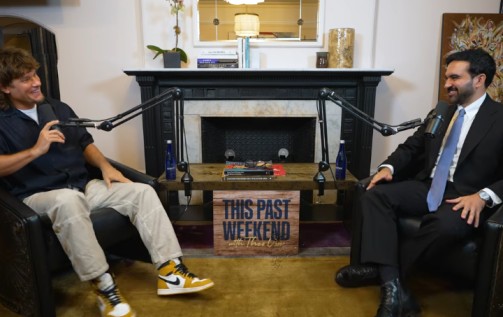
In This Past Weekend #687, Theo Von sits down with Zohran Mamdani, the 112th mayor of New York City, to talk about the city’s cost-of-living crisis, the $12 billion budget deficit he inherited, the record $131.5 million DoorDash settlement, and what democratic socialism means to him. The wide-ranging conversation also covers the nurses strike, the American dream, working with President Trump on the Sunnyside Yard housing project, and his stance on Netanyahu, the ICC and Gaza. This interview was premiered on October 2, 2026. Read the full transcript of the interview below:
Who Is Zohran Mamdani?
THEO VON: (00:00:00 – 00:00:35) He’s the 112th mayor of New York City and one of the most talked about figures in politics. He’s got a lot of big ideas, and we’re going to get into it. I’m thankful for his time. Today’s guest is Mr. Zohran Mamdani. Yeah, and if you gotta move, Zohran, just— do you prefer Zohran?
ZOHRAN MAMDANI: (00:00:35 – 00:00:43) Yeah, I’m fine with that. Okay, well, all right, so as far as Zohran is good, well, Theo, I assume, is fine.
THEO VON: (00:00:43 – 00:00:53) Yeah, that’s fine, man. Thank you so much. There’s a lot of folklore out there about who you are, right? And a lot of people have heard your name, but they don’t know you.
ZOHRAN MAMDANI: (00:00:53 – 00:00:53) Yeah.
THEO VON: (00:00:53 – 00:00:56) You were born in Uganda.
ZOHRAN MAMDANI: (00:00:56 – 00:00:56) Yeah.
THEO VON: (00:00:56 – 00:00:58) You moved to New York at age of 7.
ZOHRAN MAMDANI: (00:00:58 – 00:00:58) Yeah.
THEO VON: (00:00:59 – 00:01:09) You were a rapper for a little while. Who wasn’t? Yeah, a little while. But give me the 2-minute— who is Zohran Mamdani?
ZOHRAN MAMDANI: (00:01:10 – 00:02:01) Well, I would say it starts and ends with being a New Yorker. As you said, I moved to our city when I was 7 years old. My dad got a job here in New York City at Columbia. And so I grew up in the Upper West Side and went to middle school in the neighborhood, went to high school in the Bronx at Bronx Science. And then I left for college and came back to this city.
And the thing that has always been a part of my life is this city, no matter what stage of my life I’m in. And to me right now, I have the greatest job in the world because every day I get to wake up, serve the same city that I’ve loved since I was 7 years old.
And I think especially with a view of how do we make this a city that not only everybody can love, but everybody can live in? Because a lot of people love this city, but not as many of them can live here. And that’s because this is also the most expensive city in the United States of America.
THEO VON: (00:02:01 – 00:02:02) Is that true? Yeah. Wow.
ZOHRAN MAMDANI: (00:02:02 – 00:02:04) It’s the 3rd most expensive city in the world.
THEO VON: (00:02:04 – 00:02:05) Wow.
ZOHRAN MAMDANI: (00:02:05 – 00:02:06) Yeah.
THEO VON: (00:02:06 – 00:02:08) What am I talking about? I got to pay whenever I leave here.
ZOHRAN MAMDANI: (00:02:08 – 00:02:08) Yeah.
Why He Ran for Mayor
THEO VON: (00:02:08 – 00:02:21) And I’m not excited about it. Yeah. It’s an expensive place to be. What made you want to be mayor? I’m a comedian, right? And self-proclaimed. But there’s some evidence of it, right? Because it’s a weird thing to say.
ZOHRAN MAMDANI: (00:02:21 – 00:02:23) There’s enough evidence.
THEO VON: (00:02:23 – 00:02:50) It’s a weird thing to say, though, sometimes. But I’m a comedian because I need— there’s something I need people’s approval, right? There’s something I need when I go on stage, the laughter. I don’t know what it is. I need to be seen. I don’t know what it is.
But being a mayor, it seems like sometimes the mayor is the guy in town who finally wanted to be able to say, “Well, everybody picked me.” Or it becomes this sort of I’m the hero kind of thing. Why? Yeah, why do you want to be mayor?
ZOHRAN MAMDANI: (00:02:51 – 00:03:10) I think the thing that pushed me the most to run for this position was both a love of the city, but also a frustration with the fact that a lot of the leaders of the city talked about the problems like they— there was nothing they could do about it. It was like, “Somebody’s got to figure this out.” It’s like, you’re the mayor.
THEO VON: (00:03:11 – 00:03:14) Oh yeah, dude, that’s where we are with a lot of—
ZOHRAN MAMDANI: (00:03:14 – 00:03:15) somebody is you.
THEO VON: (00:03:15 – 00:03:15) Yeah.
ZOHRAN MAMDANI: (00:03:16 – 00:04:01) And I think it’s not to say these are easy things to resolve. It’s not to say you can snap your fingers and people just were refusing to do it, but it’s that a lot of times it felt like people weren’t even trying. And if they were, they were just trying to make things worse because there was money to be made when you make things worse.
I mean, this flip side of being the most expensive city in the world is that a lot of people make a lot of money in this city. And amidst all of that wealth, 1 in 4 New Yorkers are living in poverty.
So to me, it was looking at the politics of the city I love and seeing a complete abdication of duty, just a sense of somebody else’s problem, not mine to fix. And the thing about being the mayor is, yeah, it’s tough, but also you actually have tools that you can use to help people, to make people’s lives better.
Inside the City Budget: A $12 Billion Deficit
THEO VON: (00:04:01 – 00:04:03) Is that an honest fact, Mr.
ZOHRAN MAMDANI: (00:04:04 – 00:04:04) Yes, sir.
THEO VON: (00:04:06 – 00:04:09) 26% of you— so you’re at your head.
ZOHRAN MAMDANI: (00:04:09 – 00:04:10) It’s going to be a tough start to the interview.
THEO VON: (00:04:12 – 00:04:45) “26% of New York City residents, totally a record 2.2 million people live below the poverty line.” Once you got in office, was there things— do you get to see what’s really going on? Once you’re in there, can they keep— I don’t even know who they are anymore, but it’s like, are there still secrets kept?
Are you able to see that, okay, the way that this is structured isn’t for the everyday man, that this system here has been built for the elites or to favor the elites? What did you see?
ZOHRAN MAMDANI: (00:04:46 – 00:05:42) I think one of the major things I saw was how deeply mismanaged the city budget was. It’s not a sexy topic or one that most people wake up thinking about, but so often in politics, the incentive is just to tell the best possible story of the day and not tell the whole truth about what’s actually happening.
And so the prior administration had said, we had a balanced budget. We had, I don’t know, maybe a $6 billion deficit or so in the year to come. And then we came in, we looked through all the books, and we found that at a best-case scenario, we were at a $12 billion deficit in the city. In this city. Wow.
And the last time we had deficits like that, there was a major global event. Something had happened to cause the deficit. It was tough when it was the peak of the pandemic. It was tough when it was the global financial crisis. There was no event around this that could explain this much of a deficit.
THEO VON: (00:05:42 – 00:05:48) So what do you think is going on? Is it just greed? I think it’s— I mean, look, what did you notice? What were some of the—
ZOHRAN MAMDANI: (00:05:48 – 00:05:58) I think a lot of it is incompetence and a lack of interest in resolving it, a sense that you could just keep pushing it until it was somebody else’s problem.
THEO VON: (00:05:58 – 00:05:58) Wow.
ZOHRAN MAMDANI: (00:05:58 – 00:06:54) And that to me is, yeah, look, I want to do a good job while I’m the mayor. I also want to leave the city in a good standing for whoever comes next because it’s still the same city. Whoever’s the mayor, we still live in the city. We still love this city.
And so when you come in and you’re like, actually, the deficit is twice as large, there’s nothing you can pin it to besides internal mismanagement. It also just begs the question of what is going on and what have been the decision-making points over the course of the prior administration that led to this point?
So I think that was one of the big things where you look under the hood and it is way worse than what you would have imagined. And you also realize how so much of the government is built with a short term in mind.
I’ll give you an example. I come in, we start to see the most serious snowfall we’ve seen in New York City for a while. We haven’t really had winters with a lot of snow recently.
THEO VON: (00:06:54 – 00:06:55) Oh, that’s nice. I like snow.
ZOHRAN MAMDANI: (00:06:55 – 00:07:01) Yeah. I used to like snow until I became the mayor. And I thought about snow as a structural problem.
THEO VON: (00:07:01 – 00:07:03) Well, we’re probably overpaying for it from somebody.
ZOHRAN MAMDANI: (00:07:03 – 00:07:19) Well, I mean, the big thing is that we— I found out that the way we budget for snow removal services is as an average of the recent year’s cost of snow removal. So if you haven’t had snow for the last few years, you’re not going to have any money really set aside for that snow removal.
THEO VON: (00:07:20 – 00:07:20) Got it.
ZOHRAN MAMDANI: (00:07:20 – 00:07:28) And so I think having to reallocate that funding, deal with the first blizzard in 10 years, these are the kinds of things that are some of the ones that they shock you when you get in there.
THEO VON: (00:07:28 – 00:07:31) So it’s fair to say then you just saw a lot of mismanagement.
ZOHRAN MAMDANI: (00:07:31 – 00:08:15) Mismanagement. There was waste. There’s also this addiction to consulting, a sense that for years we’ve been told that if you contract something out of government, you will save money by bringing in kind of specialized consultants.
When we looked at the city budget, when we looked at different departments, we realized we had to save a lot of money through efficiency as well. We couldn’t just look for help from elsewhere. So we set up something called Chief Savings Officers in every department, and their remit was, how can you save this percentage in your department without cutting services? We do not want to cut services. So we saved $94 million just by renegotiating contracts to a better rate.
THEO VON: (00:08:16 – 00:08:16) Wow.
ZOHRAN MAMDANI: (00:08:16 – 00:09:01) We saved $24 million just by letting go of unused office space. These are the kinds of things where you can actually save more than $1 billion without affecting the services you’re delivering to people.
And that to me is, look, I’m a socialist. I believe in the importance of government to deliver for working people. I also believe that that government has to be the most excellent, efficient version of itself to be worthy of people’s trust.
And when I came in, the government that we saw was powered by incredible city workers, but mismanaged at the top where waste was just an accepted part of doing business. Yeah. And that can’t be. Every time you waste, you tell somebody don’t believe in government. You give them a reason.
THEO VON: (00:09:01 – 00:09:05) Yeah, that’s a good point, actually. Yeah, it’s true. You’re like, why would I even—
ZOHRAN MAMDANI: (00:09:05 – 00:09:06) yeah, why would I waste?
THEO VON: (00:09:06 – 00:09:17) I don’t want to pay my taxes. Somebody’s just going to misappropriate it. But did you notice a lot of fraud? Was it fraudulent, do you think it seemed, or was it just— or is it even worth figuring that out?
ZOHRAN MAMDANI: (00:09:17 – 00:09:42) I think if you find evidence of fraud, it’s always worth figuring it out if that’s actually the case. What I will say is, from what we’ve seen, it’s more to do with mismanagement. It’s more to do with just kind of fiscal impropriety, I would say, moving money around to make it look like things are better than they are. There are some people in the past administration who’ve been investigated for fraud. That definitely did happen.
Eric Adams and Why People Lost Faith
THEO VON: (00:09:42 – 00:09:47) It’s not— I’m trying to think. I don’t even know. Maybe it’s Eric Adams. I don’t know if it’s him or not. Is it?
ZOHRAN MAMDANI: (00:09:47 – 00:09:49) He was the previous mayor.
THEO VON: (00:09:49 – 00:09:55) He was. He had a number of these bonkers— dude, remember when he was looking for those guns in those Care Bears or whatever?
ZOHRAN MAMDANI: (00:09:55 – 00:10:00) I do remember. Yeah, “Check your backpacks.” Yeah, that’s crazy. That’s crazy.
THEO VON: (00:10:00 – 00:10:21) He had, and they had one of those or whatever in that little— they had one of those little baby— it was always a little baby stroller. It was a fake one though for kids when they have a baby, a pretend baby or whatever. Yeah, to practice for mother for being a mother one day or something. And then they found a little bag of dope on the side of it. I was like, what is this about? Yeah, but anyway, that’s fraudulent.
ZOHRAN MAMDANI: (00:10:21 – 00:10:34) I mean, he had a number of top aides who were investigated. Yeah, one of them memorably said when speaking to a contractor, “Where are my crumbs?” Oh yeah, where’s my money as part of this deal?
THEO VON: (00:10:34 – 00:10:37) Oh, that sounds like— that’s a bar though, to be honest.
ZOHRAN MAMDANI: (00:10:37 – 00:10:40) If you were going to be corrupt, those are the best words to use.
THEO VON: (00:10:40 – 00:10:45) Yeah, at least they were kind of poetic at being corrupt. You gotta say. So that’s kind of cool.
ZOHRAN MAMDANI: (00:10:45 – 00:10:56) But I think that to me is an example of why people have lost faith. And people look at it and they’re like, “I’m already giving you my money. Why should I give you my time? Why should I give you my care?”
THEO VON: (00:10:56 – 00:10:56) Yeah.
ZOHRAN MAMDANI: (00:10:57 – 00:11:05) And I don’t ever want to lecture somebody that they’re wrong to feel that way. I want to prove to them that it can be different. And then from there, hope that they can believe.
Foreclosure Prevention and the Housing Crisis
THEO VON: (00:11:06 – 00:11:09) I know that. And thanks for talking with me today, man.
ZOHRAN MAMDANI: (00:11:09 – 00:11:10) Please.
THEO VON: (00:11:10 – 00:11:18) I know one thing that you champion is rent control, right? And that you worked in the housing— as a housing counselor? What’s the term?
ZOHRAN MAMDANI: (00:11:18 – 00:11:33) So I worked as a foreclosure prevention housing counselor. Okay, I’ll say that in English. That is me working for homeowners who are on the brink of foreclosure. They would come in and I would negotiate with their bank on their behalf.
THEO VON: (00:11:33 – 00:11:35) And was that private or was that— was a public service?
ZOHRAN MAMDANI: (00:11:35 – 00:11:37) That was working for a nonprofit.
THEO VON: (00:11:37 – 00:11:37) Okay, got it.
ZOHRAN MAMDANI: (00:11:37 – 00:11:50) So I would work for a nonprofit in Jackson Heights and Richmond Hill in Queens. And these would be middle-class homeowners. What I would find is these are people who we would describe as having a successful middle-class life.
THEO VON: (00:11:50 – 00:11:50) Yeah.
ZOHRAN MAMDANI: (00:11:50 – 00:11:58) They had a union job, they had a home that they owned, and it was just one emergency often that would throw them out of being on time with their payments.
THEO VON: (00:11:58 – 00:11:59) Oh yeah.
ZOHRAN MAMDANI: (00:11:59 – 00:12:08) And it would be a medical visit they hadn’t planned for, an illness of a family member. They had a car, some kind of a car accident.
THEO VON: (00:12:09 – 00:12:18) And yeah, I’ve been there. I mean, I’ve been on the edge of where it’s like you have to call and you’re trying to figure out refinancing and that takes so much of your time. And then you have to go to a public service to get some help. It’s a nightmare.
ZOHRAN MAMDANI: (00:12:18 – 00:13:06) It is. And I think what was— it was one of the more fulfilling things I’ve ever done in my life because I could help someone stay in their home. The more depressing part of it is no matter how many clients I helped, there would always be another client.
And it doesn’t take away from the people that you helped, but it makes you realize that this is a systemic issue. There is no amount of individual assistance I can provide that will stop this.
And that’s then what made me think about running for office, was understanding that actually, if you want to resolve this, you have to get into the systems and the structures that create these kinds of conditions. Because there are so many people who you’d think are living a successful middle-class life and they’re like you said, they’re on the brink.
THEO VON: (00:13:07 – 00:13:07) Yeah.
ZOHRAN MAMDANI: (00:13:07 – 00:13:17) And they shouldn’t need some intervention from one person to be able to survive. That shouldn’t be based on whether or not that person does their job. And in that case, that person was me.
Is the American Dream Still Alive?
THEO VON: (00:13:18 – 00:13:36) Where does rent increase, the cost of living has gone up. We live in a time it’s really, really tough, right? You talked about a middle-class worker who’s just trying to keep his home. Do you think that the American dream is even— is still alive even? But bring up what is the American dream. People have shit damn forgot what it is.
ZOHRAN MAMDANI: (00:13:38 – 00:13:39) That’s—
THEO VON: (00:13:39 – 00:13:52) “The American dream is the belief that anyone in the United States, regardless of where they started, should have a fair chance to build a better, freer, and more fulfilling life through ability, effort, and opportunity. It’s an ideal, not a guarantee.”
ZOHRAN MAMDANI: (00:13:52 – 00:13:57) Look at that. Look at that second sentence. I think in many ways that is the issue.
THEO VON: (00:13:58 – 00:13:58) A fair chance?
ZOHRAN MAMDANI: (00:13:58 – 00:14:02) No, “it is an ideal, not a guarantee,” right?
THEO VON: (00:14:02 – 00:14:25) It’s not— okay, so I see what you’re saying. So it’s not something that’s guaranteed to you, but it should be something that we can feel. And I think it’s something that it’s kind of like this tone that resonates inside of everybody here, that I have a chance if I show up for myself, if I do my best. Yeah.
You may need a little bit of luck or a little bit of good fortune along the way. I feel like that’s always felt like it’s been the case. But I feel like that’s starting to dissolve.
ZOHRAN MAMDANI: (00:14:26 – 00:14:26) It’s slipping away.
THEO VON: (00:14:27 – 00:14:29) And it doesn’t feel real anymore.
ZOHRAN MAMDANI: (00:14:29 – 00:14:37) It feels like a thing you can believe in, not a thing you can live. And it needs to be a guarantee.
THEO VON: (00:14:37 – 00:14:38) Yeah.
ZOHRAN MAMDANI: (00:14:38 – 00:15:43) If something is just an ideal, it starts to lose its worth. I mean, think about democracy. A lot of people talk about democracy now as an ideal or as a value. And to somebody who can’t afford their groceries, they’re like, “What do I care about a value? What do I care about an ideal?”
I’ll give you an example. To me, the greatest mayor in New York City history, Mayor Fiorello LaGuardia. And when he was the mayor, this is about 100 years ago, he was looking at the fall of democracies in Europe. And he was saying, people are not turning away from democracy because they’re tired of liberty. They’re turning away because they’re tired of being hungry. They’re tired of not being able to feed their family.
So if democracy doesn’t mean the better life that it has to, it’ll lose its worth. And the same thing with the American dream. If it’s something you can only see when you turn on your TV or you hear about that one guy you grew up with who made it, that doesn’t mean enough.
And so to me, it’s like in this city, the reason I’m focused on housing and childcare and groceries, it’s like these are the basic aspects of a good life. Dignified life, and people can’t afford them. I mean, yeah.
Rent Freeze, Childcare and a Chance to Take a Breath
THEO VON: (00:15:43 – 00:16:09) Oh yeah, well, I’ve seen some of the stuff that you’ve done. I know that you were offering a night out for parents, the opportunity to go have a night out for themselves and to offer child care to help with that. Tickets for the opera, which is just a chance for somebody to have a new experience. That’s pretty cool, right? A lot of quality of life sort of things. I think there’s— oh, I know you’re working with the stabilization of rent control. Right. And a 2-year moratorium on an increase.
ZOHRAN MAMDANI: (00:16:09 – 00:16:16) Yeah, that’s what the Independent Rent Guidelines Board— they came out, they said for the next year and the year after that, no rent increase for more than 2 million New Yorkers.
THEO VON: (00:16:17 – 00:16:37) Right. And it sounds like you’re just trying to give people a chance to take a breath. Right. That’s what it sounds like. I mean, all those things kind of, I can have a night out, right? I can listen to music that gives me a bit of peace. Right. I can know for a couple of years that the job that I have is going to equate with the costs that are going to be going out. Right.
ZOHRAN MAMDANI: (00:16:37 – 00:16:38) That’s—
THEO VON: (00:16:38 – 00:16:38) it is—
ZOHRAN MAMDANI: (00:16:39 – 00:16:50) that is such a beautiful way of describing it, is to take a breath. Because when we talk to parents and we ask them, what are the 2 most important things that could make a difference in your life? It’s time and money.
THEO VON: (00:16:50 – 00:16:51) Yeah.
ZOHRAN MAMDANI: (00:16:51 – 00:16:56) And you give them the time of a night out, you take care of the cost of childhood.
THEO VON: (00:16:56 – 00:16:58) Oh yeah. And it keeps the love going.
ZOHRAN MAMDANI: (00:16:58 – 00:17:01) If you got to take your lady out, go out for a dinner.
Branzino, Barramundi and the Mystery of Swai
THEO VON: (00:17:01 – 00:17:09) Yeah, go out for a fish dinner. If you got a little couple extra bucks, if it’s Friday, that’s fish dinner. Yeah, that’s— if somebody loves you, I think they buy you fish.
ZOHRAN MAMDANI: (00:17:10 – 00:17:11) But what kind of fish is your favorite, huh?
THEO VON: (00:17:12 – 00:17:16) There’s one I don’t like, but it smells really bad, but I can never remember which one it is.
ZOHRAN MAMDANI: (00:17:16 – 00:17:18) Okay, I’m going to hit you with a couple. All right, is it branzino?
THEO VON: (00:17:19 – 00:17:24) I feel like it. Branzino is the one that was in the mob or something. I don’t eat that one. Was it, huh? Yeah, branzino.
ZOHRAN MAMDANI: (00:17:24 – 00:17:25) Was that in the mob?
THEO VON: (00:17:25 – 00:17:32) He probably was. What are you even talking about? You’re going to tell me branzino wasn’t freaking involved in some fishy business.
ZOHRAN MAMDANI: (00:17:32 – 00:17:42) All I’m saying is if you want some good fish, 31st Street and Broadway, Astoria. Bahari Estiatorio. Great, great Greek seafood.
THEO VON: (00:17:42 – 00:17:42) Baharia?
ZOHRAN MAMDANI: (00:17:42 – 00:17:43) Bahari.
THEO VON: (00:17:43 – 00:17:44) Bahari?
ZOHRAN MAMDANI: (00:17:44 – 00:17:44) Yeah.
THEO VON: (00:17:44 – 00:17:45) Estiatorio?
ZOHRAN MAMDANI: (00:17:45 – 00:17:46) Estiatorio. Okay. Branzino.
THEO VON: (00:17:47 – 00:17:47) Okay.
ZOHRAN MAMDANI: (00:17:48 – 00:17:49) Don’t ask, he’s not a guy there.
THEO VON: (00:17:49 – 00:17:50) Okay, okay.
ZOHRAN MAMDANI: (00:17:50 – 00:17:50) He’s the fish.
THEO VON: (00:17:50 – 00:18:02) Okay, got it, I got it. Okay, yeah, I think— but there’s a lot of misguidance with fish because they’ll come in with— every year a new fish comes out, like barramundi. Where was that? My whole life didn’t exist. Bam, suddenly—
ZOHRAN MAMDANI: (00:18:02 – 00:18:02) who is that?
THEO VON: (00:18:02 – 00:18:09) That’s what I’m saying, it’s on the menus. Oh yeah, he’s not running against you, you know what I’m saying? But barramundi— who is he? Yeah, barramundi sounds like—
ZOHRAN MAMDANI: (00:18:09 – 00:18:10) I thought we dealt with him.
THEO VON: (00:18:10 – 00:18:26) But me too. But still, then they come in with tilapia. They come in with— tilapia is a classic, but has it always been there? It came out probably 16 years ago, people started talking about tilapia. Then they come in with whitefish, and then a lot of American catfish got replaced with this thing, I think it was called Quy fish?
ZOHRAN MAMDANI: (00:18:26 – 00:18:27) Can you look it up?
THEO VON: (00:18:27 – 00:18:40) This Vietnamese fish? They snuck it in. They snuck it in. “Vietnamese fish dishes commonly feature—” No, it’s called quy fish. No, Q-U-E, maybe.
ZOHRAN MAMDANI: (00:18:40 – 00:18:41) Q-U-E. Quy fish.
THEO VON: (00:18:42 – 00:18:50) Quy— well, that’s not the clip we need out there. Okay, that’s all I got. I mean, I’m just saying, I’ll say this.
ZOHRAN MAMDANI: (00:18:50 – 00:18:51) I was repeating what you said.
THEO VON: (00:18:51 – 00:19:02) Well, look, I do not never repeat after me, sir. I’ll tell you that straight up. Yeah, but will you look it up? It was a fish that replaced catfish in Louisiana in a lot of restaurants.
ZOHRAN MAMDANI: (00:19:02 – 00:19:10) I think it’s funny because I was born in Uganda and in Kampala, we’re by Lake Victoria. Oh, this is—
THEO VON: (00:19:11 – 00:19:22) oh, swai. “The fish you’re thinking of is usually S-W-A-I, a Vietnamese farm-raised Pangasius fish often used as a cheaper substitute for Louisiana U.S. catfish.”
ZOHRAN MAMDANI: (00:19:22 – 00:19:23) Is this the one you’re thinking of?
THEO VON: (00:19:23 – 00:19:46) Yeah, they snuck it in a while back. I don’t know what happened. “Swai fillets are mild, white, boneless, and usually inexpensive— properties that make them suitable for fried fish plates.” Anyway, there was a time when they were gaslighting a lot of fish plates with using this or whatever. I don’t know if gaslighting is a term, but they were tricking people. They didn’t tell you, but you just knew something was off.
ZOHRAN MAMDANI: (00:19:46 – 00:19:46) Swai?
THEO VON: (00:19:47 – 00:19:54) Yeah, swai. It was just a fish that had happened. Anyway, do you like it? I didn’t like it, and I knew something was wrong.
ZOHRAN MAMDANI: (00:19:54 – 00:19:56) You knew it wasn’t catfish?
Enshittification and Rent vs. Income
THEO VON: (00:19:56 – 00:20:24) I just knew. Yeah, I just knew something was wrong, and I’d ask and nobody would— you couldn’t get any real information. It’s kind of like government. I think it’s probably like that. You think you have this democracy, but then you start realizing something’s wrong here, right? Something’s a little off. There’s some bad fish in here.
And that’s— I don’t even know if that was a good comparison, but I actually think— have you heard of the term enshittification? Enshittification? Yeah, I haven’t.
ZOHRAN MAMDANI: (00:20:25 – 00:20:38) I might screw this up a little bit, but my sense of it is that it’s a description of how something that is initially successful is then made worse, oftentimes in a pursuit of greater profit. The quality gets worse.
THEO VON: (00:20:38 – 00:20:38) Oh yeah.
ZOHRAN MAMDANI: (00:20:39 – 00:20:40) And profit gets greater. Yeah.
THEO VON: (00:20:40 – 00:21:37) Stance Socks. There was a company called Stance Socks, and they had— this is just my judgment— they had the best socks. And then they started getting them, I think, outsourced. Something happened. They started just wanting to make a higher, higher level of money, and it’s fair. That’s their business.
But in case— “the process where online platforms or digital services progressively degrade in quality over time as they chase maximum profits.” Well, that was going to be one of my next questions for you, is, yeah, do you think that the American dream is still alive? I don’t know, it used to feel like you did enough work, you did this and you did these things, and you could have this, you could have a life, right? You could have an existence.
What’s that graph we were looking at earlier, Nick, if you have that? It was about, yeah, U.S. rent prices versus income since 1986. And you can see that rent prices are up 150%, whereas income is up on average 25%.
ZOHRAN MAMDANI: (00:21:38 – 00:21:38) It’s unbelievable.
THEO VON: (00:21:39 – 00:21:39) It’s unbelievable.
ZOHRAN MAMDANI: (00:21:39 – 00:21:41) I mean, it’s right—
THEO VON: (00:21:41 – 00:22:17) you’re putting people— this is just a slow boiling, yeah, of people’s ability to at some point even have peace. Because if you don’t have peace, if you can’t catch your breath like you’re saying, it’s like you just can’t operate. You can’t live the American dream if you can’t get a good night’s sleep. Yeah, if you’re stressed out, it’s— and I just think that that’s a place where we’re at.
A lot of people are— they’ve internally— they still have that thing that wants them to be able to do it, right? They’re striving, but the external isn’t meeting them halfway or even a third of the way anymore like I feel like it used to.
ZOHRAN MAMDANI: (00:22:17 – 00:22:20) It feels like you have to luck out in some big way.
THEO VON: (00:22:20 – 00:22:20) Yeah.
ZOHRAN MAMDANI: (00:22:21 – 00:22:42) I mean, in many ways, I feel like it’s why a lot of people play the lottery. That’s— for many, it feels like their only chance. Well, do you feel like there’s— people think that they have better odds playing the lottery than making it in their own life. What does that say about the country that we live in?
THEO VON: (00:22:43 – 00:23:03) Well, it just feels now, it feels like if you are born in certain circles, if you have certain DNA, if you have that there’s kind of a— you do the work and I’ll earn the way, earn the wages, I’ll earn the money. It feels severely like there’s a trafficking of opportunity. That’s what I would say it feels like to me a lot of times.
ZOHRAN MAMDANI: (00:23:03 – 00:23:13) And to me, one of the greatest things about this country is that the American dream wasn’t just held up as an ideal for someone else. It was that you thought it was for you too.
THEO VON: (00:23:14 – 00:23:14) Yeah.
ZOHRAN MAMDANI: (00:23:15 – 00:23:24) And the problem is that people, like you’re saying, people feel like no matter how hard they work, it’s just as far away. They’re not getting any closer to it.
THEO VON: (00:23:25 – 00:23:31) And well, they’re the only ones holding up their end of the bargain. That’s what it feels like. America isn’t holding up its end of the bargain anymore.
ZOHRAN MAMDANI: (00:23:31 – 00:23:35) And I think the tough part of this, if I’m thinking about it from a city level as a mayor—
THEO VON: (00:23:35 – 00:23:39) yeah, that’s what I was going to say. It’s not really your responsibility because you’re a city guy, but it is a bigger picture thing.
ZOHRAN MAMDANI: (00:23:39 – 00:23:41) The city is a microcosm of the country.
THEO VON: (00:23:41 – 00:23:42) Yeah. And it’s our biggest microcosm.
ZOHRAN MAMDANI: (00:23:43 – 00:24:13) Exactly. And if you look at it at the city, it’s not even like people are struggling and it’s everybody. It’s that we’re also the wealthiest city in the world. There’s never been a wealthier city than this.
So imagine you’re living that graph, and then you look outside in your city and you see the kind of wealth that exists here. You realize that it’s not for a lack of opportunity being created, it’s that that opportunity is being consolidated.
THEO VON: (00:24:14 – 00:24:14) Yeah.
ZOHRAN MAMDANI: (00:24:14 – 00:24:35) And that’s why for me, one of the things that I speak about so often is we have to make this a place where everyone can afford it, because right now it feels like the city is becoming a museum, something a middle-class family can afford to visit once a month, maybe on the weekends. Yeah, we want people to live here, and there’s more than enough money for everyone to be able to.
Holding DoorDash Accountable: The $131.5 Million Settlement
THEO VON: (00:24:36 – 00:24:45) Well, where does greed come into play then? Because that seems like a word that’s not maybe spoken about sometimes. I don’t know, it just seems like then at that point it would seem like some people are just being really greedy.
ZOHRAN MAMDANI: (00:24:46 – 00:24:56) I think that greed is baked into a lot of this economy. I think that just last week we held DoorDash to account.
THEO VON: (00:24:56 – 00:24:58) Yeah, congratulations, dude.
ZOHRAN MAMDANI: (00:24:58 – 00:24:58) Thank you, man.
THEO VON: (00:24:58 – 00:25:01) That was cool. I mean, I know there were other people that were involved. Who was involved?
ZOHRAN MAMDANI: (00:25:02 – 00:25:09) I would say the first person I want to give credit to is the commissioner of that agency. The agency is DCWP. Commissioner’s name is Sam Levine.
THEO VON: (00:25:10 – 00:25:10) Nice.
ZOHRAN MAMDANI: (00:25:10 – 00:25:11) Does a great job.
THEO VON: (00:25:11 – 00:25:11) Thank you, Sam.
ZOHRAN MAMDANI: (00:25:12 – 00:25:34) The people at DCWP, they are doing great work. What they did, they poured through terabytes of DoorDash data and they found that DoorDash was underpaying or not paying at all more than 260,000 workers. Damn. For $131.5 million. This is the largest labor settlement in New York history.
THEO VON: (00:25:34 – 00:25:35) Wait, how much was it?
ZOHRAN MAMDANI: (00:25:35 – 00:25:37) $131.5 million.
THEO VON: (00:25:37 – 00:25:40) That’s a lot. That’s as much you can have.
ZOHRAN MAMDANI: (00:25:40 – 00:25:49) That’s a lot of money. Yeah. And the thing that I so appreciate about Sam and DCWP is that they’re not now going to make those delivery workers jump through a hoop.
THEO VON: (00:25:50 – 00:25:52) That money, they’re going to hit them with it.
ZOHRAN MAMDANI: (00:25:52 – 00:25:59) They’re going to the same email that they were registered with with DoorDash. They have a choice. Do you want it as a check? Do you want it as direct deposit?
THEO VON: (00:25:59 – 00:25:59) Dang.
ZOHRAN MAMDANI: (00:26:00 – 00:26:07) And if you don’t respond, just send in the check. Wow. And that to me is— you have to make it easy. You have to make justice easy.
THEO VON: (00:26:07 – 00:26:23) Yeah, if you make it too hard then we’re going to end up with cruelty. Everything’s big. Well, not everything. And I don’t want this to be a dour conversation. Sometimes I can get a little bit dour, so we’re not getting dour. Okay, so, but that’s awesome, dude. Oh God, I should have done freaking DoorDash.
Theo’s Cold Stone Creamery Days
ZOHRAN MAMDANI: (00:26:25 – 00:26:27) I think you’re doing all right, dude.
THEO VON: (00:26:27 – 00:26:31) You got to go after some other companies. I have a list of companies I’ve worked for that I want you guys to look into.
ZOHRAN MAMDANI: (00:26:31 – 00:26:33) The sock one, huh? Tans.
THEO VON: (00:26:33 – 00:26:34) Oh, Stance.
ZOHRAN MAMDANI: (00:26:34 – 00:26:34) Stance.
THEO VON: (00:26:34 – 00:26:38) No, I never for them. I’ve worked at Cold Stone Creamery though for almost 11 months.
ZOHRAN MAMDANI: (00:26:38 – 00:26:39) Love it.
THEO VON: (00:26:39 – 00:26:41) Got out. I did lie, 7 months.
ZOHRAN MAMDANI: (00:26:41 – 00:26:42) Where did you work for them?
THEO VON: (00:26:42 – 00:26:44) I worked at location 1171.
ZOHRAN MAMDANI: (00:26:44 – 00:26:47) Where would I— I know 1172, so I’m not as familiar.
THEO VON: (00:26:47 – 00:27:15) Oh yeah, it was— I was outside of Baton Rouge. So yeah, and people, they like ice cream, but did you have to do the singing? I would do it sometimes, but also sometimes I would send— once I was— had a little bit of seniority, which only took 1 month because we had a lot of turnover and we had layoffs.
But once I had seniority, I would make the— I don’t want to say lower-level employees, it was just me and one other guy, but I’d make Danny go up there.
ZOHRAN MAMDANI: (00:27:15 – 00:27:17) What was he singing, huh?
THEO VON: (00:27:17 – 00:27:20) He’d just sing the “Happy Birthday” song. But anyway, we got more important stuff.
ZOHRAN MAMDANI: (00:27:20 – 00:27:21) I’m sorry, shout outs to Danny though.
THEO VON: (00:27:22 – 00:27:37) Yeah, I hope he’s winning, dude. I think he’s okay, dude. Actually, I will rat him out a little bit because he had this— he kind of— this is another problem, is some people want to take it too easy. His arms would get too cold from being in where the ice cream was, in the ice cream aquarium or whatever. And he’d have to go—
ZOHRAN MAMDANI: (00:27:37 – 00:27:38) ice cream aquarium?
THEO VON: (00:27:38 – 00:27:44) Or whatever you put the ice cream in. The— never heard it described, you know what I’m saying? The thing where the ice cream’s in.
ZOHRAN MAMDANI: (00:27:44 – 00:27:44) Yeah, yeah, yeah.
THEO VON: (00:27:44 – 00:29:37) He’d start complaining his arms were too cold and have to go sit on the side and wrap a towel around each arm. So I’m going to rat him out, Danny, you little freaking cold arm monkey. Anyway, moving on, sir.
Yeah, well, it just feels like, yeah, how does greed— how do you, I think, how do you battle greed? How do you battle it? Is that even a real thing that can happen?
Can You Battle Greed?
ZOHRAN MAMDANI: (00:29:37 – 00:29:57) Yes. Yes, it is. And I think the reason I even was bringing up DoorDash is that the CEO of DoorDash spoke openly about needing to use the “greedy algorithm,” right? Needing to pursue, like we were talking about in enshittification, needing to pursue whatever the path was to highest maximum profit.
THEO VON: (00:29:57 – 00:29:58) And why did he say he did?
ZOHRAN MAMDANI: (00:29:59 – 00:30:02) Because to shareholders, profit is all that matters.
THEO VON: (00:30:02 – 00:30:07) Dude, I’d rather lose money on the stock that I invested in and everybody make a fair wage.
ZOHRAN MAMDANI: (00:30:07 – 00:30:51) That’s what I’m saying. And I think the problem is we start to think about everything from the perspective of a shareholder, that people have to make more and more and more money. And these companies look at the products they have and they say, how can I create more money? I have to drive up the margin. And I can only do that by breaking the law, driving down the quality, whatever it may be.
And I think to your question, can you hold greed to account? I believe you can. You just have to be willing because it’s not an easy thing. And the funny thing is when you do it, the people you’re holding to account will pretend like they were going to get there anyway. DoorDash, morning of the announcement, puts out a Notes apology. It’s like a, “Hey guys, we just found out—”
THEO VON: (00:30:51 – 00:30:54) “yeah, long night over here, we just, we mistreated some Dashers.”
ZOHRAN MAMDANI: (00:30:55 – 00:30:58) It sounds like they’re talking about the reindeers that you love.
THEO VON: (00:30:58 – 00:30:58) Yeah.
ZOHRAN MAMDANI: (00:30:59 – 00:31:06) And it’s like, you don’t care about these guys. But they’re like, “We just mistreated some Dashers” to the tune of $131.5 million.
THEO VON: (00:31:07 – 00:31:08) Oops. Just like a post-up.
ZOHRAN MAMDANI: (00:31:08 – 00:31:13) “Yeah, so sorry, never going to do it again.” It’s like, do you—
THEO VON: (00:31:13 – 00:31:39) is your government, your state, your— is your city government equipped well enough to battle some of those algorithms? Do you guys have a technical group that’s capable enough? Because that seems like a place where a lot of these companies sort of are hiding in sort of this place that’s not as brick and mortar where you can’t send an employee to go over there and just be a surveyor or be an inspector. Inspector.
ZOHRAN MAMDANI: (00:31:39 – 00:32:23) Yeah. I think that’s the only reason we were able to hold them to this account. Was because, again, Sam Levine, DCWP, they have incredible city workers at DCWP who literally pour through terabytes of data.
And one of the things that’s so exciting is this isn’t just a settlement where DoorDash delivery workers will get money. $15 million of this, roughly around $500— I think about $16.5 million is civil penalties and fines.
From that money, we’re developing our own app that the DoorDash delivery workers can use to record their use of the DoorDash app. So when DoorDash gives us its data, we will also have the same— the workers who worked giving us their version of the data to cross-reference it.
THEO VON: (00:32:23 – 00:32:27) Man, that seems like so much extra work just because somebody doesn’t want to be honest though.
ZOHRAN MAMDANI: (00:32:27 – 00:32:33) You gotta plan for a lack of compliance as opposed to expect that you’ll get it.
THEO VON: (00:32:33 – 00:32:38) And who was the company who owned that company that was doing that? Who was allowing that to happen on their watch?
ZOHRAN MAMDANI: (00:32:38 – 00:32:39) And that’s DoorDash.
THEO VON: (00:32:39 – 00:32:42) But who’s the owner of it? Who’s the owner of DoorDash?
ZOHRAN MAMDANI: (00:32:43 – 00:32:43) About to find out.
THEO VON: (00:32:45 – 00:33:25) But who’s the CEO of it? “Chief Executive Officer and co-founder of DoorDash is Tony Xu.” Tony Xu. Hey, Tony, what’s up with you, bro? Pay up, dog. Come on, bro. And Tony, he knew what’s— he knows what’s popping. Tony, what’s going on?
And that’s allegedly Tony Xu. We don’t know. We don’t have an attorney. So that’s just allegedly him, and that’s allegedly how you even pronounce his name. But yeah, don’t dash on your workers like that, Tony. That didn’t seem cool.
Zohran, let’s go into— let’s go into a common ground actually that both of us had. Please, we both went to the nurses strike.
“Type Shit” and Standing With the Nurses
ZOHRAN MAMDANI: (00:33:25 – 00:33:27) Can I reach over, dap you up?
THEO VON: (00:33:27 – 00:33:31) Yeah, I’ll do it. All right, type shit. We both—
ZOHRAN MAMDANI: (00:33:31 – 00:33:34) type shit, type shit.
THEO VON: (00:33:34 – 00:33:42) We need to type shit at this point, dude, just for even being alive, bro. We should have a Type Shit Day for the entire country where everybody—
ZOHRAN MAMDANI: (00:33:42 – 00:33:46) actually, what I’m here to announce. Thank you so much. I didn’t know that you were going to join me in this.
THEO VON: (00:33:46 – 00:33:54) Oh, type shit, man. Just because we’re going— people are going through it, bro. Yeah. And we’re able to feed and house ourselves, man, and people are really going through it.
ZOHRAN MAMDANI: (00:33:54 – 00:33:58) When the parents drop their kids off for that night—
THEO VON: (00:33:58 – 00:33:59) for the night of what?
ZOHRAN MAMDANI: (00:33:59 – 00:34:01) For the parents’ night out.
THEO VON: (00:34:01 – 00:34:03) When— oh, the parents were doing the childcare for the kids. Okay.
ZOHRAN MAMDANI: (00:34:04 – 00:34:06) Everybody just says it right after they drop the kids off.
THEO VON: (00:34:06 – 00:34:11) Yeah, that’s it. Now, once the kids are out of earshot, the kids do not need to be hearing this.
ZOHRAN MAMDANI: (00:34:11 – 00:34:12) Do not need to hear this.
THEO VON: (00:34:12 – 00:34:56) No, but once they’re out, I want to see parents high-fiving with a TS between them, brother. Oh, one thing that we have in common is the nurses strike. We both went out. My sister’s a nurse, right? And so, yeah, it’s just got a soft spot in my heart.
And it’s probably the job that I admire the most because it feels like it’s one of the places that it’s very obvious that someone is putting in their care, right? I mean, they’re genuinely care, their time, taking time. And these are mothers, a lot of them, and so they’re taking time away from their own children and their own family members to be there for someone else’s, right?
Which is— it’s such a— it’s almost the biggest sacrifice you could do would be to love someone, to love someone else solely for their own wellness, right? It’s— and but this—
ZOHRAN MAMDANI: (00:34:56 – 00:34:58) but that’s a beautiful way of putting it.
THEO VON: (00:34:59 – 00:35:10) I saw a fact that those nurses would have to work 200 years full-time to make some of the same salaries that some of these CEOs make in just one year at those hospitals.
ZOHRAN MAMDANI: (00:35:11 – 00:35:11) I mean, that—
THEO VON: (00:35:12 – 00:35:12) what are we doing?
ZOHRAN MAMDANI: (00:35:12 – 00:35:28) It gets back to the lottery thing. It’s like you don’t even have that shot. And it’s not that people need to make what that CEO is making, right? We’re talking about astronomical figures. But again, to what you were saying earlier, labor is what is creating the value.
THEO VON: (00:35:28 – 00:35:29) Yeah.
ZOHRAN MAMDANI: (00:35:29 – 00:35:33) And you have nurses who are pouring everything into their job.
THEO VON: (00:35:34 – 00:35:34) Yeah.
ZOHRAN MAMDANI: (00:35:34 – 00:35:42) Sometimes it’s hyperbolic when people describe things as life or death or life-saving. This is literal. This is literal when we describe this as life-saving.
THEO VON: (00:35:42 – 00:35:44) It’s a great point. And we can’t even pay them.
ZOHRAN MAMDANI: (00:35:45 – 00:35:58) We can’t. And when you go to the picket line and you hear from these nurses, what are they asking for? They’re asking for safe staffing. They’re asking for better ratios between nurses and patients so they can take care of the patients.
THEO VON: (00:35:58 – 00:36:04) Yeah, some of them had an insane— people don’t understand the nurse ratios. Of it, it’s, yeah, how many patients are they responsible for for each nurse?
ZOHRAN MAMDANI: (00:36:04 – 00:36:09) They simply cannot take care of that many patients, and yet that’s what they’re asked. That’s what they’re being asked to do.
THEO VON: (00:36:09 – 00:36:20) Yeah. And safe conditions. They wanted security around some of their parking lots and around some of the hospitals so they could walk safely to their car after work so they don’t end up hurt and in the hospital.
ZOHRAN MAMDANI: (00:36:20 – 00:36:22) Does this sound like luxury?
THEO VON: (00:36:23 – 00:36:30) One nurse got hurt after work. They put her in the hospital, then they put her on her own chart. So she had to be the patient and then come and take care of herself.
ZOHRAN MAMDANI: (00:36:31 – 00:36:31) That’s insane.
THEO VON: (00:36:32 – 00:36:35) What the heck, dude? That’s impossible.
ZOHRAN MAMDANI: (00:36:35 – 00:36:35) And I think—
THEO VON: (00:36:35 – 00:36:53) and they won’t give some of them adequate healthcare. And what are we— that’s— it’s almost at the point now where it’s like you have to laugh at sometimes, because they say that police officers, sometimes you’ll see them laughing outside of something that— a murder scene or something very sad, and it’s because it’s a body’s natural way of handling it.
ZOHRAN MAMDANI: (00:36:54 – 00:36:56) And it’s just like, it’s either laugh or cry.
THEO VON: (00:36:56 – 00:36:56) Yeah.
ZOHRAN MAMDANI: (00:36:56 – 00:37:18) And I think what’s— I remember meeting a nurse. I asked her— she let out a big sigh. We were in the elevator together. She let out a big sigh. I was like, “How’s your day going?” She was like, “Oh, it’s going okay. I gotta go home after this.” I was like, “Oh, where’s that?” She said, “I have to drive for 2 hours” because she couldn’t afford to live in this city that she’s working in.
THEO VON: (00:37:18 – 00:37:18) Yeah.
ZOHRAN MAMDANI: (00:37:18 – 00:37:32) And beyond what that does for her quality of life, beyond what that means about the city, also in terms of safety, you have nurses pouring everything they have into their shift, and then you want that person to get on the road for 2 hours at night?
THEO VON: (00:37:32 – 00:37:47) Fucking unreal. And it’s the same city that would spend all the money on the commercial, “Let’s applaud our COVID nurse, let’s be in the front lines.” And now they can’t even— but this can’t— where are those commercials now? When you want to take care of your nurses? Where’s that same energy?
ZOHRAN MAMDANI: (00:37:47 – 00:38:00) This goes back to what we were saying earlier, which is the difference between a value and something that’s material. It’s like we were there to clap. Now we have to actually take care of these people in a way that isn’t just 7 PM clapping outside of our window.
THEO VON: (00:38:00 – 00:38:01) Is there a way— go on, I’m sorry.
ZOHRAN MAMDANI: (00:38:02 – 00:38:20) Well, I think that was one of the reasons that I went out on the picket line. And there were these articles written about mayors don’t stand on picket lines, mayors have to remain neutral in a negotiation between workers and management. And Desmond Tutu spoke about a long time ago that neutrality in the face of oppression is choosing injustice.
THEO VON: (00:38:20 – 00:38:21) Yeah. And amen.
ZOHRAN MAMDANI: (00:38:22 – 00:38:32) How am I going to be the mayor who ran on a platform of making the city affordable and then just sit in my office and watch nurses rally for the basics and say, “Not my fight”?
THEO VON: (00:38:32 – 00:38:55) The basics. Agreed, dude. If you’re not fighting for the underdog anymore, who the fuck are you even fighting for, bro? That’s my question.
And Desmond Tutu came and spoke to us when I was a student. I was a student on Semester at Sea. I worked in the bookstore there, and they gave us a chance to go on this cruise ship. It was a cruise ship around the world, and I got a scholarship, whatever, and I got to go. But he came and spoke to us on our boat one day. It was pretty cool. Anyway, that’s bragging, but that’s awesome.
ZOHRAN MAMDANI: (00:38:55 – 00:38:57) It’s not bragging, it’s facts.
THEO VON: (00:38:57 – 00:38:58) It was pretty cool. You’re right.
ZOHRAN MAMDANI: (00:38:58 – 00:39:11) But I mean, to your question, if you’re not rooting for the underdog, who are you rooting for? You’re rooting for the favorite and you’re telling yourself they’re the underdog. That’s the funny thing is when you talk to people, nobody thinks that they’re rooting for the system.
THEO VON: (00:39:11 – 00:39:11) Yeah.
ZOHRAN MAMDANI: (00:39:11 – 00:39:14) They think that they’re— everyone thinks they’re aggrieved by the system.
THEO VON: (00:39:14 – 00:39:14) Yeah.
ZOHRAN MAMDANI: (00:39:14 – 00:39:16) But we have to actually address the problems of it.
Nine Months In: Childcare, Potholes and Click-to-Cancel
THEO VON: (00:39:17 – 00:39:18) Do you think you can do that?
ZOHRAN MAMDANI: (00:39:18 – 00:39:19) I think so.
THEO VON: (00:39:19 – 00:39:19) You do?
ZOHRAN MAMDANI: (00:39:19 – 00:40:14) I don’t think it’s easy, right? I don’t think it can happen. I don’t think we’ve solved it in 9 months. But I think in 9 months we’ve started to deliver universal childcare for families. There’s 2,000 families in the city that are now saving $20K that they would have otherwise spent. We’ve shown that we can do the big things, the little things. We’ve paved 200,000 potholes. We’ve won this $131.5 million back for the working-class people who deliver the food that people need to stay full.
And this while also saying that so many of the things that annoy so many people, they’re going to be our problem too. I mean, coming up in October, we’re launching the nation’s first municipal click-to-cancel rule.
So what that means is we’re going to have a portal where you can submit any of the subscriptions you have, if it’s a Planet Fitness or Peacock or whatever it may be, and you guys will cancel it for them. That’s what we’re going to do.
THEO VON: (00:40:14 – 00:40:15) Let’s go, bro! You’re going to do that? That—
ZOHRAN MAMDANI: (00:40:15 – 00:40:19) and then that’s the thing is that they— it has to be as easy to cancel as it is to sign up.
THEO VON: (00:40:20 – 00:40:52) Yeah, because it’s not fair because they trap you, bro, when you call in something. You don’t even know. “Meet me under a bridge if you want to cancel” or whatever. What are— our town doesn’t even have a river in it. What bridge?
It’s all, bro— it’s a lot of just a shell game to steal people’s money and then your time, and then your stress goes up, and then you get inflamed, and then you have to go to the hospital. That’s where it’s at. It’s just, yeah, it feels kind of a dark game sometimes. It starts small though, but all those little small things are really starting to add up for people. They build. Some people— and yeah, shout out nurses, man.
Dating Apps and Meeting His Wife on Hinge
ZOHRAN MAMDANI: (00:40:52 – 00:40:52) Shout out nurses.
THEO VON: (00:40:52 – 00:40:55) Yeah, maybe I’ll marry a nurse one day, I don’t know. Gotta meet one.
ZOHRAN MAMDANI: (00:40:55 – 00:40:56) Inshallah.
THEO VON: (00:40:57 – 00:41:01) Single, but TBD, right? TBD.
ZOHRAN MAMDANI: (00:41:02 – 00:41:03) You on the apps?
THEO VON: (00:41:04 – 00:41:09) No, I’m not on the apps. I don’t— you know what I don’t like? What I don’t like— were you ever on the apps?
ZOHRAN MAMDANI: (00:41:09 – 00:41:09) I was.
THEO VON: (00:41:09 – 00:41:09) You are?
ZOHRAN MAMDANI: (00:41:10 – 00:41:11) I met— not— no, not now. I was.
THEO VON: (00:41:11 – 00:41:11) Okay.
ZOHRAN MAMDANI: (00:41:12 – 00:41:14) Back then. I met my wife on Hinge.
THEO VON: (00:41:14 – 00:41:15) Nice, bro.
ZOHRAN MAMDANI: (00:41:15 – 00:41:17) But it’s also— it’s not easy.
THEO VON: (00:41:18 – 00:41:28) Oh dude, I don’t— oh no, I know it’s not. I know it takes a lot of work for people on there. Just the— and that’s a level of— well, congratulations. That’s cool.
ZOHRAN MAMDANI: (00:41:28 – 00:41:28) Thank you.
THEO VON: (00:41:28 – 00:41:29) Yeah. And are you still married?
ZOHRAN MAMDANI: (00:41:29 – 00:41:30) Yes, we’re still married.
THEO VON: (00:41:30 – 00:41:32) Okay, great. Oh yeah, I didn’t see that.
ZOHRAN MAMDANI: (00:41:32 – 00:41:33) I’m sorry.
THEO VON: (00:41:33 – 00:41:51) Let me ask you, but no, I do want to answer the reason why I didn’t like it. I don’t like somebody being able to tell me no when they’re not in front of me. You can look at me and tell me no because I do that every day, kind of somewhere in the dark recesses in my head. But you’re not going to do it from the comfort of your own home. You gotta show up.
ZOHRAN MAMDANI: (00:41:51 – 00:41:51) You gotta see me.
THEO VON: (00:41:51 – 00:42:25) Yeah, you at least show up. Because if you show up and tell me no, it’s like, that’s fair. You come, you’ve looked in the window, you’ve been like, “Dear God,” you gave me a shot. Yeah. Yes. Yeah. Or you just said— even you just came over. Yeah, take a gander. Look, filter, filter. I know it’s a bit of a sale rack over here, but filter through. So I think that’s why I’m not on them.
I want to talk a little bit about socialism, right? Because it’s a buzzword, right? Because socialism— will you define socialism for us? Because people say it a lot and don’t know what it is, and sometimes those people are me.
What Is Socialism?
ZOHRAN MAMDANI: (00:42:26 – 00:42:43) Well, I’m so happy to be with those people right now. Socialism to me, it means that you will have whatever you need to live a dignified life, and that it is the government’s job to deliver on that.
THEO VON: (00:42:43 – 00:42:44) Okay, right.
ZOHRAN MAMDANI: (00:42:44 – 00:43:55) It’s a belief that you shouldn’t live in a place where all you can do is pick your own leaders. You should also be able to have that power in the rest of your life, right? People talk about it as the extension of democracy from the ballot box to the rest of your life. What do people mean by the rest of your life? They mean your workplace, your home, things like that.
So when people say dignity, I want to be very clear, we’re talking about the things that allow you to take a breath. Housing, childcare, right? Public transit. No one should be priced out of these things. These are non-negotiables. You need these to live.
And what I think is so confusing is there’s parts of life in our country that line up with this belief, right? Public education, right? We believe that everyone should be able to go K through 12 for free, and they do. Libraries, we believe that everybody should be able to read a book that they’d like to for free, and they do. But when it comes to early childhood education, right before kindergarten, we’re comfortable with people paying $20,000 a year to afford it.
THEO VON: (00:43:55 – 00:43:58) ‘Cause that’s what the cost is, the average cost in New York City. In New York City right now.
ZOHRAN MAMDANI: (00:43:58 – 00:43:58) That’s a good deal.
THEO VON: (00:43:58 – 00:43:58) Yeah.
ZOHRAN MAMDANI: (00:43:59 – 00:44:06) They did a study that found that for a family of 3 to afford childcare, they had to make $330,000 a year.
THEO VON: (00:44:07 – 00:44:11) To live in the city and afford childcare? To live in the city and afford childcare. A family of 3?
ZOHRAN MAMDANI: (00:44:11 – 00:44:11) Of 3.
THEO VON: (00:44:11 – 00:44:12) So that means only 1 child?
ZOHRAN MAMDANI: (00:44:12 – 00:44:13) 1 child.
THEO VON: (00:44:13 – 00:44:13) Okay.
ZOHRAN MAMDANI: (00:44:14 – 00:44:47) And to me, that’s kind of even what used to be enough money 10 years ago is not enough money. The struggles of affordability, they apply to a lot more people than people typically think.
And to me, when as a socialist, what I’m fighting for is that nobody is priced out of dignity. And there’s just a comfort right now with living in a country where the market gets to determine everything, not just luxury but dignity too. We say, “Oh, I’m sorry, you don’t have enough money to afford a home.”
THEO VON: (00:44:47 – 00:44:50) It makes you feel like, yeah, there’s something—
ZOHRAN MAMDANI: (00:44:50 – 00:44:53) afford food. Yeah, it’s like, it’s—
THEO VON: (00:44:53 – 00:45:27) oh, I can’t imagine. Yeah, a dad that is having to maybe watch his kids eat something that he wishes they could eat something better because he can’t afford it even though he worked all day. What do you want him to do? Yeah, right. What do you want him to do? Where’s he supposed to go, right?
At that point, it’s a level of— you’re just create— you’re creating a level of suffering, right? And people will say, okay, some of this stuff I don’t know exactly about, but I’m just thinking the best that I can. And our listeners know that I don’t know about this, so it’s like I’m not going to pretend that I know a lot about some things about socialism, democracy, communism, etc.
ZOHRAN MAMDANI: (00:45:27 – 00:45:28) Right at home in politics.
THEO VON: (00:45:28 – 00:47:16) Yeah, okay, good, good. I mean, you explained socialism like I kind of thought it was, right? That’s what I’ve thought it was. It feels to me like we’re in this kind of privatized communism right now that people don’t want to admit to a little bit. It feels definitely like the government— it’s basically businesses that are running how we operate. It’s businesses that are even puppeteering our government. I mean, it seems like that at a very high level, especially when you get into lobbies and some of these tech industries and stuff like that.
I mean, and I think that’s obvious to me by— you have people that were heads of large companies, especially in the tech sector, who were Democrats last time, but now they’re Republicans suddenly. And people like, “Oh, that’s just odd.” It’s not odd. It’s just because of the opportunity, I feel like, to be some sort of a puppeteer, right?
But outside of that, people want to— there’s this desire inside of us, I feel like, as a just an American person that you want to believe in capitalism, right? You want to fight for capitalism because that feels like what’s fair. That feels like what’s always been there. But now it feels like so much is owned by just a 1%, right? How can you believe in— if there’s no capital to ism, what are you still fighting for, right?
And I do understand though that people— I understand when people like socialism, you can’t put the government in charge of everything. But at a certain point, if capitalism is not working for everybody, if it’s only working in theory, and 1% own everything and have just monopolized everything and squeezed it into just themselves and into their own chest— if there’s a level of greed that’s that big, then you have to do something to take care of people.
ZOHRAN MAMDANI: (00:47:16 – 00:47:16) Yeah.
THEO VON: (00:47:17 – 00:47:25) At that point, it’s not humane to still believe in something that doesn’t seem like it’s working. I’m not saying I know everything about capitalism. I don’t. I don’t even know why I’m kind of agitated.
ZOHRAN MAMDANI: (00:47:26 – 00:47:26) But you don’t—
THEO VON: (00:47:26 – 00:47:46) you don’t need— but it’s not— but if it’s not working, then something has to be done. And so that’s— but when people hear socialism, they get very scared, right? So is it kind of a new idea of socialism that you’re pitching, or is it just that there’s no other way out? Because for me, I don’t know.
ZOHRAN MAMDANI: (00:47:47 – 00:47:47) I—
THEO VON: (00:47:47 – 00:47:51) I wouldn’t describe myself as a socialist. I believe in democracy. That’s sort of— I think that’s the—
ZOHRAN MAMDANI: (00:47:51 – 00:47:52) that’s the building block of socialism.
THEO VON: (00:47:52 – 00:47:52) Okay. And—
ZOHRAN MAMDANI: (00:47:52 – 00:48:02) and I would say to say is that you don’t need to have a PhD in this, okay? You just need to walk outside, look at the world that you live in, and ask yourself, is this enough?
THEO VON: (00:48:02 – 00:48:54) Well, is this working? Also too, it’s, how long do we want to keep— you know what I’m saying? It’s like putting your fantasy team out there every week and you’re like, they— fuck, they’ve been bad for— one guy’s 100, one guy’s 77, one guy’s Mitch McConnell who doesn’t even know he’s a guy anymore.
You start to look at, if something isn’t working, then even if there’s a guy who will come in and has a sort of a Hail Mary idea, even if it is a Hail Mary idea to some people, right, I would rather— there’s something about at least that’s something different. Yeah, right.
That’s the part of me that— I’m not saying that I’m a socialist or that I’m a capitalist. Shit, I practice capitalism. I work in it. There’s things I don’t like about it, but I still take part in. So it’s tough for me to be angry at a system that I also cooperate with and work in. But I think the other thing— am I making any sense?
ZOHRAN MAMDANI: (00:48:54 – 00:48:57) You’re making a lot of sense. But yeah, just like I would say, what else can we—
THEO VON: (00:48:57 – 00:48:59) I feel like we’re at a point where you have to do something.
ZOHRAN MAMDANI: (00:49:00 – 00:50:04) And I think that the contradictions that you’re talking about, those are the ones that everyone is living through. We’re all living through capitalism and you might be doing well. And at the same time, you can still feel anguish about the fact that there are other people working just as hard who aren’t, and they never will because they don’t have a shot.
And the only thing— if we keep going, I keep going back to this thing of the lottery. It’s like the chances of hitting it are so low, and yet people see it as higher what the chance is in their own life, and it effectively ends up becoming a tax on the poor.
And what we’re talking about is how do you bring some humanity back into what you guarantee to everyone? And oftentimes people will say it’s idealistic. And I just go back to LaGuardia, the mayor of about 100 years ago, and he said, “I’m going to go right on with my idealism” because it is an idealism that delivers for everyone who lives here. And that to me is, if you’re not fighting for them, then what are you doing? If you’re fighting to just keep this system?
THEO VON: (00:50:05 – 00:50:07) Yeah, but that’s— yeah, that’s crazy.
ZOHRAN MAMDANI: (00:50:07 – 00:50:14) And we don’t want the same thing with a different face and a different name and a different— we want something different.
THEO VON: (00:50:14 – 00:50:23) I think it’s, fucking, this has been a long Halloween, bro. This system that we’ve been living in, it’s been a fucking— it’s been a long Halloween for a lot of people.
Democratic Socialists of America and Knocking on Doors
ZOHRAN MAMDANI: (00:50:24 – 00:51:00) You were saying earlier, what do you do, right? I think implicit in that is, you feel this, then what do you do? I mean, the place that I found as my political home was an organization called the Democratic Socialists of America. And this was a place where I would just go for meetings and I would meet people who felt the same way.
And first you would realize that you’re not alone. You’re not nuts. You are actually part of something much bigger than yourself and you can be as well. And it feels like when people go through life, the further they get away from school, the more isolated they start to become from the world around them.
THEO VON: (00:51:01 – 00:51:01) Yeah.
ZOHRAN MAMDANI: (00:51:02 – 00:52:21) That is also a function of a society where people are what they call increasingly atomized, just separated out. And so much of the fabric that we used to have, it started to come apart at the seams.
And for me, being a member of this organization, it was something that opened my eyes to how to make sense of it and also what I could do to change it. And that was something that, it didn’t just help me with my anxiety, it also just helped me with my sense of my place in the world where it was like, okay, I feel this way. Here’s a candidate that feels the same. I’m going to go and knock on doors for them.
And that’s what I did for a lot of years. I would just go out there. I would knock on doors, door after door after door. And one of the most radicalizing things is when you knock on somebody’s door, they open their door, they invite you into their home, and you see the life that they live. And you ask yourself, how can this be okay? In a city this wealthy.
You knock on a door, you’re there to ask them, are they going to vote in an election in 3 weeks? And it’s an older man in Bay Ridge. And he says, “Come in, come into my apartment.” And he’s proud and he’s welcoming you. And you look at this man, he’s north of 80 years old. He’s alone. And you’re like, how is this life? Yeah, this man has worked his whole life. And how is this how we treat him?
THEO VON: (00:52:23 – 00:52:23) Yeah.
ZOHRAN MAMDANI: (00:52:24 – 00:52:27) Sorry, I know you said you didn’t want to be dour. I don’t think it has to be dour though.
Social Security and City-Run Grocery Stores
THEO VON: (00:52:28 – 00:52:36) But yeah, so doesn’t— does our government already kind of practice socialism with some of their policies? A lot of the things, a lot of the programs that they’re supposed to have are already a form of socialism, isn’t it?
ZOHRAN MAMDANI: (00:52:36 – 00:52:39) Yes, there are socialistic policies we have.
THEO VON: (00:52:39 – 00:52:39) Okay.
ZOHRAN MAMDANI: (00:52:40 – 00:52:44) The point is, how do we actually expand that so that everyone gets to benefit from it?
THEO VON: (00:52:45 – 00:52:45) Okay.
ZOHRAN MAMDANI: (00:52:45 – 00:53:07) But, and you think about whenever people come forward with an idea of taking care of working people, it is slammed with the most kind of fearmongering tactics you can think. When the idea of Social Security was introduced, it was described as trying to “Sovietize the republic.” That’s how people talked about it. And now Social Security is the most normal thing you could think of in this country.
THEO VON: (00:53:07 – 00:53:07) Yeah.
ZOHRAN MAMDANI: (00:53:08 – 00:53:42) And right now we’re trying to build 5 city-run grocery stores. Why? Because the cost of groceries has gone up 30% since the pandemic. People can’t afford their groceries and we’re going to have one city-run grocery store in each borough and there’s going to be a 30% discount on the essential items. The idea is so that people can afford to go to the grocery store, they can afford to feed their families. Got it.
And you’ll hear a lot of fearmongering around it. But the basic question to me is, what’s the point of government if not delivering for people who are being priced out of the essentials?
THEO VON: (00:53:43 – 00:53:43) Yeah.
ZOHRAN MAMDANI: (00:53:43 – 00:53:44) That’s a key part of it.
Working With Trump and the Sunnyside Yard Project
THEO VON: (00:53:44 – 00:54:34) Well, government’s been working for the elite for a long time, it feels like. Or it feels like— that certainly feels like what’s happening more than ever. And now it feels very exposed. It feels very out in the open, especially when there’s a trove of emails connecting a lot of them, involving certain crimes or alleged crimes.
Whenever you ran for office, some of your campaigning was calling out Trump for his broken promises, right, that he campaigned on. Right? Cheaper groceries from day one, no forever wars, and helping the working class, right? How do you work together with someone that you’ve had so many public disagreements with, but then keep that energy when you have to go into a meeting in order to make deals so you can get done what you do need done for yourself?
ZOHRAN MAMDANI: (00:54:35 – 00:54:35) I think—
THEO VON: (00:54:35 – 00:54:37) sorry, God, you think it would be easier for me?
ZOHRAN MAMDANI: (00:54:37 – 00:54:39) No. Please, I understood what you were saying.
THEO VON: (00:54:40 – 00:54:46) Okay, I think if you knew earlier, you should have cut me off, dude, because I’m freaking— what are you doing out there?
ZOHRAN MAMDANI: (00:54:46 – 00:54:51) You think I’m going to be like, “I got you, man, okay, I got you”? No, I’m going to let you finish your question, please.
THEO VON: (00:54:51 – 00:54:56) And also, another thing I’m lobbying for, word lifeguards. I want them in the streets when somebody can’t get through a sentence. A word life—
ZOHRAN MAMDANI: (00:54:56 – 00:54:57) what do you want them to do?
THEO VON: (00:54:57 – 00:54:59) Come up and just help you get there. That’s what I need.
ZOHRAN MAMDANI: (00:54:59 – 00:55:01) Do they stop you or do they give you the word?
THEO VON: (00:55:01 – 00:55:04) Whatever, just put a little buoy on you and help you get to the end of a sentence sometimes.
ZOHRAN MAMDANI: (00:55:04 – 00:55:07) Don’t worry, brother, this is how it ends.
THEO VON: (00:55:07 – 00:55:08) Okay, there we go.
ZOHRAN MAMDANI: (00:55:08 – 00:55:09) Yeah, that’s it.
THEO VON: (00:55:09 – 00:55:20) Anyway, lifeguards, answer that question. All right, because you’ve had to make— because you needed federal funding, right? For some— you have to maintain that you keep your federal funding in the city.
ZOHRAN MAMDANI: (00:55:20 – 00:55:21) I got you.
THEO VON: (00:55:21 – 00:55:21) Okay, good.
ZOHRAN MAMDANI: (00:55:21 – 00:56:31) Thank you. All right, a couple of things. First is you have to be honest about the fact that you still have disagreements. If you campaign saying you have disagreements, then you get elected, and then you’re like, “Actually, we’re all good,” it’s like you’re just a part of the problem. You’re part of why people don’t believe in politics anymore.
And so the president and I still have disagreements. We talk about them whenever we meet. And also, the point of those meetings is not just to say, I believe this, you believe that. It’s also, okay, where is there a place where we could work together to deliver on something?
And so when we met recently at Gracie Mansion, I brought up this idea we talked about in the White House called Sunnyside Yard. It’s a rail yard in Queens, in a neighborhood called Sunnyside, where you could build a platform over the rail yard and then you could build housing on the platform.
And in this city, the number one driver of the cost of living crisis is a lack of affordable housing. So this project would create 12,000 homes, 30,000 jobs, be the most homes in a single project since the early 1970s. You can only do it with the federal government. So the president and I, we spoke about this. I pitched it to the president.
THEO VON: (00:56:31 – 00:56:33) Why you can only do it with federal government? Because they own the rail yards.
ZOHRAN MAMDANI: (00:56:33 – 00:56:36) Amtrak federal authorization and also the scale of funding required.
THEO VON: (00:56:36 – 00:56:37) Okay, got it.
ZOHRAN MAMDANI: (00:56:38 – 00:58:36) And so when I went to the White House the last time, I pitched it to him. I brought him a mockup of a newspaper. There was a famous Daily News newspaper headline. The President Ford said— it said, “Ford to New York, drop dead.” And I brought him that, and I brought him a mocked-up version where it says, “Trump to New York, let’s build.” Like, this is what the future could look like.
And then in this last meeting at Gracie Mansion, he agreed, okay, let’s set up high-level meetings between your housing and operations team and our White House about how we can move forward on this.
And that doesn’t mean we don’t have disagreements on other issues. We talked about them in that meeting. We talked about them before. But it also means if there’s an opportunity, take it to deliver for people, because that’s also my job. I don’t just want to be a person who tells you about what I think. I want to also be a person who proves to you that you can trust and believe in government.
And to the point of the way that you were describing some of the president’s early platform, when we were talking about cheaper groceries, we were talking about the working class, we were talking about making for a city you can afford. About 60,000 New Yorkers who voted for the president voted for us in the election.
And that to me shows that for all of this impetus in politics where you want to judge someone and you want to cast them off as if, oh, they voted for them, you can never talk to them or things like that, there are a lot of people who are just looking for someone to change their material reality. Your time is better spent listening to them than lecturing them. I mean, that’s the point of political office, should be to listen to people and then work on what they’ve told you.
Yeah, I think we keep getting all these questions of, what is the Democratic Party, where is it headed, this, that, and the other. What does this consultant think? What does this ex-Democrat think? To me, it’s like, what is the Democratic Party if not its voters? And you’re hearing from Democratic voters across the country, they want change. You even heard it from Republican voters.
Pigeonholing Voters
THEO VON: (00:58:37 – 00:58:49) Well, they’re all the same voter these days. People will try to pigeonhole— yeah, when pigeonholing is kind of bizarre, people would pigeonhole me as this sort of MAGA guy. Do you know where the term pigeonhole comes from? No, let’s look it up.
ZOHRAN MAMDANI: (00:58:50 – 00:58:51) I don’t.
THEO VON: (00:58:51 – 00:58:53) I hope it’s not a sexual thing.
ZOHRAN MAMDANI: (00:58:53 – 00:58:59) I pray to God if it is. Probably if it is, you’re reading it.
THEO VON: (00:58:59 – 00:59:23) Well, if it is, someone in your line of work who’s been involved in it. I’ll say that “the phrase pigeonhole originated in the 1500s as a literal term for a small nest recess or opening in a dovecote where domesticated pigeons live,” or a dovesote. What’s a dovesote? In a dovesote, or is it dovecote? Can you look up dovesote for me?
ZOHRAN MAMDANI: (00:59:26 – 00:59:26) Columbarium.
THEO VON: (00:59:27 – 00:59:31) Oh gosh, it’s taking us— this is what it’s doing. See, this is how it happens. This is politics.
ZOHRAN MAMDANI: (00:59:31 – 00:59:33) Columbarium, TSTS.
THEO VON: (00:59:33 – 01:00:20) Is it? “Is it a columbarium? Is a structure intended to house pigeons or doves?” So just— sorry, it’s okay. No, it’s good, dude. What are you talking about?
But yeah, people try to pigeonhole— they try to pigeonhole voters. I don’t think voters think that they’re Democrat or Republican anymore, but everybody I talk to is like, there’s not a side anymore. All of this is run, it feels like, by a higher cabal. That’s every— because it doesn’t feel real anymore.
It feels like Bernie got railroaded by his party. They never even had a primary. We tried to have Kamala on our podcast. She didn’t want to come on, right? So Trump would come on. But everybody does want to pigeonhole. I guess it makes it easier for us. I mean, I’d probably do it too, I’m sure. I’ll have to read up and look on it.
ZOHRAN MAMDANI: (01:00:20 – 01:00:23) Well, it’s easier to categorize if you put everybody in a box, right?
THEO VON: (01:00:23 – 01:00:24) It’s easier to categorize.
ZOHRAN MAMDANI: (01:00:24 – 01:00:27) And it also absolves you of responsibility.
THEO VON: (01:00:28 – 01:00:29) What responsibility does it absolve you of?
ZOHRAN MAMDANI: (01:00:30 – 01:00:38) If you’re a politician and you look at a voter and you say, well, they’re in that box, it means that you don’t have to try anymore.
THEO VON: (01:00:38 – 01:00:39) Oh, I see.
ZOHRAN MAMDANI: (01:00:39 – 01:01:15) You don’t have to reckon with why they might have chosen that box. Got it. Right. So often people talk about this like it’s fated, like people are forever that thing. And to me, it’s like every day is an opportunity to win someone over. And if you’re just caught up in the fact that someone wasn’t always with you, then you’re never going to actually build something bigger than yourself.
If you just want day ones all the time, then it’s, well, how many people were your day ones? Shoutouts to your day ones. But you also need to build a coalition that goes beyond that.
THEO VON: (01:01:15 – 01:02:03) Yeah, yeah, it’s interesting. And some of it is just for safety. Some of it is operating systems that we just use for safety and because it’s been what’s always been done. And some of it is familial as well. Your parents were this and so you’re that.
But I think people believe that these walls have dissolved, that there isn’t really— that there’s not really two sides anymore. It’s, from what I gather, just as I’m a pretty— I feel like I’m a pretty regular guy, that— and that’s a crazy thing to say. That sounds crazy for even a guy to say that, so I’m probably not.
But it seems like people don’t believe that there’s any side anymore. Can I— so, and it doesn’t matter. No, what I’m saying, just so you know, fuck, I don’t know. But what I’m saying is it seems like people don’t believe either one of these sides anymore is a real side.
Voter Turnout and Hope as a Discipline
ZOHRAN MAMDANI: (01:02:03 – 01:02:08) Can I ask a question? Yes. How many people voted in the last presidential election?
THEO VON: (01:02:10 – 01:02:14) Yeah, PS41. 2. 2 of 5.
ZOHRAN MAMDANI: (01:02:14 – 01:02:20) Oh no, sorry, I didn’t mean how many people in here. I mean how many people in the United States of America.
THEO VON: (01:02:20 – 01:02:24) Oh dang, dude, both of these gooners didn’t even vote.
ZOHRAN MAMDANI: (01:02:24 – 01:02:27) I was like, PS41, what does that have to do with this?
THEO VON: (01:02:27 – 01:02:47) What is happening here? “In the 2024 presidential election, 73.6% of the citizen voting age population was registered to vote and 65.3% voted according to new voting and registration tables.” So 65.3% voted in the 2024 presidential election.
ZOHRAN MAMDANI: (01:02:48 – 01:02:52) So almost about a third did not vote.
THEO VON: (01:02:52 – 01:02:53) Yeah.
ZOHRAN MAMDANI: (01:02:53 – 01:02:57) Hmm. And I mean, I think the reason I asked that was—
THEO VON: (01:02:58 – 01:02:59) could be disinterest.
ZOHRAN MAMDANI: (01:02:59 – 01:03:07) When you’re talking about people don’t see themselves as part of a side, people are choosing a new side, which is to be uninvolved.
THEO VON: (01:03:07 – 01:03:07) Yeah.
ZOHRAN MAMDANI: (01:03:08 – 01:03:36) It goes back to that early thing of, you get my money, you don’t get my time. And I think that there’s a lot of times when you get closer and closer to Election Day where it feels like a politician is lecturing you why you need to vote. And it’s like, actually, I need to convince you that this is worth your time. Because time is the most precious thing you have. I need to show you that this is relevant to your life.
A lot of people look at the struggles in their life and then they look at the politics they’re offered and they’re like, this has nothing to do with me.
THEO VON: (01:03:36 – 01:03:36) Yeah.
ZOHRAN MAMDANI: (01:03:37 – 01:04:02) And to me, it’s how do we eliminate the distance between the two? So that’s why we’re just as focused on a pothole as we are on universal childcare. Because you look outside your window, you see a pothole, you’re like, how could I believe that that same government that can’t fix this could do that. It has to be one that does both, and then you will slowly start to get people to believe again. Yeah, but they don’t owe you that belief.
THEO VON: (01:04:03 – 01:04:32) Yeah, I mean, look, I love hearing it, and I’m hopeful that, yeah, that anybody can do something different. I think that’s what people are like. People at this point would be shocked if somebody can do something different.
I think that— I feel like that that’s how kind of in a place that people are, and I don’t think they’re in a place of disarray for hopelessness for themselves entirely. But I do feel like there’s a hopeless malaise. There’s somewhat of a hopelessness sometimes for a society and the democracy that we have. That’s what I feel like. And also, who gives a shit what I think? But I do.
ZOHRAN MAMDANI: (01:04:32 – 01:04:36) I mean, people do. But also what you’re describing is what a lot of people share.
THEO VON: (01:04:36 – 01:04:36) Yeah.
ZOHRAN MAMDANI: (01:04:38 – 01:05:06) A lot of people have shared a sense of hopelessness. And we have to remember that there’s this— a writer and organizer. Her name is Mariame Kaba. She talks about “hope is a discipline.” You have to practice hope. And you can’t— you won’t just wake up one morning and naturally feel it. It comes from what you do. Hope is a discipline. And to me, it’s also we have to make it easy for people to hope. And that comes from our work. That’s our job.
Netanyahu, the ICC and Gaza
THEO VON: (01:05:07 – 01:05:35) Yeah. Recently they had Netanyahu was in town, right? The big dog, or some people call him, or the genocider. That’s kind of— that’s one of the terms I’ll loosely use a lot of times when I’m referring to him.
But he was in town and you had— you guys had talked about having to arrest him when he came into town originally, but that wasn’t something that you actually had a jurisdiction that could do, or try to keep him out of New York City. Was that the case, that it wasn’t a—
ZOHRAN MAMDANI: (01:05:35 – 01:05:47) it was— when we— you assess all of the legal framework that you have. It is the federal government that if they were to join the International Criminal Court, they could enforce a warrant.
THEO VON: (01:05:47 – 01:05:51) So just to the point here, the ICC, right, that people talk about, but we’re not a member of that.
ZOHRAN MAMDANI: (01:05:52 – 01:06:09) We’re not. But I believe that we should become a member, that we should enforce its warrants, because I think this gets back to the question of, when you’re asking, can you hold greed to account? Can you hold impunity to account? And the more people see someone break a rule or a law and it is—
THEO VON: (01:06:09 – 01:06:14) there is no accountability for that, or a morale, or a thing of moral conscience, maybe. I don’t know.
ZOHRAN MAMDANI: (01:06:14 – 01:06:46) It calls into question whether that has any worth anymore. And we always speak about the laws, the international laws of the world, the things that started to be created after World War II, the United Nations, the idea of multilateralism, and the lack of enforcement of it also calls it into question.
So that’s what I believe, that the U.S. government should join the ICC. It should enforce its warrants for everyone that has been issued. And when it comes to the prime minister, it’s been issued for crimes, alleged crimes against humanity and war crimes.
Combating Antisemitism and the Families of Gaza
THEO VON: (01:06:48 – 01:07:39) A lot of people are upset about what’s going on in Gaza, right? And I think specifically because it’s been one of the most— it’s been the first genocide that’s been heavily kind of televised, I’ll say, on our phones and in social media.
How do you keep people from misdirecting energy that’s against Israel towards their Jewish friends, right? Because I’ll talk about it with my Jewish friends, so we have a good relationship about it. They know how I feel and I know how they feel, and so it’s a comfortable existence. But I think some people maybe don’t have some of those conversations and they don’t know if it’s okay to maybe bring them up, or they don’t know, or sometimes it’s their boss and they don’t know if they can talk about it.
What do you think? Well, how would you manage some of that? Because you also have to manage it on an even larger kind of scale because you’re the mayor in a city that’s, well, has a large Jewish population.
ZOHRAN MAMDANI: (01:07:40 – 01:08:43) And that’s one of the things that I’m proud of, is that we live in the most Jewish city in the United States of America. And to me, it’s being very clear, one, that no Jewish person in New York City is responsible for the actions of the state of Israel. And if you want to hold anybody accountable, it’s the people who are making those decisions. The prime minister of the state of Israel. Also our complicity as American taxpayers, given that we know how many billions of dollars we have sent in bombs and continue to send.
And then I think it’s also being very clear about— actually just today we released the first plan at a municipal level anywhere in the country to combat antisemitism and listing out the ways that we would do so. And one of the things is not only ensuring that when antisemitism takes place, that you condemn it, but also that you do the work to prevent it.
And also being very clear that critique of the state of Israel, the policy actions, the genocide, that in and of itself is not antisemitic.
THEO VON: (01:08:43 – 01:08:49) Yeah, I agree. Speak up about it. If you feel something, you should be able to say something. We’re alive. This is our only chance to be alive.
ZOHRAN MAMDANI: (01:08:50 – 01:09:12) And we’re talking about, when you asked me about the prime minister, we’re talking about the architect of a horrific genocide. And I think what’s so— there have been all these attempts to— people talk about a ceasefire. Just last week, the Israeli military killed an 11-year-old boy, Palestinian boy in Gaza, in a section that’s considered to be a safe zone. This is continuing.
THEO VON: (01:09:13 – 01:09:14) And, oh, it’s unbelievable, man.
ZOHRAN MAMDANI: (01:09:14 – 01:10:16) And last week I had a number of Palestinian families from Gaza come to Gracie Mansion, where I live as the mayor of New York City, and to hear from them about the way that their lives have been shattered. You meet 2 sisters and their mother, and they tell you that the same airstrike that injured one of them ended up killing 2 of their brothers, that they lived in a tent that their father— that the father in that family is still there.
You speak to an older grandmother and at the end of the meeting, she just comes up and says, “Can you bring my son here?” And having to tell her, “I will try, but as the mayor, I can’t promise you that.”
And all these people want is what everybody wants. They just want their family. They want safety. They want dignity. And to know that not only have we watched as that has been stripped from them, but that we’re financing it.
THEO VON: (01:10:16 – 01:10:17) Yeah, I know.
ZOHRAN MAMDANI: (01:10:17 – 01:10:29) It is this conversation that you and I are having about faith in government. One of the reasons people don’t have faith is they look at the kinds of things that governments do. They say, why would I believe in that?
THEO VON: (01:10:29 – 01:10:32) Yeah, why would I even associate myself with it at times?
ZOHRAN MAMDANI: (01:10:32 – 01:10:39) And so you have to stop those things if you ever want anyone to believe. And you stop them also for the morality of it.
THEO VON: (01:10:39 – 01:10:45) Do you think— what do you think is this? Yeah, how do we move forward from that, just as regular citizens?
ZOHRAN MAMDANI: (01:10:45 – 01:11:40) Well, I think I’ve been asked about where do we go from here. And we have 2028 coming up and a big question of what happens after this administration. And I think that there has to be a commitment to a different kind of future. There has to be— if we’re talking about reckoning with this, what will you do that’s different? How will you deliver something else other than 1,000-pound bombs?
And I hear that from New Yorkers all the time, and I hear it from a wide variety of New Yorkers. And I think it has to be a big part of what comes next is a politics of humanity, not just for the people that we represent at home, but also the people that we’re bombing abroad.
THEO VON: (01:11:42 – 01:11:45) But if you had your say, we had a— we would have arrested the guy, you think?
ZOHRAN MAMDANI: (01:11:46 – 01:11:51) If I had my say, the U.S. government would have joined the ICC, honored every single warrant that they’ve issued.
THEO VON: (01:11:51 – 01:12:00) Fuck yeah. Sorry to say it like that, but yeah, I don’t know. It’s just crazy to see that guy speaking on our country. It’s almost unbelievable.
ZOHRAN MAMDANI: (01:12:00 – 01:12:01) I was, I mean, he—
THEO VON: (01:12:02 – 01:12:04) and he called you out too. Yeah. Was that weird? Was that scary?
ZOHRAN MAMDANI: (01:12:05 – 01:12:18) It was strange. I mean, I was having a meeting with the Prime Minister of the Netherlands at the LGBTQ Center in downtown Manhattan. And then I— and he’s a gay guy, the Prime Minister? Yeah. Yeah.
THEO VON: (01:12:18 – 01:12:19) I’ve never seen him before.
ZOHRAN MAMDANI: (01:12:19 – 01:12:21) He’s very handsome.
THEO VON: (01:12:21 – 01:12:26) He is? Okay, good. Yeah, I don’t know. I don’t— yeah, I’m trying to be— yeah. Hello, sir.
ZOHRAN MAMDANI: (01:12:26 – 01:12:26) Very nice guy.
THEO VON: (01:12:26 – 01:12:29) Yeah, good guy. But so you were meeting with him and—
ZOHRAN MAMDANI: (01:12:29 – 01:12:50) I was meeting with him and the director of the LGBTQ Center and a number of younger queer New Yorkers. They were talking about what that center meant to them, to have a place where they could go and be themselves and learn about the history of the queer community in New York City. And then I get back from that meeting and it’s like, “Oh, by the way, here’s what he was saying at the UN.” All right.
THEO VON: (01:12:51 – 01:12:53) It’s so bizarre. Yeah. Did it feel personal then?
ZOHRAN MAMDANI: (01:12:55 – 01:13:00) I mean, he’ll— all of this is an attempt to distract.
THEO VON: (01:13:00 – 01:13:00) Yeah.
ZOHRAN MAMDANI: (01:13:00 – 01:13:07) From responsibility. Name as many people as possible. Try and make it into a back and forth. It’s not about me and him.
THEO VON: (01:13:07 – 01:13:07) Yeah.
ZOHRAN MAMDANI: (01:13:07 – 01:13:10) It’s about the fact that he’s the architect of a genocide.
THEO VON: (01:13:10 – 01:13:10) Yeah.
ZOHRAN MAMDANI: (01:13:11 – 01:13:15) And it’s like, yeah, if I was the architect of a genocide, I would probably talk about anything but that.
Curiosity, Complicity and Keeping Hope Alive
THEO VON: (01:13:16 – 01:13:30) That’s a good point. Yeah, it’s just, yeah, I don’t know, it’s an interesting time to be alive. I think it’s probably an interesting time to be deep going further into politics, a position that a lot of people don’t trust these days.
ZOHRAN MAMDANI: (01:13:31 – 01:13:31) Understandable.
THEO VON: (01:13:31 – 01:13:55) And yeah, I don’t know exactly where all my laurels lie, but I do love getting to learn about it. And yeah, and thanks for just— thanks for talking about the— about a little bit about the genocide. Yeah. And just what’s going on over there. I do feel like it’s okay to speak about it and that it’s gotten— people have been more comfortable with speaking about it. And yeah. And a lot of people are afraid to speak about it in politics.
ZOHRAN MAMDANI: (01:13:56 – 01:14:10) And I think one thing I would just say is your curiosity is a beautiful thing. It is, because that is also how you understand the world. And none of us are experts on any of these things.
THEO VON: (01:14:10 – 01:14:11) Yeah. It’s our first time being alive.
ZOHRAN MAMDANI: (01:14:11 – 01:14:20) So people try to shame others for not knowing the answer when they’re asking the question, but there’s a beauty in asking the question.
THEO VON: (01:14:21 – 01:14:21) Yeah.
ZOHRAN MAMDANI: (01:14:22 – 01:15:39) The question is also such a critical part of it. And then listening to someone else for the answer. And I think to your point, the reaction that we’re talking about is also a human reaction to watching something horrific, seeing it, knowing that we’re complicit in it and asking ourselves, what is there to do?
And I think raising your voice is one thing. And I think understanding that no matter what box you put yourself in, that there’s a complicity across both parties when it comes to this.
And to me, I think about— there’s a book that came out by a writer named Omar El Akkad, “One Day, Everyone Will Have Always Been Against This.” And the reason that stays in my head is it’s such a succinct way of describing the fact that the more years pass, the more people will feel comfortable coming forward and saying, “That was horrible.” And we’ll eventually get to a point where some of the people responsible will start to say, “That was horrible.”
And just know that you are not crazy in thinking these things. And our job is not to pat ourselves on the back for when we got to it. It’s about to do everything that we can to bring an end to it.
THEO VON: (01:15:39 – 01:15:40) Yeah.
ZOHRAN MAMDANI: (01:15:40 – 01:15:45) And bring an end to this and make it easier for people to hope again. That’s the work.
THEO VON: (01:15:46 – 01:15:56) Cool, man. Well, yeah, thanks for thinking about it. Absolutely. That is hope. And you have to stay hopeful. That’s the thing that I just— it won’t disappear from us for some reason. That’s something pretty special.
ZOHRAN MAMDANI: (01:15:56 – 01:15:56) You always got to believe.
THEO VON: (01:15:57 – 01:16:04) That yeah, that somehow we always are able to keep some hope. That’s exciting. That makes me think. Yeah, that yeah, that’s exciting.
ZOHRAN MAMDANI: (01:16:04 – 01:16:04) Thanks.
THEO VON: (01:16:05 – 01:16:12) Yeah, Mr. Mamdani, thanks for your time. Good luck in politics.
Related Posts
- Transcript: Trump Remarks at Peterbilt Motors Company in Denton, TX
- Transcript: President Trump Makes an Announcement with the Secretary of Commerce
- Transcript: President Trump Hosts a Hispanic Heritage Month Celebration
- Transcript: President Trump Remarks at America.gov Event
- Transcript: President Trump Remarks on $15 Billion Steel Plant in Iowa