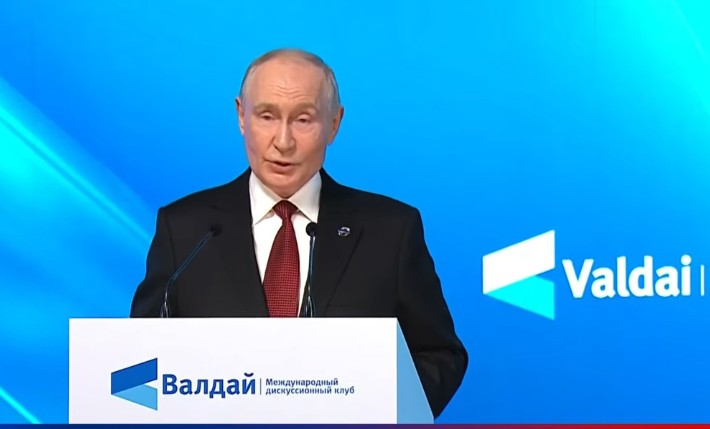
At the 23rd annual forum of the Valdai International Discussion Club in 2026, Russian President Vladimir Putin delivered a wide-ranging speech on the emerging multipolar world order, the crisis of international institutions, artificial intelligence, and the growing risk of global escalation. In the plenary session moderated by Fyodor Lukyanov, Putin also answered questions on the Ukraine conflict, NATO and Kaliningrad, Iran, China, India, BRICS, the Russian economy, and the future of Europe. Read the full transcript of President Putin’s remarks at Valdai Forum 2026 below.
President Putin’s Address: The World at a Decisive Turning Point
VLADIMIR PUTIN: Ladies and gentlemen, colleagues, according to the good tradition, we are gathering the annual forum of Valdai International Discussion Club in order to discuss the most topical global issues. We’ve always tried not only to give the diagnosis for the state of the world, but also to outline the shapes of the emerging world order.
And I’m convinced that the intellectual expertise and experience of a direct and trustworthy conversation accumulated by the club will come in handy necessarily when all of us, East and West, North and South, sooner or later will have to agree on the principles of the shaping of the new world order capable of ensuring progress and development of humanity for the coming decades.
Unfortunately, we have to admit that today we are facing different tasks, much more urgent and acute. Our moderator has already told me that we need to calm everyone down, but the acute issues are still there.
The alarming trends that we observe at the international arena make us think primarily not to… The way how we should organize the global interaction currently in a more reasonable, effective and just way, though all of that is extremely important. But we have to think on how to maintain global peace and security. Right now, when many previous rules have been cast aside and the new rules are not yet emerging. What needs to be done in order to avoid most catastrophic scenarios?
The responsibility of our common future is far from an abstract motto. This is a set of practical actions with a view to prevent humanity from coming to the brink of extinction and to avoid the irreparable. The world has come to a decisive turning point in development. The matter is not only about politics. Politics is, as usual, a derivative of deep changes.
These changes are happening in all spheres, starting with any technology, ending with the social structure of society, climate to health care, military affairs, to bioethics, matters of future of energy, to demographic shifts, comprehensive digitalization and artificial intelligence, to comprehensively new models of economic development. This list is rather long. On the whole, it creates conditions for a qualitative transformation.
All of these circumstances and outcomes cannot be evaluated definitively and comprehensively, at least for a reason that the changes that I mentioned are happening simultaneously and their impact on the society and state are rather contradictory, and I will go in more detail later. The scale of changes of what’s happened and what is yet to come is tremendous.
We seem to understand that. It’s for a reason that there are so many debates on the future quite often with a well pronounced sense of alarm due to uncertainty and unpredictability. However, humanity, though it feels tremendous changes, still is not yet fully aware of the caliber of challenge that it’s facing. This is a beginning of a completely new reality. Trends and dangers are closely intertwined with opportunities and outlooks.
They are part and parcel of each other. Our whole life is going through change. I’d like to highlight once again when not really talking about the shift of balance of powers between major powers or redistribution of economic and technological impact. Naturally, it’s all important and it’s happening. But most importantly, these changes touch upon biological, moral, and ethic nature of human and his essence, the modus, the of human and foundation of the world outlook.
Technology and technology is opening a fantastic, important sci fi outlook for extension of longevity and quality of life, but they also bring the new level of possibility of total destruction. And as a result of military conflict, fast deterioration of environment or cost of control over the And very we of achieving increased domestic tensions without… With the lack of understanding what the future is to hold.
One of the consequences of that is feverish domestic politics, especially so since the classic party systems diminishing in their reflection of the fast shifts in social structure. Any state, whatever the system or whatever the cultural historical traditions it has, inside stability, and I think you will agree with me here, is always most important.
And in order to maintain such stability, governments may undertake very different actions that could have an impact on the situation outside of the country, neighboring countries, regions, and in the world on the whole. In other words, unfortunately, this could be called the export of instability. All of that only exacerbates and increases and raises the temperature, so to speak, in international atmosphere.
Whatever the scenario that will happen in the future, unfortunately, it is very likely that international conflicts will continue, especially since major changes and opportunities opened by that only feed into the ambitions and stimulate the ambition, appetite for the risk for a seemingly big gamble. I would like to be wrong in my evaluation, but it seems that Brazilian trends of today are unfortunately indeed such.
But we’re confident that in strategic perspective, as a shift from Western hegemony is happening, the global situation will change for the better towards a more stable democratic and free multi polar world order. But it’s also apparent that on the path to such world order, many risks await us for states, communities, for each and every person. It is unavoidable amid major changes.
Therefore, minimization of risks at all levels, from global to personal level, is the main task and responsibility of decision makers in politics, businesses, science, and in life in general.
Responsibility is to help people to become cognizant of such risks and be prepared for them so that a person, a family would not be left alone with the issues in fear of security, changing labor market for digital space and so on. What is especially important in my view? Carefulness and caution not to land under an avalanche of uncontrolled changes. Should there be an active and proactive approach to prevent most unfavorable scenarios? Should the current circumstances be used to their own advantage?
There is no single answer in each case. A separate policy is more relevant. People are trying to adjust to what’s happening… To what is happening. However, amid a public crisis, as it is called today, comprehensive and ubiquitous, it’s very hard to detach themselves from daily governance crisis and to look to the future beyond the crisis.
The current responsibility is tremendous. Any mistake may come at a very high price for the future. For example, current tasks often push to the back burner strategic goals. It is easily explained. However, it is tremendously dangerous.
The Crisis of International Institutions and the United Nations
Responding to many current issues is impossible without taking into account how our current actions will impact the future. As one of the famous classics of Russian political thought said, one should see the forest for the trees. So what’s the picture on the whole?
It is apparent that the mechanisms of agreeing on the interests and actions of states that used to be created during the previous periods are incapable of efficiently conducting governance, because these mechanisms are bad, but since the conditions when and why they were created have changed. A new reality that is emerging will naturally help create new tools, but it is a very lengthy process.
Let’s be frank. Some international organizations quite often do not curb risks, but rather beget and provoke such risks serving the interests of one country or a group of states. And they were not created for that. Criticisms is voiced towards such foundational institution as organized as the United Nations, which according to its charter is called to play the central coordinating mechanism in global affairs. Quite often, this criticism is not objective.
However, there founded criticisms as well. Partly, it has to do with the fact that the UN, though it is the most representative global organization, is essentially managed not as collegially and democratically as it was conceived. Disproportionately great impact is in the hands of the limited group of western countries, which being an apparent global minority has essentially hijacked the management function.
And since the real impact of these countries is diminishing towards a more sovereign and confident global majority, the imbalances of the UN institution are thrown into great relief. This is a systemic issue that cannot be solved overnight.
Russia, before and right now, supports the idea of a just reform of the United Nations, but it’s impossible without the inner consensus, which is hard to achieve right now. I’d like to repeat that we’re consistently advocating for the UN structure to reflect the diversity of the whole world. So a more significant role would be played by the countries of Asia, Africa, Latin America, and Middle East.
It’s important to keep in mind that the UN transformation is not only the expansion of the Security Council and other measures on a more balanced geographic representation of the countries in the international governance bodies. This is new content and essence of the work of the organization.
Artificial Intelligence and Digital Sovereignty
Priority dimensions for its activity, including future dimensions, especially since the global changes create tremendous number of new dilemmas, which were simply not present in the past. Most evident example is the artificial intelligence and we electoral yet to learn how to live with it. What would be the impact of its rapid development on the intellectual level of humanity? The impact on spiritual and cultural heritage. It is no coincidence since such a term as careful digitalization is being discussed.
That is, abandoning uncontrollable introduction of such technologies into those fears that have always been important and doubted for ethical development of the person. And socio humanitarian aspects of expansion of artificial intelligence is now being analyzed more thoroughly than technical or economic.
Experts increasingly alarmed by the development and distribution of artificial intelligence, which could be yet another attempt to bring everyone to a common denominator to facelessness now through the use of algorithm established by someone. Such digital totalitarianism would be a dead end and dark and inhumane as well known examples of totalitarian societies of the past.
And yet another important matter, it is relevant today and will become even more relevant. It is how the states are becoming more and more digitized, may ensure sovereignty in this sphere. It is how can they guarantee their security and uniqueness without falling off from global progress and falling behind in technological development.
A different dimension where science and technology drastically change the world is the capacity of human to deeply interfere into what was previously thought as prerogative of the creator. Genetic changes of the body impact on the shaping of a human and programming human behavior in a way of thinking. We need to bring together efforts of countries and communities in order to find acceptable solutions for these very delicate existential matters of existence.
It would make sense to conduct such work as part… Within international organizations, but many of them, as I have already said, are under excessive influence of the West. That have an interest… They have an interest not in overall progress, but rather in maintaining their power. Institutions, which used to be efficient after the 2nd world war, do not reflect the situation of the second quarter of the current century.
New International Associations and BRICS
Is it possible to effectively reform it so that it would be in line with the modern reality? This is an open question. New international associations emerged born by the current global situation. Naturally, they have great outlook. Be that regional associations or such global associations, for example, as BRICS.
However, we need to admit that they have a lot of work ahead of them to define their own functionality, how to optimize the spheres of application and the limits of their capacity. It’s hard to expect from recent associations that will be fast in building the world and shape its multipolar model. Well, it will be too much. This is a lengthy and thorny path with many unknowns, but it will bring results. Absolutely.
Does it mean that we are right now doomed to chaos? No. Such a verdict would be premature. In general, the world regulated through clearly written norms and defining institutions, the world, and ordered world, so to speak, is a recent invention of the past century. All previous centuries did without it.
Well, as we know, to pollute my lead was happened in different ways. Conceitedness, jealousy, and lead have always had place in global politics, and this happens today as well. Nevertheless, responsible powers have always, this way or another, have competed with each other, but still they cooperated. They constructed and conducted systems of relations, other smaller states as well. And in general, they try to preserve stability.
The Responsibility of Great Powers
Right now, against the backdrop of crisis of institutions and deterioration of international law, big countries have tremendous responsibility commensurate with their tremendous opportunities. Such states have potential for actions that could, in one fell swoop, change the global trends towards greater predictability and security or, on the contrary, to deterioration and avalanche of issues. Such potential has a multiplier effect due to new technologies that I’ve already mentioned.
It is apparent that how efficiently the risks are being managed at the stage of rapid changes would define the future of all world and means every person. The lack of widely recognized rules, understanding of the principle of equal and indivisible security quite often pushes or abandon such principles pushes towards egoistic behavior.
And in some cases, it’s turning into aggressive attempts to achieve unilateral advantages, worsen the chaos and music in their own interest. Global politics gives us examples of that basically every day. Taboos, thinkable and unthinkable, are being violated. I will not be naming what’s happening, but I think that everyone present here is fully aware of that.
I’m deeply convinced that such complicated matters as international relations requires delicacy, observing not only the laws adopted, but as the advocates of common law, usually say, not only the letter, but the spirit of law and established and recognized custom.
Moral and ethical limitations in decorum are important because the respect for him creates an opportunity for at least some kind of dialogue. On the contrary, systematic violation of commitments, deceit, turning communication into travesty, turning every meaningful conversation to a propaganda, conspicuous mockery of facts and turning them inside out in order to achieve temporary benefit, that all that diminishes the foundation of international existence.
And I think this behavior is very myopic and dangerous. Temporary gain achieved through that might turn into a long term failure and most importantly deteriorate the situation for everyone since the interconnectedness of the world is still there. “All brawn and no brain” principle seems guiding for some international stakeholders.
They’re convinced of their own military, political, economic, and as I think moral exceptionalism. We know very well from history that it would bring nothing good.
On the Ukrainian Conflict
I’ll get distracted from the main topic. I think there are people present here who have very different viewpoints on the very acute conflict that is the Ukrainian conflict. Views of reasons for him.
I would like to say a few words about it. Yes. Many hundreds, even thousands of experts, your colleagues will be studying the materials of this session of the Valdai Club also have their own thoughts in this regard. And I’m sure that part of the expert community will have a question. “Russia is talking about peace, and Russia started a war.”
And I’ve responded to that notion many times. But I’d like to repeat myself the war, but the war was started against us. They shouldn’t have encouraged aggressive nationalism and Russophobia in Ukraine in order to turn it a tool of fighting against Russia. They should… NATO should not have started military exploration of our historic territories in the interest of NATO.
They should not have planned their bases there. They should not have pushed radicals in Kyiv towards a coup d’etat. They should not have used this legal regime created through this coup. They should not have pumped it through different offensive weapons. They should not have made plans of how to organize concentration camps for Donbas and Crimean citizens.
They should not have used tanks, fired missiles, shut down from airplanes, and burned alive unarmed people only for the fact that they’re Russian in nationality and in spirit. There are many such “they shouldn’t have,” but I will stop here.
I’m sure that Russia has been deliberately put in a situation where it was simply forced to respond to this apparent aggression. Was forced to defend itself, taking up arms. They put us to this red line deliberately, and Russophobia, prosecution, killing of Russians and destruction of Russia should not be turned into a state ideology.
They should not put it as goal of strategic defeat of Russia. That’s the way we’ve heard it all. No one forgot it. At least we didn’t forget it. If we want to live and everyone wants to live, but as I said, once when I spoke publicly, “let’s believe in peace and friendship.”
Let’s search together for making this a reality. Building trust is a process both complicated and fragile. Trust is very difficult to foster, very easily broken. The interests of the most close partners cannot coincide fully, much less so the countries that are in a state of rivalry, fierce competition, let alone confrontation sooner or later, the international system will come to a state of stable balance.
Certainly, this is a complex multifaceted, multi tier process which requires compromise, accommodating one another, and a clear headed assessment of the situation, in particular, from the part of the West.
The former hegemon will inevitably have to realize the realities of the multipolar world. This is inevitable. Look at the economic trends. It will have to learn to cooperate with the countries of the world majority on the basis of respect for its… For their brute interest.
This will not happen overnight. We will have to live in a very unstable, volatile world. The path towards the new system will be rife with unexpected turns and twists, and very often, they will be unpleasant and dangerous, unfortunately.
Lessons From the Collapse of the Soviet Union
And in this particular case, I would like to turn to our Russian history. Russia has traveled the arduous path of radical transformation, and this process is still ongoing.
35 years ago, we survived the collapse of our state system, which turned out to be a genuine tragedy for dozens of millions of people, both in our country and in other countries because in one night, people woke up to a new country. It changed their future and their children’s future both within Russia and in the neighboring countries, which brought about fundamental transformations within the world affairs in Russia.
I would like to take note of a certain naivety, Syriite idealism, carelessness probably of the people who stood at the helm of the country during the last Soviet years. They blindly trusted the Western partners. They were confident that certain gentlemen’s agreements would be sufficed when you take your partner on their word, which played a cruel joke with the Soviet Union.
In hindsight, it becomes clear how devastating a role it has played in the history of the USSR and for the long term world stability. The Soviet leaders wanted the West to like them, whereas the western leaders wanted to reshape the world to their liking, and they wanted to cut the legacy of the Soviet share of the Soviet the share of the Soviet legacy, the bigger the better, and we see how it turned out.
The Soviet Union’s collapse was due to a combination of internal imbalances. We have to be frank about that as well as the mistakes made by succeeding generations of the country’s leadership, the short sightedness, the narrow minded, and erroneous ideological stereotypes rather than pragmatism, unprofessionalism, and also downplaying apparent problems, all of that gradually eroded and chipped away at the internal and external position of the USSR and brought about its collapse at the end.
The ongoing conflicts and shocks that are engulfing the world, to a large extent, are the fruit of the reluctance, the unwillingness, or inability of the politicians of the end of the 20th century, both in the West and in the East, to have a serious and in-depth look at the nonnumental changes they were facing.
This is not shifting the blame. This is a reality. But back then, both in the East and in the West, there were other politicians who had an in-depth understanding of the problems. And I think they proposed the right ways to dealing with those problems. And their assessments right now can be called prophetic.
The Vision of Egon Bahr
A couple of times, I spoke publicly about Egon Bahr, a political leader who was a member of the leadership of the Social Democratic Party of Germany. Let me… When I read about his contacts with the Soviet leadership both in Bonn and in Moscow, I was surprised, astonished by how well versed he was, how unwell he understood the situation. Let me quote some of the statements that he made in June and February 1990. As you understand, this was the turning point for both Europe and the world.
The most important thing that Mr. Bahr was concerned about was the threat that the confrontation would persist in Europe even after Germany reunited and the positions would be reinforced of those circles, and I quote, “of NATO that were far from willing to embark on the path of pan European cooperation and putting an end to this confrontation.” This is a quote.
He saw that firsthand, so he understood that better. And because of the talks in 1990, Egon Bahr said, and I quote, “unless decisive steps are made to overcome Europe’s split into hostile blocks, the development work might have very… Would take a very unfavorable turn that would condemn the Soviet Union to international isolation.”
This is another quote of his. So what was he proposing instead? Incidentally, his forecasts turned out to be true in the end. So what was the proposal instead? There was a proposal that a council of Europe should be established with the participation of both The US and The Soviet Union and endowed with big powers.
It was supposed to include almost all of Eastern And Central Europe. And yet after the Soviet Union’s collapse, the West saw the triumph on those forces that, according to Egon Bahr, were “far from willing to embark on the path of pan European cooperation.”
And I would like to highlight that despite the many years of Russia’s attempting to become part of the so called Western civilization, in practice, those sagas were doing their best to isolate and finish the dismantling of the Russian Federation itself because they saw it despite all of the changes that had transpired within Russia as a key part of historical Russian empire, and they’re still seeing that. Different events, different get togethers, they say “we have to finish the dismantling of Russia.” This…
All of this has brought about the current dangerous situation Europe and the world are facing. I would like to draw your attention, ladies and gentlemen, that I believe Mr. Bahr was thinking solely about the future of Europe, and he was also thinking about the common European home that the Soviet leaders had been speaking about so much. Unfortunately, they did not go beyond rhetoric.
A Road Map for the Future
Russia probably knows better than anyone else how difficult it is to overcome the consequences of historic catastrophes and trying to discover the way forward in favorable circumstances. It had to use the trial and error and come up with off the cuff solutions.
But we never lose sight of the fact that any nation needs a long term vision. It needs to understand where it’s moving in future because there is future. The legacy of our ancestors who built a great unique country should be reinforced and enriched without historical foundation, without respect for traditions, no society can exist. But the adverse is equally true. Without the future, the past loses its sense.
Whatever and however grandiose the achievements of our forefathers, we cannot allow ourselves to turn into a museum, a shrine of erstwhile greatness. The genuine greatness of the country is impossible without the ability to keep a breath of time ideally ahead of it. We have to enrich our legacy and develop it creatively to make it adapted to the new circumstances.
This will be the best guarantee that our national tradition is not going to be an antique, a passionable historical accessory. It should be rather a living, fruitful environment. This is what our guiding principle should be for our future achievements.
As far as the future is concerned, a lot of it is truly veiled with uncertainty because there are too many factors that are volatile and uncertain, but we need a road map to this future. This is no utopia. These are no abstract concepts nor is it… We should think in that is divorced from reality.
This is rather a realistic assessment of risks, opportunities, and goals we need. Russia is building such a road map for itself, but it stands ready to work together with other countries. And nations of the world on a similar road map of the world.
The Danger of Escalation
And I would like to say that the scale and the pace of the changes the world is facing are unprecedented. And we have to understand that the point of no return can happen very fast and very unexpectedly. It will just turn out that the logic of escalating mutual tough responses will turn into a fatal inevitability. Right now, there are descriptions and forecasts about the world, conflicts, and the world escalation is heard increasingly often.
The unwillingness to turn to genuine diplomacy, is based on realities and on due respect for the interest of one another, pushes everyone to escalating the situation, to breaking the stakes, to bluffing, to overcoming, overstepping the red lines, and the hopes of overwhelming and intimidating the opponents of breaking them.
This escalation of hostilities and sanctions, there’s nothing new there. It was resorted to in many conflicts, but it is never unilateral because provocative steps from one side get a response from another, and the spiral is winding up, and the devastating consequences are becoming increasingly dire.
This escalation is based on arrogance and self conceit, and this is what pushes us to the edge of the abyss. Right now, leading countries of the world have their disposal armaments that can swipe away all… While away all life or at least push the path to catastrophic consequences.
Can we be certain that these weapons will never be used? Unfortunately, we cannot be sure because there’s this famous statement “if there is a gun hanging on the stage at the beginning of the on the wall, on the stage at the beginning of show, it’ll certainly fire at the end.”
So the more intransigent of the counteraction, the more openly the goal of strategic defeat is announced, the greater the chances that the conflict will enter the fiercest stage because the fight for survival is not just happening in the wild, but in social communities as well when people are faced with the prospect of losing their independence, dignity, and existence, ladies and gentlemen.
Let’s hope that the new world would have been trying in the near future, but so far, things are happening very chaotically, very spontaneously. But we are only trying to grasp what the outline of the future will look like, but this doesn’t mean that we should sit idle waiting for whatever will happen. We have to move towards creation, and the stage will arrive sooner or later, and we have to survive the current dangerous moment. We have to prevent the most devastating threats from realizing.
Artificial Intelligence and the Rules of Warfare
I believe there are 2 aspects that are important to be highlighted. I think they have to be a subject for our serious discussion at the political, technical expert, and even philosophical level.
The 1st aspect is AI. Right now, the world is engulfed in a discussion whether measures have to be taken to deliberately slow down research and development in AI so as not to allow these technologies to slip away from human control. This is a multifaceted issue which requires a comprehensive consideration.
Humanity’s history demonstrates that technical progress is impossible to stem, but we have to understand what the consequences of progress are, especially when these achievements are used in warfare. There are cases when AI makes its own decisions based on what considers expedient. It applies to both civilian and military users. And in the course of implementation of AI, it’ll assume a greater role.
The algorithm will… The algorithms will assume greater responsibility, especially because human beings are in… Cannot rival the machine’s capacity to analyze the situation almost instantaneously, but human beings have other qualities such as intuition and possibility of thinking out of the box and making the solution which turns out to be the right one, even sanitary.
Let me remember a story from the Soviet days, from the Soviet era. September 1983, Lieutenant Colonel Stanislav Petrov was the duty officer, and he received an alert from the early warning system. There’s early warning systems exist both in The US and The USSR.
The alert was about the launch of 5 American intercontinental ballistic missiles, and algorithms would have seen that as grounds for a reciprocal strike. But this officer was experienced, and he had doubts about the accuracy of the alert. He suspected a malfunction of the system, and he turned out to be right. Were at an AI being in his stead, it could have turned out to be quite differently. I think this is a very compelling example.
How far AI can be used in security here is the issue that will determine humanity’s survival. AI increases the efficiency of warfare, which in turn brings about greater destructiveness of the conflicts. So what we need is an unbiased professional international discussion on modern warfare. We have to think about preserving humanitarian frameworks, how to limit the cruelest manifestations of hostilities that are caused by the growth of destructive capabilities.
I know that you have had a session at this forum which had a very apt subject, and that is “the ethics of the new war, humanity, and inhumanness.”
Indeed, this inhumanness of modern conflicts can be seen in 2 ways. On the one hand, there’s the growing cruelty, neglect from humanitarian norms. There are new forms of confrontation when AI and autonomous systems play an increasingly important role in warfare. They supplant people, especially in the decision making process.
This is a very complex subject which requires our utmost attention because the automation and digitalization of warfare leads to its gamification when bloodshed and the loss of human lives turns out to be a computer game. And this, let’s be frank about that, leads to the degradation, the sliding back of humanity into barbarity.
Back at the end of the 19th century in 1899, Russia was the one that stood at the origins of the Hague Conferences that, for the 1st time enshrined the rules of warfare as well as peaceful settlement of disputes and humanization of hostilities. These were lofty ideals, but they failed to save humanity from the shocks of the 20th century. World wars seemed to have canceled the achievements of humanitarian law, but now is the time to once again brace the issue of the rules of warfare.
We’re hovering under no illusions. There have always been wars throughout humanity’s history and very probably they will keep happening. Unfortunately, this is an inherent part of humanity’s existence. Combat is the profession of those people who say… Who protect the interests of their countries, but professionalism in warfare requires respect for humanitarian norms.
The Russian military have always been guided by the indivisibility of these norms, and I have to highlight that they were never once to be the 1st to attack objects or facilities that have no direct relation to the military infrastructure of the adversary.
Global Problems and the Greater Eurasian Partnership
But these rising international tensions and increasingly acute general confrontation has another negative long term consequence, and this is the 2nd factor I’d like to draw your attention to. The thing is, in this atmosphere of conflict, what gets sacrificed is the search for solutions to global problems that affect humanity as a whole. They have been discussed in the recent years, but they have been relegated to the background. I refer to climate, environment, poverty, inequality. They’re becoming increasingly acute.
But right now, there are no grounds to hope that international community can band together in the near future to tackle these tasks in the near future. But if they cannot be addressed globally, we have to deal with them at the regional level because that’s closer, that’s more understandable for the people because all of us are responsible for the planet Earth, and especially we are responsible for our respective countries and what happens around.
Our home is Eurasia, which is a vast territory, And this is the center of most important processes that are unfolding across the world. How well we build this Eurasia will, to a large extent, determine the future of the world affairs. Amid the growing world instability, the idea of greater Eurasian partnership proposed by Russia and the past takes on a new importance, military and political confrontation undermines the connectivity of the world.
What comes under threat are the supply chains, transportation chains, as well as the established trade routes and communications. So our task and responsibility of Eurasian countries is to protect the space from global risks and their devastating consequences. We have to use these technological opportunities to improve our cooperation within Eurasia, improve the connectivity across these vast territories.
And I would also like to say that cultural and civilizational entities that are located in Eurasia have the experience of cooperation even during the most difficult historical eras. Across many centuries, Eurasia can serve as a model for international cooperation in the environment of homogeneity of heterogeneity of cultures and approaches and interests when differences become an advantage rather than an obstacle.
And I would like to draw your attention to the initiative our Belarusian friends and we have come up with, and that is the development of a Eurasian charter of multipolarity and diversity in the 21st century. Last week, foreign ministers of Russia, Belarus, Kazakhstan, Kyrgyzstan, and other partners of ours met in the sidelines of the UN General Assembly launching practical work on this fundamental document.
The value of Eurasia is that it is self sufficient. It is capable of overcoming any problems. The only thing what it needs is indivisible security, lack of military threats, and durable peace.
Responsibility for the Future of the World
Distinguished colleagues, all of us, the world’s community as a whole, are responsible for the future of the world. This is no exaggeration nor is it a metaphor. It’s an applied task, and we have to address this task immediately.
I would like to believe that when our descendants read textbooks, history textbooks, they will see that the second quarter of the 21st century became the turning point when humanity realized the scale of changes and challenges facing its existence and managed to set aside its scaffolds, ambitions, and self centeredness and banded together to address general problems and turned the technological revolution into an opportunity started to address the issues of social inequality and environmental degradation, not just in words, but in truth, understood there was no future to military confrontation in Diplkad, and understood the need to search for solutions to the problems we are facing and start to build a new stable world order.
And I’m confident that this is exactly what they will read in those history textbooks because unless this happens, there is a risk that there will be no one to read those textbooks, and these textbooks will never be written.
But let’s hope for the future. And most importantly, let’s do whatever we can to make sure this better future arrives and stays with us. And I would like to thank you for your attention, and I would like to wish every one of you success. I highly value these meetings of ours. Once again, thank you.
Conversation With Fyodor Lukyanov: When Did Bahr’s Vision Become Impossible?
FYODOR LUKYANOV: Mr. President, thank you so much for such a comprehensive review of all the issues, very specific and generalized. You have quoted Egon Bahr. Egon Bahr lived a long life and his demise happened in 2015, meaning that he saw the beginning of Europe go into real military and political crisis. We know that he was extremely saddened by what was happening in Europe in the late last years of his life.
You used to be an observer, later a participant in European processes. Could you maybe define a point when those ideals and possibilities that Bahr brought back in the time.
VLADIMIR PUTIN: Well, did not write that. Well, he spoke about it. I would like to highlight once again what I have just quoted is something from archives of his discussion with the representatives with the leadership of the Soviet Union in Bonn and in Moscow.
FYODOR LUKYANOV: Well, this vision that he presented back then and possibly that the Soviet leadership agreed with, At what point in time? It became impossible.
VLADIMIR PUTIN: That’s the trick. It did not really agree with that. The leadership… The Soviet leadership was listening to it and doing nothing. And that led to Bahr saying the phrase that discombobulated me. He said that “I did not think that me, in my years, I would have to present such a point of view in Moscow. And if the Soviet leadership does nothing and simply…” Well, this is a rough quote. “I will never travel out to Moscow again. You won’t see me here.”
FYODOR LUKYANOV: Nevertheless, this point in time, when did it happen? What point in time? The point in time when it all became impossible.
VLADIMIR PUTIN: Well, I’ve just said it. As soon as the Soviet Union collapsed, those circles in NATO, those aggressive community within NATO, to speak frankly, they perceived it as a signal that Russia shouldn’t be included, engaged in the family of civilized peoples of Europe and the world, but it should be… This opportunity should be used to collapse everything.
They said that the NATO would not expand to the East, and that was deceit. 5 of 6 expansion waves. Russia… And Soviet Union and Russia was saying that “what about the agreement?” They disregarded it and did everything they wanted to do Towards… Actually, what Bahr was mentioning towards isolation, towards further collapse of Russia… Of the Russian Federation.
Support for separatism in the Caucasus, for example, support with the use of terroristic… Terrorist tools. Terrorists were fighting there, and everyone knew it. I saw… ISIS was fighting there.
Everyone was put in shame to what was being done in the rest of the world, but it could be done in Russia as if they didn’t know anything. They disregarded it the same in other spheres. I remember fully well my discussions with the international financial organizations and political circles. It was simply amazing. It was deliberate work that was being done.
Therefore, that was the path towards the end. Impunity meant that everything was allowed.
FYODOR LUKYANOV: So it seems that at the beginning of the noughties, you had very intensive contacts with the Europeans. There were new ideas for common space. It was all hopeless, it seems.
From Yugoslavia to Ukraine
VLADIMIR PUTIN: Well, what happened in the West is that the forces who are fighting Russia to the end gained the upper hand. They prevailed. We know it very well. We all criticizing the UN for the fact that they’re inefficient and this and that. But how did it all start?
It started with the NATO attack on Yugoslavia. Yes. It was a complicated conflict. So was it a must that they had to do it without the UN Security Council sanctions that they had to start a military operation on a territory of an independent state in the center of Europe? Do they have to start to bombard the capital Belgrade?
Why? Without any decision by the Security Council. Without the sanction by the UN Security Council, it was a big war that was waged. That was the beginning. Everyone in the world looked at that. If they can, then everyone else can do that. That’s it.
The whole system that fell into place after the 2nd world war, it was based on the balance of powers between the winning countries. When the Soviet Union collapsed, the balance collapsed as well. The Western countries thought for themselves, “why should we observe the rules that were signed with the Soviet Union, whether it was Soviet Union no more. We will write our own rules the way we want them in order to achieve our own goals and interests at the international arena.”
Hence, the process commenced and it was implemented step by step. I remember when Boris Yeltsin tried to agree on Yugoslavia to solve those issues, these issues that he was saying, “yes, indeed, we need to look at the aspirations of the peoples living on those territories. Let’s do it peacefully.” But they did not listen.
They used the force. And each step later was a way of pressure by force. Military, financial, economic, it was all a conversation through force. And we lived through it. All of these deterioration processes that were happening in the Soviet space had a certain reflection on the new Russia, on the Russian Federation, and we had to fight it to rebuild and strengthen Russian statehood, economy, armed forces, and so on.
We were busy elsewhere, so we did not have time to busy ourselves with the on agreements with major powers on the rules. We had to defend ourselves and therefore it all deteriorated and it became a routine thing of slipping down, and it all came to Ukraine.
Yanukovych was the president back then. I will not give him an evaluation. Possibly, the citizens of Ukraine had every ground for him to be ousted out of power. Well, wonderful. He agreed with everything. He agreed to have snap elections. Why not go and vote and solve the issue? No.
They had to do a coup d’etat. I asked some European colleagues later why did they do it. It was apparent that Yanukovych is losing power, and he would not win the snap election. Why did they do that? “Well, it just happened.”
Well, look at that. A person was ousted who actually was for the European Union but against NATO. He was ousted from power, and it just continued down the line. Russophobia, armed actions in the Southeast Of Ukraine, we had to start and protect the people in the Crimea who lived there. And step by step, it was happening.
The Minsk agreements who it turned out known what it was going to observe, and they declared that they will not fulfill the Minsk agreements. For 8 years, it continued for 8 years. We did not recognize DPR and LPR for 8 years. Later, it became clear that it could stand no longer. We recognize them.
So we could sign in agreements on friendship and mutual aid with them. Does it run contrary to the international law? No. And we did so. And when we signed the agreements, did we have the right to provide them with aid and support when they appealed to us for it?
Naturally, that’s what we did then. When the UN secretary general, when he traveled to Moscow, presented with this whole chain of events, I asked him, “what’s wrong here?” He looked at me and said, “alright. Still, you were the aggressor. Attacked.”
And how did he come to this hot case? No one wants to think of that. Everyone understands this fully well, but they just don’t want to admit it, and that’s the issue. And it all started with what Bahr said, and he was a visionary.
NATO, the Baltic Sea and Kaliningrad
FYODOR LUKYANOV: Now down this line, we have come to this very interesting situation where NATO is holding maneuvers in the Baltic Sea, and there are very serious threats to Kaliningrad and the Russian promise in case of a blockade of Kaliningrad to be prepared to use all means and forces including nuclear. And this is a real escalation, like we are on a brink of war. Are we still scaring each other?
VLADIMIR PUTIN: We’re not scaring anyone. And what you’ve just said, the statement by the foreign ministry and the letters that was forwarded to some countries, this is not threatening, but this is a response to attempts to threaten us. These statements by the Western politicians and European politicians about the need and possibility and preparation for the war with Russia in 2029 and 2030.
It’s not us saying these words, but we hear it from the other side and constantly. And specific actions look at exercising the Baltic Sea one after another, attempts to detain our ships. This is escalation that I’ve mentioned in my statement. All of that is escalation. And we’ve heard statements about Kaliningrad.
It is written well in the foreign ministry statements and the letters that they have sent out. If it comes to direct attack on the Russian Federation, in this case, we mean Kaliningrad, maybe some other territories as well. Of course, naturally, immediately, what will be on the agenda is the use by the Russian Federation of all weapons that are at the disposal of our country. It is unavoidable. And it’s not about the name of the supreme… Of the commander in chief or the president of the country.
As far as I understand, the NATO secretary general said that there are 300 million in Europe and so on. That is indeed so. That is why we will raise the question of using of all means and weapons that we have at our disposal. 1st of all, we understand that we’ll have an adversary exceeding us more than twofold in terms of population.
This is a tremendous military and economic potential. We won’t have that many means to counter such a threat. We have to use our competitive advantages in such a fight. What are those? The thing is that those means of our self defense and we have such competitive advantage.
Of course, France and The UK are nuclear powers and we are fully aware of that. Nevertheless, as in terms of weapons that we have right now. Vehicles that we have, we are unparalleled. What’s a different way to stand up to an aggressor? We’re not threatening anyone, but we’re just saying that we don’t have many tools of self defense.
The foreign ministry statement does not mention nuclear weapons. It mentions, as I have just said, the use of all means and all forces at the disposal of our country and we’ll decide what it is.
FYODOR LUKYANOV: The secretary general of NATO responded very calmly. He said that they don’t think it’s serious.
VLADIMIR PUTIN: Indeed, if they don’t consider serious threats towards us.
FYODOR LUKYANOV: Yet another topic in order to wrap it up.
VLADIMIR PUTIN: Incidentally, sorry, for interruption. I think that this constant increased tension by many European countries that’s happening, it has to do with a great deterioration of the economic and domestic political situation in the countries. Look at their economy. Look at what’s happening in terms of social policy and living standards of citizens in major European countries. Amid such conditions, they have to shift the focus of attention of their citizens from domestic issues towards outside issues.
I had to respond to the questions that you were asking me. And I think that they were waiting for us to respond right now. Now they will cut it out of context, and they will abuse and exploit this notion. The notion that “Russia is threatening us with nuclear weapons” to distract the attention of their citizens from the fact that they are conducting their own aggressive policy against Russia, that they’re pushing their citizens towards a dangerous line, confrontation against Russia.
We’re not threatening anyone. We do not intend to attack anyone in 2029, in 2030, in 2050. But if we come across an aggression, we will have to respond, And the citizens of the European countries should be fully aware of that and make the distinction between our position and the position of incumbent governments of their countries. But I think that the people understand that and we see that according to the election results and the sentiment in major European countries.
FYODOR LUKYANOV: Now I feel like a henchman of domestic political manipulation of European governments.
VLADIMIR PUTIN: I assume that they are doing it deliberately. Well, there are people rather smart, not stupid, and they are building their PR campaigns in public sphere the way they need it in order to achieve the necessary political domestic political result.
European Arms Producers as Potential Targets
FYODOR LUKYANOV: Yet another question that has to do with this rhetoric or non rhetoric. Several weeks ago, Ministry of Defense published a list of European institutions that produce weapons and procure it to Ukraine with a very clear statement that these are potential targets. It was confirmed later several times by the foreign ministry as well.
For example, this warning would have to be confirmed by something at some point in time and the strikes will have to be conducted against some major institutions. Possibly, it will be perceived as an attack, attack by Russia with possibility of engaging the collective defense article, the article 51 by NATO. Are we prepared for that?
VLADIMIR PUTIN: Procurement of weapons of one country to another country is nothing new. This is essentially military and technical cooperation. This is… Does not cause concern among us. However, engaging other countries in direct military action, that is something of concern for us.
We are very clear that when there are strikes conducted deep inside Russian territory, it cannot be happening so smoothly for Ukrainian armed forces without space intelligence and technical facilitation by the western specialists. That is a threat to everyone. That is an engagement of these countries in the war with Russia, and that is what creates additional threats for the future.
There is nothing good in terms of procurement of weapons to conflict zones. All of the countries in the world are always trying to stay away from that zone of conflict. It seems bad form to procure weapons there when we are not receiving weapons from anywhere. We rely on our own military, technical, and economic capacity, and Ukraine cannot do that.
It cannot exist on its own. It is losing its elements of statehood. I think it’s an apparent thing. It is being managed from outside. And when someone wants to fight with us, to wage war with us, using the Ukrainian regime as a puppet, losing their own people.
And I think that they think of their people as their own when they use them as cannon fodder. When someone is starting to fight with us using someone else, that is a threat. I don’t think we’re going to conduct strikes on the territory of countries. We are procuring weapons to Ukraine. But this is a threat that we need to be fully aware of, though, give it an evaluation and to keep in mind.
And, of course, the armed forces of Russia, military intelligence, should understand where these threats are stemming from and we’re following that very carefully.
FYODOR LUKYANOV: Thank you. Egon Bahr, if he lived to see today, would be totally petrified seeing what we’ve… What he’ve come to.
VLADIMIR PUTIN: I haven’t met him. I can repeat it once again. When I read these archives, the Russian audience will understand me. Well, it sounds not very diplomatic. I was discombobulated completely. I was shocked.
It was such a visionary, and he was well versed in everything. He was a thinking person. He thought about the future of his own country, Germany, and about the future of Europe. I just quoted him. He said, “the schism in Europe has to be overcome.”
It was relevant back then. Maybe not now. It could be argued with, but still he thought about overcoming a schism in Europe. And if we don’t overcome this split. Essentially NATO sucks in all of the Eastern European territory and Soviet Union will land in isolation, and that will be bad for the whole world.
That’s what he was saying. Such a smart person. We can only wonder at his vision. He said it will be so and it is so. It’s only reason for respect for his evaluation of this… Of the situation back then and forecast for the future.
Unfortunately, no one listened to him. They did not try to overcome this block split. Russia, on its part, tried unsuccessfully to become a part of the civilized families block. But it did not succeed, and they were trying on the contrary to collapse this empire.
And this is what has brought about today’s conflict. They managed to infiltrate Ukraine for thousand times. We were telling them “you shouldn’t be doing that,” and yet they were pushing forward and forward. And it’s the result.
FYODOR LUKYANOV: Do you regret that as president in the noughties, you were trying still to integrate into this western civilization?
VLADIMIR PUTIN: No. I do regret what I was doing back then because back then, everyone was thinking that we had failed to see the whole picture, that we had to go an extra mile. We had to accommodate them there and there, but we spared no effort. We offered everything that we have to offer, and we understood that they were not waiting for us. They simply saying no.
And at the same time, they were continuing with those infiltrations into our space. They were trying to chip away at it, and this is what has brought about the current situation.
Q&A: Freedom of Navigation
FYODOR LUKYANOV: Thank you, colleagues. We are currently coming to a Q and A session. Please signal. Yes, Mr. Vernikov, we started with Kaliningrad.
AUDIENCE QUESTION: Thank you. Mr. President. I’ve got a question about the freedom of navigation. I represent Kaliningrad, the Baltic Federal University. This is a problem that is a source of great concern to us. Over the recent years, the world sees are seeing some deplorable developments, attacks on subsea infrastructure, seizures of civilian vessels.
And it brings to light certain legal matters when some mala fide participants of the world relations are abusing the instruments offered by international law and instruments that have been used for decades, norms that have been observed for many years. Some countries are recalling their flags. They are playing into the hands of other countries, but seizing and arresting vessels with no legal grounds. So basically, abusing the legal instruments to suit their political and economic purposes.
My question is whether the international community, the international majority is willing to adapt and reconfigure these norms. There is much talk about loss of international law, but in the absence of international law, we have no other mechanism to address these problems. And is Russia willing to come up with this initiative?
VLADIMIR PUTIN: Well, we stand in favor of freedom of navigation. We are against any restrictions whatsoever. Whether there’s a need for some new things, I don’t think we have a need for that. We have to abide by the old principles.
But, of course, there’s a chance that no one will abide by the old rules. There’s the International Convention on the Law of the Seas. I think it was adopted back in 1982. And this convention has to be respected. And it applies to all spaces, all regions of the world.
You have mentioned attempts at arresting our vessels, which is a violation. I’ve been to the Russian Far East. You must have seen the news. It’s not just the Baltic or the world or the North Atlantic, but this is not the entirety of the globe. There are other suites of seas, and we will take reciprocal steps, mirror steps in the Baltic, in the Atlantic, or in the Pacific or in the Indian Ocean, wherever we find it more advantageous, we will be acting.
And no one needs that because they have to understand that this is one form of aggression against Russia and they have to stop. We are not attacking anyone. We’re not seizing anyone’s ships, so this has to stop.
Strikes in the Black Sea and on Oil Refineries
Let’s look at what’s happening in the Black Sea. I said that, but I will reiterate that in this room. Once again, indeed, there are hostilities ongoing in the Black Sea. We used to carry out strikes on military vessels or armed vessels that were carrying military equipment. And there were almost no mistakes because there were secondary detonations, which mean that there had been some military equipment the vessels were carrying.
But in response, Ukrainians started to carry out attacks on our civilian vessels and ships that are carrying purely and simply civilian produce. They started that in June, I think, early June, and they said that overtly publicly. In the 1st 10 days after the launch of this campaign, they damaged 40 vessels or so. And the overall number of vessels damaged amounts to 100 or so.
And we had to start to respond right now through every means possible. They are communicating to us, “Let’s put an end to that,” but they were the ones to start that. As you know, the Soviet soldiers responded with grenades to the fascist soldiers, and that is what is happening. Any action leads to counteraction.
They also started to do the same with the oil refineries. They started strikes on that, And indeed, they managed to secure some results according to our assessments and took away around 1% of our GDP. They were doing that deliberately. They were striking civilian targets.
And we mirrored what they were doing. We started to carry out strikes that… Against the facilities that were of great importance to their economy. But once again, we did not initiate that. They are now admitting that their metal production has ceased, but that’s actually dual use because they’re not just building rail tracks or construction materials with the use of metals and steels.
They’re also using that to produce cannons and Now they cannot do that. They can no longer get revenue from the sale of other goods either. So it’s a problem.
Now we hear proposals that Ukrainians should stop attacks on our oil refineries, and we should stop the strikes on their vessels, let them keep their civilian exports. But what about our civilian cargo, like our vessels carrying oil products?
They say they will stop strikes on oil refineries, more diesel will be available that The US is needing. We have enough of diesel, but this production, these products are not flowed into the in… External markets because there are sanctions in place against Russian oil, Russian oil products, against Russian insurance, and the cost of freight is higher. So how will our diesel flow into the external markets if sanctions stay in place? It won’t.
And in response, we are supposed to stop hitting things that are important to their economy. Well, actually, it looks absurd, this proposal. All of this is subject to discussion, but this discussion has to be based on mutual interests.
Now as for the current state of affairs with regard to the law of the seas, I started with that. We advocate freedom of navigation in all regions of the world. We’re also in favor of abiding by international law and norms that exist in the law of the seas, And I would like to end where I started. We should not be trying to come up with something new. We have to abide by the old principles.
FYODOR LUKYANOV: So as you said, you say no to all the proposals that they’re trying to communicate by all means possible.
VLADIMIR PUTIN: Well, it has no direct relation to the law of the seas.
FYODOR LUKYANOV: Well but you spoke about the proposals coming from every channel.
VLADIMIR PUTIN: No, no. The answer is no.
Iran, the Strait of Hormuz and the Nuclear Program
FYODOR LUKYANOV: Mr. Dushy, professor Dushy from Iran, he has direct relation to the law of the seas.
AUDIENCE QUESTION: Thank you, Mr. President. I am from Iran. Therefore, know that after unlawful aggression of United States and Israeli regime on Iran, there were a lot of problems and the aggression of The United States and then there was the exchange of fire between the 2 sides between Iran and the southern part of Persian Gulf. Therefore, what is now is the main question is the Russian position about the future of security arrangement in the region? What is your position and approach? Thank you very much.
VLADIMIR PUTIN: Well, as for the assessment of the current developments, I think these assessments have been expounded upon by the Foreign Ministry of Russia on multiple occasions. Just recently, our Foreign Minister has been to the UN General Assembly where he spoke about our assessment of the current situation, and there is no need to revisit that. Our position is publicly stated. It’s open, and we are happy to present it openly.
As far as the aggression goes, I said that before. Well, I think I hinted quite openly. What’s happening in Ukraine is also aggression of the collective West against Russia, but this particular case by proxy of the Ukrainian nationalist regime. This is another form of aggression, and we are against any aggression. We’re in favor of addressing all issues peacefully through arrangements.
And we’re hopeful that the strait is going to be opened. We’re hopeful that sanctions will be lifted. This is something Iran is quite legitimately seeking. We hope that the sanctions against Iran will be lifted, and there is no be… There’s not going to be any need any longer to limit the movement through the Strait Of Hormuz or through the strait that is being controlled by the Houthis. So that is what we advocate.
Now as far as Iran’s nuclear program is concerned, our position on that matter is also very well known. It’s no secret. In the past, we played a very significant role in overcoming the previous crisis. We made a contribution of our own to the creation of the JCPOA. Back then, when the decision was made and our Iranian friends agreed to that, we suggested that part of the enriched uranium should be transported to the Russian territory and this mechanism was working.
This proposal is very much still on the table. We are happy to replicate this positive experience. We are proposing that enriched uranium should be relocated from Iran to Russia. And at 1st, everyone agreed to that. Iranians agreed to that. The Americans agreed to that, and even the Israelis agreed to that.
But then The US went on to toughen its position. They said it should be relegated, this uranium, but only to The US. And that is when Iran decided to toughen up its position in response.
When speaking to me personally, one of our partners, unfortunately, this person is dead, is perished, Mr. Larijani, who was a very intelligent person who could find an agreement. And he said, “we have to toughen up our position. We cannot agree to our uranium be removed anywhere. We suggest to Russia that a joint enterprise should be created with Iran. But in Iran and there, it’ll be diluted.”
But I said “The US and Israel would hardly agree to that,” but it is what it is. Our proposal is still on the table. If all the participants of the process come to realize that this will help diffuse tensions, we will be happy.
Rebuilding the Liberated Territories
FYODOR LUKYANOV: Sergey Karaganov.
SERGEY KARAGANOV: Thank you. We are very happy that we’ve been acting quite decisively over the last 8 weeks against the current Ukrainian regime. We are happy that we will have soon liberated a large chunk of Ukraine from this regime. But then the question will arise, the same one we were facing after the 2nd World War, the Great Patriotic War.
The Ukraine regions had a preference in rebuilding. After the 2nd World War, the Kharkov region was being rebuilt much faster than the Bryansk region. So the question well, setting aside Donbas, will we be rebuilding these territories? Or will we be looking, 1st and foremost, at our own development, which is far more interesting. What I refer to is probably relocating some of the enterprises into Siberia.
VLADIMIR PUTIN: What’s enterprises?
SERGEY KARAGANOV: The ones that have been dismantled and that can be rebuilt.
VLADIMIR PUTIN: Well, and the Ukrainian territory.
SERGEY KARAGANOV: Well, the liberated territories.
VLADIMIR PUTIN: Well, 1st and foremost, we have to address the problems, the tasks that emerge. This is our utmost priority. But speaking about the territories that must and will be part of Russia, we will have to rebuild the economy and also the social security system. What can and should be done there precisely? This is a big question.
Let’s take the mines. Even during the Ukrainian days, they didn’t know what to do because of the low efficiency, but we will have to look at the expediency, the efficiency, assuming that the people living in those territories are fully fledged citizens of Russia. And we will spare no effort to make sure that their standard of living should be raised as far as fast as possible to the general Russian average in terms of health care, education, and income.
On the whole, we are achieving success in that regard in the Crimea as well as in those parts of Donetsk and Lugansk Republics, Zaporozhye and Kherson regions that are currently under our control. Now what precisely is going to be rebuilt, what enterprises are going to be relocated, this is something we will address based on economic pragmatism.
As for ensuring the safety and security of our industries, ensuring the safety and security of our defense industries, I can assure you that we are currently giving a lot of thought to that. And when we are constructing new enterprises in these fields, we factor in modern warfare and we’re doing everything in our power to make sure they are located and places as safe as possible. The construction sites are working.
Russia and China as Civilization States
FYODOR LUKYANOV: Professor Fan Hui, please.
AUDIENCE QUESTION: Thank you very much, Mr. President. I’m from China, Understanding China Conference. Both Russia and China believe that as 2 great civilizations it’s essential to promote the understandings between peoples. And Chinese President Xi Jinping has proposed the Global Civilization Initiative, and Russia also proposed the concept of civilization state.
In your view, Mr. President, what are the core commonalities between these 2 concepts? And why our 2 countries place civilizational issue so high on the strategic agenda and how can we deepen this civilizational dialogue so as to better help the world to help them better understand China and understand Russia. Thank you.
VLADIMIR PUTIN: As for the civilization aspect of international relations, both in Russia and in China, I think there is common understanding of the fact that when we’re talking about Russia as civilization state or China as civilization state, primarily we understand that the need to defend and protect our traditional values, history, and our traditions will demand respect to our states from this humanitarian point of view.
However, as for actors in international relations, is a state. Nevertheless, civilizational interaction between such states as Russia and People’s Republic Of China is of tremendous significance because this is primarily humanitarian interaction and it brings peoples closer. We see this process with a very apparent example, cross cultural years, Year of education, year of culture, year of cinema, all of that unites us.
We support their ideas of the president of the People’s Republic Of China, Xi Jinping. And his ideas on this civilizational aspect of relations. I had a visit to Beijing and we signed the relevant declaration and without doubt, we’ll work in this regard. China and Chinese leadership has the same respect and attention towards our initiatives in the same dimension. We know that and we are thankful for it to our Chinese friends. Naturally, we’ll work together to achieve common goals.
As for the role and significance of China in international affairs, It is ever increasing friendly and trusted relations between Russia and China. As I’ve mentioned many times, it’s a serious factor of stabilization in international politics.
FYODOR LUKYANOV: Mr. President, you and President Xi, everyone knows that you have very good understanding. Still, you represent different cultures. Do you ever feel a cultural barrier that you have to explain something to him, that, for example, that a person with a Russian background would understand instantly, but he needs explaining.
VLADIMIR PUTIN: I will give you a very simple example. There is no barrier whatsoever. Moreover, unfortunately, I still don’t speak Chinese. My friend, President Xi, does not speak Russian yet, but we traveled to India together. And we were in a VIP holding room. They call it a holding room. It will be very interesting to see this holding room.
Well, it’s simply a room where all leaders gather in order to meet the host, Prime Minister Modi in this case. So they… So everyone would say hello to him and shake hands, and the leader of each country would later go on to the main room.
Me and President Xi were the 2 left without interpreters. What’s interesting? Which is uttered one word and we understood each other without interpretation, without words. So judge for yourselves. Are there any barriers?
FYODOR LUKYANOV: I just wanted to say, do not know Chinese or Russian yet. Well, it seems they don’t need that.
VLADIMIR PUTIN: My grandchildren will work as interpreters for us. They speak Chinese.
Russia-Japan Relations
FYODOR LUKYANOV: Please, in the same region, please. You.
AUDIENCE QUESTION: Mirio Tsakaba, Japan. In mid August for the 1st time you 1st visited the island of Iturup, and you’ve yet confirmed the Russian position in terms of the island. And 2 years ago, at the plenary session of the Valdai Discussion Club, You’ve mentioned Japan as a natural partner. And you said that Russia is prepared to build relations with Japan with a view for the next 5 to 50 years.
Incidentally at the end of August I also visited Sakhalin and we exchanged opinions with the representatives of the government of Sakhalin and scientific research fellows who deal with marine research. And during these meetings, yet again, I was convinced that Russia and Japan still have tremendous potential for cooperation in such years as prospecting and development of natural resources, marine environment protection, agriculture, northern sea route development and so on.
Hence the question, of what significance for Russia is the relation with Japan and for the long term strategy in the Asia Pacific region? Yes, now we have to admit that Russian and Japanese relations are in a very complicated situation. Nevertheless, how do you envision Russian and Japanese relations after the current difficulties are overcome?
VLADIMIR PUTIN: I see Russia Japanese relations as good, a good neighborly relations with a specific content that you’ve just mentioned, economy, environment, joint scientific research, so on. You’ve mentioned my statements in terms of Japan 2 years ago, I think. Yes. Since then, Russian approaches remain unchanged towards Japan.
However, Japanese attitude towards Russia changed. We did not introduce sanctions against Japan. It’s adverse. Moreover, we hear some tough statements by some Japanese leadership at the very top, and we’ve never allowed ourselves to say something like that. We have an interest in cooperation with Japan.
Still, we’re worried by the plans of militarization of Japan. I cannot help but mention it. We’re troubled by the policy of creation of military and political blocks in the region. I must mention it. But as you have said, after the current difficulties are overcome, how do we see the relations?
Yet again, it bears repeating. Good neighborly relations, mutually beneficial, and we have spheres that are of mutual interest. Incidentally, a number of major Japanese companies despite all difficulties, despite all political difficulties, have continued to work in Russia Despite very unfriendly steps by the Japanese government, we do not stand in the way of our Japanese partners.
On the contrary, we support them, and we support everyone who continues to cooperate with the Russian Federation. We are prepared and we intend to continue the same policy in the future. We hope that the ruling class of Japan, that the Japanese establishment of Japan shows the same sentiment towards mutual work in the interests of both countries, and that will gain the upper hand.
President Trump and a Possible Trilateral Meeting
FYODOR LUKYANOV: Mr. President, you mentioned the holding room. And I’ve just thought, what if you were in the same holding room, for example, at the APEC summit? What if you stand there and the 3 of you with President Trump too? I think you would also understand each other without words or with half a word.
VLADIMIR PUTIN: Will be more complicated. Though me and President Trump do have rather good relationship of many years, I’m thankful to him that he undertakes efforts to find a solution for the Ukrainian crisis. And as I have mentioned many times, I am convinced that he does this genuinely.
We’re thankful to the 1st lady of The US for her work in the humanitarian sphere, and I say that without any skepticism or irony in terms of exchanges and solving some other humanitarian issues. However, everything that dampens our relations with The United States and these factors that cast a shadow over them did not happen overnight, have been happening for decades.
We would really like for these factors that divide us, would become a thing of the past, and new outlooks for mutual cooperation would emerge. You’ve hinted at a possible trilateral meeting. I know that the media have been mulling it over for some time. All I know about, but there are questions and matters.
We need an agenda. We need to understand what would be an agenda for any possible trilateral. What will we discuss? But essentially, all kinds of dialogue are for the better. Thank you.
Serbia’s Neutrality
FYODOR LUKYANOV: Aleksandar Raković, please.
ALEKSANDAR RAKOVIĆ: Mr. President, my name is Aleksandar Raković, historian from Belgrade, Serbia. What is your take on the outlook for a neutral geopolitical status of Serbia. This also has an important role for the upcoming elections in Serbia. Thank you.
VLADIMIR PUTIN: We welcome a very reserved position of Serbia on a number of very key and acute issues. The fact that this… That Serbia does not make any decisions that have to do with sanctions against Russia. We value that highly. You know our position towards Serbia.
For me personally, it is simply unclear why for the last decades so unjustly and so asymmetrically, the west collective west has treated Serbia. Serb nation was divided into several entities. We’ve just met with the Dodik. They worded data on agreements back in the day, now they don’t want to implement them. In some cases, they impose some decisions on Serbs, and Serbs are a divided nation in Europe and divided by force.
That is unjust. That is bad. Since every kind of injustice brings about difficulties and conflicts. The current leadership of Serbia and the former president and I hope that the prime minister Aleksandar Vučić conducts a reserve policy and shows and intend to cooperate with Russia. We welcome that and respond reciprocally.
FYODOR LUKYANOV: Were you troubled by the visit of Zelenskyy to Belgrade?
VLADIMIR PUTIN: Well, usually girls are troubled by something. Nothing concerns us. We’re dealing in politics.
India-Russia Relations and Connectivity Corridors
FYODOR LUKYANOV: Mr. Gupta, please.
ARVIND GUPTA: Evening, Mr. President. Arvind Gupta from Vivekananda International Foundation from New Delhi. Thank you very much for your presentation. I want to just ask a couple of questions, and I want to just carry on the discussion about civilization state that you mentioned.
My 1st question is, given this whole the geopolitical environment that is shaping up, which you described so eloquently, do you see civilizations bringing people together? Or there is now a contradiction between civilizational state and a nation state? So that’s my 1st question.
My 2nd question is about India Russia relations. You have recently been to New Delhi for a very successful BRICS summit and some very fruitful talks with Prime Minister Modi. Now Prime Minister Modi has often talked about that there should not be wars and endless wars should end. Did you discuss these current scenarios with him and other leaders? And did you apprise them of the gravity of the situation?
And my 3rd question is about specifically about India Russia relations. You paid a very successful visit last year to New Delhi and several new ideas were discussed. But one of the issues between India and Russia is that of connectivity. And we have had some issues pertaining to the international transport corridor through Iran, where some projects needed to be completed, which have not yet happened.
And the INSTC is not working probably to its full potential. And also, we have also been talking about the Eastern Maritime Corridor, connecting Chennai with the Vladivostok. What is the progress on that? And my final question… Sorry. Sorry. Sorry. Just one…
FYODOR LUKYANOV: That’s enough.
VLADIMIR PUTIN: No. Keep going.
FYODOR LUKYANOV: Oh, stop with this dictate. Thank God. We have a tradition.
ARVIND GUPTA: Thank you very much. I will still respond in a nutshell. It’s a nutshell. India and Russia has a vast potential of improving their or developing their relations. So in the emerging technologies area, do you think there is now a potential for maybe a intergovernmental agreement between India and Russia on emerging technologies, bringing together semiconductors, artificial intelligence, quantum technologies and such areas together so that we make rapid progress. Thank you.
VLADIMIR PUTIN: Indeed, I will try to respond briefly as for civilization states. We see that and perceive that not as something that divides people, but something that brings people together and complements each other. India cannot help but amaze everyone by their scale and diversity.
Not many people know. And Prime Minister Modi told me that 1.5 billion people, there are 700 million Indians speak their native language, Hindi. But the majority speaks their own languages, and they all live together. It’s amazing. This cannot help but shock you in a good way.
The Indian culture has something that is so inherently theirs that it could serve as an example. It’s unique. It’s diverse but united. Naturally, it is a deserving example. And I think that’s the right path. Looking at what’s happening in India, you could build relations between different countries with diverse cultures, different traditions and customs and history. I don’t see a contradiction there.
In terms of position of Prime Minister Modi, that has to do with the wars ending and so on, I can say that he is one of those world leaders who despite our very good and even friendly relations, personal good relations, constantly raises the question and asks the question about putting an end to the conflict in Ukraine. Each hour meeting he raises this issue. He has an avid interest and he has very good ideas aimed at finding mutually acceptable solutions.
In that sense, naturally prime minister takes a neutral position but with an interest in the end of the conflict. I think it’s my duty to say that directly. And we’re thankful to prime minister for his ideas. I will not go into detail now. We’re thankful for his desire to put an end to this conflict through peaceful means and as soon as possible.
Now as for possible joint projects. Interconnectedness that you’ve mentioned, North South and Northern Sea route, Eastern Maritime Channel corridor that’s all in the pipeline. Quite recently, we have piloted Chinese container ship and South Korean ship, and we’re talking to our Indian friends as well. So we stand in favor of jointly using this promising international corridors.
As far as the Northern Sea route is concerned, the volume of cargo that is transported along the corridor is growing steadily and we’re open to working with anyone who is also interested in using this route. Not because it helps feed some competition or rivals the Suez Canal and because it’s peaceful whereas there is a very difficult situation in The Middle East due to the hostilities.
The thing is the volume of world trade is growing, so new opportunities have to be in sync with the new demands. And I think and the practice corroborates that there’s going to be growth.
Now as far as the North South transport corridor is concerned, it does not dispense early on us. We stand ready to provide the credit resources. But right now, our Iranian friends have to complete their part of the work. There’s no secret there. The land has to be purchased where this corridor is going to go through.
Part of the corridor must go through Azerbaijan, President Aliyev, and we are in contact. There are no problems there. Azerbaijan agrees. Azerbaijan believes this project to be a promising one. We have allocated and reserved the funds, so we stand willing to work together on this project.
There’s a very big potential for economic collaboration with India, not just in logistics. And you are absolutely correct, high-tech is the most sought for sphere of cooperation. There is some disproportions and imbalances in the trade, but we are taking certain steps that are nonlinear, that are unconventional, say, different exhibition are organized or joined workshops, joined fairs.
As a rule, any country offers what it has and what it can export. So with the permission of Prime Minister Modi, we throw events where Indian importers showcase the goods they can export into Russia and to the Russian market. And we are ready to keep on working on that. But that said, we believe high technology carries makes a promise. Thank you.
Nuclear Arms Control and Reducing Nuclear Risks
FYODOR LUKYANOV: Karen Hallberg, over there.
KAREN HALLBERG: Mr. President, good evening. I’m Karen Hallberg from Argentina, the Secretary General of the Pugwash Conferences on Science and World Affairs. Thank you very much for explaining and showing your views on several topics. I want to touch on the nuclear weapons. Have a proposal for a trilateral meeting you are mentioning with The U.S. And China.
I wanted to say if I mean, after your very useful initiative that was not considered, but the initiative of prolonging or a moratorium on the New START that finally did not take place, but it would have been it was an excellent idea to reduce risks.
My question is, do you have a plan of leading or co leading some agenda for reducing risks in the nuclear weapons, like, for example, considering the AI the risk of AI and nuclear weapons, the fact that there has to be a human an important human decision making in that loop or, for example, maintaining communications or reducing their high alert of nuclear weapons, etcetera.
So the question is if you have an idea or if you can tell me how we can reduce the risk of nuclear weapons mainly among the 3 states that have a largest amount? Thank you very much.
VLADIMIR PUTIN: My answer is going to be brief. We were not the ones who withdrew from all the international agreements and treaties that used to underlie the process of restricting the arms race. We were not the ones to withdraw and drop out. Under different pretext, The US was the one that withdrew from the New START treaty.
Moreover, it’s no secret maybe that was said somewhere, but I would like to tell you that back under President Obama’s administration, we proposed that a dialogue should be resumed on these topics. 1st, there was no response whatsoever, but 3 months prior before the Obama administration stepped down, we received a note saying that the US administration was ready to engage in this type of dialogue, but then they had to go.
We are not against resuming this dialogue. We’ve never been against that. We were the ones to propose that, and we still have this proposal on the table, but so far, there is no response. Well, if there’s no response, let it be so. I cannot say that Russia is that much interested in that.
We are developing our nuclear weapons. I think our strategic missile troops have been modernized by 98% or so. I think this is the highest indicator among all the nuclear powers. We also have new vehicles of delivery. There’s the gliding block, which we constructed several years ago.
There’s also the system for penetrating the missile defense system. We also have intermediate range missiles, high-tech missiles, the most cutting edge ones no other country possesses. All nuclear powers, however, are countries with high-tech and sooner or later, will be in possession of similar technologies so far. They don’t, but we are cognizant of the threat that you’ve mentioned. We’re also cognizant of the fact that there needs to be some restrained mechanism.
I’m not going to go into detail about what everyone has in their warehouses, what has been eliminated or what has not been. It’s up to the experts, technical specialists, both from the military and from other services to agree, but still they… We have signals that there’s a resuming interest in that.
And if the current administration wishes to embark on this path, we will be happy to resume this dialogue as soon as tomorrow. Well, talk to them. Maybe they will listen to you.
KAREN HALLBERG: Okay. Thank you.
European Security and Italy
FYODOR LUKYANOV: Lorenzo Pancini.
AUDIENCE QUESTION: Thank you, Mr. President. I’m from Italy, a country which actually is not having right relations with Russia. And as a European, I would like to know which conditions Russia would pose for having a new system of security of the European countries and also assuming a possible post European Union Europe, would you leave European continent being a part of the Greater Eurasia or to determine itself with its peoples in a permanent competition between The United States and Russia? Thank you.
VLADIMIR PUTIN: Well, Italy is in Europe, and I spoke about Eurasian partnership. So naturally, there’s a place, and we can and we still view Italy as a potential partner for this Eurasian partnership. Well, whether Italy is still member of the EU or not, it’s not to up… It’s not up to us to decide. We are not going into this discussion. We understand whenever we start speaking about that, they will accuse us of wanting to dismantle the EU. We do not want to dismantle anything. We want to build and cooperate.
As for the terms for building this dialogue, we have no preliminary terms whatsoever for resuming relations with either Europe as a whole or with concrete European countries. Some politicians over there say there should be no cooperation on a country to country basis with Russia. They have to work together and prevent any European country from building a separate dialogue with Russia.
There’s a dictate harsher than during the Soviet days. But back then, there was a single state and the Soviet Republics were part of a highly centralized country, the Soviet Union, whereas the EU, in theory, is different. But in practice, it’s the same. So there is someone who prohibits individual countries from building relations with Russia. No one prohibits us from doing that, and we are willing to do that.
FYODOR LUKYANOV: So if there is a prohibition, then we should dismantle that to make it easier for countries.
VLADIMIR PUTIN: Well, they will collapse on their own. No help required. Our colleague from Italy knows better than we do. All the problems stem from economy. What’s the public debt of Italy?
AUDIENCE QUESTION: 140%.
VLADIMIR PUTIN: And what’s the deficit?
AUDIENCE QUESTION: Around 45 percent.
VLADIMIR PUTIN: I mean, the deficit of the budget. No. No. Not 3%. I think it’s bigger. On the whole, understand the economic difficulties that the European countries are facing. We are not here to criticize anyone or comment on anyone. It’s up to the European countries, to the European Commission. It’s up to them to decide how to build their relations.
We believe some great mistakes have been made. Some of them have deep repercussions for the European economies, but it’s not the time or the hour to discuss that. But it’s a fact, and the problems keep piling up and keep growing. The citizens of the leading European economies feel that. They feel, as you see, the standard of living is slipping, the number of unemployed growing. And this certainly erodes the foundations of the European Union.
But again, it’s not our business. We stand willing to resume dialogue with the European Union should it be willing to do so. And we are ready to talk to European countries without preliminary conditions, but there shouldn’t be any preliminary conditions from their side either.
European Assets Under Temporary Management
FYODOR LUKYANOV: Mr. President, we started to talk about the European economy. Just recently, you have published a number of decrees of orders on the transfer into temporary management of certain European assets. These are well known enterprises. In Europe, it has been seen as nationalization, as robbery, but what’s the truth?
VLADIMIR PUTIN: Well, these are all lies and provocations. We’re not taking anything from anyone nor are we trying to steal anything or nationalize anything. They have blocked our gold and currency reserves, the reserves of the Bank of Russia, and they are also taking the revenue generated by those reserves, which I believe is absolutely inadmissible and acceptable. We are not on our side nationalizing anything else.
Certain enterprises have been handed over to temporary management, whereas some European countries are blatantly, brazenly violating all rules, thinkable and unthinkable. They’ve taken big enterprises from us in Germany, for instance. They’ve taken from Gazprom, from Rosneft, look at what’s happening to Lukoil.
So we are creating an environment for ourselves to make sure that if our companies are nationalized or taken away, it’ll give us a chance to respond in kind. So this placement under temporary management is what helps us. Under favorable conditions, they will get those companies back. Yes. They will.
The Multipolar World and a New Iron Curtain
FYODOR LUKYANOV: Thank you. General Iqsan. General Iqsan. Iqsan.
AUDIENCE QUESTION: Hello, Mr. President, I am from Pakistan, Mahdi Desaan. Thank you very much for a very comprehensive overview you have given. My question is regarding your visualization about multipolar world. And what is the most likely framework this multipolar world in your view is going to take shape?
Would it be a 3 poles with The U.S. In the Western Hemisphere, Russia and China on the Eastern Hemisphere under a new global system of global governance? Or are we looking at if the in a worst case scenario, another iron curtain between Eastern and Western Hemisphere with the Cold War?
VLADIMIR PUTIN: As far as the new Iron Curtain is concerned, once again, we are not the ones. It’s the Western community that is trying to pull down or rather pull up this new Iron Curtain. There are thousands of sanctions, I think, that have been slapped. Several thousand sanctions. There are restrictions on meetings with Russia’s representatives.
Attempts at isolating us and international organizations, These are all attempts at erecting a new Iron Curtain. But once again, we’re not the ones to initiate that. So it’s not like during the Soviet days. It’s the West that is doing that. Do you remember how this Soviet attempt at Iron Curtain ended? Well, it ended in a fiasco. So any attempts at doing the same in modern conditions will be doomed to failure.
Now as for our vision for a multipolar world, it cannot be a bipolar world or a tripolar world or a quadripolar world. This world has to be multipolar. It has to be diverse. Yes. Certainly, this is a far more complex structure than a world consisting of 2 or 3 blocks.
This is a world in which the interests of each agent, each subject of international relations, will have their interests taken into account. It’s a world where anyone’s security cannot be achieved at the expense of anyone else’s security. This is one of the corner stones that has to underlie this nascent multipolar world.
But unfortunately, we cannot present you in detail what this vision involves. Yes, I’ve spoken about this, but we have to work together to be on a quest together for the foundations of this new world order. And we have to do that without any preconditions. That is what I said in my response to our colleague from Italy.
Gaza, Palestine and the Killing of Ali Larijani
FYODOR LUKYANOV: Mohammad Marandi, please.
SEYED MOHAMMAD MARANDI: Thank you very much, Mr. President. It’s a pleasure and an honor being here. I am Seyed Mohammad Marandi from the University of Tehran. I’m very thankful to you for mentioning Doctor Larijani, who was martyred in the aggression against the Iranian people. He worked very hard in the struggle against ISIS and Al Qaeda. He was very concerned about the well-being of the Palestinian people.
And he led the resistance against the aggression against our country after the martyrdom of Ayatollah Khamenei. We will obviously defend our country, and we will emerge victorious. We recall the children of Minab who were slaughtered on the 1st day of war, the children of Lamerd who were slaughtered on the 1st day of war, and the countless people who’ve been traumatized by this aggression.
But the root of the cause is the genocide in Palestine alongside the independence of the Iranian people. This genocide won’t stop. Every day, we’re hearing about new slaughter, and the determination is to exterminate the Palestinian people. And those who oppose that extermination are now being threatened with extermination. What can be done to save the children of Gaza? Thank you.
VLADIMIR PUTIN: This is one of the most sensible, most acute humanitarian problems we are facing. As far as the tragedy unfolding in Gaza is concerned, we will know We’re well aware of what is happening. I’m not going to go into detail on Russia’s position on the Palestinian issue. It is well known nor is it subject to any short term interests or fluctuations. It’s permanent.
As far as a durable settlement is concerned, this settlement is only possible on the basis of all the previously adopted resolutions of the UN General Assembly as well as the UN Security Council. The cornerstone, the foundation for this settlement is the establishment of fully fledged Palestinian state. That’s that.
As for Doctor Larijani, I have already said that all definitions aside legal evaluations aside our foreign ministry has given multiple times. I think that this is a tremendous mistake. Regardless of everything, and I knew Doctor Larijani personally, he was a very positive person. And he was prepared to find some mutually acceptable compromises primarily in the interest of the Iranian nation.
Beyond any legal evaluation, this is a mistake because such a person would be needed today to find compromise and solutions that could bring about peace in the Persian Gulf zone.
Of course, the whole world is focused on what’s happening and is amazed by the courage and heroism of the Iranian nation and its resilience and about a deep number of substitutes in terms of government team and armed forces and IRGC and people prepared to sacrifice themselves in the name of the future of their nation. Thank you.
FYODOR LUKYANOV: I would like to use this opportunity and say that Valdai Club was especially shocked by the murder of Ali Larijani because remember very well, he was here several years ago. He was present at the session, and he made a tremendous impression by… On everyone by his skill of being a very smart person and who knew how to convince others.
The Future of BRICS
FYODOR LUKYANOV: General Sharma, please. But please, one question if possible.
AUDIENCE QUESTION: Thank you very much, Mr. President. My question is about BRICS. There was a very positive and global south centric declaration at Delhi, and number of mechanisms have also been sort of formulated. But the main countries of BRICS, they have different ecosystems and perhaps a little bit of an outlook.
And one of the intentions that was stated was to realign the position of different countries. So is it going to be a yearly ritual at the top leadership level? Or are you going to do a little more to give a little more push to this great initiative?
VLADIMIR PUTIN: As I have said many times, was born in Russia. 1st, it was a meeting of heads of Russia, India and China, BRICS, later Brazil joined, South Africa joined and all the others. I have just said during my initial remarks that such organization as BRICS indeed could be usher the future world order.
When understand that today it’s almost half of the global population and the share of BRICS in global economies constantly increasing. This is happening every year. We see the statistics. Most importantly, the principle of BRICS establishment and the functioning of BRICS, Everyone is equal. There was no domination there. That is attractive.
But there isn’t something that is present at this UN Security Council. For example, obligatory decisions, binding decisions. For the UN, this is an effective tool. How will BRICS develop future in the future architecture relations? But it’s hard to forecast, but it is a useful mechanism and a tool. It is readily apparent. And in the principles that I’ve just mentioned.
BRICS is not just a ritual meeting of the leadership of the countries. There are financial mechanisms that are being developed. When businesses meet, for example, it turns out that they’re very promising and interesting joint projects. Humanitarian cooperation is also discussed in terms of arts, for example. It’s very important. It brings people closer.
For example, we’ve proposed to create a new investment platform for BRICS countries. It would help not only to develop member countries’ economies, it could also effectively work in other countries of the world. With the burgeoning economies and populations in the countries that are trying to bring living standards to the global standards and it has great promise, I mean their urbanization process for example, it could be very interesting and very promising.
Modern payment systems that would make payments and settlements between the countries and the companies of the BRICS countries independent from external intervention. Step by step, brick by brick, it… This creates new architecture and we’ll continue to do so. It makes no sense to get ahead of ourselves and it’s dangerous as well. We need to solve the issues when we come to them. Thank you.
China’s Role and a Possible Trilateral at APEC
WANG HUIYAO: Mr. President. And my name is Huiyao Wang. I’m from Center for China and Globalization as a founder and president there. You mentioned that you’re going to APEC, and we actually saw you had a very successful summit last year with President Trump, and you had a very successful summit with President Xi this year. Of course, President Xi just come back from United States, also had a very successful summit.
So I’m wondering, while you are the APEC, this possible trilateral summit, so what do you expect China can play some more role, for example, in promoting the peace, making peace or peacekeeping or guarantee, whatever, so that can really facilitate this summit to be successful. Thank you.
VLADIMIR PUTIN: I have no doubt that the summit will be successful. As for the role of China, well, 1st and foremost, Chinese philosophy and its political thought has never had an issue of applying pressure or solving issues through military force. Well, it’s not part of Chinese philosophy. China always tries to do that through peaceful means, and we see that in the Chinese policy led by President Xi.
Could China play a role right now? Yes. Of course. That is based on its increasing economic and military potential as well. On its strive to expand its zone of free cooperation. The initiative by President Xi, One Belt One Road is aimed at precisely that together with China.
Developing this initiative as well as the Russian initiative, and we are coupling them together. For example, Russian initiative on greater Eurasian cooperation. We’re working together, and that brings positive results.
As for the positive trilateral meeting during the APEC summit, it is possible, I guess. I have said that it will largely depend on China as host of the APEC summit. But yet again, it’s always use… Useful to clear up the positions of each other and so on.
But most importantly, we need to find the agenda, the issues that could be part of that trilateral summit. We need to identify the topics for the discussion. Largely, that would depend on the host of the event and hence President Xi.
Israel, Palestine and US Foreign Policy
FYODOR LUKYANOV: Özhan from Türkiye, please. 2nd row.
TAHA ÖZHAN: Mr. President, thank you. Taha Özhan, Ankara Institute, Türkiye. Usually in Türkiye, it’s not one of the definition, but when we look US policies towards Russia, we say US policy is being hijacked towards Russia by mainly Europe and mainly some countries. By same logic, we also say U.S. Policy in The Middle East also being hijacked for decades by Israel.
You just answered Mr. Mohammad Marandi’s question in the context of Israel and Palestine Palestinian issue, but what we arrived now, Israel attacked 5 countries at least, and we are experiencing a threat from Israel directly from the ministers and the other names against Türkiye. And we are talking more than Palestinian issue as Israeli problem. How do you see this problem in near future? Thank you.
VLADIMIR PUTIN: I would like to ask you to clarify the issue of Israel or the issue of Palestine. I did not really get it.
TAHA ÖZHAN: I am saying the Israel problem.
VLADIMIR PUTIN: Well, the issue of Israel is to be defined by Israel nation. All issues of Israel should be defined by the nation of Israel. Throughout democratic elective procedures. As far as I know, the elections are to take place to Knesset in Israel, and I think that Israeli voters will express themselves on this matter.
As for the Palestinian issue, I’ve said it… I’ve said it, talked about it, and I said it could be solved only through the creation of a fully fledged Palestinian state. As for the policy towards Palestine is defined by Israel, it is unlikely to be so. I’ll allow myself to say that. I know of the Türkiye position on these issues.
Still, incumbent U.S. Leadership is following their own national interests. I have no doubt about that, knowing President Trump. It’s a different question who has an impact, how we evaluate such interests and so on. It’s a different question. The same applies to the impact of European countries on The U.S. Policy towards Russia.
Naturally, they’re NATO allies, and they have an impact on The U.S. Policy. However, a ruling class of The U.S, the establishment has its own understanding on how to build relations with Europe. Possibly, there is an impact and influence. It has always been so. In the end, The US is following its own national interest, especially under President Trump. This applies to the relations between The US and relations between themselves.
Look at that. To put it mildly, not to offend anyone, look at the pragmatism of decisions of The U.S. In terms of economic cooperation with Europe. We can see that. Do you understand what I’m talking about? Yes, there is influence. But primarily The US are following their own interests.
Before that, during the Biden presidency, I think it was the adverse. The United States leadership had more of an impact on European position towards Russia. Later the dynamics changed. It followed its own laws. And now the leading European countries have a much more aggressive and tougher stance than The US. The US is trying to stop the conflict.
And it seems that many European countries, as I have said before, following the unfavorable development of their economies, hence, the situation of the establishment there, considering the change of the sentiment in their countries, now it seems that they’re pioneering and spearheading the aggressive behavior towards Russia and the creation of additional crises between Russia and Europe in order to give foundation to the need to prepare for the war and to rally around themselves all and everyone in order to keep in power.
This is a very simple logic. I’m sure that this is the great number of reasons why the European countries are doing that towards Russia. But saying that someone from outside defines The US policy in certain dimensions, I think that’s an exaggeration.
Artificial Intelligence and National Interests
FYODOR LUKYANOV: Mr. President, you’ve mentioned national interests. And in your speech you went into detail about the artificial intelligence. We know that is introduced in many spheres, in military sphere that you’ve mentioned. In terms of politics, artificial intelligence is also coming there. Maybe it will formulate the national interest more precisely than people using massive data, what the country needs and so on.
VLADIMIR PUTIN: Yesterday we’re discussing this topic with some colleagues and we came to the following conclusion. The possibilities of artificial intelligence are tremendous. This is of course a tool, a tool that will change all parameters of human lives in the coming years. And it’s developing so rapidly that it’s so hard to forecast what the consequences would be.
Nevertheless, the number of ties between the elements of knowledge in the artificial intelligence is defined by experts as 5 trillion in the number of connections in the cerebrum of a human. The neuron connections are estimated 1,000 trillions, 5 trillion. On one side, artificial intelligence versus thousand of trillions in human brain.
Besides the energy consumption of the artificial intelligence exceeds hundreds of times than the energy consumption of the human brain. The human brain consumes only 20 watts of the artificial intelligence. You need nuclear power plants, hydropower plants to power that, so on and so forth. Oil and gas, Furnace oil.
However, the artificial intelligence has its own advantages. It has more active knowledge, and it gives you a faster result. Therefore, the artificial intelligence as of today could and should be used as a tool in human hands. And the final solution should be made by a person, by a human.
And bringing together the capacity of a human and artificial intelligence will give us the greatest effect, I think. Therefore, we need still talk to people who will use the artificial intelligence. But it would be very good if we would establish the rules in a timely fashion how to use this mechanism to the interest of all people.
FYODOR LUKYANOV: Do you use ChatGPT and neural networks?
VLADIMIR PUTIN: Well, I have views of the Russian president’s executive office, and they intend making use of everything that humanity has come up with. Well, that is a force that cannot be crushed. Thank you.
Reforming the United Nations
FYODOR LUKYANOV: Richard Sakwa, please.
RICHARD SAKWA: Richard Sakwa, University of Kent, England. You mentioned the United Nations earlier, and you also said that some of its criticism is valid. But at the same time, you mentioned some ideas of reform, which has been stuck for many years. At the moment, there are 54 major wars going on in the world. The divergence between the ability of the United Nations to deal with them and the increasing chaos in the world seems to be getting larger and larger.
Is it not time now, perhaps, for the permanent members of the Security Council and the alternate members and some other members to maybe do some sort of demarche, some sort of extra UN Congress conference to break the blockage on United Nations reform. We’ve been talking about it for a long time and the world multipolarity is not the answer. As such, it needs a legal normative framework, which the world has agreed on. So, how do we move forward with United Nations change to improve global governance? Thank you.
VLADIMIR PUTIN: Well, the answer is well known. I don’t think I’m going to say anything new. The UN reform is only possible provided there is a wide consensus. You can go on searching for different solutions to this matter. Yes. The conference can be convened. It can be done.
But the thing is, it will hardly yield any result unless you, 1st and foremost, create an outline for what the solution might look like beforehand. I’ve heard many possible solutions, many possible proposals, but we should not lose sight of the most important thing, the crux of the matter.
And what is the crux of the matter? Paradoxical as it may seem, 1st and foremost, the permanent members of the UN Security Council disposed of a veto power. Is it good? Is it bad?
When the founding members of the United Nations agreed on this right, they assumed that however archaic that right might have seemed, they thought it would prevent the conflict between the biggest military powers from degenerating into the hot phase. So when the country vetoed a decision, then it wouldn’t happen. So that was the problem. That’s the rationale behind that.
Moreover, there are ways of implementing the solutions of the UN Security Council. They can even be implemented with the use of force. But the thing is these sanctions and these decisions have to be authorized by the UN Security Council. These decisions should not be unilateral nor they should be… Should they be contained to a small group of countries as it was the case with Yugoslavia. These decisions have to be implemented.
Why do you think back then they just ignored the UN Security Council because no one wanted to take into account Russia’s vote. They didn’t even submit that for a vote because they knew that Russia would veto any such decision on Yugoslavia, and they decided to circumvent Russia. And they should not have done that. However difficult this may seem, they have to and we have to search for a solution together, all of us.
That said, I’ve mentioned that before. There are certain issues with the decision making pressures in the UN. Some things look archaic. Moreover, the world majority must be represented there. I refer to India. I refer to Africa. I refer to other countries. This is something that is clear to everyone.
India has a population of 1.5 billion. It’s a vibrant, rapidly developing economy. So how can it be otherwise? So we have to search together for possible solutions.
The Russian Far East, the Arctic and the Northern Sea Route
FENG SHAOLEI: Mr. President, I’m very happy to see you again. My name is Feng Shaolei, University of Shanghai, China. 1st, I would like to say thank you for your remarks today. History is not at its end. Achievements cannot be secured by force alone. There were great historical figures throughout history and it’s good. Well, of course, we are meeting at a very difficult time. The situation is abysmal. But right now, there is a historic chance which must be seized.
Recently, I have read your speech, the remarks at the Eastern Economic Forum which took place 4 weeks ago in Vladivostok. And what got me interested were several interesting details. You said that when you were going to Vladivostok, there was a sudden appearance of a tiger right in front of your vehicle. And you said this tiger was just staying there. It was wagging its tail.
So as far as an indication of the tiger’s mood goes, it must be in a good mood. But when the border control between Russia and China gets sometimes violent… Gets on the violated, then the environment can be protected and it gives better chances of survival for tigers. Their population is growing.
Allow me, however, to ask you a question. What are the most key issues, the biggest, most important trends in exploration and in development of our economy and the Russian Far East and the Far East and the North along the Northern Sea route. As compared to your previous strategy in this region, what are the changes, what are the trends?
Because there are big historic opportunities. So, as has been said in China, China is going to cooperate closely and more closely with Russia. So my question is what’s your assessment? What are the prospects for these historical processes in the Far East and the Arctic? Thank you.
VLADIMIR PUTIN: 1st and foremost, I would like to welcome you, and I would like to say that I’m very happy to see you. Shanghai is a twin city for my birth city, Saint Petersburg, so we’ve got very special relationship with this wonderful city of Shanghai. These relations have been there, and they will hopefully develop further.
As for the tigers, if you don’t know that, I’ve been working on preserving the population of tigers for many years. I initiated the Tiger Summit that was hosted by Saint Petersburg. It was a very big international conference on the subject.
The tiger that appeared before our vehicle and that was wagging its tail, well, it must have known that there had been no threat to it whatsoever. It must have been informed that I was working on preserving the population of the tiger. So as a result, the population of tigers in Russia has grown significantly just as that of snow leopards and other rare species.
As for our cooperation and our efforts with a view to developing the Far East, well, they are targeted and they have been implemented for many years now. I refer to the Siberia, to the Russian Far East, to the Arctic. We have set up an efficient infrastructure ecosystem full of preferences both for our businesses and foreign businesses, for potential partners, for future investors.
Incidentally, Chinese companies are one of the most active ones that operate in the Russian Far East. The government commission is going to take up projects and I think the decision is going to be positive. So it’s going to consider a proposal on developing one of the biggest world and Russia’s biggest copper deposit. And it’s possible that Chinese investors will be able to get access to this copper deposit in the Russian Far East.
And there’s a system of preferences in place and starting from 01/01/2027, which is an unprecedented solution for us. We are going to band all the previously established tools together. There’s going to be one single unified preferential regime for the Russian Far East, for the port of Vladivostok and for the territories around.
Right now, the mortgage at 15% to 17%, I think, whereas in the Russian Far East, the mortgage is approved at 2%. We were facing depopulation. People kept leaving the region. Right now, it’s been reversed. The birth rates in Vladivostok are higher than on average across the country. The income level is also higher than on average across the country, all of which creates a very favorable environment.
Many issues remain outstanding. But on the whole, as far as the targets we have set forth before ourselves are concerned, we are achieving those targets and we’re trying to direct the development of the Russian Far East into the direction of developing high technologies.
We have given support to our aircraft industry, aviation industry. There are some enterprises that used to only produce military vehicles… Military aircraft right now. They build civilian aircraft too. We have also built a very big shipbuilding dock… Shipyard as that shipyard in the Russian Far East, one of the biggest in Russia.
Even during the Soviet days, they didn’t build the ships of such high tonnage, and we started building gas tankers and other civilian ships. They’re meant to operate in the Arctic. We are also witnessing an interest among our Chinese partners in this kind of cooperation.
We have also created a space launch site in the Russian Far East. It’s operational. We keep developing it as a new settlement. Next to the space launch site. There are also the gas chemical plant and petrochemical plant that we’ve built. And the goods from there are in high demand in the world market.
And their primary destination is going to be People’s Republic Of China. There has been agreed upon in advance all of that had been computed and calculated beforehand. It will benefit both our Chinese counterparts and Russian companies.
There are other important avenues for the development of the Russian Far East. What I believe of utmost importance to develop the intellectual potential in particular, because we have built a new federal multipurpose university in the Russian Far East. We’re also developing the local branch of the Russian Academy of Sciences. It makes the… It deals primarily with marine biology. All of this can be our joint projects.
We’re also constructing one of Russia’s biggest cultural clusters. There’s going to be a branch of the Hermitage Museum, the Russian Museum, the Bolshoi and Mariinsky theaters from Moscow and Saint Petersburg respectively, I am confident this is going to be a lodestone not just for people living in the Far East and in Siberia, but also for our neighbors in the region. And it opens up new opportunities for cooperation.
Several years ago, I went to theater. Back then, it was operational. There’s another one under construction. There were ballerinas. One of them spoke to me in English. I asked her, “where do you come from?” She said, “from The US.” “What are you doing here?” I said. “I’m working here. I think it’s great here. The level here is very high.”
And we can also work with Chinese friends and museums, in theaters. We have managed to foster this kind of cooperation. I’ve spoken about cooperation in humanitarian sphere, so the opportunities are vast for cooperation.
Now as for the Northern Sea Route, I’ve spoken about that. The container ship from China has gone through the Northern Sea Route. It was a pilot journey, and I’m confident we’ll be able to foster joint cooperation, and we will be actively using the route for the benefit of both Russia and China.
FYODOR LUKYANOV: Mr. President, for tigers, I love cats. And I know that unlike dogs, when they wag their tails, they are not always sharing positive sentiments. Next time, I will ask.
VLADIMIR PUTIN: For sure, do that.
The State of the Russian Economy
FYODOR LUKYANOV: Now as for economy, Mr. President, the Russian Far East, that’s great, but let’s look at the economy in general. Despite the great resilience, the Russian economy has demonstrated. This has been recognized across the world. Let’s be honest, the situation is far from getting better and everyone is noting that the prices are growing, taxes as well, the environment for the business is worsening, so there are repercussions. What are we to expect in future?
VLADIMIR PUTIN: Yesterday, I spoke at the Russian state Duma, and I outlined some things. Well, given the format, I don’t think it’s worth going into details, but the general thing, the gist is that the Russian economy, the Russian economic system is demonstrating stability. The macroeconomics are absolutely stable.
There are some issues, some problems to be addressed, but who can boast of not having problems right now? Let’s look at any part of the world. Everyone is facing problems of their own. Let’s look at Europe. These are prosperous countries, but let’s look at Germany. It used to be a prosperous, a rich country. But what’s the current state of affairs there?
Let’s look at the public debt. That’s 120% of the GDP in Italy. It’s 140. The budget deficit is more than 3%, 3.30.8%. And The US, I think, it’s 5.8%. The public deficit or what about the public debt. And Russia, the public debt is one… Is just 17%, whereas it’s 140 in Italy. And this year, our budget deficit is around 3% next year. I’m confident it’s going to be around 2%.
Yes. We’ve been having troubles with inflation. We have driven the economy into overheat, and we have decided to deliberately cool it down. We have done that on purpose with the understanding what it would entail. The Central Bank has hiked up the key rate. We understood it would result in lower investment rates. Yes. This is the result that has been brought about.
The most important thing is not to drive it into overfees, but everyone is talking about that. Everyone is having discussions with the central bank. And this discussion is useful. And yet we had inflation rates in the double digit 10%, 10.5%, whereas right now it has been more than halved to 6% or so.
It is a very good positive result. The problems are there, but we are surviving them. And the macroeconomic fundamentals demonstrate to us that our economy is healthy. The financial system, the economic institutions are stable. Thank you.
FYODOR LUKYANOV: Godwin Gondor, please.
VLADIMIR PUTIN: Incidentally, sorry. In the main economic spheres, yes, they do face difficulties, but still they exist. They keep functioning. Take Europe for example, car industry where it’s in deep crisis. Where is the car industry in Europe? Factories are closing down. Very soon we’ll be driving Chinese cars. Is it good or bad? I don’t know. But it’s high quality and cheap.
They’re saying that there is overproduction in China. Well, if the market absorbs it all, if people purchase it, well, make your own cars better and cheaper. Everyone was telling us that the market defines everything. The hand of the market defines it all. Well, here you go. It’s cheap and high quality.
The car industry is in deep dyers, metallurgy and adjacent fields, chemicals, pharmaceuticals in crisis and everything that has to do with it. Yes. We have our difficulties. Still, we don’t have such issues as the European zone. And I spoke about financial system as well. Yes, we have difficulties. We see them. We’ll pass through them.
FYODOR LUKYANOV: Will we all drive Chinese cars?
VLADIMIR PUTIN: We’re already driving Chinese cars, but not all of us. Like the rest of the world. However, unlike the rest of the civilized… So called civilized world, we’re not following the path of administrative limitations and sanctions. We agree with each other. With Chinese friends, for example, we look for opportunities to increase their imports to our market, and we do the same with our Chinese friends and so on.
What’s interesting? We see some positive feedback. We see positive effect. For example, the share of Russian industrial goods on the Chinese market is constantly on the rise. Our Chinese friends are meeting us halfway. They find new opportunities and try to do the same with India. When you have positive dialogue and a desire to find solutions, we always achieve that. Thank you.
Russia and Africa
FYODOR LUKYANOV: Gubind Gunda, please.
AUDIENCE QUESTION: Thank you, Mr. President. My name is Gurwin. I come from Tanzania. Africa and Russia have been in relationship with has been going up and down. So my question is, are there new areas of cooperation that your government is tending to have with Africa? Thank you, Mr. President.
VLADIMIR PUTIN: Modern world is developing so rapidly, so unexpectedly, so new opportunities arise everywhere with Africa as well. But most importantly, what I would like to point out and what our… We’re discussing with colleagues, Africa is a very promising continent with very young population. This population is constantly growing, and all African states will strive for this growing population to have a better life. That creates natural conditions for investment and cooperation.
And I would like to say the most important thing that we’ve discussed yesterday with colleagues. We want to work. We do work and will continue to work with Africa, but not in the way that colonialists used to do, not to do it at Africans’ expense, but to work together and develop together. There are many directions for our work, we’ll discuss it at the upcoming summit, Russia Africa summit.
Switzerland, Nestlé and True Neutrality
FYODOR LUKYANOV: Roger Köppel, please.
ROGER KÖPPEL: Thank you very much. Mr. President, I’m Roger Köppel from Switzerland, the owner and editor of Die Weltwoche, Switzerland’s most neutral news paper. I was very happy about your remarks about Egon Bahr. I had the privilege to invite him to Zurich several years ago when we discussed the idea of Germany being a bridge between East and West.
Now my question to you is the following. 1st, how do you see Switzerland at the moment? Why did you punish one of our great companies, Nestlé, which made resistance against many calls in Europe that they should withdraw from Russia, but they still stayed here in spite of criticism?
And what is your general advice to small countries to survive in this very difficult world of competing big powers? And to end, thank you very much for Russia. You had a great contribution 1815 at the Vienna Congress for establishing neutrality in Switzerland. Thank you very much.
VLADIMIR PUTIN: As far as Nestlé goes, we did not punish anyone. We simply respond to the actions done against us. I don’t remember the details, but I think that’s the entirety of it. Some decisions were made against the Russian Federation and the Russian Federation responded reciprocally. We are not attacking anyone or depriving anyone of anything.
It would be interesting to hear from you what was your take. You said that you invited Egon Bahr. It would be interesting to listen to your evaluation of this political figure. If you could say just several words and to share with everyone, if you would please. I did not know him.
ROGER KÖPPEL: Well, he was an extremely impressive personality. We met at the center of the headquarter of the Social Democratic Party in Berlin. And, I mean, he had this vision that after 2 terrible world wars, Germany, which is… Which had a western oriented policy after the 2nd world war, had to extend its arms also towards the East.
And he was the ultimate realist. I mean, he was not immersed in this moralism and you could say moral imperialism that is so all encompassing now in Europe. And I was just impressed. He was a very funny person with a lot of wit, humor, and practical wisdom.
And his vision was that Europe, this graveyard of former empires, could be a continent for peace and connectivity and bring these 2 big countries, also The United States and Russia together. And I hope that Switzerland probably could be also part in fulfilling the vision of the great Egon Bahr, but I think that’s a very good point of departure.
You mentioned here, Mr. President, we should dare to practice more Egon Bahr, and I support you in all attempts to bring back Egon Bahr, especially in Germany. They need some, I think, assistance and some further education to remember Egon Bahr. Thank you very much.
VLADIMIR PUTIN: Thank you so much for this profile. It just adds to my opinion about him that is based purely on the archive documents that I’ve read as I have already said it. And you said a very important thing about the moral imperialism and Europe as the graveyard of empires. Maybe many in Europe would like to finish off the Russian empire, which has not long been in existence, but maybe they’ve missed that. I just want to highlight it.
As for smaller countries, what kind of advice would I give them? I’m far from giving out advice. It’s not about the size of the country. It’s about the establishment that is making decisions and how responsibly it treats the interests of its own nation, its own people, whether it is capable of conducting an independent and sovereign policy.
For example, Switzerland has been deprived under pressure from its main advantages in global financial system. They have eliminated the banking secrecy. And Switzerland is not as attractive as it used to be in terms of the global banking system just overnight.
And you spoke about neutrality. Naturally, we welcome neutrality. But if so, then Switzerland should be standing completely aside from all sanctions against Russia. Neutrality should not be done in words only. Why did Switzerland do it? What did they gain? Nothing. They simply lost its status, and that’s it.
This is not advice, but rather an urge. Fight for your sovereignty, independence, and true neutrality. I think that then everyone who follows such true neutrality would only win from it. Just like those countries who can use the truly neutral position of certain states in the world to use these platforms to find agreement solutions in acute global conflicts and interstate conflicts.
Ukraine’s Neutral Status and the Situation on the Front Line
FYODOR LUKYANOV: Mr. President, as for neutral status of Ukraine, is it still one of the goals?
VLADIMIR PUTIN: Yes. Because when it received independence, Ukraine made a declaration, and it was the foundation for its sovereignty and independence. And it’s written in this declaration that it’s a neutral state. From the very 1st steps of building the post Soviet space and the new Russia will always proceed from the assumption that Ukraine is a neutral state.
Then all of a sudden, they put in their constitution the demand and the goal of entering NATO. But this is a completely different matter for Russian security as well. This is one of the reasons for conflicts and causes that is still ongoing.
Incidentally, situation on the line of engagement is developing very rapidly. In the past months, in September, Russia has gained control of 1,301 square kilometers. This is 2.5 times more than in previous months. And the rate of the army movement is increasing.
Of course, we would have liked to stop it as soon as possible with peaceful negotiations. We should just stop blaming Russia saying that we don’t want such negotiations, but proceeding from reality on the ground and make responsible solutions, some indiscernible decisions both by Ukraine and its Western sponsors primarily in Europe.
Minsk, Istanbul, Anchorage: Why Negotiate?
FYODOR LUKYANOV: Rick Sanchez. Rick Sanchez, please.
RICK SANCHEZ: Thank you, President. What I really want to thank you for is the fact that there’s something that you don’t get enough credit for. The fact that you’re calling on me, and I’m an American journalist, even though I’m working in Russia right now. But you don’t only call on me. I’ve seen you call on reporters with the BBC and CNN where I used to work.
And I only wish that some of the other leaders in Western countries did the same thing and also called on, for example, Russian colleagues of mine who are reporters in The United States who are left out of those news conferences. So kudos to you, sir. I respect the fact that you do that more than you… More than most leaders do in the other parts of the world, and yet you get the criticism.
But my question is this, and it’s something that you just referred to a moment ago that I’m curious about. You’ve talked about Minsk. You were ready to deal. You’ve talked about Istanbul. You were ready to deal. We’ve talked about Anchorage. You, I think, had a deal or a compromise that you were all but ready to agree to. And in all of those instances, you seem to be turned down.
At the time, it could be argued that the war or conflict in Ukraine was a tie or a stalemate. Right? Now, right, the situation in Ukraine is very different. As you just explained, 2.5 times more territory being gained than we’ve seen in previous months. Most military experts, not Vladimir Putin, but most military experts say that right now, Russia is winning the war.
My question is basically one of… That just comes to mind. Given that scenario, given how many times, sir, you have been turned down, and given what’s going on right now in this conflict, why should you negotiate?
VLADIMIR PUTIN: After such a question, I don’t need to respond. Due to the fact that it will be the extensive and traditional Russian naivete and the faith in the future.
And now in a more serious note, look, incidentally, you mentioned that CNN is always called upon and given a chance to ask a question. I think something changed in The US. I don’t think that CNN is not called on anymore. I think so. Well, it’s none of our business. It’s your business. We do not interfere.
As for Minsk agreements, indeed, they were complex with hard for our partners and for Ukraine. Indeed so. I won’t go into detail, but most importantly, the essence of certain clauses there boil down to the fact that if Ukraine enters NATO, then the Southwest of Ukraine has the right to separate from Ukraine. Well, to put it bluntly, but that was the point. The 9th article and so on. It will take up a lot of our time.
It seems that that was against the grain of… For the Ukrainian leadership who came to power through a coup d’etat. It was not liked by the western sponsors as well. Hence, they disregarded the whole Minsk agreements. And the leading politicians of the European countries said that they were never going to implement those agreements.
Though I do think that some of them, indeed though Madam Merkel said that she never intended, I still think that she was hoping that it will be possible to find the peaceful vein there. No. We won’t go into details there. But most importantly, they were not implemented.
Istanbul, we had a deal. Indeed. As I said, it… Well, it’s not a figment of my imagination. There is a signature of the head of the negotiation team from Ukraine. He initialed those agreements. So Ukraine to destroy Therefore, Ukraine was generally satisfied with could go about details, but generally, we’re fine with that since they put their signature there and he did not do it on his own.
Apparently, it was sanctioned by the head of the regime. It was abandoned as well as proposed by the Western partners. And that very head of the negotiation team in Istanbul said, and he said it at a press conference that “President… Prime Minister Johnson talked us out of it.” Okay. Moreover, he said that “if we agreed back then, the war would be over.”
Now as for Anchorage, certain proposals were made to us. I said “we need to think” and I flew to Anchorage and said that “we agree with The U.S. Proposal.” It wasn’t our proposal that we’re discussing in Anchorage. It was The U.S. Proposal and I flew out there to say that we agree. The U.S. Side then said that they need to think. Okay. It’s a serious matter. We did not insist on anything.
Now as for your question. Now this is a delicate matter. Maybe I’ve never mentioned it publicly. We’re being told that “we are winning the war. You have already done this and that. Maybe it’s enough?” Well, it’s not a matter of the piece of land. About 11% of Donetsk People’s Republic is still controlled by Ukraine.
And it’s important what I’m going to say next. At the level of top Ukrainian leadership, they’re saying that they can hold the rest 11% of the territory of the DPR for 1.5 years. Europe is saying Ukraine will hold it for 2 years. We think it will happen much sooner considering the rate of our… The movement of our troops. I’ve just said it. It’s in an increasing rate.
Hence the question, if the loss of these territories is unavoidable, Does it make sense to cling to this territory? Human sacrifice, their security and lives. They’re telling us that “we’re winning anyway. It’s enough.” So the problem is not this chunk of land, it’s about the people.
The thing is we have to create an environment that favors not a ceasefire, but rather a durable peace for the long term. We need security guarantees, guarantees of security not just to the other side, and this is something we agreed to. There are many proposals. President Trump made some proposals to that sense, to that end, but we also need security guarantees. But we believe this is moving into the right direction.
So if that side, together with its Western sponsors that whose money it is constantly sealing, and no one… And everyone understands that. So if the side agrees to the terms that are acceptable to Russia, then probably it would be for the best to put an end to these grave developments and avoid any more losses on both sides and to arrive at agreements in the humanitarian field with regard to the Russian language and others.
Incidentally, there’s also the attitude, the stance on the Russian Orthodox Church because the international community is keeping mum about that, but there are terrible things happening there because priests are being killed, people are chased away from churches, churches are being seized, and there’s complete silence as if nothing were happening.
And why is that? Because the Western sponsors… Well, in this particular case, European sponsors are using that in order to address the task of complete and absolute separation of people from Russia. They want to create an environment when it is impossible for the 2 countries to peacefully coexist in future.
So all of these elements have to be addressed and removed, and we stand ready to start these negotiations and complete them as soon as possible. But naturally, based on the terms that are also acceptable to the Russian people and to the Russian Federation.
Attacks During the State Duma Elections
But it seems if there were no willingness on that side to put an end to all of this. They made several advances to us. Well, we were not the ones to suspend the negotiation process. It was the Ukrainian side that initiated the suspension, but given the situation at the battlefield, recently, they made some advances requesting a resumption of the negotiation process.
We said very well, but after the election to the state Duma, which is compete on September 20, we said we are ready to resume them as soon as September 21. But what did they do? They are not held elections of their own. They decided to sabotage our elections.
So in the night of September 19, the 20th, they tried to penetrate the missile defense system around Moscow. They sent more than 1,600 drones against Moscow. They tried to hit poll stations. And the cause of the electoral campaign and incessant strikes from Ukraine against the polling stations, we registered 6 members of the electoral commissions who ended up dead.
One of them was the head of a local electoral commission. There were deliberate strikes against their homes. And I’m not even mentioning those who were injured, those who suffered due to those strikes. And despite all of these attacks, our people were standing up in the line in order to cast their ballot.
I think this is where they miscalculated those who pushed this conflict into war because they were anticipating a collapse of Russian society, a collapse of the Russian economy as well as the Russian financial system. But in the end, something they didn’t expect happened. They were not expecting the level of solidarity within Russian society nor did they anticipate the level of resilience of the Russian economy and the Russian financial system.
Well, anyone can make mistakes, but persisting in one’s mistakes, well, that is what an idiot can do only. So if you see there is a mistake, you’ve got to change your approach. We are ready for peace talks. But let me reiterate, due regard must be given to the Russian national interest.
FYODOR LUKYANOV: Mr. President, and what if we are making a mistake? Are we willing to change our approaches?
VLADIMIR PUTIN: Yes. And we are doing that. We’re changing them. I told you, the American side made a proposal to us on emerging from this crisis. And at 1st, we said, “no, we have to think about that.” And then I flew out to Anchorage, and I changed my approach. And I said, “yes, I agree to your proposal,” so we make changes.
History and the Present Day
FYODOR LUKYANOV: Mr. President, we’ve been at it for more than 3.5 hours.
VLADIMIR PUTIN: Yes, it’s time to go home. I see.
FYODOR LUKYANOV: Well, in that particular case, allow me to ask you one final question. In your remarks and in the course of our discussion, you’ve spoken about historical territories and history. You spoke and you speak to your foreign counterparts and in Russia on history.
History is a whole universe all to itself, and you can find anything you want in history, even with particular one So if you start referring to history, this is a slippery slope because there are different things in the course of our history, and there can be many similarities to Ukrainian conflict and other cases.
You are saying that approaches can be changed and must be changed. Maybe this is an approach we have to change as well. We should not refer to history whenever any conflict breaks out.
VLADIMIR PUTIN: It’s not about history. Of course, our priority is the present day, 1st and foremost. And when I make allusions and draw parallels between the present day and history, it’s important. But what’s most important to us is what is currently happening.
I have spoken about persecutions against the Orthodox Church in Russia. And there’s not a single country in the world that would go on to prohibit a language, and Ukraine has prohibited the Russian language. The Russian people that were building up this territory, in particular, the regions around the Black Sea, they were robbed of the status of titular nations.
So that is what is happening. And if historical events can inform the situation of today, that is when we certainly need to remember what happened in the past, how the current situation has emerged, but our primary concern is the present day and what is currently happening to the people.
Closing Remarks
FYODOR LUKYANOV: Mr. President, the Valdai Club certainly has the enormous privilege of meeting you on a regular basis and to learn what you think, not just along the history, but through you, we can have a glimpse at the transformation of history that is currently happening. We are immensely grateful to you and we do hope that this tradition is going to be kept up. Thank you.
VLADIMIR PUTIN: Thank you. I, for one, would also like to thank you, our moderator, Fyodor, and I would like to thank all of our colleagues who, despite all the difficulties of the present day, still show an interest in the developments in both Russia and around. I would like to express my hopes that all of our discussions will be important.
And I do hope what we’ve been discussing is going to be heard not just in our country, but also in your countries and elsewhere and the countries that influence the world developments. And I would like to express my particular gratitude to those who have gathered in this room because here we have experts who take an interest in Russia. And we take particular pleasure in that. We believe this is a huge privilege.
Thank you for being out there, and thank you for the interest in the Russian Federation that you are showing. We are always at your disposal. We are always ready for contact and we hope that this interest is only going to get bigger and bigger. And allow me to wish you every success. Thank you.
Related Posts
- John Mearsheimer: US Pullback, Alliance Breakdown and Wars (Transcript)
- Douglas Macgregor: Israel vs Turkey and Qatar: New US War Strategy? (Transcript)
- Transcript: The Inescapable US China Rivalry – John Mearsheimer
- Transcript: This Is Trump’s Best Leverage in China Talks – Grant Newsham
- Transcript of Col. Lawrence Wilkerson: Iran War Spreads – Could Israel Fall?