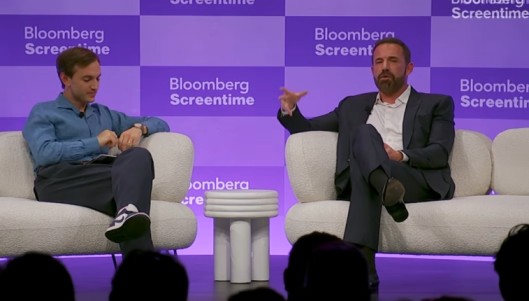
In this wide-ranging interview with Bloomberg’s Lucas Shaw, Ben Affleck opens up about founding InterPositive, the AI filmmaking company Netflix acquired, and why he believes AI will be additive rather than destructive for Hollywood. Affleck also discusses his new Netflix thriller Animals, the Joe Rogan clip controversy, and how Artists Equity is pushing performance-based compensation and residuals to realign the economics of the film industry. Read the full transcript of the interview below:
Why Ben Affleck Started an AI Company
LUCAS SHAW: (00:00:00 – 00:00:15) You are identified as the CEO of Artists Equity. You have a movie coming out that I want to talk about, but I want to start with InterPositive just because I think a lot of people were maybe not confused but thrown when they found out that you had not only started an AI company, but that Netflix was buying it for a bunch of money.
BEN AFFLECK: (00:00:16 – 00:00:30) It’s the reaction I get anytime I seem to do anything that remotely resembles achievement. It’s a vaguely baffled “is this guy? You got to be kidding me.” Well, you—
LUCAS SHAW: (00:00:30 – 00:00:45) one of the reasons among many I wanted to talk to you is because even prior to that, you had said a lot of very intelligent things about AI and seemed like someone who had been spending time doing the work trying to figure it out. So when and how did you decide to start a company, and what was the goal?
BEN AFFLECK: (00:00:47 – 00:04:19) Well, I’ve had a sort of interest in technology and trying to build— and a number of failed attempts to build companies as a sort of a tandem life going back to the early ’90s, predating most of people’s lifespan here. When I tried to build a nonlinear editing company with PCs to— because Avids are too expensive, that didn’t work because the drives were too slow and they dropped frames.
And then a few years later, as the— but I was always somebody who built computers and liked to play with them and like to program them, mostly for games and stuff like that. But I was always interested in it. And then as filmmaking segued from analog to digital and they started working with the moving image started to be mostly an array of numbers called the tensor. That became part of the visual effects workflow. Machine language is part of that. I learned Python. And so I have had an ongoing relationship with that technology.
I started a company called LivePlanet with Sean Bailey and Matt Damon in 2000, where we did Project Greenlight, and we did a bunch of shows that were new media and old media. And the whole thing was, how can you make money advertising online. There’s not enough people. And we were very proud of us. We said, “we have 40 million people watching a television show. You should be—” but the truth was, it was an interesting idea. And we did some interesting stuff. And I got some exposure to what it meant to raise money and start a business.
And so when I was— I started— had a small visual effects company. And some of the people that I was working with there said, “you should see what Google’s doing with Transformer. And there’s this— then there’s this company OpenAI, and they have this text-to-image thing.” And as I was telling you before, my life has— I’ve learned to take advantage of the opportunities my life has afforded, which is essentially, probably inappropriately, I find often I’m able to just pick up the phone and say, “hi, I’m Ben Affleck, can I just come in and see what you’re doing?” People are like, “sure.” Still baffles me, but nonetheless Went in, looked at what they were doing.
At first kind of had a heart attack because I was like, “holy—” I called Matt Damon, I was like, “dude, we have to do as many movies in the next few years because we’re finished.” Went back, looked at it, and then started saying, “well, hold on a second, why isn’t this working in the way that I think it should work?” And it was a very strange thing to realize that I was dealing with researchers and scientists who were so incredibly smart in this one way. I had so little information about video and how it’s created or how it’s defined and how it’s captioned and how it needs to be organized.
And so having learned the lessons of the previous failed entrepreneurship and having raised money for Artists Equity already, I gambled on this notion that in order to do this in an ethical way and in a way that could take this technology and actually make it work hand in glove with artists in this community, that where there are very fixed, longstanding relationships around likeness and so forth, we had to create our own dataset.
So I raised the money, I shot for about 8 months with a lot of cameras and a lot of equipment and created a dataset that would serve as late-stage training for open models to do discrete tasks, sort of where the training code and the inference code were related to one another and geared toward actual specific tasks that would generate value. As opposed to, “oh, this is novel, that’s kind of cool, look what it can do.” But to sort of say it needs to hit these criteria. And I didn’t tell anybody about it, what they call—
How InterPositive Trains AI Without Using Other Filmmakers’ Work
LUCAS SHAW: (00:04:19 – 00:04:44) and when— sorry, when you were talking about— because you were using, I think, some language that maybe not everyone in the audience is going to know. So can you dumb it down ever when you’re talking? Because my understanding, and correct me if I’m wrong, is you have— you develop tools where you shot something, you would then train the model on what you had shot, and you could then use that to manipulate or adapt things that you had already made, right?
Is that—
BEN AFFLECK: (00:04:44 – 00:05:24) Exactly. The only additional element to understand is that, other models, in order to be a video model that’s successful, you just need a huge volume of video. Initially, it learns things like what is red, and then it learns more and more specific information. To get to the cinematic information, it’s the sort of last stage.
And in order to obtain that information, I was concerned that most of the models being used had trained on my peers’, people I know’s work, and I was uncomfortable with that. And I thought, that’s not really a viable business. So I sort of created that last layer, which was an understanding of cinema and cinematic components that did not need to be—
LUCAS SHAW: (00:05:24 – 00:05:30) And so how did you create the last layer without doing all of the Essentially copying of what came before it.
BEN AFFLECK: (00:05:30 – 00:07:04) Because open models, just like open language models, open video models are available to be trained on. So you just unfreeze the weights and you say, “okay, this stopped at step 8,631. Now here’s step 8,632.” So you could take existing open models that didn’t work very well and that weren’t cinematic, but that had just aggregated a bunch of social media footage or random video online, and teach them to meet cinematic standards in very specific ways.
Then, as you pointed out, we built the workflow, which is to say this is designed to train from a filmmaker while they’re making their movie. So rather than you have to expose what you’re doing to everybody to learn from, they retain the proprietary nature. In other words, they benefit from the learning that they’re creating. They train their own discrete model using the same technique we did just on top of that additional layer we had created. And it works quite well for the discrete movie that you’re doing.
And so it’s meant to not replace people, not eliminate— there’s— I don’t believe that there will ever be just sort of type it in and make a movie that people want to see. But the whole effort behind it was to do something ethical, to do something that did not displace people, but that allowed people in this economy, in this world, to benefit from this technology as opposed to sort of obscuring it And then watching it sort of come over the gates, and eventually there’s sophomores at Stanford making 12-minute movies that run on YouTube and just eat into our business.
Using AI on Animals
LUCAS SHAW: (00:07:05 – 00:07:09) Did you use it on your new movie, which is out in a couple weeks?
BEN AFFLECK: (00:07:09 – 00:07:53) I did. I used it for lots of things in that movie. I’m a little bit hesitant to point out what they are or even talk about it because in my business, we’re trying to foster the illusion of reality, right? It’s sort of like if you went to a magic show and the magician walked out and said, “just before I start, I want you to know there’s another bunny under here. This guy’s a plant.” It sort of ruins it, right?
So, but yes, we did use it. And in fact, I thought it was a good example because it’s a very human movie. There’s— it’s not in space, or it doesn’t have visual effects, but it allowed us to move in some cases more quickly, or allowed us really mostly in post-production to do things that would have otherwise not— we wouldn’t have been able to do.
Responding to the Cynical Take on the Netflix Deal
LUCAS SHAW: (00:07:53 – 00:07:58) There was a kind of a cynical take on Netflix buying your company.
BEN AFFLECK: (00:07:58 – 00:08:02) You’re kidding me. Which is online, and people were cynical. They were—
LUCAS SHAW: (00:08:03 – 00:08:12) that they bought it to basically provide cover for all the despicable things that they were going to do with AI. Because if they’re aligned with a reputable filmmaker, then nobody’s going to question anything.
BEN AFFLECK: (00:08:13 – 00:09:40) Well, that’s a very cynical view indeed. What I can tell you is that in my experience, in my ongoing capacity, one of the things about a company like Netflix is that they’re not really in a position to just sort of go ahead and do despicable things and alienate artists because they understand that they need to be in business with people. And so actually I feel that they’ve even been, as I’ve been part of all these conversations, super judicious about, “whatever you want to do, it’s totally up to you.” And I’m sitting down with directors going, “look, man, you can change the background here, you can do this, you can do that.”
And what I find is that filmmakers and people, once they sit with it and have a sense of control and a sense of understanding what’s happening, and it moves from this nebulous, abstract, terrifying alien, it’s going to kill us all like we’re paper clips and it’s going to wipe out half of white collar, all this propaganda, and they actually see what it is, it’s another form of computing that does tools and is a technological advancement that’s really in keeping with a long-standing series of technological improvements we’ve made in the film and television business, it’s like a switch. They go, “oh, great, wonderful.”
And it’s being used on films now where the same number of people, in fact, more people technically are being employed. And I think it’s— they are— they have been absolutely, in my view, true to their word of “we want to make what we’re doing better. We’re not trying to just slash costs or do heinous things.”
Which Parts of Hollywood AI Will Impact Most
LUCAS SHAW: (00:09:41 – 00:09:51) What if you are not as concerned about the impact of the technology as you were when you first started seeing things? What parts of the industry do you think will be most impacted, whether positively or negatively?
BEN AFFLECK: (00:09:55 – 00:11:19) From AI, you mean? Yeah, I assume. I think that what— that it’s complicated and expensive and difficult for generative AI to do this beginning-to-end actual filmmaking that we do, to the extent that I think actually it may end up being bounded by the constraints of physics and energy before you reach a place where it could actually do that. I feel this is one of the least likely domains to be disintermediated by AI.
When I worry about AI, I worry about my kids in school. I worry about 30% rise in the number of A’s given out at colleges over the last 3 years. I worry about learned helplessness. I worry about responsible use. I don’t worry about Skynet, and I don’t think that it’s going to take over this business in any meaningful way. I think it’s going to be additive.
Yeah, but I think someone has to actually step in and do it in a way where it is that you can’t just bury your head in the sand. And it needs to be incorporated. And it’s a lot of technologies, it requires sort of getting comfortable and getting familiar with And then immediately it’s knowable. You see all the ways in which it doesn’t work, all the failures, the sort of dumb nature of it in a lot of ways, and it becomes a knowable thing.
Why Ben Affleck Chose to Direct Animals
LUCAS SHAW: (00:11:20 – 00:11:23) So your new movie is Animals. It’s a lot of fun.
BEN AFFLECK: (00:11:24 – 00:11:32) Thank you. It’s a kidnapping movie, kind of a thriller, but it’s got some fun.
LUCAS SHAW: (00:11:32 – 00:11:43) Yeah. You seem to be fairly selective about what you direct. You’re not one of the directors making something new every year. So why did you pick to make this one as your next movie?
BEN AFFLECK: (00:11:44 – 00:13:12) I am, and that really has to do with the fact that when you act in a movie, it might be 4 weeks, 6 weeks, 10 weeks, something like that. Directing movies, it’s a year and a half of your life. And also, you have to be the most interested, the most involved, and the most passionate. If you’re not, it’s really doomed. And so I kind of have to choose things that I think are going to sustain my interest.
And in this case, what was really— I was passionate about— it’s an interesting story. I wanted to tell a story that, yes, it uses the sort of plot mechanism of what happens when something in your life that you care about so much is threatened. But what I was interested in is sort of the nature of morality as becoming increasingly performative, whether on social media or in politics. Most obvious example of that. And the ways in which that performative morality sometimes doesn’t comport with the way you see people actually behave. And more interestingly, what happens when that professed morality collides with something that you need urgently, and the way in which moral compromise is sort of accomplished most effectively when it’s personal and about having something to lose.
So it’s a— it is a sort of morality tale, but really at the heart of it, honestly, it’s about marriage. It’s about a couple that’s married. It’s about what does it mean to have a real marriage? How intimate do you have to be? How vulnerable do you have to be? Their child is kidnapped and this person comes in. The first thing she says is, “okay, you two, husband and wife, need to tell each other all the secrets that you’ve ever kept from each other.”
LUCAS SHAW: (00:13:12 – 00:13:14) And spoiler, one half does not tell all the secrets.
BEN AFFLECK: (00:13:15 – 00:14:16) Yes. So shockingly, some people aren’t always totally forthcoming. Yeah. And really, I mean, to give a little bit away, what I thought was a really interesting proposition was to take it to the place of a couple who isn’t really able to be completely nakedly honest with one another until they kind of have nothing to lose. They almost feel like the marriage is over. And at that point, they actually can say— because look, we’re tuned to not— we don’t want to tell somebody that we want to love us the things about us that we think are unattractive or that they might find unattractive. And so there’s this sort of tension of, again, with the advertised self versus the real self.
And that— with those themes, I found really, really compelling. And I thought they’d make a good opportunity for an ensemble. And I had great partners in Kerry Washington, Steven Yeun. Gillian Anderson’s amazing in the movie. It was a— it’s— I’m really proud of the movie, and it comes out October 9th on Netflix. And if everyone in here watches it, that would be 0.0000001% of subscribers, but still No.
Spike Lee, High and Low, and Rewriting the Story
LUCAS SHAW: (00:14:16 – 00:14:24) The kidnapping part of the movie reminded me a lot of Kurosawa’s High and Low. Was that— I assume you were aware of that, or—
BEN AFFLECK: (00:14:24 – 00:14:40) It wasn’t— well, I became aware of that. I will confess that I had not seen High and Low. I’ve seen 3 Kurosawa movies, but not that one. What actually concerned me was that, when I— we were about to make it, we were 2 weeks from making it, and I heard, “Spike’s doing a kidnapping movie.”
LUCAS SHAW: (00:14:41 – 00:14:41) Yeah.
BEN AFFLECK: (00:14:41 – 00:16:30) And it was, “Spike Lee’s doing one? Yeah, for Apple and I with Denzel.” I was like, “with Denzel Washington?” These are guys who I look up to. And I thought, “whoa, how similar?” And they said, well, and I don’t want to read it. I don’t. And they told me the plot sort of. And I immediately called Matt, who was going to be an engineer. I was like, “dude, I don’t think we can do the movie.” I mean, I’ve been in the— I was in the one of 2 asteroid movies once. It was in Endwell for the other asteroid movie. And we might be the other asteroid movie here. And so, and I didn’t even want the appearance of, “well, hold on, does this have some relationship with that?” So we called it off promptly.
And what happened was that it sort of, the stuff that I was interested in, the stuff that I sort of just talked about thematically, is really wholly unrelated to that movie. And I got more, and so I rewrote it to go all the way down that direction, including sort of serendipitously a storyline about a— it’s part about, again, that the advertised truth versus the real truth. This is sort of West LA family that’s got this housekeeper, and she’s a family, and it’s all this sort of shared collective lie, kind of. And then she wants her boyfriend, who’s undocumented, that she wants them to hire him.
Anyway, this then creates a plot twist that involves an undocumented immigrant in LA. I had written this before the election, and it was the things where we were shooting and I was like, “okay, we’re going to shoot this Home Depot tomorrow.” And we go down there and then ICE would say, “you have to leave, we just did a raid here.” 3 times we got moved. So it was one of these things where it was kind of like the movie was parallel. And then there was a rather unusual mayoral primary here in Los Angeles, and I started feeling either this is terrible for us or it augurs well. But Yeah, we ended up—
Pretending to Run for Mayor of Los Angeles
LUCAS SHAW: (00:16:30 – 00:16:33) Mark Kimball was the Spencer Pratt of—
BEN AFFLECK: (00:16:33 – 00:17:06) I don’t know quite enough about Spencer Pratt’s campaign, but I’ll tell you one thing. I went and shot— I thought, we need to do campaign footage, and we were going to take the whole crew and do the whole thing. And I was like, “this is crazy. Let me just go to the Grove and take some hats and merch and go with Steven Yeun, my campaign manager, with some cameras, and let’s just tell people I’m running for mayor and see what they do.”
And I swear to God, not one person didn’t believe— they were like, “great. Yeah, sure. What do you care about LA?” “Well, I’ll tell you what.” Launch into their speech and they, and it was as if, “of course you’re running for mayor.” And I was like, “the world is fucking crazy.”
Setting the Record Straight on the Joe Rogan Netflix Comments
LUCAS SHAW: (00:17:07 – 00:17:25) I’m— I want to ask, there was a lot of attention when you and Matt went on Joe Rogan’s podcast earlier this year and Matt made those comments about sort of the Netflix movie. “They want you to regurgitate the plot 3 times and isn’t this horrible and blah, blah, blah, blah, blah.” I’m just curious, has Netflix asked you to do that?
BEN AFFLECK: (00:17:25 – 00:19:01) What is the reality of This is a very interesting case study and a phenomenon that I’ve found recurrent in my life, and it sort of relates to the truth in the story. Matt Damon and I went on Joe Rogan to promote our Netflix movie. In the context of having that discussion with Joe Rogan, what we were saying was there’s this perception, right? “How do you feel being on Netflix?” “It’s great.” This is perception that, “oh, people are in their living room and you have to do this, and they tell you that you have to tell the audience the plot.” And I said, “right, but even if you look at Baby Reindeer or Adolescence, where they have these long shots falling down, that’s clearly not true.”
We went on there to debunk this notion and explain to people why, in fact, our experience was utterly contrary to that. And yet somebody went ahead and did a pull quote, and it got picked up once, and it was “Matt Damon says Netflix makes you tell the plot in the first 5 minutes.” If you just stop and think about it, I’m in this movie, I’m directing. Even if that were true, do you think I would go on Joe Rogan and be like, “they made me put all this obvious shit”? It doesn’t even make sense.
Never mind the fact that if you look back on it— in fact, then we called a journalist and said, “hey, would you mind running a story saying that was not our intention?” I talked to him, Matt talked to him, we thought they were going to run it. I said, “what happened to that story?” He was like, “oh, he didn’t really feel like there was a story there.” I was like, “okay,” and then it keeps on coming up. This is how things get— and so here you are, an ethical, established person in this field, and you have no way of discriminating.
LUCAS SHAW: (00:19:01 – 00:19:08) Well, in fairness, I actually listened to the podcast episode because I did not want to rely on just a clip. So before this, I did listen to the first.
BEN AFFLECK: (00:19:08 – 00:19:11) You must have had some suspicion that this was the case.
LUCAS SHAW: (00:19:11 – 00:19:22) I struggle to see how— well, one, I don’t think that Netflix is telling a director of your stature this is how you should make your movie. There’s sort of—
BEN AFFLECK: (00:19:22 – 00:21:09) that is absolutely true. They would never do that. I don’t know that they— I’ve never met anyone who’s had a note that idiotic and brazen. And I’ve heard of a lot of idiotic studio notes. Idiotic studio notes long predate Netflix. This is a business with a long history of executives telling you to do the exact wrong thing that’s going to ruin your movie, and later standing there shaking your hand at the premiere when it’s a hit and you did exactly what they wanted you not to do.
So we have this— I mean, there’s a great story about Steven Spielberg on a movie. I can’t remember what it was. He was producing it, and they got these notes from the studio, and the note was something that was so outrageously bad. And Steven said, “I’ll handle this.” And he wrote back to the guy, “that was a great one. You had us all breaking up. Keep them coming.” They thought, but, but That being said, there’s absolutely no truth to that.
And of course, I wouldn’t do it. And in fact, they didn’t give me any notes, or so much so that I— they were like, “listen, we bet on you, we believe in you, you want to make this movie, go ahead.” It’s, I almost want a little more buy-in. I’m like, “but if it doesn’t work, we’re in this together, right?” It’s, “no, it’s going to be your fault.” But okay, I can take that. And The absolute honest truth is Ted has been the best and most amazing partner, and Bela as well. “We believe in you, go do your thing.” Nobody— I can promise you told David Fincher, “this movie that’s coming out to—” so it doesn’t really bear scrutiny.
It’s not really true. It got picked up. I have corrected it a number of times, but it’s sort of like the planes that land— that somehow the press doesn’t have quite the same voracious interest in stories that are, “hey, that other story is not exactly true.” As they do in the plane crashing or whatever.
Artists Equity and Performance-Based Compensation
LUCAS SHAW: (00:21:10 – 00:21:47) With Artists Equity, I am— I’m curious because you’ve made a kind of a point of pushing for residuals, and it’s part of, I’d say, a broader sense in Hollywood that there would like to be a return to some kind of performance-based compensation, that streaming warped this a little bit and it just became we are paid like everything is a modest success. So in your kind of ideal version, let’s say Artists Equity is really successful, other companies start copying. Well, what— how does the industry change? What does it look like that’s different?
BEN AFFLECK: (00:21:47 – 00:24:22) I can tell you because we did— we were able to implement that model on The Rip. The reason why it’s not actually— wasn’t used on this movie is because of the story I told you before. This movie was actually set up prior to The Rip, before I was able to get this accomplished. And where it came from was my frustration in participating unofficially in the discussions around the work stoppage and finding there was a lot of willingness, and particularly on the part of Netflix, around transparency, around performance-based incentives. And the not— and it was frustrating, because that was a hard thing to resolve.
But I thought, okay, this appetite is still there. We have this project, and what I’d like to do is essentially say to people, make it a little bit more affordable to make movies, which it does need to be. We have a sort of vestigial structure that we’ve inherited from the ’30s and ’40s that sort of assumes a lot of the same constructs that don’t even really exist now. But I want people to be able to make a living. In fact, I’d like them to be able to be aligned. I would like the shareholders of a company and the actors and the director and everyone on the crew to have exactly the same goals, because I think that’s the optimal approach.
However, as it works now, that’s not really the case. We have very different goals. Some— these guys want to go to lunch because they don’t, they want their overtime, so they may be taking a little bit longer. They don’t care about the value of making this close-up work really well. The director sometimes cares about how big his trailer is or how big an explosion it is because of their own ego, and they’re not They’ve already been paid. They’re not connected in any meaningful way to the shareholders who invested hundreds of million dollars in their movie.
My idea is let’s put us all on the same page, which is to make a great movie. And if the movie’s great, let’s believe that that will be successful. And let’s believe that if it’s great and it’s successful, then we’ll all get paid. Because we also have a history of sort of— there’s an old joke in Hollywood about what did the producer say to his kid on Christmas morning? “We’ll get you on the next one.” It’s that history has taught people to not believe that and take the cash up front, which is why you have very different way of building businesses in Silicon Valley than you do here.
So what we instituted was a model that said, we’ll take a little bit less, but at the point where you sort of break even, what you’re underwriting to in terms of viewers, we’ll recoup. And in the event that there is success beyond that, there should be additional compensation. And it’s a model that I think if it were implemented across all of streaming, they’d probably save 30% on their content spend, which that’s $2.4 billion, I think, of $8 billion. Right. That’s— I think. Right.
LUCAS SHAW: (00:24:22 – 00:24:24) Anyways, whose content spend are we—
BEN AFFLECK: (00:24:24 – 00:24:25) That’s Netflix.
LUCAS SHAW: (00:24:25 – 00:24:29) Netflix at $8 billion a year? No, no, no. They’re at $20, $21 billion.
BEN AFFLECK: (00:24:30 – 00:24:32) But that may not— that’s not movies, right? Oh, no.
LUCAS SHAW: (00:24:32 – 00:24:34) Yes. Sorry. Yes. That’s just total.
The Artists Equity Independent Film Fund
BEN AFFLECK: (00:24:34 – 00:25:58) Right. So I’m just thinking small. And so if you were to And so my hope is not only to establish this model, and it was successful so that we were able to actually have people get paid, which is important to actually find out that it’s real and it’s not “we’ll get you next year.” The hope now being, and this is what I’m in the process of trying to do, is institute this on an ongoing basis so that people are both united. We all give a shit that we do something really good. We’re going to pitch in a little bit together.
And we care about this shared vision, and in success, it’s going to rain money on everyone’s head, and if it doesn’t, it’s not, because I did this movie Gigli, and they paid me $12 million, right? I didn’t give it back, you know what I mean? But it didn’t really seem fair to me at times, ’cause they got wiped out. It doesn’t, that’s just a misalignment that, to me is not particularly wise or sustainable, particularly when it’s gotten harder to make theatrical movies, there’s more of a risk, and you can take more of a risk if you manage downward the capital that’s at risk.
And so the other model that we’re doing, because we’re announcing this Artists Equity independent film fund for theatrical, is we treat the actors and directors, what they call above the line, and the writers and the producers as pure investors, right? You are not with arcane—
LUCAS SHAW: (00:25:58 – 00:25:59) You take nothing upfront.
BEN AFFLECK: (00:25:59 – 00:27:51) You take nothing upfront but whatever the scale guild mandatory minimums are. But you are actually treated and paid dollar for dollar right next to the financiers and the investors. And by the way, it was not that difficult to raise a fund on the— that was rooted in those principles because people really understand that. It seems fair.
It also means that your talent, who you count on for a lot of earned media when you want to promote your movie at the time when the revenue is actually going to come in, when it’s in the box office, and then the obviously subsequent PVOD, SVOD, and the whole tale of it Most of the time we’ve already been paid as soon as the movie wraps. So if you don’t like the movie or you don’t really want to show up, it’s, “nah, I’m not available, I’m doing another movie.” I mean, I can’t tell you the number of times I’ve gone through this.
These are very highly paid people, but if the best predictor of somebody’s behavior is probably their incentive, and when it’s your money alongside with somebody else’s, you’re— I believe we should be fair and you should be entitled to it and you should get very rich in upside and success, but people should be aligned. And that way, I think your talent promotes your movie. Maybe they go the extra mile, maybe they’re posting it on all their social channels or doing extra shows.
So by instituting some of these changes— look, I’m not going to change the whole world, but I would like to say, look, you can establish this model, it can be done a different way. In the same way that InterPositive is to say, look, you can integrate AI into a workflow with human beings and human artists doing exactly what you’ve done and do it more efficiently and do it better, right? That there is that model. It— there is— it doesn’t have to be this binary, zero out the human beings, or not model, which just seems to me to be a crazy thing to go around and pitch people. Because how many products do you want to use where the pitch is, “we’re going to annihilate you, buy this”? They don’t really stir enthusiasm.
Dream Collaborators: Directors and Actors
LUCAS SHAW: (00:27:53 – 00:28:01) The Red Sox lost, so it killed my final question for you. So I’ll ask—
BEN AFFLECK: (00:28:01 – 00:28:01) thanks.
LUCAS SHAW: (00:28:02 – 00:28:08) Who is one actor you most want to direct and one director for whom you most want to act?
BEN AFFLECK: (00:28:09 – 00:29:03) Oh boy, there are so many directors that I really admire. I would love to work for Cuarón. I mean, yeah, Scorsese, Chris Nolan. That list is actually embarrassingly long because it just reveals how many of them haven’t hired me so far.
And actors that I want to direct, I mean, again, the list again, but I mean, there’s Denzel Washington, for example, maybe in a— not in a kidnapping movie, but Meryl Streep. I mean, the great joy— we were talking a little bit before— of my life and the real fortune is I’ve had the opportunity to meet and be around and be exposed to interesting, incredible people who’ve made me better and smarter and who it’s just sort of a privilege to spend time with. And there’s no shortage of that, folks, in my business or in here, or that it’s not just limited to this business. But, yeah, there’s a long list.
Related Posts