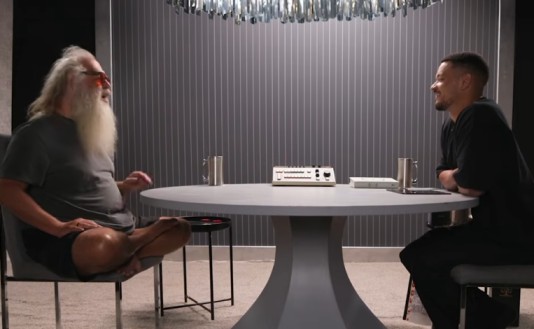
EDITOR’S NOTE: Rick Rubin has spent four decades producing some of music’s most defining records, from Def Jam’s earliest hip-hop to Adele, Johnny Cash, Kanye West, and Jay-Z, and along the way has become one of the most sought-after voices on the nature of creativity itself. In this wide-ranging conversation, Rubin talks about “indefensible” ideas, Transcendental Meditation, his depressive episode at 33, and what artificial intelligence can and cannot do to the creative process. This interview episode was premiered September 21, 2026.
TRANSCRIPT:
STEVEN BARTLETT (00:01:57 – 00:02:34): I’m going to start, Rick, where my curiosity is.
RICK RUBIN (00:02:34 – 00:02:35): Yes.
STEVEN BARTLETT (00:02:35 – 00:02:40): How would you self-categorize or self-identify in terms of your profession?
RICK RUBIN (00:02:40 – 00:02:44): I would say I’m involved in art and creativity.
STEVEN BARTLETT (00:02:45 – 00:02:46): And what is your involvement in art and creativity?
RICK RUBIN (00:02:47 – 00:03:24): Might be as a coach. It might be as a collaborator. It might come up in a film project, or it might come up in someone who has a startup who wants to talk about what are the things, creative solutions, any problem that we have or anything we want to get better at, there’s usually a creative path to improve, or at least to test to see if there are other ways around. Often the accepted version of how to move forward is another limitation.
Finding Solutions, in Music and in Business
STEVEN BARTLETT (00:03:24 – 00:03:53): I’m very curious about your principles as it relates to finding the solution, whether that’s in business or whether it’s in music. I’m really interested in if there’s any similarities in the process of finding a solution, because I’m an entrepreneur, I’m a podcaster as well, I do investments all day, every day. I’m in the pursuit of a solution to a problem, a people problem, a creative problem. Do you have any high-level principles that are broadly applicable irrespective of the type of problem you’re solving?
RICK RUBIN (00:03:53 – 00:05:19): I’ll tell you an interesting one. A word I’ve been thinking about lately is indefensible. Indefensible is a funny word because it’s a really pejorative word. It’s a strong pejorative. If something is indefensible, it’s not just bad, indefensible is really extreme.
I’m thinking that in making art, indefensible is actually a good thing. Maybe not only a good thing, maybe a necessary thing, that you take things to the extreme that are indefensible. I can’t tell you why, because it’s beyond reason. So I’m in that camp of reason is a tiny sliver of how decisions get made, and I would be much more in the camp of intuition, or maybe some sort of guidance from the universe, openness to being guided by something more, the creative force of the universe. You could call it God. I call it God. You’re not required to.
The Vibe Coding Meme
STEVEN BARTLETT (00:05:20 – 00:05:26): What art that you’ve been involved in creating would you define in the moment as being indefensible?
RICK RUBIN (00:05:27 – 00:08:30): A little over a year ago, there was a meme about vibe coding. The way it started was, something new happened. A guy named Andrej Karpathy coined the term vibe coding. I didn’t know what it was. That same day that he coined the term and tweeted about it, someone put a picture of me wearing headphones with my eyes closed, hand on a mouse. That image became associated with vibe coding. Had nothing to do with me. I saw it. I didn’t know what it meant. But then over the next few days, friends started sending me hundreds of this image associated with vibe coding in all different ways.
I thought, the old me, pre-Creative Act me, would have laughed and moved on with my life. One of the things I learned through working on The Creative Act, one of the things it talks about a lot, is we’re given information all the time around us. There are all these opportunities or invitations being made all the time. In the past, if someone told me about a movie that sounded like it wasn’t for me, I would ignore it. But if two or three people say, you might want to see this movie, even if it’s not interesting to me, it’s almost like the universe, some too much energy behind this. So this was an example of a lot of energy coming towards me relating to vibe coding. I don’t know what it is. And I thought, okay, how do I participate? If I want to participate in this thing that’s going on, an experiment, a creative experiment.
I thought, okay, I’m going to write a joke tweet related to vibe coding, and thought about it and came up with, tools will come, tools will go, only the vibe coder remains. Typically the tweets get 10,000, 20,000 views. I looked the next day and this joke tweet has a million and a half views. It’s like something’s going on. It was an indefensible act. There was no reason for me to do it, but I’m feeling this energy coming at me from all of these different directions. I participate. I answer the invitation, comes back, there’s interest. It’s like, what would be the next step? And the next step is, well, I still don’t really know what vibe coding is. Maybe I’ll write a book about vibe coding. I put aside all of my real work, my professional work, to dedicate myself to this book on vibe coding. Again, I couldn’t explain it. I couldn’t tell you why. I can’t say it was a good idea, none of those things. I was following a calling, feeling like I was being invited to participate in this thing, and this is the way that I could answer the call. So I did.
Resisting Labels
STEVEN BARTLETT (00:08:32 – 00:08:38): In so many parts of our life, we might get that invitation to participate in something that is none of our business.
RICK RUBIN (00:08:38 – 00:08:39): All the time.
STEVEN BARTLETT (00:08:39 – 00:08:47): And we usually say no because it’s not what’s on our business card.
RICK RUBIN (00:08:50 – 00:08:50): Yes.
STEVEN BARTLETT (00:08:50 – 00:08:57): I’m thinking about this idea of how one resists their label so they can capitalize on all the callings, so they don’t miss important points.
RICK RUBIN (00:08:57 – 00:09:08): Any label that you put on yourself or that’s put on you makes you smaller. No labels apply. We are beyond labels.
STEVEN BARTLETT (00:09:10 – 00:09:14): It’s tempting though, isn’t it? Because labels are nice shortcuts at cocktail parties.
RICK RUBIN (00:09:14 – 00:09:19): There are also no shortcuts. And I hope you don’t spend too much time at cocktail parties.
STEVEN BARTLETT (00:09:19 – 00:09:20): No, I don’t.
RICK RUBIN (00:09:20 – 00:09:21): Don’t worry.
STEVEN BARTLETT (00:09:21 – 00:09:26): I’m guessing what goes on there. Okay, so that’s interesting, this idea of sometimes following the indefensible.
RICK RUBIN (00:09:26 – 00:10:30): If you feel a call, even if it doesn’t make sense, for an artist to write a song and you really feel like this is really meaningful to me, I think no one’s going to like it, but I really feel it, I can’t defend it, that’s the best thing you can do. If you make something where you think this is for everyone, or they’re going to love it, it’s too easy.
The most interesting things are challenging. It’s challenging to you, it’s challenging to the people who see it. The things that are revolutionary, most of the things that I’ve fallen in love with over my life, creatively, when I first see it or first hear it, I might not like it at first because it’s too much, or I don’t have any context for it. The true revolutionary works, we don’t have context for.
Yeezus, Kid A, and the Cost of Reinvention
STEVEN BARTLETT (00:10:30 – 00:10:37): It appears to me, Rick, that sometimes things that are more of the same do bigger numbers.
RICK RUBIN (00:10:37 – 00:10:38): Maybe for a period of time.
STEVEN BARTLETT (00:10:39 – 00:11:05): I was thinking about two artists. One of them is Drake, who makes great music, makes hits, everybody loves him, we dance in the clubs to them. Then I was thinking about a record that you worked on with Kanye, Yeezus. I remember where I was when I first heard that. As a huge Kanye fan, I thought, here we go, we’re going to get more College Dropout. I put it on and I was like, what the f*** is this? But then I loved it.
RICK RUBIN (00:11:05 – 00:11:07): How long did it take? A while?
STEVEN BARTLETT (00:11:07 – 00:11:24): A while. It took a while. With Drake’s stuff, I tend to like it on first listen. But with that Yeezus album, I had to really persevere, and then I thought it was genius because it was a new paradigm. You worked on that album.
RICK RUBIN (00:11:25 – 00:11:43): Yeah. And that’s a good example of, it was a sort of an anti-hip-hop album, and that was done intentionally. We went as far as we could into an indefensible realm.
STEVEN BARTLETT (00:11:45 – 00:11:48): But what about the numbers? What about the sales? What about the record label?
RICK RUBIN (00:11:49 – 00:11:50): Is it an important album to you now?
STEVEN BARTLETT (00:11:51 – 00:11:51): Yeah.
RICK RUBIN (00:11:51 – 00:11:53): Okay. Did its job.
STEVEN BARTLETT (00:11:55 – 00:11:58): Those near-term incentives though. We need Drake, we need you to make another.
RICK RUBIN (00:11:58 – 00:15:12): We never consider near-term incentive ever, at any point in time. Never once. Never a consideration. It doesn’t exist. We’re making things forever. We’re making things that are truly personal to us. And if it’s truly personal to us, if someone doesn’t get it, they just don’t get it yet. Or maybe they’ll never get it. And it’s fine, because I know this is my diary entry. Can someone else read your diary entry and tell you it’s wrong, it’s not good enough, or it’s not true? It’s not how you see the world. Everything we make is a diary entry. Everything we make is our personal true expression. The reason we’re saying it is to show, you see it like that, I see it like this. And with that information, you can see, ah, I never considered that before. The world is bigger than I thought. It’s not just more the same, it’s not just more numbers. And the more numbers game is a shorter-term game.
I remember I made an album with Linkin Park, who at the time were probably one of the biggest bands in the world. They’d made three albums that were, I would say, stylistically very similar, rap rock. There was a rap rock movement, Korn, Rage Against the Machine was first, Korn, Limp Bizkit, all these bands, and Linkin Park was probably the last of that wave of music. They were wildly successful doing that music. When we started working together, there was a choice. We could continue and do the next one in that same style, which the audience would love, and it would be easy to do. Or we could be true to where the band was in this moment of time, about 8, 10 years after they started, and be free to find the new sound. When we did that, probably half of the audience didn’t like it, and half of the audience loved it, and new people came along, and they set themselves up to have a much longer career of making the things that they wanted to make. Whereas they were already on the tail end of a genre that was dying. Again, none of this was thought about at the time.
Another example I think of is Radiohead’s Kid A. I remember when Kid A came out, I didn’t like it at all. I loved OK Computer, they were my favorite band. And then they made this album, Kid A, totally different, and it really alienated me. Today, that might be my favorite Radiohead album.
STEVEN BARTLETT (00:15:13 – 00:15:14): It feels like a risk.
RICK RUBIN (00:15:15 – 00:15:18): Yes, but all of the best things involve risk.
STEVEN BARTLETT (00:15:19 – 00:15:27): Because I’m sure you’ve also got examples where someone followed that thesis of listening to what they wanted to make and not thinking too much about the audience, and it didn’t work.
RICK RUBIN (00:15:28 – 00:15:28): Of course.
STEVEN BARTLETT (00:15:29 – 00:15:32): And they could have just made a hit and paid off their mortgage.
RICK RUBIN (00:15:32 – 00:15:48): It’s not so interesting. I know it’s not so interesting to me. It’s a different game. That’s the investment commerce game, and I’m in the art game. Nothing wrong with that other game, it’s just not my game.
STEVEN BARTLETT (00:15:49 – 00:15:59): Which one leads to more success over the long term? Defined by, let’s say, the subjective opinion of people that it was good, and money.
RICK RUBIN (00:16:00 – 00:16:37): All I can say is that I’ve been making things for 40 years. I have never done it the way you’re suggesting. I have always taken the risk. I’ve always made my favorite thing. I’ve always supported the artists in making their favorite thing. And luckily, a lot of revolutionary things have happened from that, things that probably inspired other artists to be more free and more true and more honest and take bigger risks to make something more interesting, made the world a more interesting place.
Jay-Z, “99 Problems,” and Def Jam
STEVEN BARTLETT (00:16:38 – 00:16:39): Why do you think these people call you?
RICK RUBIN (00:16:41 – 00:16:43): I think it’s probably different for different artists.
STEVEN BARTLETT (00:16:44 – 00:16:45): Why did Jay-Z call you?
RICK RUBIN (00:16:46 – 00:17:13): The time that I first met Jay was when he was making The Black Album, and he was planning on retiring, and this was going to be his swan song, his final album. Turned out not to be, but that was the plan. He asked his 10 favorite producers to each make one track with him, and ours was called “99 Problems.” It was a really fun experience to make.
STEVEN BARTLETT (00:17:14 – 00:17:20): What an iconic record that is. What was your contribution to that record? Everybody knows that record.
RICK RUBIN (00:17:20 – 00:17:26): We created the track and we played it for Jay and he liked it. Then he wrote the words and rapped on top of it.
STEVEN BARTLETT (00:17:27 – 00:17:29): So you produced the music?
RICK RUBIN (00:17:29 – 00:17:30): Made the music.
STEVEN BARTLETT (00:17:30 – 00:17:34): Made the music. I read that you gave him direction in terms of the lyrics as well.
RICK RUBIN (00:17:34 – 00:18:03): When my friend Chris Rock had the idea, Ice-T had a song called “99 Problems” that was the opposite. It was, “I have 99 problems and a b**** ain’t one,” and then it’s a story about the girls. Chris said, “99 Problems” would be a great hook, and it doesn’t have to be about the girls. Then I suggested to Jay, make it about the problems. And that’s what it was.
STEVEN BARTLETT (00:18:04 – 00:18:08): And business people, startups, they seek your advice as well? Entrepreneurs?
RICK RUBIN (00:18:08 – 00:18:09): All the time.
STEVEN BARTLETT (00:18:09 – 00:18:10): And what are they seeking?
RICK RUBIN (00:18:11 – 00:18:13): Let’s talk about “99 Problems” a little more because it’s an interesting story.
STEVEN BARTLETT (00:18:13 – 00:18:14): Sure.
RICK RUBIN (00:18:14 – 00:19:12): Jay-Z was signed to Def Jam Records. Def Jam Records was the label that I founded. I was no longer at Def Jam when we made “99 Problems.” I remember giving it to the people at Def Jam, and the person who was the president of Def Jam at the time listened to it and said, this is great, it’ll never be a single, it’ll be a great album track. I remember thinking, okay. The president of the label that I founded was saying this could never be a single because it doesn’t sound like everything else on the radio. That was the old way of thinking, you make things to go on the radio that sound like everything else on the radio. But if you do that, who cares? It’s just more of the same. So “99 Problems” didn’t sound like anything on the radio. So when it eventually got on the radio, it had a big impact.
System of a Down and the Station That Refused to Play It
Another band I work with is called System of a Down.
STEVEN BARTLETT (00:19:12 – 00:19:12): Yeah, I remember.
RICK RUBIN (00:19:13 – 00:20:41): I remember bringing their record to Kevin Weatherly at KROQ, which is the alternative rock station in California. If they played it, all of the other alternative rock stations in the country would play it, they were the leading station. This was a California band that was starting to get popular in the clubs, maybe 200 people would come, but the club would sell out. Good sign. I think the song was called “Sugar.” I brought it to Kevin Weatherly, played it for him, and he said, not only will we not play this record, we will never play this band on our station. Because it sounded insane, it didn’t sound like anything else on the station. One year later, number one song on the station, most requested. And two weeks ago, I saw System of a Down sell out 80,000 seats in a stadium in Paris, two nights in a row.
I can’t tell you how or why this works. I can’t tell you that there’s anything to follow, but I will say we made the things that we loved. We never questioned if anyone else was going to like it. We never questioned what the audience was going to think. We never questioned where does it fit in the market. None of those normal conversations. We made our favorite thing. We took it to an indefensible level, as far as we could go. And luckily, it worked out.
Learning Transcendental Meditation at 14
STEVEN BARTLETT (00:20:42 – 00:20:48): Is there a way to get clearer on what you love? This sounds like a strange question, but meditate.
RICK RUBIN (00:20:48 – 00:20:59): I learned to meditate when I was 14, and I think having TM as a grounding element in my life—
STEVEN BARTLETT (00:21:00 – 00:21:00): TM?
RICK RUBIN (00:21:01 – 00:21:51): Transcendental Meditation. That was the first type of meditation I learned when I was 14. It changed me. I know this because I stopped meditating when I went to college, and then when I moved to California right after college, I started meditating again. Somewhere I knew it was a big decision, and somewhere I knew there would be a right moment to start. It took several months before I actually sat for the first meditation after not doing it for several years. In that first meditation, I realized, this is very familiar to me. This is a big part of who I am, even though I haven’t done it in five years. It’s a big part of how I see the world, the fact that I got to do that from a young age.
STEVEN BARTLETT (00:21:52 – 00:21:55): To understand who you are with it, I’m going to ask you who you would be without it.
RICK RUBIN (00:21:56 – 00:23:01): I don’t know. I’m curious. I’m happy that I don’t know because I like having the practice, but whether I continue a practice or not, I’ve done enough of it over the course of my life that I’m there. When I meditate more, it gets deeper. But even if I don’t meditate, Maharishi, the teacher of Transcendental Meditation, Maharishi Mahesh Yogi, says every time you meditate, it’s like making a deposit in the bank. So it builds up. That was rhetoric before, but in my experience, I got to see it’s not rhetoric. I actually had this experience and it changed the way I saw the world. You see beyond the surface. You can see the depth underneath. For me, the things on the surface are not so interesting. I’m interested in the depth behind it.
STEVEN BARTLETT (00:23:03 – 00:23:06): So my first question would be, what is Transcendental Meditation?
RICK RUBIN (00:23:06 – 00:24:26): It’s a mantra practice that’s done silently. You do it sitting with your eyes closed. You learn it from a TM teacher, I can’t teach it to you. You close your eyes, and then the mantra is a sound vibration that gets given to you. I was given mine when I was 14. I have never uttered it out loud since that time. I’ve never shared it with anyone, and that’s part of the training. It’s like a private sound, and you engage with this sound in the way that you’re taught, 20 minutes, at least once a day, typically twice a day. I would do it right when I woke up in the morning and then again before dinner. Those would be the two windows.
When I lived in California and I was working in different recording studios, I meditated with Tom Petty and Johnny Cash and different artists before sessions. That would be part of our practice. Red Hot Chili Peppers, we would sit and meditate together before sessions. I’ve had this experience for a while in my life, and it’s probably the most profound thing I can mention, that’s a learnable, practicable action that really changed who I am.
STEVEN BARTLETT (00:24:27 – 00:24:37): How did you know it was efficacious? How did you know it was working? What is the measure that this practice is worth that investment in time, in your view?
RICK RUBIN (00:24:38 – 00:24:51): The only proof that I had was getting away from it and coming back to it. I recognized it in that first meditation back, how deep and connected I was to this thing.
STEVEN BARTLETT (00:24:52 – 00:24:56): And I’m guessing this unlocks a deeper level of creativity and ideas.
RICK RUBIN (00:24:56 – 00:25:01): Everything. Everything. Deeper understanding.
STEVEN BARTLETT (00:25:02 – 00:25:42): People often hear that meditation in various forms is beneficial. Very successful people sit here all the time and say it’s so central to why they’ve been able to do what they’ve done. And then there’ll be people that think, well, I sit there for 10 minutes, my brain is very busy, I’ve tried it once, it didn’t really work, and then they move on. And I study some of the great creatives in the world, the great visionaries, people that could see round corners in an atypical way like Steve Jobs, and there’s always a meditation practice at the very heart of their brilliance. I don’t currently have a meditation practice. My wonderful fiancée does. She does it every morning for 20 minutes. She’s a breathwork practitioner, so it’s her whole world.
RICK RUBIN (00:25:43 – 00:25:44): And tell me what she says about it.
STEVEN BARTLETT (00:25:45 – 00:26:05): She says it unlocks a deeper level of calm. And I don’t mean calm as in stress, I mean a deeper level of groundedness. And she says she feels more connected. In her context, I think that’s more of a spiritual thing. She feels more connected to the universe and others.
RICK RUBIN (00:26:06 – 00:26:20): As far as the creative experience goes, a spiritual connection is a big part of that. It’s just the nature of how it works. It’s not an intellectual process. It’s a spiritual process.
STEVEN BARTLETT (00:26:21 – 00:26:27): What is the mechanism that is causing these results that you see? From a biological perspective?
RICK RUBIN (00:26:27 – 00:26:57): I couldn’t answer that in the way that you would hope. But I will say, I think it allows you to let go of all of the ordinary concerns. I also have a question, which is, if you live with a person who says this practice is so impactful on her life, I’m questioning why you at least haven’t tried it with her for a month to see how it would—
STEVEN BARTLETT (00:26:57 – 00:27:02): That’s a great question. Are you going to get me in a lot of trouble? No, it’s a good question. I have no good answer for it.
RICK RUBIN (00:27:02 – 00:27:25): It’s, what it has to do with, is you’re not looking for cues from the outside. You’re looking for cues on the inside. What lights you up? What are you excited to play for your friend? Not, what do you think this’ll do, you’re playing it for your friend like, wow, can you believe something like this exists in the world? How cool is that?
Working Backwards vs. Believing in Something
STEVEN BARTLETT (00:27:26 – 00:28:15): The distinction that I’m trying to make is, often if you read business books or entrepreneurship books, when they’re talking about innovation, when they’re talking about the great companies like Amazon, or I heard Sebastian, who’s the CEO of Klarna, say it the other day, they spend a lot of time thinking about the customer, the customer’s problem, and they work backwards, they call it, to the answer. So they’ll zoom in on Rick’s world and say, Rick has these problems, and they’ll work backwards from there to an answer. That’s how Amazon say they built the platform. And one of the quotes that’s quite famous with Jeff Bezos is he bets on things that he knows won’t change. He says, no one in 10 years is going to come up to me and say, I wish my package would take longer. So he can double down on that as solving a customer problem. Does that sit in contrast to what you’re saying, or is it the same thing, or is it a different type of work?
RICK RUBIN (00:28:16 – 00:28:40): I’ll start by saying, if you look at the history of Amazon, it lost money for probably 20 years. It was considered one of the worst investments until it wasn’t. They kept doubling down on what they believed in. It wasn’t working. The audience showed it didn’t work. The model showed it didn’t work, but they stuck to what they believed and it changed the world.
STEVEN BARTLETT (00:28:41 – 00:28:43): So it’s the same thing.
RICK RUBIN (00:28:44 – 00:28:54): It’s doubling down on what you believe in, when all of the metrics are showing you it’s not working. That’s the story of Amazon.
Creativity Is Beaten Out of Us
STEVEN BARTLETT (00:28:55 – 00:29:25): Do you think people have different levels of ability, if we take practices like meditation aside, to cultivate that or listen to that internal voice? I sit here and interview these great founders, and it appears that some people are just inherently more creative than others. Some people are in the analytical part of their brain and they need one plus one to equal two all the time. I’m wondering if there is an inherent difference in creativity.
RICK RUBIN (00:29:26 – 00:30:06): I think that creativity is beaten out of us over the course of our lives. We go to school, we’re told to repeat back what we’re told. We’re told to sit in a chair all day. Our spirits are broken by institutions. We’re not taught to be free creative thinkers. We’re taught to follow rules. The rules are not there to help us. The rules are there to control us. I’m suggesting we break free and express ourselves freely. That’s our purpose here on the planet, is to express ourselves freely. That’s why we’re here.
STEVEN BARTLETT (00:30:07 – 00:30:28): What you’re saying links to something we were talking about earlier, which is at a very young age, we’re taught that the things we make are a means to a particular end. And that end is promotions, pay rises, capital, success, job titles. In the creative process, are you saying it’s never productive to talk about how we’ll measure success and to try and optimize for that measurement?
RICK RUBIN (00:30:30 – 00:31:31): In the creative process, I tend not to think about those things. I can’t think of an example where we would want to use data. It’s much more about this internal feeling, and then the feeling we have when you play it for someone, when you share it with someone, whether it lights someone up. You can tell when someone really resonates with something. Sometimes the numbers don’t reflect that. You can have two things that are on equal footing commercially, yet one of them lights you up and the other one is, well, this gets the job done. They’re different. Long-term, chances are the one that lights you up is going to have more value to you, and you’ll be more willing to support that thing over time.
What Blocks Creativity
STEVEN BARTLETT (00:31:32 – 00:31:46): In your book, The Creative Act: A Way of Being, you talk about the things that block creativity. Thoughts and habits not conducive to the work. Believing you’re not good enough.
RICK RUBIN (00:31:46 – 00:32:29): That’s a big one. Someone at some point in time, you were singing and someone said, ah, you can’t sing, when you’re a kid, and that gets lodged in you. Singing is not something I can ever do. Or, you’re a terrible cook. Or, you’re not smart enough. So often the gifts that we have are stifled and smothered. We’re all creative. We may not choose to embark on making creative choices, but it’s on us, we can. We just have bad information. We’re told we’re not good enough and we believe it, and it’s not true.
STEVEN BARTLETT (00:32:30 – 00:32:51): When people say, Rick is a creative and Stephen is not a creative, what are they actually saying? What is that, in our culture, to be a creative? How are we misunderstanding the definition? We say creative for people who do a little bit of art and music stuff, not creative for Excel documents. What are we actually saying there?
RICK RUBIN (00:32:53 – 00:33:44): I think it’s a way to try to simplify the world. The world is complicated, and I think all of us can do anything. I’m not saying all of us could do everything to the best of our ability, better than anyone else, that’s a big part of it, is the idea of competition. If I want to play baseball, I know that I could get better at baseball. That doesn’t mean I think I could get good enough to play on the Mets, but I know I could get better, and I could train and get much better at anything I’m interested in. And as soon as we’re not capable of playing for the Mets, we think it’s not for us and we shut that off. We’re not doing a service to ourselves. We’re not becoming our best selves or really living up to our full potential as humans.
Comparison Is Always Apples and Oranges
STEVEN BARTLETT (00:33:45 – 00:34:15): It feels like a natural human instinct to compare in order to understand the value of anything. I feel like we do it when we go to restaurants. There are three steaks, the expensive one’s probably a bit much, the cheap one’s probably not good, I’ll go for the middle one. Seems like a way that humans take shortcuts, but we do it with ourselves as well. Are you saying we should get out of the business of comparison?
RICK RUBIN (00:34:15 – 00:34:56): Yes, because it’s always apples and oranges. If you were to ask, who’s better, Michael Jackson or Prince? I would say Michael Jackson is much better at being Michael Jackson, and Prince is probably better at being Prince. But you can’t compare what the two of them do. They do two different things. You mentioned Kanye West and Drake, there’s no competition there. They do two totally different things. What you get from each of them is totally different. I wouldn’t want from Drake what I get from Kanye, and I certainly wouldn’t want from Kanye what I get from Drake. It’s pointless.
STEVEN BARTLETT (00:34:57 – 00:34:58): Is either more creative?
RICK RUBIN (00:34:59 – 00:35:10): That’s for you to decide. The whole idea of competition between artists, it’s such a weird thing. Again, it’s back to who has a better diary entry. It’s ridiculous.
STEVEN BARTLETT (00:35:11 – 00:35:18): Feeling you don’t have the energy it takes, these are all things that are not conducive to the work.
RICK RUBIN (00:35:18 – 00:35:39): Yeah, I have that one sometimes. Feeling like I’m not up to it. I flew here yesterday from London. I’m tired, I’m a little jet-lagged. I’m going to show up and talk to you. Maybe it won’t be good. Maybe it’s better to just lay down, relax, and recover. But I’m here. I show up.
The Lazy Workaholic
STEVEN BARTLETT (00:35:41 – 00:35:45): You’ve referred to yourself as a lazy workaholic.
RICK RUBIN (00:35:45 – 00:35:47): Yes, it’s true.
STEVEN BARTLETT (00:35:47 – 00:35:48): What is a lazy workaholic?
RICK RUBIN (00:35:49 – 00:36:00): Most days, I would rather not do any of the things that I’m scheduled to do. And I schedule the things and I show up and I do what needs to get done.
STEVEN BARTLETT (00:36:01 – 00:36:09): Do you ever settle with creative work? The deadline for the record label is approaching, the work is not yet done, we’ll finish here and we’ll send it.
RICK RUBIN (00:36:11 – 00:36:42): I tend not to do that. I tend not to work on deadlines until we’re past the point. The first time we would ever establish a deadline is when we already know we’ve cracked the code. We know what this is going to be. We can see it. It may not be completely finished, but we have a good idea of what it is and how it’s going to work, and it’s maybe 90 percent done. Then we might set a deadline for that last 10 percent of finishing it. And that last 10 percent probably won’t make or break the project.
The Blue Statue That Turned Into a Red Painting
STEVEN BARTLETT (00:36:43 – 00:37:03): Part of what you accept when you pursue the creative process you’ve described, where it’s really about, do I like it, do we like it, is you will create things that are at some points just absolutely legendary and unlike anything else that exists. But part of the risk you take is you’ll make things that other people just don’t like.
RICK RUBIN (00:37:04 – 00:37:53): That’s all there is in this process, is you have an idea, you build it. You may learn along the way that the idea was maybe not the best idea, and it turns left, and you make, I’m starting out to make this blue statue, and it turns out to be this red painting. You don’t know that going in, but you discover it through the process, and it could take a long time. Other times you’ll think, I’m going to make this blue thing, you make it in five minutes, there it is, done. You can’t calculate that. You can’t anticipate what’s going to happen. But if I wasn’t doing this experiment, I would never get to the better thing. It happens all the time. And sometimes you build it and it doesn’t work for 20 years, and then it becomes Amazon.
Time Horizons and the Four Phases of Creativity
STEVEN BARTLETT (00:37:55 – 00:38:23): I’ve thought a lot recently about how time horizons change the work that you do. That’s also what I’m hearing there, because in that example you gave of the blue statue, if you were under a time horizon, you wouldn’t have the space for that exploration. In all of our lives, we apply time horizons. We say, this part of my career is going to be five years, and in those five years I want to achieve these things. How do you think about setting personal time horizons, but also creative time horizons?
RICK RUBIN (00:38:24 – 00:39:51): One of the things I talk about in the book is that there are different phases of creativity. The first phase is the seed phase, then is the experimentation phase, then is the crafting phase, and then is the finishing, completion, editorial phase. You can’t set a timeline early in that process. In the seed phase, you have to try a lot of things and it’s going to take as long as it takes. In the experimental phase, which is where you’re taking the seeds and seeing what they want to be, that takes time. And then in the crafting phase, it still takes time, because now you have the seed, you see what it wants to be, you’ve given it time to gestate, you see how it grows, and now you start trimming it and making it the way you see it. All of that has to happen before there’s any idea of a timeline, because until that time, you don’t really know what you’re making. It’s a dream.
Once you’ve gone through these three phases and you have this thing in front of you, it may not be finished, but you see what it is. You see it and it’s good, you’re excited about it. When I say it’s good, I mean it’s good to me. That’s it. That’s where it ends. I like it enough that I’m willing to show it to you. If I like it enough that I’m willing to show it to you, I like it enough to show it to everybody.
STEVEN BARTLETT (00:39:52 – 00:39:59): People will hear this as creative advice. I was hearing it as life advice, the seed phase of my life, the experimentation phase, the crafting phase.
RICK RUBIN (00:40:00 – 00:40:58): It’s the same. It’s all the same. And that’s why The Creative Act started with this idea of how to make things. And what I realized through writing the book is it’s how to be in the world. You either live your life to allow these things to happen or you don’t. And if you live your life to allow these things to happen, then you’re an artist. Even if you’re a businessman or a chef or a mother, you’re living your life as an artist. You’re embodying it, and it’s coming from you. It’s who you are, or it’s who you are in that moment. I’m showing you this beautiful thing as a reflection of how I see the world today. Tomorrow I may see the world differently. That’s fine. But when I share it with you, this is the best it can be in this moment.
Failure, Risk, and the “Real Job” Fallback
STEVEN BARTLETT (00:40:59 – 00:41:05): The reason I was asking this question is because sometimes the world might not like what you give it.
RICK RUBIN (00:41:05 – 00:41:05): Yeah.
STEVEN BARTLETT (00:41:05 – 00:41:31): A lot of the reason why people won’t take the risk to listen to themselves, to what they love, is because of the word risk. And with that comes, I might lose money, I might lose friends. If I quit this job and pursue that violin hobby and go to Peru with my violin, I’m going to lose friends, people are going to think I’m strange, so I’ll conform.
RICK RUBIN (00:41:32 – 00:42:54): Yeah. I’m saying you have to do all of those things, lose the friends, take the risk. I’m also saying, I’m not saying that if you go move to Peru and be the violinist, it’s guaranteed to work. And you may want to have an actual job to pay the bills while you’re doing that. That’s okay. The idea that it all has to be one thing, I have to do my dream thing and it has to be my hobby, my love, my profession, the way I support myself, doesn’t have to be. When I started making music, I thought I was going to have a real job and I’d make music and it would be my hobby. I would do it forever. Had no expectation that it could be a profession. It was a ridiculous idea. I did it because I loved it. While I was going to school, and while I was probably going to go to law school, I would have a regular day job, and I would do music as the love of my life. Luckily, I didn’t have to do that, but that’s what would’ve happened.
STEVEN BARTLETT (00:42:55 – 00:43:23): A lot of people at that age are told to follow their passion, find their purpose. A lot of people listening now would say, I’ve been told to find my passion, and when they look at their job in the factory, or wherever it might be, they go, okay, this isn’t it yet, but I will get there at some point later, and I will jump. So you’re saying don’t jump necessarily.
RICK RUBIN (00:43:23 – 00:43:59): There are realities of life that you have to deal with. I’m not saying ignore the fact that you have to pay rent, or say I’m happy living in my parents’ house until it works, that’s fine. I’m saying there are realities of life that have to be dealt with. Don’t put the pressure of that on your art, because then you won’t make the best decisions. You’ll make short-term decisions based on real-world issues that you have to deal with in that moment, that won’t support the long-term benefit of the real work you’re doing.
Role-Play: Coaching an Artist
STEVEN BARTLETT (00:43:59 – 00:44:05): I’m sure you’ve sat there in those moments where you’re trying to persuade an artist to follow themselves. No?
RICK RUBIN (00:44:05 – 00:44:07): I don’t try to persuade anyone of anything.
STEVEN BARTLETT (00:44:07 – 00:44:07): Oh, really? Okay.
RICK RUBIN (00:44:08 – 00:44:12): I wouldn’t use that word. I wouldn’t use the word persuade.
STEVEN BARTLETT (00:44:12 – 00:44:13): What word would you use?
RICK RUBIN (00:44:13 – 00:44:21): We talk about it. I ask, what do you hope to accomplish? And then I support that process.
STEVEN BARTLETT (00:44:21 – 00:44:32): Can we role-play? I pretend I’m an artist who wants to write an album. I am actually learning to DJ, I’ve been learning for four years. So I come to you and say, Rick, I want to make an album. What would the first questions be to me?
RICK RUBIN (00:44:33 – 00:44:39): Play me, of all the things you’ve made, play me your favorites. Let’s talk about it. I would listen to it, and then we would talk about it.
STEVEN BARTLETT (00:44:40 – 00:44:45): So I play you, let’s say it’s a house song. I play it. I say, this is my favorite.
RICK RUBIN (00:44:45 – 00:44:47): I would tell you whatever I think about it, honestly.
STEVEN BARTLETT (00:44:48 – 00:44:50): Honestly? Even if you thought it was terrible?
RICK RUBIN (00:44:51 – 00:46:30): Yeah, I probably wouldn’t say it in an unpleasant way, but I would probably ask more questions around it. Explain to me what it is that you like about it. How did you get to that? What equipment did you use? Was it fun making it? Was it a good experience? Have you played it for other people, what’s it like? What’s the feeling you get when you’re making it? What’s the feeling you get when you play it for a friend? Have you ever played it in a club, what’s that like?
I would listen to what you say and then we would talk about it. Often an artist will come to me, they’ll tell me exactly what they want to do and then say, I have no idea what I want to do, can you help me? It’s like they can’t hear themselves. There’s a barrier, it’s a little bit how therapy works. If you go to see a therapist, you might talk, they might not say anything, but through the talking, you start understanding what you believe, what you think, what’s going on in your life. You might have epiphanies just because someone’s listening. Most people are not used to being heard, really heard, deeply heard. Often you’ll say something to someone and they’re thinking about what they’re going to say next, they’re not really hearing what you’re saying. And I find if you really are there and listen to what someone’s saying, they tell you what they want to do. And then my job is to just help remove the roadblocks that they’re putting in the way of themselves to get there.
Self-Trust and Tasting the Pizza
STEVEN BARTLETT (00:46:31 – 00:46:37): And when they say what they want to do, but then ask you what they should do, is that a lack of self-trust?
RICK RUBIN (00:46:38 – 00:48:07): Yes. But that lack of self-trust is the condition of the world. That’s how we’re indoctrinated. Most people don’t trust themselves. And it’s a fine line, because there are the few people who might seem to really trust themselves and you think, oh, they’re egomaniacs. Usually when someone really comes off as wildly egotistical, it’s usually hiding some insecurities. It’s like a mask. So that’s dealing with someone who’s insecure and dealing with someone who’s overconfident, it’s often two sides of the same coin. We’re really looking for this middle place of reality, not what you’re afraid of about yourself, or what other people are going to think, but where are you really on this?
I often describe it as tasting food. If I gave you two pieces of pizza and say, taste the two pieces of pizza, tell me which one you like better, it’s not a hard question. You’ll probably say, I like this one much better. And when I ask you which tastes better, you wouldn’t say, well, I think this guy’s going to like this pizza better. You would say, this one tastes better to me. That’s the goal, is getting to that, this one tastes better to me. Simple. We don’t believe that it can be as simple as it is. And it is simple.
What Makes a Great Artist: The Strokes
STEVEN BARTLETT (00:48:10 – 00:48:34): If you were to bet on an artist being one of these great artists that you’ve worked with, because they have a set of characteristics or a perspective or a humility that is conducive with what you’ve seen results in exceptional work, what are those attributes? As someone that does a lot of investing in entrepreneurs, I was wondering if there were similarities even there.
RICK RUBIN (00:48:34 – 00:50:04): I’m sure there are. I asked a friend of mine who is a venture capital guy about when he’s picking things to invest in, is it the premise of the business or is it the founder? And he said, it’s always the founder, it doesn’t matter what the business is. If he believes in the person, he’ll back them. And I suppose it would be the same with artists. It’s the artist. It’s not, well, they wrote a great song, the great song is more like the great product, maybe they could do that again. But if you see the way that they see music, the way that they innovate in the things that they make, that’s a good sign.
I’ll tell you a story. The band The Strokes, I produced their new album, just came out maybe a month ago. And they had asked me to produce an album for them maybe 15 years ago, and I listened to the demos and I didn’t hear it. I’m not saying it couldn’t be good, I just didn’t see the way in for me. I don’t feel it. Then they asked me another time, maybe 12 years ago, and I listened to the demos and I didn’t hear it. I couldn’t see how to do it. So I passed.
STEVEN BARTLETT (00:50:05 – 00:50:08): I don’t see how to do it. Give me some color on what that means.
RICK RUBIN (00:50:08 – 00:51:06): When I hear something and I can see a path, I can hear a thing, doesn’t have to be good, but I can hear something in it, I understand what this is and I want to see what this can become. I didn’t feel that the first two times. Then on the first album we worked on together, which came out about six years ago, they sent me demos again. They were probably the worst demos they ever sent, but I could hear what it could be. One of the demos might be a 20-second voice note, whereas in the past there were these produced demos, here’s our great new songs. But in this 20-second voice note, I could listen and think, I really want to hear this whole song. Whatever this seed of an idea is, this is going to be good.
STEVEN BARTLETT (00:51:06 – 00:51:06): How’d you know?
RICK RUBIN (00:51:07 – 00:51:34): Feel it. There is no knowing. It’s a knowingness. I couldn’t explain it to you. It’s an internal experience. One of the things is, you tend to want to lean forward, not lean back. You tend to want to listen again, not skip to the next one. It generates curiosity, it generates interest, and I want to know more.
Impermanence and the Malibu Fire
STEVEN BARTLETT (00:51:35 – 00:51:49): Do you set goals in your own life? You strike me as someone who is okay with uncertainty, in a world where most people need certainty in order to take forward motion or take an action in a direction.
RICK RUBIN (00:51:49 – 00:52:30): I know uncertainty is real. I had a house in Malibu that was my main house, with all of my possessions, that eight years ago burned in a fire. And when that happened, you very quickly see, I thought I would live there forever, and then I realized, impermanence is real. It’s gone now. It’s a dirt lot. So I don’t think that we can know anything. We just move along and make decisions based on the information we have at the time, and life unfolds.
STEVEN BARTLETT (00:52:31 – 00:52:46): I guess an analogy would be sat nav in the car. You get in the car in the morning, put your seatbelt on, then you set your sat nav and say, this is my goal, this is where I want to go, and then you drive. So you put action towards that goal. What you’re saying sounds more like you just drive.
RICK RUBIN (00:52:47 – 00:53:21): Yeah, all the time. There was a period of time when I worked a lot in the recording studio, a lot of hours, many sessions. Sometimes I made eight albums a year and I’d be working on different projects at the same time. And then I would have a day off on the weekend and I wouldn’t make any plans, but I would just drive and listen to music in the car. I might end up somewhere, or I might just drive for a couple of hours and relax. And it felt good.
STEVEN BARTLETT (00:53:21 – 00:53:23): You might get lost though. And that’s a risk.
RICK RUBIN (00:53:23 – 00:53:23): Maybe. It’s okay.
STEVEN BARTLETT (00:53:25 – 00:53:29): That’s why we have goals in our life. That’s why we make a five-year plan, a New Year’s resolution.
RICK RUBIN (00:53:29 – 00:54:01): Yeah, I’ve never done any of those things. Couldn’t imagine it. It seems like a terrible limitation. I would have much more ordinary understanding of the world than what actually happens, than seeing the impossible become possible on a regular basis. I certainly couldn’t plan for that. Because it’s happened so much in my life, I accept that’s how it is, and I’m on the ride.
STEVEN BARTLETT (00:54:02 – 00:54:05): You accept the unknown and the uncertainty.
RICK RUBIN (00:54:05 – 00:54:05): The unknown.
On Suicide and the Reset Button
STEVEN BARTLETT (00:54:07 – 00:54:12): Is that something that we can all do, or is that a privilege that you have now that you’re so successful?
RICK RUBIN (00:54:14 – 00:57:45): We limit ourselves in so many ways. I can remember a very successful artist who was going through a really hard time. We went out to dinner at this restaurant in Malibu, I remember specifically what it was. And I remember thinking, this person might commit suicide. That’s how I could feel their energy was so unbalanced and so conflicted, and they were suffering. And I remember saying, you don’t have to keep doing this. You’ve done a lot of great things, you’ve had great success. You can afford not to do this. And any time you want to, you can say, you know what, I’m going to move to the other side of the world and live on the beach and just eat good food, play in the water. You’re not obligated to continue doing what you’re doing that’s causing so much conflict in your life. You’ve done enough.
I found out years later, I didn’t even know that the person really heard what I was saying because they were really in a hard place. But years later, that person said to me, remember what you said? You said I could go, I could check out. And he did, not in the way that I imagined. I know several people who committed suicide, and I have one good friend who unsuccessfully tried to commit suicide. In those moments, it’s like they feel like the choices they’ve made have them boxed in and there’s no way out. When someone thinks that the inclination to commit suicide is, the person knows something needs to die, and they think the body needs to die, but in reality, those choices they made, that lifestyle in that moment, that career path, that relationship, that’s what needs to die. And they can go and start a whole new life.
We don’t see that. We get very locked in thinking this is all there is. And this is not all there is. This is what we have chosen. And we’re going along on this path. And at any time we can say, you know what, I want to do it all differently, I want to start a whole new life in a whole new way. And that doesn’t take a lot of money to do. It might take less money, because you can move somewhere in the world that costs nothing to live. Beautiful places where people are happy. It’s just a choice. It’s almost like we’re playing a game of chess. You can get up and leave the table and not play anymore, and go on and play a different game and have fun. It’s always available to us. You could press a button and it all goes away. And it doesn’t mean you have to die for that to happen. Just that scenario has to stop and you go on and find a new one.
If you or someone you know is struggling, please reach out to a mental health professional or a crisis helpline in your area.
Flow, Identity, and Feeling Boxed In
STEVEN BARTLETT (00:57:46 – 01:00:16): I’ve seen a lot online again about how to find your flow, that feeling when everything just clicks, distractions disappear, and suddenly you’re operating at your very best. But most of us treat flow like it’s something that just happens randomly.
A lot of the prison that I think I almost hear you inferring to, that we’ve built, that makes us feel boxed in, is our identity. This word identity. I am a lawyer in Manhattan and a father, and I took that identity, it’s almost a bit of a trade I made. I accepted it, which meant that at cocktail parties, people were impressed by me. And so we traded something for something else, and now we’re boxed in. And I hear a lot from our listeners on this show, they feel stuck.
RICK RUBIN (01:00:17 – 01:03:13): We’re free. We just have to choose to take advantage of this human gift of freedom, and we can start over.
I remember the one close friend who tried to commit suicide and didn’t, luckily lived. I went to visit him in the hospital. He was laying in a hospital bed and he was seemingly catatonic. He hadn’t spoken since this happened. I was standing in the hallway, and there was a series of his friends coming to see him. Everybody would go into the room one at a time. And I listened to the two people who went in before me, and they were crying and acting as if he had died. He’s laying there, he’s in fetal position, he’s not saying a word. I’m just thinking, this is really weird, the whole scene is weird. Never seen anything like it before. And my first thought was, the people who are going in there and talking to him, they have no idea how to act. None of us do, because this is an unusual situation, unless you’ve been in it, which I hadn’t been before. But I knew from listening, this is not the best. There’s a better way.
I was the next one in, and I looked down and I said, again, I don’t know where this came from, but it came, I said, this may be hard for you to see right now, but you’re in the sweet spot. And he looked at me like I was insane. But it was the first thing he reacted to. And I said, you just hit the reset button. All of the things that you hate to do, that you feel obligated to do, that you feel committed to do, that made you want to not be here anymore, you never have to do any of those things again. Now you can do anything you want. You’re free to start. None of those obligations are hanging over your head. And we ended up having a really nice conversation, and he got up and he got dressed and he was like himself. It was an amazing experience. But that’s how boxed in we feel. It’s all just a story. It’s not true. We are free.
STEVEN BARTLETT (01:03:15 – 01:03:20): Is there a step one in that direction for people that want to hit the reset button? Is there a first step?
RICK RUBIN (01:03:21 – 01:05:52): I would try to see what are the things in your life that really you want to change, and then think about the cleanest way to change them. Leaving a job, leaving a relationship. The reason these things happen is we make commitments with good intentions. And then when it’s hard to keep the commitment is where it starts feeling boxed in. I think commitments are a good thing both to make and to keep. That said, there can be a point where it becomes life and death. This commitment that I made was a mistake, and/or something changed. Maybe the person that I married became an alcoholic, and it’s really hard living with an alcoholic, and it’s not fun. This is not what we signed up for. I can do everything I can to help this person, but maybe nothing works. And at some point, it’s okay to hit the reset button and say, you’re not doing any favors if you’re locked in a situation.
I have a lot of friends who are in relationships and maybe the relationship has gone south, but they stay in it because both sides feel like this is the life we signed up for. And in reality, you’re not doing any favors for the person being unhappy in a relationship. The nature of love is it’s a two-way street. The same I can say if someone is in love with someone and the other person, unrequited love, the person’s not in love with them. There’s no really such thing, because the nature of love is like a negative and a positive magnet pulling towards each other. You can’t have one side of the magnet in love, it doesn’t work. It’s just a beautiful fantasy of what, as an optimist, could be so beautiful. But if it’s not there, it’s best for everyone involved. Sometimes I have friends who feel like, well, I don’t want to break up with them because it’ll destroy them. It’s not true. It’s better for everyone involved if it’s not working to find the new beautiful life. You can do that. It’s okay.
STEVEN BARTLETT (01:05:54 – 01:06:11): I imagine as well, there’s some people who have lots of small misalignments. None of them are huge issues on their own, but now they have a life full of 100 small misaligned things. Could be anything. And so their life feels really fundamentally misaligned, but it’s actually just maybe they struggled with honesty across many little areas of their life.
RICK RUBIN (01:06:11 – 01:06:18): Maybe those could be worked on and maybe it could be fixed, but in either case, don’t let it just linger. Repair them.
STEVEN BARTLETT (01:06:18 – 01:06:19): It’s hard conversations though, Rick.
RICK RUBIN (01:06:19 – 01:06:20): Yeah.
STEVEN BARTLETT (01:06:20 – 01:06:36): A lot of people aren’t good at that. We’re people pleasers. And there’s a through line here with creativity generally, I think, this idea of people pleasing, the difficult conversation. And I’ve obviously seen from some of the things you’ve mentioned through this conversation, you’d be willing to tell people, this isn’t for me. I imagine you’re offered a lot of money a lot of the time as well.
RICK RUBIN (01:06:37 – 01:06:37): Yeah.
STEVEN BARTLETT (01:06:38 – 01:06:45): How do you sort of pass through that if you’re offered a ton of money to do something, but at some level it’s not aligned with your principles or values?
RICK RUBIN (01:06:47 – 01:06:50): I want to make good things. I want to make something good.
STEVEN BARTLETT (01:06:51 – 01:07:01): Have you turned down large numbers, in terms of money or other incentives, because you didn’t feel something was going to be good or was aligned?
RICK RUBIN (01:07:00 – 01:07:09): Yeah, I’m sure I have. I can’t think of examples, but I’m sure I have. I think about the things I do. I don’t think about things I don’t do.
STEVEN BARTLETT (01:07:10 – 01:07:11): Does it matter to you, the money part of it?
RICK RUBIN (01:07:12 – 01:07:32): I want to be in success. I want to participate in the success. I think that’s right. That feels right to me. I never make a decision for a financial reason. That said, if we make something successful, that’s valuable.
The Depressive Episode at 33
STEVEN BARTLETT (01:07:34 – 01:07:41): And in your own life, and we’re talking there about mental health, through your early 30s, you had a depressive episode yourself.
RICK RUBIN (01:07:41 – 01:07:41): Yeah.
STEVEN BARTLETT (01:07:42 – 01:07:53): Was there a causal factor? And how important was that in shaping how you think generally about the world and the art and the creativity? Because I’ve heard you say it changed you permanently.
RICK RUBIN (01:07:53 – 01:07:53): It did.
STEVEN BARTLETT (01:07:54 – 01:08:00): Take me into that part of your life. You’re 33 years old, my age. What happened?
RICK RUBIN (01:08:00 – 01:11:08): What happened was I had been an only child. My parents really loved me, really cared about me, always supportive. I went to school. I started making music as a hobby. It ended up taking on a life of its own and becoming a business, and had great success for all those years. And then at 33, for the first time, it got called into question. I had a business relationship with a big company. The person who I was in relationship with was probably the top person in the whole music industry, well-loved, beautiful person, one of my mentors. He got politically forced out and a new person was put in who I didn’t have a relationship with. That person called me and said, I read our agreement, because he had adopted the agreement that I had with my mentor, and he said, I don’t like it. When you come back to California, we should talk about it. That was it. That was the whole conversation.
For me, I didn’t know, because I’d had so much success for so long, I never had to deal with any instability in my life in that way. I felt like the rug had been pulled out from under me. And I started having panic attacks and couldn’t sleep and got really sick. Again, for almost anyone else, the exact same scenario would’ve been, okay, we’ll deal with it when I get there, no problem, and move on. But I didn’t have the ability to deal with it because I never had to deal with anything like that. I didn’t have the musculature to deal with that issue. And it felt like the rug was pulled out. I didn’t know what to do and sunk. And then it ended up going on for years, even after the problem was solved. I ended up leaving the company, starting a relationship with a new company. Everything was fine. But it was like I was a balloon that got burst in that moment. And I’m still not the same person as I was before.
Now, maybe now I’m more rooted in reality, which probably sounds funny after a lot of the things I’ve been saying. Before that, I would say I never questioned anything. It was just like everything was always rolling in this one direction. And that was the first time that it was questioned. And it sunk me and took years to get out of it. What I will say though, is that because of that, so many of the artists I work with deal with a lot of personal issues. And before I was 33, I probably didn’t understand how they felt as much as I do now, because now I’ve had an experience where I feel like the bottom fell out. It helped my understanding of the artists I work with.
STEVEN BARTLETT (01:11:09 – 01:11:13): On your Desert Island Discs, you said, it wasn’t anything that I understood, I thought I was dying.
RICK RUBIN (01:11:14 – 01:11:14): Yeah.
STEVEN BARTLETT (01:11:15 – 01:11:19): The essence of this is it was your first big professional, dare I say, rejection.
RICK RUBIN (01:11:19 – 01:11:19): Yeah.
STEVEN BARTLETT (01:11:20 – 01:11:20): Yeah?
RICK RUBIN (01:11:21 – 01:11:34): Yeah. I was wrapped up in who I was, and that questioned who I was, for the first time.
STEVEN BARTLETT (01:11:36 – 01:11:36): And you went to therapy?
RICK RUBIN (01:11:37 – 01:12:12): Yes, went to therapy and ended up using an antidepressant drug, which I tend not to be a drug person, but it was bad enough for long enough that that was the last thing. I was seeing a therapist, or a healer, at least one, five days a week. And every time I would wake up and go and just thinking, maybe today it’s going to be better. And it wasn’t better. It was really a tough time.
STEVEN BARTLETT (01:12:14 – 01:12:25): What was going on under the surface of this? Because on the surface, one would say Rick got a professional rejection and it resulted in him saying that he thought he was dying. That’s what we see on the surface.
RICK RUBIN (01:12:25 – 01:12:39): It was totally happening on an unconscious level. I couldn’t sleep, was nauseous all the time, didn’t want to get out of bed. I felt it in a physical way and didn’t want to do anything.
STEVEN BARTLETT (01:12:41 – 01:12:43): What was that?
RICK RUBIN (01:12:44 – 01:12:53): I’ve heard it described as being shot with a poison arrow, in a philosophical or a psychological way, I was shot with a poison arrow.
STEVEN BARTLETT (01:12:53 – 01:12:59): Because I’ve looked at your earliest years, two wonderful people there.
RICK RUBIN (01:13:00 – 01:13:00): Yes.
STEVEN BARTLETT (01:13:00 – 01:13:01): Your mum and your dad.
RICK RUBIN (01:13:01 – 01:13:01): Yes.
STEVEN BARTLETT (01:13:02 – 01:13:13): Sometimes, when I interview people that are anomalous in some way, I find that their upbringing had some sort of trauma and they had a chip on their shoulder. But with you, I had very much the opposite, that you had two parents that really, really loved you.
RICK RUBIN (01:13:14 – 01:13:43): Really loved me. Could do no wrong. But that was part of what it was. It’s like I had been raised believing I could do no wrong. And then in the real world, making music, the success showed that I could do no wrong, until someone decided, you know what, I don’t like what you’re doing. So I just didn’t have context for it. No way to deal with it.
STEVEN BARTLETT (01:13:45 – 01:13:53): Sounds like a horrific season of your life. If there was a button on the table now that would allow you to erase it, would you press it?
RICK RUBIN (01:13:54 – 01:13:54): I would not.
STEVEN BARTLETT (01:13:55 – 01:13:55): Why?
RICK RUBIN (01:13:59 – 01:14:13): I feel like every event that I’ve had in my life, positive and negative, has brought me to where I am now. And I wouldn’t want to change a thing.
STEVEN BARTLETT (01:14:13 – 01:14:14): What did it give you?
RICK RUBIN (01:14:15 – 01:14:31): It gave me a different perspective. I think it brought me down to a more realistic view of the world. Still one who believes in magic and that the impossible is possible on a daily basis. But before, I might have felt more like Superman, and I don’t feel like Superman anymore.
STEVEN BARTLETT (01:14:32 – 01:14:59): What do you feel like?
RICK RUBIN: Tired.
STEVEN BARTLETT: Tired. I want to go back to this question I was asking you earlier on about the similarities you see in these great artists. I heard on one end conviction, and then I also heard humility, which kind of seemed like opposing forces. Is there anything else that you see in the similarities between the Jay-Zs, the Kanyes, the list of people that you’ve worked with is endless?
Point of View, and Why Art Moves Us
RICK RUBIN (01:14:59 – 01:16:09): It usually has to do with a point of view, seeing the world in a way that other people don’t see. Maybe something that everybody sees, but no one has pointed out before. They notice the world in a different way. It’s what a great comedian does. A great comedian says something and you laugh at it because you relate to what he’s saying. It’s seeing another layer of what’s possible, understanding the world on a deeper level than we think we see it. And with art, we get to experience all these emotions that are happening to someone else, but because we’re humans, they resonate, and we get to feel. You can hear a song of heartbreak, and you don’t even have to be heartbroken, but you can feel it. You can see a movie that can really impact your life. Art has this incredible ability to widen our perspective and see things from different angles that we couldn’t see before.
STEVEN BARTLETT (01:16:10 – 01:16:12): Do great artists work hard?
RICK RUBIN (01:16:13 – 01:16:13): Very hard.
STEVEN BARTLETT (01:16:14 – 01:16:15): And what does that mean?
RICK RUBIN (01:16:15 – 01:17:06): From the outside, you’d think you check into the recording studio and make something, put it out, and then you go on tour and everybody screams. It’s a grueling job. Everything about it is hard. It’s wildly competitive, not because you’re competing with other people, but because a lot of people are trying to do it. And you can be tremendously talented, but if you don’t have the work ethic to go with it, it’s unlikely that anyone will ever hear what you do. It’s this combination of really diligent work ethic, doing whatever it takes, and some interesting perspective, an interesting point of view, that someone else looks at and thinks, I never saw it that way before.
STEVEN BARTLETT (01:17:07 – 01:17:13): Is there a way that you know to make my perspective on the world more interesting?
RICK RUBIN (01:17:14 – 01:18:09): It sounds like you spend a lot of time looking at business and self-help material. And I would say maybe look outside, look at the great things outside of that area and see how they rhyme or how they resonate or how they relate. Often we get great ideas from something having nothing to do with what we’re actually interested in. I would say start going to museums. Go to museums, look at the art, take the walking tour with the headphones, listen to the stories, read the great literature. And if three people recommend it, definitely read it. See the great movies. The greatest movies of all time.
STEVEN BARTLETT (01:18:10 – 01:18:32): It’s funny because when we’re told how to become good at an occupation, we’re told to go study that occupation. Be a good lawyer, go study law. But oftentimes it appears to be the case, even with someone like Steve Jobs, that they have these rare things in their skill stack, like his love of design and typography. No one at university would’ve told him, okay, you want to be a great computer programmer, go do typography design.
RICK RUBIN (01:18:32 – 01:18:32): Yeah.
RICK RUBIN (01:18:33 – 01:18:55): It’s usually what makes you good at what you do is not that you do it the same as everybody else. So if everyone is reading the same books, they’re going to have the same perspective. I would go outside. I would also recommend reading old books as opposed to new books. Ancient wisdom’s the best. Start very old.
STEVEN BARTLETT (01:18:57 – 01:18:59): I’ve got some books here.
RICK RUBIN (01:18:59 – 01:19:01): Yes. Good choices.
STEVEN BARTLETT (01:19:03 – 01:19:04): You’re a fan of these books?
RICK RUBIN (01:19:04 – 01:19:05): I love these books.
STEVEN BARTLETT (01:19:05 – 01:19:06): Why? What did they give you?
RICK RUBIN (01:19:06 – 01:19:48): I first read the Tao when I had just moved to California. It was probably 30 years ago. And I read it and I felt like, this is different than anything I read before. It speaks to me on so many levels. And then I remember reading it again about six months later, and it was an entirely different book. It’s the kind of book that every time you read it at different points in your life, you’ll read an entirely different book. This was the inspiration for The Way of Code. The Way of Code is essentially an adaptation of the Tao for vibe coding.
STEVEN BARTLETT (01:19:49 – 01:19:56): Oftentimes books can be summarized into a sort of a lesson. Is there a central lesson that you got from that book?
RICK RUBIN (01:19:57 – 01:20:52): Maybe I would use one sentence, that the soft overcomes the hard. Things that seem counterintuitive, that non-action is often the best action. Now, that seems crazy, but that really is where it’s at. There’s a story about Napoleon that when someone would come to Napoleon during all the warring that was going on, they would come with an emergency, you’re the only one who can answer this, here’s the problem, it’s an emergency, he would always say, bring it back to me in two weeks. And the idea was 99 percent of the problems that need your immediate attention, in two weeks, will resolve themselves. And if it’s still a problem in two weeks, he’ll deal with it.
STEVEN BARTLETT (01:20:54 – 01:20:55): Might try that with my fiancée.
RICK RUBIN (01:20:56 – 01:20:56): See how it goes.
STEVEN BARTLETT (01:20:59 – 01:21:02): It’s an interesting idea though, what was that phrase you said, the soft—
RICK RUBIN (01:21:03 – 01:21:04): The soft overcomes the hard.
STEVEN BARTLETT (01:21:04 – 01:21:06): The soft overcomes the hard.
RICK RUBIN (01:21:06 – 01:21:20): Yeah, it’s like the idea of water dripping on a rock, that eventually the water will eat through the rock, slowly dripping. Water’s soft. The water’s totally pliable, malleable, soft.
Synchronicity and How the World Really Works
STEVEN BARTLETT (01:21:21 – 01:21:24): And what about this book? Is there an essence?
RICK RUBIN (01:21:24 – 01:21:57): I like Carl Jung, and this is probably his most mystical book, but in general, his ideas of archetypes and looking into dreams and synchronicity are beautiful ideas. I think that they’re really how the world works. I find comfort in reading him because it’s different than what we’re shown in math and science, but maybe closer to how it really is.
STEVEN BARTLETT (01:21:58 – 01:22:03): I’m going to have to ask you to elaborate, especially on this point of you saying that synchronicity is actually more so how the world works.
RICK RUBIN (01:22:05 – 01:23:12): I think we don’t know how anything really works. I think the world is much bigger and more interesting than we give it credit for. And most of the things that we think we understand maybe are not so accurate. One of the things about science is that science is the understanding of how things are now, until the next scientific breakthrough comes and negates everything that was before it. It’s this ongoing interest. And I think maybe there’s an inner knowingness, we don’t know why you meet somebody and you really want to spend time with them. I don’t think that science can explain that. And you meet someone else and you feel like, you know what, I don’t want to be around this person. There’s something going on energetically here that’s not for me. I think that that’s the kind of wisdom that probably has more impact on our lives than any data can show us.
STEVEN BARTLETT (01:23:15 – 01:23:19): I was thinking about how believing what you’ve just said might change my life.
RICK RUBIN (01:23:20 – 01:23:20): Yes, it would.
STEVEN BARTLETT (01:23:22 – 01:23:24): In what ways do you think it might change my life?
RICK RUBIN (01:23:24 – 01:24:05): It’s like you would take the shackles off of feeling like it has to be this narrow way, or thinking, well, if these numbers look like this, then it means this and this is what’s going to happen. When in reality, many times you’ve looked at the numbers and then acted accordingly. And then three years later realized, hmm, it didn’t really work out the way I thought. That’s the real world. That’s one way of looking at things. The Moneyball approach is one way. And then the other way is when you met your wife and you felt like, I want to be with her. That’s different. There weren’t any metrics you could use to calculate whether that was a good idea or not.
STEVEN BARTLETT (01:24:06 – 01:24:17): It’s like an invitation to trust ourselves more as well, because you’re talking about energetic feeling, and doing things that would make trusting yourself make more sense.
RICK RUBIN (01:24:18 – 01:25:04): That’s the other part of it. If you spend so much time not trusting yourself, then that antenna to be able to tell what’s going on might be a little rusty. So anything you can do to start using the antenna as often as possible, and letting it dictate you. There was a time when I was surprised by the miracles that I would see, and now I’m not surprised. It’s still surprising, but it happens enough where it’s like, yeah, that’s what happens. Look at that. Can’t predict it. Can’t bet on it. But when it happens, it seemed like that’s what was going to happen. Happened. Look at that.
STEVEN BARTLETT (01:25:07 – 01:25:12): Do you think there is a higher force taking actions on our lives?
RICK RUBIN (01:25:12 – 01:26:30): I think there’s a higher intelligence, creative intelligence that lives the world, like the thing that allows plants to grow. There’s some generative force. I don’t know that it’s aiming particularly at you or me. But there’s some energy that life wants to live. And you can ride it, like catching a wave. The wave is there. There’s a lot of waves beyond the ones in the ocean, and you can ride those waves. You can’t always see them, but you might be able to feel them. Over time, you start to recognize them. And for some reason, it seems like the universe wants us to know about this. It’s what I talked about paying attention to and about The Way of Code. It was a ridiculous thing. It was indefensible. But I listened to this feeling. It was coming from a lot of sources. Didn’t make sense to me. But it felt like, I’m being asked to do something here. What could it be? Let me try to participate.
STEVEN BARTLETT (01:26:32 – 01:26:42): What I hear from a lot of what you’re saying is, it’s making me think about how rationality as an idea, being rational, can be a bit of a curse. I would consider myself to be quite a rational person.
RICK RUBIN (01:26:42 – 01:26:54): I would say rationality is overrated. The rational world is very small. There are much more interesting things going on than the rational world.
STEVEN BARTLETT (01:26:54 – 01:27:16): That’s exactly what my fiancée has been saying to me. I think we go together, funnily enough, you’re talking about plus and minuses, because she is someone that helps me break outside of rationality. And when she speaks to me about these bigger ideas, I always listen very intently, although at some level I am rebutting them.
RICK RUBIN (01:27:16 – 01:27:20): But do you see how they impact her life? Do you see what they do to her?
STEVEN BARTLETT (01:27:20 – 01:27:20): Yeah.
RICK RUBIN (01:27:21 – 01:27:23): Does it feel like it raises her vibration?
STEVEN BARTLETT (01:27:24 – 01:27:24): A hundred percent.
RICK RUBIN (01:27:25 – 01:27:32): Yeah, that counts. The way she feels, that counts.
STEVEN BARTLETT (01:27:33 – 01:27:34): Her vibe.
RICK RUBIN (01:27:34 – 01:27:35): Yeah.
RICK RUBIN (01:27:37 – 01:27:39): Enough for you to want to be around her all the time.
STEVEN BARTLETT (01:27:39 – 01:28:30): I feel like I’m leeching off that vibe to some degree sometimes. You talked about higher intelligence and you talked about a generative force, which is the perfect segue into the big subject of the moment, which is artificial intelligence, which kind of links to what you’re saying about vibe coding as well. For the first time ever, I got a message from one of my friends who isn’t involved in technology saying, I’m concerned, I don’t know what this technology is, is it going to take our jobs? And that for me was the bat signal that this is really getting down to everyday people. This week, there was an Anthropic researcher who also worked at OpenAI say he thinks it might be the end of the human race, or at least there’s a more than 10 percent chance of that. AI is a broad subject. I’m sure you’ve got lots of thoughts on it.
Can AI Be Creative?
RICK RUBIN (01:28:31 – 01:29:18): I think it’s a wildly powerful tool, and I’m curious to see what it can do. Like any powerful tool, it could be really dangerous. It could be used for bad or it could be used for good. Fire burned down my house. I wouldn’t say we should ban fire. Fire cooks our food, does some good stuff, heats our houses. The internet changed the world. It does some really good things, probably does some really bad things. Very powerful. The printing press, when it came along, the church tried to ban the printing press. They didn’t want information to be able to be for everybody. Good came from that and probably some bad.
STEVEN BARTLETT (01:29:19 – 01:29:20): Can it be creative?
RICK RUBIN (01:29:21 – 01:29:56): I don’t know. I’m curious. I feel like everything we’ve talked about today about what creativity is has to do with point of view. And AI doesn’t have a point of view. AI is the collected ideas that already exist. It doesn’t see it from a particular angle. And if you ask it the same question several days in a row, it may give you a very different answer day after day. So it’s not like it has, this is how it sees the world.
STEVEN BARTLETT (01:29:58 – 01:30:01): If I asked an AI to make 10 million different tracks—
RICK RUBIN (01:30:01 – 01:30:01): Yeah.
STEVEN BARTLETT (01:30:02 – 01:30:07): Would it, theoretically, at some point make a hit, even though it doesn’t have a point of view per se?
RICK RUBIN (01:30:08 – 01:30:12): Yeah, it’s hard for me to say what a hit even is.
STEVEN BARTLETT (01:30:12 – 01:30:12): Okay.
RICK RUBIN (01:30:12 – 01:31:39): But I would say it could make 10,000 tracks and you might like one or two of them, or you might like five percent of them. And that’s interesting. There was a time when we would sample records when we were doing hip-hop records. It was called crate digging, where you’d go to record stores, find old records, listen to them all the way through, and find one little part. This little breakbeat, let’s use that and make a new song out of it. And you change the context to make something new. So if AI was playing music constantly in the background, and then all of a sudden I heard a little clip, oh, that’s a good sample, we can make that into something, that would be a use.
I think the idea of it doing the end-to-end, of replacing the artist, I don’t think it does. I can’t imagine it doing that. I’d be curious to see if it could. But I think what we want from an artist has to do with point of view. And I see AI maybe as a tool that could help the artist, and maybe even help the person who doesn’t know they’re an artist be an artist. I can’t draw, I can’t play any instruments, I have no way to express my creativity, but I could talk to the AI and maybe I could prompt the AI into making something beautiful through iteration and prompting. So maybe more people will get to be creative using AI. And I think that’s a beautiful thing.
STEVEN BARTLETT (01:31:39 – 01:32:59): This is such a recurring debate, you’ll hear it probably on every panel everywhere at the moment, which is, can AI be creative? And I’ve tried to interrogate the question itself because you first need to define what creativity is. And then I think what people are saying is when they think of creativity, they actually think of good creativity that sold well or that was number one. One of my friends was saying to me the other day, I don’t think AI could ever make, and then he named a great song. AI could never make that. And even when I look at that great song, what’s making him think it was great creativity, and in hindsight was actually, as you use the word end-to-end, an end-to-end process of having the meeting with MTV, building up distribution and reputation, maybe people following that artist’s life and therefore that being part of the point of view. People have followed Olivia Dean. So when she makes music, something else comes with that. A story comes with that. Olivia Dean signed to a record label. So maybe there’s some support there that’s done. And in hindsight, we go, amazing creativity. But what we’re actually saying is there was this long process which resulted in me experiencing this thing. And so I consider it creative. AI could help with maybe the tool that you describe, but isn’t the whole process part of what we look back on and say, that was great creativity?
The Prompt Is Where the Creativity Is
RICK RUBIN (01:33:01 – 01:35:02): I would say the whole process. I also think it’s even beyond the process. The things that we make are the reminders that we’re creative. They’re just the output. The real creativity is the idea that allows this thing to be made. If you look at Alfred Hitchcock, his movies, he works out his whole movie in advance and he storyboards the whole movie. And if you look at the storyboard, he doesn’t even really need to make the movie. The whole thing is there, just in drawings, exactly frame by frame. Wes Anderson makes his movie frame by frame in advance, before there are actors, so he could watch the whole movie like a mock-up of the movie. And then with the actors is where he executes the idea. I think AI could be a great tool to assist in this mocking up, but it’s the prompt. The prompt is where the creativity is. The prompt is what Wes is using and what Alfred Hitchcock is using to tell the artist what to draw in each frame. The creativity is there. It’s not in the drawing, it’s not in the finished movie. It’s in the prompt. So using prompts, anyone can prompt, and you can get better at prompting through experimentation. Someone who thinks of themselves as not creative, the idea of learning how to prompt, it’s pretty easy, the barrier of entry is very low. And I think that’s a good thing.
STEVEN BARTLETT (01:35:04 – 01:35:15): In a world where the barrier of entry is so low to creating, what becomes the distinction? What makes a great artist from a not-so-great artist?
RICK RUBIN (01:35:15 – 01:35:51): The same thing as now. The reason you love the artists you love is they make something that changes your life, moves you. You want to listen to it a million times. You want to see the movie over and over again. You want to read their books. I don’t know if the AI itself could write the book that you want to read over and over again. I don’t know if that’s a problem. If that happens, I don’t see any indication that that’s going to happen. But more good art doesn’t seem like a bad thing.
STEVEN BARTLETT (01:35:53 – 01:36:28): Me and my business partner, Georgia Gibson, we were on Spotify and we listened to this song. We really liked it. And about two months later, I figured out it was AI. The only reason I figured out it was AI was because I went to get more from the artist, and as I clicked through, I realized it was AI. And then the other thing that happened around the time is there were two songs from this Spotify artist, and one of them disappeared. And so that’s when I went on Google and was looking, what happened to that song? And it turns out it was an AI artist. Something interesting happened when I realized I was listening to an AI song.
RICK RUBIN (01:36:28 – 01:36:29): What happened?
STEVEN BARTLETT (01:36:29 – 01:36:30): I didn’t like it as much anymore.
RICK RUBIN (01:36:31 – 01:36:31): Interesting.
STEVEN BARTLETT (01:36:33 – 01:36:52): And so when I think about creativity, I wonder if there is an irreplaceably human element, because it resonated with me, because there was this story that it came from this woman who was singing and she was talking about this subject and it meant something to her. And then when I found out it was none of that, the song lost something.
Andy Warhol and Where the Art Really Is
RICK RUBIN (01:36:52 – 01:39:13): If you think about Andy Warhol’s art, Andy Warhol started as a commercial illustrator. He would draw shoes for advertising, let’s say. And then he came up with what essentially now we call pop art. Pop art was a Brillo box or a Campbell’s soup can. Maybe the first Campbell’s soup cans, he drew them and painted them. Those were the first ones. But then over time, he did a series of images that were screen printed, Elvis, Marilyn Monroe, really famous, the most famous Andy Warhol images. He never painted anything, he never touched anything. He said, we’re going to use this shot of Marilyn and we’re going to treat it in this way, and he prompted the people in the studio to screen print these things. And they’re not less Andy Warhol. The art’s always in the ideation. That’s where the art is. It’s not who put the paint on the canvas.
There was a time, even going back to the Renaissance, so many of the painters had studios, and you’d see Rembrandt might have painted 30 percent of a painting, but it was his vision for the painting, and he would have the guys in the studio do the rest. It’s a normal thing that artists who had studios would have other people, other painters, disciples who would do a lot of the work. Happens now in the studio too, so many records you’ll hear, it can be a band, but the band isn’t playing on the record, studio musicians are playing on the record. It’s normal. It’s just part of the process, but it doesn’t make it less good. It’s just a different thing. It’s fine. The ideation is where it comes from. And I don’t know that the AI’s ideation is interesting to anyone. We’ll see.
STEVEN BARTLETT (01:39:14 – 01:39:34): I always think with F1, if they removed Lewis Hamilton from the car, I wouldn’t watch F1 anymore, even if the cars drove faster and beat their times. Because there’s something in me watching a human being experience those emotions of competition and anger. And you can kind of see, by the way they’re driving, how they’re feeling. And you can relate to that.
RICK RUBIN (01:39:34 – 01:39:40): Yeah. It does seem less interesting if it was just an automated car doing it.
STEVEN BARTLETT (01:39:40 – 01:39:52): So what has been removed is, I guess, what I experienced with that Spotify song I was talking about, human relatability and resonance and me too and connection.
RICK RUBIN (01:39:52 – 01:40:09): But it’s interesting that you liked it before you knew. And that’s interesting to me. And I wonder, would I be against something because of the way it was made? It doesn’t make sense to me. You either like it or you don’t.
Miracles in the Studio
STEVEN BARTLETT (01:40:17 – 01:40:19): We’re living in interesting times.
RICK RUBIN (01:40:19 – 01:40:20): Absolutely.
STEVEN BARTLETT (01:40:21 – 01:40:25): You used the word miracles earlier on, which I found to be an interesting word.
RICK RUBIN (01:40:25 – 01:40:25): Yeah.
STEVEN BARTLETT (01:40:25 – 01:40:30): And I wondered if you had experienced miracles through the creative process of working with great artists.
RICK RUBIN (01:40:30 – 01:40:30): All the time.
STEVEN BARTLETT (01:40:31 – 01:40:33): What are those? Is there a miracle you could share?
RICK RUBIN (01:40:35 – 01:43:47): There’s an Avett Brothers song called “No Hard Feelings,” and they were playing it in the studio and it was okay, it was fine, wasn’t great. They played it a few times, and then finally they played it one more time. I don’t even remember if we said do anything different. It could have been that nothing changed. And for some reason, while they were playing it, it was like time stopped. And this incredible thing happened. No one involved knew why or how. About a minute into the song, I remember thinking, there’s this feeling, it’s scary because it’s really good, we don’t know how or why. I hope they can get to the end of the song, because if they don’t get to the end of the song, we don’t have it, and maybe we can never get back to this. As soon as you realize in the process something shifted, something magic is happening. Sometimes you don’t know it right away. Sometimes you know it after.
I made an album with Neil Young where we recorded for a week. It was not good. The band sounded like it not only couldn’t play the songs, but would never be able to play them. At the end of the first week, Neil said to me, don’t worry, next week’s going to be better, they’re going to be able to do it. Nothing showed me that, but I said, okay, let’s go, I’ll listen. The next week, Neil said to Ralph the drummer, let’s play the third song again. Ralph said, we already did that last week. Neil said, maybe we could beat it. Ralph said, no, I really think we got it. Last week we thought not only did we not get it, but that we may never get it. And then we try playing it again, it’s no better. And then Ralph says, put on the one from last week. He puts it on and says, turn down the bass a little bit, maybe turn the piano up. We listened to it again, it still had problems, but the magic was there. It had a lot of mistakes, but forgetting the mistakes, the feeling was there. And then our job was just doing little bits of repairs here and there, ducking a sound, featuring a sound, adding another vocal. Almost the whole album turned out to be recorded that first week, when it seemed like it would never happen. That felt like a miracle.
STEVEN BARTLETT (01:43:48 – 01:43:54): The question that’s front of mind when you talk about these moments where great art was created, everybody wants to know how to make it repeatable. How do we repeat that process?
RICK RUBIN (01:43:55 – 01:45:56): None of this is repeatable. The thing that’s repeatable is you show up and you keep going till it’s great, whatever it takes. That’s the thing. Sometimes you’ll make a demo, or do a little sketch, and you think, this is a great idea, this is beautiful. Now I’m going to make a big painting. And you work on the painting for months and months. It never really comes together. But then you look back at that original drawing that you made in five minutes, and think, that’s actually it.
That happened on the first album I made with Johnny Cash. We recorded all these songs in my living room of him singing and playing guitar. We weren’t recording for an album. It was the way that we got to know each other. I asked him to play me all of his favorite songs, songs he remembered from growing up, songs that mean a lot to him, or I might say, can you try playing this song, let’s just see what it sounds like. More like trying to understand what sounded good when he sang it. We did that with the idea that we’re going to test 100 songs this way, and then maybe we’ll find 10, and the 10 that we like best, we’ll go into the studio with a band and record them. We did that, and we recorded them with a great band. And it was interesting, but it wasn’t better. Then we did it again with a different band, same thing, wasn’t better. I guess those recordings from the living room, which we had no thoughts of anybody ever hearing, had something that the real recordings didn’t have. And we ended up putting out those. But we didn’t go into the process to do that. We discovered it through the process. And sometimes it’s the opposite way, where you have a clear vision of what it’s going to be, and you do it all the way, and it tells you through that process it wants to be this entire other thing.
STEVEN BARTLETT (01:45:56 – 01:45:57): It wants to be?
RICK RUBIN (01:45:57 – 01:45:58): It wants to be.
STEVEN BARTLETT (01:45:58 – 01:46:00): You’re saying that as if it’s got a mind of its own.
RICK RUBIN (01:46:01 – 01:46:01): It does.
STEVEN BARTLETT (01:46:02 – 01:46:02): Hmm.
RICK RUBIN (01:46:04 – 01:46:13): I’m only saying it does because it shows you, no, what you think is wrong, try it like this.
STEVEN BARTLETT (01:46:14 – 01:46:16): You’re sort of personifying it.
RICK RUBIN (01:46:16 – 01:46:38): Yeah, I’m personifying it. It doesn’t say it in words, but it’s clear. The indicators are clear. What we get back is, we thought it was supposed to be this fast. When we listen to it, it’s clearly much too fast. We have to play it slower. We thought it was going to be a loud electric song. Turns out it wants to be a really quiet song. We didn’t know that.
STEVEN BARTLETT (01:46:40 – 01:46:50): Has there been a time where you thought something was just the most amazing thing ever, and then when it went out into the world, the world didn’t subjectively think it was amazing?
RICK RUBIN (01:46:51 – 01:46:53): For sure. It probably happens often.
STEVEN BARTLETT (01:46:53 – 01:46:56): And how do you rationalize that?
RICK RUBIN (01:46:56 – 01:47:29): As soon as I decide that I like it enough to share with the world, I’m done. I move on to the next thing. What anyone else thinks doesn’t really impact it. It’s fun when people like it. I love it when people like it, but that’s a total bonus. The real work is, I like this enough to put it out into the world. My name’s on the back of the record. The artist’s name’s on the front. They like it enough to put it out. I like it enough to put it out. Here you go. What’s next?
Making Offerings to God
STEVEN BARTLETT (01:47:30 – 01:47:33): And what comes of that, you’re treating like none of your business? Correct.
RICK RUBIN (01:47:33 – 01:48:14): Because anything that I think of past that is going to totally undermine the creative process. The creative process is a pure, delicate process to be protected. And if you’re thinking about what happens next, it totally undermines it. The house of cards crumbles. When we’re working in the studio and something starts sounding good, and one of the artists might say, oh, this sounds like it could be a single, it’s like, we’re not talking about that. That has nothing to do with what we’re doing.
STEVEN BARTLETT (01:48:16 – 01:48:16): What are you doing?
RICK RUBIN (01:48:17 – 01:49:00): Making the best thing we can make. We’re working towards greatness, timeless greatness. I didn’t always know what that meant. And more recently, I came to realize we’re making it as an offering to God. And if we’re making it as an offering to God, things like the numbers become insignificant. This is, we’re doing our best as an offering. There’s nothing deeper than that. There’s no metric that competes with that. I didn’t always know that, but it was always the same.
STEVEN BARTLETT (01:49:04 – 01:49:05): Was there a point when you realized that?
RICK RUBIN (01:49:06 – 01:49:16): Yeah, a few years ago. And it felt good when I realized it. It was like, of course. 35 years in.
STEVEN BARTLETT (01:49:17 – 01:49:18): Do you remember the moment?
RICK RUBIN (01:49:20 – 01:49:58): I have a vague memory. I don’t remember the specifics. I remember I was sitting on a lifeguard chair in Hawaii. I remember thinking about it there, but I don’t know if that’s the moment where it struck me. It was a total epiphany, even though it was only, for me, it didn’t apply to anything else. It was just like, I realized what I’ve been doing all this time without understanding it. It just became clear. It was a great feeling, like, now it all makes more sense.
STEVEN BARTLETT (01:50:01 – 01:50:15): Do you mean in the literal sense, you think that you are making offerings for a higher power? Very literally. I’m saying God, and God defined as the higher power.
RICK RUBIN (01:50:15 – 01:50:17): We can call him the Father.
STEVEN BARTLETT (01:50:17 – 01:50:24): Okay. And you’re literally, so the art you make, the music you make, he is actually the customer in some respects.
RICK RUBIN (01:50:25 – 01:50:57): No, because it’s a gift. He’s not a customer. He’s the beneficiary, but he’s not the customer. It’s like, I want to show you my best out of love and thanks, gratitude. Here’s the best I can do. That’s what it is. This is my best. If anybody else likes it, great. But if not, we’re good.
STEVEN BARTLETT (01:51:00 – 01:51:01): Does he ever give feedback?
RICK RUBIN (01:51:03 – 01:51:24): I want to say that when other people like it, I might take that as a good sign, but I don’t really think about it. I feel like when a lot of people like it, the energy of it is positive all the way around. Interesting to think about. Fun to think about.
STEVEN BARTLETT (01:51:25 – 01:51:31): Do you think that’s why we’re here? I’m now trying to figure out why there would be such a relationship with God where we’re offering gifts and how that links to our maybe higher purpose.
RICK RUBIN (01:51:35 – 01:52:19): I think we’re here to show who we are. We’re here to self-express. I’m here to tell you, this is me, this is how I see the world, and say to you, show me who you are, tell me how you see the world. And the way we make sense of it is we discuss that. In some areas, we may line up. In some cases, we may differ, but that’s how we figure it out. And everything we do is, this is how I see the world. And other people say, I never saw it that way, but yes, I’m on board with that. And other people are like, no, that’s not for me. And that’s fine. But our purpose is to self-express.
STEVEN BARTLETT (01:52:22 – 01:52:24): Through several different means?
RICK RUBIN (01:52:24 – 01:52:52): Any different way. Self-expression comes in a lot of forms, but the best version, it’s never because they did it this way. That’s not self-expression. Copying because they were successful and I’m copying them, that’s not self-expression. That’s a different game. That’s not what we’re here for. You can do it, it’s fine. But I don’t think that’s why we’re here.
Consciousness Exploring Itself
STEVEN BARTLETT (01:52:53 – 01:54:04): I sat with someone who was an expert on consciousness. He’s a physicist who is very spiritual. One of the things he said to me, which has really stayed with me, is he was positing that potentially consciousness itself is, God has divided consciousness into lots of little pieces, into my French bulldog Pablo, into Rick, into someone in China. And he set us all off to go and explore and understand the world. And by doing so, consciousness is seeking to understand itself. A very strange idea. And then I went to Malta, and I was driving down the road and I saw these tourists all looking up at this mountain. With that idea in mind, that consciousness has divided itself to go and understand itself into these pieces, into a fish so it can go check the bottom of the ocean, I saw these tourists, and I started to think, maybe that is true. Maybe this thing called consciousness is this exploration to understand itself, and some consciousness has gone into Rick, and Rick is experimenting and creating to understand. What you were saying reminded me of it because it sounded like you were talking about consciousness itself and the self-expression of consciousness.
RICK RUBIN (01:54:04 – 01:54:08): It could be. It’s a beautiful idea.
STEVEN BARTLETT (01:54:08 – 01:54:10): Strange idea, isn’t it?
RICK RUBIN (01:54:10 – 01:54:11): Not strange to me.
STEVEN BARTLETT (01:54:11 – 01:54:12): Not strange to you? Okay.
RICK RUBIN (01:54:13 – 01:54:14): Not at all.
STEVEN BARTLETT (01:54:14 – 01:54:16): I think nothing is off the table.
RICK RUBIN (01:54:16 – 01:54:17): Nothing’s off the table.
Jay-Z, Ace of Spades, and Creating a Vacuum
STEVEN BARTLETT (01:54:18 – 01:54:23): One of the great artists you’ve worked with, we talked about, is Jay-Z.
RICK RUBIN (01:54:24 – 01:54:24): Yes.
STEVEN BARTLETT (01:54:25 – 01:54:44): You have this wonderful eight-part documentary coming out with Jay-Z, which I was fascinated to watch. It’s out on the 18th of September. One of the clips that I watched from it just had us run down the story of this brand.
RICK RUBIN (01:54:44 – 01:54:46): Ah, yes. Ace of Spades.
STEVEN BARTLETT (01:54:47 – 01:55:13): I found it really fascinating, the story that Jay-Z told about this brand, Ace of Spades, for many reasons. It rhymes with some of the things you’re saying about integrity, and his decision to abandon another brand, at a near-term cost against his near-term incentives, and pursue launching his own.
RICK RUBIN (01:55:13 – 01:55:30): And what’s most interesting about that story, and we don’t make a lot of it, it’s just a passing remark, is that he decided not to support a company going forward.
STEVEN BARTLETT (01:55:30 – 01:55:30): Cristal?
RICK RUBIN (01:55:31 – 01:55:55): Yes. Which he had made very popular in the hip-hop community. He was the first person to drink it. Nobody knew what it was. He talked about it in records, in songs, and it became a very popular drink in the hip-hop community. And the person who ran Cristal said some disparaging remarks about hip-hop people drinking Cristal.
STEVEN BARTLETT (01:55:56 – 01:55:57): “I can’t get them to stop drinking it.”
RICK RUBIN (01:55:59 – 01:56:44): Yeah. Jay was insulted, rightly so, and he said, you know what, no more, I won’t do that anymore. Now, that didn’t happen and then he thought, I’m going to go start my own. That’s not what happened. Almost immediately someone came to him and said, I’m thinking about starting this brand, do you want to do it with me? And all they had was the bottle, which he loved the shape of, and he loved that it was a gold bottle. It’s like the universe allowed, first he gets this negative comment, he reacts, following his belief, stood for what he believed in.
STEVEN BARTLETT (01:56:44 – 01:56:45): Removed it from his clubs.
RICK RUBIN (01:56:45 – 01:57:15): Yes. And this new opportunity that he was not looking for arrives. You couldn’t write the story, well, you could write the story, but it seems almost unbelievable the way it happened. But that’s how it really happened. That’s the miraculous nature of it, Jay did the right thing, and in response for doing the right thing, he ended up owning a champagne brand.
STEVEN BARTLETT (01:57:16 – 01:57:18): Do you believe that’s how the universe is working?
RICK RUBIN (01:57:18 – 01:57:22): Yes. I know it.
STEVEN BARTLETT (01:57:23 – 01:57:25): Is that karma? What is that?
RICK RUBIN (01:57:25 – 01:57:33): That’s part of it, you could call it that. There’s a lot of names, a lot of labels, but you can call it karma.
STEVEN BARTLETT (01:57:34 – 01:57:38): When he took that action, he wasn’t thinking about how he might benefit?
RICK RUBIN (01:57:39 – 01:58:06): Not at all. All he knew was these guys are insulting this movement, and I’m not going to have anything to do with them anymore, after I was telling everybody this is the best stuff. They insult us, we’re crossing them off, they’re not for us anymore, we will not give them our business. He wasn’t thinking about starting a business at all.
STEVEN BARTLETT (01:58:07 – 01:58:09): But it became a great business.
RICK RUBIN (01:58:09 – 01:59:27): It became a great business, but the universe filled the void. This is another interesting idea. You’re dating someone, you think maybe this is not right for the long term, but you’re going along with it. And you’re thinking, well, maybe I’ll meet someone while this is happening, and then if I like that person more, then I’ll get out of this relationship for that relationship and switch. A lot of people do this. I don’t think that’s the way it works. I think when you know that something isn’t working and you end it, and you create that vacuum, that space, the good thing that you’re looking for can come in to fill it. Jay wasn’t looking for a good thing to fill it, but he did create a vacuum in his life. There’s a thing that he’s out there representing, and based on their action, he decides, I’m not going to represent this anymore. And the universe steps in and says, you know what, you were doing a good job representing that thing, how about representing one for yourself that you can feel good about representing?
Quitting as the First Step to Starting
STEVEN BARTLETT (01:59:29 – 02:00:05): It’s funny what you were saying there about creating a vacuum. We in culture, generally in society, we celebrate starting. You start a new job, you start a new thing. But logically, from what you’ve just said, you can’t really start anything big in life without first doing something which none of us really glamorize. We say never quit, don’t quit. But that is the necessary first step to starting a brand, which in Jay-Z’s case went on to be worth 630 million dollars at the time when he sold his stake. We have a weird relationship with quitting. We need certainty.
RICK RUBIN (02:00:06 – 02:00:45): Yeah, I think that’s an empowering thing. It’s like taking control. I just had a conversation about this recently with someone who’s a very high-up person in a very high-tech company who has decided to step down, and he’s stepping down for the right reasons. And he’s concerned that the perception will be he’s being fired. But he’s really stepping down because he doesn’t like what’s going on there. And usually people don’t leave jobs at that level. So it’s an interesting moment in time when that happens.
STEVEN BARTLETT (02:00:46 – 02:00:50): Similar to what you were saying about getting artists to step outside of their genre, to quit their genre.
RICK RUBIN (02:00:51 – 02:00:52): Yeah. Yeah.
You Used to Make Music on One of These
STEVEN BARTLETT (02:02:23 – 02:02:23): I hear you used to make music with one of these things here.
RICK RUBIN (02:02:25 – 02:02:27): I’ve never used that particular device, but it looks beautiful.
STEVEN BARTLETT (02:02:29 – 02:02:39): If I came to you, Rick, and I said, I love that, and clearly, objectively, it wasn’t great.
RICK RUBIN (02:02:40 – 02:02:41): I don’t know. It could be great.
STEVEN BARTLETT (02:02:41 – 02:02:48): But if I was like, Rick, I want to put that out.
RICK RUBIN (02:02:49 – 02:02:52): Do you really believe it’s great? If you really believe it’s great, I support you putting it out.
STEVEN BARTLETT (02:02:53 – 02:02:53): Really?
RICK RUBIN (02:02:53 – 02:02:55): If you really believe it’s great, yes.
STEVEN BARTLETT (02:02:57 – 02:02:58): Would you interrogate—
RICK RUBIN (02:02:58 – 02:03:13): You’re giving me this hypothetical, what if this thing is bad, if I tell you I think it’s great? It’s like, you don’t believe it’s great. I trust when you tell me, I really love this thing, I want to play it for people. I support that.
STEVEN BARTLETT (02:03:13 – 02:03:15): Even if you don’t, it doesn’t matter?
RICK RUBIN (02:03:15 – 02:03:26): Doesn’t matter. And if I don’t like it, I’ll say, you might want to try these things. But I always support somebody who makes something that they love. That’s beautiful for the world.
STEVEN BARTLETT (02:03:27 – 02:03:37): Is there an example of that with artists you’ve worked with where they presented you with something and you didn’t really get it, you didn’t feel it, you didn’t like it, they put it out and it was a huge success for them, but also for the audience?
RICK RUBIN (02:03:39 – 02:03:44): I can think of one, but I don’t really want to talk about it. But yes, it has happened.
STEVEN BARTLETT (02:03:47 – 02:03:50): Is there anything you can tell me about it without identifying what the song was or the person was?
RICK RUBIN (02:03:53 – 02:05:28): I was working with an artist and there were lots of good songs. And there was one song that I felt like, this one doesn’t fit with all the rest. It feels like it doesn’t go with the others. And the artist chose to include that one, and it ended up becoming a big hit. Wasn’t the first single, but it did become a big hit. This is a really interesting idea, this idea of, how do I have the confidence, because when I say I don’t like something, I really mean it. Well, how could you have the confidence that it’s not good? It’s like, well, I have the confidence that I don’t like the pizza. It doesn’t mean more than that.
I was asked to produce Guns N’ Roses’ first album, and I turned them down because I went to see them live, played in a little club in a basement, maybe 30 people there. They were a hair band at the time with makeup and stuff. And I just thought, I don’t really get it. Now, they went on to become Guns N’ Roses. It’s good that I didn’t work with them, because if I would’ve worked with them, it might’ve turned into something different than what they did without me. So it wasn’t the right fit. I’m honest about what I see, and it’s true, but it’s only true for me.
STEVEN BARTLETT (02:05:30 – 02:05:36): I’m wondering if you can be the inverse of that, if you can be a great creative and never be commercially successful ever.
RICK RUBIN (02:05:37 – 02:06:14): Absolutely. For sure. Probably more often than not. That’s probably regular, because becoming successful has so much to do with other things beyond being talented. The talent is a piece, but then the stars have to align. For anything to break through and get successful, so many things have to go right, totally out of your control.
STEVEN BARTLETT (02:06:17 – 02:06:21): You must have worked with a lot of artists where you thought, f***, I know this person is so talented.
RICK RUBIN (02:06:21 – 02:06:21): Yeah.
STEVEN BARTLETT (02:06:22 – 02:06:25): But for whatever reason, they just didn’t—
RICK RUBIN (02:06:25 – 02:06:26): Yeah, it happens.
STEVEN BARTLETT (02:06:26 – 02:06:27): The world wasn’t—
RICK RUBIN (02:06:28 – 02:06:46): It happens. And that also could be a karmic thing. Maybe for some reason, this person, as good as they are, that’s not their path in this life. Maybe success is not part of their life path. Who knows? That’s a different question.
What Made Jay-Z Different
STEVEN BARTLETT (02:06:48 – 02:07:10): You co-founded Def Jam when you were a very young man, I think 21 years old. Through that process, you got to meet some incredible people. I’ve got some of the albums that you produced around that time and published. But one of those people throughout your career and then thereafter was Jay-Z. What was special about Jay?
RICK RUBIN (02:07:12 – 02:08:54): Jay wrote in a way that no one else wrote. All the other rappers that I worked with spent a lot of time writing lyrics, and I never saw Jay write lyrics. And when I got to work with him, I got to see him not physically write lyrics. When I played him the beat for “99 Problems,” he said, okay, just keep looping it, keep playing it over and over again. And he sat in the back of the room, and it went on long enough that I almost forgot that he was there, because I was talking to the engineer and the song’s just playing over and over, and he’s silent in the back. On occasion you could hear him mumbling or humming. And then after 20 or 30 minutes, he said, okay, I got it. Ran into the other room and did the first verse. The whole thing. Nothing was written. He just remembered it.
He did several takes, and in each of the takes, the words were the same, but the cadence was different, almost as if a saxophonist was playing a solo, and you know how the solo goes, but every time you play it, you play a little different. One word might be featured in one version, whereas in the next version that word just kind of went by, less important. He did three takes, and then he came in, listened to them, said, I think the second one’s good, and then he sat back down and did the same thing again about another half hour later. Let’s do the next one, until he was ready. It just happens in his mind.
STEVEN BARTLETT (02:08:55 – 02:08:57): What is that? Is that taste?
RICK RUBIN (02:08:57 – 02:09:25): I don’t know. It’s a real unusual skill set. Very unusual. I don’t know how he can remember, because it’s complicated. In a rock song, there might be four lines in a verse, pretty easy to remember. But rap songs have a lot of words, and it’s complicated. That was the first thing that really separated him from everyone else for me, that his process was totally different than anyone else I ever worked with.
Where Advice Really Comes From
STEVEN BARTLETT (02:09:26 – 02:09:37): Which is interesting, because other people might arrive at the same outcome but take a different journey there. So there’s not a correct process?
RICK RUBIN (02:09:38 – 02:10:14): No, there’s no right way with any of these things in art. What works for one person doesn’t mean it works for someone else. And that’s one of the real dangers of getting advice from people, is someone tells you, I wrote it this way and it was really successful, so this is how you have to do it. But that’s not true. It might work, but that might be the way that it works for that guy. Not you. So always be wary when getting advice, because people give you advice with the best intentions, but they’re giving you advice based on their story, not your story.
STEVEN BARTLETT (02:10:16 – 02:10:17): So where do we get advice from?
RICK RUBIN (02:10:20 – 02:11:34): I would say listening to a lot of stuff. It depends on what medium we’re working in. But I would swim deeply in that medium, whatever it is, and then really listen to what’s going on in you. It has to do with you, how you see it. It’s an internal compass that tells you where to go. There may not only be one answer. There may not even be a right answer. And that’s where it really comes down to this internal feeling, of, I would hear as much information from as many people as possible, hopefully conflicting, and then really check in and take as much time as it takes to get to a point of where you know what the right answer is for you. There is no right answer. But you know what the right answer for you is. And that’s what you always want to get to. What is the right answer for me?
STEVEN BARTLETT (02:11:34 – 02:11:34): How do I know?
RICK RUBIN (02:11:35 – 02:12:00): You’ll know it. And if you don’t know it, you haven’t done enough research yet, because it has to come from you, of, I’ve done enough homework, of conflicting information, where I can listen to myself and I feel good about it.
Untangling Your Voice From Your Parents’
STEVEN BARTLETT (02:12:02 – 02:12:24): One of the ways that voice inside of us gets conflicted is we have our parents. I know your story, your parents kind of thought maybe you’d be a doctor, but you didn’t like needles, so they were like, okay, well, he can be a lawyer. A lot of people have that voice, my parents. And it’s sometimes hard to untangle what voice is me and my wishes versus external.
RICK RUBIN (02:12:24 – 02:13:17): Yes. I remember when I first went to college and moved out of my parents’ house, it took me probably a year to understand what in my head was me and what in my head was them. I was definitely confused, but I had to create that space, or was lucky enough to create that space to allow it to happen. I didn’t go to college for that to happen, but being outside of the house, I started to understand who I was and who they were and where we were aligned and where we saw the world differently. And it was fine, but it took time because I didn’t know that.
STEVEN BARTLETT (02:13:18 – 02:13:27): If you ask a lot of people who they want to be, or in your case in music, what music they want to make or what their goal is, they will say things that they don’t realize have come from somewhere else.
RICK RUBIN (02:13:27 – 02:13:28): Yes.
STEVEN BARTLETT (02:13:28 – 02:13:59): Happens a lot in my life. I’ll interview someone, I’ll say, what do you want to be? And they’ll say something just arbitrary and big and fancy. And then oftentimes when you ask more questions, there’s nothing behind it. So they got it from Instagram or they got it from their parents. How can we cultivate a better understanding of our own truth? When I played you that bad song, you went in search of truth. How can I parse out what is me and my alignment, and what is inherited from somewhere else?
RICK RUBIN (02:14:01 – 02:14:57): I think you need to find some practices that ground you in yourself. Meditation is a great one. I’m sure there are others. But you have to get in touch with you. Maybe therapy works for some people. It’s a big job. And there’s no quick fix. I remember the first time I ever was in a talk therapy session, I remember not knowing how to talk. I didn’t know how I felt about anything. I didn’t know about my inner state at all. And only through repetition and doing it over time, you start understanding. So it’s just another skill set to develop. I never looked inward, even with all the years of meditation.
STEVEN BARTLETT (02:14:59 – 02:14:59): Are you there now?
RICK RUBIN (02:15:01 – 02:15:01): I think so.
STEVEN BARTLETT (02:15:01 – 02:15:02): Do you know who you are?
RICK RUBIN (02:15:03 – 02:15:12): I don’t know that I could explain it, but I feel like I am grounded in myself and I feel it pretty clearly.
STEVEN BARTLETT (02:15:13 – 02:15:21): What’s the difference between when you weren’t and now that you are? Is it a feeling or is there a symptom? Is it happiness?
RICK RUBIN (02:15:23 – 02:16:07): There was happiness in the time that I didn’t know who I was too. So it’s not happiness. I think I come back to the word knowingness, you just feel it. When you ask me something, I can tell you how I feel. I could tell you how I see it. I don’t know if I was able to do that before, when I was young.
STEVEN BARTLETT (02:16:08 – 02:16:09): Are you telling me it’s—
RICK RUBIN (02:16:09 – 02:16:22): I still like the things I like. My taste was still my taste, but I don’t think I could access it as well as I can now.
STEVEN BARTLETT (02:16:23 – 02:16:25): Is happiness a goal to aim for?
RICK RUBIN (02:16:26 – 02:17:31): I like happiness. I don’t think it’s a goal, but I definitely would rather be happy than not. Joyful is beautiful. I think maybe the word is peace. Resting in peace seems like a really good state. And if things get too high, there’s always the other side. Even if I find myself in a really great mood, sometimes the next day I’m just in a bad mood, and it almost feels like a chemical thing. Maybe if you really use the feel-good chemicals, there’s a deficit the next day. I don’t know how it works. But it feels like if everything’s cool and if that keeps going, I like that.
What Made Kanye Different
STEVEN BARTLETT (02:17:32 – 02:17:41): An artist that is very familiar with the highs and the lows, one of my favorite artists is Kanye, and you’ve worked with Kanye. I want to ask the same question about what made him different. What makes him brilliant in your point of view?
RICK RUBIN (02:17:46 – 02:18:15): I’ve said this to him, he’s totally fearless when it comes to art. He’s fearless in life too. I’m not fearless in life. I’m a good collaborator for him when it comes to art, because I am fearless in art, and not everybody is. But he’s always fearless. And it’s really something to behold. Great strength.
STEVEN BARTLETT (02:18:16 – 02:18:23): It’s rare to have that many successes when you’re taking such big risk. That’s what fascinates me about him.
RICK RUBIN (02:18:23 – 02:18:24): Yeah, I don’t agree with that.
STEVEN BARTLETT (02:18:24 – 02:18:25): Really?
RICK RUBIN (02:18:25 – 02:18:34): No, no, no. I think the risk and the success go hand in hand. It’s only through the risk that the greatness is shown.
STEVEN BARTLETT (02:18:36 – 02:18:40): So it’s not possible to produce more of the same and still be considered great?
RICK RUBIN (02:18:42 – 02:19:05): I don’t think so. It feels like there’s this edge, a tightrope, and you’re walking on the tightrope. And if you make it, it’s really good. And if you don’t make it, it’s not so good. But the only choice is the tightrope.
STEVEN BARTLETT (02:19:05 – 02:19:06): The risk.
RICK RUBIN (02:19:06 – 02:19:06): Yeah.
STEVEN BARTLETT (02:19:08 – 02:19:10): And then you will achieve greatness.
RICK RUBIN (02:19:10 – 02:19:22): If you make it, yes. But that’s the risk. And it’s the risk that I wholeheartedly support. Wholeheartedly.
STEVEN BARTLETT (02:19:23 – 02:19:23): Why?
RICK RUBIN (02:19:24 – 02:20:04): Because that’s where it’s at. If the goal is to make the most beautiful thing you can and to self-express in the purest way, it’s a razor’s edge walk. There’s nothing ordinary about it. It’s beyond ordinary. There’s nothing normal about it. Normal is nothing to aspire to. Average is nothing to aspire to. If you’re looking for greatness, sometimes eggs get broken, but that’s what comes with it. That’s how it works.
STEVEN BARTLETT (02:20:06 – 02:20:11): Are we all cut out for greatness? Because it comes with a cost, and walking tightropes is not for everybody.
RICK RUBIN (02:20:12 – 02:20:44): I think we all have potential. When I say greatness, we all have potential to be the greatest version of ourselves. You can be the best version of you. I don’t know what that is compared to other people who are great at other things. It doesn’t mean you’ll be the best F1 driver, but your light can shine brighter than anyone else doing what you do. And I’m into that. I support that. I want to see that.
STEVEN BARTLETT (02:20:46 – 02:21:14): With these great people, this big list of people that you’ve worked with, everybody from Justin Timberlake to the Red Hot Chili Peppers to helping Kanye on the record “Runaway,” which is one of the most incredible records of all time, to Jay-Z and System of a Down and AC/DC and Mick Jagger. When I look at it, I go, were these people all great?
RICK RUBIN (02:21:14 – 02:21:14): Yes.
STEVEN BARTLETT (02:21:15 – 02:21:21): And were they great from birth, or are they ordinary people that made a decision?
RICK RUBIN (02:21:22 – 02:22:09): I would say they’re ordinary people who made a decision. Maybe some of them had some particular gifts, but others were ordinary and cultivated a gift. That list, they’re not special. They’re not the only ones like that, but they really rode that wave. I think of Eminem as a good example. Eminem is always writing, because he wants to be the best he could possibly be, and he’s insanely obsessive about that. His entire life is focused on sitting at a notepad, writing all day and all night. It’s all he does. That’s what makes him him.
STEVEN BARTLETT (02:22:10 – 02:22:11): Even if he’s not publishing an album?
RICK RUBIN (02:22:12 – 02:22:48): Doesn’t matter. I asked him one point, looking at his notebooks, is all this going to, are all these for, and he said, no, no, no, 99 percent of this stuff no one will ever see. I just want to be good. I’m practicing. I want to get better at what I do. He’s in training always. If you think of it like an athlete, there are some athletes who train in the offseason, and there are some who don’t. And the ones who trained in the offseason are usually better and usually have a longer career. It’s like that.
Johnny Cash and Tom Petty
STEVEN BARTLETT (02:22:49 – 02:23:09): When we sat down, you asked me a question, you said, Stephen, you’re doing this podcast, have the guests changed you? And much of what I’ve shown here is how you’ve changed people’s lives through being a coach or a producer. My question to you is, can you give me a couple of examples of artists that, for whatever reason, fundamentally changed you?
RICK RUBIN (02:23:09 – 02:23:11): The first one I’ll say is Johnny Cash.
STEVEN BARTLETT (02:23:11 – 02:23:12): Johnny Cash.
RICK RUBIN (02:23:13 – 02:23:59): Because I got to spend time around someone who was so humble and quiet and smart and didn’t offer much. If you didn’t draw him out, he wouldn’t say anything. But anything you asked him about, he knew about and had a really incredible point of view. He didn’t have a need to let you know that. It was all going on inside. And he was a beautiful spiritual person, and I loved him. And I feel like my life was really improved getting to spend so much time with someone so inspiring. That’s one.
STEVEN BARTLETT (02:24:00 – 02:24:02): What is the emotion there?
RICK RUBIN (02:24:03 – 02:26:28): Yeah, he’s a beautiful man. Beautiful man. Next one would be Tom Petty, who was the ultimate craftsman. In the Beatles, you have John and Paul, and John was more of a raw nerve who tore his chest open and led with his heart. And Paul was more of a savant of music, a craftsperson. Paul could take anything and make it good. Two very different skills. And together, that’s what makes it the Beatles. Also the fact that George and Ringo are incredible. Even as great as Paul and John are, it’s only the Beatles when it’s the four of them. Paul is the craftsman. Paul knows all the parts, knows how to put it together. He was the only one of the Beatles who knew how to do that, other than George Martin, whose job was to do that. But Paul understood that side of it.
Tom Petty was like Paul. He could play anything, saw all ways around it, knew how to make it, and in addition to that, was a great songwriter. So he had kind of what was great about John and Paul both in him. Being around him was really inspiring. Also, as a record producer, I learned a lot from getting to work with him. I offered an outside perspective, I was younger, different, so I brought something to the table, but I learned a tremendous amount, because at the time that I worked with him, I had only worked with artists who had made their first albums, new artists. And he was a very established, brilliant studio recording artist. So I got to learn a lot working with him.
STEVEN BARTLETT (02:26:29 – 02:26:32): What did he teach you, if there had to just be one lesson?
RICK RUBIN (02:26:33 – 02:27:43): One of the things he talked about was everything always had to be in time and in tune. You have to understand every word of the vocals. Seems like an obvious thing, but so many records you can’t understand every word. And he would listen back and say, this word is supposed to be plural and you can’t hear the S, I have to re-record it, or maybe we could punch in the S. Because if you can’t understand it, it loses something in translation. You have to understand every word.
He was another person who would work forever on it until it was right. He was not at all lazy. He would never want it to be done. The first album we worked on together was called Wildflowers. We probably worked on it, not every day, but over two years, probably two and a half years. It’s a long time for an album, especially at that point in time. But there was no hurry. It was just like, well, we’re making progress, let’s keep going. So I learned a lot from him also about patience.
STEVEN BARTLETT (02:27:44 – 02:27:49): Some might say that’s perfectionism. People think of perfectionism as a form of procrastination.
RICK RUBIN (02:27:49 – 02:27:56): Yeah, there was no procrastination in it. I’ve been around both, I’ve been around procrastinating artists too. It’s a whole different thing.
STEVEN BARTLETT (02:27:57 – 02:28:01): How do you know if you’re a perfectionist or a procrastinator? Is there a symptom?
RICK RUBIN (02:28:02 – 02:28:24): The real procrastinators get to the point, usually has to do with being afraid to put it out into the world. There are some famous artists who haven’t put out an album for 10 years. I think the longer you wait, the harder it gets in general.
STEVEN BARTLETT (02:28:25 – 02:28:25): Why?
RICK RUBIN (02:28:26 – 02:28:38): The pressure, the longer you wait, the more it feels like it can never live up to what the expectation is. It’s a difficult position to get into.
STEVEN BARTLETT (02:28:41 – 02:28:48): And the perfectionist, their reason for delay is not to do with fear, it’s to do with something else?
RICK RUBIN (02:28:49 – 02:28:55): Hard to know. I don’t know.
Adele
STEVEN BARTLETT (02:28:56 – 02:29:03): So those are two artists that you’ve mentioned that changed you, Johnny and Tom. Is there any others that come to mind?
RICK RUBIN (02:29:03 – 02:29:04): Let me see.
STEVEN BARTLETT (02:29:05 – 02:29:05): Adele.
RICK RUBIN (02:29:07 – 02:29:09): She’s really good.
STEVEN BARTLETT (02:29:09 – 02:29:13): She’s amazing. I feel like everything she does is great.
RICK RUBIN (02:29:15 – 02:29:39): When she sings, everything stops. And she can do it over and over again, and it’s always great. It’s not like some singers work for a long time singing a bunch of takes and piecing them together to get the good one. She’ll sing a song 30 times in a row, and it’ll be great 30 times. It might not be the same 30 times, but it’ll always be great.
STEVEN BARTLETT (02:29:40 – 02:29:43): You produced her 21 album?
RICK RUBIN (02:29:43 – 02:29:44): Some of that.
STEVEN BARTLETT (02:29:46 – 02:29:52): Did you know she was great when you met her? Was there something that made her distinctive from these other great artists?
RICK RUBIN (02:29:53 – 02:30:40): At a time when most pop artists didn’t write their own songs, she was more like a throwback to the ’70s singer-songwriters. There was something about her. I also got to work with Shakira, who also writes her own songs. There’s something about those pop artists who write their own songs that it’s different than someone who can just deliver a song well. It’s a bit of an anomaly in a pop world where so much of it is more manufactured, meaning a bunch of people work on the song and then the singer sings the song. With Adele, a key piece is that it always comes from her, and you can feel that in the songs, and it’s more personal. I love that.
STEVEN BARTLETT (02:30:42 – 02:31:00): You can feel it. I’ve seen her live as well. It feels like it’s the first time she’s ever sung the song when we experience her live. Rick, what is the most important thing we haven’t talked about that we should have talked about, as it relates to creativity and the art of making great things?
RICK RUBIN (02:31:02 – 02:31:42): I think we’ve kind of covered it. The main idea really is, don’t listen to what anyone tells you. Be true to yourself. Work hard. Never give up. Don’t quit. And just keep going. And don’t put undue pressure on your art. Find a way to live that doesn’t put pressure on your art, so that you could be totally free in the things that you’re making, for them to be the dream version. And hopefully, at some point, the dream version takes over and it becomes your whole life, not just your passion.
Making the Jay-Z Documentary
STEVEN BARTLETT (02:31:45 – 02:31:47): Why did you make this documentary with Jay-Z?
RICK RUBIN (02:31:48 – 02:33:24): I had made a documentary with Paul McCartney a few years ago that was six episodes. And the reason for that one was, there were no documentaries about either Paul or the Beatles about musicianship. They were always about either the songwriting or about Beatlemania. And I thought, without the musicianship, there wouldn’t be Beatlemania. Yes, you need the songs, but you couldn’t deliver the songs without the musicianship. So I thought there was this big void in the story of Paul. If you were to make a list of the best bass players of all time, Paul belongs at number one, but most people wouldn’t even put him on the list, because you don’t think of him as a bass player. You think of him as Beatle Paul.
I thought there was an opportunity to shed light on something that I love. I thought that was going to be a more traditional documentary, but it turned into a different kind of documentary. It wasn’t preplanned, it turned into this interesting thing that was different than anything else that had been made with Paul or about the Beatles. And people liked it. It felt like a dream for me to be part of it. And after that happened, I was thinking about who else is, I want to say, misunderstood, because that’s kind of what it is. Yes, Paul’s great, and everyone knows Paul’s great, but people don’t think of him as a great musician, they think of him as something else. And I started thinking about Jay-Z.
STEVEN BARTLETT (02:33:25 – 02:33:25): Why?
RICK RUBIN (02:33:26 – 02:35:45): Because Jay-Z is thought of today as this incredible businessman, a billionaire businessman, behind-the-scenes genius, married to a famous singer. Most of what we think about him isn’t poet. That’s not the first thing you think of. And even people who like Jay-Z might not really know the depth of the writing. I thought, this is an interesting story, the lyrics are really intricate and really difficult, and it’s astounding what he does. He’s famous, and that’s the reason he’s famous, but nobody knows it. People see him in a different light. So I thought shedding light on the poet, the lyricist, the artistry of Jay-Z was a really interesting thing.
Luckily, I shared the idea with him. And when I told him the idea, he said, I like it a lot, I’m not going to say yes, because if I say yes, we’re going to make it, and I don’t know, so I’ll let you know. I said, okay. We didn’t talk about it again for probably a year. Then I called a friend of his and said, I shared this idea with Jay a year ago, we haven’t discussed it since, what do you think? He said, call him and ask him. I said, I feel like I already told him the idea, don’t you think he should just call and tell me he wants to do it? He said, if you don’t call him, it’s not going to happen, just call him and ask him, and he’ll either say yes or no, but at least you could ask him. That was good information given to me of what to do. I probably didn’t call for six, eight months, just because it felt uncomfortable. Eventually, I can’t remember if it happened in a call, or if I ran into him, or if I went to see him, the next time we talked about it, he said, yeah, let’s do it. So we did it.
STEVEN BARTLETT (02:35:48 – 02:36:20): It’s stunning, I think, because it’s different in a way that’s quite surprising. A couple of observations I had is, things are usually shot in a certain way. It felt like you had, once again, abandoned the rules of how to shoot something like that. Even the color grading, the black-and-white color grade that I saw on the screen, and some of the angles were a bit off, I’m thinking, that’s not how you shoot an interview. But for some reason, it felt like I was spying on a personal conversation.
RICK RUBIN (02:36:21 – 02:36:54): That’s what it was. It was a deeply personal conversation. And in all the years of seeing interviews with Jay-Z, he doesn’t do so many, but the ones that you’ve seen, he’s never like that. This is really who he is. After you watch this, you’ll really know who Jay-Z is, which is incredible. It’s an incredible privilege to have that point of view, a real intimate view into someone so great.
STEVEN BARTLETT (02:36:55 – 02:37:08): Clearly, he felt very safe with you as well, because you do get that real side of Jay-Z that I think is really rare. Speaking of incredible things, this book is also an incredible thing. I know that in part because so many of my guests have come here and talked about it.
RICK RUBIN (02:37:09 – 02:37:09): Really?
78 Areas of Thought
STEVEN BARTLETT (02:37:09 – 02:37:36): So many of them. So many people hold it up as their favorite book on creativity, I think because it’s challenging, which is the essence of Rick Rubin in some respects, is to be a challenging coach. This book finds itself being the same. It came out in 2023. I’m going to link it below for anyone that hasn’t got it. If you haven’t got it, it might be the challenge you need. And I don’t necessarily think it’s a book about creativity. I consider it to be a philosophy book, dare I say.
RICK RUBIN (02:37:36 – 02:37:36): Yeah.
STEVEN BARTLETT (02:37:37 – 02:37:42): Tarot cards. Some people noticed, I think that you have, is it 73?
RICK RUBIN (02:37:42 – 02:37:43): 78.
STEVEN BARTLETT (02:37:44 – 02:37:46): 78. We call them chapters.
RICK RUBIN (02:37:47 – 02:37:47): Areas of thought.
STEVEN BARTLETT (02:37:48 – 02:37:53): Areas of thought in this book, and tarot cards have 78. Is there a link?
RICK RUBIN (02:37:54 – 02:41:47): There is and there isn’t. I’ll tell you the link, and it’s a pretty funny story. Originally, I want to say there were 63 areas of thought when I first thought of areas of thought and giving them names. There was this period where the book wasn’t separated into ideas and it was just a lot of pages of ideas. After a lot of unsuccessful organizational methods, and some successful experiments, moved from 1,400 pages into a little bit of a shape, when the areas of thought came to be. I think there were 63. I have them, they’re handwritten, and I have a photograph of the original 63 areas of thought on my phone. Once we separated all the ideas into the 63, there ended up being more. I think it ended up being something like 80, 82, 83, 84. They were in the 80s.
I have a collaborator named Neil who is a friend of mine who lived in my neighborhood, a great writer, who helped me from the beginning, although not in an official capacity until the end. He was involved the whole way. I was working with another writer and it just didn’t work out. We got to the point where there were 83 or 84 areas of thought, and it was all done, and everybody was happy. I remember calling my friend Neil and saying, okay, the book’s done, we have 83 areas of thought, I’d rather it be 78. He said, what are you talking about? I said, well, I want it to be related to something. Tarot cards are 78. If we had 103, I would say let’s make it 108, because there are certain numbers that are good numbers. 78, 108, 144 are good numbers. I want it to have a reference to something else in the world of numbers. He said, why? I said, that’s just how I feel, that’s how I want it. He said, you’re insane, you’ve been working on this book for eight years, now you want it to be randomly 78 instead of 83? It’s good, be happy, it’s good, be done. I said, we have to figure out how to make it 78. Just a feeling.
Listen to what happens next. I have an assistant at that time named Dylan, and we worked on the 83 sections independently, almost like separate essays. I said, okay, put them all in order, here’s the order, and he put them in order. And the next day came, we were in Italy, I remember, this is the day after the conversation with Neil where he told me I was crazy, and he said, it’s the weirdest thing, I put them in order and there were 78 sections. I said, no, there were 83 yesterday. He said, now there’s 78. I said, where are the others? He said, there are no others. That happened.
STEVEN BARTLETT (02:41:50 – 02:41:52): So, did somebody miscount or something?
RICK RUBIN (02:41:52 – 02:42:04): Don’t know. Nobody knows. But we were sure there were 80-something, and I wanted it to be 78. And the next day, there were 78, and nobody did anything.
STEVEN BARTLETT (02:42:06 – 02:42:09): Someday, Neil’s going to find four chapters and not mention it.
RICK RUBIN (02:42:09 – 02:42:11): Maybe. Or maybe call excitedly, like, I told you you were crazy.
Family and Closing
STEVEN BARTLETT (02:42:14 – 02:42:28): Rick, we have a closing tradition where the last guest leaves a question for the next guest, not knowing who they’re leaving it for. If you could make a phone call and you had 60 seconds to call anybody, and it had to be an apology, who would you call and what would you say and why?
RICK RUBIN (02:42:32 – 02:42:57): It’s a hard question for me to answer for several reasons. One, I almost never make a phone call, and I’m not really a phone person. So the only reason I would call somebody would be some sort of an emergency situation. And I feel like there are not a lot of outstanding apologies to make.
STEVEN BARTLETT (02:42:59 – 02:43:00): What about a thank you?
RICK RUBIN (02:43:00 – 02:43:03): A thank you would be great. I could call anyone and thank them.
STEVEN BARTLETT (02:43:03 – 02:43:06): If you could only make one last phone call to say thank you.
RICK RUBIN (02:43:06 – 02:43:25): One last phone call, I would probably call Mourielle, my wife, and just thank her for being in my life. And maybe either her or my child, to just thank them for bringing so much light into my life.
STEVEN BARTLETT (02:43:28 – 02:43:29): How did that change you?
RICK RUBIN (02:43:31 – 02:44:07): Totally different. It’s beautiful being in a relationship. We travel as a pack. We go everywhere together. We’ve never been apart. I think maybe in the 15 years that I’ve been with my wife, we’ve maybe spent three nights apart in 15 years, something like that. Everything we do, we travel together. This is a long time that I’m away from them. So I’m looking forward to getting back with them.
STEVEN BARTLETT (02:44:08 – 02:44:08): And becoming a father?
RICK RUBIN (02:44:10 – 02:44:43): It’s just so much fun. I get to see the things that he’s excited about that remind me of things I was excited about. And I get to show him things that I like, and sometimes he likes them. And sometimes he says things that I can’t imagine how he knows them. There’s a real wisdom that’s baffling. It’s just fun.
STEVEN BARTLETT (02:44:45 – 02:44:51): You talk in the book about how children are the great reminder of what creativity might be at its essence before we mess it up.
RICK RUBIN (02:44:51 – 02:45:40): Yeah. When you’re a little kid, no one has told you what you can and can’t do yet, how the world works. You really look at things with wonder. And that’s the perspective of a great artist. They’re walking around in wonder, in awe of things that maybe seem ordinary to everyone else. But the world is filled with incredible beauty. It’s breathtaking. People are amazing. Talk to anyone, people are interesting if you just slow down and really listen.
STEVEN BARTLETT (02:45:43 – 02:46:06): Rick, thank you. Thank you for the inspiration and the wisdom, and for being a challenging coach to many millions of creatives all around the world, and being fearlessly yourself. This is a fantastic book. I’m going to link it below for everyone that hasn’t yet read it. The HBO documentary with Jay-Z, the eight-part documentary we referenced, is out now on HBO. It comes out on September 18th. So if you’re watching this after that, it’s already out. Thank you, Rick.
RICK RUBIN (02:46:07 – 02:46:09): My pleasure. It’s on MUBI in the rest of the world.
STEVEN BARTLETT (02:46:10 – 02:46:10): Rick, thank you.
RICK RUBIN (02:46:10 – 02:46:11): My pleasure.
Related Posts
- Transcript: Ben Affleck Interview at Bloomberg Screentime 2026
- Transcript: Conan O’Brien Interview at Bloomberg Screentime 2026
- Transcript: Lulu-Garcia Navarro Interviews Sylvester Stallone
- Transcript: Druski Interview on Diary Of A CEO Podcast
- Transcript of Alanis Morissette Interview: Anger, Attachment, & Postpartum – Call Her Daddy