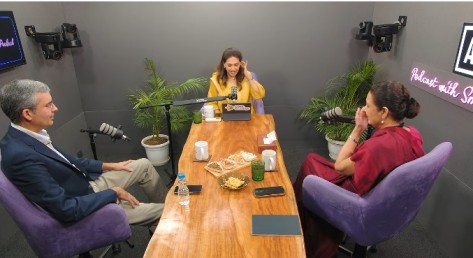
In this episode of the ANI Podcast, Smita Prakash speaks with Meera Shankar, India’s former Ambassador to the United States and Germany, and foreign policy analyst and historian Dr. Zorawar Daulet Singh about Trump’s hostility towards India, the Musk-Ambani controversy, the Iran war, and what a fast-emerging multipolar world means for India’s strategic autonomy. They also discuss the India-US trade deal, H-1B restrictions, India-China ties, BRICS, Big Tech and digital sovereignty, and why India’s influence abroad depends on building its own economic and technological strength at home. Read the full transcript of this episode which was premiered on October 21, 2026, below:
India’s Place in a Fractured World
SMITA PRAKASH: (00:02:09 – 00:03:43) Namaste, Jai Hind. You are watching and listening to another edition of the ANI Podcast with Smita Prakash. In an increasingly fractured world, what are the new alliances and partnerships that India is trying to forge? Two wars, shifting alliances and an unpredic— over traditional loyalties. So how should New Delhi navigate a world in which strategic autonomy is being tested, economic interdependence is becoming a weapon, and even trusted partners are proving unreliable? Can India balance its relationships with Washington, Moscow, and Beijing while protecting its interests in West Asia? And does India have the economic and military muscle to match its growing diplomatic ambitions?
To discuss these questions, I’m joined by 2 distinguished voices on Indian foreign policy. Ambassador Meera Shankar, India’s former ambassador to the United States and Germany. She brings decades of diplomatic experience and a deep understanding of India’s relationships with the world’s major powers. And Dr. Zorawar Daulet Singh, foreign policy analyst, historian, and author, whose works examine India’s grand strategy, the balance of power in Asia, and the changing global order. Thank you, Zorawar. May I address you by your first name?
ZORAWAR DAULET SINGH: (00:03:43 – 00:03:44) Please, of course.
SMITA PRAKASH: (00:03:44 – 00:03:50) Okay, thank you. Ambassador Shankar, thank you so much for being part of the podcast. Very happy to have you both here on the show.
MEERA SHANKAR: (00:03:51 – 00:03:53) And you can use the word Meera.
SMITA PRAKASH: (00:03:53 – 00:04:54) Okay. Feel a little odd saying it, but thank you. Thank you for giving me that liberty. So when I introduced, I said, this is like we are at this situation where everybody’s talking about a global, new global order. And where are we on that? Are we a part of the narrative or not? We as in India, part of it or not? So I really didn’t know where to begin this conversation with, but I thought, let’s go step by step.
And the first thing is because we’re going to be airing it just when Marco Rubio is going to be in India. So I thought, let me begin with India-US relations, because that seems to define almost every other relationship or strategic interest that we have in the world today. So, ma’am, if I was to begin with you and ask you about India-US relations and how do you think America at this stage is treating India? Does it see India as a partner, as a subordinate, or as a problem child?
Partner, Subordinate or Problem Child?
MEERA SHANKAR: (00:04:55 – 00:06:52) I think a bit of all 3. And I think the shifts in India-US relations that we are witnessing under the current administration flow from their reordering of US priorities. So they are no longer looking at China as a strategic challenger to be outmaneuvered. They are looking at China as an economic competitor with whom they want to manage the competition in a way which doesn’t lead to inadvertent conflict. It’s not that the strategic competition is less. It’s there. But I think for Trump, the priority has become to somehow do a deal with China which enables these 2 to bring their relationship on a more even keel.
So this means that India’s value, strategic value to the current US administration, comes down because the key issue which brought the 2 countries together was how to build a more durable balance of power in Asia, which was not under the dominance of a single country. Now, that doesn’t seem to be such an overwhelming preoccupation. With the Trump administration. They have said that they will focus on the Western Hemisphere. By that, they mean the Americas.
SMITA PRAKASH: (00:06:53 – 00:06:54) Focus or just take over?
MEERA SHANKAR: (00:06:55 – 00:08:39) So, well, this is the thing, because before Trump became president for the second time, the general expectation was that there will be a more minimalist US foreign policy with the US withdrawing from the world. But what we are seeing is the imperialism of a declining power which is seeking to build back. And that’s what you’re seeing. So the competition for grabbing resources, for grabbing energy, and so on.
The US has put trade protectionism at the forefront of its domestic agenda because they believe now that globalization led to loss of jobs in the US and also exerted downward pressure on wages. Now, this constituency, which didn’t find articulation in earlier administrations is also the core of Trump’s constituency, the MAGA constituency, which is both racist and protectionist. So it’s a backlash against 2 terms of Obama, if you will, and stoking white anxieties about possible demographic decline in future, and then who gets to control the US economy, polity, and culture.
SMITA PRAKASH: (00:08:39 – 00:08:47) So India doesn’t fit into the picture of what its goals are as far as foreign policy is concerned. India doesn’t play ball. Well, is that it?
MEERA SHANKAR: (00:08:48 – 00:11:35) It is a kind of a partner somewhere. It’s like Europe. The EU was much closer to the US than India was. We were never an alliance partner. We were a strategic partner keeping our own decisions. The EU has been given short shrift by President Trump in an even more blatant manner, being pushed to take on more responsibility for their own defense.
So you see the US’s old priorities shifting. And the competition between the great powers has intensified. The globalized world has seen its high tide. And now it’s going to be at an ebb. It’s not going to disappear because supply chains, production lines are now so split across the world. It’s going to be very difficult to undo globalization fully, but it will no longer be embraced with the enthusiasm and proselytizing zeal, actually, which the West had brought to this because they were the ones who pushed globalization. But now they feel that they actually lost because of globalization, with countries like China and India having benefited.
There’s one additional factor I would say, and that is that if you recall, President Trump came in with all guns blazing against China. And initially, he placed tariffs of over 140% on Chinese imports into the US. China too retaliated, but this time they were prepared. So they also leveraged, apart from raising tariffs on their own, they also leveraged their dominance over critical mineral processing to get the US to crawl back. So the US was forced to pull back the tariffs, reach a kind of truce with China while they negotiated a longer, more durable trade deal. This truce gave over in— gives over in November, I think. And
SMITA PRAKASH: (00:11:36 – 00:11:38) At the meeting before that, right? President
MEERA SHANKAR: (00:11:38 – 00:13:35) Xi and Trump are meeting again. They’ve extended it. It was giving over when Xi and Trump met, but they’ve extended it till November 10th. So that now, having been forced to crawl back on China, what has happened is, I think, to some extent, the targeting of India and persons of Indian origin in the US has substituted the China bogey. You pick— it’s a typical bully’s tactic— you pick on a smaller competitor who can’t use the kind of leverage against you that China can. So you can show to your constituency, I’m acting while at the same time, actually, they are not acting on their biggest trade issue, which is China.
India is not. India doesn’t have these huge exportable trade surpluses. We basically have a domestic-driven economy. In fact, we are trying desperately to become an exporting nation. And also, we are not a major manufacturing nation. So Trump’s economic issues, on account of the huge trade surpluses which China has acquired in trading with the US, don’t get addressed by attacking India. But what it does is it provides a kind of alternative target if you will, which is visible in the American scene. And it kind of feeds into his constituency, which doesn’t question why is he doing nothing about China.
Musk vs Ambani, Polymarket and American Pressure Tactics
SMITA PRAKASH: (00:13:35 – 00:14:25) Okay, so I’m going to segue on that issue of the pressure tactics that America employs. One is, as ma’am listed out, the several pressure tactics that are being used. Some of them on Indians in America, people of Indian origin in America too. The second part, you can add to what Ambassador Shankar said. In addition to that, I also want to ask you about all this talk about Trump administration trying to influence Indian domestic politics. Are we reading too much into the Musk-Ambani confrontation and even the Polymarket bets that are being placed about regime change in India and things like that. Are we seeing— reading too much into that, or is this another of those pressure tactics?
ZORAWAR DAULET SINGH: (00:14:26 – 00:18:33) Yeah, thank you. So I broadly agree with sort of a quite a brilliant overview by Ambassador Shankar. So can I actually, before coming to this, to understand American motives and why it’s behaving in this way why is it altering its calculus on India? I think you have to come back to what’s happened to America’s position in the world, right, and the balance of power. And this has been— this hasn’t happened in the last 1 year. It’s happened over the past 10 years, 15 years. And there has been a structural change where the power shift across metrics— we can get into those later on— has moved away from the US alliance to the non-West, so to speak. China, of course, is a central part of that. India is a part of that a little bit. Russian military resurgence and authority in the heart of Eurasia is very much part of it. Iran is a part of it.
So there’s— it’s a distribution that’s happening. And America is now reacting to it. Firstly, it’s going through a schizophrenic phase where the unipolar identity, the hegemonic sort of impulses that it’s had for a century, are now kind of beyond its grasp. It has this ambition, it has the policy framework, but it doesn’t have the underlying power. And this tension is precisely what you’re seeing at the complete mayhem that’s happening inside America, where the president wants to assert his authority on so many issues, wants to use force, can’t get it done. He gets a few low-hanging fruits like Venezuela, but when he meets a major player like Iran, China, Russia. India, we can get to how India is dealing with that. It’s getting more complicated.
So where was India fitting into the old American policy in 2000s? There was this framework that mainly American-led, India will be a part of their Asia policy. It will help on China. It will help in expanding American power and influence in Asia for the next 100 years. It was a very ambitious kind of story that was told to us, that India would be this important pillar, not the only one. There would be going to be Japan, there was going to be, of course, NATO and the East Asian allies that America had. But India had this promise in their mind that it could. So, but that framework of that always implied that India would have to play second fiddle. It would have to become a part of the US military, political, economic system.
So you see this tension right from the 2000s itself where Indian policymakers, Indian leaders are kind of looking and they’re getting a bit— it’s obviously like a heady feeling. You’re being pulled into this big game. You want to be a part of it. You want to run with the hare, hunt with the hound. But at the same time, you don’t want to lose yourself. You want your strategic autonomy. You want your sovereignty, your own historical consciousness, your civilizational identity from even in the Cold War period. You can’t give that up. So there’s tension that Indian policymakers, they go forward, but they can’t go to that final leap.
So that tension has been there throughout, and it’s gotten more and more evident as America asks for more but gives even less. So that exchange that Indians felt was going to be, okay, we’re going to give up a little bit of our sovereignty, but we’re getting all this economic influence, economic capital, FDI status, India, America will solve your problems on your periphery, or certainly give you the leverage to deal with China, with Pakistan. All that has vanished because American power simply does not hold that authority anymore. So it’s become a one-way thing. They’re going to take, and it makes sense for them, right? Because India is not a Japan or a Europe where you have US troops positioned. This is their frontline sort of areas. India was always a bit of a dispensable bet. If it works out, it works out. We’re not going to give them more than what— so we’re going to wait and bide our time and see if they come along, they come along. So I think India is now realizing—
“We’re Not Going to Make the Same Mistake”: The Raisina Turning Point
SMITA PRAKASH: (00:18:33 – 00:18:45) I think also there was this realization, and it became so apparent during the Raisina when Christopher Landau turns around and he says that, “Yeah, we’re not going to make the same mistake that we made with China.”
ZORAWAR DAULET SINGH: (00:18:45 – 00:18:47) That was the turning point, right?
SMITA PRAKASH: (00:18:47 – 00:18:57) Absolutely. हथौड़ा मार। It was blatantly said. There were many things America used to do without saying it blatantly. Yes. Now it’s out there, absolutely.
ZORAWAR DAULET SINGH: (00:18:57 – 00:19:58) And it was quite it was done in such a sort of assertive and articulate way where there’s nothing subtle, right? This was that now there’s going to be a new framework, and these are the terms, and they’re all well known to the Indian establishment. So we can get into what is India thinking in. How it’s reacting. But I think the American position, I think it must be understood very clearly today that they are— it’s changed. They are going to extract, and it’s a very logical, as Ambassador Shankar said, imperial decline.
If you look at the history of the last 500 years, certainly in Western states that have declined in their last phases, Great Britain for example, look what they did to India on their parting. They carved you up, they retreat and they hand over all that power to the United States, which becomes the legatee of this new— so America is going to precisely do the same thing. So once we accept that framework, you are a bit more hard-headed, more realist in how you’re going to deal with them. So I still get a sense—
SMITA PRAKASH: (00:19:59 – 00:20:01) or we ought to deal with them. I don’t know whether we really—
ZORAWAR DAULET SINGH: (00:20:01 – 00:20:02) I think whatever— I
MEERA SHANKAR: (00:20:02 – 00:20:10) think what I’m trying to suggest is, at the same time, if I may say so, they remain your largest export market.
SMITA PRAKASH: (00:20:10 – 00:20:10) Sure, sure.
ZORAWAR DAULET SINGH: (00:20:11 – 00:20:16) No, no, we’re not even— we’re not arguing with the merits and the significance.
MEERA SHANKAR: (00:20:16 – 00:20:23) So willy-nilly at some— and then if you look at alternatives for India,
SMITA PRAKASH: (00:20:24 – 00:20:25) there’s literally nowhere to go
MEERA SHANKAR: (00:20:25 – 00:21:18) because with China your exports have risen by some amount to what, $19 billion? And you have a trade deficit of $112 billion. With Russia, your exports are what, $4 billion in 2025? And it had gone up to almost $69 billion two-way trade. This year it came down to $60 billion. So the rest of it is Russian, mainly Russian exports, oil exports to India. So there is no other market for you which would absorb this. You can certainly survive without America. India is very large. We have a huge domestic market, but it’s not a choice that you need to make because you can’t flourish.
SMITA PRAKASH: (00:21:19 – 00:21:41) And I don’t think any country at this stage is talking about making a choice. I think everybody’s got its hand on every pie and wants a part of the action everywhere, whether we— even if we don’t have good ties with them strategically or whatever, you want ties with them as far as trade is concerned. China and America, case in point. But let me get back to—
How India Can De-Risk from America: Lessons from China
ZORAWAR DAULET SINGH: (00:21:41 – 00:23:10) actually, it’s a very interesting point you mentioned because this is a central part of the Indian thinking, and rightly so. How do you de-risk with America with all this massive accumulated dependence that you’ve built up? Firstly, you accept it and saying that we’re not going to go more dependent. You’re going to, on the margins, have to have alternatives where you can bargain with them on a better front. And I think that is possible. I would argue that the Chinese in the last 25, 30 years faced precisely this dilemma. Their interdependence with America was far higher than what we have today. Yeah, I mean, it’s mind-boggling the way they were dependent on US and the G7 for exports, for FDI, for technology. For human capital flows, almost very similar to India.
But what they did was, while this was happening, they were doing reverse engineering. They were just doing an enormous domestic transformation part of the story, which we are doing at a much smaller scale, more haphazard, ad hoc. We are not doing it in a comprehensive way, but we’re doing it. So that part has to come in. But at the same time, they did not go beyond a certain point. They always said every time we’re going to deal with a particular US or its ally on economic matters, we’re going to make sure that our domestic front does not get overwhelmed, right? Market access is maintained. So there is— so I think those trade-offs, I’m sure that Indian policymakers are aware of them. The question is that who ultimately is putting it all together so that things don’t fall through the cracks?
SMITA PRAKASH: (00:23:11 – 00:23:39) Let me come back to the original question which I asked you, is about the— I don’t know whether interference is the right word, but this influence, are we reading too much into it? What Elon Musk says and does when he talks about Ambani, when we see Polymarket, when we talk with all that talk about Soros, is there any kind of— do we know about it? Is it true or are these mirrors?
ZORAWAR DAULET SINGH: (00:23:39 – 00:23:42) I think it seems clumsy, right? Do it so publicly?
SMITA PRAKASH: (00:23:42 – 00:23:44) Why? Because America is doing everything publicly.
The India-US Trade Deal and the US Supreme Court Ruling
ZORAWAR DAULET SINGH: (00:23:44 – 00:25:05) Yeah. I think there’s a bit of that. Again, it comes down to really, they definitely want to put pressure. They’re trying to put public pressure on. And look at the trade negotiations, right? At the end of the day, I think everyone thought that India would completely buckle. Yeah. In the initial stages, it so happened that we did hold our ground. And you held on for a fair deal, right? Yeah. You didn’t want to open up your agricultural sectors. Areas that you would completely compromise on a vast majority of Indians, right? Because once you open that up, you can’t provide that.
So I think India held on to a fair deal. It was saved by the bell, really, the Supreme Court ruling in the United States which kind of challenged the White House so openly. And then the Iran War comes in and it completely just takes the complete— it just pulls the carpet under from Trump’s sort of, this sitting on a perch and kind of— and he’s now facing an electoral debacle, really, in the midterms, at least. So I think India has been saved partly by holding on and being a little patient, partly through circumstances that were beyond its control. But now that you’ve gotten this opportunity, I think now the time is to just wait for a fair deal, which I think will happen. And the statements that are coming out are actually suggesting that you are no longer desperate. You’re saying, okay, it’ll happen. And we’ll wait for it to happen.
MEERA SHANKAR: (00:25:05 – 00:26:17) But it’s not an equal deal. I mean, it’s a pragmatic choice that you’ve made because under the terms of the deal, the US will raise its tariffs from 3% on an average MFN basis to 18%, whereas India will reduce its tariffs on US industrial goods, preferably to zero. So it’s by no means an equal deal. But we were willing to live with it because the tariffs which we were being given were slightly better than those offered to Pakistan, Bangladesh, Sri Lanka, Vietnam, and so on, and China.
With the Supreme Court ruling, all this has gone. We don’t know where the final tariffs are going to come and lie. So that is really the issue in terms of the deal. That India is saying that we were willing to accept this deal provided that element of preference was there. Now, till you can reorder your tariffs so that we know that we have this preferential element vis-à-vis other competitors, we are prepared to wait.
SMITA PRAKASH: (00:26:18 – 00:26:32) And the point also is that if it doesn’t work in Trump’s favor, the midterms, as Zorawar was saying, if the midterms don’t work in his favor, how do we even know if he’s going to honor it or not, even if the deal goes through?
MEERA SHANKAR: (00:26:32 – 00:26:46) Well, he has put tariffs on post facto, post the deals that he has done with other countries on specific commodities or on sanctions, etc.
SMITA PRAKASH: (00:26:46 – 00:26:55) So unpredictability and ad hocism is something that we have to deal with. We have to accept as something that’s going to be there with America when we deal with them, right?
MEERA SHANKAR: (00:26:56 – 00:27:07) More under the present administration. With the Biden administration, we had managed to solve some 6 trade disputes or so at the WTO.
SMITA PRAKASH: (00:27:08 – 00:27:14) You were ambassador under which president? Obama. Obama. Okay. What were the deals that were worked out during that time?
MEERA SHANKAR: (00:27:15 – 00:27:53) Well, firstly, I think the nuclear deal, the remaining element was finalized, which was the reprocessing, which we had to negotiate, said that if India applies to put up a reprocessing plant, there will be negotiations within 6 months and an agreement will be concluded within a year. And it presumed that for each subsequent request for reprocessing, we would be doing it afresh. So I was able to convince them that’s not worth it. Have an agreement which will apply to all subsequent requests for reprocessing.
SMITA PRAKASH: (00:27:53 – 00:27:58) Are they as difficult to deal with as what one is seeing right now?
MEERA SHANKAR: (00:27:59 – 00:28:05) It depends on the domestic priorities that they set for themselves.
SMITA PRAKASH: (00:28:05 – 00:28:10) What I’m asking is, is the State Department now different from the State Department during your time?
MEERA SHANKAR: (00:28:10 – 00:28:59) Yes, certainly it would be because they’ve been denuded of officers. Firstly, Trump has made very severe cuts to the State Department staff. And their aid budget and so on. So he has virtually given up on the softer tools of diplomacy, which were much easier, say, USAID, which were much easier instruments to convert into influence than direct force. So Trump is having a bare-knuckled policy, if you will, to exert the kind of influence which the US used to do far more subtly and maybe also hypocritically in the past. He has ramped up the Pentagon budget enormously.
H-1B Crackdown and the Brain Drain of India’s Top Talent
SMITA PRAKASH: (00:28:59 – 00:29:11) Zorawar, let me come to you to ask you about this, the immigration restrictions on Indian talent. Is it a bargaining chip or is this something that was in the works for a long time and it was happening, it was going to happen?
ZORAWAR DAULET SINGH: (00:29:11 – 00:32:02) Well, I think Indian policy has kind of projected the demographic surplus that you have of high-quality labor as an important part of your economic trade agreements. So we’re doing it, in fact, with Russia. Now we’re sending an agreement to send large— so I think what you’re doing is you’ll be facing a saturation of a particular category of high-quality workforce. But I think the United States, from what we get a sense, is the really high-quality stuff, which is sad, will continue to be pulled out of India. And that’s where you should actually be focused on. Can we retain this highest quality high-tech talent innovation, science, medicine for your domestic institution.
Because even if you lose this mid-tier IT, IT-enabled services, finance, the sort of the medium to low tech for Silicon Valley, that part can still go around the world and be absorbed in India. But the highest of the highest, that 1% which was leaving, even if that half of the 1% leaves, that was every year. See, look at it, you’re only producing so much human capital a year from your universities, from your higher advanced degree program. They’re going there and then they get transformed and then they stay on, right, for 5, 10, 20 years. That’s part where— so I think the minister, Commerce Minister, said that it’s okay, we’re not— if it doesn’t, it’ll be good for— I think somebody made a comment. So that’s good that your mid-level, you absorb into a deepened India story, right? You want to absorb those engineers, sort of repurpose them for the manufacturing sector because IT itself is going to go down.
But I worry about the highest quality, where the Americans, despite what is happening, they will continue to pull that out. And which is partly natural because the instinct of the highest quality human capital is to go to those networks where they get the highest amount of not just remuneration— you’re at the peer group, right? But India, that’s where I brought the Chinese experience. 20, 30 years ago, they were nowhere in the top 100 universities. Today you’ve got such a large section of domestic indigenous Chinese institutions of learning that have moved up and that are being accounted and reckoned with by Western sort of scholars. So you’ve got to do the same.
Now that’s not a 1-year journey, it’s beyond a political cycle, but you— if you do not build those institutions, this brain drain of the highest level will— and how are you going to do that sort of high-tech comprehensive national power changes? So the state can only provide so many human capital. The vast majority of Indians, that top 2%, you’ve got to retain them. And that’s— I think that should be the primary focus of even the MEA and national security, that how do you restructure the incentives to keep them in India? You can’t just say I’m going to allow a US or a British university to set up shop. I mean, that’s it.
SMITA PRAKASH: (00:32:02 – 00:32:03) That is what is happening.
ZORAWAR DAULET SINGH: (00:32:03 – 00:32:17) No, I mean, they’re opening it up, and that’s quite a lazy way to do it because what are they going to do? They’re just looking at revenue expansion, what they were getting there in maybe Birmingham or in Manchester, they’re going to get it outside the NCR.
SMITA PRAKASH: (00:32:17 – 00:32:20) What are we going to get? Just keep foreign exchange within the country?
MEERA SHANKAR: (00:32:20 – 00:32:27) No, it’s for the universities coming here. It’s revenue expansion without the risk of immigration.
ZORAWAR DAULET SINGH: (00:32:27 – 00:32:32) Without the risk and without sending highest quality human capital to India.
MEERA SHANKAR: (00:32:32 – 00:32:57) For India, it is that you are not investing in your universities, period. Mostly now it’s private sector which is coming up, which is exorbitantly extractive. And the ordinary Indian doesn’t really afford, can’t really afford this. So for you, this is one way of expanding the universe of higher education without actually tightening your belt and investing.
SMITA PRAKASH: (00:32:57 – 00:33:05) But you don’t see this crackdown on H-1B by America as a bargaining chip against India? It’s something which was part of their domestic agenda? No, no, no.
MEERA SHANKAR: (00:33:05 – 00:35:15) I think now because of the focus on globalization, outsourcing as a source of job losses, point to an external agent as the cause of your problems, even though you know that the H-1B talent actually helped the competitiveness and profits of US companies and therefore generated jobs within the US economy. I think it’s going to be there now because of this mood of protectionism, nationalism, bring back industry and high-end services to the US or to the national economy.
But beyond that, because of artificial intelligence and the leaps that it’s making in an unregulated, completely unregulated fashion, with the US hoping that this is going to be the area of superiority which will propel them again to global dominance, I think that the need for lower-end, mid-end software engineers will come down quite dramatically.
And for India, I think the moral of the story is you diversify. Like now, we are exporting software services in much larger measure to the EU. I was looking at the figures. It’s $90 billion two-way trade in services with the US, with a $4 billion trade surplus for India. With the EU, it is something somewhere in the region of $60 billion two-way trade. So not close to the Americans, but still, making a substantive increase. So for India, you have to diversify your markets, pragmatically deal with the US as best you can, and most important, focus on building your own comprehensive economic and technological strength and capability. Without that, you’re always in the danger of being buffeted.
West Asia: Who Fills the Vacuum if America Steps Back?
SMITA PRAKASH: (00:35:16 – 00:35:40) True. Let’s move to West Asia. I don’t want to go to the nitty-gritty of the conflict, but if America steps back now as a security provider in the Gulf region, in the Middle East or West Asia, whatever you want to call it, what’s going to happen if nobody is willing to come in and fill that vacuum? How do you see that now?
ZORAWAR DAULET SINGH: (00:35:41 – 00:36:02) So that’s again quite a big change from— it’s India’s Western neighborhood, right? And right, and I would say coming just if I begin from the Indian sort of policy pronouncements in the last 10 years, you’ve kind of sort of been saying that now my fate lies with the Arab states, with the Gulf, with the US sort of groupings. And which beyond the
SMITA PRAKASH: (00:36:02 – 00:36:03) immediate
ZORAWAR DAULET SINGH: (00:36:03 – 00:37:03) neighborhood, we are looking at Look West policy as well as this in the Middle East. Yeah, yeah. So in there, and it kind of made sense, you have a large sort of 10 million workforce that’s working mainly in this sort of the Persian Gulf states. So I think that kind of bet, again, beyond India’s control, circumstances have completely changed the ballgame. And it kind of came as a shock because after the fall of Iraq, 2003, Syria eventually goes end of the 2010s. You had this impression that the US sort of CENTCOM is that the military command, right, which looks at this region. It was the dominant sort of force, military force.
And if last year you might recall, just around Operation Sindoor, there was this, where Pakistan was being sort of pulled in into this, into these, the security. So, and that time there was a— naturally it was— there was an apprehension in India that, look at the Pakistan Army, it’s found a way to get back in again.
SMITA PRAKASH: (00:37:04 – 00:37:04) Yeah.
ZORAWAR DAULET SINGH: (00:37:04 – 00:37:56) And so I see, in fact these events in a little more balanced way, in the sense what I’m saying is that you may have lost out where your economic investments, your labor flows still were heavily dependent on the stability and prosperity of the US sphere, so to speak. But on the geopolitical front, where Pakistan’s important sort of pillar of support from behind Saudi Arabia, funding from there, US Central— the whole infrastructure that kept the Pakistan Army alive. Because let’s not forget, the Pakistan Army’s purpose, it was a dual purpose. One was for South Asia, one was to keep an eye on the doors of the subcontinent from the north, Central Asia. But it was also to be a net security provider for the Middle Eastern regimes.
SMITA PRAKASH: (00:37:57 – 00:37:57) Yeah.
ZORAWAR DAULET SINGH: (00:37:57 – 00:38:13) And that part— and now you see the Pakistan Army’s— I mean, I would love to be a fly on the wall, but they would be completely facing the prospect of an important geopolitical framework of theirs is unraveling in real time. So I would say India and the rise of Iran, right?
SMITA PRAKASH: (00:38:13 – 00:38:14) Yeah.
ZORAWAR DAULET SINGH: (00:38:14 – 00:39:56) We call it a civilizational sort of partner, and we’ve been making all the right noises. But when it comes to developing ties, for various reasons, partly of our own restraint, partly because the US sanction threat, yeah, Israel relationship. I mean, again, it comes down to why can’t you find ways to do everything right? Why is this either-or? Anyway, so this has forced you to now reckon with that Iran’s going nowhere. It’s practically imposed a strategic defeat on the United States in the sense that by not falling over, by imposing costs— and like you asked the question, you are seeing the US frontline bases can never reappear in that form because military technology will not permit it, right? They’re so easy to destroy, and the whole world saw how it could be done.
So they abandoned— so you welcome a balance of power, right? You keep saying multipolarity, you keep saying you want non-radical forces to have some kind of a foothold. Because look at Syria, you have an Al-Qaeda leader who was parachuted by basically the West, right? And so you lost all secular states, all states that could have a countervailing pressure on the extremist forces. Now, I’m not saying now Iran has also got its own domestic problems. It’s got a complicated identity. But at the end of the day, it’s a counterpoise to the rest, right? It’s your neighbor’s neighbor. There’s so many reasons for you to have welcomed the rise of a new regional power, welcome an equilibrium and a balance set coming. It may be unstable for many years. But so, but at the same time, your economic ties with the UAE, with the Gulf, your energy security. But you’ve got to now manage the new landscape.
SMITA PRAKASH: (00:39:56 – 00:40:03) Why didn’t China— since you’re a China expert also, why didn’t China step in to fill that vacuum? Why do you think that they are hesitant?
ZORAWAR DAULET SINGH: (00:40:03 – 00:41:00) So the— I think the lead player really was in the military behind the scenes were the Russians, were the ones that were having some kind of a— we don’t know enough, but they were doing just about enough for the Iranians to transform a fairly formidable domestic military power to have that last-mile precision. And we’re seeing it. But the Chinese also were doing stuff behind the scenes. They provided enormous— Satellite imagery. No, no, even the Iranian economic exports. It’s only China that kept the economy alive all these years. And even during the crisis, they are the ones that are doing— We don’t know enough behind the scenes. They say they’re providing satellite imagery, etc. It’s possible that they are. A lot of components that are going in. But I think what you’re raising, another point, is that China is not stepping in, in a direct collision with the United States. It does it the way it’s always done it, indirectly, with other players leading the way, right?
SMITA PRAKASH: (00:41:00 – 00:41:00) Yes.
MEERA SHANKAR: (00:41:00 – 00:41:22) If I may say, I think China weighs its relationship with the US on the scales with its support for Iran. And then it carefully paces it in a way which won’t directly rupture China-US relations.
SMITA PRAKASH: (00:41:22 – 00:41:25) So insidiously support its war machine.
MEERA SHANKAR: (00:41:26 – 00:43:03) Well, to the extent that they can without absolutely jangling US nerves. You’ve seen it in Ukraine too. Where they have not— they have backed Russia rhetorically, they have provided them components, but they have really kind of drawn the line at supplying weapons. Through North Korea, possibly, they may be, one doesn’t know. But directly, they have not got involved in a kind of military alliance with Russia over Ukraine. Vis-à-vis the US. So because for China, the economic relationship with the US still continues to be their most important relationship.
If you see their diplomacy during the years when they were rising, when they hadn’t reached a position where the US has now to treat them more like an equal power, they would negotiate furiously on trade issues and at the last minute, under threat of sanctions, cave in 360 degrees. In international conferences, they just kept a low profile, never articulated developing country positions, never took on the US rhetorically. It was Deng Xiaoping’s advice of “bide your time and hide your talent.” Keep a low profile, don’t attract attention prematurely to your rise.
SMITA PRAKASH: (00:43:03 – 00:43:04) But now, when you
MEERA SHANKAR: (00:43:04 – 00:44:12) think about it, this changed with Xi Jinping. They first adopted this wolf warrior diplomacy, which was in-your-face rhetoric and very aggressive diplomatic posturing. It kind of— But only vis-à-vis Southeast Asia? No, no, no. It was all over the world. But when it kind of backfired and Xi Jinping was also criticized domestically for his mishandling of the ties with the West, that he has drawn back on this.
Now they exert pressure where they can or where they want to, like vis-à-vis Japan or vis-à-vis Taiwan or vis-à-vis the border with India. But they don’t take on this kind of aggressive diplomacy frontally. But now they feel there’s no longer need to bide their time. They feel their time has come.
SMITA PRAKASH: (00:44:13 – 00:44:13) Okay.
MEERA SHANKAR: (00:44:13 – 00:44:15) So it’s a different—
ZORAWAR DAULET SINGH: (00:44:15 – 00:44:16) So on Iran,
Iran’s Staying Power: Were You Surprised?
SMITA PRAKASH: (00:44:17 – 00:44:43) to both of you, one question. I mean, get to it whenever you want to. Did it take you by surprise to see the staying power of Iran? Did both of you— I want to ask you this, were you surprised that this is what has happened? And of course, I want to come back to that question. That what do you see happening in West Asia now? Who is going to be the security provider? Because clearly that Pakistan Pact, the Makkah Pact, didn’t work.
ZORAWAR DAULET SINGH: (00:44:43 – 00:46:40) So let’s start with June 2025, because while we had our Operation Sindoor, the US launched a brief strike on the nuclear facilities on Iran. And I think that set the ball rolling where they felt, we’ve done this. I’m talking from the United States. Yeah. And I mean, this is hindsight. This is hindsight where I think now the plans were really in place that Trump— I mean, we know whether it’s the funders behind him or the Zionists, whatever you want to call it— there was this that we are going to have to go into Iran. That’s been there for many, many years. And the Maduro kind of incident kind of further emboldens the United States. And it’s all coming out as a sort of a linear process.
And so in February— but I think when you look at the Iranians’ point of view, I’m like you asked, were the Iranians shocked that this was going to come? I think the writing was on the wall after June. They knew that these guys are now going to come whenever, 6 months, 1 year. Sure. So they were kind of in preparation for a large-scale assault. Also, the Iranian military doctrine, I think it’s come out quite apparently for the— from the folks who have been looking at it, that it’s prepared for a major clash with the United States for the last 30 years since the revolution comes in.
But as their military wherewithal, their missiles and drones, their domestic complex has become more sophisticated, more indigenous, they have actually got the firepower and they’ve had it for a while. But I think this crisis showed everyone that what it really has, the depth of their magazine, their underground bases, which are invulnerable to— let’s face it, for 5 weeks they faced the largest aerial assault in the post-Cold War era. That any state has faced other than maybe Serbia— I mean, Yugoslavia. But here you were talking of relentless strikes to take out everything. Their leadership was taken out, and yet they find a way to maintain stability, domestic order, and fight back. So
SMITA PRAKASH: (00:46:40 – 00:46:41) it’s like 5 Irans fighting.
MEERA SHANKAR: (00:46:41 – 00:46:42) So if I mean, I can give you—
ZORAWAR DAULET SINGH: (00:46:43 – 00:47:35) I can give you a quote by— I won’t name it— by even a retired military chief from India, where when the early phases where there was a little bit of, okay, these guys are going to be out in a— yeah, when the military might— and it was called— he was— they called Iran “a poor man’s military.” Very derogatory. I’m not going to get into who and what, but I think the events played out that the Iranian military doctrine for a power with not a trillion-dollar budget might just be the way forward, even for states like India, where you don’t have to bust the bank. You can have asymmetric capabilities. You can create a military doctrine which focuses on the weaknesses of your adversary rather than having everything under the sun. Because that’s only for the superpowers with endless budgets. So I think Iran showed a lesson that America in the right circumstances can be held and checked.
SMITA PRAKASH: (00:47:36 – 00:47:37) Yes. Yes. You
MEERA SHANKAR: (00:47:37 – 00:48:32) want to add, Ma’am? You asked whether we were surprised at Iran’s ability to hold on or its staying power vis-à-vis the US. I have to say that I was not. And in my comments when they started this military operation, I said both the US and Israel have miscalculated badly. Iran is not a banana republic. It has layers of representative governance, even though it is a theocratic state. It is perhaps more democratic than any other state in the Gulf. And it has elections to the parliament. It has elections to the president’s office directly, even though the candidates are vetted by the Guardian Council. It has elections for the supreme leader, the velayat-e faqih.
SMITA PRAKASH: (00:48:32 – 00:48:43) Which I always find so difficult to understand, that this liberal, one liberal democracy is not the only form of democracy. I mean, we in Asia understand that.
MEERA SHANKAR: (00:48:43 – 00:48:45) It’s oppressive vis-à-vis women.
ZORAWAR DAULET SINGH: (00:48:45 – 00:48:55) We also had bought into this, right, that this sort of end of history model 30 years ago. I think we’ve also— it’s come as a learning to us that you can have diverse regimes, non-plural, plural.
SMITA PRAKASH: (00:48:55 – 00:48:58) We always did, Zorawar. We dealt with Myanmar.
ZORAWAR DAULET SINGH: (00:48:58 – 00:49:09) No, no, we gave up on that mindset in the last 20 years. And now it’s coming back, a recognition that that model is, where you’re now focusing on all kinds of actors.
MEERA SHANKAR: (00:49:10 – 00:49:23) And also that, so there’s going to be no regime change. There will be stability. And then the US will not know what its end objective is. It’ll get stuck.
ZORAWAR DAULET SINGH: (00:49:23 – 00:49:31) But the question was, was the Indian government taken by surprise? Because I think the postures in India were that they were on their way out.
MEERA SHANKAR: (00:49:31 – 00:49:46) In fact, I can say that when I said this, the anchor was visibly uncomfortable because it was against the official line at the time and tried to change the subject.
ZORAWAR DAULET SINGH: (00:49:46 – 00:50:54) I think that was one of the areas where India miscalculated, misjudged, not just this crisis, misjudged the global balance of power and the larger trend towards multipolarity. Because I’m just going to just step back. There was this idea that any evidence that tells you the power is moving away from the US alliance is disregarded, right? So, but when can we really know it? I mean, nobody wants to see a spreadsheet. Proof is in the pudding. A military crisis— Ukraine showed it. NATO is nowhere on the scene, right? They’ve been depleted. Their economies are struggling. They’re begging the Russians for a peace deal. Iran did it in 2 months.
So I think this is the proof of a balance of power. And I would say the Indian policy planning in the MEA and the broader establishment, I think we may have abdicated and not provided the level of— or it was provided. And I think people just said, they know what they’re doing. But now we know Mr. Hegseth did not know what he’s doing. And all this massive military power and air power, what did it produce? Nothing. Nothing.
Has Ukraine Tested India’s Strategic Autonomy?
SMITA PRAKASH: (00:50:54 – 00:51:36) So, ma’am, this— I want to get to these both these wars without going too much into detail. About the consequences and all. Has it exposed the limits of our understanding of what strategic autonomy we were pursuing? And what about the other countries? Have they all had to recalibrate themselves now with regard to US power, China, balance of power, Russia, the changing balance which is happening? So sense of flux and the sense that there’s nobody willing to step up to come and say, okay, I have the solution, I will fill this vacuum?
MEERA SHANKAR: (00:51:36 – 00:53:01) I think for India it became, what could I call it, a testing time with the Ukraine war. Because till then, the US-India strategic partnership had kind of coasted along. On the basis of their convergence in the Indo-Pacific. With Ukraine, the US and Europe, Western Europe, certainly wanted India to exercise a choice very much in favor of their position on Ukraine.
And at that time, India realized that Russia has been a stable partner, even though the economic relationship had dwindled, even though the defense relationship was coming down. It had been a reliable and stable partner. B, that it had helped us in our moments of crisis in ’71 and other, on Kashmir and so on. It had used its veto. That India needed to strike its own position based on its understanding of its own interests. It could not fall in line with the Western position.
SMITA PRAKASH: (00:53:01 – 00:53:10) But it was a refreshing change to hear foreign policy mandarins again talk about, oh, they helped us in our times of need. That was all forgotten for almost 15 years.
ZORAWAR DAULET SINGH: (00:53:11 – 00:53:13) And it was pushed into the conversation.
SMITA PRAKASH: (00:53:14 – 00:53:29) Yes. And no, it’s being pushed in now into the conversation at every platform. You’re hearing that all over again, and justification about how we have to improve ties with China and with Russia. This was all— but that’s what a new
ZORAWAR DAULET SINGH: (00:53:29 – 00:54:42) world does, right? I mean, why be ideological? In the past, in the ’50s, when China had arrived after the revolution, you opened up ties. There was pressure that to stand and become the frontline state. You didn’t do that. After ’62-’65, you said, okay, now we’ve got to change course. We’ve got to build up your military power. You’ve got to assert your authority in the subcontinent. ’71, you do that. You didn’t do it alone. You went out and you found a superpower who happened to agree with you on fundamental issues, and you leverage it and you did it. So there were nothing ideological.
Then in the late ’80s, you’re seeing the unraveling of the Eastern Bloc, so to speak. You open up ties with the West very pragmatically. You build up ties with Israel. You open up your economy. So now this is that next turning point, right? The post-post-Cold War, the multipolar world means that now you again have to adapt. So there is this— we need to stop being rigid, ideological, and see that India has made adjustments at every phase of major power shifts. So this is one more of those. So then the debate becomes stop quibbling over— okay, tactics you can quibble over, but don’t quibble over the broader requirement and necessity to change course.
India-China Ties: From Standoff to Stability
SMITA PRAKASH: (00:54:43 – 00:55:06) One quote I want to give you which really made me wonder, because it’s External Affairs Minister Jaishankar who said, “We’ve long been telling the Chinese personally at my level that a standoff between us, India and China, a dip in our relationship doesn’t help either of us. Third parties will take advantage of that.” That really got me smiling and saying, haha, that’s interesting.
MEERA SHANKAR: (00:55:06 – 00:55:12) Well, we had a strategic, a global strategic partnership with China at one stage.
SMITA PRAKASH: (00:55:13 – 00:55:14) Who didn’t we have it with?
MEERA SHANKAR: (00:55:14 – 00:55:45) With more focusing on international issues such as trade negotiations, environmental issues, reform of the international system issues, etc. Where there was a similarity of views on some issues. But gradually you saw a little shift because China’s position as a risen power, not a rising power, began to differ from India’s, which was as a rising power.
SMITA PRAKASH: (00:55:45 – 00:55:47) Subsequently, Quad and all that happened.
MEERA SHANKAR: (00:55:47 – 00:57:54) I think initially, if you will look back also on Ukraine, we carried on engaging with the US, and we were able to persuade them to live with this difference in approach under the Biden administration. They didn’t like it. They would have preferred a different approach, but they were willing to see the logic of our position and let it be, live with it. What happened under the Trump administration was even as the US sought to pull back from Ukraine, they also sought to force countries to side with them on Ukraine. So confused policy as always.
And as far as sanctions for purchase of Russian oil are concerned, I think it’s the US oil companies who very much would like to see India as a huge captive market in the future because it’s going to be the largest growing energy economy because China has more or less reached its levels of growth. We are still to actually catch up. So we are going to see the biggest leap in consumption. And I see this pressure not for altruistic reasons, geopolitical. I see it as hard commerce.
And for India, I think it’s important that you also take a line. Which is pragmatic but also keeps hard economic outflows into account. Don’t get hooked onto something which is more expensive in the long run because it is not geographically close, because you don’t have those refining capacities for their oil, etc. So you have to be pragmatic, buy peace for a little while, but at the same time, do not allow yourself to be pushed to the point where you take uneconomic decisions which will tie the hands of future generations.
SMITA PRAKASH: (00:57:54 – 00:58:10) So, coming back to what Jaishankar said, have we managed to convince China one way or the other that prolonged confrontation doesn’t serve either country’s interests? Is it that whole wolf warrior thing which ma’am was talking about also?
ZORAWAR DAULET SINGH: (00:58:10 – 00:59:59) So I think there’s no doubt there’s a recognition now in Beijing and Delhi that that kind of phase where you needed to be sort of on the razor’s edge, keep the Himalayan front sort of simmering. Yeah, that stability helps both. You want stability, you want to detente, you don’t want conflict. Now the next phase is what will that modus vivendi be? How do you convert stability into a more productive engagement on areas where you truly have common interests, right? Whether BRICS, creating an alternative financial architecture that suits you, not because you want to just take the dollar down, but because you want the flexibility and sovereignty to have economic relations with anybody you want. For that, you need an alternative architecture. And the great part is that if you’ve got a major economic power like China if leading that way. You can free ride that and shape that. That’s one.
But on the Indian economy, I think now they’ll be coming to an understanding that while your trade with Europe and the United States will be strong and should be strong as a big market, they don’t have the technology to provide you— I’m talking of the commercial at the price points— and which will allow Indian industry to sort of become indigenous. So I’m talking something a little paradoxical here, that the deficit with China— and this may be a little provocative and controversial, but if you follow through where it leads to— a lot of the imports that are coming from China, electronic components for your IT-related, your Indian manufacturing sectors across industries rely on core machine tools and hardware that the Chinese are supplying. So they’ve got a comparative advantage in Pharma is a bit of a—
MEERA SHANKAR: (00:59:59 – 01:00:05) active pharmaceutical ingredients. Yeah, go from here and then they do a high end.
ZORAWAR DAULET SINGH: (01:00:05 – 01:04:18) So it’s actually a 3-way chain where India and China are both processing different stages and then the final player is buyer. So will that matter more? I feel that the opportunity for India and China now is what are those sectors in the economy? Because I’m talking of beyond stability, right? I think we’ve accepted Ladakh, crisis is calmed down, you may have a militarized frontier, but I think you— it may even take another few years for you to pull back your forces. You may not pull them back at that level because the game has changed. You need it for Pakistan.
But if you can have a stable relationship with China, look at the advantages. I’ll just mention 3. One, you have changed the calculus in Beijing that they have to double down on Pakistan on every single issue. You’ve just made the second group in advising Xi Jinping and the South Asia specialists. I’ve been engaging with them in the last 10 years. I mean, at the think tank level, and the hardliners came forward in the last 5 years. Now it’s time to sort of give the alternative voices a chance where they’re not going to give up Pakistan, but to maintain this military-level integration that they were going towards. They haven’t gone there. You want to slow that down. For that, you’ve got to give the impression that you are no longer a handmaiden of the United States. You’re not playing a spoiler role. You have your own regional power. You want stability. You want your core interests to be respected. So I think that if you convey to the Chinese in a sophisticated, credible, authentic way and follow it up, and then you test Chinese reciprocal action. So I think that’s one big advantage.
2, you are telling the Americans now that we are going to now deal— you, the way you’re dealing with Russia and China and everybody in a new multipolar world, you may not— they may not call it that. We’re going to have to deal with all the big players, right? If the old world was Washington and then everyone else, but if it’s going to be Washington, Moscow, Beijing certainly at the top, and then you have New Delhi, Tehran— I’m not even adding London, Brussels, and Japan because they are still tied into the US framework. So they’re not independent states. They’re not even middle powers.
This idea of middle power coalition and huddling with Canada and UK and France, it doesn’t make sense. They ultimately are tied to the Western alliance. They cannot break away. They can never have strategic autonomy. If they do, the cost will be beyond their calculation. So let’s accept that India is at a different category. India is a near-great power. When I say near-great power means it will be there in 20, 30 years. But to say that you’re a middle power means you have made your identity very similar to the other middle powers who have kind of given up on an autonomous foreign policy and an economic system that will build your own military power.
Let me give you an example. You, UK, nuclear weapons. Cannot be employed without concurrence from the White House. So that level of integration— Japan cannot operate militarily without the intelligence and the oversight that the US will provide. Europe, we saw, the moment they cut Zelensky’s— Ukraine’s high-tech targeting information, satlinks. And so they can’t— Europe cannot provide that. Germany, France do not.
So this idea that I’m— the reason why I’m saying it, because Indians have— oh, the foreign minister, in fact, let me just quote him. He said, “When Europe speaks of strategic autonomy, it’s music to our ears.” But is it really strategic autonomy? They’re paying 5 times their energy prices by giving up the Russia link and buying from the United States. They are walking into the abyss with Russia rather than actually ironically going with Trump and stabilizing that front. They are transferring their economic industries. I’m talking of Germany to China surreptitiously while talking that we are going to be the new— we’re going to rehabilitate. So I’m saying, when you take away— they watch their own pipeline with Russia get blown up by Western intelligence supported Ukraine. So is this the strategic autonomy you want? No. So
SMITA PRAKASH: (01:04:19 – 01:04:21) let’s not say make our own architecture.
ZORAWAR DAULET SINGH: (01:04:21 – 01:04:35) I mean, let’s not seek our identity with those who have given up their identity. I would rather look at lessons from the past and from rising powers. They may be different to you, but at least they’re independent, right?
Europe’s Energy Crisis and the Rise of the Far Right
SMITA PRAKASH: (01:04:35 – 01:04:35) Ma’am?
MEERA SHANKAR: (01:04:36 – 01:05:59) No, I was saying that Europe actually provides a lesson because their economies have been undergoing so much hardship since the severance of the energy link with Europe. And according to me, that was the main objective of the Ukraine war was to sever Russia’s energy links with Europe. Their prices of energy have risen manyfold. Their industry, especially small-scale and medium industries, are closing down and relocating in China because they can’t really afford to be competitive at that level of energy prices. For some time, the countries had to provide subsidies to their consumers to be able to meet those energy prices.
And as a result, you’re also seeing, because of this blind kind of ideological hostility towards Russia, you’re also seeing the emergence of far-right parties who are talking a pragmatic language. Say the AfD in Germany, which is now in the national polls more popular than the Conservative Party, which is in governance, and far more popular than the SPD, which was the other center—
SMITA PRAKASH: (01:05:59 – 01:06:02) so the centrist party is talking differently now.
MEERA SHANKAR: (01:06:02 – 01:06:06) They are saying that they want the energy links with Russia to be restored.
SMITA PRAKASH: (01:06:06 – 01:06:07) Yeah.
MEERA SHANKAR: (01:06:07 – 01:06:33) And similarly in France, Marine Le Pen, you have a whole different paradigm of political discussion, unfortunately, on the extreme right fringes. But that is because the mainstream parties do not take a pragmatic look at how this is inflicting economic pain on their own citizens.
Can BRICS Challenge the American Order?
SMITA PRAKASH: (01:06:33 – 01:06:53) So let me come to that thing about the regional order, which again, I keep talking about this vacuum. Now, if India and China in this region, if India and China cannot agree on some kind of a framework of a regional order, do you think BRICS can challenge the American order in any manner?
MEERA SHANKAR: (01:06:54 – 01:07:11) It will make— to some extent? No, it won’t challenge it, but it will make a difference at the margins and it will shape an alternative narrative. I think that is important because you have a dominant global narrative which is crumbling now. No, which is set by the West.
SMITA PRAKASH: (01:07:12 – 01:07:13) But that’s crumbling, isn’t it?
MEERA SHANKAR: (01:07:13 – 01:08:11) It’s still there. I mean, it still prevails because they have the resources, the news agencies, the reach, the glamour to actually shape the narrative. But what BRICS does is it provides alternative perspectives and alternative narratives. And in some cases, like currency swap arrangements, I think alternative channels for financing trade, I think for supply chains. Yeah, for India, the balance has to be with regard to BRICS that while we use it to create alternatives and to expand the space available to us and other developing countries. At the same time, it should not become a vehicle for accelerating China’s power.
SMITA PRAKASH: (01:08:11 – 01:08:18) Which is why I think de-dollarization is not on the agenda, because India will not be part of that narrative.
ZORAWAR DAULET SINGH: (01:08:18 – 01:08:22) It’s happening indirectly, I think, through national currencies. I think what India’s position is—
MEERA SHANKAR: (01:08:23 – 01:08:46) but not actually, they’re saying it’s not the yuan. It’s not creating a common alternative currency for BRICS, which would have been the yuan. But you have a currency swap arrangement where you’re trading in local currencies. So you have methods to actually trade even when there are sanctions on dollar trade.
ZORAWAR DAULET SINGH: (01:08:46 – 01:09:35) I think maybe just for the viewers, because this conversation on dollarization, de-dollarization, again gets ideological. I don’t think anybody is saying we want the dollar or not want the dollar. We want to be able to engage with anybody who meets a common interest in terms of commercial viability, a need between a buyer and seller. That’s where the dollar was being weaponized, because their financial networks, the banking systems, and the dollar, it all worked. It became one common ecosystem, which was meant to be a public commons. Why did the world allow the US to have its hegemony? A lot of it was consent, right? They didn’t come with a gun to everyone’s head and saying, use the dollar. The gun was on a few. The rest was sheer momentum and ease of interdependence.
SMITA PRAKASH: (01:09:35 – 01:09:36) But has the conversation picked up?
ZORAWAR DAULET SINGH: (01:09:36 – 01:10:36) But has that interdependence become, in terms of the alternatives? Of course it’s become. But I think there again, I think you’ve raised an important point where are we doing enough to create those alternatives at the pace that we need to? I think there was a calculation— again, this comes back to multipolarity— that all this may not be required for at least 5 years, 10 years. I think those calculations and the time frames have compressed so rapidly with Ukraine, Iran, and US weaponization, and US internal domestic politics where they are themselves saying we don’t want globalization in this form.
We want our direct links with all the big economies and pull capital away from them into— so it’s become such a crude kind of arrangement where BRICS is not just to supplant them. BRICS might just be in 10 years, 15 years— I don’t want to call it BRICS— this alternative narrative, this alternative framework. There may be many others who join this. Ironically, we may even have Western states, Global South, of course, and Europeans.
SMITA PRAKASH: (01:10:36 – 01:10:36) Some of
ZORAWAR DAULET SINGH: (01:10:36 – 01:12:22) them might just let’s say the EU breaks up right in 10 years, which it very well could with the economic crisis that would flow. You could have some European states joining this, so that alternative globalization model would very well be provided, and India will have been one of the core authors of that, right? So again, when people say “BRICS,” क्या है ये चीज़? ये तो बात ही करते हैं। Summits happening. Where is the practice?
Right there for 2 reasons. One, you don’t want to— like you said, Ambassador Shankar, you’re apprehensive of providing China the only— but I think it’s also that your domestic economic actors are so tightly linked to European-American transactions that that’s where the real restraint is. So you’ve got to then take a national call where you’ve got to have those alternatives in place, because when the switch goes off, let’s say you face even at 20% of what Russia faces or Iran faces, or even China could face in the future, I think your economic system could unravel if you don’t have the alternatives in place.
But now, because of our national links with China, with Russia, with the non-West, we can access our core strategic commodities. Let’s say tomorrow America shuts down access to SWIFT dollar. You have your energy from Russia. You can access commercial industrial technology from China. And your economy can survive. Agriculture, you’re self-sufficient. You’ve got Brazil and others. So you are ironic. You’re already in a de-risk state. I think your financial, to some extent, your financial system is very dependent, right? Your stock markets, your wealth. That’s where so much Western capital— even there though, by the way, domestic capital now is more than your MNCs in hot money.
SMITA PRAKASH: (01:12:22 – 01:12:38) So I think every country is doing that, right? Every country, we’re kind of moving in Asia, in— and including West Asia. I mean, I won’t say Asia and just talk about East Asia. Even West Asia, I think after these 2 wars, everybody is thinking in the same way that what you—
ZORAWAR DAULET SINGH: (01:12:38 – 01:13:16) but they can’t exit because they’re— let’s say look at Saudi Arabia, Aramco. It’s a joint venture with the United States. Their money is all parked in Wall Street. The regime is protected by Pakistani commandos probably behind the scenes. You have CIA operatives there. The whole game, you can’t— so you cannot de-risk when you’ve lost your sovereignty. I think that’s the lesson. You can only de-risk if you are substantially independent. Even Japan is facing an economic crisis. What was Scott Bessent saying? He wants Japanese money to still come in. $500 billion, I think Trump is saying we want into FDI.
SMITA PRAKASH: (01:13:16 – 01:13:18) Do they have that? So they’ve—
ZORAWAR DAULET SINGH: (01:13:18 – 01:13:19) no, they’ve got enormous surpluses.
MEERA SHANKAR: (01:13:19 – 01:13:24) The US has a trillions of dollar deficit.
SMITA PRAKASH: (01:13:24 – 01:13:25) Yeah.
MEERA SHANKAR: (01:13:26 – 01:13:39) And each of these countries— UK, US, Japan, France, and Italy— 5 of them have an outstanding debt more than 100% of GDP.
ZORAWAR DAULET SINGH: (01:13:40 – 01:13:42) Their own international debt? Yeah.
MEERA SHANKAR: (01:13:43 – 01:13:44) So, and what is that for?
ZORAWAR DAULET SINGH: (01:13:44 – 01:13:48) To keep the dollar in a stable state and keep the US financial system?
MEERA SHANKAR: (01:13:48 – 01:14:02) So their ability to finance also other countries the way they used to with soft money and a mixture of commercial credit, all that has gone because they are highly indebted.
Marco Rubio’s Visit: A Reset or a Better Bargain?
SMITA PRAKASH: (01:14:02 – 01:14:16) Indebted. Okay. Let me come to the Rubio visit. To both of you, do you think that the visit is sign that DC is offering a reset, or is it just for a better bargain on the trade deal?
MEERA SHANKAR: (01:14:17 – 01:15:27) He’s visiting the Jamnagar refinery. It could be that they are looking at a long-term or a deal where Russian oil and gas is refined by Reliance and then supplied to the US. If that is the case, it would give you a little more leverage because Russian refining capacity has been damaged by the Ukraine strike. So right now they have put a ban on exports, and basically they have been limiting exports so that they can look after their domestic requirements. Repairing all this, getting it back on stream is going to take time.
In fact, India has been refining fuel and resupplying to Russian fuel, which it imports. We have been refining and resupplying to Russia. So to me, it would make a lot of sense if the US did this, in which case then you get leverage that, you can’t have sanctions on our purchase of Russian oil because we are refining and sending it to you.
SMITA PRAKASH: (01:15:28 – 01:15:29) Yeah, otherwise we can also—
ZORAWAR DAULET SINGH: (01:15:29 – 01:16:31) I mean, it’s also erratic, right? Yeah, exactly. What he’s done now, I mean, it’s so diff— exactly the question, what is America’s game plan? Yeah, I mean, is the game plan just to manage the midterms? Because if you go by the polls, let’s say, and the Republicans are facing a very tough task to retain the Congress. So if everything is, can we maintain diesel prices? Can we? Because— and who caused that anyway? It’s the breakdown, not just of allowing Ukraine to strike Russian refineries and having its own energy system completely destroyed, logistics 80% destroyed. So it’s blown back there.
But Middle East, right, West Asia, you have created such a mayhem of the— so the energy crisis is your own making. How much can India bail you out, right? I mean, maybe he gets a little bit of— so I think this is more, I would say, coming from the Indian standpoint, don’t get bogged down into trying to read what they are doing. You just stay patient, you get into a meditative state and just lie low.
SMITA PRAKASH: (01:16:31 – 01:16:32) The Chinese way of—
MEERA SHANKAR: (01:16:32 – 01:16:33) yeah, just lie
ZORAWAR DAULET SINGH: (01:16:33 – 01:16:33) low,
MEERA SHANKAR: (01:16:34 – 01:16:39) lie low, lie low and be pragmatic. Don’t rise to the bait.
ZORAWAR DAULET SINGH: (01:16:40 – 01:17:16) I mean, but at the same time, I think what you want to do is— because I think the public, and there is a public opinion in India, and I think they do see a sense of open humiliation of the Indian government and the dignity of India. I think that part, how do you deal with that? You can— one way to say is, okay, these guys are just crazy and stupid. But I don’t know if that alone— because you’ve got to send some message that, how can you be operating and conducting these meetings outside the official apparatus? It’s almost as if he’s meeting big business and he said, told the foreign minister, would you like to drop in as well? And we’re having this—
SMITA PRAKASH: (01:17:16 – 01:17:24) you see, I’m just exaggerating, but that’s the thing that Prime Minister Modi out of the equation because the relationship
ZORAWAR DAULET SINGH: (01:17:24 – 01:17:26) obviously is in a state of friction.
MEERA SHANKAR: (01:17:26 – 01:17:51) When you do this, you must always have a buffer between the main leaders, especially if you are likely to have an unpredictable conversation. In fact, that was something which I always used to advise the ministers. Ambassador, right? Let the ambassador take the flak. Don’t take it yourself.
ZORAWAR DAULET SINGH: (01:17:51 – 01:17:57) Which is why the Prime Minister hasn’t actually gone to the White House or had any meetings since the last summer.
SMITA PRAKASH: (01:17:58 – 01:18:01) He didn’t go to the UNGA also because of all this, huh?
ZORAWAR DAULET SINGH: (01:18:01 – 01:18:31) It’s not just to be put on the spot, because he knows that the asks that are going to come to you, it’s only one way, right? There’s no quid pro quo anymore. I think we come back to the origins of the framework of Indo-US relations, it’s changed. And if you don’t accept that— and I think there is an acceptance, and you’re seeing it from the official commentary— that people are saying, okay, if they don’t take our workers, they’ll go elsewhere. That’s one. We will build ourselves up. I mean, you’re talking the right language, but now what you’re doing on the domestic front is a separate story.
India’s Leverage: Big Tech and the Payments Market
MEERA SHANKAR: (01:18:31 – 01:19:40) But there are also— I mean, it’s not that you are entirely without leverage. Yeah, see, you can, for Google, Amazon, Facebook, Apple, I mean, you have interests in these companies, but at the same time, you have given them a completely free run of your market. They do not have any entry into China. So for them, you are a very consequential market which is only going to grow bigger.
Now you have, for instance, opened up payment systems to them. It was your UPI interface, then you had your BHIM app, and then suddenly you opened it up, and now you have PhonePe, which is Walmart, you have Google Pay, which is Google, you have Amazon Pay, and now the latest is Apple Pay. Then you also have this proposal to charge fees. Part of those fees will now go to the banks, but part are going to intermediaries. That means these companies which are interfacing the payments.
ZORAWAR DAULET SINGH: (01:19:40 – 01:19:41) So you’ve raised your transaction costs.
MEERA SHANKAR: (01:19:42 – 01:19:55) You have raised your transaction costs and you’re enriching them for free. Why not undertake a review? Even if you don’t stop it, you take a look at what benefits it is bringing and what are the costs. And
SMITA PRAKASH: (01:19:55 – 01:19:55) play for time.
MEERA SHANKAR: (01:19:55 – 01:20:11) And play for time. At least let there be a review. Also, you can look at what you buy from the US, review it to say that we intend to maybe look at imposing some reciprocal tariffs.
SMITA PRAKASH: (01:20:11 – 01:20:14) Harley-Davidsons, and he’ll get all the momentum there.
ZORAWAR DAULET SINGH: (01:20:14 – 01:20:28) I mean, Harley-Davidson would be simple, right? How many can you sell in India? But I think what’s worrying is the big tech and AI. Big tech and AI is something, I mean, if you want to cast over the horizon, yeah, yeah, yeah.
MEERA SHANKAR: (01:20:28 – 01:20:35) And the tech bros are all backing Trump because he’s allowing them unregulated run of our tech industries.
ZORAWAR DAULET SINGH: (01:20:35 – 01:20:40) But will the next regime be any different? I think they will continue to have a big say in the US, sort of.
MEERA SHANKAR: (01:20:40 – 01:20:41) Of course.
ZORAWAR DAULET SINGH: (01:20:41 – 01:20:51) Because AI has become now America’s last sort of Hail Mary bet on its economy. It’s almost become a financialization in itself. Yeah. You’ve got a trillion-dollar company.
SMITA PRAKASH: (01:20:51 – 01:20:52) All the money is going into them.
Big Tech, AI and India’s Digital Sovereignty
ZORAWAR DAULET SINGH: (01:20:52 – 01:21:28) So will they be able to justify those investments. So I think they are facing what many are calling a bubble in this sector. We are kind of linked to big tech and AI. So I would just be a little conscious on the AI part coming into India in the coming years. I’m talking when it really comes in. And because your big tech integration, yeah, you could actually— we talk of domestic protests, we talk of having to have the option to keep your domestic democracy unstable. You’re talking of a complete transfer, because when you hear, you become very vulnerable.
MEERA SHANKAR: (01:21:29 – 01:21:29) You become very vulnerable.
ZORAWAR DAULET SINGH: (01:21:30 – 01:21:33) And they are talking in terms of social engineering. As a matter of fact,
MEERA SHANKAR: (01:21:33 – 01:21:36) their algorithms are breaking up countries.
ZORAWAR DAULET SINGH: (01:21:37 – 01:22:44) And here your security forces cannot do anything once this level of— so Starlink was just a little glimpse into it, but Starlink is still at a satellite level. I’m talking when it becomes in your handsets, your AI systems are integrated with big tech, and it’s a part of your common vocabulary of your citizen across the country. So information power, if they are going to be driven by— how will you— I mean, how are you going to counter that narrative? Earlier you could counter it by just having limits to what was happening because big tech in America was so unsophisticated and the crude the way they used. But now it gets— it almost will.
So that’s a dangerous sort of horizon because there I’m just now, I’m just a specter of this current protest regardless of where you stand. You forecast a similar one in 5 years, 10 years if this big tech kind of model is totally integrated. It’s unstoppable, the wave across India, and it will just overrun governments and ideas and even the agenda setting on particular policies.
MEERA SHANKAR: (01:22:44 – 01:22:51) We’ll just get actually make the exercise of strategic autonomy extremely difficult.
ZORAWAR DAULET SINGH: (01:22:51 – 01:23:53) Or even domestic authority of a government. It’s incredible. You will have non-state actors that will wield enormous power without having weapons in their hands. It’ll just be through sheer populism and driven by AI linked into the big tech. And you’ve opened the door for them. So you are actually— you’re enablers of your own, I wouldn’t say destruction, but a severe weakening of the Indian state in the coming years if you do not have not just restraints but a countervailing option where you activate it.
I would say the Russia model— moment Ukraine strikes, they were shut out from everything. They reactivated their domestic internet, domestic— same in China. You got to have— when you say digital sovereignty, it is meaningless if you do not have the digital infrastructure to able to say that if they shut you down— because the only way to save yourself in a crisis, you’ve got to turn off big tech’s access to India. People will come out in the streets if they can’t communicate with each other. So you’ve got to have an alternative to WhatsApp. You’ve got to have your WeChat the way the Chinese have the Weibo.
SMITA PRAKASH: (01:23:53 – 01:23:53) Yeah.
ZORAWAR DAULET SINGH: (01:23:53 – 01:24:00) And so you’ve got to have your domestic ones in place, which nobody— you have only few years to do it. You can do it
MEERA SHANKAR: (01:24:00 – 01:24:17) actually for your companies who are facing this structural transition, when AI is going to do away with many parts of the model that they were adopting, I think it would be very good for them to get aggressively into these services.
ZORAWAR DAULET SINGH: (01:24:18 – 01:24:41) And you set the framework, you provide the incentives, you keep saying you’ve got the best talent here, your IITs are providing engineers, so it can be done. It’s about allocating resources, providing the government takes the lead. All these, by the way, these big tech companies came out from US defense research. Whether it’s whether the what Musk is doing, but that’s even flying car.
SMITA PRAKASH: (01:24:41 – 01:24:42) Yeah. So why can’t you do the same?
ZORAWAR DAULET SINGH: (01:24:43 – 01:25:05) You lead it. I’m saying the state has to be a player in the first 5 years. It may lead to rent seeking, but that trade-off has to be weighed with the ability to have alternative domestic indigenous technologies. It doesn’t matter if you give it to 2, 3 players, but you must control the technology. It must have firewalls. Nobody can break it. And so that should be—
MEERA SHANKAR: (01:25:05 – 01:25:07) it has to have handholding.
ZORAWAR DAULET SINGH: (01:25:07 – 01:25:07) Yeah.
MEERA SHANKAR: (01:25:07 – 01:25:15) And facilitation from the state in the initial period. Without it, it’s probably not going to happen.
ZORAWAR DAULET SINGH: (01:25:16 – 01:25:16) Yeah.
Recalibrating After Decades of Investment in the US
SMITA PRAKASH: (01:25:16 – 01:26:03) Yes, ma’am. I want to ask you this, that India had invested so much of political capital with America. We glossed over it initially. We put so much effort into it, years and years, whether you want to— let’s not go into the past. Even if we were to start from Manmohan Singh’s era, with George Bush, second George Bush, the Obama era, and then Trump first term, we’ve invested so much. Every prime minister of this country and the president of that country invested so much in it. And now it’s unraveling to this extent that we are seeing right now. Did we not see it happen? Were we ready for it when it has happened right now? And are we recalibrating at the pace that it should be recalibrated?
MEERA SHANKAR: (01:26:03 – 01:28:22) I think we need to recalibrate in the changed circumstances, take stock of how you can pragmatically progress your relationship with the US. While safeguarding your equities in other relationships, which may not always sit comfortably with the US. So it means you have to meet the challenge of strengthening strategic autonomy, both through building your own capabilities and from whichever source is willing to help you, or from your own resources and human capital. Diversify your partners so that your overdependence on any one is reduced and go wherever you think best serves your interests.
So for instance, if in defence the Russians offer you better bargains or they are more willing to share technology with you, for instance, than the US’s, go there. Or if you have a smaller European country, let’s say like Sweden or even UK, which is not a small country but whose market is not that large because UK now being out of the EU does not have access to the European defense market. Because of that, they may be more willing to share technology with you and actually do production in India rather than pussyfoot around it like the US companies have been doing all these years.
So make your choices where you need to buy a certain technology which is at a certain level which nobody else can give you. Buy it off the shelf from the US. Buy it from other countries if it’s possible, or like countries like Japan or South Korea. Where you want co-production or you want technology to be produced in India, go to whoever will give you the maximum and look at life cycle costs. When you are assessing a weapon system, it’s not the immediate price, it is the life cycle cost.
SMITA PRAKASH: (01:28:22 – 01:28:25) But haven’t we been doing it with Europe?
MEERA SHANKAR: (01:28:25 – 01:28:49) Not to such an extent. I don’t think we establish direct quid pro quos. And to the extent we should, when we are buying a large amount, you have the leverage and you should put it on the table instead of obfuscate or do it in a very, very tangential manner.
Is India Overestimating Its Leverage?
SMITA PRAKASH: (01:28:49 – 01:29:07) Okay. Zorawar, talking about leverage, is India overestimating its leverage in this world order which is emerging, seems ruthless world order. Are we overestimating it? Because a number of countries who look at us think that. So that’s why I want to ask.
ZORAWAR DAULET SINGH: (01:29:08 – 01:31:00) I think if anything, we are underestimating it. We’ve been told that you should just get in line. And so I think what India is now saying, that you’ve got these alternative options for precisely the points where you need them. And you already have those links in place. You’ve got military high-tech access from the Russian military-industrial complex. It goes back a long way. You’ve got with France, you’ve got some stuff coming from the Americans. How much would you want to now go deeper into in areas where the switch could be turned off? I think that’s the decision and a longer thinking that’s happening.
On China, you got the economic ties regardless of what you say on the surface. It’s happening, the interdependence. Now you want to translate into something a little more of a blueprint where you get them to invest, you get production manufacturing here, jobs here, and it’s part of a game plan rather than hiding and saying, we’ve got stability, we’ve got data on, we’re going to manage it. So let’s be a little more bold in how you formulate that process.
But in terms of— if I’m— the only way to test Indian leverage is in a crisis, right? And we don’t want that crisis. But I think we’ve seen many crises, right? We’ve seen the Pakistan crisis last year. I think we held up pretty reasonable where we sent a message to Pakistan, China, and the United States that, okay, we did this, we gave each other a little bashing, final word by India. But if it happens again, we are ready to play that. But not that you’re looking for conflict. I’m saying on the domestic politics, you managed to held your way, right? You’ve got the little protest camps. You’ve got little pinpricks that come your way. They quietened off. So you’ve not given them a chance to really on energy security. You maintained your ties with the Russians. 40%— you’re still buying from them despite all the halla gulla. They’re going to give it up. करना तो पड़ ही रहा है। Out of necessity.
SMITA PRAKASH: (01:31:00 – 01:31:01) Yeah.
ZORAWAR DAULET SINGH: (01:31:01 – 01:31:11) Middle East is in shambles. So partly out of necessity circumstances, partly by your domestic actors saying, guys, if you stop these supply chains, we will be finished.
SMITA PRAKASH: (01:31:11 – 01:31:13) So it’s not your ambition to be Vishwaguru?
MEERA SHANKAR: (01:31:14 – 01:31:17) I would say we are far from Vishwaguru right now. This is about
ZORAWAR DAULET SINGH: (01:31:17 – 01:31:19) maintaining stability,
MEERA SHANKAR: (01:31:19 – 01:31:42) and I think, see, I think having a policy which enables you to meet your national goals, ensuring your security, building your capabilities and your developmental aspirations. I think all 3. That is really what you need to do.
The One Assumption India’s Foreign Policy Must Change
SMITA PRAKASH: (01:31:43 – 01:31:53) Final question. If you could— this comes from the group— if you could change one fundamental assumption guiding Indian foreign policy, what would that be?
MEERA SHANKAR: (01:31:55 – 01:32:32) I think that there has to be greater focus on realizing that the space you have in the external arena flows from your internal strength— economic, technological, defense— and also from social cohesion. So I would say that it requires this holistic approach, understanding that power and diplomacy essentially are as effective as the nation’s capacities.
SMITA PRAKASH: (01:32:33 – 01:32:33) Nice.
ZORAWAR DAULET SINGH: (01:32:33 – 01:32:48) Yeah, I would say a big shift would be to reimagine India not just as a piece of territory to be leveraged by one or the other, right? There’s always this belief that, can— how can we be useful in somebody else’s grand plan, in their chessboard?
SMITA PRAKASH: (01:32:48 – 01:32:49) Is that what we think? I
ZORAWAR DAULET SINGH: (01:32:49 – 01:33:36) think that’s what Pakistan thinks. We can help, we can help be a net security provider. I’m— this is part of Indian policy discourse. How can we help America manage China’s problem? I think, look at the region where you are a regional power. You’ve got a great power on your frontiers, you’ve got a nuisance on your borders, you’ve got these vast oceans. You’re going to have to imagine the chessboard where you are reaching out to everybody. So I think there is a little bit of change. I’m not saying this is the dominant view, but the view was that how can we leverage ourselves? I think that’s not the point. The point is that how can you reimagine the region around you and reconnect with the states that for some reason or the other were fallen by the wayside? So
SMITA PRAKASH: (01:33:36 – 01:33:36) Africa,
ZORAWAR DAULET SINGH: (01:33:37 – 01:33:42) Africa, Iran, East Asia as well. You’re broadening it even, Eurasia, right?
SMITA PRAKASH: (01:33:43 – 01:33:46) Yeah, you talk about this completely ignored even though there was looking—
ZORAWAR DAULET SINGH: (01:33:47 – 01:34:04) even the Arctic, for example. You’re talking of new shipping routes that would eventually come in. If, let’s say, the entire Red Sea and the Suez shuts down, are you going to go all the way around Africa to the North Sea to Europe? No, you’re going to go from the Vladivostok route and to the Arctic. So
SMITA PRAKASH: (01:34:04 – 01:34:11) there’s the FTA that we’ve been signing with this zeal in the past 6, 7 months.
ZORAWAR DAULET SINGH: (01:34:11 – 01:34:17) But kind of in Asia, you are kind of still absent. From Asia, I’m saying. If you’re— if
SMITA PRAKASH: (01:34:17 – 01:34:23) it’s 19, 18 years, 19 years in the making, and we still finally got around to doing it.
ZORAWAR DAULET SINGH: (01:34:23 – 01:34:30) But that could be partly that because, again, the gives and the asks were not sort of meeting a fair deal.
SMITA PRAKASH: (01:34:30 – 01:34:32) Or with the UK. Yeah. So there is a reimagining, right?
Connectivity Corridors and India’s Role in the New World Order
MEERA SHANKAR: (01:34:33 – 01:35:06) So it has to be reimagining in terms of logistic connectivity and infrastructure, I think would be very important. Because to the Middle East, the North-South Corridor to Russia, the Vladivostok-Chennai link, these are all logistic corridors. The India-Middle East-Europe Corridor, these are all logistic corridors which you actually need to have this long-term vision to actualize.
SMITA PRAKASH: (01:35:07 – 01:35:19) They’ve been on the drawing board for adapting to this new world order, or are we actually at the table where we are coming up with solutions to this disruption which is happening?
MEERA SHANKAR: (01:35:20 – 01:35:29) I think that we are at the moment very much a kind of bystander to these events. We are not in a position to influence them.
SMITA PRAKASH: (01:35:30 – 01:35:34) Okay. Are we a solution provider? Can we be a solution provider?
ZORAWAR DAULET SINGH: (01:35:34 – 01:36:13) I think BRICS is one area where you are a part of that conversation. But ironically, the areas where you can be part of it, you are kind of being very, very sort of incremental in moving forward or even articulating positions. You’re so conscious that, if I say this, who— how are they going to react? You articulate a framework. Doesn’t mean you operationalize it tomorrow, but articulate an alternative globalization framework and at least do the 3 or 4 things that you need for your own domestic economy. So that’s where maybe there is a little bit of, I wouldn’t say lack of ambition, but circumspection and just being a little bit too cautious, I think, on that front.
MEERA SHANKAR: (01:36:13 – 01:36:17) But on geopolitics, for instance, it’s been off again, on again.
ZORAWAR DAULET SINGH: (01:36:17 – 01:36:19) Yeah, the North-South Corridor.
MEERA SHANKAR: (01:36:19 – 01:37:26) In fact, Putin was asked this question, and it’s only a small portion of railway which is now, network in Iran which is left. But of course, with the war, they may need to rebuild, but it would give you that connectivity. Chabahar would be your lifeline to Central Asia because Pakistan denies you land transit. So these actually, you need to build the underground cables for telephone connectivity.
I think logistic infrastructure, because India was an integrated whole, the subcontinent was an integrated whole with intrinsic links to Southeast Asia and to West Asia and the Gulf. Now, all this got severed with partition, and for political reasons, they really haven’t been rebuilt in any substantive measure. How do you rebuild these? I think that should be a major enterprise for you because with these networks in place, you suddenly expand the possibilities that are open for you.
SMITA PRAKASH: (01:37:26 – 01:37:41) Okay. On that note, thank you so much, Ambassador Shankar. Thank you so much, Zorawar, for giving us the insights about this fractious way that the world is right now in. And hopefully we will be part of the conversation. Right. Thank you so much. Thank you.
ZORAWAR DAULET SINGH: (01:37:41 – 01:37:41) Thanks so much.
SMITA PRAKASH: (01:37:42 – 01:38:01) Thank you for watching or listening to this edition of the ANI Podcast with Smita Prakash. Do like or subscribe on whichever channel you’ve seen this or heard this. Namaste, Jai Hind.
Related Posts
- Scott Ritter: Trump vs. Zelensky – End of Ukraine, NATO & EU (Transcript)
- Seyed M. Marandi: Egypt Joins Saudi War – A Wider War Is Coming (Transcript)
- Joe Kent: Why the U.S. Proxy War in Ukraine Must End Now (Transcript)
- John Mearsheimer: Russia’s Existential War & the Rise of a Post-Western World (Transcript)
- Transcript: Western Dominance Ended 25 Years Ago – Jeffery Sachs