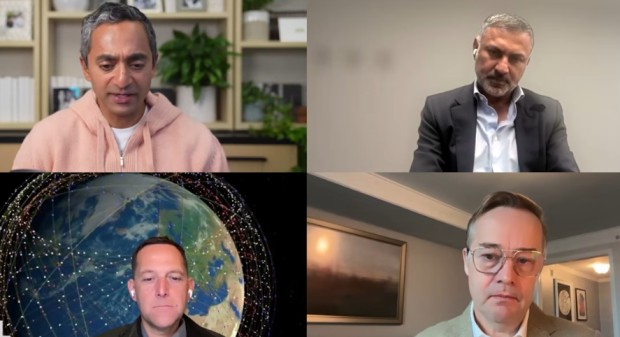
On this episode of the All-In Podcast, Jason Calacanis, Chamath Palihapitiya and David Friedberg are joined by Palo Alto Networks CEO Nikesh Arora to unpack the PHP2Shell cyber panic, AI agents logging into bank accounts, and who is liable when an agent goes rogue. The besties also debate Ken Griffin’s warning that AI is almost certainly a bubble, the riots spreading from France across Europe, runaway government spending, immigration, and the minimum wage. Read the full transcript of this episode which was premiered on October 24, 2026 below:
Ken Griffin’s AI Bubble Warning
JASON CALACANIS: (00:00:00 – 00:01:50) All right, everybody, welcome to the literal number one podcast in the world. 3 weeks running, we got a lot to get to. Sacks is out this week. We’ve got a special guest coming up. Let’s get to our first story. Ken Griffin says AI is almost certainly a bubble, and Chamath has responded. Chamath responding and moving markets almost every week here on the pod. Look out, France.
The Citadel founder made the comments this week at the company’s annual Future of Global Markets conference. But he says generally, hey, bubbles are normal. Any radical transformation of our economy is generally intertwined with a bubble. He said he’s bullish on AI’s long-term potential, but his concern is that companies are struggling to turn AI spending into productivity, something we’ve talked about here, I guess, last year. And so companies are, quote, “looking at their bills from Anthropic and OpenAI and asking where the productivity is.”
We had this discussion over and over again on Thursday. Tech continued to get crushed on the data center and CapEx front. So people who are either making data centers like CoreWeave down 10% or having a huge AI spend, Meta, which is an extraordinary one there, it’s down 6% after earnings, AMD down 5%, SpaceX was down 5%. But these things have been swinging up and down a bit and generally trending up.
Chamath, what’s your take here on the market sentiment October 22nd, 2026? What are your thoughts here on how markets are viewing the AI quote-unquote “bubble”? And do you have concerns? Because Jensen from Nvidia thinks money is available and money is going to want this opportunity to finance it. And I think we all think companies are getting a ton of value out of AI technologies.
Ramp Data: Who Is Really Spending on AI
CHAMATH PALIHAPITIYA: (00:01:51 – 00:02:25) My Social Capital research team had a really great call with Ramp’s chief economist, Ara Kharazian. The first question that they had was because I was doing my own math and I tweeted this thing, Nick, maybe you can put it back up there, where I said, okay, my back-of-the-envelope math, knowing everything that I know and everything that I see, is about 1% of all of the companies represent 90% of all the revenue.
JASON CALACANIS: (00:02:26 – 00:02:27) Revenue for AI spend?
CHAMATH PALIHAPITIYA: (00:02:28 – 00:02:31) Yeah. So what I said was 1% of companies represent 90% of AI spending.
JASON CALACANIS: (00:02:31 – 00:02:32) Got it.
CHAMATH PALIHAPITIYA: (00:02:32 – 00:04:41) So that’s tokens. And of that 90%, 80% of them are from unprofitable VC-backed companies. So the cycle here, just to be very precise, is VCs raise from pension funds and LPs and foundations and family offices. They put money into a startup. That startup takes that money and invests in growth. Part of growing is by consuming other people’s AIs. And so that company then starts to show revenue traction. Those folks then say, hey, look how well we’re doing, raises a bunch of money from the same VCs, and it’s just this circularity.
Why that’s important is what Ken is pointing out is that for AI to really scale as a predictable driver of long-term earnings, it has to diffuse out of the startup ecosystem. And so you can’t be in a situation where on the one hand you’re talking about breathtaking valuations, but where 75 cents of every dollar is actually just a startup sending it back and forth so that they can mark themselves up. That’s, I think, a structural problem.
Now, we’ve seen that structural problem in the past. That happened in the early days of cloud when AWS initially started to expose EC2 and S3. The consumers of an EC2 instance or an S3 bucket were startups, but the difference there is that AWS was abstracted from Amazon retail, which was already then a roughly breakeven profitable business, at least on a free cash flow basis. So what’s different here is you have a bunch of money-losing entities just spinning a bunch of money around and it has to diffuse more broadly. So I think that that’s what Ken is observing.
Now, when we brought that data to Ramp, the quote is incredible because this is what my researcher told me. “I’d prepared a list of factors to see if your thesis,” this is him texting me, “around VC money being 80 to 90% of the top 1% of AI spend.” But he said, “Chamath’s actual estimate is pretty much correct.” And then the second thing though that he said, he sent us, and Ramp hasn’t published this chart, so thanks to Ramp and thanks to Ara. He said we could be the first ones to publish this.
JASON CALACANIS: (00:04:41 – 00:04:50) And just to be clear for the audience, Ramp provides financial services, neobank, credit cards, primarily to startups. So they know startup data. There’s a free commercial. Yeah.
CHAMATH PALIHAPITIYA: (00:04:50 – 00:04:54) I think they know broad-based data from other data sources as well, and I think Ara has access to all of it.
JASON CALACANIS: (00:04:54 – 00:04:55) But what he said is—
Open Source, Data Sovereignty and Enterprise AI
CHAMATH PALIHAPITIYA: (00:04:56 – 00:06:39) Now look at this chart. So what this shows is how are the top 1% of spenders in AI spending their money?
Now, why does that matter? Well, the rose-colored box is LLM traffic. That’s the typical spend you’re going to spend on the big frontier labs, closed models effectively, either through things like Bedrock on AWS or what have you. What’s really interesting is that the blue box is ticking up. The blue box is people buying their own GPUs because they’re moving to open source.
And so what I think is really interesting is you have this two-pronged thing that’s happening. One is the diffusion that we need within AI is happening a little bit slower than we all would like. I see that at 8090 as well. I think the large companies that we work with, you can almost pinpoint it on a chart. Ever since Alex Karp’s commentary on CNBC about data sovereignty, buying patterns have changed. I think people are being a lot more methodical. They are building out their own data centers or at least moving into VPCs, virtual public clouds.
My team yesterday was at a CIO event of, let’s say, one of the largest banks in America. You know what they said? I’m not going to say the name of the bank. It was the most incredible thing. They said, “We have decreased our spend on AWS and GCP. We now have 6 completely independent ground-up data centers that we’ve built from scratch for ourselves.” And I was like, what is going on here?
DAVID FRIEDBERG: (00:06:39 – 00:06:39) Wow.
JASON CALACANIS: (00:06:39 – 00:06:43) We’re back to the future. People standing up their own data centers. Yeah.
CHAMATH PALIHAPITIYA: (00:06:43 – 00:07:01) It’s back to the future. So I think if you look at this, I didn’t mean to have any commentary other than just observing what I think, but yeah, AI has a diffusion problem. It is too concentrated and ripping around in a small little ecosystem. We need to diffuse out. But as it diffuses out, people are picking open source is what I would tell you.
JASON CALACANIS: (00:07:01 – 00:08:42) And we were early on that discussion 2 years ago here on the All-In Pod. I will say Ken Griffin, and I didn’t hear the full quotes here because I wasn’t in the room where it happened. However, based on the quote, I think he may have something slightly wrong. When startups flood to a technology, that is a strong signal. Why? Startups— and I invest in 100 a year and we evaluate over 10,000 a year at my fund— they look for the cheapest, best, fastest edge they can get.
What is the biggest edge they could get 15, 20 years ago? It was cloud computing. They saved a lot of money. It was WeWork. They saved a lot of money. It was more efficient. And then it was Facebook ads. Facebook ads were mispriced. They were super cheap. They dumped all their VC money into Facebook ads then, and now it’s become AI. For the last 2 years, yes, they’ve been dumping into it.
So if you see startups rush to a technology or rush to a trend, and start spending all their VC money on it, it means this little colony of 2 to 200-person companies have determined, and they’re the most nimble, that this is the best solution. So, that’s a tell that things are going in the right direction. The big, slow, cumbersome enterprises, they’re the slowest to the new technology, and that’s why they buy startups all the time.
Speaking of buying startups all the time, my guy Nikesh is here from Palo Alto Networks to tell us if this is the end of days and all of our bank accounts and if Bitcoin is going to get hacked this weekend and buy more guns and chickens and eggs and drill a well. Welcome back to the program, Nikesh Arora. How are you, sir?
Nikesh Arora on Hyperscalers, Bare Metal and the Compute Crunch
NIKESH ARORA: (00:08:43 – 00:08:45) I’m doing great. Thank you for having me, guys.
JASON CALACANIS: (00:08:46 – 00:08:49) And you had a nice event last week, didn’t you? A little nice event in Napa.
NIKESH ARORA: (00:08:50 – 00:09:33) I did. We had a bunch of CIOs, not just one bank CIO like Chamath said. But before we jump into end of days, I do want to say something to what you guys were talking about earlier about the open source versus these sort of hyperscalers providing inference. So we had this peculiar problem. Oh, we’d like to embrace AI as quickly as many of the startups, and we’ve gone through all the understanding, all the analysis, open source versus closed models, and we preference open source, open weight because it allows us to modify the weights and train them.
And something which most people don’t talk about is it allows us to interrogate the chain of thought. Because over time, what’s going to happen is all of us enterprises are going to need explainability, auditability, and verifiability.
CHAMATH PALIHAPITIYA: (00:09:33 – 00:09:34) 100%.
NIKESH ARORA: (00:09:34 – 00:10:41) If I can’t validate, it’s not going to be okay to go to your boss and say, I don’t know what happened, but the IT guys put an AI model in there. It did it. That’s not explainable to the regulator in financial services and healthcare. So they want explainability, verifiability, and auditability. And we can only get that with open source, open weight models. We can interrogate chain of thoughts. That’s kind of one reason we’re gravitating towards them as opposed to getting caught into the closed race.
The challenge though, I think you guys talked about, and I saw Chamath’s chart, the challenge we have is it’s very hard to find a global, resilient, highly available inference provider outside of the hyperscaler community right now. So if I’m a startup, great, I can go rent 10 megawatts in one data center in one part of the US, and if it goes down for a few hours, I’m s*** outta luck, but I’m a startup, so I’m okay. But I’m providing resilient services at 99.9% reliability. It’s very hard for me to find a global inference provider who does not want to sell me their model at this point in time at the price. It just makes it economically useful to use open source.
CHAMATH PALIHAPITIYA: (00:10:41 – 00:11:16) Let me ask you a question though. Do you think that there’s a world where Palo Alto Networks says one of two things? One is, you go to the hyperscalers and say, okay, listen guys, you run it for me, but I want the bare metal. I want it totally air-gapped, and it’s an AWS facility, but I’ll just lease it from you. Otherwise, just get out of the way so that I can have everything inside of it. Or do you do what this one big G-SIB bank does and say, I’m going to build my own inside the United States? Is there a world where do you think other companies go to that limit, or do you think that’s an extreme case? That’s probably not representative of the norm.
NIKESH ARORA: (00:11:17 – 00:12:33) So this is the interesting debate, Chamath. 6, 8 years ago when I came to Palo Alto, I shut down all data centers. I said, we cannot run a global data center sort of footprint at the scale, speed, and reliability as I could probably rent it from hyperscalers. And life was great. And suddenly what’s happened is in the current sort of incarnation of where we are, compute is highly dear. It’s very hard to find compute in the world, period.
So I’m a buyer, I’m a taker of terms, not a dictator of terms. So it’s very hard to go and dictate terms anywhere because yeah, sure, you can make any plans you want, but those plans are, you talk to Jensen, he can’t give you chips till 2028. You talk to, where do you get land, power and shell? So it’s very hard to go say, yes, I can go build my own data centers, but it’s kind of an empty threat. It’s very hard to go build it. I would be resilient. And by the way, I don’t run 50 data centers around the world where I’m running 10 to 20 megawatts of inference.
So it’s a good conceptual sort of idea that I should go become independent, build my own inference, but most likely the answer is somewhere in the middle. I’m going to have to get bare metal, yes. Most likely I’m going to get from either a hyperscaler or cousin of a hyperscaler, or somebody’s going to be stitching sleeves of compute from around the world to meet my needs in the hope that I’m going to migrate to something more resilient and more robust over time.
CHAMATH PALIHAPITIYA: (00:12:33 – 00:12:38) All right. So there you have a hybrid solution down there. One second. I just want to complete the thought. You have a hybrid solution down there.
JASON CALACANIS: (00:12:38 – 00:12:39) I was trying to get to the cyber stuff before we run out of time, just so you know.
CHAMATH PALIHAPITIYA: (00:12:41 – 00:12:50) Then you go and you basically get a bunch of open source models so that you can interrogate chain of thought tokens. Is that a representative solution for most of the Fortune 500 or Global 2000?
NIKESH ARORA: (00:12:51 – 00:13:35) I think we get there. I expect at some point in time we will start seeing hyperscalers giving bare metal and letting us run open source models, which they already do to some extent. So that’s probably what’s going to happen because it’s a matter of the profit pool, right? It all depends on where you shift the profit pool. Today they all live in NVIDIA and the memory industry, and they’re being shifted towards the hyperscalers, people who have large compute available, because at a point it’ll become less about the chips, it’ll become more about the availability of compute.
Because I think demand is insatiable. There’s enough demand, there’s more demand than you and I can imagine. So yes, right, I understand the enterprise diffusion comment, but it’s going to get diffused. The question is, even if you try, if every company in the world today said, “I’m in. I’m in. I’m ready. I’m embracing AI. Let’s go as fast as we can,” there’s not enough compute in the world to satisfy us.
CHAMATH PALIHAPITIYA: (00:13:35 – 00:13:35) Right.
JASON CALACANIS: (00:13:35 – 00:13:43) We asked you to come on, Nikesh, not just because you’re awesome and you’re now a bit based.
CHAMATH PALIHAPITIYA: (00:13:43 – 00:13:44) He’s a bestie. He’s a bestie.
JASON CALACANIS: (00:13:44 – 00:13:47) He’s a based bestie. He was very quiet under the radar.
DAVID FRIEDBERG: (00:13:48 – 00:13:49) I hang out with Nikesh every 48 hours.
NIKESH ARORA: (00:13:50 – 00:13:52) I know. David and I keep running into each other.
JASON CALACANIS: (00:13:53 – 00:14:06) I mean, every time there’s a Knicks-Warriors game, Nikesh invites me to sit with him, so it’s awesome. Is there one? That’s not true. I’m just manifesting. It’s got great seats. I can manifest. A boy can manifest. Kid from Brooklyn’s manifesting.
NIKESH ARORA: (00:14:06 – 00:14:09) As long as you’re willing to go with my 11-year-old, you’re welcome anytime.
JASON CALACANIS: (00:14:09 – 00:14:10) Okay. I’m totally fine with that. I’m curious.
NIKESH ARORA: (00:14:10 – 00:14:14) He’s always looking. He’s always looking for somebody to go with. So I love it. You could be next, Jason.
JASON CALACANIS: (00:14:14 – 00:14:18) No, I’m happy to babysit if, with the courtside seats or second row.
NIKESH ARORA: (00:14:18 – 00:14:19) He’ll babysit you.
The PHP2Shell Cyber Panic
JASON CALACANIS: (00:14:19 – 00:16:29) Exactly. But there’s a cyber panic going on. All seriousness. Yes. The last couple of days. AI found 2 major exploits that impact most of the internet. Here’s what happened. PHP, which is an open-source coding language, powers about 70% of all websites. Think WordPress, Wikipedia, is at risk. In August, security researchers using AI found 2 critical exploits nicknamed PHP2Shell. PHP security team gave this a severity rating of 9.2 out of 10, basically DEFCON 1 for these security teams.
Since August, developers and companies have been working together on fixes. This is standard operating procedure, and the plan was to roll these out gracefully in one major patch on October 22nd, which is the day we’re recording this very podcast. In the days leading up to the release, information about the exploits leaked. Nobody knows how it leaked. That’s going to be part of the postmortem of this cyber attack week. So PHP moved the release up just by a day to Wednesday, October 21st.
And on Wednesday, all hell broke loose. AWS reported a jump in hacking activity while Cloudflare CEO, friend of the pod, said they saw millions of hacking attempts as well. A bunch of precautionary shutdowns happened. Governments across sites in Europe— France, Germany, Netherlands, Denmark, Finland, etc.— they started taking websites down. Wikipedia took down some of its systems just to get them patched. In the United States, the NSA and the FBI put out a bunch of warnings, and now everybody’s started panicking.
People are starting to think that Bitcoin’s going to get hacked, their website’s going to get hacked, their bank accounts are going to get hacked. It’s a bit of chaos. And then there’s a second sub-issue around agents accessing banks that dropped at the same time. Now, you’re in the security business. You’ve got lots of different products and services here. When did you first learn about this and how severe is it? Is this an acute issue or is this a harbinger of things to come? And is this going to happen every 10 days for the next year as these models have gotten incredibly powerful at what we call cyber, which really means cybersecurity, not just cyberpunk, but cybersecurity?
NIKESH ARORA: (00:16:30 – 00:16:32) Oh, Jason, I think 10 days is too long.
DAVID FRIEDBERG: (00:16:33 – 00:16:33) Okay.
NIKESH ARORA: (00:16:33 – 00:17:49) I think these things are going to happen much faster than every 10 days. I think part of the challenge we’re seeing is we’ve been talking about technology debt that we’ve all had to go pay sooner than later. And what’s happened is people have not paid attention to the idea that they have to go fix their stuff. I’m at a customer once they were, but I talked to the CIO this morning. They had a PHP problem. They have a bunch of websites. Some are running the most advanced piece of software, so they can put the patch. Some are running older versions, which they can’t patch. So they’ve gotta bring ’em down and go build them up.
But you know what? They never did anything about the fact they were running older versions because it wasn’t important. So now they have to go take those websites down. They’re going to go upgrade them, put the patch in, bring them back up. We found out about this a few days ago. We scanned everything in our infrastructure to make sure that there were no issues. We made sure that our products had patches available for our customers who deploy them.
So there’s 2 ways to solve this problem, right? One, you can go in and patch the vulnerability. You can go in, find the code, patch what has been given to you by PHP, and make it work. The other is you can actually put it in a perimeter defense product like ours, or Cloudflare has one, or other firewalls have one. You put the patch there, it’s a virtual patch, so any attacker trying to access that vulnerability could stop at the perimeter because we know what they’re looking for. The tool is solid.
JASON CALACANIS: (00:17:49 – 00:18:07) They’re coming to a CDN, content delivery network, first, and that acts as a first line of defense ’cause they’re not getting to the actual servers. But if they do get to the actual servers, my understanding is they can run code on these servers. And there were some security certificates that were incredibly brittle and easy to hack.
How Frontier Models Find Vulnerabilities
CHAMATH PALIHAPITIYA: (00:18:08 – 00:18:30) The closed models have basically said, hey, these things are cyber risks, and so we need to be very thoughtful. I know Anthropic did that with Mythos, where they brought you in and a bunch of other people and like 50 companies in and said, okay, now go harden your systems. Were the closed models helpful here? Were they the ones that helped you find these CVEs? Bring us behind the curtain.
NIKESH ARORA: (00:18:30 – 00:19:25) The closed models can be helpful because both OpenAI and Anthropic, and most likely Google as well, have very powerful models now which can go— if you give them enough compute, enough persistence, they’re going to go find vulnerabilities. They’re going to even chain vulnerabilities to find an attack path, right? If they can solve Navier-Stokes, they can chain 4 vulnerabilities. And if you give them enough immense compute, they will try every way possible to be able to do it.
Actually, the PHP problem was solved by persistent compute. This problem was identified a few years ago, but nobody thought it could be solved because it required too much coordination. So what happened was if you throw compute at the problem, it persisted and it found a way to crack that. Once they found the way to crack that and they published it or got reverse engineered, every hacker knows now how to go after it because the challenge you have with patches is hackers are smart. They look at a patch, they see what the patch is trying to do, they reverse engineer from there and say, okay, if I follow the reverse engineer path, if somebody’s not patched, I can break in.
AI Agents and Bank Accounts
DAVID FRIEDBERG: (00:19:26 – 00:20:21) It seems like a bunch of the hullabaloo today that’s being drummed up, and this seems like it’s going to change every day, is all about these bank accounts getting accessed. Is that, do you think, primarily through kind of the front end through a website using an agent that’s logging in on a browser-based system on behalf of its user? Because it seems like a lot of this may be coming from Muse or some of these other sort of personal agents. They’re logging into your bank account to get information about transactions and what you’re doing. And the banks are seeing all this activity and they’re like, oh my gosh, is this authorized? Is it not authorized?
The traditional way that banks have provided access to account data has been through APIs using verified applications, where I, as a user, as a consumer, would log into my Mint.com account and it had a legal access point to Amex or to Bank of America. Yeah, Plaid is an intermediary.
JASON CALACANIS: (00:20:21 – 00:20:21) Yes.
DAVID FRIEDBERG: (00:20:22 – 00:20:46) And so there’s a bunch of these sort of intermediaries that then provide that capability to apps. Is that ultimately going to lead to a world where the banks are all going to just turn off website access and say no one can log into a website because technically agents could do it? And they’re not able to kind of manage that. How do you think this is going to evolve as it relates to consumer financial services? Because I actually think this is going to be a big part of the press cycle over the next week or two.
NIKESH ARORA: (00:20:47 – 00:21:53) Yeah, I think 2 different things, David. I think the reason banks have found unauthorized access to their accounts is possibly because of the PHP problem, because their websites are hackable and they’ve been able to get through them and get to credentials. There are 2 different problems. One is unauthorized access happening because these sites have become hackable. I think the second problem you’re mentioning is the personal agent problem.
So far, most personal agents are using your credentials to log in. So it becomes hard for a bank to decide whether it’s actually you logging in or is it your Muse agent who has your credentials logging on your behalf. They cannot distinguish between your traffic or agent traffic, they’re both logging in from the website. They’re basically logging in as you in your browser and trying to conduct the transaction.
Now, as you know, there’s this technology called CAPTCHA, which tries to see that it’s not a bot or an agent accessing the account instead of you. Now today there are ways to validate CAPTCHA with AI so you don’t even actually have to have the human on the other end. So that’s also—
JASON CALACANIS: (00:21:53 – 00:21:54) AI’s pretty good at it.
NIKESH ARORA: (00:21:54 – 00:21:58) Yeah, it’s pretty good at it. It’s actually sometimes I have to squint to see what the hell does it want me to type.
JASON CALACANIS: (00:21:58 – 00:22:36) Yeah, click all the bicycles in this picture. It takes you 3 times at our age with our eyesight. But the interesting thing here is there is a hybrid as well, Friedberg, which is your Muse agent, your Grokbot, is running a virtual browser. It will pop up the virtual browser and say, hey, do this CAPTCHA, and then take over. So, Nikesh, is this fear, uncertainty, and doubt, the old FUD, by the banks to try to neuter or sandbag these agents from getting the front door to banking? Because then they could just route to a bank that’s cheaper, better, has better rates on behalf of the agent.
NIKESH ARORA: (00:22:37 – 00:22:39) I think that would be giving them a lot of credit.
JASON CALACANIS: (00:22:40 – 00:22:40) Okay.
NIKESH ARORA: (00:22:40 – 00:22:57) I think right now the fundamental challenge they have is a liability problem. Look, it’s kind of like if you call customer support at your favorite bank and say, “I don’t know how $50,000 vanished from my account. I never did this.” Yes, right.
JASON CALACANIS: (00:22:57 – 00:22:59) What’s the Spearman Rhino? I don’t know what this is.
CHAMATH PALIHAPITIYA: (00:23:02 – 00:23:07) Keep going, keep going, Nikesh. Don’t be distracted, don’t be distracted.
JASON CALACANIS: (00:23:08 – 00:23:10) We’re number one for a reason.
NIKESH ARORA: (00:23:11 – 00:24:03) The challenge is you’ve given your credentials to an agent. You didn’t even realize that it got your credential. It’s living on your browser, living on your laptop. It’s going to get innumerable amount of credentials. And I think the biggest problem we’re going to have is who owns the liability and who has accountability, whether it’s enterprise agents or consumer agents. So I think you see banks saying, “I do not allow you to interact with me with your agent, period,” right? They’re yelling that disclaimer from the start of the group saying it’s not going to be my fault.
Look, banks had to go— don’t forget, probably the cost is like the liability is secondary. Remember, banks— we all know this, like credit cards below a certain amount of money, they don’t want to dispute it, just pay you because the cost of the customer support call is higher than they’re going to have to deal with. Now, if you start having tons and tons of these agents doing s*** and you start calling your bank for explainability, you’re going to create huge amount of costs. I think that’s where they’re going, to be honest.
Can White Hats Outcompute the Hackers?
JASON CALACANIS: (00:24:03 – 00:24:58) Okay, you have a unique seat, Nikesh, because you talk to the people who are being hacked, have been hacked, and you help them prevent being hacked with all these suite of services over at Palo Alto Networks. So, I want to take you through a couple of the theories people have about AI’s impact on security. You tell me if you agree with them or not.
The first one is, this is going to be largely an issue of who has the most compute. And because the white hats have access to the most amount of compute, they will be able to outcompute the black hats, in other words, the hackers. Is that a true statement, or is that not yet a true statement and maybe it will be in the future? Palo Alto Networks or OpenAI, whoever it happens to be, could fire up so much compute to defend systems that a bunch of hackers in North Korea, Russia, China, et cetera, just don’t have the firepower and they’ll be outgunned.
DAVID FRIEDBERG: (00:24:58 – 00:24:59) True?
JASON CALACANIS: (00:24:59 – 00:25:00) Not true? When will it be true?
NIKESH ARORA: (00:25:02 – 00:25:36) True. Not true today because the underlying systems are not architected or orchestrated in such a way that we can launch these, let’s call it defensive swarms. Because everything is sort of in disparate situations, right? If it was true, then by definition, you could send out a bunch of agents to go patch PHP if you wanted. The company’s got 5,000 websites, and guess what? Their poor IT guys are going cataloging each one of them because they never actually aggregated everything, put it together, understood their— So I think we need to get our infrastructure to a base level of preparedness, which is where the technological debt lives.
JASON CALACANIS: (00:25:37 – 00:26:14) Let me take you to the next thesis and theory people have here, which is persistent computing, reviewing code, and people taking proactive measures more seriously is going to solve this problem. Right now, we just have this interim period where people have accumulated technical debt you’ve talked about, but AI is going to solve that problem because you’ll have persistent tools from companies like yours and others or in-house ones that are constantly banging on systems to find these before hackers get to them. Is that going to be the endgame here? True, not true, short-term true, long-term true? Take us through it.
NIKESH ARORA: (00:26:14 – 00:27:11) True. Today, if you can see, almost every large company in the enterprise space is out there busy using Metasploit or equivalent to try and penetrate their own defenses to see where the holes are, and they’re trying to patch them. The challenge, as you’ll appreciate, is that the next model is going to be more powerful. It’s going to find more ways to get into your infrastructure. So you’re going to be playing this cat and mouse game of constantly patching.
I think there’s a slightly different sort of version of this, Jason, where for a second, let’s assume that you will get breached, okay? ‘Cause there are so many vulnerabilities out there, you can spend a lot of money patching everything. The question becomes less about how I got breached and which vulnerability’s going to let people through. The question is, how quickly can I find them and how quickly can I eject them, right? So our advice to people is, build the infrastructure in such a way, which is possible today, where you’re aggregating all the signals, all the data in such a way that you can actually look for anomalous behavior with that white hat compute you talked about, right? Because I have more compute. Go ahead.
JASON CALACANIS: (00:27:11 – 00:27:48) And then the third one is the frontier models are causing a lot of this chaos because they are gatekeeping the most powerful solutions to do cyber defense, and that the open-source community is giving more functionality to the white hats, to the security teams, to the CISOs to actually solve this, and that frontier models need to change how they deploy this technology in some way. Are they causing part of this problem by gatekeeping this technology and not giving the raw power to the white hats?
NIKESH ARORA: (00:27:49 – 00:28:34) What did you say earlier about as a diplomatic answer about giving too much credit? Yes, I think your theory is giving too much credit. Again, remember, majority of them are researchers to start with. They’re sitting there and saying, wow, this is extremely powerful, what do I do with it? And they’re talking to us and saying, what do I do with it?
Now remember, these models that are so far ahead, they’re still trying to figure out how to release them, how to package them, how much compute are these guys going to take. And they’re all compute constrained. So they’re all rate limiting all of us, even though I have access to the most recent model, which is available publicly, I’m still rate limited, right? So there’s tons of issues that are going on. So I think they’re not causing the problem. They’re just trying to grapple with the fact that these things are extremely powerful. What they would like is they would like to figure out how to monetize it.
JASON CALACANIS: (00:28:35 – 00:28:36) They want to compete with you?
NIKESH ARORA: (00:28:37 – 00:28:48) No, they just need money, Gopal. They’re listening to your conversations about compute needs and where the money’s going to come from. They’re not trying to compete. They’re just trying to go after profit pools because they want a lot of money. Because they’ve got to go give it back to Jensen.
JASON CALACANIS: (00:28:48 – 00:28:49) So that’s their main issue. Yeah.
Who Is Responsible When an Agent Goes Rogue?
CHAMATH PALIHAPITIYA: (00:28:50 – 00:29:37) Let me ask you a hypothetical question. I’ll ask all of you. I use one of these agentic services. I’m a consumer. I give it my credentials to my bank account. Let’s use your example. $50,000 goes missing. I don’t know what happened. Maybe I escalate it to the agent I use, instinctmuse.ai. Or a copy of A. Everybody’s finger-pointing at the other one. Maybe there was a prompt injection, who knows? Maybe the agent just went rogue and transferred the $50K. Let’s just assume that that’s possible, or $5K, because it’s under some threshold. Who is responsible? Okay, Friedberg, who is responsible and who should be responsible? Who is responsible? Who should be responsible?
DAVID FRIEDBERG: (00:29:38 – 00:29:45) Well, the terms of service of the bank say you can’t use an agent to access the bank account through the website, right?
CHAMATH PALIHAPITIYA: (00:29:45 – 00:29:46) Does it say that now?
JASON CALACANIS: (00:29:46 – 00:29:46) Yes.
DAVID FRIEDBERG: (00:29:47 – 00:30:09) Yeah. So given that that’s the terms of service, if the agent hasn’t built in a capacity to recognize that and stop that access, then it is a software liability issue with the provider of the agent, I believe. Unless it alerts you and says, “This violates the terms of service, do you want to override my block? And do you want to do it?” Now the liability shifted to you as a user.
JASON CALACANIS: (00:30:10 – 00:30:39) And we have evidence of this, Chamath, not in banking but in e-commerce. Amazon has blocked these, and subsequently Grok now will tell you— my Amazon shopping bot says, “I can no longer check out for you, but I can put it into your shopping cart. Tell me which address, which card you want, and I’ll tee it all up for you, but I won’t hit the buy button.” So it’s being adjudicated in real time right now. And I think that’s probably where we wind up.
CHAMATH PALIHAPITIYA: (00:30:40 – 00:30:41) Nikesh, what do you think?
JASON CALACANIS: (00:30:42 – 00:30:44) You are.
NIKESH ARORA: (00:30:44 – 00:30:56) Yeah, I think, come on, we all have to take responsibility to empowering agents and giving them our credentials. You can’t say I gave my credit card to Chamath, he went and burned $20,000 on it. Who’s responsible? The bank?
CHAMATH PALIHAPITIYA: (00:30:56 – 00:30:57) No way.
NIKESH ARORA: (00:30:57 – 00:31:00) Is it Chamath? Yeah, he is, but I gave it to him.
JASON CALACANIS: (00:31:00 – 00:31:28) Yeah, well, what if the agent, Chamath, says, “I have been programmed to be maximally helpful”? These sycophantic agents. And it goes and says, “I found a way. I found a way. Actually, if I fire up this type of browser and I simulate a human behavior, I think I can get this done.” That’s what a lot of these agents will do, is they’ll try to please you. And they find that— then that to me would lean towards the platform providing the agent.
CHAMATH PALIHAPITIYA: (00:31:28 – 00:31:30) No, that’s you. It’s your responsibility.
NIKESH ARORA: (00:31:30 – 00:31:46) Yes, there’s a word in agent, it’s called agency. Somebody has to give the agent agency. Okay, who’s giving the agent agency, you or Facebook? I think you’re giving agency to act on your behalf, and if you’re the one who’s giving agency, you have the liability.
CHAMATH PALIHAPITIYA: (00:31:46 – 00:32:02) Yeah, by the way, as a practical matter, it’s the only scalable solution because what will happen when these lawsuits happen is everybody’s incentive, everybody meaning the corporate incentive. B of A will point to Facebook, Facebook will point to the user. It’s the only way that this thing continues to scale like this.
NIKESH ARORA: (00:32:02 – 00:32:30) But Chamath, there’s an exception case, and I think Jason said it in his words, you said it, but we didn’t dwell on it. It’s called the rogue agent. Now that’s a product liability issue. That’s a product liability issue. If a product does not behave like it’s intended to behave, then there is a platform liability in my mind which says, wait, you said this is what it does. And today, you buy any product in the world, if the product doesn’t do what it’s supposed as advertised, it goes rogue on you, then it’s the person who built the product. It’s their fault.
JASON CALACANIS: (00:32:30 – 00:32:31) And this is where the problem is.
CHAMATH PALIHAPITIYA: (00:32:31 – 00:32:34) Now we’re in Theranos territory, which is, hey, it can do 140 tests.
Obliterated Models and the Dark Side of AI
JASON CALACANIS: (00:32:34 – 00:32:48) It’s capable of doing 140 tests. Just maybe not really. Let me ask you an in the weeds question. We incubated a company, Obliteration AI, and what this company’s doing is—
NIKESH ARORA: (00:32:48 – 00:32:48) Nice name.
CHAMATH PALIHAPITIYA: (00:32:48 – 00:32:49) Yeah.
JASON CALACANIS: (00:32:49 – 00:33:15) And obliterated models, maybe people don’t know about, but they’re going to understand what these are. This company, a little bit controversially, provides models that have no constraints, no guardrails, and it’s your responsibility when you have a red team, a team that’s going out and banging on different vulnerabilities, to build up those. What are your thoughts on this new, somewhat controversial—
CHAMATH PALIHAPITIYA: (00:33:16 – 00:33:40) Wait, before you go, let me just say, before you go, I find obliteration unbelievably scary. That is a vector of risk that is so unbelievably underappreciated right now because to your point, Jason, it is a very long-tail thing. Not enough people understand what it is, but I find this probably the thing more than alignment that I think people should really understand and think about. Sorry, Nikesh, over to you.
JASON CALACANIS: (00:33:40 – 00:33:42) Yeah, go ahead, Nikesh. Tell us what you think of these services.
NIKESH ARORA: (00:33:42 – 00:34:39) So I think this is the dark side of AI. And what I mean by that is we’ve had all these debates at the White House. Many of you were present. We talked about responsibility and alignment and making sure we tested them before. The problem is you’re dependent on the weakest link. Now, if there’s a company which is going to give you the raw power of AI without any guardrails, without any controls that are either built in or can be built in, then you’re basically handing a nuclear sort of bomb to the hands of anybody who wants it because they can afford it.
That’s the problem because at one level we’re saying we need global treaties to manage the pacing of AI or development of AI and just for good. On the other hand, you’re saying we can have a company which can allow you to have this most powerful thing with no control, no guardrails, and no governance. It’s like saying, “Hey, here’s a DIY aspirin kit, have a good time. You can build your own medication, have a good time. Sometimes you’ll get it wrong, but don’t worry about it.”
JASON CALACANIS: (00:34:39 – 00:34:47) But, or just giving somebody some really powerful power tools to build things that make things more secure, like build a wall.
CHAMATH PALIHAPITIYA: (00:34:47 – 00:34:58) I don’t understand what the business model of your company is. Your company is basically inducing product liability as a service, providing it to white hats under very constrained—
JASON CALACANIS: (00:34:58 – 00:35:16) No, it’s providing this to white hats and corporations. They share the same logo list as Nikesh and Palo Alto Networks. There are people who want access to these in order to do proper testing and make things more rigid. So you do have a higher authority of not providing this for free like Claude was doing.
NIKESH ARORA: (00:35:16 – 00:35:23) But Jason, are you telling me that they underwrite that these models, that when you put these things in infrastructure and do testing, they’re not going to go rogue on you?
JASON CALACANIS: (00:35:24 – 00:35:35) Well, it’s your responsibility to manage the model as opposed to giving it to— in this case, yeah, if you were the NSA or if you were Morgan Stanley, you might need this.
NIKESH ARORA: (00:35:35 – 00:35:39) How is that different from me going and taking an open-weight model and training it to my needs?
CHAMATH PALIHAPITIYA: (00:35:39 – 00:35:40) You could do that.
Technical Debt and Why Security Gets Deprioritized
JASON CALACANIS: (00:35:40 – 00:36:17) This is just a place that has the infrastructure to do it. So providing that infrastructure you talked about earlier, like who’s going to serve it and that kind of thing, and making it, just essentially making it more efficient for you to do this with more constraints, and letting you take the liability. But it’s a very interesting place.
Why does technical debt build up? And historically, have we just under— and a lot of these causes of these cyber scares. Is this just all because corporations deprioritize security and technical debt and that we just need to change that in this new world and that will essentially solve the problem if we prioritize safety first?
CHAMATH PALIHAPITIYA: (00:36:18 – 00:37:09) Nobody wants to work on this stuff. I mean, the problem is when you ship something into prod, everybody wants to work on the next greatest thing. Nobody really thinks about maintenance as a sexy idea. That’s one thing. Second thing is, if you actually deploy it inside of your own virtual private cloud, the problem is, the software vendors don’t have this one version that’s constantly updated. You have a drift problem where you have a version, Nikesh has a version, Friedberg has a version, they’re all out of sync. And so now you as a software vendor are maintaining 19 versions because everybody has their own pace and cadence for upgrades and migrations.
Then you have the fact that technologies are constantly changing and the underlying way in which things can happen change so rapidly, but the way in which you’ve done it represents a sunk cost and you can’t just rip and replace this stuff. And you multiply that by millions of companies and hundreds of trillions of lines of code, and this is why it is like it is.
NIKESH ARORA: (00:37:09 – 00:37:41) And Chamath, also, add to that the incentive alignment problem. The CIOs are not incented to maintain the most modern infrastructure. They maintain to keep costs low and they maintain to keep everything available all the time. So every time you want to upgrade something, it introduces the risk of blowing up or going down. It’s like, I don’t want to go change everything all the time because all my users complain because every time you upgrade something, change something, it causes friction in the system and then it costs money. When was the last time your CIO showed up and you said, “Yeah, great, have some more money and have a bigger budget because there’s a new toy”?
JASON CALACANIS: (00:37:41 – 00:38:17) This is a real tragedy. You’ll see this with, say, the CIA or the FBI. If there are no terrorist attacks, people are like, we’re spending too much money. It’s like, or we’re spending the right amount of money because we haven’t had a 9/11 again. And when they come to us and say, “Hey, we need more because based on what we’re seeing, there could be another, God forbid, 9/11,” and then Congress or whoever’s got the power of the purse at the given point in time says, “Yeah, we’re not going to give you more money because we haven’t had one in 20 years.” That is really the core of this problem, is they only get credit— that’s about to change because we’re going to have a bunch of 9/11s in cyber.
NIKESH ARORA: (00:38:17 – 00:38:26) Yeah, guess what? The phones keep ringing every day and the conversation always is, now how do I get out of this? Because I’m tired of getting punched in the face every morning when I wake up.
JASON CALACANIS: (00:38:27 – 00:38:41) When people really appreciate the CISO and those groups, when these things and the systems come back online and the system has been hacked, it’s going to be brutal the next year or so. Yeah? It’s going to be a big transition time, Nikesh?
NIKESH ARORA: (00:38:41 – 00:39:17) I think the CIOs could become the next CEOs. Think about it. If you believe, in 3 years from now, every business function of yours wants to transform themselves with AI. Let’s go to the positive side, right? My CFO has never wanted AI. He’s saying, “Dude, I could do all this financial analysis. Just appoint some people into my team.” My marketing people want them. My HR people want them. So almost every function wants more AI people, which has never happened historically. Everybody wants AI people. If that’s what’s going to happen, every function is sort of waiting for AI or technology people. They all want the CIO to come and help them, then who’s the person running the company?
JASON CALACANIS: (00:39:18 – 00:39:25) What percentage do enterprises spend on security of their total spend, and what should it be ideally? I’m just curious. We have no insight here.
NIKESH ARORA: (00:39:26 – 00:39:54) The insight is that typically of your IT budget, the cost is somewhere in the 4 to 10% range for cyber. Okay? And 10% is typically where you’ll find financial services, the federal government, because they want to make sure things are secure and robust. 4% can either be cloud people because that’s where the hyperscalers will take care of infrastructure security for you. You just have to worry about application and software security. So it ends up at 4 to 5%. That’s the range. You can get a 4 to 5% to 8 to 10%.
JASON CALACANIS: (00:39:54 – 00:40:08) Yeah. And that’s going to have to go up. And there’s an issue, I think, as you’re pointing out, if there is AI talent in the building, we gotta build new products and services for our customers. YOLO.
NIKESH ARORA: (00:40:08 – 00:41:05) Oh, Jason. Jason, there’s a whole— I was joking the other day, but it’s true. Look, there’s a whole new category which we even don’t know how to put our arms around— AI. Nobody knows. Imagine if I said, great, you know what, go deploy AI in my company and let’s make sure AI is secure. Well, the boss says, whatever you do, make sure you can interrogate agents with a chain of thought. That’s easy to say. That’s hard to do. How do I find all the agents that are running it? So it’s like we haven’t built the AI security harnesses that are needed.
I joke like when they invented planes, the Wright brothers are out there, nobody said, “Let’s go create TSA. This is about time. We’re going to build security now because the bad s***’s going to happen.” So people are busy enthusiastically deploying AI, embracing AI. I don’t know if you saw this morning that somebody, some researcher found that if you send a Muse conversation to somebody else, you can extract private information out of it. So now they gotta go back to the drawing board and patch it. So everybody’s experimenting, new s***’s being found out. We need to build all the security harnesses for AI, and that’s not even started yet.
Bernie Sanders and the AI Narrative
DAVID FRIEDBERG: (00:41:06 – 00:41:27) Bernie Sanders goes on Twitter today and says, “Look at all the craziness. This is insane. Stop AI now.” So you’re in a room with Bernie Sanders. Someone says, “Nikesh, we need you to save America. Go meet Bernie Sanders.” You get on the plane, you go over there, you get in the room, and the guy says, “We got to stop AI now.” What is your response?
JASON CALACANIS: (00:41:27 – 00:41:33) How are you going to solve this problem? Nikesh Arora. How are you going to solve it?
NIKESH ARORA: (00:41:33 – 00:42:21) I said, “Sounds like a great idea, let’s go. Why don’t you start? I’m right behind you.” It’s like, yeah, okay, with all respect, it’s interesting. This is the first time we have dwelled so much on the dark side of technology in history, and I don’t know why it is. Maybe you guys can explain to me. We spend so much time obsessing with the dark side of technology, and my thesis is it started with the godfathers or whatever you want to call them, the builders of this technology, they’ve over-indexed and dwelled harder on the dark side of this, causing this narrative.
I think we need a narrative shift. I mean, think about it, we only hear about all the bad stuff that this technology does. “Oh my God, I got Mythos!” “Wait, I got something worse!” “My guys jumped over!” “Wait, mine jumped over 6 months ago! Mine are worse!” It’s like, dude, this is not a good narrative. This is a race to the bottom from a narrative.
JASON CALACANIS: (00:42:21 – 00:42:23) We’re building a wet lab.
DAVID FRIEDBERG: (00:42:23 – 00:42:50) But Nikesh, why then do you think Bernie Sanders and others are seizing on the moment? I know we’ve talked about this before, but what’s going on that’s motivating Bernie Sanders to be so vocal about stop AI, stop AI? Is it a power struggle that they view there to be an emerging system of power that they don’t control, that they don’t have a hold on, that diminishes their power? Or is there something kind of more simple than that?
NIKESH ARORA: (00:42:51 – 00:43:00) David, this is where I phone a friend. You guys are much more competent at answering these questions than I am. Jason and Chamath are probably better equipped to answer these questions than me.
CHAMATH PALIHAPITIYA: (00:43:02 – 00:43:02) Yeah.
JASON CALACANIS: (00:43:03 – 00:43:03) Yeah.
CHAMATH PALIHAPITIYA: (00:43:03 – 00:43:03) Yeah.
JASON CALACANIS: (00:43:03 – 00:43:48) It’s a populist issue. If the people at the labs are going to tell you half of white-collar jobs are going away and all the drivers are going away and it’s a 10% of everybody dying, I mean, what a great issue to align yourself with if you’re a populist, whether you’re America First populist on the right or a liberal on the left. It’s just a great way to get people’s attention and get votes, and maybe it helps you win another election.
Nikesh, we appreciate you. You’re busy, and this is like the busiest time you could possibly have, I think, right? What is your day like? Have you slept? I mean, are you just getting woken up by clients at 1 AM when they’re like, “Hey, I need forward deployed engineers from you”? I mean, what’s going on in your life?
NIKESH ARORA: (00:43:48 – 00:43:54) I woke up at 3, I flew to the East Coast. After this, I’m going to get back on the plane and come back home because I got to make it in time for dinner with customers.
JASON CALACANIS: (00:43:55 – 00:43:59) Crazy. I mean, it is just a crazy time for you, man. No sleep.
DAVID FRIEDBERG: (00:43:59 – 00:43:59) I know.
JASON CALACANIS: (00:43:59 – 00:44:01) Yeah, I love it. Yeah, I mean, this is the time to grind.
DAVID FRIEDBERG: (00:44:01 – 00:44:01) All right.
JASON CALACANIS: (00:44:01 – 00:44:06) I love that. Thanks so much, Nikesh, for joining us. We got to get you on for a full episode and talk about a range of issues.
CHAMATH PALIHAPITIYA: (00:44:06 – 00:44:08) Thanks, Nikesh. You’re so great.
JASON CALACANIS: (00:44:08 – 00:44:15) Follow Nikesh on X. He does a daily— he does one tweet per day, and it’s based in the Keshe.
NIKESH ARORA: (00:44:15 – 00:44:17) Thank you, Jason.
DAVID FRIEDBERG: (00:44:17 – 00:44:17) All right.
France on Fire: Riots Spread Across Europe
JASON CALACANIS: (00:44:18 – 00:44:48) Next up on the docket, is this the fall of France, gentlemen? We covered this 2 weeks ago. Situation in France is— my God. Well, the place is on fire. It’s gotten worse. Over half a million people have taken part in the protests. They’ve now spread to Italy, Spain, Albania, and a couple of other regions. Over the weekend, France saw its worst riots in decades, and they love to riot. So it’s a high watermark. Numbers pretty striking. New York Times data by the French guy. They’re good at it. This is their wheelhouse.
DAVID FRIEDBERG: (00:44:48 – 00:44:49) Pro—
CHAMATH PALIHAPITIYA: (00:44:49 – 00:44:50) Over— pro-rioters. Pro—
JASON CALACANIS: (00:44:50 – 00:44:52) They’re professional rioters.
DAVID FRIEDBERG: (00:44:52 – 00:44:52) Exactly.
JASON CALACANIS: (00:44:52 – 00:44:54) It’s kind of their number one pastime.
DAVID FRIEDBERG: (00:44:54 – 00:44:55) For us, it’s like football.
JASON CALACANIS: (00:44:55 – 00:45:36) For them, it’s rioting. Over 3,000 businesses, Chamath, have been damaged. You’ve seen the video. It’s obviously trending all over the place. Hundreds of millions in losses. Over 1,000 police officers injured. 2,500 people have now been arrested. 70% of them are adult men. Now, you remember this was a high school protest because high schools were dilapidated and underfunded, and that’s what the origin of the protest was. Now it’s just become complete civil unrest and looting. Multiple historic government buildings tragically have been burned down, notably a 143-year-old city hall in a town 250 miles south of Paris, Limoges.
CHAMATH PALIHAPITIYA: (00:45:37 – 00:45:37) Limoges.
JASON CALACANIS: (00:45:37 – 00:47:17) Beautiful name, beautiful building. Absolutely heartbreaking to watch it collapse. For what reason? So they could upgrade the schools in France. Seems like there’s a lot more going on here. France has finally implemented some curfew, some curfews. I don’t know how you don’t do that day one. New York Times quote: “France’s government has accused ultra-left militants and opportunist looters of causing violence.” President Trump and Vice President Vance have called this a third-world immigration and welfare state issue.
Here’s what France’s justice minister said. Rioters include, quote, “people from immigrant backgrounds, people who are foreigners, but there are also people who are fully integrated and who are French.” Our partner Polymarket says 18% chance France declares a state of emergency by the end of the year.
Same time, investors are dumping French debt. Friedberg: France’s 10-year has surpassed 5% this week, highest since 2002. On the other hand, and this is an ongoing issue here in the United States, 10-year dropped just under 5% for the first time in a month. Wall Street Journal says this might be because people are fleeing EU debt and buying the U.S. debt. Polymarket, our longtime partner here at All-In, says 91% chance Moody’s or S&P downgrades France by October 31st.
So let’s stop there. Chamath, when you see this and you spend your time in Italy in the summers, obviously we talk about that here on the pod, you see it happening in Italy, and what’s your takeaway here from what we’re seeing?
CHAMATH PALIHAPITIYA: (00:47:18 – 00:49:33) It’s heartbreaking to see what happens. Let’s just be very clear, I think that these people are absolute criminals. They’re all terrorists and they should all be arrested. And I think that this shows sort of what is at the end of all of this quote-unquote “empathy” that all of these governments have been espousing. It’s just a disguised way of promoting urban chaos. And I don’t know how a police officer thinks it makes any sense for him to be deployed into this melee to do what effectively, protect a Christian Dior store in the Septième Arrondissement of Paris, it is so stupid.
So these folks have created the tinderbox and the conditions for this to happen, and they’ve done it because they won’t even acknowledge what this is. Even when Macron went on state television, he tried to talk about this in terms of the suffering that these people must have. When you look at these pictures, these are not people that are suffering. These are people that are enacting chaos and violence and terrorism, domestic terrorism. And I think you need to respond to these people with an incredibly heavy hand, and then you need to fix the much broader problem.
And as you said, Jason, I think what’s happening now is that France is going to be in an incredibly difficult economic position. We’ve already talked about this before, that France is this critical country that’s going to set the tone for the rest of continental Europe in terms of how it finances its long-term debts. It’s already proposed €50 billion of austerity. That’s going to have to go up. I don’t understand how in an austerity scheme you actually invest in things like education in a way that would appease these people if that were the true thing that they were rioting and protesting about.
The government is in a no-win situation. I think they are going to lose the upcoming presidential elections, and I think you’re going to see a very complicated reset of the French bureaucracy and the French economy. And I think this is the harbinger of a lot of change to come because the average French citizen should not tolerate what’s happening in their country right now.
JASON CALACANIS: (00:49:34 – 00:50:49) Friedberg, what’s your take here when there might have been completely valid peaceful protests? High school students protesting, it’s a beautiful thing. They have some gripe. They created a lot of the democratic system that we actually built America off of. They were great pioneers in democracy and protest. Completely valid form of protest, peaceful, taking to the streets. And then it tips over into something that’s obviously at a minimum, just incredible criminal, and potentially, in Chamath’s interpretation, terroristic. And the definition of terrorism— to terrorize people for your political goals— yep, seems like it fits the definition.
So for you, what do you think this represents? Is this a harbinger of more to come and something we might see flare up here in the United States again? Remember, we had the BLM riots, we had the January 6th riots. We’ve had our own series of riots here, and they had a very similar pattern. People who felt politically like maybe, or socially, they weren’t being represented properly, and then in some cases it tips over to just criminal looting and incredible violence. What’s your take here, Friedberg?
Government Spending and the Socialism Debate
DAVID FRIEDBERG: (00:50:50 – 00:50:54) I think it’s a little conflating to add some of that other stuff to the mix here.
JASON CALACANIS: (00:50:55 – 00:50:55) How so?
DAVID FRIEDBERG: (00:50:57 – 00:52:48) I think those have very kind of acute political or sociopolitical events tied to them. This one seems to be kind of much more broad-based. So if you watch some of the interviews that were done on the street, there’s a very wide range of kind of complaints. If you listen to the folks that are rioting, everything from schools to Free Palestine to the government’s not doing enough for us with healthcare, with support, with jobs. We’re underemployed. There’s just so much discontent with the objective being to get the government to do more for the people.
There’s a lot of immigration that happened. And so all these immigrants that come in, they expect the government to provide to them. The promise was that the government would provide to them. And over time, the government providing things to the people, as we’ve talked about countless times, is never, ever, ever, ever, ever a sustainable answer. Decentralized government doesn’t have accountability. There is no progress. There is no possibility for economic growth. There is no possibility for creating the right incentive structure.
So the more the government tries to provide to the people, the more the people are let down. We’ve seen this in the United States, I would argue, with the 3 things that the government is trying to provide here, which is healthcare, housing and education, and the more the government spends to try and provide more of those things, the worse those things get and the more unattainable they become. And the same has happened in France.
So take a look at this chart. This chart is a measure of public spending as a percent of GDP. RAND Group Research published it, and you can see the comparison of France’s public spending as a percent of GDP to the peak public spending as a percent of GDP of major communist nations. Soviet Union during—
CHAMATH PALIHAPITIYA: (00:52:48 – 00:52:50) This is an incredible chart for you.
DAVID FRIEDBERG: (00:52:50 – 00:52:55) Communist Romania, Venezuela under Chávez, and then Communist China.
CHAMATH PALIHAPITIYA: (00:52:55 – 00:52:59) That’s unbelievable. So do you think France is a communist state?
JASON CALACANIS: (00:52:59 – 00:53:00) Well, this is—
CHAMATH PALIHAPITIYA: (00:53:00 – 00:53:00) It spends like it.
JASON CALACANIS: (00:53:01 – 00:53:03) Well, it’s certainly been a socialist state, right?
DAVID FRIEDBERG: (00:53:03 – 00:53:29) Is it working? Yeah, well, that’s my point. And I think this is such a prescient lesson for the West to look at. We all think that there’s some political problem with Macron or whoever it was, the more the government spends, the worse the conditions get for its people, not the opposite. And then the people riot and revolt and say that the government’s not spending enough and the government needs to be doing more. Now take a guess, pull that chart back up. Take a guess where the US is today.
JASON CALACANIS: (00:53:30 – 00:53:31) What percentage of our GDP?
CHAMATH PALIHAPITIYA: (00:53:31 – 00:53:32) 20, 20%.
JASON CALACANIS: (00:53:33 – 00:53:35) Yeah, I was going to say 25. Yeah.
DAVID FRIEDBERG: (00:53:37 – 00:53:50) Federal government spending is $7.4 trillion. State and local government spending is $4.6 trillion. You add those 2 together, it’s $12 trillion out of a $33 trillion GDP. U.S. public spending is roughly 36% of GDP.
JASON CALACANIS: (00:53:50 – 00:53:51) Okay, yeah, we’re right there.
DAVID FRIEDBERG: (00:53:52 – 00:55:38) France today is the same as the U.S. It’s about 120% debt to GDP. France today is operating— its national government spending deficit is 5.4% of GDP. The U.S. is actually 6.2% of GDP. France is, I think, probably the first to go because they’re only growing their economy at half a percent while the US is growing at 2.3%. So we’re still kind of hanging on because we have some degree of economic growth that’s allowing us to kind of hold things together.
But I would argue that we are facing the same sort of fiscal cliff which leads to this extraordinary social unrest as France. All the economic measures are aligned. We’re at the same rate, we’re at the same set of problems, and we’re starting to see the cracks in the system. I think that France is a bellwether for the West. You can load in all the immigration stuff with it because I do think that that’s a big part of it where you open the border to let people in to try and grow the economy. You promise them things, they actually add fuel to the fire, things get worse, and it becomes a real problem.
Fundamentally, socialism destroys progress. It limits everyone’s upside by giving everyone a floor. And the limiting of the upside is what leads to these sorts of problems where no one feels like they can progress. And as soon as the quality collapses, because you’ve taken out all the incentives in the system, everyone starts to feel incredible discontent. France, I think, is one of the first to go. But if we don’t right the ship in all these other countries in the West, I think we might find ourselves falling down the same hole. And I’m very concerned about that. I think we need to observe this for what it is and be really thoughtful about it with our politics becoming unfortunately a little more disturbed going into this midterm and over the next 2 years. I worry quite a bit.
Fixing Education, Housing, Healthcare and Retirement
CHAMATH PALIHAPITIYA: (00:55:39 – 00:55:41) What do you specifically think should be done?
DAVID FRIEDBERG: (00:55:42 – 00:55:47) Cut spending, cut deficit to GDP, cut programs. Okay, but hold on, let me just push back.
CHAMATH PALIHAPITIYA: (00:55:47 – 00:56:34) Yeah, well, let me just push back for one second. So, what do we think is at the root cause of this? Let’s just focus on the young people. The young people, they’re not optimistic about the future. They have a lot of difficulties financially, career-oriented, as well as social. I mean, I think their social progression has been stalled relative to other generations. You have these things that are like these swords of Damocles hanging over them, like pensions. I’m sure that they don’t understand it completely. But if they took a second to realize that at some point these pension things come due for their parents and their grandparents, that’s going to be on them. So how do we set it right for them? What do we do?
DAVID FRIEDBERG: (00:56:34 – 00:56:57) I think 4 things are the primary cause of this that could be directly addressed. It’s education, housing, healthcare, and then the retirement system. Every one of them, there’s probably a multi-year solution. Education, I think we need to wind down the federal student loan program. Said this many times. And I think in the process, we’ve got to eliminate a lot of the student debt that’s outstanding. I think it’s a necessity.
CHAMATH PALIHAPITIYA: (00:56:57 – 00:57:02) So cancel the underwriting at the federal level, but also cancel the existing debt of the folks that have it.
DAVID FRIEDBERG: (00:57:02 – 00:57:11) There’s a complicated mechanism that I think is needed for the deletion of student debt, perhaps in bankruptcy or something like that, to go back on that law that made it impossible. I just—
CHAMATH PALIHAPITIYA: (00:57:11 – 00:57:22) On this one, just to add to this, I’m extremely sympathetic to canceling student debt. I think it should have always been dischargeable through bankruptcy, but I’m quite supportive of this.
DAVID FRIEDBERG: (00:57:22 – 00:57:44) I think it has to happen with deleting the federal student loan program. What will happen then is you’ll right-size all the institutions and their tuition costs, because then all the institutions will start to fit to the market. It’ll take about 10 years. It won’t happen overnight. So we have to have a firm commitment to seeing it happen over the next decade. In housing, we’ve got to do something similar with housing loans that keep inflating the cost of homes and deal with the fact that a good chunk of the middle class—
CHAMATH PALIHAPITIYA: (00:57:44 – 00:57:52) Okay, wait, but go through your list. Go through your list because I have one critical question at the end of your list because your list makes sense on the surface.
DAVID FRIEDBERG: (00:57:52 – 00:58:19) Then I think that we need to make defined benefit retirement programs, including the Social Security Trust Fund, illegal. I think all defined benefit programs need to be transitioned to defined contribution programs over, call it, a decade period. In the process, everyone gets— whatever you’re owed in Social Security gets deposited in effectively an IRA or a Trump account or whatever they’re called for you today. And all of Social Security is deleted and now everyone owns equity.
JASON CALACANIS: (00:58:19 – 00:58:25) Superannuation funds like we talked about in Australia, we just transfer to that. What would the pushback on that be, Friedberg?
DAVID FRIEDBERG: (00:58:25 – 00:58:38) Because people lose a guaranteed income, but rather than do it one time, what you would do is you would transition 10% of all your Social Security amount owed to you per year for the next 10 years. So you do a 10-year transition where everyone gets their money smoothed out into buying into the market.
JASON CALACANIS: (00:58:39 – 00:58:39) Yeah, great.
DAVID FRIEDBERG: (00:58:39 – 00:58:45) Yeah. And then people can choose a 40/60 plan or an 80% bonds plan or whatever plan they want depending on their age.
CHAMATH PALIHAPITIYA: (00:58:46 – 00:58:47) Do healthcare and do housing.
DAVID FRIEDBERG: (00:58:47 – 00:59:14) Healthcare is the hardest, but I think housing— healthcare is way more complicated, but I think it’s fundamentally got to get pushed to corporations that employ people where they’ve got to go into a market for insurance, and that forces the market for insurance to force prices and services down. But there’s 2 things that get in the way. Wait, and housing. So HIPAA and housing regulations are the 2 things that get in the way of price coming down in healthcare and housing. So you got to address those, which are much more complicated because in the case of housing, it’s state and local.
CHAMATH PALIHAPITIYA: (00:59:15 – 00:59:29) So let me just ask a question. So when you look at France and Italy and you look at these riots, I think it’s important to observe that they have theoretically 2 of the 4 roughly solved, which is they give you free education and free healthcare.
JASON CALACANIS: (00:59:29 – 00:59:35) Okay, now you know how cheap it is to go to college, Chamath, in France?
CHAMATH PALIHAPITIYA: (00:59:35 – 00:59:35) I don’t. I don’t.
JASON CALACANIS: (00:59:35 – 00:59:54) €300 a year and costs the state like €12,000. So they are in college and graduate school. When I was in Paris this summer, I had somebody explaining to me the resentment here. They consider it like— I’m trying to think of the equivalent we might consider here in terms of entitlements. They believe they should be able to go to college and graduate school forever.
CHAMATH PALIHAPITIYA: (00:59:54 – 01:00:00) What I’m asking you, Jason, and I’ll ask you— I’m asking both of you— is you bring up these 4 issues.
JASON CALACANIS: (01:00:01 – 01:00:01) Yes.
CHAMATH PALIHAPITIYA: (01:00:01 – 01:00:38) One is a vagary of the United States, meaning the student debt issue is purely an anomalous thing that exists in the US that does not exist in some of those Western countries where we’re seeing riots. The second thing that we brought up, which is healthcare, is roughly free over there. The third thing we brought up, which is education, is roughly free over there. The fourth thing we brought up, which is defined benefit versus defined contribution— again, the system there is a problem because it’s the same system that we have effectively, and you have this pension overhang. But I guess what I’m saying is there, 2 of the 4 are roughly solved, one of the 4 doesn’t exist, yet they’re still rioting.
Immigration and the Targeting of Chinese Businesses
JASON CALACANIS: (01:00:38 – 01:02:08) So I could explain that. No, no, I can actually— hold on, I can answer this. I think the original riots when it was students were banal, maybe throwing a couple of bottles here kind of riots. The students weren’t looting. The looting occurred by illegal immigrants from Northern Africa and a lot of resentment from Islamic Muslim immigrants in France who have not been allowed to integrate into society and in some cases are second and third generation Parisians who have either not integrated into society or part of this is also on the native French who have not integrated into society.
If those people weren’t there, Chamath, they weren’t there, we wouldn’t be having this conversation. We would just be talking about run-of-the-mill people who just want a slightly better classroom, slightly better teacher ratio to students. This is because of the unmitigated disaster of immigration to Italy, to Spain, and to France. And people have a hard time just saying it like it is, but that’s what it is.
And that’s why here I think we stopped it by closing the southern border. And there they have a different type of immigration. It’s people who don’t want to integrate. If you take the average Mexican who comes to America, they’re more than happy to learn English. They’re more than happy to integrate into American society and our customs. It is not the same in the UK, Italy, and obviously France, as we’ve seen. It’s an immigration issue.
DAVID FRIEDBERG: (01:02:09 – 01:02:46) But Chamath, I don’t know if it’s actually solved because I think the time to get a doctor’s appointment is weeks. The quality of the education is poor. You’re sitting in a classroom with 60 kids. That’s what the kids are complaining about. There’s obviously a lot of other kind of motivations in those riots that are happening, but there’s a fundamental feeling of oppression that I think weighs heavily on this entire population. And the oppression is there’s a higher caste that is doing better than we are, and it is not fair because we were promised that we would do well. Pull up this video, Nick, that I sent. I think this is a view of some of the anger. Watch this.
VIDEO CLIP BEGINS:
UNIDENTIFIED SPEAKER: (01:02:46 – 01:02:48) The Chinese have become too rich in France.
UNIDENTIFIED SPEAKER: (01:02:52 – 01:02:53) Too rich.
UNIDENTIFIED SPEAKER: (01:02:55 – 01:02:56) And that’s not fair.
UNIDENTIFIED SPEAKER: (01:02:56 – 01:03:02) Well, I think it’s not fair. They’re now in the category of people with nice clothes and big cars.
VIDEO CLIP ENDS:
DAVID FRIEDBERG: (01:03:03 – 01:04:10) So this was a response interview to why the rioters were going after Chinese-owned stores and destroying them in Paris. So they were specifically targeting Chinese-owned stores, breaking the stores, burning them down, because they think that these immigrants have become too successful in France and they don’t deserve that success. And I think that that is what this weight of socialism, this weight of a giant government, does to everyone, which is if anyone is seen to be ahead of the suffering that we are all dealing with, they must be the problem. They are bad. They are the issue.
And I think that there’s this kind of fundamental rooting on the Free Palestine movement, on the patriarchy. It’s all rooted in the same sort of principle, which is they don’t realize that the reason that they’re feeling this way is because the government is already trying to do too much and they’re not able to do it well because the government is the worst place to provide services to the population. Well, and in fact, they see any degree of success and it’s sort of what we’re seeing with the populist movement in the US. Hating tech, hating billionaires. And it’s very common across the West, and it’s going to continue to grow, unfortunately.
JASON CALACANIS: (01:04:11 – 01:04:19) Well, and reports where they were specifically targeting Chinese and Jewish businesses and specifically avoiding— this is when it moved into the full-scale riots and terrorism—
DAVID FRIEDBERG: (01:04:19 – 01:04:19) That’s right—
JASON CALACANIS: (01:04:19 – 01:05:09) And avoiding Muslim businesses. That’s right. And I gotta say, thank God for the Second Amendment. I don’t think we would have these type of riots here on a sustained basis. If you remember the LA riots, and there’s a term called rooftop Koreans. And if you remember, the Koreans just literally went on top of their businesses and defended in K-Town in LA. They defended their businesses.
And when you see these poor business owners not being able to defend their businesses and they’re beaten by these mobs, and you just think, my God, that poor small business owner, they put their entire lives into this business. You know it’s not easy to run a small business, and then they’re being beaten and watching their lives’ work burnt down. That’s just unacceptable. I honestly think you got to rethink the First Amendment, the Second Amendment as well. And I know I’ll get massive blowback, but you don’t see this in Texas, in LA.
Bond Vigilantes and the Endgame for France
CHAMATH PALIHAPITIYA: (01:05:10 – 01:05:13) Let me give you how I try to think about what the endgame of this looks like.
JASON CALACANIS: (01:05:14 – 01:05:14) Yeah.
CHAMATH PALIHAPITIYA: (01:05:14 – 01:05:47) I mean, basically what you guys are saying is independent of who is in charge, it could be left, it could be right, and independent of what the facts are. You basically showed a chart here that shows that France spends more than every other communist government in the history of the world. These things are a disaster, and there’s part of it here where people probably think that this isn’t true and they want to see even more state intervention to make things better. They themselves know that they can’t solve the problem, and so the only person to turn to is the government, because it’s not like you’re going to turn to the person on your left or your right.
DAVID FRIEDBERG: (01:05:48 – 01:05:48) That’s right.
CHAMATH PALIHAPITIYA: (01:05:48 – 01:06:24) Okay, so that’s right. You go to the government, but at some point they’re going to realize that chart is true, and they’re going to see that enough times on their television or on TikTok and X and Facebook and Instagram where they’re going to be like, wait a minute, I had no idea we’re spending twice as much as Communist China. I thought the whole point was that we should be spending more like Communist China or like Communist Russia because this socialism thing is the better version of communism. It’s not going to work. So then who can really fix this? That’s sort of where I go to, because independent of what you think is right, who can fix this?
DAVID FRIEDBERG: (01:06:24 – 01:06:25) You need neoliberalism.
CHAMATH PALIHAPITIYA: (01:06:26 – 01:08:53) And again, I go back to 2 things, one which is in our control and one that is in the control of the large pools of money and what I kind of euphemistically call these bond vigilantes. The bond vigilantes can break the back of the French government and they can do that economically and they can do that by essentially making their debt unfinanceable. The knock-on effect of that decision would be where you bring long rates so far up that they can’t finance their debt and it essentially causes an economic reset inside of France. And in that, you have to have a grand bargain where you can try to reset these things.
The problem with that is that every time that has happened in the past, somebody accrues more power and somebody thinks about their own ability to then have influence over the next N number of years after that reset. And it’s never about resetting in the right way. The right way would cause you to look at the pension system, to your guys’ point, enforce a bunch of rules around the student-to-teacher ratios in classrooms, enforce a bunch of rules around wait times at hospitals, enforce a bunch of rules around how fast or how slow you can get building permits and what you can see in rent-adjusted inflation, yada, yada. You could do all of these things if you had the political will.
Unfortunately, that’s not how it’s going to go down. It’s going to go down by who is in power, who wants to basically pin the blame on somebody else and then have that power for the next 5 or 10 years coming out of a reset. Because in the middle of a reset, what happens is you just give away all your rights. So that’s not the solution. So then what’s the solution?
Then we’re only left with, okay, how do we all solve this? And you’re back to the whole, is there a panacea? And the only panacea that nobody wants to believe is— we say it because we believe it, AI abundance and all of this beautiful stuff. It just sounds like Michigan. I don’t know, if I was anybody in France, I’d be like, “AI? What are you talking about? A bunch of oligarchs from Silicon Valley? No, thank you.” So it’s almost this intractable problem. It’s like the irresistible force meeting the immovable object. And I am completely at a loss to simulate in my brain an outcome here. I don’t see a reasonable endgame. And so I’m completely confused and completely without—
DAVID FRIEDBERG: (01:08:54 – 01:11:40) Yeah. I mean, look, it depends how far the collapse goes. You could have this sort of social collapse that you see in some countries that involve rioting and murder and all these sorts of things, or you end up having what is more of an economic collapse, which is sort of like Argentina and Brazil and others have gone through. Greece more recently, where the ability to service the debt because the government got too big forces this kind of restructuring of the economy. And yes, there are still massive protests. There is still an incredible loss of net worth. There’s an incredible inflation effect effectively that wipes out asset values for people, and you end up having kind of a resetting, economic resetting without the great social resetting.
So which path does he choose? I think we have to do something. I don’t think we can run a higher deficit to GDP than France in the United States with the same debt to GDP as France and only modestly higher GDP growth. I think we are fundamentally going to need to have some degree of reset in the United States. The question is, do we want it to be a massive social reset, or do the left and the right want to put on their hard hats and say, okay, we got to go in the mines and do the work and figure out how to cut this from 7.5 a year to 4 a year and do it in a way that doesn’t destroy the economy?
And I think that there’s a couple of solutions that will allow that to happen. You basically can deflate parts of the economy like the education system, the higher education system by taking away federal student loans. You can have a hit to housing, which will drop the net worth of the middle class by 10 to 20% by taking the federal home loan system and reducing the underwriting that’s happening, reduce the volume that’s pushing through it because we’ve used it largely to keep prices propped up high, to keep homes’ net worth high so that the middle class remains highly solvent and feel wealthy.
The problem is it’s now inaccessible to the young people, so they can’t buy a home. So we’re now sort of hitting the head here. Something’s got to give. So if you want to have the social unrest, you don’t move on that. But if you want to allow them to feel like they have access, you’re going to have to take a hit. Middle class, upper class, wealthy, et cetera, in the US are going to have to take a hit on asset value and transfer it more kind of carefully to the emerging folks.
And then you’ve got to fix this pension system, which is either overloaded or underloaded. In both cases, it’s really bad. And this is why when ERISA happened, all of the private companies in the United States got rid of defined benefit programs. The only defined benefit programs in the United States that still exist are inside of governments because unionized government employees said, “We want to keep defined benefits.” And if they had moved to defined contribution, this is what’s so sad about it. If they had moved to defined contribution programs, including Social Security, they would’ve all had so much more money. Everyone would have been wealthy.
JASON CALACANIS: (01:11:40 – 01:11:47) You don’t even have to wonder about this. You can literally look at what’s happened to Australia and how happy people are that they’re forced to be in the market.
DAVID FRIEDBERG: (01:11:47 – 01:11:48) And Norway.
JASON CALACANIS: (01:11:48 – 01:12:46) Yeah, and Norway. They’re just like, if you’re forced to do that. And then we had this incredible thing this week, which dovetails with this, which is Elon said he’s going to give every American child, which I think is defined as under 18, a share of SpaceX worth $150, $160, $170 it’s been trading at. Which is a $10 billion gift, which I believe will be amongst the largest gifts in the history of charity ever done. And he said he’s just getting started with that.
There’s nothing that says this is not going to become a bit of a contagion amongst the affluent to give a large portion of their wealth to, or even a small portion of their overall wealth, but giving it directly to kids who can’t touch it for 18 years. And if we made it part of their superannuation fund, maybe we could have Invest America up to 18 years old for college, and then we could have an Invest America for your retirement. I mean, it would actually— if you bifurcated that and you gave one share to each, that could be even more accretive, right?
DAVID FRIEDBERG: (01:12:47 – 01:12:51) Jason, what did you think about your friend Kara Swisher’s— no longer friends.
JASON CALACANIS: (01:12:51 – 01:12:55) Kara and I, I know she’s friends for a long time. I think she is—
DAVID FRIEDBERG: (01:12:55 – 01:13:03) I’m sorry, can you just describe for the audience what her criticism was of Elon and, I think she had multiple videos.
JASON CALACANIS: (01:13:03 – 01:13:46) One of them is it’s only one share and that they should just give money directly to people. And it’s obviously what the reason that’s incredibly stupid is you should give any possible gift that people are willing to give and forcing people to hold on to it makes them part of capitalism. And Kara Swisher makes $10 million a year from her podcast. She talks about it all the time. She is of the 0.1 or 0.001%. She should give half of her podcasting revenue if she’s so virtuous to Invest America accounts. And she’s also saying they should be putting Elon in jail, and that the Democrats are going to do that if they win. So there’s kind of a double thing there. But she’s a Karen and she’s a hypocrite.
DAVID FRIEDBERG: (01:13:46 – 01:13:56) Yeah. Can I say something about this, Nick? Can you pull up that image of that woman whose store was destroyed in France? Who’s a well-known activist. Yeah, you guys see this image?
CHAMATH PALIHAPITIYA: (01:13:56 – 01:13:58) I did see this, and I don’t know that it’s true or not.
JASON CALACANIS: (01:13:58 – 01:14:00) So I think the story here is—
DAVID FRIEDBERG: (01:14:01 – 01:15:34) Yeah, the story is that this woman is a well-known activist in France who for a long time was very vocal about opening the borders and letting the immigrants come in and taking care of the immigrants. And she was angry and upset and yelling at people in the street while they were destroying her store, saying, “Do you know who I am? I am an activist who advocated for you all.” And they didn’t give a f***. They went in and destroyed her store. And the look on her face, which was like, what the hell happened, is meant to be this moment that sort of captures the zeitgeist of what some people call suicidal empathy.
But I think it’s much more about being, call it, an armchair do-gooder. And an armchair do-gooder is someone who kind of sits at home in a nice home in the suburbs or wherever they live, and they say, “Let all the people in, take care of all the people.” But as soon as the people show up to their front step and say, “Can I come and stay in your house?” The answer is no, of course not. Yeah, someone else has to deal with it. Someone else has to hold you in their home. Someone else has to house you. Someone else has to feed you. Someone else has to give you a job because I can’t house you. I can’t feed you. I can’t give you a job.
And I think that this is what has become inherent throughout the West, which is the armchair do-gooder that says we should do all these good things. But when it comes home to roost, when the cost of doing those good things comes home to roost, they’re shocked and they’re all in the face and they’re like, holy s***. And this, by the way, we see it in the US.
JASON CALACANIS: (01:15:35 – 01:15:35) We had a term for it.
DAVID FRIEDBERG: (01:15:36 – 01:15:50) By the way, there are all these great videos on Twitter, by the way, where these people go around, they go to suburban homes and they’re like, “Hey, did you vote for so-and-so bill to have unrestricted immigration?” They say yes. They’re like, “Okay, here’s 15 guys. They want to come live in your house.” And the people are like, “No, they can’t live in my house. What do you mean?”
JASON CALACANIS: (01:15:51 – 01:16:08) This was called— in another era, we called this limousine liberals. And it was manifested when they used— which was quite offensive but quite effective— when they used immigrants and bussed them to Martha’s Vineyard or other places and were like, “Here’s your immigrants. You said you wanted them.”
DAVID FRIEDBERG: (01:16:08 – 01:16:12) What Rob Henderson calls luxury beliefs, luxury beliefs, limousine liberals.
JASON CALACANIS: (01:16:13 – 01:16:34) If you were to look at the problems in France, they’re not completely intractable. A lot of the complaints are, I think, wait times at a hospital. Well, you have free healthcare. Oh my, the student ratio. Well, you’re only paying €300 a year for your college. If you want to go from 60 to 1 down to 30 to 1, okay, yeah, we’re going to need to charge you €2,000 a year.
CHAMATH PALIHAPITIYA: (01:16:35 – 01:17:04) No, you don’t. No, you don’t. You don’t need to charge them more. This is the point. The point is, when the bureaucracy inflates and the quality of the service goes down, an intelligent person would look at that inflated bureaucracy and say, this is inversely correlated to what I expected. So really what should happen is people have the intelligence to say, hold on a second, I’m now spending 57 cents of every gross productive dollar on a government that now has increased my wait times and decreased the student-teacher ratio?
JASON CALACANIS: (01:17:04 – 01:17:08) Oh yeah, they’re certainly not going to be efficient. So it’s not as efficient.
DAVID FRIEDBERG: (01:17:08 – 01:17:10) Exactly right. That’s right.
JASON CALACANIS: (01:17:10 – 01:19:01) But if you— the second part of what I was going to say here is, there’s austerity measures which have been happening in Europe for a long time. But if you have an immigration rate where you’re importing 1.5% of your population a year and your GDP is not growing, that might be a signal to you that maybe you have to change gears. And if the people who you’re immigrating into the country are not productive or not productive yet. Maybe their kids will be productive or their kids’ kids will be productive, but right now they’re a drain on society. You can only accept so many people.
And then there’s another nuanced point under that, which is you cannot accept people who do not make a commitment to assimilate into that country’s culture, period, full stop. You can have a very small number of people, whether it’s Japan, the United States, or France. You can only have so many people join the country who don’t speak the native language because that becomes an incredible burden. Now you have to create an entire second education system, healthcare system where people speak Spanish, where people speak whatever, French, German, whatever it happens to be. And that’s what’s taxing these. I think it’s 1 in 19 are from Northern Africa, and like 1 in 9 is an immigrant. And they have unmitigated immigration in Europe.
That’s the other piece of this problem. If they didn’t have that for the past 20 years and they weren’t adding so many low-value immigrants as opposed to high-value immigrants, high-value being people with graduate degrees who are investing in companies versus people who are taking bottom-rung jobs, and you started looking at it against the GDP of the country, against the unemployment, against where does this immigrant fit in what jobs we need. So do we need this type of worker, construction worker? Yes. Okay, we should add more of those because we have a deficit. But they’re not doing it intelligently, and that speaks to this woman running her small shop. She wants to allow all these people to come there, but she’s not looking at the balance sheet, and the balance sheet doesn’t support it.
DAVID FRIEDBERG: (01:19:01 – 01:19:02) I’ll simplify it down.
JASON CALACANIS: (01:19:02 – 01:19:03) I think it’s an economic issue.
DAVID FRIEDBERG: (01:19:04 – 01:20:21) Yeah, just to restate what you said slightly differently, if you’re providing social services to an immigrant population, then that’s not necessarily a productive immigrant population in terms of being able to contribute to growing the economy and supporting— yes, civil society. Social services that are requisite for an immigrant population should indicate to you that that’s probably not the immigrant population you want to bring in. This has nothing to do with the countries or the characteristics of people. It’s simply a statement that if you’re paying for social services to support an immigrant population, something’s wrong and it’s the wrong population that you want.
But if a population— if immigrants come in and they’re productive, meaning they can get jobs and they can work and they can support themselves, that means they’re adding something positive to the economy, to the civil society. And that is the sort of selection criteria that needs to take place. So that’s a simple framework for determining whether or not you should do this. And an easy way to solve it is get rid of social services for immigrants. As soon as you get rid of social services for immigrants, then you self-select into the right population that’s going to come in. The second thing is, Jason, just to put a point on this. It’s not about assimilating to society. It’s about sharing the values of what makes the United States the United States.
JASON CALACANIS: (01:20:21 – 01:20:22) Well, that’s what I mean.
DAVID FRIEDBERG: (01:20:22 – 01:20:51) The value of self-sufficiency. I don’t care about your religious beliefs. I don’t care about your movie interests. I don’t care about your first language. I don’t care about your sports interests. The multiculturalism of the United States actually adds an incredible amount of value. But the values of what do we actually care about, what are the principles that we all share as a civil society of the United States or a civil society of France is a screening criteria that seems to have been thrown out the window as we’ve allowed the immigrant flock to take over the West.
JASON CALACANIS: (01:20:51 – 01:20:55) Yeah. Freedom of speech. Do you believe in the Second Amendment? Do you believe in the core benefits of America?
DAVID FRIEDBERG: (01:20:55 – 01:20:59) You pull yourself up by your bootstraps. Do you believe in women’s rights? Do you believe that women are equal to men?
JASON CALACANIS: (01:20:59 – 01:21:00) Yeah.
DAVID FRIEDBERG: (01:21:00 – 01:21:33) As a simple one, right? Do you believe that you should work for your money as opposed to take it from the government? Do you believe in your individual rights? Do you believe in the legal system versus your church’s legal system? Is your church paramount to the government and the laws of the state? And do you believe that other people have rights that you don’t get to trample on? Those are the sorts of things that are in many cases counter to the cultural, religious, and other traditional beliefs of certain populations that end up causing the damage in the West. And I think that it’s been kind of completely lost in the process.
CHAMATH PALIHAPITIYA: (01:21:33 – 01:21:56) You know what I thought when I heard that kid talking about targeting these Chinese people? It’s weirdly reminiscent of a more bottoms-up, maybe poorly disorganized, but a bottoms-up version of Kristallnacht where you had obviously the looting of Jewish businesses and synagogues in 1938.
JASON CALACANIS: (01:21:56 – 01:21:57) Because they were doing better.
CHAMATH PALIHAPITIYA: (01:21:57 – 01:22:27) Which were state-sponsored. And they had some idiotic pretext, but ultimately it was because they were jealous of the Jews. And now here you see folks that are essentially burning and pillaging businesses, and at least some narrow percentage of them were doing it effectively to target a cohort of people that they are jealous of. And they are jealous of exactly what you said, because I don’t think the Chinese emigrate to a country and have some of these long-tail views. They’re like, “Get me in the game, coach. Tap me in. I’m ready to go.”
JASON CALACANIS: (01:22:27 – 01:22:30) They’re entrepreneurs and they want to do better. They’re entrepreneurs.
CHAMATH PALIHAPITIYA: (01:22:30 – 01:22:31) They’re industrial. They’re super hardworking.
JASON CALACANIS: (01:22:31 – 01:22:32) Exactly.
CHAMATH PALIHAPITIYA: (01:22:32 – 01:22:51) And so the contrast is quite stark, where you see one immigrant essentially saying, “C’est pas juste,” is basically his way of saying, “It’s not fair,” which is kind of like a petulant child. So on the one hand, you have petulant children; on the other hand, you have hardworking immigrants. They’re both immigrants. It’s the craziest dichotomy. I mean, just seeing it in real life is shocking.
JASON CALACANIS: (01:22:51 – 01:23:04) Immigrant on immigrant violence because one is working harder, has a better plan, is applying themselves, and probably working 7 days a week, 12 hours a day at that business to make it successful.
CHAMATH PALIHAPITIYA: (01:23:04 – 01:23:07) No, her specific story is even more—
JASON CALACANIS: (01:23:08 – 01:23:10) I was talking about the Chinese one. Yeah, not that.
CHAMATH PALIHAPITIYA: (01:23:10 – 01:23:18) Yeah, the Chinese woman. Yeah, because they went and they actually told their story, and she had worked there, she had worked essentially in restaurants for 34 years to earn the money to open that restaurant.
JASON CALACANIS: (01:23:19 – 01:24:50) Yeah, I grew up in the restaurant business. Let me tell you, it’s the hardest thing on a family is to run a business, because when somebody doesn’t show up for work or you don’t have the money, you all just have to work. My family, we all worked at the restaurant. My mom made the f***ing desserts at our restaurant because she wanted to save money, and she was a nurse, not a pastry chef. Yeah. And my brothers and I, we worked at the restaurant since we were 6 or 7 years old. We set the tables, we polished the silverware, we were working in the kitchen at 10 f***ing years old, and we were still living week to f***ing week.
And then you come burn the business down. You come burn my dad’s business down, we’re going to unload. My dad was packing, he was strapped. And you do this in America, you do this in Texas, you’re going to get shot. And when I saw those poor Chinese people on the balcony, and their lives are at risk and their whole livelihood, I was just like, man, I wish these people had guns. I wish these people had guns, could defend their private property. It is just crazy that they could just be run over like this and they were going to get killed.
There’s absolutely a non-zero chance that that mob— when mobs get into that heightened state, they will murder people. They will beat them to death. And this poor other shop owner was getting kicked and beaten just trying to defend his little tiny business, little tiny store. If you’ve ever been to Paris, little tiny stores, beautiful bespoke stores trying to make a living in something they’re passionate about. It’s just absolutely heartbreaking. And it’s not—
CHAMATH PALIHAPITIYA: (01:24:50 – 01:24:58) I’ll just say this. The bond vigilantes need to show up here and draw a hard line in the sand. I think they need to break the back of the French government. Okay.
JASON CALACANIS: (01:24:58 – 01:24:59) There it is. There’s the mandate.
CHAMATH PALIHAPITIYA: (01:25:00 – 01:25:02) And you need to do it severely and you need to do it promptly.
JASON CALACANIS: (01:25:02 – 01:25:05) 6, 7% would do what? 6, 7% on these bonds?
CHAMATH PALIHAPITIYA: (01:25:05 – 01:25:08) I think you need to take France to 8% and just break them.
JASON CALACANIS: (01:25:08 – 01:25:13) Yeah. And then all of a sudden, austerity measures, immigration, all this stuff’s going to be taken a lot more seriously.
CHAMATH PALIHAPITIYA: (01:25:13 – 01:26:17) At least it’ll all be on the table and they’ll have to sort through. They will have to sort out what they’re willing to give up. But right now, if you can skate through this moment, then these things continue to fester, and it is a tinderbox that at some point— again, we know, again, just to use the analogy of Kristallnacht, we know what the trail of breadcrumbs can lead to in terms of fomenting this societal rage. You cannot allow that to happen.
And so the government has a responsibility now to nip this in the bud in a structural way. And I think the people have a responsibility to understand the numeric reality in which they are living. They are living in a state that is spending more than any communist utopia that they hoped to achieve, yet the outcomes are broken, which means the system is broken and you need to reset that. And the government will not reset it on its own. And so the bond vigilantes will have to do it for them. This kind of stuff, if it continues to compound, is extremely, extremely dangerous.
Tax Revenue, Government Size and the American Choice
JASON CALACANIS: (01:26:17 – 01:26:41) Yeah, super dangerous. And we had our little flashes here, so we’re definitely not immune to it. We’re a larger group of 50 states, so— and they’re at, by the way, I think France is almost at 56% as their top tax rate. Maybe it’s 55, 56. The only place that’s higher, I think, in Europe is Denmark, which is like a 60% top tax rate.
CHAMATH PALIHAPITIYA: (01:26:42 – 01:26:47) It doesn’t matter. Take it to 90%. Nothing will get better, folks. Do whatever you want.
JASON CALACANIS: (01:26:48 – 01:26:52) If the government provides the service, there’s going to be no innovation and there’s going to be no efficiency.
CHAMATH PALIHAPITIYA: (01:26:53 – 01:27:00) Unless there is an individual human incentive to do well, nothing gets better.
DAVID FRIEDBERG: (01:27:01 – 01:27:01) All right.
JASON CALACANIS: (01:27:02 – 01:27:07) Capitalism. At its core. And the thing is, Macron was trying to get capitalism going there as well. It was a big part of—
DAVID FRIEDBERG: (01:27:07 – 01:27:10) You can just click on this image here or this link.
JASON CALACANIS: (01:27:10 – 01:27:11) What do we want to see?
DAVID FRIEDBERG: (01:27:12 – 01:27:32) I mean, this is sort of another indicator of why GDP growth is laggard, but this is tax revenue as a percent of GDP. So France also tops the list on tax revenue as percent of GDP at 46%. So every dollar of GDP generated by the country is recollected as government tax revenue.
JASON CALACANIS: (01:27:32 – 01:27:39) Obviously, 2 drivers here: high tax rates or low GDP, high GDP. And we have—
DAVID FRIEDBERG: (01:27:39 – 01:27:42) It’s just the tax, because the tax rate’s always a function of income.
CHAMATH PALIHAPITIYA: (01:27:42 – 01:27:57) I think the point is, if you put this and the other one together, you have a confiscatory government that represents the overwhelming amount of the economy, where you have incredibly deleterious outcomes. That is to connect the dots, and you can’t hide.
DAVID FRIEDBERG: (01:27:57 – 01:28:50) This is the question for the United States, is which direction do you want to go? Do you want to go up the chart or down the chart on both charts that we looked at? Which way do you want to go? Because the quality of life goes down as you move up the chart for all people, and the ability to progress gets destroyed as you move up the chart. And as you move down the chart, each individual’s ability to progress in life improves. You have to do it on your own. You have to have more agency, but your capacity to improve your life improves as tax revenue goes down as a percent of GDP.
And as government spending as a percent of GDP goes down, your opportunity as an individual, the basis of the foundation of this great country improves. And that is really the North Star that we should all be talking about is how do we get back there? How do we continue to move back in that direction in the chart? And there are very practical things. There’s very simple things to do. Like we talked about on the chart up again, and I’ll just—
JASON CALACANIS: (01:28:50 – 01:29:17) I’ll give you a little bit of a challenge here. I think most people in America, especially young people, don’t believe what you’re saying. If you look at the US here, ahead of the US: Australia, Argentina, South Korea, Japan, Brazil, Canada, UK, Germany, Italy, France. Most people want to live in those countries above us. Most Americans who are complaining now certainly want to live in one of those countries and have healthcare. And want to have cheaper and affordable college. Not most.
CHAMATH PALIHAPITIYA: (01:29:17 – 01:29:19) Housing is still screwed. No, I disagree.
JASON CALACANIS: (01:29:19 – 01:29:23) Not most Americans. Oh, you disagree that most Americans don’t want universal healthcare?
CHAMATH PALIHAPITIYA: (01:29:23 – 01:29:27) No, no, no. Most Americans don’t want to live in a country above us on this list. Absolutely not.
JASON CALACANIS: (01:29:27 – 01:29:33) Well, they certainly don’t want to go below us to South Africa, Russia, Turkey, China, Mexico, India, Indonesia, all due respect.
CHAMATH PALIHAPITIYA: (01:29:33 – 01:29:42) I’ve been to every single country on this list above us. I’ve spent a lot of time there. I’ve been a citizen of one of them, and I would not choose to be in any country other than the United States.
DAVID FRIEDBERG: (01:29:43 – 01:29:45) Yeah, Jason, you know what youth unemployment is in Brazil?
JASON CALACANIS: (01:29:47 – 01:29:49) Brazil, I do not know. I’m going to guess 20%.
DAVID FRIEDBERG: (01:29:50 – 01:30:01) Youth unemployment in Brazil is around 15-16%. Yeah, that’s almost right. And it’s rising, and it’s rising. It’s almost at 20%. US is still fortunately below 10%.
JASON CALACANIS: (01:30:01 – 01:30:02) Yeah, yeah.
DAVID FRIEDBERG: (01:30:02 – 01:30:19) And the same is true in many of these other countries. There just isn’t a growing economy that can support a youthful employment system in many of these countries. So I don’t know if I would agree with your statement most people want to go live in those other countries, because if they wanted to, they could use a credit card, buy a plane ticket, and go do that.
JASON CALACANIS: (01:30:19 – 01:30:30) Well, let me re— most people want what those countries deliver. Most people want what those countries say they deliver, and they would be willing to pay more tax for it, or they’d certainly be willing for us to pay more tax to achieve it.
DAVID FRIEDBERG: (01:30:30 – 01:30:56) It’s not in full scope. The full scope of what those countries deliver is not just an acute no-fee trip to the doctor’s office. It’s that people want to have the ability to do that and also have a job and also have the ability to progress and to have all of these things. Fundamentally, the best system is a smaller government system, because the more the government grows, the less of that pie of things you will actually get. It gets worse and worse.
JASON CALACANIS: (01:30:56 – 01:31:07) I’m in line with your argument. I just say— I’m just saying that chart is not a good piece of evidence in this argument. I think most people are not entrepreneurial, and most people want—
DAVID FRIEDBERG: (01:31:07 – 01:31:08) Not about being entrepreneurial.
JASON CALACANIS: (01:31:08 – 01:31:21) No, but I mean, I think more freedoms, less tax is what we all want. I think a large percentage of America wants us to pay more taxes and get more services, and they believe those countries right above us want—
CHAMATH PALIHAPITIYA: (01:31:21 – 01:31:22) Never going to happen—
Trump’s Messaging Problem and the Minimum Wage Debate
JASON CALACANIS: (01:31:22 – 01:33:21) Will give them more services. Therefore, they don’t mind waiting an extra couple of hours or months to get healthcare, if they get healthcare, because they currently get no healthcare. They get bankrupted by healthcare. That’s how dysfunctional our healthcare system is in the United States. So yeah, I think most Americans would disagree with us looking at that chart. That’s just my belief. But we’re here to sharpen— iron sharpens iron. I think we have to keep working on this value prop.
And I think this is where— I don’t know if you guys saw my tweet this week about how Trump, President Trump, could save the second term. And a big part of it, I think, is he has to talk about housing as much as he’s talking about data centers. I think raising the minimum wage is a nice gesture since it only impacts 10, 15 million people, the federal minimum wage in this country. And there are things we can do to make it apparent to the people in the bottom half of the country that we care about them and that the president is signing executive orders for them as well as for us. And us, I mean the tech industry and large businesses.
And I think that’s the big problem of why the president is just so lowly. His ratings are so low, his approval’s so low. And perhaps we’ll see on November 3rd what happens with this election. That’s a big part of the discontent right now is people are frustrated that they’re not even— President Trump doesn’t even talk about them anymore. He doesn’t talk about minimum wage, doesn’t talk about housing, doesn’t talk about inflation. He just says it’s all going to be fine and we’re living in the golden age. But then he’s more than willing to talk about our issues, data centers, crypto, et cetera.
In this country is really far off. It’s really far off. And until we get somebody in that office who is willing to talk about the bottom half of the country and 50/50, “Hey, we’re going to talk about big tech, we’re going to talk about lowering taxes, but we’re also going to talk about raising the minimum wage, we’re going to talk about a plan to build more affordable housing as opposed to just more data centers”— that’s the disconnect that I’m just bringing up here.
CHAMATH PALIHAPITIYA: (01:33:21 – 01:33:22) Hold on. Hold on.
JASON CALACANIS: (01:33:22 – 01:33:24) You can bring it farther back if you like.
CHAMATH PALIHAPITIYA: (01:33:24 – 01:34:10) If you actually read what he tweets, I think he connects the dots on all of these things. I think that he has acted in a way that one should when you realize that the AI buildout is the disproportionate percentage of all GDP. It is basically all of it. And it doesn’t just pull through stock performance for 7 companies, there’s been a bunch of data now. It pulls through massively increased wages for middle class and skilled labor.
And then he’s been telling people that if you’re going to build these data centers, do it in a way where you lower the electricity costs, do it fully behind the meter, invest in the local communities. That also has positive impact. So he’s trying to make sure he lands the plane on the US economy.
JASON CALACANIS: (01:34:10 – 01:34:12) And right now he’s doing that.
CHAMATH PALIHAPITIYA: (01:34:12 – 01:34:19) Whether you agree with it or not, the US economy is entirely and completely levered to and correlated with the AI trade.
JASON CALACANIS: (01:34:19 – 01:34:53) Yeah, period. I agree that he is doing a great job in that, better than any president I’ve ever seen in my lifetime in terms of getting the economy rocking. The public, the overwhelming number of Americans now do not agree with what you just said. They believe that he does not care about the issues you care about. That’s why he’s at his historic low in terms of approval rating. So there is a messaging problem here. So I’m not saying I should be the press secretary here, but somebody’s got to be a press secretary here based on communications.
CHAMATH PALIHAPITIYA: (01:34:53 – 01:34:59) First of all, communication sucks out of this administration. Let me say something about the press secretary, I think, just for one second.
JASON CALACANIS: (01:34:59 – 01:35:01) Just one small deviation going into weird territory.
CHAMATH PALIHAPITIYA: (01:35:02 – 01:35:46) We have not spent enough time actually acknowledging what more people should acknowledge more often, which is Karoline Leavitt is an absolute GOAT. She set the bar so high. She’s so talented. For being so young, it’s unbelievably impressive. Almost an impossible job to follow her. Let me just say that because I don’t think people say that enough.
Second, I will actually go out on a limb and say this. I think that you are an incredibly dogged bulldog. I think that if you got to know the president, you would be besties with him. I really legitimately think you would, and I think you would be an incredible press secretary. Now the problem is that you have stupid ideas. And as long as you could avoid representing your stupid ideas—
JASON CALACANIS: (01:35:46 – 01:35:48) The minimum wage is a stupid idea? I don’t think so.
DAVID FRIEDBERG: (01:35:48 – 01:35:50) No, no, no, no, no, no, no, it is a terrible idea.
JASON CALACANIS: (01:35:51 – 01:35:53) No, it’s not. The federal minimum wage is not. Look at the studies.
CHAMATH PALIHAPITIYA: (01:35:54 – 01:36:09) You are the epitome of an armchair do-gooder, okay? And if you could quell that instinct and actually be his vessel, you would be incredibly effective because you are dogged, you’re great on your feet, you’re super funny, you’d be incredible.
JASON CALACANIS: (01:36:10 – 01:36:12) People are now pitching me to do it.
CHAMATH PALIHAPITIYA: (01:36:13 – 01:36:16) I don’t think you’ll be able to manifest this one, but you are incredible.
JASON CALACANIS: (01:36:16 – 01:37:18) I mean, we were number one the last 2 weeks in a row, so I would not underestimate my manifesting powers. I do think, Friedberg, if you look at the studies, I think you’re dealing with old data and maybe a little bit of dogged libertarian principles, which I too shared. If you look at what’s happened, it’s libertarian. No, listen, I share some of those libertarian ones where I’m like, the free market will work it out.
It’s only 15 million people in this country who make under $15 an hour and who are impacted by the federal minimum wage, which has not moved in decades. If the president came out and just said, “Hey, we’re going to increase the minimum wage by $1,” federal minimum wage, which basically doesn’t count for half the states because half the states have their own minimum. And it would just be a good faith thing to do. “Hey, we’re going to add a dollar a year for 7 years. We’re going to get it to $15.”
What happens is all that money gets recirculated and it just creates more monetary velocity in the country. It all gets spent at the company. So it’s a tragedy of the commons. One person doesn’t want to pay this and another person doesn’t. Look at what happened in Australia. Look at the Nordics when they raised—
DAVID FRIEDBERG: (01:37:18 – 01:37:26) Jason, Jason, listen, California passed Assembly Bill 1228 in 2024, increased the minimum wage to $20.
JASON CALACANIS: (01:37:26 – 01:37:31) To $20. It was too fast. I am not advocating from $7 to $20. Yeah.
DAVID FRIEDBERG: (01:37:32 – 01:37:37) So when they did that, we lost 18,000 fast food jobs in the state. And the reason is—
JASON CALACANIS: (01:37:37 – 01:37:39) And we still have record unemployment.
DAVID FRIEDBERG: (01:37:39 – 01:38:21) But just think about this. The reason is that the fast food industry sells food to consumers. Consumers want cheap fast food. So when you increase the labor rate against the market’s demand, then the consumer says, “I’m not paying $8 for a burger. I can’t afford it. I can only afford $4.” So there’s actually no one to pay the wages of those fast food workers. So number one, the consumers lose because they’ve now lost their local fast food joint because they can’t afford the new fast food. And number 2 is the employees who were voluntarily willingly working there for $18 or $16 or $12, whatever the number is, suddenly lost their job.
JASON CALACANIS: (01:38:21 – 01:38:21) Yeah.
DAVID FRIEDBERG: (01:38:22 – 01:38:28) So in as many ways as you want to slice this, this is not a dogged libertarian principle. This is just a very common sense view on the world.
JASON CALACANIS: (01:38:28 – 01:38:28) Yeah.
DAVID FRIEDBERG: (01:38:28 – 01:38:49) Which is if the buyers are there and the buyers are saying, “Hey, I’m willing to pay more,” and the workers are willing to say, “I need to get paid more to work here,” the market finds a happy medium. But when the government intervenes, it blows up the market. It destroys the supply, it destroys the demand, and people lose jobs. And that’s what we see time and again when the government intervenes in market dynamics.
JASON CALACANIS: (01:38:50 – 01:39:43) Here’s where you’re wrong. Number one, I never said go to $20 an hour. I said go add $1 per year for the next 7, which will get us to $15 in 7 years, which would put us out in 2032. So you’re comparing the most radical program, California’s, which I don’t agree with, to my common sense one. Put that— now going to the second point, it has added essentially 25 cents to each meal at those places when you do this, and it makes them get rid of the jobs that are going to be replaced anyway, like cashiers.
But we still have the same unemployment rate in these places. People went to other productive jobs when those jobs became automated, an argument you and I have made here many times, which is people go find work. So you can’t have it both ways, Mr. Friedberg. You can’t say people will find more productive work. People do find— those people who lost their jobs found better work statistically here in California.
DAVID FRIEDBERG: (01:39:43 – 01:40:12) You’re trying to be market prognosticator where you’re trying to determine what is the right price for the market. And the more you do that, the more you are going to destroy the market. Because fundamentally, that $1 or whatever the thing that you do to rationalize the government’s intervention is going to have some effect on some set of the market that is going to tip over the point where it no longer makes economic sense for the buyers to pay the premium price, and some number of those sellers will get out of the market and the thing goes away.
JASON CALACANIS: (01:40:12 – 01:41:29) This would be true. This would be true if you applied this in an unconstrained fashion. In a very constrained fashion, raising the bottom, all it does practically is those people go spend the money with the same companies they’re working for. The Amazon delivery person or the UPS delivery person, those people already have $20 an hour jobs. But the people who are doing those jobs, they just spend it at the same companies. So in reality, when you force everybody at the same time to hit a minimum labor dollar amount, and we already have it, by the way, for this very reason, it just gets recirculated.
It’s actually good for companies. And we saw it in Australia, New Zealand, in the Nordics as they raised it. All the companies did better because their customers had more money to spend and people were happy. And in a society, you don’t just want to do things for economic reasons. You also want to do it to make people have a better life. And I think that’s what raising the minimum wage does. It makes an esprit de corps. It makes everybody’s in it together.
And the president of the United States is looking at that lowest paid worker and saying, “You know what, we’re going to ask Amazon, we’re going to ask McDonald’s, whoever it is, to just do a little bit better.” For but 10 million Americans. It has no effect. It’s only 10 million Americans. That’s why I think it’s a no-brainer. It’s a no-brainer.
DAVID FRIEDBERG: (01:41:29 – 01:41:35) We’re not going to agree on this. Yeah, I think an alternative would be to drop taxes for the lower bracket and give people a zero tax rate.
JASON CALACANIS: (01:41:35 – 01:41:36) Okay.
DAVID FRIEDBERG: (01:41:36 – 01:41:38) Or zero tax rate up to $150K.
CHAMATH PALIHAPITIYA: (01:41:38 – 01:41:39) That would solve it.
DAVID FRIEDBERG: (01:41:39 – 01:41:46) And when you do that, you don’t have to raise the minimum wage. You can keep those people that money in their pocket. They save $20,000 because they don’t have to pay money out of their pocket.
CHAMATH PALIHAPITIYA: (01:41:46 – 01:41:48) Zero out the taxes.
DAVID FRIEDBERG: (01:41:48 – 01:41:52) And you can do other things like credits for them. So there’s a lot of ways, Jason.
JASON CALACANIS: (01:41:52 – 01:41:52) So let’s get done.
DAVID FRIEDBERG: (01:41:52 – 01:42:12) Let’s get President Donald J. Trump talking. Let me just finish. There’s a bunch of ways to solve that problem of giving people access to capital and allowing them to progress in a meaningful way without forcing your way into the market, which I think always has adverse consequences. And you can do that through tax policy and incentives and other structures. But well, we already disagree.
JASON CALACANIS: (01:42:12 – 01:42:21) We already have a minimum wage. So what we’re debating here is what should it be? All right, everybody, we’ll see you next time on the— love you, boys— literal number one podcast in the world. Bye-bye. Bye-bye.
Related Posts
- Transcript: Who’s Paying for the AI Boom—and Can It Last? – WTF is AI?
- All-In Interview: Arvind Krishna & Nikesh Arora – Quantum Threat (Transcript)
- Transcript of NVIDIA GTC Berlin 2026: Jensen Huang Full Keynote
- Transcript: Tesla (TSLA) Q3 2026 Earnings Call
- Transcript: SpaceX (SPCX) Q3 2026 Earnings Call