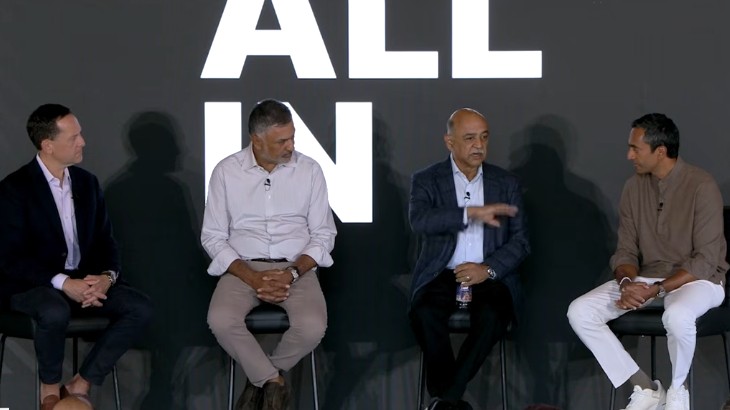
IBM CEO Arvind Krishna and Palo Alto Networks CEO Nikesh Arora join David Friedberg and Chamath Palihapitiya on All-In to discuss the quantum threat to today’s cryptography, why the shift to post-quantum cryptography must start now, and how AI models like Mythos are reshaping cybersecurity. The conversation also covers open weight vs. frontier models, the AI arms race and regulation, vertical integration from the IBM mainframe to Nvidia, and the coming wave of software consolidation and SaaS disruption. Read the full transcript of this interview which was premiered on October 22, 2026 below:
The Quantum Threat to Today’s Cryptography
DAVID FRIEDBERG: (00:00:00 – 00:00:36): I know that you guys have been using the T-word a lot the last day or two in your conversations, the tokens, but maybe we could kind of pivot a little bit away from AI. I guess it’s a little bit rooted in AI, but there’s been this big conversation set in the last couple days about cryptography and some of the risks to cryptography.
I think it took root after the OpenAI math drop, but there’s more conversations now about this big quantum initiative and how that might kind of take us into an era where we need to kind of start to think about adopting quantum cryptography. But Arvind, maybe we could start and talk a little bit about where things stand today from your view.
ARVIND KRISHNA: (00:00:37 – 00:01:50): Sure. So a little bit of what David just touched on is DARPA has been running a competition called QBI, or Quantum Benchmarking Initiative. A couple of hundred companies joined it a couple of years ago. I think it’s down to maybe 13 are left. So that tells you kind of what’s maybe real. I’m calling it maybe not quite real. Some of it is real. And so their goal is who can build a quantum computer that works? Let’s sort of put the technology side out of it.
And the debates are, is it 2028, 2029, 2033? And sort of if you pick the middle point, let’s call it 2030. Well, it will break today’s cryptography. That’s not a supposition. That’s just a reality. And if that’s going to happen, then what’s the cryptography that you got to use to protect yourself against that? Unfortunately for some of you, what’s even worse, if you have an encrypted hard disk today that gets stolen, somebody could keep it for 5 years and break it at that point.
The good news is post-quantum cryptography is understood. It’s well known. The code is written, but people have been too lazy to get to it. But I think the wake-up moment is now.
CHAMATH PALIHAPITIYA: (00:01:50 – 00:02:00): Are the solutions that we understand quantum-proof or quantum-resistant? Because it’s sort of based on our basic understanding today of what quantum probably looks like.
ARVIND KRISHNA: (00:02:00 – 00:02:28): Yeah, no, it is based on understanding at a theoretical level of what quantum could do. So they are quantum-proof in the same level of rigor that today’s cryptography cannot be broken by today’s classical computers. That’s actually not a theorem proof level answer. It’s more based on complexity theory in computer science, which is grounded at the end on some assumptions, not on—
Milestones on the Road to a Working Quantum Computer
CHAMATH PALIHAPITIYA: (00:02:29 – 00:02:41): So if you look at where we are today and that 2030 midpoint, can you just walk us through the evolutionary moments that you need to see where we all have to start paying attention and say, “Okay, how do we move?”
ARVIND KRISHNA: (00:02:41 – 00:03:24): Yes. So today you got toy quantum computers. I’ll call them toys because they can do certain problems, but they’re rife with errors. They have no way to scale fully yet. So question one will be, who’s the first one who can demonstrate not a simulation, not on the side, but some level of error correction or mitigation on a running quantum computer? Step one.
And so I’ll predict you’ll see somebody make claims by next year. Then you should get third parties to evaluate, are those claims real? You’ll find one or two will make progress by 2027. Error correction, not at scale, but error correction.
NIKESH ARORA: (00:03:25 – 00:03:25): Yeah.
ARVIND KRISHNA: (00:03:25 – 00:03:48): Question 2 will be, can you run these things at some level of scale? Not yet complete scale, I call it gate computations for the lack of a better word. Today, most people are somewhere around 10,000, which if you think of a normal computer is not very much when your iPhone does a couple of billion per minute.
DAVID FRIEDBERG: (00:03:48 – 00:03:48): Yeah.
ARVIND KRISHNA: (00:03:49 – 00:04:10): So gate computations, is somebody scaling from 10,000? Are they adding a zero each year? That’s the second milestone I would put. You put those 2 steps together. And now if you put a zero per year, that means you could be at 10 million by 2029. That’s remarkable. That can do some things that’ll surprise the hell out of everybody.
DAVID FRIEDBERG: (00:04:11 – 00:04:24): Does this reference kind of this notion of a logical qubit being kind of an error-corrected operating qubit? Is that— it’s about— is that a term you’ve adopted, logical qubits, and that everyone kind of has the same milestone, the same metric?
ARVIND KRISHNA: (00:04:25 – 00:05:04): I don’t love the term, but I think it’s a fair term to just explain to people to say, “Hey, if I say I’m building a computer that’s got 10,000 qubits,” and they say, “Yeah, but they’re all noisy.” You’re right. So if I begin to error correct, it in some sense decreases the effective capacity of the machine. So a logical then says, okay, what’s the effective capacity of this machine is I think a reasonable way to look at it.
So that’s a term that I, while I don’t love, because it’s not like I’ve taken these 4 things and it’s like a DRAM cell and that’s it.
Where Attackers Will Strike First
CHAMATH PALIHAPITIYA: (00:05:04 – 00:05:22): Nikesh, you have red teams that think about what is at the frontier and pushing it. Let’s say that you start to see these OOMs, these orders of magnitude start to compound. If you had to guess, where would your red team say are the obvious honeypots? Where do you point that if you were a bad actor?
NIKESH ARORA: (00:05:23 – 00:06:26): If you think from the perspective of everybody here has pretty much crypto keys running across their entire IT infrastructure, it’s not one thing. Everything is running with crypto keys which are encrypted. Every vendor in our space has keys at each end. So the first thing that’s going to happen is whatever is not quantum-proof is going to be breakable.
So our view is you can’t wait for 2029 or 2030 because it’s not like one day all of us are going to go out and say, “Oh shit, let’s go burn $5 trillion of IT infrastructure and let’s go build it again in one year because now we need quantum-safe infrastructure.” So you should be built— you should be replacing your IT stack today with quantum-safe or quantum-proof infrastructure right now.
Now there are technologies, there are capabilities which are already out in the market where you can start wrapping post-quantum ready sort of keys around traffic as a stopgap. So you can do that. But the time— if he says it’s 2029, ’30, we’re already late.
CHAMATH PALIHAPITIYA: (00:06:26 – 00:06:27): We’re 3 years away.
NIKESH ARORA: (00:06:28 – 00:06:39): Well, 3 years away, and I’m pretty sure everybody in this room has got a few hundred million dollars of IT spend that is earmarked for this year. And I’m guessing 50% of your spend is on infrastructure that is not quantum safe.
Can AI Break Cryptography Before Quantum Computers?
DAVID FRIEDBERG: (00:06:40 – 00:07:20): There was a pretty senior AI researcher that said we don’t need 29. Well, I mean, his view was actually AI models today can get us there before quantum computers get us there. Do you have a view on this? And I guess it’s rooted in this idea that on the frontiers of number theory, you can see AI start to develop models and proofs that are not apparent to humans today that allow us to rethink how we can effectively do codebreaking. And perhaps the OpenAI math dump this week is an early indication that this might actually be a good prediction that he made.
ARVIND KRISHNA: (00:07:21 – 00:08:19): Since you geeked a little bit by going down that direction, you’ll excuse me if I just geek a little bit. It’s not going to be possible. At the end of the day, this goes back to stuff that people like Richard Feynman did. You cannot simulate something on a different architecture and expect a more efficient result. Right. So if you take that as a thesis, quantum computers do not operate in arithmetic. Right. Which is what all of classical computers, including GPUs, do.
Could you have an AI algorithm discover a new quantum algorithm? Absolutely. Could it run it effectively and efficiently? It’s not possible. Yes, it’s not possible. So you need quantum hardware to run these things to get the positive advantage that the quantum algorithm has. Otherwise, it’ll be slower by an order of 1,000 or 10,000. So could you prove that it’s a workable algorithm?
DAVID FRIEDBERG: (00:08:19 – 00:08:19): Yes.
ARVIND KRISHNA: (00:08:20 – 00:08:22): Could you get that benefit? Unlikely.
DAVID FRIEDBERG: (00:08:22 – 00:08:44): I think the argument is using— and I know we’re geeking for a minute, but just using classical computing, you can actually have a different path, an arithmetic path. For example, if you had a better predictor of the distribution of prime numbers, at the frontiers of number theory that we’ve not really resolved, we can start to have classical models that can start to break cryptography?
ARVIND KRISHNA: (00:08:44 – 00:08:48): It is possible. The question is how long will that take, because that’s always the question.
DAVID FRIEDBERG: (00:08:48 – 00:08:48): Yeah.
ARVIND KRISHNA: (00:08:48 – 00:09:02): So I think it is going to be possible, but if it takes 10 years to break one key, most people are going to rest in peace. That’s not a practical answer. That’s, I think, where the debate is going to lie, but it won’t prove out until it’s done.
Open Source, Open Weight, and Frontier Models
CHAMATH PALIHAPITIYA: (00:09:02 – 00:09:35): Let me move the conversation to something that’s happening currently. I would love to get both of your takes on the following concept. There’s open source, there’s closed source, there’s frontier, there’s pacing the frontier, there’s now effectively very reasonable alternatives that are open weight at a minimum. Your philosophy around the entire spectrum and just give us a sense of how we should think about models and capabilities over the next couple of years. Nikesh, you want to start?
DAVID FRIEDBERG: (00:09:36 – 00:09:36): Sure.
NIKESH ARORA: (00:09:36 – 00:10:42): Look, I think earlier in the day somebody said don’t restrict your teams in terms of capability in the experimentation phase. Don’t start trying to cost optimize. Don’t start trying to stitch your own in that phase because The teams who work for us, 20,000 people, have just discovered AI in the last 12 to 18 months, and it’s not fully diffused across the organization. So if you make it harder for them to adopt, if you make it harder for them to understand, it’s going to take longer for us to be ready.
So right now we’re saying, “Go use the best model you can find, the easiest way to use it,” so you can understand, can we validate the things that these things can do, whether it’s from an efficiency perspective, a revenue perspective, or a product development perspective. That’s kind of— I’ll call it phase 1.
But in phase 1, what we’ve discovered is there’s different horses for different courses, right? What people don’t understand, there was a moment when everybody thought the cybersecurity was going to get consumed by AI models and our lives are over because Mythos is going to solve every problem. Well, guess what? We inspect all traffic at an endpoint at the cost of $20 a year.
ARVIND KRISHNA: (00:10:45 – 00:10:45): Right?
NIKESH ARORA: (00:10:45 – 00:12:46): Hundreds of megabytes of traffic per endpoint at the cost of $20, $25 a year because machine learning is running on your endpoint, your compute, and we run it on a 20, 30, 40 megabyte payload. Now, if you want to take all that traffic, run that through OpenAI using tokens for every employee in your company, sounds like the sound of revenue. OpenAI would probably generate all the revenue in one year from one company, right? So that’s not a practical example of how models use.
So what you do is you take a small language model, you compress it, you make it task-specific, you keep training it until it gets to 99.9% accuracy and say instead of using it using machine learning algorithms, we’re going to use generative AI, small language models, and they’re going to do that.
Yeah, so my point is what we’re doing is we’re trying to figure out what task requires what level of intelligence and what is the cost of that intelligence for that particular task. And you suddenly discover You don’t need a Ferrari for every task. And by the way, the customers don’t want to pay for a Ferrari for every task.
I’ll give you the flip side. Flip side is, let’s assume you’re undergoing a breach, you’re being attacked, you know you’re being attacked. At that point in time, every customer in the room says, “Don’t worry, use whichever model you need to to stop the breach,” because they know the business impact of that breach in the billions of dollars. At that point in time, I can run agent swarms, I can do all kinds of stuff that you want from a defensive perspective. So there, I may want to use the most up-to-date frontier LLM and say, “Go think about it, reason the hell out of it, and figure out how to stop this breach, how to make this happen.”
So what we’re discovering is you’re going to end up using frontier LLMs in unique cases where the business value that is going to get disrupted justifies— you can do drug discovery if you want. I think for most practical use cases in enterprises, we’re going to end up training some version of an open-source model and I think when it comes to even in peacetime, for us, for example, running a Defender model, we’re most— more than likely going to take an open weight model, use our own proprietary data, train it, manage the weights, because that’s what gives us the auditability, the explainability, and the open system. We can actually explain how that happened.
ARVIND KRISHNA: (00:12:46 – 00:14:35): I completely agree, but I’m going to take a slightly different lens to get to the same exact end conclusions. Let’s take economics. So Today, $20 for a million tokens for probably generation -1, $50 if you want to go to the most extreme. We could take one of the Chinese open weight models, take a Kimi K3, something 800 billion parameters. And if you run your own GPUs with a little bit of optimization, but I’m talking like a week of engineering work, we could drop the cost to about $1 to $2 for a million tokens. Which enterprise in the world will not accept a 10 times, or in this case, a 40 times cheaper answer for effectively what can do 95% of the work. So I think economics is important.
The second is going to be, at the end of the day, you just talked previously about chain of thought, not just the end tokens. Well, effectively then you’re giving away your IP if that chain of thought can be captured and logged and audited by somebody else. So brand and IP is going to drive people to say I need to run the models on my own. Well, you can’t run a frontier model on your own because none of them will give it to you. So then you’re back to open weight.
And the third is geopolitics. The best open weight models today are Chinese. By the way, I think there’s very little danger if you’re putting them in a sandbox and running them by yourself. Sure, if you use them from a cloud, that’s different. But I think that over the next year or two, I’m very doubtful that there will not be great models that come up in the West that are also open weight. And that are as capable as the Chinese. The gap in these things is 6 to 12 months at the most.
And so all those 3 drive me to conclude, I don’t know whether it’ll be 75 to 90%, but that’s the range I would put of all token usage will go to open weight models for the reasons I mentioned, added to the reasons that Nikesh mentioned.
CHAMATH PALIHAPITIYA: (00:14:35 – 00:14:44): And the token consumption that’s left over, is that because you actually need it, or is that because it’s a default behavior and people are too lazy to change?
ARVIND KRISHNA: (00:14:45 – 00:14:58): Okay, so I’m going to talk about developer behavior. And since I was one, I’m making fun of myself in a younger age. Developers are lazy. They’re going to use the most expensive answer unless you put a control on it, right? Because it’s easy.
CHAMATH PALIHAPITIYA: (00:14:59 – 00:14:59): Yeah.
ARVIND KRISHNA: (00:14:59 – 00:15:20): And so that is going to take it there. So I would say if experimentation phase, you allow that to prove it works, and now I got to put on a cheaper answer, it’s probably fine if it gets me there a lot faster. But doing it for production usage is where I am skeptical that it’s of value, except for a tiny number of use cases.
Inside the Mythos Preview and Zero Data Retention
CHAMATH PALIHAPITIYA: (00:15:20 – 00:16:17): Nikesh, you were brought in as one of this small circle of people for Mythos, kind of preview it, be their partner. I’m sure you’re now doing that with OpenAI as well. When you’re sitting with these guys, is part of you thinking they’re looking at my business and they’re like, “Wow, this is a great business”? Do you think that they’re— and what is the actual technical boundaries that you expect to be respected?
And the reason I ask this is we’ve talked to a couple of other CEOs. I think Marc Benioff does the best example of this where we’ve talked about ZDR and he’s been incredibly aggressive about making sure there’s zero data retention and doing that on behalf of his customers. What’s so interesting about the ZDR and all of this stuff is none of the models say that they won’t generate synthetic data. It’s literally not in there. You guys should look. There’s all these outs. There’s all these trapdoors. So I’m just wondering, when you’re in the room, What are you thinking when you’re in the room?
NIKESH ARORA: (00:16:18 – 00:16:20): You come out and say, “These guys are not going to get into my business.”
CHAMATH PALIHAPITIYA: (00:16:21 – 00:16:22): They’re not going to—
NIKESH ARORA: (00:16:22 – 00:16:23): they’re not going to be able to get into my business.
CHAMATH PALIHAPITIYA: (00:16:23 – 00:16:24): Okay.
NIKESH ARORA: (00:16:24 – 00:17:57): Because if you think about when Mythos came out, right, we’ve been paying billions of dollars for coding agents. Well, guess what? We’re fundamentally— not everybody’s got ZDR on coding. There’s tons of people out there using Claude Code who have no issue about that data training the model. So we are training these models with end users doing coding. These models are getting better and better doing coding. Well, guess what? If you teach a model what good code looks like, it also can figure out what bad code looks like.
So the first thing that this was doing, it figured out what bad code looks like. And if you let it loose against your code, it’ll tell you what is bad. Now, what’s fascinating is when it did that, even then it was fine. It was hallucinating 30% of the time. Right, but the problem is the reason it’s perfect for attackers is they just need one vulnerability. They don’t need 10 vulnerabilities. If you’re a defender, you need to find every vulnerability and patch it.
So all the people in the room, I think, have been through this journey in the last 12 months, is that everybody here has gone, tested them, either with Mythos or with some cousin of Mythos or some open source models, and discovered every vulnerability has to then be tested, understood, figured out. And I would guess in this room, if a show of hands, people say the number is roughly 60 to 80% have been real and 20% have been hallucinations.
So from that perspective, the models are great to be able to tell you what the vulnerability is. But I don’t even think anybody in this room, if you ask them to raise their hand, will tell you that they’re not going to even use Claude Code to patch the vulnerability without having to test it again.
Cybersecurity as Warfare
CHAMATH PALIHAPITIYA: (00:17:57 – 00:18:18): I have a very random question, but it makes me think. So you’re engaged to defend companies, but it now looks basically like warfare, both of you guys, it’s like warfare. And so is there something that you can learn from how war has been fought or how war is being fought? And do you do that to actually inform how the technology should behave?
NIKESH ARORA: (00:18:18 – 00:19:00): I don’t know if this question makes sense, but I think to the extent that you can be better together, You can collaborate. Arvind runs a program. We’re now saying we’re all finding vulnerabilities. Why don’t we pool our vulnerabilities and find the defense once, as opposed to every company in the room trying to go test all the open source vulnerabilities they have, figure out how to patch them, go patch them individually?
So then you take some trusted parties, “Give us your vulnerabilities, we’ll patch them, we’ll distribute the patches so you can all be safe at the same time.” It’s kind of like how cybersecurity works today. If you find an attack technique in a different part of the world. We can take that attack technique, write machine learning code, and ingest that into our product and make sure it gets available to every customer.
CHAMATH PALIHAPITIYA: (00:19:00 – 00:19:03): Is agentially written code error-free?
ARVIND KRISHNA: (00:19:03 – 00:19:04): No. No.
CHAMATH PALIHAPITIYA: (00:19:05 – 00:19:05): Okay, explain that.
ARVIND KRISHNA: (00:19:06 – 00:19:07): So look, but first on your war question.
DAVID FRIEDBERG: (00:19:08 – 00:19:08): Yeah.
ARVIND KRISHNA: (00:19:08 – 00:20:39): So what Nikesh talked about is you can have powerful alliances where the alliance effectively can become more powerful than the attacker. That’s technique 1. Technique 2 in warfare, what has been the most effective is asymmetry. And so often an attacker is cheaper than the defender, so the defender runs out of money and at some point then concedes. Or can you make defense equally cheap, in which case you can basically have symmetric warfare, and then you have a much better chance of success?
And the third, which has been the way all wars have been won, is when you get technological superiority on one side. So go back to World War II, go back to Korea, go back to Iraq, go back to anyone If you get technological superiority on one side, you tend to win. And so our goal is, can we get technological superiority? And that’s what Nikesh was referring to. Can we find vulnerabilities? Can we patch them? Can we put boundaries around them that makes it really expensive for the other side to now try to find a way through? So that’s what I would answer there.
Look, at the end, will agentic code be superior to human-written code? Absolutely. We can find that. We use agents and coding agents now for probably half the code that is written inside our place, and it is superior to what was being written before. But the reason it’s superior is the agents can also do evals and basically make sure that everything they can find is actually fixed before it ever goes out. All that said, we are only finding all the flaws that we know how to find. And so you get into this weird loop in computer science Okay, do I—
CHAMATH PALIHAPITIYA: (00:20:39 – 00:20:41): it’s not really properly verifiable.
ARVIND KRISHNA: (00:20:41 – 00:21:10): It’s not fully verifiable because that is a task that is going to be almost computationally infeasible right now. Now, I’m not going to hold out hope that it doesn’t become what you were talking about in number theory and all that. This is a task in which maybe we’ll find a way to actually get to be able to verify the correctness of these things, at least in where the inputs are limited. If the input can be anything, then I think it’s really hard. Does that make sense?
CHAMATH PALIHAPITIYA: (00:21:10 – 00:21:10): Yeah.
The AI Arms Race and the Push to Regulate AI
DAVID FRIEDBERG: (00:21:10 – 00:22:20): Let me ask the implications of the points that you just made. It seems obvious to me that there isn’t a world where China and the United States or the West or whomever, a bunch of international countries all hold hands and say, “Let’s all stop AI development.” That being the case, it becomes a necessity. That there’s an arms race, that there’s a defensive or offensive superiority requisite, that there’s a compute capacity requisite, that there are all of these needs that arise to protect industry, to protect our economy, to protect our jobs.
Does that argument win the day with everyone that’s trying to stop AI and the political conversations and the social stuff about “AI needs to stop and we need to stop doing this”? Does this point about the inevitability of one side having it requiring the other side to defend it change the conversation? I’d love for you guys to share any anecdotes you’ve had with senior party officials who might not be in power today but might be coming into power and whether they’re going to kind of have a view change around this because of that point.
NIKESH ARORA: (00:22:21 – 00:22:56): I think it’s abundantly clear that nobody’s stopping. Everybody seems to be working at a frenetic pace to try and make sure that they get a better, smarter, faster model. It’s kind of interesting. You can take the charitable side and say there’s no technology in the world that was built where people were building security in parallel. I don’t think TSA existed when they built planes. It’s just like Wright Brothers say, “Great, we have planes. Let’s figure out how to take your shoes off. Let’s frisk everybody before they get on the plane.” That was not what they were thinking about.
ARVIND KRISHNA: (00:22:56 – 00:22:57): Exactly.
DAVID FRIEDBERG: (00:22:57 – 00:22:59): Keep the explosives out of the shoes.
NIKESH ARORA: (00:22:59 – 00:23:39): Yes, that’s right. That’s not what they were thinking about. So unfortunately, we’ve been shown the dark side of these models and we’ve over-rotated on the dark side of the model where now the entire conversation is about the dark side and the perils of AI and not on the benefits of AI. I think there’s a narrative problem.
That notwithstanding, I don’t think anybody’s slowing down. I think the most likely outcome, which I think hopefully is the right outcome, is that in the world— you said it and Arvind said it earlier— if you build something, you’re accountable for it. If you build something and unleash it, you can’t unleash and say, “Oops, I don’t know how to control it.” That argument doesn’t work.
DAVID FRIEDBERG: (00:23:40 – 00:23:45): Yeah, because you wrote the software. Yeah, yeah. This whole argument that you didn’t write the software, that the software was—
CHAMATH PALIHAPITIYA: (00:23:45 – 00:23:51): because the engineer is going to say, “Well, agent 745 565 from my harness wrote it.” And it’s like, “No, you wrote it.”
ARVIND KRISHNA: (00:23:51 – 00:23:54): Well, but the company still wrote it, so there’s product liability.
NIKESH ARORA: (00:23:54 – 00:23:56): You’re a commercial enterprise.
CHAMATH PALIHAPITIYA: (00:23:56 – 00:23:56): Exactly.
NIKESH ARORA: (00:23:56 – 00:24:16): You’re taking economic value in return for giving me something. You’re required to abide by the responsibility, the responsibility that you signed up for. So I think that’s— in my mind, it’s as simple as that. And there’s enough regulation in the world, perhaps too much, to hold people accountable for stuff that they put out in the open market where they don’t take responsibility.
ARVIND KRISHNA: (00:24:17 – 00:24:53): But David, it’s actually impossible to control it unless we think the entire world is going to sing Kumbaya and say, “Let’s slow down,” which, as you said, is unlikely. So if that’s the case, fine, you put it— slow down here, maybe. Well, okay, does it mean Japan slows down? Does that mean China slows down? Does it mean India slows down? No chance. They’ll say, “Great, you’re slowing down, it gives me a chance to catch up and get ahead.”
So a digital technology is impossible to actually slow down. And the European example tells us So there you get afraid of all the possibilities. I’m not saying they’re real dangers. You get afraid of all of them and you impose regulations first. I guess it’s such a vibrant tech economy there, right?
DAVID FRIEDBERG: (00:24:54 – 00:25:29): Yeah. Well, I mean, neither of you actually answered my question about conversations you’ve had, which, because I’ll tell you a conversation I had last week in DC. I had drinks with a member of Congress, pretty senior-ranking guy, and the conversation had 2 parts to it.
One is, “I think one of the CEOs of the biggest companies in the world is completely freaked out about cyber, and he’s losing his mind, and he doesn’t know what to do. And I just had dinner with him, and here’s all the stuff he said.” And then, “I also think that by Q4, we might see a 50-state ban on data centers,” which isn’t likely, but he says—
CHAMATH PALIHAPITIYA: (00:25:30 – 00:25:31): 50 is a big number.
ARVIND KRISHNA: (00:25:31 – 00:25:32): Big number.
NIKESH ARORA: (00:25:32 – 00:25:35): Have 50 states ever agreed on anything in this country?
DAVID FRIEDBERG: (00:25:35 – 00:25:35): No.
CHAMATH PALIHAPITIYA: (00:25:36 – 00:25:37): Well, a few things about—
ARVIND KRISHNA: (00:25:37 – 00:25:38): So that’ll be amazing.
NIKESH ARORA: (00:25:38 – 00:25:38): Yeah.
DAVID FRIEDBERG: (00:25:38 – 00:25:53): Okay, get everyone together. By the way, when everyone agrees on something, you know it’s not true. But I think it’d be like a miracle. And it’s the fact that both of those statements are being said by someone. So where do you think this resolves? How do we resolve this path forward?
NIKESH ARORA: (00:25:53 – 00:25:54): He’s good at this.
ARVIND KRISHNA: (00:25:54 – 00:26:57): I’ll try to answer your direct question. So look, amongst us, we have all— and other members of your group have— we all had different conversations with different members of this administration, the previous administration. The Senate runs longer than just one admin. Congress tends to change a lot faster. This question has been in there since 2022. The Senate had closed hearings in ’22. They had open hearings in ’23. Congress had them. The White House had them in both admins. And they go round and round this question.
The regulation question on AI and data centers is driven— I’m going to be sorry and cynical— is driven by populism, not by any reality. If I can get more votes, should I look like I’m trying to do those things? Politics is politics. I’m not going to say that’s not real. It is real. That said, enough people also care deeply about the long-term economic advantage. And so that’s the balancing act that is happening. I do think we are on the correct balance right now, but I’ll acknowledge an election can change where we fall on that balancing act.
On data centers, I think there’s no chance all 50 will ban. Is it possible 30 will ban?
CHAMATH PALIHAPITIYA: (00:26:58 – 00:26:58): Yes.
ARVIND KRISHNA: (00:26:58 – 00:27:00): The remaining 20 will rub their hands in glee at that point.
Haves and Have-Nots in the AI Era
CHAMATH PALIHAPITIYA: (00:27:01 – 00:27:05): If you look geopolitically for a second, it seems like we’re trending to a place of haves and have-nots.
DAVID FRIEDBERG: (00:27:05 – 00:27:05): So I can—
CHAMATH PALIHAPITIYA: (00:27:06 – 00:27:35): everybody in this room is a have, you’re a Western market company, you have the benefit of being able to work with guys like you, but there’s a certain price of entry that may not make sense for the random pick-your-company anywhere else around the world. What happens then when these models are so capable and effectively free? What is the actual manifestation? I’m sure you’ve had to think about this in terms of how you want to respond. So how do you think about that problem, this separation of haves and have-nots?
NIKESH ARORA: (00:27:36 – 00:28:48): Look, I think Arvind said that you have to make technology so cheap that it can be easily accessible by everyone. And I think we have the opportunity of making that happen. I don’t think that it’s going to be so expensive that if you can run an economic enterprise, it should be possible in the envelope to be able to find a way to protect yourself. So I don’t think we’re going to end up in a have-have-not scenario.
I think the bigger challenge, which is more pertinent to people in the room, is I fear that we will see fast advances in compute development in 2 large countries in the world. We may not see that as evenly distributed across the rest of the world. And compute is very dear right now. It’s very hard to get compute to run anything at scale at the current moment. And the challenge is going to be that the further away you are from the epicenter, the less likely you will have access to this computer. It’s not because of economic reasons, it’s purely because of supply constraints.
I think that’s the bigger challenge. You could be a company in Europe and you have the right intentions and motivations to go and sort of innovate, optimize, and run with it, and you may just suddenly discover that because you’re far away from the epicenter you don’t get access as much as companies in the Western world, in the US, or perhaps in China are going to get?
ARVIND KRISHNA: (00:28:49 – 00:30:01): I think, look, I like to look at history because it gives us some information on how these things roll out. I think this is the classic labor versus capital trade-off that is happening. It happened in the 1700s. It happened again in the 1800s. It happened again in the 1900s. People who spend more on capital than worried about labor tended to win every previous one of the 7 or 8 cycles like this. So this is what is going to happen this time.
What Nikesh pointed out is the 2 nations here are also quite willing to be capital intensive. Yeah, it’s not as simple as this. And they’re willing at the end of the day to concede that labor is going to be less important. That’s the way it goes, is going to play out. Nations that get very hung up on social and left-leaning philosophies that labor has to be protected at all costs Not that there has to be opportunity for labor, but every existing job has to be protected or the ones are going to lose.
Because I think the ones there, to Nikesh’s point, it’s cheap enough. Somebody in one country can use the capability, but what’s going to be in their head is, “Hey, but does it mean there’s a job loss or a job displacement?” Job displacement you should take because it may result in a better job. I think that’s the social philosophy that’s going to determine winners and losers here.
Vertical Integration: From the IBM Mainframe to Nvidia
CHAMATH PALIHAPITIYA: (00:30:02 – 00:30:46): I have a Final question before I give it to you for the final question. But my final question to both of you, you mentioned this here, which was great. Can you tell the story about— I’m a huge fan of vertical integration, huge fan. I think markets swing in pendulums and there was a world even in the ’60s, ’70s, and ’80s where there was the conglomerate and it was an incredibly valuable enterprise. And it was in a time of turbulence. It was a safe harbor for capital. Because the conglomerate was the mechanism by which you organized.
And then when you had peace and prosperity, then people disaggregated. And I think we’re moving back to the world of the conglomerate. And you told me just back there about the vertical integration of IBM at its peak. I just wanted you to— and then Nikesh, what are your thoughts on vertical integration?
ARVIND KRISHNA: (00:30:46 – 00:31:59): So what Chamath and I have often talked about is the IBM mainframe, which, by the way, there’s a few people in the room who do use it quite well. And at scale. The IBM mainframe has lasted 65 years. Why? It was vertically integrated. We’re a little less right now in the sense we don’t go all the way to dirt.
In the ’60s, we went all the way to dirt, meaning we found sand, we made our own wafers, we built our own fabs, we built our own chips, every single thing out to the metal that surrounded the machine. What that avoided was any IP leakage. But it allowed us to keep the profit of the complete stack in the company. Today, the only piece we don’t do is the actual fab. Still, the design of the chips, the design of the engineering, the resilience, the bulk of the software is inside.
And that vertical integration, you’ve got to decide. Yeah, of course I’m not going to make our own metal. You buy metal and fabs is because of scale. But I think that vertical integration in areas which are of incredible important advantage, which goes back to the infrastructure point, the two of you were making before is incredibly important to understand where do you want to be and where, if it’s a commodity, then you should not be.
NIKESH ARORA: (00:31:59 – 00:32:02): Yeah, but you can see that the modern-day version of that is Nvidia.
CHAMATH PALIHAPITIYA: (00:32:03 – 00:32:03): Yeah.
NIKESH ARORA: (00:32:03 – 00:32:08): If you look at what Jensen is doing, he’s the modern-day version of the vertically integrated stack. And he went and bought—
CHAMATH PALIHAPITIYA: (00:32:09 – 00:32:11): Jensen is at the dirt and he’s at Hugging Face.
NIKESH ARORA: (00:32:11 – 00:32:38): He wants— he understands that there’s going to be a balance between frontier models and other models. He’s trying to fund everybody in the ecosystem to ensure that they don’t stray from the vertically integrated stack that he’s producing. And the good news is if you control the vertical stack, you can decide which part of the stack to commoditize. So you can decide to move profit between layers. And if you see that there are other people attacking a certain part of your stack, if they destroy the profit pool on that stack, you move the profit to the other part of the stack. And you can see that happening.
DAVID FRIEDBERG: (00:32:38 – 00:32:39): Very powerful market leverage.
The Application Layer: Open Stack vs. Closed Stack
CHAMATH PALIHAPITIYA: (00:32:39 – 00:32:53): So to put you on the spot, so if you look at the application layer today, What’s the obvious vertical integration strategy that OpenAI or Anthropic should be taking? And then what’s the defensive mechanism for the companies that are maybe on the receiving end of that?
NIKESH ARORA: (00:32:54 – 00:34:14): I think you’re already seeing that, and I think we trivialize this conversation. We start saying open models, open weight. It’s literally— it’s an open stack versus a closed stack. Because I don’t think— I think at some point in time, this notion of running something like an OpenRouter become Impossible, because models are getting more and more— each model is requiring more memory, more context, more understanding. You can’t separate context and memory from the reasoning. Now, if you want to separate reasoning from the context and memory, then OpenRouter is only responsible for moving the reasoning tokens back and forth.
So I think over time you’ll start seeing it doesn’t make sense that you’ll have an effectively end-to-end stack. It’ll be like a CPA you talked about earlier when you were chatting. So it’s a cost per action. The action will require you to go and traverse the entire logic, right, from prompt till outcome. And then memory will require or make it easier, and there’ll be too high a friction for you to move your task from one stack to the other stack because it has all your context and memory. And you’re going to see that.
Look, look at what’s happening in the personal agent space, right? If you start training a personal agent with all your context, all your APIs, all your connectivity, now you’ve built a moat. Because now I can’t take that every day and move it to the next stack and the next stack. Stack. So I think you will find in the application layer they’re going to have a vertical stack as well, which will go through the entire process of software reasoning, memory context.
CHAMATH PALIHAPITIYA: (00:34:15 – 00:34:19): To your logical conclusion, everybody will have their own then. Yes, because it’s just the right thing to do.
NIKESH ARORA: (00:34:19 – 00:34:36): And then brute force distribution wins again in the enterprise space, right? You’re seeing that in the consumer space, brute force distribution is going to compete. In the next 3 months, every frontier lab is going to have a full-on, full-court press on the Muse concept, right? Yeah, they tried that 6 to 9 months ago. It didn’t work.
CHAMATH PALIHAPITIYA: (00:34:37 – 00:34:37): They—
NIKESH ARORA: (00:34:37 – 00:34:49): now with Facebook showing us how it can work, I think pretty much everybody has it. There will be APIs. There’ll be the largest battle of consumer control. Every app that exists on the iPhone has to become headless.
M&A, Software Consolidation, and the Future of SaaS
DAVID FRIEDBERG: (00:34:50 – 00:35:18): Maybe we can wrap by going from vertical integration to horizontal expansion. It’s been a common business strategy in enterprise technology companies to expand horizontally through M&A, drive synergies, cross-sales, and so on. And you’ve obviously both done it exceptionally well and executed it well. How has your view been affected in the last year, this year, let’s say, in terms of valuations and multiples, cost of capital?
NIKESH ARORA: (00:35:18 – 00:37:43): Let’s talk about M&A in the context of cyber. Then we can talk about M&A in the context outside of cyber. In the context of cyber, I have always maintained over the last 8 years that it’s silly that our customers have to buy 40 different solutions and stitch them together. We barely understand our— you think you understand our 10 other vendors, whether you can stitch it? God bless your soul, right? So we’re working as fast as we can to take disparate parts of our industry and find the way to stitch them together to have the data work together. I think that’s a journey.
And if you want parallels, when I started, my first job was at Fidelity Investments many years ago. We had 23 systems which collectively would be called CRM today. We had master tables, we had tables that concatenated with them. We had 23 different applications that did 23 different things. Today you go buy it off the shelf and you cringe at the cost of Salesforce or the cost of Microsoft Dynamics, Oracle, whatever you choose to do.
So in 30 years, what’s happened is that’s consolidated into a singular platform. The customers don’t stitch the solutions anymore because what happens is these software solutions become consistent, they all become like each other, they all roughly do the same thing, and there’s no differentiation. So I think same thing is going to happen in cyber. That’s what we try to do. We’ve tried to find things that are best in their category, stitch them, make them work, so our customers don’t have to do the stitching.
So that’s kind of the answer on Cyber, for some reason, cyber is enjoying much better valuations lately because of the AI Mythos event, which is fine, which will rationalize over time, because all these guys are going to go spend unlimited amounts of money on cyber.
Outside of cyber, I think it goes back to the conversation, Chamath, and we were having earlier about it’s very hard to understand the terminal value of software. It’s not clear what software is going to survive the next 5 to 8 years with where we are from an AI perspective and the notion that product-market fit is getting disrupted for many of these companies. We all know with— if AI was applied well, how our current software should behave in an ideal scenario.
I know what I want from half the package software that I buy. I know if I could have my magic wand and make it do things, I know exactly how it should work in an AI-first world, which means somebody is going to do it. So I think there’s going to be huge disruption in the SaaS space over the next few years.
CHAMATH PALIHAPITIYA: (00:37:43 – 00:37:47): Are you looking at anything thinking, “Hmm, juicy multiples”?
ARVIND KRISHNA: (00:37:47 – 00:39:25): So over the year it was very attractive at the beginning, not so attractive a month ago. We’ll wait and see how it goes over the next few. But actually, I want to build on Nikesh’s thought. This is not just unique to cyber. The average enterprise uses anywhere from 500 to 5,000 distinct software vendors. In a world when you have to protect against it all, it’s not just the cyber threat. That’s a massive attack surface.
So you have to ask yourself, could I replace 490 of them with minor AI capabilities? And do I need to go back and leverage 5 to 10 main platforms? That implies massive consolidation because that’s where the spend goes. That’s what I believe is going to play out. So there is going to be consolidation because if you want to keep your cost of distribution low, then they can distribute all of it. And if the value of that software is falling, then you cannot afford independent distribution for each of those. I believe that’s going to play out whether it takes 6 months or 6 years. It’s somewhere inside that equation.
I do think also software should be distinguished. There is software where there is a lot of interaction value which, as we have seen clearly, can be replaced with a lot of AI. Both examples you used were things which were interaction-rich, right? But if in the end you go down to, I need you to be reliable at 10 to the minus 15, right, which is a database lookup for somebody doing retail banking or closing the books, I think that’s going to be hard to replace that easily, right, with AI-generated software. So I think there is going to be a distinction on how easy it is for investors.
CHAMATH PALIHAPITIYA: (00:39:25 – 00:39:27): Yeah, you’re going to run that digital twin for years before you cut over.
ARVIND KRISHNA: (00:39:28 – 00:39:30): Correct. Yeah. And then there’s no cost advantage to do that.
CHAMATH PALIHAPITIYA: (00:39:30 – 00:39:36): Yeah. Guys, thank you very much. Arvind Krishna, Nikesh Arora, thank you.
NIKESH ARORA: (00:39:36 – 00:39:36): Thank you.
CHAMATH PALIHAPITIYA: (00:39:37 – 00:39:38): Thanks everybody, all of you.
Related Posts
- Transcript of NVIDIA GTC Berlin 2026: Jensen Huang Full Keynote
- Transcript: Tesla (TSLA) Q3 2026 Earnings Call
- Transcript: SpaceX (SPCX) Q3 2026 Earnings Call
- Transcript: Meta Platflorms Inc. (META) Q3 FY26 Earnings Call
- Transcript: Merz x Jensen Huang – AI Safety, Regulation & Germany’s Industrial Future