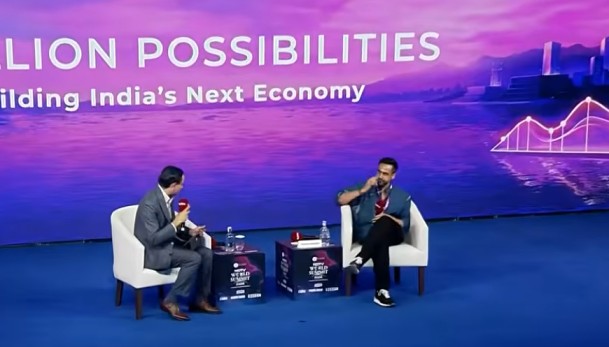
Zerodha co-founder Nikhil Kamath sits on the other side of the table at the NDTV World Summit 2026, in a completely unscripted conversation with NDTV’s Rahul Kanwal. Kamath talks about dropping out of school, where India stands in the AI race, what India can learn from China, F&O speculators and retail investors, inheritance tax, why 2027 could be a tough year for raising capital, and the two philosophies he has tattooed on his hand. Read the full transcript of the interview which was streamed live on October 22, 2026, below.
From Dropout to Billionaire: The Tables Are Turned
RAHUL KANWAL: (00:00:06 – 00:02:37) Hello and welcome. Some people spend their lives trying to climb the ladder of success. My next guest at the NDTV World Summit decided very early in life that he wasn’t particularly interested in climbing the conventional ladder at all. He dropped out of school as a teenager, worked in a call center, started trading stocks, and went on to build, along with his brother, one of the most successful financial technology companies. Along the way, he became a billionaire before he turned 40.
But what’s fascinating about Nikhil Kamath is not simply the money that he’s made. It is what he’s trying to do with it and the questions that he’s trying to ask and answer. He has gone from disrupting the stockbroking industry to backing young entrepreneurs, experimenting with new ways of building companies, investing in the technologies of tomorrow, and sitting across the room with some of the most important people on the planet— Prime Minister Narendra Modi, Elon Musk, the pioneers of artificial intelligence. He’s interviewed all of them.
In fact, he’s become so accustomed to asking questions that I suspect he’s forgotten what it’s like to be on the receiving end. We were sitting in the lounge waiting for this session to start, and so many people walked up to Nikhil Kamath and said, “Nikhil, हमने आपका podcast देखा है.” And I thought to myself, “ये company भी चलाता है काफी बड़ी company.” I hope people remember him. For Zerodha as well.
Ladies and gentlemen, today the tables are turned. Join me in welcoming the co-founder of Zerodha, investor, entrepreneur, and a man who’s made a career out of questioning conventional wisdom. Can we have a round of applause for Nikhil Kamath?
Nikhil, you dropped out of conventional education, did your own thing. Now my son is young, his mom is here. She’s asked him to do homework and he’s telling us, “Why should I do my homework? Why do I need to study? Why can’t I drop out of school, do what Nikhil Kamath did? I’ll end up fine. He did fine.” What would you tell him?
NIKHIL KAMATH: (00:02:39 – 00:03:22) I get into trouble for this a lot. Of late, when I go to weddings, parents come up to me and say, “You’ve told our kids not to go to college, not to get married, and not to have children. Could you talk to them please?”
I think everybody’s journey and the circumstances of it are different. For me, it worked out because I was A, lucky, but B, maybe the timing of it and what I attempted to do after I dropped out was okay. But would I recommend it for everyone? Probably not. Your kids should be fine. The father has done so well and made so much money. How does it matter?
If Nikhil Kamath Were 17 Today
RAHUL KANWAL: (00:03:24 – 00:03:46) I wish that were true. It’s not. But let’s focus on building NDTV and maybe one day God willing. So if you were 17 right now, you didn’t have the money, you didn’t have the connections, you didn’t have the network, but you were full of ideas and raring to go. And this is the India of here, this is the India of now. Where would you go? What would you do?
NIKHIL KAMATH: (00:03:50 – 00:04:51) To be fair, the one big advantage for a 17-year-old today versus 20 years ago I think education has become largely democratic today. If I want to learn about something, I could use AI, I could use the internet, and almost anything I want to learn about, if I so choose to, is available freely. The delta of going to a formal institution like a college has probably dropped significantly from then to now.
Well, if I was 17 today and I were to be given a different set of options that exist today, I would probably try to build something on top of the technological changes that are happening in the West. I think there is opportunity there. I don’t think we have come to it yet, but I would focus on building something on the application or services layers. Sitting on top of the new tech stacks.
Where India Fits in the AI Stack
RAHUL KANWAL: (00:04:51 – 00:05:21) So you’re saying don’t bother so much with the foundational LLMs, focus instead of building the stack on top. Talk to us about it, because this is a big debate in India. People blame companies like Infosys, HCL, TCS, that they had so much money, they had so much tech and coding talent, and yet the entire AI boom came, it’s here, and we’re still trying to build on the sidelines of it. We’re not being able to do what China did.
NIKHIL KAMATH: (00:05:23 – 00:07:48) So if you were to look at the AI boom, I think different people look at it differently. If I were to break it up into a few layers, I’ll say at the very top is the hardware, the chips, the compute that’s going into it. One level down are the frontier guys. If you were to go one level below that, are the inference, neolab guys. If you go one level before that, below that, you have the training, the data providers. I’m talking about the Turings and Mercors and people like that.
I’ve been spending a fair amount of time around the frontier model guys. I spent the last month in San Francisco. I was in China for a month earlier this year. They have a lot more capital, risk capital at hand to experiment and try different things. I don’t see how an Indian company, or for that matter, any company outside of those 2 or 3 countries where there is that much risk capital having a fair shot at competing in that layer? It would be really hard. I think the odds are low.
Can India build a great inference company where we sit on top of open source models, we put compute, and we allow for companies to keep their own context and not share it with frontier and serve them more efficiently with cheaper compute? I think there’s an opportunity there.
The one thing people don’t take cognizance to when it comes to India is the cost of putting on a megawatt is probably 30-40% cheaper than it is in the West. Like somebody who’s doing the plumbing and the piping around a data center in America gets paid $300,000. The same person here makes a lot lesser money. And we also don’t take cognizance of the fact that power in India is actually significantly cheaper than many geographies in the world.
So we do have some unique moats, but to broadly say India should attempt to do everything across the stack, I don’t know if the risk capital to do that is around today. So I would say build around—
What India Can Learn From China
RAHUL KANWAL: (00:07:48 – 00:08:00) We’re almost a $4 trillion economy. Why don’t we have this risk capital? You’ve been studying the Chinese IT companies quite closely. What has China figured out about building an AI ecosystem that you think India hasn’t been able to?
NIKHIL KAMATH: (00:08:03 – 00:09:24) So China claims not to be capitalist, but when I’m in China, it almost feels like the state is capitalist in itself. Every municipality or the mayor of each province competes with another province like he were a capitalistic organization. There are many dichotomies in China. They say one thing and they do another. You take land ownership for example. People are not allowed to own land but have long leases. It’s like owning land.
The one thing that maybe we can change and learn from China— I feel like we should learn from whoever has done something well. Is allow for different provinces, states— India has 28— why not each state compete with another like they were a capitalist organization itself? Maybe the Chief Minister of a state could operate like the CEO of the state.
It would be possible if the upside of the winnings of that capitalistic endeavor were also allowed to remain with the But maybe that’s something we can question structurally and see if it makes sense for India. And maybe that’s one thing we can learn from China.
The Foundery and Building Indian Brands for the World
RAHUL KANWAL: (00:09:24 – 00:09:55) India has done very well in things like Q-commerce, e-commerce, a lot of it tapping into India’s consumption boom. In the way you see the next few years, is that the way it’s likely to stay? Or do you see that potentially change? I was seeing some of what you were trying to do with The Foundery where you’re trying to encourage the next bunch of entrepreneurs, back them, guide them. But there again, most of them seem to be tapping into the consumption story of India.
NIKHIL KAMATH: (00:09:56 – 00:11:37) So Foundery specifically, we are trying to build brands that can sell outside of India. That’s the aspiration. We look at America because it’s the largest consumer market in the world. And we’re trying to figure out whatever it might be, it might be a shampoo brand, it might be toothpaste. We’re building with the very focused target of these brands being able to sell there.
You remember at Sangam last year there was Satya Nadella, right? I was having a meal with him and he said, “Nikhil, I’m Indian, I live in America. In the entirety of my day, in 24 hours living in the Valley, I don’t touch an Indian product, either software or consumer or hardware of any sort. I touch a whole bunch of Chinese products in different ways. It might be a TikTok, it might be this, it might be another thing.”
So when we speak about fiscal deficit and the need to bring more dollars into India in a manner that we become stronger as a— I don’t want to speak too much about the currency, but more as an economy where we sell more of our produce outside. I don’t think we need to be limited to things like software. Why not consumer goods? We have cheaper labor.
A lot of the businesses you mentioned earlier, like quick commerce, I think these are labor arbitrage businesses. And they exist in India for a reason, because policies are conducive to labor arbitrage businesses existing in India.
Optimizing for Freedom and the Problem With Certainty
RAHUL KANWAL: (00:11:37 – 00:11:44) You said something about not getting married, not having kids. That’s at the moment, or that’s like Rahul Gandhi, your decision for life?
NIKHIL KAMATH: (00:11:46 – 00:12:56) Nobody knows what they want for life. We were speaking to the Swamiji right now, I think incredibly articulate man, he spoke so well. I don’t know what I want 6 months from now, let alone 5 years from now, and I think that’s true for all people.
The people I find appealing are people who are not certain. I think certainty is a problem. Too much of the world is trying to figure out what they believe in and then get so emotionally attached to that belief, and almost egoistic about that belief, that they’re never willing to change their mind.
That certainty I hope I’m able to fight for as long as I can, so I definitely don’t know what will happen 5 years from now. But for now, I’m kind of optimizing for freedom and peace of mind and living life in a manner where I have the time to pursue different things and just be open.
RAHUL KANWAL: (00:12:56 – 00:13:45) Just be fluid in a way. I must tell you, there was this one event that Nikhil Kamath was doing. This is in Mumbai, and he put me on the stage with someone without telling me who this person is and what I had to do or what I had to ask. He just said, “कुछ तो करी दो.” मतलब जैसे कि he put them there and he said, “Something will happen.”
It was just purely by fluke and happenstance that I happened to know who that strategist was, and I’d read his book. But the chances of that are very, very, very small. So you basically like this. कि कुछ करके देखते हैं, कुछ तो होगा।
That’s why I didn’t tell him at all. In fact, his producer Bilal is here somewhere, and he said, “मत बताओ। इसने भी तो नहीं आपको बताया था।” So we didn’t discuss the session at all. So Nikhil has absolutely no idea about what’s coming. So you met so many of these tech—
The Right to Disagree
NIKHIL KAMATH: (00:13:45 – 00:13:46) We need more of that, don’t you think?
RAHUL KANWAL: (00:13:46 – 00:14:44) Discourse in society and disagreement and dissent and the ability to take people with different points of view. Because there’s so many people in our newsroom I don’t agree with, and we don’t agree with them all the time. Dhirenji is sitting there. Dhirenji is the DG of the Press Information Bureau of the Government of India. I don’t agree with him so often. He keeps calling in such a lovely fashion. We keep having conversations, and I think that’s fantastic.
Because that, ladies and gentlemen, is the heart of a beating democracy. The right to disagree, the right to dissent, the right to put your point of view, and not always say that just because someone’s richer, more powerful, or in a position of power, that we have to agree with him. Can we have a round of applause for that, please?
Because if that isn’t the case, then we’re no longer a democracy, then we’re just taking orders, taking dictation, acting as robots. Then people stop breathing, they stop living. That’s no fun.
NIKHIL KAMATH: (00:14:45 – 00:15:13) I agree 100%. I think somewhere we are conflating ideology with identity. When you believe in a particular idea, it could be anything, it could be religious, it could be political, it’s an idea and you need to have maneuverability in your mind, you need to be malleable in a way where you can change that idea or you can want a different version of that same idea. If I do not agree with that idea, it doesn’t mean I’m against it.
RAHUL KANWAL: (00:15:13 – 00:15:57) And I love the fact that Nikhil actually lives and breathes that. I don’t want to name this person, there was one person who was extremely close friends with Nikhil and this person came from a very different point of view. Here is Nikhil Kamath largely seen as blue-eyed boy of the current system. The— from the Prime Minister downwards, everybody has a lot of fondness, love and affection for what he’s built as the epitome of the Make in India story, the Build in India, the Make in India story.
And somebody he was great friends with had completely the opposite views. And I was sitting, I was like, this is a television show of sorts. Does this happen all the time, where you’ve got points of view of people who are very close to you, but have very, very different points of view? I quite enjoyed that conversation. It was like, yeah, this looks like being on primetime TV.
NIKHIL KAMATH: (00:15:57 – 00:16:11) Yeah, I feel like I’m surrounded luckily by people who put me in my place and say no to everything I want to do. But it’s good. I feel like we all need a few people like that in our lives.
Bilal on Working With Nikhil Kamath
RAHUL KANWAL: (00:16:13 – 00:16:18) Where’s Bilal? Is Bilal here? I saw he was here. Can we just find him?
NIKHIL KAMATH: (00:16:18 – 00:16:19) Is he in the room or has he run away?
RAHUL KANWAL: (00:16:20 – 00:16:33) There he is. Bilal. Ah, there. Is Nikhil like this in reality, or is he like this just on the stage? Because bosses say one thing which they want people to know. And I told Nikhil that neither Nikhil nor Bilal have any clue where this session is going. Okay, so Bilal, tell us.
NIKHIL KAMATH: (00:16:34 – 00:16:35) Rahul, I can ask you the same question.
RAHUL KANWAL: (00:16:36 – 00:17:05) You can, you can, 100%. Do it, go for it. You can find anybody from the team. I have no idea what they’ll say, which is fine because we’re live at the moment. So can we have a mic go across to Bilal, please? Bilal works very closely with Nikhil. And is he like this when he’s not on stage? Can someone take a mic there, please? Alex, do you want to help? Okay, Bilal, why don’t you come here? Just walk this side. We have a mic coming to you. Okay, there, the mic’s with you now. Fantastic.
BILAL: (00:17:06 – 00:17:42) Nikhil is exactly like this. He’s exactly like this. He doesn’t know what the next 6 months are going to look like. But he’s very authentic with his feelings and emotions, which is why we love working with him. So he’s always open to new ideas and super democratic in nature. It’s not that his stature makes us feel like we can’t stand up to him or have differing opinions.
I think he always leaves room for discourse in a meeting. He has a 6-people IC committee that is always deciding what direction should we take the company this year?
BILAL: (00:17:42 – 00:17:44) What should we do? Where should we spend our time?
BILAL: (00:17:44 – 00:18:10) So I think that’s great. He’s a visionary with people who he’s surrounded have very differing opinions. If you think about all the people that we have in our team, we all come from different backgrounds, different styles of working, and he makes sure all of us sit and have a discourse regarding what direction we should head in. We end up voting and then even if it’s against him, he abides by it. So it’s good.
RAHUL KANWAL: (00:18:10 – 00:18:12) Your company takes decisions by vote?
BILAL: (00:18:12 – 00:18:15) It’s appraisal time this month. Huh?
RAHUL KANWAL: (00:18:15 – 00:18:29) आपका appraisal अक्टूबर में ही हो जाता है? That’s a note for our HR, our Chief People’s Office. You do your appraisals in October? Hey, listen, none of the NDTV folks get any ideas here. We still have some time to go. He doesn’t do it annually.
BILAL: (00:18:29 – 00:18:32) In fact, if you do a good job, he’ll keep doing appraisals.
Building an Indian Social Media
RAHUL KANWAL: (00:18:32 – 00:18:53) So NDTV, take note. I see everybody’s clapping really hard. They’re like, this is— please don’t get any ideas. I know he’s partly in the media, but yeah, you almost have the makings of a media guy. Is that something that you’re very passionate about? You want to build beyond where you’re at and take this to the next level? You seem to be heading in that direction.
NIKHIL KAMATH: (00:18:55 – 00:19:55) With media, we do have aspirations, but I don’t think it’s like covering the news kind of media. I think the aspiration is to build like social media, a new version of it. And we’ve been trying, we’ve been experimenting with different applications.
The way I see the world, Rahul, again, like China, I grew up in a world which was getting more globalized. Today’s world seems to get more fragmented with every passing month. China has its own version of everything, social media, e-commerce, quick commerce, all of that. I wouldn’t be surprised if more of the world goes in that direction.
And at some point of time, India might have its own social media, India might have its own version of everything American. So we’re trying to build something with that world in mind. But hopefully also something that can travel outside of India and not just be restricted addicted to it.
Lessons From Silicon Valley: Failure Without Stigma
RAHUL KANWAL: (00:19:55 – 00:20:17) So in all the podcasts that you do, what is it that you’ve picked up about talking to the tech bros, as it were, the most successful tech billionaires of Silicon Valley? What is it that you have seen or experienced while being in the room with them which you think Indian entrepreneurs should really be thinking about or trying to do so that they can scale at that level?
NIKHIL KAMATH: (00:20:22 – 00:21:41) Culturally, for a lot of places which are being very innovative, somehow when these guys fail, society does not look down upon them. Maybe that’s something we need to inculcate. Here, if somebody were to raise a bunch of capital, attempt something huge and not succeed along the way for whatever reason, it’s not as easy here as it is for them in different pockets of the world where maybe more innovation is happening today. That’s another thing I think we need to learn.
China, when it boomed— I’m sorry I’m saying so much China, but I’ve been reading a bunch of books on China and I find their journey, the pace of their journey, to be something that we can learn from. I don’t condone everything, I don’t kind of align with everything that they’re saying, but some things we can definitely pick off.
But in the ’90s, when they really took off, they had this amnesty program. When an entrepreneur tried something and failed, he kind of had to pay a fine, and they got him back to start working right away and try again and really pushed him to do it. I think culturally and more both from a policy standpoint, we need to inculcate that in some way.
What Makes Successful People Different
RAHUL KANWAL: (00:21:41 – 00:22:16) That’s important. I think that’s a very valuable point that you’re making. I want to throw this open to people sitting here so you can have a shot at asking Nikhil a question he wasn’t prepared for. The more tangential it is, the better. So I’m going to get Tamannaah Inamdar to ask the first question. Tamannaah runs NDTV Profit. Can we have a mic sent across to Tamannaah, please? There you go. Tamannaah, that’s the mic right there. Just give it a second. We can get the mic turned up. Use this in the meanwhile. Here you go.
TAMANNAAH INAMDAR: (00:22:19 – 00:24:36) Thank you for that. I’m just loving the riffing happening between the two of you and the great things that Bilal has said about you. Nikhil, what has been your biggest learning being in the position of getting the best out of people that you interview? You on your podcast? Because I see you listening very intently. And sometimes all the answers are not that interesting. So have you developed that listening face? Or how do you make sure that your podcasts are interesting? Because you’re also looking at the social views, aren’t you?
NIKHIL KAMATH: I am curious. I think I have been for a while. So I don’t know if it’s a new thing I’ve inculcated. But these guys have a lot to teach. The one realization I’ve had is there are no superhumans.
When I was younger, I used to grow— growing up, I used to always think I want a mentor, I want this person I can mold my life to be like. When I grew older, I became friends with a lot of people I wanted to be— I wanted to have as my mentor. As a child. And then I started to see the chinks in their armor. They had their own flaws. They were a lot like me.
So the realization I’ve had is I don’t think there is a big delta between one human and another at birth. I think we’re all very similar. No genius is coming out of somewhere and you’re far inferior to him. So to know that the other person, say a tech entrepreneur who has done really well in the world, is so similar to me and is also flawed in so many ways similar to me, I think is interesting.
Then you start looking at those tiny differences and it always comes down to really simplistic things— how obsessive somebody is, how curious somebody is, how not certain somebody is, and how willing to change somebody is. If I had to bring it down to one trait, I would say the ability to change your mind and change your mind fast is probably one thing that sets these people apart and something that I would like to inculcate in myself.
Zerodha, Groww and the Need for More Market Participants
RAHUL KANWAL: (00:24:37 – 00:24:59) Nikhil, how competitive are you at work? Zerodha is very successful, but now Groww has more active clients than you do. There are challenges with the retail boom in the way that you rode it initially. You were not venture funded, Groww is. Does it irk you that somebody else has overtaken you and is growing in active clients? Or are you chill about it?
NIKHIL KAMATH: (00:24:59 – 00:26:00) I think my brother is better positioned to answer Zerodha questions, but it’s a very small market. I think the penetration of equity investors in India is sub-5%. Groww did well. I think we need hundreds of Growws and hundreds of Zerodhas to create a market which is of that scale that a developed country like India requires.
I think if you were to look at the trajectory of economies across the world, a stock market where it is easy to list companies and raise capital, a really large stock market has been synonymous with developed economies and how well and how quickly they have done well.
So the Indian stock market has to grow, and we need more traders, we need more speculators, we need more investors, we need more people to participate, and we also need more brokers and intermediaries. And I think it’s a good thing—
In Defense of Speculators: F&O Trading and Retail Investors
RAHUL KANWAL: (00:26:00 – 00:26:34) We need more speculators. Let me challenge you on that, because you’ve seen the governments and the regulator trying to come down on speculative future and option trading. Single disproportionately large number of these inexperienced retail investors actually losing money. It’s good for your business, of course, but it’s bad for their pockets, right?
How do you see this? Because you’re now also earning a lot of money by lending to these retail investors who are essentially into speculation. Does that sit well with you, or is that— you think that’s an inevitable consequence? You burn your fingers, you learn. Or how do you look at this morally, ethically, and from the lens of commerce?
NIKHIL KAMATH: (00:26:35 – 00:29:37) Nobody asks the question, what happens if you take away all these speculators? Now picture the stock market tomorrow with none of the speculators who exist today. Price discovery would become so inefficient, and net-net, I think the impact to the market would be more detrimental. It would put us back 10 years. So the speculators provide a very valuable resource which is needed for our stock market to thrive. So the first thing is, I don’t think they should be reprimanded or looked at in the manner that they are.
Now, a lot of people speak about them losing money, whatever percentage— 80, 90— everybody has a different number attached to it, but nobody’s breaking down that number and figuring out where that money is being lost. A significant chunk, I would say as much as majority of those losses happen in things like security transaction tax, transaction charges, SEBI cesses, impact cost.
If something is at $100, say a particular option is trading at $100, and every time you’re trading at $100, you’re getting price discovery or matching happening at $101, $102, $103, so much is lost in impact even. Everything I want changed, I think has to be changed in favor of retail investors, where we create more of a conducive ecosystem where they can actually be profitable, not look at it the other way around where we will increase taxes.
I feel like the one category of people that the government has in a way kind of— I wouldn’t like to say reprimanded, but they’ve looked deeply at high-frequency traders and all these hedge funds from both India and other countries. I feel like that’s something that one should relook at. Should colocation exist where certain people are allowed to execute faster than the retail client? In my view, probably not. I think you need to have a level playing field for everybody participating.
Should every algorithmic order that comes in be interspersed with retail orders so they don’t have an advantage there? Again, yes. I feel like Indian retail should be given a level playing field across every realm of strategy that they’re trying to execute.
And taxation should be tweaked in a manner where taxes apply more on income alone and not on the cost of doing a transaction. Because all of that takes away from the end state outcome that I think everybody wants, which is a robust, really large equity market in India where it is very easy to raise the large amount of risk capital required to take on bets and challenges like we spoke about earlier.
Starting Over With ₹10 Lakh
RAHUL KANWAL: (00:29:38 – 00:30:04) Okay, my colleague Shiv Aroor has a question for you. Can we have a mic sent across to Shiv, please? Shiv is the managing editor of NDTV. He has a question for you.
SHIV AROOR: Nikhil, big fan, love your podcast and obviously know about Zerodha as well. So a question for you is, God forbid if Zerodha disappears today and you had ₹10 lakh in your pocket, your current brain, but none of your contacts, what would you do tomorrow?
NIKHIL KAMATH: (00:30:09 – 00:30:43) Well, I hope that doesn’t happen. Life would be hard. What would I do with ₹10 lakh? Making content is one of the few things where anybody can do it. There is no cost attached to doing it in the beginning. And if you get any kind of distribution, you can slap a business on top. It could be consumer, it could be a whole bunch of different kind of businesses. So maybe I would do something like that.
RAHUL KANWAL: (00:30:45 – 00:31:12) No, but this is the flip side, because the argument against a lot of people doing that is that “ये सब लोग really बना रहे हैं, कोई काम नहीं कर रहा।” That’s the backlash that happens against this model. This idea has caught on so much that people actually moving away from the hard labor of learning, upskilling, trying to get ready to fight the hard skills that are required, which are being manufactured in a country like China, and everybody’s busy making reels.
NIKHIL KAMATH: (00:31:15 – 00:32:08) Another reason why I think that is if you look at how AI and manufacturing is getting more automated with time, I feel like taste and nuance and having distribution becomes the differentiation. So I don’t know if you’re looking at FMCG companies. I used to track HUL and ITC and companies like this for a long time. They had really expensive multiples.
There has been multiple compression through the last decade, and all these new brands which are sitting on the back of content or a distribution of a different kind are really blowing up. And as manufacturing and tech becomes more democratic and commoditized, I feel like this will become more relevant. You need to find a differentiation.
Where the Opportunity Lies
RAHUL KANWAL: (00:32:08 – 00:32:25) If you are helping people here pick an opportunity, they’ve got some money, okay, Shiv has ₹10 lakh. Now he’s saying, “Nikhil, advise me, where do you see the opportunity in, say, the medium to long run? What are the sectors, if not companies, that we should be looking at that you think really can write the India story from here?”
NIKHIL KAMATH: (00:32:32 – 00:33:10) It’s a tough question in the world today. I feel like one would still do well playing the labor arbitrage. In India, you can hire, you can employ an engineer at maybe $500 a month to $1,000 a month. If you were to tie him up with some kind of a model and build a midway instinct kind of end product where you’re half human and half tech coming together to service customers outside of India who do not have the labor arbitrage, that’s maybe something I would consider.
The AI Bubble and Why 2027 Could Be Tough
RAHUL KANWAL: (00:33:12 – 00:33:31) You endorsed a warning recently which asked entrepreneurs to raise funds now because you see 2027 as being a tough year. What are you seeing in the horizon that makes you feel that the months ahead could be tough, especially in the context of so much that’s being said about a potential AI bubble?
NIKHIL KAMATH: (00:33:33 – 00:35:20) So the money going into AI and the money going out of AI, there is a big gap in between that. I think something like maybe now a trillion dollars a year is going into AI, the amount of money coming out of AI, I mean through the enterprise way, is maybe between $100 to $200 billion. That gap of $700, $800 billion a year has to be bridged from somewhere.
If one were to argue in the last cycle, I don’t know, the Middle East, a lot of oil money went into AI, a lot of foreign capital went into AI in America and took these bets, to find that new capital every year— and this is significant, right? This is like a trillion dollars of fresh money— is tough.
So everybody makes the debate, Rahul, that world GDP is $100-120 trillion, services is about half or 60% of it, and AI will disrupt 10% of that. So you will have $6-7 trillion of productivity coming out of it, and hence this spend is justified. I don’t know if I’ve seen that happen on the ground yet.
So for next year, with American Treasury rates going up, cost of money going to 5, 6, 7%, I don’t know where it’ll go, it’s at 5 today, somebody has to bridge this gap up until that $5 trillion revenue story plays out, even if it does. Or it doesn’t, nobody knows. So in the interim, I think it will become harder to get money, harder to get money than it has been this year or the last year. So if somebody is able to raise a lot of capital today and keep it, probably not a bad idea.
Inheritance Tax and Wealth Inequality
RAHUL KANWAL: (00:35:20 – 00:35:44) Interesting. You’ve committed to giving away a lot of your money, which I find fascinating that such a young age you’re already thinking about giving away rather than accumulating more. You’ve also spoken about the need to look at how families inherit their resources, the capital that the patriarch has or the matriarch has. What do you think of the idea of inheritance tax in the Indian context?
NIKHIL KAMATH: (00:35:46 – 00:37:30) I said something around this and got trolled once. There’s this thing called Gini coefficient which measures income inequality or wealth inequality in a society. It’s doing badly in most pockets of the world, but in some countries it seems to be changing for the positive, and it was quite rare, so I was kind of researching that.
I feel like as long as wage growth in society is not going to keep up with asset price inflation, logically it’s impossible for wealth inequality to come down. So government has to probably be interventionist in some way to make this Gini coefficient better.
I don’t like the idea of taxing somebody who is earning money in his lifetime and disincentivizing that, but taxing people between generations when wealth is being passed through— I don’t know in what manner, it has to be done in a manner where it’s not unrealized gain, it doesn’t mean selling equity in your company and having to pay those as tax. There might be an efficient way to do it. It’s probably not the worst idea in the world.
This is a problem that needs to be solved. To the rich people in this room, it’s not even altruism, but it could be self-serving to solve this problem when you can before you reach a point where you— when you have to. And I think it’s a lot worse trying to change it then.
Young India, AI and Jobs
RAHUL KANWAL: (00:37:30 – 00:38:04) To be able to become Viksit Bharat, India needs to take care of its Yuva Bharat. And there’s so many people now who, when they’re entering the job workforce, face the challenge of AI automation not having as many jobs, which in any case for any country particularly one like India with 1.4 billion people, is a huge, monstrous societal governmental challenge. How do you think we should be looking at this issue? What should we be doing which we’re not right now? What should governments be doing? What should these young people be doing to be able to survive and thrive in the age of AI?
NIKHIL KAMATH: (00:38:07 – 00:39:04) So I see all the criticism online, especially in the last cycle. The one thing I have to say, Rahul, and this is not sugarcoating something because I don’t know if I need to do that, but India has come a long way. If I were to look at how things were 20 years ago when I started working, a little bit over 20 years ago, to I look at where the country is today, so much has changed. So much has changed for the better.
Could we be hitting some kind of a blip short term because of AI and not having the risk capital to attempt it? Maybe, but that doesn’t make me look at India pessimistically. I am 90% allocated to the equity markets. I think valuations are great today in many, many sectors.
RAHUL KANWAL: (00:39:04 – 00:39:04) Sectors.
NIKHIL KAMATH: (00:39:05 – 00:40:22) I’m able to buy great quality banks, IT service companies, pharma companies at 11, 12, 13 PE, which was not the case in maybe barring COVID. I can’t remember another time where I’ve had opportunities like that. So India is doing well. Can we change a couple of things to make the GDP growth of the country to GDP growth per person of the country? Maybe. There are many ideas around it.
America seems to be trying something new and interesting where every young kid born in America gets equity in the S&P, a certain number of shares. There is some research around how the psychology of a child changes if he knows that he has even a small pool of money lying for him that he can’t touch up until he’s 18. It becomes like, I don’t know, entrepreneurship capital available to him when he’s 18, and he works harder because he knows there is that rainbow at the end.
Things like that should probably be attempted. This is a problem that people should take cognizance of. I don’t know if there is one solution, but a bunch of things could be tried.
Delayed Gratification: The Tattoo on His Hand
RAHUL KANWAL: (00:40:22 – 00:41:08) You’ve also emphasized again and again the need for delaying gratification. Now that’s something I feel sometimes that the young generation, or most young people, don’t necessarily relate to. If they have some money, they want the iPhone 18 Pro Max or the Duo, which over here only, by the way, Ayush has, nobody else has it. Ayush has been showing off that phone to everyone and saying, “See, I have this phone, nobody else does.” But he went to Menlo Park and nobody else did.
So yes, but you talk about delaying gratification and most people don’t get it. If you were Guru Nikhil Kamath, as you were at this moment, right? What would you tell people? Because why should— why is it so important for young people to realize that you don’t have to spend now? There are better uses of this money which can help you grow, delay your gratification.
NIKHIL KAMATH: (00:41:10 – 00:41:17) I actually have that tattooed on my hand. So in a way, it is so I can remember because it’s hard even for me to.
RAHUL KANWAL: (00:41:17 – 00:41:20) I thought you were going to say it’s tattooed on my hand and then take off your shirt.
NIKHIL KAMATH: (00:41:20 – 00:41:20) No, no, here.
RAHUL KANWAL: (00:41:20 – 00:41:21) Okay.
NIKHIL KAMATH: (00:41:21 – 00:41:27) Yeah, here. No, I put it facing me so I look at it and get reminded of it.
RAHUL KANWAL: (00:41:27 – 00:41:52) Can we just bring a camera in here? Just have one of our gimbal cameras brought in, please. The gimbal camera. Just bring one of the gimbal cameras and show us the delayed gratification. No, he’s got it. I saw it’s right here. I thought he would have to take off his shirt. He doesn’t need to do that. It’s just right here. पीछे से, पीछे से, पीछे से। वहाँ से वो वाला उनका बाजू, उनका बाजू। हाँ। वो जो ये वाला। ये वाला। Yeah. Now talk about it.
NIKHIL KAMATH: (00:41:53 – 00:42:57) Yeah. I feel like in psychology man kind of optimizes for pleasure. Short-term pleasure is more attractive than midterm pleasure and then long-term pleasure. Innately, that makes us human, and I don’t think that’s going to change.
Counterintuitively, every little thing in life— I got this tattoo when I was thinking of stock markets, and I had this habit of selling my winners too early. But I extrapolate that out of the stock markets, out of the investor’s shoe, to every little element of my life. It could be having that drink instead of going to bed. It could be watching that thing on Netflix versus reading a movie.
I can, I think, bring two philosophies, forget all religion, and live my life by that if I follow them well enough. I have both of that tattooed on my hand. What’s the second? It says, “Do unto others as you would have others do unto you.”
“Do Unto Others”: Keeping Life Simple
RAHUL KANWAL: (00:42:57 – 00:43:27) ये तो मैंने किया। ये तो मैंने किया, आपने भी नहीं बताया and मैंने भी नहीं बताया आपको कुछ भी कि क्या होने वाला है। Nikhil was a great sport, you have to give that to him while he completes the answer, to take questions in this fashion completely, completely unscripted. Well done. Thank you.
NIKHIL KAMATH: (00:43:28 – 00:43:49) यार, I look at these 2 things and I— I think as long as in my own mind I’m not doing something that someone else will do to me and I will feel bad, it’s good enough. I think we should simplify life, not overcomplicate it. And we should make up our mind about everything ourselves and not do it in the third person. So this allows me to do that.
RAHUL KANWAL: (00:43:49 – 00:44:10) If we go on any further, there was Swami Sarvapriyananda earlier, there’ll be Swami Nikhil Kamath later. So this was fantastic. Delay gratification and do unto others what you expect them to do unto you. Swami Nikhil Kamath, that was fantastic. Thank you so much for joining us and being a part of the NDTV World Summit. Thank you. Thank you very much.
UNIDENTIFIED SPEAKER: (00:44:18 – 00:44:29) Thank you, Nikhil and Rahul. If you could get a photograph together, please. Please, a photograph, and then a token of appreciation on behalf of NDTV.