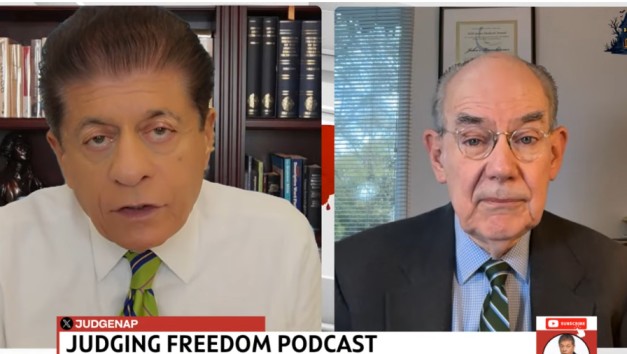
In this episode of Judging Freedom, Judge Andrew Napolitano and Professor John Mearsheimer discuss Israel’s Election Day and what it means for Benjamin Netanyahu, Secretary of State Marco Rubio’s claim that the West still rules a unipolar world, and the Houthi strikes crippling Saudi Arabia’s airports and oil infrastructure. They also examine America’s addiction to war, AIPAC’s retreat, Britain’s stockpiling warning, and Pete Hegseth’s FORTRESS America initiative as the West faces defeat in Ukraine and the Middle East. Read the full transcript of this interview which was live on October 27, 2026, below:
Israel’s Election Day and Netanyahu’s Future
JUDGE ANDREW NAPOLITANO: (00:00:27 – 00:01:37) Hi everyone, Judge Andrew Napolitano here for Judging Freedom. Today is Tuesday, October 27th, 2026. Professor John Mearsheimer joins us now. Professor Mearsheimer, pleasure as always, my dear friend.
Today is Election Day in Israel. So 2 questions: what will happen to Netanyahu himself if one of his adversaries successfully forms a new government, and what will happen to Israeli policy if that takes place?
PROF. JOHN MEARSHEIMER: (00:01:38 – 00:04:06) Well, I think with regard to Netanyahu himself, he has 2 major concerns aside from the fact that he’ll be out of office. One is that this trial, which he’s been able to prolong, where it seems like he is likely to be convicted will go forward, and he may very well end up being convicted.
But the second problem that he faces, and it is a huge problem, is that the successor government, assuming there is one, would probably create an independent commission to examine what happened on October 7th. And I believe if that happens, he will be held responsible. In ways that will damage his reputation permanently. And he has gone to great lengths since October 7th, 2023, to make sure that no official commission was formed because he understands what the likely implications would be. So that’s Netanyahu.
Then there’s the whole question of Israel. I would approach that question from 2 directions. First of all, what’s the likely future domestically for Israel inside the black box, so to speak? And there you have very powerful centrifugal forces at play that are not going to go away. You want to remember that there was this CIA report that was leaked a few weeks ago that said there was a serious possibility of civil war in Israel before the election.
Now, that obviously didn’t happen. But the fact is that these centrifugal forces are powerful and dangerous for Israel’s future, and they’re not going to go away. And in fact, I would make the argument that they’re going to get worse over time.
Then there’s the foreign policy dimension. I think there you’ll have some tactical changes. There’ll be some differences between the new leadership and what Netanyahu was doing. But at a more macro level, there’ll be no change at all. Israel remains committed to continuing the genocide, to expelling the Palestinians, to expanding its borders, and acting pretty much the way it has been acting under Netanyahu. So I don’t expect any big change either at the macro level or again, once you get inside of Israel itself.
Netanyahu Wanted to Resume Bombing Iran
JUDGE ANDREW NAPOLITANO: (00:04:07 – 00:04:31) The New York Times and Haaretz are reporting this morning that Netanyahu wanted to resume bombing Iran last week in some sort of last-ditch effort to unite Israeli voters behind him. And both President Trump and the head of the IDF said no. Does that surprise you?
PROF. JOHN MEARSHEIMER: (00:04:31 – 00:05:17) No, not at all. I mean, the head of the IDF made it clear that if Israel were to bomb Iran at this point in time, that the election would have to be postponed indefinitely. And given that the available polls say that Netanyahu is likely to be defeated at the polls, you can see where it was his— in his interest to start a shooting match with the Iranians so that the elections would be postponed.
But the IDF, much to its credit, and it appears most of the security elite inside of Israel, said that this is unacceptable and pushed back really hard, and therefore there was no attack.
Rubio’s Acropolis Speech and the Myth of a Unipolar World
JUDGE ANDREW NAPOLITANO: (00:05:18 – 00:06:05) About 2 weeks ago, Secretary of State Rubio gave a speech in front of the Acropolis in Greece, in which he said we are still in a unipolar world. The United States is the hegemon. He didn’t say United States. He said the West is the hegemon. He didn’t use the word hegemon. He said “head of the world,” an odd phrase, but the United States will use its military power to preserve this hegemony.
Why was there no pushback to this ignorance of what’s happened in the past 25 years. How could he possibly say, as the American Secretary of State, that this is still a unipolar world and the United States is the king of the hill?
PROF. JOHN MEARSHEIMER: (00:06:07 – 00:07:39) Well, as you know, many of our foreign policy elites, including Secretary of State Rubio, are delusional, and this is just more evidence of that. And of course, this explains why we’re in so much trouble today, because we have people like Rubio running American foreign policy.
But I want to make 2 points about what he said. First of all, as we all know, we’re no longer in a unipolar world. We’re in a multipolar world, and I estimate that we’ve been in that world since 2017, which is close to 10 years now. There are 3 great powers on the planet: China, Russia, and the United States. I think we’re the most powerful of those 3 great powers, but the other 2 great powers are formidable in their own right. That’s point number one.
Point number 2 is, if you go back to the unipolar moment and you think about how we performed militarily during the unipolar moment, remember that was the period of the forever wars.
That’s when we used military force very liberally and ended up shooting ourselves in the foot at almost every turn. So the idea that we should be nostalgic for this period, for the unipolar moment, in terms of the use of military force is a foolish argument to make. What actually happened during the unipolar moment tells us that using American military forces and all those escapades in places like Afghanistan and Iraq did not work out.
JUDGE ANDREW NAPOLITANO: (00:07:40 – 00:07:59) Wow. But why was there so little pushback? Because the media, the think tanks, the elites agree with Rubio? When he was saying the West, what is he talking about? Is he including Europe in that?
PROF. JOHN MEARSHEIMER: (00:08:00 – 00:09:34) Well, the West is a euphemism for the United States, right? He’s talking about the United States, and he understands that pretty much since the end of the Cold War, the Europeans have been basically our lackeys. They do pretty much what we want them to do. And therefore the United States clearly is in the driver’s seat. That’s what he’s talking about.
But what’s very important here in regard to your question about the absence of pushback is that the truth is that most people in the West, certainly in the mainstream media but in the foreign policy establishment— establishments inside the United States and inside Europe agree with Secretary of State Rubio. We don’t want this idealistic world that we’ve created in our own heads to go away. We want to maintain this imaginary status quo where the United States runs the world and does so in a successful and brilliant way.
And the problem that the elites face today, Judge, and it’s just very important to understand this, is that everything has gone wrong everywhere. We are on the verge of suffering catastrophic defeats in Ukraine and in the Middle East. One cannot underestimate how much trouble we are in with regard to those 2 major arenas of conflict, and the elites understand this, and that’s why they are saying all sorts of foolish things these days.
The Houthi Onslaught on Saudi Arabia
JUDGE ANDREW NAPOLITANO: (00:09:35 – 00:10:04) Wow. Let’s go to the Middle East. How unstoppable is Ansar Allah in its onslaught to Saudi Arabia? Yesterday, I’m rounding the numbers off, of 4,200 scheduled flights over Saudi Arabia, more than 4,100 were canceled, talking about commercial airline flights.
PROF. JOHN MEARSHEIMER: (00:10:06 – 00:11:48) There is absolutely no question that the Houthis are pounding Saudi Arabia, and the 2 general sets of targets that they’re going after are, number one, the airports, as you described it, and they’re wreaking havoc at Saudi airports, no question about it. But they’re also going after oil and gas infrastructure inside of Saudi Arabia in a really serious way.
They’ve hit the East-West Pipeline in Saudi Arabia, which we’ve talked about many times, and it’s hard to tell for sure whether it is shut down, but it appears that it is temporarily shut down once again. They’ve been attacking Yanbu. Which is at the end of that east-west pipeline on the Red Sea. And there’s no question that they have successfully attacked Yanbu. What the actual consequences are, again, is hard to tell.
And I was reading just before I came online that they have struck Ras Tanura, which is this huge refinery and port on the Persian Gulf. Of course, it’s a Saudi port. And refinery on the Persian Gulf, and they have struck that today. So what you see happening here is that they’re going after all key elements of the Saudi oil infrastructure in addition to going after the airports. And the Saudis have virtually no ability to shoot down the incoming ballistic missiles and drones that the Houthis are firing at them.
Why the United States Can’t Protect the Gulf States
JUDGE ANDREW NAPOLITANO: (00:11:49 – 00:11:58) Wow. And what has the United States done to protect its so-called allies in the Gulf?
PROF. JOHN MEARSHEIMER: (00:12:00 – 00:12:10) Nothing. Well, there’s nothing the United States can do. What can we do? We can’t even protect our own bases.
JUDGE ANDREW NAPOLITANO: (00:12:11 – 00:12:14) Yeah, well, what was the quid pro quo for building those bases?
PROF. JOHN MEARSHEIMER: (00:12:15 – 00:14:31) Well, the quid pro quo is that we would protect all of these Gulf states, the 6 GCC states, and in return they would provide oil and gas and they would help prop up the Western economy in very important ways. And that worked very well for a while, up until about February 28th when President Trump foolishly started this war against Iran.
And what that war revealed, to the surprise of many people, yours truly included, is that the United States cannot protect those targets inside of the Gulf states that the Iranians and now the Saudis— I mean, excuse me, the Houthis— are going after. We just don’t have the ability to defend places like Saudi Arabia, places like the UAE, or places like Israel.
You want to remember in the 12-day war last year— this is the June 13th to June 25th, 2025 war that the United States and Israel launched against Iran— that Israel and the United States brought that war to an end Because it was quite clear that we, the United States and Israel, could not together defend Israel in the face of ballistic missile, cruise missile, and drone attacks from Iran. And you’ve seen the same thing happen in the war that started on February 28th.
This is why the Israelis are sitting on the sidelines, and this is why the Israelis have no interest in getting back in this war, except for Benjamin Netanyahu. For political reasons, because the Israelis understand they can’t protect themselves, we can’t protect them in any meaningful way. And the same basic logic applies to the Gulf states.
This is a fundamental, a radical change in our relationship with the Gulf states, and it’s going to have huge consequences moving forward. And more importantly, this is why I said a few minutes ago that what’s happening in the Middle East is catastrophic for the United States.
America’s Addiction to War
JUDGE ANDREW NAPOLITANO: (00:14:32 – 00:14:35) How dangerous is America’s addiction to war?
PROF. JOHN MEARSHEIMER: (00:14:36 – 00:16:08) Well, it’s very dangerous in the sense that we have been addicted to war since the Cold War ended, and certainly after 9/11. There’s a widespread belief, or at least there has been a widespread belief in the American national security community, that we have this powerful military weapon and all we have to do is use it and it solves the problem at hand.
I remember that famous conversation, or infamous conversation, between Madeleine Albright and Colin Powell, where Madeleine Albright was very anxious to use the American military quite liberally around the world, and Colin Powell was blocking her. And she said to him, “Why do we have this powerful military if we’re not going to use it?”
And I think what was going on here is that Powell had a very healthy sense of the limits of what you could do with military force because he was a serving military officer. He remembered the Vietnam War and he understood that military can only do so many things. Whereas Madeleine Albright, who I think is reflective of how most people in the national security community think, believed that the United States had this weapon that it could use for social engineering and all sorts of other purposes and succeeded almost every turn.
Those are 2 very different worldviews. Now we’ve run the test to see who’s was right, Powell or Albright. And I think the evidence, at least to me, and I would expect you as well, is overwhelming that Powell proved right and Albright was wrong.
War Weariness Inside the U.S. Military
JUDGE ANDREW NAPOLITANO: (00:16:09 – 00:16:45) I mean, how do the troops vote? I see that Hegseth, Secretary Hegseth, has given them a day off, at least the ones that are stateside, on Election Day, to vote. But probably not a bad thing. I’m saying that as somebody who’s been harshly critical of my former colleague and probably former friend. But are troops necessarily pro-war? Aren’t they probably anti-war, at least a war of choice, at least a war that’s not defensive in nature?
PROF. JOHN MEARSHEIMER: (00:16:47 – 00:18:31) Well, I think we don’t have any survey data here, at least any survey data that I know of, but I would imagine that almost all the troops, especially people in the Navy who have to serve in the Persian Gulf region, are just sick and tired of this war and want it to end immediately. I don’t know if that means that they’re anti-war, but I think that they’ve probably had it.
I would imagine too, Judge, that if you look at the senior ranks in the Pentagon and in particular in the Navy, that there are lots of officers who want to bring this war in the Gulf to an end. I think the wear and tear on the U.S. Navy is just enormous, and the idea that you’re going to continue this for many more months probably frightens the admirals greatly. Furthermore, if you think about what this means for containing China in East Asia, which is a mission that the Navy really cares about— what’s happening in the Middle East is a disaster.
So I think that in the military there’s probably not a lot of what I would call anti-war feelings, the sort of feelings that you saw in the military as the Vietnam War wound down. I don’t think you’re seeing that, but I think you’re seeing a great deal of war weariness, and I think there’s also a powerful sense inside the military that the people who are running national security strategy really don’t know what they’re doing. It’s hard for me to believe that most sailors and soldiers and airmen and airwomen have not figured out that the people who are in charge are basically “the gang that can’t shoot straight.”
AIPAC Backs Off
JUDGE ANDREW NAPOLITANO: (00:18:31 – 00:18:44) Wow. Were you surprised when AIPAC said recently it’s no longer going to endorse and it’s going to dial back its donations to American politicians? I mean, is this credible?
PROF. JOHN MEARSHEIMER: (00:18:45 – 00:20:53) Yeah, I think it is credible. I am surprised because when Steve Walt and I wrote the Lobby book back in 2007, of course we wrote the London Review of Books article the year before in 2006, at that point in time I found it unimaginable that we would be in the situation we are in today with regard to all the negative exposure the lobby, the Israel lobby, is getting, and in particular AIPAC.
When people talk about the Israel lobby in public discourse these days, they use that phrase Israel lobby interchangeably with AIPAC. So all of the negative talk about the Israel lobby and Israel and the damage it’s doing to U.S. foreign policy and inside the U.S. political system really zeroes in on AIPAC.
And it’s quite amazing when you look at the level of criticism inside the Democratic Party for sure, but even inside the Republican Party, and you think that this is only likely to increase with the passage of time as more and more older people who are more sympathetic to the lobby and to Israel die and are replaced by younger people, which is where the real hostility is. So AIPAC is in really deep trouble at the moment, and I think going to be in even deeper trouble moving forward. And it doesn’t have any meaningful way of fixing the problem.
They’re flailing. They’ve tried smash-mouth politics. That’s been basically their only strategy for dealing with this problem. But smash-mouth politics just makes the problem worse, especially in the age of the internet where everybody sees what the lobby is doing. So I think that what they’re doing now, to some extent, and I think you’ll see even more of it moving forward, is they’re backing off. I think they understand that doubling down doesn’t work. Doubling down again makes a bad situation worse.
Britain’s Defence Secretary Urges Households to Stock Up
JUDGE ANDREW NAPOLITANO: (00:20:53 – 00:21:17) I’m going to play a clip of the United Kingdom Defense Minister, sounding as if he’s Churchill during the Blitz, warning people to stock up on food, water, medicine, batteries, and things of that nature, and ask you what you think the origin of this is. Chris, cut number 1.
VIDEO CLIP BEGINS:
WES STREETING: (00:21:18 – 00:22:29) It’s about saying to households across the country to be ready by just having some everyday essentials indoors, so should there be disruption from those sorts of events, you’re ready. Now that’s things like 2 litres of water per— 3 litres of water per person per day, tinned goods in the cupboard to last you a few days, things that don’t necessarily need heating up in the stove or the microwave, tinned goods.
If you’ve got babies Things like your baby food and nappy supplies, pets, pet food, water, and then things like torches that are battery-powered, mobile phone charging packs. Do you have enough cash indoors if the local payment systems were down? Those sorts of things that we can all do to do our bit to be ready for everyday acts of nature.
But as I said today in response to questions at my speech in Telford, there are also state-backed actors and terrorists who wish to do our country harm and are looking to do that by disrupting life for ordinary citizens.
VIDEO CLIP ENDS:
JUDGE ANDREW NAPOLITANO: (00:22:29 – 00:23:00) In addition to this, you also have some American hard-right podcasters making the same warning. Do you think something big and dangerous is brewing, or do you think people like this defense minister, of whom I’ve never heard— he’s probably new under the Burnham administration in Great Britain— are just trying to mask their own domestic failures or justify their massive military expenditures.
PROF. JOHN MEARSHEIMER: (00:23:01 – 00:23:14) Before I answer your question, let me just say it reminds me, and I’m sure it reminds you as well, of the 1950s. All that’s missing here is the need for bomb shelters, right? Remember the 1950s in the United States?
JUDGE ANDREW NAPOLITANO: (00:23:15 – 00:23:33) I remember being instructed to hide under the desk. I think I was 6 years old. Hide under the desk because Khrushchev is going to bomb us, and the desk, your old-fashioned 1930s era— this was the ’50s— wooden desk will protect you from Khrushchev’s bombs.
PROF. JOHN MEARSHEIMER: (00:23:33 – 00:25:38) Yeah, we used to go to the gymnasium and everybody would sit down around the wall in the gymnasium and put their head between their legs and their hands over their head so that when the incoming warhead hit, we would maximize our chances of survival. But anyway, it just reminds me of that.
One could argue that back then there was a legitimate threat because there was a serious possibility of nuclear war, and of course you wanted to maximize the chances that the American public would survive in large numbers. That argument really didn’t end up carrying the day.
But anyway, what is this British minister talking about? I mean, what’s the threat that justifies these kinds of measures? I can’t imagine. He wasn’t talking about a Russian missile attack on Britain similar to the missile attacks that we see the Russians launching against Kyiv and other cities in Ukraine. He didn’t mention that. He was talking about terrorism. And I guess this is terrorism that’s generated by the Russians. But this is a ludicrous argument. You just sort of say to yourself, what world are these people operating in?
My best explanation, the best explanation I can give you for this, is that you want to understand that people who have been pushing this war and that includes a lot of people in the national security establishments and in the media in countries like Britain and the United States, are now coming to the realization that Ukraine is going to lose.
Michael McFaul, who has been one of the arch proponents of the Ukrainian cause and is profoundly anti-Russian, certainly anti-Putin, has a new piece in Foreign Affairs that says “Putin’s strategy is winning.” You just want to think about that.
JUDGE ANDREW NAPOLITANO: (00:25:38 – 00:25:38) Wow.
Who Is Responsible for the Catastrophe in Ukraine?
PROF. JOHN MEARSHEIMER: (00:25:38 – 00:28:30) “Putin’s strategy is winning.” This is Mike McFaul, who is a super anti-Russian hawk, okay? And I could point to all sorts of other evidence that points up that people in the establishment understand that we have failed— we meaning the West— have failed in our endeavor to help Ukraine win its war against Russia, and that Russia is going to win.
Now, this is going to be a devastating defeat in the West, and the big issue here that is going to haunt us for a long time to come is who is responsible for this catastrophe. And the argument that people like you and I have been making is that it is these hawks who have portrayed Putin as an imperialist and have been dedicated to defeating Putin and using Ukraine as a battering ram who are responsible.
Our argument is that if they had listened to us and this war had never started, or it had been stopped at various points along the way, Ukraine would be in much better shape today than it actually is, and it certainly would be in much better shape 5 years from now than it will be. If they can’t— again, had listened to us, but they didn’t. So they now have to figure out how to deal with this problem, how to deal with the fact that they are in good part responsible for this catastrophe that’s taking place inside of Ukraine.
So what they’re going to do, and you’ll see lots of evidence moving forward, is try to portray Putin as the devil incarnate to support their initial claim that he was this super imperialist who was bent on conquering all of Ukraine and bent on conquering all of Europe. And the only reason he hasn’t done that is because we have stopped him in his tracks. Yes, he won the war, but it’s just an ugly victory. If we hadn’t supported Ukraine, we’d have him in Berlin now, if not in Paris now. And of course London is on his target list, and that’s why we need to build bomb shelters and so forth and so on. This is the rhetoric.
So they’re going to continue to portray Putin in the most negative light because they have to rescue their reputation. They are responsible for this catastrophe inside of Ukraine. Again, if Ukraine had listened to Judge Napolitano or to John Mearsheimer and many other people of our persuasion Ukraine would be intact today inside its pre-2014 borders and have millions, millions more Ukrainians living.
Hegseth’s FORTRESS America and Threat Inflation
JUDGE ANDREW NAPOLITANO: (00:28:31 – 00:28:47) The Defense Minister of the UK is not the only one talking this way. So, Chris, can you run a shorter version? You’ll know who this is, Professor Mearsheimer, in an instant. A shorter version of cut number 7. Please.
VIDEO CLIP BEGINS:
PETE HEGSETH: (00:28:47 – 00:29:40) Today, at my direction, we are launching FORTRESS America, a national insurance policy for the American homeland. Now, FORTRESS stands for Federal Operations for Resilience, Troop Resources, Energy Supply, and Survivability. And here’s what FORTRESS calls for. Every major military installation in America is going to generate its own power. Independent of the civilian grid.
If an adversary takes down the grid by cyberattack, by sabotage, or by any means, our bases stay lit, our aircraft keep flying, our command centers never go dark. We’re bringing our critical supply chains home. The rare earths, the specialty metals, the semiconductors, the propellants mined in America, refined in America, built in America by American workers.
VIDEO CLIP ENDS:
JUDGE ANDREW NAPOLITANO: (00:29:41 – 00:29:45) Are these fears realistic, Professor Mearsheimer?
PROF. JOHN MEARSHEIMER: (00:29:46 – 00:31:17) No, I don’t think so at all. But, I mean, threat inflation is part of his game plan. It’s long been part of his game plan. And he’s also long been dedicated to portraying himself as this tough guy. And for anybody who’s seen the movie Patton with George C. Scott, you know right off the bat that Hegseth talking to a large audience like that in front of a giant American flag the size of a football field behind him is an imitation of that famous Patton speech that’s depicted in the movie.
But the idea that we’re on the verge of being attacked by Russia or any other country is just not a serious argument. The United States remains the most powerful state in the world. Its greatest problem is that it has a penchant for getting into foolish wars, and it has gotten itself into 2 really foolish wars, one in Ukraine, and 2 in the Middle East. And it’s going to suffer catastrophic defeats in both of those wars.
And this is a huge problem for this administration, and it’s a huge problem for the national security elite. And that, of course, is true not just in the United States, but it’s true in Europe as well. And this is why we see all this nonsense from Hegseth and from the new British defense minister.
JUDGE ANDREW NAPOLITANO: (00:31:18 – 00:31:26) Wow. Professor Mearsheimer, thank you very much. A great conversation as always. Look forward to seeing you next week, my friend. Thank you.
PROF. JOHN MEARSHEIMER: (00:31:27 – 00:31:30) You’re more than welcome, Judge, and I look forward to seeing you as well.
JUDGE ANDREW NAPOLITANO: (00:31:30 – 00:31:50) Thank you. Coming up later today at 2 this afternoon, Matt Hoh. At 3 this afternoon on all of this, she actually has a fascinating piece out. Does the United States still want to colonize other countries? Who else? Colonel Karen Kwiatkowski. Judge Napolitano for Judging Freedom.
Related Posts