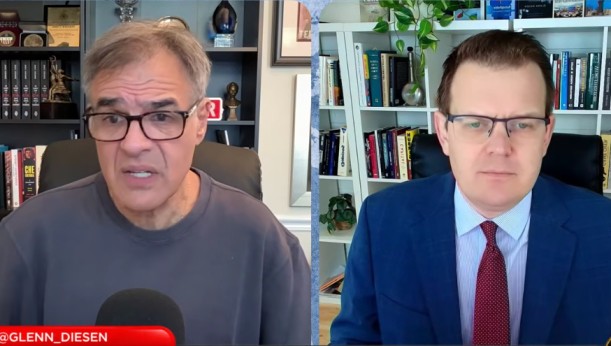
In this interview, Glenn Diesen speaks with former CIA counterterrorism officer and whistleblower John Kiriakou about how the CIA changed after 9/11, how the agency recruits spies and organizes regime change operations, and its alleged role from Ukraine in 2014 to Iran in 2025. Kiriakou also discusses the torture program he exposed, Israeli espionage against the US, the deep state, Russiagate, and why he believes the CIA is only becoming more powerful and less accountable. Read the full transcript of this interview which was live on October 30, 2026 below:
Introduction
GLENN DIESEN: (00:00:00 – 00:00:37) Welcome back, everyone. Today we have a fascinating guest, John Kiriakou, a former CIA counterterrorism officer who, following the 9/11 attacks, he became involved in the hunt for senior al-Qaeda figures. He also became the first CIA officer to publicly confirm that the CIA used waterboarding, and thereafter he subsequently became the first CIA officer to serve prison time in connection with the torture program, not for participating in torture, but for exposing it.
So thank you very much for coming on. It’s a great honor to have you on the podcast.
JOHN KIRIAKOU: (00:00:37 – 00:00:42) Well, the pleasure’s all mine. My only regret is that it’s taken us this long to get together.
How 9/11 Changed the United States and the CIA
GLENN DIESEN: (00:00:44 – 00:01:16) Let me, well, let’s just start after the September 11th attacks about how it changed the United States. I mean, you were involved in some of the early operations, the capture of Abu Zubaydah. I mean, this was one of the CIA’s most significant operations after the September 11th attacks.
But here we are, 25 years after those attacks on the United States. And how do you see this war on terror having affected the US as well as the CIA, where you were an officer?
JOHN KIRIAKOU: (00:01:17 – 00:02:31) I think that the US government’s response to the 9/11 attacks, and especially the CIA’s response to the 9/11 attacks significantly weakened the United States. It significantly weakened the rule of law, and it significantly damaged the ability of the American government to carry on or to continue on in a leadership position internationally in human rights.
I’m ashamed to say that we committed war crimes. We committed crimes against humanity. We set up a torture program, a rendition program, a secret prison program, and then when it was finally outed, said to the world, “And what are you going to do about it?”
We launched a 2-decade-long war in Afghanistan. We launched a nearly 2-decade-long war of choice against Iraq, not to even mention Libya and Somalia and Syria and so many other places. I think that overall the war on terror, and I hate that term, the war on terror could not have been handled any worse than the way that it was handled.
GLENN DIESEN: (00:02:33 – 00:02:56) How about the agency though? How did the CIA, did it begin to operate differently? I mean, often when we talk about CIA, we think this is about espionage and all states covering intelligence, but of course, when it becomes involved in a war against terrorists, or I’m not sure, again, whatever the term you might prefer, it would change some of its tasks.
JOHN KIRIAKOU: (00:02:56 – 00:04:49) Yeah, Glenn, the CIA changed permanently on 9/11 in that when I was the CIA’s executive assistant to the deputy director for operations, he used to have this mantra. He would say it all the time. “The job of the CIA is to recruit spies, to steal secrets, and to analyze those secrets so that the policymaker can make the best informed policy.” And in a perfect world, that’s exactly what the CIA should be doing.
But after 9/11, it changed, and the CIA became a paramilitary organization. It created assassination squads. It created kidnapping teams. As I said, it established an archipelago of secret prisons and torture chambers. It just changed completely.
Even under the Obama administration, the CIA’s director, John Brennan, and before becoming director, he was the Deputy National Security Advisor. He would host a meeting every Tuesday morning at 7 AM at the White House called the Tuesday Morning Kill List Meeting, where he would meet with the White House counsel, with attorneys from the CIA and from the Justice Department, as well as operations officials from the CIA.
And every Tuesday morning they would meet, they would come up with a list of people to kill that week. The teams would fan out around the world. They would carry out their assassinations, and then they would meet again the next Tuesday and come up with the next list of people to kill.
Well, that’s extrajudicial. It is extraconstitutional. It is a violation of international law. And the attitude was, “What are you going to do about it?”
GLENN DIESEN: (00:04:52 – 00:04:54) Has anyone been held accountable for any of this, or?
JOHN KIRIAKOU: (00:04:55 – 00:05:12) I’m the only person associated in any way with the CIA’s response to 9/11 who ever was prosecuted or went to prison. And I was prosecuted and sent to prison not for participating in the torture, but for blowing the whistle on it.
How the CIA Recruits Informants
GLENN DIESEN: (00:05:16 – 00:05:24) How did you recruit new informants? I mean, how did this work? Because I only know it from the movies, to be honest. That’s why.
JOHN KIRIAKOU: (00:05:24 – 00:08:00) Sure. I actually enjoy doing that very much. I mean, there’s a schoolbook, a textbook way to do it. It’s called the asset acquisition cycle. Spot, assess, develop, recruit.
I spot you at a diplomatic cocktail party, let’s say, and I walk up and I say, “Hi, my name is John Kiriakou. I’m at the American Embassy. What’s your name?” And you say, “My name is Glenn Diesen. I’m an academic. I’m a foreign ministry official, a defense ministry official,” whatever you happen to be.
And so I begin developing you, and I say, “Glenn, this conversation has been delightful. Please allow me the honor of taking you for a cup of coffee.” And so we meet for coffee, we have a very good time, then we meet for lunch, then we have dinner, then my wife meets your wife and they become friends, and then we go on vacation together, and the next thing you know, you are my best friend.
So I can put my arm around your shoulder and say, “Glenn, you know I love you, you’re like my brother. May I ask a favor? The plans to that new Russian tank that you have on your desk, do you mind making a copy for me? I’d really appreciate it.” 9 times out of 10, you’re going to do it because you’re my best friend.
But then in the meantime, I’ve identified a vulnerability that you have, and the vulnerability may be something obvious. You have a drinking problem, you have a gambling problem, you’re bankrupt, something. But it may be something as simple as, you really love your kids and you want your kids to go to the best university in the world. I’ll pay for it. You really love your wife, and maybe she’s developed, God forbid, breast cancer. I’ll send her to the Mayo Clinic. I’ll pay for it, and she’ll get the best medical care in the world.
And once we establish that quid pro quo, I’ve got you. That’s how it’s done. I always found that it was far, far better to do the light touch. Use the light touch. Let’s be friends. If you put a gun to somebody’s head and you say, “You’re going to work for me,” they’re not going to work for you. That’s just not going to work.
How the CIA Organizes Regime Change Operations
GLENN DIESEN: (00:08:03 – 00:08:29) Yeah, now that’s what I heard as well. I mean, if you putting just money in front of someone, they would feel like they’re betraying something. They would feel corrupted. It’s not a good approach.
Yeah, well, another thing the CIA is renowned for, of course, is coups, that is overthrowing governments. How does this actually work? Sorry, I’m not looking for a guidebook, but how does the CIA usually organize this kind of regime change operations?
JOHN KIRIAKOU: (00:08:30 – 00:11:28) It can start with something as simple and as elementary as recruiting journalists in that country to spread propaganda, anti-government propaganda, pro-American propaganda, whatever your goal happens to be.
Probably the easiest example is the very first covert action program that the CIA ever carried out, and that was to steal the 1949 elections in Italy. This has all been declassified over the years. It was clear that the communists were going to win the election of 1949. And so the CIA set out to discredit the communists and to steal the election, to effect essentially a pre-election coup in favor of the Christian Democratic Party, which was the conservative party, the pro-American party.
And they did it very simply with $150,000 in cash. And they just went out and bought every journalist they could find who was willing to take the money. And the media were flooded with pro-conservative and pro-American articles. And the Christian Democrats just edged out the communists. That was the very first CIA covert action program.
If you’re talking about something more military, in nature. The CIA works very, very closely, of course, with the Pentagon. And not just the Pentagon, but specific elements of the Pentagon like NSA, for example, or DARPA, where you can hack into a foreign country’s government computer system, for example, and plant viruses or plant messages saying, “You’re all going to die. This is your only chance to come onto the side of the good guys. Join us now, or we’re going to wipe you out and your family and your government and save yourself,” which we’ve done. And then you start seeing defections.
You do that. You coincide an operation like that with what’s called a cold pitch. A cold pitch is I knock on your door. “CIA. This is your only chance to work with us. Either say yes or you’re going to die.” And you do that country’s ambassadors all over the world on exactly the same day. At the very least, that never works, of course, but at the very least, it causes disruption. It causes chaos.
And when you’re able to weaken a government like that, and disrupt its computer system and affect its media and bombard it with propaganda, people take to the streets in what looks like a natural domestic uprising. The next thing you know, there’s a coup and you’ve overthrown a government.
Ukraine 2014: The Removal of Yanukovych
GLENN DIESEN: (00:11:30 – 00:12:13) How do you assess then what happened in Kiev back in 2014 with the removal of Yanukovych? Because was it a few years later, or actually in 2024, that is 10 years later, there was this famous New York Times article that argued the day after Yanukovych was removed, this new intelligence chief, which had been helped to be installed by the West, essentially called the CIA, MI6 to set up a trilateral partnership in this covert war against Russia, to set up secret bases along the border.
I mean, how do we know anything about the involvement of the CIA in removing Yanukovych in 2014?
JOHN KIRIAKOU: (00:12:15 – 00:14:00) Of course, I’ve been out of the CIA for quite some time. I left in 2004, but like you, I have the unpopular opinion that the removal of Yanukovych was a CIA operation. It was something that was organized by the Obama administration. And that it was a long time in the making.
Remember, the Russians asked the United States repeatedly— President Clinton, President George W. Bush, President Obama— to join NATO. Russia wanted to join NATO, and all 3 presidents said that’s not a good idea. And what the Russians sought in exchange were assurances that NATO would not expand to Russia’s borders.
And of course, NATO continuously expanded, whether it was Latvia, Lithuania, Estonia, whether it was, well, much later on, Finland. They drew the line at Ukraine. We had specifically promised the Russians that Ukraine would not become a member of NATO. And then all of a sudden, US policy is that Ukraine should be a member of NATO.
So I always believed that the removal of Yanukovych was step one in what was a slow-motion coup and attempt to bring Ukraine into the embrace of the West. And the calculation, the incorrect calculation was made that the Russians were powerless to do anything to stop it. Well, they’ve proven that they weren’t powerless to do anything to stop it.
GLENN DIESEN: (00:14:03 – 00:14:20) The actual removal, what is a trend or a pattern from the past? Is it simply paying protesters? Is it taking existing grievances and manipulating it? Is it buying off journalists using NGOs or what?
JOHN KIRIAKOU: (00:14:21 – 00:15:14) It’s every one of those things. It’s clandestine radio broadcasts. It’s soft power. It’s USAID. It’s the Voice of America. It’s beaming in jazz music, talk shows in whatever languages are spoken in any given region. It’s all of the above, all of it.
And then at the same time, behind the scenes, the CIA is actively seeking to recruit not just leaders. Sure, everybody wants to recruit the prime minister or the president. That’s not going to happen in most cases. So you recruit members of parliament, you recruit ambassadors who are overseas, you recruit intelligence officers who are posted overseas, and then you direct them to go back to their country to assume positions of authority, and then you can guide them from inside government.
The CIA’s Role in the War Against Russia
GLENN DIESEN: (00:15:17 – 00:16:11) As you said, the experience with the Global War on Terror was that the CIA didn’t only do this recruitment, it also got engaged in the warfare thereafter. And again, this is a lot of the reports we see. Again, there’s a lot of a lack of clarity exactly what is happening behind the scenes.
But how do you see this? To what extent did the CIA go from just helping with toppling the Ukrainian government to actually getting involved in the war against Russia because someone has to organize all this logistics, the weapons, using the weapons, the targeting. I mean, there’s a lot of, I thought it was interesting when this new CIA director went to Moscow, ’cause usually they’re not the one doing the negotiations, but if they are the one managing the war, then it would make perfect sense for the CIA director to go to Moscow.
JOHN KIRIAKOU: (00:16:11 – 00:18:08) Yes, indeed. My information of course is dated, and my specialty was the Middle East, so I don’t have any inside information. I can only comment on what I’ve read in the media.
But I think that we should take media reports very seriously when they tell us that the CIA brought back dozens of Ukrainian pilots to work with the Pentagon and to teach them not just how to fly whatever, F-16s I guess is what it was, or old F-14s, but also how to be appropriately trained in evasive actions, what to do when you’ve been shot down.
You and I have both heard stories that it’s essentially the CIA that is running the Ukrainian intelligence service. I think that’s probably true because that’s what’s happened in the past. Going all the way back to the CIA running the South Vietnamese intelligence service when there was such a thing.
I’ll give you another example. I happened to be overseas doing a surveillance detection route with a senior officer who was on loan to us from another country. While we were on the surveillance detection route, his cell phone rang and it was the president of the country that he was serving in. And he said, “Yes, Madam President, how may I help you?” And she said something, and he said, “Yes, my choice would be—” and then he named a name. And then he says, “You’re welcome, Madam President, such a pleasure to speak with you again,” and hung up.
I said, “What the heck was that?” He said, “I just chose the new intelligence service director for that country.” And I said, “We do that?” And he said, “Last week I chose the defense minister.” So yeah, that’s what happens.
GLENN DIESEN: (00:18:10 – 00:18:32) Yeah, the involvement or the growth of this intelligence service is kind of fascinating. And well, I remember reading in the Washington Post as well, they were almost bragging in hubris that they rebuilt the entire security services of Ukraine after removing Yanukovych because they used to be allied with the Russians, so they had to remake them as anti—
JOHN KIRIAKOU: (00:18:33 – 00:19:12) Fire everybody, bring in your own people. Keep in mind though, and I know that you’ve spoken about this in the past, that, and this is not John saying it, this is the United Nations saying it, that Ukraine is the most corrupt country in the world, or at least the Western world. And so you’re going to have to continue to deal with that kind of corruption.
And then we are shocked when American weapons, in some cases heavy weapons, end up in the possession of Mexican drug cartels. And then we wonder how in the world that happened. So the plan is not really as smooth as the American government would have you think.
Iran, Mossad and the Protests of December 2025
GLENN DIESEN: (00:19:14 – 00:20:04) Let me pivot a bit to the Middle East again, where you’re an expert, of course. On January of this year, 2026, I saw Pompeo go out on Twitter and he wrote something, yeah, “Happy New Year to every Iranian participating in the protests and also every Mossad agent walking besides them.”
I mean, there’s been a few other comments, I think, especially by Scott Bessent, where they kind of recognized that the American intelligence services were also involved. At the same time, they say that everything was just an organic protest. How do you see this? What was the involvement of the CIA in Iran? That is in December of 2025, because this was kind of used as a reason for attacking.
JOHN KIRIAKOU: (00:20:05 – 00:24:27) Well, there’s a lot to say about that, actually. The CIA historically has had almost zero presence inside Iran. Iran is what is called a denied area for the United States, but there are hundreds, maybe thousands of recruited agents working for Mossad spread all over Iran. And that’s how the Israelis have been so successful in targeting the military leadership, the civilian political leadership, as well as just about every Iranian nuclear scientist that there was in the country.
And the way the Israelis did this was severalfold. Number one, Iran has a serious problem with the sheer number of Afghan refugees in the country. Iranian government policy is to not provide refugees with anything. No shelter, no food, no water, no medical care, nothing. You live on the street as a beggar.
Well, if Mossad comes in, and says, “Listen, I’ll give you $50 a month, $100 a month.” And you do this to 10,000 people, 20,000 people. And you say, “I want you to just stand on this street corner and tell me every time the minister’s car passes or the general’s car passes or the scientist’s car passes. Just text me every time.”
And then while you’ve done that, you’re also hacking into the Tehran traffic camera system so that you can watch live when the minister’s car drives through or the scientist’s car or the general’s car. That’s how you carry out targeting.
What the Iranians did in response was they forbade any general officer or any minister from carrying a cell phone. Great. But the Israelis continued to kill them because it didn’t occur to the Iranians to tell all the bodyguards, “You can’t carry cell phones either.” And so the Israelis targeted the cell phones of the bodyguards. That’s how they were able to do it.
Now, when Mike Pompeo makes an ass of himself, which he does with some frequency by saying stupid things like what he said about Iran, and Mike Pompeo doesn’t know anything about Iran. By the way, nothing. He gets more information about Iran from his church, and that information, of course, is wrong, than he ever got with the CIA or with the House Intelligence Committee. When he says things like that, he’s just parroting Israeli propaganda.
The Israelis want people to think— the Israelis actually successfully convinced President Trump to think that the Iranian government was a house of cards, and that as soon as the leadership was taken out, that house of cards would collapse on top of itself. And that did not happen. Instead, what happened was American-Israeli aggression forced all these disparate factions together.
One of the lessons that the United States just can’t seem to learn and I saw this immediately upon the US invasion of Iraq in 2003, was that we are never seen as liberators. We are always seen as invaders and occupiers.
And look at it this way. For the Iranians to, quote unquote, “win” this war, literally all they have to do is survive. That’s it. For the United States and Israel to win the war, we have to remove the Iranian government. We have to install a pro-US, pro-Israel, essentially occupation government, which will never, ever happen. Right. And then protect that government from its own people.
It’s not possible. Especially in a country of 92 million people that is the size of the entirety of Western Europe and is surrounded on 3 sides by forbidding mountains and on the 4th side by water. It can’t be done.
How CIA Practices Have Evolved Over Time
GLENN DIESEN: (00:24:31 – 00:25:02) Well, I’m just thinking about the continuity and change in the practices because, well, again, you were the chief of counterterrorism operations in Pakistan. The CIA has a long history of involvement in operations against foreign governments. And how do you see this having evolved over time, or does it stay somewhat constant? That is, again, what they did back in the ’50s or ’60s vis-à-vis what they all did when you were there.
JOHN KIRIAKOU: (00:25:03 – 00:26:30) Well, the CIA was successful in the mid-1970s in convincing pretty much every country around the world that the bad days were behind them. That this was a new CIA. It was not going to be involved in coup plotting and the overthrow of governments. It was not going to be involved in human rights violations.
That attitude lasted from 1975 until roughly 1982, when the US became involved in, well, in wars of liberation in Central America, and then it initiated the Iran-Contra scandal. It’s been downhill since then.
And then, of course, the 9/11 attacks just changed the entire landscape for the CIA, where now everything is a potential target. Every person is a potential target that the CIA is going to do what the CIA wants to do, and it will deal with blowback if and when that blowback occurs.
They’re just not— they don’t feel the need to answer to anybody, especially any foreign governments, but they don’t feel the need to answer to US policymakers or even to the congressional oversight committees. They just simply do whatever they want. And one boss once told me, “It is always easier to beg forgiveness than to ask permission.”
The National Endowment for Democracy, USAID and Hiding in Plain Sight
GLENN DIESEN: (00:26:34 – 00:27:16) This aspect, as you said, of convincing people, for example, that the CIA doesn’t do much or that it now behaves properly. How do you see the intelligence agencies in terms of their role of manipulating public opinion, manipulating civil society?
Because there’s this famous world establishment, for example, of National Endowment for Democracy in 1983 by Reagan and this CIA director. If I’m not mistaken, yeah, the whole logic was that they should hide in plain sight. I think that is, “Let’s not do the covert stuff. Let’s just do it in the open and call it democracy.” How, well, hey, what exactly happened? What do you know of this?
JOHN KIRIAKOU: (00:27:18 – 00:29:50) It’s not just the National Endowment for Democracy. It was USAID. It was both the Democratic and the Republican National Committee’s international arms. It’s the labor, the international labor movement. It’s— the CIA has its hands everywhere, all through civil society.
It’s not just that even. It’s the think tanks too, major think tanks that take CIA money, that take defense contractor money. They take money from some of the most conservative elements of the foreign policy community.
So yeah, I found some documents online just recently related to USAID, which stands for the United States Agency for International Development. Now, on the one hand, USAID was doing wonderful, important work. It was digging water wells in Africa. It was setting up medical clinics in some of the poorest places on Earth, teaching children how to read, building one-room schools, wonderful things. But the other half of the budget was created to hide CIA covert actions.
And so the documents that I found online, it was a letter from Senator Ted Kennedy in 1971. He wrote a letter to USAID saying, “One of my constituents wrote to me and said that the USAID budget is really just a place for the CIA’s covert action budget to hide. Is this true? Is the USAID actually a CIA covert action organization?” And they wrote back to Ted Kennedy and said, “Yes, what are you going to do about it?” And there was nothing he could do about it.
Finally, the document was declassified just over the last 5 or 10 years. And what could anybody do about it?
Now, Donald Trump focused on the soft power side of digging water wells and building schools and clinics and said, “I don’t want to do that anymore. That’s American taxpayers’ money. I don’t care about foreigners.” So he zeroed out the USAID budget, thus then depriving the CIA of a place to hide its covert budget. But they just moved it elsewhere, like I said, to think tanks and the Endowment for Democracy and these other organizations.
GLENN DIESEN: (00:29:52 – 00:30:17) Yeah, that was interesting when that little period, because it did reveal a lot of things. That is, when Trump cut the USAID money, suddenly there were reports in the news, in the media, that suddenly there was a lack of funding for journalists in Ukraine, that about 85% of them had received money from the USAID, which kind of begs the question how neutral they were or how objective they could be.
JOHN KIRIAKOU: (00:30:17 – 00:30:18) Exactly.
Human Rights Organizations and Smear Campaigns
GLENN DIESEN: (00:30:19 – 00:30:34) But you and I, we spoke on a panel together in Oslo. And I thought it was interesting. The initial panel we had was supposed to be in a church and that got canceled. And apparently that was because of me, because there was some journalists who—
JOHN KIRIAKOU: (00:30:35 – 00:30:46) You know, it’s funny that you say that because I assumed that it was me. And then my host said, “No, no, it wasn’t you. It was Glenn.” I said, “Glenn must be dangerous if they’re canceling him?”
GLENN DIESEN: (00:30:48 – 00:30:59) Well, I’m kind of not so very dangerous at all, but there’s been a very horrible smear campaign in media. I can’t really talk, speak anywhere because it gets canceled immediately.
JOHN KIRIAKOU: (00:30:59 – 00:31:00) Outrageous.
GLENN DIESEN: (00:31:00 – 00:31:34) But the organization that’s led this is an organization called the Norwegian Helsinki Committee, and one of the people of— well, one of the organizations that financed them is the National Endowment for Democracy.
And I was just wondering, is this a common practice to— no, not that it’s operation, but to use human rights organizations to essentially push an agenda? Because this same, again, I have to use quotation marks, “human rights organizations,” when they saw the crimes exposed by Julian Assange, they went up criticizing Assange, which is strange.
JOHN KIRIAKOU: (00:31:34 – 00:33:24) They ran for the hills. That’s right. They ran for the hills. When I was arrested, one of my attorneys was a member of the board of directors of the American Civil Liberties Union. The American Civil Liberties Union, ACLU, was a natural partner for me. They wouldn’t even take a meeting, and my attorney ended up resigning from the board because they would not speak out against torture or speak up on my behalf. Number one.
The other one was Amnesty International. We reached out to Amnesty International, the world’s preeminent human rights organization, and I said, “Please, I’m begging you, just a statement of support.” They said, “Absolutely not.” They ran away from me.
And then it was only when I was released from prison they came out and said, “Oh, you know what, on second thought, John Kiriakou really did do a service in the name of human rights.” It’s like, “Well, thank you now that I’m out of prison.”
But sure, these organizations that appear on the surface to be democratic with a small d, pro-human rights, pro-civil rights, pro-civil liberties, they’re either joined with the powers that be, the intelligence services, national or international law enforcement, or they’re afraid of them and thus won’t take a stand. So yeah, it’s not at all unusual for ostensibly good organizations, human rights organizations, to want nothing to do with someone like you or me.
May 6th, 2002: The Day John Kiriakou Turned Against the Torture Program
GLENN DIESEN: (00:33:27 – 00:33:56) I wanted to go back a little bit to your own experiences, because again, you devoted a lot of your life and time and safety to serving your country. When was it with the— was it the torture program itself, or when did you start to feel that things had gone too far? And sure, because I mean becoming a whistleblower, you must have known that this could have some severe consequences. Indeed, which it did.
JOHN KIRIAKOU: (00:33:57 – 00:37:37) It did. For me, I can specifically tell you it was May 6th, 2002. That was the day I flipped. May 6th, 2002, I had just returned from Pakistan. I was a true believer that we had to bring Osama bin Laden, Ayman al-Zawahiri, and everybody around them to justice. 9/11 was the gravest crime ever committed against the United States. We lost 3,000 people on one morning, and we had to bring them to justice.
So my job in Pakistan was to find them and capture them and bring them to justice. Well, before we even caught Abu Zubaydah, we had been capturing so many al-Qaeda fighters that we literally filled the jail in Rawalpindi, Pakistan. And the Pakistanis came to me and said, “You have to do something with these prisoners. The jail is full and we have to get rid of them.”
I called CIA headquarters and I said, “The Pakistanis want these prisoners out. What do you want me to do with them?” And they said, “Put them on a C-12 transport plane and send them to Guantanamo.” And I said, “Guantanamo, Cuba? Why would we send them to Cuba?” And the response was, “We’ve come up with this idea. We’re going to send them to Cuba. We’re going to keep them there for 2 or 3 weeks until we can determine in which federal district court to put them on trial.”
Because 9/11 was an open criminal investigation and the crimes had been committed in the Southern District of New York, the Western District of Pennsylvania, the Eastern District of Virginia, right? The World Trade Center, the field in Pennsylvania where the flight crashed, and the Pentagon. I said, “That’s a great idea.” So I sent them all to Guantanamo. In the end, 770 people we had in Guantanamo.
But then somebody in Vice President Cheney’s office said, “You know what, Guantanamo is a no man’s land for them. They don’t have any constitutional rights there. We could keep them there literally forever, and there’s nothing that anybody can do about it.”
I didn’t know that until I got back to CIA headquarters on the 6th, and I was standing in the sandwich line in the CIA cafeteria. When a senior officer came up to me and asked me if I wanted to be— his words— “certified in the use of enhanced interrogation techniques.” I had never heard the term before, so I said, “What does that mean?” And he said, “We’re going to start getting rough with these guys.” And I said, “What does that mean?” And he described these 10 techniques. That sounded like a torture program to me.
And in the end, I told him, “This is a torture program. I believe that it’s illegal. I think that it’s immoral and unethical besides the fact that it’s illegal, and I want no part of it.”
But that was when I realized that when the CIA leadership said to the media that “we’re going to take the gloves off,” what they meant was, we are going to begin committing crimes against humanity and nobody can stop us. That was the day I decided that I was on the other side of the issue.
Israel, Mossad and Espionage Against the United States
GLENN DIESEN: (00:37:40 – 00:38:55) Yeah, I remember the, well, in wars, apparently, according to international law, you can only have, you’re either an enemy soldier or you are a civilian. So if you’re a civilian, you should be tried in civilian courts. If you’re a soldier, then you don’t get that civilian court. But at the end of the war, you’re prisoner of war, you should be released.
I thought it was interesting that Bush, he came up with this 3rd category, that is the “unlawful combatant.” Yeah, because then suddenly it was in— no, as you said, in no man’s land. You have no rights. It’s no civilian court and no prisoner of war. I thought— and of course in Cuba would be perfect location where it’s— yeah, but still.
But on this wider though, the wider operations the US has or had or still has in the Middle East, what is the, within the intelligence communities, I guess, a key partner, the most important partner would be Israel. I mean, from what I’ve heard at least, their intelligence services are second to none, that they are excellent. But how, I mean, are you too close? Did this become an espionage concern for the US? I mean—
JOHN KIRIAKOU: (00:38:55 – 00:40:00) It is an espionage concern for the US. 3 weeks ago, the director of DIA, the Defense Intelligence Agency, sent an all-hands email to every employee of the Defense Intelligence Agency saying that the Israelis have ramped up espionage activities inside the United States. They’re targeting everybody at DIA, and to be on your guard for Israeli approaches.
The Israelis are actively involved in spying against Americans, in infiltrating the CIA and the Defense Department and the State Department, NSA. They’re an actively hostile foreign intelligence service.
But then on Capitol Hill, there’s a measure in the National Defense Authorization Act which will come up for a vote in the coming weeks. That will embed the Mossad both at the CIA and at the Pentagon, where they will be sitting side by side with Americans. It’s an outrage.
GLENN DIESEN: (00:40:03 – 00:40:58) Yeah, well, that is a bit crazy, but there’s been increasing criticism about Israeli influence over US Middle Eastern policies. I mean, especially because of, well, what’s happened in Iran, as often Israel is accused of having walked the Americans into this war.
But so this kind of demand for decoupling, I’ve never seen this kind of criticism open in the public before. And it seems to have some impact on the politics, but I guess in the area that matters a lot, especially for people like you in the intelligence sector, is there any decoupling happening there or are the American intelligence services and Israelis as close as they were? Because if you have all these reports, warnings that Israelis are seeking to infiltrate, spy, it doesn’t impact the relationship at all? Or is it just this perspective?
JOHN KIRIAKOU: (00:40:59 – 00:41:38) We never liked the Israelis at the CIA. We kept the Israelis not just at arm’s length. We wouldn’t even allow the Israelis into the building. Whenever we had a meeting with the Israelis, it would be at an offsite facility because every time they would come to our building, they would try to bug it every time.
And so you have to keep in mind though, that the CIA is not a policy organization. It’s a policy support organization. And so if the policy is to support Israel with everything we have, that’s what you have to do. If the president and the Congress say, “Give the Israelis everything,” that’s what you have to do. You can’t make a decision like that on your own.
The Deep State and the Hunter Biden Laptop Letter
GLENN DIESEN: (00:41:41 – 00:42:22) On the decision-making though, in the United States, we hear a lot of talk about the deep state and I kind of empathized a bit with, well, not so much now anymore, but with Trump in the first administration when he warned that the deep state essentially came after him because it looked like the intelligence services did so, also in 2020 with this, the Biden laptop when they all, this former intelligence officers came out and essentially had all the media censored. They claimed that the Biden laptop scandal was a Russian disinformation campaign, which didn’t make any sense.
JOHN KIRIAKOU: (00:42:22 – 00:42:30) “Bears all the hallmarks of a Russian disinformation campaign.” The day that that letter came out. I’m sorry to interrupt you.
GLENN DIESEN: (00:42:30 – 00:42:31) No, no, please.
JOHN KIRIAKOU: (00:42:31 – 00:44:14) The day that letter came out, I gave several interviews, and I said in one of them, I know literally every single one of the 51 signatories, but there’s something that everybody’s missing in this letter, and it’s that phrase “bears all the hallmarks of a Russian disinformation operation.” They did not say it was a Russian disinformation operation. They wanted people to think that’s what they were saying.
And that’s, in my mind, what made that a political document. That was a swipe against Donald Trump, and it was a message in support of Joe Biden. It was the CIA’s attempt to swing the election. It was all made up.
This is that mealy-mouthed analytic language that is so common at the CIA. They’ll never say, “Glenn Diesen has a blue jacket on.” They’ll say, “Glenn Diesen almost certainly is wearing a blue jacket.” Almost certainly. Just in case I’m crazy and that jacket is actually orange, or there’s something weird about your lighting that makes me think that that jacket is blue.
But that’s how they wrote that phony fake memo. They knew that that wasn’t true. They knew it, but they knew that they could trick most of the American people into thinking that it was true. That was, in my view, that was an illegal intelligence operation. Run against Americans.
GLENN DIESEN: (00:44:18 – 00:44:48) How does the deep state, or how do you conceptualize this? Because often, at least in Europe, they kind of just brush it off as if it would be some conspiracy theory. But the deep state, if we would define it as a permanent bureaucracy, yes, which over time takes on some level of independent decision-making power. How do you, well, how do you conceptualize it? And to what extent does it influence the US foreign policy?
JOHN KIRIAKOU: (00:44:51 – 00:47:35) I’ve said many times that the deep state is real. You don’t have to call it the deep state. You can call it the government bureaucracy. You can call it the state. But the truth is, at organizations like the CIA, the Defense Department, NSA, the FBI, et cetera, et cetera. Senior employees there called the Senior Intelligence Service. They are in their positions for 25, 30, 35 years. They don’t go anywhere. And they know that presidents come and go every 4 years.
And if there’s something that a president orders them to do, or to not do that they don’t like, they just ignore him. They’ll say, “Yes sir, yes Mr. President,” and then they go back to their offices and they say, “Ha, I’m not doing anything,” because they know that by the time he realizes that his orders haven’t been carried out, his term is up and he’s not going to be president anymore.
And another thing, one of the things that the CIA is very, very good at is recruiting with, quotation marks, “recruiting” new presidents, they especially love new presidents with no intelligence experience. And I’m going to use Barack Obama as an example. Barack Obama was a senator for 2 years. That was it. That was the extent of his government service. 2 years. He was not a member of the Intelligence Committee, so he didn’t know anything about intelligence.
Well, a president-elect is eligible for his first classified CIA briefing on the day after the election, and so usually it’s the Deputy Director of the CIA for intelligence who gives that briefing. And when the DDI says to the new president-elect, “Mr. President-elect, just wait until you see the incredible things we’re doing all around the world.” And he gives him the president’s daily brief, which is classified at levels above top secret. And he gives him a blue border report or a black border report that are— it’s classified 6 levels above top secret.
And they bring him in as one of the boys. One of the group, and they say, “Just wait until you read these incredible reports. You’re going to be amazed.” They know that they’ve gotten him. They’ve recruited him, and now he’s going to be their biggest proponent and biggest cheerleader, and then they don’t have to worry for the next four years. That’s exactly how they handled Obama.
Russiagate, Christopher Steele and John Brennan
GLENN DIESEN: (00:47:38 – 00:48:46) If Obama was especially vulnerable or receptive to this approach, there seemed to have been a panic though in the U.S. intelligence community in 2016 when Donald Trump suddenly appeared out of nowhere and had some very new ideas, which I guess hadn’t been approved by the intelligence community. How do you assess the Russiagate years and the role of John Brennan?
Because for me, I mean, it’s shocking to me that all of these allegations had such an influence on society and the relations with the Russian Federation. So much of it was, were lies and it was proven to be lies, but it never dented the narrative. Like reality apparently didn’t mean anything. So I just wanted to get your, hear what your thoughts were on those Russiagate years. ‘Cause even today when I look at Trump running foreign policy with Witkoff and all of them, it looks very amateur, but I can understand on some level he doesn’t trust the intelligence community.
JOHN KIRIAKOU: (00:48:46 – 00:48:46) Yeah.
GLENN DIESEN: (00:48:47 – 00:48:53) But not that I approve of how he is running the government now, but yeah, again, sorry, the Russiagate.
JOHN KIRIAKOU: (00:48:54 – 00:51:10) Yeah. Russiagate to me and to other former CIA officers had hoax written all over it from the very beginning. I’ll preface this by saying that I think there was a fundamental misunderstanding of some of the information coming from Christopher Steele.
I knew Christopher Steele. I worked with Christopher Steele on a joint operation against a terrorist group. And Christopher Steele was one of the most highly respected MI6 officers I’ve ever encountered. So Christopher Steele was tasked with canvassing his contacts in Russia on Barack Obama, Donald Trump, et cetera, et cetera. And he did that.
Now, it is not the job of an operations officer to determine whether or not something is true. It is the job of an operations officer to collect the information and turn it over to the analysts, and the analysts determine whether or not it’s true.
So Chris Steele collected this information that Donald Trump had sex with prostitutes in Russia. And he paid prostitutes to pee on the bed that Barack Obama had slept in, and he took money from the Russians, and the Russians helped him get elected. Now, that all sounds nonsensical, and of course, at the end of the day, it was nonsense.
But Chris Steele reported it as, “This is what my Russian contacts are saying,” rather than to go to an analytic team to determine whether or not it was true, it went straight to the Clinton campaign and they ran with it.
So those of us who had CIA experience read this, and I remember having conversations with former colleagues of mine saying, “You think this is as crazy as I do, right?” And they all agreed with me. This is crazy, but it became a political football and the Democrats decided to run with it. But those of us who had intelligence experience, we never believed a word of this stuff. It was just nuts.
GLENN DIESEN: (00:51:14 – 00:51:26) Another thing that happened though, I think, well after the Russiagate years was to see all those former top intelligence officials suddenly end up in media jobs.
JOHN KIRIAKOU: (00:51:26 – 00:51:47) Oh yeah, look at John Brennan. John Brennan was on MSNBC yesterday as their paid intelligence correspondent, John Brennan, who’s under criminal indictment right now for essentially trying to overthrow the US government. And he’s on MSNBC now as the go-to intelligence commentator.
What the Public Never Hears About CIA Operations
GLENN DIESEN: (00:51:50 – 00:52:25) This is the hiding in plain sight aspect. That is, you don’t have to do anything covert if you sit there and masquerade as something else.
I just, yeah, I had a last question though in terms of, and again, a lot of this is clandestine. The CIA doesn’t— the whole point is that it shouldn’t be in the open. What are the kind of things though that usually, CIA operations that doesn’t make the news, I guess? Because there must be some internal rivalries like we saw in Syria. I’m not sure how serious that was. And I mean, what are left out of public narrative, you think?
JOHN KIRIAKOU: (00:52:25 – 00:53:11) Most everything is left out of the public narrative. We have no idea, for example, what the CIA is doing against the Chinese, what the FBI is doing to protect us from the Chinese. We have no idea really what the true story is in Syria. I assume that President Jolani is a former CIA asset. But I’ve read that he’s actually a former Turkish asset.
So it’s impossible to say, but whatever you see in the media about CIA operations, multiply that by 100 or 500 or 1,000 things happening around the world that you don’t see.
Where Is the CIA Headed?
GLENN DIESEN: (00:53:14 – 00:53:57) Surely there must be a lot of good people in the US or, sorry, in the CIA who’s motivated by wanting to help their country, but at the same time are worried that the CIA has become too militant, that is engaged in this warfighting, assassinations, that it’s essentially passed from its— well, walked away, strayed from its path, and feel that it’s on the wrong, yeah, wrong track. Like, yeah, like yourself when you became a whistleblower.
Do you see any internal efforts to reform the CIA, go back to its old ways, or dismantle it? Or where is the organization headed?
JOHN KIRIAKOU: (00:53:58 – 00:54:30) No, the budget is bigger and bigger and bigger every year. They hire more and more people every year. They are deeper in the American tech industry than they ever have been in history. They received a congressional exemption to allow them to actually invest in tech startups. The CIA was the very first investor in Palantir, for example, and owns stock in Palantir. So no, I’m sorry to say there’s no good news. It’s just getting worse and worse.
GLENN DIESEN: (00:54:32 – 00:54:39) This should worry the Americans though, to have an unaccountable intelligence community having this amount of power.
JOHN KIRIAKOU: (00:54:40 – 00:54:42) Yes, yes indeed. It’s very disturbing.
GLENN DIESEN: (00:54:44 – 00:54:51) Well, John, thank you so much for taking the time. I see you everywhere these days. I know you’re a busy man, so I appreciate it. Thanks a lot.
JOHN KIRIAKOU: (00:54:51 – 00:54:53) It’s so good to see you. My pleasure.
Related Posts
- Trump Will Hit Iran After the Midterms w/ Ian Bremmer – One Decision (Transcript)
- Lawrence Wilkerson: America’s Retreat From Europe & Middle East (Transcript)
- DOAC Podcast: Geopolitical Strategist Dr. Sarah Paine (Transcript)
- Prof John Mearsheimer: America’s Addiction to War (Transcript)
- 4 Point Peace Plan That Could End the Ukraine Conflict w/ Jeffrey Sachs (Transcript)