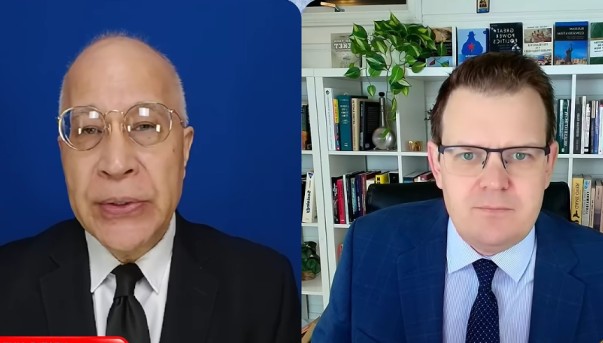
In this interview, Glenn Diesen speaks with Einar Tangen about China’s 5th Plenum, its anti-corruption drive and the difference between “prescriptive” and “performative” governance. Tangen explains China’s dual circulation strategy, the push to take small and medium-sized businesses global and the expanding use of the renminbi, while both men discuss how ideology and universalism keep the West from learning and course-correcting. Read the full transcript of this interview which was premiered on October 31, 2026 below:
Introduction
GLENN DIESEN: (00:00:01 – 00:00:20): Welcome back. We are joined today by Einar Tangen, a senior fellow at the Taihe Institute and also a senior fellow at the Centre for International Governance Innovation. He runs an excellent Substack, so make sure to check it out. That’s Asia Narratives, and I have left a link in the description. So thank you for coming back on the program.
EINAR TANGEN: (00:00:20 – 00:00:45): Glenn, it’s a pleasure to be here. I’m just sorry under the circumstances that you’re being pushed around by governments about this, trying to depersonalize you and criticize you for simply taking an honest look from a historian’s perspective at what we are facing today. And unfortunately, it’s a trend that we can perhaps talk about later.
Freedom of Speech and Europe’s Lost Competitiveness
GLENN DIESEN: (00:00:46 – 00:02:39): Yeah, I was going to say, I think there’s an interesting relevance. That is, during the Cold War, when the economic situation was well, better at least, and the West was more confident, I think it often manifested itself in more stable politics and the confidence in terms of freedom of speech and so forth. I think this is a luxury when countries go through difficult times. They, a lot of these principles can no longer be defended, it seemed, and part of it is also one of the reasons for panic now as well.
Well, of course we have wars, war in Europe, but another one is the recognition in Europe that they don’t really have that economic competitiveness anymore. And without a clear economic model, political models are questioned, security becomes diminished. I mean, the inability of the Europeans to compete properly also results in the US losing more interest in the continent. Which means the West is fragmenting. So we see a lot of different variables tied up together, and of course it ends up also with basic freedoms which can’t be defended anymore, apparently, under extreme conditions.
But I did want to start on something related but slightly different, which is what is happening over there in China. That is, China’s 5th Plenum has been come— or is being concluded, and we see that this, well, this is a political gathering of China’s Central Committee, which tends to be associated with China’s long-term economic strategy. And you are there in Beijing, so I was wondering what are your takeaways? What is changing and what can be expected from the Chinese economy moving forward?
China’s 5th Plenum and the Party’s Self-Reflection
EINAR TANGEN: (00:02:41 – 00:06:48): Okay, so there’s a lot to unpack there. This is— the plenum is actually ending up today, so we’ll be expecting more information. But going into it is very clear the party is going through self-reflection, something that is not happening as what you described in other nations. Rather than reflecting on the decisions that are made and what is necessary to go forward, they are simply reacting and saying, “Anybody who disagrees with me needs to be punished severely.”
So this is a very different take and it shows the differences in approach and style between China and the rest. And I’m not saying that countries should copy China. I don’t think it’s possible. They have a separate cultural and historical context that does not fit the West. But there is this need to reflect in Washington and EU. I mean, rather than trying to understand what is going on, that you just, as you say, you get these knee-jerk reactions and it’s borne out by the statistics.
In 1992, since 1992, today in the last 12 years, what you’ve seen is a tripling of the number of journalists who have been put into prison. It used to be that there was, press freedoms were about, in countries in terms of ranking, it was about 70%. Today it is 1%. We have had more journalists killed in the last 2 years in Gaza than the combined of World War I, II, and all the wars since. And yet, what happens is they wanted to crush dissent. The very people that should be listening to in terms of saying, are there alternate ways they’re doing it?
So how does this tie into Beijing? Beijing is looking internally, it’s not about the press, although they’re very concerned about the message. And the message right now is that they have to lead by example. So what you’ve seen here is out of the 372 people, those are regular members, a little over 200, and then alternate members on this central committee. And this is a very important committee. It’s under the NPC and they, what they do, it’s, I’m sorry, it’s under the party. What they do is they’re responsible for direction. And people should remember that there are 2 parts to China. There’s the government, that’s the State Council, et cetera. Then you have the legislative and party side. That is what we are looking at today.
Anti-Corruption and Leading by Example
So going in, they have been very aggressive about going after corruption. Now, a lot of people always say to me, “Oh, well, no, that’s just power politics.” And I say, “Nonsense.” All of these people are convicted because they took money, used their influence to enrich themselves. Now, this is not the United States. It’s not that people don’t turn a blind eye to it. If you engage in this kind of activity, you will be caught and you will be punished.
In order to go forward, there has to be a basic belief in the party. So the party has to act, has to lead by example, and the only way it can do that is if it’s not corrupt. So while they are struggling with a lot of things—the real estate, the debts, especially local government debt. Trying to get more consumption. The fact is none of those policies will be legitimate if the government itself is not legitimate. And this is one of the things that is lacking in both Europe and America right now. No consideration of whether or not they are representing the values and needs of the people. Just simply, how do we use power to cover up the fact that we have no idea what we’re doing or where we’re going?
The Legitimacy Problem in Liberal Democracies
GLENN DIESEN: (00:06:51 – 00:08:08): Yeah, I think that’s an important point. I often make the argument that one of the things I think we’re going to discover at least in the West over the next months and years, will be that the— this assumption that because there’s the elections, it’s— we call ourselves liberal democracies— that this creates an assumption of legitimacy that irrespective of what happens they will nonetheless, that they don’t think about the need to shore up the legitimacy, that they can squander this. I mean, this assumption, I mean, this I think will result in some miscalculation because with all of this economic, political, social instability and misgovernance split between elites and the public, the legitimacy issue will grow.
And usually the response I get is, “Well, no, no, we’re liberal democracies, it’s the people who chose the government,” but go back 200 years and read the second volume of Alexis de Tocqueville on freedom in America. And he has actually a chapter on democratic despotism where he addresses this very specific problem. And I would hope that our leaders would actually read this because we should hope for some stability moving forward.
Prescriptive vs. Performative Governance
EINAR TANGEN: (00:08:11 – 00:16:40): Glenn, I completely agree with you. I wrote an essay about this, the difference between prescriptive and performative governance. Prescription is exactly what you said. Well, as long as you have a voter box and we pretend that you have free speech, although obviously you’re an example of how that is not happening. And the statistics show that the world is less free today in terms of expression. All right. But as long as you pretend that those values are in place, it legitimizes everything you do, regardless if you’re supporting a genocide in Gaza or promoting wars that have no end, involving yourself in endless amounts of investment in arms and war, as opposed to your infrastructure and your people.
So that is one way of doing it, and I think absolutely agree with you. That’s May’s. China’s is about performative, and this goes back to this plenum issue. They have to perform. There’s only one party. You can blame one person, but after a while, if you are not actually changing anything, blaming one person is not going to allow the party to escape responsibility. And there’s nowhere else to go. They can’t say, “Well, it’s the other guy’s fault, vote them in.”
And this is what we have today. I mean, the— it is— democracy has not failed, all right, the West. The West has failed democracy. When people vote only for their own interests, there is no future. There cannot be. The majority of people just say, “I want, I want more in my pocket today and I don’t care about what happens tomorrow.” You can’t build anything. You’re not going to invest in the future. You’re not going to put money into infrastructure, into education and everything like that because you feel aggrieved. You feel you are the victim. You shouldn’t be punished. Everyone else should give something, but not you. That is the rot that is facing Western democracies right now.
So I always put that in difference to the way China says this is, “Well, I have to perform. If we’re going to perform, we have to be legitimate and we have to produce results.” There’s no other country on earth, whether you like China or not, you have to understand its system. Every year they have a report card. They have to read out exactly what they promised the year before, and they have to say whether they accomplished it or not. And it’s part of a larger plan, these 5-year plans, which then fold into multi-year, multi-5-year plans going up to 50, even 100 years. So it’s all part of a continuum. Yes, they do adjust. But my point is there is a plan.
Today, under prescriptive government, you have one government comes in, does whatever it thinks is important to get more votes. Unfortunately, they never solve the problems, which means that they’re voted out in the next or the next one or maybe 2 elections. And the other party comes in and undoes everything that they did. How is that planning? How can a country go forward that way? And why aren’t the leaders of the West reflecting on this? Why aren’t they saying, “Okay, we need to have better systems. We need to have performative systems. We have to have measurements that we are in fact taking care of our people”?
So to me, this is what the plenum represents. Other people criticize it and they say, “Well, he’s gotten rid of over 100 people from standing, I mean, from a combined of the standing committee, the political bureau, and the central committee.” But no one argues that these people weren’t corrupt. They just say, “Well, he got rid of a lot of top people.” Well, I think that’s great. I think it shows that they’re trying.
Now, there are always dangers to that. The apparatus that you set up to take, to get rid of people who are corrupt, unfortunately, they become bureaucracies. They have internal KPIs. And in those instances, the very system that is supposed to help can also be detrimental. It can result in lower-level people saying that “I have to get more convictions, I have to gather more money.” And that is something where the central government has to self-correct. You have to make sure that that doesn’t happen. There are always going to be small abuses. The question is, are you trying to make the system better?
So China continues on its own beat. It has been very successful with that. I think countries should study not how you replicate that system, but how you replicate the results. How can you take long-term planning and the future of your people seriously? And then put that into a form of action that both sides or multiple sides can agree on. This idea of factionalizing, “I want this and you want that and we’ll make a horse trade.” That’s not a plan. That’s politics. And politics doesn’t work, especially when the world is facing real problems, mostly self-created, but there’s still problems. And the question is how you address them.
And today we seem to be bankrupt in terms of our ability to go at it. You have a president of the United States who alternates between, “I’m going to bomb them back to the Stone Ages,” and “There’s a peace deal waiting to come.” Or “They really want a deal, but they just don’t know it.” I mean, it’s incredible that it has come to this. I mean, you cannot, no one should be able to look at the world today and not realize that we are living in some alternate universe. Leaders who have 10% approval, right? Somebody like Donald Trump who is enriching himself. It’s, I’m not making accusations. These are facts, right? It’s not something where we, “Oh, well, is he or isn’t he,” he’s skating the line. No, he’s quite open about it.
And we know that he’s a convicted felon, that he has more than 30 women who’ve accused him of sexual molestation, right? This is the reality of the world. It would have been a joke 20 years ago. Today is the reality that we live in. China looks at this and they’re horrified. They say, “We do not want to go down that path.” And this is the major difference that is happening today.
Dual Circulation and the “China Collapse” Narrative
So when people look at the plenum and what that means for the economics, all right, China has spelled out what it wants to do. It has this dual circulation strategy, which put into simple terms means they want to attract investment based on expanding their domestic market. So the more money that Chinese netizens spend and not putting themselves in poorhouse or on credit card bills, but simply if they spend more, there’s more activity, there are more opportunities, there are more sales, and that will attract companies were interested in growing their markets. Right now, China is really the only stable market in the world that’s growing.
I mean, the way I hear it, and I’m sure you do too, is that China’s on the verge of collapse. Okay. It’s leading the world in manufacturing of things that you cannot get by without. Its growth rate is twice the US. And 3 to 4 times that of Europe. But consistently, what do you hear from the press? “China is on the verge of collapse.” And it’s been the same story for the last 30 years. It just doesn’t change. It’s like Gordon Chang. He’s been predicting the collapse of China for the last 30 years, just under 30 years. Every year he’s wrong. But it doesn’t mean that he doesn’t confidently come out the next year and say, “It’s good. This is the time.” So you can say what you want about China, but let’s look at the performance. And I think if people start reflecting on that, they’ll get a better idea of what they expect from their governments.
Universalism and the West’s Inability to Self-Correct
GLENN DIESEN: (00:16:43 – 00:19:16): I noticed if you look in the, a lot, especially the American media, that it’s the coverage of China has begun to follow a little bit out of Russia because with Russia as well for the past 25 years. There’s been very consistent reporting that it’s on the verge of collapse. I mean, yes, at least since 2001. So we’ve been doing this for quite some time, and the kind of headlines, if you put them side by side, you see now this is being applied to China. I often think it’s wishful thinking, that is, that we should go back— we will at some point go back to the natural order, which is, yeah, the US will lead the world because you choose your own time frame. And then we look, “Oh well, look over the past 100 years or 200 years, this is the natural order of things.” So again, this is how people tend to pick that key time in history to define what is normal, when history began.
But this— what you said though about the need to learn a bit from China as well, not just China but other countries, and doesn’t mean to copy them, but see what works and what doesn’t. This should appeal, though, to the Western experience because in ancient Greece, they were quite deindustrialized, the Greek city-states, and they essentially all tried different economic governance, political governance, and they saw what worked. And they might emulate what works, what doesn’t. And again, look a bit outwards. And the United States as well, I would argue, built on that tradition about having that decentralized state system. That is one state, they can all do things different and they learn a little bit from each other.
I think what is unique in this day and age is that we have all these universalist principles. Like we already had this liberal democratic dogmas, which are, you can’t really contest. And with universalism, we already have the formula. We were told by Fukuyama exactly what is required for good government. And even when it crashes at home and we see more competitive models abroad, we don’t, it’s very difficult to say, “Oh, well maybe we can tweak this or change that.” Instead, one just holds onto it and politics degenerates into some kind of a wishful thinking, which is not a strategy that will soon everything will fall in place. “It’s just Trump. As soon as Trump is gone, we’ll go back to normalcy.” But
EINAR TANGEN: (00:19:16 – 00:19:17): no,
GLENN DIESEN: (00:19:17 – 00:21:15): no, no, no. If you remember the Bush election, he was saying, George Bush was like, “Why does Clinton do nation building? We will not do this. We’re not the world policeman,” really. And then look what Bush became. And you had Obama, it was going to change. “This is not how we’re going to do things. We’re going to lead from behind.” Then you had Trump, he was going to end all wars. He was going to be ultimate peace president. Now he’s talking about genociding entire nations. Biden was going to be the adult in the room. So you just, at the end, one gets the impression it doesn’t matter who sits on the throne if they can’t, if policy doesn’t change.
And no, so I think, I’m not sure if it’s universalism or how you see the challenges because what, sorry, this last thing I was thinking is, with this idea of universalism that you sit on the winning ticket already, that you don’t need any change, it’s very hard to adjust as well because any internal criticism going, saying “we’re on the wrong path, we should fundamentally reconsider this,” is seen as almost a treason against the assumption about the, yeah, universal ideals which everyone agreed upon, the consensus that you, if you criticize the model we have in the West, it’s not that anyone would try to fix it or course correct, it’s that you hate the West because the West has become defined by these universalist ideals.
So it is, yeah, I think we’re stuck, I think. And I’m not sure if it’s the universalism, the lack of self-criticism. It’s because that was supposed to be the strength of the West, that openness, that we can do our laundry in public, we see what is wrong, and then once we see what’s wrong, we can change what is wrong. But we can’t discuss what is wrong really, and we can’t change. So, sorry, a bit of a detour perhaps, but,
EINAR TANGEN: (00:21:16 – 00:21:17): I agree.
GLENN DIESEN: (00:21:17 – 00:21:29): But for all things of China, they say the centralization of power, and there is a see a strong degree of centralization of political power, but economics very decentralized though.
Ideology, Originalism and the Federalist Society
EINAR TANGEN: (00:21:31 – 00:30:47): Yeah. One thing I want to add is that there’s 2 bookends of the way that people look at the world. There are people who want certainty and most of these people, they’ll point to a book, whether it’s a Bible or a Constitution, and they’ll insist that all the wisdom in the universe is contained in that book or that piece of paper or their set of beliefs. And that, and anybody who violates that is heresy. All right. And this is exactly what you have. The West has become extremely ideological, which is kind of ironic because West always said that they don’t like ideology and they accused other countries, especially communism and socialism, for being ideological nothings that could not actually be real.
The other kind of person is somebody who believes that we don’t know everything and that we have to adjust, that we have to continue to learn because life is dynamic. And these are the kind of people who create change. I’ve never seen anybody who is an absolutist, who believes that what they believe is right, who is interested in change. No, they’re interested in going back.
They want to go back to being originalists, kind of like the, in the United States, there’s a legal society called the Federalist Society, and they call themselves originalists, meaning that they think that they know the original intent of the framers of the Constitution and that, those framers, although that was 250-some-odd years ago, had all of the knowledge and wisdom that was necessary for the next billion years. And they cannot imagine that there’s anything else. And they believe in this kind of nostalgic, “We need to go back.”
Well, here’s the irony. These people were born out of this contempt and hatred for what was called the Warren Court. Warren Court believed that African Americans and women and all the rest of it deserved equal treatment, that people were people and that you had to make sure that they were treated equally. They championed civil rights. They made sure that individual rights were protected, that the police, the power of the police could not be used to suppress the people. And they said, the originalists said, “This is heresy.” Literally, they said, “This is heresy. This goes against the framers’ intent, goes against the Constitution, and we have to get rid of it.”
And they have been very successful. There are now 6 justices on the Supreme Court that are either members or associated with this group. So they’ve been extremely successful. I mean, it was started while I was in law school. Somebody offered, asked me to join, and I said, “Well, what are you?” “We’re originalists.” And I started laughing. “Original what? Do you think everything was there?” And they’d look at me and they’d think, but this goes to this fundamental attitude. Now, I’m not saying that you’re one or the other. There’s certainly amount, there’s a rainbow in between. Where people have to make, they sit somewhere, not on one side or the other side, but somewhere in the middle.
Why China Changed Course Under Xi Jinping
But I am impressed. And the reason I came to China and stayed in China and was interested is because they wanted to learn. That was evident. China, when I first came here in 2000, was not a great place. It was very dusty, very, it was just beginning its development. 2001 is when they joined the WTO and you start seeing all this fast, rapid economic advancement. But even as it was going, they were so concentrated on economic development that they, social development lagged behind.
And you had people who were feeling disenfranchised, disconnected from society, although they were working hard in the cities to make the buildings. They didn’t feel part of the very cities that they had created. Migrant workers, even people who were pursuing money, didn’t really, they felt empty. They had money, but it didn’t seem to make a big difference in terms of making them happy. Maybe a little bit more secure, but that was about it. And I’m not saying that any of this is bad. I’m just saying that this was the reality.
Then China switched. And I put a lot of that at the feet of Xi Jinping. He comes in in 2013. He starts the BRI. He says, “We are going to pay attention to people. We’re going to get rid of extreme poverty. We’re going to make sure that the benefits of progress are shared rather than captured.”
Billionaires, Extraction and the Zero-Sum Model
And this is one of the big issues in the West right now. You look at the zillionaires who are out there, Elon Musk, etc., they literally want to dictate society. They want to capture more wealth. Not content with being the richest man in the world. Elon Musk is trying to combine his companies, which seems to be one of his hallmarks. He starts a bunch of companies and then he combines them and he creates more wealth for himself. So instead of being a single trillionaire, maybe he’ll be a double trillionaire. But is that helping the rest of America? Is it really helping the world that he accumulates this money and then tries to dictate the politics?
He is now officially has put more money in the last few years into American politics on the Republican side than the boogeyman of conservative politics. Wow, what’s his name? I forget the guy who arranged he and Bessent were involved in the takedown of the Southeast South. Southeast Asian financial system. Not Bezos. Anyways, I’ll remember the name later in the middle of the night. He was one of these people who everyone accused of trying to create a liberal order in his own image. And I mean, it’s just the numbers are extraordinary.
So you have a system today, where those who see anything that is a change as heresy, who are meanwhile going to the bank with the money, they’ve captured these markets. Of course they don’t want it to change. In America, the top industries are basically controlled by 2 or 3 supposed competitors. And what do they do? The model is to extract value. Not service people, but to extract as much as they possibly can from them. And they do that domestically and then they do it internationally.
China has a different— and this is based on this kind of zero-sum, either I get it or you get it, but we can’t share it. And China says, “No, that’s not the way you grow yourself. It’s not stable. It’s not sustainable.” If I’m playing king of the hill, the only thing I know is somebody’s going to try to knock me off because they believe that I’ve taken too much. So their idea is that we can grow our economy at the same time that we grow the world’s economy. Why? Because they’re connected. The more money that people have in other countries, the most disposable income, the more they’re going to buy products and the more products we can produce. The more that they can develop, the better it is for China. So they see making the pie bigger is the key to it.
And that goes back to this plenum. What is it all about? If you could read the press tomorrow or later today, they’re going to say, “Oh, this was just Xi Jinping getting ready for his 4th term.” They missed the point that China is going through a very difficult time of transformation as it reacts to internal issues in terms of fairness and creating a better society. Well, beset with the issues with real estate, local government debt, low expenditure, consumption within their people. And at the same time that they’re confronting a very determined US that is, has said openly, “We want to continue.” So they’re doing what they, the best they can under those circumstances, but they believe that they can, they should be learning.
I don’t hear anybody in Washington say they can learn anything from anybody. And it doesn’t matter if you’re Democrat or Republican. I always believe they have all of the answers. And that’s getting back to why I came to China. That’s what impressed me most. It wasn’t the physical circumstances. It was the fact that everybody I met wanted to learn. They didn’t think they knew it all. And to me, that’s the hallmark of a country that has promise. So that’s why I came to China. I thought if there’s going to be a renaissance in my lifetime, it will be in China because it only happens when people want to learn, not when they think they know everything.
The 5-Year Plan and Environmental Rights
GLENN DIESEN: (00:30:49 – 00:31:30): Yeah, again, the danger of having all the answers would be the ideologies. But more of the specifics though, in terms of how China’s economic strategy, I mean, the continuity and change. China’s emphasized a lot of technological self-reliance, a need to enhance domestic consumption. Do you— are we seeing any transformation, or is it an evolution, or— well, essentially, where do you see it headed in terms of how it’s changing from previous priorities? Not that it’s necessarily abandoning a lot of the ideals.
EINAR TANGEN: (00:31:31 – 00:41:34): Well, I mean, okay, so go back to the 5-year plan that was passed. What did it say? It took environmental rights and made them the same as contractual rights. There’s nothing like it in the West. And they say that as a human being, all right, you have the right to clean air, clean water, all right, and in an environment and education that allows you to enjoy life. The reason they did that is it goes once again to this idea that they’re shifting from purely saying that “we want to make more money,” okay, to “look, we have to figure out ways in which we can have a fairer and better and more sustainable society.”
And this isn’t just pure altruism. I mean, they’re looking at this in a very practical way. If everyone is benefiting, guess what? You’re not going to have huge amounts of destabilization. That used to be true in the United States. 1972, 61% of the population was middle class. Today it’s 50% and falling. And of that 50%, most of ’em are extremely fragile and they’re afraid that they could go underwater at any time if there’s an emergency.
So yes, they are trying to do it. Now, what are the headwinds internally? China is a still relatively new country. 1949, it comes together. It doesn’t have a modern economy at all. Then you get in ’79 and Deng Xiaoping starts talking about very practical things. And yes, it’s good to make money. You have to use the forces of capitalism to encourage people to be productive. And that works, worked for China and continues to work for China and will probably be part of its new ideas about how to expand and make these gains more substantial.
Taking Small and Medium-Sized Businesses Global
And what do I mean by that? The 99% of all the companies in China are owned by small and medium-sized businesses. Entities, 99%. So this idea that this is a factory, factory place, they produce 60% of all the revenues, about 80% of all existing employees and over 90% of all new employees. So China is very interested in harnessing this, and that’s all capitalism. That’s all market interplay. Doesn’t mean that they don’t have rules and regulations to make sure that these markets aren’t captured and that people think that they have the right to extract value, have to compete for it. China is— I mean, anybody, if you know anything about China, you understand that it is hypercompetitive.
So the idea is to use this force, but to take it international. In the past, a small business in China or somewhere else in the world, going international, impossible. Letters of credit, lawyers. Fees, bank fees, understanding local regulations. All of these things made it virtually impossible except for the very large entities, and they dominated trade. But today we— you have these tools, digital tools, which allow you to identify markets through the internet, to use the existing logistics that have now been upgraded to get whatever it is you want to sell to those markets. And finally, payment platforms that allow you to get paid for them.
Now, there are things that are missing. These are things that China is paying attention to, and that is you have to know about the markets you want to sell into. It’s not enough to just identify buyers. Anybody could do that. So there’s no barrier to entrance on that economic front. Your ability is to understand what you have and the markets that you’re concentrating in. Deepen your ability before somebody comes from your area or another country comes in and says, “Hey, that’s a good market. I could do that. All right. I can identify people and I can compete.”
They don’t want to make their specialized products into commodities. It’s like coffee and wine and things like this. The more you know about them, the more discerning you are and the more you, your taste, take you in directions which will help a lot of small, medium-sized business entities who are able to satisfy either broad markets or niches. And this could be, for the world, a new ocean of opportunity.
And they’re pushing this along. They want people to understand more about the markets. They have this China International Expo, Import Expo. It’s the only one in the world. It, and you have over 100,000 people who show up, countries around the world, not, China isn’t selling them. They’re saying, “Hey, what do you have that we could buy?” And billions of dollars of deals are concluded to that. And it allows small, medium-sized business entities from around the world to come to China and understand it.
The last part that is absolutely necessary to this is some sort of agreements so that when you’re exporting to a country, instead of having 50 different standards for export of, let’s say, honey because of the processing, you have one, one that allows you to enter 50, 100 markets, whatever. Would be great if the BRI did that. That’s 100, almost 140 countries. If they have uniform rules, regulations, safety. You’re not downgrading them. You’re just simply saying, “Well, can’t we agree that this is the minimum that is necessary for products to be safe?” And if you can do that, all of a sudden you’re unleashing tremendous amounts of productivity. People are getting paid at the base level, cutting out the middlemen. Yes, but the people themselves are actually making more money. That money transfers into disposable income, which is a huge part of what the global economy is today.
AI, Productivity and a 3.5-Day Week
Remember, I talked about this before. You have essentials. I need food and water and shelter and things like that. Then you have the things necessary for people to live together. Also sewer, water, roads, telecommunication, jobs, opportunity to specialize and things like that. But then after that, and we’re facing that with the digital revolution, robots and the ability of AI to assemble huge amounts of information and to give us ideas and answers that can be collated. That used to be done by people. Now it can be done by a computer. It doesn’t mean the world is ending. What it means is that if we take that productivity that is created by this and we spread it around, more people will have a better life.
You could have a 3.5-day week, basically a job share, in which case you have a 24/7 economy. You have 3 shifts, people working all 3 shifts so that it doesn’t matter when you work, everything is still open. And as a result, you can enjoy life whether you work during the day or through the evening or in the early morning. This would take, allow a lot more activity. It would also increase the number of jobs that are available, but it would also mean that you, for 3.5 days, you could rest, relax, pursue other things, which generally cost some sort of money. It’s disposable income that you can choose how to use or not use.
But those are things that are possibilities, but they’re only possibilities if we think we can change. If we think everything is set in stone, we are going nowhere. If we think that markets are all about extraction, you’re just going to have a dogfight. But if you think that there is possibilities we can learn and change and we can adapt and do better and grow things, yeah, I think there’s a bright future.
And that’s a lot of what people miss when they read these pundits who try to read in all these nefarious terrible things about the Chinese government. If the Chinese government was even 1/100th as bad as people, as the Western press said, it wouldn’t exist. People would’ve revolted, right? I mean, getting rid of extreme poverty. I mean, that doesn’t sound like a dictatorial government intent on suppressing people. And that’s the story you always get.
So the disconnect is there. I mean, anybody who comes to China suddenly realizes that they have been lied to. And I’m not saying misled, I’m saying lied. They look around and they see the advancements and how people are living. The fact is you can walk around at 4 AM in the morning as a single woman and not be afraid of anything. This just doesn’t exist elsewhere. And that’s performative government, not prescriptive. “I did enough. Get it. Oh, if I can’t protect you, get a gun.” Nowhere in China does anybody say that. They say it’s the government’s responsibility to create a safe environment, provide opportunity, education, the basics of life, and at the same time provide an area where opportunities where people can compete and create new things. And that’s working well for China. I just don’t understand why we’re not studying it, kind of understand how we can extract value from this that will make our people and our system stronger.
Adam Smith, Rent Seekers and the Collective
GLENN DIESEN: (00:41:38 – 00:44:36): Yeah, well, it’s also this wrong reporting. It’s not just wrong, but the objectiveness of it. It’s— you can see that between the lines that there’s this strong and desperate hope that China will fail, which kind of should be an indicator that perhaps we should be a bit critical of the reports. But when you talk about finding the economic— an economic model where it doesn’t encourage too much extraction of, from the markets, I think, oh, we become very ideological. The first thing people think is, “Ah, it’s because of the communist China, we have free markets.” This is kind of usually the ideological framework we end up in.
But what you talk about, it’s indeed what industrial capitalists in the West in the 19th century talked about. It’s what original liberal economists in the West talked about. John Stuart Mill, David Ricardo, Adam Smith, they all essentially said what you’re saying. That is, we should avoid extracting too much wealth out of the economy. That is, well, especially the rent seekers, the people who don’t contribute to the production process, their ability to extract billions from the production process, that this is a negative thing. And they always made the point, as you and I spoke about in the past, about the need to spend it on society or to use socialist language, the collective.
I mean, even in The Wealth of Nations, Adam Smith, he supports the idea that you need all these public investments to build your infrastructure, your bridges, your roads, your harbors, but also education. Once you have that infrastructure and you take the collective, build strong education, it elevates the standard of living for all of society, and it also makes the country more competitive. So this idea that you have to have this dichotomy between, “No, no, no, we have individual responsibility” or the collective. And I don’t mean to go after the Americans on this, on individual responsibilities, because there’s something that can be said about the character of the Americans as they do focus on individual responsibility. But it’s not the only thing. It’s not the only variable. It’s not the silver bullet.
And indeed, that’s the whole point of Adam Smith. If you let the markets dictate everything, you get max market efficiency. But he was also spec— didn’t say this was the only variable to consider. So I feel, yeah, again, this, going back to what you said about the originalist or having this, having everything already written down clear, this universal doctrines, it’s, I think it’s very destructive. Do you have any final thoughts on China’s yuan or anything else before we finish up?
The Renminbi and the Weaponized Dollar
EINAR TANGEN: (00:44:38 – 00:49:05): Yeah, I mean, China is very quickly now expanding the use of the renminbi. It is not to compete with the dollar. It is an alternative to the fact that the US has weaponized the dollar. And unfortunately for the US, this is not a good sign. The US dollar has, as the trade mechanism for the world, has kept our debt afloat. All right, allowed low levels of borrowing, which were used in Washington to do for wars and all sundry other things. But nothing seems to help.
Now we have huge debts to which we’re adding $2 trillion a year to in addition because the rates for debt that we’re borrowing today, if you’re rolling over debt, you’re not paying it off, you’re going to reborrow that. To the extent you’re doing that and you’re borrowing more money, you’re going to pay a higher interest rate. And now it’s more than double what it used to be, around 2%. Now we’re looking at 5% on the 10-year bond. This is not sustainable.
We have a $7 trillion, $7.5 trillion budget. $2 trillion is borrowed every year. And then of that $5 trillion in revenues that we get, almost 58% is spent on security-related issues, whether the Army or internal or these like the National Endowment for Democracy. It’s only $330 million, but it’s allied with other entities that are pouring billions into creating change. Making, supposedly making countries better by making them more like us. But unfortunately, to do that, we feel we have to support dictators and regimes that are committing genocide.
So, I mean, it’s just we’re— we have way too much money that is going into nonproductive areas. The guns and butter analogy in terms of economics and the reaction by the rest of the world is, “You’ve weaponized the system, you’re using it against countries, and this cannot be sustainable. We are going to find alternatives. We may not— we may smile at you today, but tomorrow, today, I mean, when we go back to the office, we’ll be figuring out how to avoid being dominated by a US dollar,” especially when you have somebody like Trump who’s so mercurial. One day it’s this, one day, the next day it’s something else.
So this is not working well for the United States, but it is not some strategy by China to disrupt America. It is simply self-preservation. And this same ideas, as I said, are being applied across the world. Every country is looking at this. I talk to ambassadors all the time and then I say, “Well, what do you think about that?” It says, “Well, we have to be realistic about this and have backups and alternatives,” but those alternatives will have severe repercussions.
The AI Bubble and America’s $40 Trillion Debt
Because already you saw yesterday the situation with AI. A lot of people are starting to question it. It’s overvalued. When that value comes down, I know that this group will go to the US government and say, “We’re too big to fail, we’re too important to fail, you’ve got to bail us out.” But meanwhile, people have lost a tremendous amount of money.
And at the same time, bear in mind that the US economy looks good, 3 point, over 3.5% growth, except 2.1% of that. I mean, 2 out of the 3.5%, 2.1% is actually due to investments in these data centers and things like that, which have become a very hot topic. So if you take those away, all of a sudden America’s growth is going to be extremely anemic. And if that happens, it’s going to be basically at the same point, shooting on par with most of Europe.
And it just, there’s no way that this is not going to affect borrowing rates because everyone’s going to look at the US in terms of its creditworthiness. And if it’s not leading the world in AI, what does it have to offer? There are things that are there, but is it enough to sustain a $40 trillion and growing debt pile in a country which is politically, socially, and economically divided?
Closing Remarks
GLENN DIESEN: (00:49:08 – 00:49:15): Well, I know it’s always a great pleasure, and I know you had something to say. Thank you.
EINAR TANGEN: (00:49:15 – 00:49:44): Thank you, Glenn. All the best to you. And as I said, I hope that this time passes and that governments realize that people like yourself who take the lens of history, whether they agree with you or not, you are an important part of discussion. You’re not trying to bring the world down. You’re just trying to say, “Look, there are alternatives here to this idea of going backwards, of adhering to a past that never worked to begin with, and then pretending that is somehow the future.”
Related Posts
- View From India Podcast w/ Gautam Bambawale: India Walking A Fine Line (Transcript)
- Transcript: Marco Rubio Remarks at G20 Summit Press Briefing in Atlanta
- Transcript: Mearsheimer & Parsi – Will Trump & Israel Strike Iran Again?
- Seyed M. Marandi: Iran’s Supreme Leader Orders Military to Strike W/O Geographic Limits (Transcript)
- Trump Will Hit Iran After the Midterms w/ Ian Bremmer – One Decision (Transcript)