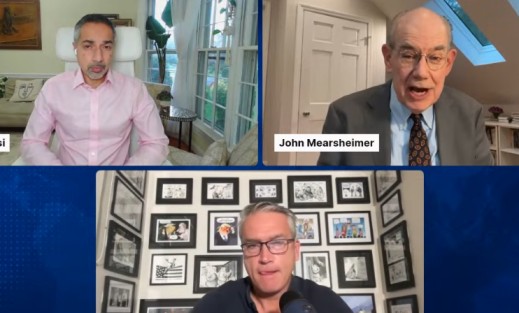
Will Trump and Israel strike Iran again after the US midterm elections? In this episode of Switzerland, Tom Switzer is joined by John Mearsheimer of the University of Chicago and Trita Parsi of the Quincy Institute to discuss the risk of a third round of the Iran war, Tehran’s hardball strategy in the Doha negotiations, the damage Iran has inflicted on US bases, the Houthi-Saudi war, and the future of American support for Israel. Read the full transcript of this conversation which was streamed live on November 1, 2026 below:
Will the US Renew the Iran War After the Midterms?
TOM SWITZER: (00:00:00 – 00:00:05) Switzer, and our guests today, first, Trita Parsi from the Quincy Institute. Hi there, Trita.
TRITA PARSI: (00:00:05 – 00:00:06) Good to see you.
TOM SWITZER: (00:00:07 – 00:00:10) And John Mearsheimer from the University of Chicago. Hi there, John.
JOHN MEARSHEIMER: (00:00:10 – 00:00:12) Hello, Tom, and hello, Trita.
TOM SWITZER: (00:00:13 – 00:00:43) Well, there’s lots of speculation that the US will conduct a short, intense renewal of the Iran war after the US midterm elections this week. That’s on November 3rd. John, why would Trump do so, given that the overwhelmingly unpopular war— and it’s been that way since before February 28th. Why would he do so when the unpopular war helps explain why the Republicans and Donald Trump himself are so unpopular?
JOHN MEARSHEIMER: (00:00:44 – 00:01:44) Well, it’s not clear that he will actually attack Iran even after the elections. Lots of people have said that we have no military option here. And a 3-day bombing campaign is not going to accomplish what a 40-day bombing campaign did not accomplish at the beginning of this conflict.
And if you listen to a number of the people around him, Scott Bessent, for example, they’re not interested in going to war. Bessent wants to rely on economic strangulation and the blockade as the best way to defeat Iran. Because Bessent surely understands there is no military option here. So it’s not clear he’ll go, but if he does go, it will not have a happy ending, as the Iranians have made clear to him, and as I would say most analysts in the West now understand.
TOM SWITZER: (00:01:45 – 00:02:14) Well, just say these wave of strikes do take place. As many media outlets are publishing stories in the course of the last week. That’s what they’re suggesting. But if, say, for argument’s sake, this is true, Trita, could this latest wave of strikes be designed to just muscle what many people in Washington see as an increasingly weak regime in Tehran? Could these strikes muscle them to the negotiating table and make more concessions?
TRITA PARSI: (00:02:15 – 00:04:40) Well, Tom, they’re at the negotiating table. They’re actually at the table right now. They were at the table in September, when they were at the UN. I don’t think Trump is necessarily looking for concessions as much as he’s looking for capitulation, and I don’t see capitulation in the cards at all.
And as John correctly pointed out, there’s really no good reason to believe that the next round will produce things dramatically different from what the first round and the second round failed to produce. And when you take a look at the second round, it’s really astonishing to me. What on earth was that? There was no new strategy, no new target system, no new thinking, nothing. But nevertheless, the US went back at something that had already proven to be a failure.
So I fear that if there is a third round, there’s a likelihood that Trump will do exactly what he has said he would do and what the Israelis have been very explicit, which is to go after infrastructure, critical infrastructure, energy infrastructure, and hope that that one way or another will bring the government to its knees.
I very much doubt it because the messaging from the Iranian side has been really quite remarkable in the sense that they’re making very clear both publicly and in private messages that they’ve sent to the US and to European capitals. They’re saying things such as “there are no such things as red lines any longer,” meaning that in this type of scenario, they will not respect any type of red lines. They’re saying that there is no geographic limitations to the war any longer. And they’ve made it very clear that they will strike at Europe as well if Europe ends up providing logistical support for the United States.
So I think both sides have now really gone to the brink of the abyss, making the most aggressive threats that we’ve seen so far. And right now, they are still talking to each other indirectly in Doha to see if there is a possibility to walk it back, because reality is it will be an absolute lose-lose-lose situation if the United States and Trump goes forward with this 3rd round in that manner.
The only potential winner, at least in their own minds, I don’t think ultimately will be good for them either, but in their own minds, are the Israelis, and particularly the current prime minister, whose future, of course, is uncertain at this point.
Who Wins If the War Escalates?
TOM SWITZER: (00:04:41 – 00:04:41) John?
JOHN MEARSHEIMER: (00:04:42 – 00:06:08) Trita, I think if this plays itself out in terms of real escalation, you get a real war, I think the Iranians win. I think it will devastate what’s left of the American military infrastructure in the region, will inflict great damage on the Arab states that are allied with the United States. And this will work to Iran’s advantage.
And I would just add to that, that it’ll do significant damage, if not grave damage, to the international economy. You want to remember that the Iranians are talking about tearing up those 7 internet cables that run underneath the Persian Gulf.
The Iranians are playing hardball here. I think what’s happened, Trita, is the Iranians have figured out more and more as time goes by that they have much more leverage than they realized at the beginning of this war. And my view is that if a war actually breaks out and we have a serious set of exchanges between the two sides, the Iranians will end up on the winning side. Are they going to suffer a lot of damage? Yes, they are. But are they going to—
TRITA PARSI: (00:06:09 – 00:09:17) Pardon me, that’s the point, John. They absolutely have that confidence that at the end of the day, if it comes to this, they believe that they will fare better than the United States because of the tremendous damage they will do to the US, US bases, US ships this time around.
There’s a debate going on in Iran in which there are criticisms that the Iranians didn’t strike at the American warships in the Persian Gulf or outside of the Persian Gulf. They claim to have the technology. There’s a high likelihood that they do have the technology, and they probably could have sunk a couple of American warships. They didn’t go that far in the previous rounds, and there’s some elements inside of Iran that criticizes the government for not having done so.
So I do agree with you that there will be a tremendous amount of damage. I think it’s important to recognize the Iranians are not looking forward to this. They’re not opting for this because they recognize that they too will suffer tremendous, tremendous costs in such a war.
So, for instance, last weekend, the Israelis actually breached Iranian airspace and the Iranians chose not to respond. And incidentally, there were also 2 attacks in Tabriz against radar sites. They still didn’t respond. And the only explanation I can see, and based on conversations I’ve had, is that they viewed it as a trap, that this was something the Israelis were doing. They were hoping for the Iranians to respond and by that force Trump’s hand and make sure that there would be a third round. And even if the Iranians believe that they will do better than the US in it, it will still be tremendously costly for them.
And this is, I think, also a very important aspect from the Israeli standpoint, the way they’re looking at these things is that they’re not looking at strategic victories in the same way that the US is. Instead, they’re just looking at the tally of how much things have been damaged in Iran and how far Iran has been set back in years. The Israeli Defense Ministry on Israeli TV said that “we’re going to set them back to the Stone Age or at least 40 years in this next round.”
And I think this reflects a very important difference between the US and Israel, frankly, most countries and Israel. The Israelis look at the images of the massive destruction in Gaza, and in that they see victory. They see strategic achievement. The rest of the world just sees horror and meaningless destruction. Even Benny Gantz in his 2018 campaign video showed images of the destruction he had inflicted in Gaza. And this is supposed to be one of the more dovish people in the Israeli political spectrum.
Destruction and the manner that you set countries back years is the strategic objective. I’ve never seen any American official or military personnel look at or show images of destruction in Mosul and use the destruction or point to the destruction as a metric of American success. But the Israelis do this. And as a result, they will happily welcome any such confrontation, even if the Iranians inflict more damage on the US than the US inflicts on Iran, it will nevertheless set Iran back decades. And that’s a win for the Israelis.
TOM SWITZER: (00:09:18 – 00:09:18) John.
JOHN MEARSHEIMER: (00:09:19 – 00:11:08) Oh, I think that if you have a major conflict along the lines that we’re describing, it will do enormous damage to Israel as well as to the United States, as well as to Iran. The international economy is going to be badly damaged, and Israel is integrated into the international economy, as is the United States. Furthermore, the Iranians will go to great lengths to target oil infrastructure, maybe even nuclear infrastructure inside of Israel. They will punish Israel greatly. Israel will not get off scot-free if the Israelis and the Americans attack Iran.
The more general point that I would make, Trita, is that it’s important to understand that from Iran’s point of view They are up against the mortal enemy. They’re up against the United States and Israel, which are bent on destroying Iran. And the only way you deal with adversaries like the United States and Israel is that you play hardball. You have no choice. And if you have to go to the brink, you go to the brink.
But the idea that you can negotiate in Doha and you can convince the United States and the Israelis to give you a sweetheart deal or a deal that’s kind of okay, I just don’t think it works that way. If you don’t play hardball now, they’ll come back at you later. So I think the Iranians have a deep-seated interest in making the United States and Israel pay a significant price. If they can do that without a war, all for the better. But they have to make Israel and the United States pay a real price to get the kind of deal they need to make something happen like the Memorandum of Understanding of 17 June.
TOM SWITZER: (00:11:09) Trita, let’s talk about—
TRITA PARSI: (00:11:09 – 00:13:18) Yeah, so clearly they are playing hardball. What they’re recognizing though, John, is that the cost so far on the US, setting aside what Trump may or may not do right now, given the fact that Trump is too heavily invested in this and he doesn’t have the ability of recognizing when he really should stop, is that I find it very unlikely that any future American president will think about a war with Iran again and make empty, needless threats against Iran militarily, as we have seen almost every previous American president do. So, I think the Iranians see that already having been achieved, but you’re quite right, they’re going to play very hardball, and they clearly are right now in Doha as well.
With the Israelis, it’s very different, and you and I had that conversation on another podcast after the June War, in which, again, the Iranians did inflict a lot of pain on the Israelis. And many thought that as a result, the Israelis wouldn’t go at Iran again. And my argument was, on the contrary, it’s precisely because the Iranians managed to inflict pain on the Israelis and the Israeli lack of tolerance for any country in the region being able to have a deterrence against Israel. It’s the precise reason for that, that the Israelis would go back to war with Iran because they want to live in a neighborhood in which no one will be able to have any type of deterrence against Israel. Israel’s ability to be secure is for everyone else to be insecure.
And as long as Trump is still in the White House, which, and has that level of control, which may only be till January depending on what happens on Tuesday, I think the Israelis will continue to push for that war. And particularly if the prime minister’s name is Netanyahu, he certainly will. Not to say that the others will be dramatically different, but he has a particular drive for this issue. So I think he will continue to push.
And again, the Israelis, you’re quite right, they suffer too, and they will certainly suffer. And they have had massive military censorships that doesn’t allow us to see what they actually suffered. But their calculation is if they don’t suffer now, they’ll suffer more down the road, much more if the Iranians are allowed to be a major power in the region.
Iran’s Demands and the June 17 Memorandum of Understanding
TOM SWITZER: (00:13:19) John,
JOHN MEARSHEIMER: (00:13:19 – 00:14:47) Trita, the Iranian— I mean, the Israelis can push all they want. Their situation does not improve over time. The Israelis are in deep trouble. Iran has an incredibly formidable array of ballistic missiles, cruise missiles, and drones, and that array is only going to get more potent with time. Furthermore, in terms of the nuclear issue, there’s no evidence you’re going to get a settlement on the nuclear issue anytime soon. And furthermore, the Iranians have very powerful incentives to acquire nuclear weapons of their own.
Second point I’d make to you is you’re saying that the Iranians, given what’s happened so far, are in a very good position because it means that any future president of the United States will not attack Iran down the road the way President Trump did on February 28th. That’s correct. But the Iranians have a bigger set of goals than just preventing the United States from attacking. They want the sanctions taken off. They want reparations. They want their frozen assets returned. They want American military forces out of the region.
You know what’s in the 17 June Memorandum of Understanding? Yeah, that’s their list of demands. And the question is, what do they have to do to realize almost all of those demands? And the answer is, they have to play hardball if they want to achieve those goals.
Divisions Inside the Trump Administration
TOM SWITZER: (00:14:48 – 00:15:39) Trita, let’s talk about the negotiations in Doha, because all this comes at a time when we hear that the Vice President, J.D. Vance, has written directly to a senior Iranian security official. I think he was the former commander of the Revolutionary Guards. And Vance is proposing these negotiations, comprehensive peace negotiations, which raises the question, to what extent is the administration in Washington divided over this issue?
I mean, John earlier mentioned the Treasury Secretary Scott Bessent preferring to keep in place the naval blockade designed to strangle the Iranian regime. You’ve obviously got Vance, who apparently was against the war from the outset. He was a supporter of the memorandum of understanding. To what extent does this show that Washington itself or the administration itself is divided on how to deal with Iran, increasing the strikes or peace negotiations? Trita?
TRITA PARSI: (00:15:40 – 00:17:12) I think it’s a very important question you’re asking, Tom, and far more important than the question that oftentimes is asked, which is how divided is Iran? And Iran has its divisions, but it’s been very clear on this issue. In this iteration of it, that the divisions are far deeper on the American side.
I don’t think Rubio ever was in favor of any of the negotiations. I don’t— it doesn’t fit with his long past as a neocon to want to have any kind of a deal with Iran. I think we saw very clearly how aggressively he acted against the MOU as soon as it was signed, both pressing the GCC to go along, adopt a position on the strait that was simply not workable. Simultaneously striking this trilateral agreement between Israel, the United States, and Lebanon that completely contradicted the MOU.
I think Bessent has always been far more favorable towards these kind of economic warfare, although we know very clearly economic warfare has a tendency to far more likely lead to military warfare than to anything else. And then of course you have Hegseth and others who have also been more on the hawkish side. Vance is one of the few inside that has really been willing to be a major champion for diplomacy.
I think what they’re seeing now, though, is that, again, this is not going to be a round 1 or a round 2. This is going to be something far, far more devastating than what we’ve seen before. And I think it has caused a lot of different people in the administration to have some pause. I think the fundamental problem, though, is with Trump himself. Trump is looking for something that still will turn this into a win. And I don’t think that simply is in the cards any longer.
TOM SWITZER: (00:17:13 – 00:17:25) Yeah, John, these deep divisions in the administration that we’re talking about here, what do you make of that? I mean, doesn’t that hurt any prospect of getting a revised memorandum of understanding, which presumably Vance wants?
JOHN MEARSHEIMER: (00:17:26 – 00:17:35) Yes, but this supports my point that I was making against Trita before, that this is why the Iranians have to play hardball. You can’t trust the Americans.
TOM SWITZER: (00:17:35 – 00:17:36) Yeah, yeah,
TRITA PARSI: (00:17:37 – 00:18:23) Yeah. Just on that point, John, I just want to make this very clear that the point is, it’s not that whether they should or shouldn’t play hardball. They clearly are playing hardball. The question though, I think, is do you want to play hardball because you want to go to a 3rd round because of the calculation that Iran will do better in that 3rd round of war, or do you want to play hardball because you want to get a deal that ensures that there is no 3rd round in the first place and that you secure all of your other interests?
My point is that even if the Iranians believe that they will do better in US in the third round. All evidence shows that they’re not looking for that type of a third round. They know very well that it will be devastating for them as well, and as a result, they’re playing hardball to win at the negotiating table right now rather than to win at the battlefield.
TOM SWITZER: (00:18:24 – 00:18:24) John,
JOHN MEARSHEIMER: (00:18:25 – 00:19:54) I think, Trita, the Iranians would prefer to get a new version of the June 17th memorandum of understanding without going to war. And I think that’s in effect what you’re saying. And I agree with that. Maybe they’ll get it. I think the administration is getting cold feet. And at the same time, I do think the administration is increasingly desperate. So the Iranians may win without a war. But my point is, if that doesn’t happen, then going to war is better than not going to war.
Because I think from Iran’s point of view, you have to understand that they are facing an existential threat. They are dealing with 2 states that have genocidal intentions towards them. President Trump has made this manifestly clear on more than one occasion, and all you have to do is look at what the Israelis are doing in Gaza, what they’re doing in southern Lebanon, to realize that you’re dealing with a genocidal state.
So from Iran’s point of view, you’re in the driver’s seat now. And you want to take full advantage of that. You want to make sure you get the best deal possible. You want to protect yourself over the long term. This is not in America’s interest. It’s not in Israel’s interest. But what we’re trying to do here is strategize from Iran’s point of view. And I think the Iranians ought to play hardball from their own point of view now and moving forward.
Why Tehran Doesn’t Trust Washington
TOM SWITZER: (00:19:56 – 00:20:42) We want to make it very clear here for our viewers because we often talk amongst each other assuming that everyone knows what we’re talking about when we’re talking about the issue of trust. I think this is a key issue, just to elaborate here, because you’re both arguing that Tehran has good reason not to trust anything Washington does.
And the history here is important. It’s not just the American withdrawal from the Iranian nuclear deal that was signed in 2015 and that was withdrawn in 2018. That’s one thing. But it was the US decision and the Israeli decision to attack Tehran during negotiations on 2 occasions. So that was February this year and June last year. Am I right in saying that, John?
JOHN MEARSHEIMER: (00:20:43 – 00:21:08) Definitely. There’s no question. The Iranians were negotiating in good faith. And the Israelis and the Americans launched 2 Pearl Harbor attacks or the equivalent of 2 Pearl Harbor attacks on the Iranians. Look, I am a realist. I do not believe that you place much emphasis on trust under any circumstances. I am with Ronald Reagan on this one.
TOM SWITZER: (00:21:08 – 00:21:10) “Trust but verify.”
JOHN MEARSHEIMER: (00:21:11 – 00:21:24) But in the case of the Iranians, putting trust aside, the rhetoric I would use is you want to assume worst case in every instance when you are dealing with these 2 adversaries.
TOM SWITZER: (00:21:24 – 00:21:39) Yeah, I just thought I’d make that clear because this often gets lost on people. I was at the pub the other day talking to people who follow the subject in very general terms, and they had no idea that the United States had actually attacked Iran during negotiations. And I just think that’s very important to recognize.
TRITA PARSI: (00:21:40 – 00:22:25) John, meanwhile, it’s a testament of how badly mainstream media is handling this issue, because in the conversation, the mainstream media it is deliberately overlooked over and over again. And you can have questions being asked, “But why should the United States trust Iran?” Which is not an unfair question in and of itself, but in a context in which the United States and Israel have twice attacked Iran in the midst of negotiations, the only deal that ever has been signed between the United States and Iran was one in which the US betrayed it and walked out of it, then that question then is just completely out of place. But the reverse of it is almost never asked, and that’s why ordinary people following this from the pub will never be fully informed of what the actual situation is.
TOM SWITZER: (00:22:26 – 00:22:27) I know, John, you’re shocked to hear that.
JOHN MEARSHEIMER: (00:22:28 – 00:23:16) Yeah, I mean, I often make the point that Iran, since it’s been created as a modern nation-state, has never initiated a war against another state. Israel, on the other hand, is one of the most aggressive states in recorded history. And with regard to the subject of genocide, last time I checked, there is zero evidence that Iran has ever committed a genocide. But we have watched the Israelis commit a genocide in Gaza.
Yet if you ask the average person on the street in the West who are the good guys and who are the bad guys, they would tell you the Israelis are the good guys and the Iranians are the bad guys. Why? Because as you said, Tom, this is the way our mainstream media deals with facts in this day and age.
Iran-Backed Militias, Terrorism and the Fight Against ISIS
TOM SWITZER: (00:23:17 – 00:23:38) Yeah, I mean, the media response or the conventional wisdom would respond by saying that the Iranian Shia militia have committed horrible abuses in, say, Iraq, when they were fighting the Sunni jihadists. That’s, and that the Iranian Shia militia are the major source of terrorism in the Middle East. That’s what they would say to you.
JOHN MEARSHEIMER: (00:23:39 – 00:23:41) I’ll let Trita deal with this.
TRITA PARSI: (00:23:42 – 00:24:09) Look, there are Iranian-supported militias in Iraq that have been involved in all kinds of atrocities. The idea that they would be the main source of terrorism is just factually wrong. When you take a look at the American victims, let’s just take a look at the American victims of terrorism. It is overwhelmingly, I mean, we’re talking about 99%, coming from jihadi groups that are falling into the Sunni bracket, of course.
TOM SWITZER: (00:24:10 – 00:24:11) Yeah, they’re not Iranian-backed.
TRITA PARSI: (00:24:11 – 00:25:01) Yeah, one way or another related to Al-Qaeda, groups that have been supported by American allies and funded by American allies such as Saudi Arabia. The Obama administration revealed that the seed money to Al-Qaeda came from Saudi Arabia.
And of course, we have seen massive intervention by the US government in any trials and court cases in which the family members of the 9/11 survivors have put forward to try to get to the bottom of what was Saudi Arabia’s role in all of this. And the executive branch is using its privilege to intervene in those cases on national security grounds. So we’re not even allowed to fully know what the full content of that support, lack of support, whatever the role was. If there’s nothing to hide, I would assume that it would be pretty easy for them to allow these members of the families of the victims of 9/11 able to get their justice in court.
TOM SWITZER: (00:25:02 – 00:25:36) Trita, just on this note, in 2014, 2015, at the height of the Obama administration’s war on the Islamic State, this policy to degrade and destroy the Sunni fundamentalists known as Islamic State, a school of thought says that the only way the Americans could really be effective in that coalition against ISIS was not through the air campaign, but because it was the Iranian-backed Shia militia that did the dirty work on the ground against the Sunni jihadists. Fair point?
TRITA PARSI: (00:25:37 – 00:26:41) It’s absolutely correct. I mean, look, the Iraqi defense minister himself said that once ISIS took Mosul and the fear in Baghdad was that within a day or two they would have rushed and taken Baghdad as well, and he believed that they would have succeeded. The first amount of aid came directly from the Iranians, no questions asked. They were sending munitions, weapons, etc. And according to the Iraqi defense minister, had it not been for the Iranian intervention, Baghdad would have fallen to ISIS as well. And if ISIS had taken Baghdad, the whole course of that conflict could have taken a completely different direction.
The American support came about 48 to 72 hours later. So, and with the imminence of that threat and need that existed. The American procedure, etc., was simply not suitable for that situation. So the help came in too late. Obviously, at the end of the day, the US was helpful in defeating ISIS, but at that critical moment in which ISIS could have won, it was thanks to the Iranians, according to the Iraqis themselves, that ISIS did not manage to take Baghdad.
TOM SWITZER: (00:26:41 – 00:26:43) That’s a— this is an interesting point.
TRITA PARSI: (00:26:44 – 00:26:46) Yeah, it’s all on the record. People can verify it themselves.
TOM SWITZER: (00:26:46 – 00:26:50) Yeah, John, isn’t that interesting? You rarely hear that analysis in the mainstream media.
JOHN MEARSHEIMER: (00:26:51 – 00:27:40) This is hardly surprising, Tom. The mainstream media gives us a completely distorted view of Middle East politics. It gives us a completely distorted view of the Ukraine war. It’s just the way things are in the West, and anybody who challenges these narratives gets lambasted for being “Putin’s puppet,” or for being anti-Israel or anti-Semitic or what have you. It’s really kind of crazy.
One of the principal reasons the United States is in so much trouble on the foreign policy front is because it’s impossible to have a rational legal debate inside the United States. And by the way, it’s impossible to have a rational legal debate inside Europe today about the Ukraine war. Anybody who disagrees with the conventional wisdom is sent to the gulag.
The Wall Street Journal Report on Iran’s Damage to US Bases
TOM SWITZER: (00:27:41 – 00:28:13) And if viewers are interested in a broader subject about this, tune into my discussion with the British journalist Mary Dejevsky. That was on Switzerland about 3, 4 weeks ago. Mary’s a veteran British journalist. She resigned because she just couldn’t get that argument into, of all places, The Guardian and The Independent.
Talking about the mainstream media, John, one major source is The Wall Street Journal. Let’s change the subject because they published a major piece on how Iran has battered and bruised US bases, caused millions, billions in damage. I take it you saw that piece?
JOHN MEARSHEIMER: (00:28:14 – 00:28:15) I saw it. I read it.
TOM SWITZER: (00:28:15 – 00:28:48) Yes, it was. Yeah, well, there you go. It was a really revealing investigative piece of journalism. They showed satellite imagery that showed that Iran inflicted billions of dollars in damage on American military installations of the Middle East, precise attacks on facilities housing American servicemen. Tell us more about this report. What did you make of that, John? I mean, what does it tell us about Iran’s remaining military capabilities, particularly its missiles and drone capabilities?
JOHN MEARSHEIMER: (00:28:49 – 00:32:55) Well, let me make a couple points, Tom. First of all, the basic story as to the fact that Iran greatly damaged and destroyed most of our bases in the Persian Gulf region was well known. But what the Wall Street Journal does is that it provides lots of pictures and videos, and it gives you a fine-grained analysis of what exactly happened. It has numbers and, as I said, pictures and videos. So it’s very helpful for fleshing out the story.
The second point is it makes it very clear that the Iranians have a formidable capability. You want to remember that, as that Wall Street Journal piece makes clear, the U.S. government has gone to considerable lengths to prevent American journalists and to prevent an American senator— this Chris Murphy from actually inspecting the damage because the military, the US military, didn’t want people to see how much damage had been done.
And by the way, with regard to the Saudis, if you watch them today, they’re going to great lengths to make sure that nobody really sees what the Houthis are doing in terms of destroying Saudi infrastructure. And the Israelis did the same thing going back to the 40-day war. It was almost impossible to get any pictures out of Israel as to what effect the Iranian ballistic missiles, drones, and cruise missiles were having when they hit Israeli targets. And the reason there with regard to Israel, and the reason with regard to Saudi Arabia, and with regard to those American military installations, is the fact that the Iranians were so effective.
Now, my third and final point, which I think is of great importance, is that what all this tells you is that the whole subject of American military bases in the Persian Gulf region, or the whole subject of U.S. power projection into the region, has obviously been changed in ways that we did not anticipate before this war started. Most people thought, me included, that the United States would not lose its ability to keep its bases in the region and project power in the region.
But if you look at what’s happened since February 28th, it’s quite clear that American military installations in the Persian Gulf region are highly vulnerable, and any troops or aircraft that are in those bases are liable to get destroyed. And this is why we moved many of the troops and many of the aircraft, many of the military assets, generally speaking, from the Persian Gulf to Jordan and then to Israel. But you know what happened once we moved them to Jordan? The Iranians came after our bases in Jordan. So Jordan is no less safe than those Persian Gulf bases were.
And this gets back to our earlier discussion about Israel. Iran has the capability to slam Israel. They’ve done it already. By the way, they did it last year in the 12-day war between June 13th and June 25th. They did it in the 40-day bombing campaign. And if this one starts up again, they’ll slam Israel again.
And my final point to you is moving forward a year from now, 5 years from now, 10 years from now, you can rest assured that the Iranians will have a much larger inventory of missiles and drones. And those missiles and drones will be more lethal than ever. And the Russians and the Chinese will be helping to provide them with the intelligence so that they can wreak havoc on American bases that remain in the region, and on the Israelis, and on their Arab neighbors.
Has Iran Undermined the American Security Architecture in the Gulf?
TOM SWITZER: (00:32:56 – 00:33:17) Which raises the question, Trita, if Iran can make the continued American military presence in the Gulf, increasingly expensive and dangerous, as John has just outlined. Does Tehran then have the capacity to fundamentally undermine the American security architecture in the region? What does all that mean?
TRITA PARSI: (00:33:18 – 00:33:21) Sure, let me just say one thing about the article that I think is important.
TOM SWITZER: (00:33:21 – 00:33:23) This is the Wall Street Journal last week.
TRITA PARSI: (00:33:23 – 00:35:49) Yeah, but the Wall Street Journal article Again, as John correctly pointed out, a lot of this was known, but this provides details, it provides context, it provides images. It’s not just what the Iranians can do, it’s how fast the learning curve for the Iranians have grown since last June, that every round of war they have learned faster than the US and Israel have.
And because we see that as the war progressed, despite the damage that Iran also took, not anywhere near the kind of exaggerated numbers that Pete Hegseth is throwing out there, but nevertheless, they took a lot of hits as well. Despite that, they became more and more effective in terms of precision, in terms of being able to better coordinate between, synchronize cyberattacks, with military attacks, etc.
And that, I think, is an important element of this because this is not just about a profound geopolitical miscalculation that Trump and Israel did by starting this idiotic war. It’s also that once the war started, how they conducted the war is also something that has been terribly incompetent. And we see that the Iranians have been much more effective than the US and Israel in learning from these attacks, learning from the war and becoming more efficient. And I think the Wall Street Journal, if you scratch the surface, you really see that the trend that they’re pointing to is exactly that, which again goes back to what will happen potentially in the third round.
Now, when it comes to security architecture, they’ve already destroyed it. There is no American security umbrella in the region any longer. The only reason people are still in the region kind of pretending that it’s there, they’re trying to say they’re going to go for things in tandem with American security support is because they don’t want to create too much anxiety on the American side, and they don’t want to expose themselves to additional vulnerabilities vis-à-vis Iran, vis-à-vis Israel, etc.
They’re in a terrible situation. They put all of their eggs in a security umbrella in the American basket. That basket has been blown up, and now they have to find some alternatives, and they’re going to partially pretend as if that basket still is working because that pretense they calculate will potentially help them a little bit along that security road, but in the long run, it clearly will not. They have some very, very tough decisions to make.
The Houthi-Saudi War
TOM SWITZER: (00:35:49 – 00:35:49) John,
JOHN MEARSHEIMER: (00:35:51 – 00:38:23) I think we’re missing a very important dimension of what’s going on in the Middle East that just adds to America’s woes, and that is the war between the Houthis and Saudi Arabia. You want to remember that before that war started, which the Saudis foolishly started, they asked President Trump for a green light. He not only gave them a green light to attack on June 13th— this is the Saudis attacking the Houthis— but he encouraged them to do so.
This war has been a disaster for Saudi Arabia. The Houthis are pounding Saudi Arabia infrastructure to virtually all their airports and oil and gas infrastructure. And this matters greatly to the United States because Saudi Arabia is an ally. You’re asking Trita about the security architecture. Part of that security architecture is protecting Saudi Arabia not just from Iran but from the Houthis as well.
And the fact is that Saudi Arabia is getting pounded by the Houthis and lives in mortal fear that President Trump after the midterms will start up a war with Iran, and Saudi Arabia will get pounded not simply by the Houthis, but by the Iranians as well. And at the same time, the United States can’t do anything to protect the Saudis, who the United States encouraged to get into a war with the Houthis with, and who the United States dragged them into a war with Iran with.
So this war is taking place and it matters greatly. And although it’s hard to get good information on exactly what specific infrastructure has been— oil and gas infrastructure has been shut down inside of Saudi Arabia, there’s all sorts of evidence that they’ve hit Yanbu, which is the important port on the Red Sea. They’ve shut down at different points, the East-West Pipeline, and they’re even going after Ras Tanura, which is this big refinery/port on the Persian Gulf that belongs, of course, to Saudi Arabia.
So you just do not want to lose sight of the fact that if this war against Iran is ramped up after the midterms, it’s taking place alongside a major war between the Houthis and Saudi Arabia that has all sorts of deleterious effects for the United States.
TOM SWITZER: (00:38:24 – 00:38:27) And just following on from the regional security architecture — sorry, Trita, go, Trita.
TRITA PARSI: (00:38:27 – 00:39:10) If I could just add to that, and there you can see it even more clearly, the Houthi capabilities just a year ago compared to today is vastly advanced, and the Saudis were completely unready for this. John is right about the lack of information, the censorship, whatever, is not allowing that information to come out. But people in the energy industry are quite clear on what actually is happening, which is that the Houthis are taking out Saudi Arabia’s excess capability. And as a result, profoundly undermining Saudi Arabia’s ability to be— it’s not necessarily been that for some months now, but its ability to set the oil prices.
Can Iran Reshape Its Relationship With Its Arab Neighbors?
TOM SWITZER: (00:39:11 – 00:39:58) John, there was a piece in The Washington Post a day or two ago that reported that Oman’s foreign minister has called for a regional security arrangement involving Iran and Iraq, and argued that the policy of antagonizing and excluding Tehran has come at a terrible cost, which is precisely what you and Trita have just been saying.
But the counterargument is that surely the strategic and ideological differences between Iran and not just Israel and America, but the Sunni Gulf states. Surely that’s simply too profound to allow Iran to over time reshape its relationship with its Arab neighbors. That’s what the counterargument would be, John.
JOHN MEARSHEIMER: (00:39:59 – 00:42:09) Well, I mean, there are a lot of different points to make here, Tom. First of all, as I said before, the Iranians do not have a rich history of going on the offensive and attacking other countries, and I think the surrounding Arab states can take some solace from that.
Secondly, you have to ask yourself what options the countries in the Gulf have moving forward. We just talked about the fact that the American security architecture has basically been wrecked. The Americans are not only not an ally, they actually get you into a whole heck of a lot of trouble. Do you really want to depend on these people. It’s not— it’s more than they can’t protect you. They get you into serious trouble. So if you’re the Saudis, can you really look to the Americans down the road?
I think almost all the Gulf states have a deep-seated interest in working out a modus vivendi with Iran. They have to accept the fact that Iran is a very powerful state It can do them great damage if they get into a fight with it, and they should do everything they can to work out good relations with Iran. And then they’re going to have to figure out other ways to make sure they can protect themselves if that rapprochement with Iran doesn’t work out.
This is why I’ve argued, if you’re the Saudis, aren’t you going to think about getting nuclear weapons? The Saudis have said, “If Iran gets nuclear weapons, we will not be far behind,” ladies and gentlemen. “We’re going to go out and get nuclear weapons ourselves.” And you can see the Saudis already moving in that direction. They want an enrichment capability, surprise of surprises.
But if you’re Saudi Arabia and you think about what is happening now and what the situation looks like moving forward, a rapprochement with Iran looks awful good, but at the same time, maybe a nuclear deterrent as well. But there is no really good solution for Saudi Arabia. They’re between a rock and a hard place because the Americans let them down.
Israel’s Election: Does the Problem Go Beyond Netanyahu?
TOM SWITZER: (00:42:11 – 00:42:50) Trita, let’s talk about Israel. There was an election, as you both know, about a week ago, and there will be a lot of horse trading during the course of the next few weeks as to who will actually form a coalition government. In the meantime, it’s more than likely that Benjamin Netanyahu will remain caretaker prime minister for several weeks, possibly months, regardless of the outcome of the election. And there may well be another one in a few months’ time.
Does anything really change in Israel with respect to its foreign policy settings? Because there has been a view that the— in the West, that the problem with Israel is Netanyahu, or does it go beyond Bibi? Trita?
TRITA PARSI: (00:42:51 – 00:44:36) I think it’s a very self-serving argument and narrative that is being put forward by supporters of Israel in the West, particularly in the United States, that want to put all the blame on Netanyahu. He’ll become the fall guy so they can go back to business as usual with Israel, as if the genocide, the apartheid system, all of these different things are only at the hands of Netanyahu. It’s, of course, completely false.
We’re not seeing any profound differences when it comes to strategic direction for the Israelis. Sure, there might be some differences here and there. There’s some differences in intensity, speed. Trump is an accelerant of a lot of different things the US was already in the making to do in the Middle East. And I think Netanyahu plays a similar role in Israel in terms of pushing things faster than what many others would do. But I don’t see that the current Israeli electorate would be electing someone to take the premiership that would have a profoundly different approach to Gaza or a profoundly different approach to Lebanon or profoundly different approach to Iran.
Where I think the difference is, is that Netanyahu is more astute and more capable than any of the other Israeli candidates in terms of influencing US policy, in terms of manipulating US policy. He has such familiarity with the American political system, spent so much time here, speaks English with an American accent, knows everyone, whereas Eisenkot, for instance, doesn’t even speak proper English, and he doesn’t have a relationship with Netanyahu. So the only difference that will come is because of these types of complications, rather than a strategically different approach by the Israelis. That’s my suspicion.
The US Midterms and the Future of American Support for Israel
TOM SWITZER: (00:44:37 – 00:45:09) John, we’ve got the midterm elections coming up in a few days’ time. And if you look at a lot of the Democrats. They’ve become increasingly more critical of Israel, and of course Democrats are likely to gain the House, possibly the Senate. Given that it’s conceivable that American support, financial support for Israel over time might become far more conditional, more qualified than it has been over the last few decades, doesn’t that hurt Israel’s foreign policy settings? John?
JOHN MEARSHEIMER: (00:45:10 – 00:47:42) It helps— excuse me, it hurts it enormously. It’s very important to understand that from the beginning, Israel has prided itself on being an independent state and not depending on any other state for its security. If you look at where Israel is today, it is overwhelmingly dependent on the United States for its security. Virtually all of these aircraft that it’s used to wage the genocide, to attack Iran and other countries in the region, are American aircraft.
If you look at the number of bombs and other kinds of weapons that we sent to Israel after October 7th, the numbers are staggering. The amount of money involved is staggering. As many people, including prominent Israelis, have pointed out, there’s no way they could have executed the genocide without American support. This, of course, is why we’re complicit in the genocide, right?
So you just want to understand that once you get underneath the hood, and you start poking around, and you look at Israel’s military assets, you see very clearly that it is super dependent on the United States. And I’m not exaggerating here. And this is why the lobby works overtime to maintain that relationship, because members of the lobby here in the United States understand full well that if you were to cut the cord between the United States and Israel, it would force Israel to fundamentally change its foreign policy. This cannot be emphasized enough.
So what’s happening inside the Democratic Party— and as you well know, Tom, it’s not only the Democratic Party, it’s the Republican Party as well. And by the way, it’s inside the Jewish community as well. When you look at Jewish attitudes, especially among younger Jews towards Israel today, from an Israeli point of view, it’s a frightening situation.
So the Israelis see what’s happening in the United States as an existential threat, as does the lobby. And that’s why they’re working overtime to do everything they can to get the discourse back to where it was before October 7th, and also to make sure that the policy links between the United States and Israel are not severed.
Trita Parsi Responds to the “Stooge of the Regime” Accusation
TOM SWITZER: (00:47:44 – 00:48:24) And one Senate seat to keep an eye on is in Michigan, where the Democrats are trying to hold their Senate seat. And a lot of the debate there has come around this very issue about Israel. To be continued.
Before we go, Trita, just last week, I chatted with Kylie Moore-Gilbert, the Australian academic who was detained in an Iranian prison. I think it was something like 804 days between 2018 and 2020. Now, she was my guest, and she called you when I mentioned you. I put your argument to her about something about Iran. She said you were “a stooge of the regime.” I think it’s only appropriate that you get a chance to respond, “a stooge of the Iranian regime.” Trita,
TRITA PARSI: (00:48:25 – 00:49:51) I think this is a preposterous accusation. Oftentimes, I don’t know her, so I don’t understand her motives, but they’re usually put forward by the pro-Israel crowd who wants to silence any voices in Washington, mine and many others who have tried to push for peace, push for diplomacy, and push against war. And they’ve seen anyone who can actually bring some understanding of how are the Iranians calculating their situation, how do they see their situation, as a threat to the black and white picture of Iran that they wanted, which is necessary if you want to push things towards war.
I did take a look at that. I’m not familiar with her, so I had to kind of read her Wikipedia page to better understand her, and I don’t claim to understand her necessarily. But I have to say, I was always surprised by one thing. I was surprised by the fact that someone who has been accused of being a spy and who have been paying the price for it, 100 or so years in a prison, as I understand it, falsely accused, to the best of my knowledge, no real evidence has been put forward against her that others can scrutinize.
I just found it surprising that someone that had experienced that would so easily just throw out similar accusations against someone else with no evidence whatsoever, no convincing evidence whatsoever. It’s just the evidence is the accusation itself. And I just, I was surprised and saddened by that.
TOM SWITZER: (00:49:51 – 00:50:02) Well, we should stress that the Free Press, they went after you a few months ago, and but that was quickly squashed by the federal authorities to detain you, correct? So that shows the system works.
TRITA PARSI: (00:50:03 – 00:50:36) I don’t know if the system works, but what it does is you weren’t detained. Yeah. So efforts by— I mean, those efforts to deplatform and silence me took an additional step in which some of them, again, Free Press, you can look up who’s behind that outlet, were actually trying to even get me arrested and expelled from the United States, which just shows the insanity of the lack of freedom of speech in the United States, particularly when it comes to issues that has some sort of an angle, a dimension of Israel in it.
TOM SWITZER: (00:50:37 – 00:50:40) Well, we at Switzerland like to hear from both sides of an argument. Always great to have you, Trita.
TRITA PARSI: (00:50:41 – 00:50:44) I think John—
TOM SWITZER: (00:50:44 – 00:50:46) Oh, sorry, John. Yeah, you make the concluding thoughts, John.
JOHN MEARSHEIMER: (00:50:47 – 00:51:03) Very quickly, Tom and Trita, I just wanted to say, as my mother, the late great Ruth Mearsheimer, used to say, “when people can’t beat you on facts and logic, they get down in the gutter and throw mud at you.” And that’s exactly what’s happening to Trita here. This is just nonsense.
TOM SWITZER: (00:51:05 – 00:51:08) Sticks and stones. John, Trita, great to see you both as always.
TRITA PARSI: (00:51:08 – 00:51:10) Good to see you. Thank you so much for having us.
JOHN MEARSHEIMER: (00:51:11 – 00:51:12) Yes, Tom. Thank you.
Related Posts
- View From India Podcast w/ Gautam Bambawale: India Walking A Fine Line (Transcript)
- Transcript: Marco Rubio Remarks at G20 Summit Press Briefing in Atlanta
- Einar Tangen: China’s New Economic Strategy vs the West’s Ideological Trap (Transcript)
- Seyed M. Marandi: Iran’s Supreme Leader Orders Military to Strike W/O Geographic Limits (Transcript)
- Trump Will Hit Iran After the Midterms w/ Ian Bremmer – One Decision (Transcript)