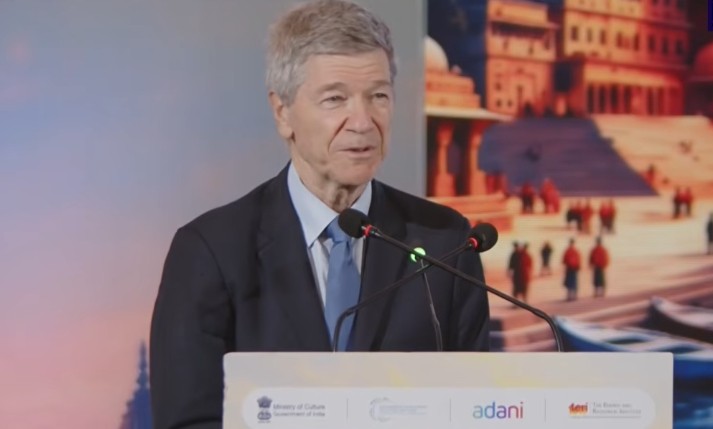
In this keynote at the Aristotle-Confucius Symposium in Varanasi, economist Jeffrey Sachs traces how Asia’s share of world production fell under European and American imperialism and why it is now returning to the center of the global economy. He talks about India-China ties, the rise of a multipolar world, family businesses and corporate responsibility, reviving the United Nations, and why the shared ethics of the world’s great traditions can help build a new world order of peace and cooperation. Read the full transcript of this lecture below:
Opening Remarks and Acknowledgments
JEFFREY SACHS: Good morning, friends. Doctor Adani, thank you for that brilliant address, but especially for all that you and your family and the foundation are doing for the world, which is very profound and very moving also to hear. And, Nirupam, thank you for the last thirty two years of collaboration and the continuing thirty two years of collaboration at least. I’m thrilled with all that we do together and most grateful. I want to thank the government of India, the Ministry of Culture.
I know the Secretary of Culture will be arriving shortly. His plane was diverted because of the fog this morning, but I think he’s landed and will arrive soon. I want to thank the partnership, of course, of the Adani Foundation and the Adani Group. And to pay my great respect to what the Adani Group is doing for sustainable development in India and globally because the scale of your work is remarkable as you just described, and it’s very, very inspiring. I’d like to thank TERI, which is a partner in organizing this symposium.
With TERI, we go back many decades of TERI’s leadership in sustainable development and in green energy and in climate safety. So it’s a tremendous joy to be working with TERI and joining together with TERI.
For me, it’s very moving to be here in Varanasi. Sonia and I first came here forty seven years ago. We fell in love with this magical place, which is one of the great, most holy places on the planet and one of the greatest centers of learning and knowledge and spirituality in the world, there’s probably not another place that combines such crucial world traditions as the place where we are.
So to be in Varanasi is absolutely extraordinary. We keep coming back, and we are inspired every time that we come together. And for me, it’s wonderful that so many of our colleagues and friends from this effort of ancient wisdom for modern challenges are together again here so that we can add, I think, significantly and profoundly to the depth of our work together and to help advance that work.
I’d like to spend a few minutes on the background of this symposium and why I think it’s so important. I have prepared remarks, which I will share with anyone that’s interested later, but I will not read them certainly right now.
The Shifting Share of World Production
I want to just share some basic thoughts with you. And I do need one slide, this one. So a lot of numbers, but the numbers… I’m an economist. I can’t help but look at some numbers.
But the numbers, I think, are absolutely key to understanding our world today. We are in a new territory in the world, not only because of AI or because of climate change or because of other technological disruptions that we face or being in the nuclear age, which is sad to say, perhaps the deepest reality of our world, which is the capacity to… Of humanity to end humanity in about seventy minutes as the current analyses show.
But we’re in a different world because history has moved in a very important and fundamental way, and that’s what these numbers help us to understand. So what you see here for several benchmark years starting in 1700 at the top row and then going to projections to 2100 to the end of the twenty first century in the bottom row, our estimates of the share of world production, this is a shorthand, but the share of the world product produced in different regions of the world.
And I’m showing you The United States, Europe, which in this case is the European Union plus Great Britain, China, and India. And I want you to see what has happened in history and what is happening today. Back in 1700, China and India each had about 20% of world production. Europe, about 24%. The United States didn’t exist yet.
It wouldn’t exist till the end of the example very to see be so of how that we’re world. The world economy. There’s obviously other places of not counted in this table to add up to a 100%.
As late as 1800, China was a third of world output more than Europe. India had already started to lose its share because India was already starting to be imperialized by Britain and by other European empires, which would be soon kicked out by Britain.
The Century of European Imperialism
But India was being held back by the British Empire. China, not yet. It had not faced yet British imperialism that was to come starting in 1839. The United States now existed, and it was 1% of world output.
By 1900, the world had changed fundamentally because the nineteenth century was the century in which Europe temporarily dominated the world, and that was the world of European empire, not centuries long a century of domination of the nineteenth century.
And in that nineteenth century, of course, India fell entirely under British rule. China entered into what China calls the “century of humiliation,” which began with the… One of the most sordid wars of history, the war by Britain on China to force China to open up to actually British grown, India grown opium. It’s hard to imagine a more disgusting war than this, although I think the current Iran war ranks high as well, a war out of nothing.
But the Opium Wars started a century of disaster for China because two Opium Wars were followed by a massive civil war in China after those disruptions, known to us as the Taiping Rebellion, but really one of the largest civil wars in history.
And to cap that off at the end of the nineteenth century, Japan invaded China and began forty years of invasions of China so that there was catastrophe in both India and China.
We know that this imperial century was a disaster for this region.
Millions of people died in repeated famines in India completely unrelieved by the British Empire who stuck with a stiff upper lip to their laissez faire policy as people were dying and continued to export grains from famine stricken regions of this country.
So by 1900, Europe’s share of the world output was almost 40%. China and India together, and, of course, India being part of the British empire at that point, were now less than 20%.
So a decline to a mere 18% of world output for two countries that held more than 40% of the world population. 1950 was the nadir of Asia because this was a hundred fifty years of European and then American imperialism with American overseas imperialism starting in the eighteen nineties, first overthrowing the Kingdom of Hawaii and then taking the colony of The Philippines in the so called Spanish-American War.
Look at the situation in 1950. 56% of world output was in The United States and Europe, more than half. Whereas in China and India now combined on the independence of India and the independence of the People’s Republic Of China under 10% combined for two countries which still constituted more than 40% of world output.
That world of 1950 and the world that was created between 1800 and 1950 came to be seen as the norm of the world, that the West leads the world, the West designs the global realities, Asia is a small footnote under Western guidance, and this ideology was the prevailing ideology of the nineteenth and twentieth centuries. It’s the ideology that I grew up in myself and that I was trained in.
When I… When Sonia and I came to India in 1979, I was enthralled. This was a completely new world, an impoverished world, and I carried in my backpack a famous book of the time called “Asian Drama” by Gunnar Myrdal, which explained to me why Asia was poor and will always be poor.
Asia Returns to Center Stage
This was the basic lesson of the “Asian Drama.” He won a Nobel Prize, certainly not for that. Most Nobel Prizes in economics are wrong anyway, but that one was another failed prediction.
Let’s look at what’s happened since then with sovereignty of India starting in 1947, with sovereignty of China starting in 1949, both of the world’s giants began an economic recovery. Not easy, not evenly paced, not with every success that one wants with lots of setbacks and advances, but a recovery nonetheless because the norm of history was that Asia was the center of the world economy.
And the fact that Asia had almost become a footnote to the world economy by the middle of the ninth… Of the twentieth century was not a norm that was going to remain, but was a perversity that resulted from a hundred fifty years of European and US imperialism. By the way, The US and European imperialism had a technological base. It was the industrial revolution. It was the discovery of the steam engine more than any other advance.
But such technologies would have readily diffused and not created these deep imbalances in the world had it not been for the application of power. Without European empire, Asia would have simply industrialized as well in the nineteenth and twentieth centuries without the great drama.
But it was imperialism that led to what I call the “age of divergence” rather than what we live in today, which is the “age of convergence.” Asia is returning to center stage. It’s not somehow miraculously developing.
It is returning to a norm, a norm that existed for millennia, actually, and that was broken temporarily during the past hundred fifty years. But by nine… By the year 2000, the share of world output in the West, so called, had declined to about 45%, and Asia share had doubled from 18% in 1950 to 37% in the year 2000.
As of today, Asia is now a larger part of the world economy than the West, a larger producer of the world economy than the West. India is now the third largest economy in the world, the China number one, The United States number two.
And if we aggregate the so called Western world with… By which I mean Canada, The United States, and Europe combined is now 31.8% of the world economy according to IMF data, and in Asia, 48% of the world economy. Asia has returned to the center of the world economy, and that trend will continue.
Why do I bring this up in a workshop on ancient wisdom for modern challenges? Mainly because we don’t yet know how to live in this world that has developed so recently in the last seventy five years.
A World Stuck in the Ideology of 1950
And I’ll speak for my own part of the world, The United States. The United States is stuck in an ideology of 1950, And it’s fitting we have a president who is stuck somewhere around age three in his development, and his world is a world in which The US is the boss. And Europe is also stuck in that world. Europe is stuck in a world in which the West is the boss. Yes.
Maybe not the old empires, although I say of Britain that it has “phantom empire syndrome,” which I analogized to phantom limb syndrome. Someone who loses a limb, feels that limb for a long time, Britain still thinks it’s an empire every day. They think The United States does its bidding for it, but that the British Empire still exists. I’m sorry to say it, but this is the mentality that still prevails.
This is why we have the wars that we have because the idea is The United States is still trying to maintain its supposed hegemony, whether it is in Europe vis a vis Russia, an ancient enmity that goes back to the British Empire in the nineteenth century, and you can think about the war in Ukraine as really being the second Crimean War, the first one in the mid eighteen fifties, this one being absolutely on the same premises as the war that Palmerston and Napoleon the third fought between 1853 and 1856, and that is that the West should dominate the Black Sea region rather than Russia.
So this is a part of this mindset. The wars in The Middle East are wars of hegemony. The war in Iran is a contest. The United States says, “We run Iran, not the Iranians.” It’s as simple as that.
And if you have any doubt that it’s as simple as that, just look at Truth Social posts every day because the president of The United States announces that, that he will select the new leader, that we will decide the regime.
By the way, Iran is an ancient civilization, well known to this region as well. It is a great civilization. It is 10 times older than The United States, 2,500 years old since the Achaemenid Empire, and it is one of the greatest civilizations in history and gave much to India, gave much to Christianity, gave fundamental ideas to Judaism and to every other of the great religions. And we are at war because The United States thinks that it runs that country, which is quite odd.
The World in 2050 and 2100
Look at what will happen in 2050 and 2100 based on sensible economic extrapolations, meaning that if you use a standard kind of economic model that I have been using myself for the last forty years that has proven to me to be quite adequate to understand global trends, and that is a continued convergence in the world economy.
By 2050, The United States and Europe, rather than being more than half the world, will now be about 20% of the world. Asia will be 50% of the world, so more than twice the so called West. And I want to note that Africa will become a far more significant part of the world economy in the course of the twenty first century. And that is because Africa, with its independence, will catch up.
Africa was left in a far more dismal state of affairs after centuries of enslavement and a century and a half of European imperialism and the continent being divided into 55 separate countries rather than left as one giant of India or one giant of China. But Africa is now figuring this out as well. Get together, create a union, create a continental economy, educate young people, and progress will come.
By 2100, look at the world. Three quarters of the world is likely to be in Asia and Africa. Africa itself will be about 30% of the world population and somewhere around that share of the world economy. Asia will be a little bit less than half because populations will peak. In China, they will significantly decline.
By the end of the century, India will have twice the population of China, most likely, which is quite astounding, and India will be the single largest economy in the world. I think that this is absolutely in the deep trends.
Building a Multipolar and Multilateral World
Well, for me, all of this means we better understand each other a lot more than we do right now. We need most fundamentally to understand that we have entered a multipolar world, and that means a world in which civilizational ideas, histories, identities need to be understood across the oceans. No one region, no one country will dominate. China will not be the new hegemon. And I say to friends in India, you have no fear…
Should have no fear of China. And I say to my friends in China all the time, Encourage and promote India as the sixth member of the UN Security Council and understand that China and India working together makes the multipolar world, not the competition between the two.
Don’t join things like the Quad and other things which are Western attempts to prolong their declining power, but rather work together as the two Asian giants to promote a truly multipolar, peaceful, and multilateral world. I strongly believe that this is the right way forward.
Now I also believe that not… India will not be the world hegemon. China will not be the world hegemon. The United States certainly is no longer the world hegemon, though it can’t get it out of its head that it is. Europe is shrinking.
It will be under 4% of the world population, the EU-27, by 2100 on current trends. They’re nervous. They should think more clearly. Being nervous does not mean arm up or go to war with Russia or do something completely suicidal as they are thinking about doing. It means understanding how we can build a truly multipolar and multilateral world.
I distinguish multipolarity, which is just a fact of many areas of power, which we have, and multilateral, which is a world of shared laws and norms and peaceful behavior and cooperation.
Ancient Wisdom and Shared Ethics
Well, I am convinced that ancient wisdom is a crucial path to building the kind of world that we want. If we looked at ancient wisdom, at the traditions that we will be discussing in the next hours today and then tomorrow, and found that the ancient wisdom conflicted fundamentally, well, then we’d be in trouble. Then we would be heading inevitably towards a clash of civilizations.
But when I, as a student of you, because, of course, I’m not even qualified as an amateur philosopher, but I am an avid devotee of philosophy. What I read in my understanding from you and from the ancient texts is a shared understanding about the challenges of living a decent life, the challenges of peace, and the challenges of cooperation.
What I am convinced of, it’s my hypothesis, it’s not to put it in your terms at all, and I have to say philosophically, I am a lumper, not a splitter. So I like to see the commonalities far more than I like to see the differences. And I believe that the differences are… This…
Are superficial compared to the deeper commonalities. What I like to see and to propose is that the underlying ethics of the traditions that we will be discussing of Hinduism, Buddhism, Jainism, and that we have been discussing of Aristotelian philosophy, of Confucianism, of Christianity, of Islam, of Judaism, the deeper commonalities of these faiths regarding ethics, how to live, how a society should be organized for peace and well-being, what are the measures of justice, That here, we find very, very deep commonalities that exist across the world’s traditions.
What is not the same across these traditions is what can be called the metaphysics. The descriptions of how the universe came, how it’s ruled by one personal god, by many gods, by no god. The metaphysics are rather different across the traditions.
But the implications that have been drawn by the sages, by the scriptures across all of these grand traditions is to live in harmony, to live in peace, to live in mutual respect, to live with reciprocity, to honor the golden rule, which is a fundamental tenet across virtually all of the great faiths to do to others what you would want them to do to you and to not do to others what you would have them not do to you. Whether it’s Jesus or Confucius or the other sages, they came to the same point.
One of the crucial points of commonality that I believe is that all of the great traditions are what in the jargon today can be called virtue ethics. And that is that it’s not that ethics is a set of laws or rules. It’s not Kantian imperatives.
It is to become better human beings. Virtue ethics is ethics based on building one’s own understanding of the world, building one’s own character, building one’s own humility, building one’s own responsibility, building one’s own respect for others. Virtue ethics is an ethics of cultivation of the best in human nature. Every ancient tradition teaches that human beings are complicated. They are…
Have tendencies towards temptations, towards hubris, towards violence, towards hatred, and that the solution is cultivation of the better side of humanity, whether it’s cultivation through mindfulness, cultivation through what Aristotle called the habit or habit formation, what all of the religions teach as mentorship, whether it is a guru or a mentor or an education. It is the cultivation of the best of us.
The Role of Education
I believe as an educator for the last forty six years that education plays a critical role, which is why I believe that our universities and our schools have an absolutely essential role to play. And that when young people demand better education, they’re absolutely right. This is their future, and we should respond by saying, yes.
We need to make sure that education meets your needs, but education also of your humanity, not education for coding or how to ask Claude the right question, but also education so that we understand each other, relate to each other, appreciate each other, honor each other, respect each other, and treat each other in peace.
Well, this is why this symposium is here. We have been profoundly fortunate to have previous meetings in Aristotle’s birthplace in Stagira, in the place of his university, the Lyceum in Athens, in Qufu, in Shandong province where we were hosted at Confucius’ birthplace. And now we are so lucky to be here at this remarkable center of wisdom of Hinduism, Jainism, and Buddhism. And being here, I’m sure, will profoundly enrich our deliberations.
And our deliberations, I am confident, can help the world to find a path to peace. Thank you very much, ladies and gentlemen.
Audience Questions
UNIDENTIFIED SPEAKER: Thank you so much, professor Jeffrey D. Sachs, for giving us the address over here. Ladies and gentlemen, I shall now open this floor for any questions that you may have to ask to our esteemed guests seated over here.
Do we have any questions from the audience? Okay, I do see a hand going up over there. Can you please have the mic passed over?
Family Businesses and Corporate Responsibility
JEFFREY SACHS: Let me make an observation that I have felt very strongly for many, many years, and it grows on me. The Adani Group is a…
An enormous business, and it’s one of the great progenitors of change and advance in India. So when we look at India’s very rapid economic growth, the fastest growing large economy in the world, It is fueled in significant part by the advance of infrastructure, and the Group is playing a huge role in that.
But I want to come to the name of the Adani Group. Okay? Consider a big infrastructure company in The United States, SpaceX or Amazon or Meta or Google.
There isn’t a family name in that. These are not businesses that represent family’s values, what we heard from doctor Adani. These are not businesses that carry the name and the responsibility of a family that feels a question, what do we give to society?
These are American corporates. They behave, in my view, for one purpose, and that is to maximize shareholder value, period, and any way they can by owning the government, by twisting regulations, by cutting corners, by promoting destructive technologies.
In fact, we have the oddity right now in The United States that a company has told us “our product might destroy humanity” and will have an IPO to promote it rather than “our product might destroy humanity. So why don’t we give it a think about what should be done to make sure it doesn’t destroy humanity?”
America is so twisted in its confusion right now that literally the CEO says 10 to 20% chance we do in humanity, and we’ll have the biggest IPO in history. Thank you. And the president of The United States who depends on exactly these people for their campaign finance says, “I don’t see any problem.”
So the point I am making is we heard doctor Adani talk about how the family feels about what it’s doing. And I can say that I hear the same from families in other places where there are third or fourth generation family businesses. In Italy, we were just with a leading pharmaceutical company in its third generation. We were with one of the great coffee companies in their third generation, Italy company. A family business is different.
Now I think all businesses should have that sense that we are not here for some financial bottom line no matter where it comes from, no matter what risks it imposes, no matter what costs it imposes to others, but we are a moral entity. That is going to be recaptured by deeper wisdom, and we lost it in The United States.
Britain was an empire by corporation. The East India Company did not carry a family name. The East India Company carried an army.
It was rapacious. It was as greedy and corrupt as imaginable and as violent as imaginable, so much so that it was an embarrassment to the British Crown by 1857. And so the British Crown took over the East India Company and closed it down because it had been nothing but headaches in its rapacity. This, I think, is for the business sector big issue. You know it well.
We talked yesterday. You had a partner and a corporate leader in Unilever, Paul Polman, a dear friend of ours, who tried to make a publicly traded company a socially responsible company, and he meant it. But he faced huge backlash from shareholders, from investors, from analysts. “What are you doing, Mr. Polman? You’re supposed to be a CEO.
You’re not supposed to be a do gooder.” Well, this is what can get us all ruined. That’s one dimension I would say to this issue. And that’s why I really praise families that understand this carries not only their name, their heritage, but their responsibility, and it’s extremely important.
Reviving the United Nations
At a political level, let me just add very quickly, We need multilateralism to work because the kinds of challenges we face, whether it is AI, whether it is extraordinarily biotechnology, which is as dangerous as AI because we can make pathogens that can wipe out humanity, and it’s not so hard to do anymore.
You just ask Claude what to do. It’s not so hard. Not to mention the nuclear age, not to mention global climate change, we have things we need to do together, and that requires institutions that work. And I’ve spent my last twenty six years devoting my time to the United Nations trying to help make that institution work. Many people write it off.
“It’s useless. What does it do? It can’t do anything. It’s a talk shop.” Well, there’s a lot of truth to that, but we will not survive without the United Nations.
And so we had better not just resign to its original architect, The United States, turning against it, but rather to say how do we make it work. One of the ways I want to make it work is I would like India and China and Brazil and Russia and others to host major UN campuses in their countries rather than leaving this to headquarters in New York or a few cities in Europe.
That’s the old world way. The new world way is that the UN is a truly global institution with a major Delhi campus, with a major campus in Beijing, with a major campus in Brasilia because this is the real world that we’re in, the world of 1945 or 1950. So thinking about how international institutions can work is crucial.
And there, I’ll just stop by saying the UN got into the business in 1948 of what were in ancient wisdom for modern challenges. And a committee was chaired by a most wonderful American leader, Eleanor Roosevelt, who, of course, was the wife of our greatest ever president in The United States, Franklin Roosevelt.
And Eleanor Roosevelt led the multicultural, truly global commission to create the Universal Declaration of Human Rights. And the whole world agreed on a basic ethical framework for the first time in human history. There was actually…
There is a document. It’s out of date. It doesn’t answer a lot of the questions we face today, but they did it in 1948, and that was extremely important. My favorite lesson of that experience is a famous quotation of a Catholic philosopher named Jacques Maritain who was part of this process. And the quotation was the…
He was asked, how did the world agree on this? He said, “We could agree on what to do, but just don’t ask why.” And what he meant by that is that everybody had their own metaphysics. Maybe some read the gospels. Maybe some read the Old Testament.
Maybe some read the Vedas. Maybe some read Confucius. But they all came to the same principles about what human decency is. And so by not asking why, he meant let the metaphysics be different, but the ethics can be shared worldwide.
And I think that that’s what we’re after also and that we’re also after a rejuvenation of the United Nations as being absolutely central to creating a world that doesn’t destroy itself.
AUDIENCE QUESTION: I’ve got a question, one if I may. Good afternoon, everybody. Good afternoon, chair. Good afternoon everybody here. Thank you very much.
Those are very seditious words coming in from the dais here as well as
UNIDENTIFIED SPEAKER: My apologies sir. My apologies for actually coming in between to interrupt you. But we’re running short of time in this session. In fact, we’re going overboard, and we have a dignitary over here to also welcome amongst us. So I’ll just request you to kindly We’ll just pause that question for take it up in the next session.
Welcoming Shri Vivek Agarwal
Once we start the sessions, I’ll allow you definitely to take that question. And first of all, thank you to professor Sachs for having addressed that question with such profound insight. Thank you for doing that. Thank you.
And ladies and gentlemen, it’s time now for me to also welcome amongst us one of our esteemed dignitaries that we’ve been waiting for for quite some time, and I’m indeed glad that he could make his presence finally felt over here for the opening session today.
Ladies and gentlemen, please put your hands together as I invite amongst us Sri Vivek Agarwal, Secretary to the Government of India in the Ministry of Culture and the Vice President of the Financial Action Task Force. Now before I invite him over here, a little bit about him for each one of us.
Mr. Vivek Agarwal is a distinguished officer of the Indian Administrative Service from the 1994 batch belonging to the Madhya Pradesh cadre. Over a career spanning more than three decades, he has held a wide range of leadership position across the government of India and state government combining extensive administrative experience with expertise and financial integrity, public policy, digital transformation and international cooperation.
Now ladies and gentlemen, as secretary, ministry of culture, Mr. Agarwal is leading cultural diplomacy, heritage preservation, digital transformation and creative economic initiatives with focus on public private partnership.
One of his contributions was that he played an active role in developing Gyan Bharatam Mission to survey, conserve and digitize over 10 million manuscripts by creating a national, digitally repository of Indian knowledge systems.
One of his most important contributions was steering India through its FATF mutual evaluation during twenty twenty three-twenty twenty four. This involved coordinating an extensive whole of government effort, introducing important legal, regulatory and procedural reforms and demonstrating the effectiveness of India’s AML/CFT framework.
Mr. Agarwal has consistently advocated a whole of society approach in which governments, regulators, financial institutions, technology companies and other stakeholders work together to address evolving financial crime risk.
His experience in building partnerships across institutions and jurisdictions is especially relevant as the international community responds to cyber enabled fraud, rapidly changing payment systems and risks associated with virtual assets.
Now ladies and gentlemen, please put your hands together as I invite Shri Vivek Agarwal to give us the partner’s address. I present you, Shri Vivek.
Related Posts