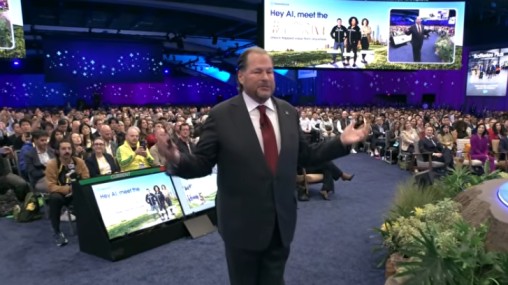
EDITOR’S NOTE: Salesforce CEO and Chair Marc Benioff opened Dreamforce 2026 in San Francisco by unveiling AI Force, a new agentic interface built with Anthropic’s Claude, alongside Agent Force, Data 360, and a suite of new products designed to bring “trapped value” out of enterprise systems. The keynote featured appearances from Anthropic CEO Dario Amodei, NVIDIA CEO Jensen Huang, Siemens CEO Roland Busch, Adecco Group CEO Denis Machuel, and senior Salesforce executives including Patrick Stokes, Rohan Kumar, and Miguel Milano. Below is the full transcript of the keynote.
TRANSCRIPT:
Opening: The Agentic Enterprise
VIDEO CLIP BEGINS:
UNIDENTIFIED SPEAKER: Everybody wants to know who’s going to win AI. Which model? Which company? Which one is the smartest? But maybe that’s the wrong question.
Because the future isn’t about choosing one intelligence, it’s about having access to the best intelligence in the world and choosing the right one for whatever you are trying to do. The AI you want for the job you need done. Now there’s just one problem. See, these models may know just about everything there is to know about the world, but they don’t know about your world, your customers, your business, your pipeline, your inventory, your service history, your contacts, your permissions, your processes. But you know what does?
Salesforce. A true partner that knows your business. Because before you can act, you have to understand. Right? I mean, really understand your context.
When your data is connected, now you have a foundation and a 360 degree view of the customer. This is where decisions become action. Sales, service, marketing, commerce, every function, every industry, executing with precision inside the applications that you already trust. Now you create a system of agency. Agent Force.
This is where your intelligence is multiplied. Agents that reason with the full weight of the business behind them. Built with governance, deployed with control, observed, improved, trusted. It’s even more than 27 years Salesforce has been helping you understand something better than anyone else, your customers, your data, your relationships, your conversations, your transactions, your workflows, your business rules, the truth of how your company actually works. So what happens when you take the world’s frontier AI models and connect them to all of that?
Any surface, any interface now becomes your coworker. Say hello to AI Force, the world’s leading AI models connected to the world’s number one AI CRM. And once you see it, there’s no going back. You see, for decades, we’ve had to go to software, open the app, find the screen, navigate the menu, go looking for what we need. AI Force flips that around.
It’s not the end of software. It’s the end of software that makes humans do all the work. See, the interface itself now becomes dynamic, intelligent, open, composable, and it’s right where you already work. You don’t have to go find the enterprise. The enterprise comes to you. Ask about your pipeline.
And suddenly, you don’t get 12 links in the dashboard to go figure it out. You get the answer. Build the account plan, fix the service issue, launch the campaign, change the offer, move the inventory, create the workflow, close the deal, and blaze a whole new trail. So maybe the future of AI isn’t about which model wins. It’s about how you win.
The AI you want. The trust you need. Welcome to the Agentic Enterprise. And now, our CEO and Chair, Mr. Marc Benioff.
VIDEO CLIP ENDS:
Marc Benioff Takes the Stage
MARC BENIOFF: Good morning, everybody. Is this microphone on? Good morning, everybody. Aloha. We are so thrilled to have everybody here.
What a great, great group this is. Wow. Can you look around this room? It’s amazing what’s happening here. Totally incredible.
We are going to have an amazing day. We’re going to have an amazing conference. We’ve been on the road exhaustively for the last two months. I’ve been in Europe myself for the last two months. You’re going to hear some stories about that.
Then we got back here to United States. We did some incredible focus groups with all of you getting ready for this amazing Dreamforce keynote. And let me just tell you this, we have never been more excited about a Dreamforce in our history. This is going to be absolutely incredible. You’re going to see some truly amazing technology.
You’re going to meet some incredible people, and we hope to open a door for all of you. Now for the last two months, I’ve been in Europe. It’s been amazing. I’ve met with hundreds of you. You’ve inspired me.
You’ve energized me. You’ve really shown me what the future was, and it’s been an incredible experience. But I’ll tell you something amazing that occurred to me while I was in Europe. I had this awesome meeting with one of our top customers in Lausanne, Switzerland. And it was like an exhaustingly long meeting.
It was like three hours. And we were getting down to the end of the meeting and I was like, I really want to show you what we’re going to do at Dreamforce. It’s going to be amazing. And so finally, I had our CEO of Switzerland with us. He’s here today.
I said, alright, let’s show them this amazing new technology, and we showed them the beginning of something we’re going to show you today called AI Force. And they started using this platform. We’ve been using this kind of build and run our company now for several months. It’s been transformational for us. In this case, we were using the version built on Claude, we call Cowork.
And this Claude Force product, we’re about to show it to you for the first time. The customer at the end of it said, this is really something, like I see several things. One, we had built a full new interface across their entire enterprise. It did a complete AI transformation in real time with the customer.
But number two was this. The customer said, “Wow. What I see happening right now is that you are really unleashing for me trapped value in my system that I knew was there, locked in the metadata, locked in my systems.” And for the first time, they saw that trapped value coming into real value for their company. That’s when we realized we could say, hey, AI, meet this number one CRM Salesforce and unlock this trapped value from anywhere.
Now, I want to just tell you, we are here to do many things with you. And one of the things you’re going to see is that when we get into this incredible platform for our trailblazers, do we have any trailblazers in the audience today? We’ve got a couple of them here. For our trailblazers, this is the most empowering piece of technology we’ve seen. It really is becomes a partner for you.
It becomes a partner in helping you to execute the next generation of your enterprise. And these demonstrations that you’re going to see are unlike anything we have ever demonstrated at Dreamforce before. Now, as you know, we are here to excite you. We are here to motivate you. We are here to inspire you.
But mostly, we are here to do what? Thank you. Thanks to each and every one of you for what you do for us every single day. We are so grateful to you for what you do for us. We know that you have a choice in vendors, and we know that you have a choice in where you have to put your time and to come here to this show and spend time with us.
Twenty Years of Trailblazers
It’s very meaningful to us. So thanks for being a great customer. Thank you for coming to San Francisco, and thank you for coming to this incredible Dreamforce. Now, twenty years of these trailblazers. It’s been twenty years of these trailblazers, 23 million trailblazers all over the world, 90 countries, 700 community groups.
I saw Steve Moe got an amazing blue blazer. Where are you? Got your golden blazer. Stand up, Steve. Here’s Steve.
Great job. How long have you been a trailblazer now? I celebrated my Salesforce birthday, the day that my first user ID was created in August 2003. Steve, we could not be more proud of you and how you have lit up the whole community, and you just guide us everywhere all over the world.
Thank you for being such a great partner with Salesforce. Great job, Steve. Incredible. And Steve represents each of those 23 million trailblazers all over the world. It’s going to be an amazing show with all these trailblazers.
And as I said, I think the technology that you’re going to see is going to really take all you guys to another level. But listen. This is the biggest and most important Dreamforce ever. And we’ve got all the greatest players here.
We’ve got all the most incredible people from all over the world. You know that Dario is going to be in the keynote in a little bit. We’ve got Jensen is going to be here. We’ve got Sam speaking here later. Tony Robbins.
We have all of our friends here. Isn’t that amazing? And one more thing, we have 1,600 sessions for you. One really critical point about these sessions, we expect you to go to each and every one of them. We put a lot of work into them.
1,600. Let’s do that. Okay. Tomorrow night, how was Gwen Stefani? Was that awesome?
Well, we also have Usher coming as well. That’s going to be awesome. And here’s one more thing. We’re going to be giving another incredible $10 million to the UCSF children’s hospitals tomorrow night.
Salesforce’s Giving Back and Growth
You’ve now raised a total of $130 million through that concert every year for this hospital. Amazing what you are doing. You already know we so strongly believe that business is the greatest platform for change. You can see what we’ve done, about a billion dollars of grants since we started the company, eleven million hours of volunteerism, 65,000 nonprofits and NGOs run on our service for free. And this is where I get to say this.
If you are with a nonprofit or NGO and you are here at the conference, will you stand up and be recognized, please? Amazing. And this is the opportunity for our commercial customers to realize that nonprofits and NGOs do not have as many resources as our commercial customers. Please support them and help them. And not only are we giving back at this scale, but one more thing, we are also deeply committed to San Francisco.
Now with $156 million given for our public schools, $130 million to our hospitals, we have done 1.7 million hours of volunteerism here in San Francisco and Oakland, and we support 4,000 local NGOs. We’ve even given $13 million to our local police force to keep all of you safe. But we believe so strongly through this kind of $300 million in all-time giving that we have to give back to the communities that have given so much to us. One more thing, we’re also deeply committed to America as well. We now run 15 of the 15 cabinet agencies.
50 out of 50 states also now run on Salesforce, all built on our core values. Our core values of trust, the trust we have with all those trailblazers. Their success is our highest priority. The innovation you’ll see here at the show that we’ve been delivering day in and day out for twenty seven years, the equality of every trailblazer, we so strongly believe in that, and the sustainability of our world creating a net zero company. And that is why we have been recognized now as one of the most ethical companies in the world by Ethisphere 17 times, probably one of the most meaningful recognitions that we have received.
Thank you so much. And it has delivered the largest and most trusted enterprise software company in the world. An incredible slide as we slide into these very high ranks of these amazing companies. I guess you could say, some people said, well, is sales slowing? And I said, well, actually, I don’t know if you noticed, we spent thirty three years in the 30 billions in revenue.
We spent just two years now in the 40 billions in revenue. And next year we’re entering into the 50 billions in revenue. Looks pretty good to me actually, the chart, not bad. Not a horrible chart. Thank you.
And twenty seven years of amazing innovation inspired by all of you, our trailblazers. Incredible what you have been doing for us. And that in that innovation, it’s organic, it’s inorganic. And let me also say this, it’s also these incredible companies in San Francisco that we’ve kind of become part of our Ohana, and we want to welcome starting today, Finn, now part of AgentForce, the highest performing customer agent in the world, amazing company. Anybody here from Finn?
Stand up if you were Finn. Would you be recognized? Oh, we have our Finn team right over here. Congratulations and welcome to Dreamforce. Great to see Owen.
Fantastic. Okay. Look, it’s been ten years of pioneering AI here in the enterprise. You have all been going through this with us. It’s been an amazing journey.
There’s no question about it. And then we’ve been hearing all this kind of crazy nonsense about the SaaS apocalypse especially over the last six months. Hasn’t it been wild? But I think that we realize that SaaS apocalypse was not about the end of software but it may be about the end of software that makes humans do all the work. And I think you’re going to see that especially at the show.
It’s been incredible to watch the success of Salesforce this year. The growth, the capability of our customers. In our second quarter, we just delivered $46.4 billion in revenue guidance, delivered another billion dollars in free cash flow, 14% CRPO growth. It was awesome.
Our lowest customer attrition ever, our longest customer contracts ever. And it’s all driven by the deep commitment that we have at Salesforce to do this, to help you connect with your customers in a whole new way. How do we do that? And now, as you start to begin to see the technology that we’re about to reveal, there’s this fundamental question. And the question is this, how are we unlocking this trapped value across every single app?
Introducing AI Force
Now at Salesforce, we are starting to do this. It’s been amazing. We already have 7,000 users on Cowork Force. So while you’re at the show, take our Salesforce employees aside and say, show me how you’re running Salesforce. You’ll see the Slack bots that we have running and the coworkers that we have running in Lightning and that we generated $500 million last quarter in pipeline.
Incredible with our new Hunter and Piper agents. But we resolved 5 million service conversations with Casey on help.salesforce.com. We’re being the change that we want to see with you. We believe that every company can become an agentic enterprise, and we’re going to show you the best way to do it by doing it ourselves. It’s been awesome for us.
And as I’ve gone around the world, I see it in all of you. I see it in your eyes, your inspirations, your ideas. I see these companies changing and transforming in ways I could have never imagined. AI has opened a door that’s never been opened before. How many of you in San Francisco, while you’ve been here, have already jumped into a Waymo?
Anybody here jump in a Waymo? Not too many. Well, you might want to try it. It’s kind of an amazing experience. It’s an autonomous vehicle driven by AI.
And one of the things about it is it’s kind of a metaphor in many ways. I told you about my trip to Europe. Well, when I was in Europe for two months, I didn’t see a single autonomous vehicle. That was kind of a metaphor to me. Well, we might be living at it here, or if you go to Shanghai, maybe it’s AI on steroids right now.
But when I went to Europe, I didn’t see that same kind of transformation. That same AI global, I would say, unbalanced capability, where some countries have more AI than others. This is a very real thing, but it’s also true in our customers too. When I go to visit all of you and I just spent my time with hundreds of you, probably what I love doing more than anything else, what I saw was a lot of unevenness when it comes to AI. So that idea is that when we start to look at what AI can do, yes, the door is opening, but not everyone has gone through it yet.
In many cases, some of our customers are kind of stuck. They’re kind of stuck in the old world. Maybe they’re even using ChatGPT or Claude Cowork during the day at home, but when they get to their businesses and they get to their enterprises, they still don’t see that enterprise transformation. Do you know what I’m saying? And I think we have to do more to help you accelerate that transformation.
But one of the key parts about that is this, models alone cannot run the enterprise. Models alone are not going to show us what’s possible. Models also are very probabilistic. You know what that means? They’re probabilistic.
Like, they kind of know what’s going on, but they’re not grounded in a single set of truth like your traditional Salesforce apps. I have a friend back home and they’ve built this amazing app on Claude Cowork. And every time he shows me the app, he goes, well, this is this amazing app, but this number, I know it’s wrong every time. I know it’s not exactly the right number. I said, that’s because it’s not grounded in your single source of truth.
It’s not grounded in your core dataset. And then how can you do that? The idea really is how can you bring that probabilistic world, the AI world, and the deterministic world together? The deterministic world is where all that corporate data is, where the single source of truth is. That is the question that has been on our mind and that is the bridge that we want to cross.
Because when we look at enterprise intelligence, yes, we love these probabilistic AI systems. But how do we deliver the governance and the security and the workflows and the apps and the rules and the context to all of them? How do you bring all the power of the corporate system into the AI? And then one more thing, how do you then layer in these four critical layers? One, how do you deliver the data?
Because we all know you’ve got to get your data right to get your AI right. Two, how do you take the power of the apps which have all the intelligence of the business and all of the capability and the metadata and the semantics that’s deep in the analytics layers, the semantic layer. How do we unleash a digital workforce with agents like we’ve been talking about here for the last several years? And how can we build a radically different interface on all of those things? These four layers, data, apps and semantics, agents, interface, that is what we want to transform right now.
And to make that happen, to really bring enterprise intelligence to run on our core system, we have to unify the probabilistic intelligence with that deterministic intelligence. And the interface and agents remain probabilistic. And that is great as long as they are grounded inside the deterministic data, the source of truth of data, the data layer, and the semantics as well, where you have spent so much time educating those applications on who your businesses are and how they run. So at this show, what we will do and what we’re going to do over the next thirty minutes is show you those four layers in an incredible new way. Data 360, a layer that helps you to integrate, to federate, and harmonize all of your data.
And that means connect everything in your enterprise together to smooth it out. Okay? And then to let it drive the AI. And two, to unleash through a new headless version of our applications, the fundamental application and semantic intelligence to drive that intelligence. And then, let the agents and let the interface do what it’s going to do.
The Vision Behind AI Force
When we get to the interface layer, I promise you this. You will see an interface unlike anything you have ever seen before. It will transform your enterprise. And that is what is exciting.
Now people have been saying, as I’ve said that to them, how is that possible? How is it possible that so much could change so quickly at the interface layer? Well, for those of you who know how Salesforce operates, we operate through a metadata platform. When you’re working in Lightning and you’re running Lightning applications and we are building on Salesforce, you’re writing in metadata. You’re writing in the objects and the interfaces and the rules.
You’re writing in the fields and the relationships. You’re writing in the permissions and the business logic and security and analytics. You’re writing into the metadata and then it gets decomposed into the database. It gets pushed down into our database. It’s not fixed.
I loved it when we announced headless and everybody thought we somehow had cut the head off of our apps. There was never any head on the apps. It was always in the metadata layer. It’s just it’s hard to explain that to folks who are not Salesforce folks. So it’s down in the metadata layer and then it’s been recomposed into Safari or Chrome.
It’s been recomposed into the browsers or into iOS. And now it’s going to get recomposed into these AI interfaces. It gets recomposed into Cowork. It gets recomposed into Slack. It gets recomposed into Lightning.
So that is what becomes really dramatic. It’s an interface revolution. We’ve seen a lot of interface revolutions. We went from DOS to GUIs, and we went from GUIs to web, and we went from web to mobile. And today, you’re going to see, and I bet a lot of you have not yet seen this, you’re going to see AI interfaces that are dynamic and intelligent, that are composable and alive, and that can work with you in the fundamental administration of the applications, can work with you in building the applications, and work with you in operating the applications because the interface itself is live.
Some people say the interface is living. It’s really interesting. I’m going to let you determine what you think about that interface. Now, to make all this happen, the first thing we had to do is write a layer that would empower all that. We knew we wanted the dynamism.
We knew we wanted the intelligence. We knew that we wanted to deep go down into that metadata and pull it up. We knew that it had to be secure and governed. And one more thing, we knew that it had to have zero data retention. Now three years ago we were here, we talked about zero data retention.
That means this, when you’re working in Salesforce apps and when you’re working on our platforms, your data is your data. It does not go in the models. We’ve audited it. We’ve tested it. We’ve tried it.
Regardless of what you’ve heard on media or from other vendors, let me assure you that Salesforce products are built with zero data retention, tested over and over again by our security teams. Your data is your data. You’re not training any other model when you’re using our products. This is extremely important having ZDR built in. And then when you put it all together, when you put all those things together, you get AI Force.
You get those capabilities and you get this live interface that unlocks the trapped value. And then we’re going to deliver for you AI Force in many forms. If you’re a coworker user, you’re going to get Claude Force. If you are a Slack user, you’re going to get Slack Force. If you’re a Lightning user, you’re going to get the new coworker.
And there will be many others too. And we will also deliver an SDK so you can build your own AI Force applications as well. This is really the most exciting thing I have ever seen for Salesforce because we have been talking about the data layer for a long time. We have been talking about the applications and semantic layer for a long time. And we have been talking about now the agentic layer for three years.
And now for the first time, we’re talking about this, a live interface on Salesforce. Unlocking this trapped value. Finding the patterns across all your data. Getting answers in seconds, not days. And now, anyone can get that value from Salesforce.
That is the power of AI Force. And while you might not have seen this from other vendors yet, I assure you, you’re about to see something that I’m sure will get repeated over and over again throughout our whole industry. Just like the trailblazers have said in this conference now for almost three decades, I’m confident you will see this pattern repeat everywhere else. We saw Steve Moe. We saw how incredible our trailblazers are.
They are going to be even more incredible with AI Force. They are going to be even more powerful to administer, develop and operate these systems across all of these layers. It is really awesome. And you’re going to see the demo and pay attention. It’s going to be really incredible.
Now, we’ve talked about the vision of lighting up the data, making sure your data is ready for you. And two, making sure all of our apps, which were always built this way, always built with metadata first so that this moment would be a moment they could take advantage of, are also ready for you. And three, the agentic layer as well so that it can really deliver that value. Now I know many of you are already starting to use these incredible agents. How many of you have been on salesforce.com or informatica.com or already using Piper, by the way, this qualification agent?
Quite a few hands. It is amazing. You’re talking to Piper. We’re going to demo it in a second. It’s helping to qualify your prospects and your customers.
Hunter went out and generated $500 million of pipeline for me last quarter. It was kind of amazing what Hunter did. Casey answered 5 million customer service issues for me so far since I launched about eighteen months ago. And Page is doing our ITSM work and HR capabilities. And Marshall is doing this incredible work as well in the supply chain.
And now we have Finn, which is the number one customer service agent. We’re even using that on help.salesforce.com already. It’s incredible what Finn is. And we got that running, I think, in about twelve days at Salesforce. It’s an incredible capability that you can go super fast with.
That idea that you have those three layers, data, apps and semantics, and agents, and then add the interface on top. Adding the interface on top means that everything is going to change. So one of the things I noticed when I was with all the customers for the last two months, and it was pretty incredible being there with everybody. But the applications kind of looked mostly the same that they’ve looked like for the last few years. And I would say to the CEOs and CIOs and CDOs of these companies, do you feel like you’ve gone through an enterprise transformation? Well, we’ve got this pilot going or we tried this or we did that.
I think when you put this interface on, everyone will see that their systems have now changed. Incredible. Okay. So let’s take a look at Claude Force. This is Salesforce and Claude.
It’s the number one AI meets the number one CRM. It is that live interface built around you. If you are a coworker user, you are going to love this platform. We use it at Salesforce. We use it aggressively.
We turned it over to our operating unit leaders several months ago. They have been running their businesses. When we were doing the focus group for this room, I was sitting next to Miguel Milano, our new chief operating officer. Miguel, are you in the room? Where?
Stand up. Here’s Miguel Milano, our new COO. Congratulations, Miguel. I was sitting next to Miguel and he was using Claude Force to run Salesforce. It was incredible.
And he was also using Slack at the same time. It was hard to believe. Now for those of you who use Slack, how many Slack users do we have here? Raise your hands. Oh, quite a few.
Oh, I’m surprised. Well, Slack is where AI works. It’s pretty awesome. We bought this company six years ago. We have invested a ton in this company, transformed it.
It’s done amazing. It’s become our very fastest growing product. So many AI companies here in the valley, like within a mile or two of this building, all run on Slack. It’s awesome. But one of the things though about Slack now that you have is Slack Force.
So that same user interface that is running from AI Force and Claude Force is also now running in Slack, and you’re going to see that at the show. And for those of you who are coders or who are using coding agents in your businesses, did you know now you can code inside Slack? Coding has traditionally been a single player sport, but now it becomes a multiplayer sport, and you can write, review, and ship code together with agents. And all of Salesforce is available inside Slack with Slack CRM.
So you can use Slack to run Salesforce. And many of our customers are already using Slackbot millions every single week where they’re reading across their DMs, they’re reading across their channels, they’re reading across the whole dataset, and letting Slackbot provide the AI for the enterprise. That is why Slack has become Salesforce’s fastest growing product. Okay. And there’s one more piece of this.
For those of you who are in Lightning, anybody here use Lightning by any chance? Okay. We have a few Lightning users out there. Now, AgentForce coworker is running inside Lightning as well. So now, you can have that same live interface in Lightning.
So if you use Cowork, you’ve got it. If you have Slack, you’ve got it. If you’ve got Lightning, you’ve got it. And I bet by the time we get back here a year from now, we’ll have dozens of live interfaces running on Salesforce. We’ve transformed our architecture.
Look at this. You can see that core data layer with Informatica and MuleSoft. You can see it with Tableau and how it’s working to deliver that core system. And then you can see the application layer. And all the different applications are now headless and providing that API and that capability.
And the agentic layer as well, and all the agents that you need to run your business or build your own agents with AgentForce also. All of these incredible pieces helping to create and empower those trailblazers that are so important to us. We want to make sure the trailblazers are successful. They’ve built 12.8 million custom enterprise apps. They’ve done countless Apex calls and API calls.
They’ve built these incredible systems. It’s been awesome what the trailblazers have done and this is going to elevate them to an incredible new place. And we’re delivering new versions of Salesforce including our new AI Force Max edition, which bundles all of this together so you can have one core product that you can acquire that delivers all of this functionality to you. One product, AI Force Max with all of our functionality built together so there is no concern. Do you not have everything you need to be totally successful right now.
Claude Force: Salesforce Meets Claude
So please welcome to give this incredible demonstration, our new president of applications and marketing, Patrick Stokes.
PATRICK STOKES: Alright. Thank you, Mark. Good morning, Dreamforce. It’s awesome to be back with all of you. I love doing this every year. I hope I get to keep doing it. We’ll see here in a moment. So listen, six months ago, we held an event.
It was actually right across the street to launch Slackbot. And at that event, our co-founder, Parker Harris, you all know Parker, he’s sitting right over here. There he is. He looked right into the camera and he said something a little weird. You want to know what he said?
I’ve got the clip. Let’s actually just watch the clip.
VIDEO CLIP BEGINS:
PARKER HARRIS: We are basically saying, why should I ever log into Salesforce? I built the Lightning UI. I worked really hard on it.
Why should you ever log into Salesforce again? Maybe you never will.
VIDEO CLIP ENDS:
PATRICK STOKES: Crazy thing to hear, right? Crazy. If you’re any other software company that would be a terrifying thing to say.
Because other software companies, they think their product is the UI. But that’s not what we think at Salesforce. At Salesforce, our product is the trust that all of you, our customers, put in us to hold your data. To hold your workflows, your business processes, your permissions, your security rules. That is the Salesforce product.
And we asked ourselves, what would it look like if we could plug that product into a new interface? To an entirely new interface, an agentic interface. And that’s exactly what we set out to do with our friends from Anthropic. Now here I am inside of Claude Cowork. And I am about to show you my interface.
Everything you are about to see is something that I asked Claude to do for me. And before I show it to you, I’m going to give you one last warning, which is, despite what Parker just said, you are going to see just a tiny little bit of Lightning in here. Just bear with me. Okay? Here we go.
DIGITAL PARKER: Hello Patrick. Here are your deal signals for today. This just in. The quarter sits $8.2 million short of your $285 million target with three weeks left to run.
Northstar needs your attention. $4.8 million, ten days past close, and a blocked security review. Those are your signals, pal. Your command center has the answers. Trailblazers, welcome to Dreamforce.
Digital Parker, out.
PATRICK STOKES: Alright. You Parker. Appreciate the insights. So look, this is my Salesforce.
Like I said, everything that you see here is something that I specifically asked for and Claude helped me bring it together. I can see, if I expand this, I can see my pipeline coming in from around the world, everywhere I’ve got a new opportunity opening up. I can see all of my service data coming in, all where my cases are landing around the world. So I can see where my hotspots are. I can even see all of my marketing data.
People interacting with all of my different websites, interacting with Piper on my website, signing up for new campaigns, interacting with campaigns, all in this live interface. But this is more than just an interface to look at data. Remember, we’re combining this with AI. In this case, Parker, who’s got a lot of insights, right? And Parker reminded me right when we started there that I have a problem with North Star communities.
And he said, you should probably take a peek at that. Now I know North Star happens to be based in San Francisco. So I can click into San Francisco here to drill into the pipeline that I have. I’ve got two accounts that have opportunities. I am going to click into my North Star account here.
And there it is. There is that security review that is blocked. And it is actually kind of bad. We have got $4.8 million in open pipeline that is not going to close unless we get this thing moving. Now, I wanted a way to let my team know that this is unacceptable.
And I did that in the most Patrick way that I could think of, which is I asked Claude to code in a sad trombone. And that actually sends a real activity over to Salesforce. So that logs in this account record, so my team knows that I’m frustrated. If I wasn’t frustrated, I could do something that I’ve always wanted to do, which is blow an air horn on the Salesforce stage. I can do this as many times as I want.
Nobody can stop me. Okay. But, to get real for a second, what do I actually want to do? What I want to do is I want to send a Slack message over to my team. I need to get them rocking and rolling on this opportunity.
So we’re going to click into this Slack interface, and I said, hey, give me a way to have Claude generate, but let me be able to rewrite the message if I want to, so I can do that right here. We can say, hey Dreamforce, it helps if you spell it right, although it actually does not really matter. It is hard typing on stage. There we go. And then all I have to do is post this over to Slack.
And if I get over there fast enough, there it was. You saw it just pop up. 1046. There is our message right over to Slack, getting our team rocking and rolling. Okay.
Now, I bet you are probably wondering how this all actually works. And let me tell you. So, it all starts right over here. If we go into, excuse me, plugins, you’ll see we’ve got this brand new plugin Salesforce for Claude. Now this plugin solves all of the hard problems.
Who’s heard of MCP servers here? Who knows what MCP servers are and how to use them? A lot of hands are going to go down. Right. They’re hard.
This is a new technology. Who knows how to enable zero data retention. Right. Not many people. Who’s written skills for Claude?
Probably a few more of you. Right. This is hard stuff. And we sat down with our friends at Anthropic and said, what if we could put all of that together into one package, one plugin that if you have Claude Enterprise, can just go in, turn it on and pick the users that you want to give access to. So that is exactly what we did.
But what about that UI? How did I create that UI? Some PM didn’t create that for me somewhere. That is a UI that I personally created for myself by just asking. And I’ll show you that conversation right here.
Here is the complete conversation. You can see where I started. You get up and running on these interfaces, I am not kidding, in like six to eight minutes. And then you have a few days worth of back and forth as you iterate, and you add all of the silly features, like I did with sad trombones, and that awesome 3D Parker that you saw. All of that.
Look at that. Literally create an avatar of Parker Harris in his Lightning suit. And I had to give it some things. But that is how we do it. Now, the last question I want to answer for you is how on earth do you get this thing.
Right? Well, we can show you. Now Mark mentioned the pricing and packaging earlier. But this is Dreamforce, baby. We don’t want you to worry about pricing and packaging.
What we want you to do is go get your hands on this thing. So for the time being, everything that you just saw is in open beta. Any one of you can go. You jump over to the AppExchange. I’ll show it to you right here, right again inside of Claude.
Look for this plugin within the Exchange. Fill out the form. Give us your org ID and we will turn you on today. If you are not here with us at Dreamforce, of course we’ve got Trailhead. I blew right through the applause but that’s okay.
You’ll do it afterwards. And if you are here with us at Dreamforce, I beg you, get over to Moscone West. It’s across the street. We have AI learning labs. You will get in there.
There is an ocean of laptops with Claude Force set up. You can learn how to build your own command center and walk out of here with your org turned on. So that is AI Force. Alright. Thank you.
A Conversation with Dario Amodei
So now we have something incredibly special and to do that, I’m going to reintroduce Mr. Mark Benioff. Mark.
MARC BENIOFF: Alright. Great job. How about a hand for Patrick? Who’s excited about that interface? That is just the beginning of the interface that you’re going to see. I think AI Force remains the most exciting thing we have ever done at Salesforce and to see this first version of it running on Cowork and Claude, which is amazing. I don’t know if you saw the cover of Time Magazine today, but Cowork is also on the cover of Time Magazine. And here we have the CEO of Anthropic right here, Dario.
Hello, Dario. How are you? Great to have you. Fantastic.
Great job, Dario. You’re doing an amazing job leading the AI industry, guiding it all right from our Slack headquarters building. We watch you every day. We’re watching it from you. It’s all good karma, isn’t it?
And we’re watching you do an incredible job. You become the number one AI in the world, three times larger than the nearest provider. It’s been amazing to be partnered with you. It’s all been very karmic and kismet and good. And one of the things I have to ask you before we get into the interview, I want to talk to you about AI Force.
I want to talk to you about Claude Force. I want to talk to you about how you’re running your own business. But wow, you wrote, everything from your first essay that you wrote, about loving grace, to the essay this weekend on pacing has been incredible. But give us your state of the AI industry and pacing and where your mind is right now.
DARIO AMODEI: I think it’s maybe easiest to explain it by an analogy. So let’s say you’re running a car company, and another car company, not yours, they have some kind of safety incident. Right? Something goes wrong with the brakes, something with the manufacturing. Now you believe you have the best safety record in the industry.
What do you do? How do you approach it? Obviously, it’s very tempting to attack your competitor and say these guys are unsafe. But I think the more responsible way to respond to it is to say, hey. First of all, let’s look at our own record.
We may not have had this big high profile incident, but I’m sure we’re not perfect. Let’s look at everything and we can always be better. Let’s make our practices better. Let’s recommit to transparency. Let’s invest more in safety.
Then let’s organize the rest of the industry and say, what can we do to set standards for everyone? What can we do to make everyone’s standards better? And then finally, there should be an international component to it. And that’s essentially the three step plan that I laid out in the essay, the first of which we committed to and the others of which we’re going to have a dialogue with the rest of the industry about. And I think that’s the way to lead the industry forward, to set an example, to say that everyone can always be better.
MARC BENIOFF: Let me ask you a question, Dario. It’s been amazing what you have been able to accomplish, like I said, but there are a lot of surprises also that you have gone through. So, just tell us what has been your biggest surprise over the last decade? And, you’ve obviously been heads down in AI now for ten years really in earnest. What’s your biggest shock about where we are right now?
DARIO AMODEI: It’s been the pace of the progress, not just of the technology, but of the economic side of it. We formulated the scaling laws along with some of my co-founders, which tell you that AI models get smarter and smarter the more compute you throw into them. And so we had a prediction of just how capable these models would be. But I think what we didn’t appreciate is that it would lead to these companies growing so fast, to all these incredible products that we’re working together on and you’ve been talking about today, and how quickly they would become central to everything that’s going on in the world. Right?
I just watched the talks before that where you guys talked about MCP and Cowork and Claude skills, and these are all new things that people are just beginning to use, but they’re being adopted so quickly because the economic value is so great. So I’ve just been surprised that such a pace is possible in the business world.
MARC BENIOFF: Well, I’ll tell you at Salesforce, we are huge Cowork fans, and also when I was in Europe, I met with so many customers who are Cowork fans. It’s incredible what you’ve done with the product. I’m noticing over your shoulder here, you’ve got a few Salesforce alumni behind you who are helping you to run your company, which they’re doing well, Mark. Train them well.
DARIO AMODEI: Trying to do my best to help the whole industry. I measure myself by how many CEOs, COOs, and CROs are in other companies that all came from Salesforce.
MARC BENIOFF: You do a fantastic job of that. No. Truly, you do. Thank you. But what I want to say is this.
I want to say, yes. We’re have to keep our eye on the pace of AI. It’s been amazing what’s happened over ten years. No one could have written the story. Now these interfaces are truly amazing.
The demo we just saw is remarkable. I think every customer here wants to have that same interface on all of their systems. Everybody wants to unlock the trapped value. What is your kind of recommendation for everyone in this room and the virtual room? Obviously, you can see we have 10,000 people all over this room, but 10 million joining us online.
What actions do you want us to take?
DARIO AMODEI: I would just say when I look at the technology versus how much it has diffused, even if we freeze the technology in place, which we’re not doing, facing the frontier is not doing that at all. The technology will keep getting better. But just suppose we freeze it in place.
Even if that were the case, we’re making use of maybe only 5 or 10% of what the possible value of the technology is. So I’ll give you just an example that relates to what we’re doing together and to the CCO you just pointed at, which is that Paul, every day now he wakes up and if he wants to look at our head go-to-market prospects, he still uses Salesforce, but he uses Salesforce with Claude. He talks to Claude using Salesforce’s data about what are the 10 biggest deals we’re doing this week? What are the 10 deals we’re most likely to lose? What are the themes in those deals?
How do we win those deals? Just making use of all the information fluently with Claude. And it’s really incredible. And the fraction of people who have seen this and seen that this is possible is still small compared to those who could gain utility from it. And so there is still so much diffusion left to do.
MARC BENIOFF: Well, we are really excited to wake everybody up at the show, to show people what the possibilities are for the future, how we’re going to show them that data layer, which as you know, I think is really critical, having that grounding of the data. We’ve talked about that so many times. The application and semantic layer giving it the AI even more intelligence capability, the agentic layer that you’ve really helped pioneer, and now this incredible interface layer. We’re so excited that the first one is on Cowork. Congratulations.
Well done. We’re going to do incredible. Great job, Dario. You’re doing a great job. Thanks for everything you’re doing for the whole industry.
We’re so grateful to you.
DARIO AMODEI: Thank you for having me. Really thrilled. Thank you so much.
Agent Force and the Digital Workforce
MARC BENIOFF: Alright. And thank you for coming to Dreamforce. Please thank the Anthropic team. And now, please welcome back from that brief intermission, Patrick Stokes. Give him a hand.
PATRICK STOKES: Alright. Me again just for a minute. Okay. So I think you can see how special this is and what I really want is for you all to go out and feel it. Dario was right. When you start using Salesforce with an agentic interface the amount of value that you get from Salesforce just explodes.
It’s an incredible experience. Okay. So we’ve talked about AI Force. It’s time to talk for a few minutes about Agent Force. Agent Force has been this incredible platform for us.
I think I was the one launching it maybe two or three years ago. I’ve lost track of time right up on this stage. And then in that time we have over 30,000 customers on this platform. We’re doing 7 billion AWUs. We’ve been adding more and more to it like AgentScript and Voice which are GA now.
But we’ve kind of learned something as we’ve started putting this out. This is built as a platform. So any of you can come and build your own agents. But what we learned is that building agents, it’s actually kind of tricky. Building with a probabilistic system is a new muscle, is a new skill that we all have to learn.
And so we wanted to solve for that. So this year we have been hard at work building out-of-the-box agents that sit on top of Agent Force that anyone in the organization can go and implement and deploy. Anyone, not just IT but your business users as well. And that starts with agents like Hunter. Mark talked about this a little bit.
Your outbound sales agent out there responding to your leads, hunting them down and trying to turn it into real pipeline. Or Piper, which you’re going to see in just a moment, which sits on your website responding to questions that all of your customers might have. And then of course we have Casey. When you need to get help you can go see Casey right now on help.salesforce.com. You can deploy this on your own website so that your customers can get help.
But your customers aren’t the only ones who sometimes need help. Sometimes your employees need a little bit of help as well. And we have Page for IT service and HR service. So if your laptop breaks you know exactly where to go. And as Mark pointed out, we’re incredibly excited about our all new customer agent, Finn, which is just an incredible agent.
I hope you get down to the campground to see Finn. And now, to bring Agent Force and all of these agents to life, I’m incredibly excited for her first Dreamforce main stage appearance. I think you’re going to like her. Please welcome Katie O’Neil.
Siemens in Action: Piper and Marshall
KATIE O’NEIL: Thank you, Patrick.
Siemens is a global leader in industrial AI. Their technology powers buildings and factories and transportation around the world. Over the last decade, Salesforce has really become an integral part of how they run their business. And today, they’re driving success with AgentForce, a family of agents working together across the business and we’re going to show you these agents in action. So let’s dive into a demo.
We’re going to start here on the Siemens website. Now Siemens, they rely on a global ecosystem of partners to bring their technology to their customers. But when one of those prospective partners arrives on the website, they could be left searching through pages, filling out static forms and ultimately waiting for someone to get back to them. That is potential revenue slipping through the cracks. But Piper changes all that.
Piper is Siemens’ inbound pipeline generation agent. You can think about her like their newest employee on a single mission, converting inbound buyers into quality pipeline. Piper, she is always on. She is super easy to implement. Every customer goes live in forty five days or less and she is working 24/7.
So let’s jump in. Let’s engage with Piper.
PIPER: Welcome back. How can I help you today?
KATIE O’NEIL: Hi. Thanks, Piper. I got an email from Siemens about becoming a distribution partner. Can you tell me a little bit more about the program?
PIPER: Absolutely. Based on what I know about your business, I think there could be a strong fit with Siemens Industrial Automation Distribution Partner Program.
I pulled together a quick overview based on what’s most relevant to your business.
KATIE O’NEIL: How incredible is that? Piper knows who I am because I clicked through an email. She’s grounded in the context of Siemens Salesforce so she knows everything about my role and my company. Combine that with all of her knowledge of Siemens messaging and positioning and Piper just spun up a super personalized presentation just for me in seconds on the website.
This is the dream. You have a hot lead and Piper is ushering them along in their journey. Now this has piqued my interest and I do want to take it one step further. Thanks, Piper. What would the commercial model look like for a distributor of our size?
PIPER: Great question about the commercial model. It’s definitely worth exploring in more detail. Let’s get you in touch with a Siemens representative who can walk you through it. Go ahead and pick a time that works for you. Feel free to pick a time that works best for you.
KATIE O’NEIL: Okay. So Piper knows that a question around commercial signals buyer intent. Combine that with my account context, Piper knows that right now is the time to bring in a seller. So she looked inside of Salesforce, saw that Ryan Smith is my aligned account executive, and in just a few clicks, I can book that time. Boom.
Pipeline was just created. No forms. No waiting. Piper just generated quality pipeline for the Siemens business. That was totally incredible.
Now that’s one area of the business where agents are going to work. Let’s expand Siemens’ digital workforce. Let’s talk about another agent, an entirely different area of the business, supply chain. For Siemens, something like supplier onboarding, it is a process that can take days. A single disruption can cause a huge domino effect that creates production delays and it can cost the company millions.
But that’s what we’re solving with Marshall, our operations agent. Marshall is going to take that entire onboarding period from days and bring it down to just hours. And here’s how. All we have to do is give Marshall the name of a supplier and he’s going to go to work in the back end. We’re here in Slack but AgentForce meets you where work already happens.
So if you work out of email or Microsoft Teams, Marshall will come find you in those channels. Now you’re watching Marshall go to work. He’s doing things like collecting information. He’s reviewing documents. He’s even going to pull in a person when something needs human review.
Now here, you’re watching he’s getting through the majority of it but if you’ll notice, there’s one area where he’s getting stuck and that’s actually creating this supplier inside SAP. And in fact, this is where the majority of AI projects hit a wall, which is actually getting your agents to work inside of back end systems. So today, we are so excited to announce new capabilities with Marshall that is going to do exactly that. And let’s show you. Now as Marshall jumps into these backend systems, the first thing he has to do is learn.
He has to learn this process of supplier onboarding. It is not a trivial process. So we’ll give him access to an SAP sandbox. You can think about a sandbox like a classroom. It’s a safe learning environment where Marshall can go through and safely learn this process without touching production.
You’re watching him do things like learn where to click, which fields are required. But he’s not just memorizing those things. He’s using LLM reasoning to really understand the business rules behind that process. So here for example, Marshall will learn that a US supplier actually needs an additional form before they can continue onboarding. Now this whole process of learning, this is what would take a new employee weeks to learn.
But Marshall, he just learned it in ninety minutes. And what does he do with all these learnings? Marshall will package them up, create a library of trusted actions and that is where AI reasoning becomes deterministic execution. What does that mean? It means when it comes time for something like supplier onboarding, Marshall’s not just improvising.
Marshall’s executing against the same set of trusted actions every single time so you know you can rely on him. Okay. So we just watched Marshall learn this entire process of supplier onboarding. Let’s put him to the test. Let’s see him go to work.
Now in this next part of the demo, I do want to direct our attention over to Gus, our demo driver. Gus, give everyone in the audience a quick wave for me. But actually Gus, wave with both hands because look at this. Gus is actually completely hands free in this demo. Gus is enjoying his cup of coffee while Marshall goes to work.
Look at this. This is incredible. Marshall is in SAP. Marshall is updating every single field completely autonomously. This is incredible.
This is where agents are at their best. Repeatable work that has to be done right every single time. Now back over in Slack, all your employees are going to see is that this supplier has now just been created, has been onboarded, and is activated. And if something inside SAP changes, no problem. Marshall will go back into that classroom.
He’s going to relearn and adapt and that is trusted process automation. That is how Siemens is putting agents to work across their business. That’s how they’re using Marshall to take supplier onboarding from days down to just hours. That is how they’re using Piper to generate quality pipeline. This is Agent Force.
This is your digital workforce. We’re here at Dreamforce. We are so excited for you to get hands on. We want you to walk away with your own family of agents. So come find us in the Learning Labs.
And for now, Mark, I will pass it back over to you.
MARC BENIOFF: Alright. How about a huge hand for Katie? Great job, Katie. Well done.
Great demo. Well done. Fantastic. Amazing. Katie came from our Qualified acquisition.
Qualified team stand up and take a hand, Qualified team. Piper, amazing what you have done, built Piper. Great job.
A Conversation with Roland Busch
Okay. My friend has come from Munich, Germany. I was just with him. Welcome, Roland. Hi, Mark.
Fantastic. Great. Nice to have somebody my size here. People don’t know. My family’s from Baden-Baden and Bavaria. So, we have a lot of fun together. We’ve known each other for a long time. We’re so grateful to have you as part of the Salesforce Ohana and your first Dreamforce.
Isn’t that right? Amazing.
ROLAND BUSCH: It is. What’s your initial experience at Dreamforce so far?
MARC BENIOFF: I love it. You throw a great party.
ROLAND BUSCH: Thank you. Great people.
MARC BENIOFF: And Katie, thank you very much. Great job. And I’m so happy to learn that you share talent. Great. Well, we’re just starting.
Now, okay, Roland, give us your vision because you understand these deterministic layers, but also these probabilistic layers, how AI works in the enterprise. You’re building products yourself. Siemens is an incredible company. You’ve built some of the best, most exciting technology across every industry, whether it’s industrial or even health care or energy. It’s amazing.
I think all of us at some time of our life have found ourselves in a Siemens CT scan or seeing a huge energy plant that you have built. It’s amazing what your company does. So give us your vision of how you see this technology impacting Siemens.
ROLAND BUSCH: Well, you said it. We are building the real stuff.
Every third manufacturing line in the world is automated with Siemens technology. Every other electron is touched by Siemens technology or controlled by it. So in short, what we do is we combine the real and the digital world in the age of AI. So we build the real thing. This is the hardware part, but we also build digital twins of the real world, which behave really like the real thing.
So combining that is the huge potential, and AI is accelerating it. So we talk about industrial AI, and you phrased it perfectly. This is bringing a probabilistic technology into a deterministic world. Hallucination does not really work on the shop floor, as you can imagine. And that’s the exciting part about the journey which we started.
You know that Salesforce is the backbone for how we serve our customers in selling, in maintenance service and the like. And onboarding, I mean, we have 120,000 suppliers, 65,000 partners and counting. So that’s huge. But we don’t stop there. So you are the single source of truth for customer, the enterprise AI.
With our technology, Teamcenter, this is the backbone for products, the parts in it, instructions for manufacturing, for service, the single source of truth of the product. Now we bring that together so the enterprise AI meets industrial AI and that helps really our sales guys, our service guys to serve our customers much, much faster and better. We give a virtual engineer next to each sales rep or service rep. And that’s just the start. Dario said it.
Even if the models would not change from now on, they didn’t see most of the industrial data yet, and this is really where the real world kicks in and makes a big difference.
MARC BENIOFF: That is a key point. Now I want to ask you to that point. You and I have talked for years and years because you helped us build this amazing children’s hospital, which is a few blocks away from here. So one of the things we’ve always thought about is the CT scanner is going to be not just kind of, you know, it’s going to be, I would say, more intelligent. It’s more of a diagnostic device. It hasn’t exactly happened. Right? Radiologists are still in the loop.
Even though Geoffrey Hinton said in 1995, we’re not going to have any more radiologists. We have more radiologists today than ever. Tell us, how is AI and that world coming together? I know you’ve thought about this exhaustively.
ROLAND BUSCH: So the thing about AI is you come from a world where you just have a co-pilot somehow helping you in really embedding AI technology really deeply in your workflow.
You have to rethink the way how you design products, how you produce them, and how you operate them deeply. It changes the user interface. You said it perfectly. It changes everything and the whole process behind it. The big thing in that particular case is data fusion, because currently, it’s already there to analyze CT and MR scanners with an AI agent to really help the doctor.
The doctor is obviously finally in the loop. But if you fuse data from your blood diagnostics, from your scans, even the medication you get, this makes the way how you treat people, or how you actually act before a disease strikes, bring it to the completely the next level. By the way, eating habits do the same.
MARC BENIOFF: I want to ask you one critical question, is this. Roland, when you think about your vision for your company or for all your companies, you have such a portfolio of companies now, over the next year, call it, what’s the biggest change you think that your customers will begin to see?
ROLAND BUSCH: They will see that a new superpower, which is a general purpose technology, will change everything what we do, the way how we design products, the way how we manufacture, and the way how we use them. And that happens, Dario said it, in an unprecedented speed.
MARC BENIOFF: It’s great to have you at Dreamforce. Roland Busch, welcome. Thanks, so glad to have you.
Please welcome him. Thank you so much. Great job.
Nine Favorite Features Across Customer 360
Okay, Mary Anne. Take it away.
MARY ANNE: Thank you, Mark. We are all here at Dreamforce to answer one big question. Will AI actually work for my business? You know what is at stake. A lost customer, a missed quarter, your reputation.
Generic AI is basically like an amazing race car with absolutely no wheels. But the Customer 360, well, that is the wheels and the steering wheel. Why? Because of all of you. You have, for the last twenty seven years, put all of your business logic, your data, your processes right inside of Salesforce.
And the Customer 360 brings all of that alive. And then what we did, we took that amazing foundation that you built, and we built on top of it. Our product team has been working so incredibly hard innovating every single cloud. We’ve completely reenergized every single business and we’ve put agents and AI at the heart of it. Now, I know that we have 1,600 sessions but I have nine super favorite features that I want to walk you through.
So are you ready? Alrighty. Let us start with sales. What’s the absolute best thing about Sales Cloud? Well, it is Hunter, of course.
And sorry, Patrick, but the best part of Hunter is not just that it’s all new and it is an outbound sales agent, it’s that it is built with your data vendors included. What does that mean? ZoomInfo, Demandbase, Apollo. Your data vendors are built right in.
That is amazing. This agent has everything. But I am now on Service Cloud, and my team, well, we are kicking butt because CCaaS is going live in October. Now this person is looking at me wondering why we are putting cats in the ocean. Sorry, Contact Center as a Service is important because it is your contact center. It is your telephony. It is your CRM as one system. Every single person needs this. Why?
Because you don’t really think about technology. You want to be focused on your customers. I think I hear angels singing, no more tool stitching ever again. And what about marketing? Well, marketing is crushing it and their all new campaign agent, it actually builds and iterates campaigns by itself.
Now, how many marketers love manually building 500 campaigns in the middle of the night before Dreamforce? Yay. No one. So I am sorry. The midnight snack business is now officially closed.
Marketing Cloud is really taking us to the agentic future. And the new Commerce Cloud, well, it has a shopper agent, which frankly is way too good. I had one conversation and then I ended up with 10 outfits for this keynote because it looked at the shipping information, the inventory. They even made me backups for what I was going to buy. So I said yes to the dress, and then to the suit, and then to another dress.
Thank you, Commerce Cloud. And if anybody here has people who are fixing physical things out in the field, well, you know that field service is where it’s at. And the best thing about field service is voice to text. Now, who loves taking off their gloves, using greasy fingers, touching a phone while you are doing the job? Well, with voice to text, you have no hands that you need to use.
You can get more paperwork done without your hands. You just speak and the form literally fills itself. That is amazing. Okay. Now hold up.
We just launched IT and HR service last year here at Dreamforce. I happen to run this business, so I’m not allowed to pick favorite children. But if I was, my favorite child would be our brand new CMDB. Why? Every single IT organization knows that the CMDB, it is the brains of your organization.
It’s how you map your assets. And ours, well, it even updates itself. You’re welcome. And with Revenue Cloud, what’s Revenue Cloud?
Well, of course, it’s quote to cash. And the all new renewals agent, I absolutely love that it automatically figures out what accounts you need to go reach out to, and it even does the upsell. That is amazing. Anyone found their favorites yet? Keep watching because now we have Tableau.
Tableau gives you a semantic understanding of your entire business that’s live for your teams and your agents. And what is even better than that? Well, proactive intelligence is better than that. Who wants to know the story without even having to ask for it? Thank you, please.
And then there’s industries. Every single one of us, we run our business inside of an industry. There are regulations that maybe aren’t just ours but our regulators’. The industries team is amazing. They have packed all of that into industries so that know-how is built into Salesforce.
You can do what you want and make sure it is compliant every single time. And I’m going to steal this phrase from Miguel, but we have an embarrassment of riches. There are over 500 agents and actions built right in, in every single industry, every single sector. So if you are wondering, dive right in today. You just saw the amazing reimagined Customer 360.
It is on fire. This is amazing. So as you can tell, I’m a little obsessed with product, but what I love more than product is I love the people I get to work with.
Introducing Koa: Salesforce’s CRM Reasoning Model
MARY ANNE: So Rohan, can you stand up? Rohan just joined us.
He is our new president of platform and engineering. This is his first Dreamforce, everyone. Thank you.
MARC BENIOFF: Can you tell us what you’re working on? I’ve heard you have an amazing announcement for us.
ROHAN KUMAR: Oh my god. It’s amazing. For the last three months, I’ve traveled around the world, met a lot of customers. And one consistent piece of feedback that I’ve heard from everyone is that they want a choice for AI.
They essentially want to pick the AI model which is best in terms of price performance for the outcome that they are seeking. And given that feedback, I’m so excited. Are you guys excited to introduce Koa? Salesforce’s first CRM reasoning model for Customer 360.
You just step back and think about twenty seven years of product innovation in CRM, deep understanding of the customer scenarios, and almost a decade plus of AI and data research. All that learning and all that value has gone into Koa. Koa is designed to support long running agents that execute multiple tasks and complete complex outcomes. So think about a sales agent that’s trying to figure out the next best step to take to actually pursue a complicated but a very valuable sales opportunity.
Koa can help with that. Think about a service agent that’s actually figuring out the next best step to take to handle a complicated customer support case to get the customer to the right place. Koa can help with that. As a part of designing Koa, our commitment to customer trust has always been maintained. It’s something that’s extremely important to Salesforce.
Koa has always been trained just on synthetic data, built and extending Nemotron from NVIDIA, another phenomenal company. Right? And the reason that’s important is because our commitment to customer trust has been carried forward. Not a single byte of customer data was used. We can’t wait to see what you build with it.
And to talk about where we are going with this incredible partnership, let me hand it over to Mark.
A Conversation with Jensen Huang
MARC BENIOFF: Alright. Great job. Please welcome Rohan Kumar. We’re so excited to have you Rohan as our new president of engineering and platform, but we are especially welcome. Please welcome Jensen Huang, the CEO of NVIDIA is here. Jensen. Great to have you Jensen. Thank you for being here. All have to learn how to walk and talk at the same time.
How are you guys doing this? Jensen, we can do that. I have a heart. It’s an exciting thing to be able to complete a sentence. You have to take a left now.
Alright. So Jensen, congratulations on everything that you are doing for the whole industry. The GPU, it’s a huge success. It’s transformed everything.
You’re sitting next to David Kirk on our board, who I think was at NVIDIA for a while as well.
JENSEN HUANG: That’s right. Love David Kirk.
MARC BENIOFF: And now give us your vision of the future. Where are we going?
Because, of course, you’ve got these critical components. You’ve got the GPU. And now you’ve got the number one open source platform in the world that companies like ours can fine tune. How do you think this can go ahead?
JENSEN HUANG: Well, first of all, as you know, we’re going through a new industrial revolution just as a few hundred years ago. With electricity, we could power everything. With the internet, you can find anything. And now with artificial intelligence as an infrastructure layer across the planet, we can know everything and do anything. And so this layer, this layer, this is good. This is fantastic. This is good. This is good.
So that’s the first part. Now the work that we do together, what we see is that every company, every enterprise, every country would become an AI company.
Everybody would be. You’re an AI company. I’m an AI company. It’s going to be an agentic enterprise. And so what we did was we said, listen.
We took the GPU and we evolved it into these giant systems that are now essentially full stack AI factories. So what happens is we evolved our company from a GPU company to a full stack AI infrastructure company. We built out these giant systems that are essentially AI factories that turn electricity, and data that’s stored in all the enterprises, into intelligence.
And then on top of it, we said, listen, how can we turn every single enterprise into an agentic enterprise? And so we did several things. The first thing that we did was we created the frontier AI models. Nemotron is for language, but we also lead five other frontiers.
We have Nemotron, the language model. Cosmos is a world foundation model. It’s at the frontier. Alpamayo for navigation systems, autonomous vehicles, for example. We have BioNeMo with a Proteina-Complexa at the frontier of protein models.
Incredible. And then, of course, GR00T, our human robotics models. And so we’re at the frontier of these models, all completely open. That’s the first thing that we did. The second thing we did was create an agentic harness system.
It’s completely open. You could put your model inside of it, create amazing harnesses around it and the run times that do it. And then the third thing, super important, is this thing called OpenShell. It is the world’s first secure sandbox but also secure runtime. So that you could deploy these agents at scale across enterprises safely.
So these are the things that we did and now we can turn every single enterprise, every single company into an AI company. And of course, we believe we see a future where the world uses closed models, but every company would also be able to build their own private models, your own customized models, which is the work that we’re doing with you guys. Salesforce is going to be an AI company.
MARC BENIOFF: Jensen, we have been seeing an incredible day of debate for the last day on pacing and safety and the future of these models. You’ve had some time to think about what everybody is saying and kind of bring it all down to us and explain how do you see that?
JENSEN HUANG: Safety is paramount. In a lot of ways, it’s job one. However, safety is an engineering problem. We’re developing software after all. We’re developing computing systems after all.
It’s a complicated computing system, but it’s ultimately a computing system. And so the first thing is to make sure that we create the test environments for testing these complex systems. And those test environments have to be built in a good way, built in a safe way. And then the second thing is we have to test these products. If we’re not confident about the safety of the products, like all companies, if you build a product or a service and you’re not confident in its functionality, capability, or safety, then don’t release it.
And so that’s a very obvious thing to do. You pace yourself until you are confident you’re releasing something that the market would appreciate. The market forces are already there. We don’t need any new laws. We don’t need new regulations.
We just need companies to decide that when it’s run as fast as they can. I think innovation, speed, and safe products, it’s a false choice. You could definitely have both at the same time. So run as fast as you can. But if you feel at any given point in time, the company’s out of control or the product’s not going to be safe, take a pause and make sure you get it right.
MARC BENIOFF: What’s your vision for the next year in the short term? What would you like to see everyone in this room do? We have 10,000 people in this room. We have 10 million people online, 53,000 people here at Dreamforce with us this year.
I think this is your second Dreamforce. What do you want to see us all kind of get done this year?
JENSEN HUANG: Well, I’ll say this first, and then I’ll say last. And I’m pretty sure what we want to do is Agent Force every company. Do you guys agree with that?
Alright. So I’m the consummate sales guy. And so, of course, what I mean by that is that we really want to deploy AI. In order for all of our, we were the people here, you represent a lot of different companies, a lot of different countries. You don’t want to be left behind.
This is too important of a technology revolution. It is too extraordinary of capabilities. Engage the technology. Learn about it. If it doesn’t work for you right away, don’t give up on it.
And the reason for that is because there’s a massive industry working behind it, making it better all the time. If you just tested it today and you felt that it did 80% of what you expected, test it again in a couple of weeks. It’s going to get much, much better. And so don’t give up on the technology. The most important thing is don’t get left behind.
I think that in the big picture though is that in the last six months, there’s no question AI went from the labs into what I would consider extremely useful AI. You’re experiencing and I’m experiencing across all of our companies. The surprising thing for a lot of people, and it wasn’t surprising to me. In fact, you heard me say it. I was the first CEO to come out, not in the software industry, to say the end of software is nonsense.
This is going to be a layer on top of software. It was a layer on top of software. This new layer on top of software is going to be agentic. It’s going to make you use the software so much better. So that’s the first idea.
The second idea is AI is going to destroy jobs. That’s also completely nonsense. And the reason that is very, very simple. You and I look young. The fact that we could sit here and pace and talk at a hundred miles an hour and keep up with young people, it’s really true.
MARC BENIOFF: It’s really true what you’re saying, by the way. Roland, do you agree with this?
JENSEN HUANG: Roland also agrees. The two of you guys, you know what? Look. I’m very good friends with both of you guys. The thing that I was amazed by is finally, look. When I’m with the two of you, I always feel like I need to stand on a chair.
MARC BENIOFF: I just want to let you guys know that when I’m on an airplane I’m a lot more comfortable than you guys. Through human evolution they realize that big is unnecessary. There’s about a million years of evolution between you and me.
JENSEN HUANG: Well, the thing that’s happening now is, of course, AI is becoming productive and useful. And as a result, the number of tokens that are being generated is skyrocketing. Some of the most important things of course is that closed models are doing incredibly well. In the last year, I think the number of tokens increased, skyrocketed by 25x.
And a lot of that in the last six months. What’s amazing is the open models in that same period of time, the open models went from 30% at the beginning of that year to now some 70%. And so what that basically says is that people are both adopting closed models at exponential rates, but also people are building their own custom AIs because every single software company is an AI company and every single enterprise is going to be an agentic and AI enterprise. And so I think that these transitions are super powerful for the industry.
As a result, companies are going to become more ambitious than ever. You’re more ambitious than ever. I’m more ambitious than ever. As a result of our ambition and with the productivity boost that we get from AI, the sky’s the limit for us.
MARC BENIOFF: I agree. The sky’s the limit for our company. The sky’s the limit for every industry, for every single country. So engage AI, don’t get left behind. And I’ll tell you, the sky is especially the limit for our trailblazers.
I think this technology, the way it empowers people, the way it takes people who can really make a huge dent in companies and transform them, the technology can partner with them to do this in incredible new ways. That is what I’m really excited about.
JENSEN HUANG: You and me too.
MARC BENIOFF: You and me both. Jensen, we could not be more grateful to you for coming to Dreamforce, being here with us, being a part of this. Thank you. We are so, please thank Jensen Huang. Thank you.
Building Enterprise Context: Data, Semantics, and Trust
Thank you, Mark. Thank you, Jensen. Alright. Amazing.
How about that? Wasn’t that fantastic? And with that, I want to bring back our good friend Rohan Kumar. Rohan, let’s hear it.
ROHAN KUMAR: Thank you, Mark. That is amazing. Well, this is not going to be a comedy session, but I want to talk about something that’s foundational to everything that you’ve seen today. Data and enterprise context. Enterprise context is anything that makes your business uniquely your business. These models are very intelligent.
They’re extremely smart. They know a lot about the world. They know nothing about your business. They don’t know your customers. They don’t know your products.
They don’t know your employees. They don’t know your transactions, your conversations. They don’t know your business workflows. They don’t have the history and the context of how your business functions. And guess what?
At Salesforce, we have an incredible suite of products that helps you create this enterprise context, manage it, secure it, and make it available to all the agents across your enterprise. Let’s get started. The first step is to get your data ready for AI. Before your agents understand your business, you need to understand your data. And it’s actually extremely complex.
Data is locked into silos, data lakes, warehouses, storage systems, applications. Informatica is the product suite. It’s the world class product suite that helps data leaders discover their data from all these silos, clean it, curate it, and make it ready for AI. So that’s the first step. Use Informatica to get your data ready for AI.
Now once your data is ready for AI, you basically need to create the trusted context. And the way you create trusted context is through Data 360. So what is trusted context? A customer of yours called your support case. That is data.
Deeply understanding that customer, what is their business, what are they trying to accomplish in the moment, and what can your agent do to take the next best step and help them, that is enterprise context. And, with Data 360, you can use the zero copy capability to get the data that’s outside of Salesforce. We know there’s a lot of your enterprise data that’s outside of Salesforce. And you can get all that data, synthesize the enterprise context and knowledge without actually physically copying those data assets. So that’s how you create the enterprise context.
Now once you have your enterprise context created, you need to create the business semantics. Every company has a unique way in which they think about the business conversations. What does revenue mean? What does ARR mean? What does customer churn mean?
What does customer help mean? These are not just some static fields inside a database. These are business metrics, business relationships, and logic that have been built over years. And Tableau is the most amazing tool for you to go create those business semantics, augment your enterprise context, and make it available to all the agents across your enterprise. Now you’ve got your data AI ready.
You essentially created the enterprise context, and you got the business semantics. These agents that have access to all this information are extremely powerful. But put yourself in the shoes of the security leader. They create an amazing amount of security risk. What do these agents do?
What are they accessing? Can they leak my confidential data, my enterprise context? These are serious questions. That’s why I’m so excited to introduce Salesforce Guardian. Salesforce Guardian is the security suite of products.
That’s the evolution of Shield and Trusted Services that focuses on two things. Agent identity, how do you discover agents that are going rogue, and data security. So think about data classification and data life cycle protection. Those are the two things that we are focusing on, solving with Salesforce Guardian. And, of course, our commitment to zero data retention.
You saw Mark speak about it multiple times. It’s very important to us that even when models reason over a confidential enterprise context, that’s your IP, we will always protect it. Alright. That’s how you secure your AI. The final step essentially is think about the IT leader.
Now you have a digital workforce that’s coming together. Hundreds of agents, thousands of agents, who knows, millions of agents across all your teams, platforms, and enterprises. How are you going to manage them? How are you going to discover them? How are you going to control them, especially cost control?
That’s where MuleSoft has been up-leveled into Agent Fabric. IT leaders have trusted MuleSoft for decades to manage their APIs that connect their business. With Agent Fabric, you can manage all your agents using one single registry. Alright. So you’ve seen Informatica gets your data ready for AI.
Data 360 builds out your enterprise context. Tableau builds out your business semantics. Salesforce Guardian helps you secure your AI. And then MuleSoft and Agent Fabric helps you manage and govern your AI. Let’s see how this comes together at a customer, Adecco.
Adecco in Action: Meet Ada
Adecco is an agentic enterprise that actually is helping candidates who are looking for jobs, mapping them with their active opportunities. Think about it. Millions of candidates every year looking for new jobs. Right? And to get this right, the Adecco agents have to rely on trusted context that’s built on Data 360 and Customer 360.
It’s incredibly exciting. Just this year alone, based on the scale, they’ve managed 2.6 million agent interactions with these candidates. I’m going to show you how Adecco is actually building these agents in a very trusted and scalable manner. But before I do that, I’m going to pass it to Mara to actually show us the agent experience. Go ahead, Mara.
MARA: Let’s do it. Who’s ready? Okay. Okay.
So, Adecco is this huge staffing company, as Rohan said, and they connect people all over the world with their dream job. But the scale of Adecco, it’s massive. They have over 5 million candidate applications every single month. So the scale is great. Right?
But it’s too much work for their recruiting team to handle. So what did the Adecco team do? Well, they went ahead and they brought on a recruiting agent to manage all of these candidates, to pull them through the funnel. And they named this agent Ada. They wanted to personify this agent so it felt like an extension of their brand.
And Ada is built on AgentForce Voice. So she can have live phone conversations with candidates all around the world 24/7. So let’s see it in action. Who’s ready? Let’s do it.
Okay. So we’re going to do a little role play right now. Let’s pretend that I just applied to an IT role. Wish me luck. It’s not my forte, but my application, it’s stuck.
It’s stuck in the process. So I want to give Ada a call and I want to see what’s going on.
ADA: Hi, Mara. I’m Ada, Adecco’s AI recruiting assistant. I see your IT support specialist application, JR325421, is paused due to an expired CompTIA certification.
Have you renewed it?
MARA: I have. My confirmation number is MP2890. Am I able to move forward in the process?
ADA: Let me take a look.
I was able to verify your new certification. I’m updating your application now. Is there anything else I can help you with?
MARA: Nope. I’m all set. Thanks, Ada.
Okay. So what just happened? I just had a live phone call with this recruiting agent and it was a really productive experience. I was able to get my problem solved.
I was able to move through the process. And the question is, how? How did that work? Well, it’s because of all of the rich data in Data 360. This is your agent’s single source of truth.
Mark said it earlier. This is the data that drives your AI. So Ada, she was able to see everything about me. She saw what my name was. She knew my identity.
She saw my job application. She knew which role I was going after. And she saw that certification flag. She knew that I needed to renew it and complete that in order to move forward in the process. So this was a really great candidate experience for me.
Right? I’m feeling good. But the power of agents, it’s scale. That personalized experience that Ada just gave me as a candidate, she could give it to hundreds of thousands of candidates all at the very same time. So speaking of scale, what’s really important is that the business leaders at Adecco, they can see the impact that she’s having on the business.
It’s not just about one candidate interaction. It’s about knowing that she’s moving the business forward. So here we are in Slack Force. And this is a live interface that’s pulling all of the information of what Ada’s doing with her candidates. I look at this and I’m like, wow, Ada’s going to work.
Right? Ada’s been busy. I can see that she’s having conversations all around the globe, all the way from the United States to Spain to France. And more importantly, I can see that she’s moving these candidates through the funnel. Because when you think about agents, it’s not just about knowing they’re having all these interactions, it’s about making sure that they’re moving your business forward.
So I can see she’s pulling these people through to hire and she’s filling these jobs. So I just showed you one example of an agent. I showed you a recruiter agent that Adecco has used to engage these candidates at scale. And companies like Adecco, they are deploying agents all across their business and all of you guys.
Agent Fabric and Salesforce Guardian
But the next major question is, how should I think about managing these agents and how should I do it with trust front and center? So Rohan, I know this is top of mind for you. Break it down for us. Thank you, Mara.
ROHAN KUMAR: That is wonderful. So now you want to pay attention. I know it’s towards the end of the keynote, but you really want to pay attention at this time because I’m going to show you two new product experiences that have never been shown at Dreamforce. Agent Fabric for the IT leaders to manage the agents, and then Salesforce Guardian for the security leaders to secure their agents. So what you see on the screen over here essentially is the homepage for Agent Fabric.
Right? It essentially has scanners that are actively scanning your enterprise continuously to discover new agents as they come up, and then agents that become inactive. Let’s go take a look at the agents tab. Here you see the list of agents, all the agents that are there in the enterprise. And I want you to focus on the provider column.
You see the agents from Azure, Microsoft, AWS, Google, and Agent Force, of course. So every provider’s agents are actually managed by Agent Fabric. Now let’s go a little deeper into the other recruiting agent that Mara spoke to. Here, as an admin, I get a very clear view of all the skills that the agent is using. How do the candidates get qualified?
How does the agent look at the verification status? They have listed a whole bunch of things on their resume, verifying that those are actually true. Let’s go a little deeper into the lineage. Where is this agent getting its grounding data from? Remember, enterprise context is how the agents become deterministic.
This essentially shows you how. And the beauty is we have deeply integrated Agent Fabric with Informatica. So all the catalog information in Informatica, where your catalog was discovered across your enterprise, those sources show up, and so the IT admins can pick what the agents get connected to. So that’s the first issue. The next thing as an admin I’m worried about is, how are these agents performing? What does the performance look like? And with Agent Fabric, you basically see a very clear view of the average latency. So every request, how long does that take to complete? What’s the error rate of these agent interactions?
That’s important. Policy violations, is the agent going rogue and should something be done about it? And then the total number of requests. This is important from a cost management standpoint. It’s great that the number of requests are increasing because you want the business to grow, but how does that impact cost?
Let’s go take a look at that. So in Agent Fabric, cost management is made really easy. So you have these things called agent fabric wallets, which essentially is a way for you to budget your spend across multiple agents. So here you can see Ada sort of hitting towards the end of the budget for the month. And Agent Fabric essentially gives me a way to optimize my agents.
It’s observing your agent interactions, what your agent is doing. And using AI, it’s figuring out certain optimizations that’ll help you reduce your token costs. So it’s pretty amazing. I can just go click, view the optimizations for Ada, understand the recommendations being suggested, if they have any behavior changes. If I’m okay with that, all I need to do is go apply the change, and that’s how I manage my costs.
So there you go. Agent Fabric essentially helps you manage, govern, and control your costs. Now let’s put ourselves in the shoes of the security leader. Right? Like I said, the big thing that agents change are agent identity, really trying to understand the risk associated with the agents, and data security.
And those are the two big areas that Guardian is focused on in terms of new innovation. Right? We show you all the agents that are considered risky based on the actions that they’re taking. And then across your data assets, which data assets are not classified and not protected so the security leaders can take action.
So that covers Salesforce Guardian. We’ve shown you a lot within Data 360. And guess what? Across Dreamforce, there are many more sessions that you can go watch to learn much more, go much more deeper. I have a keynote that’s coming up where I’m going to talk about the evolution of Data 360 to what we call the enterprise AI harness.
This is going to be an amazing future for us. And with that, let me hand it over to Mark.
A Conversation with Denis Machuel
MARC BENIOFF: Alright. Great job, Rohan. Great job, Rohan, really, really great.
And Denis, please stand up. Please welcome Denis, the CEO of Adecco is here. Great to have you, Denis. Bon ami. Happy.
DENIS MACHUEL: Hey, Mark. Really excited.
MARC BENIOFF: We had our friend from Germany. Now we have our friend from France. So, Denis, just give us the vision for how you are using AgentForce in interviewing all these candidates and automating your companies and building new companies like r.Potential.
Right. Give it to us.
DENIS MACHUEL: Well, first of all, thanks for having me. And it was great to hear Jensen saying that jobs are going to remain in the world. Right?
That the massive destruction of jobs is not going to happen. So actually what happened is we started to identify the business by thinking about what was happening in the company. We are a people company and recruitment is about people talking to people. And actually our recruiters were doing a lot of things, but not enough time spent in the human to human connection. So what we did, we didn’t start where it was easy, we started on what mattered most, which is the core process.
We started on the core workflows, but on top of that we had a growth mindset. We wanted AI to be a growth engine for the business by generating higher level of conversations with our clients and candidates and with Agent Force, it’s now possible 24/7. That was a life changing moment for us. On top of that, the time saved, now our recruiters saved 35 to 40% of their time thanks to agents and AI. And what they use that time for is to create much more qualitative conversations with clients, and when you do that, with candidates.
And when you do that, you grow the business. We have placed 20,000 more people year to date, thanks to better conversations. And in doing that, we also create joy at work, because people are focused on what they love most. And the last thing, because you mentioned r.Potential, I think when we started to work together, we had a common vision that AI had to happen with people and not to people. And that co-vision created r.Potential.
This AI native platform that is there to guide our clients. Many clients still struggle about how they can scale AI and struggle on how to decide what work goes to AI and what work remains done by humans. And r.Potential is about that. It’s about core business reinvention, measuring outcomes. This is fundamental.
And also bringing people along. So, at the end of the day, if AI wants to be successful and if we want to measure and bring the returns, people cannot be an afterthought. We have a common responsibility to create a human centric AI.
MARC BENIOFF: Very good. That’s what we are about.
Denis, great job. Thank you so much for being here at Dreamforce. We could not be more grateful to Adecco and to you and for your leadership and everything you’re doing. Thank you so very much for coming and visiting with us today.
DENIS MACHUEL: Thank you. Thank you very much.
Closing: Welcome to Dreamforce
MARC BENIOFF: Well, this is the moment to start your Agentic Enterprise journey. We have just an incredible show set up for you. You’re going to have an amazing opportunity to get going. Dreamforce is where everybody transforms, and we are so grateful to each and every one of you for joining us today at Dreamforce and spending the next several days with you.
Welcome to Dreamforce.
Related Posts
- Transcript: Tesla (TSLA) Q3 2026 Earnings Call
- Transcript: SpaceX (SPCX) Q3 2026 Earnings Call
- Transcript: Meta Platflorms Inc. (META) Q3 FY26 Earnings Call
- Transcript: Merz x Jensen Huang – AI Safety, Regulation & Germany’s Industrial Future
- Transcript: Tucker Carlson Interviews Tristan Harris on Rogue AI