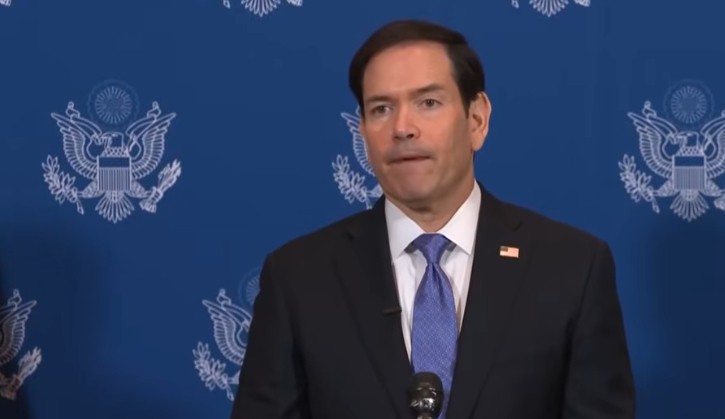
EDITOR’S NOTE: Secretary of State Marco Rubio held a press conference in New York City on September 23, 2026, on the sidelines of the United Nations General Assembly. He took questions from reporters on the Iran nuclear talks and the Strait of Hormuz, Cuba, Venezuela’s political and economic transition, the Russia-Ukraine war, the state visit of Chinese President Xi Jinping, and a range of other foreign policy issues.
TRANSCRIPT:
SECRETARY RUBIO: Okay, go ahead.
Iran Nuclear Talks and the Strait of Hormuz
REPORTER: Mr. Secretary, what were the U.S. demands with the Iranians yesterday? And was there any discussion of —
SECRETARY RUBIO: Well, yesterday’s conversation was with some of the mediators involved in that process, and I don’t want to characterize it as one direction or another. I think it’s pretty clear understanding of what this — remember, everything here at its core, the number one issue, the president highlighted this yesterday in a speech before the world — Iran can never have a nuclear weapon. Everything emanates from that.
We understand the Straits is an issue. The southern lane of the Straits is open. Every day, more and more barrels of oil are flowing through there, and they’re open thanks to the efforts of the United States military that’s both defending shipping and has removed mines. And that trend will continue.
Meanwhile, the only blockade in the Hormuz Strait is the one we’ve imposed on Iran, because they keep firing on ships, and they continue to do so — as early as this morning there was another launch. So, on shipping, we’ll continue to defend, we’ll continue to hold the Straits open. So that’s an issue. But the core issue here is that Iran can never have a nuclear weapon. We make that point in every interaction with them.
Beyond that, I would say — and I don’t want to characterize these — because if there’s going to be a deal with Iran, it’s not going to happen at a press conference. It’s going to involve a lot of hard work over a period of time, and it will engage and involve mediators as well. So as the president said, he’s open to a deal. The president’s open, still to this moment, to making a deal with Iran that allows Iran to be what it should be, which is a great and prosperous country.
But if they continue to insist on the desire for a nuclear weapon, their support for proxies in the region, their support of terrorism — they’re the world’s leading sponsor of terrorism — then we’re going to have big problems with them. And the president has a number of options available to him, including the ones he’s already taken, which is to impose severe and growing economic costs. But he also has some military options upon which I won’t speculate.
Cuba: “The Revolution Has Failed”
REPORTER: Secretary, the president said that freedom will come to Cuba. How will that happen? In the past you’ve said that it’ll collapse on its own, but is —
SECRETARY RUBIO: Who has said that?
REPORTER: Well, the administration said that the regime —
SECRETARY RUBIO: No. Look, I’ll answer — I know your question. The Cuban revolution has failed. It has failed for sixty-something years. It is a failure now. I think there’s acknowledgment within the Cuban system that the revolution has failed. The question is what replaces it, and they have an opportunity to make changes.
They have an opportunity to begin to put their country on an irreversible trajectory towards progress and a better future. And that involves both political and economic freedom, no doubt about it. And so we’ll remain engaged in that portfolio. We’re open to measures moving forward that begin that process of change.
And it will be a process that will not be easy. We’ve seen these transitions happen historically throughout the world. They don’t happen overnight. They don’t happen immediately. You don’t reverse sixty-something years of mismanagement, corruption, and incompetence in six months.
But I do think that Cuba has a golden opportunity to place itself on an irreversible path towards a better future, and we are prepared to be helpful in that regard if they’re open to it, obviously. Right now, the people that speak on behalf of the government are led by people who at least publicly are quite recalcitrant, but the reality of their situation is things are not going to get better in Cuba without them making very substantial changes.
REPORTER: Something like Venezuela, changing the regime with some military extraction — there’s an indictment against the former president, there are other actions. Would you rule that out?
SECRETARY RUBIO: Look, first of all, this is a general answer, not even specific towards Cuba. If there is a threat to the national security of the United States, the president has both the power and the obligation to address it. That’s just my general statement, not just Cuba-specific.
That said, our preference always is to deal with these things in a negotiated way, in a political way, in a way in which progress is made through substantial changes to a country that don’t involve the use of military force. So I’m not going to speculate beyond that, and I’m certainly not going to threaten anything.
I’m just going to tell you that Cuba and its leaders, or the people that are in charge of its government now, have an opportunity to begin the process of forever positively changing that country, and it’s an opportunity they should take. I’m hopeful that they will. I’m not confident that they will, but I’m hopeful that they will, and we stand prepared to contribute towards that.
Obviously, there are some individuals in that regime with whom we can never work because their hands are stained in blood. But there are people there that I believe you could work with, if they are willing to put the country on a path towards political and economic freedom — and the process that will get us to that ultimate goal, although that’ll take some time to get there.
Iran and the Midterm Elections
REPORTER: He believed that the U.S.
SECRETARY RUBIO: Well, I think the Iranians misread our system. I think the Iranians are under this illusion that Democrats are going to win in November and the president will no longer be able to do things against them. I just don’t think they understand our system very well. Other countries do, but they don’t seem to.
In our system of government, obviously, Congress, the legislative branch, is a very important branch of government. I served in it for fourteen years, so I understand its powers, but I also understand its limitations. When it comes to the national security of our country, when it comes to the imposition of both sanctions and the use of military force, the president has extraordinary powers. Every president does. He’s the commander in chief, both constitutional and otherwise, to be able to carry out those functions.
So I think the Iranians are fundamentally misreading our political system. And I think the president made it very clear yesterday — for him, the Iranian issue is not a political issue. It is the fact that for generations now, for almost fifty years, every American president, and frankly every country in the world for the most part, agrees that Iran can never have a nuclear weapon. But ultimately no one ever does anything about it, and he’s going to do something about it. And he’s doing something about it, and it comes at a price and at a cost. There’s no doubt about it. But the cost of not doing something about it is substantially higher, especially for future generations.
Macron’s Remarks and the International System
REPORTER: President Macron yesterday spoke about a descent into a return to the law of the jungle, and spoke about this idea of an erosion of international norms, something that other leaders here seem to have echoed. I wonder what you thought of that, and also whether the language of annihilation of countries gives people grounds to think that that’s happening.
SECRETARY RUBIO: Well, I didn’t see President Macron’s speech. The president saw him briefly, I guess, the night before that speech, so I don’t know what he’s referring to.
Look, the international system is not in good shape right now. And these international norms people talk about — I think the limit of international norms is your national interest. At the end of the day, the president and I reflected this going back to the very beginning: the view of this administration is that the number one obligation of every government is the national interest of their country.
So the United States, we see the utility in the international system. We’re here, we’ve argued — I think the president has said that the United Nations, for example, has tremendous potential, but it’s not living up to it because it’s lost its — and I think, a very curious thing, and something you guys should point to, is multiple leaders pointed to the fact that the international system is failing, and it’s failing because it has grown beyond its mandate. It has grown beyond its intent. It’s involved in all kinds of things it shouldn’t be involved in, and it’s unable to solve virtually any major conflict in the world.
So I think there’s unanimity and consensus here in this gathering, and broadly, that the international system is broken, but it’s broken because it broke itself. It needs to be brought back to its proper focus and its proper role. It would be great if we had a functional international system, for example, that could deal with a war between Thailand and Cambodia that occurred, or the potential conflict between India and Pakistan, or what’s going on in the DRC and Rwanda, or what’s going on in Sudan, or what’s going on with Iran in the Straits. Right now we don’t seem to have a functional international system that can address it. And in the absence of that, nation states will act in their national interest.
I will say this to you, and I want to be clear because this is not an attack on the international system: at the end of the day, the United States will always act — at least as long as President Trump is in office — we will always act in the national interest of our country, not in the interest of the international order. We will never put the international order above the interest of the United States.
Coordination Among Gulf Allies on Iran
REPORTER: Is there any sort of coordination or consensus going forward among allies as to how to deal with Iran, coming out of the GCC?
SECRETARY RUBIO: Well, I think there’s consensus that the Straits need to be open and free without attack. I think there’s consensus that what’s happening with the Houthis and in Yemen is deeply problematic. I think there’s a consensus that Iran can never have a nuclear weapon. And I think, writ large, you’ve seen a lot of support from many of those countries for the sanctions and the economic cost that the United States is imposing.
So we work and coordinate very closely with these countries for a variety of reasons. First, because they’re in a position to be very helpful on the economic front, and there’s an expectation that they will live up to that. And the other is because they are directly threatened. At the end of the day, the one thing you will find in the region is that virtually every country in the region is facing the threat of some Iranian proxy that has, for years — not for the last few months, for years — threatened the safety and security of these countries. And on that, there’s very strong consensus that Iran is a malign force in the region.
Serbia’s Strategic Partnership
REPORTER: There’s a great deal of praise coming from the Serbian president about you and President Trump.
SECRETARY RUBIO: Oh, good. I like praise. We don’t get praise always, you know that, guys.
REPORTER: How do you see the evolving role of Serbia as an American strategic partner, and how specifically do you intend to deepen that partnership?
SECRETARY RUBIO: Well, we intend to, and we already have. We’ve taken steps in this administration to grow closer in our interactions. I know we’ve already had individuals from the State Department and other government agencies visit there. Hopefully I’ll have an opportunity to visit as well. Obviously Serbia is tied up in some issues that are potentially problematic and explosive, and that there’s international interest on, but it is a strategic partnership that we’d like to deepen and intend to do so, as we manage some of the potential issues that might emerge, that I know deeply involve them as well.
Cuba: American Private Sector Investment
REPORTER: How far along are the opportunities for American privatization of Cuban industrial sectors? And have you personally seen any of the proposals for U.S. business interests to own or operate on the island?
SECRETARY RUBIO: Well, first of all, it’s actually a good question. On Cuba and the American private sector — what people have to understand is, unlike some other parts of the world, U.S. policy towards Cuba is codified in law and statute by Helms-Burton. So there are substantial limitations to what any American company can do in Cuba, because Helms-Burton, a law that was passed by Congress and is on the books, limits it. It makes certain conditions have to be met in order for that commercial interaction to happen.
Now, do I believe that American business interests could play a positive role in a future Cuba in which its economy is free and open and people are allowed to self-employ or work for whoever they want? Sure, of course. We’re the largest economy in the world. I also think, by the way, that one of the huge opportunities that Cuba has is it has a very large expatriate community of Cuban Americans and Cubans living in other parts of the world that could contribute greatly to Cuba’s future. And there are also companies from other parts of the world that could contribute as well.
The fundamental challenge in Cuba, and what keeps companies away — forget about American companies for a moment, because obviously they’re impeded by Helms-Burton — Cuba can do trade and commerce with any country in the world they want outside the United States. The reason why they don’t is because — why would I invest, say I’m a business person from Spain, why would I invest $10 million in Cuba if two years from now they just decide on their own to change the rules, take it from me, keep the money, and never pay me back? And that’s happened over and over and over in Cuba.
Even now, as they announce these reforms, everyone’s saying, well, these things are just on paper — you have to implement them, and you have to keep them. So certainty is the problem, and there’s simply no legitimacy or credibility that this regime will ever live up to these conditions, because they never have before. So that ultimately is an impediment.
But to answer your question — have I reviewed any of these? No. People are always pitching things. I’m aware that there are some companies and individuals and others that would love to be involved in Cuba’s economic future. But right now that’s not possible — it’s not feasible because of Helms-Burton, and also because of the lack of certainty about its future. No one is going to invest in Cuba under their current governance model. They’re just not going to do it. Which is why I always go back to — it’s not just about political freedom, which is incredibly important, but it is about having a governance model on that island that gives the private sector confidence that if they invest, they’re going to make their money back with a profit, and not have it taken from them and never get paid back.
Russia-Ukraine: A Possible Energy Ceasefire
REPORTER: Did you find that the Russians are at all interested in an energy ceasefire, as Zelenskyy has been proposing?
SECRETARY RUBIO: Both sides have expressed an interest in some limited ceasefire that involve grain and energy. Obviously that won’t be easy either, but it’s something that both sides have expressed an interest in. I think President Zelenskyy has done so publicly — did it with us yesterday, did it, I think, in interviews over the last few hours.
So obviously, that’s something that might — it doesn’t solve the war, but it does, I think, in some ways, potentially alleviate some of the global pressures that are being felt as a result of that. So that’s something we’re always open to exploring. It’s been a feature of every conversation that we’ve had with them. It was a feature of the Witkoff-Kushner meeting in Moscow and in Kyiv. It was a feature of our conversation with President Zelenskyy yesterday. And it’s something that, if we can play a constructive role in making happen, we’d be very open to — again, recognizing it doesn’t end the war, but it does deal with something, and maybe it can serve as the baseline or a platform for a broader agreement.
Ultimately we all want this war to end, and that’s the one thing about Russia and Ukraine I will say — the war is not going to end on the battlefield. That war is going to end, I think everyone acknowledges, with a negotiated agreement, and we all understand that. And the sooner we can reach that agreement, the less things will be destroyed and the less people are going to die on both sides. That’s what the president wants.
Venezuela: The Meeting with Acting President Delcy Rodríguez
REPORTER: Mr. Secretary, if I could ask you about the meeting that President Trump had last night with acting President Delcy Rodríguez — can you tell us about what was discussed?
SECRETARY RUBIO: Well, it was a short meeting, but it was an important meeting. And obviously there are three things that were discussed that are important.
Number one is — look, I go back to what we said from the very beginning. Venezuela is dealing with almost twenty-something years of destruction, economic and otherwise. And then you add to that probably the worst earthquake in the region, maybe ever, according to seismologists. I am not a seismologist, so I rely on their expertise on it, but certainly a very devastating one. And by the way, an earthquake that could have been far worse had it hit inland versus on the coast, but it was very bad. The full death toll is still not known. And as you saw, they struggled to respond to it, because they have not invested in the mechanisms to do so as a government.
So Venezuela has a lot of problems. They have probably the world’s largest sovereign debt that has to be restructured. They have an economy that is still suffering from the remnants of kleptocracy and graft, and the fact that the glue that held the regime together was corruption, and the fact that individuals tied to government got sweetheart deals that they have to disentangle from. There are 8 million Venezuelans living abroad, many of whom would desire to come back to Venezuela, live there, invest there, rebuild their businesses there, but they need to have confidence that that’s going to happen. So there’s a lot that needs to be fixed in order for Venezuela to be successful. So we discussed the steps that remain to make that happen. Debt restructuring is key to that. Obviously we want to be helpful in that regard. It has to be done in the right way.
The second, and equally important, is there has to be a political transition process, which is underway. Leadership from the 2015 National Assembly have been engaged now in regular talks with the interim authorities to create the groundwork and rebuild the institutions necessary in order to have free and fair elections in Venezuela, which is critical.
What we want to see is not only that you have free and fair elections, but that you have an enduring republic. What would threaten an enduring republic in Venezuela would be that someone is elected and they inherit a complete catastrophe, economic and social. And then the whole project is endangered, because now anything can happen. So we want to do two things at the same time. We want to help them rebuild their economy — not perfect, but certainly to a level of stability that allows an elected government to succeed. And second is build back all the things necessary in order to truly have free and fair elections.
What are the things that are required for that to happen? You need media. You need media coverage. Candidates need to be able to communicate with the public, and there have been positive steps in that regard. In just the last two weeks — underreported fact — a number of independent Venezuelan outlets that had not been allowed to broadcast in Venezuela for almost seven years are now broadcasting in Venezuela. If you watch some of these opposition figures, they do press conferences, and there are literally 50 microphones on the table. If you had gone there two years ago, there would have been three microphones at the table.
You need to rebuild political parties. Many of the leaders of these parties are still abroad. It’s not just María Corina Machado, who’s a very brave woman, but there are other people that are abroad. These parties need the opportunity to rebuild, to organize, to become not protest movements, but political movements. You need to have an electoral process that people have confidence in — in essence, are the votes going to be accurately counted and accurately reported? So you need to have authorities that govern elections so people have confidence that those elections are real.
So we made that point, that in the end, for this project to be successful, it culminates in a free and fair election in which the leaders of that country have the credibility that the private sector will have confidence in. But obviously we also need to, at the same time, work on the economic conditions that need to be improved. Because if you have societal breakdown, if you have economic crisis in Venezuela, it not only endangers elections, it endangers the survival of a democracy there, which is ultimately what we want to see in Venezuela — a stable democracy with a functional economy that allows its people to have prosperity, and allows many of the millions of Venezuelans who have had to leave the opportunity to go back and live, invest in their country again, participate in their country.
Ukraine’s Energy Strikes Inside Russia
REPORTER: Ukraine says its refinery strikes inside Russia are aimed at targeting revenue, the main income source for Russia. Is the U.S. asking Ukraine to stop targeting Russian energy sites?
SECRETARY RUBIO: Well, how do you know we haven’t asked the Russian side, too? Look, when you talk about energy for the Russian side, the energy strikes they’re facing are refineries and oil and gas. For the Ukrainian side, energy means their electrical grid, and going into winter, with a fear of losing the electric grid. So when you talk about energy, it means two things to different people.
And what complicates it further is that energy strikes are at the core of the tactical pursuit that both sides are — the Ukrainians are inflicting pain on the Russians by hitting their energy sector, which is a revenue source. The Russian side is inflicting pain on the Ukrainian side by targeting their electric grid, especially as we head into winter. So there’s the challenge — both sides have identified energy as a strategic objective of their war aims. But it’s having a global impact in the case of oil and gas, and it’s having a very real and immediate impact on life in Ukraine, especially these threats to it.
So it’s not easy overnight to just say let’s reach an agreement. But it’s something that I think is worth investing in, trying to make that happen, because I think it would be beneficial to the world and beneficial to both countries. I think if you ask President Zelenskyy, he would argue that the ability to protect his electric grid is at the core of their interest, and that’s something that we can help achieve through a deal. And obviously the Russian side is facing strikes it has not seen before, deep in Russian territory and against key industries. So that’s what makes making a deal on that limited basis difficult, but it also is the reason why it’s so important that we try. So we’ll try, and I think we’re prepared to play a positive role if we can in making that come about.
Taiwan Arms Sales
REPORTER: On arms sales to Taiwan — the one that’s still pending.
SECRETARY RUBIO: Again, look, this — people think this is just — you view arm sales through the limited vacuum of one particular place. A lot of this also involves balancing our industrial capacity and our military industrial base. This is not about Taiwan specifically, but when we sell something, that means we don’t have it anymore. We can get it in the future, but we don’t have it now. So anytime we do any sales, not to Taiwan, to anybody, it is always balanced against what are our own needs in different parts of the world, and whether we can afford to sell something, because we may need it for ourselves. So that’s going through that process.
On the broader issue of supply chains — the United States, we have this trilateral going on with South Korea and Japan, and I think we’ve had those meetings now, four in the last three months, and we continue to engage. It’s a very useful forum. And I think when you look at one of the shared interests, both Japan and Korea are advanced technological economies, so they have the same supply chain concerns that we do, and I think they’re excellent partners. We’ve signed a memorandum of understanding with them. We’re cooperating with them jointly on a number of other places in the world where we can work together to improve supply chain security.
Obviously supply chain issues are global in nature. The need to diversify our supply chains is a global international imperative that we share with many countries. It’s been at the core of our policy, not just as we engage with South Korea and Japan, but as we engage with the world. And I imagine that those issues will also be discussed in our interactions with the Chinese, because much of our interactions with China over the last year have been largely focused on the trade portfolio, which Secretary Bessent and USTR Greer are handling, and supply chains are at the core of that trade portfolio. So there’s no doubt that issue will be raised. But in the meantime, we’re going to continue to work with partner nations around the world to diversify our supply chains on everything — not just critical minerals, but pharmaceuticals, everything else.
Hybrid Attacks on Germany and Europe
REPORTER: There’s been an increase of hybrid attacks recently on Europe and on Germany specifically. There was just a drone that was stuck with explosives. Is that a conversation you’re having with Foreign Minister Lavrov, and can Europe and Germany —
SECRETARY RUBIO: Let me first — be clear, because he’s asking — these meetings don’t work really well with anybody. If I leave the meeting and run out and tell the media, this is what we talked about, that’s what we talked about — I’m not trying to be secretive with you, I’m just telling you, let’s be frank here, these meetings don’t work well.
Now let me comment generally. One of the concerns we have, among many, about the war between Russia and Ukraine, is that it could metastasize and spread into other places, that it could grow into somewhere else, be it through a hybrid attack, be it through a sabotage attack, be it through a misunderstanding — some pilot went the wrong way, and all of a sudden you’ve got active combat. These things are of concern. We raised that in multiple meetings in multiple countries, because it’s a real concern. These are how things sometimes get out of control — that a war metastasizes to some other part of the world or some other country. So yeah, we’re concerned about it. We watch reports carefully, and we raise them with the right people at the right levels.
Yemen and the Houthis
REPORTER: Can I come back to the situation in the Middle East and Yemen specifically? Is the president prepared to do more against the Houthis?
SECRETARY RUBIO: Well, I’m not going to get into a discussion about the tactical options available to the president. As I’ve said, we have a very strong defense agreement with Saudi Arabia, and we will live up to our commitments in that agreement. We don’t like what’s happening — obviously it’s very disturbing. I’m happy to see that the Saudis were able to restart the pipeline again, which is critical for their economy and also critical for the global economy.
We think these strikes on energy infrastructure in the Middle East — they weren’t just attacked by the Houthis, they were probably also attacked by Shia militias in Iraq who are an Iranian proxy. Every time you guys ask me a question about the Middle East, it goes back to someone who’s supported by Iran. Let’s just be clear here — the Iranian regime actively supports organizations in the Middle East who target infrastructure, energy infrastructure, and civilians. They attack, for example, diplomatic facilities — unheard of, that you would bomb or attack, for example, our embassy in Kuwait. That’s a diplomatic facility that was deliberately targeted. It wasn’t hit by shrapnel. All being done by people that are sponsored by the Iranians. So they are a malign force in the region, and that’s why the region understands it.
But going back to your question about Saudi Arabia — they are a strategic defense partner. We have made commitments to them. We will live up to those commitments. We are living up to those commitments now, and that’s all I’ll say about it. Obviously the president has many options available to him.
Sudan
REPORTER: [QUESTION INAUDIBLE]
SECRETARY RUBIO: We have a team of people that work Sudan full time. It’s a very frustrating thing. We’ve had agreements, both at various gatherings around the world, we’ve had people agree to things, sign to things, and the commitments are never met.
I want to be frank — we all recognize that what’s happening in Sudan would not be happening were it not for external actors supporting one side or the other, and it’s growing increasingly frustrating. We have engaged in it, we have participated in it. The U.S., the U.K., other countries have tried to play a role in furthering this. But every time it seems like we’re making progress towards something — at a minimum we would love to see a permanent peace agreement, but at a minimum we would like to see the opening of humanitarian zones, because the humanitarian calamity there is very significant — and every time it seems like we’re on the verge of making progress, one side or the other will back off because they think they’re winning, or they think they could win.
And there are external actors — I’m not going to signal who they are, I don’t want to create any more friction than there needs to be created. But that war, and that conflict, and that crisis, would not be happening were it not for the active participation of external actors that are feeding one side of that conflict or another. So I would say that ultimately, until those external actors are prepared to use their influence and pressure their respective proxy to live up to the commitments that they’re making, we’re not going to make progress. And so we are raising this in every forum and in every setting possible. We would like to see a positive outcome there. At a minimum we would like to see the humanitarian situation addressed, because it’s catastrophic and horrifying. Aid groups cannot go into these active combat zones. Both sides have made commitments to allowing certain areas to be safe, and then they don’t live up to it. We would like to see the war ultimately solved, but that doesn’t mean we’re going to stop. But if we can at least achieve the humanitarian achievement in the short term, we could build upon that. That’s what we’ve tried to do, but it’s been frustrating, as I said, because of external players that are involved.
Iraq’s Disarmament Effort
REPORTER: Are you confident that Prime Minister al-Sudani — you met him briefly last night as well and had this conversation —
SECRETARY RUBIO: Look, we have zero doubt of his commitment to doing this. We understand it’s a massive challenge and a difficult challenge. I think he’s achieved certain things — at least three militias have disarmed and have basically joined the national government. There are a couple, at least one in particular, that has not been as forthcoming, and we recognize that’s going to be a real challenge that he’s going to have on his hands.
And as we’ve told him, we want him to succeed. We think he gives us, and Iraq, the best chance to succeed. I think he has the right intentions, I think he has the right motivations, he’s very intelligent and a very willing partner in this regard, and we’re going to do everything we can to help him achieve results. And we know it will not be easy, we know it will be difficult. And we want to help him achieve it, because nothing would be more important for Iraq than to deal with this, and to bring all the arms in that country under the control of its national government, and not have these independent forces operating and balkanizing the country. So we’re going to do everything we can to help him, because we do believe strongly that he wants this to work, and we want it to work for him. And we’ll do everything we can to help him succeed.
Iran Talks: Format and Mediators
REPORTER: Did he ask you to extend your —
SECRETARY RUBIO: No. I wouldn’t — first, I’m not going to characterize the talks one way or the other. The readout and the reporting that I have on it, which is pretty deep, is that basically it was a continuation of conversations that have occurred in the past with people involved in those conversations. But again, as I’ve highlighted in the context of whether it’s former Foreign Minister Lavrov or any of these other meetings, it’s our experience that oftentimes it is not constructive or productive for us to leave them and come out and tell you the blow-by-blow of what happened, for a variety of different reasons. Again, the United States always remains open to talking to almost anyone in the world about a conflict or a crisis or some disagreement that we may have. So if there’s an opportunity to exchange ideas and messages, we will. And that’s what largely yesterday was. It was positive in that regard. But I don’t want to mischaracterize this as a major breakthrough, but at the same time, I think it was significant that at least there was a conversation.
A Possible Trump-Putin Summit
REPORTER: Is there a desire on the U.S. side for another Trump-Putin summit?
SECRETARY RUBIO: That hasn’t been discussed. Look, the president of the United States, this president, is willing to engage, meet with virtually anyone. His view of the world, which I think maybe from a traditional political standpoint people don’t understand, but I do, coming from the world he comes from — he’s a businessman who relies more on common sense than he does on political orthodoxy. If you only meet with people that you agree with, then these are very nice meetings, but nothing happens. In order to solve problems you have to meet with people that you disagree with, or people that you might have some issues with.
So we’ve invited President Putin to the G20. We think it’s an opportunity for him to engage not just with the president, but with other world leaders. We hope that’s an invitation he’ll accept. So there’s an opportunity in December if that happens. If there’s another opportunity for them to meet, and there’s a purpose behind the meeting, that would be good. They’ve had conversations on the phone numerous times — I don’t know the number, but since the president’s come into office, I think at least a dozen times they have spoken. So yeah, we’ll remain open to engaging. Obviously the ideal would be a meeting in which there will be a result, an outcome, and a lot of that means there has to be a lot of work that goes into it beforehand. But if not, maybe if President Putin attends the G20 in December, that will certainly be an opportunity for them to interact and talk.
The Xi Jinping State Visit
REPORTER: Your former colleague, Senator Roger Wicker, said that he would have suggested the president not invite the Chinese president to Washington for such a lavish welcome, and he called him a brutal, unelected, oppressive dictator. Have you heard a similar sentiment from allies in the lead-up to this dinner? And what’s your message to people who are concerned about the U.S. welcoming the Chinese president with such open arms?
SECRETARY RUBIO: Guys, let me just say it to you this way, because I think this is important, and I used to have that job too, in the Senate, so I understand it and I respect the role that it plays in our system.
The United States and China are the two largest economies in the world. The United States and China are probably the two most powerful militaries in the world. The relationship between the United States and China will define the twenty-first century. What happens in that relationship — the idea that we would not interact with them at the highest levels is irresponsible. It’s outrageous. We have to. That doesn’t mean we don’t have strong disagreements — of course we do. But even at the height of the Cold War, even in the midst of the threat of nuclear annihilation, the United States had communications and meetings often with Soviet officials, and thank God we did, because it prevented a real war. So we have — I think it’s an obligation to be able to interact and speak at the highest levels.
Now, I think that’s what this visit reflects — the president’s belief that no matter what our disagreements and differences may be with the Chinese government, this is not some small country. This is the second-largest economy in the world, and a pretty substantial military that’s undergoing the most rapid military buildup probably in history. And by the way, a country that we also have very strong points of friction with when it comes to trade, and supply chains, and critical minerals, and things of this nature. So I think it’s just responsible statecraft for our leaders to speak and meet with one another. And that’s the way we view it, that’s the way we view this visit.
We had a visit to China — they hosted us earlier this year. Part of the agreement is that we would visit there, they would visit here. And this is the back end of that agreement. And there’ll be an opportunity for them to interact again potentially later this year, both at APEC in China and at the G20 in Florida.
Iran’s Internal Divide: “A Country or a Revolution”
REPORTER: You and others in the administration have said the Iranian regime is divided, and that you’ve struggled to come to an agreement with them. Has there been any change? Do they have any new mandate to negotiate?
SECRETARY RUBIO: Look, I think the fundamental challenge, and it’s really at the core of what Iran needs to decide, is do they want to be a country or do they want to be a revolution? If they want to be a revolution that exports the revolution into other countries and dominates the region, it’s very problematic, and I would say that is largely reflected in the IRGC. If they want to be a country, which is where I think their political leadership — whether it’s their president or their foreign minister — then that’s one thing. So I think that’s part of the challenge that we face here.
I think it’s pretty clear to everyone — I am not claiming to be an expert on the Iranian government’s internal operations, but I know enough about it to tell you, and I think all of us would recognize, that right now the ultimate decision-making in Iran lies in the hands of people that are strong believers in Iran the revolution. And that makes interactions problematic, because you can deal with the people that represent Iran the state, and you could reach agreement on some points, and you can even discuss the potential for agreement on other points. But they have to take that back to Iran the revolution, and it’s there where it’s often failed.
A great example of it is the memorandum of understanding. No matter how people may feel about it, the MOU came to an end because Iran the revolution violated it — it was being adhered to, and then the IRGC decided to strike shipping, and that killed the agreement that had been made at that point. So that is an ongoing challenge, and it’s something that is a factor in this negotiation. It doesn’t mean we stop trying if there’s an opportunity to do something, but I think it’s important to highlight that this is a real impediment.
Gaza Reconstruction and the Board of Peace
REPORTER: On the president’s Board of Peace — the new reconstruction blueprint — how will that be funded?
SECRETARY RUBIO: Well, we have donor countries that’ll be there today. And they’ll be announcing not just the commitments, but what it will go towards. A number of countries have stepped forward and have pledged financial assistance. We’re looking for more that will participate in that.
Obviously this is something that we want to see happen, because, as the president highlighted yesterday, a year ago at this time there were still hostages, there were still active, extensive combat operations ongoing in Gaza. We’re in a different place now, and that’s good, but that’s not enough. Ultimately, the way this gets solved is a Gaza that’s free of Hamas, governed by Palestinian leadership that is reflective of its people, is not Hamas, and that controls the security environment, and that has a prosperous economy, so that people don’t join groups like Hamas and have a chance to live the life they deserve.
So obviously part of that is this reconstruction, which is key. And so today, you’ll see at the Board of Peace presentation not just the commitments being made by various countries, but what it would go towards. And obviously this is a long-term project — this is not something that can happen in six months. But it at least gives people the hope of, here’s the future that awaits you if everyone does their part, and that’s what we hope the event today will highlight.
Taiwan Arms Sales (continued)
REPORTER: Does this administration remain committed to regular and increased arms sales to Taiwan generally?
SECRETARY RUBIO: Look, I think the largest single arms sale to Taiwan ever was consummated and completed in December, just a few months ago. But we’re at a point now — again, everyone’s focused on Taiwan, but I want you to focus globally for a moment. If we sell you something, we don’t have it anymore. Now we may be able to make it in the future, but we don’t have it right now. So any arms sales we do with anyone on the planet — think about Taiwan, with any country on the planet — has to be balanced with what our combatant commanders around the world are telling us are their minimum needs in case of a conflict in their region.
And so this is the constant balancing act that the Department of War goes through as they make these recommendations to the administration. And so that’s the process we’re undertaking, not just with Taiwan, but with every commitment that we’ve made. And that’s the answer that’s governing us now, not just on Taiwan, but on foreign military sales to anyone. And it depends what you’re selling, it depends how quickly we can restock if we don’t have it, it depends on whether we need it for ourselves. It depends on a lot of factors.
REPORTER: Munitions weren’t an issue?
SECRETARY RUBIO: Well, we have plenty of munitions to achieve our objectives in the case of Iran, but we’re not only in Iran — we have obligations in the Indo-Pacific, we have obligations increasingly in Southern Command, we have obligations and commitments to NATO and our partners there. And any part of the world where you go and tell them there’s going to be five less American soldiers and two less planes, everybody freaks out. So at the end of the day, that’s what this is all balanced by. And it’s not just about the current standing — when we military plan, we don’t plan for the next three months, we plan for the next ten years. So that’s why all of this is constantly being weighed. We rely on the input of the Department of War to determine what sales can happen now versus later.
China, Iran, and Russia
REPORTER: What will President Trump ask of President Xi in terms of help getting China to bring both the Iran war and Russia’s war in Ukraine to a negotiated end? And will he ask President Xi to address the military and industrial aid China’s providing to both Iran and Russia?
SECRETARY RUBIO: I think the president will raise every relevant topic that involves the world. I’m not going to stand here today and tell you this is what the president’s going to — he just wouldn’t do it, no matter what. We just don’t do meetings that way. If I stand here and tell you, tomorrow we’re going to call them in and we’re going to talk about this and we’re going to talk about that — these meetings just don’t work well that way. So it’s not that I’m trying to be evasive, I know you have to ask me the question, but for me to tell you, oh yeah, here’s the ten things we’re going to talk about — we’ll talk about everything that’s relevant, we’ll talk about everything that’s important, we’ll have a very frank, as we always do, conversation.
Secretary Bessent had a meeting with the Chinese on Sunday, I believe, here, on the trade issues. These are always very frank, open, and direct conversations. We’re just not going to have press conferences about it, because it doesn’t work well when you do it that way. Hopefully, if we have good outcomes or things to announce jointly, we’ll obviously put that out there. But again, diplomacy and these efforts always work best when you’re able to have honest and open conversations that don’t immediately wind up in the public sphere, because it makes it hard and it constrains future talks.
Wrongfully Detained Americans
REPORTER: [QUESTION INAUDIBLE]
SECRETARY RUBIO: We always raise Americans. In every gathering with any country that we have, whoever it may be, the case of the unlawfully and wrongfully detained Americans is always raised — not just at our meetings, but at any engagement that we have, and in our communications with any country around the world. This is a constant under this administration.
New Tariff Authority Under the Sanctioning Russia and Iran Act
REPORTER: You’ve publicly expressed your support for the law — the Sanctioning Russia and Iran Act — now that it is implemented —
SECRETARY RUBIO: The law gives the president tariff authority. It’s the first time, I think, in like seventy years that Congress has granted the president tariff authority. And as you know, the president is a very strong believer in tariffs as a tool of national policy. So this is good. Obviously the law also gives the president national security waivers, which allows him to apply them as needed, in individual cases.
So what the president has now is a tool in his toolbox that he could use not just to influence what happens in Russia, Ukraine, and in that conflict, but potentially what’s happening with Iran as well. How he’ll use it is up to him to decide and up to him to announce.
More on Yesterday’s Iran Talks
REPORTER: On the format of yesterday’s Iran talks — you said the mediators were involved. Did they strictly shuttle back and forth, or was there a face-to-face —
SECRETARY RUBIO: I’m not going to characterize that. Human beings talk to each other.
REPORTER: Was it mediated by Qatar?
SECRETARY RUBIO: I’m not going to discuss who the mediator was.
REPORTER: You mentioned the MOU — did that serve as the basis of yesterday’s talks?
SECRETARY RUBIO: I’m not going to characterize yesterday’s talks, but by and large, at this point, the Iranians violated the MOU, as the president said. They killed the MOU, they strangled it, by violating it, the IRGC. So we’ll see what happens. Like I said, they have a choice to make. The president outlined that very clearly yesterday. They have a chance to have a prosperous country that’s not at war with its neighbors, or they can continue on the path they’re on right now, and they’ll face extraordinary economic and potentially military repercussions as a result of it. That’s a decision for the president to make. But beyond that, I don’t want to characterize the talks yesterday, or tell you who was in there or what the basis of it was. The MOU didn’t work out — they violated it, they broke it.
Venezuela: María Corina Machado and Institution Building
REPORTER: Following up on Venezuela — María Corina Machado made three attempts in the last twenty-four hours to get back to Venezuela and was prevented by authorities of different countries, including Venezuela, from returning. Should she be allowed back into Venezuela now? And what is the timeline for the institution-building and reform you described as necessary for elections?
SECRETARY RUBIO: I’m not sure what you’re referring to — I was here yesterday all day. But on a broader perspective, I told you this earlier — María Corina is very brave. We like her very much. I’ve known her for a long time and been interacting with her for a very long time. But this is in no way downplaying her — there are 8 million Venezuelans that have left that country, and it is our policy that we want — not that we want to kick them out of the United States, I’m not saying that — we would like to see that community be able to return to their country and reopen the businesses that they lost, if they want to.
And we’re seeing signs that that’s happening. Those American airline flights that are going in from Miami are packed every day. And what we’re seeing now is — one of the points we raised yesterday in our meetings — these Venezuelans who were perhaps key to their political or economic life are going back to Venezuela, they’re kind of scouting out the situation, and then they’re returning. We’d like to see a point where they feel and have confidence that they can actually go back and rebuild what they lost, or rebuild what was taken, on the political front but also on the economic front. And for that to happen, we need to make more progress on these talks with regards to the transition and reconciliation. So all that is interrelated. On the specific — I apologize, you’re just — we had, like, I don’t know, 142 meetings yesterday. The president took a bunch of meetings that lasted till 11 p.m. I can get back to you.
The West Bank
REPORTER: Can I ask a question on the West Bank, please? The situation is quite explosive. You’ve been very involved in Gaza, but the West Bank — what is your feeling on it?
SECRETARY RUBIO: It’s not my feeling. The president has made it clear that we don’t want to see additional flash points there. Given everything that’s going on in the region now — the difficulties in implementing the agreements made with regard to Gaza, the tenuous situation in Lebanon, the Houthis and Saudi Arabia, the ongoing friction and conflict with Iran — the last thing this region needs is an additional flash point. And the last thing we think Israel needs is an additional flash point. So as I said, it is our preference, and we’ve communicated that to everyone — the president really doesn’t think the world right now needs a West Bank crisis. And that’s our position. I think we’ve been clear on that.
Boat Strikes and the Shield of the Americas
REPORTER: Any more boat strikes, or an uptick in boat strikes, after the Shield of the Americas meeting yesterday? Was there receptiveness to designating more terrorist groups, narco-traffickers?
SECRETARY RUBIO: Yeah, every one of these countries has different laws, and their systems are all different in terms of how they designate. The president yesterday asked every country in there to designate these organizations as foreign terrorist organizations. Obviously some countries are in the process of doing it, some have already done it. They all have different laws internally as to how they can reach that designation.
But the Shield of the Americas is about defeating these transnational criminal groups, but it’s about a lot more than just that. There’s an opportunity to act collectively on economic issues — for example, again, securing a supply chain for the region. It’s a forum in which democratically elected and aligned countries can act in concert with one another. It’s actually sort of old-fashioned diplomacy, in the way that you work with partners and collectively take action in international forums, as a potential. So it’s not just about strikes.
Obviously, at the core, many of these countries feel threatened by, or are threatened by, transnational terrorist organizations that in many cases have more money to spend on weapons than the government does. And it’s a direct threat to their citizenship, but it’s a direct threat to their sovereignty. So the Shield is a great achievement. It obviously has to be built, because it’s new. We’ve added two new members, Colombia and Peru, which is a very positive thing. And we are continuing to seek ways to build it, not just in membership, but in the things that it takes on. So it’s a very positive thing, and we’re very happy with yesterday’s meeting.
Response to Iran’s President at the United Nations
REPORTER: While you were here, the Iranian president spoke at the United Nations, and he said that President Trump’s speech goes against the very essence of the United Nations. He said that President Trump must know that the resistance of the Iranian people will only increase in the face of sanctions, increased pressure, and increased bullying, and that “we will never bow our heads or bend our knees.” Do you have a response to him today?
SECRETARY RUBIO: Yeah, I think slaughtering 10,000 of your own people in protest is a violation of the U.N. — I hope it’s a violation of U.N. principles. I think sponsoring terrorist organizations in the region to attack your neighbors, attack energy infrastructure, attack civilian sites, is a violation of the U.N. system. So I don’t know what standing Iran has to lecture anyone on human rights or the international system, when they habitually violate it. They violate the sovereignty of every one of their neighbors, by sponsoring terrorist organizations that reside within the borders of those countries. They slaughter their own people. They violate rules that were sanctioned, that were imposed by the international community against their nuclear weapons program.
So I honestly don’t know how you stand up there and argue on behalf of the international system when you are the world’s leading violator of the international system. That’s what the Iranian system has been, unfortunately, sadly, tragically.
Venezuela Oil Fund Audit
REPORTER: On the auditing report of the Venezuela oil fund — do you intend to turn that over?
SECRETARY RUBIO: Sure. No, and that’s going to happen, I mean it has to be completed. KPMG is doing that. But I can describe it to you now, and that’s what the audit’s going to show — every month, that fund is held. We don’t take it. That fund is held. They make requests as to what they want the money to flow towards, which is largely government function. There was a little bit that was released in response to the earthquake, but largely it goes to meet government payroll, government needs. And then KPMG goes back and audits that. So all of that will be available. We’re actually — not only are we not going to hide that, we’re very proud of it.
But it’s a nascent process, but we have — as I told you, KPMG is doing that work, and the reports we’ve gotten back are very positive. And this is not forever, right? Eventually — but what we wanted to make sure was that if we were going to release the sanctions on the sale of Venezuelan oil, the money went to benefit the Venezuelan people. That’s the core of the audit — to make sure the money was going to benefit the Venezuelan people, not going to the pocket of some corrupt official that was benefiting from the natural resources of that country.
West Bank Annexation and Sanctions
REPORTER: Would the administration be supportive of sanctions to help facilitate a specific project when it comes to annexation on the West Bank — the E1 facility?
SECRETARY RUBIO: Look, I can tell you what the administration’s position right now is — that we don’t want to see flash points in the West Bank right now, that the last thing that Israel needs, or the region needs, is an additional crisis or an additional friction point. We understand that that’s the case, and that’s what’s happening, and some people are pointing that out. I don’t have a comment on the legislative effort — to be frank, if the Democrats are sponsoring this, they probably don’t care what my position is. But we haven’t seen — I haven’t seen it. I can’t opine on something we haven’t seen. I’m just going off what your question is.
2028 Speculation
REPORTER: Recent reports have described you as either closing the door to a run in 2028 or still weighing your options. On running in —
SECRETARY RUBIO: Oh God, come on, God. I told you guys I’m not talking about that stuff anymore. I have two — I legitimately have, like, two jobs now. I’m not talking about this stuff, okay? But thank you for asking. The archivist job I lost, unfortunately, after nine months — it was one of my favorite jobs, but it was a cool job. But if I was the archivist, I would be there to receive them. But now I’m just an observer.
Why Not “Declare Victory” on Iran?
REPORTER: President Trump did oversee a successful tactical strike on Iranian nuclear sites in June 2025, and people assessed that those sites are buried under rubble. You could walk away from the war right now and declare victory. A lot of the president’s supporters are asking him to do that. Why not just declare victory now and walk away?
SECRETARY RUBIO: Because at the end of the day, you have to have not simply the destruction of facilities, you have to have a long-term and enforceable commitment to never pursue a nuclear weapon ever, as long as they’re governed by the people they have now. That’s an unacceptable risk to the world.
By the way, if what they want is nuclear energy, there are dozens of countries around the world that have nuclear energy — for example, these small modular reactor agreements we’re entering into with countries all over the planet. But that’s not what they want. What they want is the capability to have their own enrichment facilities, and we know that repeatedly they have explored a weaponization program. So the idea that the world’s leading sponsor of terrorism would be in possession of nuclear weapons is simply unacceptable, not just to us, but to the world. In fact, virtually every country in the United Nations has voted at one time or another in support of that principle.
So what’s important here is not simply the destruction of facilities — that obviously sets their program back and eliminates it for them — but the president is not thinking about just the next two years, he’s thinking about the next generation. What the president of the United States is saying is that multiple American presidents have understood this threat and not addressed it for the long term. He is not going to leave this as an unresolved problem. He is committed to ensuring that what is achieved here is something that is not just for the next five years, but is enduring and secures the world for the foreseeable future. That’s what his interest is here, and that’s why he’s focused on that.
SECRETARY RUBIO: Okay, guys, thank you.
Related Posts
- Transcript: Nepal PM Balen Shah’s Speech At UN General Assembly 81st Session
- Transcript: President Trump and the President Xi Remarks at a State Dinner
- Transcript: Israeli PM Netanyahu Addresses UN General Debate, 81st Session
- Transcript: President Trump and President Xi Deliver Remarks at Arrival Ceremony
- Transcript: Finnish President Alexander Stubb Addresses the 81st Session at UNGA