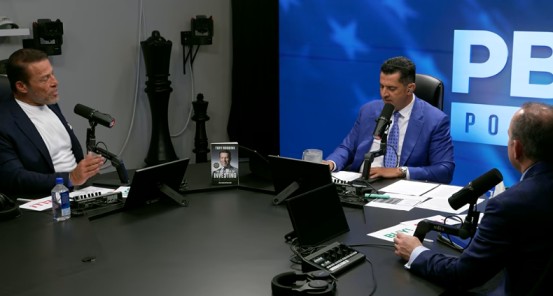
EDITOR’S NOTE: In this episode of the PBD Podcast, Patrick Bet-David sits down with legendary personal development coach Tony Robbins and private equity investor Christopher Zook, co-authors of “The Holy Grail of Investing.” The two discuss how they built a partnership that now manages nearly $14 billion in assets, the principle of owning uncorrelated investments, the rise of sports teams and private equity as asset classes, and Tony Robbins’ views on AI, quantum computing, the national debt, and reskilling America. They close with personal advice on relationships, careers, and a lighthearted round of buy-sell-hold on luxury watches. This interview episode was premiered September 22, 2026.
TRANSCRIPT:
The Buy, Sell, Hold Game
PATRICK BET-DAVID: (00:01:32 – 00:03:26) Our goal today is to get better with investments. So who we brought in today is the great Tony Robbins. Every once in a while I can introduce people with “the great,” and Tony qualifies. He’s the greatest in his space. So we have the great Tony Robbins back, and we have Christopher — not Chris, Christopher Zook — here back with us. I have to qualify that because it’s very important to make sure we say that, who’s back here with us today.
And you got a great story on how you went from having half a billion dollars of money under management. You’ve been following Personal Power for many, many decades, and then all of a sudden Tony invests in your company. You don’t even know about it, even though you’ve been following him for nearly 30 years. And then you get even more involved, and then now you guys got nearly $14 billion or so of money under management, which is an amazing story.
So our goal is for our audience to get smarter today. So I’d like to start with a game. If you can see what you have in front of you, you have a buy, sell, and hold sign in front of you. I’m going to go through different investments, okay? And we’re going to start off with value right off the bat, and then we’ll get into it. So gold — do you buy, sell, or hold gold today? What do you do? Hold your home, your body.
TONY ROBBINS: (00:03:26 – 00:03:30) I think that the answer to all your questions, they’re being asked in the wrong order.
PATRICK BET-DAVID: (00:03:30 – 00:03:31) Okay.
TONY ROBBINS: (00:03:31 – 00:04:03) The dog bit Johnny, Johnny bit the dog. Same elements, different sequence, different result. You can’t have an answer to this question if you don’t know what your outcomes are, and you have to know what your asset allocation is. So right now, for example, if you don’t have anything that’s covered in that category — which I have very little, honestly — then it might be an area that you might want to consider because it’s something that’s changing, but based on inflation. But all the answers you’re going to ask for here are basically based on that individual’s real needs. If you start making a generalization about it, we’re going to give people the wrong advice.
PATRICK BET-DAVID: (00:04:03 – 00:04:23) I think that’s a good qualification for you. So this is for you. This is not a recommendation to others. This is just where you’re at. That’s it. And if on any one of them you want to unpack — and remember, guys, we just said this is not financial advice. This is just they’re telling you what their opinions are. Bitcoin, buy, sell, and hold? Sell for you. Okay, you’re also sell.
TONY ROBBINS: (00:04:23 – 00:04:23) Yeah.
PATRICK BET-DAVID: (00:04:23 – 00:04:26) Okay, maybe a couple of these, if you don’t mind, I’ll come back to.
CHRISTOPHER ZOOK: (00:04:26 – 00:04:26) Sure.
PATRICK BET-DAVID: (00:04:26 – 00:04:29) Okay, so how about commercial real estate?
CHRISTOPHER ZOOK: (00:04:29 – 00:04:30) Depends on where.
TONY ROBBINS: (00:04:30 – 00:04:32) Yeah, I was going to say that’s location.
PATRICK BET-DAVID: (00:04:32 – 00:04:36) So that’s going to be located — so some areas are sell, some areas — okay, that’s fine. I like that.
TONY ROBBINS: (00:04:36 – 00:04:40) So real estate is all local, right? You don’t think about it on a national scale.
PATRICK BET-DAVID: (00:04:40 – 00:04:43) I think that’s fair. I agree. So, S&P 500?
TONY ROBBINS: (00:04:47 – 00:04:47) Really?
PATRICK BET-DAVID: (00:04:47 – 00:04:48) Maybe.
CHRISTOPHER ZOOK: (00:04:48 – 00:04:49) Okay, I’m a seller today.
PATRICK BET-DAVID: (00:04:49 – 00:05:01) I’m going to come back to that one as well, and I will talk about that as well. So I’m going to put C, if you don’t mind. I’m going to put C next to it, and I’m going to put T here. Single-family homes — is it still based on states?
CHRISTOPHER ZOOK: (00:05:01 – 00:05:02) It’s definitely still —
PATRICK BET-DAVID: (00:05:02 – 00:05:04) Okay, so let’s just move on.
CHRISTOPHER ZOOK: (00:05:04 – 00:05:04) Real estate, neighborhoods.
TONY ROBBINS: (00:05:07 – 00:05:07) California —
PATRICK BET-DAVID: (00:05:07 – 00:05:09) You guys are on the same page there?
CHRISTOPHER ZOOK: (00:05:09 – 00:05:10) Absolutely.
TONY ROBBINS: (00:05:10 – 00:05:11) Texas —
CHRISTOPHER ZOOK: (00:05:11 – 00:05:12) That would be a buy.
PATRICK BET-DAVID: (00:05:12 – 00:05:17) That would be a buy. Okay, New York. Yeah, all right.
CHRISTOPHER ZOOK: (00:05:17 – 00:05:20) Florida? I’m a holder there. Really?
TONY ROBBINS: (00:05:20 – 00:05:21) I’m a buyer.
PATRICK BET-DAVID: (00:05:21 – 00:05:25) You’re a buyer? Okay, I’m going to come to you with that one if you’re saying that. How about Illinois?
CHRISTOPHER ZOOK: (00:05:26 – 00:05:27) Illinois, I’m a holder.
PATRICK BET-DAVID: (00:05:27 – 00:05:29) Really? Okay, that’s a blue state.
TONY ROBBINS: (00:05:29 – 00:05:31) I don’t know about the market there. I wouldn’t.
CHRISTOPHER ZOOK: (00:05:31 – 00:05:33) Okay, you said Chicago would be a different answer.
PATRICK BET-DAVID: (00:05:33 – 00:05:35) That would be a sell, but Illinois, that would be a hold.
CHRISTOPHER ZOOK: (00:05:35 – 00:05:36) There’s so many great parts.
PATRICK BET-DAVID: (00:05:37 – 00:05:39) Naperville, some of the markets that they have.
CHRISTOPHER ZOOK: (00:05:39 – 00:05:41) Tennessee is a definite buy.
TONY ROBBINS: (00:05:41 – 00:05:41) Yeah.
PATRICK BET-DAVID: (00:05:41 – 00:05:44) Okay, so you guys are both buy there. Collectible cards?
TONY ROBBINS: (00:05:47 – 00:05:48) Yeah, again, I’ll hold.
CHRISTOPHER ZOOK: (00:05:48 – 00:05:51) If I own them, I’m going to enjoy them, but I’m not going to be a buyer today.
PATRICK BET-DAVID: (00:05:52 – 00:05:53) Are you in the same place?
TONY ROBBINS: (00:05:53 – 00:05:53) I wouldn’t be a buyer today.
PATRICK BET-DAVID: (00:05:54 – 00:05:55) Okay, fair enough. Sports teams?
CHRISTOPHER ZOOK: (00:05:55 – 00:05:57) No, we do that every day.
TONY ROBBINS: (00:05:57 – 00:05:58) We’re big buyers.
PATRICK BET-DAVID: (00:05:59 – 00:06:03) Then we’re definitely talking about that. Nuclear stocks? Nuclear power?
CHRISTOPHER ZOOK: (00:06:03 – 00:06:04) Depends on the newest types.
PATRICK BET-DAVID: (00:06:06 – 00:06:15) You know, the call I had with you, Tony, a couple months ago when you just broke down what you’re involved in with the power and nuclear. And I don’t know what state it was — was it South—
TONY ROBBINS: (00:06:15 – 00:06:15) West Virginia?
PATRICK BET-DAVID: (00:06:16 – 00:06:27) West Virginia, where you’ve been. Maybe we’ll get into that later on. It’s very interesting the way you were breaking it down. Okay, defense companies, definitely buy. Are you following what Palmer Luckey is doing with some of the newer drones?
CHRISTOPHER ZOOK: (00:06:27 – 00:06:30) Early investors with Palmer.
PATRICK BET-DAVID: (00:06:30 – 00:06:35) Good call. And that thing’s going to go — I think that could be a trillion-dollar valuation depending on how much he scales it.
TONY ROBBINS: (00:06:35 – 00:07:25) College degrees. I’m actually in the place of showing people how to get those without spending any money. I’ve got a new program called United Colleges of America, where we guarantee anybody with less than $100,000 a college degree where they get new skills, a new life, but no debt. The number one debt in America is mortgages. Number 2 is education. And imagine this: $1.8 trillion, people spend 4 years worth of education to pay it off over 20 years. Obama was still paying it off as a senator, and he had a bunch of scholarships. It is out of control, it is out of balance, but there are good solutions. Especially if you’re getting skills that are actually in the marketplace — borrowing money you don’t have to get skills that are outdated for a job that doesn’t exist is not a good formula. And that’s why I think a lot of kids are so upset coming out of college right now.
PATRICK BET-DAVID: (00:07:25 – 00:07:29) Would you mind if we come back and revisit this? Because that’s something I definitely want to talk about.
TONY ROBBINS: (00:07:29 – 00:07:29) Okay.
CHRISTOPHER ZOOK: (00:07:29 – 00:07:34) Nvidia right now? Right now I’m a seller.
PATRICK BET-DAVID: (00:07:34 – 00:07:35) You’re a seller? You’re hold?
TONY ROBBINS: (00:07:35 – 00:07:35) Yeah.
PATRICK BET-DAVID: (00:07:35 – 00:07:37) Okay, fair. Palantir?
CHRISTOPHER ZOOK: (00:07:38 – 00:07:39) I’m a holder right now.
TONY ROBBINS: (00:07:39 – 00:07:39) Yes.
CHRISTOPHER ZOOK: (00:07:39 – 00:07:41) And an owner, for full disclosure.
PATRICK BET-DAVID: (00:07:41 – 00:07:42) Okay, fair. Tesla?
CHRISTOPHER ZOOK: (00:07:43 – 00:07:44) Tesla, hold. Hold.
PATRICK BET-DAVID: (00:07:44 – 00:07:46) And last but not least, SpaceX.
CHRISTOPHER ZOOK: (00:07:46 – 00:07:47) SpaceX, we’re a holder.
TONY ROBBINS: (00:07:47 – 00:07:48) We’re holding there as well.
PATRICK BET-DAVID: (00:07:48 – 00:07:49) You’re holding that?
TONY ROBBINS: (00:07:49 – 00:07:50) We hold together. Yeah.
PATRICK BET-DAVID: (00:07:50 – 00:08:06) Okay, fantastic. Before we go into the story, walk me through why you’re on sell on Bitcoin. Three weeks ago I think Cramer said he sold all his Bitcoin. Three weeks later, it goes from $62,000 to $78,000. You saw that whole story. Maybe you’re following it. Why sell on Bitcoin?
Why Sell Bitcoin? A Case for Private Equity
CHRISTOPHER ZOOK: (00:08:06 – 00:08:27) So I only use Bitcoin as a trading vehicle. So therefore, when it’s up higher, I’m typically a seller. When it’s down low, I’m typically a buyer. So this is more of a trading recommendation, not a long-term investment recommendation. I think there’s a place for it in a portfolio as a trading instrument. It’s got lots of volatility. You can make a lot of money or lose a lot of money quickly. But after this move, I’m a seller.
TONY ROBBINS: (00:08:27 – 00:09:05) I think you have to look at where you’re putting your money and where your returns are. I think most people get into Bitcoin initially under the idea that it’s going to protect you against inflation. But as you know, the same people who invest in Bitcoin are the same people investing in tech. So right now you have 32% of the S&P that’s in 7 companies, the Magnificent 7, the most we’ve ever seen as a percentage. That means 32% of the entire volume of 500 companies is coming from 7, right? That is an imbalance. The most we’ve ever had before is 17%. That is a challenge waiting to happen. When technology goes down, all the guys who have Bitcoin have to go sell because they’re leveraged usually, and you see another price change. So for me, it’s just not the best use of my capital right now.
PATRICK BET-DAVID: (00:09:05 – 00:09:08) Respect. And neither one of you is holding any Bitcoin right now?
TONY ROBBINS: (00:09:08 – 00:09:09) No, no, I have some Bitcoin.
PATRICK BET-DAVID: (00:09:09 – 00:09:10) You have some?
TONY ROBBINS: (00:09:10 – 00:09:10) Yeah.
PATRICK BET-DAVID: (00:09:10 – 00:09:20) Okay, so you’re on the hold side with whatever you have. Okay, fair enough. So for the audience that doesn’t know, I know the story of how you guys met. Tony, if you don’t mind, kind of sharing how the two of you became friends and partners?
CHRISTOPHER ZOOK: (00:09:20 – 00:09:21) Sure.
How Tony Robbins and Christopher Zook Became Partners
TONY ROBBINS: (00:09:21 – 00:12:13) Well, it started because, after 2008, I’d been working with Paul Tudor Jones, one of the top traders in the history of the world. I’ve worked with him for more than 30 years, so I’ve learned a lot, at least from being around him. And after 2008, I was so frustrated with the fact that the people who almost destroyed the world economy — the punishment they got was more money. That was the reward.
So about 4 years later, I said to myself, I don’t have everything, but I have access. So I want to interview 50 of the smartest financial investors in the history of the world who are alive today. I’ve got access and I want to see, is the game still winnable? And I wrote Money Master the Game, wanting to write a book that my billionaire clients would love and someone just starting the game would love. It became the number one bestseller and took off like crazy. I thought that was it, I wasn’t going to write another book.
But then I saw people making dumb mistakes, and every market changes. So you have to know how to deal with the downside. I didn’t know COVID was coming, but fortunately I wrote Unshakeable. I wasn’t going to write another book, but then I started seeing people making dumb mistakes and I started seeing individuals, young people especially — you’re seeing it today — young men especially, taking money they think will be investments and using it on sports betting right now. 24% of them say that’s their best long-term investment. That is a recipe for disaster. So people are trying to make up for time.
So I started looking around and asking, how do I help people? Well, you and I both know that where the smart money goes — if we look at high net worth people, where are their assets? 52% of it’s in private equity and private assets, only 29% in public markets. And here’s a stat everybody needs to hear: for the last 39 straight years, basic private equity — not the masters of the universe we wrote about in this book, just basic private equity — has outperformed every stock market in the world every year for 39 straight years, right? That’s a pretty amazing track record.
Let’s take the S&P 500. Over those 39 years, it’s averaged 9%. Pretty nice compounding. But basic private equity is 15.7%. That’s 74% more per year, compounded. So if you put $1 million in 39 years ago and forgot about it in the S&P, you’d be a happy camper — you’d have just under $29 million, $28.6 million to be exact. If you’d put that same money in private equity, it’s worth $293 million — tenfold. Or with a smaller number: $100,000 in becomes $2.9 million versus $29 million.
So the problem is how do you get access, right? And the problem has been — until very recently, some brand new rules we knew were coming, which is why I wrote the book — you had to be an accredited investor, and many times a qualified purchaser. As a qualified purchaser, you need a $5 million net worth to make some of these investments. The richest people in the world get access. But even me — I’ve done pretty well and I have a name, like you have a name, you can usually get access. But the slice I get will be so small it’s not going to change my life. And I was lamenting about this to a friend of mine, a former partner of Paul Tudor Jones.
PATRICK BET-DAVID: (00:12:13 – 00:12:16) Until when did you feel that way, that even a guy like you—
TONY ROBBINS: (00:12:16 – 00:12:18) Yeah, 10 years ago. 8 years ago.
PATRICK BET-DAVID: (00:12:19 – 00:12:20) What were you worth 10 years ago?
TONY ROBBINS: (00:12:20 – 00:12:22) My net worth then, probably $400 million.
PATRICK BET-DAVID: (00:12:22 – 00:12:26) So even at $400 million, you’re not getting the type of access that the big guys are getting?
TONY ROBBINS: (00:12:27 – 00:12:34) I was getting access, but it’s like I want to buy an SP3 Ferrari, right? They come out, they’re $3 million, but they’re all pre-sold to everybody already.
PATRICK BET-DAVID: (00:12:35 – 00:12:36) You’re paying $5.8 or $5.5.
TONY ROBBINS: (00:12:36 – 00:12:37) Well, actually a little more now, right?
PATRICK BET-DAVID: (00:12:38 – 00:12:41) So I see the numbers. One of them sold for $25 million. I don’t know what—
TONY ROBBINS: (00:12:41 – 00:12:42) I think it was $12 or $14 million.
PATRICK BET-DAVID: (00:12:42 – 00:12:43) Did you see that? Whatever charity event.
TONY ROBBINS: (00:12:43 – 00:14:27) And I was like, oh my God, crazy. But the point is, so getting access — I would get access but a small slice. So I mentioned this to my friend, and he said, look, you’ve changed my life so much, I’m going to change your life today. He’s a really sophisticated investor, right? And he said, I want to tell you where I put most of my money. A guy like this, putting most of your money, I’m leaning forward. And he said there’s a firm. I’m waiting for him to say it’s going to be in Singapore or London or obviously New York, Connecticut. And he said, Houston, Texas.
I said, Houston, Texas? There’s a firm where you don’t have to fight to get in anymore. You don’t have to be a limited partner. You can own a piece of the firm and own all that they own. He said, Tony, you can own the racehorse or own the racetrack. You own the firm. That means the 2% they charge — no matter how well they do or don’t do — and the 20% upside you get. I said, how is that possible? He said, this firm is the best at it. They’ve been doing it for years. They’re leaders in the area. You got to meet him.
So I flew to meet Christopher Zook. I want to meet this guy. And I found out, first of all, I got to brag on him for a second: over 25 years, he has a 96% profitability ratio on his investments. How many people on earth have done that? I was totally impressed. I saw what he was doing. I was like, why would you ever be a limited partner again? This is insane. You get to have all the investments they made in the past, the present, the future. You get this massive diversity. When the firm sells, you get the multiple on the firm on top of it. That to me was the greatest thing I could imagine.
So I got involved with Christopher and then I started finding all the other investments that were part of it. And about four and a half years ago we got together. He’d been to my seminar years before and started his business out of it, which I had no idea.
PATRICK BET-DAVID: (00:14:27 – 00:14:31) He apparently listened to the tapes. Was it Personal Power? Which one was it?
CHRISTOPHER ZOOK: (00:14:31 – 00:14:33) So Personal Power, back in 1991.
PATRICK BET-DAVID: (00:14:33 – 00:14:33) 1 or 2?
CHRISTOPHER ZOOK: (00:14:34 – 00:14:34) The first.
PATRICK BET-DAVID: (00:14:34 – 00:14:35) The first one.
CHRISTOPHER ZOOK: (00:14:35 – 00:14:36) So, cassette tapes.
PATRICK BET-DAVID: (00:14:36 – 00:14:36) Yes.
CHRISTOPHER ZOOK: (00:14:36 – 00:15:48) At that time I was working my tail off but came home late one night and saw Tony doing an infomercial. Loved what I heard, ordered the tapes. My wife and I did the series. One of those days you do a goal-setting workshop, and from that workshop I set a goal to start a firm named Caz Investments within 10 years. Nine years, nine months later, I started the firm. That obviously was not a coincidence. I worked every step of the way to make that goal a reality.
But I never went to a live event until 2013. In 2013, I went to Date with Destiny, which totally changed my life. Then I went to Business Mastery and I completely redesigned the firm. It had already been around for 12 years at that point, was successful, but was not anywhere near what it was capable of being. So I totally redesigned everything.
It had nothing to do with Tony and his family becoming an investor with us until I literally found out from one of our team that it had happened, which was a pretty cool moment, because all I do is talk in basically sports analogies and Tonyisms — that’s basically everything I do when I’m coaching our team. So from there, I learned more and more about what he was interested in, what we were focused on as a business, and how we potentially could come together. That obviously led to them becoming a partner in 2021.
PATRICK BET-DAVID: (00:15:48 – 00:15:50) So from there, you guys have been working—
TONY ROBBINS: (00:15:50 – 00:16:17) So we’ve grown from $2.7 billion to over $13 billion in assets. But what I’m most excited about is the people — what we’re making available to the average person. The average person has never had access to this. You have $100,000, $250,000, try to get access, try to get a piece. We have 100 firms now, some of the best on earth. Average firm’s $30 billion, to give you an idea. And the type of returns, and to have that level of intelligence working for you — and now we have a fund. Share what’s happened, because it’s pretty amazing.
CHRISTOPHER ZOOK: (00:16:17 – 00:17:08) One of the things we talked about in the book is how we expected that Congress was going to pass a rule allowing people to take a test to become an accredited investor and start investing in things that only historically very wealthy people or institutions could do. But in June of ’25, the SEC changed the rules. So just over a year ago, they made it so there’s no accreditation required to invest in certain funds that own assets that are very unique and different for everybody in the world, at a $2,500 minimum, no accreditation.
So now somebody can own a piece of a private equity firm or private asset management firm, a piece of a professional sports team, a piece of, say, Anduril, using the example we talked about earlier — the things we’re able to do in the private markets that were never available. They can do that literally for $2,500, in a structure that’s now available to literally everybody in the world.
PATRICK BET-DAVID: (00:17:08 – 00:17:12) So a person can become a minority owner of a team with $2,500?
CHRISTOPHER ZOOK: (00:17:12 – 00:17:13) That’s exactly right.
Sports Teams as an Asset Class
TONY ROBBINS: (00:17:13 – 00:17:34) I wanted to own a sports team more than anything. The Dodgers — when I was growing up, we were totally poor. I worked my ass off to save a little bit of money so I could go sit in right field maybe twice a year. Now I own a piece of the team, right? But when I first started out, the first sports team I was involved with was LAFC. I helped start that with Peter Guber and our group. And I had to go through a year’s worth of scrutiny to be approved.
PATRICK BET-DAVID: (00:17:34 – 00:17:35) Tom Penn.
TONY ROBBINS: (00:17:35 – 00:18:57) Yes, Tom Penn’s one of my partners as well. And we had to go through that, and it was fun. We designed everything, came up with the colors, the stadium. It was a blast doing it. Then I moved to Florida and I wasn’t there for most of the games.
But I went through all of that, and then the rules changed to where certain firms can actually buy a portion of these different sports teams. So I’ve got a piece of the Dodgers now, a piece of the Red Sox, a piece of Golden State Warriors, and it goes on and on. Different sports teams, different elements.
Now, why is that important? Let’s go back a step. The Holy Grail of Investing — I wrote this not only to talk about private equity, because it’s more than that. It’s to understand the formula that ensures you have the least amount of risk with the most amount of upside. And I didn’t come up with that. I interviewed 50 of the smartest people in the world.
Ray Dalio is one of the greatest investors in the history of the world. He and I became good friends. I went in for a 30-minute interview, left 4 hours later, and became good friends. And at the end of my first interview with him, I asked him: of everything we’ve talked about, if there’s one principle that investors need to understand that’s been most important to your success, what would it be? He said, “Tony, I used to have to think about that a lot. I thought about it for 15 years, and I can now tell you — I even call it the Holy Grail of investing.” He said, “If you can find 8 to 12 uncorrelated investments that you believe in, you reduce your risk by 80% and you increase your upside.”
The Holy Grail of Investing: Uncorrelated Assets
PATRICK BET-DAVID: (00:18:58 – 00:18:59) Uncorrelated?
TONY ROBBINS: (00:18:59 – 00:18:59) Yes.
PATRICK BET-DAVID: (00:18:59 – 00:19:03) So for example, gas, oil, technology, finance—
TONY ROBBINS: (00:19:03 – 00:19:12) Well, it depends on where you are. If they’re all in the public markets, they’re going to be correlated, right? Think about the easy ones: stocks and bonds. They’re supposed to zig and zag, go in opposite directions.
PATRICK BET-DAVID: (00:19:13 – 00:19:14) You’re protected. Holy God.
TONY ROBBINS: (00:19:14 – 00:20:22) One’s supposed to do well when the other doesn’t. However, that’s not quite true anymore. Most things are correlated in the public markets. In 2008 and 2020, they both went down. And your broker will say, I don’t know, this is what happens, it happens always in that nature. That’s why you need private equity, private credit, private assets, private real estate. You need to have those other types of tools.
So I looked at that and thought — in case I wasn’t convinced that was important, which I was — two weeks later I was here in Miami for the JP Morgan Alternative Assets Conference, and you have to be a billionaire to go. I’ve been there three times. They invited me to speak, with Ray Dalio speaking right before me. Most people there are worth $10 million or more. He gets up and speaks. The last question he was asked was similar to my own: what’s the most important thing you’ve learned? He gives the exact same answer. Every head in the room looks down and writes it down.
It’s so simple, but all you have to do is have that diversification. Most people think diversification means, “oh, I’ll have Apple, I’ll have 9 different stocks.” That’s not what we’re talking about. We’re talking about diversification where they’re going to move in opposite directions. You’ve got a great metaphor you always use in terms of golf.
CHRISTOPHER ZOOK: (00:20:22 – 00:21:13) I love the way that it’s simple to explain a very complex concept. If you have a golf shop and all you sell in your golf shop is sunscreen, then on sunny days you sell a lot of sunscreen, and on rainy days you don’t sell any. If you only sell umbrellas, on rainy days you’re going to sell a lot, and on sunny days you’re going to sell very little. But if you have both in your golf shop, every day you’re going to be a winner — you’re going to have something that is selling. Something’s zigging and something’s zagging.
You can do the exact same thing with your investments, but most people never get access to that, because the public markets are so correlated. Look at what’s happened because of indexation — more and more index funds, people just putting their money into the S&P 500. They move together as a group, so they all go up and down together. You don’t want that as an investor, because you want to get off the roller coaster. You want to get onto an escalator where you can have a much smoother ride.
PATRICK BET-DAVID: (00:21:13 – 00:21:17) Right, makes sense. So, Christopher, can you give me the example of 8 to 12 uncorrelated investments?
CHRISTOPHER ZOOK: (00:21:17 – 00:23:09) Very easy. Sports being right at the top of the list, since we were talking about it. I’ll give the technical definition of correlation: something is 1-correlated to the S&P 500 if it moves together with it basically 100% of the time — could be different magnitude, but basically the same direction. That’s 1 to 1. 0 means no correlation at all. A negative number means it moves in the opposite direction.
Sports has a negative correlation — less than 0 correlation — to the S&P 500. The business model of sports teams is not what drives the S&P 500 every day. You have inflation protection, real estate, and all these media rights, which are enormously valuable. Here’s a fun statistic for your audience: in 2005, 14 of the top 100 watched live programs were sports. In 2025, 96 of the top 100 are sports, because who wants to watch a commercial if you don’t have to? But you’re going to watch a live sporting event, and it doesn’t move at the same time as the S&P.
So there’s one easy example. Owning a GP stake, owning a private asset management firm, that’s basically 0.1 correlation — 90% of the time it’s not moving in the same direction. Energy has a negative correlation; it usually moves in the opposite direction. Something like space and defense or venture capital has some correlation, but call it 30 or 40%, as opposed to public assets in the technology world that might be 80, 90, or 95% correlated, in the case of something like Nvidia, because it’s effectively the market.
So you want to have all these assets that aren’t zigging and zagging at the same time. That’s what gives you a smoother ride and the ability to have a steadier return with less volatility, less risk by definition. But in most cases, you actually have the ability to make more return.
TONY ROBBINS: (00:23:09 – 00:23:28) Just to take sports as an example for a second — there’s been an 18% compounded return the last 10 years alone in sports teams, and you couldn’t even participate in this a few years ago. Now you can. My dear friend and partner Peter Guber bought the Dodgers for $2.2 billion. I don’t know if you remember 2012.
PATRICK BET-DAVID: (00:23:28 – 00:23:28) I do.
TONY ROBBINS: (00:23:28 – 00:24:08) Every article said they were insane, they were going to lose money, it was the most anybody had ever paid for a franchise. And I said to Peter, “Are you sure about this?” He said, “You know me, I know what I’m doing. I’m not going to tell you — I’m going to make an announcement, and then you come over, we’ll have a little celebration.”
Bear in mind, if you’re on an NBA team, you’re one of 32 teams. NFL, one of 32 teams. You get 1/32 of all the revenue that comes from selling national and international rights, but you keep your local advertising rights. He sold advertising rights the next week for $7 billion — added $5 billion in a week. These are also monopolies. You have a legal monopoly.
PATRICK BET-DAVID: (00:24:08 – 00:24:17) Did the guy previous to him not know that? I know he was going through a divorce, but how did he not know to sell the rights? I know Peter’s in the media business, but was Peter just a better negotiator?
TONY ROBBINS: (00:24:17 – 00:24:22) Is that really all it is? It all comes down to who do you know, the relationship.
PATRICK BET-DAVID: (00:24:22 – 00:24:22) $5 billion.
TONY ROBBINS: (00:24:22 – 00:24:23) $5 billion.
PATRICK BET-DAVID: (00:24:23 – 00:24:24) That is just something.
TONY ROBBINS: (00:24:24 – 00:25:57) But he also held out for it. He’s a smart negotiator, knows what he’s doing. To give you an idea, he took the Golden State Warriors, paid $450 million for them. They were the worst team. Built the stadium, built the team. I’ve got world championship rings from coaching and working with the team — one of the most fun experiences of my life. At the same time, it’s worth $11 billion. Only the Dallas Cowboys are worth more.
The amount of value that can be added — because they’re not just selling hot dogs, and their fans are called “fanatics,” that’s where the word “fan” comes from, and they’re multi-generational. It’s like you’ve got a monopoly that’s legal, you’ve got customers built in, and with inflation they just raise the price of the hot dog, it doesn’t matter. But now these are media firms, real estate firms. So we’re involved in that business as another giant chunk of opportunity.
Look at what’s happened since the war in Ukraine and Iran. We’ve completely seen war change. You can’t send multi-million-dollar missiles to take out a swarm of $30,000 worth of drones that are being knocked out. So now you have Anduril and companies saying we’re going to build the next era of warfare. You can predict what’s going to be spent there, because every government around the world aligned with the United States — NATO has asked to spend 5%. So they’re going to go from $3.6 billion to $6.6 trillion dollars they’re going to have to spend. And there are certain places that’s going to have to go. The leaders in this area are the ones we want to own, and we own them early on. Those are part of what our fund is about as well.
PATRICK BET-DAVID: (00:25:57 – 00:26:13) Yeah, I remember a tweet — maybe you’ll remember this — where Chamath tweeted about buying a 10% stake, I don’t know what it was, in Golden State. He put $25 million into it. By the time he sold, he made a 25x return on his money.
TONY ROBBINS: (00:26:13 – 00:26:14) Yes, and he sold early.
PATRICK BET-DAVID: (00:26:15 – 00:26:30) He sold early — he could have made 50x on it. So here’s another question for you within sports: do you sit there and categorize which one within the space of sports is better right now? Like, is it NHL, NBA, MLB, NFL, MLS? Do you look at it that way?
CHRISTOPHER ZOOK: (00:26:30 – 00:26:43) You have to. You have to value everything based on what you put out. The NFL is the 800-pound gorilla. It is the dominant player by a very large margin — it’s like 3 or 4 times the revenue production as the—
PATRICK BET-DAVID: (00:26:43 – 00:26:44) In only 16 games.
CHRISTOPHER ZOOK: (00:26:44 – 00:26:45) That’s exactly right.
PATRICK BET-DAVID: (00:26:45 – 00:26:46) Playing in 8 homes.
TONY ROBBINS: (00:26:46 – 00:26:57) If you own a team, your share of the revenue — not your local revenue, advertising revenue — is around $450 million on day one, before you play a game, before you sell a season ticket, before you do anything.
CHRISTOPHER ZOOK: (00:26:57 – 00:26:59) It’s $450 million.
PATRICK BET-DAVID: (00:26:59 – 00:27:00) The CFO of the Dolphins is a friend of mine.
CHRISTOPHER ZOOK: (00:27:00 – 00:28:26) It’s just a fantastic business. But candidly, I was the skeptic. It took me two years to make a decision to invest in sports — two years — because I wasn’t convinced it wasn’t just a trophy asset, that everybody wasn’t just going to do it to say they owned a piece of a sports team.
What I realized is that cord-cutting was real, the example I just gave, and that’s what’s driving the valuation. When the NBA renegotiated their media rights, it was a 3x step-up in the value of their media rights. Right now the NFL’s media rights, currently in place through 2032, are at a 37% discount to the NBA’s rights today when you look at it on a per-viewer basis. In 2029 the NFL has the ability to renegotiate that.
Here’s a fun statistic: people know Amazon has Thursday Night Football, but everybody thinks about it as just hosting those games. The number one sign-up for Prime is every Thursday night in the fall — because if you want to watch your team and that’s the only way you can, and you’re a fanatic, you’re going to pay for Prime. Some people will cancel, but a lot will decide it’s a pretty good deal and keep it all the way through the year. It’s a huge revenue driver for Apple, Amazon, Google, YouTube, and so on. That’s why it’s such an immense business opportunity going forward.
Energy, Nuclear Power, and Data Centers
PATRICK BET-DAVID: (00:28:26 – 00:28:34) Tony, I believe in the book you guys talk about 7 things, right, if I’m not mistaken — 7 different ways of looking at investments, sports teams being one of them. What are the other 6?
TONY ROBBINS: (00:28:35 – 00:29:13) Well, another one you should touch on is energy. When we first wrote the book less than two years ago, this is the paperback coming out, but we had to update it because there was nothing in there about data centers back then. I have a place in West Virginia — I bought a power plant myself there, 1.3 gigawatts, with some partners. It’s 8% of the electricity there. That was before data centers came along. Now the demand for electricity is so large. It’s been growing anyway based on population and technology, but with AI, it is a matter of whether China wins or not. So we’re in a position right now where, for years, because of the approach toward fossil fuels, we weren’t making investments in those areas. Tell them the types of deals we’re able to make right now.
CHRISTOPHER ZOOK: (00:29:13 – 00:29:24) As an example, in the private markets we’re able to make investments at 3 to 4 times cash flow. Now, that’s incredibly inexpensive, because—
TONY ROBBINS: (00:29:24 – 00:29:25) The contrast—
CHRISTOPHER ZOOK: (00:29:25 – 00:29:48) As an example, many of the Magnificent 7 we talked about earlier are trading at 200 times cash flow, or 100 times cash flow. We’re paying 3 to 4. The reason is there aren’t as many people willing to invest in fossil fuels, and I respect their right to do that. But I also respect the right to invest my capital and our capital in that and make a lot of money, because we’re providing what the country and the world need.
TONY ROBBINS: (00:29:48 – 00:29:51) We’re doing the other sources of energy as well. We need it all.
CHRISTOPHER ZOOK: (00:29:52 – 00:29:54) We talked about that earlier as well. So nuclear—
PATRICK BET-DAVID: (00:29:54 – 00:30:10) Why are you long on that? Because you knew the data centers were going to boom? Right now I think we’ve got like 1,500 pending that have to build. It’s a very big political discussion right now — it’s going to be one of the topics they talk about during the midterms as well as 2028.
TONY ROBBINS: (00:30:10 – 00:30:18) China is the one putting out the information about it to try to make us weak and turn our population against it, because if they win that war, they win the war of AI.
PATRICK BET-DAVID: (00:30:18 – 00:30:28) What do you say to people in America who say, “Tony, I love you, but I’m not for AI data centers being built everywhere. The sound, the noise.” What’s your position on that?
TONY ROBBINS: (00:30:28 – 00:31:26) You need to go find out the data, because the people who say it’s using up all the water don’t understand what’s actually being done. They’re hearing the story that’s being told, and most of it comes from bots — it’s been documented over and over by China. If they win on energy, they will control the world through AI. That’s how important this is. This isn’t just “I like AI, I don’t like AI.” I don’t tell people to agree with me about everything. You can decide to invest in anything, do anything, not do anything. But you ought to educate yourself, because otherwise — the problem with social media is most people’s news comes from social media, and most of it isn’t even real.
Even the top media, their job is not to inform you. Their job is to startle you. The information age died a long time ago. There’s too much information. We’re drowning in information, starving for wisdom. So they have one job — and they’re not doing bad things, they’re doing what they’re supposed to. They’re supposed to make money for their investors. The way you make money for your investors is to get your attention. If a headline inflames you or excites you and you click on it, I’m paid. It doesn’t even matter.
PATRICK BET-DAVID: (00:31:26 – 00:31:30) How does the individual know the difference between BS and real? How do I?
Media, Misinformation, and Free Enterprise
TONY ROBBINS: (00:31:30 – 00:34:45) That’s tough. But there are some companies now that have filters — just like they filter what’s AI and what’s not — that can let you see, okay, this is being published by a bot, this is being published by someone far left, far right. A couple of these filters, I like to use so I can read what’s real, and see a left and a right point of view when it’s accurate — meaning their perception is still based on the facts. Otherwise you’re just being fed stuff all day long.
Where are most people getting their stuff? Not even from social media — from TikTok. So they don’t have a clue what’s really going on, and they’re making decisions that affect their lives or the country. Let’s look at communism right now. When I was 23, I went to the Soviet Union. I was brought over there because of doing the firewalk — brought with a group of scientists interested in paranormal things. I wasn’t a capitalist, I didn’t know what a capitalist was. I thought, well, this is cool, everything’s going to be equal and fair, we’re all going to sing “Kumbaya” and everything’s going to be free.
And guess what I discovered by spending two and a half weeks there? I traveled by train from one end to Siberia and all the way back to Moscow. Two and a half weeks. Everyone I traveled with, on the train, were all comrades — all equal. We had caviar, champagne, everything you could possibly imagine. Every single town we pulled into was the same ugly gray area, giant building, and people wrapped up in the freezing cold every single day, standing in line to get a quart of milk and half a loaf of bread.
When you see what communism and socialism bring, you understand. Down in Cuba — Castro said he wasn’t a communist, he wasn’t a socialist, he was for free elections, he said it was free everything. We have a society of people we’ve failed to show how important free enterprise is in our country. The reason kids are suffering is we haven’t taught them any history, and they’re all consumers.
If you have an Apple phone — which most people do — I’ll ask how many of these you’ve bought. I showed some kids the other day: if you’d bought every iPhone, it would come to about $22,000. If you’d taken that same amount of money and become an owner instead of a consumer — bought the stock of Apple at the same price as that phone at the time — you’d have $331,000 right now. It’s not an economic problem, it’s that you’re a consumer and not an owner. We need to teach people to be owners.
So we show people how to do that, though in a way that has a huge advantage. Yes, we’ve got massive inflation right now, stimulated by multiple generations, but certainly during COVID we spent $3.5 to $4 trillion more than we needed to. Everybody thought it wouldn’t create inflation, and it has. So we have to deal with that inflation right now. There’s a war being fought to try to keep nuclear weapons from being used in the Middle East. All that plays a certain role.
But I did an analysis with a group of people and looked at all the things we buy today. This generation that thinks it can’t afford anything — there are only 3 things that are more expensive than for any other generation. Everything else is cheaper. You’re old enough to remember, if you wanted music — did you ever go to a music store and buy music? CDs?
PATRICK BET-DAVID: (00:34:45 – 00:34:45) Warehouse?
TONY ROBBINS: (00:34:45 – 00:34:49) Yes, absolutely. We all went someplace. How much did it cost you to get 12 songs?
PATRICK BET-DAVID: (00:34:51 – 00:34:56) I don’t know, but I would buy singles for 99 cents. So $14.99, whatever it was.
TONY ROBBINS: (00:34:56 – 00:34:59) Well, very few people got singles in those days, right? You got them on CDs.
PATRICK BET-DAVID: (00:34:59 – 00:35:04) I didn’t have that kind of money. I was buying single Eazy-E hip-hop, that’s what I was—
TONY ROBBINS: (00:35:04 – 00:36:52) Fantastic. Most people were buying an album, because that’s what they bought in those days — about $14, $15 for it, right? Now it’s $8, and you have 100 million songs in your pocket. Crazy, right? If I wanted to go on a date with a girl, I had to pay $8 each and pay for dinner. I couldn’t Netflix and chill with 8,000 movies available the moment I wanted them. I’m being humorous, but it’s true.
The 3 things that are more expensive: housing — that’s a local problem, a political problem, because people aren’t being allowed to build. LA is a perfect example of how bad that can be, and New York is very similar. The other 2 are education, which is out of control in its cost, and that’s why kids are so upset — they’ve paid all this money, gone into massive debt, but that can be changed. And the last one for us is healthcare. Those 3 are higher, and I’m personally working on solutions for 2 of them. I can’t do the housing one by myself, that one people have to do. But everything else is cheaper.
And even in housing, the average-sized home for this generation is twice the size of the last generation, average square footage. People don’t compare apples to apples. Here’s what we do today: we look at social media and compare ourselves to a billionaire. Well, there are 3,200 billionaires in the world out of 8.5 billion people. We used to compare ourselves to our neighbor, so now people are dissatisfied. They compare themselves to somebody who’s a phony, making themselves look better than they are, acting better than they are, and then people feel inferior and get angry.
So our solution is: you need to take advantage of the system that’s here. The game is still winnable, but you’ve got to educate yourself. Get the skills. You’re not going to be replaced by an AI — you’re going to be replaced by somebody who knows how to use AI. So let’s get you the investment skills so you can secure your financial future. Let’s get you the personal skills so you can do well in your personal life. Let’s get you the business skills so you can do well in your career.
PATRICK BET-DAVID: (00:36:52 – 00:37:01) I want to get into that. But real quick, before ’23, were you into things like communism, capitalism? Were you into none of that stuff?
TONY ROBBINS: (00:37:01 – 00:37:01) No.
PATRICK BET-DAVID: (00:37:01 – 00:37:03) So it inspired you afterward, when you left?
TONY ROBBINS: (00:37:03 – 00:37:19) Because I thought it was going to be all equal, like what these kids are being sold, just like what Castro sold. Go down to Cuba, see what it’s like. I’ve been there. You don’t want to go. Anybody here in South Florida will tell you there’s no way they’ll allow socialism here. It’s a delusion that things are free.
Serving Something Bigger Than Yourself
PATRICK BET-DAVID: (00:37:19 – 00:38:26) This gets me thinking about something, Tony. Your mind is very creative, so I’m curious what you’d say, or Chris, what you’d say. When you look at Mormons, the church — I’m going to come back to a good place. I’ve worked with a lot of Mormons for a long time, I know you have as well. You go to a lot of these sales organizations, Utah’s filled with a lot of Mormons. When their kids turn 18, 19, they go on 2-year missions, and they come back able to learn a language within 6 weeks. The FBI is trying to learn how Mormons do this — how do you teach people a language that quickly?
They go to people like Nick Shirley, who’s doing great work — he’s Mormon, so he doesn’t have a problem going to these countries. Sometimes, when Israel wants someone to see the country again, they’ll bring people back to show them how special it is. You see how much pride Jews have in what they have. What can we do as Americans to take our youth, send them somewhere, fund it, so they realize how great America is, to minimize the amount of socialism spreading amongst the youth? If you were Secretary of the Treasury, Tony Robbins, what would you do to get some of these young kids to realize how amazing America is?
TONY ROBBINS: (00:38:59 – 00:42:37) Most people, we own — a belief is a poor substitute for an experience. You can believe what America’s like when you haven’t compared. You saw all the people coming here during the World Cup, raving about America. Their view of America had been shaped by the same media that’s convinced Americans this is a terrible place. So it’s nice to see how the rest of the world actually sees us when they’re actually here. They were excited about the size of our burgers and whether they could have ranch dressing. Everything people take for granted in this country, they take for granted not because they’re not good people — they just don’t have the experience. So anything that gives them the experience would help.
If I were president of the United States, the thing I’d do — and you can’t — is have a national service, like in Israel, where once you turn 18 everybody joins the service. If you’re, say, 120 or 130 IQ, they put you in Mossad or AI. That’s why I have partners there — there’s a concentration of intelligence there like nowhere else on earth for the size of the population. But when you serve, it helps you see other worlds. That’s what the Mormons do too. They get to see how good it is here. They get to serve and feel their life is about something more than themselves.
When we think it’s only about us, we get angry, because we’re not made to just get — we’re made to give. Anybody who has really experienced caring about something more than themselves — their children, their community, their company, their county, whatever it is — there’s an energy human beings have. That’s what makes us human. When there’s something we’re here to serve, life is calling to us. We don’t really have a vision in this country strong enough for people to be called to anymore. John F. Kennedy used to have the famous phrase, “Ask not what your country can do for you, ask what you can do for your country.” Our whole thing now is, what are you doing for me, and you’re not giving me enough, and I’m a victim.
So I think we have to give that example, by showing people who have succeeded from nothing. It’s the same thing with rich people. I had someone the other day say, “Well, we should take all the money that Elon has and pay for all these things.” Elon doesn’t have all this money — it’s all in businesses, buildings, creating things. Call him a trillionaire, it’s not cash. Have communists ever created a cell phone? Did they create AI? No, that’s not done by governments, it’s done by individuals who take risks with their capital. If we divide all that up — I did a video years ago showing that if you took all the richest people in the United States, all the sports teams, and killed them all and took all their money, you couldn’t cover the U.S. government for a year. And you’d lose whoever was going to produce the value going forward.
So our mindset has to shift if we’re going to succeed. And I’ll tell you when it starts to shift — when you become an owner instead of just an operator or consumer. If you’re a consumer, you’re always stressed. You don’t have to have a lot of money — even a tiny amount, set aside as a discipline, that you watch grow. Then all of a sudden you say, this is different. This is why the Trump accounts are so valuable. Michael Milken and these guys helped push this out. You can take your kid, if they’re born from ’25 to ’28 during this administration, and $1,000 is given to them. Your employer can donate $2,500 a year to them. We were just with the Secretary of Labor yesterday, Keith Sonderling, who was talking about how this is creating a new generation where at 18 these kids can have $300,000.
Now the next piece is to not spend $400,000, in my opinion, on an education where the skills don’t matter and now you’re in debt — that’ll make anybody angry. So I understand why these kids are angry. I’d be angry too. They’ve been sold a bill of goods, but it’s still better than anywhere else, and you still have to do something with it. We’ve all had things that were unfair and unjust to us. Anybody who hasn’t had that yet will have it sometime in the future.
PATRICK BET-DAVID: (00:42:37 – 00:42:44) The government can play a role on affordability. I know you said some of it is local. I’m doing something with health and I’m doing something with education.
TONY ROBBINS: (00:42:44 – 00:42:46) Let me give you an example — education is a simple one, okay?
CHRISTOPHER ZOOK: (00:42:46 – 00:42:46) Right.
AI, Quantum Computing, and Robotics: The Next 36 Months
TONY ROBBINS: (00:42:46 – 00:42:55) Let’s look at what’s happening right now. If I said there’s going to be more change in the next 10 years to humanity than all of humanity’s history, do you buy that or not?
PATRICK BET-DAVID: (00:42:55 – 00:42:55) I do.
TONY ROBBINS: (00:42:55 – 00:49:51) Me too. But when it’s 10 years out, that’s a way out. So when I say I’m going to feed probably a billion meals 10 years from now, it makes you feel good, but you’re not called to do anything today. When I say this year I’ve got to provide 100 million meals — it took me 37 years, having had no money myself, to get to feeding others. Finally I fed 42 million people in 37 years. Now I have to do 100 million in one year. I have to find a new way to do this.
So with technology, I tell people, forget the 10 years — what’s going to happen in the next 36 months? I’ll give you 3 technologies. First, we’re going to have AGI. There’s zero question. Some say we have it now, meaning one AI has more understanding in mathematics or chemistry than any human. In 5 to 6 years, we’re going to have superintelligence, where one AI will have the power of all human brains combined.
I was talking to Gary Cohn, the vice chairman of IBM, who ran Goldman Sachs for 10 years — had dinner with him. I asked, “Are we winning? I’m concerned there’s no safety on AI, everybody’s going for a trillion dollars, that’s the target, the carrot. And the stick is, if we don’t do it, China gets it and takes over the world.” He said, “Tony, we’re slightly ahead, but here’s what matters more — if you’re concerned about that, you should understand what’s happening with quantum, because whoever gets quantum will control the other’s military. We don’t have to have the bombs, we can just get the codes and blow them up where they are.” He said, “If your friends are worried about their cryptocurrency, be worried about the banks — we have some anti-quantum right now, and it’s us, and Google. We’re the leaders right now. But JP Morgan has it, Bank of America doesn’t, Citibank doesn’t. So the president’s going to do an executive order saying if you’re doing business with the government, you have to have this.”
I said, “When is it going to happen?” He said, “Less than 36 months.” I was like — and the next day I called my friends in Israel. There are 6 people there with quantum companies. I talked to them all. Everything they’re doing is less than 36 months out, and there could be a spark at any time.
Then there’s robotics. Have you met Brett Adcock yet, from Figure AI? If you go to California sometime, we’ll set you up to go there. You walk into his place, and it’s not like those robots you see from China doing automated karate stuff. These are thinking robots, and they’re everywhere — you’re in another universe. They’re doing everything you can imagine, running things, making things happen. That’s happening as we speak. Within 10 years there will probably be more robots than there are humans. Think about electricity — you don’t think about it when you go somewhere, you don’t think about what it’s going to cost, you know the power will be there. 10 years from now, labor will be like electricity.
So we have to think differently. If that’s true, what’s it going to disrupt? Number one, business. If you don’t have agents in your business, they’re not getting implemented right now because people are afraid. I have a company that does implementation — instead of replacing you, we do an analysis of everything you do, and 40 to 60% of it turns out to be boring work — you’re supposed to be head of strategic marketing and you’re making a PDF, right? So we give you a digital robotic assistant that does that for you, and you get to work on strategic elements. Now you’re 10 times more valuable to the company. You want me to replace you?
So I’m working with the UAE, because they want to make their government agentic. And I’m working with Marc Benioff at Salesforce — I’m doing a big presentation to all the companies there, coming up at Dreamforce.
Then the next part is reskilling America. I remember being with Obama 10 years ago and saying, “Mr. President, you inherited 2008, it wasn’t your fault, and you’ve done as good a job as anybody managing through it. But you can prevent the next 2008 if you have some vision.” He said, “What are you talking about?” I said, “In 2008 we lost 8 million jobs, almost destroyed the American economy. There’s technology right in front of us” — and we didn’t know AI like we do now, but I gave self-driving cars as an example. I said, “Sometime in the next 8 to 12 years there won’t be any truck drivers. Who’s going to pay a truck driver to drive 8 hours a day when I have a truck that can do it 24 hours a day, not make mistakes, cheaper insurance, no health insurance, and I depreciate the asset?”
There will be a point where there are no truck drivers, no taxi drivers, no Uber drivers — that was 8 million jobs in the economy then, more now. And he said, “Well, Tony, we think that’s going to take 20, 25 years.” I said, “What if you’re wrong?” He said, “There’ll be new jobs.” I said, “There will be new jobs — 150 years ago, 90, 85% of us were farmers, now it’s 3% of America, and we feed the whole world with technology. But we had 150 years to come up with new jobs. There’s an early disruption we have to deal with.” And he said, “We got too many fish to fry.” I respect that — he was going through hell at that time.
But today everybody knows it. So how do we retool the country? I’ve got a 60-year-old brother-in-law who just got laid off 2 months ago, a software engineer. They all told you to become a software engineer, and now, of course, Vibe comes along, and now you don’t even need that — your agentic AI does it in a heartbeat. Gary Cohn’s daughter, he told me, used to get $1 million to crush code — turn 100,000 pieces down to whatever’s more efficient. Now she doesn’t have that job anymore as of this year, because an agent can do it in a few days. She’s pregnant, they have a lot of money, she has a new mission, he’s not worried about her.
But my 60-year-old brother-in-law walks in, no severance, 650 people let go on the spot — they sold the company to a Swedish company that made it agentic. And he’s got 2 kids in college, a wife who works as a substitute teacher at $30,000 a year, and a mortgage to pay.
So here’s what I have — United Colleges of America, you can go to unitedcolleges.org. We offer everybody debt-free education, based on jobs that are actually available today. We look at it as head, hands, and heart. Head is technology — if software isn’t working out for you, we can turn you into a software engineer at a different level on AI, where you make $200,000 to $500,000, and the jobs are dying to have you. You’re taught by an AI that knows everything about you, at a pace you couldn’t normally learn, tied to a real college or university where you get your degree too. If you make less than $100,000, we pay for it all — no money out of your pocket.
We do the same thing with hands. Truck drivers who won’t have driving jobs need to reskill. We need 500,000 electricians right now — you start at $85,000, top electricians make $250,000. It’s not going away. And heart — we need 500,000 nurses right now, 95,000 were turned away last year. We need them desperately, and they make $100,000 a year.
PATRICK BET-DAVID: (00:49:51 – 00:49:53) It’s the whole head, hands, heart.
TONY ROBBINS: (00:49:53 – 00:49:56) Yeah. And I’m making all of that agentic too, because here’s what education has learned.
PATRICK BET-DAVID: (00:49:56 – 00:50:00) Can I ask you this — so what’s your brother-in-law going to do?
TONY ROBBINS: (00:50:00 – 00:50:06) He just got a scholarship. He’s studying now to do AI engineering, at Phoenix University.
PATRICK BET-DAVID: (00:50:06 – 00:50:09) How soon will he replace his job? How soon will he have it?
TONY ROBBINS: (00:50:09 – 00:50:10) In 18 months.
PATRICK BET-DAVID: (00:50:10 – 00:50:12) So for the next 18 months, what’s he going to be doing?
TONY ROBBINS: (00:50:12 – 00:50:19) He’s got a certain amount of money he’s living on. He’s still applying for other jobs, finding the balance. He needs a long-term solution.
PATRICK BET-DAVID: (00:50:19 – 00:50:45) So let’s stay on this, because what you just described is what a lot of people are concerned about, and it’s very personal to you — your brother-in-law. For a guy watching this right now saying, “Tony, that’s my concern — if these software engineers are being replaced, guys who were making $250,000, $150,000, $300,000, some making $800,000 a year depending on how good they are — what do I do now? My worry is I’m going to lose my job. How do I replace it in 18 months?”
TONY ROBBINS: (00:50:45 – 00:52:13) What I’d be doing right now is going to United Colleges, where we have an AI that walks you through the opportunities, your skill sets, the direction, what you’re trying to accomplish. It’s better than most counselors — our live counselors would complain that people told them too much information, they talked forever. Our AI has endless appreciation and respect for you and guides you through it to help you figure out where to go. Then you apply for the scholarship, and we govern where you go.
Right now we have over 100,000 people who’ve already signed up and are getting scholarships as we speak, and we’ve done that in 4 months. We’re going to have a million people in the next 36 months. Our biggest piece now is locking down the right university. We’re in negotiations right now with several universities, some with maybe 3,500 people in a 13,000-person university that are online. And online isn’t a great experience for the most part, but agentic AI that individually meets your needs — this is the “2 sigma” component.
We start out with education for a mass audience — I’m pretty good at that, not everybody can be. Smaller class size gets you “one sigma,” a better result. The only thing that blows everything away is one-on-one mentoring — you can take an average student and have them outproduce 98% of the class. But it’s been too expensive. With agentic AI, it’s not anymore. We have the systems in place, we’re doing it as we speak. So that’s one solution — I’m not saying I have the whole solution, but it’s a solution for people to start reskilling before there’s a problem, or if they’re already in one, to take action now.
Would Tony Robbins Run for President?
PATRICK BET-DAVID: (00:52:14 – 00:52:18) At 17 years old, you had a dream of being president one day, right?
TONY ROBBINS: (00:52:18 – 00:52:18) Yeah.
PATRICK BET-DAVID: (00:52:19 – 00:52:38) And you’ve now advised billionaires, athletes, celebrities, actors, presidents, prime ministers — you name them, you’ve sat with everybody. 2028, I’m calling it the free agency year of the presidency. In 2028, I think you’ll be 68 years old — I’m doing the math for you, because you’re a young 68-year-old.
TONY ROBBINS: (00:52:38 – 00:52:39) Yes.
PATRICK BET-DAVID: (00:52:39 – 00:52:49) If I’m a betting man, should I consider putting some money on Kalshi about Tony Robbins running in ’28? Because I know RFK wanted you as VP — he spoke to you about it, right? That was—
TONY ROBBINS: (00:52:49 – 00:52:53) No, I was his first choice. We spent a month going back and forth about whether I’d be his vice presidential candidate.
PATRICK BET-DAVID: (00:52:53 – 00:52:55) Are you entertaining it?
TONY ROBBINS: (00:52:55 – 00:53:21) No, I’m not. I spent a month looking at it, made the decision. The main reason is that the minute I do that, half the country you can’t talk to. And unfortunately, where we are right now, I want to serve people. I’m an independent — I’ve served Republicans and Democrats, people on both sides. Worked with Clinton, all the way back to Reagan. I want to be able to help everyone I possibly can, so I’m not here to divide that. I think I can do more from the outside than the inside.
PATRICK BET-DAVID: (00:53:21 – 00:53:22) You still believe that?
TONY ROBBINS: (00:53:22 – 00:53:24) I really do. When I was younger, I thought that would be the position.
PATRICK BET-DAVID: (00:53:24 – 00:53:28) So let me ask you, is there any chance anybody can change your mind?
TONY ROBBINS: (00:53:30 – 00:53:33) Maybe my wife, but I doubt it seriously. She’d rather it not happen.
PATRICK BET-DAVID: (00:53:33 – 00:53:36) She’d probably rather you not do it. A better life.
TONY ROBBINS: (00:53:36 – 00:54:31) COVID was good to me. I have 5 kids and 5 grandkids. I have a 52-year-old daughter, and I have a 5-year-old daughter thanks to COVID. COVID was good to me. So I don’t know that I want to disrupt that stage. I just turned 66. I want the next 20 years or so to be about contributing in as many ways as I possibly can to humanity, making the biggest difference.
I said I was going to feed a billion people — we did that in 8 years. Then I said we’re going to do 100 billion people, a 100-billion challenge in 10 years. I can’t announce it here because I’m announcing it at the UN in September, but I can tell you we’ve outstripped the 100 billion by a long number. These were numbers that seemed impossible — I didn’t have food for myself once. So I’m into scaling solutions, that’s what I love.
And to come back to this — the number one challenge for people, besides emotion and psychology, is that they don’t know how to take advantage of the system that’s here. You don’t have to make it so complex. Can we do this?
PATRICK BET-DAVID: (00:54:32 – 00:54:47) Can we do this? This is a professional communicator — he’ll do laps around any one of us. Can you do me a favor? Go on Twitter — what’s Tony’s handle? Is it @TonyRobbins or Anthony Robbins?
TONY ROBBINS: (00:54:47 – 00:54:48) Is it—
PATRICK BET-DAVID: (00:54:48 – 00:55:18) Can you look it up? Tony Robbins. Okay, go on Twitter @TonyRobbins, tweet and make an argument for why he ought to consider running in 2028. And I’d love to see some of the ideas — for anyone who wants to communicate with him directly, we’ll put the QR code below. But if you’d like to see that, let’s see some of the arguments and tag me too, put “PBD Podcast.” I’ll go look at all the tweets and maybe we’ll get some of his attention collectively. Maybe we can make some changes.
TONY ROBBINS: (00:55:18 – 00:55:22) You don’t have to be in office to come up with solutions. In some ways you have more freedom outside of office.
PATRICK BET-DAVID: (00:55:22 – 00:56:34) But I think there are certain times in life when responsibility comes on, and some people are gifted with things that aren’t duplicable, that we ought to consider. I’m just encouraging you as a friend — take that as a compliment.
How to Allocate Your Portfolio at Every Net Worth Level
Let’s talk investments. You mentioned $2,500 earlier. Now, when they change it, it can go all the way down — I remember when it used to be $25,000. I talked to the former Comptroller General of the U.S., David Walker, about a man running a portfolio where you could put in $30,000, and that was a big deal. So walk me through levels, okay? Say I only have $10,000, making $80,000 a year — put me at 30. For $100,000, put me at 40. For a million dollars, put me at 50. For $10 million, put me at 60. What do you do with your investments?
CHRISTOPHER ZOOK: (00:56:34 – 00:58:31) The answer is it absolutely should change over time as somebody gets closer to retirement. It should be based on the amount of time they have to be invested in something. You don’t invest in a professional sports team or Anduril for a couple of weeks — you just don’t do that, that’s trading. You can trade Bitcoin if you want, but you don’t invest long-term that way.
So what I tell everybody is, don’t think dollars — don’t think dollars at all, it’s not relevant. The only thing that matters is percentages. So for the $10,000 portfolio, investing 5% means you’re investing $500. At $100 million, you’re doing $5 million. The key is not to get tripped up by the dollar amount driving the decision, because what happens to that same person — I remember when I only had 10 grand, that was a whole lot of money to me. If you’ve got $100 million, 10 grand isn’t going to move your portfolio one bit. So you need to think in percentages, which also removes the emotion from the equation.
What happens to so many investors is they get stuck with emotion — “I bought Nvidia, it went up a little, I’ve got to sell it,” or “it went down a little, I’ve got to get out.” That’s a bad decision. They need to understand why they own something, size it correctly, and that allows them to stay with it over time. That $10,000 investor absolutely has room in their portfolio for a lot of things. I wouldn’t suggest putting $2,500 of the $10,000 into something that’s not totally liquid, simply because you might need it.
Once you get to $100,000, you should absolutely have alternative investments in your portfolio — again, assuming the age of 40 you gave. As you get more wealth, you should have a larger percentage, because you don’t need as much liquidity. I’ll tell you a story. I had a gentleman who literally started with me in 1992 as an investor. He’s now worth well over $500 million. When I started working with him, he was worth about $500,000.
PATRICK BET-DAVID: (00:58:31 – 00:58:32) Okay, what a great testimony.
CHRISTOPHER ZOOK: (00:58:32 – 00:58:34) No, I mean, obviously I didn’t make all that.
PATRICK BET-DAVID: (00:58:34 – 00:58:37) I understand, but was he holding paper? How did he make his $500 million?
CHRISTOPHER ZOOK: (00:58:37 – 00:58:41) Business, and obviously compounding wealth over time. We’ve done a very good job.
PATRICK BET-DAVID: (00:58:41 – 00:59:07) Can I stop you right there? He said something — that 10 years ago he was worth $400 million and had access, but not as much as he’s got today. Sometimes when you’re a good earner you’re not a good investor, and he had to shift that mindset. Of the half a billion net worth he has today, how much came from his exit versus from investment compounding?
CHRISTOPHER ZOOK: (00:59:07 – 00:59:30) Probably about $400 million of it came from his business, either through earnings or his exit, and over $100 million came from earnings on his investments over time, though a lot of it happened later with his exit. But the point is, he always invested the same dollar amount every single time, whether he was worth $5 million, $10 million, or $25 million.
TONY ROBBINS: (00:59:30 – 00:59:31) Percentage-wise, yeah.
CHRISTOPHER ZOOK: (00:59:32 – 00:59:34) No, as dollars, not the same percentage.
TONY ROBBINS: (00:59:34 – 00:59:35) Interesting. How?
CHRISTOPHER ZOOK: (00:59:35 – 01:00:07) He was, in his mind, as he got older and got more wealth, he’d say, “I put $1 million in everything.” I’m like, dude, you’re worth $100 million, putting $1 million now isn’t a lot of money. Gets to $250 million, still putting $1 million in — that’s crazy, it’s not even relevant. Going back to what Tony said, he remembers how hard it was to make his first million, so he was stuck with “I can’t do more than a million, because if I lose it I’m going to beat myself up all day.”
PATRICK BET-DAVID: (01:00:07 – 01:00:09) He needs this guy if he’s got that limiting belief.
CHRISTOPHER ZOOK: (01:00:09 – 01:00:11) Well, he had me, fortunately — I learned a lot from this guy.
PATRICK BET-DAVID: (01:00:11 – 01:00:11) Makes sense, right?
CHRISTOPHER ZOOK: (01:00:12 – 01:00:19) So I was able to tell him, do this: just put 20 basis points of your net worth into this investment. Now put 40 basis points.
PATRICK BET-DAVID: (01:00:19 – 01:00:20) That’s a better strategy.
CHRISTOPHER ZOOK: (01:00:20 – 01:00:28) Yeah, absolutely, the percentage. If that 30 basis points has a bad outcome, it’s going to stink, but it’s not going to be fatal.
PATRICK BET-DAVID: (01:00:28 – 01:00:28) Yeah.
CHRISTOPHER ZOOK: (01:00:28 – 01:00:45) That’s the psychology somebody has to have — that they can look at the overall percentage of their portfolio, maybe 10% to begin with. We talked with Secretary Sonderling yesterday about 401(k)s — there’s $14 trillion in 401(k)s that cannot invest in alternative investments today.
TONY ROBBINS: (01:00:45 – 01:00:46) That’s about to change.
CHRISTOPHER ZOOK: (01:00:46 – 01:01:26) That’s totally changing. So for people making investments in their 401(k), do the right percentage, let it grow, get the tax benefits, but you have to have the psychology of what’s the right percentage. When you look at the results of large family offices, endowments, and foundations, they have anywhere between 35% and 60% of their net worth in alternative assets, in private assets. They don’t need as much liquidity, so they have a larger percentage, giving them the opportunity for a higher rate of return. That’s what I’d advise anybody along their path to remember.
PATRICK BET-DAVID: (01:01:26 – 01:01:27) By the way, just saying—
TONY ROBBINS: (01:01:27 – 01:02:17) I just want to mention: most people’s biggest reason for losing money has nothing to do with the capacity of the investment. It’s their emotions. In the last 100 years, the market has had, on average, a 14% correction at some point every year. Some years it’s bigger, but most of those never turned into a 20 or 30% drop, a bear market. The vast majority did not. But people get panicked, and since they can push a button and have liquidity, they do — and that’s how they get hurt.
Most people make money on their own private real estate, their own home, because they can’t push a button and get rid of it. So a portion of your investments should be thought of as long-term, and as a result, you’re going to have a higher rate of return where the money’s tied up producing greater results, but you don’t have as much liquidity. That’s the balance that has to be found.
Correlation, Indexing, and Market Risk
PATRICK BET-DAVID: (01:02:18 – 01:02:55) That does make sense. By the way, he’s talking about robots — 10 years, more robots. Elon talked about it, said we’re going to sell 10 to 30 million robots. And he answered it like it wasn’t a big deal. He talked about this last year, we all saw that clip. How do you feel about what’s happening with autopilot strategies, people pulling the 13F filing of what Jim Simons was doing with Renaissance Technologies, who’s been doing 49%, and just matching their 13F filings? You know, the whole Nancy Pelosi trader, the upside-down Cramer thing — what do you think that’s going to do to the market? Do you believe in that concept?
CHRISTOPHER ZOOK: (01:02:55 – 01:03:00) Most of that is more marketing than substance, because even with the 13F filings, there’s a huge delay.
PATRICK BET-DAVID: (01:03:00 – 01:03:00) There is.
CHRISTOPHER ZOOK: (01:03:00 – 01:04:27) Between now and the time — you don’t know when they sold, right? It could be totally gone by then. The Nancy Pelosi or Jim Cramer things are great marketing, they may work, they may not, but they don’t drive things nearly as much as the reality of indexing, because of how much indexing has happened in our country and around the world. That is what’s created this concentration, what’s created all this correlation, so that when things move, they move in the same direction.
A simple, well-diversified portfolio in 2005 had an average cross-correlation of 0.16 — remember, 1 is fully correlated, 0 is not. Today, that exact same portfolio in the exact same weights is 0.65. Nothing’s changed with those assets other than the concentration and indexing that’s happened — when people are sellers, everybody’s a seller; when people are buyers, everybody’s a buyer, because when you buy the ETF, the index fund, they have to literally be a seller or a buyer, there’s no in-between.
So in stress environments, when the market gets stressed, correlation goes up. That same portfolio in stress environments has an average correlation of over 85%. Everything gets hammered at the same time, except for a few assets. That’s why the Holy Grail of investing is so important — you need things that are truly less correlated, or not correlated at all, in your portfolio, to get off the roller coaster and onto the escalator.
Ray Dalio and the Coming Debt Crisis
PATRICK BET-DAVID: (01:04:27 – 01:05:26) You’re a big fan of Ray Dalio. I spent some time with him at Bridgewater — he’s right across from IBM, in Armonk, I think, where his headquarters is. He’s been talking about many signs — we just crossed $40 trillion of debt — of a Great Depression-like moment. He’s got a video on YouTube, about 45 minutes, on his channel, Principles by Ray Dalio. It has around 400 million views, and the second one has over 200 million. These are not small numbers. He believes a possible depression-type moment is around the corner. Do you agree with him?
TONY ROBBINS: (01:05:27 – 01:07:11) Well, that’s not exactly what he believes. What he believes is there’s a pattern that’s happened throughout human history — he studied more than 500 years of history to see what that pattern is. Countries grow just like a kid grows. Different stages: a toddler gets into more trouble than an infant, because a toddler can do more things. A teenager goes crazy, you mature, you get older, you behave differently at each stage. Well, so do countries.
There’s a pattern where when a country gets too much debt, when people expect too much without working very hard — you can look back to Roman times, to the British Empire — there’s a period where someone else becomes the challenger. Right now, China is that challenger, by far. When that occurs, you get conflict, and it happens even more if there’s conflict within the country too. So we not only have debt, we have several of these elements at once. We have internal conflict, we’ve used social media to a great extent, and other actors outside of us have augmented that to create more internal conflict, which makes us weaker.
We’re spending money all around the world on different wars. China is keeping everything central, playing Go. We’re playing chess. Go is a million times more complex but much slower — you gradually, before somebody knows it, take over their territory. You’re not going straight into war, it’s the art of war. So we’re in a place right now where we have to cut back on expenses, but no one’s doing it, neither party. So he’s raising the flag saying we can’t have more — we’re going to pay a trillion dollars in interest this year.
CHRISTOPHER ZOOK: (01:07:11 – 01:07:24) Nobody wants to address that issue because it’s not popular, and politicians have never wanted to do it because it doesn’t get them elected. We’re right now in August, where they were projecting we’d be at a certain level by the end of the year—
PATRICK BET-DAVID: (01:07:25 – 01:07:38) $40 trillion. So he said on the brink, his words: “Yes, I believe we are currently on the brink. I’m worried about something worse than a recession if this isn’t handled well.” Worse than a recession — depression is kind of what he’s talking about.
TONY ROBBINS: (01:07:39 – 01:09:30) He’s also worried about civil strife, and all those elements together — they’re all legitimate. I bring him out to talk, he’s a dear friend. He sent me a note the other day: there’s a Chinese proverb that says a rabbit has many holes. He asked how many other holes I have in the world, and to make sure I’m in great shape. So yes, I think it’s a very serious issue. But the only way to solve it is by individuals actually pressing on their politicians. Right now we have politicians on both sides who take advantage of whatever’s going on for more power — it has nothing to do with what serves the American people. So it doesn’t look good for us to solve it.
But here’s what I know about human history — usually it takes a crisis for us to wake up. Even in my own business career: look at Blockbuster. They weren’t dumb people — how did they go out of business? They could have bought Netflix for $50 million. They said, “Ah, we don’t need them.” Everything was going so well for so long that all of a sudden it didn’t, and they didn’t recover. Other companies found a way to recover, saw what was happening, and the crisis made them come up with a new way of doing things.
So I think crisis creates breakthroughs. Some of those breakthroughs are painful, some are going to make a better life for all of us. We do have some capacity to deal with that debt by becoming more productive — AI is one possibility, but we’re not getting AI to produce the level of result yet that gives us that massive jump in productivity. You have to look at your assets and liabilities — if you look at all our resources, including everything below the ground, the ratio of our debt to our real full resources is completely manageable in the minds of the people who study this. But are we coming to a place where there’s going to be a reckoning? I believe the answer is absolutely yes.
PATRICK BET-DAVID: (01:09:30 – 01:09:52) I wonder who’s going to take the lead on this, because you can’t win an election saying, “We’re going to cut the debt during my term, cut some entitlement programs, spend less on the military, spend less on this.” It’s such easy fear porn for opponents. It’s almost like — I don’t even know how you’d put it through the Supreme Court. Someone needs to say, “We’re the board of America, you can’t be doing this.”
TONY ROBBINS: (01:09:52 – 01:10:03) It’s going to take a crisis to do it. It’s like when someone overuses a drug — that’s what we’ve been doing with capital to a certain extent. Spending has been our drug.
PATRICK BET-DAVID: (01:10:04 – 01:10:04) We are bloated.
TONY ROBBINS: (01:10:04 – 01:10:16) There’s a point when you keep trying to get more in, you get less of a high, and then there’s a point where you finally hit a crisis and either die from it or transform. I think we’re going to have a crisis, no question about it.
PATRICK BET-DAVID: (01:10:16 – 01:10:51) And what you guys said, the 8 to 12 uncorrelated investments, is important to make sure that even if it happens, certain things are going to perform well during that season. If you’re 100% in one area — like the S&P 500 you put on sell — back in the day people used to say just put your money in Investment Company of America or American Funds, or T. Rowe Price. Those days are behind us.
TONY ROBBINS: (01:10:51 – 01:10:52) I’m trying to time the market.
PATRICK BET-DAVID: (01:10:52 – 01:10:53) No, I’m not trying to time them, I can’t do that.
TONY ROBBINS: (01:10:53 – 01:10:54) Nobody does that.
PATRICK BET-DAVID: (01:10:54 – 01:11:03) Nobody does that, right. So give me the hedge — what’s your hedge against a massive crisis, a 40% type of correction?
TONY ROBBINS: (01:11:03 – 01:11:51) Ray’s hedge is in Money Master the Game, and it’s basically what we’re doing — he calls it the all-weather portfolio. When people think about stocks and bonds and say “I’m 50/50, splitting the difference,” you’re not actually 50/50, because stocks are 3 times more volatile than bonds. So the idea of a 60/40 or 50/50 split is based on an illusion — it’s not balanced by risk level, and that’s why people get a result they’re really unhappy with. He’s laid out, and I’ve laid out in my book, exactly how to balance it so that if one thing goes up, the other goes down and vice versa, so you end up with a balanced portfolio — not the most aggressive, highest-return thing, but one that protects you in all weather, any season, any environment. He’s the master of that.
CHRISTOPHER ZOOK: (01:11:52 – 01:13:10) Markowitz won the Nobel Prize for Modern Portfolio Theory, and what Ray did such a great service with is making that actually understandable for a lot of people. What we did is take the all-weather concept and apply it to the true less-correlated assets that are the private markets. When you combine private market assets that have less correlation with the overall philosophy of the all-weather portfolio, that’s how you get to what we call the Holy Grail of investing. That’s what ultimately allows people to ride through that.
I do want to come back to one thing you said — there is actually a solution that doesn’t require a crisis. It’s not very popular, but it is a reality that the American people have the power to fix the debt problem themselves, without waiting on politicians: a constitutional convention, where they pass a balanced budget amendment. There’s a lot of pain that comes with that and a lot of hurdles, but it is within the rights of the American people under the Constitution. If they stand up unified, they absolutely can make a difference. I don’t know if that will happen in my lifetime, but we have to prepare the investments in case it doesn’t — an all-weather portfolio using the best of the public markets and the best of the private markets.
PATRICK BET-DAVID: (01:13:10 – 01:13:41) And if you’re watching this right now thinking, “That’s why I’m so scared, that’s why I’m not going to get into the market, what if it happens” — well, if you don’t, and it does happen, and the next 5, 10 years the market goes, you miss out on so much. If you go back 20 years and miss the 6 best days, the difference in the amount of money you’d have is huge, depending on how much you have — you lose so much return for it being fear-based.
TONY ROBBINS: (01:13:41 – 01:14:04) The best days are usually within 2 weeks of the worst days if you look at history, and people are panicked and stay out of it. That’s also why having assets that aren’t quite as liquid helps — why has private equity done so well? They don’t drop as much and they return faster. How is that? Because they don’t have to sell when everybody’s going crazy — like owning your own real estate, or your own business.
PATRICK BET-DAVID: (01:14:04 – 01:14:05) You don’t even have a choice, you’ve got to stay locked in.
TONY ROBBINS: (01:14:05 – 01:15:06) We’ve got cash flow, we don’t have to do anything, we keep running the business. Maybe we buy during that time, but we sell when the market goes higher again. That’s why they’re able to produce these magnitudes of wealth. If you look at the Fortune wealthiest people in the country, what industry are they in? Most people say tech — completely wrong. Real estate — wrong. Medical — wrong. It’s private equity, and it’s not hedge funds, because they come and go. It’s private equity because these guys aren’t trying to time anything. They’re buying an asset — same thing you and I do in business. We’ve done this many times: get a business, add massive value, transform the team, bring in a new CEO, bring in AI, change the marketing, grow the business, and sell it for a multiple to another business, or take it public. It’s a very different formula. It’s not like the old days where they took something, divided it up, sold off all the pieces, and loaded it with debt. Those days are mostly over. And one of the biggest differences since 2008 — Bain was the one that started this — is the alignment. Maybe you should mention that.
CHRISTOPHER ZOOK: (01:15:06 – 01:15:38) What changed for most people in the investment world is trying to get more aligned with their investors. Bain was the first to really do this after 2008, to convince people to go into their fund — they put $1 billion of their own money into the fund. That obviously gives people confidence they’re aligned. We have a saying as a firm that we’re “freakish about alignment.” We’re the largest investor in everything we do — we’ve got $750 million of our own money invested in our own vehicles. We always lead with our own money. That’s alignment. It doesn’t mean it’s going to work, but it means we’re aligned.
TONY ROBBINS: (01:15:38 – 01:15:41) If we’re not willing to bet our money, why should you bet yours?
What It Takes to Build a Private Equity Firm
CHRISTOPHER ZOOK: (01:15:41 – 01:16:32) Exactly. What happened is the industries continued to grow. The ability to raise funds is highly dependent on how much of your own capital you put in, typically 2 to 5%. Say 5% to make the math easy — you raise a billion-dollar fund, you put up $50 million of your own money. You have a good track record, want to raise a $2 billion fund, now it’s $100 million. Want to raise a $5 billion fund, that’s $250 million, and you haven’t gotten your first $50 million back yet. So where are you going to get the money? That’s why people will sell a stake to firms like ours — they need growth capital to reinvest in the business.
And when they raise that $5 billion fund, they’ll get a 2% management fee on average, some higher, some lower — over a 5-year period, just from managing that portfolio, that’s a billion dollars.
PATRICK BET-DAVID: (01:16:32 – 01:16:33) $200 million a year over 10 years.
CHRISTOPHER ZOOK: (01:16:33 – 01:18:10) Right, $200 million on a $10 billion fund, for 5 years, because it’s locked up, contractually obligated — you’re talking about a billion dollars. And if you take that $10 billion and turn it into $20 billion, you get paid 20% of the profits, an extra $2 billion. That’s the opportunity in owning a private asset management firm, whether it’s a $500 million firm, a $5 billion firm, or a $10 billion firm. That’s why people sell a stake.
If we buy, say, 13% of somebody’s position, they still have 87%. We’re very aligned. That economic outcome is what makes owning a private asset management firm such an attractive business model. Imagine having customers who aren’t allowed to fire you, and who have to give you a 5-year contract — it’s pretty easy to budget if you know your revenue for the next 5 years. If you have a billion-dollar fund, it takes 20 people; raise a $2 billion fund, it doesn’t take 40, maybe another 5 or 6. So you have this huge operating leverage. The average operating margin for private asset management firms, just from management fees, is 60% profit margins.
Then on top of that they get the carry, the return on their own money in the fund, and the growth in enterprise value — if they grow from $3 billion to $30 billion, they’re worth a lot more. We now have over 100 firms we own stakes in that collectively manage $2.9 trillion in assets, with $12 billion of contractually obligated management fees over the next 10 years. They don’t even have to raise another dollar and they’ll make $12 billion of revenue. That’s the sustainability — and it’s not correlated.
PATRICK BET-DAVID: (01:18:10 – 01:18:11) How hard is it to get into the business?
CHRISTOPHER ZOOK: (01:18:11 – 01:18:13) Oh, it’s very, very hard. It’s extremely—
PATRICK BET-DAVID: (01:18:13 – 01:18:16) What does it take to create a PE firm and succeed?
CHRISTOPHER ZOOK: (01:18:16 – 01:18:20) You’ve got to have a great track record, people who believe in you, and then you’ve got to deliver performance.
TONY ROBBINS: (01:18:20 – 01:18:20) What’s the—
PATRICK BET-DAVID: (01:18:20 – 01:18:52) So if I’m talking about putting together a winning team — I asked Tom Penn this question, since he used to do the collective bargaining agreements on ESPN, he was so good at it. If I asked Shaq, or the late Kobe, or Magic, “What matters most — the owner, the coach, the star player, the GM?” they’d each give their philosophy. What’s the most important hire in a PE firm? If somebody wants to start one, what are the 5 steps, and what matters most?
CHRISTOPHER ZOOK: (01:18:52 – 01:19:09) I’d answer that very differently for a private equity firm than for private credit or private real estate, but I’ll answer for PE. You’ve got to have somebody who’s the superstar investor who can convince people that they’re the right person to back. They need strong partners who bring complementary skill sets. You have to have somebody with the relationships.
PATRICK BET-DAVID: (01:19:10 – 01:19:11) Somebody like you.
CHRISTOPHER ZOOK: (01:19:12 – 01:20:38) That’s certainly one way to do it. Other firms have different formulas, but I’ll give you the most common: a dominant personality, a dominant investor with a great track record, who builds a team around them that gives them enormous credibility, so people know that what they do, they have an edge. That’s the key — that’s the formula most people don’t have. It can’t just be financial engineering, they’ve got to be able to add alpha, as we call it.
As an example, there’s a firm right down the road from here called TriVest, one of our favorite firms, one of our largest positions. TriVest is an amazing firm, 30 years old, and all they do is invest in founder- and family-owned businesses. They’re the first institutional capital in, and they make those companies better. They buy at, say, 7 times cash flow, put a little leverage on it, grow the business dramatically, make it more profitable, professionalize everything, and sell it at 10 to 12 times. It’s not a complicated strategy, but they have what they call the “path to 3x” — they’ve done that on every fund they’ve done for 30, 35 years. They’re a systematic alpha creator across generations of leadership, too — they’ve actually had generational change in leadership over that period.
PATRICK BET-DAVID: (01:20:38 – 01:20:43) So far, you need a Christopher. What’s number 2? Give me the 4 steps.
CHRISTOPHER ZOOK: (01:20:43 – 01:21:16) You need at least 2 or 3 other really solid investment people who know how to break down opportunities to build those businesses once you’ve acquired your stake or the firm as a whole. And you need somebody good at relationship management — somebody with relationships with institutions, family offices, or other large pools of capital that will give you money to manage. You need a great operations, compliance, and regulatory person, because this is a very regulated—
PATRICK BET-DAVID: (01:21:16 – 01:21:18) Are you a Series 7?
CHRISTOPHER ZOOK: (01:21:18 – 01:21:25) What’s the difference — we’re not a broker-dealer, so all our people are Series 65, RIA, registered investment advisors.
PATRICK BET-DAVID: (01:21:25 – 01:21:59) The reason I’m asking — this is purely for me, so listen or don’t, up to you. Say you have a consulting firm that gets deal flow constantly, companies ranging from $5 million all the way up to $385 million in EBITDA, and you consult for them, could be a multi-million-dollar engagement. What do you do with access to those deals — founders who own the majority of the company and would like to team up with your firm?
CHRISTOPHER ZOOK: (01:21:59 – 01:22:30) It depends — do you want to be the investor in that opportunity you’re helping improve? The vast majority of firms actually are consultants to the companies they acquire. They come in as an advisor, in the boardroom, saying, “We’ve got to make some tough decisions, set really good goals, make sure we get there.” You can absolutely translate that into the role of investor in that company. A lot of consulting firms take a percentage of the company instead of a hard-dollar fee. We do that as well.
PATRICK BET-DAVID: (01:22:30 – 01:22:30) Yeah, right.
CHRISTOPHER ZOOK: (01:22:30 – 01:22:32) That’s a way to monetize the equity.
PATRICK BET-DAVID: (01:22:32 – 01:22:33) We’ll do cash and equity.
CHRISTOPHER ZOOK: (01:22:33 – 01:23:01) That’s right. Somebody could certainly start a fund once they have a proven track record. The key for anybody is you’ve got to show the good, the bad, and the ugly, not just cherry-pick the winners and say, “Look how great I am.” We look at 2,000 investments a year and might make 20 or 30. Somebody’s got to convince me — and I’m not easy to convince — that they can do this over and over again in good markets and bad markets.
Red Flags: How Christopher Zook Evaluates a Deal
PATRICK BET-DAVID: (01:23:01 – 01:23:31) That follows up with another question. When you look at a deal coming in, we score it on an 8-point system to see if it’s something to entertain. We’ve made a lot of mistakes — like, “I like the guy’s personality,” which is not the way to do it. What used to matter to you 20 years ago that no longer impresses you, and what matters today, when you say, “I think this is something we should invest in?”
CHRISTOPHER ZOOK: (01:23:32 – 01:23:42) The track record itself impresses me very little, actually — that’ll surprise a lot of people. I want to know it’s there, but more importantly, I want to know the why behind it.
PATRICK BET-DAVID: (01:23:42 – 01:23:43) Right.
CHRISTOPHER ZOOK: (01:23:43 – 01:24:19) There was a great, well-known firm — I won’t use their name — that came into the office a couple of months ago. Fantastic track record, but if you dig into it, in every single fund they’ve had one investment that made basically the entire track record real, and everything else was very mediocre. And they’ve done that every single fund. I don’t want to be the one who doesn’t get that lucky investment. What matters to me, and to most great allocators, is persistency, not performance — the persistency of the performance.
PATRICK BET-DAVID: (01:24:19 – 01:24:19) How do you measure that?
CHRISTOPHER ZOOK: (01:24:19 – 01:24:57) Do they have, say, every fund between 14% and 16% internal rate of return? That’s a lot of persistency, highly unusual, but there’s a reason it was created that way, off of 5, 6, 7, 8, 10 funds. If you have one fund at 2%, one at 30%, one at 3%, one at 40% — that’s not persistency, that’s inconsistency. I don’t know which one I’m going to get, the bad one or the good one. So persistency matters most to me.
The other thing that didn’t matter much to me before, but I care more about now, is pedigree. I want to know they went to a good school, had a good education.
PATRICK BET-DAVID: (01:24:57 – 01:24:57) You do.
CHRISTOPHER ZOOK: (01:24:57 – 01:24:59) But generally speaking, I don’t care that much.
PATRICK BET-DAVID: (01:24:59 – 01:25:00) Did that matter to you more before?
CHRISTOPHER ZOOK: (01:25:00 – 01:25:02) It mattered too much when I was 20.
PATRICK BET-DAVID: (01:25:02 – 01:25:02) Now it doesn’t.
CHRISTOPHER ZOOK: (01:25:02 – 01:25:03) I mean, I—
PATRICK BET-DAVID: (01:25:03 – 01:25:04) Tell me why.
CHRISTOPHER ZOOK: (01:25:04 – 01:25:26) Because some of the best schools have put out some of the worst investors, and some great investors too. You can’t just say that because they went to X, Y, or Z, they’re a great investor. I respect their intellect to get through a great school, but that doesn’t mean they’re a great investor. The smartest people I know in this industry could not make an investment to save their life.
PATRICK BET-DAVID: (01:25:26 – 01:25:33) What’s an eliminator — if you see these things, don’t even bring the opportunity to me. What are those?
CHRISTOPHER ZOOK: (01:25:33 – 01:25:36) First thing: if they don’t have an auditor, run.
PATRICK BET-DAVID: (01:25:36 – 01:25:41) Don’t walk. Auditor meaning audited financials, quality of earnings type of thing?
CHRISTOPHER ZOOK: (01:25:41 – 01:25:44) QOE, but they’d better have audited financials.
PATRICK BET-DAVID: (01:25:44 – 01:25:45) Okay.
CHRISTOPHER ZOOK: (01:25:45 – 01:25:50) No audited financials, I’m out, period. That’s how we avoided Madoff — that’s a whole story I could tell you, that’s how we avoided Madoff.
PATRICK BET-DAVID: (01:25:50 – 01:26:02) If a person doesn’t have it, do you tell them to go get an audit and come back to you? Kind of like if I’m a realtor showing a million-dollar property, but you don’t have pre-approval from a lender or a bank that’s given it to you. It’s kind of like that.
TONY ROBBINS: (01:26:02 – 01:26:03) Absolutely.
PATRICK BET-DAVID: (01:26:03 – 01:26:03) Okay.
CHRISTOPHER ZOOK: (01:26:03 – 01:26:05) And it’s got to be an auditor we know and trust.
PATRICK BET-DAVID: (01:26:05 – 01:26:07) Top 50, like BKD?
CHRISTOPHER ZOOK: (01:26:07 – 01:26:15) There are some specialties in certain industries and sectors, technology in particular. They don’t have to be that big, but we have to know they’ve been around and aren’t conflicted.
PATRICK BET-DAVID: (01:26:15 – 01:26:16) What are the other 2?
CHRISTOPHER ZOOK: (01:26:16 – 01:26:37) The other 2 are basically where they got lucky. There are so many people who built a great track record because they started at the right time. We looked at some people the other day who started in 2009 in real estate — you had to be pretty stupid not to make money in 2009 buying real estate. 2006 is a different story entirely. That’s the third.
PATRICK BET-DAVID: (01:26:37 – 01:26:38) You got destroyed.
CHRISTOPHER ZOOK: (01:26:38 – 01:26:46) I don’t want them learning on my nickel. I don’t want somebody figuring it out with my money. They need to have proven themselves through different cycles.
PATRICK BET-DAVID: (01:26:46 – 01:26:47) I’m tracking. What’s your third?
CHRISTOPHER ZOOK: (01:26:48 – 01:26:53) That’s the third — they can’t learn on my nickel. The second is, it can’t be that they just got lucky with their record.
PATRICK BET-DAVID: (01:26:53 – 01:26:54) Got it.
CHRISTOPHER ZOOK: (01:26:54 – 01:27:04) There are so many times I see people who got involved in something in healthcare, technology, or consumer, and happened to catch a lucky trend. That doesn’t mean they could do it again.
PATRICK BET-DAVID: (01:27:05 – 01:27:06) Great for you.
TONY ROBBINS: (01:27:06 – 01:27:40) You see the distinction of being willing to focus on the worst-case scenario, and whether you can survive and succeed from that. The level of discipline he has — the reason he’s got a 96% profitability rating over 25 years — is that level of discipline. 90% of what we see, we’ll never even consider. We’ll look at it, go deep, but not consider it, because he has that level of focus and discipline. That discipline disappears when you get excited about something based on track record, pedigree, or whatever pushes your buttons — “Oh, it’s another AI company.” People stop evaluating with depth. This is Christopher’s greatest strength.
Advice on Choosing a Spouse
PATRICK BET-DAVID: (01:27:40 – 01:28:11) I love it. So, completely different direction now. Tony, say you’re 25, 30 years old today, a regular worker doing your part, wanting to get married, have kids, buy a house. What decisions would you make before choosing a wife? Tony, what advice would you give me before choosing my wife?
TONY ROBBINS: (01:28:12 – 01:28:14) About who you choose as your wife?
PATRICK BET-DAVID: (01:28:14 – 01:28:14) Who I choose as my wife?
TONY ROBBINS: (01:28:15 – 01:28:35) The most important thing is not just chemistry, because chemistry can go away for a while and be reignited too — you can be with somebody for years and have it come back, because chemistry is really based on opposite energies, masculine and feminine energies. If both people are feminine in their energies — I’m not talking about gay, both men, or both women.
CHRISTOPHER ZOOK: (01:28:35 – 01:28:36) Totally get it.
TONY ROBBINS: (01:28:36 – 01:31:46) Just opposite energy. If that opposite energy is there, there’s polarity, and polarity creates excitement and energy, just like opposite poles, North and South, or the two plugs when you plug in electricity. We have to have that. If we both become the same, a relationship loses polarity — and when it loses polarity, you start to become judgmental. Things that were cute now become, “Why do they always do that? Why does he always tell that story? Why does she always take that long?” You get annoyed by things because the attraction isn’t there.
So chemistry isn’t the place to start. Here’s what you need to understand: what makes a relationship work is things in common. What makes it passionate is differences. Things in common — common values, maybe common dreams.
I’ll give you an example. I bumped into a friend in Fiji years ago. We were still flying commercially. I had my resort there, and my wife and I had just gotten married, only been together a short time, and we were both crazy. There was a line to go through immigration, I said, “Let’s go this line,” she said, “No, let’s go that line.” I said this was a better line, she said that one was, so we did this stupid little race.
All of a sudden a guy behind me said, “Tony.” I turned around — a very famous guy, if I said his name you’d know him. He said, “I haven’t seen you in years, how are you doing?” We started talking. I asked what he was doing there, and he said he’d just gotten married, going on his honeymoon — his third marriage. I asked where his wife was, and he said she was over there, doing the same thing, in the line next to my wife.
We laughed about it for a minute, and I asked how long they’d known each other. He said, “Gosh, I think I met her right around the time I met you, probably 8 years.” I said, “Wow, you just got married now, how come?” He said, “She wore me down.” So I thought, well, what do you say to that?
I asked, “So you’re going to have kids, right?” He said, “Hell no. I’ve been through 2 other marriages, I’ve already got kids, I’m not doing this.” She was 28 and he was mid-40s or a little more. I asked if they’d talked about it, and he said, “Oh yeah, that was the deal — if we get married, no kids.” I’m thinking, he doesn’t understand, they’re not aligned — he’s just convincing himself they’re aligned on something really important, like kids. It doesn’t mean you have to be identical in your goals and dreams, but on something like that you’ve got to have alignment.
Sure enough, going through immigration, we introduced our spouses, and I looked at my wife and she looked at me. Afterward she asked what I’d learned, and I asked what she’d learned. I said, “They’re screwed.” I told her he said they weren’t having kids, and she said his wife told her they’d have them within 2 years. And they did — and now they’re divorced. He lost half of everything again because he didn’t understand alignment.
Just like alignment in a business — how can you trust somebody? You can’t just trust based on their past behavior, you trust them because your interests are aligned. You could trust an enemy if I lose and you lose, or I win and you win — you could trust them. I don’t believe in enemies, but you know what I mean.
So in a relationship, what makes it work is: do you have values in alignment, some things in common? It doesn’t have to be identical. What makes it alive, though, is differences — masculine, feminine energies. Sometimes it starts that way, and then through the stress of life both people become people-pleasing, feminine energy, or both become really tough, and when they’re both the same there’s no opposite energy, and the relationship starts to break down, because people start judging each other, feeling unloved or unrespected, and then drift toward their interests elsewhere, in work or their kids.
So the number one question you need to ask about being in a relationship: 80% of success in a relationship is selection. You’ll say, “Thanks, why didn’t you tell me before I married this idiot?” No — you don’t understand who you select to be in that relationship. In the beginning of a relationship, part of who you select to be is the person who shows love.
PATRICK BET-DAVID: (01:32:44 – 01:32:45) Who you select to be.
TONY ROBBINS: (01:32:45 – 01:32:46) That’s right.
PATRICK BET-DAVID: (01:32:46 – 01:32:46) Married to.
TONY ROBBINS: (01:32:46 – 01:33:35) That’s right. At the beginning of a relationship, everybody selects their best self — “I’m going to do everything for you, whatever it takes, I’ll take out the trash.” Then after 7 days, 7 weeks, 7 months, 7 years, 70 years, it’s “take out the trash yourself, what do I look like, your janitor?” So I always tell people, if you keep doing what you did at the beginning of the relationship, there won’t be an end to it. But people often change the rules once they get married, become different than they were while pursuing someone, and that will cost you no matter what you do.
So it’s about making sure you’re aligned on values, aligned on the most important goals — not identical everywhere, but enough that you’re not in conflict at a deep level. And then it’s about who you’re showing up as, because your state is what you bring to that relationship.
What to Warn Your Kids About
PATRICK BET-DAVID: (01:33:36 – 01:33:49) Okay, let’s go a little deeper. Say I’m your son, I’m 18, 22, 25 years old. What are you telling me to look out for? Like how Charlie Munger would always, at dinner, talk about the mistakes his friends made?
TONY ROBBINS: (01:33:50 – 01:33:50) Yes.
PATRICK BET-DAVID: (01:33:50 – 01:33:52) What are you warning me against in life?
TONY ROBBINS: (01:33:52 – 01:33:55) Making a choice too soon, before you know what’s really—
PATRICK BET-DAVID: (01:33:55 – 01:33:56) This could be general.
TONY ROBBINS: (01:33:56 – 01:34:41) This could be general to start, but also getting my kids — I’ve had these conversations with all of them — to really see that they have their own sense of identity, and they’re not running to something else to heal them or solve them. You’ve got to solve what’s in yourself so you bring something to a relationship. If you’re going into a relationship to get something, it’s already upside down. If you’re going in to give something, you feel alive. What makes you feel alive is being loving — people say “I want love,” well, be loving.
Today so much of our society has been focused on ourselves. So much of the anxiety in so many young people is because we’ve been so protected that everything’s about getting what we want. Not getting what you want is one of the most important things in life. Remember the old days of “The Secret,” “Think Positive”?
PATRICK BET-DAVID: (01:34:41 – 01:34:44) Michael Beckwith was in it. I remember all the guys who were in it.
TONY ROBBINS: (01:34:44 – 01:36:19) They invited me to participate, and I said I would not, because it’s not that there isn’t an attraction principle — of course there is, thoughts are attractive — but that’s not the only principle that affects human beings. The guy who cut my hair, a kind of rocker guy, said to me one day here in LA, “I’ve been doing that Secret thing, I get all green lights.” I said, “What are you going to do when you get all red lights, say something’s wrong with you? Are you going to tell me the people who went to Auschwitz were negative thinkers?” Sometimes not getting what you want is the universe’s way of making you grow and become someone who can bring something to the world. It isn’t all about getting what I want.
And by the way, when you get everything you want easily, you’re never happy. You and I both know that the people who sit around the table at this stage of my life, my friends who’ve achieved incredible things, we usually talk about the early tough times the most. I had a dinner once called the GOATs dinner — everybody there was considered the greatest of all time in what they do, some athletes, some in fashion, entertainment, sports, myself, movies. The whole conversation was mostly about all the things we went through, and the joy of where we are today, because you can’t have a foreground without a background — that contrast is what makes life feel alive.
If you just get everything, you take it all for granted. When you start giving things, that’s when you become more. You could take away everything I have — the toys, trinkets, economics, acknowledgment from other people — but you can’t take away who I’ve become as a man in the process. Who you become is what makes you really happy or really sad. What you get isn’t going to do that.
Career Advice for Your 20s
PATRICK BET-DAVID: (01:36:19 – 01:36:29) 20s advice for career. Tony, what do I do about my career? Do I go into real estate? Become an influencer? Create a podcast? Go into PE? What do you tell them?
TONY ROBBINS: (01:36:29 – 01:36:42) It depends on your passions. You want passion and skill together, passion and competence together. I have a passion for singing, but listen to this voice — it’s not going anywhere. I can speak, but I’m not going to be—
PATRICK BET-DAVID: (01:36:42 – 01:36:43) This is a great voice, though.
TONY ROBBINS: (01:36:43 – 01:37:58) You need to have a passion, but also see what you’re aligned with. And the way you find your passion — first of all, stop thinking there’s one purpose in your life. This whole thing of, “I don’t know my purpose, I’ve got to find my purpose” — who said you had one purpose? I have a different purpose when I’m hanging out with my brother than when I’m with my daughter, or sitting down with you, versus going into a business meeting. There are different purposes in life. Stop thinking there’s one.
Second, let something hit you. Get around better people, happier people, people who love what they do. If you think you’re interested in private equity, or think you’re interested in being a musician, go shadow somebody. See what their life is really like versus what you think it’s like, and live with that for a few days. Then you start to understand what it really takes.
You look at somebody like Steph Curry and think, “Wow, amazing, he makes that shot from half court without even looking.” But he makes 500 shots a day in practice — 3,500 a week, 168,000 a year, over 15 years, about 2.5 million shots in practice, to make 3,600 in his career and be the best in the world. 99% of what he did was behind the scenes. That’s what makes you successful. You’ve got to see what it takes, because otherwise you have the delusion that if you just do that, you’ll be happy. That’s not how it works.
Buy, Sell, Hold: Watches
PATRICK BET-DAVID: (01:37:58 – 01:38:00) Can we finish up with another game? Is that okay with you?
TONY ROBBINS: (01:38:00 – 01:38:00) Sure, go for it.
PATRICK BET-DAVID: (01:38:00 – 01:38:14) Let’s do another game. Buy, sell, hold — watches. I don’t know if you’re into watches, I know he is. You are? I can see you are as well. All right, here we go. Patek?
TONY ROBBINS: (01:38:15 – 01:38:18) I’m a hold on that one myself.
PATRICK BET-DAVID: (01:38:18 – 01:38:19) Okay, you’re hold.
CHRISTOPHER ZOOK: (01:38:19 – 01:38:20) That’s all I buy.
PATRICK BET-DAVID: (01:38:20 – 01:38:23) Okay, good, I respect it. All right, Rolex?
TONY ROBBINS: (01:38:23 – 01:38:26) It’s a buy. Depends on the one you’re going to get.
CHRISTOPHER ZOOK: (01:38:26 – 01:38:29) I’d hold it if I had it, but I—
PATRICK BET-DAVID: (01:38:29 – 01:38:30) You don’t have any Rolex?
CHRISTOPHER ZOOK: (01:38:30 – 01:38:31) I just do Patek.
PATRICK BET-DAVID: (01:38:32 – 01:38:33) Forgive us, forgive us.
CHRISTOPHER ZOOK: (01:38:33 – 01:38:34) That’s totally right.
PATRICK BET-DAVID: (01:38:34 – 01:38:38) I get that, I like Patek as well. Okay, RM.
TONY ROBBINS: (01:38:39 – 01:38:41) That’s pretty much all I wear. The exception is today.
CHRISTOPHER ZOOK: (01:38:42 – 01:38:46) I know of it, but wouldn’t buy it — I’d hold it.
PATRICK BET-DAVID: (01:38:46 – 01:38:51) Have you ever seen this giant on stage with his RM that he walks around? Everybody spots it.
TONY ROBBINS: (01:38:51 – 01:39:11) I have. I was given one by Sheikh Tahnoun. I said, I’m not going to spend half a million dollars on a watch, it’s absurd. And he gave me one, and it was so light. You know me, clapping and moving around, and all my other watches get destroyed. I’ll wear this today because I’m not going to be clapping and moving — otherwise this watch would be destroyed. I love those watches, I think they’re phenomenal.
PATRICK BET-DAVID: (01:39:12 – 01:39:14) How many RMs do you have now?
TONY ROBBINS: (01:39:14 – 01:39:15) 8.
PATRICK BET-DAVID: (01:39:15 – 01:39:17) So that gift led to you buying a few?
TONY ROBBINS: (01:39:17 – 01:39:24) I bought them — actually, my wife has bought them for me. They’re more like an investment, and they’ve gone up in value.
PATRICK BET-DAVID: (01:39:24 – 01:39:29) And you buy directly from them, so you’re probably getting them at 50% off, I know how that goes. AP — where are you at with AP?
TONY ROBBINS: (01:39:29 – 01:39:30) I’m wearing one.
PATRICK BET-DAVID: (01:39:30 – 01:39:31) So you like AP?
TONY ROBBINS: (01:39:31 – 01:39:36) I like AP. They don’t hold up with my demands, but if I’m wearing a dress watch, it’s a nice watch.
PATRICK BET-DAVID: (01:39:36 – 01:39:43) Okay. Best way to build influence — you’ve done this. Podcast, books, live events today?
TONY ROBBINS: (01:39:43 – 01:40:01) Podcast is the largest reach today, because that’s what people are doing by far. But the only way you build a brand is by adding value. You do that here in a podcast. If you did an event, you’d better add massive value. Whatever you’re going to do, it’s not the vehicle, it’s the value. If you overdeliver for people consistently, you build a brand and people seek you out.
Closing
PATRICK BET-DAVID: (01:40:02 – 01:40:06) Folks, we got smarter today. I got smarter, I hope you did as well.
TONY ROBBINS: (01:40:06 – 01:40:08) This was phenomenal. This book, I want to do that.
PATRICK BET-DAVID: (01:40:08 – 01:40:10) Yeah, I’m going to put the link below.
TONY ROBBINS: (01:40:10 – 01:40:13) We’re giving 100% of the money from this to Feeding America.
PATRICK BET-DAVID: (01:40:13 – 01:40:19) Beautiful. So do we drive it to this website, or do you want to go to Amazon? What would you like them to do, or does it not matter?
TONY ROBBINS: (01:40:19 – 01:40:20) Doesn’t matter, they want—
PATRICK BET-DAVID: (01:40:20 – 01:40:29) So go order the book, The Holy Grail of Investing, and a couple of the other things we talked about. What’s the link to what you guys do, where do they go for the investment?
CHRISTOPHER ZOOK: (01:40:29 – 01:40:32) cazinvestments.com. cazinvestments.com.
PATRICK BET-DAVID: (01:40:32 – 01:40:39) Can you go to cazinvestments.com? If I want to learn about the $2,500 investment, what do I do here to participate?
CHRISTOPHER ZOOK: (01:40:39 – 01:40:45) Individual investors would select on the left, investment professionals on the right.
PATRICK BET-DAVID: (01:40:45 – 01:40:52) Can you click on individual investors and then—
CHRISTOPHER ZOOK: (01:40:52 – 01:41:17) We’ve got videos that help educate people about everything we do, and if they want to learn specifically about any of our funds, they click on “Our Funds,” which takes them to a full list. They log in, get credentials to access it. We’re an SEC-registered investment advisor, so we have protections for the investor and have to comply with all the SEC rules. But from there, they can get instant access to learn about all our funds.
PATRICK BET-DAVID: (01:41:17 – 01:41:21) There you go. So order the book and go visit the fund to learn more about it.
TONY ROBBINS: (01:41:21 – 01:41:23) Tony, keep seeing you, as usual.
PATRICK BET-DAVID: (01:41:24 – 01:41:28) Christopher, pleasure, great having you on. Take care, everybody. God bless. Bye-bye.
Related Posts
- Transcript: Mark Carney’s Keynote Speech at Canada Investment Summit 2026
- Escaping Interface Debt: Migrating to a Unified Icon System Before Series A
- How to Decide Which Home Improvements Are Worth the Cost
- Transcript: Howard Lutnick Interviews Nvidia CEO Jensen Huang at G20 Innovation Summit
- Transcript: Ciena Corp (CIEN) Q3 2026 Earnings Call