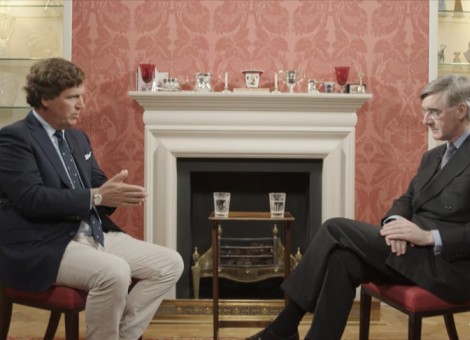
In this heated, wide-ranging interview, Tucker Carlson sits down with Sir Jacob Rees-Mogg at his home to challenge his warning that Britain must prepare for war with Russia. The two clash over Ukraine, NATO, deterrence, Hiroshima and the Second World War, before turning to immigration, sovereignty and the state of free speech in the UK. This interview was premiered on October 2, 2026. Read the full transcript of the interview below:
Why Britain Must Prepare for War
TUCKER CARLSON (00:00:04 – 00:00:15): Mr. Rees-Mogg, thank you very much for having us in your home. It’s really pretty. I’m sad to think of it being destroyed in the war you described. What is this war and why do you have to fight it? Okay.
SIR JACOB REES-MOGG (00:00:16 – 00:00:57): What I’ve said is that the United Kingdom needs to be prepared for war, that we are coming under attack in various ways from Russia. We’ve had murders and attempted murders take place. There was attempted murder in Salisbury and there was a murder that took place in London. By agents of Putin, that Putin has invaded Ukraine and he is making threatening noises, that some Russian people close to the state, not formally of the state, have talked about the potential for nuclear war.
And the way to avoid war is to prepare for it. And if you are prepared for war, it doesn’t happen. So that’s what I’m talking about. It’s the preparedness, which I’m worried that we don’t have.
TUCKER CARLSON (00:00:58 – 00:01:01): Why would Putin want to threaten Britain?
SIR JACOB REES-MOGG (00:01:01 – 00:01:03): Well, he is threatening Britain. Why?
TUCKER CARLSON (00:01:03 – 00:01:03): I wonder why.
SIR JACOB REES-MOGG (00:01:04 – 00:01:12): Why has he tried to poison people in Salisbury? Why have his submarines been poking around near our undersea cables?
TUCKER CARLSON (00:01:12 – 00:01:14): Do you have any sense of why? Why would he want to do that?
SIR JACOB REES-MOGG (00:01:15 – 00:02:02): Well, I think he wishes to reassert the power of Russia, which in many ways is now a failing state, that its economy has been in the doldrums for years since the decline of the Soviet Union. It’s lost a good deal of territory, which is a very un-Russian thing.
That if you go really from the Romanovs taking charge in Russia through to the collapse of the Soviet Union, in most years Russia expands. And then you get the collapse of the Soviet Union and Russia suddenly shrinks. And it seems to me that that is looked upon by some Russians as a matter of shame and against the historic destiny Russia. Hence, of course, the reason for activity in Georgia and more recently in Ukraine.
Russia’s Economy and Ambitions
TUCKER CARLSON (00:02:04 – 00:02:24): Clearly Russia wants some control over its neighbors. It wants a sphere of influence as a nuclear-armed power. But I wonder, and assuming that everything you’re saying is true and we could debate it, it still doesn’t explain why Russia would want to pick a fight with Britain. It’s got a much larger economy than Britain’s by, I think, basically—
SIR JACOB REES-MOGG (00:02:24 – 00:02:29): No, no, no, it hasn’t got a larger economy than Britain’s. It’s got a smaller economy than Britain’s. It’s got a larger military.
TUCKER CARLSON (00:02:30 – 00:02:35): But it’s a much larger economy. It has much more wealth and resources. It has a much larger manufacturing sector.
SIR JACOB REES-MOGG (00:02:35 – 00:02:39): Its GDP is smaller than the UK’s. It’s about 2/3.
TUCKER CARLSON (00:02:39 – 00:02:42): GDP is not, I mean, the only measure of an economy.
SIR JACOB REES-MOGG (00:02:42 – 00:02:44): It’s an important measure of an economy.
TUCKER CARLSON (00:02:44 – 00:02:45): No, the Russians—
SIR JACOB REES-MOGG (00:02:45 – 00:03:12): It’s one measure. Russia is an economic failure. That it could have a huge economy, but it’s got a small economy because it’s deeply corrupt and it hasn’t managed to use its resources effectively.
And so although the population of Russia is bigger than that of the United Kingdom very significantly, its GDP per capita is so much lower that the total GDP of Russia is smaller than that of the United Kingdom.
TUCKER CARLSON (00:03:12 – 00:03:21): Right. Its inherent wealth dwarfs that. Of the UK. It’s the largest country in the world. But leaving aside that, I’m not in charge of central bank policy.
SIR JACOB REES-MOGG (00:03:21 – 00:03:26): Yeah, but inherent wealth isn’t very useful, is it? There are lots of African countries that have huge resources that have never been able to use them.
TUCKER CARLSON (00:03:26 – 00:03:27): It depends what your timeline is.
SIR JACOB REES-MOGG (00:03:28 – 00:03:30): Well, if you go over hundreds of years, they haven’t used them.
TUCKER CARLSON (00:03:31 – 00:03:31): Yeah.
SIR JACOB REES-MOGG (00:03:32 – 00:03:35): Russia has consistently been a poor country in spite of its resources.
TUCKER CARLSON (00:03:35 – 00:03:36): Yeah.
SIR JACOB REES-MOGG (00:03:36 – 00:03:36): Okay.
TUCKER CARLSON (00:03:37 – 00:03:47): I don’t agree, but I will grant you that. Okay. But it still doesn’t explain why Russia would benefit from fighting with the UK. Do you imagine that they want to take your territory?
SIR JACOB REES-MOGG (00:03:48 – 00:04:18): Russia has already shown itself to be aggressive, as we saw with the invasion of Ukraine, which was not only illegal in international law, but also against a specific agreement between Russia, the United States, the UK, and Ukraine that in return for Ukraine giving up its nuclear weapons, Russia and the other signatories would allow its territorial integrity to be maintained.
Ukraine, NATO and the Nuclear Weapons Agreement
TUCKER CARLSON (00:04:18 – 00:04:39): I, we can debate why that war started. I have a completely different view from yours, but I think these are subjective questions. But I feel like we’re avoiding the question I have asked you now 3 times, which is why does any of that add up to Russia threatening the UK?
SIR JACOB REES-MOGG (00:04:39 – 00:04:43): Why do dictators attack. They do because they can.
TUCKER CARLSON (00:04:43 – 00:04:44): But you’re nowhere near Russia.
SIR JACOB REES-MOGG (00:04:44 – 00:04:44): And because they see—
TUCKER CARLSON (00:04:44 – 00:04:45): this is on Belarus.
SIR JACOB REES-MOGG (00:04:46 – 00:05:09): But we have the NATO agreement with Poland, which must feel under attack. We know that the Baltic states feel threatened. We know there have been cyber attacks on the Baltic states. So of course we should be concerned about our fellow NATO members.
And we have Article 5 of NATO, which would then involve us. And we’ve got Russia saying bellicose things about the United Kingdom. So of course we should be—
TUCKER CARLSON (00:05:09 – 00:05:34): do you have any sense of why? I guess it’s— so here’s the point that I’m attempting to make, and I just think it’s important to understand it whether or not you approve of it, which is that from the Russian perspective, you are helping to fund a war against Russia. And so therefore you’re a combatant in that war.
They feel this way about the United States as well, and Germany, NATO. But that is a legitimate perspective. Can you not see that, that there’s a reason that they’re mad at the UK?
SIR JACOB REES-MOGG (00:05:35 – 00:05:37): Russia invaded Ukraine.
TUCKER CARLSON (00:05:37 – 00:05:38): Right. But this is not Ukraine.
SIR JACOB REES-MOGG (00:05:38 – 00:05:43): This is the UK. That’s right. And what the UK is doing is supporting Ukraine and defending its territorial integrity.
TUCKER CARLSON (00:05:43 – 00:05:46): Fighting a war against Russia. So you are participating in a war.
SIR JACOB REES-MOGG (00:05:46 – 00:05:51): This is exactly the same as America helping Kuwait rescue itself from Iraq.
TUCKER CARLSON (00:05:51 – 00:05:54): Right. Except Iraq isn’t— didn’t have nuclear weapons.
SIR JACOB REES-MOGG (00:05:54 – 00:05:56): But do you believe in territorial integrity of nation states?
TUCKER CARLSON (00:05:57 – 00:06:02): In my own, for sure. I’m not sure the territorial integrity of someone else’s state is worth risking my—
SIR JACOB REES-MOGG (00:06:02 – 00:06:03): Even when America has guaranteed it?
TUCKER CARLSON (00:06:04 – 00:06:07): Life for. The question is, should— first of all, can you guarantee it?
SIR JACOB REES-MOGG (00:06:07 – 00:06:17): America did. So do you think that was wrong? Because the quid pro quo was that Ukraine would have kept its nuclear weapons. So you’re saying Ukraine should have kept its nuclear weapons?
TUCKER CARLSON (00:06:17 – 00:06:21): Well, there were many subsequent arrangements that were violated on all sides.
SIR JACOB REES-MOGG (00:06:21 – 00:06:25): But no, this is the fundamental point which you’re trying to get away from. So let me put this back to you.
TUCKER CARLSON (00:06:25 – 00:06:26): Please do.
SIR JACOB REES-MOGG (00:06:26 – 00:06:37): The United States made an agreement with Ukraine, Russia, and the United Kingdom that the territorial integrity of Ukraine would be inviolable on condition that Ukraine gave up its nuclear weapons.
TUCKER CARLSON (00:06:37 – 00:06:42): Oh no, you are mistaken. The United States has never pledged to go to war with Russia.
SIR JACOB REES-MOGG (00:06:42 – 00:06:43): I didn’t say it did.
TUCKER CARLSON (00:06:43 – 00:06:45): Okay, then what you’re saying is immaterial.
SIR JACOB REES-MOGG (00:06:45 – 00:06:49): I said— no, I’m saying it made this agreement with the other parties.
TUCKER CARLSON (00:06:49 – 00:06:52): So there’s a treaty that obligates the United States to fight a war against Russia?
SIR JACOB REES-MOGG (00:06:52 – 00:07:01): No, it doesn’t obligate it to fight a war. Okay, then it’s irrelevant what you’re saying. I’m saying that if you don’t think America has an interest in this. It shouldn’t have signed the treaty, and then Ukraine should have kept its nuclear weapons.
TUCKER CARLSON (00:07:01 – 00:07:09): There is no treaty that obligates the United States— I’m speaking with authority on this— to fight Russia on the basis of what Russia did in February of 2022.
SIR JACOB REES-MOGG (00:07:09 – 00:07:28): I’m well aware of that. I’m well aware of what was said in relation to the nuclear weapons. It is not an agreement to go to war, nor strictly speaking is Article 5 of NATO. It’s not a requirement to go to war. It’s a request that can be ignored. It’s not an automatic act of war, that the member state affected can call upon Article 5.
TUCKER CARLSON (00:07:28 – 00:07:30): I’m aware it doesn’t require an automatic response.
SIR JACOB REES-MOGG (00:07:31 – 00:07:36): But what you’re saying is that this treaty that was signed where Ukraine gave up its nuclear weapons was entirely pointless.
TUCKER CARLSON (00:07:36 – 00:08:05): Well, of course I’m not saying that at all. What I’m saying is there have been many subsequent agreements since, including a verbal agreement which has been testified to by people who were present, that the United States would not expand NATO to Russia’s borders, which is an understandable concern of Russia. You don’t want nuclear weapons controlled by another country on your borders. Why would you?
And so, look, a lot has happened. There was the overthrow of the Ukrainian government by NATO in 2014. A lot has happened.
SIR JACOB REES-MOGG (00:08:05 – 00:08:06): All sorts of things have happened.
TUCKER CARLSON (00:08:06 – 00:08:14): But my only point is, right now we’re on the brink of a nuclear exchange. And the question is why? And I don’t understand why it’s in Britain’s interest to be at war with Russia.
SIR JACOB REES-MOGG (00:08:14 – 00:08:22): What I am arguing is that if we are prepared for war, war becomes less likely. That’s the whole basis of deterrence. It’s the whole reason.
TUCKER CARLSON (00:08:22 – 00:08:25): But if you stop fighting the war, they will be less likely to nuke you.
SIR JACOB REES-MOGG (00:08:26 – 00:08:34): Oh, no, that’s not true. If you don’t support Ukraine, if you allow Russia to take Ukraine, then it moves on to the next object.
TUCKER CARLSON (00:08:34 – 00:08:40): Why is it up to the UK to decide whether or not Russia takes Ukraine?
SIR JACOB REES-MOGG (00:08:40 – 00:08:43): Because it’s strongly in our national interest and indeed of the United States.
TUCKER CARLSON (00:08:43 – 00:08:44): In what way?
SIR JACOB REES-MOGG (00:08:44 – 00:08:57): Because the one fundamental thing of the world order is the integrity of nation states. If all nation states are up for grabs for whichever country wants to take it, then why shouldn’t China take Taiwan tomorrow?
TUCKER CARLSON (00:08:58 – 00:09:02): Well, I don’t know whether the UK can expect—
SIR JACOB REES-MOGG (00:09:02 – 00:09:03): Would you worry to be a part of that?
TUCKER CARLSON (00:09:04 – 00:09:05): I assume that’s going to happen, of course.
SIR JACOB REES-MOGG (00:09:06 – 00:09:08): So you don’t mind nation states being taken?
TUCKER CARLSON (00:09:08 – 00:09:21): I mind a lot of things, but it’s— the question is not simply do I think it’s wrong. The question is, can I do anything about it? And at what cost to my own population? So it’s a much more complicated calculation than the one you’re presenting.
Projecting Strength and the Gulf Wars
SIR JACOB REES-MOGG (00:09:21 – 00:10:01): You can if you project strength. And I’m afraid what the West did towards Russia was protect— project weakness, that the agreements made over the Crimea by Germany and France made it look to Putin that he could do what he wanted. He then miscalculated with Ukraine and found that the West was not going to go along with that. And it’s very important that you don’t allow dictators to miscalculate.
Same is true of Saddam Hussein. Saddam Hussein thought that he had had a message from the CIA, and I’m sure you know all of this, that invading Kuwait would not upset the Americans. And that’s when you project weakness, you make war more likely.
TUCKER CARLSON (00:10:02 – 00:11:31): Well, I think if you truncate the story, you can tell yourself that, but you are truncating the story because that war ended in 1991, the first Gulf War. And then 12 years later, there was another Gulf War in which more than a million people—
SIR JACOB REES-MOGG (00:11:31 – 00:11:33): Okay, on the second Gulf War, I share exactly—
TUCKER CARLSON (00:11:33 – 00:11:34): And now there is—
SIR JACOB REES-MOGG (00:11:34 – 00:11:35): Okay, on the second—
TUCKER CARLSON (00:11:35 – 00:11:43): 22 years later, another Gulf War, and Iran is using Iraq as a staging base to hit the United States. So how did this work?
SIR JACOB REES-MOGG (00:11:43 – 00:11:50): Okay, on the second Gulf War, I share what I think is your view. I think you supported it at the time, but now I think it was a mistake.
TUCKER CARLSON (00:11:50 – 00:11:57): I thought it was a mistake when I went to Iraq in December of 2003. I knew immediately it was a mistake, and I’ve been apologizing ever since. Let me do so again.
SIR JACOB REES-MOGG (00:11:57 – 00:12:07): I apologize. Mistake too. I agree with you that the first Gulf War, I think, was absolutely right because it was about the territorial integrity of nation-states. I think there’s one fundamental—
TUCKER CARLSON (00:12:07 – 00:12:11): Well, if it was right, then how did it result in another war less than 15 years later?
SIR JACOB REES-MOGG (00:12:11 – 00:13:18): Because the other war was none of our business. It was the internal affairs of Iraq on a pretext of nuclear weapons that didn’t exist. But hold on, the 2 wars are completely different.
And actually, the George Bush Senior got it right because he had the opportunity to take Iraq at the end of the first Gulf War. And he said, “No, that is not the objective of this mission.” The objective of the mission was the territorial integrity of Kuwait.
Now, where I think I disagree with you is that the fundamental building block of any form of world order is the nation-state. And that therefore it’s in all our interests to protect the nation-state. Because if aggressors can invade one nation-state and get away with it, they will carry on. And then you’ve got no global order at all.
Where I think we have made a mistake is in liberal interventionism, which I’m opposed to. I think it is not my business how Iraq is managed internally by Iraqis. That is a matter for them. Or how Putin manages Russia.
Putin, Zelensky and Great Power Politics
TUCKER CARLSON (00:13:18 – 00:13:24): Then why do you keep describing Putin as a dictator? As distinct from Zelensky, who has not been elected.
SIR JACOB REES-MOGG (00:13:24 – 00:13:25): Well, he was elected.
TUCKER CARLSON (00:13:25 – 00:13:30): In 7 years. He’s canceled the elections and banned the largest Christian denomination in the country.
SIR JACOB REES-MOGG (00:13:30 – 00:13:31): It would be—
TUCKER CARLSON (00:13:31 – 00:13:34): And imprisoned people for criticizing him. So he’s not addicted.
SIR JACOB REES-MOGG (00:13:34 – 00:13:40): It would be very difficult for me to criticize him on canceling elections. It’s exactly what the UK did during the First and Second World War.
TUCKER CARLSON (00:13:40 – 00:13:45): I’m merely saying, if you’re not a liberal interventionist, why is Putin’s form of government even material? Why do you care?
SIR JACOB REES-MOGG (00:13:45 – 00:13:50): It’s up to him how he governs Russia. It is my business when he starts invading neighboring countries.
TUCKER CARLSON (00:13:50 – 00:14:06): But the question is not whether or not you approve of one nation’s territorial expansion or its need to control its neighbors, which is, by the way, the state of play for all great powers. No country with nuclear weapons will tolerate another nation’s nuclear weapons on its border, of course.
SIR JACOB REES-MOGG (00:14:06 – 00:14:09): Well, that’s the Cuban Missile Crisis. Yes, of course. Yes.
TUCKER CARLSON (00:14:09 – 00:14:15): Well, it’s the current Iran war because Israel, a nuclear-armed power, did not want Iran to have a nuclear weapon. And I’m not criticizing anyone.
SIR JACOB REES-MOGG (00:14:15 – 00:14:18): And this is very sensible. We do not want Iran to have a nuclear weapon.
TUCKER CARLSON (00:14:18 – 00:14:19): I don’t want anyone to have a nuclear weapon.
SIR JACOB REES-MOGG (00:14:19 – 00:14:24): I’m just saying I want Britain to have nuclear weapons and I don’t mind the United States having them. I didn’t want anyone on our trails to have them.
TUCKER CARLSON (00:14:24 – 00:14:29): I’m merely saying that we can’t be surprised by that response because that’s just the nature of great powers.
SIR JACOB REES-MOGG (00:14:30 – 00:14:31): Okay. Yes.
The State of the British Military
TUCKER CARLSON (00:14:31 – 00:14:40): My question is, what can you do about it? So you have said that weakness abets aggression.
SIR JACOB REES-MOGG (00:14:40 – 00:14:40): That’s right.
TUCKER CARLSON (00:14:40 – 00:15:10): Which is an often repeated axiom, which I’m sure is entirely true, but it can’t be true. But what’s your option? So Britain right now has apparently a military strength of under 19,000 ready for combat.
So for perspective, there are battles in the First World War in which Britain lost more than 19,000 in one day. So that’s nothing. Russia has one of the most powerful militaries in the world, a standing army of 1.5 million.
SIR JACOB REES-MOGG (00:15:10 – 00:15:16): Well, that’s not necessarily the same as one of the most powerful militaries in the world, is it? A very large number of troops is not necessarily a powerful army.
TUCKER CARLSON (00:15:16 – 00:15:26): No, it’s not. That’s right. And I’m not— and by the way, it’s hard to know exactly how powerful the Russian military is. It’s very easy to know how powerful the British military is, which is not at all. So what is this?
SIR JACOB REES-MOGG (00:15:26 – 00:15:31): Everyone thought the Russian military was sufficiently powerful that it could roll up Ukraine in a fortnight and it failed.
TUCKER CARLSON (00:15:32 – 00:15:43): Well, they could send hypersonic missiles into Kyiv today and end the war. We’re relying on Putin’s restraint not to do that. They could also nuke Ukraine if they wanted.
SIR JACOB REES-MOGG (00:15:43 – 00:15:45): They could, but that would be—
TUCKER CARLSON (00:15:45 – 00:15:52): I’m just saying, as a material fact, They have restrained themselves to a land war with people.
SIR JACOB REES-MOGG (00:15:52 – 00:15:56): Where they were thought to be overwhelmingly powerful. And they’ve turned out not to be.
TUCKER CARLSON (00:15:56 – 00:16:01): Well, they could be overwhelmingly powerful if they wanted to. Like this afternoon, they decided not to.
SIR JACOB REES-MOGG (00:16:01 – 00:16:03): Well, if they used nuclear weapons, but without—
TUCKER CARLSON (00:16:03 – 00:16:05): They used hypersonic weapons, which can’t be stopped.
SIR JACOB REES-MOGG (00:16:05 – 00:16:14): If they took it up to an enormous stage. But actually, in 2022, people thought Russia would walk in and roll up Ukraine within a fortnight. That was all the expert predictions.
TUCKER CARLSON (00:16:14 – 00:16:19): Do you disagree that they could if they wanted to today? End this war? Of course they could.
SIR JACOB REES-MOGG (00:16:19 – 00:16:23): Well, I think if they took it to another level, they would risk—
TUCKER CARLSON (00:16:23 – 00:16:28): Maybe if you keep pushing them, they’ll do it. And maybe that’s the basis of this conversation, which is why are you pushing them to that point?
SIR JACOB REES-MOGG (00:16:28 – 00:16:37): No, I’m not pushing them. I’m pushing us to be prepared because they are making attacks on the West. And we know this. They are making cyberattacks. They are making—
TUCKER CARLSON (00:16:37 – 00:16:45): But do you see a connection between what the West is doing and Russia’s attacks on the West? Or is this just— What would be the other explanation for why they’re doing this?
SIR JACOB REES-MOGG (00:16:46 – 00:16:58): I actually think the reason for Russia going into Ukraine What allowed them to do it was our weakness earlier over the Crimea. And that made it look as if we didn’t really care. And then it turned out that we did care.
TUCKER CARLSON (00:16:59 – 00:17:01): I never cared, for the record, at all.
SIR JACOB REES-MOGG (00:17:01 – 00:17:01): Okay.
TUCKER CARLSON (00:17:02 – 00:17:03): So that’s my position.
SIR JACOB REES-MOGG (00:17:03 – 00:17:20): But you see, I cared because we had signed a treaty about the nuclear weapons being given up by Ukraine, as had your country. And that as it was overwhelmingly in our interests, Expect you to agree with this, for Ukraine not to be a nuclear power. We didn’t want small—
TUCKER CARLSON (00:17:20 – 00:17:25): You keep referring to an event from 35 years ago that is one small part of a long saga.
SIR JACOB REES-MOGG (00:17:25 – 00:17:33): No, no, no. This is fundamental because Russia would not have invaded Ukraine if Ukraine had kept its nuclear weapons.
TUCKER CARLSON (00:17:33 – 00:17:41): Well, Ukraine being the most corrupt country in Europe might have already sold those nuclear weapons to bad actors around the world, which is one of the reasons that the United States forced them to get rid of them.
SIR JACOB REES-MOGG (00:17:41 – 00:17:41): That’s not true.
TUCKER CARLSON (00:17:41 – 00:17:42): I was there for this.
SIR JACOB REES-MOGG (00:17:42 – 00:17:43): I remember this very well. I’m not denying that.
TUCKER CARLSON (00:17:43 – 00:17:43): Right.
SIR JACOB REES-MOGG (00:17:43 – 00:17:47): I’m not denying that Ukraine has had enormous corruption and still does.
TUCKER CARLSON (00:17:47 – 00:17:52): I’m saying that’s why the rest of the world felt Ukraine could not be trusted, not because we didn’t want them to have sovereignty, but because—
SIR JACOB REES-MOGG (00:17:52 – 00:18:04): we wanted to protect their sovereignty and for them not to have nuclear weapons because we didn’t want smaller states to have nuclear weapons. We could live with Russia and China and India and Pakistan and Israel and the UK and France having nuclear weapons, but we didn’t want—
TUCKER CARLSON (00:18:04 – 00:18:07): but I feel like we’re at a cul-de-sac right now.
SIR JACOB REES-MOGG (00:18:07 – 00:18:42): This is fundamental because you have to go back to why is it in our interest for Ukraine’s territorial integrity to be maintained? First of all, because the nation-state is the fundamental of global order. Without the nation-state, there is no global order. I’m not an internationalist.
And then there is the issue of, is America’s word worth anything? Do you have an interest if you persuade a state to give up nuclear weapons and say that you believe its territorial integrity should be maintained and you are a signatory to that treaty? Does that matter? Or do you just sign these things?
TUCKER CARLSON (00:18:42 – 00:18:45): We have never signed a treaty obligating—
SIR JACOB REES-MOGG (00:18:45 – 00:18:46): I know you signed one before.
TUCKER CARLSON (00:18:46 – 00:18:47): Well, we haven’t.
SIR JACOB REES-MOGG (00:18:47 – 00:18:48): I’m well aware of that.
TUCKER CARLSON (00:18:48 – 00:18:49): And you keep pretending that we have. So we have no—
SIR JACOB REES-MOGG (00:18:49 – 00:18:51): I haven’t. You’re not listening.
TUCKER CARLSON (00:18:51 – 00:18:52): No obligation to keep—
SIR JACOB REES-MOGG (00:18:52 – 00:19:00): You seem to be devoid of nuance, that the 2 questions are not the same. Just because you’ve signed a treaty does not automatically commit you to fighting a war.
TUCKER CARLSON (00:19:01 – 00:19:05): But the treaty doesn’t suggest the course of action that you’re suggesting. So the treaty is immaterial to this.
SIR JACOB REES-MOGG (00:19:05 – 00:19:06): The treaty is pretty important.
TUCKER CARLSON (00:19:06 – 00:19:08): Here’s what I’m saying. Let me ask you this question.
SIR JACOB REES-MOGG (00:19:08 – 00:19:10): It gives you an interest in the territorial integrity of Ukraine.
TUCKER CARLSON (00:19:10 – 00:19:25): Let me ask you this question. There’s a hierarchy of responsibility that a nation and an individual faces. We’ve got all kinds of obligations, but we have to put them in order of importance. And you seem to be suggesting that a nation’s obligation is to something called the international order.
SIR JACOB REES-MOGG (00:19:27 – 00:19:27): No.
TUCKER CARLSON (00:19:27 – 00:19:29): Over and above the interests of its own populace.
SIR JACOB REES-MOGG (00:19:29 – 00:19:35): No, I don’t agree. No, that’s not what I’ve said. The national interest is my biggest concern.
TUCKER CARLSON (00:19:35 – 00:19:35): Okay.
SIR JACOB REES-MOGG (00:19:35 – 00:19:40): And the national interest is served overwhelmingly by the integrity of nation states.
Welfare Spending vs. Defense Spending
TUCKER CARLSON (00:19:40 – 00:19:42): Do you have majority support for war with Russia here in the UK?
SIR JACOB REES-MOGG (00:19:42 – 00:19:43): Majority support for what?
TUCKER CARLSON (00:19:44 – 00:19:44): A war with Russia.
SIR JACOB REES-MOGG (00:19:45 – 00:19:46): Nobody wants to go to war with Russia.
TUCKER CARLSON (00:19:46 – 00:19:46): Okay.
SIR JACOB REES-MOGG (00:19:47 – 00:19:54): But that’s why there is increasing support in this country for building up our military so that we are able to defend ourselves.
TUCKER CARLSON (00:19:54 – 00:19:55): How would you do that?
SIR JACOB REES-MOGG (00:19:55 – 00:19:58): Well, you just spend more money on it. You recruit more soldiers.
TUCKER CARLSON (00:19:58 – 00:21:20): So if you go from a fighting force of under 19,000, which is bigger than Estonia’s, which is 5,000, but still somewhat less than the 3.5 million in the Russian army, how much would that cost and where would the money come from?
SIR JACOB REES-MOGG (00:21:20 – 00:21:28): Well, there’s plenty of money. We’re just spending it all on welfare at the moment. We’re about to spend £400 billion a year on welfare.
TUCKER CARLSON (00:21:28 – 00:21:30): On welfare? Specifically, what do you mean by welfare?
SIR JACOB REES-MOGG (00:21:30 – 00:21:39): Welfare benefits people who are out of work. Some of that’s on pensions. But our welfare benefit system has been ballooning. If we could take even a part of that—
TUCKER CARLSON (00:21:39 – 00:21:42): And you could spend that on bombs. So what are you doing? That’s a fair point.
SIR JACOB REES-MOGG (00:21:42 – 00:21:57): Right. We’ve got a crazy welfare system. I mean, this country is not being well run. We are spending much more money than we have. And our defense spending is pitifully low. It’s even lower than it seems because we’re at 2.7% of GDP.
TUCKER CARLSON (00:21:57 – 00:22:00): Is there a public demand for more defense spending?
SIR JACOB REES-MOGG (00:22:00 – 00:22:02): The public is getting increasingly worried. The world is getting—
TUCKER CARLSON (00:22:02 – 00:22:12): Do you think that the average Briton, if given the choice between food and housing assistance or unemployment benefits, would instead choose to forego those in favor of more bombs?
SIR JACOB REES-MOGG (00:22:12 – 00:22:16): I think the country at large is deeply fed up with people on welfare who have made it—
TUCKER CARLSON (00:22:16 – 00:22:16): I bet that’s true.
SIR JACOB REES-MOGG (00:22:16 – 00:22:17): Who have made it a lifestyle choice.
TUCKER CARLSON (00:22:17 – 00:22:21): I bet that’s true. But do you think if you put it up to a vote, a national referendum—
SIR JACOB REES-MOGG (00:22:21 – 00:22:23): I think you would find that people want defense.
TUCKER CARLSON (00:22:24 – 00:22:27): And they’d be willing to reduce social spending.
SIR JACOB REES-MOGG (00:22:27 – 00:22:42): I think they want to reduce social spending anyway. Okay, I think they might rather have the social spending in tax cuts, but people are deeply fed up. Do you know in this country there are 6 million wonderful people who we should really admire who work even though they would be better off on benefits?
TUCKER CARLSON (00:22:43 – 00:22:58): Oh, I’m aware. I would never defend your disease tax cut. This is just crazy. No, I’m in full agreement with you. The question is, should you take that dividend, that savings, and spend it on a pointless war that you can’t possibly win that will only get your citizens killed?
SIR JACOB REES-MOGG (00:22:58 – 00:23:00): We won’t fight a war if we are defended.
TUCKER CARLSON (00:23:01 – 00:23:08): So to what extent would you have to increase the size of your military to intimidate Russia, which possesses nuclear and hypersonic weapons?
SIR JACOB REES-MOGG (00:23:08 – 00:23:13): Putin— it’s not a question of intimidating. We’re not trying to intimidate Russia because we wouldn’t succeed in intimidating Russia.
TUCKER CARLSON (00:23:13 – 00:23:15): Now I’m totally confused.
SIR JACOB REES-MOGG (00:23:15 – 00:23:17): It’s a question of being taken seriously.
TUCKER CARLSON (00:23:17 – 00:23:18): What’s the difference?
SIR JACOB REES-MOGG (00:23:18 – 00:23:22): Putin did not take Ukraine seriously. He thought he could invade it and take it over very quickly.
TUCKER CARLSON (00:23:22 – 00:23:28): What’s the difference between intimidating someone and being taken seriously? I thought They’re identical concepts, aren’t they?
SIR JACOB REES-MOGG (00:23:28 – 00:23:29): No, I don’t think they are. Intimidation—
TUCKER CARLSON (00:23:29 – 00:23:30): They’ll just be impressed by your resolve?
SIR JACOB REES-MOGG (00:23:31 – 00:23:35): Intimidation is throwing— is suggesting that you are intending to be aggressive.
TUCKER CARLSON (00:23:35 – 00:23:37): It’s suggesting there’s a penalty for messing with you.
SIR JACOB REES-MOGG (00:23:37 – 00:23:46): That’s right. No, I don’t think that is right. I think intimidating is showing that you want to be aggressive, whereas showing resolve—
TUCKER CARLSON (00:23:46 – 00:23:48): Scaring someone off. “I’m armed, back off.”
SIR JACOB REES-MOGG (00:23:48 – 00:23:51): “I’m armed, so it’s not in your interests to do anything.”
TUCKER CARLSON (00:23:51 – 00:23:53): That’s okay. So we’re saying the same thing.
SIR JACOB REES-MOGG (00:23:53 – 00:23:55): We’re saying broadly the same, but possibly— I don’t think it is intimidating.
TUCKER CARLSON (00:23:55 – 00:23:56): You’re using different forms of English.
SIR JACOB REES-MOGG (00:23:56 – 00:23:58): Because we’re not going to intimidate Russia. I understand. Or do we want—
TUCKER CARLSON (00:23:58 – 00:24:08): But you’re going to— you want to tell Russia, “If you mess with the UK, it’s just not worth it. We’re scary enough that go pick on someone else.” That’s—
SIR JACOB REES-MOGG (00:24:08 – 00:24:09): Well, ideally, don’t pick on anybody.
TUCKER CARLSON (00:24:10 – 00:24:22): But how much do you think you would, from the condition of the British military right now, how much would you have to spend? How many people would have to join the British military in order to have that effect on Russia?
SIR JACOB REES-MOGG (00:24:23 – 00:24:34): Well, it’s a question of building up our overall defense expenditure. The interim target is 3.5% of GDP, whether that’s enough It’s highly debatable, but it’s much more about equipment than it is about numbers.
TUCKER CARLSON (00:24:35 – 00:24:38): Okay, so you wouldn’t have to have a larger fighting force then?
SIR JACOB REES-MOGG (00:24:38 – 00:24:50): I’d be very surprised if you needed it, but it’s not going to be a war on British soil. Russia is not going to invade Britain. It’s got a long way to go to get here. It’s a question about working—
Deterrence and Nuclear Weapons
TUCKER CARLSON (00:24:50 – 00:24:53): But it could take out your capital city instantly.
SIR JACOB REES-MOGG (00:24:53 – 00:25:01): It could, but then we could take out Moscow. I mean, if you want to get to nuclear war, but the reason we don’t get to nuclear war is that both sides are armed.
TUCKER CARLSON (00:25:02 – 00:25:06): So you’re totally convinced that Russia would never use nuclear weapons under any circumstances offensively?
SIR JACOB REES-MOGG (00:25:07 – 00:25:09): One could never go that far. The whole point of—
TUCKER CARLSON (00:25:09 – 00:25:16): Well, both Russia and the United States, President Trump, are both openly threatening to use offensive nuclear weapons.
SIR JACOB REES-MOGG (00:25:17 – 00:25:19): Both to use tactical nuclear weapons at the moment.
TUCKER CARLSON (00:25:19 – 00:25:22): Low-yield nuclear weapons. They’re the same thing.
SIR JACOB REES-MOGG (00:25:23 – 00:25:49): And the reason the Cold War strategy worked is because deterrence work. But to make deterrence work, you have to be strong. And there is no deterrent, really, if you go from step one to nuclear weapons in one fell swoop.
If your only real defense, if Russia does something in Poland or Estonia, is to go to nuclear war, nobody’s going to take you seriously on that. No one’s going to go from—
TUCKER CARLSON (00:25:49 – 00:25:53): no one’s going to take you seriously if you use a nuclear weapon? I think people take you very seriously.
SIR JACOB REES-MOGG (00:25:53 – 00:25:57): No, no, no, they’re not going to take you seriously that you would use a nuclear weapon because it wouldn’t be proportionate.
TUCKER CARLSON (00:25:58 – 00:25:59): So tell me how this plays out.
SIR JACOB REES-MOGG (00:25:59 – 00:26:17): You’ve got to have the interim levels of defense as well. You can’t just go from, “We’re all pacifists, but if you really do something nasty, we’ll nuke you,” because nobody will believe that you would use the nuclear bomb in those circumstances. Because the level of aggression would not be high enough.
TUCKER CARLSON (00:26:17 – 00:26:27): So you’ve got to have— Would it be worth using a nuclear weapon against Russia to preserve the world order and to deter territorial aggression against sovereign states like Ukraine?
SIR JACOB REES-MOGG (00:26:27 – 00:26:46): I think ultimately nuclear weapons serve a very useful purpose as being the final threat. Useful in what way? To what end? Useful in that the whole Cold War strategy worked Russia and America did not go to war because both sides realized that the other could wipe them out.
Hiroshima, Nagasaki and Just War Theory
TUCKER CARLSON (00:26:47 – 00:26:53): Right. They talked about using nuclear weapons, but is using nuclear— the actual use of nuclear weapons, is that ever justified?
SIR JACOB REES-MOGG (00:26:53 – 00:26:59): I think justified in Hiroshima and Nagasaki, yes. I think it was justified in bringing the Second World War to an end. Yes, unquestionably.
TUCKER CARLSON (00:27:00 – 00:27:00): Unquestionably justified?
SIR JACOB REES-MOGG (00:27:00 – 00:27:04): Unquestionably, yes. I thought the number of lives—
TUCKER CARLSON (00:27:04 – 00:27:06): So it’s justified to kill people who did nothing wrong?
SIR JACOB REES-MOGG (00:27:08 – 00:27:10): Well, we’re not talking about people who did nothing wrong.
TUCKER CARLSON (00:27:10 – 00:27:17): The Japanese ruled— populations of crowded cities are not responsible for the war. Women and children getting destroyed.
SIR JACOB REES-MOGG (00:27:17 – 00:27:23): We were in a state of total war. Okay, well, I think we were not in a state of total war, actually.
TUCKER CARLSON (00:27:23 – 00:27:26): There were no Japanese troops on American soil. We were not in a state of total war.
SIR JACOB REES-MOGG (00:27:26 – 00:27:32): They had attacked American soil 4 years before, and then they were losing.
TUCKER CARLSON (00:27:32 – 00:27:43): But we were not in a state of total war. And But I’m asking you a theological question, which is, is it ever allowed under the precepts of, say, Christianity to kill people who did nothing wrong, to kill women and children?
SIR JACOB REES-MOGG (00:27:43 – 00:27:46): Does it meet Aquinas’s test of a just war?
TUCKER CARLSON (00:27:46 – 00:27:46): It does not.
SIR JACOB REES-MOGG (00:27:47 – 00:27:47): I think it does.
TUCKER CARLSON (00:27:47 – 00:27:48): How?
SIR JACOB REES-MOGG (00:27:48 – 00:27:59): Well, are you a legitimate authority? Yes, you are. Is it an important cause? Yes, because you have been attacked and you’re defending yourself. And is it proportionate? Yes, because it actually shortens the duration of the war.
TUCKER CARLSON (00:28:00 – 00:28:09): That’s not the definition of proportionate. Proportionate means that you’re responding in a way that is not grandly larger than the initial attack.
SIR JACOB REES-MOGG (00:28:09 – 00:28:10): The overall—
TUCKER CARLSON (00:28:10 – 00:28:12): in other words, if you punch me in the face, I can’t shoot you.
SIR JACOB REES-MOGG (00:28:13 – 00:28:18): The— yes, but this is different means of killing people.
TUCKER CARLSON (00:28:19 – 00:28:20): But I’m zeroing in on—
SIR JACOB REES-MOGG (00:28:20 – 00:28:23): you’re not talking about a punch in the face. You’re talking about, is it legitimate that I—
TUCKER CARLSON (00:28:23 – 00:28:27): I’m talking about killing people’s kids. I have nothing to do with it. That’s okay because why?
SIR JACOB REES-MOGG (00:28:27 – 00:28:28): We are at war with the whole country.
TUCKER CARLSON (00:28:29 – 00:28:30): We’re at war with the kids?
SIR JACOB REES-MOGG (00:28:30 – 00:28:34): And it ended the war. Yes. Japan was at war with the United States and the United Kingdom.
TUCKER CARLSON (00:28:34 – 00:28:38): So if another nation says they’re at war with us, it’s okay to kill our kids?
SIR JACOB REES-MOGG (00:28:39 – 00:28:42): Well, we don’t want to be at war with other nations.
TUCKER CARLSON (00:28:42 – 00:28:45): No, I’m asking an abstract question. But you’re asking a ridiculous question.
SIR JACOB REES-MOGG (00:28:47 – 00:28:49): Japan had attacked the United States.
TUCKER CARLSON (00:28:49 – 00:28:51): I don’t think its kids attacked the United States.
SIR JACOB REES-MOGG (00:28:51 – 00:28:52): Had started a war.
TUCKER CARLSON (00:28:52 – 00:28:53): Why not kill the people who started the war?
SIR JACOB REES-MOGG (00:28:55 – 00:29:03): Well, we did in the end. We, the Japanese prime minister tried to commit suicide and we spent ages getting him back to good health.
TUCKER CARLSON (00:29:03 – 00:29:08): We also killed tens of thousands of children in Hiroshima and Nagasaki. And you’re saying that’s okay?
SIR JACOB REES-MOGG (00:29:08 – 00:29:12): I think it was justified. I think the use of nuclear weapons at the end of the Second World War—
TUCKER CARLSON (00:29:12 – 00:29:18): So what you’re saying as a Christian is, yes, it is okay to kill children who did nothing wrong.
SIR JACOB REES-MOGG (00:29:18 – 00:29:19): It was a proportionate response.
TUCKER CARLSON (00:29:19 – 00:29:21): Do you feel that that is a Christian position?
SIR JACOB REES-MOGG (00:29:21 – 00:29:24): Yes. I think it meets Aquinas’s conditions of a just war.
TUCKER CARLSON (00:29:26 – 00:29:39): Really? Has any pope since Aquinas confirmed that? Have there been any papal statements saying, “Yes, under certain circumstances it’s okay to kill other people’s kids”?
SIR JACOB REES-MOGG (00:29:39 – 00:29:44): The church has preached for centuries that there are conditions of a just war.
TUCKER CARLSON (00:29:45 – 00:29:56): I don’t think there’s any statement since 1945 from— and I’m not Catholic, so I’m not an expert, but you are. So you tell me, there’s— as a Catholic, you think that the church endorses killing people’s kids?
SIR JACOB REES-MOGG (00:29:56 – 00:30:03): Since 1945, there’s only been one explicitly ex cathedra statement by the Holy See, by the Holy Father.
TUCKER CARLSON (00:30:06 – 00:30:17): I guess the question is, if you are willing to kill noncombatants who committed no crime, if you’re willing to murder the innocent, then in what sense are you better than the people you are fighting?
SIR JACOB REES-MOGG (00:30:19 – 00:30:25): That once a war is engaged with— the whole point of what I’m talking about, to go back to the opening part of your question—
TUCKER CARLSON (00:30:25 – 00:30:26): Can you finish the thought?
SIR JACOB REES-MOGG (00:30:26 – 00:30:35): I will come back to it because it’s to avoid war. And you avoid war by being strong. Once you’re in war, you are justified in winning the war.
TUCKER CARLSON (00:30:35 – 00:30:38): So you can behave like an animal once the war starts.
SIR JACOB REES-MOGG (00:30:38 – 00:30:44): If the risk to you is sufficient, you can use nuclear weapons. I think that is morally justifiable.
TUCKER CARLSON (00:30:44 – 00:30:57): I mean, even leaving aside the details of America’s use of those 2 bombs, there was no risk to the United States. Japan was in no condition to invade the United States. It had never put troops on our shores. So there was no risk.
SIR JACOB REES-MOGG (00:30:57 – 00:30:59): It attacked you, but it wasn’t likely to put troops on our shores.
TUCKER CARLSON (00:30:59 – 00:31:01): It attacked a territory, right?
SIR JACOB REES-MOGG (00:31:01 – 00:31:03): And which is bad. Well, it attacked a state.
TUCKER CARLSON (00:31:03 – 00:31:04): It was not a state.
SIR JACOB REES-MOGG (00:31:04 – 00:31:06): It wasn’t a state then. Of course, you’re quite right.
TUCKER CARLSON (00:31:06 – 00:31:11): In December ’40. But the point is, we were not at risk from an invasion by Japan. In any sense.
SIR JACOB REES-MOGG (00:31:12 – 00:31:12): Okay.
TUCKER CARLSON (00:31:12 – 00:31:14): It was a defeated nation. We already firebombed Tokyo.
SIR JACOB REES-MOGG (00:31:14 – 00:31:15): Yes.
TUCKER CARLSON (00:31:15 – 00:31:16): Multiple times.
SIR JACOB REES-MOGG (00:31:17 – 00:31:21): So you see, that’s where— do you think the firebombing of Tokyo was justified?
TUCKER CARLSON (00:31:21 – 00:31:53): I don’t think killing the innocent is ever justified under any circumstances. And I think the basis of Western civilization is justice for the individual. I believe that blood guilt and group punishment are antithetical to our entire civilization. They’re the things we fight against. Yeah, that’s why the Gulag was wrong. That’s why what’s happening in Gaza is wrong.
It’s always wrong to kill people who did nothing wrong. And if we don’t think that, then on what basis are we administering our own justice systems that take such exquisite care to punish only the guilty? I don’t even understand what you’re saying.
Was the Second World War Worth Fighting?
SIR JACOB REES-MOGG (00:31:54 – 00:31:58): I think it’s very difficult to have fought the Second World War without innocent people being killed.
TUCKER CARLSON (00:31:58 – 00:32:03): I don’t know. No one tried. But maybe— I never understood why fight the Second World War in the first place.
SIR JACOB REES-MOGG (00:32:04 – 00:32:07): Well, that’s a very fundamental question.
TUCKER CARLSON (00:32:07 – 00:32:08): Well, how about the First World War?
SIR JACOB REES-MOGG (00:32:09 – 00:32:10): Well, let’s stick to the Second World War.
TUCKER CARLSON (00:32:10 – 00:32:11): No, let’s start with the first, which was—
SIR JACOB REES-MOGG (00:32:11 – 00:32:17): we were on the second. The Second World War, Hitler would have taken as much as he could have done.
TUCKER CARLSON (00:32:17 – 00:32:18): Okay.
SIR JACOB REES-MOGG (00:32:18 – 00:32:20): As he was showing. And did you really want him—
TUCKER CARLSON (00:32:21 – 00:32:31): well, Hitler said that 15% of Poland was once Germany and it was given to Poland at the Treaty of Versailles. That was German territory with Germans. That was his case. And by the way, that was true.
SIR JACOB REES-MOGG (00:32:32 – 00:32:35): Except the Polish borders had been cut up.
TUCKER CARLSON (00:32:35 – 00:33:04): I’m not here to— I’m just saying the idea that Hitler just randomly rolled into Poland is a lie, and everyone believes it because they know nothing about the actual facts. But the truth is Germany had big pieces of it carved off, including part of Prussia, and it was given to this other country. It infuriated the Germans. Maybe it shouldn’t have, but it did, and that was a justification for it.
The UK had nothing to do with it at all. And they destroyed their empire and their country fighting this war that they still pretend was a good idea. But it wasn’t.
SIR JACOB REES-MOGG (00:33:04 – 00:33:08): It was fundamental. It was the classic good versus evil.
TUCKER CARLSON (00:33:09 – 00:33:10): Has the UK benefited from it?
SIR JACOB REES-MOGG (00:33:11 – 00:33:12): We did the right thing.
TUCKER CARLSON (00:33:12 – 00:33:13): Is it a better country than it was?
SIR JACOB REES-MOGG (00:33:14 – 00:33:15): To have defeated Hitler? Yes.
TUCKER CARLSON (00:33:15 – 00:33:18): So the UK is a better country now. It’s a healthier country now.
SIR JACOB REES-MOGG (00:33:18 – 00:33:20): Otherwise we’ll be speaking German.
TUCKER CARLSON (00:33:21 – 00:33:27): Who cares? There are a lot of people in Britain who can’t speak English. So it would be nice to have at least a European language spoken in your country.
SIR JACOB REES-MOGG (00:33:28 – 00:33:33): No, I see no advantage speaking German over any other language. We want to speak English. Thank you so much.
TUCKER CARLSON (00:33:34 – 00:33:44): But the point is, a war should benefit— if a war is fought with the children of your citizens, which it is, then that war should benefit those citizens.
SIR JACOB REES-MOGG (00:33:44 – 00:33:46): And it did benefit. In what ways benefited this country?
TUCKER CARLSON (00:33:47 – 00:33:47): Can you tell me how?
SIR JACOB REES-MOGG (00:33:47 – 00:33:52): But as I said to you, otherwise Germany would eventually have invaded us. So you, Germany—
TUCKER CARLSON (00:33:53 – 00:33:59): we’ve had 80 years to assess. Tell me the benefits now, sitting 80 years later as the grandson of, I’m certain, people who fought in that war. I am.
SIR JACOB REES-MOGG (00:34:00 – 00:34:06): Well, my grandfather was too old. He was in the First World War, not the Second World War. My father was too young, so we sort of missed a generation.
TUCKER CARLSON (00:34:07 – 00:34:26): I’m saying, now that we’ve had it, and as a lover of history, why don’t you tell me the ways in which Britain benefited from— I’m going to use air quotes here— “winning” the Second World War? Because from my perspective, it looks like the empire ended, India was lost 2 years later, the United States took over the world and has had troops here ever since.
SIR JACOB REES-MOGG (00:34:26 – 00:34:26): Yes.
TUCKER CARLSON (00:34:26 – 00:34:31): You lost your sovereignty and your self-respect, and this beautiful country, we certainly have been destroyed.
SIR JACOB REES-MOGG (00:34:31 – 00:34:42): We certainly didn’t lose our self-respect over winning the war. I mean, in terms of self-respect, though, that’s a rather ethereal benefit. Our self-respect was hugely maintained by defeating the greatest evil the world has known.
Sovereignty, NATO and Foreign Troops
TUCKER CARLSON (00:34:43 – 00:34:46): Then why would you allow foreign troops on your soil ever since?
SIR JACOB REES-MOGG (00:34:46 – 00:34:47): Because we wanted to stop the Russians.
TUCKER CARLSON (00:34:50 – 00:34:55): Okay, but I mean, it’s kind of a prerequisite of sovereignty and self-respect not to have foreign soldiers on your soil for 80 years.
SIR JACOB REES-MOGG (00:34:56 – 00:34:58): They’re allies. We’re in NATO together.
TUCKER CARLSON (00:34:58 – 00:35:01): Call them whatever you want, but there’s foreigners on your soil.
SIR JACOB REES-MOGG (00:35:01 – 00:35:23): Yeah, they’re very welcome here. I know, but they’re part of defending our shared interest, which we have, and our shared interest is the nation-state and maintaining its integrity and not having people thinking because there was a treaty some hundreds of years ago and Poland once had a bit of it that was Germany, we can now say we’re going to take it. I’m merely saying we cannot allow—
TUCKER CARLSON (00:35:24 – 00:35:29): You use the phrase nation-state, but it has no meaning if the nation-state has no sovereignty.
SIR JACOB REES-MOGG (00:35:29 – 00:35:30): This nation-state has sovereignty.
TUCKER CARLSON (00:35:30 – 00:35:32): How can it have sovereignty when it has foreign troops on its soil?
SIR JACOB REES-MOGG (00:35:33 – 00:35:39): We were able to pull out of the European Union. That showed as an exercise in sovereignty. You—
TUCKER CARLSON (00:35:40 – 00:35:53): well, that’s a whole thing. I was on your side there, and I feel so sad about what happened. But my point is, if you don’t have sovereignty, if you can’t make decisions that are rooted in the core interests of your own population, then how are you a nation state?
SIR JACOB REES-MOGG (00:35:53 – 00:35:56): But we do make interests that are in the core interests of our population.
TUCKER CARLSON (00:35:56 – 00:35:59): Well, you’re just telling me that you may need to prepare for a war.
SIR JACOB REES-MOGG (00:35:59 – 00:35:59): Yes.
TUCKER CARLSON (00:36:00 – 00:36:03): On behalf of the territorial integrity of Ukraine.
SIR JACOB REES-MOGG (00:36:03 – 00:36:11): And why is that in our interest? Because if the territorial integrity of nation states is protected, there’s much less need for us to go to war.
Immigration and the Nation-State
TUCKER CARLSON (00:36:11 – 00:36:18): But what about your own territorial integrity? Aren’t you getting invaded by people in boats all the time? Why don’t you use the military to protect your own borders?
SIR JACOB REES-MOGG (00:36:18 – 00:36:23): Oh, look, I’m not going to disagree with you on that. We should definitely be much—
TUCKER CARLSON (00:36:23 – 00:36:29): But you’re not calling for conscription or defense buildup or 3% of GDP to go to a military response to an invasion of your own country.
SIR JACOB REES-MOGG (00:36:29 – 00:36:34): I think you can do it without a military response. Why? I think the Rwanda scheme would have worked.
TUCKER CARLSON (00:36:35 – 00:36:44): No, but why not? If you’re so willing to commit military force and lives of Britons to defending Ukraine, why not commit them to defending your own country?
SIR JACOB REES-MOGG (00:36:44 – 00:36:48): Because the small boats is a civil matter rather than a military matter.
TUCKER CARLSON (00:36:49 – 00:36:52): Really? What percentage of your population is foreign-born?
SIR JACOB REES-MOGG (00:36:52 – 00:36:53): 19%.
TUCKER CARLSON (00:36:53 – 00:36:56): 19%. How— what was the percentage 20 years ago?
SIR JACOB REES-MOGG (00:36:56 – 00:36:57): It was about 8%. Okay.
TUCKER CARLSON (00:36:58 – 00:37:00): What was the percentage 40 years ago? It was 2%.
SIR JACOB REES-MOGG (00:37:00 – 00:37:07): So, okay, look, I think our immigration policies have been catastrophic. I think we’ve got it hopelessly wrong.
TUCKER CARLSON (00:37:07 – 00:37:11): But it’s not immigration, it’s an invasion. And so why not use the military?
SIR JACOB REES-MOGG (00:37:11 – 00:37:29): Because actually the small boats is not the biggest part of it. The biggest part of it, which is now coming down thankfully but needs to be reduced much further, is legal immigration. But you’ve also got the problem of visa overstaying, which is a massive problem, and we don’t even know the details of it.
TUCKER CARLSON (00:37:29 – 00:37:35): So you’re already admitting that you’re not a nation-state? That’s not because you can’t control who comes in and out of your own country.
SIR JACOB REES-MOGG (00:37:35 – 00:37:40): No, no, what I’m saying is that there are failures in the administration. Every country has—
TUCKER CARLSON (00:37:40 – 00:37:41): how do we define nation-state?
SIR JACOB REES-MOGG (00:37:41 – 00:38:04): Well, let’s deal with the first point first. Every nation has crime that takes place in it. This is crime that is taking place in this country. This is civilian crime. It’s not military crime.
There are things you can do, as Donald Trump has shown, you can get a grip on the new flow of illegal migrants. It turns out even in America, it’d be very difficult to remove the illegal migrants who are already there.
TUCKER CARLSON (00:38:04 – 00:38:05): Well, we’re not even trying.
SIR JACOB REES-MOGG (00:38:06 – 00:38:06): Well, there you go.
TUCKER CARLSON (00:38:06 – 00:38:07): Just for the record.
SIR JACOB REES-MOGG (00:38:07 – 00:38:12): Okay, well, that’s— I’m glad you said that because it’s not for me to make any disclaimers.
TUCKER CARLSON (00:38:12 – 00:38:16): The UK is not alone in lacking self-respect or the willingness to protect itself.
SIR JACOB REES-MOGG (00:38:16 – 00:38:24): It doesn’t stop you being a nation-state, but we have a serious political problem of immigration which we need to deal with, and particularly of illegal immigration, and we need to be deporting people. But I’m just not sure what a nation-state is.
TUCKER CARLSON (00:38:26 – 00:38:42): Is because the countries that you have described, Ukraine specifically, which has been completely controlled by NATO and the United States and the US intel agencies since at least 2014, and we know that, it’s on tape. How is that a nation state? That’s a proxy state. That’s a country controlled by a larger power.
SIR JACOB REES-MOGG (00:38:42 – 00:39:00): Very interestingly, I think you make a very important point about Ukraine. Ukraine was to a significant extent in 2022 still Russian speaking. Putin has created a strong feeling of Ukrainianism by his attack.
TUCKER CARLSON (00:39:00 – 00:39:01): Oh, sure. Yeah.
SIR JACOB REES-MOGG (00:39:02 – 00:39:05): And has strengthened Ukraine as a nation state. It’s a very interesting side effect.
TUCKER CARLSON (00:39:05 – 00:39:28): That may be right. But I’m merely saying the pretense that Ukraine is this sovereign country when it’s controlled by larger powers is grating because really the choices between a Ukraine controlled by the East, Russia, or the West, the United States. That’s the choice. No one’s actually suggesting Ukraine should be able to make independent decisions. They tried to do that in 2014 and we overthrew the government.
SIR JACOB REES-MOGG (00:39:28 – 00:39:35): I don’t think that’s right. I think that the American interest is in having an independent Ukraine that makes its own decisions.
TUCKER CARLSON (00:39:35 – 00:39:40): Really? What if an independent Ukraine wanted to link up with Russia? Because they have a lot more in common with Russia than they do with most of Europe.
SIR JACOB REES-MOGG (00:39:40 – 00:39:43): I think under current circumstances that is extremely unlikely.
TUCKER CARLSON (00:39:43 – 00:39:51): Well, it is now. You’re right. But in 2014, it was moving in that direction and the US government just kind of overthrew the government.
SIR JACOB REES-MOGG (00:39:52 – 00:40:28): Well, you then got the invasion of Crimea at about that time. And so you’ve got active attack from Russia, which was deeply problematic. But I think we’re beginning to lose the wood for the trees because the world is built up of nation states. And nation states are the legitimate building blocks.
They sometimes are badly governed. They are sometimes dictatorially governed. But nonetheless, they have an inherent legitimacy. And if you don’t believe in the nation state, what do you replace it with? You replace it with—
TUCKER CARLSON (00:40:28 – 00:40:31): I do believe in the nation state. That’s why I don’t believe in NATO.
SIR JACOB REES-MOGG (00:40:31 – 00:40:33): So we agree. We agree on—
TUCKER CARLSON (00:40:33 – 00:40:40): So how is NATO consistent with your concept of the nation state? Here you have a supranational organization that’s over these nations.
SIR JACOB REES-MOGG (00:40:40 – 00:41:30): NATO is by far and away the best supranational organization. Because it is a voluntary grouping with no ability to compel. So the nation-state retains its nation-state capability within NATO. It’s not like the European Union or the International Criminal Court or any of these things which seek to override your sovereignty by a higher sovereignty.
NATO requires the cooperation of states within a structure But they are always the individual nation states, except when you’re at war, when you agree that your troops may be commanded by an ally. But we’ve agreed to the command of troops by allies in wartime long before we had NATO. So that’s a norm of international affairs for hundreds of years.
TUCKER CARLSON (00:41:30 – 00:41:37): Yeah, I mean, you still give up your own sovereignty because you wind up in a place where you’re like, really, we have to defend No, you don’t.
SIR JACOB REES-MOGG (00:41:37 – 00:41:43): Because as we were discussing earlier, Ukraine or Estonia or— Ukraine is not a member of NATO.
TUCKER CARLSON (00:41:44 – 00:41:46): No, no. But I’m saying I’m aware of that.
SIR JACOB REES-MOGG (00:41:46 – 00:41:55): I know you are. You don’t get obliged to. You get asked to. Article 5 is not—
TUCKER CARLSON (00:41:56 – 00:41:56): No, I understand that.
SIR JACOB REES-MOGG (00:41:57 – 00:41:58): And that’s important.
Is Britain Better Off Than in 1945?
TUCKER CARLSON (00:41:58 – 00:42:16): We just— let’s just reinsert common sense here. I just want to tie a bow on our previous conversation, which is how specifically did the UK benefit from its heroic victory in the Second World War? What are the material or spiritual benefits? How do you see this country as better than it was in 1945?
SIR JACOB REES-MOGG (00:42:16 – 00:42:33): Well, I think if you think of it in terms of peace, there has now been peace in Europe between the major nations since 1945. And in the history of the UK, our prosperity has always depended upon peace.
TUCKER CARLSON (00:42:33 – 00:42:35): So is this a richer country than it was in 1945?
SIR JACOB REES-MOGG (00:42:36 – 00:42:38): Much richer. Materially, much richer.
TUCKER CARLSON (00:42:38 – 00:42:39): Really?
SIR JACOB REES-MOGG (00:42:39 – 00:42:43): Oh yeah, GDP growth per capita, GDP growth from 1945 to today.
TUCKER CARLSON (00:42:43 – 00:42:46): What was the unemployment rate in 1945?
SIR JACOB REES-MOGG (00:42:46 – 00:42:47): Well, everyone was in the army.
TUCKER CARLSON (00:42:47 – 00:42:50): Well, of course, we were in the years after the war, right? It’s an unfair question, I agree with that.
SIR JACOB REES-MOGG (00:42:50 – 00:42:57): But we’ve got much more welfare. I’m not saying we’ve got no problems, but has our GDP grown in real terms profoundly?
TUCKER CARLSON (00:42:57 – 00:43:00): But GDP is not a measurement of national strength or prosperity. Prosperity at all.
SIR JACOB REES-MOGG (00:43:00 – 00:43:01): It is a prosperity.
TUCKER CARLSON (00:43:01 – 00:43:07): Of course not. It’s a measurement of money, how much money is in the system, but it doesn’t account for where it goes.
SIR JACOB REES-MOGG (00:43:07 – 00:43:14): Okay, we are better fed, we are better housed, we have conveniences that weren’t even thought of in 1945.
TUCKER CARLSON (00:43:14 – 00:43:15): Happier country?
SIR JACOB REES-MOGG (00:43:16 – 00:43:17): Happiness is a different concept.
TUCKER CARLSON (00:43:18 – 00:43:20): Suicide rate, higher or lower? Oh, it’s much higher.
SIR JACOB REES-MOGG (00:43:21 – 00:43:35): Well, that actually depends. The thing about suicide is that it depends on the reporting of the rate. In 1945, there’s much more stigma around suicide, and therefore people were much more likely to record—
TUCKER CARLSON (00:43:35 – 00:43:37): it was a Christian country, now it’s mostly atheist country.
SIR JACOB REES-MOGG (00:43:38 – 00:43:39): Yes, I think that’s a great tragedy.
TUCKER CARLSON (00:43:39 – 00:43:43): Yeah. But the point is, I mean, you’re an Episcopalian, aren’t you?
SIR JACOB REES-MOGG (00:43:43 – 00:43:48): But you don’t believe in half things the Episcopalian Church now says.
TUCKER CARLSON (00:43:48 – 00:43:49): I don’t believe in witchcraft.
SIR JACOB REES-MOGG (00:43:50 – 00:43:53): No, nor do I. No, I’m out on that. You want to come over to Rome?
TUCKER CARLSON (00:43:54 – 00:43:59): Well, I certainly believe in Rome’s position on murdering innocents. I’m totally opposed.
SIR JACOB REES-MOGG (00:43:59 – 00:44:00): So I admire—
TUCKER CARLSON (00:44:00 – 00:44:04): I admire that, whether it’s in the womb or in Hiroshima. They’re against it, and so am I.
SIR JACOB REES-MOGG (00:44:05 – 00:44:09): I think the killing of the unborn child is the greatest tragedy of the West.
TUCKER CARLSON (00:44:09 – 00:44:17): But you, bottom line, think— I just want to get this on tape— you think the UK is a stronger, better country now than it was in 1945?
SIR JACOB REES-MOGG (00:44:17 – 00:44:50): Yes, I do. I think we have all sorts of problems. I think we have bad governments. I think immigration has been terribly badly handled. I think we have too much state control. But of course, in 1945, we had masses of state control. And I think there are huge ways in which we can improve the country.
But are we a better country in 1945? Are we a better country for the fact that we defeated Nazism? Yes, I think Hitler was one of the great evils the world ever saw. And it was a good thing to ensure that that was destroyed. Because it would have destroyed us otherwise.
TUCKER CARLSON (00:44:50 – 00:44:57): Yeah, I’m against the Nazis, against Hitler. I don’t think it was a good thing for you at all. But I don’t live here, so I’ll leave it to you.
SIR JACOB REES-MOGG (00:44:57 – 00:45:10): I also— I don’t think you mentioned, touched on India. I think it was very unlikely that we would have kept India much longer anyway, because the First World War— India was going. The First World War is a different question.
Lessons of the First World War
TUCKER CARLSON (00:45:10 – 00:45:25): Okay. So without even getting into all of this, I’m just trying to get to the core. Question here, which is, is it worth it? So Britain lost, I think, just in deaths in the Second World War, I think 450,000 maybe.
SIR JACOB REES-MOGG (00:45:25 – 00:45:44): But let me— the point you’ve really challenged me on is the idea that being prepared deters war. The experience of the UK in 1914 and in 1939 was that because we were thought to be soft, our enemy didn’t take us seriously.
TUCKER CARLSON (00:45:44 – 00:45:47): You joined both of those wars. You were not attacked in either war.
SIR JACOB REES-MOGG (00:45:47 – 00:45:49): We joined both of those wars.
TUCKER CARLSON (00:45:49 – 00:45:51): What are you even talking about?
SIR JACOB REES-MOGG (00:45:51 – 00:45:59): The Kaiser knew that that was the guarantee to Belgium, and he thought the British wouldn’t do anything about it. He thought we weren’t interested, we would not do anything.
TUCKER CARLSON (00:45:59 – 00:45:59): So you went—
SIR JACOB REES-MOGG (00:46:00 – 00:46:15): So we unfortunately, our enemy in 1914 and in 1939, on both occasions, thought we were weak, and defeat and would cave and therefore felt it was free to—
TUCKER CARLSON (00:46:15 – 00:46:23): So you’re saying in order to protect Belgium, it was worth destroying all of Europe and losing 1.5 million Britons?
SIR JACOB REES-MOGG (00:46:24 – 00:46:25): You don’t always listen if I’m being precise.
TUCKER CARLSON (00:46:25 – 00:46:25): I do.
SIR JACOB REES-MOGG (00:46:25 – 00:46:35): I’m listening carefully. What I said was that the enemy felt free to invade because we were seen to be weak. That’s not the same as saying the right thing to do.
TUCKER CARLSON (00:46:35 – 00:46:38): But you attacked them. They did not attack you.
SIR JACOB REES-MOGG (00:46:38 – 00:46:47): If— well, we went to help the French. If we attacked them, we had a treaty with Belgium, but we went to help the French who were falling back remarkably quickly in August.
TUCKER CARLSON (00:46:47 – 00:46:49): You attacked the Germans. They did not attack you.
SIR JACOB REES-MOGG (00:46:49 – 00:46:53): They attacked Belgium, with whom we had a treaty, on their way through to attack France.
TUCKER CARLSON (00:46:54 – 00:46:58): But can’t you take a big picture view and answer the question, was it worth losing everything?
SIR JACOB REES-MOGG (00:46:58 – 00:47:44): I’ll happily come to that question, but I’m trying to make a point that you seem to refuse to make, allow me to make, that had we in 1914 been projecting strength. Had the Kaiser thought there was a big British army and the British will take this seriously, he would not have gone through Belgium. And if he had not gone through Belgium, we would not have gone to war.
And it is the projection of strength that avoids war. And this is what we should be doing now. We should learn from history that if your enemy thinks you are weak, then you find you get into war by accident. If you show that you are strong, then the invasion doesn’t take place. And if Hitler had thought we were strong, then Poland would not have been invaded.
TUCKER CARLSON (00:47:44 – 00:47:46): Hitler did not want to go to war with the UK.
SIR JACOB REES-MOGG (00:47:46 – 00:47:48): He thought we wouldn’t do anything about Poland, as we’d done nothing.
TUCKER CARLSON (00:47:48 – 00:47:52): He repeatedly said, “I do not want to go to war with the UK.” Do we acknowledge that?
SIR JACOB REES-MOGG (00:47:52 – 00:47:55): As we’d done nothing about Czechoslovakia, he thought we’d do nothing about Poland.
TUCKER CARLSON (00:47:55 – 00:47:59): Will you acknowledge that Hitler said repeatedly in public and through diplomacy, “I do not want war with the UK”?
SIR JACOB REES-MOGG (00:48:00 – 00:48:02): More trust in Hitler than I would. He said all sorts of things.
TUCKER CARLSON (00:48:02 – 00:48:02): You’re saying he said that?
SIR JACOB REES-MOGG (00:48:03 – 00:48:04): He signed an agreement with Neville Chamberlain.
TUCKER CARLSON (00:48:04 – 00:48:05): Did he say that?
SIR JACOB REES-MOGG (00:48:05 – 00:48:10): I really don’t care what he said because he said to Neville Chamberlain— he signed a piece of paper with Neville Chamberlain saying he would not invade.
TUCKER CARLSON (00:48:10 – 00:48:10): Okay.
SIR JACOB REES-MOGG (00:48:10 – 00:48:15): I’m very surprised you’re verging on defending Hitler. I think this is not really what you want to be doing.
TUCKER CARLSON (00:48:15 – 00:48:19): Yeah, I guess I’m just a secret Nazi. I’m actually not a secret Nazi.
SIR JACOB REES-MOGG (00:48:19 – 00:48:20): I’m reassured.
TUCKER CARLSON (00:48:20 – 00:48:26): And hardly a public Nazi. I’m someone who tries to think clearly about cause and effect.
SIR JACOB REES-MOGG (00:48:26 – 00:48:26): Yes.
TUCKER CARLSON (00:48:27 – 00:48:40): And this is the point that I think you’re missing. The cost of the First World War is going unacknowledged by you. So the high school you went to is called Eton. No. Eton lost 1,100— this is a high school— 1,100 students from just from one school.
SIR JACOB REES-MOGG (00:48:40 – 00:48:40): I think it was 1,200.
TUCKER CARLSON (00:48:40 – 00:48:41): Was it 1,200?
SIR JACOB REES-MOGG (00:48:41 – 00:48:45): Okay, well then we effectively lost a full 5-year period. If you ever gauge—
TUCKER CARLSON (00:48:45 – 00:48:48): well, you lost the entire nation and all of Christian Europe.
SIR JACOB REES-MOGG (00:48:48 – 00:48:49): You ought to go and speak at Eton.
TUCKER CARLSON (00:48:49 – 00:48:51): I don’t think I would be welcome at Eton.
SIR JACOB REES-MOGG (00:48:51 – 00:48:52): Oh, I’m sure.
TUCKER CARLSON (00:48:52 – 00:48:53): I doubt it.
SIR JACOB REES-MOGG (00:48:53 – 00:48:53): I think you would.
TUCKER CARLSON (00:48:54 – 00:48:55): But here’s my point.
SIR JACOB REES-MOGG (00:48:56 – 00:49:07): And if you do, you should go to the College Chapel because it is the most moving thing as you go past this list of names of all the people who were killed. And it is equivalent to a full 5-year cohort.
TUCKER CARLSON (00:49:08 – 00:49:09): And you don’t think that’s a waste?
SIR JACOB REES-MOGG (00:49:10 – 00:49:19): I haven’t actually answered your question on whether it was right to go to war in the First World War. I think it’s a very different question from the Second World War.
TUCKER CARLSON (00:49:19 – 00:49:31): But when you see those boys’ names, it was terrible. But can anyone look at their mothers and say, “Your son died for a good cause protecting Belgium, which we’d created”?
SIR JACOB REES-MOGG (00:49:31 – 00:49:36): It was always worth reminding the Belgians that. And Queen Victoria’s uncle got made king.
TUCKER CARLSON (00:49:36 – 00:49:38): That seems like a bigger lesson to me.
SIR JACOB REES-MOGG (00:49:38 – 00:49:41): I think the lesson is the war would not have happened if we had projected strength.
TUCKER CARLSON (00:49:42 – 00:49:46): Who knows? But we know that the war wasn’t worth fighting in the first place. And that seems like the overriding lesson.
SIR JACOB REES-MOGG (00:49:46 – 00:49:49): I think the difficulty I can draw many lines in the sand.
TUCKER CARLSON (00:49:49 – 00:49:52): It matters at what point I do that, right?
SIR JACOB REES-MOGG (00:49:52 – 00:50:13): If you appear strong, both sides during the Cold War the whole time appeared strong, and therefore there was no hot war. The lesson I would draw is the appearance of strength is the best guarantor of peace. The Kaiser referred to the “contemptible little army” that we’ve sent over.
TUCKER CARLSON (00:50:13 – 00:50:15): But why would you draw the line there?
SIR JACOB REES-MOGG (00:50:15 – 00:50:17): Because he thought it was meaningless.
TUCKER CARLSON (00:50:17 – 00:50:18): But why do you care?
SIR JACOB REES-MOGG (00:50:18 – 00:50:46): Why was the First World War necessary? In traditional British political terms, it was to maintain a balance of power on the continent because we felt threatened otherwise. And we felt threatened by Germany in our imperial possessions and by the buildup of the German Navy. I’m not clear that the First World War was the right war to fight. I am clear the Second World War was, but what I’m clear on—
TUCKER CARLSON (00:50:46 – 00:50:48): Do you see a connection between the wars?
SIR JACOB REES-MOGG (00:50:51 – 00:51:40): This is the question really of the Treaty of Versailles. The really interesting thing on the Treaty of Versailles is we make the terrible mistake of letting the French lead the negotiations. Because if you go back to the Congress of Vienna, which was led by Castlereagh, Castlereagh’s peace treaty with France, Napoleon said, “These are the terms I would’ve given Britain had I defeated Britain.”
We were so generous that Napoleon himself said these were as generous terms as he would’ve given had he won. And that led to 100 years of peace. So I don’t think we make a catastrophic mistake in Versailles. Yes, of course we did. But There’s a great difference between seeing why things happen and viewing that as a justification. And we would have avoided—
TUCKER CARLSON (00:51:40 – 00:51:44): I think the critical difference is being willing to apologize for mistakes.
SIR JACOB REES-MOGG (00:51:44 – 00:51:59): We would have avoided the Second World War if we had been strong and if we had rearmed earlier. And that’s my worry now, is that we aren’t learning the lessons of how we got into those 2 world wars because we are weak and we do not have the defense expenditures we need.
TUCKER CARLSON (00:51:59 – 00:52:31): I mean, not to get crazy with alternate history or whatever, but you’ve just described 2 wars that killed millions and millions and millions of people, tens of millions of people, and totally destroyed your country and depopulated it in some places.
And both of them were initiated in the defense of small, basically irrelevant countries that are not contiguous to Britain, that you had no cultural history with, you had no connection to whatsoever. And on the basis of some theory that you keep repeating 80 years later, you destroyed your entire country and got millions of people killed. Maybe that’s one lesson.
SIR JACOB REES-MOGG (00:52:31 – 00:52:52): We really didn’t destroy the entire country. That there was a very large cost. But I think you need to go back, go back to the Napoleonic Wars. Were the Napoleonic Wars worth fighting? Is it worth trying to stop a dictator having a commanding position in Europe? And it has usually been seen to be in British interests to stop that happening.
TUCKER CARLSON (00:52:53 – 00:53:00): Do you think that, as in business, the cost needs to be part of the calculation, the potential cost? So you’re a businessman, right? So you don’t— of course, you don’t just look at the potential upside.
SIR JACOB REES-MOGG (00:53:01 – 00:53:44): And that’s absolutely right. And this is why I was going on about the Congress of Vienna, because the Congress of Vienna led to 100 years of European peace. So we got the peace right after we’d got the war right. In the First World War, whether or not we got the war right is an arguable point, but we unequivocally got the peace wrong.
And that then didn’t lead to, you see, We got the peace of the Second World War right and have had 80 years of peace since, pretty much. The wars that have taken place within Europe have been sideshows, and that allows for prosperity. So if you get stability, that is hugely beneficial for your country.
Rounding Up Dissenters in Wartime
TUCKER CARLSON (00:53:45 – 00:54:04): So you did a segment on GB News recently which precipitated this conversation, actually, in which you were speaking with a former Labour advisor whose name I can’t remember, but more on the other side of British politics from you. And you— but you’re both in agreement that we need to confront Russia. We can’t— it’s the most important thing to restrain this monster Putin.
SIR JACOB REES-MOGG (00:54:04 – 00:54:08): I didn’t want to confront Russia. I just want us to be prepared. I don’t want us to be aggressive.
TUCKER CARLSON (00:54:09 – 00:54:11): Well, the UK is confronting Russia because it’s funding—
SIR JACOB REES-MOGG (00:54:11 – 00:54:12): we’re helping—
TUCKER CARLSON (00:54:12 – 00:54:14): it’s funding the— no, it’s fighting a war against Russia right now.
SIR JACOB REES-MOGG (00:54:14 – 00:54:17): We’re helping Ukraine defend its territory.
TUCKER CARLSON (00:54:17 – 00:54:19): They’re fighting a war in Russia.
SIR JACOB REES-MOGG (00:54:19 – 00:54:20): Anyway, you can—
TUCKER CARLSON (00:54:20 – 00:54:22): no, no, no, they’re fighting a You are fighting a war with Russia.
SIR JACOB REES-MOGG (00:54:22 – 00:54:27): We are not fighting a war with Russia, but Ukraine is. And we are supporting Ukraine, but we are not directly at war with Russia.
TUCKER CARLSON (00:54:28 – 00:54:34): Your citizens haven’t died yet in great numbers. But I would argue that the United States and Britain are both fighting a war against Russia because—
SIR JACOB REES-MOGG (00:54:34 – 00:54:36): if we are, we should do it properly because I don’t think we are.
TUCKER CARLSON (00:54:38 – 00:54:47): And in that conversation, he said the first thing we’re going to need to do, not in Russia, but here in the UK, is round up people who disagree with the program and put them in jail.
SIR JACOB REES-MOGG (00:54:47 – 00:54:53): And I was finding an historical precedent for that, but I can’t think that this is necessary or good or right.
TUCKER CARLSON (00:54:55 – 00:54:58): Now, the British government did that in the Second World War immediately.
SIR JACOB REES-MOGG (00:54:58 – 00:55:26): It did in the Second World War. I knew a wonderful man, amazing man. Now, I’d gathered his father’s, who was rounded up in 1939 when war was declared, was put in an enemy aliens camp, and in Shropshire. And he was German Jewish, and all Germans were rounded up. He was of fighting age. The day he left the camp, he joined the British Army, and he ended the war as a brigadier. Amazing.
TUCKER CARLSON (00:55:27 – 00:55:28): Yeah, he sounds like a very forgiving man.
SIR JACOB REES-MOGG (00:55:28 – 00:55:30): He was a wonderful, wonderful man.
TUCKER CARLSON (00:55:30 – 00:55:34): He sounds it. But I’m not talking about people who are rounded up as potential foreign nationals.
SIR JACOB REES-MOGG (00:55:35 – 00:55:39): We can’t round up people for their expression of opinions, and people must be free to oppose.
TUCKER CARLSON (00:55:39 – 00:55:48): But the British government has never apologized for violating its own ancient principles by rounding up not simply members of the opposition party, but their families.
SIR JACOB REES-MOGG (00:55:48 – 00:55:49): Yeah. Yeah.
TUCKER CARLSON (00:55:49 – 00:55:58): And I’m talking about the Mosleys, but also everyone who worked with the Mosleys, all the whole leadership and their wives. And no one’s ever apologized for that. And it does raise the question—
SIR JACOB REES-MOGG (00:55:58 – 00:56:01): In America, you arrested the Japanese, didn’t you?
TUCKER CARLSON (00:56:01 – 00:56:07): Hundreds of thousands of them. Some of them, in fact, I think the majority— I think the majority were American citizens.
SIR JACOB REES-MOGG (00:56:07 – 00:56:09): Has America apologized for that?
TUCKER CARLSON (00:56:09 – 00:56:15): Yes, but not enough as far as I’m concerned. You can’t arrest your own citizens because of how they look. That’s what we’re fighting against.
George Galloway and Free Speech
SIR JACOB REES-MOGG (00:56:17 – 00:56:18): Not going to disagree with you on that.
TUCKER CARLSON (00:56:18 – 00:56:30): So if there was an attempt, and there has been an attempt already in Britain to penalize people for opposing a war with Russia, George Galloway was accused of being a foreign agent or something. He’s from here, as you know.
SIR JACOB REES-MOGG (00:56:31 – 00:56:31): I know George.
TUCKER CARLSON (00:56:32 – 00:56:33): Yeah. You think he’s a foreign agent?
SIR JACOB REES-MOGG (00:56:34 – 00:56:50): No, I don’t think George is a foreign agent. George is a very brilliant orator. And an interesting political figure. Yes. So one of the best orators in modern British politics. His views are completely bonkers, but that’s another matter. We don’t need to go into George’s— Yeah, but I mean, but he’s okay.
TUCKER CARLSON (00:56:50 – 00:56:51): I’m sure he thinks out of YouTube.
SIR JACOB REES-MOGG (00:56:51 – 00:56:52): I’m sure he does.
TUCKER CARLSON (00:56:52 – 00:57:00): And you’re being very gracious about him as a person. And I, by the way, he’s charming when you meet him. He’s so charming. But the point is, the British government—
SIR JACOB REES-MOGG (00:57:00 – 00:57:03): Catholic as well. He is a great supporter of the old right.
TUCKER CARLSON (00:57:03 – 00:57:04): Whole life leftist.
SIR JACOB REES-MOGG (00:57:04 – 00:57:16): Rather wonderfully, he Pope Francis and told him— I heard this on the grapevine, so I hope it’s true— he told him that he shouldn’t be so mean about the Latin Mass. So I’m rather pro-George Galloway.
TUCKER CARLSON (00:57:16 – 00:57:21): I am too. But the point is George Galloway can’t live in the nation of his birth because he opposed—
SIR JACOB REES-MOGG (00:57:21 – 00:57:53): George should be free to say what he says, what he wants. We should— I’m very worried as a much broader point about free speech in this country. We can’t simply adopt a First Amendment because with an uncodified Constitution It doesn’t work. But we have historically protected freedom of speech through the way politicians have behaved.
And we are now attacking freedom of speech. And I’m deeply concerned about that. Of course, if people want to be Russian apologists, they should be free to do so and they will be ridiculed for it.
TUCKER CARLSON (00:57:53 – 00:57:54): Thank you for saying that.
SIR JACOB REES-MOGG (00:57:54 – 00:57:55): But they should be free to do so.
TUCKER CARLSON (00:57:56 – 00:58:02): Should journalists be— should Britons be allowed to watch RT or any other news source they want to in their own country?
SIR JACOB REES-MOGG (00:58:02 – 00:58:03): Of course they should.
TUCKER CARLSON (00:58:04 – 00:58:04): Good.
SIR JACOB REES-MOGG (00:58:04 – 00:58:34): I’m very against banning things. If you think of Lord Haw-Haw in the Second World War— “Germany calling, Germany calling”— he was a source of ridicule. And actually, the more people listened to him, the more ridiculous they thought the Germans were.
So I would never ban things because you get propaganda broadcast to you and you laugh at it. The British laugh at most things most of the time. Of course, if we had RT coming through all the time, we’d be giggling at it thinking, “That’s rum old stuff.”
Is a War Worth Your Own Life?
TUCKER CARLSON (00:58:35 – 00:59:01): I think that’s a wise and evolved point. My final question to you is, if for whatever reason Britain’s war and America’s war against Russia provokes Russia into responding against the UK and the United States, and I pray that that doesn’t happen, but if it does and Britons are killed, will you be able to say to their surviving loved ones it was worth it? That your child died?
SIR JACOB REES-MOGG (00:59:01 – 00:59:07): This is the most important question. Is a war worth your own life?
TUCKER CARLSON (00:59:07 – 00:59:08): Yes.
SIR JACOB REES-MOGG (00:59:08 – 00:59:24): And the freedom of the United Kingdom is certainly worth my rather elderly life, which won’t be much use to anybody. But you cannot say this country must be strong and must be ready to go to war without thinking that if it came to a bomb dropping on your house, that is a bomb you would have to accept.
The Threat to Freedom: Russia or the British Government?
TUCKER CARLSON (00:59:26 – 00:59:42): I just don’t understand, given what you’ve already just conceded, that the government of the United Kingdom is punishing and prohibiting people and ideas it doesn’t like. Russia is not doing that. So how is—
SIR JACOB REES-MOGG (00:59:42 – 00:59:43): What?
TUCKER CARLSON (00:59:43 – 00:59:43): To you.
SIR JACOB REES-MOGG (00:59:43 – 00:59:48): You can’t say that. In Russia, it’s doing it in spades. It’s beating people up. It’s arresting them.
TUCKER CARLSON (00:59:48 – 00:59:49): It’s murdering them. In your country?
SIR JACOB REES-MOGG (00:59:50 – 00:59:50): Well, it’s—
TUCKER CARLSON (00:59:50 – 00:59:52): No, your citizens are under—
SIR JACOB REES-MOGG (00:59:52 – 00:59:54): Russia has poisoned people in this country.
TUCKER CARLSON (00:59:56 – 01:00:01): Russia has put fewer people in jail in the last year for—
SIR JACOB REES-MOGG (01:00:01 – 01:00:02): were they just—
TUCKER CARLSON (01:00:02 – 01:00:04): social media posts than the UK has.
SIR JACOB REES-MOGG (01:00:04 – 01:00:10): They just accidentally fall out of windows in Russia. Look, I’m just saying, if you’re a Brit—
TUCKER CARLSON (01:00:10 – 01:00:19): neither of us live in Russia— but if you’re a Brit, if you live in this country and your ancestors have lived here for thousands of years, the threat to your freedom comes from your government, not Russia.
SIR JACOB REES-MOGG (01:00:20 – 01:00:24): I’m not in favor of the way free speech is being policed in this country.
TUCKER CARLSON (01:00:25 – 01:00:26): So why not try to overthrow your government?
SIR JACOB REES-MOGG (01:00:27 – 01:00:30): Well, I hope to stand at the next election. We have a democracy that functions.
TUCKER CARLSON (01:00:31 – 01:00:34): But if they’re oppressing you, if you can’t say what you think, that’s oppression.
SIR JACOB REES-MOGG (01:00:34 – 01:00:39): They’re not oppressing anything that I have tried to say. But I think—
TUCKER CARLSON (01:00:39 – 01:00:42): whoa, wait a second. No, no, no.
SIR JACOB REES-MOGG (01:00:42 – 01:01:28): I’m aware of that. But I need to continue that they are applying laws, to my mind, much too rigorously on people who are saying things that are unpleasant but not dangerous. So I agree with that. I’m not saying anything that is bordering on that. I’m not justifying acts of violence. I’m not pointing towards violence. I’m not doing any of those sorts of things.
I think a state is entitled to say that if you put on the internet, “Let’s go and string up Mr. X,” that that should be illegal. But I don’t think it should be illegal to say, “I wish Mr. X were strung up.”
TUCKER CARLSON (01:01:29 – 01:01:31): Exactly. And that’s the standard that we have in the United States.
SIR JACOB REES-MOGG (01:01:31 – 01:01:40): And unfortunately, we have been eliding the two and people have been prosecuting for expressing a desire rather than threatening an action.
TUCKER CARLSON (01:01:40 – 01:01:46): Well, you’re being very generous to your own government. Many people have been prosecuted for expressing views that don’t touch on violence at all.
SIR JACOB REES-MOGG (01:01:46 – 01:01:55): They have been completely mad. Policemen who have gone around to people who’ve been rude about schoolteachers or praying outside abortion clinics, which is dreadful.
TUCKER CARLSON (01:01:56 – 01:02:00): So my question is, why is that not a much bigger problem than anything Russia is doing to you?
SIR JACOB REES-MOGG (01:02:00 – 01:02:11): Because we have a functioning democracy. We’ll have a general election, and I hope we will have a Conservative government that will restore freedom of speech, because I think people are getting increasingly angry about how their freedom of speech is being—
TUCKER CARLSON (01:02:11 – 01:02:14): How can it be a functioning democracy without freedom of speech?
SIR JACOB REES-MOGG (01:02:15 – 01:02:32): Well, because the limits that there are at the moment are, to my mind, wrong and should not be allowed, but they’re not affecting normal political discourse. You know that I’m very against people praying outside abortion clinics being arrested.
TUCKER CARLSON (01:02:32 – 01:02:32): I bet.
SIR JACOB REES-MOGG (01:02:32 – 01:03:07): I think it’s quite improper and is against freedom of speech, but that is not at risk of determining a general election. They are not stopping people from saying, “I think Andy Burnham is a useless Prime Minister.” There’s no threat of that.
So there’s some overzealous enforcement of laws that are meant to stop harassment, which to my mind go much too far. But there has been as yet no attempt to stop free political speech, really.
TUCKER CARLSON (01:03:07 – 01:03:18): So if I say “free Palestine,” if you say “free Palestine, from the river to the sea, I want Palestine to be free,” which I don’t say, but I don’t know why you wouldn’t say that. I can be arrested for that in the UK. Many have been.
SIR JACOB REES-MOGG (01:03:18 – 01:03:28): Well, I think they’ve only been arrested for saying that if they’ve been saying it in a way that appears to threaten violence on marches. I don’t think they’ve— if you put that on your Twitter account—
TUCKER CARLSON (01:03:28 – 01:03:31): elderly women have been arrested. I don’t think they pose a threat.
SIR JACOB REES-MOGG (01:03:31 – 01:03:36): Well, I happen to think this has been completely stupid. That they banned whatever the organization is called.
TUCKER CARLSON (01:03:36 – 01:03:38): Palestine Action, I think.
SIR JACOB REES-MOGG (01:03:39 – 01:03:44): And then they’ve arrested elderly people who belong to it, which has made the government look stupid. That’s—
TUCKER CARLSON (01:03:44 – 01:03:50): but what about the elderly people? What about them? Well, who cares about the government looking stupid? The government is stupid. I mean, who cares, right?
SIR JACOB REES-MOGG (01:03:50 – 01:04:30): I mean, the reason this matters is that governments have power to stop terrorist organizations. Quite right. They need to have that power. But what they’ve done with Palestine Action is confuse the people who support it politically with the people who are bad people who want acts of violence.
And therefore they’ve arrested elderly people who, to my mind, very silly people, but nonetheless are entitled to their view. I don’t think the arrest of people for supporting a political view is right. I do think it is reasonable to arrest people who propose and prepare acts of terrorism.
TUCKER CARLSON (01:04:30 – 01:04:31): I agree.
SIR JACOB REES-MOGG (01:04:31 – 01:04:55): So we’re agreeing on that. But yes, there has been overzealous efforts. And as I say, I think it’s made the government look very foolish. And this is one of the great things about having freedom of press and so on, which we still have, is that governments, when they are overzealous, which is in the nature of government, doesn’t really work because they get to look ridiculous.
TUCKER CARLSON (01:04:56 – 01:04:57): I hope you’re right.
SIR JACOB REES-MOGG (01:04:57 – 01:05:01): I’m not pessimistic about the ultimate success of free speech in this country.
Closing Remarks
TUCKER CARLSON (01:05:02 – 01:05:09): Well, I’m rooting for that, and I’m rooting for the country itself, and I’m rooting for peace. And I hope you don’t pick a fight with Russia.
SIR JACOB REES-MOGG (01:05:09 – 01:05:11): We’re not picking a fight with Russia. We just want to be strong.
TUCKER CARLSON (01:05:12 – 01:05:15): And I am grateful for all the time that you have spent graciously.
SIR JACOB REES-MOGG (01:05:15 – 01:05:16): It’s been a pleasure to meet you.
TUCKER CARLSON (01:05:16 – 01:05:17): Entertaining my nasty questions.
SIR JACOB REES-MOGG (01:05:17 – 01:05:21): No, they’re not nasty at all. I don’t have a concept of nasty question.
TUCKER CARLSON (01:05:22 – 01:05:26): Thank you. Thank you very much, Mr. Rees-Mogg. Thank you, and thank you truly for your graciousness.
SIR JACOB REES-MOGG (01:05:27 – 01:05:28): It’s a pleasure. Pleasure. Thank you.
Related Posts
- Transcript: S Jaishankar Speaks at Munich Security Conference 2026 in New Delhi
- Transcript: War Secretary Pete Hegseth’s ‘State of the Force’ Address
- Transcript: Professor Jiang Part 2 Interview With Jack Neel – Government’s Secret Plan to Control
- Jeffrey Sachs: Ukraine Peace Proposal vs. NATO Salami Tactics (Transcript)
- Transcript of The Long Shadow of the Iran War: Dr. Robert Pape