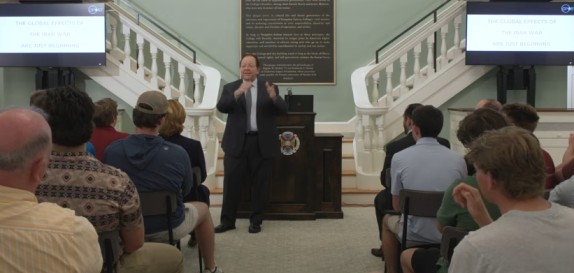
In this lecture, University of Chicago political scientist Dr. Robert Pape explains why the Iran war has become an “escalation trap” for the United States and Israel, and why regime change bombing, blockades and air power cannot suppress Iran’s cheap, precise drones. Drawing on 30 years of research on air power, coercion and political violence, he traces how the war is shattering the post-1991 image of American military invincibility, and what that means for power vacuums, global trade, China and Taiwan, and the generation that will live with the consequences. Read the full transcript of this lecture below:
Introduction
ROBERT PAPE: Thank you. Thank you very much. It is truly a great honor to be here today. I feel like I am at the beginning of the American moment coming on to your campus. I want to thank the president. The for inviting me, the Department of Politics for inviting me, the Wilson Center for inviting me, and I really want to give a special thanks to Gore. He has been unbelievable.
So I recall when I was a young assistant professor starting out, and there’s so many things happening when you’re starting out. But to see somebody so dedicated to his institution, it really just warms my heart. And I just want to say thank you for everything that you’ve done.
The Escalation Trap
Now today, I want to talk to you about the Iran war. I want to talk to you about the issues here. But more than anything else, I want to talk to you about the seismic changes that your generation, and I mean generation, is going to deal with. Now some of these were already beginning before the Iran war, but the Iran war has done more than just become a war. And it’s now almost an endless war. Right? It’s creating seismic changes. And that’s more than anything else what I want to talk to you about tonight.
Now the Iran war, I characterize it as an escalation trap. That’s a phrase I started a few days before the Iran war kicked off. I wrote a paper, put it on a Substack. And by an escalation trap, I mean that in this case, it’s the attacker is The United States and Israel. They attack, bombs hit targets, bombs kill leaders, tactical success occurs, but we’re strategically weaker. And as we have been strategically weaker, we are then in a trap.
Because once the side that initiates starts and is weaker, the initiator faces a choice. Do they walk away, concede, declare victory and walk away? In which case, the other side, because it’s stronger, gets stronger still. Or does it escalate again? Does it double down? That has been the trap that we have seen for over 7 months. And I’m sorry to say that’s going to continue for some time here, probably at least through January, if not longer than that.
Smart People Mistakes: Overestimating Punishment
Now, let me explain several of what I would call the strategic mistakes. And again, I’m not speaking so much here to the administration, I’m not speaking to the media, I’m speaking to the generation that’s going to come and deal with these seismic changes. That’s why we need to talk about this. So what do I mean by mistakes?
And these are what I call smart people mistakes. I talked for the US Air Force 3 years teaching conventional targeting strategy, not international relations theory. I know a lot about how to take down electric power targeting, for example, things like that. And so I was teaching the best pilots in the world, not how to put a bomb on a target, but how to think about strategy. And they would come in, and I think I could fairly say they had initial assumptions, and I called them smart people mistakes.
When I’m at the University of Chicago, a lot like here, I’m dealing with people with way beyond triple digit IQs. Super smart folks. That doesn’t mean their initial instincts are always right. So when you hear me make criticisms here, I’m not talking about dumb people. I’m talking about the smartest people usually in our country or in the world.
And one of them is overestimating punishment. The idea that you can punish governments and they’ll break. Punish societies and they’ll break. Now you might say, “Well, wait a minute. I don’t make that mistake because I know that I don’t want to do that because it’s not nice.” Well, when you get into a real pickle, you put morality a lot on the side. Now maybe you won’t. A lot of leaders do. The issue is not morality here. The issue is, will it work? Is it effective? And we often overestimate punishment.
Regime Change Bombing and the Weight of History
Now what do I mean by that? Stage 1, February 28, President Trump urged regime change in Iran and combination of Israeli, American bombs. Those bombs hit targets. Those bombs killed leaders. It wasn’t just the supreme leader. It was his wife, multiple of his kids, half of what effectively would be the cabinet if this was in The United States, 137 other leaders, essentially a third of the Congress it were in The United States. The senior leaders of… Effectively, it would be the Defense Department. It would be the CIA. So we didn’t just kill one leader. This was regime change. Very ambitious.
The fundamental problem is this is where President Trump went up against the weight of history. The weight of history. Regime change bombing since World War I when it began has never on its own toppled a government. Now that’s a big statement, but that’s 30 years of my life. That’s what I’m teaching. This isn’t just a casual statement. This is what this book is about. This book is not Tom Cruise and Top Gun, How to Put a Bomb on a Target.
This book is about the punishment, regime change, other strategies states have been using since World War I to actually win wars.
Now to give you an example, and I’ll pick one that’s not a Republican. This is 1991 [sic] (1999). Bill Clinton, Democratic president, Rhodes scholar, not a dumb person. Okay? He wanted to support the pro democracy movement in Kosovo, pro democracy movement similar to and attacked 51 targets in and around Belgrade. These were the Milošević regime in Serbia, including Milošević’s home. Now we didn’t kill him, but we hit all of those targets.
That then unleashed, not caught… Not intentionally triggered a lashing back. It wasn’t just the regime didn’t crumble. That’s not the risk here. The risk is it will lash back and gain power, and that’s what happened in Operation Horseshoe. Within a day and a half when our regime change bombing started, Milošević launched 30,000 troops that were already ringing Kosovo. This was like a republic. It’s like Maryland. Think of it as ringing Maryland. And forced 1 million civilians out of that region. 1 million.
So this was not just failed to help the pro democracy movement. This was a gigantic catastrophe. It took us 3 months to turn the tables. How could we turn the tables? Serbia was ultimately 6 million people. 6 million people. Iran, 92 million people. And I’ll say more about that scale in just a moment.
So it is true, if you are the world’s sole superpower as we were in 1991, you can unleash a strategy that has been known to fail since World War I every single time, and it will fail, and it will cause a 3 month crisis, and you can dig yourself out of it as long as your target is tiny enough. And I’m just skipping over all the details of what happened in that case.
What happened in the Iran war? Stage 1 of the escalation trap. We did leadership decapitation, bigger than just killing one leader. And what happened here, a lot of people think that because this is how they’re described in sound bites on the media, that these are hierarchical structures, a house of cards. You knock out that one card, the whole house of cards comes falling down. There are a few regimes like that, very few.
Most regimes are a version of this, and in fact, went even more in this direction since the ’79 revolution. Think of this as a set of concentric circles, a set of concentric circles. So you can knock out parts of it, a large parts of it, but it’s not a Jenga game. You’re not bringing down the whole house of cards by doing that. It will morph. It will turn into a new spongy animal. And in this case, harder than ever. That is what happens with regime change.
And lashing back, Iran is the strongest opponent America has gone up against since Nazi Germany in World War II. This is not Afghanistan. This is not Iraq. This is not Venezuela. This country has a major space program, major universities. This is not Afghanistan. This is not South Korea. This is a very big opponent here.
And where do they sit? Right on the Strait of Hormuz. What did they do? They barely have to exert themselves because of geography to do what? Gain control of 20% of the world’s oil. 20% of the world’s oil. Now that ebbs and flows, I understand the tanker traffic, I understand that. But nonetheless, this is major power.
And once they did that, they’re not giving it up. Not very easily. I’m a realist. Realism 101. You don’t hand back power. The one country that handed back power, Gorbachev Soviet Union. That didn’t go so well, did it? So there are a few who have done it. I don’t want to tell you it never happens. But the countries that have done that, they don’t turn out too well.
The Blockade
What about the blockade? So we slap on the blockade. Expectation is it’s going to crumble. Scott Bessent tells you it’s still going to crumble. Well, here’s the big question here. Name the case, the one case, only one. So I don’t want you to name 5. I just want one case where a blockade alone, since World War I, has won the war.
You don’t get to have blockade plus other bombing. You don’t get to have blockade plus atomic bombs. That’s Japan. Okay? You don’t get to have blockade plus ground occupation of the entire country. That’s what we did to Germany. I’m talking about just the blockade. And I’m not saying naming the case where it won in 3 months or 6 months. I’m saying ever. That is the problem. Pardon me?
AUDIENCE: Cuba.
ROBERT PAPE: Say again?
AUDIENCE: Cuba.
ROBERT PAPE: Cuba was a war. Was a war. What’s the war, sir? Cuba was not a war. Oh, yes. Cuba, we’re still waiting, sir. We’re still waiting for Cuba to fall. So we put on the sanctions on Cuba in 1960.
So for 30 years of my life, I have studied every air campaign since World War I, every sanction since World War I, every naval blockade since World War I. These are not just summaries from these are the I’m the guy generating the articles on this. So this is the real challenge here for this.
So these are not small mistakes. They are what I call smart people mistakes. Because a lot of smart people, again, think, “The issue here, Professor Pape, is that we just haven’t been willing to be tough enough and strong enough.”
Well, in World War I, the British slapped a blockade, that’s one of these cases, slapped a blockade on Germany in World War I. Churchill was the First Lord of the Admiralty. That was his baby. And it was very effective in terms of economic punishment. That blockade alone starved to death 700,000 German civilians. 700,000 German civilians.
Big fat books on this. You don’t have to just get a Wikipedia. This is your library. You may have a lot of the books here. We did when I was at Dartmouth. That was one of the great things about being at Dartmouth. They had a library since 1773. You have really good stuff. You will probably have that here, too. I don’t know it was a fact, but probably do.
That blockade alone wasn’t enough to defeat Germany in World War I. Just to put it in. So we had to have a massive ground army, war of attrition, and then the American ground army had to come in. That’s how World War I ended. Anyway, case after case after case of this.
Underestimating Iran: The Drone Problem
But then there’s another set of mistakes, underestimating Iran. Underestimating Iran. The big issue that we underestimated with Iran is scale, is scale. Now we’ve just come out of 2 forever wars. We’re used to thinking about Iraq, Afghanistan. This is not Iran. Scale. And you’ll see an issue with the drones in just a moment here. Literally the next slide. It’s not just the drones. Iran is too big to suppress the drones. And let me explain what I mean by this.
This is the Shahed 136 drone. This is the drone that we’re talking about. We’re talking about drones shutting down, attacking ships on the strait. It is about 400 pounds. That is the size. It is almost the same size as a king-size mattress. It’s heavier than a king-size mattress, but it’s almost the same size.
Now, you can fire them from trucks. You can fire them not from trucks. You don’t have to have trucks. The motor, it is a 2 cylinder snowblower motor. There’s nothing fancy about that. All the parts here, the GPS, not as fancy as this. And as I was explaining at dinner, the parts here, the cameras, the GPS, they’re the knockoffs you buy in India. That’s where this stuff comes from.
But just look at that size. And now you’re given the mission as the military to consider the plan to suppress those drones. And you’re going to have to suppress those drones because there are literally thousands and thousands of those drones, and they can make hundreds and hundreds every month. And you don’t know where all the factories are. But the biggest problem is they only need a few drones to knock out a few ships to send those insurance rates skyrocketing to maintain control.
So let’s make it generous. Let’s say your actual milestone is the military. You’re actually now the 1 star general who’s actually going to be in charge of the actual mission. And you’ve got to reduce the number of drones that Iran has to 200 on a continuing basis. 200. They may have somewhere around 5 to 7,000. Your job, and they could even have more than that. We don’t really know how many they have. But your job is getting under 200. Let’s see how easy that mission is going to be.
So each of those drones has a minimum range just with that 2 cylinder engine I talked about without additional engine, 500 miles. That’s its range. 500 miles, 40 gallons of gasoline. That’s how far they go. That is what 500 miles of depth really looks like for real. And that’s in Hormuz with Hormuz as the center point. And that is the entire launch zone you have to search. And you have to find them and you have to destroy them. That is 1.5 times the size of California.
Now, already, you’ll say, “Oh my God, that’s a pretty daunting problem.” But that’s not the worst of it. You see, so far, I’m showing you this as a 2 dimensional problem. Drones are so easy to move around and you can take them apart so 2 or 3 guys can move these around very, very easily. The real problem with drones are the mountains. You see that entire zone there is almost completely composed of the Zagros Mountains. The Zagros Mountains are huge mountains.
So now let’s put this in a little bit different context. Instead of drones, think of it as king-size mattress, where you’ve got to find every king-size mattress in effectively a skyscraper. Think of a mountain as a skyscraper. And that king-size mattress could be buried underneath the skyscraper in the parking garage. It could be on the 1st Floor, the 7th Floor, the 77th Floor.
In this room right here, how many could we probably put in this room? 40 or 50. But this could just be one room in a skyscraper that is how far? How big? 10 times taller than the Empire State Building. Think about that. Now let’s look at how many Empire State Buildings you can put in that 500 by 500 mile area. 1.6 million Empire State Buildings. Another way to put it, how many have been to Manhattan? Okay. There are 11,000 Manhattans you have to search in that 500 by 500 mile area.
So why are we not doing this mission? Okay. Why is air power not going to do this mission? I think you’re seeing why. Now, you take an army, we take a 100,000 ground troops. That’s a different story. I’m not saying this can’t be done at any price. Now you’re seeing the real challenges here for our military.
And you’ll say, “Wow, gee, okay, but what would somebody who really ran an operation, a 4 star general?” Advocating exactly for this thing. So please Google Piers Morgan, General Wesley Clark. He was advocating exactly for this until we got on and I laid it out for him. So Clark knows me. And then he… You’ll see. Just watch. It only take about 10 minutes. You will see what happens when you actually confront reality with smart people. And you will see that this is a serious problem.
So this is why we have a major… When I say underestimate, this is underestimating Iran. Now it doesn’t mean you can’t go in with ground power, but now you have to go in with ground forces.
Escalate or Stand Aside
This is why we’re in what I call the escalation trap. The escalation trap is Iran is not just going to give up that power because it’s not just local power, it’s world power. And they’re not going to give it up without a fight, folks. And it’s not going to be standoff weapons. We can talk about nuclear attack later on. I’m sure that’s on your minds. But the bottom line is, this is the real escalation trap we’ve been in since March. This is the problem.
Either we escalate and it’s most likely could start limited. You take ground forces, take Kharg, you could take your 82nd Airborne, take Pickaxe Mountain, all those scenarios. But what’s going to happen is you’ve got to suppress those drones. That’s going to be a big deal. How are you going to do that? That’s stage 3.
Or do we stand aside? A lot of people, including somebody I like a lot, Joe Kent, some of you will know that name. He wants us just to march out. I was in 2008, I’m probably the only person in the world that was simultaneously on the primary team of Barack Obama and the foreign policy adviser to Ron Paul. So just figure that one out. Okay?
And it’s because both of them agreed on the position on Iraq, which is my position in my books on Iraq. So that’s how I ended up with both of them there, on those. And it didn’t last long because that’s not politically tenable. That’s, if you think, why am I a professor? It’s because that’s the, I’d rather try to help both sides out than just go, anyway, so you can start to see that.
But what I’m trying to say here is a lot of people like Ron Paul, they just want to march out. They say, “We marched in. We’re just going to march out.” Same with Bohemiah. And I’m explaining to them, well, the problem is Iran’s not just going to stay with what it has. It’s going to take more power. And that’s what’s happened as President Trump tried to march out. Iran is initiating violence because it wants more power, and that’s the issue. That’s why this is not just Afghanistan, this is not Vietnam, this is closer to Germany in World War II. That’s what this is like.
Underestimating Public Support for Iran
Now what are the implications of all this? This is what I’m telling you, you folks are going to have to live with. Okay, so this sounds very daunting, but most of you in this room are not likely to have to make the decisions in the next 4 to 6 months. You might vote different ways on this, but in the future, looking at who has come through here, some of you may be making decisions about the consequences here.
Oh, I’m sorry, one more thing before I do that. I just wanted to say a word about a final thing. I’m sorry, I just added this slide on the last day. You’ll see why in a moment. There’s one more thing we’ve underestimated. That is the public support for Iran. The public support for Iran.
So I’m just showing you a picture of July of the 10 million people who came out to support the supreme leader in the funeral here, calling for the death of Americans, the death of America, the death of JD Vance, the death of President Trump. And you might say, “Well, wasn’t that orchestrated by the government?” I don’t think the government can orchestrate 10 million people. Now you might think that. I don’t think. I don’t think that’s possible. A few 100,000, maybe even 1 million. That crowd, very different.
And then we still don’t know with what happened in Tel Aviv, the incident, whether that was a suicide attack or not. I know a lot about suicide terrorism. You can go look up the books, 4 of the books. 2 of them are on suicide terrorism. And the big thing to notice is where the incident occurred. To me, if somebody studied 8,000 suicide attacks, that’s the most important fact that I now know. And I want to know more facts.
But what I now know is that plane took off from Dubai, flew 2.5 hours, then the copilot decided to stab the pilot. And how far away was he from the plane from Tel Aviv? 30 minutes. That’s exactly what you would do if you were going to slam the plane into something in Tel Aviv. Exactly what you would do.
And so I’m not telling you for sure, but what I think is there’s at least a better than even chance. It was what I call an inspired attack, not command directed by Iran itself. And you might say, “Well, thank God, it’s not command directed by Iran.” No. Then Iran could turn it off. If it was inspired, it’s way more dangerous. Look at the 10 million people. Much, much more dangerous. So what I’m telling you is 19… 2006, things are not going well.
The Inverse of the 1991 Gulf War
But let me put this in some perspective for the seismic changes for you because what you’re really seeing in the Iran war is the inverse of the 1991 Gulf War. And let me explain that to you this generation what I mean by that. That the Iran war is literally shattering the image of the US military that we build up in the 1991 Gulf War. That’s when I was teaching for the US Air Force. I taught the best pilots in the world that they just come back from bombing Baghdad. That’s the biggest problem of what we’re facing and that your generation will have to deal with.
Let me explain the world we created in 1991 that is now being shattered. So I know most of you were not alive in August 1990, but if you can just imagine the Cold War ends, long 45 year Cold War. Not a shot fire, but what happens within less than a year when the Berlin Wall came down? Saddam Hussein, leader of Iraq invades Kuwait. He invades Kuwait with 1 million… It was only 350,000 in Kuwait, but he had 1 million man army in Iraq. And it’s the 4th largest military in the world. This was a big deal.
Potential oil hegemon, we wanted to reverse this. We brought 10,000 body bags with us. 10,000 body bags. This was something we were worth, we thought was worth a lot of dead Americans.
What happened is we unleashed technology that had not been used before, certainly not very much in a major war. That was the precision revolution. Sometimes it’s referred to as shock and awe. This is stealth fighters. We had not had stealth fighters used in any major way before this. GPS, laser guided munitions. This was the precision revolution that was rolled out for all the world to see.
This is what defined America’s unipolar moment. It’s not just that there were 2 superpowers, one went away. This was America’s what? Invincibility. This set the rules for the next 30 years. America cannot be defeated militarily. America controls escalation. America protects global commerce. Resistance to America is futile.
Now, yes, we have terrorist groups. I’m telling you that there are knocks in that, but these were the operating assumptions, not just of the American military, the world adopted. When Europe, after the Cold War, cut all its military budgets, why did it do that? Because it was counting on this. China ended the Cold War with 3.5 million troops. What did it have 10 years later? 2 million troops. It got its army because its army was built on the Iraq model targets for the American Air Force.
This was taken seriously by the rest of the world. It wasn’t just a feel good war for The United States and how many Americans died? We shouldn’t be, say only ever? 147. Nowhere near the 10,000 body bags. That was America’s unipolar dominance that the world counted on.
But there was more to it than that, folks. There was a hidden economic benefit. This wasn’t just military power. This is trade as a fraction of world GDP. Notice in 1990, it was 38%. And notice it almost doubles over time. If America can guarantee stability so that no actor can really rock those trading avenues. What happens in economics when the cost of something goes down? Trade, the cost of supply goes up. That is globalization.
The Breakdown of the Liberal Order
Now then, what’s happening today? That model is breaking down. Number 1, we saw the demise of the post liberal international order fading even before the Iran war. Then we saw the diffusion of precision technology. And now we see with Iran war economic interdependence, globalization, vulnerability. Vulnerability.
So I won’t spend much time on this. I just want to briefly show you that the liberal order was breaking down before Trump came back into office. There’s a whole history there. I’m just going to hold that as a point. But what happened when President Trump came into office wasn’t just the liberal institutions were breaking down, globalization breaking down, is that America was supposed to be the guarantor of that order.
We were, coming out of ’91, the guarantor of that stability. We turned into not the guarantor, but the opposite. We were dismantling those institutions. We’re dismantling the order. We’re deciding preventive war is acceptable. That’s new. That’s really new.
The Second Precision Revolution
The 2nd thing that happened is the monopoly on the precision revolution was collapsing. In ’91, no other country in the world had that precision military like The United States did. The next 10 years, China upends its whole military to try to start to get close to us now, 30 years later. Europeans, they never do quite get close to us. And why? And what do I mean by that? Super cheap precision. It’s not just the drones are cheap. They are precise. They are accurate. That’s what makes this so challenging.
Now, where did that start to change? Ukraine. This started to change in Ukraine. So Russia invade Ukraine 2022. Ukraine, which is much weaker than Russia, looks at first like they were just going to get stomped on, smashed. That’s not what happened. And why not? Drones. They didn’t have drones. Not at first. Starting in 2023, they did.
And this was not a Biden program. This was not a European program. This was a donor led program. And I know because certain really rich families in Chicago that have Ukrainian backgrounds, and you can look them up because they’re in the top 10 billionaires in Illinois, but I won’t say who. I have dinners with them and they fund our center, so I know something about this. Okay? This is not just generalities.
They are the ones who funded the drone factories in Western Ukraine. And at the time, governments wouldn’t touch this because it was untried. So now, governments are supporting it, but after it’s already been established. So that’s usually what happens, by the way, with new technology. And so that’s how that happened in Ukraine.
Then the Houthis, it spread to the Houthis in the Red Sea and probably a war you paid no attention to. This happened starting in 2023. There was a war in 2025 with Biden, and then there was a 55 day war between the Trump administration, 2 of our aircraft carriers for 55 days, and the Houthis in the Red Sea. Now, in the last few weeks, you probably have heard of the Houthis, so you probably know about the Houthis today.
Nobody’s ever beaten the Houthis. We didn’t beat the Houthis. We just gave up. We walked away. And I don’t say that, Rob. I want American primacy, just so you know. I want us to be the strongest country in the world. I want us to be the richest country in the world. We’re not doing that right now, folks. And we’re not going to do that by not understanding what’s happening.
So this is showing you it was the drones that beat us with the Houthis. Then of course, we saw what happened with the Iran war. And this of course raises the huge question, how could we go into this war not understanding the drone threat? Which I don’t have an answer to.
But that would be the number 1 thing that if you’re looking for histories to come out of this war to help guide you in your generation, that’s the number 1 thing you want to know. Where did we miss the boat on that? Because that is something we clearly underestimated and probably the central underestimation, and that will matter to you more than our generation. So for us, politically, it matters or retirement matters. For you, it matters for the rest of your careers why we made that mistake.
And we shouldn’t have because we were supporting Ukraine to give you examples of why this is so paradoxical. So this new form of power, basically I’m telling you, in the old days, ’91, we had the monopoly on the precision revolution. Now it’s diffused to the 2nd tier states.
What happened with world trade? I’m showing you world trade went up. We’ve been enormous beneficiary of that trade. 1990, we’re 26% of the world’s GDP, 25. Today, we’re 25, 26. What about the EU? We constantly complain they’re ripping us off. The EU was 25% of world GDP in 1990. Today, they’re 17%. 17%. That means relative power has shifted in our favor versus the EU.
So this is not a case where, “Oh, the problem is we’ve been ripped off by the Europeans.” It’s the other way around. We’ve been really good realists with the Europeans. We’re constantly complaining as we’re making money and making power. “You’re taking all my power” as I’m gaining more power. Yeah, that’s Thomas Hobbes would tell you, man. You’re the perfect realist when you do that. Okay.
The Return of Power Vacuums
The consequences here, I’m not persuaded at all our primacy is locked in going forward because as this all gets undermined. But here’s the big set of consequences. Number 1 is the return of power vacuums. This is the problem that your generation is going to have to face, which is America’s invincibility that has basically deterred so many other actors in so many regions of the world has been shattered. And that means power vacuums are growing in those regions. And who’s going to stop those power vacuums?
It’s not about American will. I was just 2 weeks ago, 3 weeks ago at the European Parliament. I spent 2 hours with the members of parliament. It was supposed to be about the Iran war, but you know what it turned into? A discussion of what the Europe should do with Ukraine. And you know what we didn’t talk about? How to persuade Trump to help bail Europe out. No.
This isn’t about European looking at America’s will because what Europe has learned is America doesn’t have the capability. That’s a different conversation. And if that’s happening in the Europeans, vis-à-vis Ukraine, that’s going to be happening with Japan, South Korea, and Taiwan. So this isn’t about America’s choice not to help. The world doesn’t think we can help. And if we do choose to get in, they’re very worried we’ll just make it worse. But the big problem is they don’t think we have the capability.
So this is why it was so easy for the Houthis to take the Red Sea Coast and spike up the price of gas in the last 3.5 weeks. That’s what instability looks like. That’s what it looks like when the rivals of America are no longer deterred. They’re just going to move. And what are we going to do to stop them?
And notice it’s been almost a month, 3 weeks. We almost bombed a week ago. We pulled back. We can go through all the different strategies. We didn’t beat the Houthis in 55 days with the Trump administration in spring 2025. I don’t think we’re beating them in 55 days here again. So ground forces, that’s another story. But now we’re talking about real blood, real blood. That’s the problem that we face here. And that’s what I mean by we don’t have the capability and a power vacuum.
China, Taiwan and the Coming Supply Shock
But it also… This revolution will apply to other areas of the world and areas that are in ways that are going to surprise the world. And the biggest surprise I want to show you has to do with China and Taiwan. So for many decades, we’ve been worried about China invading Taiwan. And there’s a constant scenario. It’s called the blockade scenario. I know this scenario very well. I teach about this scenario, so I’m very familiar with it.
And so Taiwan’s an island. Here’s the problem. With the 2nd precision revolution, if we can’t beat Iran’s drones, there’s no way we’re going to be able to go up against China’s missile. This is just not happening, folks. This is just not happening.
But does that mean that Taiwan is all on its own and can’t do anything? See, this is the thing that’s paradoxical. I want to just show you that it’s true. We’re not going to be able to bail them out. But what about Taiwan? See, think of Taiwan as the next Iran. And think of Taiwan, which already has 10,000 drones, using Taiwan’s drones against the seaports of China. The seaports of China.
All of those seaports, where 40% of China’s trade, a GDP, excuse me, nearly all of its trade, but 40% of its GDP goes to those seaports. Taiwan’s drones can hit those seaports just the way Iran’s drones can hit ships in Hormuz. You don’t have to put troops on the seaports. All you have to do is sink the ships. And there are civilians on those ships. They’re not going to want to die. This changes the tables a lot in a future war between China and Taiwan.
And what does it mean? For us, you might say, “Well, that’s great, Professor Pape. We don’t have to fight that war. That’s just one less war for us to fight.” That part is true. But what that means is we get the supply shock. You think we’ve been shocked with Hormuz? Wait till China’s seaborne trade goes down for 3 months or 6 months. Woah. That is going to have major ripple effects in our country. Interest rates are already going up. This will drive them up higher. This is the world we’re going to have to navigate.
So the global effects of the Iran war, I believe, are just beginning. And that’s what I meant by the seismic changes that your generation is going to have to deal with. I’m sorry. I wish I had better news.
What I would suggest is you look at this like the founding fathers in 1770s. They weren’t much older than you. Yeah. Ben Franklin, my age. Yeah. Okay. And I wish I was half as smart as you. But I’m just telling you, your age, there’s going to be a lot to do. A lot to do. And I’m looking forward to sticking around to watch how you do it. Thank you very much for having…
So I realized I may have gone on longer or so forth, but I’m glad to do whatever you’d like to do, Gore. Take questions. It’s long… I’m not going anymore.
Questions and Answers
UNIDENTIFIED SPEAKER: Yes. We have about 14 minutes for questions. So please,
ROBERT PAPE: Yeah. So I’ve been modeling the bombing of Iran for 20 years in my classes starting in 2005, and I ended in 2025 here just 2 weeks before the bombing of Iran you’re talking about. The key issue, sir, is the bombing of the facility called Fordow, where Iran had 1000 pounds of 60% enriched uranium. And in my modeling, I said this is what would provoke regime change bombing a year later, and that’s what happened.
So what happened was we bombed Fordow and we crushed the facility. It was deep and buried. We had redundant attacks. Very cool. Trump said it was a victory. The problem was we had no idea what happened to that enriched uranium. There were satellite images that showed maybe they moved this stuff. Iran moved this stuff out ahead of time, but that problem, I’ve said for 20 years, would gnaw on us.
We would become fearful Iran would covertly transition that to a nuclear weapon. Would have no on ground inspectors anymore. Iran wouldn’t let us in. And that, I said, would be the trigger a year later to regime change bombing. And that’s exactly what happened. So I think that the problem with the idea of the limited in, limited out is the limited in can create a much bigger sucking sound of bringing back.
Yes, sir.
Right. So what’s happened, sir? Just to sort of the… We’re on the road to that being the case. Number 2, this escalation trap I’m talking about where we don’t have good military options in the short term, that is the problem. President Trump wants a warrior’s victory and he wants that between now and the midterms, which I believe would extend into January. There’s a whole discussion of that. But it’s not just November 7.
And so the problem for President Trump is that the midterms, whether he invades the public or not doesn’t matter, is a forcing function limiting the choices he has in front of him. Iran is taking advantage of that. So Iran is not sitting back looking for a deal. They’re not looking for peace. They’re looking to gain power.
So if they negotiate, what does it mean for them to negotiate? And why can’t Trump accept the deal? Because every deal Iran has proposed would make it stronger as a regional hegemon. And as Iran gains power as a regional hegemon, it’s not just going to want to keep control of Hormuz. It’s going to assert political control of Saudi Arabia, political control of The UAE, and control of their central banks, which means our bonds. This is a big deal, folks. So this is the problem that we face.
Now, sir, beyond… Once we get to January, we might have a chance to think about a new multiyear strategy. That’s something I’ll be saying more about in January. But between now and January, I think we’re stuck. I’ll come back to you just 1 sec. If we have time, I’ll come back.
Yes, sir.
Yeah. One of my best friends from graduate school, his name is Craig Koerner. He’s an economist. He got his PhD in our economics department while I was getting my PhD in our… And he runs the Naval War College’s classified war gaming center in Rhode Island. So I had him come and speak to my class just in May.
On this exact issue, he got permission because he can’t speak without levels of permission you would believe here. And, of course, nothing he said was classified. Well, we hope that’s true. He did get permission, so he’s not in trouble. The bottom line is that’s 4 or 5 years away at fastest, and that assumes the other side does not improve.
Here’s the problem with that, sir. The other side is certainly going to improve, and the reason is because if you just will Google what’s coming with your cell phones by 2030, you’re going to see nanotechnology is coming into your cell phones. This is about to be much more powerful in the next 4 or 5 years, which means those drones are going to be able to have a base… They’re already evading, by the way. That’s why we’re having to pull our naval ships back. They’re already evading and swarming. That’s going to get a lot better. A lot better. And this is our problem here.
So there’ll be basically a mini arms race where the cheap drones are already ahead, and we will have to catch up because we have not been going down at that level. We’ve been trying to produce new aircraft carriers. Yes. This is not… Yeah.
That’s what’s coming. What’s coming is we’ve got another 5 or 10 years of stuff that’s already in the blocks, already half done, and we’re probably either going to have to cancel it and throw it all away, or we’re going to put it out there and simply become great big fat metal margins. So this is something someone like me has been complaining about for a long time. Now what’s going to happen is the Republicans in Congress, absolutely think that.
So the reason I spent 5 years working on this last book, it’s called “Our Own Worst Enemies,” is because I go to what I think is the biggest threat to America’s democracy. And the biggest threat to America’s democracy is not Iran. It’s not even a nuclear Iran. It’s not a militia group. The biggest problem is what I call violent populism, and that is what is pulling our country apart.
And that’s why these strings of attacks against Trump won’t stop. That’s why the attacks on both the right and the left won’t stop. The right and the left can’t agree that they’re both rising. They’re both rising, and that’s a fact. It’s not an opinion. The book will lay all this out. It goes through all the FBI data on this.
And the problem is that Abraham Lincoln once said, “A house divided cannot stand.” That we’re not at civil war, and I don’t think we would be for many several years. Don’t say never, but it’s another distraction. What we’re doing is continually distracting ourselves.
And the very next book I want to work on, and that’s why I went to China, was going to do this anyway, is we need to focus on economic modernization. We need to do this in a good way, and that’s the problem. We’re not doing that, folks. We’re just not doing that.
If our bonds were at 5.5% and half of that was… They’re not half. 5% was productivity growth, no problem. At most productivity growth is 1% of that 5.5%. That’s our problem. China is going the other way around. And Iran, oh my God. Given the alliance that’s forming here with China, Iran, Russia, we’ve got to get going. And get going doesn’t mean conquering more countries. It means economic modernization.
Yes, sir.
You are absolutely right. So President Trump, more than any other president we’ve had, believes in punishment. He believed in that model of the ’91 world. If it was still 1991, you could behave that aggressively and probably get away with it quite a bit. The problem is it’s not 1991. That diffusion has occurred, and that diffusion is occurring across the globe.
And so being stuck in fighting the 1991 model, that’s where our Defense Department’s been. I’m telling you, that’s where… When I talk to the Air Force, and, oh my God, would they be bust by just about anything they possibly could because they wanted all that work. The problem is we’ve been stuck in that model for too long while the rest of the world is moving on. And I think this is unfortunately a good exit.
So it’s not that Trump doesn’t have a… A lot of people say he doesn’t have a strategy. I’m explaining he has the wrong strategy. And that is what the problem here.
Yes, sir.
AUDIENCE QUESTION: So we’re seeing some direct spillover from Ukraine, Russia to the Iran conflict. Do you see that going anywhere?
ROBERT PAPE: Yeah. So I think it’s 1 in 10. We will have a true interlinked 3rd world war the way it’s described. And I spend a lot of time in the podcast world now, and boy, could I make money if I said the opposite. Okay. So I am not saying that because that’s the moneymaker. I guarantee you. Alright?
So… And if you think the podcast… Well, just because you’re not giving them money, you think they’re not making money on you? Oh my God. Have I got something to sell you? No. No. No. No. These folks are not doing it for nothing. Okay? Alright. They’re selling your data. They’re doing all that stuff. So all of that is happening. Okay? And so that’s why these ideas can…
Now do I say you could never have a world… What would a true World War look like? In World War II, America was literally fighting with ground operations, hundreds of… Well, over a 100,000 dead in 2 different theaters. That’s a world war.
I don’t think Ukraine is going to take troops and literally give them to Saudi Arabia. That would be a world war. I don’t think Russia is going to take troops. And I mean troops. I mean, it’s got to be over 10,000 to match. A few 100, though. But 10,000, 20,000 troops to literally fight against Iran, bail out or the Houthis, bail out Saudi Arabia with the Houthis? Ukraine is not doing it.
I don’t think Russia is going to send 10,000 troops. I don’t think it’s going to send its navy. I don’t think it’s going to do that to Iran. If they did, now you have cross theater combat operations. And what we have today is 2 theaters that are both very, very big and intense creating global economic problems. That’s a global crisis, but it’s not World War II. And I don’t think World War II is likely in the next few years. I’d give it a 1 in 10 probability. Yeah.
UNIDENTIFIED SPEAKER: One more question, folks? Anybody want to take this? Yeah.
ROBERT PAPE: So I’ve been very worried about this since June. So what’s happening, is that as our Strategic Petroleum Reserve has run down, that’s our cushion, our insurance storage. It’s like having a spare gas tank in the back of our truck. We have now used up that… And that’s why it’s flat. We’re not taking any more out. There’s literally still stuff in the gas tank, but we’re worried the truck will basically break up if we take it out. So we’re not taking it out anymore.
And what I worried about since June was if once that happens, that’s when you’ll see the Houthis and others, and it won’t just be the Houthis, but it’s the Iran backed militias in Southern Iraq do a pincer movement on Saudi’s oil getting out of the Red Sea because that’s maximum leverage.
Why was that such a… In 2 days, the price of gasoline in our country went, at least in Chicago, we’re outside my door, $4.09 to $4.99 in 2 days. How could that happen? That happened by timing that just right, you see. And that’s what I worry about going forward. And I don’t think Iran is going to… They’re supporting the Houthis. I don’t think they’re a puppet master controlling them.
And the truth is we don’t have enough aircraft carriers to have a blockade on Iran and fight the Houthis. Now give me a year, maybe I could do that. But this is a much bigger war already. You see, we were built for the ’91 Gulf War that lasted 43 days, 39 day air campaign, 4 day ground war. It was a mop up operation. That’s what we have been building as a model of the war for 35 years.
The problem is the other side has caught up, and that includes not just Ukraine versus Russia, the Houthis a couple years ago and Iran, also the Houthis now. And by the way, for Israel, those Shahed 136 drones, they can do quite a number on Israel’s seaborne ports. So this isn’t just about… So we haven’t, again, we haven’t started to map out all of those scenarios, and those are the scenarios here that are going to affect stability. They’re going to increase the cost of trade, and as the cost goes up with trade, they will go down.
And who will be hurt the most by that economically? It’s certainly relative. It’ll be the country that benefited the most from that, The United States. So this is why this was the war. For 20 years, I’ve modeled the bombing of Iran and this war. This was always the war never to do. It’s not just another war. It’s not just even Vietnam. This has that many consequences, and we just didn’t take it seriously is the bottom line.
But your generation is the one who’s going to have to deal with the seismic consequences here. My generation, as we have done before, will try to dig us out as best we can with this hole, if we can at all. Okay?
But I think at best, if we can just get… We’re not going to get back even. If we can just get back, sort of think about this. We were up here. Iran was here. Now the tables are turned. If we could just make up half of the ground, our generation would be doing fantastic. You won’t give us any credit for it because yours doesn’t solve your problem. But that’s probably what we can look forward to. This problem is that big and it’s for the reason that I’m talking. Thank you very much.
Related Posts
- Transcript: S Jaishankar Speaks at Munich Security Conference 2026 in New Delhi
- Transcript: War Secretary Pete Hegseth’s ‘State of the Force’ Address
- Transcript: Professor Jiang Part 2 Interview With Jack Neel – Government’s Secret Plan to Control
- Jeffrey Sachs: Ukraine Peace Proposal vs. NATO Salami Tactics (Transcript)
- Transcript: Tucker Carlson Debates Sir Jacob Rees-Mogg