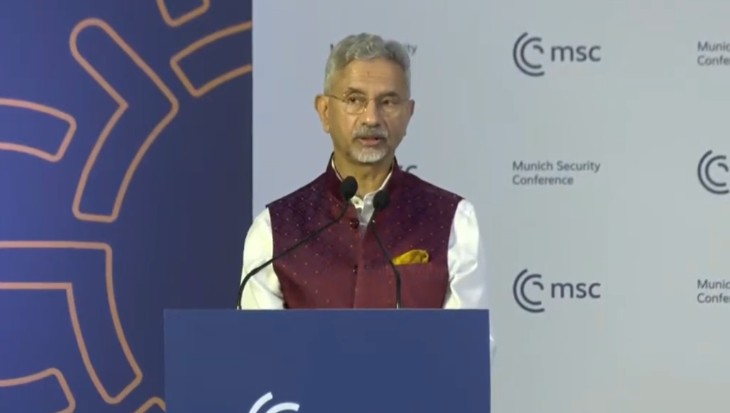
External Affairs Minister S Jaishankar spoke on emerging and middle power cooperation at the Munich Security Conference’s Munich Leaders Meeting in New Delhi, covering the repositioning of the United States, the rise of China, multipolarity, multi-alignment and the deepening India-EU partnership. In a fireside chat with MSC Chairman Wolfgang Ischinger and German State Secretary Bernhard Kotsch, he also took questions on India-Russia ties, AI governance, Iran, climate finance, BRICS and US-India relations. This event took place on October 4, 2026. Read the full transcript of this event session below:
Opening Remarks: Defining Emerging and Middle Powers
S JAISHANKAR: Ambassador Ischinger, State Secretary Kotsch, ladies and gentlemen, it’s really a great pleasure for me to welcome you all since I’m the resident here. And I do so very conscious that for us, this has been very much the year of Europe.
It was the year of Europe when we had presidents António Costa and Ursula von der Leyen for our National Day, the conclusion of the free trade agreement, the strategic, the security and defense partnership, mobility understanding, and for us today, the event here by the Munich Security Conference is very much in that spirit, very much in that direction, and I welcome you all.
Now, was asked to speak on the subject of emerging and middle power cooperation. And not just asked to speak, but even given guidance cues, I’m very disciplined. I follow those cues, and I would like to share some thoughts with you on that subject.
So let’s start with what do we mean by emerging powers. I mean, what are they emerging from? And the answer is not that simple because there are countries who are emerging from colonization, who are whose economies are growing. India is a good example of that.
But there are also countries which are emerging from what has been the comfort of an alliance structure till now. So one category of emerging countries you can say are from the global South, and one category are from the global North. Both are emerging in different ways. And what is common between them is the desire to be more relevant, to make a greater impact, and that really is a point of convergence.
Let me turn to the other term, middle power. I think it’s easier to say what is not a middle power than today to say what is a middle power. We should not take that term very literally because there will be countries, I mean one way is to say, well, let’s go with a definition like the G20, but there would be countries which may not be in the G20, but which would still, and again, it’s not a direct, literal size of the economy definition, that they would be very relevant in a particular domain.
An example which comes to my mind is Netherlands in, say, semiconductors, or if you look at a country like UAE, which punches above its weight. So I would say both in the case of emerging powers and middle powers, should take a very flexible, expansive view of what it is we are talking about.
The Changing Global Landscape
Now we are looking when we say, what are the prospects. We are also looking at international landscape, and as I said, what is important to define is what is not a middle power. And here, first of all, The United States comes to mind, very much the underwriter of the global system for many decades, and which is by any standards you could say has a significant lead over any other power.
And to some extent China. China partly because of its economic strength, it accounts for one third of the global manufacturing and its economic capabilities are today translating into political influence. So this is really in a sense the subject matter of our discussion.
Now what unites the emerging and middle powers, differentiated as they may be, is a growing self awareness of their interest. All of them in a way are becoming more self reliant. It’s a term very much invoked in India as well. And many of them today are driven by this calculation, what is it that they bring to the table when they participate in any discussion or negotiation.
So with those words, allow me to come back to the nature of the landscape because that in many ways today will shape the debate and outcome. And I think nobody in the room would disagree with the fact that the landscape today is primarily marked by a radical repositioning of The United States. Repositioning which is a posture of choice and where in a way it has deliberately become a lonelier power.
The second feature of the landscape is of course the rise of China. A China which sees itself as a unique country that is in a way both its self perception, but in many ways also the reality. And we are looking at very sharp competition.
That competition today, not limited to these two countries, has led to a weaponization of any leverage that any country has, and that competition coexists with the complexity of interdependence. So the question in an interdependent world is who leverages what? In any transaction, does the supplier have leverage? Does the consumer have leverage? Do you get leverage by dominating production? Do you get leverage by having a great market share or having a purchasing power?
And the answer there is really the player with a greater command in a way of various factors. One with greater commitment and determination is obviously the player who is able to leverage better.
So where the world is concerned, I mean, particularly in the context of a U.S.-China rivalry, I think we are looking at what is often called a “Goldilocks scenario.” You don’t want it to be too hot. You don’t want it to be too good. You want it somewhere in between at the right temperature.
De-risking, Diversifying and Agenda-Based Cooperation
So where does this leave emerging and middle powers?
And the operating principle for emerging and middle powers should be, and perhaps is already, reasonable degree of convergence. That the days when you had to have an identity of views or a very strong congruence of interest, I think that’s too high a bar today. If you have enough touch points that is good enough for countries to work together. And in this process of de-risking, diversifying, hedging, slowly a new architecture is coming into place.
Now, the question flows from that as to who cooperates with whom, and obviously amongst the emerging and middle powers, to the extent that they don’t have direct clash of interest, they have an obvious interest in strengthening their inter se cooperation, but it is also natural that they would have a cooperation with The United States and of course also with China.
Examples of Emerging and Middle Power Cooperation
So let’s look at some examples of this kind of cooperation. One which certainly most Indians would be familiar with, and ambassador, you referred to the Indo Pacific, is the Quad. That if you look today in a maritime space, in the Indo Pacific space, we have Quad as a example of, I would say, emerging middle power cooperation with an emerged power.
A second example would be in the field of connectivity, where you have something like the IMEC initiative, the India, Middle East, Europe connectivity corridor. The International North South Transport Corridor, even the Polar route, the Northern Sea Route could be the subject of cooperation.
Or if you simply look in terms of expanding space, of having a greater voice in the global order, the BRICS is a good example. The BRICS is an example actually of various parties who feel today that their collective voice is much stronger than the individual ones.
If I were to turn my attention to the field of resources or to technology, a new example is Pax Silica. If I could think bigger in terms of global good, the International Solar Alliance or the Coalition for Disaster Resilient Infrastructure, both of which India initiated, and which have been very successful. One has… The ISA today, in fact, has over a 100 members.
So you have this situation where a number of countries, not necessarily the leading country in the world or the second or even the third, they come together where their interests require them to do so. They find working arrangements, they develop an agenda, sometimes they develop organizations, they develop habits of cooperation, and this is today the evolving global order.
Multipolarity, Multi-Alignment and the Third Way
So what have been the resulting outcomes of that order? One, it has accelerated the emergence of multipolarity. Again, ambassador, I referred to you when we speak about the third way, and you can have variations in the third way.
If you look at history, what Asian and African nations were doing after decolonization was actually, whether it was Bandung or whether it was Non-Aligned Belgrade, to talk about a third way in terms of non aligned. There was also a different kind of third way, one espoused by France at a certain point of time.
So, but my point is today, the third way will be much more the norm than the exception, and many countries who till now may have been secured in the first way or the second way would be much more open to the third way. And the third way, at one level, can be stay away from others, but since that is not possible in much more interdependent world, I think how to engage while hedging, while diversifying.
So what will come into increasing practice will be the idea of multi alignment. The idea that countries will have relationships with players who which may not always be easy to harmonize, but nevertheless are a reality, are a compulsion for countries. So it’s a sort of strategy of advancing by hedging.
And one will then have to look what the consequences of this are for multilateralism. A multilateralism which is already under visible pressure because the main multilateral body, the United Nations, is very visibly gridlocked.
And finally, the fact that a resulting outcome of this would be the kind of small groups, I gave you some examples, that you will have sets of countries convening for specific agendas, and they would see themselves as responsible for that particular part of the world or that particular issue or that particular problem.
An Agenda for Emerging and Middle Powers
So what could be the agenda for emerging and middle powers? And I would share my thoughts in terms of a few ideas which occurred to me. One obviously would be international peace and security, that if there are conflicts going on, if there are frictions, if there are tensions, other than the biggest countries can other nations pull their resources, back each other’s diplomacy up, try to do something out there.
Another obvious area, of course, is investment and trade itself, and a good example is the… What happened this year between India and the European Union, that we had almost 25 of negotiation, and that negotiation came to a head because I think there was a realization on both sides that in the transforming world, it was essential that our economic engagement was intensified and the barriers to it removed.
But there are, in different domains, I would argue, enough cause for middle and emerging and middle countries, middle players to come together. Supply chain resilience is one. As I said, different countries have different strengths. You don’t have to be the biggest country in the world to dominate the world of chips, or to even produce the machines which are necessary today for semiconductor production.
You can have area like health. Today, health security warrants a much more diversified production of APIs and pharmaceuticals.
One looks at mobility, that the reality of the world is where there is demand is not where there is demographics, and how do you level that out, and that is best done through a flow of talent and skills, and you can see even in the field of advanced manufacturing today, that advanced manufacturing requires a certain amount of mobility if it is to be sustained.
Connectivity is again an area, important agenda for emerging and middle powers. So indeed is climate action and sustainability because whatever you might say, I think a very large part of the world believes and experiences climate change. I would say it is today very much the dominant thinking in the world, and the compulsion to cooperate in that regard on climate action has not changed. In fact, the circumstances have made it even more urgent.
Even in a field like defense, because the old who produces and who consumes in defense, the old systems, the orthodoxies are changing. A smarter defense comes into being. New producers are coming up, and new producers are not located necessarily in the same countries and in the same companies where they used to be in the past. So defense space is again an area which has seen some dramatic transformations.
So I would argue that there is today a substantial agenda for emerging and middle powers to cooperate. The world is changing. Its agenda is changing. The landscape is changing. The architecture is changing.
And I’m very glad today that we have this issue as a starting point before us because I hope in… That it would give our gathering a stronger purpose and a clearer direction as we begin our deliberations. Thank you very much.
Fireside Chat: Where Will India Be in a Decade?
WOLFGANG ISCHINGER: Your excellency, thank you very much for this very thoughtful statement. I’m sure there’s lots of points to be talked about. Before we get into our discussion, let me just make one important point, which I should have made earlier.
Every one of the participants here should have found in his welcome bag a copy of a paper prepared by Sophie Eisentraut, our Head of Research, on this issue of the role of middle powers. And I can only recommend to those who have not yet had a chance to take a look at this paper because it does cover in a comprehensive manner the options, the possibilities that come with that were provoked by Mark Carney’s speech and have been the topic of your remarks.
Second, just to follow-up on your initial point, on your initial reflection about middle powers. I mean, I admit that countries like, let’s say, The Netherlands or Italy or Germany are middle powers, will probably remain middle powers more or less. In my view, in my humble opinion, India is a different story. You have the potential of going far beyond this description of middle power.
So my question, if I may challenge you, where do you think India is going to be five or maybe ten years from now? Because you are the lot… In terms of demography, the largest country in the world. You have… Your country has an enormous potential that goes far beyond what we can think in terms of our national ambitions. So where is India going to be?
S JAISHANKAR: Well, ambassador, I think they’re middle powers and middle powers. So some are more middle and some are upper middle. So it’s a bit like income. You have this strata. But I do think it’s a valid point. It’s a valid point because some of the powers have really considerable potential, realistic potential even in the near short medium term to grow very rapidly.
I mean, in the case of India, because we have really decades of high growth ahead of us, and we have all said and done a demography which will sustain that growth. And I would even argue world which is much more creative, which is where many new possibilities are there so that we don’t necessarily have to tread the earlier part of industrialization which the orthodox part will have to devise something much more contemporary for what awaits us.
I would say, yes, you have a fair point. I mean, among the middle powers, some will peel off, some will stay put, some may drop down a bit. That is the reality. That will be part of the evolution of the global order.
Europe’s Perspective: Speaking with One Voice
WOLFGANG ISCHINGER: Right. Let’s turn to Bernhard Kotsch. Welcome. Bernhard Kotsch is state secretary in the German foreign ministry. We had originally planned for your colleague, Johann Wadephul, but he has asked to be represented by Bernhard. So thank you very much for making the trip.
I just want to offer you the opportunity to offer a few thoughts of your own, I’d like to ask you one question in particular. It’s one thing to consider these middle powers and what’s been called the third way. It’s another question to look at this from a European point of view where, if we are honest, we actually have to admit that we are in a very, very different situation than India.
All 27 members of the European Union, for example, are seen from India or seen from China, dwarf states, including our own. We’re tiny. And many of us, including myself, believe that we can only hope to be listened to if we try to speak with one voice.
So that is, I think, a particularly large and historic and strategic challenge for us in Europe. If we have learned, I think, that if we do not manage to speak with one voice, we should not be surprised that we don’t get listened to very much. So Bernhard, maybe offer your views and maybe take a look at that particular issue also, please.
BERNHARD KOTSCH: Thank you very much for having invited me. As already told, Johann Wadephul was supposed to come, but unfortunately, he had to stay in Berlin. So it’s a great honor and privilege to be here and sit next to you, excellency.
Actually, I have nothing to add substantially because I totally agree. Maybe two points I would like nevertheless to add. Ambassador, you mentioned Europe. I think Europe is a good example of a functioning partnership. We have decided after the second World War to establish a cooperation. Someone would tell it was urged from outside, and it was a consequence of the Second World War. But we have a regional partnership.
And over the last seventy years, this partnership has worked quite well. Yes, we have our problems and we have our differences, but we are dealing with these problems in a democratic way.
The second issue I would like to mention is, yes, we have to build up our foreign policy on more pillars and on different pillars. And we have to establish new partnerships. Our minister is traveling quite a lot, and one of his first trips was to India, to Indonesia, and Japan. And right after he took over the… His new position, and I think this shows clearly what the German government is trying to achieve.
It’s… We want to have a close contact to regions where so far we had an economic interest. But now we are also looking for a political cooperation. And this is something we still have to learn from my perspective. We have a very good economic relation and this relation will grow. We have a very good cooperation among universities, among cities, among all kinds of civil society elements.
But what we still have to learn, at least from the German side, is a better understanding of the political view of the others. So when we talk, for example, about the Russian aggression on Ukraine, we are very thankful that both sides are trying to achieve a peaceful solution by negotiations. But of course, we come from a totally different perspective. And this I think we have to intensify to get to know each other better on a political level.
And one last point to add, yes there will be regional cooperations, there will be cooperations on different aspects like connectivity or artificial intelligence. But I wouldn’t underestimate the role of the United Nations. We still need this global environment. That’s the reason why we are so much in favor of reforming the United Nations.
And why are we still putting an emphasis on the United Nations? There are problems which we cannot solve alone, which we cannot solve on regional or in sectoral groups. So, take the climate issue. We need a common approach on the global level. So, that’s the reason why we want to strengthen or to re strengthen the United Nations, including another kind of security council?
How India Views Europe
S JAISHANKAR: May I?
WOLFGANG ISCHINGER: Sure.
S JAISHANKAR: Well, I think first of all, when panelists agree, there’s a bit of a problem because you don’t know how to take the panel forward after that. So I wish we had disagreed a bit more. But let me try and find some points of disagreement. And I will start, ambassador, with actually what you said. Viewed from India, how does Europe look?
I would say, to be very honest, I mean, there is a lot that Europe can offer to the world. There is a sort of a big attraction in terms of a big benefit in terms of a deeper partnership. I would say candidly at times, I feel Europe itself may be insufficiently aware of it.
And it is has been defined broadly, people think in economic terms, but if one looks, for example, at technology, if one looks at standards, if one looks at innovation, today, Europe is a world leader in many, many domains. So… And again, I’m giving you a distant perspective, a faraway spectator.
The fact is also that for all your internal debates, and I know they are very vigorous with the passage of time. The fact is that there has also been a process of consolidation of Europe. At least that’s how it looks from outside. I mean, you may be… There may be nuances. There may be divergences. You each one have your internal politics, but Europe as a whole has in the last few years become more cohesive. And therefore on the world stage, more potentially more credible as one of the poles of the multipolar order.
So, it’s a… I would say as the Indian on the rostrum, I do think Europe has really a very powerful case today and frankly offers a very strong attraction for a country like India to reach out and develop its relationship.
Now having said that, I would also point out where there have been shortcomings on our part that we have historically tended to look at the larger nation states of Europe. The engagement with, let us say, Berlin or Paris or when London was part of the EU, or even Rome was stronger than they were with Brussels.
And a big change in the last decade, a big change particularly in the last four or five years, last year, for the first time, we had all the commissioners of the European Commission come to India. Now I would say before that, I’m not even sure other than the HR/VP who deals with foreign policy, how many commissioners were even known to their Indian counterparts, maybe the trade one was, but not beyond that.
Whereas now, the level of familiarity, the level of intimacy, the engagement, the conversation, that has changed the fact that we have a body like the Trade and Technology Council, where we discuss a whole lot of technology issues, that we are actually discussing what you do in third countries, what do we do in third countries. That again is a change out there.
So we are in the process of, I would say, I don’t want to say discovering the European Union, but at least intensifying that relationship. And it will require a lot of improvisation and innovation on our part. I mean, you are 27 countries. It’s hard to engage 27 in the room at the same time with deep intensity.
So what you have, for example, is something we started a few years ago, which is a separate meeting with the Nordic group. Now we have found that to be very, very productive because, again, the Nordics have, these are all high technology powers. Some of them strong manufacturing powers. Lot of them have energy interests, including in renewables.
Now, we are now attempting something, I hope, which will go forward, which is try to meet with the Visegrad Four on a more sustained basis. So we’ll have to divide Europe into more subgroups and engage more deeply.
So when we talk in terms of emerging and middle powers and how do you engage, certainly, as a practical proposition for me, because many emerging and middle powers happen to be EU members that do it in a kind of bite size handleable package, which will… While engaging European Union as a whole.
And then we’ll have to look at new domains. Is one. Today, I when I look, I would say last two years of just a country like Germany, Germany’s approach towards mobility of talent has actually profoundly changed, at least in so far as India is concerned. That we see today in many areas, Indians present working, welcome, accepted in Germany. The same thing, I would say, I’m seeing in a few other countries.
When you go to an ASML or an imec, I mean, when you look at the number of Indians who are working there, you can see that many of the practices which we associate with The United States are actually now seeping into the European corporate thinking, that they are scouting talent from other countries. They are open to bringing talent to other countries, and I think we have new areas of work there.
The bit which we would like to see more active is on the education side. This country is now open to foreign universities in a very… Really in a very sort of innovative way. But the first set of universities which have come have not come from Europe. They’ve come from Australia, New Zealand, some from The UK. But we would hope in a field like education that we will be able to actually see much more coming out of Europe.
Beyond Trade: A Wider India-EU Partnership
WOLFGANG ISCHINGER: Great. Thank you very much. I want to remind our participants that in just a few minutes, we’ll open this up to your questions. So prepare your thoughts. We have about half an hour or so roughly for a Q&A session. But before we turn to that, let me go back to both of you and start following up on what you just said about the relationship not between individual EU members and India, but between India and the EU proper.
I looked at the numbers just an hour ago, the trade numbers. I mean it’s staggering what the growth literally in both directions has been in terms of export trade from Europe to India and vice versa. It’s really a tremendous success story. So that’s, of course, great news.
The question is, do you see further steps in this relationship going beyond trade, investment, economic issues? Is there room for a wider partnership? And maybe you want to comment on that also. Do you want to go?
S JAISHANKAR: Well, yes, absolutely. I would say, if one looks, for example, at technology, at innovation, at emerging domains, not just emerging players. I mean, something like advanced manufacturing, semiconductors. These are areas definitely a partnership can increase.
If you look even at the AI debate that what kind of AI are we looking at, what should be the regulations, should there be guardrails, what kind of user cases would be developed. Again, there is a considerable degree of convergence between the European thinking on AI and the Indian thinking on AI. So… And I would argue even in an area like life sciences, that is the case.
What is happening now if you were to track global GCCs, the global capability centers, the centers which today multinational companies are establishing in a way to get the optimal use of global talent. I think GCCs are becoming also a bridge today between our economies and our corporates without actually the physical mobility which is involved in this kind of knowledge driven activity.
So the whole, again, another area is space. That Europe today realizes that it must have its own space capabilities, and that ambition has always been there in India. So when I look at many of those loads in our space launches, because we are today really expanding our capability to do space launches on a much more globally competitive and significant basis, and creating infrastructure for that.
Even in an area like defense, as I said, that we do see that Europe has determination today to rebuild its defense industry. But as I said, defense is not static. So the nature of products, the nature of technology, the nature of war fighting has changed. So again, what are the partners that you are looking for?
And we are finding it very interesting that many of our startups today have found partners abroad, but then so have many of our orthodox industries. There are areas like, say, ammunition production, or even certain kinds of weapons artillery, for example, or vehicles of certain categories where we have today a global competence. Our defense exports are growing very rapidly.
So I would say, yes, absolutely. There is a wider agenda. There is a wider agenda in terms of India, Europe, but there is a wider agenda also about how we shape the world. Because it can’t… If we limit it to a narrow benefit or make it too transactional, then we are missing out on what is actually going to affect all of us, which is the nature of the world.
And when you have initiatives like P4M, or we have debates. Security, you mentioned the UN Security Council, that we are united in our belief that what we need is a better UN. We don’t need no UN. The idea is not to throw away the UN, but to fix the union.
So, how to how today to work the multilateral system, how to shape the big debate? Both of us have a strong climate action commitment. So that again, it is important to… Today to protect that particular domain and to take it forward because developing countries are very much at the receiving end of climate change. So, sure, there is a very compelling case for a wider relationship.
BERNHARD KOTSCH: Well, once again, it’s hard to find something to criticize. Well, first of all, we were very happy that the free trade agreement between the European Union and India was finalized this year. And the free trade agreement with India was one of several agreements the European Union finalized this year with Mexico, with Mercosur, with The Philippines. We are in negotiations with Thailand.
So this alone shows that Europe is really trying to build up different pillars, especially now when partners or former partner or partners are trying to limit free world trade. So I think it’s a good signal that we have this free trade agreement.
You mentioned already the different categories we can build upon and we have to intensify. One issue for me is important. World is changing and we need partners to set standards. And I think with India, we have a close partner, especially for standard setting in different fields. In the economic field, in the field of artificial intelligence, etcetera. I think if we don’t do it, others will do it and they will not do it in our favor.
The second issue is once again, I would like to intensify also the political cooperation, the exchange of, on different issues. And we have very often a common understanding also coming from a different perspective. And we can profit from that.
And as you mentioned, we are 2 billion people. We have strong institutions. Also, sometimes the European Union better perform. We have to modernize us definitely. But we are strong and stable organizations. And together with India, I think we can really be a very strong couple.
AI Governance and the Iran Question
WOLFGANG ISCHINGER: Before we turn to you, I need to raise two small issues. They are actually not that small. First, could you talk a little bit about how you view this ongoing AI race and where is India’s position after the summit between Trump and Xi Jinping recently? My understanding has been that India, like most of us in Europe, would favor a more comprehensive governance of the future of AI. So that’s my first question.
Second question is a more direct strategic issue. Iran. Now India happens to be a nuclear power. We, Germany, France, and The United Kingdom, we actually started in 2003, that’s twenty three years ago, to discuss with our Iranian counterparts how we could prevent Iran from emerging as a military nuclear power. And now here we are with the aftermath of the American intervention with an unresolved issue as I see it.
So what’s the Indian position on what should not be done, what should be done, what should happen in this situation? I assume that India, we in Europe, would not like to see the emergence of more nuclear powers regardless of whether one believes in the NPT or not. But certainly, from our point of view, as a non nuclear country, new and additional nuclear powers would not be much appreciated. So these two issues, AI and how to deal with Iran, if you could briefly, and then we’ll open it up.
S JAISHANKAR: Well, on AI, I think our position was very, sort of amply demonstrated in the AI Impact Summit that we did in February this year. And the theme of it itself was a message. It was called “AI for All.”
So the whole idea, I mean, in this country, we’ve actually used the digital capabilities, the digital tools today to bring about a massive governance and social transformation. So people perceive AI also as something which must become accessible, affordable, used really for a certain social economic purpose. Obviously, people will develop other capabilities, etcetera.
So the key is really very much about… It’s a sort of AI for humanity, develop user cases which are relatable to people’s needs. That’s the kind of vision that we have. And along with that, also a concern about the safety and security issues that arise. And this is too major an issue to leave it to the market, so to speak.
On the Iran issue, I… First of all, I do want to make a very clear distinction. India was a country which did not sign the NPT and which reserved its rights. Iran was a country which signed the NPT, so the situation is very, very different.
So where right now for us, the concern is more immediately on the energy and trade disruptions which have happened as a consequence to this conflict. Because one does… You get these reports, well, energy flows were very good today, but last week, was almost the same as what it was. But the fact is energy markets are deeply unsettled. The price of energy tells you really what the sentiment is and what the market expectation is. And you can’t have oil at above 100 and pretend that things are near normal. They are not.
So that is our big concern, which is how do we ensure? Because the… This is not economics in a detached sense. I mean, this is people’s kitchens. These are people’s jobs. These are people’s livelihoods, and these are all on the line for us because we were primarily dependent on that part of the world.
So what we want to see today is a restoration of that uninterrupted flow of energy, of trade, of mobility, because we are paying the price in many ways for conflicts in which we have no part and which are often very distant from us. And we also hope that whatever emerges is in consonance with international law. That is also an important factor in our minds.
BERNHARD KOTSCH: Thank you very much. Maybe just one comment on Iran. No distinction, but I think one issue is also important. Iran should stop threatening its neighbors. I think this is one important issue we have to keep in mind talking about a sustainable solution for the region.
Q&A: India-Russia Relations
WOLFGANG ISCHINGER: So now we open it up. If you could please be kind enough to identify yourself so that our panel knows who you are. And please also, if you could, make clear whether your question is directed at both panelists or at only one of them. And we’ll maybe start with the lady here in the middle.
ANJA WEHLER-SCHÖCK: Thank you very much. I’m Anja Wehler-Schöck. I’m the international editor of the German newspaper Tagesspiegel. My question is for Minister Jaishankar. Many Europeans see the growing partnership with India as a great opportunity. But a pain point is, of course, India’s relationship with Russia.
And I’d like to hear where you see the future of the Indian Russian relationship given, of course, the historical ties, India’s defense industrial ties with Russia and its dependence on energy security. But where do you see India’s partnership with Russia headed?
WOLFGANG ISCHINGER: Would it be okay if we collect two or So the gentleman with the glasses in the middle.
ŁUKASZ PAWŁOWSKI: Yes. Thank you very much. My name is Łukasz Pawłowski. I’m the head of policy planning department at Polish MFA. I’m very grateful that the Germans asked the questions about Russia first. Thank you very much. But I wanted to follow-up on that.
I would like to know your opinion on Russia’s place or self image within that framework of emerging powers and middle powers. Because Russia tends to think about itself not as a middle power, obviously, but as a great power or great civilization even, whereas the facts show that it’s not even upper middle class. So I’d like to know your opinion how do we manage Russia within that framework. Thank you.
WOLFGANG ISCHINGER: So everything you always wanted to say about Russia, now is the chance.
S JAISHANKAR: Well, on the first issue, I would say, look, India and Russia have historically very good relations, particularly since the 1950s. And that history is not forgotten. I mean, generally, in most cases, people neither forget good history or bad history.
For us, Russia and Soviet Union before that was a country that stood by us in many ways when our security, when our territorial integrity was under threat. And at a time when much of the world preferred backing a military regime next to us, Russia was a country with which our relations were very good, and it has… We are obviously shaped in many ways by that legacy.
Today, the relationship has widened beyond that. It is, again, the world has changed. We have changed. Our own relationships are not what they were in the seventies and eighties, neither is the case with Russia’s. So, like any relationship, it is refreshed, it undergoes a change, new issues come, old issues sometimes get rebalanced.
So it is very much more today an economic relationship as well. So there is a military component, there are nuclear component, there are space issues, but there is a significant amount of trade and investment between the two countries, and of course energy and resources as well.
So our… Any country would… When you view another country, you judge it from our experiences. I mean, I can’t expect Europe, for example, to look at the world and say, okay, what does India think and my view should be based on India’s experience. Europe will base its judgment on Europe’s experience. India will base its judgment on India’s experience. So India’s experience has been frankly quite positive and consistently positive.
Having said that, I mean, we are seeing today an unfortunate conflict. Our position on that conflict has been very clear, which is that we would like to see an end to this conflict, and we believe that this will require dialogue and diplomacy. There has to be negotiations in this regard. We have been advocating it for many years.
And in recent months, we have got a little bit more involved beyond advocacy. So we have conversations with both Russia and Ukraine in this regard. We are trying to be helpful, starting with the Black Sea safety of shipping issue, but going beyond that to cover some immediate concerns, which both of them have on grain exports, on energy exports, on non attack possibilities. So those are ongoing conversations right now.
On the question of what is Russia’s perception of itself? Look, I want to make one broader point. I mean, I use the word emerging and middle powers not because I like the word, because that was the… What the panel was given… That was the term given to me. If I sat and thought about it, I’m not even sure I would fit into it. So I might… In fact, gave me an opening to sort of say, well, maybe I should escape from that category and go higher than that.
And after all, my self perception of myself is I’m a 7,000 year old civilizational power. So I would look around the world and say, there are very few others who would qualify under that criteria.
So countries have their self perception partly based on their history, partly based also on their capability, on their near history. So I would say… And there is a great deal of subjectivism in putting countries in these slots. So I think it is best to leave that debate at that point.
Q&A: Climate Finance and Global Public Goods
WOLFGANG ISCHINGER: Great. Next questions. Maybe we can go to the gentleman here in the second row who has been urgently requesting the floor. You.
NICK STERN: Thank you very much for the very thoughtful statements. I’m Nick Stern.
WOLFGANG ISCHINGER: Can you say who you are?
NICK STERN: Yes. I’m Nick Stern from the London School of Economics, wishing that we still were in the European Union. My question is about the crucial story of climate action and the alternative parts, different parts of industrialization, which you mentioned, Minister Jaishankar.
The action agenda is investment. So the question is how can Europe and India work together to generate the investment for green and intelligent growth, which will drive Viksit Bharat and which will drive action on climate change. And in particular, the role of the international financial institutions, the multilateral development banks and reminding that EIB
WOLFGANG ISCHINGER: The lady right next to the gentleman here in the second row.
SALMA BAVA: Thank you, chairman, to Minister Jaishankar. Salma Bava from, professor for European studies at JNU. You spoke about cooperation and shaping a new world order, and I draw your attention to the 16th India-EU Summit, which happened this year. A new roadmap has been put out.
But in a period of uncertainty and you spoke about The US underwriting the global order, how would you see India and the European Union and maybe at the bilateral level producing those kind of global public goods which have traditionally been assumed that The US would provide. Both are, whether we use these labels of emerging or middle pass, there are limitations to what one can do collectively.
So from a security perspective, in terms of being a provider, guarantor or even securing, are we even talking about it or are we limited by a sense of political imagination? Or you think, because I think the FTA is done, but there is MOU on security and defense, which is a really remarkable achievement and a political breakthrough in how a political partnership can be framed. So do you see a kind of new at least sign, eighty years of the UN? Are we looking at a different kind of agenda setting?
WOLFGANG ISCHINGER: All right. That’s also for both of us. So why don’t you have a first shot?
BERNHARD KOTSCH: Well, think the climate issue is a very good opportunity to foster the cooperation between Europe and India. It’s not only the question and you mentioned it, it’s not only the question money and technology, how to finance it. I think this is an important issue. We have different possibilities the national level, but also on the European level. And of course, there is also political will to do it.
I think the climate issue is one topic where both sides can profit. And we have to act. And that’s not one way or why we are not giving only the technology. It’s also the investment coming from India in our enterprises, which is important. So in this context, that’s a perfect issue where we should intensify our bilateral cooperation.
UNIDENTIFIED SPEAKER: You want to take the other one or okay.
S JAISHANKAR: Nick, on the climate one, look, there have been both not just conversations, there have actually been projects between India and Europe. I mean, one which readily comes to my mind is the German involvement with our solar, the growth of solar renewables in India.
And we are… Today, our hope is the FTA, I would not sort of diminish it saying, okay, they… I’m not looking at you here. I’m now looking next to you. That it’s not FTA is done, so it’s out of the way. Look. With the European Union, having an FTA makes you a serious partner. And it’s almost… It’s actually not almost. It is a real game changer.
It’s a game changer in how you perceive each other. Many other things which are not directly trade related will happen because there will be comfort created by the FTA, the ability of businesses, of regulatory bodies, of bureaucracy to know each other. And I expect that FTA to actually have almost like a cascading impact through the entirety of our relationship with Europe.
So when it comes to climate, the… We certainly seek international cooperation, collaboration, not purely as a G2G, frankly, often as a B2B. We would like to see, obviously, big infrastructure projects will require sovereign borrowing, will require MDBs to come in. But a big part of it will also be to attract your… This huge European renewable capacity, renewable energy capacity to get them to come into India.
And we ourselves today, if you look at it, our own international cooperation, we are talking hydel with… We’re trying to double down on hydel with Bhutan. We are trying to build it up at Nepal. We are discussing wind with Sri Lanka. So we have very ambitious renewable targets because we feel the pressure of climate change.
And here, Europe will be a crucial factor because Europe has the technology, Europe has the business expertise when you are looking at offshore wind, for example. I mean, Europe is by far the leader of that game.
So these are areas. I mean, when I laid out what could be a emerging middle power agenda, frankly, in my mind, a lot of it was really an India Europe agenda, which I was putting in broader terms to fit into the discipline of the guidance.
On the issue of where do we… Who will fill for global goods. I… My point was the current system as we have it was significantly underwritten by The United States. That the underwriting we can all see is going… Is diluting. And there are gaps which have emerged.
Very ready example that we cite is about twenty two years ago, twenty odd years ago. There was a big tsunami in the Indian Ocean. And that tsunami… The response for that tsunami primarily came from The United States to some extent from Japan, little bit from Europe and India.
Today, if you actually have a big disaster event in the… In this region, if I were to say who picks up the load, you’ll be hard to shoot Cyclone in Sri Lanka, Cyclone Ditwah or the flash flood which we just had in Nepal. So you can already see who’s filling in the gaps, what has been the shift.
And in India’s case, we are conscious that as our economy grows, as our standing grows, our responsibility and contributions also have to grow. So I would argue that where global goods are concerned, well, we can’t speak of a multipolar world for everything else and say, oh, it will remain unipolar for certain things. It will… If it changes, it changes as a whole, and it is changing as a whole.
So there will have to be more India EU conversations. And in fact, that is happening. I mean, I talked to some of my counterparts, for example, Commissioner Síkela, who deals with some part of this. And what can be projects that India and EU can do in third countries? Can we support sustainability? Can we do more in renewables? Are we… Even capacity building training.
I mean, we have when you look at capacity building and training, while obviously we have our own demands, but our the numbers we can handle are very significant. I mean, we have students by the… And trainees by the tens of thousands. So we can make a difference here, and it’s certainly an area which we should be growing.
BERNHARD KOTSCH: Greg, maybe one comment, additional comment. While the gaps are global and the competition to fill the gaps is also global. So it’s not only… We are not the only one who are there who can offer something, others are too.
And therefore, it is important not only to focus on one region, we have to see that also in Africa, there is taking place a race on economic and political influence. And this we also have to take into consideration. So our cooperation should not be between India and maybe and Europe and its neighboring regions. We have to go to Africa and also to Latin America to fill these gaps.
Q&A: AI Fragmentation, BRICS, US Repositioning and the Submarine Deal
WOLFGANG ISCHINGER: We have time for exactly one more double question. So let me turn to the gentleman in the third row. Yes? And then next to the gentleman behind him.
LOVNEESH CHANANA: Okay. Thank you, minister, for the interesting observation on the convergence of AI approaches between EU and India. My name is
WOLFGANG ISCHINGER: Say who you are, please?
LOVNEESH CHANANA: My name is Lovneesh Chanana. I work for SAP. See, the point that I wanted to raise is this fragmentation in the approaches to AI across the globe. See, in Europe, the regulated AI in U.S., the innovation for AI. Some parts, it is controlling the AI. And in India, it’s the inclusion of AI.
Given this whole fragmentation on one side and the aspiration for trade on the other side, do you see a structure, a framework appearing which will actually become the integration for business and consumers or across to actually get the best of everything? And if not, how long this fragmentation will continue to impact the trade, if you have a view on that?
WOLFGANG ISCHINGER: All right. And now the gentleman behind.
HENRY HUIYAO WANG: Thank you. Thank you, Minister Jaishankar. My name is Henry Huiyao Wang from Center for China and Globalization. So it’s great to hear all of you. And my question is that I would like to congratulate India just hold the very successful BRICS summit last month. And also China going to host the next BRICS summit in Beijing.
So my question would be, BRICS countries are now you talk about emerging countries, powers. But BRICS is now a very large block now. It represents 50% of global population, almost by purchase parity is 40%, 50% of the global GDP. So what do you see in the future, the cooperation among the BRICS countries in terms of economy?
As a new we talk about New Delhi to new momentum. Would that be a new momentum as well for BRICS countries to collaborate? But of course with Europe, with Latin American, African, everyone. Thank you.
WOLFGANG ISCHINGER: Do we have time? Okay. Where were if we can take two more, the gentlemen there, Ed, in the middle.
TRISTAN AUREAU: Thank you very much. Tristan Aureau, Director of Policy Planning at the French MFA. I have a question for you, Jaishankar. As you said, the whole discussion on middle powers is largely a consequence of a repositioning from The U.S.
And over the past months, there has been some turbulence, let’s put it this way, in India U.S. Relations as well as in U.S. Europe relations. And I’d be really interested in getting your sense from an Indian perspective as to whether this is a parenthesis or a structural repositioning from The U.S. And what consequences you drove from it in terms of the future of US India relations?
WOLFGANG ISCHINGER: Okay. And finally, the… Yes, please.
MATTHIAS GEBAUER: Hi. My name is Matthias Gebauer. I’m with German magazine Der Spiegel. Minister, if you allow me, I would like to abuse this little round here for one concrete question. You have been mentioning defense corporations and, obviously there’s one big deal looming in the last couple of months, which is the submarine deal between India and Germany. So my very simple question is since we’ve been reading some headlines today, will we see an Indian signature in the very near future?
S JAISHANKAR: On the fragmentation, yeah. Look, I feel we are still in the relatively early stages of the AI debate. I mean, your expectation that we will get a structured pathway is probably a little optimistic at this point of time because there are, I think that too many moving parts. There is too much at stake. The competitive instincts are strong.
The even the range of user case, which will shape what people’s expectations of the benefits are are not yet clear. So my sense is you… It’s a good question, probably posed a bit too early in terms of time.
On the gentleman behind you on the BRICS, it’s very interesting on the BRICS because the BRICS goes through this, how weighty is it? Will it work? Does it make a difference, etcetera? And over a period of time, we have shown it does. I mean, the fact that so many countries want to join BRICS. The fact that we doubled the membership, and frankly, we could have quadrupled it without difficulty.
So it does show today that people want to have different conversations. They want to have other players in the room. They want to do their own thing. And the challenge for BRICS now is to develop a deeper and deeper agenda to fit with the growing space.
I mean, it… It’s a case where the agenda and the profile are keep competing with each other. And my sense is that as the BRICS increases in its membership and rises in its profile, many more issues will come on the agenda.
On the question on The United States. Look, some of it may be passing or may be limited to a particular administration. But there are deeper changes going on in The United States. I mean, you if you saw even between Trump one and Biden, many policies which President Trump initiated in his first administration continued under Biden.
I mean, the very idea of The United States having an industrial policy, which historically Americans were very uncomfortable with. It actually persisted on under Biden. So I would say it’s important here to distinguish the more structural trends from the behavioral ones, and take both of them seriously.
And on the submarine deal, I can give you two answers. One, you could ask the state secretary. The second, my ministry doesn’t deal with it.
BERNHARD KOTSCH: Yeah. The first question a civil servant is always asking, “Am I responsible for that?” And I can only say, it’s also not the foreign office, but the cooperation between India Germany and Europe is so good. So, it includes all kind of aspects. So in this context, we can go forward.
Maybe one last word on BRICS. Of course, we are watching how BRICS is developing. And we also understand BRICS as a reaction of and on the old system. And actually, for us, it’s a good competition to have another organization as long as this organization remains peaceful and works with normal standards and normal instruments.
And so far, for us, it’s also a mirror how to develop on the G7 agenda or the EU agenda. So in this context, BRICS for us is a competition partner. Thank you.
Closing Remarks
WOLFGANG ISCHINGER: Before we conclude, time is up actually, I do want to recognize my longtime friend, Samir Saran, from the Observer Research Foundation. They’ve been a wonderful partner in preparing all of this and to identify Indian speakers and participants. Welcome, Samir.
Finally, Mr. Minister, your excellency, goes without saying that you have, after this wonderful performance, a standing invitation to the Munich Security Conference. We hope very much you will show up again in Munich next February.
By that time, there should be replacing me, a double headed leadership of the Munich Security Conference. We recently announced that Jens Stoltenberg, whom you know well from Norway, and my colleague, our colleague from the German diplomatic service, Helga Schmid, who served as secretary general of the OSCE, had said earlier, they will be taking over as the two Chairman and woman early next year. So please do note the moment in your calendar, February in Munich.
Thank you very much for joining us here and spending so much time explaining Indian policies. And thank you all for your active participation. Thanks, and let’s now go to the coffee break. Thank you, Bernhard.
Related Posts
- Transcript: War Secretary Pete Hegseth’s ‘State of the Force’ Address
- Transcript: Professor Jiang Part 2 Interview With Jack Neel – Government’s Secret Plan to Control
- Jeffrey Sachs: Ukraine Peace Proposal vs. NATO Salami Tactics (Transcript)
- Transcript of The Long Shadow of the Iran War: Dr. Robert Pape
- Transcript: Tucker Carlson Debates Sir Jacob Rees-Mogg