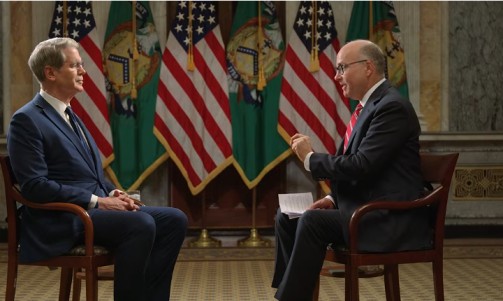
Treasury Secretary Scott Bessent sits down with Axios co-founder Mike Allen in the Treasury Department’s historic Cash Room for a candid conversation on inflation, gas prices, the Iran conflict and Operation Economic Fury, the AI boom, US-China AI safety talks, and the bond market. Bessent also discusses new Fed Chair Kevin Warsh, Trump Accounts for kids, no tax on tips, his clash with Elon Musk, and his journey from Little River, South Carolina, to Wall Street and the Cabinet. Read the full transcript of this interview below:
Welcome to the Cash Room
MIKE ALLEN: (00:00:24 – 00:00:35): Scott Bessent, 79th Treasury Secretary, proud South Carolinian, once known as “Wall Street’s quiet killer” for your dealmaking chops. Secretary Bessent, welcome to the Axios Show.
SCOTT BESSENT: (00:00:36 – 00:00:37): Mike, great to be with you.
MIKE ALLEN: (00:00:37 – 00:00:41): Thanks for having us into the Cash Room. I understand there used to be literal cash in these vaults.
SCOTT BESSENT: (00:00:41 – 00:01:21): There used to be cash in these vaults. And at one point, the inauguration ball was in here. So Treasury is a great building. We’ve got 3 museum offices. So we’ve got Salmon Chase’s Office that he financed the Civil War. I used to say for the Union, but I was corrected and said for the United States of America, which allowed Abraham Lincoln to win against the Confederacy.
We have the Johnson Suite where President Johnson actually worked after President Lincoln was assassinated because he wanted to give Mary Lincoln 30 days to move out of the White House. And then we have the Treasurer’s Office, which also has vaults in it.
MIKE ALLEN: (00:01:22 – 00:01:30): Very neat. So, Mr. Secretary, I want to have a real conversation. I’m going to be blunt. I won’t bullshit you. Please don’t bullshit me. Does that work?
SCOTT BESSENT: (00:01:30 – 00:01:34): We can both pull out our BS flags.
Cost of Living and the “Golden Age”
MIKE ALLEN: (00:01:38 – 00:01:59): You’re in charge of the economy at a time when many Americans are hurting and they blame your boss, the president. A new AP poll says 17% fewer than 1 in 5 approve of the president’s handling of the cost of living, one of the big issues that got him elected. And we spent a lot of time together on the campaign trail. What happened to the golden age?
SCOTT BESSENT: (00:01:59 – 00:02:10): Look, I think it is there. I think it’s accelerating. I think the Iran conflict is masking a lot of it. But Mike, I can tell you what we’re not going to do.
MIKE ALLEN: (00:02:10 – 00:02:15): Well, it’s not just masking it, it’s deterred it, it’s held it back.
SCOTT BESSENT: (00:02:15 – 00:02:26): Well, if you look at the numbers, any of the numbers are quite strong, other than headline inflation. The numbers are very strong.
MIKE ALLEN: (00:02:26 – 00:02:30): Well, look at the number. Gas is $4.41 a gallon, up a buck and a quarter from a year ago.
SCOTT BESSENT: (00:02:30 – 00:02:34): That’s headline inflation. That’s headline inflation.
MIKE ALLEN: (00:02:34 – 00:02:37): And that’s what hits most Americans.
SCOTT BESSENT: (00:02:39 – 00:03:14): But what everyone calls groceries, what do you think the inflation rate is? Economists call it food at home. 2.2%, right back down to where it had been. So, but what we’re not going to do is do what the Biden people do and did, or tell the American people how good they had it.
That, look, I understand sometimes I feel like an emergency room doctor, that the American people were backed over by the inflation Mack truck, 21.5% inflation. And at least -4% real wage gains.
MIKE ALLEN: (00:03:14 – 00:03:29): But they feel like they’re still in the hospital. 2 weeks ago, Wall Street Journal, weeks before the midterms, “almost everything is getting more expensive.” Last weekend, Wall Street Journal, “the cost of transporting pretty much everything just won’t stop going up.”
SCOTT BESSENT: (00:03:29 – 00:03:44): Well, again, I’m not going to speak to the veracity of the Journal. And is how much is everything going up over time? Prices go up. The Fed wants them to go up about 2%. But, Mike, to come back—
MIKE ALLEN: (00:03:44 – 00:03:47): But so you are saying that people are better off than they feel?
SCOTT BESSENT: (00:03:48 – 00:04:25): I am saying that there is the stated preference and revealed preference. So I was just with the largest banks in America. I had the 2 major credit card companies come in last week. And what we’re seeing is spending is quite strong. Especially for the bottom 2 quintiles of wage earners. If anything, the spending is coming down for the top quintile.
And one of the largest banks in America told me, “we can see working Americans putting more into their accounts every week from wages.”
MIKE ALLEN: (00:04:25 – 00:04:27): So you’re seeing light at the end of the tunnel?
SCOTT BESSENT: (00:04:28 – 00:05:17): No, what I’m saying is we are seeing substantial wage increases, 3.5%, 3.7% median wage increase. And that’s about in line with headline inflation. And the difference here is, look, breaking even after what happened during the Biden years is not our goal.
But what will happen, we will get to the other side of this Iran conflict. I think oil is going to be more well-supplied. I think we’re going to be much lower, Wage gains will keep coming because we are having a manufacturing renaissance.
We are seeing the job gains go to Americans. We’re seeing private sector jobs this time other than government jobs. Private sector jobs are what drive wage increases. And the energy shock will fade away.
Iran, Economic Fury and Operation Economic Outcast
MIKE ALLEN: (00:05:21 – 00:05:35): You became the economic face of the war with Economic Fury, as you branded, and Operation Economic Outcast.
SCOTT BESSENT: (00:05:35 – 00:06:13): Yeah, so Secretary Mnuchin and I went to school together. We’ve known each other since we were 17. He kindly invited me out before I took this job, and he said, “what is going to surprise you the most is the amount of national security in the job.” And it did. But now with the Iranian operation, it’s really expanded.
And I’ll tell you that what we’ve had is a very strong sequencing in this Iran conflict. So 6 weeks of kinetic conflict, and none would’ve been possible without the other. 6 weeks of kinetic—
MIKE ALLEN: (00:06:13 – 00:06:16): But you were hoping you would have victory right here, a shorter sequence.
SCOTT BESSENT: (00:06:17 – 00:06:25): Well, I’m not a chess player. With chess, everything’s on the board and you can mostly predict things.
MIKE ALLEN: (00:06:25 – 00:06:27): You have a lot more sequences than you’d like to have.
SCOTT BESSENT: (00:06:28 – 00:06:40): No, I got called in at the end and I’m quite optimistic about what I see. But I play backgammon, I play cards, and you got to deal with what you’re dealt.
MIKE ALLEN: (00:06:40 – 00:06:42): Okay. All right. While we’re on cards.
SCOTT BESSENT: (00:06:42 – 00:07:31): But what I want to say is that we had kinetic, we destroyed their navy, their air force, substantially depleted their drone and missile capability, destroyed their chances of rebuilding that. Then we went to what the president calls “the iron wall” and the blockade, which we’d never done before.
And now we have Operation Economic Outcast, and we are isolating them economically like it’s never happened before. Right now the score in terms of barrels out of the strait, US about 1.1 billion, Iran zero. For the first time in history, since they started pumping oil, they will have no oil on the water this week. They will have no revenues.
Is AI a Bubble?
MIKE ALLEN: (00:07:35 – 00:07:45): A real issue for the Treasury Secretary is how much of America’s market gains and capital demand are all driven by the AI buildout. Are we in a bubble?
SCOTT BESSENT: (00:07:46 – 00:08:26): Well, some people would say it’s the other way around. Some people would say, well, rates are high because of the capital demand from AI. And look, I think that this is the generational or it’s something we saw the internet in my lifetime. We saw the internet boom. During the ’90s and the office modernization.
Before that, probably electrification. Before that, the railroads. Before that, the canals. No, we don’t have to be in a bubble. There’s a substantial amount of capital going in.
MIKE ALLEN: (00:08:27 – 00:08:29): So we don’t have to be, are you afraid we are or you think we’re not?
SCOTT BESSENT: (00:08:30 – 00:09:14): Well, I think what tells me that we’re not is what is different this time than the ’90s is we are seeing the so-called hyperscalers, we are seeing the most smartest and most successful people and the most cash-rich companies probably in the history of the world. They are willing to use their own money, their own balance sheets to invest in this. Microsoft, Google, Meta.
This is not kind of the speculative Pets.com that we had in the ’90s. These are serious companies with serious business models. And for both the frontier labs, Anthropic and OpenAI. We’ve never seen revenue growth like this.
AI Risks and US-China Talks
MIKE ALLEN: (00:09:35 – 00:10:02): I just interviewed Larry Fink, who you know very well, the CEO of BlackRock, the world’s largest asset manager. He told me it’s inevitable that something big and bad is going to happen because of AI. He says adversity accelerates innovation. What are you most worried about from AI?
SCOTT BESSENT: (00:10:03 – 00:11:19): Look, I think that one of the things I was worried about— well, 2 things. One, we cannot lose our lead to the Chinese. So one of the portfolios that I also have is I manage the US-China relationship. And I can tell you that it would be very different if they had the lead in AI rather than us, both from a capability point of view, how they would be using it, But more importantly, their willingness to discuss it.
So my counterpart, the Vice Premier, and I had a very good discussion. It’s going to lead to more discussions in October or November. And we have a substantial lead. They’re second, and then everyone else is way behind.
But a lot of these Chinese models are very powerful, not as powerful as the US models, but you get something that’s 80%, 90% as powerful without guardrails, that can be imported anywhere in the world. So the Vice Premier and I talked about 3 areas of safety concern. So it would be out of control, uncontrolled agents, non-state actors with cyber or biologics.
MIKE ALLEN: (00:11:19 – 00:11:26): And are you going to re-raise the idea that was floated of having some sort of communication between the 2 superpowers?
SCOTT BESSENT: (00:11:26 – 00:11:32): Yeah, sure. We’ll see. I do think that they have—
MIKE ALLEN: (00:11:32 – 00:11:33): What are you going to propose?
SCOTT BESSENT: (00:11:34 – 00:11:39): That we have some kind of a notification process, just like—
MIKE ALLEN: (00:11:39 – 00:11:40): And do you think he’ll go for that?
SCOTT BESSENT: (00:11:40 – 00:12:26): I think so. I think that they, over the past 60 days, have woken up to— I think that they didn’t realize how powerful their open-source models are. So the open-source models, they do industrial distillation, which is a nice word for stealing from the US models.
Some of their models, one of their very powerful models is Kimi. Kimi thinks she is Claude. Kimi will tell you she is Claude sometimes. It’s public, so I can talk about it. Kimi sent back, very helpful, Kimi sent back some PLA weapons plans to Anthropic. So I think things like that have made the Chinese realize that this is a very powerful technology.
MIKE ALLEN: (00:12:27 – 00:12:34): So just to button that down, you think there’ll be some agreement between China and the US about a channel of communication if something goes wrong?
SCOTT BESSENT: (00:12:34 – 00:12:35): Yes.
MIKE ALLEN: (00:12:35 – 00:12:38): And what about the capabilities of coming models?
SCOTT BESSENT: (00:12:39 – 00:13:08): I think just as your article said today, and I’m very aligned with Dan Huttenlocher at MIT who runs their AI group, I think on safety, One of the things with safety is we have to be able to assign liability. And Professor Huttenlocher really said that it is the people at the labs who have to accept responsibility. And I agree with that. And I think the labs have come around to that way of thinking too.
MIKE ALLEN: (00:13:08 – 00:13:16): And last one on China. Can you see the US and China exchanging windows into the coming capabilities of each other’s models?
SCOTT BESSENT: (00:13:18 – 00:13:26): Probably not that, but I think we can agree on this is what models should not do.
Preparing for an AI Cyber Crisis
MIKE ALLEN: (00:13:31 – 00:13:41): Rapid round on AI. How much planning is there for the day after, the day after a catastrophic cyber calamity caused by AI that hits the financial system?
SCOTT BESSENT: (00:13:42 – 00:13:57): Yeah, so you would’ve seen that Within days of the release of Mythos, it was coincident, but the largest bank CEOs were in D.C. for another meeting. I gathered them here at Treasury along—
MIKE ALLEN: (00:13:57 – 00:14:00): And they told you they were very worried.
SCOTT BESSENT: (00:14:00 – 00:14:49): They were. They were. But they have the best cyber defenses outside of governments in the world. And they have done a lot together since then. We have formed something called Golden Eagle, which is a clearinghouse. They have 4 best practices and they can actually collaborate here at Treasury in terms of their learnings.
And we are able to distribute that down the cap. So from the megabanks to the regional, super regionals to the regionals to the small and community banks.
But to get back to what Larry Fink was saying, I think what we really have to do, we are doing this hard scramble to the frontier for the models. We really need to start worrying more about resilience and defense too.
MIKE ALLEN: (00:14:50 – 00:14:58): How worried are you personally about the day after recovery from something where our accounts look like they have zeros or our PIN numbers don’t work?
SCOTT BESSENT: (00:14:59 – 00:15:09): Again, I think that the system is quite healthy and I would be very surprised to see something of that scale.
AI Regulation and Safe Acceleration
MIKE ALLEN: (00:15:13 – 00:15:32): You were one of President Trump’s most knowledgeable advisors on AI. My conversations with Wall Street, Silicon Valley, they both trust you. You were floated to be the AI czar, but you have a day job. After the midterms, can you see the administration being more activist, more interventionist on AI?
SCOTT BESSENT: (00:15:32 – 00:15:40): Well, it depends on what you mean by activist and interventionist. That we want safe acceleration.
MIKE ALLEN: (00:15:40 – 00:15:48): Do you agree with David Sacks, the presidential adviser and Silicon investor that worries of widespread AI harm are BS?
SCOTT BESSENT: (00:15:50 – 00:16:06): I believe that we have to be prepared for every occasion. But on the other side, I think that kind of this alarmism without solutions by some of the AI community, that’s not leadership.
MIKE ALLEN: (00:16:06 – 00:16:17): Well, and it’s not just some in the community. It’s their CEOs are basically screaming for regulation, warning of losing control of AI. Well, then they should slow down.
SCOTT BESSENT: (00:16:18 – 00:16:23): But it’s, I mean, it’s kind of like Hannibal Lecter— “stop me before I kill again.”
MIKE ALLEN: (00:16:24 – 00:16:38): It seems like you do regulate AI companies, but for whatever reason you don’t brag about it. The administration reviews all the models by the frontier labs weeks before they’re released, does order pauses if they needed. Why not brag about that and say we’re on it?
SCOTT BESSENT: (00:16:38 – 00:16:42): Well, it’s all voluntary right now, and except for one—
MIKE ALLEN: (00:16:42 – 00:16:42): You say right now?
SCOTT BESSENT: (00:16:42 – 00:17:10): Yeah, no. And that it’s all voluntary. And except for one instance, it has been voluntary. So if there were something disturbing and a lab, they kind of went against something that we had seen, then we would maintain the right to intervene, just as we had to do once with Anthropic’s Fable.
MIKE ALLEN: (00:17:11 – 00:17:12): And can you see that happening again?
SCOTT BESSENT: (00:17:13 – 00:17:23): I think that having seen that one incident, that the labs have been very cooperative and we’re seeing them.
MIKE ALLEN: (00:17:23 – 00:17:26): So it sounds like you think it may not be necessary to happen again.
SCOTT BESSENT: (00:17:27 – 00:17:43): Well, it shouldn’t be. Okay. It was— there was a boundary. It was tested. It was a successful test. And we’re actually seeing OpenAI hold back some of their models to do more testing on a voluntary basis.
AI, Small Businesses and Jobs
MIKE ALLEN: (00:17:48 – 00:17:58): Last one on AI. If existing product liability laws are good enough to police AI, why not waive all regulations on all products and just rely on that?
SCOTT BESSENT: (00:17:59 – 00:18:37): Again, your very good article today. I think we’re going to have to explore this in a more meaningful way. And this happens in every technological change. And just to go back to the AI doomerism, what we’ve actually seen is AI creating jobs.
And back to Main Street, some of the great proponents of AI 6, 9 months ago told me that we are going to see a proliferation of small businesses due to AI. And I was like, “oh, gimme a break.” We have.
MIKE ALLEN: (00:18:37 – 00:18:37): No, it’s happening.
SCOTT BESSENT: (00:18:37 – 00:18:38): No, it’s happening.
MIKE ALLEN: (00:18:39 – 00:18:53): I run a small company and we’re growing. And so far, and this was not necessarily foreseeable, so far people are growing. Do you worry, though, that that could come to a screeching halt, as my grandma would say?
SCOTT BESSENT: (00:18:53 – 00:19:24): Well, what we’re seeing, though, is your company, you call it small, but by many standards it’s large. What I’m talking about is the advent of the 1, 2, 3 person startup. Which is now enabled by AI.
I also oversee the IRS, so we can see a record number of applications for tax ID numbers. I talked to one of the big payment companies and they are seeing record requests for payment portals from small businesses.
MIKE ALLEN: (00:19:24 – 00:19:25): Do you think that’s going to persist?
SCOTT BESSENT: (00:19:26 – 00:19:26): Yes.
MIKE ALLEN: (00:19:27 – 00:19:31): So you are a super optimist as far as what AI is going to do for jobs?
SCOTT BESSENT: (00:19:32 – 00:19:42): I think that the— I don’t know if every corporation is going to hire more people, but for overall— You think net for the benefit? Net for the ecosystem, yes.
MIKE ALLEN: (00:19:42 – 00:19:47): What are your concerns about the possible inflationary effects of AI?
SCOTT BESSENT: (00:19:47 – 00:20:16): Well, Mike, I actually think it’s the opposite because what we’re seeing right now is the buildout. And I actually think over the medium and long term, AI is going to be very disinflationary as we increase productivity.
So we are, in essence, kind of making the payment upfront. We’re seeing some substantial capital usage. We’re seeing natural resource usage. But as we complete the buildout on the other side, I think it’s going to be very disinflationary.
“I Am the House Now” and the Bond Market
MIKE ALLEN: (00:20:21 – 00:20:29): Last month, you told the markets “I am the house now.” They bet against you at their peril. Do you regret saying “I am the house now”?
SCOTT BESSENT: (00:20:30 – 00:20:52): No, because look, the house doesn’t win every hand. The house plays percentages. And, look, that I maybe hurt some fragile egos on Wall Street, that I always had respect for the market. And I always tried to look and think, what’s the move after the move? That if you have an ego, you lose a lot of money.
MIKE ALLEN: (00:20:53 – 00:20:55): But the market slapped back.
SCOTT BESSENT: (00:20:55 – 00:21:15): No, it didn’t. How did it slap back? Rates went up, but oil went up. I could say, okay, yes, yesterday we had the first full allocation since we have expanded our Treasury buybacks and rates collapsed. There’s nothing causal there. It was coincident.
MIKE ALLEN: (00:21:15 – 00:21:22): The Financial Times, probably your favorite paper, said, “Bessent fails to break fever in US bond market.” What did you learn from that?
SCOTT BESSENT: (00:21:23 – 00:21:40): Well, I learned that the Financial Times is anti-American, anti-business, and they have a fever. They’re constantly trying to create a problem for the US. But let’s leave that disgraced publication in London aside.
MIKE ALLEN: (00:21:41 – 00:21:44): And so is it fair to say no longer your favorite paper?
SCOTT BESSENT: (00:21:44 – 00:23:20): It never was. But they do have some excellent journalists. But what I would say is that, and again, what I’ve learned, that everyone in the market knows you don’t win every hand, but you win over time. Everyone knows I’m a big basketball fan, big fan of John Wooden, big fan of Dean Smith. And how did they win? You trust the process and you put a good process in place.
And what we can see with bond yields, that I would be concerned if we were having this some kind of idiosyncratic rise. It’s been a global rise. The US market, US bond performance since the president came in has been the best in the world. So we are not seeing people sell Treasuries to buy German bonds or Japanese bonds.
And like I said, that I can’t control the bond market. What I can do is try to get people to slow down and think. Because my job in the financial markets for 30 years was to be outside the door, ear to the door when policy was being made, sometimes with myself over the transom and think, what policymakers going to do, should do, can do?
And now that I’m in the room, and what I meant by “I in the house” is that I have superior information. People could ask, Obviously, the Japanese would have liked for us to intervene in the yen at some point any time since January. Why did we do it then? People should sit back and ask themselves that rather than, “oh, we intervened in the yen.”
Economic Security Is National Security
MIKE ALLEN: (00:23:21 – 00:23:29): So are you prepared to step in again? Should financial markets expect a more interventionist, activist Treasury from now on?
SCOTT BESSENT: (00:23:30 – 00:23:44): Again, we’re not an activist Treasury, but what we had to What I have done with President Trump’s blessing is we believe that economic security is national security. National security is economic security.
MIKE ALLEN: (00:23:44 – 00:23:46): But so you could see stepping in again?
SCOTT BESSENT: (00:23:47 – 00:24:36): Well, let’s think about what we did in Argentina, that a great US ally who had done a great series of reforms, his opposition was trying to turn the markets against him. And create a financial panic going into the election.
I was able to use the balance sheet of the United States of America, make money for the American people with a fully secured currency swap, central bank to central bank, and the bridge President Milei during the election.
And I would submit that the stabilization of Argentina has led to a sea change in Latin America, something generational or maybe first time in history that we’ve never had this many Latin American countries allied with the US. So could we do that again? Sure.
The Fed Chair Search and Kevin Warsh
MIKE ALLEN: (00:24:41 – 00:24:49): You’ve led the search for the new Fed chair. You’ve known Kevin Warsh forever. How has that relationship changed and can it get awkward?
SCOTT BESSENT: (00:24:50 – 00:26:19): So we had a very rigorous process. We had a group of 12 candidates. We moved that down and that down. And what I can say it was 100% the decision of the president. I never put my thumb on the scale. We had some great candidates. And as you said, I’ve known Kevin for a couple of decades.
And look, we represent 2 very different powerful institutions. And Chair Warsh has talked about that maybe the Federal Reserve has taken some powers that Treasury traditionally had pre-GFC. And remember, Chair Warsh was in the administration during Bush, and then he was also the youngest governor in the history of the Fed. So he was there for the financial crisis. So he has great perspective on both sides.
And I think for him, the president kept saying, “are you sure you don’t want this job?” And I said, “sir, I think to succeed, you have to have been in the building before.” So if you look, if we say you turned it down, if you think about the 3 or 4 of the finalists, they’d all been in the building before, which I think is a real— you start with a big lead if you understand the institution.
MIKE ALLEN: (00:26:19 – 00:26:20): So how’s Chairman Warsh doing?
SCOTT BESSENT: (00:26:20 – 00:26:34): Sorry, I think he’s doing well. We have traditionally Treasury Secretary and Fed Chair have breakfast every week. I had over 40 breakfasts with Jay Powell. And I think—
MIKE ALLEN: (00:26:35 – 00:26:37): Are these ones— these are probably a little more cordial?
SCOTT BESSENT: (00:26:38 – 00:26:38): Sorry?
MIKE ALLEN: (00:26:38 – 00:26:40): These breakfasts are probably a little warmer?
SCOTT BESSENT: (00:26:41 – 00:27:27): Yeah. Chair Powell and I had a very good relationship. And they’re private. We talk about the events of the week. We talk about where we think the economy’s heading.
I’m fortunate that I think, if I look at my call sheet every day, I probably have 100 calls to make. I think if you’re Fed Chair, you probably have 3. So part of my job is to make sure that he can hear what’s going on in the wider world, what maybe the markets are saying. We have a large markets desk. He does have the New York Fed. And it’s a very healthy back and forth.
From Hedge Funds to MAGA Darling
MIKE ALLEN: (00:27:31 – 00:27:56): Secretary, you came to fame and fortune running hedge funds, but Steve Bannon, one of the most powerful MAGA podcasters, told me, “Bessent’s my guy. Best Treasury secretary since Alexander Hamilton. In Bessent we trust.” That’s Steve Bannon. How the hell did a hedge fund guy former Democratic donor who managed George Soros’s fortune become a MAGA darling?
SCOTT BESSENT: (00:27:56 – 00:28:03): Well, a couple of things. First, Democratic donor. I made a couple of donations to Democrats.
MIKE ALLEN: (00:28:03 – 00:28:04): Well, you stood with Al Gore, so.
SCOTT BESSENT: (00:28:04 – 00:29:37): Yeah, but I would say it’s like $300,000 to $15 million, Dems, Republicans. I’ve— my first election was Ronald Reagan in 1980. I met him on the Yale campus. There were only 5 of us who went to see him. One was Art Laffer’s nephew.
So And look, I think deep down inside, I’m just a kid from Little River, South Carolina. And I haven’t forgotten my roots. And a lot of what I’ve done, where I have had good fortune on Wall Street, a lot of the big trades, the big investments have been against elite consensus, where President Trump winning, that was one of best nights our fund ever had.
And the market traded down. The market was crashing. I believe my former employer, George Soros, was the one selling it. And I’m sitting there watching this and I’m thinking, this is the most pro-business president maybe of all time, certainly since Calvin Coolidge. And why is the market trading down?
So just to push back against the weak consensus and I have a view, and one of the reasons I thought President Trump would win, one of the reasons I thought Brexit would likely happen, was that the people had had enough. So President Trump always thinks about the American people.
I think of myself as a Main Street person more than a Wall Street person. I’ve talked a lot about parallel prosperity. Wall Street always does well. Now it’s Main Street’s turn.
Bringing a Private Sector Mindset to Treasury
MIKE ALLEN: (00:29:38 – 00:30:06): So as part of that, you’ve tried to bring private sector mentality approach to this big old government building? You look at your accomplishments, you got tax cuts done, One Big Beautiful Bill as one bill on time. I will say I was skeptical of both of those. A bunch of international deals, Trump Accounts. You led the Fed. You led the search for the new Fed chairman. How has that private sector mentality worked in this building?
SCOTT BESSENT: (00:30:06 – 00:30:28): I think, look, the American people go to work every day and work hard. Many of them work overtime. Many of them work on weekends. Might want to— I have a history of working on Sunday afternoons, Sunday evenings, and it took a lot to get this building open on Sundays so I could come in, members of my team could come in. It just wasn’t something the federal government does.
MIKE ALLEN: (00:30:28 – 00:30:31): So you were trying to get literal lights, literal heat?
SCOTT BESSENT: (00:30:32 – 00:30:58): Literally, the lights turned on and the doors unlocked. And there’s this theory, one of the reasons that people are now unhappy with government is you can get a ride at your car or at your house in 4 minutes. You can get food in 22 minutes. You can get clothes or a book the next day. But the government’s still moving slowly. And I think people want to see that the government is moving quickly.
MIKE ALLEN: (00:30:58 – 00:30:59): So you’ve tried to speed it up?
SCOTT BESSENT: (00:30:59 – 00:31:28): We’ve tried to speed it up. We have a performance attitude here. And one of the things that I say frequently, a great surprise for me has been the career staff here at Treasury is fantastic. They’re fantastic that many of them, the majority of them who I have interacted with, I would hire them in my private sector businesses. It’s Thursday, I need a 20-page report on Monday. Great. And it’s super high quality.
MIKE ALLEN: (00:31:29 – 00:31:32): And that has not been common in government for sure.
SCOTT BESSENT: (00:31:32 – 00:31:53): It’s not common for sure. But I think that there are people who just, they want to be led. They want to make a difference. That’s why they come into government. People don’t come into government for the retirement benefits. They come to make a difference, to do their job well. And that’s what we find here at Treasury, some great civil servants.
Trump Accounts for Kids
MIKE ALLEN: (00:31:53 – 00:32:17): No, it is a truism of life. People want to be led. You announced— just announced the completion of auto enrollment for Trump Accounts for kids. Trump Accounts supply $1,000 in federal seed money for American children born during this administration. A tax-smart running start for anyone under 18. If you qualified for auto enrollment, did the money just appear this week?
SCOTT BESSENT: (00:32:18 – 00:32:27): So what happens is auto enrollment, the accounts have now been created, is the parents just have to go and claim them.
MIKE ALLEN: (00:32:27 – 00:32:28): As you download the app?
SCOTT BESSENT: (00:32:28 – 00:34:03): So you just download the app, trumpaccounts.gov. We’ve had about 8 million people who already before we did the auto enroll went on and created their own accounts. We decided to make it even easier.
And as you said, for children born during President Trump’s second term in office, Treasury is going to seed the accounts with $1,000, and that will grow. So I believe that this is the most important benefit for young people since the GI Bill.
38% of Americans have no exposure to our great equity markets. When I was a kid in rural South Carolina, All I knew about Wall Street was something bad had happened in 1929. And I think this is going to be— we’re going to take it from abstract to a real-time learning experience in financial literacy.
In nutrition, there’s this idea of a food desert that if you live in certain rural areas, urban areas, you don’t have access to clean, fresh food. I would submit to you that we had financial service deserts. That if the average household doesn’t have $500 in cash to meet a medical emergency, then they’re not going to open an online brokerage account, put in $10, $20.
But by seeding these, by creating these accounts, we are opening this up. It is a gigantic oasis of the financial desert. And our goal is to get every family participating in the innovation and capital markets that drive the U.S.
MIKE ALLEN: (00:34:03 – 00:34:06): And it’s an opening for employers, for philanthropists.
SCOTT BESSENT: (00:34:06 – 00:35:08): Employers, philanthropists, foundations. And I think this can be a new kind of philanthropy that if the philanthropists are really true to their goals, if they want to help the children of America, this is the direct way to do it with 100% of the donation going directly to American children.
There’s no starchitect-designed foundation headquarters. There’s no annual dinner. There’s no award, there’s no big staff. If you really want to do this, it’s what Susan and Michael Dell have done. It’s what Ray Dalio has done, Brad Gerstner, Harold Hamm.
And the other thing too is that these billion-dollar gifts are incredible. But if a local philanthropist wants to adopt a zip code, a school district, we’re going to be able to tailor those. Many states are thinking of topping these up. I think it’s going to become a fringe benefit for many workers, just like a 401(k) contribution that the employers can make up to a $2,500 contribution.
“Fired When Fired Upon”
MIKE ALLEN: (00:35:09 – 00:35:22): In talking to administration officials for this interview, 2 themes kept coming up. One is they said you’re the most competent cabinet member. Other people said you’re the most volatile cabinet member. What kind of person sets you off?
SCOTT BESSENT: (00:35:23 – 00:35:56): Well, let’s go back. First of all, I think we have a great cabinet. And I think the president’s assembled a different kind of cabinet that when I have a question on the energy to be able to talk to Secretary Burgum, Secretary Wright, both with substantial experience, Secretary Rubio.
People may forget he chaired the Senate Intelligence Committee. So for him to be the National Security Advisor or Secretary of State— and look, I don’t think I’m the most— believe me, I’m far from the most evolved.
MIKE ALLEN: (00:35:56 – 00:36:04): Well, you’ve joked that dueling among Treasury Secretaries respect to Alexander Hamilton, you have had some heated confrontations.
SCOTT BESSENT: (00:36:05 – 00:36:40): Yeah, I would say that I stand my ground like Alexander Hamilton, fired if fired upon. And I always point out, did not end well for Treasury, the Alexander Hamilton-Aaron Burr duel. So my goal is not to duel, but it is to stand my ground.
And look, if I think someone is not following what the president wants, because I am here to do what the president of the United States wants and is not trying to do what is best for the American people.
MIKE ALLEN: (00:36:40 – 00:36:42): So fired when fired upon.
SCOTT BESSENT: (00:36:42 – 00:36:43): Fired when fired upon.
Growing Up in South Carolina
MIKE ALLEN: (00:36:43 – 00:37:09): Touché. A warning there. So yes, you have a surprising biography. You still belong to the French Huguenot Church in Charleston, South Carolina, which your family helped start in the 1680s. Your family got into money trouble and you had a job by 9. You had a job setting out deck chairs?
SCOTT BESSENT: (00:37:10 – 00:38:08): Beach chairs. Beach chairs on the beach and as a busboy. So age 9, I was getting a W-2. I was getting tip income. I was getting overtime. So when the president, with his economic policy, no tax on tips, no tax on overtime, I was one of the biggest supporters. And you grow up with a lot of agency at that point.
I’d be a very different— our family was affluent for a couple hundred years and my dad had some bad breaks. And, but I’m a very different person from having gotten a paycheck since I was 9 years old and seeing working Americans up close, experiencing economic hardship economic insecurity.
One of the reasons I originally wanted to go to the Naval Academy, one of the reasons I wanted to go, because I didn’t necessarily have the money to go to Yale, but ended up working 3 jobs.
MIKE ALLEN: (00:38:08 – 00:38:10): And now you’re worth hundreds of millions of dollars.
SCOTT BESSENT: (00:38:12 – 00:38:13): That’s what people say.
No Tax on Tips and the Tax Bill
MIKE ALLEN: (00:38:14 – 00:38:27): I watched you at McLean Family Restaurant across the river here in McLean, Virginia, talking to servers there. No tax on tips has become very personal for you. It’s become a signature issue for you.
SCOTT BESSENT: (00:38:27 – 00:39:21): Well, it also means I think I’m the most popular cabinet secretary when I walk into a hotel or a restaurant in D.C. And look, the president was adamant about keeping his 4 signature promises in the tax bill, as was I, because I could tell you a couple of old-line, very orthodox Republicans, economically orthodox Republicans weren’t in love with that.
And I think we ended up, in nature, the most beautiful thing is symmetry. So I think the tax bill ended up with great symmetry. On one side, you had things that are powering industries. So 100% expensing for equipment, 100% expensing for factories, 100% expensing for farm structures.
And then on the other side, no tax on tips, no tax on overtime. 85% of our seniors aren’t paying taxes on security and deductibility of auto loans on American-made cars.
The Naval Academy, Yale and Being Gay
MIKE ALLEN: (00:39:22 – 00:39:35): Now, you modestly said you wanted to go to the Naval Academy. You actually got an appointment. One of the reasons you’ve talked about the fact that one of the reasons you didn’t go was because you’re gay. And did that hold you back earlier in your career?
SCOTT BESSENT: (00:39:36 – 00:40:23): I don’t think it did at all. And it’s very difficult to talk about the counterfactual. That, but I don’t think going to Yale held me back. Maybe some people who went to other Ivy League schools would think it might. But I think that it makes you aware.
And I’ve openly spoken about it before too, is I think maybe some of my career choices, great thing about money management is there’s a scorecard. It’s not, maybe in sales, maybe in trading, maybe In relationship management, there’s a lot of subjectivity. That money management, there’s a scorecard.
MIKE ALLEN: (00:40:24 – 00:40:32): And you said “President Trump chose me because he believes I’m the best candidate, not because of my sexual preference or” your green eyes.
SCOTT BESSENT: (00:40:32 – 00:40:49): Exactly. So I am. And I think that’s one of the reasons we have such a great team, that the president makes his decisions all the time. He’ll occasionally tell me, he goes, “you’re breaking Melania’s friends’ hearts. They see you on TV and they want an intro and we have to break the news to them.”
Clashing with Elon Musk
MIKE ALLEN: (00:40:49 – 00:40:56): As we say goodbye, last year in the West Wing, you got heated with Elon Musk. It was the talk of the White House. What was that like?
SCOTT BESSENT: (00:41:00 – 00:41:17): Again, I am a huge Elon fan. And in terms of what he was trying to do with government, very supportive. And there was one turn that things were taking that we didn’t agree on.
MIKE ALLEN: (00:41:19 – 00:41:24): And Elon was at the White House the other day for the big AI meeting. Have the two of you met up?
SCOTT BESSENT: (00:41:25 – 00:41:54): Yeah, I mean, that’s a good thing. I’ve often said that We’re kind of like a sports team. You can have an argument in the locker room, but you go out on the field together and you’re all doing the same thing.
So I’ve been in regular contact with Elon and he’s amazing. He’s taking us to Mars. Look at what he’s done with SpaceX and Starlink and all these other things.
MIKE ALLEN: (00:41:55 – 00:41:58): Starlink is great for the World Cup on a cross-country flight, I can tell you that.
SCOTT BESSENT: (00:41:59 – 00:41:59): Yep.
MIKE ALLEN: (00:42:00 – 00:42:04): Mr. Secretary, thank you for inviting us into the Cash Room, and thank you for joining the Axios Show.
SCOTT BESSENT: (00:42:04 – 00:42:05): Good. I hope you’ll come back.