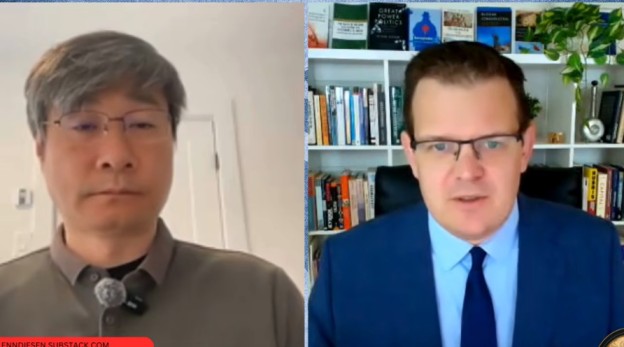
In this interview, Glenn Diesen speaks with Jiang Xueqin, host of Predictive History, about a world in revolution and the growing conflict between globalism and nationalism. They discuss Trump’s reversal on foreign policy, the Canada-US sovereignty clash and the “Donroe Doctrine,” the Iran war and the Houthi-Saudi conflict that could spark World War III, Europe’s push toward war with Russia, and rising tensions between China and Japan in East Asia. This interview was premiered on October 4, 2026. Read the full transcript of this interview below:
Trump’s Reversal and the Factions Behind Him
GLENN DIESEN: (00:00:00 – 00:00:16) Hi everyone and welcome back. Today is October 4th, 2026, and we have the great pleasure of being joined by Jiang Xueqin, the extremely popular host of Predictive History. And I’ve left a link in the description. So thank you for coming back on the program.
JIANG XUEQIN: (00:00:18 – 00:00:18) Thanks, Glenn.
GLENN DIESEN: (00:00:20 – 00:01:38) So the United States, after, well, 30 years of pursuing a strategy based on global primacy, we see that, well, the US has been exhausted. It’s also been overstretched, and we see the other great powers or even large powers collectively balance the United States. It seemed for a while that Trump recognized this, he was communicating this, and essentially the solution made sense. He was talking about fiscal discipline, cutting the waste, ending all of these wars. So I would say to some extent, remarkable consistency.
However, this spectacular change of Trump is interesting. He doesn’t preach this anymore. The debt is going through the roof. He’s— all the things he initially began to cut seems to have come back. The wars— I mean, the Ukraine war he owns now, Iran it was completely unnecessary to start to begin with.
How do you see this switch in the United States? What does that tell you about the political system? Because this is something that is making a lot of people quite curious how this happens.
JIANG XUEQIN: (00:01:40 – 00:04:55) Well, I would say that right now we are almost experiencing a revolution around the world. And there’s certain factions that have rallied around Trump and they’re trying to establish a new world order. So I’ll just list some of the factions and how this is manifesting in geopolitics.
So one conflict that we are experiencing right now around the world is that between the globalists and the nationalists. And so you may know of the recent trade war between Canada and the United States. Mark Carney, who is Prime Minister of Canada, is proposing a new trade alliance between Europe and Canada that circumvents the US-led trade alliance. And the United States under Trump is trying to establish better relations with Russia and China.
So what will happen over the next few years is the world will divide between the old global order, basically Canada, Europe, Britain, and a new Trump-led world order where the 3 main powers are United States, China, and Russia. And we’re already seeing this play out because of Mark Carney, his desire to promote a new trade bloc. Okay, that’s one sort of source of friction in the world.
Another is the war between the central banking and the tech bro oligarchs in Silicon Valley. And so what’s been happening is that Trump has been promoting the interests of AI companies such as OpenAI and Nvidia. And what they want to do is establish a new financial monetary system based on digital ID and digital currency that circumvents the old central banking model of money printing.
And then you have the secular people versus the religious people, and we’re seeing that play out in the Middle East, where Israel is trying to achieve the Greater Israel Project and it is trying to promote a Zionist agenda around the world.
So there are 3 major factions right now rallying behind Trump, the nationalists, the AI oligarchy, and the Zionists. And that’s why we’re seeing a lot of conflicts throughout the world, and it’s best to understand Trump’s decision-making in that light.
Globalists vs Nationalists in Europe
GLENN DIESEN: (00:04:58 – 00:06:28) Yeah, no, well, it’s interesting you break down to the different groups because within that camp there appears to be not everyone on the same page. Well, they essentially have some different motivations about the globalist versus nationalist.
I always recommend this. I know I’ve done before, but Samuel Huntington, the political scientist, he wrote this article, “Dead Souls,” on the denationalization of the American elite back in 2004. Again, it’s been 22 years, but he essentially argued that America’s elite was becoming so detached from the nation and national interests that essentially their circle will look at global institutions, markets, this cosmopolitan nature, and that’s effectively where their interest and their heart would lie. And this is why he said America will split, and also the world, between nationalists and globalists. And the elites would be— as they become more detached, one can assume that this would be fertile soil for the populists.
But you see similar developments in Europe though. Again, in Europe, they don’t have the tech bros or the Zionist lobby isn’t as strong, but how do you explain Europe? Because again, if I would argue or define it, it’s hard to see how the leaders of France, Germany, or even the UK pursue their basic national interest, which is largely reflected in their polling.
JIANG XUEQIN: (00:06:30 – 00:07:29) Right. So to better understand this globalist-nationalist conflict and how it applies to Europe, let’s use the case study of Canada. So there’s reporting right now that Republican operatives, basically Trump loyalists, are in 2 provinces, Alberta and Quebec, fomenting separatist movements. So what they’re trying to do is trying to rally these nationalistic energies in Canada in order to undermine the authority of the federal government led by Mark Carney.
Mark Carney’s response to this American provocation is to target certain red states with tariffs that hurt their economy.
GLENN DIESEN: (00:07:29 – 00:07:29) Okay?
JIANG XUEQIN: (00:07:30 – 00:08:48) So Canada provides a very good case study of how this war between the globalists and nationalists will eventually play out in Europe, right? So in other words, what I think is happening is that you have Trump-aligned political factions throughout Europe, basically in a place like Hungary, Austria, Poland, and then you have these nationalistic parties in Western Europe, the AfD, Vox, Marine Le Pen’s party, and they’re trying to capture government and promote a more nationalistic agenda. And obviously they’ll be supported by Trump.
And then on the other hand, you have these globalists, and the globalists right now are the current government, the current regime throughout Europe. And they want to maintain the status quo. The best way to maintain the status quo is to continue this war in Ukraine. And Britain, France, Germany are committed to extending this war in Ukraine. So there are different points of friction between these 2 camps. I would say the war in Ukraine is the main source of friction within Europe at this point.
GLENN DIESEN: (00:08:50 – 00:09:01) But how so though? Why would that extend their cost, that is to keep this war going? Because it seems as if this is something that could sink the entire European project.
JIANG XUEQIN: (00:09:03 – 00:09:55) Yeah, that’s a really interesting question. So I think that these different global factions are fighting over interests, right? So these different factions are supported by different interest groups. And so if we look at the war in Ukraine, clearly there are certain European interests that benefit from this war, including defense companies, basically the military-industrial complex of Europe.
And so by continuing this war, the globalists are trying to benefit their own vested interests. And so really, they don’t really care if this war is won or lost. They just want to continue this war because it benefits their constituencies.
Canada, Greenland and the Donroe Doctrine
GLENN DIESEN: (00:09:58 – 00:10:46) You did mention the US possibly pushing for, well, secessionism in Canada. Again, if I would, well, if you look towards what they did with Greenland, it kind of was a similar logic there. You don’t need to annex Greenland if you can first step to push for Greenland to secede from Denmark, then if they stand alone, it would be much easier to get what you want.
I mean, if I was Trump looking at Canada, I would look at Quebec, I would look at Alberta, thinking that this would be a vulnerable region in terms of some secessionist movements. Did you see kind of this being the pathway, pushing for them to secede and then not divide and, more or less divide and rule, and then seek to get some better deals for the United States?
JIANG XUEQIN: (00:10:47 – 00:13:38) Yeah, so Trump is very clear about his intentions via Canada. As you point out, Trump has been saying for the longest time that he wants to take over Greenland, and recently the United States and Denmark signed a treaty that basically gave the United States de facto control over Greenland. So if Trump says something, then I think he means it. And Alberta is home to a lot of energy resources in the United States, wants control over those resources.
Also, a few months ago, Trump promoted something called the “Donroe Doctrine,” which is a corollary to the Monroe Doctrine. And basically the idea is the United States sees the entire Western Hemisphere as vital to US national strategic interests.
And so the trade war between Canada and the United States, it’s not really a trade war, it’s a war over sovereignty. So basically, the United States wants to control who Canada can trade with, specifically China. And Mark Carney has expressed that that is unacceptable. Canada will maintain its sovereignty and it will trade with whoever it chooses to trade with. And so this trade war is really one over national sovereignty.
And so we can expect this trade war to continue and to escalate, and the best way to undermine Canada’s national sovereignty, of course, is to foment separatist movement in Alberta and in Quebec. Quebec is interesting because for decades, the Quebecois have tried to achieve independence. Alberta is right now suffering from this trade war. And we can expect that as this trade war increases, then the separatist sentiments in Alberta will only increase.
Right now, polling shows that about a quarter, at most maybe 20% of Albertans support independence. This is not to unite with the United States. This is just to secede from the Canadian Confederation. Actually, we don’t even know if that is legally possible. But the idea is that Trump is a chaos maker and he just wants Albertans to try to secede. And then this will allow Trump to apply pressure on the Canadian government.
Trump Loyalists in Latin America and Europe
GLENN DIESEN: (00:13:40 – 00:14:15) Well, I guess once, if he’s able to, once all Canada been broken, he could pick up some of the pieces. Well, it’s hard to say if it will succeed, but there seems to be a common theme in the Western Hemisphere, from Greenland, Canada, Cuba, the Panama Canal, Venezuela.
You also hear a lot of arguments that there’s a lot of interference into the politics of the Latin American states. So the US appears to be trying to strengthen its hold over Latin America. Did you see this as being feasible though in the long run?
JIANG XUEQIN: (00:14:15 – 00:15:19) So if we have evidence that Republican operatives, Trump loyalists, are in Alberta and Quebec fomenting separatist movement, then we have a lot of reasons to suspect that there are agents throughout Latin and South America as well. Right now there are the Brazilian elections, and we can expect that there are Trump people throughout Brazil trying to create election results that favor Trump.
Max Blumenthal has reporting that there are Trump agents throughout Latin America, specifically El Salvador. So we have to expect that there are Trump loyalists, not only just throughout the Western Hemisphere, but also throughout Europe, that are trying to foment more nationalistic parties because these parties are more sympathetic towards a Trump worldview.
The National Security Strategy and the Iran War
GLENN DIESEN: (00:15:21 – 00:16:11) Yeah, indeed. In the national security strategy of the United States, it outright states that the US should help to reverse the problems of Europe. They see this as being a globalist decline of Europe. It won’t look the same or exist in 20 years. To save Europe, you essentially need regime change here and there.
So that seems to be— well, again, it sounds outlandish, but based on what they’re stating, what they’re putting down in their strategic documents, and what they’re doing, they seem to follow this logic. But while there’s, you can argue, successes in the Western Hemisphere, the Iran War isn’t going though as planned. How do you see though this war fitting into the US strategy and the— well, how is it changing it or changing the world?
JIANG XUEQIN: (00:16:13 – 00:18:29) Right. So if you look at the National Security Strategy very carefully, it calls for the United States to retreat from the world and create a situation in which these different regions are in conflict with each other. So imagine a scenario where in Europe, the Europeans are fighting the Russians. In East Asia, the Chinese are fighting the Japanese and their allies, the Filipinos, the Indians, the Australians. And in the Middle East, Israel and the GCC are fighting Iran and their proxies.
Well, in that situation, the Western Hemisphere becomes a fortress that provides the world with the financing, the resources, the armaments necessary in order for them to continue these conflicts. And this is a situation very similar to right before World War II. And so it seems to me that given what’s happening in the Middle East, specifically Saudi Arabia going to war against Houthis, then things are going according to the National Security Strategy plan.
And this conflict in the Middle East directly benefits the United States because number one, it’s cutting off cheap energy supplies to the world. And so Europe, Japan, South Korea are increasingly dependent on US energy. Number 2 is that because the GCC is at war, it is increasingly reliant on Israel and the United States for military assistance, giving Trump tremendous leverage. And number 3 is that this war in the Middle East, it is hurting the Chinese economy by a great deal because China relies on a lot of cheap energy imports from the GCC. And so this allows Trump to pressure China even greater.
So I mean, just from a Trump perspective, maybe not from a US perspective, but from a Trump perspective, this war in the Middle East is going according to plan.
Why Voters Don’t Shape US War Policy
GLENN DIESEN: (00:18:31 – 00:19:02) But at some point though, the defeat, wouldn’t that cost him his political support and foundation in the United States? And I guess the energy cost as well, that would become difficult for the Americans as well. Or I don’t know, the Americans strike me as uniquely rebellious. If you have high energy prices in Europe, they get angry, but in the United States, yeah, it’s, I don’t know. Yeah, rebellious is a good word for it.
JIANG XUEQIN: (00:19:02 – 00:22:39) Right. Okay. So you’re absolutely right. And our polling shows that most American voters are very annoyed at this war in the Middle East, which is causing diesel prices to go up. And because the United States is a car-driven economy, this affects everyone in the United States. And so in theory, what should happen is that in the midterms, the Democrats sweep both the House of Representatives and the Senate, and they apply pressure on Trump to end this war in Iran.
History tells us a different story. Number one is that for the past 20 years, the United States has fought these forever wars in the Middle East with no political repercussions in the United States. I mean, the United States lost the war in Iraq, lost the war in Afghanistan, spent trillions of dollars losing these wars, and there was absolutely no consequences in American electoral politics. In fact, no one was ever prosecuted or charged for this bad policymaking in the Middle East. So it seems that the American people are insulated from the consequences of the American empire. Okay, that’s point number one.
Point number 2 is if you look at how US politicians behave, especially congresspeople, they don’t actually represent the interests of voters. They represent the interests of donors. And the reason why is that congresspeople go into Congress not to serve US national interests, but because once they’re in Congress and they retire, they can then become lobbyists for the military-industrial complex or for these AI companies, for Wall Street, and make millions of dollars doing so.
So the way that congresspeople behave is maybe during election, they voice very nice rhetoric. When they go into Congress, they do nothing because they don’t want to piss off donors and voters. And then when they leave office, they just become lobbyists. And that’s why even though this war against Iran has been ongoing since March, Congress has never forced a vote on this war because congresspeople do not want a record of their vote on this war. So that’s point number 2.
Point number 3 is what ultimately decides elections nowadays is not voter sentiment. This is not polling. It is dark money. So if you look at Thomas Massie, he lost his primary even though he’s extremely popular incumbent in Kentucky. He knew his voters. He was very loyal to his voters. He was very popular amongst his voters. But there were 3 individuals, Miriam Adelson, John Paulson, Paul Singer, who, by the way, were not even residents of Kentucky. They poured in $30 million of dark money into the primary to defeat Massie, and they won.
So there’s something about the US political system, and it’s gamed a certain way that benefits certain donors. And so what we should be looking at are the political interests of these donors as opposed to polling or US national security interests.
The Houthi-Saudi War and the Bab el-Mandeb Strait
GLENN DIESEN: (00:22:41 – 00:23:34) But you see the economic focus on both sides. That is, the US is now pushing for this economic strangulation of Iran. And again, they do have tools at their disposal. And the Iranian economy is experiencing a lot of pain. At the same time though, you see on the American side, you have a brewing financial crisis, the economy isn’t doing too well.
How do you see this playing out? Because if something would happen to the Gulf states as well, that’s a lot of money which is used to finance the US bond market, to keep the AI bubble afloat. I mean, there seems to be a lot at stake here. How do you see this playing out? Which one would come out on top?
JIANG XUEQIN: (00:23:36 – 00:26:35) Yeah, so if you look at how these major wars start, it’s never started by the powers. It’s always started by marginal that are allied to these great powers. The classic example, of course, is World War I, where it was really started in Serbia. If you go back to the Peloponnesian War, it was not started by Athens and Sparta. It was started by their allies in the margins.
And we’re seeing a very similar dynamic today in the Middle East where the real conflict is not between the United States and Iran. It seems as though they’ve reached an equilibrium where it’s a major standoff. The real problem is the war emerging between the Houthis and the Saudis. So this huge problem because the Saudis see the Houthis as an existential threat to its existence. And for the past 10 years, the Saudis have tried many ways of defeating the Houthis, including trying to starve them.
So the Houthis are a huge problem for the Saudis. The Houthis can, with their drones and ballistic missiles, attack Saudi energy infrastructure or pipelines, the oil refineries, the desalination plants. There’s nothing the Saudis can do about it. Recently, the Saudis have signed something called the Mecca Accords, which means that Turkey, Pakistan and Saudi Arabia are committed to each other’s defense. And because of the Houthi attacks on Saudi energy infrastructure, the Saudis have invoked the Mecca Accords.
And so what’s happening is Saudi Arabia and the UAE have asked the Yemeni government to launch a massive offensive against the Houthis. The Pakistanis are sending troops to guard Saudi Arabia energy infrastructure, and so this will spiral out of control.
I think that what’s happening in the Strait of Hormuz will be secondary to what’s going to happen in the Bab el-Mandeb Strait because regardless of what happens in the Strait of Hormuz, both Iran and the United States are state actors, and they are constrained by geopolitical interests. China and Russia can always restrain Iran from going too far.
The Houthis are a completely different matter. The Houthis are a non-state actor and they have this messianic fervor to them. They hate the Saudis and when they’re attacked, then they will do whatever they can to defend themselves. So I see this situation as spun out of control very, very quickly, and this will probably drag in all the great powers at some point.
Could World War III Start in Yemen?
GLENN DIESEN: (00:26:38 – 00:27:11) Yeah, no, the Houthi issue is quite interesting because, well, I can understand the Saudi dilemma. On one hand, if they give in to the demands of, one, want to put an end to this peace with Houthis, then they have to end the blockade on Yemen. If they do that, the Houthis will grow very strong. If they don’t, the Houthis will continue their blockade on the Saudis, and the Saudis might actually collapse if this continues for too long. So it is an interesting— I’m not sure how they’re supposed to get out of this. Do you think it’s—
JIANG XUEQIN: (00:27:11 – 00:28:48) No, they’re trapped. The Saudis are facing a credibility issue where if they make any compromises, they’ll be seen as weak. And Saudi Arabia fancies itself as leader of Islamic world because first of all, it’s very wealthy, but also it’s home to Mecca and Medina. So Saudi Arabia cannot be seen as backing off or compromising or seen weak against Houthis.
And quite honestly, Saudi Arabia under its current leader, Mohammed bin Salman, MBS, he’s a very arrogant person and he believes that if they just go all out against the Houthis, then the Houthis will fold because ultimately these are tribespeople with sailboats and the Saudis have fighter jets, F-35s. They have the most advanced US technology.
And if the situation gets bad for the Saudis, then the Americans will be compelled to come into the war just because Saudi Arabia is the basis of the petrodollar. If Saudi Arabia falls, so does the petrodollar. And this would lead to, as you point out, an AI bubble collapse in the United States. It would lead to possibly a sovereign debt crisis in the United States as well because the Saudis buy a lot of US treasuries.
So if we were to say 100 years from now, look at how and where World War III started, I would say we would probably focus on the Houthi-Saudi conflict.
GLENN DIESEN: (00:28:50 – 00:28:52) World War III could start with Yemen, essentially?
JIANG XUEQIN: (00:28:53 – 00:28:55) Yes. All right.
A Ground Invasion of Iran
GLENN DIESEN: (00:28:57 – 00:29:27) Well, if the United States would decide to— well, they recognize this. They see what’s happening. They can’t afford Saudi Arabia to fall. They know the Saudis can’t win this on their own. What could they do though? Because they already tried taking out the Houthis in Yemen a year ago, and it didn’t work. Did you think a ground invasion could be coming? If so, only Yemen, or would this have to be coordinated with something against Iranians as well, right?
JIANG XUEQIN: (00:29:27 – 00:31:30) If you look at the geopolitical map of the Middle East, Saudi Arabia is in a lot of trouble. Because let’s just say Saudi Arabia is able to muster a multinational force comprising of the Egyptians, the Turks, the Pakistanis. I’m saying in an ideal situation, right? They have half a million troops surrounding the Houthis. Well, now then this force is surrounded by the Iranians and their proxies, right? Hezbollah and Iran provide an outer siege against this force. And so they’re basically pinned down.
And so if Saudi Arabia were to move against Houthis, then the United States would have absolutely no choice but to commit ground troops to try to pin down Iran. And so what Trump has discussed is a possibility that after the midterms, he has nothing to lose, right? Those are the exact words. “I have nothing to lose after the midterms because the Democrats are going to take the House. So I have 2 years and I can do whatever I want,” right? And as president, I can order a ground invasion of Iran.
It’s most likely, given how Trump does these military adventures, he will try for a very quick win. And that could mean trying to take Kharg Island, trying to occupy Qeshm Island, trying to move forces into Pickaxe Mountain. Okay. But it will start off as a very limited tactical military maneuver. And, but then it will escalate into a full-scale ground invasion.
And that’s exactly what we saw in Vietnam, where the war started when 2,000 Marines landed at Da Nang Air Force Base hoping to take the airport. And then 2, 3 years later, you have half a million troops in Vietnam.
Israel’s Role Behind the Scenes
GLENN DIESEN: (00:31:33 – 00:32:25) How, again, if you look at the whole Middle East exploding, you can’t really do it without also taking into account Israel. How are you reading this situation, the split between the United States and Israel? As many people point out, the language is being used, especially by people like J.D. Vance. It’s quite remarkable. Also the public, this well-standing of Israel among the public in the United States is also falling very quickly.
Do you see a split around the road here? Or again, it’s hard again to predict because this is very much a black swan moment, it seems. I haven’t seen this kind of criticism come from the US against Israel before. At the same time, the US is also following Israel. So it’s, again, it’s hard to read.
JIANG XUEQIN: (00:32:26 – 00:34:16) Right. If you look at the geopolitical chessboard in the Middle East, there’s only one country that benefits from any of this, and it’s Israel. And Israel is consistently benefiting from this. So right now, the United States is in conflict against Iran. And Saudi Arabia is in conflict against the Houthis. Israeli politicians, people like Bezalel Smotrich, have said publicly that Israel will not involve itself in either of these conflicts. It will not help the United States against Iran.
At the same time, if you look at the timeline, it’s interesting in that right before Saudi Arabia announced an offensive against the Houthis, Benjamin Netanyahu visited the UAE. It was a secret meeting. We don’t know what happened. What we know is that for Saudi Arabia to get the Yemeni government to move against the Houthis, they also needed the support of the UAE, right? So you can make the argument that even though Israel is not involved in any of these conflicts directly, Israel is working behind the scenes to make these conflicts possible, right?
So remember, when the conflict between the Houthis and the Saudis first started, when the Houthis started to occupy the Red Sea coast, Saudi Arabia appealed for help from the Israelis, and the Israelis said, sure, but as long as you normalize relations. So I think that things are moving away that directly benefit Israel, and I think that you can make argument that Israel is working behind the scenes to make a conflict in the Middle East much more salient.
Syria and the Greater Israel Project
GLENN DIESEN: (00:34:19 – 00:34:58) If we, well, let’s step back from that, the region. If we shift a little bit north into Syria. How do you see this fit into the wider game here? Because there seems to be, seems to be melting down quite fast. No one seems to be able to stop it. Again, it’s not destined to fall apart, but the instability seems to be spreading, and the ability of Jolani to hold the whole thing together— or sorry, al-Sharaa— seems to be also declining quite fast. Again, it could be reversed, but how do you see the future of Syria here?
JIANG XUEQIN: (00:35:01 – 00:36:14) Right. So if you look at the Greater Israel Project, what the map entails, Syria is a very integral part of it. And as you pointed out, there’ve been lots of protests throughout Syria, and it looks as though that al-Sharaa will have difficulties keeping the country together. And the instability directly benefits Israel. So you can make the argument that the ultimate endgame is the Greater Israel Project, and Israeli operatives are working across the Middle East to destabilize all the different governments.
So if you look at the United States, we know that AIPAC controls many politicians. They’ve co-opted a lot of politicians, not only in Washington, DC, but also in state capitals. So if the Zionists were able to penetrate US domestic politics, why couldn’t they penetrate the governments of the Middle East? Why couldn’t they blackmail and co-opt the governments of the Middle East and cause a lot of instability there? So I think that ultimately everything is moving towards the achievement of the Greater Israel Project throughout the Middle East.
Trump, Europe and the War in Ukraine
GLENN DIESEN: (00:36:16 – 00:37:31) Well, if we pivot a bit towards Europe, how do you see this within the context of this massive Trump switch? As I started saying in the beginning, Trump has, one of the main foreign policy objectives he had was to put an end to the Ukraine war in 24 hours, but he appears to abandon that project altogether. That is, it seems to be a Trump war now. They are not just extending sanctions, they’re putting new ones, they’re sending weapons.
And again, if you listen to the likes of Marco Rubio, they’re expressing hopes that the strikes deep inside Russia would, well, be a game changer. You see the seizing of ships, Russian ships, which they are now relabeled, yeah, “Shadow Fleet.” You see the pressures put on Kaliningrad. All of this seemed to create a lot of optimism in Washington, but now of course the Russians have begun to respond in quite a forceful way, especially if we look at Kyiv. How do you explain what Trump has been doing here, and where is this headed?
JIANG XUEQIN: (00:37:33 – 00:40:52) So if we go back to the Trump first term, in the first term, it was clear that Trump got along very well with Vladimir Putin and Kim Jong-un of North Korea and President Xi Jinping of China. And his main adversary in his first term was Europe. In fact, you can make the argument that Europe worked very closely with the Democratic Party to ensure that Trump would lose the 2020 election.
There’s a lot of evidence to suggest that the British specifically was providing a lot of aid to the Democratic Party. If you go back to 2016, there’s something called the Steele dossier. Christopher Steele was an MI6 agent, retired supposedly, who provided a lot of intelligence to Hillary Clinton about Trump’s relationship with Vladimir Putin. Now we know a lot of this evidence was fabricated, right? So if you are Donald Trump, you see your real global adversary not as Russia or China, but as Europe.
And when Trump first came into power in the second term, he met with Putin in Alaska and he was trying to negotiate an end to this conflict between Europe and between, sorry, between Ukraine and Russia. And it seems as though the Europeans went out of their way to sabotage any peace negotiations. And so if you’re Donald Trump, basically your best strategy moving forward is, you know what, I’m going to wash my hands. All of this conflict. If the Europeans want to go destroy themselves against Russia, then let them do so.
You were at Valdai and Putin at the conference did say, “Look, we will not move against the Europeans because the Europeans will just end up destroying themselves.” You look at the protests in France, this is clearly what’s happening. It seems as though all of Europe, Western Europe is on the brink of a civil war or some form of civil unrest. It’s only a question who breaks first? Is it Britain, or is it France where civil war first breaks out?
What we know historically is that when you have these protests and riots at the scale that we see in France, the governments tend to divert people’s attention externally. So we can expect this conflict between Ukraine and Russia to ramp up. We can also expect conflict between Europe and Russia to ramp up. So this August, Germany claimed that Russia launched a drone strike against an airport in Leipzig. And as a result, Germany kicked out some Russian ambassadors.
And so we can expect over the next few months this sort of thing to continue where the Europeans are blaming drone incursions and blame it on the Russians. And the rhetoric against Russia will only increase. And the United States will just sit back and let the Europeans dig their own grave. That’s what I think is most likely to happen.
Europe’s Leaders and the Road to War With Russia
GLENN DIESEN: (00:40:55 – 00:41:46) It doesn’t seem to make much sense though, this new militarism of these Europeans. I heard someone recently refer to it as “militarism without the military.” I mean, there’s no real conceivable way they can defeat the Russians. And indeed, none of these European leaders have described how this would be defined. How would you defeat the world’s largest nuclear power? They don’t even say how this war would be fought. It’s just, yeah, very unclear, vague references to about fighting Russia.
They’re of course insinuating that they would defend themselves, that Russia’s coming for them. But to what extent is this chest beating for a domestic audience, or do you think they could actually go all the way and pursue a war with the Russian Federation?
JIANG XUEQIN: (00:41:47 – 00:43:28) I think we’re moving towards a full-scale war between Europe, NATO, and Russia. And at the same time, we’re seeing widespread social unrest throughout Western Europe. The reality is that right now Europe is led by buffoons. If you look at Emmanuel Macron, I have absolutely no idea how he’s able to stay in power for the past 10 years. He is historically one of the most unpopular leaders in France.
If you talk to any of his classmates at university, at the Sorbonne, they would tell you this man was a dunce. He was a moron. We have absolutely no idea how he became president of France, and France under his leadership has fallen apart.
So I don’t know how Europe has gotten in this situation, but it’s clear that the European leaders are incompetent. They don’t know what they’re doing. They have no grand strategic vision. They continue to dig a bigger hole for themselves. And they refuse to turn course, even though it seems that right now Europe is heading towards suicide.
So even if this conflict against Russia would not materialize, Europe still is suffering from an aging crisis, is still suffering from an economic collapse, is still suffering from immigration issues. And there’s really no way out for Europe right now. I mean, Europe is dead end walking, basically.
Gerontocracy and the Baby Boomer Worldview
GLENN DIESEN: (00:43:31 – 00:44:35) Yeah, I’m always shocked they’re not walking any of this back. They keep to go straightforward even though there’s no convincing pathway here. But again, do you see the same elite problem then as in the United States? Is it simply desperation? Because at least Americans have somewhat of an economic model still. The Europeans do not. I just— yeah, how do you explain this?
Again, I don’t disagree. Macron, I mean, it’s amazing that he’s been ruling France for so long. But you see, in Germany, the policies of Merz, nobody asked for it. Nobody wants it. Approval ratings are just awful, and in Britain they accepted having a change in leadership yet again. But effectively, it’s a clone of Starmer, so it’s not that much of a difference. So how is it that these policies remain so consistent, though? Even though the people it doesn’t well seem to reject it on a massive scale.
JIANG XUEQIN: (00:44:37 – 00:47:14) Right. So I think the best way to understand what’s going on is to understand the demographic crisis in the Western world. So if you look at the average age of these politicians, if you just look at who has all the money, the power, and the status, these are really old people. So in the United States, you have in the Senate people like Mitch McConnell, who is essentially brain dead. You have Chuck Grassley who’s 92 years old and he’s still working in the Senate. So Donald Trump is 80 years old.
And what we know about old people is the older they get, first of all, they lack an imagination, their brain function decreases. This is counterintuitive because we’ve been taught in school the older you get, the more wise the more strategic you become, right? That’s not true at all. If you actually meet these people, if you actually talk to these people, they’re very slow and they have absolutely no imagination.
And the other thing is that they’re very, very stubborn. And also what people don’t appreciate is the older people get, the more authoritarian they become. They refuse to listen to other opinions. They refuse to appreciate the diversity of viewpoint and they’re very stuck in a certain way and they’re perfectly happy and willing to sacrifice their entire society in order to maintain their worldview.
And that’s what we’re seeing throughout the world where the United States has clearly lost this war in Iran. The only people who actually support this stupid war are baby boomers. And why? Because baby boomers do not want to live in a world where America is not on top. And so I don’t think the midterms will go the way people expect because we know during these midterms, it’s usually baby boomers who come out to vote and young people don’t actually come out to vote. And so it’s entirely possible Republicans keep control over Congress, in which case Trump is emboldened to launch a ground invasion against Iran.
The same in Europe where these European baby boomers do not want to live in a world where Russia is ascended and where Europe is inclined. And they’re perfectly happy to sacrifice the young of Europe in order to maintain their prejudices. That is exactly what happened in World War I.
Hubris and the Decline of Empire
GLENN DIESEN: (00:47:14 – 00:48:49) Let me just ask a last question here. That is, if take a few steps back, if you’re the United States or the political West here, you want to sustain global primacy. I would think of 3 major targets you have to weaken or destroy. You would want Russia down, China at least scaled back, and Iran as a, at the southern end of the Eurasian continent.
Obviously, the Russian war hasn’t gone as planned. I don’t think it can be denied anymore that the Russians are moving towards victory. In Iran, obviously, as you said, that is also not going as planned. And also the conflict against China. China is, well, it was all the sanctions put on it. It seems to be able to roll with the punches. It continues to grow. It’s competitive.
How do you see this? How will this move forward? Because again, the defeats or failed attempts, they don’t seem to have deterred the US and the Europeans yet. But with every effort, it weakens the West as well, and it only cements the deepening determination and partnership between these centres of power. Where do you see this headed? Of course, we can’t know, something could happen in Iran tomorrow and all of these things. A game changer could emerge in Ukraine, although very unlikely. But where do you see this headed at the time being?
JIANG XUEQIN: (00:48:51 – 00:50:40) So empires all decline for a reason, and the reason is hubris. And so maybe you and I agree that the geopolitical map does not favor the United States and Europe, but they don’t know that. If you, they live in their own bubbles and they have their own metrics to determine how the war is going.
So if you look at this war in Iran, there’s been reporting in Stars and Stripes, which is basically the official media of the US military, that there’s a lot of discontent, that there’s a lot of morale breakdown on these aircraft carriers because they’ve been deployed for so long, specifically Abraham Lincoln. And in response to this reporting, what Pete Hegseth did was fire the editor of the Stars and Stripes for reporting the truth.
So again, if you just look at things objectively, then things aren’t going well for the empire and the United States should make some compromises. But unfortunately, the response from the empire is not to reflect and make necessary changes. The response of the empire is really to shut up its critics, to silence all possible dissent. We’re seeing that throughout the US military.
And that’s why I think that the United States is heading towards disaster in Iran. And if it’s heading towards disaster in Iran, then the United States just will not have the energy to deal with either Russia or China in the future.
Japan, China and the Next Flashpoint in East Asia
GLENN DIESEN: (00:50:43 – 00:52:00) And well, sorry, I have one last question. In Europe, as General Keith Kellogg and others, Mitt Romney, Lindsey Graham, Mitch McConnell, all of them has made very clear is that this is a good war because you can weaken Russia without losing a single US soldier. That is, or Keith Kellogg says, “We can win this with Ukrainians and focus on China.” So they have that frontline state they’ve been building since 2014.
In the Middle East, they’ve been able to use their Gulf allies to bear the brunt of the Iranian retaliation. Again, all these frontline states which used to have full security, now they realize that there’s a target on them. That’s the thought in the Gulf states, is increasingly thinking in Europe.
But we haven’t seen anything play out in East Asia yet though. I know that from South Korea and Japan, there’s some concerns that the Americans might put a target on them, and might not actually be there to save them. But did you see any possibility of something similar playing out there, like the Japanese being put up for a fight with the Chinese?
JIANG XUEQIN: (00:52:00 – 00:54:32) Yeah, I mean, it’s clearly happening, right? So U.S.— sorry, relations between China and Japan are the lowest in 5 years. The reason why is that Prime Minister Sanae Takaichi of Japan have said that Taiwan is core to Japan’s national interest. And this caused a huge diplomatic furor. And basically China is trying to embargo Japan. And I don’t think this relation will get any better.
Japan is now remilitarizing very quickly in anticipation that the United States will withdraw from the Asia-Pacific, forcing conflict between China and Japan over the South China Sea. Japan is now allying with the Philippines, Australia, and India to counter the threat of a rising China. So conflict between China and Japan, it’s clearly on the horizon.
China has announced a mass mobilization program. China has also announced an exit ban, so its IT talent, its AI talent is not able to leave the country. And recently in May, the Chinese president Xi Jinping visited North Korea. So I think the most likely scenario for East Asia is that China will use North Korea as a proxy against Japan while Japan tries to build an alliance to embargo China. And I think that this conflict can only heat up over the next few months or next few years.
It’s very easy for North Korea to lob missiles in the Sea of Japan, which will freak out the Japanese. It is very easy for North Korea to threaten South Korea because most of the Korean population is in Seoul, and Seoul is within a 20-minute range of North Korean artillery. So I think that the next major geopolitical flashpoint will be in East Asia, and I think it will involve North Korea.
Internal Collapse and Civil Unrest
GLENN DIESEN: (00:54:35 – 00:54:38) Using nuclear weapons as well, or is that not required?
JIANG XUEQIN: (00:54:40 – 00:55:47) No. So I think it’s a nature of this current stage in the crisis for these countries to flex against each other, right? Nuclear weapons will only be used as a last resort, meaning it is entirely possible the country collapses or the country will be overrun.
We have to remember that in what will happen in the next 5 years politically, a lot of the conflict will be internal. Okay, so a lot of conflict will be domestic unrest, political revolution, civil war. We’re already seeing that in France, right? So again, and Vladimir Putin said it best. “I don’t have to do anything because the Europeans will destroy themselves,” right? So Russia will not go and conquer Europe. What’s going to happen is that Europe will be torn asunder from within.
And I would say the same is true for every other nation in the world. It is much more likely that the United States suffers from a civil war than the United States losing a war against China.
GLENN DIESEN: (00:55:51 – 00:56:08) Well, the political crisis now, at least it can’t be denied, I think, not just the United States, but Europe. So, well, let me thank you again for taking the time to come on. It’s some disturbing developments. So I hope to see you again soon.
JIANG XUEQIN: (00:56:09 – 00:56:10) Okay, thanks, Glenn.
Related Posts
- Transcript: S Jaishankar Speaks at Munich Security Conference 2026 in New Delhi
- Transcript: War Secretary Pete Hegseth’s ‘State of the Force’ Address
- Transcript: Professor Jiang Part 2 Interview With Jack Neel – Government’s Secret Plan to Control
- Jeffrey Sachs: Ukraine Peace Proposal vs. NATO Salami Tactics (Transcript)
- Transcript of The Long Shadow of the Iran War: Dr. Robert Pape