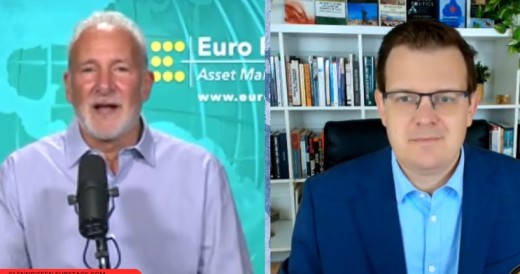
In this interview, Glenn Diesen speaks with Peter Schiff, CEO of Euro Pacific Asset Management and host of The Peter Schiff Show, about record-low consumer confidence, America’s soaring national debt, and why he believes a sovereign debt and currency crisis is coming. Schiff also discusses Trump’s tariffs, the Federal Reserve, the future of the US dollar, central bank gold buying, Bitcoin, and why he sees gold and silver as the place to be. This interview was premiered on October 15, 2026. Read the full transcript of this insightful conversation below:
Consumer Confidence at a 75-Year Low
GLENN DIESEN (00:00:00 – 00:00:57): Hi everyone and welcome back. We are joined again by Peter Schiff, the CEO of Euro Pacific Asset Management and also the host of the very popular Peter Schiff Show. Thank you for coming back on the program.
I wanted to start off with the health of the US economy as well as the world economy because, well, there tends to be a lot of distortions and we often use indicators that have been manipulated as well. But well, to start off, we’re told that the economy is doing well, the stock markets are up. In Trump’s words, it’s “hotter than it’s ever been before.”
But I also see this new Current Condition Index, the CCI, which has been released, which measures how people or businesses perceive the, well, the state of the economy. And this appears to be the worst ever, again, since ’51. How do you make sense of this?
PETER SCHIFF (00:00:59 – 00:02:59): Well, first of all, whatever Trump says is irrelevant. Trump’s going to say whatever the hell he wants. The facts or the data don’t make a difference to Trump.
In fact, he let you know how he thinks just a few days ago when he was asked about this deal that he claimed was made between Russia and the Ukraine on an energy ceasefire. And after both sides denied having made a deal, a reporter asked the president, “Well, Mr. President Trump, you said there was a deal, but the Russians and the Ukrainians say they never made a deal.” And then Trump said, “Well, there is a deal. There’s a deal because I said there’s a deal. That’s why.”
So the economy is the hottest ever because Trump says it is. That’s it. I mean, that’s the only evidence. That’s the only proof. It’s whatever Trump says. So he says we have a booming economy. We have a booming economy, even if it’s a complete bust.
So you’ve got the lowest consumer confidence in current conditions in 75 years. And that’s how long they’ve been collecting the data. So we’ve gone through a lot of difficult time periods. We’ve gone through wars, we’ve gone through recession, financial crises, pandemics, all kinds of bad things have happened. Yet through it all, the consumer was more optimistic than he is right now.
So there’s no way that you could claim that we have this great economy. Because if we did, the people who are living in the great economy would appreciate that and the Republicans would be getting credit for that. Instead, they’re getting the blame. And the reason they’re getting the blame is because it is a bad economy and getting worse.
Why the Stock Market Doesn’t Reflect the Real Economy
GLENN DIESEN (00:03:02 – 00:03:12): But how do we explain the economy in this current state though? If the stock market is doing so well, yet the average American is now beginning to, well, really feel the pain?
PETER SCHIFF (00:03:13 – 00:04:12): Well, the stock market is always doing well. We’re at 52,000, right? The stock market keeps going up. That doesn’t mean anything. In fact, the bad policies that are hurting the economy are propping up the stock market.
We had record high stock prices under Biden, yet Trump claims that under Biden we had the worst economy in the history of the world. So apparently the stock prices can go up whether we have the best economy or the worst economy. So it’s irrelevant to the stock market.
But what is ultimately going to be relevant is going to be a financial crisis, sovereign debt crisis, a currency crisis. That’s what’s coming because interest rates are normalizing now and they have a long way to rise to get to normal. And the current economy that we have will not be able to withstand normal interest rates, let alone high interest rates, which is what we’re going to end up with.
Decades of Living Beyond Our Means
GLENN DIESEN (00:04:14 – 00:04:24): But how did we end up here though? The sovereign debt crisis, the currency crisis. Again, you say the interest rates has to be adjusted, they have to go up furthermore.
PETER SCHIFF (00:04:26 – 00:05:45): Well, yeah, yeah. Well, we got here as a result of decades of extravagance and living beyond our means. Running large deficits and maintaining artificially low interest rates. And that allowed our economy to transition or morph from a production-based economy to a service sector consumption-based economy. It allowed everybody to take on too much debt from governments to corporations and consumers.
And we’ve been living in a fool’s paradise. That has not really been that much of a paradise for a lot of us who have seen a decline in standard of living. But I think we’re about to see the final payback. They say that “the piper has to be paid.” Well, it’s been a long time since we’ve had a pony up. And I think that’s going to happen.
I know there are people that think we’ll get a get-out-of-jail-free card. Based on AI, we’ll see. I don’t know if we’re going to get that lucky. I think AI is going to deliver substantial benefits over time to mankind, but whether or not it’s going to happen quickly enough to get us out of this mess, that seems like a long shot.
The Failed Shift From Manufacturing to Services
GLENN DIESEN (00:05:47 – 00:06:11): Well, for decades though, we were told about, at least since the ’90s, about this successful transition from a manufacturing economy to a service economy.
But at the same time as this transition happened, we saw the debt levels going through the roof. I mean, was this essentially a failed transition or in other words, what is the solution? Should the US—
PETER SCHIFF (00:06:11 – 00:07:16): Well, it wasn’t a viable transition because we were running massive trade deficits. So we didn’t really get to a point where we can run the economy on services. We couldn’t. We needed to import all the goods that we couldn’t produce. Now, maybe if we had such a surplus in services, if we could have sold the world our services and used that income to import all the goods, then it may have been a viable transition.
But when you’re running more than $1 trillion a year trade deficit, in fact, now it’s probably closer to $1.2 trillion. We’re having the biggest trade deficits in history under President Trump. We’re also having the biggest budget deficits in history under President Trump. So the twin deficits have never been bigger than they are right now.
And again, that proves that the strong economy is a figment of Donald Trump’s imagination. Because if we really had a strong economy, those deficits would be going down.
Why Copying Trump’s Tariffs Is a Mistake
GLENN DIESEN (00:07:19 – 00:07:46): But can there be a return to this more, again, the physical economy, the industries? Because I know in Europe there’s a, they’re deindustrializing quickly and they would like to reindustrialize, but they see now that they can’t compete with the Chinese. So many are now talking about emulating Trump’s tariffs, subsidies to try to, well, find a way of creating a competitive space for their own, well, at least their strategic industries?
PETER SCHIFF (00:07:47 – 00:08:32): I don’t know why you would want to emulate a failed policy. Trump’s tariffs have not delivered what they’ve promised. The trade deficits are higher with the tariffs. Our imports are at an all-time record high. We’re importing more with the tariffs than we ever imported without the tariffs. All that’s happened is we have to pay more money for the imports.
So Americans are paying higher prices because the tariffs are embedded in those prices. But they haven’t revived anything. We haven’t onshored anything. So the tariffs have accomplished nothing other than raising revenue for the US government by raising taxes on the American people. That’s all he’s done. So what’s so great about a tax hike?
How the Federal Reserve Distorted the Economy
GLENN DIESEN (00:08:35 – 00:08:50): No, that doesn’t help with the competitiveness. But on the topic, though, of, I guess, distorting or manipulating the indicators of how the economy is doing, how do you see the Federal Reserve having distorted the economy?
PETER SCHIFF (00:08:51 – 00:10:37): Well, the Federal Reserve has been distorting the economy for decades by constantly expanding the money supply and artificially suppressing interest rates. It’s because of the Fed’s interference in the markets that everything is so distorted.
That’s why we don’t save as much as we should. That’s why we borrow too much. That’s why we have too much debt. That’s why we don’t manufacture as much. All of these, as much as we should because of the distortions that have been introduced into the economy by the Fed’s monetary policy.
And of course, we have a reckless fiscal policy, so I don’t want to let Congress or the president off the hook for those distortions because they’re also culpable and both parties share in this blame. It’s hard to say, oh, the Democrats should get more of the blame than the Republicans when you’re looking at what the Republicans are doing right now when they have the White House and for now the House and the Senate. They won’t have those bodies for long, but they’ve had it for a year and 3 quarters and they’ve made the problems worse. So it’s going to continue.
And of course, regulation, it’s not just the fiscal policy, it’s regulatory policy that has distorted what otherwise would have occurred had we had freer markets and the most efficient markets, the best way to allocate resources is without government interference. Whenever the government gets in the way with either regulation or taxation, you get a less than optimal outcome. And so you have a lower standard of living than otherwise would have been the case absent that government interference.
Is Debt a Sign of Strength?
GLENN DIESEN (00:10:39 – 00:11:00): I remember for, well, at least about 20 years ago, it was common to push forward the argument that the amount of debt the US was taking on was actually not a problem. It was an indication of the strength of the US because it indicated that the world trusted the US economy. That kind of has— that argument you don’t hear anymore. But we’re also—
PETER SCHIFF (00:11:00 – 00:13:38): Well, I never bought into the idea that going into debt is a sign of strength or of wealth. When people are experiencing an increase in their work, their worth and their income, they would pay down their debt. People aspire to be out of debt, to be debt-free. That’s a sign of affluence that you don’t have debt. But if you’re constantly going into debt and you owe more and more money, you’re going backwards. You’re not going forwards.
Now, I mean, I would differentiate certain types of debt. So if you accumulate debt as a business, you’re borrowing money to make capital investments, well, that’s okay. Or if you’re developing rental properties, commercial or residential, and you’re borrowing to finance that, but the cash flow that’s generated from the real estate, the rents that you collect, if that exceeds the interest that you pay to borrow the money, well, then that’s fine.
But when you’re talking about consumer-based debt, you’re talking about borrowing money to buy stuff, whether it’s credit card debt, auto loans, a residential home mortgage, that’s not good. Taking out a third loan on your home isn’t a sign that things are doing well. People aspire to pay off their home mortgage, pay off their credit card debt, own their car free and clear. Right. And so those are good. Those are good things.
Going deep into debt is a sign that you’re struggling. That you can’t get by. And so you’re resorting to borrowing to keep your economic head above water.
And so all of that stuff was just rationalization. They were looking at a problem and instead of acknowledging it, they rationalized it as if it was something good, right? So they turned a bad thing into a good thing because they didn’t want to deal with the bad thing. Or admit that there was a problem because they didn’t want to try to solve it. Because solving the problem creates an even bigger problem for the politicians.
Inflation, Bond Yields and the Debt Spiral
GLENN DIESEN (00:13:40 – 00:14:07): But they kind of had a similar argument for the inflation. That is, “We’re sticking on our 2% inflation target. This is under control.” But again, it appears that that narrative is also faltering a bit. But they still suggest, I guess, that this is a transitional period that will stabilize on its own. How do you see this? I mean, what is fueling the debt and why would it stabilize itself or will it spiral out of control?
PETER SCHIFF (00:14:08 – 00:15:28): Well, it’s not going to stabilize it. I mean, the only thing that will eventually do it would be interest rates rising so much that the government has no choice. But the Federal Reserve may step in to spare the government of having to make that choice. Because the Fed could just buy up all the bonds to artificially suppress the interest rates. But then we get runaway inflation.
So it’s not like it’s really a get out of jail free card for all the debt because Americans are going to pay the price with inflation and higher consumer prices. But that’s going to happen. I mean, so far it hasn’t quite happened.
I mean, rates have backed up. Yields are above 5% now, 5.3 on a 10-year, 5.6 on a 30-year. But they’re still historically low relative to where they were in the ’70s, ’80s, ’90s. And I think we’re headed back to the types of rates that we had back then, only even higher because we’re in a lot worse financial shape than we were during those decades, but we have a lot more debt than we had back then. So we can’t handle the debt service.
The Coming Global Rebalancing
GLENN DIESEN (00:15:30 – 00:15:57): But if we’re sailing into a conflict now in terms of the bonds, well, here, which includes the debt, the US dollar might also be questioned. The US economy doesn’t exist in isolation. I mean, it is the whole world economy has been organized around it for over the decades. How do you see this economic crisis playing out? I mean, will it— Yeah, sorry.
PETER SCHIFF (00:15:58 – 00:17:35): Yeah, well, I do think that the global economic order needs to rebalance as a result of the monetary and fiscal policies and the dollar’s reserve status. Americans have been able to consume a far greater percentage of the world’s economic output than they really would otherwise be entitled to, to consume. And so too many goods have been headed towards America and too few goods have been consumed outside America.
Foreigners have accumulated too much of our liabilities. So we owe the world a lot more than we could actually repay. And the world has misinvested a lot of that capital. Instead of lending money to Americans who can’t repay, they should have lent money someplace else or invested someplace else.
So all of this is going to change and the result will be a substantial decline in the standard of living of Americans because we’re going to lose that global subsidy that we’ve enjoyed. And so as a result of that, consumer goods will be far more expensive and therefore much less available to Americans, and interest rates will be much higher. So that is a big game changer.
Again, the only way that that might change would be if AI is able to transform the economy rapidly enough so that we can produce for ourselves using computers and robots what we now rely on China and the rest of the world to produce. I will see.
China, the Dollar and the Move Into Gold
GLENN DIESEN (00:17:37 – 00:17:52): But on the topic of China though, if they wanted to create a rival to the US dollar, they could enjoy some of this exorbitant privileges, if you will, to manage the world currency. But,
PETER SCHIFF (00:17:52 – 00:17:52): yeah,
GLENN DIESEN (00:17:52 – 00:18:00): that— I was also told that the Chinese don’t really want this, that they see it as a burden, that they don’t want to go down that road.
PETER SCHIFF (00:18:01 – 00:19:22): Well, it’s not about not wanting to. I don’t really think they have the option of just offering the RMB as a replacement for the dollar. I mean, you don’t have to create an alternative for the dollar. An alternative already exists, and that’s gold. And that’s where foreign central banks are headed. They’re divesting of US dollars and they’re buying gold. That’s been going on for years now. And I think that trade is going to continue. And I expect it to accelerate as the dollar really starts to fall against its fiat counterparts, something that hasn’t happened yet.
The dollar, even though gold prices have gone up, although recently they’ve pulled back to around $4,000, but they doubled from $2,000. But during that time period, the dollar held its own against the euro and the pound and the yen. In fact, it went up against the yen. Maybe it backed off a bit against the Swiss franc, but overall the dollar has held up against other fiat currencies.
It hasn’t held up against gold and it hasn’t held up against goods and services. And it’s lost purchasing power even as its relative exchange rate has been stable. But I think that’s going to change. I think you’re going to start to see a dollar depreciation against other currencies, and that’s going to really accelerate the movement into gold.
Why China Is Stocking Up on Gold
GLENN DIESEN (00:19:24 – 00:19:46): Well, in terms of foreign powers, there’s been some reports that the Chinese are really stocking up on gold, buying a lot of it. Do you— how would you interpret this? Do they see a crash coming, a crisis? I mean, I know we don’t have a window into their heads of their central bankers, but how do you assess this kind of bull?
PETER SCHIFF (00:19:46 – 00:21:48): I think they do, especially if they watch my podcast, right? They know it’s coming. But they could figure it out on my— on their own. They don’t necessarily need me to shed light on something that is pretty well illuminated. So I think they understand that.
But politically, they don’t want to be beholden. I mean, we’ve made it clear that China is our enemy. Well, why would they want to hold all these Treasuries and hand us a weapon? Because we can always sanction them or pull the rug out from under their holdings, default on their Treasuries, maybe kick them off of the US dollar SWIFT system. So I think that China has a lot of incentives to move away from the US and the US dollar so that America doesn’t have that financial leverage anymore.
And also, they want to reduce trade with the United States, which is happening. I mean, one of the things that Trump has accomplished by heavily targeting China’s goods with high tariffs is that our trade deficit with China has gone way down, maybe by about 30%. But our trade deficit with everybody else has gone up even more. So it’s not like he’s solved the problem. He’s just rearranged the deck chairs.
But for China, China’s surplus is at an all-time record high, even though it has a smaller surplus with America. So China is developing more trading relationships with other countries, and that’s good for China because that means they’re less dependent. I mean, their businesses are on the American consumer, which means that it’s not a big deal to them if the American consumer is broke because they’ve got other consumers to trade with. In other countries who are better positioned to buy their stuff because they have goods that the Chinese want. They don’t have to vendor finance them like they are with us.
The Inflation Tax on Dollar Holders
GLENN DIESEN (00:21:50 – 00:22:09): Yeah, I thought about that with the Chinese as well as the Russians. So if they hold a lot of dollars and the US prints a lot of dollars to finance its military, that effectively is a taxation on them though, by creating new money and reducing the value of the money they have. So they would actually finance their own containment.
PETER SCHIFF (00:22:10 – 00:24:02): And yes, inflation taxes everybody who holds dollars. And so if the Russians don’t want to pay for our military, for our Social Security, for our Medicare, then they shouldn’t hold any dollars because the inflation tax is going to be the source of revenue that the government relies more on in the future because there’s no real appetite for tax hikes other than on the very rich. And even then, they have a hard time hiking taxes. But that doesn’t raise that much money when you raise taxes on the rich.
There is zero appetite for cutting spending. They won’t even cut waste, fraud, and abuse. I mean, they’ll talk about it, but they won’t actually do it. But they’re not going to cut entitlements, which are skyrocketing, and interest on the national debt, which is now the biggest entitlement, right? Because if you own a bond, you’re entitled to your interest. And that’s going to be the biggest line item in the budget. Right now, it’s number 2 behind Social Security, but by next year, it’s going to pass Social Security.
So how is the government going to handle these debts that are going to be skyrocketing? Our annual budget deficits are going to go from $2.5 trillion a year to $3 trillion to $4 trillion to $5 trillion. Where’s the money going to come from? It’s going to come from inflation. The Fed is going to create it. And so if you hold dollars, you’re going to be picking up the tab.
So if you don’t want to pay it, you get rid of dollars. And then the bill gets concentrated in the people who still have dollars. But then more and more people want to get rid of dollars to escape the inflation tax. And then it just becomes a bigger and bigger tax on the people who still hold dollars.
Default or Inflate: The Only Two Options
GLENN DIESEN (00:24:04 – 00:24:19): But with this problem you described, though, there’s a debt that keeps growing. The interest rates must also come up. It’s impossible to service the debt. I mean, how will the US get out of this debt problem? Will they default, do you think, or will they print their way out by—
PETER SCHIFF (00:24:19 – 00:24:48): Yeah, well, exactly. Those are the two ways you— they can either be honest and default or they can create inflation and default dishonestly. But that’s— those are the only options. I mean, there’s no way we’re going to repay the debt. That’s not even a viable solution. So forget about that. The question is, how do we repudiate it? How do we default on it? And those are the only two ways to go.
GLENN DIESEN (00:24:50 – 00:24:59): Yeah. So Scott Bessent was asked, “How do we pay this $40 trillion?” And he said, “We’ll grow our way out of it.” I was not reassured by that answer. Yeah.
PETER SCHIFF (00:24:59 – 00:25:47): Well, initially, when he first got the job, he was talking about reducing the deficit, cutting government spending. And now it’s all about growing our way out of it. But politicians have been promising that we would grow our way out of the deficits for as long as we’ve had deficits. Yet the national debt is over $40 trillion. So it’s not going to work.
And in fact, the debt is now growing at a pace that’s much faster than the economy. So there’s no way to grow our way out of a debt problem when the debt is growing faster than the economy. We’d have to get the economy to grow faster than the debt, which is very, very difficult now. Given how big the debt is and how rapidly it’s rising?
How the Coming Crisis Compares to 2008
GLENN DIESEN (00:25:49 – 00:26:18): Well, I think everyone sees us heading into some serious problems in the economy. The only issue is the timing. When does it happen? But it’s also common to compare it by looking back at the former crisis and the last big one being the global financial crisis of 2008 and ’09. Yeah. To what extent do you think that we’ll have something similar, that is a housing crash and well, how would you compare it, what we’re heading into now vis-à-vis 2008?
PETER SCHIFF (00:26:19 – 00:27:44): Well, I mean, I think that the problems now are much bigger than they were in 2008. In 2008, the national debt was under $10 trillion. I forget exactly what it was, $7 trillion, $8 trillion. So it’s more than 4 times as large. All the big banks that we decided were “too big to fail” are much bigger now. And they’re probably even more insolvent than they were then. So I think we have a real problem on our hands that’s larger in size than the one that blew up in 2008.
And I think the big difference between the crisis that we’re heading to and the crisis that we had is that in the coming crisis, the government is not going to be able to bail anybody out. So it’s going to be far worse because there won’t be that safety net of a bailout because the government is going to be at the epicenter of the crisis.
It’s not just going to be people not paying their mortgage. And there may be a lot of those, too, or corporations defaulting or banks failing. It’s going to be the U.S. government itself that can’t pay. The U.S. government is going to be in need of a bailout. But the only way to bail out the government is through the Fed. But if the Fed does it, then they destroy the dollar. So we got to pick our poison.
Social Unrest and the Entitlement Society
GLENN DIESEN (00:27:46 – 00:28:10): Well, in Germany, the economic mismanagement is now, well, I would say fueling growing political illegitimacy of the leaders. But in France, you have outright, well, protests or riots. Which are spiraling out of control. So it’s not just political instability. You also see growing social instability. Do you see any similar indicators coming to the United States?
PETER SCHIFF (00:28:10 – 00:29:42): Yeah. I mean, this is going to happen around the world. When you create a society of government dependency and entitlement, the public begins to believe that they are owed things, that they are due things. Simply because they exist. And as governments go broke because they’ve already overpromised and overpaid the public in exchange for their votes, they get upset, they get mad, and they take to the streets and they protest. And they want more.
They want more from the government because they don’t understand that the government doesn’t have anything. They think the government is just sitting on all this stuff that it could just give the people. The government doesn’t have any stuff. They go— the government can only take stuff. But when you run out of stuff to take, well, there’s nothing to give when you’re broke, right? When you run out of other people’s money, there’s nothing to redistribute.
And so that’s where a lot of these democracies are headed or are in this predicament now where it’s too much and they have to deliver the bad news to the public that has no idea the news is coming and doesn’t understand that there’s any limits on what the government can provide them.
Why Bitcoin Hasn’t Crashed
GLENN DIESEN (00:29:45 – 00:30:24): Well, I remember back in 2006, I bought your book on the coming global financial crisis. Oh, there you go. That’s 20 years ago. Yeah. Anyways, I remember, well, based on that, I bought a lot of gold and that did very well during this coming crisis, which you foresaw.
But I always stayed away from the cryptos like Bitcoin, but it doesn’t seem to crash though. How do you make sense of this? Because I don’t disagree with the assessment that it has no foundation, but how can we explain that Bitcoin and the digital currencies continue to, well, do somewhat well?
PETER SCHIFF (00:30:25 – 00:32:26): Yeah, well, I was just commenting about that myself a little earlier today on X that I don’t know what’s holding Bitcoin up. I mean, it’s $81,800, and change as we’re speaking. It should be a lot lower than that.
I think, given the fact that a lot of speculative assets other than AI-related— and I don’t see any relation between Bitcoin and AI, but I would think that the rising interest rates and a bear market in 60% of the S&P 500, I think that would weigh on Bitcoin, plus the specter of the Democrats taking Congress, because a lot of the wind in the Bitcoin sail was provided by a friendly Congress. The Republicans were very much backing the Bitcoin and crypto agenda, but the Democrats are going to have a very hostile regulatory agenda to that industry. And so that’s going to be very difficult.
And of course, they’ll still have the Trump administration, but Trump’s political capital is going to be dramatically diminished after this big loss in the midterms. So he’s going to even lose his power within his own party. And he may be fighting impeachment or other kinds of criminal investigations. So I don’t know that he’s going to have time to be pumping up Bitcoin.
And then, of course, he’s a lame duck and in 2 years he’ll be gone and we could have a Democratic president. And one of the first things they may do is raid the Bitcoin strategic reserve and just sell all those Bitcoin because the government needs money. So there’s a lot of reasons to be worried. And so I don’t know why Bitcoin isn’t lower.
Gold, Silver and Where the Smart Money Is Going
GLENN DIESEN (00:32:28 – 00:32:57): Well, I would have assumed now, given that the US is in this very unique situation where you got this massive debt and growing debt and growing interest, there’s no way to, well, to seemingly get out of this, it looks like the logical thing will be to start to transition into metals. But what do you see then being the— how much growth potential do you think it has, gold? Well, versus silver, I mean, where do you see the, well, the smart money going?
PETER SCHIFF (00:32:59 – 00:34:20): Well, I mean, I think I’m the smart money and yeah, I mean, I have it in metals and a lot of other things, precious metals. But I do think that the dollar’s days as the reserve currency are numbered. And I don’t believe that what we’re seeing now with the Fed hiking rates and bond yields rising, I don’t see that as bearish for gold. I see it as bullish for gold.
I don’t believe the Fed is an aggressive inflation fighter. The Fed is an inflation enabler. I don’t care what Kevin Warsh wants to say. I look at what he does. And despite all of his tough talk, he’s only hiked interest rates once by 25 basis points. They should have been hiked by a lot more than that by now. The balance sheet continues to expand, the money supply continues to expand. So he is running an expansionary, inflationary monetary policy. He’s a dove in hawk’s clothing, I suppose.
So I think that gold should be bought, silver should be bought. Commodities in general are going to keep rising. And I think that the investment opportunities in emerging markets and abroad are going to deliver better returns as the air comes out of the bubble here in the US.
Where to Follow Peter Schiff
GLENN DIESEN (00:34:22 – 00:34:41): Just the last question then, where can people find your work? Because you’ve been one of the best ones, spot on, in terms of predicting, yeah, where the economy is headed. So especially, yeah, the— well, especially the housing crisis, you’re very spot on on this one as well. So where can people follow your work?
PETER SCHIFF (00:34:42 – 00:38:09): Well, first of all, if you want to follow my investment strategy, we’re happy to have you as a client at Euro Pacific Asset Management. We manage individual portfolios for clients, both in individual stocks and in our proprietary mutual funds. So you can get information about how to set up an account. You can speak with one of our representatives by going to our website at europac.com. You could fill out an online contact form or just call the 800 number. And you’ll get to talk to one of my representatives.
If you’re more of a do-it-yourselfer, you can get the information on my 5 mutual funds from the europac.com website and they can be bought no-load at any discount brokerage firm. So if you’re with Schwab or Fidelity or one of those companies, you can have my funds. I’ve got a gold fund, an emerging market fund, an international dividend payers fund, an international value fund, and a foreign bond fund. So 5 different funds that I think will do well in an environment of stagflation. Weak US stocks, rising inflation, falling US bonds.
If you just want to stay informed, if it’s not just about protecting your wealth. Oh, and by the way, if you want to get some gold and silver, I got a business, SchiffGold. So become a customer there as well. Go to schiffgold.com. Today’s a great day, with gold back down near $4,000. Silver, silver is about $55. That’s a great buy, I think. I didn’t actually think it would get back down this low. It got up to $125,000. So it’s, I mean, $125 an ounce and it’s had a big, big pullback. I don’t expect it to get all the way back down to $50. So you’re within 10% of a low, I think. So great time to buy gold, gold and silver in particular. So go to SchiffGold and get in on it before the prices reverse.
But if you just want to follow me, get my take on things, on the economic news, on the economy, financial markets, on politics, I’m constantly posting about that on X. I’m getting close to 1.8 million followers on X. So a lot of people are now paying attention and you could be one of them and you can help me by reposting my content. That’s very important. Don’t just read what I post, but repost it so that more and more people get an opportunity to read it.
Subscribe to my YouTube channel. It’s got about 630,000 or 640,000 subscribers. I put my podcasts, I do usually 2 podcasts a week on schiffradio.com and on my YouTube channel. So make sure and sign up there. But you can also, I’m on Instagram, I’m on Facebook, I’m on TikTok. So all putting out content everywhere. So not only should you try to listen to that content, but you should help me disseminate it on all those platforms so that more people get a chance to benefit from what I’m saying and learn the truth.
Because there’s so many lies that are being told by everybody, the Republicans, the Democrats, financial news, you’re getting misinformation and fake news and just about every major mainstream outlet. So the way to get the real deal and know what’s actually happening is to seek out alternative sources of information like me.
GLENN DIESEN (00:38:12 – 00:38:14): Well, thanks again. I really appreciate your insights here.
PETER SCHIFF (00:38:15 – 00:38:17): Yeah, Glenn. Hey, thanks a lot. Nice seeing you.
Related Posts