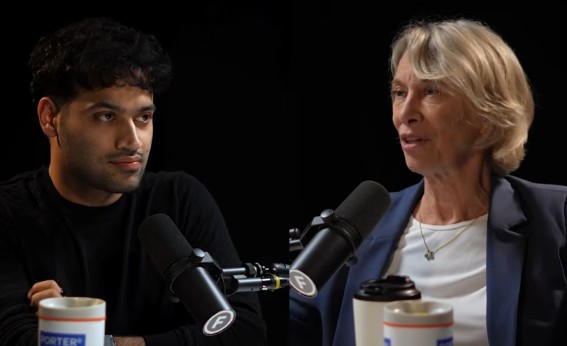
In this episode of Figuring Out, Raj Shamani sits down with Barbara Butcher, the former New York City death investigator who examined more than 5,500 death scenes across two decades. She explains how crime scene evidence, gunshot wounds, blood spatter and the body itself reveal whether a death was murder, suicide or an accident, and how investigators catch killers who try to stage a scene. She also opens up about 9/11, ghosts, reincarnation and the personal cost of a career spent learning what the dead know. Read the full transcript of the interview below:
Meeting a Death Investigator
RAJ SHAMANI: (00:02:42 – 00:04:18): And I’m very fascinated to do something like this with you because I’ve never done— I’ve never met a death investigator. I’m excited. I’m nervous.
BARBARA BUTCHER: (00:04:18 – 00:04:19): Don’t be nervous.
RAJ SHAMANI: (00:04:19 – 00:04:20): I’m a little bit scared.
BARBARA BUTCHER: (00:04:21 – 00:04:21): Really?
RAJ SHAMANI: (00:04:21 – 00:04:21): Yeah.
BARBARA BUTCHER: (00:04:22 – 00:04:22): Why?
RAJ SHAMANI: (00:04:23 – 00:04:31): I don’t know. I just— everything you will say, I’ll have visuals in my head. Yeah. That scares me.
BARBARA BUTCHER: (00:04:32 – 00:04:48): Well, I can assure you of one thing. The safest people in the world are dead people. They will not hurt you in any way. However, you’re right. Seeing some of the ways they die is absolutely horrible.
RAJ SHAMANI: (00:04:48 – 00:04:56): So I was going through your work, okay? And I found out that you have investigated more than 5,500 deaths.
BARBARA BUTCHER: (00:04:56 – 00:04:56): That’s right.
RAJ SHAMANI: (00:04:57 – 00:05:01): You have spent 2 decades reading bodies and crime scenes.
BARBARA BUTCHER: (00:05:02 – 00:05:02): Yeah.
RAJ SHAMANI: (00:05:02 – 00:05:09): And you have seen suicides, murders, accidents, personal revenge, disasters up close.
BARBARA BUTCHER: (00:05:10 – 00:05:10): I have.
RAJ SHAMANI: (00:05:11 – 00:05:19): And then you say that after going through all this work, you’ve realized that death tells you the stories which living beings can’t.
BARBARA BUTCHER: (00:05:19 – 00:05:21): That’s right.
RAJ SHAMANI: (00:05:21 – 00:05:23): Welcome on Figuring Out, Barbara Butcher.
BARBARA BUTCHER: (00:05:24 – 00:05:28): Thank you so much. I am pleased to be here.
What Does a Death Investigator Do?
RAJ SHAMANI: (00:05:28 – 00:05:32): It’s my pleasure if someone’s watching you for the first time and they have no clue what you do.
BARBARA BUTCHER: (00:05:33 – 00:05:34): Okay, I’ll tell you.
RAJ SHAMANI: (00:05:34 – 00:05:41): So tell them what is death investigator and what will people learn by the end of this podcast.
BARBARA BUTCHER: (00:05:41 – 00:11:31): Okay. A death investigator, in the United States anyway, we have 2 systems, coroner system and medical examiner system. And each of those systems is charged with investigating deaths, in particular violent deaths, suicides, accidents, things like that, and homicides, of course. We also have to look at natural deaths. So if an elderly woman dies alone in her apartment, we have to go make sure that nothing bad happened.
So what’s the purpose of that? Well, for one thing, it’s for justice. So if someone is murdered, we want to know who did it and why, and so that we can catch them. We want to prevent that person from committing any more homicides.
So you would think, “Oh well, why don’t you just do an autopsy?” The forensic pathologist does an autopsy, and in looking at that body, they see the cause of death. So suppose the man on the table has a gunshot wound to the head. Fine. Cause of death is gunshot wound. But what is the manner? Was it a homicide, a suicide, or an accident? That’s my job.
The death investigator goes to the scene and takes in the entire context. What is the room like? What is his life like? Where is the evidence? Is there blood spatter on walls? Are there bullet marks on the ceiling? And what does the body tell me? We can get into that more deeply later. But everything I’m doing there is to find out how did this death arise.
So if I go into a room, as I have, and seen a young woman clutching an automatic weapon and there’s a close contact gunshot wound to her head, the abrasion ring, the gunpowder into the wound, I know it’s close contact. And if I get a good story from her friends or neighbors, like, “Oh my God, I tried to stop her,” then I know it’s likely a suicide.
Now, this one case I’m thinking of was terrible. A young woman said to her friend, “I’m going to kill myself, I can’t stand it anymore.” Her boyfriend left and she was heartbroken. So the friend said, “Give me that gun.” And took it away from her. And the girl said, “No, no, give it back to me. I promise I won’t do it.” So the woman, her friend, pulled out the chamber and gave it back to her. She didn’t realize there was one round of ammunition still in the barrel. So when the girl took it, there was still a bullet, and she shot herself in the head. Now that’s a clear suicide. I have an upset witness. I have everything I need to see right in front of me.
But then I go to another case out on Houston Street in New York, and there’s a group of young men, 17, 18 years old, and they’re shaking. They’re so frightened. And their friend lies dead on the ground in the middle of the avenue. And they said, that he had just gotten a new gun, his very first gun. It was a Saturday Night Special, which is like a .32 revolver, very cheap, flimsy. And that morning he was showing them tricks like a cowboy. He was spinning the gun on his finger and it hit the— it flew off, hit the ground, and shot him straight between the eyes.
Now, of course, we don’t really believe that right from the beginning. We think, “No, they’re just making this story up.” But I saw on the pavement, on the sidewalk, a little piece of concrete that was chipped and the little dust of it on the hammer. So I knew the gun had hit just that way. And his friends were crying and shaking. They couldn’t make this story up. So I said, “This is definitely an accident.” And then about 2 hours later, a guy came by, a truck driver, and said, “I was going to work this morning and I saw this kid playing with a gun.” So that cemented it.
But if it’s a homicide, now I have to get a whole nother set of evidence, of facts. Now I’m not just looking to see what is the manner of death. I’m looking to see who did it, when did they do it, why did they do it. And I’ll see that in the scene and in the body.
So what I do, I investigate the scene. I work with the police closely, but it’s an independent investigation because we might have differences sometimes. They say, “No, that’s not a murder, Barbara, come on.” “Yes, it is.” So once I gather all that evidence and do all my photographs of the scene, my measurements, I write a report and take it to the forensic pathologist who’s going to do the autopsy the next day. Then they’re now doing an informed autopsy. They say, “Oh yeah, gunshot wound, manner of death, homicide.” And then we give the police all the information we’ve gathered so that they can better investigate and find the person. That’s my job.
The First Thing a Death Investigator Looks At
RAJ SHAMANI: (00:11:32 – 00:11:37): It’s— it can be fascinating and it can be very daunting.
BARBARA BUTCHER: (00:11:38 – 00:11:39): Yes, absolutely.
RAJ SHAMANI: (00:11:40 – 00:12:01): Based on what kind of perspective you’re looking at from. But tell me, the moment you walk into a death scene, okay, what do you first look at? In the first 30 seconds, what is that you’re trying to find out? Where do you actually look at, which most of the world would actually ignore?
BARBARA BUTCHER: (00:12:02 – 00:15:23): It’s a very good question. I don’t look at the body first. In fact, I stand at the doorway just inside, and I take in the totality of the scene, the feeling of the room, the zeitgeist, the atmosphere. I want to see what kind of person is this, what kind of life, what kind of home. Like I said, I want to see how they live.
And so taking in the entire scene, and then I’ll put on my booties and Tyvek covers and all that, and go around the perimeter, taking my photographs of everything all around. Then I zero in on the body. I do my photographs, the overalls, but I haven’t touched it yet. What I wait to do is, now crime scene, they’re doing fingerprints and things like that. I say, “All right guys, I’m ready,” and bring them over.
Now I’ll start examining the body. I’ll open the shirt and look for a stab wound or a gunshot wound. I’ll look under the fingernails and see, is there flesh or hair or blood because someone was fighting for their life? I will determine the time of death, which is an art as much as it is a science.
You have the rigor mortis, the stiffening of the body. And that happens over a period of 8 hours. The body becomes more and more stiff. First, the small muscles like the jaw and fingers, then the larger muscles like the legs. After about 8 to 10 hours, that body is so rigid that if you lifted it up, it would not bend. So if I see someone fully rigid like that, that’s about 8 hours ago.
Now I look at the lividity. That’s the settling of the blood. When a dead person lays on the floor like this on their back, the blood settles down through gravity and it stays there for a while. And then after about 8 to 10 hours, it becomes fixed, you can’t move it. But if I go in there and see that the— his back is all purple and yet his left side has, it’s like red blood, a little bit lighter. I know he was originally on his side and then they, when he died, and then they put him on his back. I know when a body’s been moved. So now that takes a certain amount of time.
Then I take the body temperature. The body loses about 1.5 degrees of temperature every hour. Fahrenheit. So in a room of the average, oh, 70, 72 degrees, I take the temperature of the air, then the temperature of the body. Usually a rectal temperature is most accurate. And now I divide. So if the body started out roughly 98 and is now 90, that means they’ve lost 8 degrees of temperature. Divide by 1.5. That’s each degree you lose is 1.5 per hour. And now I come out with— what does that come out to? 5, 6 hours, whatever the math is. So is that enough? No,
RAJ SHAMANI: (00:15:23 – 00:15:23): no,
BARBARA BUTCHER: (00:15:24 – 00:16:34): because common sense— you have to have common sense. So one day I’m a brand new investigator and I go into a room with an elderly old, old man has died and his whole family is there and they’re so upset. He is the beloved patriarch of this family. And they’re all crying. And I said, “All right, I’m going to go examine him.” And I did. And when I came out, they said, “Could you tell us what time he died? Because we’d like to have a special church service at that time.” I said, “All right.”
And I went back in and I just recalculated. Yes, yes, yes. All right. 3, take away the 7, 4 times 18. And I came out and I said, “He died right around midnight.” “No, no, I spoke to him at midnight. I spoke to him at 12:30.” I was like, “Oh my God, I forgot the most important question. When was the last time anyone spoke to him alive or saw him alive?” Because these calculations, they have great variability. Great variability. It’s a lot of interpretations. So
RAJ SHAMANI: (00:16:34 – 00:16:35): see,
BARBARA BUTCHER: (00:16:35 – 00:16:59): after that I learned: ask the right question. If there’s no one to ask, you can also do things like look at the newspapers. If the newspapers are on the front of the house, not picked up yet, it says Saturday, Sunday, he probably died Friday. If he had food delivered, there’s a receipt on it with the timestamp, right? So we use common sense.
Why Time of Death Is Always an Estimate
RAJ SHAMANI: (00:17:00 – 00:17:06): So there’s no accurate, specific way to actually find out what time a person died.
BARBARA BUTCHER: (00:17:06 – 00:17:11): Not unless somebody saw it. If we have it on videotape, yes. If someone saw it.
RAJ SHAMANI: (00:17:11 – 00:17:19): Because in movies you just see that, hey, somebody would come out and they tell that this person died XYZ time.
BARBARA BUTCHER: (00:17:19 – 00:18:44): Lie. It’s a lie. That’s why I get very irritated with some shows. Some of the true crime shows, they have a doc— or even the fictional ones, they have a medical examiner who shows up on the scene, a forensic pathologist. Well, first of all, what did she do? Leave the autopsy table to come to this death scene? What about her work? She has 3 cases to do.
And she comes in and she looks at the body a couple of times and then she pokes her finger in something and says, “That looks like a 9mm.” What? What did you stick your finger in the hole and measure it? And then they say, “Dead about, I’d say about 4:30-ish, 4:30 this afternoon.” Why? Was there a bullet hole through his watch and it stopped at 4:30? Right?
So the shows get it all wrong. Now my show, The Death Investigator, we’re very, very careful to do everything and explain everything accurately. There’s no magic tricks. So I’ve been thinking for years, there must be a way to design an app that will take body temperature, ambient temperature, pictures of the lividity, estimates of, and calculate it all and says, “11:45 AM.” So far nothing.
RAJ SHAMANI: (00:18:44 – 00:18:46): Nothing. There’s no accurate formula.
BARBARA BUTCHER: (00:18:47 – 00:18:47): No, there isn’t.
RAJ SHAMANI: (00:18:48 – 00:18:49): It’s a guess.
BARBARA BUTCHER: (00:18:49 – 00:18:50): It’s a guess.
RAJ SHAMANI: (00:18:50 – 00:18:56): How close can you be? How close can you get to accurate time of death just by investigating?
BARBARA BUTCHER: (00:18:57 – 00:18:59): Just by using all those factors.
RAJ SHAMANI: (00:18:59 – 00:19:08): And can you actually probably go to autopsy lab and take blood sample or tissue sample and then actually predict?
BARBARA BUTCHER: (00:19:09 – 00:19:11): No, they’ve tried.
RAJ SHAMANI: (00:19:11 – 00:19:11): No.
BARBARA BUTCHER: (00:19:11 – 00:19:26): In fact, a lot of scientists and researchers have tried using the potassium levels of the eyeball. We draw the fluid out and estimate, did the potassium shift into the cells, into the fluid? No.
RAJ SHAMANI: (00:19:27 – 00:19:27): Nothing works.
BARBARA BUTCHER: (00:19:27 – 00:19:41): So everything is an estimate. And I never say anymore, 2 PM. I say sometime between noon, maybe 4. A 4— I give you a 4-hour window.
RAJ SHAMANI: (00:19:41 – 00:19:42): Yeah.
BARBARA BUTCHER: (00:19:43 – 00:20:23): And even that can— you can be fooled. Now one thing that fools you is when cops come in and fooled around with things. So sometimes I come into an apartment and it’s freezing cold, and I said, “Why is it so cold in here?” “Oh, we opened all the windows because it smelled.” I’m like, “Wait a minute, guys, how am I going to figure out body temperature now? You just ruined everything.” And like, “Well, Barbara, it was hot in here, so, and smelly.”
So we have to be very careful with those things. And that’s one of the first questions I ask: what has changed since you got here between that time and my time? And if they say, “Well, we opened the windows, we moved the body”— oh no, no, no.
RAJ SHAMANI: (00:20:23 – 00:20:25): Then the whole math is gone.
BARBARA BUTCHER: (00:20:26 – 00:20:27): It’s— then it’s all messed up.
Reading Gunshot Wounds Without Ruining the Evidence
RAJ SHAMANI: (00:20:27 – 00:20:35): And how do you make sure, to roll a body to investigate without even ruining it?
BARBARA BUTCHER: (00:20:36 – 00:23:53): Without ruining my evidence? It’s not easy. Now, first of all, I don’t want to strip the clothes off because sometimes there is evidence on the clothing you don’t want to lose. For instance, I had a man who was shot on the street. And the guy who shot him said, “No, he was running toward me and I shot him.”
And then when I look at his jacket, the collar has a little bit of a bullet. The bullet came through the jacket. But then I look on his arm, there’s a bullet hole here. I’m like, “Wait a second, let me line these up.” And here’s what happened. He was shot. He was going like this. It went through here, through here, past the collar and into his neck. And I could line it up perfectly. So no, he wasn’t coming at you. He was going like this. “Please, no.” Right? So that’s very important. Don’t mess up your evidence.
Now, I do need to see their back, obviously. So I’m careful not to mess up the clothes. I’m also careful about bullets that might pop out. Sometimes you turn a body and there’s a bullet hole in the front and at the back, it’s just at the edge of the skin and you turn it over and it pops out. That’s not good. So when I turn it, it’s just very, very gently. And I don’t remove the clothes. I just peek up underneath. When we get them in the autopsy room, I can tell a lot more.
But so why would I want to see the gunshot wound? Why do I need to see that? Well, if you think about the physics of bullets, ballistics, when the bullet goes through the flesh, it leaves a little abrasion ring. The skin stretches inwards, very flexible. So as the bullet goes in, it pulls the skin and makes a little abrasion, right? A little ring.
Now, if it’s a straight-on shot, it’ll be perfectly circular. If the person is shot from up here as they’re standing, it’s going to have an angle where the abrasion ring will be greater at the top or at the bottom, meaning shot from below, shot from above, or shot from the side. So if you’re really careful with this and you look for the bullet impact marks on the walls, I can tell you where the shooter was standing, and I can tell you the position of the victim.
But it’s very important to know where was that shooter. If they were right up close, then I’ll see gunpowder in the wound. I’ll see the fouling, which is the greasy smoke that comes out of the barrel. So if I see the little stipples of gunpowder burned into the face, I know it was about, oh, maybe 8 inches, 10 inches, something like that. Any further and it falls to the ground. But now if I see, I don’t see any stippling gunpowder, but I see the greasy smoke around it. I know they were standing back just a little, but they were still quite close. So I can tell you so many things just by looking at that wound.
RAJ SHAMANI: (00:23:53 – 00:24:04): Interesting. I want you to demonstrate on me how can you roll a body without actually disturbing the evidence? Can you do that little body demonstration? I’ll just lay down. Yeah.
BARBARA BUTCHER: (00:24:04 – 00:24:54): Now if a person is stiff, it’s easier. But see, that’s why I tell you, be dead weight, totally relaxed. Okay? Dead weight. Nice and easy. Just breathe deeply. So what I do in order to turn a person over, carefully place this leg over that one. Okay? Then this arm at the shoulder, just like that. Now all I have to do, 2 fingers under the hips and the shoulder, and he rolls right over.
You see, I do it gently so that there’s no evidence lost. I don’t move any clothing, anything like that. Goes right over. Now I’ll examine here under the shirt. Perhaps I’ll check the legs if there’s any trauma. But it’s easy, right? So even a small woman can roll over a heavy man.
Business Killings vs. Personal Killings
RAJ SHAMANI: (00:24:55 – 00:25:04): This question, because you said someone, you can look at a bullet mark and find out whether it was hit from close or far. Right?
BARBARA BUTCHER: (00:25:04 – 00:25:04): Yeah.
RAJ SHAMANI: (00:25:04 – 00:25:15): Can you also tell the relationship or the kind of motive behind death just by the distance of the shoot?
BARBARA BUTCHER: (00:25:16 – 00:25:30): Hmm. To a certain extent, yes. Because if it’s a contact wound, then we know, either suicide or execution style.
RAJ SHAMANI: (00:25:30 – 00:25:30): You
BARBARA BUTCHER: (00:25:30 – 00:26:21): come up to someone, put the gun against their head, you’re going to get everything I just spoke about, but the gunpowder will be inside the wound. And there’ll be like a stamp. If a gun barrel has a little notch at the top, I’ll see that because the bang hits the skin. Now I know what it was.
And this happened in a case I did on my show, the Carnegie Deli Massacre. The guy who was arrested said, “Oh no, it went off accidentally. I was holding the gun and I was shaking so bad and I got nervous and it went off.” No, it didn’t, you lying dog. I know because what I see on the head, I see the contact. You were perfectly steady. So don’t cry to me. I’m very harsh about these.
RAJ SHAMANI: (00:26:22 – 00:26:40): But have you ever seen that someone who’s very close and they’re closely related, do they shoot from close or do they shoot from far? Because if sometimes it’s revenge or a business killing or a drug killing, they’re usually— it’s very close. It’s not from far away because they want to make sure that the person’s dead.
BARBARA BUTCHER: (00:26:40 – 00:29:13): Yeah, I mean, a sniper is very impersonal. So I know it might have been far off, but I can’t say how far because after just, let’s say, 4 or 5 feet away, now there’s nothing for me to see. So he could be 5 feet or 100 yards with a good sniper bullet. But I will notice something about the bullet. It will have to be a rifled— a rifle or automatic weapon kind of thing. So yeah, that’s an interesting thing.
For me, there are basically 2 kinds of homicide. One is business and the other is personal. And there’s also the ones that are done for fun too, like serial killers, but that’s another category. I don’t even like speaking or thinking about it. However, if it’s a business killing, it’s very efficient. You walk in, shoot them in the head, and walk away. There’s no DNA, there’s no contact, there’s nothing. No fingerprints even. It’s business.
Now, if I see that the body is stabbed multiple times, punched, beaten, especially at the face. Beaten, stabbed, strangled, shot. That’s so personal. That’s the killing of rage. So I know it’s someone who knows them, and someone who has such huge anger toward this person. Could be revenge, could be love.
And one of the most brutal killings I ever saw was a man who had a wife he was crazy about. She was a pretty little woman, all nice little jewelry, and she dressed up nicely. I saw pictures of her in the house, and he loved her insanely, but he was wildly jealous. And one day they were coming into the apartment building, and there was the building manager— the super was in the hallway— and she looked at him and said, “Oh, hello,” nodded at him, and they went into the house.
And he went insane. He started screaming. The neighbors could hear. “Why are you talking to him?” He thought she was flirting with the building guy. And so this is the saddest thing. He stabbed her so many times that there was blood on the ceiling, the walls, the floors. Yeah,
RAJ SHAMANI: (00:29:13 – 00:29:15): just because she talked, nothing else.
BARBARA BUTCHER: (00:29:15 – 00:29:18): Yes, because he was so jealous. To him,
RAJ SHAMANI: (00:29:18 – 00:29:21): in that one incident, after that one incident,
BARBARA BUTCHER: (00:29:22 – 00:30:32): that’s it. He was always insanely jealous and watched her all the time. But all the neighbors, they said, “Oh, he loved her insanely, he worshiped her.” Well, when something happened, when he saw her look at another man, he went psychotic. He suddenly saw, I’m losing her, and he lost his mind and he stabbed her. The room was horrible. It was horrible. It was just blood everywhere. And this poor little woman, all she did say hello.
And the guy jumped out a window. It was only the second story. And we got bloodhounds who tracked to her blood, and they caught him in the park up in Inwood, just running through with the bloodhounds, the what we call them, actually not bloodhounds anymore, they’re German Shepherds, but they’re police dogs. And they found him very quickly because he was covered in her blood. So that gets me so confused. I’ve loved people pretty strongly, but never like that.
RAJ SHAMANI: (00:30:33 – 00:30:36): That’s not love, that’s obsession. That’s psychotic behavior.
BARBARA BUTCHER: (00:30:36 – 00:30:39): Yeah, it’s obsession. It’s not really love. It’s completely—
RAJ SHAMANI: (00:30:39 – 00:30:42): he didn’t kill her just by shooting her.
BARBARA BUTCHER: (00:30:43 – 00:31:06): No, no, no. He wanted to punish her for breaking his heart. His heart was probably broken. When he somehow the way he saw it in his psychosis, in his insanity, was that that was her lover and she was leaving him. And the pain and the fear were so great that he had to destroy her—not just kill her, but destroy her.
RAJ SHAMANI: (00:31:06 – 00:31:11): And did he tell this that he wanted to destroy? And what all did he do
BARBARA BUTCHER: (00:31:11 – 00:31:14): when they caught him? He said, “Yeah, I just.” What
RAJ SHAMANI: (00:31:14 – 00:31:15): did he do? Like in you.
BARBARA BUTCHER: (00:31:15 – 00:32:13): Oh, how he killed her? Oh, he stabbed her so many times. And when you stab the carotid arteries or cut them, the blood sprays. It’s high pressure. It sprays up onto the walls. And then if you keep stabbing someone, every time you go in, you hit blood. And when you pull the knife back, the blood flings or casts off the knife and lands on the walls or even the ceiling.
So he had stabbed her, I don’t know, 80 times, something so ridiculous. There was nothing left to stab. So it was just the bloodiest scene I’ve ever seen in my life. And the poor woman, I hope she died very quickly because this was just— but he told the police, “She looked at the building super. I knew she was having an affair with him.” They’re like, “What?” So of course,
What Matters Most at a Crime Scene
RAJ SHAMANI: (00:32:13 – 00:32:23): we’ll get to this mindset of serial killers and things in a while. So when you’re at the crime scene, other than the body, what is the most important thing?
BARBARA BUTCHER: (00:32:25 – 00:33:26): The witnesses. The witnesses, sometimes they lie, sometimes they tell the truth, sometimes they exaggerate. But most times you can get a straight story out of someone because they’re in shock. If they come into the room and see their brother laying dead on the floor, it’s like, “My God.” And now if the police ask them, “What did you hear?” “I don’t know. I thought he was jumping on the floor. I heard something loud.” “What time was this?” “Well, it was 2 o’clock, and I know because I was— my new show just started on the TV.” Those things help.
The body tells— to me, the body doesn’t lie. The body tells you what is there. Then the scene, of course. Was the room ransacked? Were they looking for something to steal, jewelry or money? Or was it a fake crime scene, which I see a lot?
RAJ SHAMANI: (00:33:26 – 00:33:27): What do you mean by fake crime scene?
BARBARA BUTCHER: (00:33:28 – 00:33:48): Well, they want to make it look like it was burglars coming in to steal. So they’ll pull all the drawers out of the bureaus and chests, and maybe they’ll throw some clothes around, but it looks fake. We call it a staged crime scene because they make it look like it was a robbery, but no, it isn’t.
RAJ SHAMANI: (00:33:48 – 00:33:49): Oh, somebody killed it inside?
BARBARA BUTCHER: (00:33:50 – 00:34:55): Yeah, somebody just came in and killed them and said, “I’ll make this look like robbers.” So sometimes, and the best way you can tell that is you see the room, all the things thrown around, but then there’s a box in one of the drawers and there’s a bracelet in it, a gold bracelet. So why didn’t he take that? I had one like that recently where it was something like— I think it was $16,000 in a coat jacket, in a coat pocket. And all they went through when they just opened the drawers and threw some clothes around to make it look like a burglary. They didn’t even take the money. So that’s pretty damn stupid.
You see in the movies all these very brilliant criminals who pull off these heists. They rob a casino or a bank or whatever. But people who come in to murder somebody, they’re not very bright. So they might know a couple of things to do— wipe off my fingerprints, things like that. Don’t eat any food because I’ll leave DNA behind.
RAJ SHAMANI: (00:34:58 – 00:35:10): Oh God. If you have to point out, let’s say, 3 things, 3 specific things without the body, which is a must when you enter a crime scene, you want to make a list that these are 3 things I will watch.
BARBARA BUTCHER: (00:35:11 – 00:35:13): Besides the body, besides what’s on the body.
RAJ SHAMANI: (00:35:14 – 00:35:18): Which will tell you a lot about how the person lived and how a person died.
BARBARA BUTCHER: (00:35:18 – 00:38:21): Okay, well, number one is evidence of human contact. So DNA and fingerprints. So how do I know what’s DNA and what’s fingerprints? Well, suppose we have a bloody scene. Person’s been killed and there’s blood all around. Now I walk down the hallway toward the bathroom and I see some blood drops on the floor. That’s not from the body. How did they get there?
So when a perpetrator stabs someone, very often they cut themselves, because as you push the knife down like this, sometimes it hits bone and it goes upward and cuts your hand. See? So now you have to go to the bathroom and wash it off and wrap it up in a Band-Aid. But you’re going to leave one little drop of blood on the floor. And we just did a case like that in my show. One drop of blood. Isn’t that amazing?
But you have to look for these things. You can’t walk in and say, “Oh yeah, guy stabbed, that’s that, all right.” No, I have to go throughout the house. I have to know everything, especially any point of human contact. So if I see a telephone, I know crime scene is going to want to check that for fingerprints. The doorknob. And they’re very careful about doorknobs, right? They might wear a glove or use a towel to open it. But they forget that when they come in, they touched the door sill as they pushed it open. Not touching the knob, but they’re touching the door sill. So that’s where we look for prints. So human contact, number one, DNA and fingerprints.
Next is, I would say, the appearance of the house as to whether or not it was something that was a real burglary where things are missing, or a fake staged scene. And in that house, what does that person have that may have been important. So suppose there’s a scientist working on a very important project for the government, and we come in and we see that he’s been shot, and we don’t see any prints anywhere, nothing, but his computer’s missing. All scientists have at least one computer, right? If that computer is missing, then I know this was a business job. This was something high level. This is something where they wanted to get some piece of information that he had.
So it’s not just what’s there that you’re looking for, it’s what’s not there. There you go. Just— this should actually be a class. We should record this and use it to teach people, giving you all my secrets.
What Happens to a Body After Death
RAJ SHAMANI: (00:38:23 – 00:38:24): I want to ask you for more secrets.
BARBARA BUTCHER: (00:38:24 – 00:38:24): Mm-hmm.
RAJ SHAMANI: (00:38:25 – 00:38:32): How do you know, actually, what happens once somebody dies, minute after minute?
BARBARA BUTCHER: (00:38:33 – 00:38:33): Mm-hmm.
RAJ SHAMANI: (00:38:33 – 00:38:40): What happens to the body? How does it decay? What happens 6 hours later, 24 hours later? What happens to the body?
BARBARA BUTCHER: (00:38:40 – 00:39:40): Good question. When death is immediate, let’s say a gunshot to the head through and through. Immediately dead, fall to the ground. They will not really bleed that much, but they will leak because they died instantly. The heart is no longer pumping out blood, so it’ll leak from the head. There’ll be a good amount around them.
And then as that blood leaves, there are things that happen inside us that— well, I guess the best— it’s like being digested by our own bodies. We have enzymes inside us, and as the body dies, those enzymes just digest what’s there, the cell walls. And so fluids begin to leak out from the nose. So now we have blood, we have fluids. Now,
RAJ SHAMANI: (00:39:41 – 00:39:43): probably livor mortis.
BARBARA BUTCHER: (00:39:43 – 00:42:46): No, that’s what, that’s just the ordinary process of a dead body. It starts to digest itself and to decompose so it can return to the earth. And which is a very good idea. So as that’s happening, there are bacteria in our gut and the abdomen and the intestines that normally our body keeps in check. They don’t grow too much, but they grow just enough so that they can help us with digestion. When they’re not— when now they’re free to do whatever they want, they start digesting, eating up the internal organs of the body. And when they do that, it causes gases to form.
So in the first, let’s say, 1 hour, we get the little bit of fluid leaking, we get the oozing of blood, and now we get the digestion of the body. And as that happens, the gases build up. And over a period of time, let’s say, well, it depends on the weather too. If it’s very hot, it goes faster. If it’s cold, it’s like refrigeration, slows the bacteria down. So the gases form and the body begins to swell. And it’s not a pretty thing. Okay. In fact, it’s horrifying. As the abdomen swells, the eyelid swells, anything that’s soft in the body, the gases will start to come. Then the skin will begin to rot.
Okay, now we have not just blood and the inner fluids, the plasmas. Now we have green horrible things. And this is the point where the smell is so overwhelmingly bad. There is no way I can describe it. I have tried. There is nothing that describes that smell. It’s so horrible. And that’s, to me, that’s like a signal, like, stay away, it’s bad things here, like a warning almost.
So then the body goes through all these— it’s like wet decomposition. On the other hand, suppose you die in a desert. You bleed a little bit, but the fluids leak out? No. In fact, the bacteria start doing their little actions. They start digesting things, but then they get so dried out from the hot, dry sun that they can’t even work anymore. There’s no fluids for them. So now the body shrinks down. All the water leaves it, and we’re about 60% water. So the water leaves it, and then little animals come and they eat whatever’s left. So now what do you have? A skeleton with some leathery-like skin over it. So that’s out in the desert more. But I did have a case on the Lower East Side here. Do you know New York?
RAJ SHAMANI: (00:42:46 – 00:42:47): Yeah.
BARBARA BUTCHER: (00:42:47 – 00:44:33): Yeah. Okay. So back in the ’70s and ’80s, early ’90s, we had squat buildings. They were abandoned. No one wanted them. So people would go in and live there. They’d steal electricity from streetlights. And they’d go out and get food and live in these little places. And we came upon a man. Someone wanted to buy the building. They’re looking in the room. There’s a man laying on the bed, but he’s just a skeleton with a little bit of raggedy clothing. And it looked like leaves, like autumn leaves, but it was more like leather.
And I’m looking at him and I noticed that all his internal organs are gone. And I said to the police officer, “Well, that’s interesting. Why do you think they’re completely gone? We still have skin.” He said, “Well, because it’s very cold here. There’s no heat. So the rats burrowed inside and ate up all the organs so they could stay warm in there.” Wow. So what we had left is just skin and bones. Now, can I tell how long he was there? All I can say is a long time. But I can’t tell you if that was 3 weeks or 5 months.
So that’s what happens to a body. The— I believe that the body wants to return to the Earth as an organic substance. I personally would like to be buried and become a tree. There are certain cemeteries I’ve heard about, and they dig a hole, put you in a burlap sack and drop you in, crumbled up, not too much space, and they plant a very nice tree over you. I would love to go like that.
RAJ SHAMANI: (00:44:33 – 00:44:35): We did that with our dog.
BARBARA BUTCHER: (00:44:35 – 00:44:37): Did you? Oh, that’s so nice.
RAJ SHAMANI: (00:44:37 – 00:44:42): There’s a tree, and every time we look at that tree, we just miss him.
BARBARA BUTCHER: (00:44:42 – 00:44:43): Yeah.
RAJ SHAMANI: (00:44:43 – 00:44:46): And we feel like there’s a belief that he’s there.
BARBARA BUTCHER: (00:44:46 – 00:44:59): Oh, he is. He’s in that tree. Isn’t that a wonderful thing? Yeah, I’d love it if people came by and sat by my tree, had picnics, keep me company.
What Does Death Smell Like?
RAJ SHAMANI: (00:45:02 – 00:45:10): See, you said something that you can’t describe how that smells. If you have to, let’s say try, what does death smell like?
BARBARA BUTCHER: (00:45:14 – 00:46:21): Hmm. Regular death, just not rotted, a fairly fresh body. It just smells kind of earthy, organic, warm, like an old grandma. When their skin is just kind of soft and their bodies are just kind of little and they smell a certain way, kind of stale. It’s just the smell of a human being but without any hormones, without anything like that.
But then when they rot, when they decompose, let’s see, if you took feces, dog and human, put them in a blender, added strawberry ice cream, honey, garlic, hmm, what else? Rotten ground from the woods. Because it’s an earthy smell too, decomposed leaves. Put that in there, blend it up, and smell that. It won’t smell anything near as bad as a decomposed body.
RAJ SHAMANI: (00:46:22 – 00:46:28): That was quite accurate. I could somehow— I could sniff it for no reason.
BARBARA BUTCHER: (00:46:29 – 00:47:16): It’s funny, isn’t it? But it’s true. Even as bad as that would be, it’s still not as bad as a rotting decomposed body. I worked in Thailand after the tsunami, the Christmas tsunami of 2000— what was it, 2004? And they, as they recovered bodies, they took them to the temples and they just lined everyone up on the ground and in the hot sun and the humidity was god-awful. Those bodies just decomposed and the smell was— you learn to breathe differently. It’s little gasps through your mouth because you don’t want
RAJ SHAMANI: (00:47:16 – 00:47:16): it.
BARBARA BUTCHER: (00:47:17 – 00:47:25): And there’s nothing you can do to stop it. Some people say, “Oh, use Vicks VapoRub or menthol, put it under your nose.” No, that makes you hate the smell of menthol.
RAJ SHAMANI: (00:47:26 – 00:47:26): Oh yeah.
BARBARA BUTCHER: (00:47:27 – 00:47:52): There’s nothing you can do. So we smelled that for a long time. They even tried to use dry ice to put all over the bodies, but that made it worse because now they were wet. But I have a picture of that. It’s ghostly, just ghostly. Really awful. That was a very, very, very tragic thing. Yeah, it’s hard to get out of my mind.
Can a Dead Body Move or Make Sounds?
RAJ SHAMANI: (00:47:52 – 00:48:03): Yeah. Can a dead body move or make sounds or have its eyes partly open or feels like it’s breathing?
BARBARA BUTCHER: (00:48:05 – 00:48:06): It’s happened to me. It’s very scary.
RAJ SHAMANI: (00:48:07 – 00:48:08): Really?
BARBARA BUTCHER: (00:48:08 – 00:48:39): Yeah. Because even after they’re dead, really dead, there’s still all those gases inside them. So I was called to the scene where they had a cargo van full of junk. And in the back was a man who was dead. Big heavy man. And I climbed through the junk. I poked my way in and I found him and he was decomposing. It was awful. And as I went to, I moved him so I could see him and he went,
RAJ SHAMANI: (00:48:39 – 00:48:40): ugh.
BARBARA BUTCHER: (00:48:41 – 00:50:09): And it was the gases escaping through his throat. But I screamed and I ran out of the van and I jumped into the arms of a police officer who was laughing like hell. He said, “What happened, Barbara? Did he come alive?” I said, “But he’s, he groaned at me.” Actually, he was like that. I was never so scared in my life.
Now, there’s a story which I think is probably not really true, but police have been telling it for many years that there was a rookie cop brand new on the job. And they said to him, “You’re going to sit and guard this body until Barbara, the investigator, gets here.” And he’s sitting there and he’s very afraid, very afraid. It’s a little studio apartment. It’s right there in front of him.
And then as the body starts to go like that, it jerked a little. I’m not sure why. Maybe the rigor mortis. I don’t know. But it may— he said it moved and then it made a sound like the gas. He got so frightened that he shot it twice. He thought it was like a zombie. And he actually shot the dead body. So what did they do? Well, of course they took him off the police department. He didn’t have the kind of stomach that you need for this business. But can you imagine the fear?
RAJ SHAMANI: (00:50:10 – 00:50:10): Yeah.
BARBARA BUTCHER: (00:50:10 – 00:51:42): And then there was one that came alive. One of the guys I worked with, Kenny, he went to the scene of a woman who had taken pills to commit suicide. She’s laying on the floor and the ambulance had already come, pronounced her dead. And she’s just laying there very pale, dead. And he started examining her, opened her shirt and was looking at her mouth, and she popped her eyes open. She was actually still alive.
What happened is her heart rate— she took Valium, I think it was— her heart rate got so slow, so very, very slow. And the ambulance guys were probably in a hurry. They were like, oh, they checked the pulse. “I don’t feel anything.” Pulse was just too hard to feel because her heart was barely beating and she was barely breathing.
So poor Kenny, he almost peed himself. I mean, I think he actually did, but he just didn’t want to tell us. He jumped back and she was actually alive. So they called the ambulance back again. And Kenny said, “What happened, guys? You couldn’t do it right the first time. Tell me now that she’s dead.” They said, “No, she’s alive.” They ran her to the hospital and tried to save her, but then she died the next day. But can you imagine? Alive, dead, alive. Poor Kenny. He was so traumatized from that.
RAJ SHAMANI: (00:51:42 – 00:51:43): But they couldn’t save her?
BARBARA BUTCHER: (00:51:44 – 00:51:55): No, no, she was too far gone. She was really in a coma. The eyes popping open was probably more of a reflex than anything. But she was alive when he moved her. Sad, huh?
Suicide or Homicide? What a Hanging Reveals
RAJ SHAMANI: (00:51:56 – 00:52:14): And how do you know that whether it’s a suicide or a homicide? Somebody choked someone to death, somebody, and then hanged them to make it look like it’s suicide. How do you know the differences between a murder and a suicide? There must be,
BARBARA BUTCHER: (00:52:14 – 00:52:14): well,
RAJ SHAMANI: (00:52:14 – 00:52:15): probably signs.
BARBARA BUTCHER: (00:52:15 – 00:53:56): The best example is hanging. We could use that to demonstrate. When people hang themselves, they don’t really need to stand up on a chair and jump off. That’s not how it works. It’s not high enough, it’s not going to break your neck. But the thing about hanging is that— or strangulation with hands— if you put someone. Let’s say the suicide of L’Wren— what was her name— Mick Jagger’s girlfriend. All she did was tie a scarf around her neck, kneel on the floor, and attach the scarf to the doorknob. She had to just lean forward, and what it did is it compressed the veins, the big jugular veins here. They’re very soft.
If you strangle someone and cut off the airway, it’s a horrible death. You can’t get any air. It’s painful. If you cut off the carotid arteries, which are strong, the person will pass out. They won’t have any air and they’ll die. But if you just compress the jugular veins very soft, just enough to close them, now you keep getting air, you keep getting blood in your head, but it can’t get out. So it builds up and up. And it actually feels good as they black out. And we know this because people do it as a sexual play. I won’t tell you how because I don’t ever want you to think about this. Yes, that’s how people do. Now,
RAJ SHAMANI: (00:53:56 – 00:53:59): so blackout, they do it for some pleasure.
BARBARA BUTCHER: (00:53:59 – 00:54:03): Yes, yes. Because it makes your head go like, “Wow, wow, wow.” Yeah.
RAJ SHAMANI: (00:54:04 – 00:54:05): And if you do it long enough, then you can die.
BARBARA BUTCHER: (00:54:05 – 00:54:09): Yeah. If you— what they usually do, this is called autoerotic asphyxiation.
RAJ SHAMANI: (00:54:10 – 00:54:11): What do you— what is it called?
BARBARA BUTCHER: (00:54:11 – 00:54:53): Autoerotic asphyxiation. You smother yourself during masturbation or sex with somebody. What they usually do is they’ll put something around their neck and they’ll tie it around their finger so that when they pass out, the finger— the hand drops and the ligature opens up. But it doesn’t always work. And there I come over. “Oh, hello.” He’s got pictures of naked women and lubricants and things. And he’s hanging. And everyone says, “Oh no, it’s a suicide.” No, it’s not. It was a bad boy game. See?
RAJ SHAMANI: (00:54:53 – 00:54:54): It was an accident.
BARBARA BUTCHER: (00:54:54 – 00:54:59): Yeah, it was an accident. He was having a good time with it. And he died.
RAJ SHAMANI: (00:54:59 – 00:55:02): And is it a real, is it a big thing? A lot of people do this?
BARBARA BUTCHER: (00:55:03 – 00:55:07): Kind of a lot. Yeah. A lot of famous people have died that way.
RAJ SHAMANI: (00:55:08 – 00:55:11): That they choke themselves to the point that they blackout.
BARBARA BUTCHER: (00:55:11 – 00:56:57): Yeah. And then when they pass out, it loosens. That does not always work. It gets stuck. And then you just black out and next thing you know, you’re dead.
Now, how about a murder? What happens is they’re either going to use their hands or a ligature. So if they use their hands, you’ll see prints, bruising all over the neck. And you can even tell the size of their hands. If they use a ligature, let’s say an extension cord, an electric wire, it’s usual that they’ll go behind the victim, put the ligature around, cross it over, and pull upwards like this. So now I see the mark. The mark of the wire is here, goes up, crosses over in the back, leaving a blank part in the skin. And it’s very deep because they’re pulling hard. That’s a homicide.
Now suppose they did that and then they hanged them to make it look like a suicide. Well, it’s very hard to lift a dead body. Usually takes 2 people to do that, but if it’s a little small person, maybe they could. So they’re already dead. You tie a noose around their neck, throw it over the pipe, haul them up, tie it off. But now what did you forget? The positioning. When you do that with someone, it usually goes— the rope will go up this way, right? But no, you look on the neck and you see the marks of ligature strangulation at the back. So there are no secrets from me. I can tell what you did.
RAJ SHAMANI: (00:56:58 – 00:57:01): And maybe there are 2 different, there are 2 signs as well.
BARBARA BUTCHER: (00:57:01 – 00:57:02): Sure, there could be 2.
RAJ SHAMANI: (00:57:02 – 00:57:08): Because it would be very difficult to accurately just give a sign at mark at the exact position where you’ve killed them.
BARBARA BUTCHER: (00:57:08 – 00:57:09): Sure.
RAJ SHAMANI: (00:57:09 – 00:57:09): Would it be?
BARBARA BUTCHER: (00:57:09 – 00:57:47): Yeah, exactly. There’s a mark here, but now you use a rope because it’s stronger. Not a little scarf. No. Or not a piece of little wire. You got to get them up there, you see. So I’ve only known in my personal cases one where a handyman strangled a woman with a— he choked her with a ligature and then hanged her. But she was a small woman, he was a big man, and it was obvious right from the beginning. She did not die by hanging. She died by being strangled. Very sad.
How Killers Try to Fool Investigators
RAJ SHAMANI: (00:57:48 – 00:57:49): But how do killers fool?
BARBARA BUTCHER: (00:57:50 – 00:57:53): They can fool us. They do all the time.
RAJ SHAMANI: (00:57:53 – 00:57:57): Tell me 3 smartest ways that somebody has fooled you.
BARBARA BUTCHER: (00:57:58 – 00:58:01): Now then, I’d have to kill you because you know the secrets.
RAJ SHAMANI: (00:58:02 – 00:58:03): Tell me the ones which are out there.
BARBARA BUTCHER: (00:58:04 – 00:58:05): Okay. The ones that are popular.
RAJ SHAMANI: (00:58:05 – 00:58:06): Don’t tell me the one which can be used.
BARBARA BUTCHER: (00:58:07 – 00:58:09): Okay. No, I won’t do that.
RAJ SHAMANI: (00:58:09 – 00:58:12): Yeah. I don’t want people to have some random ideas.
BARBARA BUTCHER: (00:58:12 – 00:58:12): Yeah.
RAJ SHAMANI: (00:58:13 – 00:58:16): Tell me the ones you’ve caught in it, you have caught it but it was difficult.
BARBARA BUTCHER: (00:58:17 – 00:59:55): Let’s see. Oh well, let me see. He got away with that one. I can’t think of anything except the robbery, ransacking and making it staging a crime scene. However, oh, wait a minute. When they make it look like there was a sexual assault, okay? So if we come in and see that a woman or a man has been sexually assaulted, there are signs, obviously. It’s very traumatic. But if a person, let’s say a woman, is laying on the floor and it appears that she’s— her arms are out, legs are out, she’s naked. And so this perpetrator wants to make it look like it’s a sexual assault, but the perpetrator is a woman. Mm-hmm.
Now, when you come in and it looks like someone’s been raped, you’re thinking man, right? Suppose it was a woman that came in, strangled the victim, laid her out, stripped the clothes and made it look like rape. Then you’re thinking of a man, see? But now, fortunately, most women do not kill like that. Women who kill, it’s either someone attacking their children, their husband who has been beating them for years, it’s more personal.
RAJ SHAMANI: (00:59:55 – 00:59:58): Is it rare that a woman is killing other women, another woman?
BARBARA BUTCHER: (00:59:58 – 01:00:00): Oh, sure.
RAJ SHAMANI: (01:00:00 – 01:00:01): It’s not very common.
BARBARA BUTCHER: (01:00:01 – 01:00:03): I’ve never— no, not at all. Not common at all.
RAJ SHAMANI: (01:00:03 – 01:00:12): A man killing another man is common because of business, because of revenge, because of hierarchy, because of cheating and all of that.
BARBARA BUTCHER: (01:00:12 – 01:00:16): Sure. Business cheating. 80%—
RAJ SHAMANI: (01:00:16 – 01:00:23): women are not killing another woman because of, let’s say, a cheating scandal with her husband or something?
BARBARA BUTCHER: (01:00:23 – 01:00:53): I’ve heard of it, but I’ve never seen it. No, I’ve seen women kill their husbands or have him killed. I’ve seen women— when we know some— the woman who killed her little children in a psychotic episode of postpartum psychosis. So women can kill children. Yes, they kill men. I can’t think of another case. I’ve never seen one where a woman killed a woman.
RAJ SHAMANI: (01:00:53 – 01:00:55): Interesting. Why do you think so?
BARBARA BUTCHER: (01:00:56 – 01:01:11): Well, the main reason might be, suppose you loved your husband, very happy, and a woman came in and seduced him and took him away. Who should you kill, the woman or your husband? Your husband, of course.
RAJ SHAMANI: (01:01:12 – 01:01:12): No one.
BARBARA BUTCHER: (01:01:12 – 01:01:18): But yeah, no, yes, thank you, I forgot that part. No one. Please don’t kill anybody. Buddy, we’re going to catch you.
RAJ SHAMANI: (01:01:18 – 01:01:19): Yeah.
BARBARA BUTCHER: (01:01:19 – 01:01:20): And you’re going to be punished for life.
RAJ SHAMANI: (01:01:21 – 01:01:22): In your head, both.
BARBARA BUTCHER: (01:01:22 – 01:01:23): Yeah.
RAJ SHAMANI: (01:01:23 – 01:01:24): In reality, no one.
BARBARA BUTCHER: (01:01:24 – 01:01:43): Yeah. So yeah— if that’s the case, if they’re so angry and so hurt, they’re going to kill the husband. And God, I’ve got 2 cases like that we talked about. Well, you’ll see them in my show, but yeah, where the woman really got revenge.
RAJ SHAMANI: (01:01:44 – 01:01:49): So you were saying first they tried to stage a sexual assault, that’s how they tried to fool.
BARBARA BUTCHER: (01:01:49 – 01:01:50): Sure, that’s one way.
RAJ SHAMANI: (01:01:50 – 01:01:51): What’s the second way of fooling?
BARBARA BUTCHER: (01:01:52 – 01:02:12): Faking a hanging. Oh, wait a second, there is something else. Altering the time of death. A man was known as a hustler. He had a little studio apartment, and men used to come in and have sex with him, and he’d get paid. And he was popular, so there was a lot of business. Hustler
RAJ SHAMANI: (01:02:12 – 01:02:13): as in a
BARBARA BUTCHER: (01:02:13 – 01:02:18): Popular as in a lot of people came to be with him and paid money.
RAJ SHAMANI: (01:02:18 – 01:02:19): Hustler.
BARBARA BUTCHER: (01:02:19 – 01:03:09): Hustler. Oh yeah, hustler. A hustler is a man who will pick up other men for money. It’s a form of prostitution, of sex work. And usually these so-called hustlers are men who say they are straight, but they just want mess around, try something different.
And then sometimes when they see the victim, then they see the hustler and they’re giving him money— the hustlers give— I mean, the victim is giving the hustler money, and they’re looking in his eyes, and suddenly a hatred comes over him. He has horrible disgust for what he’s just done. He can’t admit that he has homosexual urges. He can’t. It would be too awful
RAJ SHAMANI: (01:03:10 – 01:03:14): because the straight man is going to this guy. The straight man can’t actually— exactly, accept it.
BARBARA BUTCHER: (01:03:14 – 01:03:31): That’s right. He can’t accept what he just did. So what does he do? He beats in the face of the guy who he paid because he doesn’t want him looking at him. It’s called internalized homophobia or homophobic rage.
RAJ SHAMANI: (01:03:32 – 01:03:35): When he do it by his own will and consent.
BARBARA BUTCHER: (01:03:35 – 01:06:54): I know, but there’s something psychotic about them. I’ve got a couple of these and it’s very sad. In fact, when I walk into an apartment and it’s extremely well decorated and the victim may be on the floor nicely dressed, a beautiful home, and then I see that his face has been bashed in with a vase or something or a baseball bat and he’s dead, that’s first thing I think of is who did he meet in a bar? Who did he pay for sex today? And usually it’s true.
So this guy, he had his customers, and the neighbors said, “There were always people in, out about every 2 hours,” and he worked a lot. And we came there because there was a fire in the room in the apartment. The fire department got there, they saw it was very smoky, there was flames around the bed on a bureau. They put it out and I came in. Laying on the bed is a man who has been obviously stabbed. His face has been beaten, he’s been stabbed in the chest.
And the reason the fire started is that the bureau at the foot of the bed had big candles on it and little candles, and they were all lit. And they were— the drawers were opened and the candles were placed at the edge of the drawer so that as they melted down, eventually it would set fire to the clothes.
So now how can I establish the time of death? If I can get a reasonable estimate of time of death, we know who was there because there’s videos in the hallway, right? So who was it? There were 2 guys who came between noon and 4. Which one is it? I don’t know because now he’s been smoked. The temperature’s all wrong. I don’t know what time he died. This person, this perpetrator, set it up very cleverly so that he’d stab him and then he set fires, but just enough so that he could get out safely. And they were slow fires. They were smoky.
So when I got the man out in the hall to examine him, his skin was yellow leathery because the heat was slow. It baked the skin. I couldn’t tell rigor mortis because the firemen had moved him, and so that breaks it up. I couldn’t tell rigor mortis because he had been rolled all around and every part of him was covered in smoke. And it was a bit of early decomposition, which is skin slippage. Sometimes after you die, the skin becomes loose, and if you pull it, it will actually come off.
So I saw on his lower legs that the skin had come off. Was that because he was there a long time? No, it’s because the firemen pulled him out by his legs, and their rough gloves made the cooked skin come off. So I couldn’t tell what time he died. Nobody could.
Why 40% of Homicides Go Unsolved
RAJ SHAMANI: (01:06:54 – 01:06:56): And were you able to catch the guy?
BARBARA BUTCHER: (01:06:56 – 01:07:02): No. In this country, about 60% of homicides are solved.
RAJ SHAMANI: (01:07:03 – 01:07:04): Only 60?
BARBARA BUTCHER: (01:07:04 – 01:07:06): Only 60%. No.
RAJ SHAMANI: (01:07:07 – 01:07:08): 40% of
BARBARA BUTCHER: (01:07:08 – 01:07:09): killers, they’re out there.
RAJ SHAMANI: (01:07:11 – 01:07:12): And nobody’s able to catch them.
BARBARA BUTCHER: (01:07:13 – 01:07:13): That’s right.
RAJ SHAMANI: (01:07:14 – 01:07:16): In the most powerful country in the world.
BARBARA BUTCHER: (01:07:16 – 01:07:33): That’s right. This most powerful country has very uneven resources. In New York City, it’s hard not to get caught. You’re going to get caught because we have everything. We have the best DNA labs, the best detectives, the best crime scene unit.
RAJ SHAMANI: (01:07:33 – 01:07:35): Yeah, there’s surveillance. There’s a bunch of things.
BARBARA BUTCHER: (01:07:35 – 01:08:41): Right. Now, when you go out to Wisconsin, the Dakotas, where they don’t have— maybe they only have one forensic pathologist for the state or the county. In New York, we have 15. We have 45 investigators, see? Out in the country, in order to get DNA done, they have to have a budget for it. They have to send it all to a state lab. And they don’t have the experience.
If they get— oh, I was working with one guy the other day who’s only had one homicide in 9 years. And he’s a homicide detective. I said, “What else do you do?” He said, “Well, I help out.” So can you imagine? One homicide in 9 years? I’ve got 680 in 10 years. So it’s very uneven. So it’s kind of easy if you do it out in the desert, out in the plains. You’re going to have a better chance of getting away with it. Not in New York, not in Baltimore, Chicago, Miami. Los Angeles. Nah,
RAJ SHAMANI: (01:08:41 – 01:08:42): no,
BARBARA BUTCHER: (01:08:42 – 01:08:44): no. I mean, we still don’t get all of them.
RAJ SHAMANI: (01:08:44 – 01:08:48): Yeah, I was just going to point out some shootings and things which have happened.
BARBARA BUTCHER: (01:08:48 – 01:08:48): Yeah,
RAJ SHAMANI: (01:08:49 – 01:08:51): in California and New York as well.
BARBARA BUTCHER: (01:08:51 – 01:08:51): Sure.
RAJ SHAMANI: (01:08:52 – 01:08:57): And they’ve not been caught. Nobody know where. Yeah, nobody has any clue.
BARBARA BUTCHER: (01:08:57 – 01:09:00): Not one single clue, right?
RAJ SHAMANI: (01:09:00 – 01:09:03): And they’ve done it open out there in public and nobody knows.
BARBARA BUTCHER: (01:09:03 – 01:09:07): That’s right. They walked down the street, shot somebody, and they drove away.
RAJ SHAMANI: (01:09:07 – 01:09:07): Exactly.
BARBARA BUTCHER: (01:09:08 – 01:09:08): Yeah.
RAJ SHAMANI: (01:09:08 – 01:09:09): How is that possible?
BARBARA BUTCHER: (01:09:11 – 01:11:44): Even in New York that happens, a drive-by shooting. These kids in gangs, they have nothing, so they take risks, bad risks. They think, “I want to live the life of a drug dealer. Even if I die by 30, at least I’ll have a car, clothes, diamonds, money, girls.” That’s not how it works. You usually get killed pretty quickly.
But these guys, they’ll get a couple of teenagers in a car, they’ll drive past a place where there’s all people hanging around and they’re looking for someone who’s their enemy. And they shoot into the crowd and they shoot a couple of people because they’re not very good at shooting. And they shoot people and they kill them and they drive away. And in the shock and horror, not everybody knows to look for the license plate. And sometimes that’s a stolen car. You see? So those sometimes don’t get solved.
However, now in New York, we not only have video cameras everywhere, we also have something— I’m not even sure what they call it, but if a gunshot is heard, it alerts the police department. A gunshot has a very particular sound, and I know this because it happened to me. I was living up in Harlem and I was walking across the street to the subway and suddenly, ping, ping, I heard the crack of gunfire and the bullets hit the building corner in front of me, passed about 10 feet in front of my eyes. And I was like, “S***.” And I hit the ground, right? And another woman was there and I yelled, “Hit the ground.” And we both got down on the ground. We crawled toward the subway. I was furious. I had a nice outfit on.
And there was 3 gunshots, right? 2 of them hit the building. The other one, no one was killed. But I was so angry. I called the police department. “What the hell was that?” And they said, “Well, you know how these gangs are. They start shooting at each other. But it wasn’t— they weren’t aiming at you.” So I said, “Wait a minute, I don’t care. I don’t care if no one was killed. They were still firing a gun, and there’s a playground just half a block away.” So they’re like, “Oh no, no, we’re going to find them. We’ll get them on the video cameras.”
But my God. So, but here’s the thing, police responded immediately. I didn’t even have to dial 911. As soon as the ping, ping, ping, they hear it. They have sensors. Maybe they call them listeners. I don’t
RAJ SHAMANI: (01:11:44 – 01:11:45): know. That’s a good thing.
BARBARA BUTCHER: (01:11:45 – 01:11:55): Yeah, but police in New York have great technology. Really good. So don’t come over here to kill anybody. Not worth it.
Peaceful or Violent? What the Body Shows
RAJ SHAMANI: (01:11:56 – 01:12:05): Do you, can you look at a body and actually tell that if the person has died peacefully or was it a violent death?
BARBARA BUTCHER: (01:12:06 – 01:13:58): It’s very hard to tell. Because even if a person is being badly hurt, strangled or something or stabbed, and their face in that moment might be screaming or the eyes open. When you die, everything kind of relaxes. It just goes pop. Your face falls, everything just falls. So I really can’t tell if they died peacefully or not.
Now, I had a little old lady. She was dead in the bed and we went over because she was alone and there was medicine on the night table for heart disease. She was old and normally a little lady like that would be laying in the bed peacefully with the covers on her. But there was something funny. The covers were pulled, they were messed up, and her drawers were open. There was nothing in them to steal, but they looked like they had been searched, not just tossed out. And we found out that a neighbor’s son had gone in there and strangled— but what he did really was smother her.
Now, how did we know that? Because if you hold your hand like that over somebody’s mouth, particularly an older person or a child, they go like this to get away. And when they do, it leaves abrasions. Their teeth abrade the inside of the lip. You lift up the lip and you see it, and you’re like, “Wait a minute, she was smothered.” Yeah. And that little friend, it’s called the frenulum, a little web of tissue that holds your lip to the gums, that can sometimes tear if you’re doing that. See? So many things to know.
Reading Blood Spatter
RAJ SHAMANI: (01:13:58 – 01:14:03): Yeah. I have some pictures to show you. They’re all blood spatters.
BARBARA BUTCHER: (01:14:03 – 01:14:03): Okay.
RAJ SHAMANI: (01:14:04 – 01:14:10): Can you tell me what happened where? Because every blood stain is going to tell you a different story, right?
BARBARA BUTCHER: (01:14:10 – 01:14:25): All right. Someone said you’re catching me by surprise here. All right. This is blood swipe. All right? It’s been— something came across a little pool of blood and drew it in a line.
RAJ SHAMANI: (01:14:26 – 01:14:27): Okay.
BARBARA BUTCHER: (01:14:27 – 01:15:40): Okay. This is interesting. Now blood drops, we can tell a lot about them. If it’s straight down like that, it means it fell straight and round. But when it’s like this, this means that the drop was moving. Okay, but in this, this is a kind of a strange one. It looks more to me like someone took a drop of blood and then smeared that way. But now if I see it— let me see if you have any of these. Oh, here, blood spatter. Okay. Oh, this is called drip. Okay, so blood splashed here and dripped straight down.
This— ah, this is blood spatter. Now this is interesting. Now you can see the movement I’m talking about. When a person is running and the bloody knife is dripping, you’ll see the blood will hit the ground and then it will streak that way, and it will leave a little tail, and that tail points you in the direction that the person was moving. See? So you can see that here. You can see the blood moved a drop and then it smeared.
RAJ SHAMANI: (01:15:41 – 01:15:43): So this is mostly a knife killing, are you telling me?
BARBARA BUTCHER: (01:15:43 – 01:15:59): It’s not, you can’t be sure. It could be also a hammer. When you hit somebody with a piece of wood or a baseball bat, it splashes up just like that. All right. Yeah, this is pretty much straight down blood drip.
RAJ SHAMANI: (01:16:00 – 01:16:01): What’s this?
BARBARA BUTCHER: (01:16:03 – 01:16:10): Oh, look at that mess. Hmm. This looks like something that was faked.
RAJ SHAMANI: (01:16:12 – 01:16:12): Faked?
BARBARA BUTCHER: (01:16:12 – 01:16:16): Faked. Yeah, this doesn’t look real. This doesn’t look like a real crime scene.
RAJ SHAMANI: (01:16:17 – 01:16:18): Someone tried to—
BARBARA BUTCHER: (01:16:19 – 01:16:26): Yeah, it looks like someone was flinging— how could it be so even? Flinging blood and then drips down.
RAJ SHAMANI: (01:16:26 – 01:16:28): Can’t be multiple stabs, no?
BARBARA BUTCHER: (01:16:29 – 01:16:33): No, they wouldn’t. Is this the wall? I think this is a cinder block wall, right?
RAJ SHAMANI: (01:16:33 – 01:16:34): Yep.
BARBARA BUTCHER: (01:16:34 – 01:16:39): This doesn’t look like anything that I’ve seen. No, it looks fake.
RAJ SHAMANI: (01:16:39 – 01:16:40): That’s a fake story.
BARBARA BUTCHER: (01:16:41 – 01:16:47): Oh, like they were— they’re doing a test for the police here. “Interpret this,” and they did it.
RAJ SHAMANI: (01:16:47 – 01:16:52): But they’re trying to mess it up on purpose.
BARBARA BUTCHER: (01:16:52 – 01:16:54): Yeah, to do this. Flashing it. Yeah.
RAJ SHAMANI: (01:16:54 – 01:16:55): What does this say?
BARBARA BUTCHER: (01:16:57 – 01:17:24): Hmm, high-velocity blood spatter. When a clot of blood, or let’s say a gut from a gunshot, push out pieces of the brain, when they hit, it’s high velocity, so they spray out all around, right? One single bit of tissue, brain matter, or a blood clot traveling at a high speed.
RAJ SHAMANI: (01:17:25 – 01:17:25): This one.
BARBARA BUTCHER: (01:17:26 – 01:17:42): You can’t even tell what this is. Is this a pipe? No. I don’t even know what that is. Looks like a pipe.
RAJ SHAMANI: (01:17:42 – 01:17:43): Turn it around so that I can see from this side.
BARBARA BUTCHER: (01:17:44 – 01:17:44): Sure.
RAJ SHAMANI: (01:17:44 – 01:17:45): From that side so that.
BARBARA BUTCHER: (01:17:46 – 01:18:03): Mm-hmm. Wait. Oh, it’s the muzzle. Okay. Yeah, here we have the muzzle, and as the projectile went in— it’s probably got shot, a shotgun— the blood blows back. Yeah.
RAJ SHAMANI: (01:18:04 – 01:18:05): What does that mean?
BARBARA BUTCHER: (01:18:05 – 01:18:08): Splashes back just means close contact, close range.
RAJ SHAMANI: (01:18:08 – 01:18:10): Somebody shot it. Somebody—
BARBARA BUTCHER: (01:18:11 – 01:18:26): so somebody shoots, and let’s say the abdomen. When it goes in, like a gunshot from a shotgun, some will splash back and go into the gun. Yeah.
RAJ SHAMANI: (01:18:27 – 01:18:28): And what’s this?
BARBARA BUTCHER: (01:18:31 – 01:18:43): Oh, this could be fling or cast-off, what they call it now. When you pull the— you hit with a bat, makes blood. You come back for more, and the blood casts off onto the wall.
RAJ SHAMANI: (01:18:43 – 01:18:44): So this is like second or third?
BARBARA BUTCHER: (01:18:45 – 01:18:50): First. Oh, yeah, second strike, right. You’re right. Yeah, that’s what that looks like.
RAJ SHAMANI: (01:18:50 – 01:18:52): And what’s this? These are two different types of blood.
BARBARA BUTCHER: (01:18:53 – 01:19:31): Mm-hmm. No, this is drying blood. Oh, see here? The blood. Here’s a big pool of it, but the blood has different components to it: more liquid like plasma, the more solid like red blood cells. So. It separates. See, here we have all the blood, and here is the plasma, which is orange and yellow. It just separates away from the rest of the blood. Just simple physics. This here, this part is more dried. This, I don’t know. Looks like somebody cooked it.
RAJ SHAMANI: (01:19:32 – 01:19:33): It’s like clot.
BARBARA BUTCHER: (01:19:33 – 01:19:40): Yeah, it’s all, but the blackness of it. Either very old or someone heated it up.
RAJ SHAMANI: (01:19:40 – 01:19:45): Oh, do you think it is because the blood was just lying there for a long time?
BARBARA BUTCHER: (01:19:45 – 01:19:53): It’s— yeah, I mean, this is a very— this is clotting like you’d normally see. This is a very old clotting of blood. It’s all dried up.
RAJ SHAMANI: (01:19:54 – 01:19:54): Just like weeks?
BARBARA BUTCHER: (01:19:55 – 01:19:55): Yeah.
The Tiniest Clue That Changed an Investigation
RAJ SHAMANI: (01:19:55 – 01:20:07): What is the tiniest clue that you’ve seen that completely changed your investigation? Or what completely changed about a death that you used to believe?
BARBARA BUTCHER: (01:20:18 – 01:23:25): Hmm. That’s a very good question. Well, oh, how about this? A woman is stabbed to death, brutally stabbed. There’s no sign of forced entry. Looks like someone was just able to walk in, or she let someone in because she knew them. All right, and now I’m feeling— I’m thinking of family. And so I have to explore the family with the police. Who are they? Does she have any fights with her sisters, her aunts, her husband, anybody? Someone she knew came in there and stabbed.
Now, then I also see that her face has been punched, punched repeatedly. But I don’t see big knuckle punches. When you smash somebody in the face, you can see the individual knuckles sometimes. This looks more like this, right? Like it’s a softer strike. And who hits like that? A woman, not a man. So that gives me another clue. Somebody— it might be a woman.
Then I see that there is a big butcher knife, a big kitchen knife, 10 inches, on the hallway, in the hallway outside the bedroom where she is dead. Hmm, that’s probably the murder weapon. And now I go into the kitchen and I see that there’s one of those blocks that you put your knives in. And sure enough, there’s the missing one, is the big one. But I’m looking at it and there’s something wrong. It’s not bloody enough.
First of all, what am I thinking? It’s a weapon of opportunity. The person who killed her probably didn’t go there to kill her. They had a fight of some kind, because if she was just going to murder her, why not bring your own knife? Why not bring a gun? Why not? And why beat her face? Probably started arguing and start punching her, hitting her, and then you’re like, “Oh my God, she saw me. I can’t leave her alive. She’s unconscious. But she’ll tell everybody. I’ll go to jail. I better kill her. All right, let me see what we got in the kitchen here.” And they’re looking at the knives. “I’ll try this one.”
But when I see that big knife in the hole, A, it’s not bloody enough. It should be soaked for all these stab wounds. And when I look at the stab wounds, I can tell the size of the knife. If it’s a little skinny stab wound, it’s probably a little kitchen knife. If it’s a big wide one, more like a butcher’s knife. But these are different. They have a little edge, we call it a scalloped edge. It’s not a clean slice. It’s like little waves.
RAJ SHAMANI: (01:23:26 – 01:23:26): And
BARBARA BUTCHER: (01:23:26 – 01:24:45): what does that tell you? Steak knife. A serrated edge knife. Now I go back to the kitchen and I see, okay, in that block there’s only one big knife missing. I look on the side of the counter is another, what do you call it, piece of pottery, and it has more knives in it, just junk knives. What’s in there? A couple of steak knives. Hmm, that means she’d probably use the steak knife. So then why— and by the way, there were 5 steak knives left. Usually they come in a set of 6. Okay, so one was out on the counter because she was chopping up a salad. 4 were in the jar and one’s missing.
So what I think is that, why wouldn’t she hide that big knife? Why’d she leave it right there on the floor? Well, to make us think that some big man came in and grabbed a big knife and stabbed her. I mean, what’s this? What’s the thinking there? Well, the truth is there is no thinking. They don’t know what the hell they’re doing. So what really was the weapon was the steak knife, and she took it with her. And I say she, right?
RAJ SHAMANI: (01:24:46 – 01:24:47): That woman killing another woman.
BARBARA BUTCHER: (01:24:47 – 01:24:58): That’s what I think. Yeah. I believe— they said, “Oh, it must be the handyman across the street.” I said, “No, something’s telling me woman.” Okay. And that’s probably the punches like this.
RAJ SHAMANI: (01:24:59 – 01:25:01): That’s why you were saying women, men don’t kill like this.
BARBARA BUTCHER: (01:25:02 – 01:25:09): No, men stab like that. But when they’re going to beat someone’s face in— I don’t know if you’ve ever been in a fight. I hope not.
RAJ SHAMANI: (01:25:10 – 01:25:10): Never.
BARBARA BUTCHER: (01:25:10 – 01:25:35): But they do like this. They punch, punch, punch with the hard knuckles. Women might go like this in a fit of rage, like they’re arguing. So maybe it’s 2 sisters, they’re like, “Yo, you slept with my husband,” something like that. So it’s pounding, punching, punching. And she’s like, “Oh, damn it, I gotta kill her. I can’t let her tell everybody that I beat her to death.”
RAJ SHAMANI: (01:25:35 – 01:25:36): Yeah.
BARBARA BUTCHER: (01:25:36 – 01:25:37): So, yeah.
RAJ SHAMANI: (01:25:38 – 01:25:38): What’s—
BARBARA BUTCHER: (01:25:38 – 01:25:40): that’s right. That was a woman-on-woman killing.
RAJ SHAMANI: (01:25:41 – 01:25:50): Yeah. And what’s the weirdest object that you’ve seen that somebody’s used for killing?
BARBARA BUTCHER: (01:25:53 – 01:26:45): A fireplace tool. In fireplaces we have here, you get a little set of tools. They’re usually black iron, and there’s a poker. There’s a hook to move the logs around. And there’s also something I’m not even quite sure what it’s there for, but it’s a long thick rod, and at the end there’s 2 little curved forks.
So when I saw on this guy’s head, he had been hit multiple times with probably the fire poker, but there was a pattern of these 2 little curved hooks, and that one was not in the fireplace set. So I figured the killer used a fire iron— fire, what do you call it? Yeah, fire iron. Used the one that had the hooks on it, beat him in the head, and then took it away.
A Psychic, a Ritual and the Irene Silverman Case
RAJ SHAMANI: (01:26:46 – 01:26:53): Have you seen— I was reading somewhere that you’ve seen satanic rituals.
BARBARA BUTCHER: (01:26:54 – 01:26:54): Oh yeah.
RAJ SHAMANI: (01:26:55 – 01:26:56): What are they like?
BARBARA BUTCHER: (01:26:57 – 01:27:20): What I’ve seen is, I don’t think they were satanic rituals. I think they were— there’s Yoruba things that are done. It’s Afro-Cuban. There are different religions and spiritual beliefs that use sacrifice. Usually a dog or an animal where they—
RAJ SHAMANI: (01:27:21 – 01:27:23): but what did you see? Have you seen it?
BARBARA BUTCHER: (01:27:23 – 01:27:52): I’ve seen them in a very interesting place in New York. There was a woman named Irene Silverman. She was very wealthy and she was very, very nice. So 2, a mother and her son, came to Mrs. Silverman’s home and said, “We have no place to live, could you help us? My job, I got fired, my son came to stay with me, now we have no home. And we’ll help you, we’ll clean the house, we’ll take care of things.” “Sure, come on in.”
RAJ SHAMANI: (01:27:52 – 01:27:52): Yeah.
BARBARA BUTCHER: (01:27:53 – 01:28:31): And they came in, and then they realized, well, this is a pretty good job. We could have this house if we wanted it. We could have her money, her jewels. We could have everything. And they were a couple of grifters. Grifters are con men. And this woman and her son, Sante and Kenneth Kimes, they— she disappeared suddenly. And suddenly they were owning her house and everything in it. So when the relatives called the police, couldn’t find Mrs. Silverman anywhere. I got a call from a psychic
RAJ SHAMANI: (01:28:31 – 01:28:31): who
BARBARA BUTCHER: (01:28:32 – 01:29:08): said, “Barbara, I think I know where she is. There’s a big field out in New Jersey and I think she might be out there. I just have a strong feeling.” I said, “All right, I’ll go, we’ll go out there.” Not a Saturday, what the hell. Now, what am I looking for when I’m looking in a field for a buried body? Well, first of all, when you dig a grave, put the person in, and put the dirt on top, the dirt settles, right, as the air gets compressed out, it settles. Now you’re going to see a dip in the ground.
RAJ SHAMANI: (01:29:08 – 01:29:09): Okay.
BARBARA BUTCHER: (01:29:09 – 01:30:50): And if it’s been there for a while, you’re going to see that if there’s old grass and weeds over that area, the grass will be much greener because it has the fertilizer of the body. So I’m looking around for that. And now the psychic has a tool, and she’s going around looking for the magnetic pulsations of the Earth. To tell her where the body is. And it’s like, okay, whatever.
But then we come upon some railroad tracks and they’re abandoned. And on those railroad tracks is the skull of a dog, a bowl with clotted blood in it, feathers, a cross like a crucifix. And, oh, little bits of what looked like a dried heart, like a heart from an animal. And I believe that was a Santería ritual. And that was scary to be out there looking for a body and seeing this strange little ritual set up in the middle of a railroad track. I had a really hard time with that. I thought, my God, what if the people who killed her were putting a spell on someone? I don’t know.
Anyway, they never found Mrs. Silverman’s body. They believe that the house next door that was being built, that she was in the foundation and cement was poured on top of her. That’s what they believe. But how are we going to prove it? You have to take down a whole building.
Ghosts, Souls and Reincarnation
RAJ SHAMANI: (01:30:50 – 01:30:52): Do you believe in ghosts and stuff?
BARBARA BUTCHER: (01:30:52 – 01:33:11): Generally speaking, I don’t believe in ghosts. However, in my family, there is an absolute ghost in my great-grandmother’s home where my mother grew up. My mother was a little girl. She’d sleep upstairs in this old house, and at night she would hear people crying and fighting, a man and a woman, long way off. And then when we were kids, as we got old, she used to say to my great-grandmother, “What is that?” She said, “Oh, it’s nothing, people fighting.”
Then when I got older, as kids we used to play there and we’d go up the stairs and when we got to the stair landing, your belly sinks and it’s a cold feeling. So we’d run very fast right through. And I asked my mother about it and she asked her grandmother again, and she finally told her that my great uncle Al was very, very jealous of his beautiful wife Cora, and he thought that she was flirting with a young man who worked in the grocery store.
And they were fighting and crying, and there was a loud shot heard, and someone ran upstairs and found Al dead. On the stair landing. Cora was nowhere to be found. So they assumed that she had run away with this young man that she was interested in, or he thought she was interested in.
So they had the funeral downstairs, as we used to do in those days, and the body was in the casket, and everyone was talking about where did Cora go? Did she go back to Italy? And then some workmen went upstairs to fix a furnace in that room, and they screamed because hidden behind the little furnace, the heater, was the body of a young woman stuffed into a trunk, and her arm was hanging out, and it was Cora. So what my Uncle Al did was shoot her, put her in the trunk, and then shoot himself. And you can hear those noises there, and you can feel the cold
RAJ SHAMANI: (01:33:12 – 01:33:12): even today.
BARBARA BUTCHER: (01:33:12 – 01:33:18): Even today. So how can I not think that there might be something to it? Maybe.
RAJ SHAMANI: (01:33:19 – 01:33:27): But do you think you hear them because you can imagine, because you’ve lived that, not because the ghost is still there?
BARBARA BUTCHER: (01:33:30 – 01:34:08): I think that metaphysically, what I believe is that our bodies are matter and that what makes us alive, which gives us— we call it a soul, it’s energy. It’s universal energy that comes from the great source. And when we die, the energy just leaves and goes back to the source and that’s that. However, if there is something so painful, so emotional, so horrifying that the soul is blocked somehow from leaving, perhaps that’s what we’re sensing there, that little bit of energy on the stairway.
RAJ SHAMANI: (01:34:09 – 01:34:12): Yeah, that’s what they say in our religion as well.
BARBARA BUTCHER: (01:34:12 – 01:34:13): Oh, no kidding. Yeah,
RAJ SHAMANI: (01:34:13 – 01:34:29): yeah. If there’s an unfinished business of the soul, the soul stays there and it’ll find its way and it’ll keep suffering until it finds its way to actually finish the work or the purpose why it was there and why there was life.
BARBARA BUTCHER: (01:34:30 – 01:34:30): Wow.
RAJ SHAMANI: (01:34:30 – 01:34:37): And then once you have finished that purpose, you’ve achieved that purpose, then you actually get free or else you keep suffering.
BARBARA BUTCHER: (01:34:38 – 01:34:56): I wonder if I could go there and help them to get over their pain and let go and go back to source, and perhaps they’ll come back in other pieces or other people, or maybe they’ll break through the cycle of reincarnation.
RAJ SHAMANI: (01:34:57 – 01:34:59): Yeah, you believe in reincarnation and stuff?
BARBARA BUTCHER: (01:34:59 – 01:36:51): Well, I believe that when a new body is born, that another packet of energy comes into that baby as they’re born and makes it alive. So sometimes that whole packet might contain the memories, the thoughts, the feelings of someone who died before. Sometimes it’s a little tiny bit of that packet because they all get mixed up. So there are some people who can talk about a life and describe it from 50 years ago before they were born. They say, “Oh, that was my life.”
I know a little boy at 5 years old, we were having dinner with his parents. And he suddenly started crying and said, “Mama, when I come back, I want to come back into this family.” And she said, “What?” He said, “Yeah, I want to come back in your stomach. I want to come to this family again.” And he was really upset. And she said, “Of course you can come back here.” And he was like, “Mama, please promise me I can come to this family.” Well, he scared the hell out of me. Because the emotion was so real and I could see that he wasn’t making this up. He was just a little boy.
So yeah, and of course that scares me because my life is so wonderful now. It’s had its ups and downs, but, and things have been tough, but each of those things taught me something and now I’ve come to a place of peace. As much as I can hold on to that, because the world is going crazy. But I wouldn’t mind coming back, maybe as a French woman. That would be fun.
When a Family Hides a Killing
RAJ SHAMANI: (01:36:52 – 01:37:05): Does it ever happen that a family killed some family member? They make it look like it’s normal, and then they close the shut like they close the case because. Nobody’s actually complaining to the police.
BARBARA BUTCHER: (01:37:05 – 01:37:05): That’s right.
RAJ SHAMANI: (01:37:06 – 01:37:07): Does that happen a lot?
BARBARA BUTCHER: (01:37:07 – 01:37:08): Sure it does.
RAJ SHAMANI: (01:37:09 – 01:37:15): The state or the police is not like, “Hey, no, we need to investigate and figure out,” or they’re like, “Let it be if the family doesn’t object.”
BARBARA BUTCHER: (01:37:16 – 01:39:41): Well, here’s what happens. There was a case I had where 2 men lived with their old mother and she died at home. And they called the ambulance who pronounced her dead. And they called her family doctor and said, “Look, Mom died in her sleep last night.” And the family doctor said, “Yes, I’m not surprised. So I’ll sign a death certificate.” Nobody called us, right? So they buried her in New Jersey in a grave very quickly. And then they had her inheritance.
Then we got some calls to the police where neighbors were saying, “Look, I know that lady just died, but her sons, they used to hit her. She always had bruises. She always had something wrong. She was always injured. She could barely walk out of the house.” And the police were like, “Well, I mean, this is— can you give us anything more specific?” “Well, yeah, one time she had her arm in a sling. I think it was broken.” And so it got to a point where these people gave so much information that the police called us and said, “Look, we think you should dig up her grave and let’s have a look,” right?
And we did. Now, this poor lady, was she buried in a nice burial robe? No, she was in a dirty old house dress and torn underwear, as if they just threw her in the cheapest coffin they could find and buried her. They said closed casket, nobody sees her. We dug her up and she did have injuries all over— bruises, old healed broken bones.
I believe that they actually beat her, but can I prove it? Maybe she fell down a lot, and that’s what the son said. “Oh, she was always hurting herself, always falling down.” But to the kicker was the fact that they just threw her in the grave without even putting her in a decent dress. So I feel like, yeah, they hurt her and she died from that. Who can prove it though?
RAJ SHAMANI: (01:39:41 – 01:39:42): Nobody.
BARBARA BUTCHER: (01:39:42 – 01:39:45): Nobody. It’s hard. I hate those cases.
The Biggest Mistakes Murderers Make
RAJ SHAMANI: (01:39:45 – 01:39:52): Usually when somebody kills somebody, the murderers, what are the biggest mistakes murderers make,
BARBARA BUTCHER: (01:39:53 – 01:40:03): thinking that they won’t get caught. They think they’re so smart sometimes. “Oh, I’m going to wear gloves so that I don’t leave any fingerprints.”
RAJ SHAMANI: (01:40:03 – 01:40:03): Yeah,
BARBARA BUTCHER: (01:40:03 – 01:41:02): “I’m going to clean up all the blood. I’ll use ammonia. Yeah, ammonia is good for cleaning up blood.” Well, they’re wrong on 2 counts. One, the inside— if you use a glove like a dishwashing glove to kill— and you’re killing someone, and then you just take off the gloves, rinse the blood off, and put them in the sink. I can go inside that glove and get your DNA. That’s number one.
Number 2, ammonia does not kill blood. It doesn’t kill DNA, right? It cleans it up, but there’s still traces. So the crime scene unit will bring in alternate light sources, special lights that they can shine on the— they spray a thing called luminol, and that makes the blood shine, fluoresce. And we can see the blood on the wall or the blood on the guy’s shoes. So yeah, they think they’re smart. “Oh, I know how to cover up a murder.” No, you don’t.
RAJ SHAMANI: (01:41:02 – 01:41:03): You can outsmart them.
BARBARA BUTCHER: (01:41:03 – 01:41:08): That’s right. And the police, the crime scene unit, they know every trick.
The 4 Biggest Reasons People Kill
RAJ SHAMANI: (01:41:09 – 01:41:21): And if you have to draw a— let’s say if I give you this to draw, what are the 4 biggest categories or what are the 4 biggest reasons why people kill other people?
BARBARA BUTCHER: (01:41:21 – 01:41:23): What are the 4 biggest reasons why they kill?
RAJ SHAMANI: (01:41:23 – 01:41:24): Yeah. So what would be those?
BARBARA BUTCHER: (01:41:26 – 01:41:59): Okay. Money. H, Mensch. Okay.
RAJ SHAMANI: (01:41:59 – 01:42:01): What is it? Money, hate.
BARBARA BUTCHER: (01:42:01 – 01:42:02): Money and business.
RAJ SHAMANI: (01:42:03 – 01:42:03): All
BARBARA BUTCHER: (01:42:03 – 01:42:03): right.
RAJ SHAMANI: (01:42:03 – 01:42:05): Okay. Hate, revenge.
BARBARA BUTCHER: (01:42:05 – 01:42:11): Hate: “I don’t like foreigners. I’m going to go shoot them.” You know how these young crazy people do this?
RAJ SHAMANI: (01:42:11 – 01:42:12): Really?
BARBARA BUTCHER: (01:42:12 – 01:42:12): Yeah.
RAJ SHAMANI: (01:42:13 – 01:42:14): They just want to kill, let’s say—
BARBARA BUTCHER: (01:42:14 – 01:42:27): Yeah, yeah. Remember that kid who went into a demonstration? I think it was Palestinian people. He just starts shooting at people. They kill out of hate because they’re frightened of foreign people.
RAJ SHAMANI: (01:42:28 – 01:42:29): Is it because race, color?
BARBARA BUTCHER: (01:42:29 – 01:42:33): Yeah, race, color, religion, being gay, any of those things. Yeah.
RAJ SHAMANI: (01:42:34 – 01:42:34): Yeah, okay.
BARBARA BUTCHER: (01:42:36 – 01:42:37): Revenge.
RAJ SHAMANI: (01:42:38 – 01:42:39): This is personal.
BARBARA BUTCHER: (01:42:39 – 01:43:29): Your husband has cheated on you and he’s been doing it for a long time. He made a fool out of you. “All right, I’m going to hire a couple of guys to come and kill him.”
And then here’s a big one. The man’s cheating on his wife. He finds she’s been boring to him. He’s getting older. He wants to have young women. And then he falls in love with a young woman, and now he wants to get a divorce, but he doesn’t want his wife and children to have his money. So what should he do? “Hmm, let’s see. Either I could give her child support and pay her alimony, or if I could get rid of her, then I keep all my money and my girlfriend and I can go get married.” That happens a lot.
RAJ SHAMANI: (01:43:29 – 01:43:31): Is that a big reason? You’ve put it in the top 4.
BARBARA BUTCHER: (01:43:32 – 01:43:36): Yeah, well, what else is there? What other reasons can you think of to kill people?
RAJ SHAMANI: (01:43:36 – 01:43:38): No, I’m just asking, that is a big reason? It happens a lot?
BARBARA BUTCHER: (01:43:38 – 01:44:05): Sure. Look at these American shows. Look at Scott Peterson. All these things where the wife, they say she commits suicide. And then everything starts to look funny. And when you begin investigating, you find out he has a girlfriend. Then you go talk to the girlfriend and she’s frightened. She knows if this man she loves killed his wife, he could kill her.
RAJ SHAMANI: (01:44:05 – 01:44:06): S***.
BARBARA BUTCHER: (01:44:06 – 01:44:08): Yeah. So they tell the story.
RAJ SHAMANI: (01:44:09 – 01:44:13): So if you were to point out, let’s say out of 100 deaths,
BARBARA BUTCHER: (01:44:13 – 01:44:13): hmm,
RAJ SHAMANI: (01:44:14 – 01:44:18): what would be, how many would be this, this rough estimate?
BARBARA BUTCHER: (01:44:18 – 01:45:19): It depends on the year. Now, when I first started out in the business in 1992, we were getting about 2,400 homicides every year just in New York City. So about 70% of them were business. It was drugs. That was the crack epidemic. That was— drugs were driving people crazy. There was all those cocaine wars, all that stuff. So it was business.
And they are very, very hard to solve because it’s 2 unknown guys. One shoots the other one, kills him. Then the victim, his brother, comes and shoots other members of the gang, and it goes back and forth, and they’re killing each other left and right. That was the big majority. Then the personal killings, husband wants to get rid of his wife, yeah, kills her. That would probably be number 2, is the personal. Or someone broke your heart, you gotta strangle— today, hmm,
RAJ SHAMANI: (01:45:20 – 01:45:21): what would it be like today?
BARBARA BUTCHER: (01:45:22 – 01:45:42): I don’t really know right now. This— there’s hardly any homicides in New York, maybe 300, 350. So some of them are, oh, the hate. Like the guy Luigi who allegedly shot a man who was working in a pharmaceutical company. He hates him.
RAJ SHAMANI: (01:45:42 – 01:45:42): Yeah,
BARBARA BUTCHER: (01:45:42 – 01:45:45): “I’m just going to shoot him on the”
RAJ SHAMANI: (01:45:45 – 01:45:47): today the hate would be the biggest?
BARBARA BUTCHER: (01:45:48 – 01:45:49): Not the biggest, no.
RAJ SHAMANI: (01:45:49 – 01:45:54): Out of all 4, which one, what would be scenario like today would be top 4?
BARBARA BUTCHER: (01:45:55 – 01:46:17): The top 2 would be money and business and the personal, between a couple or people in a family. Revenge is not that much, and hate, it doesn’t happen that much in New York, certainly. So it’s kind of hard to give you a breakdown, but I’d say the 2 major ones—
RAJ SHAMANI: (01:46:17 – 01:46:18): this and this—
BARBARA BUTCHER: (01:46:18 – 01:46:27): money and business, and then personal jealousy, love, wanting to get rid of your family so that you can go live with a mistress on the Caribbean island.
RAJ SHAMANI: (01:46:30 – 01:46:32): How do they live after doing this?
BARBARA BUTCHER: (01:46:32 – 01:46:59): I don’t know, because you see them, they get arrested and they go to trial and they’re found guilty. And now they’re going to be in jail for the rest of their lives. These guys, only 40 years old. And that’s it. Your life is over. Why don’t you just pay her the damn money? Pay for your children’s education. Pay for your wife who helped you build your business. It’s just money.
RAJ SHAMANI: (01:47:00 – 01:47:04): Are there signs that somebody will turn into a killer?
BARBARA BUTCHER: (01:47:08 – 01:47:42): Rage. These personal killings, I think a lot of times they’re done in a psychotic rage. You just can’t stand it anymore and you kill someone. And that would be a person who was known to be rageful, have temper, have attacks of anger and rage or beat their wife or beat their husband. Some women hit their husbands. Yeah. So they have rage. I don’t know why, but it’s part of their psychological makeup.
Mapping Homicides Across New York City
RAJ SHAMANI: (01:47:43 – 01:47:47): See, you’ve spent enough time in New York understanding death.
BARBARA BUTCHER: (01:47:48 – 01:47:48): All my life.
RAJ SHAMANI: (01:47:49 – 01:47:56): So if I show you a map of New York, can you tell me what kind of neighborhoods will have what kind of homicides or deaths?
BARBARA BUTCHER: (01:47:57 – 01:47:57): No,
RAJ SHAMANI: (01:47:57 – 01:47:58): no.
BARBARA BUTCHER: (01:47:58 – 01:48:01): I can tell you what neighborhoods have the most homicides.
RAJ SHAMANI: (01:48:01 – 01:48:02): Okay.
BARBARA BUTCHER: (01:48:02 – 01:48:04): That would be in Brooklyn.
RAJ SHAMANI: (01:48:05 – 01:48:06): If I show you this,
BARBARA BUTCHER: (01:48:06 – 01:48:08): certain neighborhoods in Brooklyn.
RAJ SHAMANI: (01:48:08 – 01:48:09): Let’s see.
BARBARA BUTCHER: (01:48:09 – 01:48:11): You’re going to make me draw things.
RAJ SHAMANI: (01:48:11 – 01:48:13): Okay, you can. All right, point it out.
BARBARA BUTCHER: (01:48:14 – 01:48:19): Okay, let’s see. In Brooklyn, I would say that East New York has a good number.
RAJ SHAMANI: (01:48:19 – 01:48:19): Why?
BARBARA BUTCHER: (01:48:19 – 01:49:15): Crown Heights, because there’s still poor people that live there. There’s still people that sell drugs. But you know what’s interesting is that Brooklyn is really changing, and it’s now in many ways more expensive than Manhattan. Now, as more young people move there, young people with money, it gets gentrified, and then the poor people are pushed out, and then they go do homicides elsewhere.
In Manhattan, it would probably be up here in the 34th Precinct. That used to be the most homicides in Manhattan. I don’t know what it is now. And then in the Bronx, it would be scattered around places like, oh, what used to be the— oh, maybe it still is, the market area with trucks coming in and out delivering food and meat and things like that. And people used to rob them, rob the truck drivers. There used to be prostitutes down there, and they were easy to kill.
RAJ SHAMANI: (01:49:16 – 01:49:17): Staten Island and Queens?
BARBARA BUTCHER: (01:49:17 – 01:49:19): No, Staten Island, nothing.
RAJ SHAMANI: (01:49:20 – 01:49:20): Queens?
BARBARA BUTCHER: (01:49:21 – 01:49:23): Queens, maybe a few, but they’d be personal.
RAJ SHAMANI: (01:49:24 – 01:49:25): They won’t be—
BARBARA BUTCHER: (01:49:25 – 01:49:51): No, they won’t be crazy drug things. But in Brooklyn, around the projects, the housing areas where there’s government housing, that’s where you get kids with guns, just shooting at each other and they hit innocent people. So, but it’s so hard to tell if you only have 350 homicides. What are the statistics?
RAJ SHAMANI: (01:49:52 – 01:49:57): But what’s the most unsafe area today? Which one is the most unsafe area in New York?
BARBARA BUTCHER: (01:49:57 – 01:50:02): Oh, you know what? I couldn’t say because there aren’t really many areas left.
RAJ SHAMANI: (01:50:02 – 01:50:06): Still, if you had to still point out, still there is some left.
BARBARA BUTCHER: (01:50:06 – 01:50:27): There actually is not any county or town or area that I could point to. It’s more scattered now. There’s nothing. It’s just everywhere. Just in any country in this world, you can have areas where crazy people just go out and kill someone. Or look at the school shooters. My God,
Why School Shooters Kill
RAJ SHAMANI: (01:50:27 – 01:50:28): why is that happening?
BARBARA BUTCHER: (01:50:29 – 01:50:32): That is one of the strangest phenomenons I’ve ever seen.
RAJ SHAMANI: (01:50:33 – 01:50:38): And it’s happening left, right, center. You keep hearing about almost every state.
BARBARA BUTCHER: (01:50:38 – 01:50:38): Yeah,
RAJ SHAMANI: (01:50:38 – 01:50:45): that California, I mean, and you would assume that California is safe and it’s rich and it’s great.
BARBARA BUTCHER: (01:50:46 – 01:50:47): Yeah, like Connecticut.
RAJ SHAMANI: (01:50:48 – 01:50:48): Yeah,
BARBARA BUTCHER: (01:50:48 – 01:52:01): a very wealthy town, nice schools, little children, and some guy, Dylan, whatever his name was— we don’t even say their names anymore because they should disappear from history— goes in there with a gun and just starts shooting little children. And then what do they do? They kill themselves. And I say, wait a minute, if you’re going to kill yourself, please just do it. Why do you need to take other people with you?
Well, there’s a reason. Because they’re angry. They are young teenage boys who are confused and lonely and frightened, and they take a few drugs, even just smoking pot, and it makes them worse. And they start to think everyone in the world is against them. And they get darker and darker in their minds. And they’re so angry. They feel like the world is against me. “Why don’t people be nice to me?” Well, because you act like a lunatic. You walk around the school in black clothes with hoods on. And then they just go and shoot children. It’s because they are enraged with anger and unhappiness.
The Suicide That Was Built to Kill Someone Else
RAJ SHAMANI: (01:52:02 – 01:52:08): Your first suicide case that you investigated, was about an angry man.
BARBARA BUTCHER: (01:52:08 – 01:52:09): Oh yes.
RAJ SHAMANI: (01:52:10 – 01:52:11): And you were about to kill yourself.
BARBARA BUTCHER: (01:52:12 – 01:58:17): Oh my God, that was the craziest case. Yeah, that’s the first story in the book. This man, I was called, they said, “No, there’s a suicide, there’s a guy hanging in his apartment.” And it was late at night and I went over there and all the lights were out. The cop said, “Well, I think the electricity was turned off. Probably he didn’t pay his bills.” Very dark. He had a flashlight and I had a flashlight.
So I go in and look at the guy and it’s just a heavy man, white man, very pale, and he’s just hanging from a pipe. Nothing unusual. His feet were touching the ground because it stretches the rope. He just cut off blood supply. And the apartment was so sad and lonely looking. It just had stacks of dirty old newspapers. The sheets on the bed were filthy. The furniture was just old and dirty, and it just looked awful. Even the windows were just covered with filthy old shades, and it was dark in there.
And the cop, I was teasing him. I said, “Where are the detectives?” He said, “Well, they came here earlier and then they said, ‘Oh, it’s a suicide,’ and they left.” I said, “Well, that’s not very nice. I wanted to come up and hang around with the guys and talk about the case.” So I went in there and I looked around and everything appeared to be like a suicide. Now I’m taking pictures, and back then in ’92, ’93, we used Polaroid cameras. All right, before digital. So I take my pictures, the flashlight lights— the flash lights up the body, and I went back to my office.
Okay, now the strange thing was that I had had an operation on my hand. I was using a saw and I cut through the tendons, and so my hand was in a cast. I couldn’t use it. Normally what I would do before I left was to cut the guy down. I would hold the rope and then very carefully cut above my hand and let him— I mean, I couldn’t ease him down, but I could let him down a little easier, just didn’t break his head. But I couldn’t do it this time because my hand was in a cast. So I told the cop, “All right, I’ll send the morgue wagon and the guys will cut him down, but please tell them to make sure they cut way above the ligature.” All right, then I left.
I get back to my office and I’m looking at the pictures and I’m writing up my reports, and I see something interesting. In the flash of the camera, I see that what he’s hanged himself with is one of those big outdoor extension cords. They’re orange, very hard, very tough, and that’s a good thing to hang yourself with. It works. But here’s the funny thing. Right next to the body on the wall, the end of that cord was plugged into the wall. I’m like, wait a minute, why is that plugged in? There’s no electricity in the house, right? Then I realized, wait a minute, I think he faked this.
What he did— well, I called the cop and I said, “Look, don’t let anybody touch the body, don’t cut it.” He said, “What’s the matter?” I said, “Just go do me a favor, turn the light bulbs, screw them in and see if they’re loose.” He goes and does it, and yes, there really is electricity. But this guy took out the bulbs or left them so loose they didn’t work to make it look like there was no electricity.
And then when he plugged himself in before hanging, knowing that whoever cut him down might get a deadly electrocution shock— but why didn’t I get shocked? Because I didn’t cut him down. And why didn’t I cut him down? Because I cut my hand with a saw. You see how the powers of the universe work? Sometimes a bad thing happens to you for a good reason.
So I was thinking, why on earth would this guy want to do that? Why don’t you— if you have to kill yourself, okay, but why try to hurt someone else? Because they’re angry. They’re so unhappy, and no one pays attention to them. No one loves them. No one is their friend. They’re lonely, and they get so angry. “All right, I’m taking somebody else with me.” And that’s how I feel about those school shooters— so enraged. “I’m going to make other people suffer the way I do. The parents of these children are going to suffer.”
Then there’s the peaceful suicides. Someone who has a broken heart, just can’t bear the pain anymore. They take pills, they drink some liquor, and they go to sleep. And then people who jump off buildings, land in the street with a huge noise and could possibly hurt someone on the ground, hit them. They’re saying something. “Hey, look at me, look at me, I’m in pain.”
And this one case I did, the young woman who killed herself was a student at Juilliard, a music student. I think it was violin. And she wrote a note. She said, “Dear and honorable parents, I am so sorry that I did not make first chair for the violin. I have let you down. I am so sorry and ashamed. Have a nice day.” And then her name. Have a nice day. That is passive-aggressive anger. She was so angry at— she let them down just because she wasn’t the best violinist. So she killed herself, but she made them feel like s***. Right?
The Best Way to Die
RAJ SHAMANI: (01:58:17 – 01:58:30): After investigating all these deaths and going through certain experiences, and more than— you’ve experienced thousands of deaths. What do you think? What’s the best way to die?
BARBARA BUTCHER: (01:58:32 – 01:58:45): In your sleep. Absolutely. If you can just go to sleep next to somebody you love after a fine dinner, a good evening, cuddled up, then you just die quietly.
RAJ SHAMANI: (01:58:45 – 01:58:47): And then the person you love will be traumatized for life.
BARBARA BUTCHER: (01:58:47 – 01:59:48): Exactly right. They wake up because you’re cold and they’re like, “Ah, oh my God.” But here’s something I used to think about. I know I don’t want to die because I’m having a very, very good life. I want to enjoy it. But in times when I was just depressed or things were bad, I’d think, I wish that I was 95 years old walking down the street and someone shoots me in the back of the head and I die instantly. And then there would be a big story in the newspaper: “Vibrant, lively woman dies in her prime, shot brutally, murdered in the streets. Lovely, wonderful woman.”
Because if you get sick and you lay around in bed and it takes you 8 months to die and everybody’s like, “Oh my God, we gotta take care of her every day,” that’s a drag. But if you go out dramatically with a big bang, then it’s like, wow, everybody notices. “So poor Barbara, oh my God, she was so wonderful.”
The Emotional Toll of Death Investigation
RAJ SHAMANI: (01:59:49 – 01:59:57): I love how lively you are when talking about death and making scenarios and imaginations like another day at work.
BARBARA BUTCHER: (01:59:57 – 02:01:09): It is, yeah, because I don’t mind being around dead people. Now let me tell you the truth though, that many of the cases I saw were so bad, so tragic, so brutal that they crushed my soul. How can you do this work and still have your heart? Well, when I walked into a scene and it was just awful, like a child dying or something like that, being murdered. The shock is very bad, and you’re like, “No.”
But what you have to do is drop the curtain, drop a shield. You have to stop your emotions because you’re no good. You can’t do your work if you’re all feeling, “Oh my God, this poor child.” I must be perfect at my work for the victim and for the family. So I close it down and do my work precisely. I don’t miss anything. Now, hopefully, when the day ends, you can go home and lift that shield up and be with your family. You know what? After a couple of years, you just can’t.
RAJ SHAMANI: (02:01:09 – 02:01:22): Do you lose empathy and love and just this little feeling when you do certain kind of work like this? Do you become emotionless? Do you feel numb?
BARBARA BUTCHER: (02:01:22 – 02:02:28): Not emotionless, but shut down. Yeah, for many years, especially after 9/11. Now that was life-altering. It’s a huge tragedy. And to have to work down there and find the remains of these people and, oh, the work was just so awful and it was so frightening because Americans always think, “Well, we’re so safe, we’re so powerful.” No, we’re—
And so I was completely shut down for a long time. I couldn’t keep a relationship. I couldn’t speak because I’d come home and I was thinking of all the horrible things I’d seen that day. And then my partner says, “Well, look, we’re going to have to paint this kitchen. I can’t stand this color anymore. Maybe on Saturday you could— we could paint.” And I’m like, “Oh my God, please don’t talk to me about paint. Please don’t talk to me about booking a vacation in Florida. I can’t think. I can’t.” And it’s so unfair to the people we love because we’re gone.
RAJ SHAMANI: (02:02:29 – 02:02:29): Yeah.
BARBARA BUTCHER: (02:02:30 – 02:03:05): Now, why do I not feel like that anymore? Because I had very, very good therapy through the World Trade Center Health Program. Yeah, great therapy. I have a brilliant therapist, and we work on all these traumas until they can fade to the back of my mind and I don’t have to think of them every day. So no, I enjoy life completely. I love, I live, I play, I have friends. I enjoy every minute, every day.
RAJ SHAMANI: (02:03:05 – 02:03:06): That’s amazing.
BARBARA BUTCHER: (02:03:06 – 02:03:07): It’s a gift.
What the Dead Know
RAJ SHAMANI: (02:03:08 – 02:03:10): What can people learn from your work?
BARBARA BUTCHER: (02:03:14 – 02:04:47): Hmm, a couple of things. I think, like the books, the title is What the Dead Know, and what I mean about that is a couple of things. One is they know how they really died, and I hope that they will tell me because they know the story of what happened at the end, and I try to read that story by examining the body in the scene.
But the other thing they know is the moment of infinite regret. If you are dying and it takes a few minutes, you think, “Oh, this is it. Why didn’t I play more? Why did I work all the time? Why didn’t I play with my children? Why did I yell at them to clean their rooms all the time? What difference did it make? Instead of cleaning their rooms, we should have been outside throwing a ball. I worried so much about the little things. I paid too much attention to the wrong things.” Nobody ever died and said, “Oh, I wish I worked more.” No, they say, “Ah, I wish I had spent more time with people I love.”
So I try to remember that every day. I have my moment of gratitude. Thank you for another day. Thank you to the universe, to the God, to the higher power, whatever you believe in. And thank you for the gift of today, of life. Thank you for the ability to walk. I’m so happy that I can walk and see and hear and taste. What a gift.
RAJ SHAMANI: (02:04:48 – 02:04:49): Yeah, it is.
BARBARA BUTCHER: (02:04:49 – 02:05:08): I’m at an age now where it counts. So I hope people learn that— the death rate is now 100%. Every single person’s going to die. So I just, I believe in the gratitude of every day.
RAJ SHAMANI: (02:05:09 – 02:05:09): We all should.
BARBARA BUTCHER: (02:05:10 – 02:05:10): Yeah.
RAJ SHAMANI: (02:05:10 – 02:05:15): And what is one thing that people don’t want to hear about death?
BARBARA BUTCHER: (02:05:16 – 02:05:20): Why don’t they want to hear? Because they’re afraid. Nobody wants to think about that.
RAJ SHAMANI: (02:05:20 – 02:05:22): What is one thing that they don’t want to know about death?
BARBARA BUTCHER: (02:05:22 – 02:06:13): They don’t want to know? I think everybody has a belief of maybe there’s a heaven or a hell. I think that nobody wants to believe that there is nothing. That’s scary to think that— I mean, many religions believe that this is one life, that’s it. When you’re gone, you’re gone. That there is no chance to return to the universal light or the source of energy. There’s no chance to come back. There’s no chance for anything because it ends and that’s it. That’s sad to think about. It’s scary. No, I want to keep going. But I believe that I will. So I don’t fear death.
RAJ SHAMANI: (02:06:14 – 02:06:16): What is one advice that nobody should follow?
BARBARA BUTCHER: (02:06:19 – 02:07:22): Put yourself first. People say, “Oh, take care of number one. Take care of yourself before anybody else.” Nah, that’s an empty way of life. We are a global society. This nation, this world is now global. If a child in Africa is hungry, it’s going to affect me, my karma, my life, my reincarnation, my happiness. I don’t think that I should just look out for number one. I think I should look out for the people I love and the people I come across in the world who maybe I can help.
Can I stop starvation in Africa? No. But can I feed a guy who’s sitting on the sidewalk and doesn’t have any money for food? I’m not going to hand him money because he might use— buy cigarettes. But I’ll go into the restaurant with him and say, “Here, give this guy a meal, I’m paying for it.” That’s a little thing to do that has a big impact. See,
RAJ SHAMANI: (02:07:22 – 02:07:24): that’s beautiful. Yeah, that’s a beautiful thing to say.
BARBARA BUTCHER: (02:07:25 – 02:07:26): Yeah, so we all should look out for each
The Personal Cost of Being a Death Investigator
RAJ SHAMANI: (02:07:27 – 02:07:36): And the last thing is, what is the personal cost that you have paid to become a death investigator?
BARBARA BUTCHER: (02:07:37 – 02:08:35): There is a personal cost. There is the cost of having shut down from my emotions for so very long. The relationships I lost, the friends I lost because I wasn’t there emotionally. There is some health issues from 9/11, of course, but they’re manageable. But probably the biggest cost is the loss of innocence. I know things that people should never know.
I hope that no one ever has to see the things I’ve seen. So many times I wish, I wish I had never seen. So I hope everyone gets to live a life of beauty, love, creativity, and joy. If you want to be a death investigator, get ready because it’s going to be
RAJ SHAMANI: (02:08:35 – 02:08:39): rough. Thank you so much for sharing your stories.
BARBARA BUTCHER: (02:08:39 – 02:08:42): Oh, thank you. It was a pleasure speaking with you.
RAJ SHAMANI: (02:08:42 – 02:08:57): It was pleasure to have you here. You’re a fierce woman with amazing storytelling skills and a lot of courage, which I believe rarely somebody has. I’ve never seen that. Hi, Raj.
BARBARA BUTCHER: (02:08:57 – 02:08:59): Nice to meet you.
RAJ SHAMANI: (02:08:59 – 02:09:02): Glad you just want— how are you doing? You are an excellent storyteller.
BARBARA BUTCHER: (02:09:03 – 02:09:03): Thank you.
RAJ SHAMANI: (02:09:03 – 02:09:09): I really enjoy the way you explain things. It’s quite interesting.
BARBARA BUTCHER: (02:09:09 – 02:09:56): Well, it’s become my salvation because after spending nearly 25 years in death, despair, and destruction. Now I want to do things that are more creative, more light. And so it’s telling stories for me. You might wonder, why is a nice woman like me doing such a horrible job? Because it’s important to me, and I feel like if you can do it and nobody else can, then you should. And I can do it. For some reason, I am not frightened by dead people. I don’t mind being around them, not at all. And they’re very safe. It’s living people who scare me, not dead people.
RAJ SHAMANI: (02:09:57 – 02:10:15): Thank you for watching this episode till the end. We would love to know what you liked or disliked about this episode and which guests you would like to see on the show. Let us know in the comments. Your feedback helps us improve and make every episode a little better. I’ll see you next time. Until then, keep figuring out.
Related Posts
- FO576 Raj Shamani w/ Adam Grant – Read People, Build Trust & Choose Better Friends (Transcript)
- Diary Of A CEO w/ Deathbed Doctor Christopher Kerr (Transcript)
- Transcript of Kate Manne Interview: “I Am Jane Doe” – Call Her Daddy
- Taimi App for LGBTQ+ Dating: Features, Community, and User Experience
- Transcript of Arthur C. Brooks Interview: Success, Family & Love – PBD Podcast #853