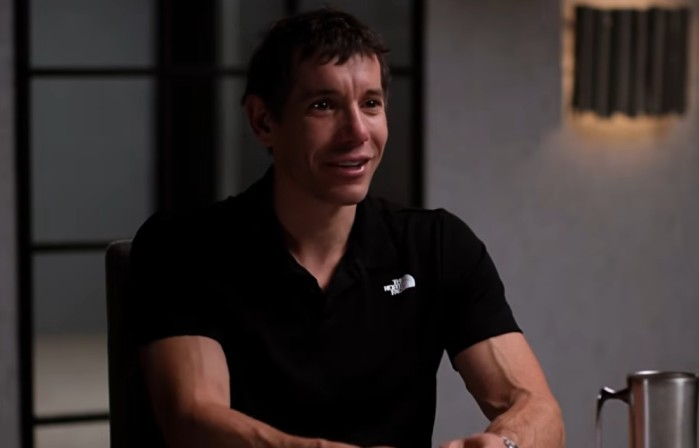
Editor’s Notes: In this gripping episode of The Diary Of A CEO, world-renowned climber Alex Honnold sits down with Steven Bartlett to discuss the mindset required to scale the world’s tallest structures and the profound difference between taking “crazy” risks and smart, calculated ones. Honnold reflects on his unemotional upbringing and how it shaped his unique perspective on fear, while sharing the incredible journey of living in a van for a decade to pursue his passion for climbing. The conversation also delves into the “Honnold Foundation,” his attempt to make a material impact on the world by providing solar energy to communities in need. (Feb 19, 2026)
TRANSCRIPT:
Alex Honnold’s Childhood and Early Climbing Career
STEVEN BARTLETT: Alex, to understand you, I think from everything I’ve learned about you, from the research I’ve done, from speaking to your wife, your agent, everybody I could speak to, I think to understand your context, we first need to understand the circumstances in which you were raised and the childhood you had.
Because it seems to be — I mean, for all of us, there are fingerprints left on us that define the anomaly that many of us become, including yourself. So what do I need to know? What does the viewer need to know about the early context?
ALEX HONNOLD: I mean, how deep do you want to go? I need a sofa. I need to recline. Just be like, “All right.”
But yeah, certainly there’s an imprint from my parents, my upbringing. They had a very fraught relationship. They eventually got divorced, but they stayed together for the kids. It was a tense home life because neither of them really liked each other.
My mom is very driven, very high performing. And my dad — it’s hard to say. I think my dad was deeply depressed basically the whole time I knew him, because he was in this relationship. He wasn’t living his best life. And then sadly, after they got divorced, he was much happier. But then he died, and so I never really got to see him blossom that much.
A Mother’s High Standards
STEVEN BARTLETT: And your mother’s high performing — did she sort of implicitly demand that of you in any way?
ALEX HONNOLD: Yeah. My mother speaks like seven or eight languages. She plays every instrument. It’s kind of crazy. She’s very artistically minded in that way — the arts in a classical sense. She wanted us to do all those things, too. I’m a deep disappointment in that regard.
STEVEN BARTLETT: There was a phrase that I saw when I was watching the documentary that your mother would continually say, which I think translates to something like, “Not good enough.”
ALEX HONNOLD: Like, “Almost doesn’t count.” It’s funny because I feel like a lot of my adult life now, one of my go-to sayings is, “Don’t let perfect be the enemy of good.” I’m really into “good enough.” It’s better to try, it’s better to do something, it’s better to fail quickly and learn and keep moving forward than to not try something at all.
Basically, I don’t want to be crippled by perfectionism. My mom is very much a perfectionist — if you can’t do it right, don’t do it. I think it’s better to try, learn, and improve.
STEVEN BARTLETT: But she’s accomplished a lot of things with that approach.
ALEX HONNOLD: Yeah, she has, for sure.
An Unemotional Household
STEVEN BARTLETT: What about emotions? This is something I’ve heard you talk about a lot — in that environment where your mother and father aren’t getting along well. I think I heard you say that you hadn’t seen your father really happy before he passed away.
ALEX HONNOLD: Yeah.
STEVEN BARTLETT: Was it an emotional household in terms of affection?
ALEX HONNOLD: No, it was a very unemotional household. That said, it was a safe, relatively happy household. It was fine. I was close to a lot of my extended family, so I had a really good relationship with my grandparents and some of my aunts and uncles.
I basically would have characterized it as a totally happy family life until I became older and started seeing other people’s families more and was kind of like, “Oh, this seems even happier.” It was basically really good until you see what else it can be, and then you’re like, “This seems even better.”
STEVEN BARTLETT: And your mum wasn’t ever affectionate?
ALEX HONNOLD: It always felt slightly conditional — where it’s like, she cares if you perform well, if you do well, if you’re a good kid or whatever.
The Beginning of a Climbing Life
STEVEN BARTLETT: Where did climbing come into your life? Because I’ve found some photos of you climbing. You look here — with your sister, I believe. Here we go. This one here?
ALEX HONNOLD: Yeah. Classic.
STEVEN BARTLETT: How old are you there?
ALEX HONNOLD: I don’t know, like six or eight. It’s hard for me to tell medium-sized kids’ ages.
STEVEN BARTLETT: Why climbing?
ALEX HONNOLD: Oh, why not? It’s so freaking cool. Have you rock climbed?
STEVEN BARTLETT: Yeah, I have.
ALEX HONNOLD: You’ve gone to a gym?
STEVEN BARTLETT: Yeah, I have, but—
ALEX HONNOLD: And wasn’t it the freaking coolest thing?
STEVEN BARTLETT: It was fun. Yeah, for sure. I mean, saying I’ve climbed when I’m sat with you feels like—
ALEX HONNOLD: Yeah, but you have tried it.
STEVEN BARTLETT: Yeah, I have.
ALEX HONNOLD: As an adult, if you can imagine as a kid how fun that is — and then if you just keep doing that nonstop and find that you have some aptitude for it and you enjoy it — you can imagine going down that path. It’s so cool.
STEVEN BARTLETT: But is there something about the challenge of climbing that you think was just a jigsaw piece for your brain, like problem solving?
ALEX HONNOLD: Well, I think there’s something elemental about climbing in the same way as running or swimming. It’s a basic movement thing that I think is quite enjoyable. I also think I have an innate love of being on top of things — being at the top.
STEVEN BARTLETT: I’m assuming you never thought this could be a career.
ALEX HONNOLD: No, not at all. And actually, even when I started rock climbing sort of full time, I still didn’t think it could be a career because there just wasn’t really professional climbing at that time. The industry was way smaller. Climbing was way more fringe and less of a thing.
STEVEN BARTLETT: But you weren’t motivated by money or anything, because one does not pursue rock climbing to become rich.
ALEX HONNOLD: Not to become rich. No.
Living in a Van for 10 Years
ALEX HONNOLD: My father died the season before that. And because my parents had just gotten divorced, he basically left his retirement savings to my sister and me. She used it to finish college. I just put it into bonds and was living off like $300 a month or whatever, which kind of worked. I was living in a car — I stole my mom’s minivan. I had a couple hundred bucks a month and it was kind of enough to just be a 19-year-old camping, you know.
STEVEN BARTLETT: Was it this minivan?
ALEX HONNOLD: No, that’s my second one. That’s the Ford Econoline. That’s the first actual van that I bought. I lived in that van for 10 years.
STEVEN BARTLETT: For 10 years?
ALEX HONNOLD: Yeah. So I bought this van for ten grand. This is the last build-out, which is the classiest build-out. The original one my uncle and I did for free with scrap wood from his wood shop. I lived in that for 10 years. I couldn’t even stand in this van. But when you’re living in your car for 10 years, you save quite a lot of money.
STEVEN BARTLETT: Between what ages did you live in your car for 10 years?
ALEX HONNOLD: I probably bought this van when I was 20, so — 20 to 30, basically. I think that’s right because I think I met my wife when I was 30, and that same year I switched from this van to the bigger van. If you’ve seen the film Free Solo, that’s the Promaster — this Dodge. I could finally stand up in my van. I was like, “I’m moving up in the world. I can stand.”
STEVEN BARTLETT: That’s pretty exciting.
ALEX HONNOLD: Really.
STEVEN BARTLETT: Well, there is a little stove in this one, but yeah.
ALEX HONNOLD: So I did three different build-outs of this van over the 10 years. The original one was super scrappy, the second build was a little nicer, and then this was a pretty nice build that I had for five or six years or something.
STEVEN BARTLETT: When you live in your van for 10 years and you have a mother who is very performance focused — I’ve got a photo here, I believe. You coming with her? Yep.
ALEX HONNOLD: Classic.
STEVEN BARTLETT: Did you not face a lot of external pressure to go get a real job?
ALEX HONNOLD: Honestly, less so than you would think. To her credit, my mom was always pretty supportive of the whole path. I think I was kind of lucky that I did a lot of this when I was young enough that it was all part of like your gap year — you’re young and you’re finding yourself.
And then I think there was enough external validation that my family could at least look at it and be like, “Well, you seem to be good at this random thing even though we don’t get it and don’t really know what you’re doing, but at least other people think you’re good at it — so keep doing your thing.”
STEVEN BARTLETT: And at this point, was it rock climbing? Was it free soloing?
ALEX HONNOLD: It’s a little bit of everything, basically. Just being a professional climber, quote unquote. Some of it’s free soloing, some of it’s speed climbing, some of it’s just hard climbing, some of it’s going on expeditions, doing new routes. It’s a little bit of everything.
What Is Free Soloing?
STEVEN BARTLETT: And for the average person that doesn’t know what free soloing is, what’s the definition of it?
ALEX HONNOLD: That’s climbing without a rope — climbing without protection. It’s definitely what I’m most well known for now. But in the context of professional climbing, I’ve done tons of other things. Most of the time you have a rope on, most of the time you’re doing other sorts of things. But free soloing is what I’m well known for because it breaks into the mainstream a lot more.
Mapping the Career Graph
STEVEN BARTLETT: I’m really intrigued generally by people like you who take the path less traveled in their career and then, maybe nearer the end of the graph, pick up traction. I have this piece of paper and pen here — I’d love if you could draw a graph showing how your career looks in terms of success. You can measure that by money or attention or whatever. You’re now 40 years old.
ALEX HONNOLD: Yeah, I turned 40 this year.
STEVEN BARTLETT: Getting old. Could you draw that graph from the age of, let’s say, 18?
ALEX HONNOLD: Let’s see. So it was kind of like nothing. Slow, a little bit. And then like — this, ish. And then kind of like, meh. And then basically just like this, where you kind of flat but growing. And then you have Free Solo where it jumps a ton — it’s kind of crazy. And then it keeps growing at a slightly faster rate than before. And then it basically jumps a ton again because of the building thing.
STEVEN BARTLETT: I find this fascinating because most people in their lives wouldn’t be willing to endure this phase — 18 to 29 — where—
The Winner-Take-All Economy and Living Intentionally
ALEX HONNOLD: Well, but it’s not enduring. It’s so great. I would do that again. I loved it so much. I often think I’d be so happy to just start over from zero because all the places that I go climbing now, I’ve been climbing there for 20 years and I’ve done most of the things I can do. I’ve sort of tapped out a lot of stuff in the Western U.S. and I’m like, man, I would love to just hit the reset button and start over because you’d have so much stuff to do. It’s so amazing.
STEVEN BARTLETT: I guess that’s the different — the fault of my question is that I said the word “endure,” but you see it as…
ALEX HONNOLD: Yeah, you get to climb every single thing you see. It’s amazing. And that’s the thing — from age 18 to 30, I basically did try to climb every single thing I could see because I was just like, I’m learning, I’m growing, this is amazing, I’ll climb everything.
And now I’m actually much more strategic about it because doing tons of easy climbing doesn’t really help me at this point. I’m not going to make big technique gains. It basically just makes me tired. Without the right kind of gains, it’d be like an elite runner just jogging for miles and miles every day — that’s not going to improve your marathon time if you’re already an elite runner. It might be fun, but it’s just not going to move the needle for you.
STEVEN BARTLETT: Through this period of your life, 18 to 30, you’re optimizing for just having fun doing things you enjoy.
ALEX HONNOLD: Well, no — I was always challenging myself. Basically I was optimizing for what’s the next thing I can do that pushes me a little bit.
STEVEN BARTLETT: But you weren’t optimizing for how to get rich or…
ALEX HONNOLD: Well, then I would have gotten a job. If I was optimizing for getting rich, I would have finished my college degree and gotten a job.
STEVEN BARTLETT: I say this in part because I’ve interviewed so many people who pursued careers that are often considered not real jobs — like comedians or magicians. And I tend to find the same thing: between the age of 18 and 30, they optimize for something that isn’t necessarily being rich or famous. And then at some point, the graph looks like this.
ALEX HONNOLD: Well, it’s because the world really — and I’m sure you know this — it’s like a winner-take-all economy type deal. Basically, if you’re the person that does the thing, all of a sudden your earnings go insane. But until you become that person, if you’re like the best magician or the best comedian or the best whatever, then all of a sudden you make an insane amount of money. But when you’re just one of many struggling comedians, you’re struggling.
And so I think for me, as a climber, you’re sort of like, “Oh, I’m just a dude living in my van, climbing.” But then at a certain point, you become the person that, you know — “Oh, you’re that guy that climbs without the rope.” And then all of a sudden, your earnings are like…
STEVEN BARTLETT: Was this a difficult period of your life, this 18 to 30?
ALEX HONNOLD: No, it was like the best. Well, obviously there was turmoil — I was trying to get a girlfriend, you’re a young man in your 20s living alone in a car, wanting to be better at something than you are but not quite knowing the way, not knowing what you’re doing with your life. So obviously there was tons of emotional turmoil throughout it. But retrospectively, it’s amazing.
The Loss of His Father and Confronting Mortality
STEVEN BARTLETT: And your dad passes away, which is in part, I guess, some of the catalyst for that.
ALEX HONNOLD: Yeah, honestly, my dad passing away should be the beginning of that graph. It should basically start at 19, because at 18 I went to university, and then starting at 19 I went on the road.
STEVEN BARTLETT: Your dad passing — what impact did that have on you, outside of it somewhat liberating you to make decisions outside of his expectations?
ALEX HONNOLD: Well, obviously it was sad and hard. And especially now, I’m sort of like, “Oh, it’s too bad that I don’t have a relationship with my dad,” and that my kids don’t have a grandfather — all that kind of thing. Yes, it’s tough.
I think the most immediate impact it had was just reminding me of my own mortality. He died unexpectedly at 55 — just fell over in the airport, fell over dead from a heart attack. And I think that reminder of my own mortality has had a big impact on my career, my life, my climbing world, everything.
STEVEN BARTLETT: One might not expect you to go, quote unquote, “do risky things” because of that.
ALEX HONNOLD: Well, no — because I think one of the reasons that people don’t do risky things is because they have this mistaken idea that they can live forever. People don’t want to think about their own mortality, so they’re like, “Oh, I don’t want to take any risks, I could die.” And you’re like, you know that you’re going to die either way.
And either way, when you die, you’re going to be bummed that you didn’t live longer. The life expectancy in the US is 78. Say you make it that far — you’re still going to be like, “Man, I wish I had 22 more years to watch my grandkids graduate college.” It’s still going to feel like too little.
And so I’m kind of like, you’re better off dying at 55 in an accident, but having done many things that you’re proud of and having led a life that you’re proud of, than dying at 78 and still wishing you had more, but having done none of the things that you wanted to do.
STEVEN BARTLETT: It is interesting. It does appear that people live as if they think they’re going to live forever.
ALEX HONNOLD: Yeah, it’s totally insane. Everyone’s like, “Oh, I don’t take any risk.” And you’re like, yeah, well, you can take no risk in your life and you’re still going to die. So you might as well take smart, calculated risks, do all the things that you want to do, and at least die happy.
STEVEN BARTLETT: When you say “live intentionally,” what does that mean to you?
ALEX HONNOLD: Well, that’s exactly it — choosing the risks that you’re willing to take, making choices, using your time the way you want to use it.
Personality, Neuroticism, and the Nature of Fear
STEVEN BARTLETT: I was looking at — I think it was your personality test.
ALEX HONNOLD: You did? I did a personality test? How much material do you have? Jesus Christ, how many things do you have?
STEVEN BARTLETT: I have unlimited things.
ALEX HONNOLD: I know. I’m so impressed.
STEVEN BARTLETT: On this personality test, it says you’re higher on thrill seeking and sensation seeking, but then also significantly higher than the average male on urgency — which I think kind of overlays with what you were just saying there, about making the decision to do something.
ALEX HONNOLD: Yeah, basically because your time is short and you’re going to die. So get on with it.
STEVEN BARTLETT: It says here you’re higher on conscientiousness.
ALEX HONNOLD: Very polite, you know — thrill seeking, sensation seeking.
STEVEN BARTLETT: You’re low on boredom.
ALEX HONNOLD: I think low on boredom means that you don’t get bored.
STEVEN BARTLETT: Perseverance — you’re very high on perseverance.
ALEX HONNOLD: Yeah, I think that’s the same as low on boredom.
STEVEN BARTLETT: And low on neuroticism, that’s for sure. What’s the definition of the word “neuroticism”? Is it like…
ALEX HONNOLD: Well, I’m sure there’s a clinical definition, but I think of it as general anxiety — people spinning in their heads about things that don’t matter.
STEVEN BARTLETT: And has that always been the case when you look back through your life, and the feedback you’ve had as a kid and a teenager?
ALEX HONNOLD: Kind of, yeah. I think so. I’ve never been too concerned — I don’t spin. Obviously, occasionally I stress about things, but just not the way I think a lot of people do.
STEVEN BARTLETT: I’m trying to figure out if that’s a learned behavior, or maybe a little bit learned and a little bit from your upbringing, genetics, whatever it might be. Can one learn that? Can one learn to be less neurotic?
ALEX HONNOLD: Well, presumably. Meditation, things like that — I think people can sort of find a way to let go of certain things.
STEVEN BARTLETT: Isn’t this quite interesting — when people ask you questions, inevitably about fear and how you take on such terrifying challenges — to Muggles like me, anyway — there’s an element of all of this which is: you do have a nature and a nurture which is somewhat impossible for someone like me to replicate, because your brain and my brain are completely different. Your parents, your early contacts, when your brain was being wired — they’re completely different to mine. I always find this is the trouble with giving people advice — we’re dealing with different…
ALEX HONNOLD: Different natures.
STEVEN BARTLETT: Different natures.
The Role of Passion Over Genetics
ALEX HONNOLD: But I do feel like in my case, the biggest difference in nature is the fact that I’ve just always loved climbing. Because basically, I think nurture is the majority of this. If you spend 30 years training at something, you’re going to get better at it.
And so I think the biggest difference between me and somebody who’s not into rock climbing is that I freaking love rock climbing. I could go out and do it 10 days a week if I could — sadly, I get too tired and my body breaks down. But I basically have a limitless capacity to do the thing. I just love doing the thing.
And I think that is probably the biggest difference in nature, because everything else you can kind of overcome. If you loved rock climbing as much as I love rock climbing, no matter what your genetic disposition towards neuroticism and all that stuff, you would just kind of work through it and find your own path to getting good at climbing.
STEVEN BARTLETT: If your kids came to you — you have two girls, right?
ALEX HONNOLD: Yeah.
STEVEN BARTLETT: If they came to you and said, “Dad, give me advice on what I should aim at in life,” would you?
ALEX HONNOLD: No, I wouldn’t give them advice. I’d be like, “You do you. You find the thing you love to do, go hard — basically, learn some skills, get good at something. What do you like to do?”
I mean, that’s kind of the thing for me, especially with climbing — if someone had told me, “You’re going to train climbing for the rest of your life,” I’d be like, “Oh, that sounds like kind of a grind.” Because it is hard work. You’re hiking uphill with a heavy backpack, it’s cold and it’s windy — being a professional rock climber means that you’re physically uncomfortable all the time. It’s hard.
But if you’re doing it because you freaking love doing it, it doesn’t feel very hard. And so I think the key for a kid is: find the thing that doesn’t feel like hard work.
STEVEN BARTLETT: And when you started, were you scared of big, tall rock faces and stuff like that?
The Illusion of Overnight Success
ALEX HONNOLD: I mean, yeah, I had a healthy intimidation of things. My first season in Yosemite, the first time seeing El Cap as a climber, I was 19. And it looks impossible. It looks completely insane. I was like, “That’s so big.”
But then, within a couple seasons, I climbed some bigger walls, learned how to climb. And then a friend and I had the sort of season goal — we were going to climb Yosemite all season with the aspiration at the end to climb El Cap in a day.
So basically, there was this long progression on El Cap, specifically, where it’s like you go from just trying to get up it, to trying to get up it faster, to trying to get up it with just your hands and feet, still using protection. But basically there are all these steps you can take. And so over a bunch of seasons, I climbed El Cap like 60 times, different routes, all these different things, and then eventually you’re sort of like, “Oh, maybe I can start thinking about free soloing it,” which is where the film Free Solo comes in. And then eventually you do this thing. Then people are like, “Well, aren’t you scared?” And you’re kind of like, “Well, I’ve spent 10 years building up on this thing.”
STEVEN BARTLETT: I guess that’s what people don’t see.
ALEX HONNOLD: Yeah. I mean, the documentary Free Solo I think does a pretty good job of showing the direct preparation — the training involved in doing that specific climb. But it just doesn’t show the eight years before that. The documentary was filmed over two years, and I’ve been going since 2006. So it was nine years before that that I’ve been going to Yosemite, spending maybe three months a year climbing walls.
STEVEN BARTLETT: I guess that’s the illusion — like all people that do great things and become athletes or sprinters or whatever, Ronaldo or Messi. You don’t get to see the—
ALEX HONNOLD: Yeah. The whole life that they put into doing the thing.
STEVEN BARTLETT: Yeah. So it looks like a magic trick when we see the outcome. We show up on Netflix to watch you climb, like, “Whoa, he’s hanging from his leg.”
ALEX HONNOLD: Yeah. I mean, people watch some of those programs and they’re like, “He just walked up and did it.” And you’re like, “Well, yeah, after 30 years of practice, I just walked up and did it.” But no, it’s not like just walking up and doing it. I’ve literally been climbing five days a week for 30 years. That’s so much climbing. I freaking love climbing, and I climb a lot.
Fear, the Amygdala, and the Brain Scan Misconception
STEVEN BARTLETT: On this idea of exposure therapy as it relates to fear and anxiety and confronting the things that terrify you — in the early days, were you scared at some point?
ALEX HONNOLD: Oh, all the time. That’s actually something I’ve obviously done so many interviews around — fear, managing fear, all that. I’ve talked about fear a lot of different ways over the years. And I think, as I’ve gotten older, I’ve come to realize that you’re just scared all the time as a climber. Low-level fear. But climbing is fundamentally scary. It’s always kind of scary because there are always consequences.
Even if you’re climbing with a rope, you’re still always visualizing — what happens if the rope breaks? Is this safe? Is the gear good? And so you’re always a little bit scared. After years and years of always being scared, you get pretty good at managing that kind of stuff.
STEVEN BARTLETT: There are a lot of misconceptions swirling around this brain scan you got.
ALEX HONNOLD: Yeah, I hate all that stuff. That’s just from the film Free Solo. It was too short of a scene in the film. They needed to let it breathe, explain things a little better, I think.
STEVEN BARTLETT: So they scanned a control subject, scanned you, looked at the amygdala in your brain, and the conclusion that a lot of people have arrived at is that you don’t experience fear. Because when they look at the two brain scans, your amygdala is lighting up less when you’re shown scary images. Right?
ALEX HONNOLD: But shown just an image — what does that even mean? My brain’s purple and his brain is orange. What does that mean?
But this is what I wish was explained in the film better — we’re being shown black and white photos inside an fMRI. So you’re inside a sealed metal tube. You’re totally safe, physically safe and comfortable, and you’re being shown black and white photos. Obviously that’s not going to light up the fear response in my brain, because you’re looking at pictures. You’re like, “Who cares? I’m totally safe.”
But in a control subject, apparently your brain responds to images one way or another. I’ve been climbing for 20 years, so I’ve been scared quite a lot. Black and white photos start to lose their edge if you’ve been scared all the time for 20 years. So obviously that’s not going to trigger much.
STEVEN BARTLETT: And I imagine everybody in their life can think of a scenario where they have mastery. A stand-up comedian looking out on a stage probably wouldn’t be as scared as me.
ALEX HONNOLD: Yeah.
STEVEN BARTLETT: Because that would terrify me. So again, this is not necessarily some sort of neurological—
ALEX HONNOLD: No. I mean, I think the real takeaway is that I have an amygdala and it works. Because if the results had shown that I was missing my amygdala, I would have died already in youth — I wouldn’t be able to function as a human, basically.
Had it shown something like structural differences or some real change, that would be different. But this is basically just showing that after 20 years of conditioning, I respond differently than an average person. And you’re like, “Yeah, no kidding.” If you put a monk into an fMRI, their brain responds totally differently than an average person as well.
Exposure Therapy: The Only Real Hack
STEVEN BARTLETT: Which I actually think is a really inspiring conclusion, because it means that we can all grasp our fears better. People won’t know this about me, but 10 years ago I sat down on camera with my friend Ash in his apartment to record a two-minute video. And as I sat there, I was so scared I couldn’t get the words out. In that two-minute video that came out, you see it go from night to day in the background, just because we did that many cuts over seven hours to try and get me to say two minutes on camera. And obviously after 10 years of being on camera, I can now speak without shitting myself. I imagine my brain state looks significantly different because of exposure therapy.
ALEX HONNOLD: Totally. Yeah, you should do the fMRI. You should have done it 10 years ago, because then you’d have your control, and then you do it now and it’d be totally different.
STEVEN BARTLETT: The psychologists I’ve sat with all confirmed this. They talk about exposure therapy.
ALEX HONNOLD: I went through exactly the same thing with public speaking. I was always so afraid of public speaking. I was also very shy — it was terrifying. And now, because of the Free Solo film tour and all the public things I’ve done since then, I’m basically fine. You still get a little nervous, but it’s basically easy now. And you’re kind of like, “Well, that’s a total change.” Obviously there’s a tremendous capacity for humans to learn.
STEVEN BARTLETT: People talk to you about fear all the time, because I mean, your work—
ALEX HONNOLD: Because climbing is really freaking scary.
STEVEN BARTLETT: It makes sense.
ALEX HONNOLD: It’s totally understandable.
STEVEN BARTLETT: And they also realize, I think at some deep level, that the thing holding them back from who they think they want to be, or who they aspire to be, is fear. Often it’s the judgment of someone else. It’s taking a risk.
ALEX HONNOLD: Totally.
STEVEN BARTLETT: So you’ve become, for many people, the — tell me, tell me how to overcome—
ALEX HONNOLD: Yeah. Well, everyone’s like, “What’s your hack to overcome fear?” And you’re like, “There’s no hack.” You just get really freaking scared over and over for so long, and eventually it’s not that scary anymore.
But I will say that that’s a very enduring way to overcome your fear. If you’re willing to go through that process, then you are actually unafraid. You can do hacks — you can crank up loud rock music and just go for it. And there are plenty of examples of that in what I’d call gravity-assisted sports.
Say if you’re going to jump a cliff on skis — you can get to the edge, be like, “This is really scary,” and then be like, “Three, two, one,” and just go. In climbing, you can’t really do that as much, because it’s so slow. You make one move, then another move, and then you’re like, “Do I still want to be here?” Fear creeps in a lot more.
In gravity-assisted sports, you can have more of that moment where you just overcome your fear and then it happens — making a big drop in a kayak, or on skis, where once you commit, it’s happening one way or another anyway.
The Half Dome Experience
STEVEN BARTLETT: I want to get into it. I watched a video of you climbing Half Dome, I think it was.
ALEX HONNOLD: Yeah.
STEVEN BARTLETT: And it looks like you got scared halfway up.
ALEX HONNOLD: Yeah. Well, that video is actually filmed later. The voiceover is me talking about the experience of free soloing when I was totally alone. And I did get really scared on Half Dome — I had this whole somewhat traumatic climbing experience near the top of the wall.
But then when we went back to film it, I had a different, less traumatic but very scary experience while we were filming. And they got that on camera. So in the film, they just cut the two together, because it shows me being really scared.
STEVEN BARTLETT: What’s Half Dome to start with? And then what was the traumatic experience?
ALEX HONNOLD: So Half Dome, for anyone who hasn’t seen it, is this totally amazing wall in Yosemite. It’s a 2,000-foot granite face. Actually, it’s the North Face logo. That’s Half Dome.
STEVEN BARTLETT: Oh, okay.
The Mental Game: Fear, Panic, and the Edge of Control
ALEX HONNOLD: Yeah, so it’s like an iconic wall in Yosemite. It looks like half of a dome, but actually it’s more like a hockey puck just shoved in. It’s actually a full dome, depending how you look at it. But the northwest face is vertical for 2,000 feet — it’s incredible.
So I free soloed that. That was one of the first major free solos I did in 2008, and one of the things that sort of made me a professional climber in a way. But when I did the climb, I did the bare minimum preparation. It was the biggest thing I’d ever free soloed, and I didn’t quite know how to go about getting ready for it.
Anyway, I climbed it and basically hadn’t practiced enough, was really freaking scared, got off route, got confused, skipped some stuff, and then at the very top, had this whole moment of extreme panic. Basically I got up into some stuff and it all sort of crumbled mentally, and I barely managed to finish this upper slab.
The hardest part of the climb is right near the top. I was trying to walk across this ledge. I’ve walked across that ledge face in and face out — normally people hand traverse it or they crawl across it. There are different ways to go across the ledge, and I’ve done it every which way. Then we were up there filming and I was like, “Oh, I’m going to walk it face out.” But it turns out when you walk it face out, it’s really freaking scary. So I made it kind of halfway and was like, “Oh my gosh,” and then bailed.
STEVEN BARTLETT: And when you say you are having a crisis in your mind, what is that? How does that sound when you’re up there?
ALEX HONNOLD: Well, in this case, walking across this ledge — it starts maybe as a foot wide, so your foot is fully on the ledge and you’re shuffling across it. But then at a certain point — yeah, that’s the video.
STEVEN BARTLETT: Put it on the screen for anyone watching.
VIDEO CLIP BEGINS:
ALEX HONNOLD: Yeah, that’s the ledge. But basically at the narrowest part, your feet are sticking out over the lip of it and the wall bulges ever so slightly, so it forces your back out a little. And so you’re basically rocking on your heels with, I don’t know, like a 1,700-foot drop or something — 1,800-foot drop — straight down below you. It’s pretty intense.
Anyway, I thought I was going to walk across it like that, and I made it to the bulging part and was suddenly like, “Oh my God, this isn’t for me.” And then managed to shuffle back and change my strategy.
VIDEO CLIP ENDS:
STEVEN BARTLETT: Is it like panic in your head?
ALEX HONNOLD: It’s not panic, but you’re like, “Oh, I made the wrong choice. This is bad, this is bad.” It’s not like full five-alarm-bell panic. But yeah, you’re like, “Oh, I’m so screwed.”
Falling, Fear, and the Reality of Risk
STEVEN BARTLETT: You have fallen a long, long way before. I was hearing about a time when you were young and you fell off a mountain and managed to call your mother.
ALEX HONNOLD: Yeah, that was like sliding down an icy couloir type thing — it’s a little different than free falling off a cliff. But yeah, I got totally messed up. And I’ve broken my arm several times as a kid falling off things. Then with a rope, as a climber, you take big falls routinely when you have protection. That’s just part of the sport, basically.
I mean, it’s certainly easy to visualize falling 1,700 feet when you’re standing on a little ledge and the wall is bulging and you’re looking down. You’re like, “Oh my God.” It’s like, if you just bend forward a little bit, you’re just going to take a swan dive 70 to 100 feet to the ground.
STEVEN BARTLETT: The stats in this sport — the fatalities — how do they compare to other sports?
ALEX HONNOLD: Safer than you would think. That’s the thing — everyone thinks it seems crazy, but it’s not that crazy. I don’t know the actual statistics, but I suspect it’s actually pretty comparable to skiing or something, because recreational skiers die all the time — falling in tree wells, going off cliffs by accident, things like that.
Climbing is actually surprisingly safe, which is one of the things I love about it. It’s very binary — either you’re totally safe or you’re going to die. And the odds of you dying are very, very small. But because they’re there, they always keep you alert. You’re never really going to get hurt.
STEVEN BARTLETT: Is that including free soloing?
ALEX HONNOLD: Yeah, for the most part. A couple of people have died free soloing, for sure, but actually most of the cutting-edge free soloists have not died soloing. They’ve died doing other things.
STEVEN BARTLETT: I think it was in the documentary on Netflix, Free Solo, where one of your colleagues —
ALEX HONNOLD: Yeah, Tommy said something like, “Most free soloists are dead now,” which is kind of true, but it’s slightly misstated. He was just speaking off the cuff and it’s not strictly true. A couple of the best free soloists have died free soloing, though they died on very easy terrain. But the majority of other great free soloists have died in climbing-adjacent accidents — like wingsuit base jumping. One got swept out to sea by a rogue wave while he was out climbing a sea cliff, standing on shore.
Things like that — obviously they’re taking risks in their lives and they wind up dead, but it’s not the way people think. You see a photo like that and you’re like, “Free soloing — you’re going to die for sure.” And you’re kind of like, “Well, people don’t actually really die that way.” I mean, it has happened, but way less frequently than people would suspect.
What Would Be Alex’s Worst Life?
STEVEN BARTLETT: If I was to professionally torture you — and I’m not talking in extremes here — what life would I prescribe you to live?
ALEX HONNOLD: Being like a finance bro or something. Having to work spreadsheets my whole life. Or honestly, being like a choreographer for dance, or an opera singer. I would just kill myself. I just couldn’t do that.
STEVEN BARTLETT: Why would being a finance bro be the worst thing for Alex?
ALEX HONNOLD: Just the idea of sitting at a computer in a cubicle, just typing. I’m kind of contrarian — I don’t like rules, I don’t want to jump through hoops, I don’t want to do arbitrary things. I don’t want some manager to come and tell me, “Oh, you’ve got to file that report again, you missed a line.” I’d be like, “You go f* yourself.” I’d just walk out of the building. I just don’t know if I could take that.
STEVEN BARTLETT: But that’s how most of the world lives. We all kind of live in —
ALEX HONNOLD: I just don’t know if it’s for me. I mean, I had this moment — I’ve been in New York a couple of days and I took the subway down to see some friends. I was coming out of the tunnel and it’s packed with people, and I was just looking at the ground, following someone else’s footsteps up this beaten-down path of stairs. And I was like, “I couldn’t live like this.” Not day in and day out, every day. Just feeling like you’re doing the exact same thing as everyone else around you. It seems so, so boring.
STEVEN BARTLETT: It’s funny, because so many of us look at your life and go, “Wow, that’s not very normal.” But actually, maybe at a foundational level you’re living a much more normal life — you’re out in nature, you’re moving your body.
ALEX HONNOLD: Yeah, for sure. Going on cool adventures, going out — I don’t know.
STEVEN BARTLETT: I think that’s also part of the attraction and allure of your life, especially when you watch Free Solo. You do seem to be a free man in a way that most of us aren’t.
ALEX HONNOLD: Yeah, well, I think we’re all aspiring to that to some extent. Most people see that though as — they get their vacation for the year, they’re planning to retire at some point, and then they’re going to have their freedom. And you’re kind of like, “Well, maybe you’ve got to try to live that way as much as possible.”
On Meaning, Values, and Living Deliberately
STEVEN BARTLETT: If your young girls, June and Alice, came up to you and said, “Dad, what is a meaningful life? What are the principles of living a fulfilling, meaningful life?” — what would you tell them?
ALEX HONNOLD: It’d be a long, rambling, multi-day conversation. But I mean, following your own goals is certainly one of the cores of having a meaningful life — having things that you find valuable. Really living in line with your values, finding things that are important to you, and pursuing them with as much as you can give them.
STEVEN BARTLETT: When you look at your early 20s to 30s, it kind of looks like you were living like a Buddhist a little bit.
ALEX HONNOLD: Yeah, I went on a trip once where they called me “the Monk,” just because I was living such a sedate lifestyle. I was reading, I don’t drink, I don’t party — just personal preference. So I’m just living in my little van, reading books, and climbing all the time. Those are the things I’m into doing. It’s just doing what you want to do.
STEVEN BARTLETT: Have you ever been depressed?
ALEX HONNOLD: Yeah, probably not deep clinical depression, but there are certainly periods from time to time where you’re just like, “What am I doing? Why? What are my goals?” I think the most surprising thing is that I’ve put my whole life into climbing — trying to be the best you can be all the time — and sometimes you put tons of effort in and you just don’t see results. For whatever reason, you just suck. You’re like, “I’m trying so hard and I’m just not as good as I want to be.” That’s challenging. But everybody faces that to some extent — working hard at something and just not achieving the results you want.
From Living in a Van to Making Real Money
STEVEN BARTLETT: Between that period — that no man’s land of your 20s and 30s, where your career hasn’t taken off yet, the documentary’s not out, you’ve not climbed El Capitan — how much money were you earning from climbing?
ALEX HONNOLD: My first couple of years, my sponsorship through The North Face was — I think my first year was like $10,000 a year. I was like, “This is amazing.” When you live by yourself in a van, making $10,000 is more than you need, basically. It obviously went up beyond that at some point, but it was in the $10,000 to $100,000 range for years.
STEVEN BARTLETT: Then at some point it increases.
ALEX HONNOLD: Yeah, and then it increases. Free Solo was obviously a big thing, and that opened up all these opportunities. I started doing corporate speaking and stuff like that — and as I’m sure you know, that’s just a whole different world. You go from making some money from sponsors to making money from other corporations. So then you’re like, “Okay, now you’re making some money.”
Breaking Down the Challenge: El Capitan, Taipei 101, and the Art of Preparation
STEVEN BARTLETT: One of the things when I was hearing you talk about some of your incredible climbing stories is I was trying to understand what role visualization or your preparation plays and how that’s transferable to me in my life. We talked a little bit about just how much preparation you did for something like El Cap, but it sounds like you really break down the challenge into smaller bits and then really go through those individual steps, whereas a lot of people would just look at El Cap and go, “Oh my God,” they’ll be terrified. And that’s impossible.
ALEX HONNOLD: Yeah. Which is fair. I mean, I spent years looking at El Cap and being like, “That’s too big. That’s impossible.” And then, after years of that, I kept hoping that I would look at it and it would look easy somehow, and I’d be like, “Cool, now I’m going to do it.” And it just never looked easy. And so then finally I was like, “Okay, I’m going to have to put some real work into it.” And then I started slowly breaking it down. And once you break it into pieces and start working on the pieces, then you’re kind of like, “Okay,” it starts to feel more reasonable.
STEVEN BARTLETT: Break it into pieces and start working on the pieces. What does that mean in terms of climbing? I’ve got this model here of Taipei 101. And this is also a metaphor for any challenge I have in my life.
ALEX HONNOLD: But this is actually perfect because it’s right here.
STEVEN BARTLETT: Yeah.
ALEX HONNOLD: So I scouted this in September of this year. I did the climb in January or whatever. In September we went — well, we had to make sure it was possible before you sort of commit to it. Doing a whole TV program, you’re kind of like, “Let’s make sure we can do this.” And then they also had to get all this sort of marketing material — you get the full photos with the building, all the stuff that becomes the trailer and whatever. And so we went in September to sort of do the prep.
I basically checked out all the different pieces, and so anywhere where you see it looking a little bit different — you know, this whole bottom part is like a low angle slab, punctuated with these two little ruyi, these little coin things, the clouds or whatever they are. Then there are the dragons on the corners. These are all overhanging — each of these eight blocks is like a big overhanging thing. It feels a little bit different. Then you get up here, there are these balconies. These are actually overhanging. Basically, each little segment of this is quite different. Obviously on this model it looks the same, but each transition between the different pieces is like a thing. So I checked out all of them with ropes, and yeah, you just go piece by piece all the way up the whole thing.
STEVEN BARTLETT: And you hadn’t ever climbed it before? We saw it on Netflix Live.
ALEX HONNOLD: Well, I hadn’t free soloed it. No, but I had climbed it. I climbed all the pieces with a rope, for sure. I’d checked out the different things.
STEVEN BARTLETT: Okay. So you look at these as individual challenges every step.
ALEX HONNOLD: Yeah, it’s like you go — even just getting off the ground, the first move is a slightly different move than any of the other moves. You have to jump up to a thing and press it out. Then climbing over these little clouds is a different thing. Each dragon is a different thing. There’s a surprising amount of complexity to it. And so on the first scout, I had a note on my phone and I’m just writing down all the different — basically, I’m trying to learn it the way you study anything, where I’m just making notes and sort of like, “From floor 54 to 72, it feels like this. I climb the southeast corner, the left arc,” and just writing it all down.
The Rings, the Energy, and the Hardest Moments
STEVEN BARTLETT: And there’s this famous photo of you hanging with your leg.
ALEX HONNOLD: Yeah, that’s this. These are the rings up here.
STEVEN BARTLETT: So you’re hanging from here with your leg. This is really a question of endurance. How would you plan to have the energy? How do you know if you’re going to have enough energy when you’re up here, when you’re just planning it?
ALEX HONNOLD: Well, that’s what makes it exciting, because you can’t be sure. But I’ve done a lot of climbing in my life, and I’ve done a lot of climbs that were like 24 hours. I had this experience in Patagonia once — it was a 54-hour push, with the last 20 hours we hiked without food because we got caught in a storm. It’s a whole crazy story. But basically, I’ve had a lot of experiences in my life where I’ve done hard exercise for more than 24 hours. And so this — I expected it to take me somewhere in the hour and a half to two-hour range. And I’m kind of like, yeah, I’ll be tired after two hours of exercise, but I’m not going to be exhausted. I know that I have a much deeper reserve than that.
STEVEN BARTLETT: So much of the conversation after you’d done this was around whether this was a harder challenge than El Capitan.
ALEX HONNOLD: No, it’s obviously much easier. I mean, I’m doing it on live television. Obviously it’s easier. But what makes it cool is that it’s different, it’s fun, it’s challenging. For me, it’s really in my sweet spot where it is challenging enough — it’s not easy. Saying “easier than El Cap” doesn’t quite capture it. El Cap was like a ten-year life project that I did in absolute secrecy, on my terms, on the correct day, after years of effort. I had failed attempts. El Cap was an all-consuming life project for years. Obviously you can’t do that for live TV.
But this was very much in my sweet spot where you’re like, “Oh, it’s hard enough that it’s hard.” It’s cool, it’s fun, it’s interesting. The climb is engaging. It gave me something to train for for months. It’s super fun, but it’s not the absolute limit of what I can do, because you just can’t do that on live TV.
I mean, if nothing else — I was climbing the southeast direct because it gets good morning light, it looks beautiful, and it’s great for filming. But if I was trying to do the absolute most cutting-edge climb I could do, I’d be climbing the northwest direct because it’d be in full shade, better conditions, colder. You just don’t want to be in the sun — it makes your skin hot and everything. So if you’re doing it for TV and trying to broadcast it, you want it to look good. But if you’re trying to do it for hard climbing in good conditions, you do it in full shade.
STEVEN BARTLETT: And Netflix had a 10-second delay just in case you fell.
ALEX HONNOLD: I mean, I’m sure part of it’s in case you fall, but part of it’s like, what if somebody unplugs one of the things? It’s so complicated. There’s so much stuff going on, it’s insane.
STEVEN BARTLETT: Was there a hardest part of this? A part where you were at all nervous?
ALEX HONNOLD: The thing I was most nervous about when I started were the bamboo boxes — doing these eight overhanging segments — because they’re just so relentlessly the same move. It’s pretty physical. You get tired for sure. The actual physically hardest moves — actually, randomly, one of these corners up here would have been quite a hard move. But there was this security camera bolted onto the wall, and so you use the security camera as a handle. It was really cool. It was bolted on these giant bolts, so it looked super safe and was very robust and secure. It would have been kind of an extreme jump otherwise, which was probably possible, but would have been a major thing. But instead you just reef off the security camera. I was like, “That’s so cool.”
There are a few things like that — individual moves that are kind of muscly — but overall it’s the stamina, the challenge of doing this over and over for hundreds of feet, that was the hardest thing.
Family, Fear, and the Burj Khalifa
STEVEN BARTLETT: Do you have a conversation with your girls and your wife before you go and do something like this — about just in case you don’t come back?
ALEX HONNOLD: Not with the kids, because they’re too young. They wouldn’t understand anyway. And not with her because she came with me to Taipei — she was there for the whole end of it. I went a little bit early so I could adapt to the time zone and feel better, but basically she was with me. We went to bed together that night and woke up that morning, had breakfast together. So it didn’t feel like a big goodbye.
She was with me at the base. We did the start together, and then I literally was like, “Okay, bye,” and walked over and did the thing and saw her again at the top. We were only apart for about an hour and a half of the whole experience. I saw her through the window a couple of times, so it felt like she was just there having the whole experience with me.
STEVEN BARTLETT: Did you look at other buildings in the world, like the Burj?
ALEX HONNOLD: Some, yeah. I’ve scouted the Burj twice over the years. This project almost happened in 2013 or something, and so I’d scouted some buildings then. The Burj was just a little too extreme — it’s just too hard. But someday, maybe. Who knows?
STEVEN BARTLETT: Because it’s — what, there’s not enough? It’s too slippery?
ALEX HONNOLD: Yeah, it’s super slippery. Also, it’s just the way the holds are. The beauty of Taipei 101 is that the holds are good things to hold that are close together, and you just feel secure. The Burj — I can barely span tip to tip to reach between the holds. So then your face is right against the glass, holding on like this. It’s pretty hard. And you have to do the same thing 112 times in a row. It’s kind of hard to do it once, and then you have to do it 100 times. You’re like, “It’s kind of hard.”
STEVEN BARTLETT: The other thing that I saw online, after you’d climbed it — about one or two days after — everyone started talking about how much you were paid to do it, I think because you did an interview with —
On Getting Paid and Doing What You Love
ALEX HONNOLD: It’s funny, there were some quotes that were kind of taken out of context because a New York Times reporter asked me how much I was getting paid, and I was kind of like, oh, I don’t want to talk about it. Because it’s kind of embarrassing — all my friends, it’s like an embarrassingly high amount for my community. Like, in the climbing world, if you’re getting paid to rock climb, you’re like, great success. You’re getting paid to climb. That’s insane.
And so I thought it was sort of an embarrassingly large amount where I’m like, oh, this is kind of weird. But then he sort of poked around and he started comparing it to, like, boxing matches and stuff, where people get paid like $20 million to fight someone. And I was like, well, no, compared to that, it’s an embarrassingly small amount. Or if you compare it to Major League Baseball contracts and things, yeah, it’s an embarrassingly small amount. But I was never complaining. I thought it was great. I mean, I would do it for free.
I’ve paid money to go up to the observation deck. The observation deck is way up at the top, and the view is insane and the city’s incredible. It’s like $20 or whatever to take the world’s fastest elevator to the top of the building. I’ve done that at the Burj as well, where you pay the money and you go to the very top of the building, and the view is insane. I do that anywhere that I travel — like the Willis Tower, the Sears Tower in Chicago. I’ve paid the money to go to the observation deck and see the view. And it’s so cool. And I’m kind of like, if someone’s willing to pay me to climb up to the observation deck, that’s freaking cool.
STEVEN BARTLETT: Yeah. I think it’s because people believe that you’re risking your entire life.
ALEX HONNOLD: Yeah.
STEVEN BARTLETT: And so they don’t think of boxers as risking their entire life in the same way.
ALEX HONNOLD: Except they kind of are.
STEVEN BARTLETT: They are. Yeah. But they don’t see it as that.
ALEX HONNOLD: Of course they don’t see it as that, and that’s totally understandable. I get that. But I see it as, like, anybody going into the boxing ring, particularly if they’re very mismatched — you would think that there is some real chance of grievous injury or death. It’s insane.
And I think people that don’t know anything about climbing, look at me climbing a building and they’re like, it’s 50-50 if he lives or dies. No idea. And you’re like, no. If you put this in the context of all the things that I’ve climbed in my life, I felt very confident that I wouldn’t fall off the building. Obviously it’s never 100% because, whatever, it’s life. But it feels like 100%. You’re like, oh, there’s no chance I’m falling off this building.
STEVEN BARTLETT: The rumors were that you got $500k to climb it from Netflix.
ALEX HONNOLD: Throughout my whole career as a climber, I basically have never worried about money. I’ve always just tried to do the thing and let it all play out at the end. I’ve done a ton of work for free over the years. We were talking about the Half Dome film earlier — I did that film for free. I did tons of films like that for free. Just because you’re kind of like, oh, it’s part of being a professional climber, and I get to go climbing and I’m up with my friends filming. You’re just working for free. It’s fine.
But by doing all that stuff for free, I never stressed the day rate. I was like, I don’t need to get paid to go have fun with my friends on a wall. It’s fine. But as a result of that film, a year or two later, they wound up doing a photo shoot out there for the cover of National Geographic. And so you just wind up in other things. And then that got seen, and I wound up being profiled by 60 Minutes, which actually was one of the first sort of career inflection points — that 60 Minutes profile in 2011 or something.
Basically, I’ve done a ton of work for free over my life, all as part of the game, and I just love playing the game. So you just let it play out. And it’s funny because with this building, a lot of people thought that I was sort of underpaid. But afterward, some people have approached me about some bonuses and some other work stuff, and a lot has already sort of happened, and it’s only been a couple of weeks since the building. I’m kind of like, you don’t need to get paid for the thing itself because it always works out. I’m like, don’t get hung up on how much you get paid. Just do the thing. Make sure it’s rad and it all sorts itself out.
Value First, Economics Follow
STEVEN BARTLETT: Yeah. I mean, that’s also been completely true for my life as well. Even this podcast — when we started it in my kitchen, and this is a replica of my kitchen, and Jack was here — there was no payment when we started it.
ALEX HONNOLD: Yeah, exactly. You’re just doing a thing. You make it as good as you can, and eventually it all sort of works. And you’re like, cool.
STEVEN BARTLETT: Because that pattern you’ve just described has played out for 15 years of my life. My CFO and commercial director might not love me saying this, but they know this about me — and we even talked about it recently with a particular project — is, don’t let the inability to see where the money’s going to come from in the near term stop you from pursuing something that you think is going to create value. Because history shows that giving value out into the world precedes the economics. Totally.
I remember when I started the social media business and a guy sat me down at Google in London and explained to me why I would never make money from that business. He did the math for me, and the math was solid. He was like, “If you want to do this, you won’t make any money.” And I was like —
ALEX HONNOLD: But I don’t think that’s true. You have no evidence. Yeah, but you just know it’s going to work.
STEVEN BARTLETT: The Uber CEO sat here with me yesterday, and he was telling me about this thing called Jevons Paradox, where when something —
ALEX HONNOLD: Efficiency.
STEVEN BARTLETT: Yeah. When something becomes more efficient, people think of things in linear progression, but actually there’s exponential progression. So when they launched Uber, more people started taking taxis. So all of the models about how big the market was were all wrong. And I find the same in podcasting when we started about five years ago. Yeah, like, you sit me down and go, “Well, Steve, CPMs — you’re going to have to be getting a million downloads to make a living.”
ALEX HONNOLD: But you’re like, wait and see. Yeah, let it happen.
STEVEN BARTLETT: I mean, you’re a prime example of that.
ALEX HONNOLD: Yeah. It’s always better to focus your energy on being the best at the thing you’re trying to do than figuring out how to monetize it or make money off it. My whole life as a climber, I’ve always tried to focus on how do you send — which in climbing terms means do the hard thing. You always focus on sending, and then everything else follows.
Mortality, Legacy, and What Really Matters
STEVEN BARTLETT: It’s funny, you’re talking about mortality earlier on, and in the last couple of years, realizing that I’m going to die someday has been such a thing to really remind myself of on a frequent basis.
ALEX HONNOLD: What? How come?
STEVEN BARTLETT: Just because — okay, so there are many things. One of them is the whole idea of sunk cost bias, where you become successful at a thing and now you have something to lose. So people go into a state of loss aversion where they start to protect what they have. And this narrows your life in a way where you stop taking challenges, stop taking risks, stop doing new things.
And the other thing, generally about knowing you’re going to die and really reminding yourself of that, is it liberates you from getting caught up and worrying about things that, in the grand scheme of cosmic reality, are totally inconsequential.
ALEX HONNOLD: Yeah.
STEVEN BARTLETT: I was hearing someone say the other day, “Do you know the name of your great-grandfather? Do you know his first name?”
ALEX HONNOLD: Not really.
STEVEN BARTLETT: And do you know the life they lived and what they were worried about and how they were embarrassed and their shame?
ALEX HONNOLD: Yeah, exactly. No, you don’t know any of that.
STEVEN BARTLETT: And the point is, if you don’t even know your own family’s —
ALEX HONNOLD: Yeah, it’s all bullsh. Nobody else cares.
STEVEN BARTLETT: But even extremely famous people — a couple of weeks after they trend on Twitter, a week later, everyone just gets on with their life again.
ALEX HONNOLD: Totally. Well, I’m already experiencing that with this stuff. The building was insane for a moment, but now it’s the Olympics and there’s a lot going on in the news cycle and the world’s moved on. And I’m like, great, I’ll go back to just being at home with my family and climbing as much as I can.
Relationships and Emotional Intelligence
STEVEN BARTLETT: Being at home with your family? You said earlier that when you were in that van for 10 years, you wanted a girlfriend. Now, people that fit your profile — and to some degree, people that fit my profile — struggle in intimate relationships for a variety of reasons. And I actually saw this in the documentary when I watched Free Solo. I saw you had a partner at the time. There was an accident on the cliffside where you fell, and she was supposed to be protecting you. And generally I just saw someone who probably is more on the less affectionate, more commitment-avoidant side of life. Is that accurate?
ALEX HONNOLD: I don’t know about commitment avoidance, because actually I have had long-term girlfriends and things. But yeah, definitely — I’m less expressive, I’m less emotionally intelligent than my wife.
Sani’s Letter & The Language of Love
STEVEN BARTLETT: Has she ever given you feedback that she wishes you were more emotionally available? I mean, I get that.
ALEX HONNOLD: In different words, perhaps, but yeah, basically Sani.
STEVEN BARTLETT: Yeah, Sani is her name. She wrote a letter. Oh, gosh, that’s funny, because the first two words are, “Oh, gosh.” An intimate letter out loud.
ALEX HONNOLD: Oh, gosh, she does know me.
STEVEN BARTLETT: Obviously. This is your worst nightmare.
ALEX HONNOLD: She knows me so well.
STEVEN BARTLETT: But we all have to do scary things sometimes, Alex.
ALEX HONNOLD: My coach…
STEVEN BARTLETT: She said, “I remember when you read a book once about a woman who said she was less affected by emotions than most people. For her entire life, people tried to convince her that she was wrong, that she was suppressing her feelings, but at the end of the day, she just wasn’t. As you were reading, you turned to me and said something similar. Something like, ‘Everyone wants to believe that I’m burying all these things, these feelings, deep inside, but I’m just not.’ And I laughed and I joked, ‘Don’t worry, I know you’re dead inside.’ If I remember correctly, you gave me a hug.
But I’ve thought about this conversation a lot because as the person married to you, I spend a lot of time trying to understand you. And while there obviously are emotions that drive you, I was mostly joking about the dead inside part. I do think you are far less affected by some feelings like anxiety, fear, shame, guilt, or self-doubt than many of us. But the longer I know you, the more I see an ocean of something else hiding beneath the surface.
Filling the space that would normally be taken up by all these feelings is the ability to truly see things. You move through the world like a hawk, while the rest of us are lost in thought. As a climber, you can see the way up a rock face, the climbability of a building, or the layered history of a mountain range. As a father, you notice the quiet intrinsic desires of your daughters or the chores that need doing around the house. And as a friend, you see the raw potential in every person that you meet.
Sometimes this is the hardest thing about you. Nothing goes unnoticed, neither the strengths nor the weaknesses, the moments of dedication or the moments of laziness. You are practical and blunt in your assessment of your choices and our lives, but that’s also because you see us, and paying attention is love. Your ability to see the world so clearly allows you to also appreciate it more clearly, and that is a special form of your love. Perhaps there’s a well of emotion in there after all.
But for the purposes of this letter, Alex, I want to give you your gift back to you and tell you what I see, particularly in the last four years since we had kids, because I think the way you move through the world with us is a unique love story.
I see you rushing down the trail from the climbing area so you can get back in time for dinner with me and the girls. I see you flying the red eye so you can be home a day sooner. I see you cramming in your gym session even when you have a huge goal on the horizon so that I have time for my workout, too. I see you pushing your body to the absolute limit during the day, but still managing to stay awake long enough to chat to me at night. I see you taking on an extra day of travel just to convince someone with money to donate to your foundation and help save the planet. I see you adjusting your whole training schedule for work opportunities in order to provide a wonderful life for me and the girls. I see the insane juggling act you do every day to not only be a great athlete, but a great dad and husband. I know it’s not easy, but I see it and I appreciate it.
We love you as you are, Alex. Not overly emotional, but present, committed, and always seeing what others miss.
Yours, Sani.”
ALEX HONNOLD: She is very astute. I was like, that’s why I married her. I don’t know.
STEVEN BARTLETT: She’s very astute.
ALEX HONNOLD: Yeah.
STEVEN BARTLETT: I learned a lot about you from reading this.
ALEX HONNOLD: What do you think?
STEVEN BARTLETT: You know, we all show our love in different ways. And sometimes I think the conventional way that the world tries to measure love is through the verbal expression of it, romantic gestures, and those kinds of things. But there’s another type of person who often struggles, I think, with life’s expectations of what love looks like, who show it through acts of service.
ALEX HONNOLD: That was literally one of our last big arguments about something. In bed the other night, not like a total blowout, but basically she was saying, “I just need more of the verbal kind.” And I was like, “I’m literally doing all the things.” And I always say, actions speak louder than words. If you’re doing all the things, you’re doing the correct things. You don’t need to talk about them because you’re doing the things. And that was basically a back and forth. I mean, I took her point that occasionally you have to say the right thing, too.
STEVEN BARTLETT: Well, I have the same argument on repeat with my fiancée.
ALEX HONNOLD: She needs the words, too. Yeah.
STEVEN BARTLETT: She has a different language. She’s speaking Spanish, I’m speaking French.
ALEX HONNOLD: Yeah.
STEVEN BARTLETT: And also, by the way, I have to say at some deep level, again, because of my early context where, like you, I wished my parents would break up. I wish they would just get a divorce because the model of love I saw was not a happy one. I think at some deep level, I have a commitment problem or an intimacy problem where even growing up, calling someone my best friend somewhat made me cringe. Saying affectionate words to someone at some deep level made me feel deeply uncomfortable. And so you can imagine me dating. And I think oftentimes we go for the opposite in the person we end up marrying.
ALEX HONNOLD: Yeah, certainly for me.
STEVEN BARTLETT: Yeah. Well, certainly for me.
ALEX HONNOLD: My wife is way more emotionally intelligent than anyone in my entire extended family.
STEVEN BARTLETT: Yeah. Same.
ALEX HONNOLD: This is how you build a rich life. You basically find members of the team who have all the strengths that you need. It’s like filling your blind spots.
STEVEN BARTLETT: Have you got better at saying the words?
ALEX HONNOLD: No.
STEVEN BARTLETT: Any progress?
ALEX HONNOLD: Yeah, progress, probably, but very slow. But in a way that’s great, because we’re going to be married the rest of our lives, and that could be another 50, 60 years together. So you need to see incremental progress. There’s nothing better in life than making progress. I’ve started at such a low point, and I’m making progress so slowly that I basically have a good project for the rest of my life.
The Power of Perseverance & Compounding Growth
STEVEN BARTLETT: One of the things that’s been front of mind for me at the moment is something I saw in your personality test, which was that you were high in perseverance. We talked earlier on about mastery and how it’s important to persist to get good at something. This has been front of mind for me for a long time, because even with the podcast, I’m five years in now, and when I look at someone like Joe Rogan, he’s been going for 15, 17 years or more. So much of the game in becoming great at something…
ALEX HONNOLD: It’s just grinding.
STEVEN BARTLETT: It’s just going.
ALEX HONNOLD: Keep doing it.
STEVEN BARTLETT: An unusual amount.
ALEX HONNOLD: It’s like compounding interest. Look at Warren Buffett. It took him 40 years to make his first couple million, another 10 or 15 years to make his first billion, and then in the last several years he’s made enormous amounts on top of that. His whole wealth is like, whoosh. Basically, if you put enough time into something and you let it compound, it slowly gets bigger and bigger.
STEVEN BARTLETT: It’s exactly that.
ALEX HONNOLD: Also, all those numbers are incorrect, but the shape of the graph is correct.
STEVEN BARTLETT: We’ll put it on the screen so everyone can see.
ALEX HONNOLD: Yeah, somebody correct my numbers. The principle is correct.
STEVEN BARTLETT: It’s the same as this graph here that you drew of your career. It’s the same as the podcast growth, where for years no one was listening, and then we have this. And I think as a principle, that’s…
ALEX HONNOLD: Why you focus on doing something of value. Because with the podcast, if you feel like you’re doing something useful and that you think is cool and you think there’s something there, you just keep doing it and eventually people get on board.
STEVEN BARTLETT: So on that train of thought, I’ve thought a lot about how to create the conditions to out-persist other people in the areas that I love. One such thing, for example, with the podcast is to never have a conversation that I’m not looking forward to, because that’s unsustainable over the long term.
ALEX HONNOLD: Totally. Because then it feels like hard work as opposed to something where you’re like, “This is amazing.”
STEVEN BARTLETT: Yeah. So when my team says, “Oh, this person wants to come on, and they’ve got 160 gazillion followers…”
ALEX HONNOLD: But you’re like, “I don’t care about that person.”
STEVEN BARTLETT: Because if I use that as a decision framework for the next 10 years, I’ll quit.
ALEX HONNOLD: Yeah.
STEVEN BARTLETT: Do you think about that? Like, the conditions to out-persist in your domain?
ALEX HONNOLD: Kind of, yeah. I haven’t had to think about it too much because I freaking love climbing in all its forms, so climbing comes easily. But in terms of the work stuff I do, I host this podcast called Planet Visionaries — it’s a Rolex Perpetual Planet thing where I interview scientists and conservationists. And for whatever reason, every time I do those podcasts, I come out of it feeling all energized, like I should train more, I should study, I should learn something. Because the people I’m interviewing are all so uniquely good at what they do, and they’re all trying to save the world in different ways — marine biologists exploring the deep sea floor and things like that.
Yesterday, I interviewed these two women about the fact that we’ve only explored 0.001% of the deep sea, which represents two-thirds of the planet. So basically, two-thirds of the planet we know literally nothing about. There’s this rich underwater world of cool stuff going on on the ocean floor that we’ve never seen and know nothing about. It’s insane. I was like, “That’s so cool.” And I got all fired up about it.
So I come out of work things like that feeling energized and excited to learn and grow, to push myself. And I think, that’s the type of work I want to do as much as possible. And then there are other kinds of things, like corporate speaking, where you show up at a conference and you just get ground down. You leave, go back to your hotel, and all you can do is lie there on the bed for an hour thinking, “What am I doing with my life?” You feel wrecked.
So if you can focus on the work where you come out of it feeling inspired and excited to try hard, versus the work that makes you want to mindlessly scroll for hours — that’s the difference. Because sometimes you’re just so over it.
What’s Next? Goals, Serendipity, and Doing Cool Things
STEVEN BARTLETT: Yeah. Someone said that to me in my career. They said, whenever you find domains that make you feel expansive, you should double down on those domains because that’s the path to mastery. You’re going to be able to continue.
ALEX HONNOLD: Yeah. Because you can just keep pushing super hard in that. Thankfully for climbing, that’s always just been that — I just freaking love climbing. It’s so great. You should do it more.
STEVEN BARTLETT: I know. You make us all want to climb more, Alex. That’s one of the great consequences of watching you do something like Taipei. There were loads of kids in the streets of Taipei trying to climb buildings. There were loads of funny videos. Obviously, they were only getting, like, a meter up before they fell.
ALEX HONNOLD: Hopefully it’s not too much copycatting. But yeah, we got some crazy numbers from Netflix — I think more than half of people who have a Netflix subscription in Taiwan watched the building climb. In Taiwan, it was insane. Literally everybody watched it. It’s such a singular, striking building in Taipei. It’s like a total national icon.
STEVEN BARTLETT: Have you already started thinking about what you’re going to do next?
ALEX HONNOLD: People are always like, what’s your next big thing? And I’m kind of like, if you just focus on doing lots of little things all the time, occasionally the big things just happen and you can’t totally know ahead of time.
I mean, I have climbing goals going back 20 years. I have all these notes on my phone. I always have to-do lists, especially when I lived in the van and I was traveling — seasonally moving between climbing destinations nonstop. I’d layer out all these different types of goals. I want to do these types of things. Certain goals lead to other goals because they’re the same type of fitness. Doing really big things helps you do even bigger things later, but doing really hard and intense things helps you do other hard and intense things later.
So in some ways, in the way you stack your goals, you can kind of build up to big things or really hard things or whatever. I’ve always had running to-do lists — I’m going to try to do all these climbs this year — and realistically, I normally do about half of them. Some I never even get to because the weather’s not good and I wind up going to a different area. But I’ve always had tons of goals like that.
Looking back at years and years of those types of lists, I just see that it’s slightly hard to predict when you’re going to achieve the things that are cutting edge or groundbreaking. You just have to keep doing the things nonstop, and every once in a while, some of them rise to the top. This kind of goes back to the same value of creating things — you don’t know which things are going to be rad. You just do all the things and some of them wind up being rad.
STEVEN BARTLETT: And the decision framework there is to just do things you love and that challenge you.
ALEX HONNOLD: Yeah, things that push you — things that are new for you, that are hard for you, that are challenging in the right ways. You don’t always know ahead of time which of those things are going to stand out, but you just do them anyway because you’re learning from them, you’re excited about them, they’re hard. And then some are cool, some aren’t, some you never even try. And that’s fine. You just keep doing things.
Strong Opinions, Loosely Held
STEVEN BARTLETT: The CEO of Uber was out there yesterday and one of the contrarian pieces of life advice he gave — which kind of overlaps with what you just said — is that people, young people in particular, need to stop making life plans because it narrows them to the serendipity and opportunity and things that might happen if they’re broader and more open-minded.
ALEX HONNOLD: My wife and I sometimes joke that we both have very strong opinions loosely held, where it’s like, I’m totally sure of a thing right up until I get some data that shows that that’s wrong. And then you’re like, oh, never mind, throw that away.
That’s kind of how a lot of my to-do lists have always been, or my goals. I have all these goals, but if I take a slight fork in my year — where for whatever reason something else lines up and it makes sense to do all these other things — I’m just like, right turn, and I just change.
STEVEN BARTLETT: And it overlaps with what you said earlier about not worrying so much about how much it’s going to pay you today or what the big thing is — it’s kind of like
ALEX HONNOLD: just keep doing cool things and it’ll all work out.
The Brain’s Willpower Muscle
STEVEN BARTLETT: I would love if we could scan your brain and look at all the parts, especially in the context of a particular region of the brain called the anterior mid cingulate cortex, which I heard Andrew Huberman talking about. It’s a part of the brain they discovered quite recently that lights up when you do things that you don’t want to do — not things that you enjoy doing that are somewhat difficult, like running a marathon, but things that you actively avoid and resist but do anyway. Pain, fear, effort, discipline. This is the circuit that decides whether you quit or you push through, and it grows the more you do things you don’t want to do. They now consider it to be the muscle of willpower in the brain.
ALEX HONNOLD: Interesting.
STEVEN BARTLETT: When you look at athletes, they have bigger ones. When they look at people who are more sedentary or struggling with their weight, they often have smaller ones. Anyone that avoids discomfort has a smaller one.
In the context of the way you’ve lived your life, you’ve continued to do things that are hard. I mean, you can love climbing, but you don’t necessarily love—
ALEX HONNOLD: Yeah, just doing one more set every time is always a challenge. You’re always like, my whole body hurts, but I’ll just do a little more.
STEVEN BARTLETT: And I think the thing here is about neuroplasticity — there are going to be a ton of people listening right now that are so far away from their Type A 101. They’re in a job they just don’t like. They’re maybe the finance bro you talked about a second ago, and their life is absent of adventure. And they probably look at you and go, “Well, he just has something I don’t have.”
“I Don’t Think I Have Anything Different”
ALEX HONNOLD: I know, but I just don’t — I mean, I’ve structured my life in a different way and I’ve made many different choices. But that’s the thing — I don’t really think I have anything different.
I actually hate all the brain stuff because people always use that to put me in this box of like, “Well, you’re different.” And I’m like, well, not really. I’m a middle-class suburban kid. Both my parents — nobody in my family is athletic. Nobody is good at sports at all. If I was a video game character and you were to look at all my little bars, you’d be like, “That guy’s not going to be an athlete.” My parents are professors and we read books. I was bad at sports as a kid. I’m not good with balls. There’s no reason.
But really, I just have loved climbing enough that I’ve been willing to put in a tremendous amount of time and effort and eventually get good at it. And when people say, “Oh, your brain’s different,” I’m kind of like, well, everybody’s brain is a little bit different in some ways. It doesn’t mean that you can’t devote yourself to something that you care about.
STEVEN BARTLETT: But with this in mind, and with all the neuroscientists that I’ve interviewed — your brain is different in part because you’ve done different things. And neuroplasticity says you can change your brain right the way up throughout your entire life.
One of my friends, Tom Bilyeu, is a good example of that. He’s a big podcaster. He was — I can’t remember the exact age, but I’d say around 30 years old — so lazy, in his own words, that he would lay in bed all day. When his girlfriend came home, he said he would jump up out of bed just so she didn’t think he’d been in bed all day. And when he asked her dad if he could marry her, the dad said no. He was lazy and down and out.
Over the next 10 years, he makes decisions to take on more difficult challenges, builds a billion dollar company, and sells it. If you meet this guy today, you’d think: athlete, genius, super smart, motivated. You’d beg him for advice on discipline and motivation. He’s that kind of guy.
ALEX HONNOLD: Yeah. So what did he do?
STEVEN BARTLETT: He read a book about neuroplasticity and he realized that he wasn’t stuck. He learned that at any age in your life, the decisions you make change your brain. And that’s why I love this discovery of the anterior mid cingulate cortex — because it means that maybe in part the reason why I’m not taking on my Type A 101 is because I haven’t taken on my Type A 101.
Start Small: The Right-Sized Challenge
ALEX HONNOLD: Yeah, well, you haven’t taken on your Type A 1, your Type A 2, or whatever — just the little pieces at the bottom. Because that’s the thing — and actually, this is why when you ask about big goals, I sometimes think the big goals are slightly limiting.
If you’re the friend who’s laying in bed, Type A 101 is not the appropriate goal. You need a Type A 4. You need to just get out and do a little thing. You need to achieve some success. You need to see that you can do something and take on appropriately sized challenges. Having a great white whale is great sometimes, but that’s not always what you need.
And partially, for me right now — we’re raising two little kids and we’re just in the midst of it. Bedtime right now is hanging. It’s just a lot. And I’m like, I don’t need an El Cap-sized goal right now because we’re just trying to make it through a certain phase of life. Not to say that I’ll never have other big goals, but you want your goals to be appropriate to the time and space that you have available.
STEVEN BARTLETT: I had a psychologist say to me about this idea of just setting yourself a Type A 1 — a small goal — that the reason why people don’t do it is because they see it as almost so embarrassingly small that they don’t think it matters.
ALEX HONNOLD: Yeah, but that’s why you focus on — does it matter to you? Is it something that you haven’t done? Is it good for your growth? Is it challenging for you? That’s good enough.
STEVEN BARTLETT: That same psychologist told me that when they were dealing with a patient who was so demotivated that they couldn’t get out of their bedroom — which was stacked to the ceiling with plates and cutlery — day one was bringing the hoover into the room. That was day one. Day two was plugging it in. That was day two. And by day 30, they’re outside. This is someone who was scared of going outside. They’re outside, walking around, the room is clean.
But he said to me that people don’t take that first step because it’s so embarrassingly small that it’s almost shameful to say, “Today we’re just going to bring the hoover in.”
Don’t Let Perfect Be the Enemy of Good
ALEX HONNOLD: Yeah, but that’s the thing. It’s always better to take a step than to not take a step. That’s how I’ve always felt with all these things. You might as well go out and do the thing. Do something.
I remember at the beginning I was like, don’t let perfect be the enemy of good. Do the good thing, because perfectionism shouldn’t cripple you. That’s why I think, if Taipei 101 is your perfect goal, don’t let that hold you back from going out and climbing Taipei 4 or Taipei 8 or some of the surrounding little buildings, because you practice on what you can.
STEVEN BARTLETT: It goes back to this point of perseverance. I read a quote many years ago that said, “Greatness doesn’t exist. Greatness is just good repeated.”
ALEX HONNOLD: I would actually say that if you repeat good enough, every once in a while some of those are great, actually, but you just don’t totally know.
I noticed that a lot in my climbing life. In the long arc of climbing, there are tons of things I did in Yosemite where in a season I’d have five or six goals, and I’d do all the things, and one of them, for whatever reason, would wind up being like, that’s rad. It would make climbing news and things like that. And the other ones, maybe less so, but you don’t totally know ahead of time which ones are cool or not and which ones are going to stand the test of time.
At one point in the not too distant past, I held the speed record on every major formation in Yosemite. Now a few of them have been broken over time. Those are the kinds of things where you never really know how long those types of records will last, because sometimes you do them and then your friend comes and breaks it the next season, and you’re like, cool. You go back and forth and it’s all part of a fun game. And then some of them, you set a speed record and it lasts for 15 years, and you’re sort of like, oh, I didn’t realize that this was going to be such a milestone.
Connecting the Dots Looking Backwards
STEVEN BARTLETT: It reminds me of the Steve Jobs quote about how you can only really connect the dots looking backwards. From his commencement speech: “You can’t connect the dots looking forward. You can only connect them looking backwards. So you have to trust that the dots will somehow connect in your future.” Clarity isn’t a prerequisite for action. It’s the reward you get after you move.
ALEX HONNOLD: That’s the thing. I do so many interviews where people ask, when was the moment you decided to be a professional climber? And I’m like, there’s no moment. I just did the thing for years and years. And now, looking backward, it looks like this amazing arc. But at the moment, I spent years being like, should I go back to college? Do I need a degree? And then I spent a few years wondering if I should go back and get an executive MBA or something, because I was like, I don’t want to go back to undergrad. I’ve been living in my van for 10 years. But you’re still like, I need that validation. I want to jump through the hoops. And really, it’s only now that I’m kind of like, I don’t think I need that.
STEVEN BARTLETT: In part, I think the reason why so many of us get forced into procrastination when we’re trying to connect the dots looking forward is because we face these questions from society — what’s your plan? What’s your career? What are you aiming at? And we don’t have answers, so we fill in the gaps. We have to say something to Mum and Dad. You can’t say nothing.
ALEX HONNOLD: No plan. Or you just say, I’m living. I’m just letting it play out. We’ll just see what happens. It’s going to be a grand adventure. I kind of hope my kids feel confident with that. Just kind of like, well, I’m doing the best I can. I’m practicing the things that I care about, and we’ll see how it plays out.
STEVEN BARTLETT: We’ll see how it plays out.
ALEX HONNOLD: Because either way, it’s going to play out with me and them and everybody else dying. You know how it’s going to play out at the end. And so the whole space up to there is like, oh, you just try to fill it with as many things that you’re proud of as you can.
STEVEN BARTLETT: It’s a remarkably simple way to live in a world that’s increasingly complex, Alex.
ALEX HONNOLD: Well, it doesn’t need to be that complex. This is why I think spending some time in nature helps remind you of some of those sorts of things.
The Next Generation Challenge: Free Soloing the Triple
STEVEN BARTLETT: If you knew that you only had one week left to live and you could only do one last climb — go back and recapture the record, do El Cap again, a different building — you have one week, and assume you’re sufficiently prepared for whatever the climb would be.
ALEX HONNOLD: Am I allowed to do cutting edge, futuristic things?
STEVEN BARTLETT: Yeah.
ALEX HONNOLD: The free triple in Yosemite would be insane. It’s the three biggest walls in Yosemite — El Cap, Half Dome, and Mount Watkins. Mount Watkins is kind of a Half Dome-sized wall that’s further up the valley. Tommy Caldwell and I have free climbed the triple together with ropes, and I’ve soloed the triple — all three with ropes by myself. It was like 18 or 19 hours of climbing. But it’s never been free soloed.
I’ve free soloed Half Dome individually and I’ve free soloed El Cap individually. No one’s ever free soloed Watkins, but the idea of doing all three in a day would be like a totally next generation achievement. There are certain things like that where I’m sort of like, if I was starting over, if I was an 18-year-old trying to make it as a professional climber nowadays with a higher level of skill than I have now, that would be the obvious next generation challenge.
STEVEN BARTLETT: Free solo all three in the same day.
ALEX HONNOLD: Yeah, it’d probably take just under 24 hours.
Training, Hands, and the Pain of Crack Climbing
STEVEN BARTLETT: What is your training regimen these days?
ALEX HONNOLD: Go rock climbing a lot. Today I did a little workout in the hotel gym this morning.
STEVEN BARTLETT: Your hands are quite different. They’re quite big hands.
ALEX HONNOLD: Well, think of a stonemason just grinding away their whole life.
STEVEN BARTLETT: I don’t know if people can see that on camera, but it does look like you have very wide fingers.
ALEX HONNOLD: Yeah, my fingers have taken a lot of abuse in their time.
STEVEN BARTLETT: I see you putting them in between walls and stuff.
ALEX HONNOLD: Yeah, crack climbing. You basically put your fingers into a crack and then you torque them. The side-to-side pulling does sort of make your connective tissue bigger.
STEVEN BARTLETT: And does that hurt?
ALEX HONNOLD: Yeah, it hurts.
STEVEN BARTLETT: I was wondering when you’re going uphill —
ALEX HONNOLD: When you’re doing it well with good technique, it’s not that painful. It depends on the type of rock, but some rock is kind of sharp and painful. But yeah, this goes back to strengthening your — what’s the part called in your brain?
STEVEN BARTLETT: Anterior mid-cingulate cortex.
ALEX HONNOLD: Yeah, exactly. Even when done well, climbing hurts your fingers and toes. Crack climbing, when you’re jamming your toes into a crack and wedging your fingers in — when you’re doing it well, it has a pleasant feel of safety to it because you can really lock into cracks and it feels comfortable. You feel like you’re swimming. You’re like, this is beautiful. But when you really come down to the sensations, you’re still crushing your bones into a crack. It still hurts.
The Photo That Terrifies Everyone
STEVEN BARTLETT: When I look at this photo where it looks like you’re hanging by one and a half hands, and you’re going to fall to your death if your grip isn’t sufficient, it makes me think you must have the world’s greatest grip strength.
ALEX HONNOLD: I definitely don’t. Well, there is a sloping cliff thing below me in that photo, so I’m actually only about 30 to 40 feet off the ground. But if you fell, you’d bounce off and go basically all the way down to the valley floor.
STEVEN BARTLETT: Terrifying photo.
ALEX HONNOLD: It’s funny, actually. Have you seen Free Solo? Do you remember the camera guy that can’t look — the guy shooting the long shot on the ground? Mikey. He’s a really good friend of mine. I’ve done tons of things with him. He shot the Taipei climb as well. Mikey was the photo assistant for this photo, holding the lights, and he did the whole shoot just looking into the wall. He just never looked at any of the things happening. Jimmy Chin was taking the photo, and Mikey did all the rigging and the lights and everything, just looking into his armpit the whole time, looking the other way. He was like, I am not part of this.
STEVEN BARTLETT: I’d like to see his brain scan.
ALEX HONNOLD: He was stressed. I mean, he’s an elite climber himself and he’s amazing. But basically, watching free soloing is stressful, and nobody wants to do it if they don’t have to.
STEVEN BARTLETT: In all your career, when is the moment where you were most scared — where you thought maybe you had pushed it too far?
Risk, Fear, and the Philosophy of Climbing
ALEX HONNOLD: Oh, it’s actually. I’ve had several moments, but actually mostly with ropes on. That’s the thing is that because when you’re free soloing, you generally keep it within a healthy margin or you practice ahead of time, basically because you’re going to die. You make sure that you can do it, but when you have a rope on, you’re way more willing to push into the unknown because you’re kind of like, “Surely I’ll get some protection eventually. I’ll just keep looking.”
And so I was on an expedition to Antarctica actually, in 2017, and did a bunch of climbing that was very extreme, but with a rope. But it’s Antarctica. It’s really freaking cold. Conditions are challenging. The rock is crumbling. Everything is scary. And you just keep hoping that it’s going to get better, and it just keeps getting worse instead.
The thing is, having a rope on doesn’t mean anything unless you get good protection, which means you have to be able to put gear into the rock. And if you can’t find places to put gear into the rock, then the rope is 200ft long. If you go 200ft without getting good gear, then you’re looking at taking a 400ft fall before the rope catches you, which is almost certainly fatal. Even though the rope will catch your corpse, you’re still going to hit the wall after 400ft. You’re screwed.
So anyway, my scariest experiences have all been situations like that for the most part. This is why I’m saying climbing, you get scared a lot. On that expedition, we were climbing basically day on, day off. Each day we would go climb one of these crazy spires and we’d have these experiences where I’d be so scared. And then the next day we would just sit in the tent because it’s Antarctica, it’s really cold. You’re in the cook tent. And I would basically just spoon Nutella all day, totally shell shocked, completely traumatized.
And then you’d be rested enough and you’d go out the next day and do it again. We just did day on, day off of full trauma and fear for the whole trip. And then we climbed everything in the range. It was amazing. It was an incredible trip.
STEVEN BARTLETT: So you do get scared.
ALEX HONNOLD: Yeah, I was so scared the whole time.
STEVEN BARTLETT: Are there any techniques that have proven to be effective for you to deal with that fear? People talk about breath work and —
ALEX HONNOLD: Yeah. Take some deep breaths. Try to compose yourself. I try to stay rational. Am I in danger? Because sometimes, like in this case in Antarctica, I am actually in danger. If I fall, I could die. But oftentimes you feel those feelings of fear and you’re not actually in danger. It’s just your mind running away from you. And so sometimes you can rationally rein it in a little bit where you’re like, “No, I am safe. The protection will hold me. The rope is good. My gear is good.” And then you just take a deep breath and carry on.
STEVEN BARTLETT: And do you visualize falling ever?
ALEX HONNOLD: Oh, yeah. Of course. You have to understand what the consequences would be. That type of visualization is also how you can know when you’re safe. Like if you place gear and you’re trying to visualize, “If I fall, am I going to hit the ground or is the gear going to catch me before I hit the ground?” There are often situations where you’re like, “If I fall, am I going to hit that ledge and break both my legs, or am I going to clear the ledge and fall into free space, in which case it’s totally safe?”
It helps to have a clear-eyed visualization, because most people visualize the worst case — “If I fall, I’m going to die.” And oftentimes, if you fall with a rope, you’re going to be fine. But it’s important to know the difference.
STEVEN BARTLETT: So you don’t avoid the confrontation with the negative outcomes.
ALEX HONNOLD: No, because you have to think about it. How else do you mitigate that kind of stuff?
STEVEN BARTLETT: But you can’t let that stop you taking action when the risk profile is okay.
Intentional Risk-Taking
ALEX HONNOLD: Yeah, exactly. This is like a whole rant about risk-taking, but the thing is, you want to be taking the risks that you choose to take. And it drives me crazy that nobody else thinks about risk in this way.
Think of all the people that go out partying every weekend, get a little buzzed, and drive home. They’re taking all kinds of risks that they’re not actually choosing to take. They’re just choosing to go out and party and have a good time. But then they’re driving a little buzzed and they’re like, “No, it’s fine.” But obviously they’re taking a risk. Or they’re putting themselves into vulnerable situations because they’re incapacitated, because they’re drunk or whatever. So they’re at higher risk for crime, things like that. They’re taking risks — they just haven’t chosen to take those risks.
The thing with climbing is that I’m choosing to take the risks and I’m pretty clear-eyed about them. I’m not going to say it’s perfect, but for the most part I think I have a pretty good idea of which aspects are dangerous, when the consequences are high, what will happen if I do fall. You try to think it all out as much as you can.
How many people in normal life actually think through all the risks that they’re taking? Even totally sedentary people who are like, “Well, I don’t take risks. I stay home and I play video games.” You’re at a much higher risk of heart disease. You’re going to die from other things. You’re still going to die either way. That’s okay. I’m done ranting. I’m sorry.
STEVEN BARTLETT: No, no, but it’s really important because I think we are all taking risks, but some of us aren’t intentional about the risks we’re taking.
ALEX HONNOLD: That’s exactly it. Even if you take no risk, you’re going to die. You’re taking a different set of risks. And so people look at my life and they’re like, “Well, you’re crazy. You’re such a risk taker.” And I’m kind of like, well, at least I’m taking the risks that I’m choosing. And I’m choosing them very intentionally, and I’m pretty careful about them and I mitigate them as much as I can. Can you say the same for the risks that you’re taking? The average person, I think, doesn’t think about risk as much as they should.
STEVEN BARTLETT: And is there anything that you would give them as a framework to help them be more intentional about those risks?
ALEX HONNOLD: Well, you’re going to die either way. So choose the things that you care about and then do them well.
STEVEN BARTLETT: And do them well. Prepare.
ALEX HONNOLD: Yeah, execute. Have a plan. But don’t just take risks willy-nilly. Don’t just get drunk and go out and do a thing, because that’s stupid. That’s not the risk you should be taking. Don’t put all your money on black and just hope. Don’t just let fate roll the dice with your life. Make choices.
STEVEN BARTLETT: And free soloing — there’s a bigger existential risk with no margin for error, but —
ALEX HONNOLD: But it’s very intentional.
STEVEN BARTLETT: Very intentional. Drinking as a risk is like a volume knob — the more you do it, the more the risk increases. And the other one is kind of like an on-off switch, which you can do it today and then — yeah. So, grip strength.
The Grip Strength Test
ALEX HONNOLD: I wouldn’t be even a little bit surprised if you can pull that more than I can, actually. But we’ll both try.
STEVEN BARTLETT: Okay, this is a grip strength meter.
ALEX HONNOLD: Okay, so we’re at 0kg. Let me just preface this — I’ve had tons of people be like, “Well, surely you’re going to break the machine.” And I’m like, no, because for climbing you just need to do the things that you’re trying to do. How much do you weigh right now?
STEVEN BARTLETT: Like 165.
ALEX HONNOLD: 165, which is actually basically the heaviest I’ve ever been. Maybe 163 if I’m lucky right now.
STEVEN BARTLETT: So 165 pounds in kg is equivalent to 75 kilograms, roughly. Yeah. Okay, go ahead.
ALEX HONNOLD: 49 or 50? 49.9. I didn’t try that one. It’s just, yeah, 49. But those are just kind of like — it’s just a different thing. That’s not climbing.
STEVEN BARTLETT: 49 kilograms in pounds is 108. Interesting.
ALEX HONNOLD: Yeah. Let’s see yours. I’m strongly —
STEVEN BARTLETT: Different arms.
ALEX HONNOLD: It should be about the same with both hands.
STEVEN BARTLETT: 62.
ALEX HONNOLD: Yeah, see, there you go.
STEVEN BARTLETT: Yeah, I can’t lift my body weight.
ALEX HONNOLD: I might be able to muster a little more in it.
STEVEN BARTLETT: 63 on that one.
ALEX HONNOLD: Let me try again. Do you work out? Do you do weights and stuff?
STEVEN BARTLETT: I lift dumbbells, but I’m not doing anything grippy. I curl and stuff, but I don’t do anything grippy.
ALEX HONNOLD: I know. I’m at 50 and a half.
STEVEN BARTLETT: How many pull-ups can you do?
ALEX HONNOLD: Don’t know, but yesterday I did a couple of one-arms. Yeah, basically.
STEVEN BARTLETT: Pull-ups. Yeah.
ALEX HONNOLD: Yeah, which is very hard.
STEVEN BARTLETT: Yeah. I don’t think I can do one-arm pull-ups.
ALEX HONNOLD: Yeah, well, that’s the thing. That’s why grip strength stuff — have you done weighted pull-ups in a gym?
STEVEN BARTLETT: Weighted pull-ups? No, I just do my own body weight, and I weigh a lot so I’m deceptively heavy.
ALEX HONNOLD: Really, like very dense.
STEVEN BARTLETT: Very dense. Cats float on water. No, like big bones — you just sink straight to the bottom.
ALEX HONNOLD: Straight to the bottom.
STEVEN BARTLETT: How many kilograms do you think? Oh wait, in pounds you’d know, but —
ALEX HONNOLD: Well, now I’m guessing. Now that you’re saying that you’re big, I’m like, maybe 185 or something.
STEVEN BARTLETT: Whatever, I’m 211.
ALEX HONNOLD: Yeah, well, actually that’s another thing with grip strength — it makes sense that your grip strength is proportionately stronger. You’re like 25% bigger than me. So you would expect it to be at least 25% stronger right there. Just because you can do body weight pull-ups, you’re going to be much stronger.
The Closing Question: Life Beyond Climbing
STEVEN BARTLETT: We have a closing tradition on this podcast where the last guest leaves a question for the next guest, not knowing who they’re leaving it for. And the question for you is — what do you want to achieve in your life outside of your mainline job that you haven’t yet achieved?
ALEX HONNOLD: There are basically two other avenues that I care about in my life. My family — I want to be a good dad. I want to make sure my kids grow up to be healthy, well-adjusted people that live their best lives. And then I have a foundation that supports community solar projects around the world, and I’d love to see that thrive. We give as much as we can to solar projects around the world, and I’d love to see that do more.
STEVEN BARTLETT: On that point of your foundation — what is the thesis there? You want to — for solar projects?
ALEX HONNOLD: Yeah, solar. It’s basically energy access around the world.
STEVEN BARTLETT: Okay.
The Honnold Foundation’s Global Impact
ALEX HONNOLD: Yeah. I think now we’ve given over $13 million to something like over 100 partners around the world. Basically small scale community solar projects. So people getting access to energy for the first time, basically using solar for anything ranging from light to food refrigeration to pumping water. Whatever people need energy for, which is basically everything.
STEVEN BARTLETT: More than $13 million across 130 projects in 30 countries, impacting 650,000 people and creating 1,200 plus jobs. Protected 15 million acres of biodiverse forest as well.
ALEX HONNOLD: Yeah, some of those things are sort of the secondary and tertiary benefits. When you empower certain kinds of communities, they’re better able to take care of their lands and things like that. Some of that has to do with indigenous sovereignty, like in the Ecuadorian Amazon, where when the local people have power, suddenly they can protect their land from illegal logging, illegal mining, things like that. And so then you wind up having this knock-on environmental benefit that’s also great, in addition to the human aspect where you’re like, “Well, these people are living better lives and helping to save the planet.”
STEVEN BARTLETT: And you’re giving away roughly a third of your wealth to cover the majority of the foundation’s overheads.
ALEX HONNOLD: Yeah, I’ve been giving roughly a third of what I make every year since 2012. And that’s basically just sort of coincidentally tracked with the overhead for the foundation. So it just means that anything that people contribute goes straight to projects, because I basically cover all the staffing and everything.
STEVEN BARTLETT: How does one contribute to that?
ALEX HONNOLD: Honnoldfoundation.org is the easiest way. You can support directly, see all the projects that we’re working with, and donors can go there.
STEVEN BARTLETT: If they want to contribute to this, they can go to the website. I’ll link the website below. And if anyone is interested in continuing to support the great work you’re doing there, I’d highly recommend they go and make a donation. It’s also just a way, I think, to give back to you as a person for the inspiration you’ve given so many of us.
The Broader Impact of Climbing
ALEX HONNOLD: Yeah. To me, the foundation has always been my attempt at doing something useful. I love rock climbing, I think it’s so fun, but in the grand scheme of things, it doesn’t really matter in the world. And I feel like the work that we’re doing through the Honnold Foundation at least materially improves the well-being of other humans. It actually has a real impact both for the environment and for people.
STEVEN BARTLETT: Well, I don’t know. I think watching you climb El Capitan, and watching the millions of people all around the world watch El Capitan, was an expansive moment for all of us. Because it holds a mirror up to us in a really inspiring way and says, “What obstacles can you overcome in your life?” The many millions of people now have that visual, and sometimes it is an absurd visual that does that and is most memorable — etched into their brains. And that means that they, in their own lives, are looking for their own type of challenges. If you play that forward as a ripple in the ocean of how people are going to strive, and maybe live more intentionally — maybe it does really, really matter.
Maybe the whole conversation, which was my entire Twitter feedback for days and days and days of people saying, “This is a miraculous human achievement” — that’s the first half of a sentence. The other half of that sentence, which we never really hear, is, “So, now what can I do?” And that is a profound thing.
ALEX HONNOLD: Well, that’s definitely the best frame. That’s the framing that I hope for. But I think that’s the best case scenario for my climbing, and I hope that’s how people take it. I will say that the work through the Honnold Foundation at least has a direct material impact immediately. You don’t have to hope for ripples or anything. You can say, “Well, this person can now read after dark for the first time ever.” And that is game changing.
If anything, I’ve been talking a lot about actions speaking louder than words. It’s great if the climbing I do inspires people — that’s all good — but at some point, you just do a direct thing that actually helps people’s lives too.
STEVEN BARTLETT: And you’re doing both.
ALEX HONNOLD: Yeah. Aspiring to do my best.
STEVEN BARTLETT: The tangible and the intangible. Alex, thank you so much.
ALEX HONNOLD: Thank you. Amazing conversation.
Related Posts
- Seyed M. Marandi: Israel & U.S. Launch Surprise Attack on Iran (Transcript)
- Joe Rogan Podcast: #2461 w/ Robert F. Kennedy, Jr. (Transcript)
- Tucker Carlson Show: w/ Catherine Fitts on Control Grid, Banks’ Role in War (Transcript)
- Megyn Kelly Show: w/ Tucker Carlson on Epstein, Iran, America’s Gender Divide (Transcript)
- This Past Weekend: #642 with James Li (Transcript)