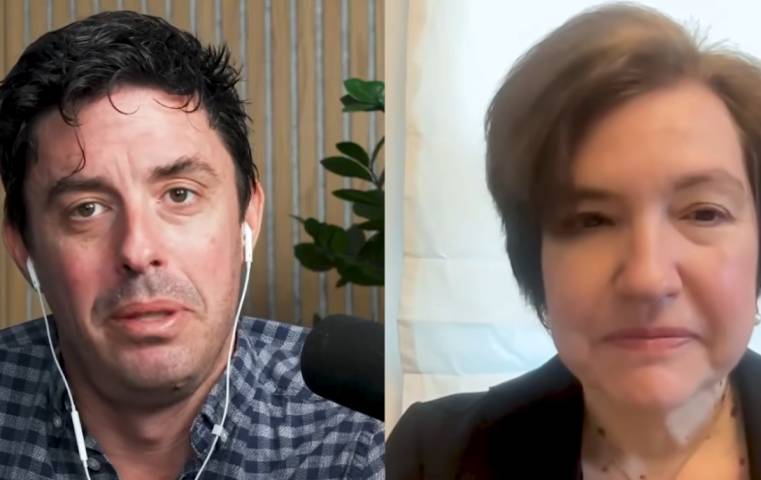
Editor’s Notes: In this episode of The Bulwark Podcast, host Tim Miller is joined by New Yorker staff writer Susan Glasser to dissect Donald Trump’s latest State of the Union address, which they describe as one of the darkest and longest in recent memory. The two delve into the speech’s dystopian rhetoric, its lack of substantive policy, and the “industrial-scale” lying regarding the economy and immigration. They also explore broader concerns about “media capture,” the administration’s escalating threats to free speech, and the precarious state of foreign policy in Ukraine and Iran. (Feb 26, 2026)
TRANSCRIPT:
Introduction
TIM MILLER: Hello and welcome to the Bulwark Podcast. I’m your host, Tim Miller. Delighted to welcome back to the show, staff writer at the New Yorker. It’s New Yorker week at the Bulwark. Her most recent book is The Divider, co-authored with her husband, Peter Baker. It is Susan Glasser. Susan, how are you feeling? Last night you witnessed history yesterday. The longest State of the Union in the Republic. What is there to say?
SUSAN GLASSER: What is there to say? It was long and it was wrong. That’s my headline. It’s an hour and however many minutes of our life we won’t get back.
TIM MILLER: No, it was under two hours. Is that right?
SUSAN GLASSER: It was. It was.
TIM MILLER: Okay, well, I was live streaming and it felt like six hours. Small blessings.
“Long and Wrong”: Reacting to the Speech
SUSAN GLASSER: There were a lot of exclamation points. There were six different medal ceremonies in the course of the event. And that does not include, of course, the tribute to the gold medal winning American men’s hockey team. I think Donald Trump thought maybe he was hosting the Grammys or something.
TIM MILLER: But Toastmaster, here was our big mistake, okay? In retrospect, after he instigated a deadly riot at the Capitol, there was one view that me at the Bulwark had, which was, yeah, we should impeach and convict and arrest him, probably. There’s another view that Merrick Garland had, so it’s like, let’s let the process play out. Norms. We’ll see how it goes. Maybe he’ll just disappear.
It seems like there was a third door, which was Joe Biden naming him the permanent chairman of the board of the USO and just letting him travel the world giving awards to people, because it does seem like what he wants to do. Taking awards for himself, receiving awards and giving awards. Maybe he would not have run again if we had just given him his true job.
SUSAN GLASSER: This is amazing, Tim. This is your Bob Hope theory of the case. Basically he’s sort of like, if Bob Hope were a wannabe dictator.
But I think that’s right. I was sort of focused — I realized I wrote my piece, I had to stay up late for the New Yorker. I wrote my piece, but I realized in having this conversation that I was still pretending this was an actual State of the Union. And by that standard, there’s no news. What did we learn?
Remember all the big buildup? There were two things that we thought about the speech going into it. One was, is he going to make his case to the American people, as Caroline Levitt told us he would, about how he is going to handle the affordability crisis? Well, I defy you to find a coherent case to the American people there.
And then the other thing for my fellow foreign policy wonks was, is he going to make the case about why we need to go to war with Iran? And again, I defy you to find a case. Basically, I learned from that speech that we may or we may not go to war with Iran in order to obliterate the nuclear weapons program that, by the way, we already obliterated.
So I think I was judging it as a speech. I was judging him as a president. If I had just let go of those preconceptions and thought of it in terms of how would I write about the Oscars or the Grammys, or anyone else with a particularly long-winded host with somewhat noxious political views, I probably would have.
The “Stand If You Care About Americans” Stunt
TIM MILLER: Well, unfortunately, in this case, our kind of dystopian Bob Hope does have a lot of power. The policies impact people. I want to get back to Iran because I think what was said and unsaid was pretty important there. But I just want to hit through a couple of the other things from the speech.
Some people suffered with me last night on the Bulwark livestream, which I appreciate on YouTube. Others, I assume, just watched Love Story, John F. Kennedy Jr. and Carolyn Bessette. And that was correct if they did that.
So just a couple of things you might have missed. Trump and Stephen Miller really thought that they had the Democrats at one moment. Stephen Miller says that this moment will last for 1,000 years, and that was when Trump goes, “Stand if you care about Americans more than illegal immigrants.” He thought that this was a very tricky bind that he’d put the Democrats in. The Democrats did not stand.
Unmentioned during that segment was the fact that there were two Americans that were killed by the government in the process of caring about Americans more than illegal immigrants. But that was their big gotcha. I’m wondering if you think that’s going to really land for them during the midterms.
SUSAN GLASSER: Look, Tim, I want to turn the question around on you since you, I think, understand the psychology of your former fellow Republicans better than I do.
But it strikes me there were two speeches in there, in addition to the Bob Hopeism. There was the Donald Trump huckster pitchman speech at the beginning and the end — everything is frickin’ awesome, America was brilliant to have elected me as its president, as a result of that everything is actually going great, there’s no such thing as an affordability crisis.
And then embedded within it was this other speech that you’re mentioning — the Democrats and illegal aliens are destroying everything that we hold near and dear speech. And I do think this part of the speech gets closer to addressing Trump and the White House’s political goals for this midterm election, which is they have a turnout problem, they have an enthusiasm problem, they have a Republican problem actually, as much as they have a Democrat problem.
The Republican problem is that they are scared, they are unhappy. And if you look at the polls like CNN’s latest, which has 63% disapproval of the president, that’s a bunch of Republicans and Republican-leaning independents in particular, who are embedded in what’s now close to two thirds of the country disapproving of the president.
So I think it’s that kind of “scare the crap out of you about the Democrats” part of the speech that’s really the motivation for things like that stupid stunt. Can we rile them up? Can we sort of go back to our playbook of anti-Trumpism basically?
Can Fear of Democrats Win the Midterms?
TIM MILLER: Yeah. I just think that history shows that’s very tough in a midterm when you control the whole government. Could that strategy work again for J.D. Vance in 2028? Sure. And I think that the Democrats need to think about how to combat that. There’s no evidence that this has ever worked in the midterms when one party controls everything and then they say, “Well, look at the other party, remember how bad they were a couple years ago.”
I hear you. Maybe they only have so many arrows in the quiver. That is certainly one to try to motivate people.
I was with Josh Barro over on his podcast Central Air — people can listen if they want. But I think he summed up the point you’re trying to make pretty well. The “everything is terrible in America” section of the speech, which lasted roughly from minute 30 through 75 of the interminable and plodding address, significantly undermined the “everything is wonderful in Trump’s America” message that preceded it.
He was trying to do the “everybody loves us again, we’re great, it’s the golden age” — but also “remember how horrible the Democrats are.” And I think that probably worked for sycophants, but it’s unclear who he’s convincing with that given the nature of the speech.
SUSAN GLASSER: Yeah, Donald Trump is not a persuader. I think we’ve learned that. He just doesn’t care about you enough to try to convince you of something.
JD Vance: The New Fraud Czar
TIM MILLER: Another big news item from the speech last night — well, maybe the only big news item from the speech last night — is the vice president has a job now. Besides being the shitposter-in-chief, he’s also the fraud czar. He’s going to be searching for fraud.
Which is interesting because we don’t have a public corruption section of the DOJ anymore, and the administration has pardoned a lot of fraudsters, and the administration is doing a lot of fraud, and the President’s family is committing a lot of — if not crimes, certainly self-dealing and corruption. So it’ll be interesting to see where J.D. Vance starts on his search for fraud.
But I don’t know, what do you think? Do you think it will be like the Biden administration where they indicted the President’s own son? Do you think J.D. will be looking to the Trump children or no?
SUSAN GLASSER: I’m glad you picked up on this important development, which I admit I did leave out of my New Yorker column. It’s an important assignment.
I’m sure on a night when the loudest applause of the evening went to Marco Rubio, J.D. Vance was grateful to have this crumb thrown at him by the President.
Look, it underscores something that is an important fact about the Trump administration, which is the world’s largest most powerful irony-free zone. Donald Trump was literally found guilty of fraud in New York State and actually had to literally shut down his Trump charity in New York State because it was found to be a fraudulent entity that was misrepresenting itself. So he could start in the White House — I mean, that’s just a suggestion.
TIM MILLER: It’s kind of like the man in the banana suit meme that you see on the Internet. We’re all looking for the guy that did this. We’re all looking for the people that committed the fraud. We’ll see if J.D. finds any of them.
What Was Left Out: ICE, RFK, and MAHA
TIM MILLER: Something I haven’t seen a lot of mention of that caught my eye — I’m curious what you think about this. There’s at least some recognition of his political vulnerabilities. There was not really a mention of ICE and internal deportation specifically. There was a lot of discussion about illegal crime and a lot of here’s your snuff porn and these really grisly stories of illegal immigrants that did horrible things to American girls. But there wasn’t a big push for “hey, we need to fund ICE more.” And there was a tribute to Greg Bevino. It’s interesting that ICE itself was not really mentioned.
RFK also wasn’t mentioned, or any of his programs. None of the MAHA stuff was mentioned at all either. There’s been a big beltway push for saying that RFK is going to be big in the midterms and all that. Nothing from the State of the Union. I thought that was somewhat telling that those things were avoided.
SUSAN GLASSER: I absolutely agree with that. I think that maybe the American people don’t like armed masked goons beating up Americans for expressing their First Amendment rights.
To me, the ICE thing — I can’t stand it when it’s talked about on television as like, “well, Americans’ views of immigration enforcement under Donald Trump.” No. The reason the country is in an uproar, one of the major reasons that almost two thirds of Americans are so upset with this administration, is because it’s assaulting Americans in their neighborhoods. It’s grabbing and snatching mothers from vans. It’s shooting people. That’s what it is.
So ICE has become a shorthand, I think, for Americans like that. And I think Trump is doing what we’ve seen Republicans in general do in recent years, which is just don’t mention the bad stuff and hope that everybody ignores it except for the people who really love Stephen Miller. And I think that’s what they were doing.
TIM MILLER: Yeah. And I guess in the interest of just being precise, he did mention that the Democrats are defunding DHS. So that funding fight was mentioned. But again, it wasn’t ICE.
SUSAN GLASSER: I agree with your point.
Laura Ingraham’s Review and the Theory of the Case
TIM MILLER: Yeah, it wasn’t ICE. Yeah. And as I was watching that, I kind of was expecting the next sentence to be like really pressuring them on that. Like, you must fund our noble law enforcement agents and ICE and CBP. And that’s not where he went. Like, that’s when they pivoted off to the weird Stephen Miller civilizational struggle and immigrant crime part of the speech, I think, which just demonstrates where they think their safe ground is on all of that.
I think it’s important to engage with the counterview. As I was watching last night, I kept saying, who is this for? Because I truly didn’t understand. I felt like this seems very boring to me. Like, even if I was a MAGA, I feel like I would have turned it off after the hockey part and been like, okay, I’m going to go watch whatever else is on my Paramount Plus. But Laura Ingraham liked it, which you noted on social media. And so I want to play her review.
VIDEO CLIP BEGINS:
LAURA INGRAHAM: We have a rendezvous with destiny.
UNIDENTIFIED SPEAKER: It was a little bit Reagan-esque, especially toward the end.
LAURA INGRAHAM: I think this could have been the best speech he has ever delivered. And I’m interested to see perhaps a little bump in the polls. But regardless, any historian who’s writing about this presidency has to watch this speech tonight and read it carefully, because this to me is one of the best State of the Union speeches I’ve heard in probably 20 years.
VIDEO CLIP ENDS:
TIM MILLER: The substance of that — I watched the whole clip a little bit before. It also was just, basically, she said it was a rebuttal to the globalist view of the left and how we’re not going back to that and how we’re just going to be patriotic Americans now. I mean, I don’t know. What did you make of it? You were watching it live, apparently. What did you think?
SUSAN GLASSER: You sort of stole my thunder here, Tim, because I was going to ask you, literally, before I got on here, I was like, I’m going to ask Tim, because I really don’t understand the theory of the case. And I quoted this Laura Ingraham thing in my column. Although interestingly, let’s just take the Laura Ingraham thing for a second, because I have been puzzling over this, trying to actually understand, as you said, what is it that she heard here that we didn’t.
But I realized, go back, parse that sentence more carefully. Maybe she means it was the greatest Trump speech she’s ever heard, but maybe she’s damning it with faint praise. Maybe she means that she really hated every other Trump speech.
TIM MILLER: Maybe, right?
SUSAN GLASSER: It’s like she didn’t say it was a great speech. She said it was the best one of these that Trump has ever given.
TIM MILLER: And it’s hard to think about his other State of the Unions, I guess, which is the point of how dumb this all is. Like, it kind of just washes away. Like, what did Trump do in the 2019 State of the Union? I have no idea. Who knows, right?
SUSAN GLASSER: Well, I would say this, by the way. Was that the Rush Limbaugh one? No, that was 2020.
TIM MILLER: This was not a trick. I have no idea. I really don’t remember.
The Dystopian Turn: When He Should Have Stopped
SUSAN GLASSER: But I also think your point is important here about he could have ended it after the gold medal Olympic team moment. It was already sort of incoherent, whatever, but it was actually a very Trumpy, like, everything is fricking great, yay. And like a lot of really bad clichés about America that ChatGPT could have written better. So if he had ended it there, right, it would have been sort of like a bizarre, newsless, classic Trump speech. It would not have been a national ordeal, going on and on and on.
And I think the dystopian part — they may also not understand when they have a somewhat broader audience than they’re used to, because Trump at this point is kind of a narrow caster. I heard from a lot of folks — definitely not Trump fans, but people who are not used to listening to the full-on Trump, which is most of America at this point, certainly the non-MAGA part of America. And the thing I kept hearing from people in my chat groups and college friends and things like that was, “My God, this is so grotesque and bloody and dystopian,” and like, it’s over the top and it’s sort of a bloodlusted kind of tone.
And I think they were really shocked by that in ways that the White House may have forgotten, because they’re not used to speaking to anybody except sort of the hardcore Trumpists. And it probably would have been a safer speech for them politically if they had just shut up after the hockey team.
TIM MILLER: It’s not a terrible idea, if you think back on it. You could have a theme there — we’re bringing back the golden age. Maybe you come up with some dumb policy idea like, we’re going to have a new golden tax cut for people, some new policy item for Politico Playbook to write about. And then you bring out the hockey team who just won gold and call it good — 20 minutes, you’re out of there. Everybody remembers what you did. It wouldn’t have been a terrible counter idea.
And the hockey team thing — I at least get it. When I was fighting with JBL about this the other day, it was like, Trump wants to isolate the left, right? And say, like, hey, I love America, I’m going to wrap myself in the flag, I love these hockey guys, they just won the gold, they shocked the world, they beat Snow Mexico, who I was trying to invade earlier. And like, we love them, and I’m going to give them the Medal of Freedom. And like, only these weird lefties who are obsessed with politics and hating America are mad about this. I understand the strategy of that, right? You’re aligning yourself with the broad part of the country and isolating people that don’t like him. So that part makes sense.
And I think that they were trying to do that with all of the other medals and whatnot. But it’s just like, once you hand out the seventh medal, the only person that cares about this is Megyn Kelly, who is the hall monitor watching, like, who stood up for the World War I veteran. “I see you, Jason Crow, you are sitting down for the mother of the killed.” And it’s just like, okay. I don’t think that makes them seem strange. This is very abnormal.
CBS Evening News Weighs In
There’s one other positive review, though, I do want to play, which is from the CBS Evening News. Let’s listen to that.
VIDEO CLIP BEGINS:
UNIDENTIFIED SPEAKER: It was an extraordinary speech — the longest to a joint session in history, the longest State of the Union in history. In some ways, vintage Trump: combative, populist, historic for other reasons as well. The first part of the speech, all about the economy, an issue we know a lot of Americans want to hear about. He touts it, but he does so against the wall of negative opinion that we see in our polls. And then really all the energy of the speech, the heart of the speech, on culture issues through the middle — immigration, gender, voter ID — and a lot that wasn’t in the script. He ad-libbed: “The first duty of elected officials is to protect Americans, not illegal aliens.” He seemed at times to be goading Democrats into reacting, and at times they took that bait.
VIDEO CLIP ENDS:
TIM MILLER: So that’s a different perspective — it was the Democrats that screwed up last night. I don’t understand, what bait did they take? They just sat in their seats.
SUSAN GLASSER: Tim, that was a very extraordinary moment. And I think when we look back on this — I mean, it was definitely, he felt like he was channeling the Winter Olympics announcers. Honestly, it’s like the middle passage of this run was, “I’m not sure, it’s a little off the time, but he might have done what he needs to do to get on the stand tonight. I’m not sure it was a gold, but it could be good enough for some medal.”
TIM MILLER: That feels right. Yeah. This is something that Trump has preyed on his whole life, his whole career really, in politics. So Tony D. is just the latest on this one. But it’s like, if you judge him —
SUSAN GLASSER: Who was that?
TIM MILLER: That was Tony Dokoupil.
SUSAN GLASSER: It was the actual anchor of CBS. It wasn’t a commentator.
TIM MILLER: No, that was the anchor of the CBS Evening News. Yeah, that’s the anchor of the CBS Evening News, Tony Dokoupil. Yeah. Sorry, I’m consuming a lot of CBS Evening News. I hadn’t watched the CBS Evening News for like 50 years, and lately I’m just like, what’s up, I wonder what the CBS Evening News thinks about this.
Trump’s Immigration Lies Go Unchecked
TIM MILLER: So, look, you can see how in the script that feels like, okay, we’re calling this one straight. And this is what Trump preys on. He just preys on these old mores of how Washington did these things, where it’s like, okay, well, they’re not going to fact-check every lie that I said, because the speech was just filled with nonsense.
And like, there’s a mention of — well, the Democrats take the bait. There’s no mention of the fact that, in the heart of the speech, the meat of the speech, during the middle part of the bobsled track where he was gaining momentum, he just lied about his immigration policy. It’s like, “Hey, our immigration policy is getting rid of the illegal, but we love the legal immigrants, we love the legal.” And that is popular, and so you can see why he would say that.
But I think it is worth mentioning in the news that, actually, what they’re doing is they’re taking people who came through legal pathways and putting them in gulags. Like, that’s what’s happening. People are being detained for months at a time who came and who were following the rules and were showing up for their immigration appointments, hoping to get asylum, hadn’t had a ruling yet. And we’re just nabbing them and sending them to different states and putting them in camps.
Some of the people we sent to El Salvador came legally, so it’s not true, actually. And we’re interested in illegal white people coming from South Africa. But anyway, that didn’t get brought up.
Fact-Checking the Speech
SUSAN GLASSER: No, you’re right to point out about the fact checking, because if CBS Evening News or any of these folks were interested in evaluating it on the level, what they would have to say is, first of all, you talk about the economy section of the speech, it wasn’t true. The foundations here again, of this entire thing, Trump has been given a pass on lying to the country on an industrial scale.
And objectively speaking, actually, what he said about the economy that he inherited was not only untrue, but actually kind of a grotesque lie. Saying that it was the worst inflation in the history of the world and that it has now disappeared. Not only untrue, but misleading to the point of fantastical.
In fact, politically speaking, I would argue one of the bigger problems for Trump coming out of this speech, or that’s reinforced by this speech, is that the president of the United States seems delusional to everyday Americans when he goes on and on and on in the longest State of the Union in history, telling people that there is no affordability crisis. In fact, that it is a made up word. That’s what he said again last night, is a made up word that they use and that Joe Biden’s America had the biggest inflation in the history of America. Not true. That it’s now disappeared. Not true. That he has all these great economy. Not true.
It actually reads as delusional when two thirds of the country is upset at you for all the reasons that you claim don’t exist. And so if you were doing a kind of more objective analysis and you wanted to focus on the substance as opposed to the metal giving and the gilding, I think you would have to focus on the untrue statements that were the underpinning of it, the lack of concrete policy proposals. Again, just being quite neutral. Whether you like the proposals or not, there weren’t any.
And again, what was the news a few days after? In the olden days when we had news and we had substance, we had people who were accountable for that. I can tell you the lead of the New York Times or the Washington Post, as someone who edited many of those stories, it would be: the president of the United States went before Congress yesterday, just a few days after the Supreme Court rejected the pillar of his economic policy and said that he would disregard the court’s demand that he follow regular order and ask Congress to approve it. He said he would continue with his policies anyways through means which may or may not be legal. And he assured Congress, in fact, that they would not have to take a vote on the pillar of his economic policy.
At the same time, he failed to address concerns of nearly two thirds of Americans that the cost of living is far too high, that the foundation of the American economy is weak. And he offered no new substantive proposals to address that, despite his White House promising hours before that the entire speech would be focused on his “case to the American people for how he is best positioned to handle the affordability crisis.” And that is a direct quote.
Abigail Spanberger’s Response
TIM MILLER: That’s some editor skills right there, Susan. I can see what you did there. I want to come back to CBS in a second because there’s some media merger authoritarianism news. But just really quick on one thing that you said there. It was a weird part of the speech. It was so early, I’d kind of forgotten about it. You just sort of mentioned it where he was talking about the tariffs. And he was like, “I’ve talked to some of the other world leaders and they’re going to keep paying them.” And it’s like, well, that’s not like how this works. There’s not like voluntary tariffs. It was like, this was illegal. And so they’re not going to anymore. And you can cut a new deal, but Congress has to be involved. Like, this was just resolved. And like you said, that sort of gets washed away. Any thoughts on Spanberger before we move on? Spanberger’s response?
SUSAN GLASSER: You know, you can usually only screw that up. Right. There is actually a long record in the recent past of people who’ve really made a hash of that. It’s not an easy role to have, I think. You know, remember Katie Britt from Alabama a few years ago? I mean, just absolutely.
TIM MILLER: I love the Katie Britt one. That kind of aged well, actually.
SUSAN GLASSER: There was the glass of water. I mean, you know, remember that?
TIM MILLER: The butcher knife? No, no. You’re wondering, is someone going to come into the kitchen?
SUSAN GLASSER: The kitchen.
TIM MILLER: What is happening? Yeah, yeah, Marco. And the water.
SUSAN GLASSER: What happened to all the stuff in the kitchen? But putting that aside, you know, she said all the things that one could expect. She said it pretty clearly. I thought it was a, you know, the sort of case for why it’s still worthwhile to live in reality, as opposed to Trump’s reality.
But, you know, let’s be real. I mean, no one was listening. To me, I’m curious what you think about this, but I noticed before the speech that Jon Favreau, Obama’s former speechwriter, was basically saying what a lot of people think, which is, these speeches actually don’t matter, even if they’re good, as opposed to epically terrible. They don’t move the needle politically. Nobody likes them. They’re sort of long and awful, and they disappear within 24 hours. No one can remember what was said.
With that in mind, when I thought at the end, well, maybe this is the one that’s really sort of killed this tradition. There’s no law that says this has to happen. You know, at the very early years of the United States, presidents sent written messages to Congress. And I just had this flash of, like, if the Democrats were to take back the House and the Senate, why should they invite Donald Trump to come to Congress and lie to the country for two hours?
Should Democrats Host a Future Trump Address?
TIM MILLER: You know, I hadn’t really thought about it that way. I’d been thinking about it from the perspective of, could a new president reinvent this? And I always want to say yes, but then all the incentives are towards no. You know, you get this one night where you get to check off and name check all of your various policy things and every interest group. So it’s hard. You have to break this gridlock to change the plan.
I mean, as a person, like, you know, had they ever made it, I would have been in the room being the one pitching, “We should totally change this. We should go in, talk for 12 minutes, announce one new policy, highlight one brave person, have one funny joke and go.” And people would love that. Right? But then the policy person from the health care department will be like, “Well, we got to mention what we’re doing.” You know what I mean? Like, there’s all these incentives the other way.
The Democratic question is, should they host him? I want to sit with that. My initial gut reaction is I agree with Susan Glasser. Last State of the Union. Last president. Last State of the Union. Anyway, I’m interested in that, but I’d have to think about it.
SUSAN GLASSER: But I’m just—
TIM MILLER: Yeah, I’m not either. That’s what I’m saying. I’m interested.
SUSAN GLASSER: It’s not being considered more because Trump has blown up so many norms and showed that unless it’s really codified in law, he’s going to go around it. And you realize that. Okay, fine. So the conventional explanation in Washington for why Democrats don’t blow things up is because when they get back in the White House, they don’t want it to be taken away. But frankly, it would not be a bad thing for a Democratic president if they didn’t have to go speak in front of a future Republican Congress that was just going to boo them or sit on their hands.
TIM MILLER: The interesting thing, you play that out. I’m interested in it. I like the idea. Trump does it anyway, right? And he has a rally or he does it at the White House. And CBS airs it for sure. Do the other networks? I don’t know. Something to think about.
Media Capture and the CBS Drama
Back to CBS. So there’s a lot of drama around this this week. This is going to set the stage for people who have not been reading their media tabloid rags. Warner Brothers Discovery, that owns CNN, is looking for a buyer. Netflix went to purchase it. Paramount, which has now taken over CBS, and the Ellisons, who were also lead investors in the TikTok deal, big friends of the Trump family, big donors to Trump, put in a hostile bid. And so there’s been this kind of back and forth, and Warner Brothers wanted to sell to Netflix. But Paramount just put in even higher bids now. Not overwhelmingly higher, but higher.
And they basically are doing this thing with Warner Brothers like, “We can get this approved. Stick with us. This will actually get done if you go with us. Might not get approved if it’s the other guys.” So there’s this sort of gangster style government negotiation happening.
Meanwhile, underneath all this, Susan Rice was on the board of Netflix, worked for Biden, was on a podcast where she was talking about how corporate America should react to Trump. Let’s listen to that and then talk about the implications.
VIDEO CLIP BEGINS:
SUSAN RICE: If these corporations think that Democrats, when they come back in power, are going to play by the old rules and say, “Oh, never mind, we’ll forgive you for all the people you fired, all the policies and principles you’ve violated, the laws you’ve skirted.” There will be an accountability agenda. Companies already are starting to hear they better preserve their documents, they better be ready for subpoenas. If they’ve done something wrong, they’ll be held accountable. And if they haven’t broken the law, good for them. If they’ve done the right things, good for them. That also will be noted and remembered.
VIDEO CLIP ENDS:
TIM MILLER: Trump replied that Netflix should fire “racist, Trump deranged Susan Rice immediately or pay the consequences.” So I want to talk about what Susan Rice was proposing there in a second. But first, from the Trump side of this, it’s pretty insane what’s happening. I mean, literally one of his billionaire buddies is trying to shake down another media corporation and saying that I’m the only one who’ll get this approved. And then Trump is threatening the other company and trying to tell them who they can have or not have on their board.
SUSAN GLASSER: Yeah, you know, I’ve seen how this happens because I lived in Russia and watched the oligarch wars and how the Kremlin interposed itself and was just a weapon in those wars. And often, certainly in the 1990s, available to the highest bidder.
Susan Rice is correct. We still have laws on the books in this country and it is actually still illegal to bribe government officials and to extort other people, using and misusing the power of your public office and your public trust. You know, if we don’t have a Justice Department or an FBI right now that is in the business of enforcing those laws, one can still hope in that very American way that we hope even when things are dark, that there will be a future Justice Department and FBI that gets back in the business of enforcing our laws against public corruption. So that’s first of all.
Second of all, the other thing that really resonates for me in the experience of looking at what happens in other countries experiencing this kind of democratic rollback is the fact that it’s media companies that Trump is intervening in these deals. There’s a sort of formal term of art for this one. It’s called media capture. And it is actually a hallmark of almost every modern authoritarian government that you can think of, that the state wants to get bigger control over media companies, and have, in essence, a fusion between a kind of conservative, favorable oligarchy and a government that is open for business and for being purchased.
And so I think it’s media capture that we’re seeing, the effort to transform the media ownership landscape, and also the realization on Trump’s part — he’s a sort of mapper of power, as so many people who get to that position are — and he has noticed in his first year back in office that who are the weak links. It turns out it’s definitely not the individual reporters who are doing all this great investigative reporting about Trump and his administration. It’s the owners, it’s the billionaires, it’s the people at the top. And he controls them. He controls what people think about him.
Media Consolidation and Free Speech Concerns
TIM MILLER: Yeah, look, I mean, I think at the individual level, I’ve joked about the CBS Evening News is just like the amount of people that are watching that at some level. My hair’s not on fire about that. There are multiple options in the evening news. We’re still in a free country. This isn’t Russia.
You start to get to a scale, though, where if these guys bully through this merger and we’re talking about TikTok, CBS, CNN, and then they already have Fox. There really is. And you said Russia. But the closest, I think, is Orbanist. This is what Orban did literally in Hungary as far as taking control of the predominant media institutions. And it’s pretty alarming.
On the Susan Rice thing, I do want to hash this out because I think it’s complicated because I — good on her for speaking out. A lot of people are chilled right now, and she’s been on this show. And I like Susan. And the first part of that quote about how corporations should watch themselves because eventually we’re going to be back in charge, and if you broke the law, we’re coming for you. I love that.
Second part of the quote about the ledger had me a little bit when she was talking about — and we’ll notice the good companies too, and we’ll have a ledger and it’ll be Santa’s nice and naughty list. I worry about that. And I think that this is a legitimate challenge for the Democrats going forward. On the one hand, they need to make sure that the incentives are running both ways. The bad actors know that there will be a DOJ again at some point and the Democrats have an obligation to actually do things next time. There’s been a lot of conversations on this, but also it’s like you don’t want to become the thing that you hate. And I think that that is a complicated tightrope to walk. But anyway, I’m wondering if you have any reaction to that.
SUSAN GLASSER: I think that’s right. I mean, the Democrats are not synonymous with civil society. And I think that’s part of the problem we’ve been having all along here is that our politics are so zero sum and even our way of thinking about it is all sort of like, okay, you’re either all in on one team or the other — that we only have two teams in America. And I think that’s part of why we have this sort of crisis.
The interest the capital D Democratic Party may well be in keeping such a ledger because they need to raise the billions of dollars that are now required in American politics because they have constituencies that have to be addressed in order to win elections. They have a vested interest, even in a very dysfunctional system — I think that’s sort of what you heard from that.
And from my perspective, again, what’s the way to challenge the excesses here that are not policy disputes or partisan disputes, but which really go to fundamental things like people being arrested in the streets of the country for trying to document armed mass agents beating the crap out of their neighbors? Right, like that’s not a question I think that’s easily answered by, well, let’s just elect a few more Democrats in a small handful of swing districts.
The Multi-Front Attack on Free Speech
TIM MILLER: On the free speech part of this — you wrote about this a couple weeks ago for the New Yorker. “If we don’t have free speech, then we just don’t have a free country.” You were writing in particular about the DOJ investigation into the six members of Congress for the video, saying that people should follow the law — an absurd investigation. Jeanine Pirro, Judge Box Wine, has dropped that investigation since she wrote the article, making the administration, I think, 0 for 72 so far in their efforts to indict and jail their political foes.
But I think this all relates, right — the assault on free speech is happening all over this government. And the fact that Trump is threatening Susan Rice is an assault on free speech. The fact these investigations, even though they didn’t go anywhere, is a threat on free speech. Being jailed — right, like this is happening across a lot of different areas. And it’s important to be vigilant about it in the way that you’re writing about this article, because in this sort of weird upside down world we’re in, this was like a big debate in the 2024 election where a lot of people who supposedly said they’re on the side of free speech were for Donald Trump.
SUSAN GLASSER: Yeah. By the way, the quote that you mentioned — “If we don’t have free speech, we don’t have a country” — that was what he campaigned on in 2024. Remember, the same people who are bringing us this effort to capture the media companies and to silence dissent and to abuse their power to threaten jail for people who speak out in ways they don’t like, who threw the Associated Press out of the White House press pool for not calling the Gulf of Mexico the Gulf of America — these are the same people who literally whipped up a sort of existential panic in the 2024 election about the idea that woke liberal thought police were destroying the country.
Now all of a sudden, it turns out that’s not really what they were after. And of course you and I can say, fine, we knew they weren’t on the level, but a lot of people, I think, believed them. To this day, when I talk to a lot of conservative folks, even many who don’t love Donald Trump, it’s an issue that they remain very, very exercised about — the idea that on America’s left-leaning university campuses and in sort of various woke corporations, they are being systematically silenced.
And so in that context, to have what is really a pretty sweeping multi-front attack on free speech in Trump’s second term — I think it’s a signature really of this presidency. And it’s not appreciated, in fact, because it’s so multi-front and it’s happening all over the place. And that’s because you can’t have the kind of sweeping executive power that Donald Trump is claiming for himself without silencing dissent. And that’s why the First Amendment is frankly the best insurance policy that the founders gave us against tyranny. It really is. And I know that sounds really sappy, but that’s something that I think is important to remember because right now we are literally watching a demonstration case of what somebody would do who doesn’t want us to really be in a free country.
Dystopian Surveillance of Protesters in Minnesota
TIM MILLER: Not sappy here. I was a teenager that had a pocket constitution. Okay, Susan, we got one more thing I just want to mention on the free speech attacks because it also kind of relates to the big tech overreach and all this — we’re in Minnesota. Like you’re here. What DHS is doing targeting these protesters is truly dystopian and crazy. I mean, grabbing their facial ID, putting it back into some system that Palantir is running. There was the DHS going to the tech companies, saying they wanted to see who was behind the information behind anonymous accounts criticizing ICE. That’s the stuff that you see in authoritarian countries that don’t have the First Amendment. That’s happening here.
SUSAN GLASSER: Yeah, I thank you for adding that. That was also on my list in the column because I think that — but again, it’s often misportrayed. What happened in Minnesota was Americans were horrified at the excesses of the immigration enforcement agenda. And that’s not what it was. I think it was really a more profound horror at the idea that mass federal agents were literally using force to suppress the free speech of an entire city.
Those were, by and large, American citizens who were out there trying to protect their friends and neighbors. And that makes it a free speech crisis that was unfolding in Minnesota, embedded within an excessive and heavy-handed immigration enforcement operation gone bad.
Is This a Real Story? The EEOC vs. Coca-Cola
TIM MILLER: Speaking of freedom — so we have in this country, I have a new game for you that we’re going to start to play on the podcast, which is: is this a real story or not?
SUSAN GLASSER: Oh, no.
TIM MILLER: And so here we go. A U.S. agency sued a Coca-Cola bottling company for discrimination over a networking event it held for female employees at a casino resort. The Equal Employment Opportunity Commission said the company had violated civil rights laws by not inviting male employees to the 2024 getaway in Connecticut, which it said included, quote, “a social reception, team building exercises and recreational activities.” So do you think that’s happening in the country where companies are being sued by the federal government for reverse discrimination against men?
SUSAN GLASSER: Well, Tim, I’m going to go with yes on that.
TIM MILLER: I mean, the Connecticut thing makes it seem unreal. It’s like, oh, the men are really being denied here. The men were not able to go to Connecticut. Everyone was dying for that free vacation in Connecticut with team building exercises. That makes me want to kill myself. Please do not invite me to the Trust Fall event in Connecticut if that ever happens in the future. But I mean, it seems like we should, in a free country, be able to associate in groups that we choose, I would think.
SUSAN GLASSER: Looks to me like a lot of women are not invited to Trump’s meetings in Mar-a-Lago, but, you know —
TIM MILLER: Yeah, there weren’t a lot of women. I was saying last night, if you looked at the crowd at the Republican side of the State of the Union when Trump was walking in and then you made it black and white, it could have been the Harry Truman State of the Union. The demographics of the Trump inner circle — it’s pretty crazy. Marco being the diversity hire.
SUSAN GLASSER: Just one point, though, on that. Because they have this sort of caricature of femininity for those few women who are let in. The Attorney General of the United States and the Secretary of Homeland Security and the White House Press Secretary are literally, I don’t know, sort of like robotically remixed images of women from a sort of Fox News fever dream. They’re like Roger Ailes’s revenge on women to make themselves look this way. Look at the before and after pictures of the women in Trump’s cabinet and you’ll see what view of women Donald Trump has. So it’s not that they’re excluded, it’s that they literally have to alter themselves physically in order to be admitted into this male realm.
Trump’s Foreign Policy: Abandoning Ukraine
TIM MILLER: Yeah, that’s a good point. I want to move to foreign policy before I lose you. There was a UN resolution about Ukraine. I will say, just generally, as a principle matter, I’m just not big on non-binding resolutions, but it’s kind of one of those things where you’re either doing them or you’re not. If somebody came in and said, “We’re making a principled stand, we’re not doing any non-binding resolutions anymore. Those are just tweets,” I would be okay with that. But we’re picking and choosing which non-binding resolutions we weigh in on, at which point that becomes a policy decision.
So here’s this one. It was: “The sovereignty, independence, unity and territorial integrity of Ukraine should be respected within its internationally recognized borders.” Period. That’s all it is. Ukraine’s territory should be respected. 107 countries were for it. The UN — 12 against, 51 abstentions. We abstained. Among the other abstentions: Uzbekistan, Yemen, Qatar, Pakistan, Libya, Haiti, China, and El Salvador. Our new allies. Iran, which we’ll get to in a second, was a no.
Zelensky said, “I’m grateful to each of the 107 countries that stood with Ukraine today in defense of life at the UN.” That’s pretty crazy. Like, we’re now with China and El Salvador saying we don’t have a view on whether Ukraine has a right to its own territory.
SUSAN GLASSER: Yeah, I mean, Tuesday was the fourth anniversary of Russia’s full-scale invasion of Ukraine. And that vote that you mentioned took place just a few hours before Trump’s speech, in which he made no mention at all of the extraordinary courage and bravery of Ukrainians in resisting this horrible and unprovoked assault on their independence. The largest, deadliest land war in Europe since the end of World War II.
What a contrast to four years ago when this happened right before Joe Biden’s State of the Union, which was then rewritten — Biden promising that America would stand with Ukraine as long as it took to restore their territory and their independence.
And to me, again, if you cut through the fog of words and the haze of Republican enabling for Trump, what that tells you about yesterday is that Donald Trump has switched sides here. And most Americans — and that includes Republicans as well as Democrats — they support Ukraine. They want to stand by Ukraine. They believe that Russia is at fault in this war of aggression. And the President is pursuing a policy of not only appeasement toward Russia, but seeking business deals that would benefit himself and his inner circle in order to sell out an American foreign policy that actually is bipartisan at a time when so few things are.
The Iran Situation: Conflicting Signals and the Drums of War
TIM MILLER: Yeah. You shared one other thing that I don’t think I’ve talked about on this podcast, so just wanted to mention it. This is a post by Yaroslav Trofimov, who’s a Wall Street Journal correspondent. He wrote this.
“It’s mind boggling that for four years Ukraine has been allowing Russia to sell oil via Ukrainian pipeline, helping fund the bombs that have destroyed Ukraine. All of this because Hungary and Slovakia are addicted to cheap Russian oil and are blackmailing the rest of the EU to keep that oil flowing.”
It is a crazy story, and I think it’s particularly relevant right now given that after Marco’s speech in Munich, doing a soft J.D. Vance speech about blood and soil nationalism, the two countries you went to visit after were Hungary and Slovakia.
SUSAN GLASSER: Yeah. Again, if you strip away a lot of the partisan litigating the case here, just calling it down the middle here, America is taking the side of the small number of countries in Europe who are led by right wing authoritarians supportive of Russia, period, full stop. That is just the way it is. Further, America has decided to intervene in European elections in support of extremist right wing political parties that wish to radically change the foreign policy and security direction of Europe.
Iran, Nuclear Ambitions, and the Threat of Military Action
TIM MILLER: I guess this kind of bookends us with the speech because, as you said, he tried to brag about this weird paradox he wants us to just take in, which is we destroyed the nuclear ambitions of Iran, but also Iran could get another nuclear weapon in a week, and so we have to invade, potentially. We’re negotiating. How about that?
The background of that is the US military deployment in the region is extremely significant — we have basically about half of the deployable US air power in the world now moving towards Iran. This was a post he shared: “Never has the US deployed this much force against a potential enemy and not launch strikes simultaneously.”
To that, the general of choice around Trump right now, raising Cain, there’s a leak to Axios that he said to Trump that there’s a lot of risk here, which maybe explains why the drums of war are softening a little bit, but maybe they’re not. Maybe Trump just wanted to get through the State of the Union. What do you make about these conflicting signals in the state of play?
SUSAN GLASSER: Yeah, I do think they’re conflicting signals. I mean, first, just on the rhetorical front, you pointed out it’s almost a sort of postmodern leap of faith required here to even be able to parse the argument in Trump’s State of the Union speech, which was, “I obliterated Iran’s nuclear program. And also we might need to launch a war tomorrow to obliterate Iran’s nuclear program.”
It’s very, very hard even for those of us who are used to ambiguities in American foreign policy. That one is a hard circle to square. And by the way, also, he is demanding that Iran agree to a nuclear deal that is similar to the nuclear deal that Trump blew up in 2018. So just putting that out there because it often gets —
TIM MILLER: So you call it the art of the deal, Susan?
SUSAN GLASSER: Yeah. Get rid of the deal in order to have the deal — just obliterate it in order to then obliterate it. So that’s one thing, which is that it’s confusing.
Two, I think on the conflicting signals, I have heard a lot of experts on the region, people that I respect a lot, very nonpartisan people, who do believe that some kind of military action is imminent, is very imminent. And I think part of their basis for understanding that is just the nature of the vast armada and firepower that have been assembled against Iran. And to the point that Trump made, such a large force has not been assembled not to be used.
In part, people have not focused on this — the cost of this kind of brinkmanship and adventurism is vast and again, totally unaccountable. Trump has not asked Congress to spend this money. He has just sort of done it. And so one thing is just, we don’t tend to bluff in using this many military assets.
Two, there are reports that I think are credible that some kind of military follow-on operation had been previously agreed to between the United States and the Israelis, and that what we’re just seeing now is that playing out. I think that is credible reporting.
And then three, there is the question of events inside Iran itself with this horrific massacre of tens of thousands — I think Trump used the number in his speech last night of more than 30,000 dead protesters around the country. And that number could well climb. This is a horrific massacre, one of the largest in modern times. By contrast, Tiananmen Square and the killings there by the Chinese government were far, far smaller, far, far fewer people.
And so the enormous scale of the killing is underscoring, I think, the perilousness of the situation for the Iranian regime in ways that might encourage the President of the United States to strike now and to go after them when they are potentially more vulnerable than they’ve been in years.
A Ham-Handed Strategy With No Clear Endgame
TIM MILLER: Yeah, I mean, the scale of the crackdown on the protesters is horrifying. It just is horrifying. The politics of it is like, Trump made it worse kind of. He said that he was going to come defend the protesters, then didn’t. I think about all the ink that was spilled on Fox and Wall Street Journal, et cetera, about the red line with Obama and Bashar Assad. Right now, he kind of put a red line and then didn’t follow through on it. Trump basically did that with Iran.
Maybe now he follows through, but the whole thing is just extremely ham-handed. Many, many thousands more protesters were killed after Trump said to stop killing protesters. And now we’re potentially bracing for this war that even Dan Cain says could be a s* show, to paraphrase — he didn’t use that word — that nobody wants. It’s a very — I think they have backed themselves into a situation that I don’t see a really clear political or military strategy that ends up well. I guess, except maybe some face-saving bombing campaign on the missiles and then declaring victory again and moving the ships away.
SUSAN GLASSER: Yeah, I mean, Trump is attracted to these militarized displays of force — quick, lethal and easily moved on from. And I think that some of the more maximalist descriptions we’ve heard of possible US action here, including going after regime leadership type figures, that’s so destabilizing. Iran is not Venezuela. It’s at the heart of the Middle East. Its position on the Persian Gulf — I mean, you could go on for all the reasons why unleashing chaos, disarray, and retaliatory fury on the part of the Iranians that would come against American targets and Israeli targets is a very, very serious enterprise.
And I do think it goes against Trump’s personal grain. Many times before, he’s come up to the brink of some more major military action and he has backed away. I think he is very wary of that. And so he will very likely be casting about for, as you said, some kind of a face-saving action here — something short, in my view, of a full-scale morass-type war that ensnares us for a generation.
Closing Remarks
TIM MILLER: We will see. That’s Susan Glasser. Thank you as always. Come on back soon. I appreciate you very much.
SUSAN GLASSER: Thank you, Tim. I’m not sure we figured it out, but at least we’re trying.
TIM MILLER: Yeah, well, you suffered through the State of the Union for us and that is a real gift. So I appreciate that. We got a new guest coming tomorrow that I’m excited about. I think it should be a fun one. So we will see everybody else then. Thanks to Susan Glasser.
Related Posts
- President Trump Remarks on US, Israel Attacking Iran (Transcript)
- President Trump on Economy, Energy in Corpus Christi, TX (Transcript)
- Douglas Macgregor: US-Iran Diplomacy Fail (Transcript)
- The Truth About Trump’s State of the Union w/ Sen. Bernie Sanders (Transcript)
- Does Democracy Still Control Power? w/ Curtis Yarvin (Transcript)