Ask a legal question, make a slide deck, or solve a puzzle, stuff like that.
Transforming Knowledge Work
Yeah, so I really think on the product side, we’re really going to see a huge transformation happening in a very short period of time. We’re going to see the magnitude of the amount of work that all knowledge workers are going to be able to produce increase tenfold in the next short period of a few months.
The models that we are building out are incredibly amazing, and we have a lot on the way. So we’re really excited to share that with you all. And on the product side, the goal is to just build that portal that allows you to accomplish all of your work. And how do we amplify everyone to achieve much, much more than what they can accomplish alone? And we’re building that out, and it’s going to be an incredibly easy-to-use experience that just works seamlessly.
Working at xAI
That being said, we are hiring. We’re looking for intelligent and smart people. This is not an easy place to work, guys. It’s a grind. But we have, I guess, interstellar ambitions, so it’s not going to be easy, right?
So I will say, having come to xAI, it has been an opportunity of a lifetime to work among really smart and really passionate people. The vibes here are amazing, and it’s truly an environment where if you’re a smart person and you want to get shit done, you can get shit done. There isn’t organizational overhead getting your way, or having to write docs and all this kind of stuff. You just do stuff. At least for me. You can do things here, and that’s amazing. And I invite more people to come here and just do awesome things.
Grok’s Capabilities
With the Grok main foundation model, the intent is that it’s genuinely useful in a wide range of areas. So if you’re doing engineering or law or medicine, anything, it is useful to you in your job. That’s essential to understanding the universe and making things as useful as possible. Like, when Grok gives you an answer, you can count on it.
Absolutely. Thank you. Thanks.
The Evolution of Coding Models
MAKRO: Hi, everybody. I’m Makro. So the world changed a lot recently in terms of coding. The coding models… I was always complaining people were trying to convince me to use a coding model, and I was trusting it, and I wasn’t really convinced. But as of recently, the models, they actually produce good, decent quality code. I mean, you still need to review and give feedback, but it’s easy to see how they can accelerate you quite a lot.
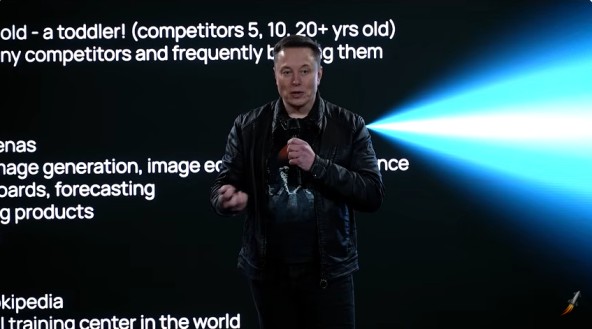
So it’s not only about coding, it’s they understand your intuition much better than before. Like, now, when I describe a problem, I only have to phrase it like I would to another colleague engineer who has already seen the code base. That’s a huge change. Before, you kind of need to handhold a toddler to make a change.
And they don’t only write your code, but they also can debug your code. So now we have hours of Grok code running continuously to make sure that a more complex change to the training system actually works in production. So it’s easy to see for us that this is not only about accelerating ourselves, writing code and making us 10x more productive, but we are really on this path for recursive self-improvement where the current generation of Grok code is training the next generation of Grok code. And we see that this path, we are on an exponential takeoff here. This path will continue. So we are doubling down on coding and making coding one of the highest priority efforts in the company.
So if you’re out there and you’re excited about coding and you’re either very good at training modeling, or you’re a really good low-level software engineer interested in systems design, this is the place to work. Like, we have a million H100 equivalents to train the best coding model in the world right now. So, please join us.
GORDON: Yeah, I’m Gordon. I work here with Makro on coding. So it’s become more and more obvious to us, like, all the time, we are on a path to singularity, at least on coding. So, we decided, have our best engineer in the company, Makro, to lead the coding, and we’ll build the best coding model for everyone, to empower everyone to build. And for me, the main limiting factor is probably compute and energy. Whether you can run the best model to support everyone, to empower everyone. And with SpaceX, now we are one team, and we will win on the compute, and we will win with space compute.
And also, for every engineer, right, so if you are writing kernel, if you’re writing compiler, just think about it, whether it’s still worth it. Maybe you should join us for coding effort. To automate yourself a little bit, to speed yourself up. Yeah, I think it’s really amazing year. Basically, what a year to be alive. And I can already feel the AGI. Feel the AGI, at least for coding. Yeah.
AI Creating Binaries Directly
ELON MUSK: Yeah, I think, actually, things will move, maybe even by the end of this year, to where you don’t even bother doing coding. The AI just creates the binary directly. And the AI can create a much more efficient binary than can be done by any compiler. So, just say, “create optimized binary for this particular outcome,” and you actually bypass even traditional coding. There’s no, that’s an intermediate step that actually will not be needed, probably by, I’d say, the end of this year. And we do expect Grok code to be state-of-the-art in two to three months, so it’s happening very quickly.
GORDON: Yeah. You also do imagining, so, you know. I mean, what will you do, right? After post-AGI, right? You probably do digital life. So, that’s what we are doing here as well. And we have the Imagine team, started pretty much from scratch, six months ago. We have a few people. We decided we have to do the image gen, we’ll do the video gen. Look at what we achieved today. Two weeks ago, we released Imagine V1. We actually top of the leaderboard across many of them. And people really love our product, love our model. And we have many more releases, actually, this month and next month.
Building the Metaverse
So, yeah, to me, there’s a really high chance, we actually may build a metaverse before Meta. Yeah, I’ll also try to talk about the metrics we have, the product, yeah. Yeah, like, Gorong said, it’s only been six months since we started working on Imagine. We had no code internally for diffusion at all, six months ago.
And basically, now, we have launched Imagine on every product surface that we have, including seamlessly integrating into X. So, you can open the X tab right now. You can long press on any image. You can edit the image. You can make a video out of the image. We also ran a contest recently where we had some really funny submissions that I’m sure many of you have seen.
So, Imagine is growing extremely, extremely fast. And it’s because of the speed at which we iterate, basically. We do multiple product updates every day. We do model updates every other week. And effectively, what this has led to is, now, users are generating close to 50 million videos every day using Imagine. And just to reiterate what Elon said earlier, that, to the best of our knowledge, that is more than every other provider combined, which, again, is an astonishing place to be compared to where we were six months ago.
We are also generating six billion images in the last 30 days. Google recently posted that one billion images were generated using Nano Banana in 30 days. So, we’re six times that, right? And really, the goal is, we don’t just want to win. We want to win over a long period of time and have sustained greatness. And so, the goal with Imagine is to take anything that you can imagine and turn it into reality. And so, that’s what we’re going to, that we’re going to speedrun that, basically, is the goal.
Real-Time Video Generation and Interaction
HAOTIAN: Yeah. Hey, I’m Haotian. As we keep scaling our model capabilities, building visual worlds that’s indistinguishable from reality, we’re also building systems that unlock much more possibility than what we have right now. They will be able to generate the videos that’s much longer than what we have right now, with stories or with source of your imagine.
And by the end of the year, we likely will be having models that allow you to generate videos of 10 minutes or 20 minutes in one shot without any intervention. You just need to give your imagination and our model, our agents will do it for you. And moreover, those are the videos we generate. And we’re also going to allow rendering those, we’re already the fastest in generating the videos. And we’re going to keep pushing the extreme where we’re going to render those videos in real time. And you will be able to imagine, build, and interact with your own world. And the world will respond to you in real time. And it is exciting future that we’re going to build with ourself.
ELON MUSK: Absolutely. And my prediction is that most of AI compute is going to be real time video understanding and real time video generation. And we expect to be able to use in that.
It’s worth emphasizing these points that six months ago, we didn’t even have, we had basically nothing in very weak in video and image generation and editing. And we’re in six months to number one spot. And in fact, generating more videos and images than everyone else combined. We’re going to do the same thing with coding. And we’re going to do the same thing with macro hard.
GROK 4.2 and Future Model Improvements
And I think people will be pretty impressed with the GROK 4.2 model that’s coming out. That’s, it’s a significant improvement. And that’s really just, that’s the small version of our new model. So, we’ll have a medium and a large version that are even more intelligent.
Introducing Macro Hard: AI Computer Control
TOBY: All right. Hi everyone, I’m Toby. And I work on macro hard, the most serious of all product names. So arguably giving computers to humans was a good idea. So we’re doing the same thing for AI. It’s kind of like inception. We’re giving computers to computers.
So macro hard is building a fully capable digital real time, very important, human emulator. So it’s able to do anything on a computer that a human is able to do. Including using advanced tools in engineering and medicine. So there should be rocket engines fully designed by AI. And in a sense, it’s one of the last few remaining areas where AI is significantly worse than humans.
Which is why I think it’s one of the most exciting areas to actually innovate in and actually change the field.
JOHN: Hi everyone. So yeah, my name’s John. And yeah, so we’re building these strong reasoning models which are now going to control our CLI. Like we’re actively using these every day. They are like tremendous productivity boost to the whole team. I know the voice team is like killing it on that. And this is the reason why we need to compute. We need the large scale compute to run these models to boost our own productivity.
But 80 to 95% of the world software has a GUI. So that’s like great representation. And to truly make people’s lives easier, we need to develop models that are capable of solving day to day tasks on GUI.
MacroHard: Emulating Companies Where Output is Digital
So MacroHard, we will emulate a company where the output is digital. So this is the obvious next step for agents. MacroHard will enable true end-to-end orchestration across the desktop. And it will lead to immense economic prosperity.
So yeah, we’re entering an era where we need to tackle the hardest of tech problems. But in order to solve this, we need to hire the best people. So think of the smartest people that you’ve worked with and put them forward for a position here. And if you can’t think of anybody, go through your phone book, go through your LinkedIn. You’ll be surprised how big your actual network is.
And they just need three properties, obviously, that we want to optimize for. Are they clever? Can they solve hard problems? And the second property is, are they driven? Do they have the ambition? Do they want to win? And the third is, are they a nice person? Do you want to actually work with them? But yeah, so thank you.
ELON MUSK: Yeah, the MacroHard project is, over time actually will probably be our most important project because what we’re talking about is emulation of entire human companies. So when you look at the most valuable companies in the world, they are, their output is digital. So they don’t actually make hardware. So it should be possible to completely emulate any company where the output is digital.
And this will usher in an age of prosperity the likes of which we can barely imagine at this point. You need to imagine to imagine it. So this is a big deal, and this is why the words MacroHard are painted on the roof of the training cluster, because that’s what it’s going to build. It’s also pretty funny. It’s meant to be a joke.
Core Product Infrastructure and API
UNIDENTIFIED SPEAKER: It’s me again. You might remember me from MacroHard and computer use from a long time ago, but I also actually work on core product infrastructure and API. In fact, this is what I’ve done for most time at xAI. So any time you use any of our products like grok.com, API, authentication, you go to status.x.ai, this is done by the core product infra team.
A large portion of them actually sit in London, and we work with Jaime over there. So we keep the lights on at peak hour, 4 p.m. every day. We get paged at night when stuff goes down. Also, thank you to anyone in Palo Alto getting paged. There’s really important work, reliability, security, core product infrastructure. So if you’re really interested in solving difficult distributed problems with messy data, this is the team to join.
High-Quality Evaluations and Training Data
DIEGO: Hey, everyone. My name is Diego. Yeah, so I think one of the main bottlenecks in this next year for these models is going to be very high-quality evals and training data. And one of the ways we’ve solved that is by taking the world’s foremost experts in these respective domains, bringing them here, and having them evaluate the model.
We do this for domains like medicine, finance, law. We have voice actors. We have video editors who contribute daily to making Grok better. And yeah, we’re going to be continuing to work on very high-quality evals for the next two months.
We have some exciting stuff in the frontier of useful tasks in finance and law. We’re trying to build evals that are useful and training data that represents useful work and not necessarily proxies of intelligence like a lot of the open-source evals do today. We’re shifting from using these sort of common internet evals, which I think are actually not a real indicator of usefulness, to having expert tutors in each domain, so every domain of engineering, medicine, law, whatever the case may be. And the actual eval is, does the expert in that arena, or does that group of experts in that arena, human experts, agree that grok is extremely useful and that the results are correct? That’s actually the only eval that really matters.
Yeah, exactly. You’ll see this in Grok 420, but we’ve made some improvements because of that sort of data in truth-seeking and minimizing political bias. The responses are much more cogent. So yeah, that’s exciting.
Grokipedia: A Modern Library of Alexandria
And we are also working on Grokipedia. So the goal of Grokipedia is to create a distillation of all human knowledge. I kind of like to think of this as a modern-day version of the Library of Alexandria. And in the quest to build Encyclopedia Galactica, which it will one day be called, we’ve gone from essentially having nothing to around 6 million articles. For context, Wikipedia is around 7 million English articles. And yeah, we’re improving on hallucination. And our goal is essentially for Grok 5 to not have to search out of the data center. So, yeah. Thank you.
Building Training Infrastructure at Unprecedented Scale
So in the ML Infra team, we are building the training, inference, and tooling software for the company. So to give you an example, when we were training Grok 3, we built a pre-training framework for this. And these are some of the coolest systems, in my opinion, that you can build as a software engineer. So it’s like, we have 100K H100s at the time. And they were just delivered. And we didn’t quite have the software. So we thought we’d have the software. But then at 30K scale, we realized, actually, the software is not quite working.
And it took a major, almost, I would say, halfway rewrite of the software. Because there’s so much going on in a data center that you can’t actually account for. Switches are flapping. Links are flapping. Switches are going down. GPUs are just burning through. You have numerics issues. And it’s a system where you want, really, 100K H100s to behave in lockstep. So a training step is like five seconds. And you’re going five seconds in lockstep. But during that five seconds, everything can happen.
So you need to write a system that makes progress despite all these things that can happen in the environment. And we did this successfully. And it was one of the coolest times in my life, where the system was actually running. And it was running at the same time my son was born. So there was extra excitement.
But these problems, you don’t find anywhere else. Nobody has this kind of compute. And also, nobody has this kind of talent density. So at the time, to give you a perspective, we were like, an overall team in pre-training were probably like 15 people. Out of that, maybe like seven people were working on the actual training system. And we still maintain that talent density in the team. So if you are interested in working on these problems, and you don’t want to be just part of a bigger organization where you’re one of like 1,000 people working on this, then this is the place. We are still a very small team.
Reinforcement Learning and Inference at Scale
With me is Lian Min from the RL and Inference team. Hi, I’m Lian Min. So at our team, we run our reinforcement learning training job and the production inference at a large scale on the earth and probably soon in space. And we have kind of already designed a lot of things to make it more resilient and scalable. So we’re building a system to scale from 100K chips to millions of chips.
And we optimize every aspect of the stack, like parallelism, pre-fill, decode, and make it resilient to every known and unknown hardware failure. So if you are system hackers obsessed with extreme performance and reliability, so here is where you will find the most interesting problems to work with. And I think, actually, very similar to all kinds of things, it’s very important for you to first see the problem, and then you will develop the solutions that no one else can develop before.
Okay, I’ll hand over to the tooling team.
The Tooling Team
ASHDEEP: Hello, I’m Ashdeep from the tooling team. Every software needs to have a great interface to be able to make it useful. So as the tooling team, we are responsible for building the platforms, frameworks, and infrastructure, which is required for humans as well as agents to be able to use our products.
We started by building out the human data platform. This is the place where we collect all of our human data, and eventually expanded on to build our internal engineering platform, through which we basically run deployments, run evaluations, or look at what training results exist. So if you really care about building a good interface or providing a really useful framework for researchers, for agents, as well as our tutors, then you should definitely join our team.
The JAX Team
YILONG: So hi, everyone. I’m Yilong from the JAX team. So now JAX at xAI is a really small team with a couple of engineers that are working on JAX GPU to optimize our ultra-large-scale GPU training. So you can imagine that training at scale can be very complicated. Even if you run “hello world” at scale, it can be complicated, right?
So then we are actually responsible for supporting the entire company from pre-training information models, RLs, and also multi-model to scale things. First from 10K, 100K, and then probably 1,000,000 H100 equivalent GPU scale. And to implement a lot of practical optimizations, we have to customize the entire JAX stack from compiler and run times, and there will be a lot of interesting problems.
And also, if you really want to obsess on optimizing the entire stack at scale, we are probably the best place to go because we really have very large-scale GPU clusters, and we have a lot of interesting problems to work with.
The Kernels Team
PRANJAL: Hey, I’m Pranjal from the Kernels team. Basically, the Kernel team sits at the very bottom of our training and serving stack. Our code runs inside the million equivalent GPUs that we have. And if you look inside the GPU, there’s hundreds of thousands of threads. And these threads are trying to talk to each other, to multiply matrices, compute attention scores, and some of them even talk to the million other GPUs that we have.
And this is the low-level system that we have, and we like optimizing every single microsecond in this, and we care deeply about squeezing every last drop of performance from these GPUs. So if you like this low-level systems problems, algorithms, please join us.
The Computer and Network Infrastructure Team
SPEAKER: I will try to bring in Heiner and Spencer who are actually at our supercompute cluster in Memphis. Hey Heiner.
HEINER: I’m Heiner from the Computer and Network Infrastructure team. We are mainly based in Palo Alto but today we are here in Memphis in the supercompute. So the data center here in Memphis is one of the largest GPU clusters on the planet and it is still growing. So our job is to keep all this compute up and running and serve AI outputs to all users. So if it continues to work well, a lot of ingredients have to be here.
SPEAKER: Actually just put the mic really close to your mouth because the ambient noise is high. It’s getting too loud. Let me go back.
HEINER: So our job is to keep the compute up and running, trying to make the model work and serve AI to all users. So for GPUs to work well, a lot of ingredients have to come together, mainly software and hardware.
So there’s all these GPUs, CPUs, NICs, switches, there are hundreds of thousands of operating systems running this one big supercomputer and what we need is folks to really understand the nodes, really understand how they are made and really understand how computers work on a deep level. If that is you, reach out and ask.
And I’m handing over to Dan. So we have 300,000 GPUs here today. We’re still growing, still building. 847 miles of fiber per data hall. 12 data halls. If you want to be part of the world’s largest supercomputer, come join us.
Alright. So it’s quite marvelous what we’ve been able to do in less than one year’s time here. We have, once we’re completely finished, we’ll have north of a gigawatt of power online and running. We’ll have the largest Tesla Megapack system in the world, larger than Hawaii or South Australia. And Zach is really quickly going to talk a little bit about actually constructing the data center.
Building Data Hall 11 in Six Weeks
So behind me you can see data hall 11. So one of the most incredible things about what we’re doing here at MacroHards is how fast we do it. Right? So like they were saying before, over 850 miles of fiber at every single data hall. Over 27,000 GPUs and over 200,000 connections. So all of this that you can see behind me was put up in less than six weeks.
We do that over and over and over again. We massively parallelize it. It’s pretty much the most complex and consistent type of engineering, design, and construction project you can possibly imagine. So come join us.
Yes. You know, the other really awesome thing about this is that everything is completely vertically integrated within the team, from architecture, mechanical, electrical, structural, all the disciplines. And we also care a lot about efficiency while we’re designing all of this too. So it’s not just about getting the most compute online the fastest, but also achieving the highest PUE in the industry, using as much power-smoothing technology as we can, and being really good partners in the community here in Memphis.
With the Tesla MegaPacks and the events that we have going, you can check them out at XAI Memphis. Back to you, Rilo.
XAI’s Compute Advantage
All right. Thank you. All right. So that was live from the front lines in Memphis. So fundamental to any AI company’s success is the compute advantage. And what we’ve demonstrated over and over again is that XAI can actually deploy more AI compute faster than anyone else. And actually, as Jensen Huang, CEO of NVIDIA, has said many times in interviews, “there is no one faster at getting AI compute online than XAI.” So congratulations, guys.
Yeah, this is what it looks like. So that’s really phase one, which is 330,000 gray slack wells with macro-hot on the building. That’s not an image edit. It actually is on the roof of the building. And then macro-hotter will be the building that you can see, which has got the macro-hotter with the rockets on it. And that’ll be another 220,000 GB300s. So all of this will be training the models that you experience. So it’s absolutely fundamental, obviously, to have large-scale training compute in order to get the best models.
Yeah, I’m sort of reminded of the Jose meme where you see one guy digging and there’s like seven people watching. And one of the big differences between XAI and other companies is we are actually Jose.
Hello.
X Platform Reaches Over a Billion People
All right. I’m Nikita. You might know me as a part-time shitposter, full-time customer support for X. So we’re now reaching over a billion people across our family of apps. Every time news breaks, it just becomes evident that this is the most important communication tool of our time. It’s where the most influential people convene. It’s where truth is crystallized. Everything is downstream of X. The reason they say “this is going to hit Facebook in a week” is because it happens here. And I think we’re only beginning to realize its full potential. We had a remarkable year for the app. We rolled up our sleeves and got a ton done.
January was our biggest month ever for the app in terms of engagement. And then February is on track to beat that. Much of the credit lies with the algorithm team. They’ve been putting in crazy hours and it’s clearly paying off, but there’s still a huge amount of work to be done. On the top-of-funnel side, first-time downloads are up over 50% every month. And we’re exhibiting right now basically the growth rates of an early-stage consumer product. We also made a ton of headway in solving one of the 20-year-old problems of the app, which was ramping up new users. New users are now spending 55% more time per day in the app than they were six months ago.
And on the core product side, we’re hitting our stride, too. Not only did we rebuild the algorithm, we rebuilt our onboarding flows, and we’re seeing double-digit increases on all our key metrics. We rebuilt notifications, our web browser, XChat. Basically, every surface of the app has been rebuilt to be better than ever. And it’s clear that if we’re focused, we can move mountains and evolve this platform. Just last month, we did a little push on articles, and articles published are up 10x. Articles read are up 17x.
And on all other fronts, like over the holidays, we did a big push on subscriptions. We just crossed a billion dollars in ARR there. I think with the X app, there’s very few unknowns. The path for us to win and become the number one app in the world, we know what to do. The ball’s in our court. It’s for us to win, and it’s just a matter of us executing.
XChat: Encrypted Messaging and Open Source Transparency
We’ve evolved what used to be the old Twitter DM stack, which was unencrypted, basically just text, to a fully encrypted messaging system that allows you to do audio and video calls, has all the things you’d want from any messaging app, the dispersing messages, screenshot blocks. There’s all the features that you’d want in an app. And we will be open sourcing the code for this in the next few months, as we are open sourcing the recommendation algorithm code, so people can actually see what we’re doing. Nothing beats transparency for believing in a company.
So we’re going to be the only recommendation algorithm that actually open sources, so you can see what it does and how it’s evolving. With GrokChat, it will also be open source, so you can actually see if there are any vulnerabilities. There will be no hooks for advertising or anything else like that in GrokChat, which is really intended to be a generalized communication system.
And in the next few months, we’ll be releasing a standalone XChat app. So if you just want to do messaging, you can do that. You don’t have to go to the core product. And we’ll have desktop sharing and multi-user, so you can do video calls with lots of people. It’s really intended to be a fully functional communication system with XChat.
XMoney: The Future of Financial Transactions
For XMoney, we actually had XMoney live in closed beta within the company, and we expect in the next month or two to go to a limited external beta, and then to go worldwide to all X users. This is really intended to be the place where all the money is, the central source of all monetary transactions. So it’s really going to be a game changer.
And the reason we say one billion users is actually over a billion users is that while our monthly users are on average around 600 million, the number of people who have the X app installed is well over a billion. It’s just that most people only occasionally come to the X app when there’s some major world event. But as we give people more reasons to use the X app, whether it’s for communications, for rock, or for XMoney, whatever the case may be, we want it to be such that if you want to, you could live your life on the X app.
And as we make it more and more useful, we’ll obviously give people reasons, compelling reasons to use the app every day and have, my expectation is, well over a billion daily active users.
Exploring the Universe to Understand It
Now, in order to understand the universe, you must explore the universe. There’s only so much you can learn from just being on Earth, with telescopes and colliders on Earth. Ultimately, you have to go out there and you have to explore the universe to understand it. And that’s the motivation behind the combination of SpaceX and xAI, is to accelerate humanity’s future in understanding the universe and extending the light of consciousness to the stars.
So, in the grand scheme of things, when you look at how much energy Earth is actually using for civilization, we’re only right now using, quote, roughly 1% of the potential energy of Earth. And if we wanted to use even a millionth of the sun’s energy, that would be roughly a million times more energy than civilization currently uses.
The only way to access that energy, the energy of the sun, is to extend beyond Earth. Earth is really a tiny, tiny dust mote in a vast darkness. The sun is 99.8% of all mass in the solar system. So, you have to expand beyond the tiny dust mote that is Earth to make any significant dent in using the sun’s energy. Like I said, you’d have to expand roughly a million times just to get to one millionth of our sun’s energy. And then, going beyond that, extending to the galaxy and maybe someday even to other galaxies.
Earth Orbital Data Centers
So, the next step beyond Earth data centers is our Earth orbital data centers. And we’ll be launching with SpaceX orbital data centers at the 100 to 200 gigawatt per year level. Not cumulative, I mean per year. And ultimately, we see a path to maybe launching as much as a terawatt per year of compute from Earth.
Lunar Factories and Mass Drivers
But, what if you want to go beyond a mere terawatt per year? In order to do that, you have to go to the moon. So, by having factories on the moon, building AI satellites, and having a mass driver, which is the kind of thing you really only learn about in, or read about in science fiction, but we’re going to make it real. We’re actually going to have a mass driver on the moon. And, if you do that, you can go several orders of magnitude greater. You can go to a thousand gigawatts or more per year. And ultimately, get to maybe a millionth and then a thousandth, and maybe even a few percent of the sun’s energy.
It’s difficult to imagine what an intelligence of that scale would think about. But, it’s going to be incredibly exciting to see it happen. I really want to see the mass driver on the moon that is shooting AI satellites into deep space. It’s going to like, shroom, shroom, just one after the other.
The Path to the Stars
I can’t imagine anything more epic than a mass driver on the moon and a self-sustaining city on the moon, and then going beyond the moon to Mars, going throughout our solar system, and ultimately being out there among the stars and visiting all these star systems. Maybe we’ll meet aliens. Maybe we’ll see some civilizations that lasted for millions of years, and we’ll find the remnants of ancient alien civilizations. But, the only way we’re going to do that is if we go out there and we explore. And, this is the path to making it happen.
Related Posts