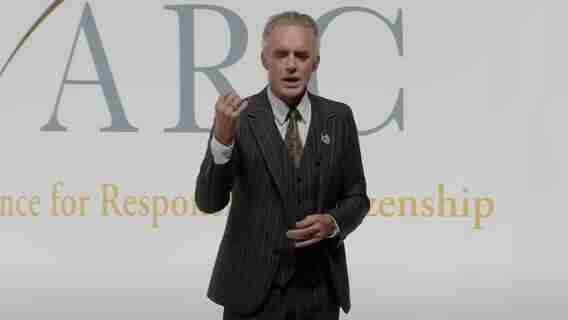
Read the full transcript of renowned psychologist Dr. Jordan B. Peterson‘s speech “Tilt The World Towards Heaven” at Alliance for Responsible Citizenship (ARC) 2023 conference.
Listen to the audio version here:
TRANSCRIPT:
Introduction to the Culture War
DR. JORDAN B. PETERSON: We find ourselves in the midst of a so-called culture war. It’s a psychological and social minefield. And at this conference, we’d be trying to weave our way through that minefield and to offer something approximating a solution that beckons and is productive and generous.
I want to investigate, though, a little further. I want to investigate the essential feature of that war a little further. And while doing so, I want to wind together, weave together the themes of the conference. We’re at odds with one another about identity. And in order to reduce the tension and bring about a new psychological integration and a proper social peace, we can’t merely criticize the suggestions about what identity constitutes that have been brought forward.
Faith and Responsibility
We have to offer an alternative. And so, I would like to delve deeply for half an hour into what identity must and should be. And to relate that to what social structure must and should be. I opened the conference by pointing out, proposing that the two fundamental themes that we would address would be those of faith and responsibility.
And I suggested that faith is the kind of courage that allows you to welcome the possibilities of the future with open arms. And I say possibility because the future is the manifestation of possibility into actuality. And the possibility of the future is what we contend with. The unknown treasure house of what could be is what we contend with.
And given that that’s what we eternally contend with, we might ask ourselves how best to contend with that.
Vision and Identity
And we look into the future and we cast upon the unknown landscape of the future a vision. A vision that provides us with hope and security because that’s what a vision does. And then we bear the responsibility of attending and acting in a manner that makes that hopeful and security providing vision possible. And so then I would say that identity is the proper union of faith and responsibility.
And then you might say, how does a proper identity unite faith and responsibility? And I would say that it does that in a subsidiary manner, in a hierarchical subsidiary manner. If you’re beset with conflict subjectively and in your society about what identity constitutes, you need a counter position that’s well developed. So, identity is the proper union of faith and responsibility and proper identity is subsidiary in structure.
Jacob’s Ladder: A Simple Story
Alright, so let’s take that apart. First slide. Now I’m going to tell you a little story. It’s a very simple story, but simple stories scale upward. And that’s Jacob’s Ladder. Jacob’s Ladder, that’s the eternal liana, the vine that unites the material and proximal realm of the earth with the eternal realm of heaven. How do we construct and climb Jacob’s Ladder? How do we comprehend it?
Teaching Through Simple Actions
When my son was one and a half years old, I taught him to set the table. But that’s not right because when you’re one and a half, you can’t set the table. If you take a two-year-old and you say, “clean your room” to a two-year-old who’s in the midst of a room that he’s distributed a terrible mess in, and you come back in 15 minutes, the room will be equally messy, and you’ll ask your two-year-old, “why didn’t you clean the room?” And he will just look at you.
And the reason he will just look at you is because he doesn’t know what “clean your room” means. So, you can take the two-year-old, my son in this case, and you can say, “hey kid, you see that teddy bear?” Now, he’s happy about that request, hey, because at two, he knows how to see a teddy bear. And so, he’ll point his eyes at the teddy bear, and then he’ll look at you, and then you can pat him on the head and say, “good,” and then you can say, “go over there and pick up that teddy bear.”
Building Micro-Routines
So then he does that, and he looks at you, and then you can say, “you see that space on the shelf there?” He goes, “yes.” You say, “take that teddy bear, and you put it in that space in the shelf.” And he’ll go over and put it in the space in the shelf, and then he’ll look at you, and you can pat him on the head.
And then if you teach him a hundred micro-routines like that, very carefully, you can tell him to clean his room, and he knows how to do it. And that’s how we build ourselves, and that’s a little vision. It’s a little vision. It’s a micro-vision.
The first vision is what the room would look like if the teddy bear was put in its proper space, right? And it’s not a glorious macro-vision of how to unite heaven and earth itself, but it’s the proximal beginnings of exactly that process. So, we scaffold ourselves upward from the finite to the infinite, and it’s the entire scaffold that constitutes our identity.
Learning Through Daily Tasks
My son, he’s 18 months old. I’m having him help set the table. I say, “kid, you know where the drawer is with the knives and the forks?” And he says, “yes.” I said, “go to that drawer, and open it up, and pick out a fork.”
And so he goes and does that, and he can feel the fork, because he has drawers above him, and he can feel the fork. And then he can come and say, “bring it into the kitchen, and put it on the table by the plate.” And he can do that, and then he can do that with a knife, and then he can do that with a plate, if you dare to let him carry a plate. And then he’s learning what?
The Scale of Growth
He’s learning to set the table. And then he sits at the table with the people that are there, and he’s learning to share food, and he’s learning to take turns, and he’s learning to be hospitable. And so you can see that that starts to scale upward. And then he’s hospitable, and he can take turns, so he’s starting to be a good boy, a good kid.
And that’s part of taking his proper role in the family, which is a broader form of sharing, and the beginnings of his ability to play properly with others, and then to take his position as a potential friend in the community, and then to mature. And as he matures, the scale of his vision expands step by step, until it encompasses not merely what he wants in the short term, but what would be good for him in the medium to long term, so the temporal scale of his vision expands, and not only so that he accomplishes or attains what’s good for him, but so that he does that in a way that incorporates more and more other people into the expanse of his vision.
The Path to Responsibility
And so by the time you start to operate as an adult, you can take responsibility for yourself, you know how to be hospitable, you know how to play with others, if you’re fortunate, or maybe you still have to learn that within the confines of your marriage, and then you take responsibility for your partner. And they do that with you, and the two of you take responsibility for your children, and that gives you the satisfaction, and the adventure, and the responsibility, and the burden, and the meaning of your family.
And you embed that in your community, and you take responsibility for that, and you take responsibility beyond that for your town, and for your city, and for your state, and you do that all in as balanced and harmonious a manner as you can.
The Spirit of Goodness
And the spirit that infuses that entire hierarchy, and that stands at the top, is something like the spirit of goodness itself, and that’s classically associated with what is highest, and that’s traditionally associated with God. And the identity that you have is all of that stretching from lowest to highest at once, and having understood that, you now understand something else, you understand what actually constitutes genuine human flourishing at the psychological level.
Mental Health and Harmony
So one of the disservices that clinicians have offered the general western world, and the world at large as a consequence of that, is the notion that mental health is somehow something subjective, and that’s not true, and we know it’s not true, even though we don’t know that we know it. And you know that because there’s no way you’re going to be mentally healthy if your wife is miserable, first of all, she won’t let you be. And the same thing applies to your children.
One of my neighbors in Toronto said to me once, “a mother is never any happier than her most miserable child,” and so you can see in that that whatever mental health constitutes, it’s not exactly mental, and it’s certainly not merely subjective, it’s something that’s much more like the harmony that exists when the entire subsidiary structure is performing all of its functions as they should be performed.
The Music of Life
Now Samuel Andreyev just before me talked about what music speaks to us, and that’s what music speaks to us. It speaks to us of the harmony that can exist in a complex structure that’s laid out in a properly subsidiary manner, where each note serves the phrase, and each phrase serves the melody, and each person who’s playing in the orchestra serves the overarching function of the music. And the music is the eternal dance between chaos and order, and that speaks to us of meaning, because that’s where meaning is to be found, and that’s the other thing to understand about a subsidiary organization.
Now we have so many people in the world who are lost in ways that are almost unimaginable with their absolutely fragmented identities, and they have no meaning in their life. And they have no meaning in their life because strangely enough, the meaning in your life doesn’t emerge as a consequence of your pursuit of your proximal, hedonic, subjective, narrow, purely self-serving goals and drives.
The Nature of Meaning
There’s nothing in that that’s nourishing, and there’s nothing in that that’s nourishing in part because unless you can integrate yourself across a large time span, taking care of who you will be in the future, and simultaneously fulfilling your social obligations in a responsible manner, none of the, nothing within the subsidiary structure can operate properly, much less you claim the right to the gratification of your hedonic desires, that’s a non-starter.
And even if you could do that, you wouldn’t find in that the meaning that would sustain you in times of trouble, you find the meaning. And everyone knows this, you find the meaning that sustains you in trouble when you need, for example, to regard yourself with some positive attitude in the midst of your stupidity and your suffering. And you can see in yourself the fact that, well, at least you were in service to your wife, at least you had been useful to your children, at least you helped take care of your parents, at least you were of some service to your friends, or to your customers, to your business associates, to your nation.
Service and Sacrifice
You find that meaning in service, and that service is in service of that harmony that makes up the entire Jacob’s Ladder, that stretches from earth to heaven. And it’s always been that way, and we offer our children thin gruel as a replacement for that magnificent version of multidimensional harmony, responsibility, and beauty, and there’s more to it than that too.
You know, I read the book, the biblical book that details out the life of Abraham, and I mentioned this when the conference opened. Abraham begins his life with all his proximal hedonic needs satiated, and the voice of God comes to him and says, “go out into the world, get away from what’s merely infantile and satiating, and have the adventure of your life.” And that’s a good bargain, because we’re built not for mere proximal infantile satiation, the satiation of our base desires, but to move out into the world like the adventurers that we are, and to face the complexities of the catastrophic future with a certain degree of nobility and courage, and to hoist the world on our shoulders, and to struggle uphill. And it’s in that struggle that the meaning of life emerges.
The Worth of Life
If you lived your life completely, maybe it would justify itself, right? And where would you find the meaning that justifies the suffering in life? And the answer to that is, well, you find it in the burden of responsibility, because the burden of responsibility isn’t a burden, it’s the greatest opportunity you could possibly have, and you know perfectly well when you’re trying to decide if your own life is worth having, that if someone comes up to you even once and says, “you know, what you did for me, it really mattered.”
And that might get you through like a week of rough times, just the mere fact that it was obvious that the sacrifices that you made in relationship to others actually made a difference, and you can make a continual difference in your life if you adopt the proper sacrificial attitude, right?
The Hierarchy of Identity
And it’s the sacrificial attitude that makes the hierarchy of identity possible, because what you do with the proper sacrifice is continually sacrifice the lower to the higher. You continually, you sacrifice your own meat, self-serving, proximal hedonic whims to a pattern of being that sustains you across the long run and that unites more and more people. And it’s a worthwhile sacrifice because the payback for the sacrifice overwhelmingly, what would you say, is overwhelmingly disproportionate to the cost.
And everyone who’s had a child who has any sense, who’s escaped from their primordial narcissism understands this because bringing a child into the world and watching that person develop is a bittersweet adventure, because children are fragile and things go wrong. But it’s a very rare person whose head is set on their shoulders in anything approximating the proper manner who isn’t thrilled to death to see the person they brought into the world thrive as a consequence of their sacrifices, and to see in that thriving the justification for all the pain that was associated with their production.
The Psychology of Self-Consciousness
And so, and that’s what life is like, and we don’t let young people know this anymore. You know, here’s something psychologists discovered in the last 20 years. There is no technical difference between thinking about yourself and being miserable. Those are the same thing, and you know that too.
You know, if I’m on stage and I’m talking to you, and all of a sudden I become self-conscious, I drown in anxiety and I lose my place, right? And that’s what’s happening to the young people that we see who are adrift. They’re taught to be nothing but self-conscious, to do nothing but think about their immediate needs, to refer to themselves as the locus of all things. And there’s nothing you could do that would make them more miserable. It’s identical with the instruction in misery.
The Purpose of Service
And you want to be outside yourself, serving a higher purpose, and maybe you’re cynical about that, but you can think about it technically. Why do you bring a fork to the table? Well, so that you can put a plate beside it. And why do you put a plate at the table? So that you can set the table to serve your family, to share food, to bring together the people you love in something approximating harmony as a microcosm of the entire cosmic order.
The Call to Responsibility
And you can replicate that at every level of complexity, all the way up to what’s at the pinnacle. And that’s all real, and so is what’s at the pinnacle. And we’ve forgotten all of that, and as a consequence of forgetting that, we’ve forgotten the responsibility that we need to bear in our life to make our lives bearable. And we’ve forgotten the meaning and the adventure and the purpose and the significance and the earned self-regard that goes along with that sacrificial attitude. And we’ve forgotten to tell our children the same thing.
Remembering Who We Are
And we can remember, we can remember who we are. We can remember who we are. And that’s what this conference was for. To remind people, everyone who attends, who you are. Right? You’re the… You’re the men and women, individuals made in the image of God who stumble eternally uphill towards the Jerusalem on the hill, the shining city on the hill.
No, and we’re so foolish. We regard those propositions as something approximating what primitive superstitions, when in fact they’re the most brilliant intuitions into the fundamental structure of reality that have ever been offered. We’ve predicated our civilization on those presuppositions. And look at it. It’s not so bad.
The Vision of Progress
We’ve brought wealth and plenty to billions of people around the world. We’ve been struggling uphill properly. And if we were wise and faithful and courageous and responsible, we could continue to spread that to everyone. We could eradicate absolute poverty. We could bring about a time of abundance and opportunity for everyone.
And we’ll do that. We can do that. If we hoist the world on our individual shoulders and operate collectively in this harmonious manner we can continue to struggle uphill toward the city of God. And that’s the truth. That’s the truth. It’s not some superstition. It’s not some primitive defense against death anxiety. It’s not the opiate of the people. Right? It’s the call to divine responsibility.
The Call to Action
And to the degree that each of us acted out in the confines of our own life, we do what I suggested at the beginning of this conference, which is tilt the world towards heaven and away from hell. And we put this conference together to encourage people to do exactly that in the belief that it is, in fact, the people who can do exactly that. Not only can, but must.
Any attempt to circumvent that responsibility merely brings about some, what would you say, oscillating tension between absolute tyranny and utter slavery. Right? As a responsible citizen, bearing the weight of the world on your shoulders, you obliviate the necessity for the tyrant and the slave.
The Final Message
And so that’s what we want to do. And that’s what we encourage all of you to do. And to leave this conference thinking deeply about what it is that you could offer to the world if you threw everything that you had into it. Because life is a very difficult proposition. And you’re not going to be the glorious success that you could be unless you throw yourself into it utterly, wholeheartedly, accepting it in all its terrible expanse of catastrophe and possibility, and realizing in yourself the person who has that divine responsibility, along with all the rights that are attended upon that, to set the world straight.
My sense is that if enough of us, enough of us realize that sufficiently, there’s nothing we couldn’t accomplish. There’s no desert we couldn’t make bloom. There’s no reason for zero-sum Malthusian pessimism. Right? We could have what we wanted if we truly wanted it, if we truly sought for it, if we truly asked for it, it would make itself manifest as a consequence of our faith and our responsibility, the adoption of our proper identity.
And so you’re invited to do that. As the individuals, the worthy individuals that you are, who were called to this place because you had let enough of the light inside of you out to shine enough on other people so that your value was clearly made manifest. And we tried to gather 1,500 people together who had done that, however imperfectly, as we do such things imperfectly, to encourage them, to introduce them to other people with the same abiding spirit and to see what we could do with all the opportunity that we have in front of us.
And so that’s the hope of ARC. On that note, I would like to call on someone to remind us in the most appropriate manner of what it is that we all have to do when we leave here.
Related Posts
- TRANSCRIPT: “Two Things Tyrant FEARS!” – Patrick Bet-David CPAC 2025 Speech
- TRANSCRIPT: ‘Good People Must Not Be Silenced!’: Jordan Peterson at ARC 2024
- FULL TRANSCRIPT: Where Do We Go From Here: Martin Luther King Jr.
- FULL TRANSCRIPT: Netanyahu Remarks At 2024 UN General Assembly
- Malcolm X’s Speech: The Ballot or the Bullet (Full Transcript)