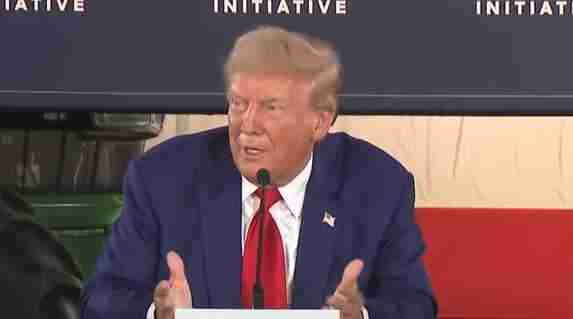
Read here the full transcript of former President Donald Trump’s roundtable discussion event hosted by the “Protecting America Initiative” on agriculture and China in Smithton, Pennsylvania on September 23, 2024.
Listen to the audio version here:
TRANSCRIPT:
Opening Remarks
DONALD TRUMP: Thank you very much. It’s an honor to be with you and a special group of people, the farmers. Nobody’s done for farmers what I’ve done. Unfortunately, they haven’t followed through.
We made a deal with China. It was one of my best deals that I made. I made a lot of good deals, but we made the USMCA, Mexico, Canada, which was terrific. But we had a specific deal with China where they were going to buy $50 billion worth of farm product. And it’s interesting how we got there because when the negotiation was going on, and it was a nasty negotiation, and I said to the farmers, just stick with me because we’re going to do it. They’re great negotiators. They’re not going to go that fast. Just stick with me because you never had anybody negotiating for the farmers before me as president.
And my people, I said, what are the numbers we’re talking about? And they said 15 million, 15, not 50. I said, all right. So it’s $15 billion worth of product that they were going to buy because they’ve been taking advantage of the farmers for years.
This was like a penalty to China. And I thought they said 50, not 15. So the negotiations were going along. We were getting close. I said, how are you doing with the 50 billion? No, sir, we’re close to 15. I said, what do you mean 15? You said 50. I said, no, no, I want 50. They said, that’s not what we said. We said 15. I said, that’s okay. Ask for 50. Tell them we have to have 50 billion, not 15. And I got it. The problem is, big problem, that now they don’t enforce it.
I enforced it. Every single week I’d go into the office, I’d say, how’s China doing? Because you have to live up to that commitment. I’d say, how’s China doing buying the product? Good, sir. Good. They’re doing good. And they were doing good because they knew I was watching.
I don’t think Biden is exactly watching. Do you? Does anybody think that Biden is? Let’s check it. I don’t think so. And it’s a shame. And that number is way lower than it’s supposed to be. So the first thing I do is I would probably my first call, I’m going to call up President Xi. I’m going to say you have to honor the deal you made. We made a deal. You’d buy $50 billion worth of American farm product. And I guarantee you he will buy it 100 percent. He will buy it.
Second thing I’m going to do is I’m going to say you have to give the death penalty to your fentanyl dealers who are sending fentanyl. You know, in China, they give the death penalty. They don’t have a drug problem because they give the death penalty.
But I’m going to say second thing. And this affects you also. It affects everybody. We’re losing — we’re losing hundreds of thousands of people a year comes through the southern border, now the weakest border in history. It was the best border we ever had when I was there. We built hundreds of miles of wall and everything else. And it was the best border. Now it’s the weakest. I had a handshake deal with him. It was going to happen very quickly. And then this side didn’t do anything about it.
He said and he suggested to me, anybody sends fentanyl to the United States, it’s the death penalty. They get the maximum penalty. They would have done it. And then we had an election that didn’t exactly work out too good. And it was a disgrace, frankly. And that deal went. And a lot of other bad things happened, like Russia attacking Ukraine, October 7th, inflation. A lot of bad things happened.
The horrible way we got out of Afghanistan. So many things happened that wouldn’t have happened. But it did, nevertheless. But as to the farmers, we have a deal in place that China is supposed to buy 50 billion dollars worth of our product. And they are not living up to it. And they were living up to it. And every farmer I spoke to, I spoke to a lot of them recently in Iowa, and they’re having the same problem. They’re not doing well.
They’re not doing well. They were doing great during the Trump administration. I think you would say that. Were you all? I hope you… there’s always dangerous to do. But I hope you’d say you were doing well because you’re not doing now. I’m hearing it from farmers all over the place. And one of the big reasons is they haven’t enforced the deal with China. And that deal was really a penalty deal to China because they took advantage of you for 25 years.
And it was like a penalty. And, you know, Biden and Harris, they’re never going to enforce anything. That group — that group is a disaster. It’s a disaster for our country in so many ways. But certainly the farmers are one of those ways. So I think either Rick or are you starting off, Rick? Why don’t you start?
Introduction by Rick
RICK SCOTT: Well, first of all, Mr. President, we we really appreciate you being here as part of the Protecting America Initiative. We at Protecting America Initiative see China very clearly, as we know you do. China has quietly but strategically worked against us whenever we are distracted by wars or COVID. China goes in and absolutely tries to distract the American people.
They work quietly. They go after our local and state politicians. They go after our manufacturing. And there is no question that they are looking to at some point leverage that investment and that activity.
I’ve seen it very clearly at the U.N.
But for the past four years, while America and America’s Democratic-controlled White House have been distracted by wars, China is getting into our farmland and we have to be able to see China very clearly. So we want to thank you for being here. And Lee is going to take us off into Q&A.
Lee’s Introduction
LEE ZELDA: Well, thank you, Rick. Like Ambassador Grenell said, President Trump understood the Chinese Communist Party threat and protected Americans from the CCP’s attempts to infiltrate America. It is great to be here with the 45th and our next president of the United States, Donald Trump. China now owns 349,442 acres of agricultural land in the United States. That is up 82 percent from three years prior.
America’s food supply and the farmland that enables it is critical to our national security interests, especially due to China’s aggressive ventures into the U.S. food supply. While in the White House, President Trump took on China in many ways that stood up for American farmers. In 2018, he signed a law requiring the federal government to review CCP purchases of land around critical infrastructure, airports and military bases.
That is why we need President Trump back in the White House to pick up right where he left off and go even further. Another one of President Trump’s greatest accomplishments was the groundbreaking United States-Mexico-Canada trade agreement that replaced NAFTA, improved supply chain resiliency, and put America’s farmers first. The USMCA provided new market access for U.S. agricultural products, a fair, non-discriminatory pricing plan, and improved grading standards for products.
It has been reported that the USMCA trade deal led to $2 billion in annual increases for the U.S. in agricultural exports to Canada and Mexico, with an overall increase of $65 billion in gross domestic product for farmers and ranchers. Contrast that to Kamala Harris’s lack of support for U.S. farmers and weak stances on China.
At the time, then-Senator Harris voted against President Trump’s USMCA trade deal, voting against America’s farmers. Harris also opposed President Trump’s necessary tariffs against China, and most recently cast the tie-breaking vote for the Biden-Harris scheme that has sold our auto industry out to China. That’s what brings us here today to discuss what Pennsylvania farmers need from the leaders to combat the threat that they see every day from China. President Trump is here with us today to listen to those concerns, to offer his remarks on China’s influence over our food supply.
And, President Trump, if it’s okay with you, I’d like to introduce some of our panelists who are here.
DONALD TRUMP: I’d love that, yes.
Todd Reamer’s Comments
LEE ZELDA: Our first speaker here is Todd Reamer. Todd is a cattle farmer from West Moreland County. Todd?
Todd Reamer: Hello. I am Todd Reamer. I own, with my wife, a beef cattle cow-calf operation right here in South Huntington Township.
My concern today is with foreign entities buying up American farmland while young Americans can’t afford to buy a farm or even get started. My American dream was to buy a farm and raise a family there, and I was fortunate to find a farm and purchase it 30 years ago while working a full-time job in addition to doing the farm. Finally, in 2010, I was able to quit my full-time off-the-farm job and devote all my time to the farm, something that is rarely achievable now. I know there are young farmers out there who really want to aspire to own their own farm and ranch, but they can’t afford to do so with the high cost of the farm, the ranch, and the equipment to get started.
We all hear the word sustainability. To stay sustainable, we need to give Americans a chance to own farms and ranches so they can continue to produce the safest food supply in the world for generations to come. And perhaps a solution could be maybe to offer a retiring farmer or rancher an incentive tax break if he sold his farm to an American farmer or rancher.
Also, if I may, I understand that China now owns major meat processing plants. They hold the contracts on production barns, and they even own feed milling plants in the United States. I believe that Americans should control their own destiny when it comes to food production and the future of it. It’s a life of hard work and heartbreak, but I know there’s some young farmers out there that can carry the load if we can give them the opportunity. I had an uncle who was a lifelong dairy farmer, and when I was a kid back in the 70s, he had a bumper sticker on his GMC Jimmy that read, No Farmers, No Future.
That was 40-plus years ago. Since then, technology and crop yields have changed for the better, but the message on that bumper sticker has not changed at all. No farmers, no future. Thank you.
DONALD TRUMP: Thank you very much. That’s very good. Thank you.
Matt Carr’s Comments
LEE ZELDA: Thank you, Todd. Matt Carr is here. He’s a third-generation farmer of dairy, corn, soybeans, and alfalfa from Westmoreland County. Please welcome Matt Carr.
Matt Carr: Thank you, Mr. President, for this opportunity to be here. Like I said, like I was introduced, I am a third-generation farmer. I would consider myself the young farmer that Todd is talking about. I am a small dairy farmer from Westmoreland County. We currently milk 250 head of full-steam cows twice a day. It is more than a job. It is a lifestyle, as you know. I would like to talk now about what agriculture means to this country.
Currently, it’s 30 percent of the jobs and 7.43 trillion in economic impact to this country. Like you had said, you are pushing through to China for dairy products to be sold there. That is a huge market, and I would see that that isn’t a large area that we could expand into and continue to push to try to achieve those goals that you talked about. With that, in 1992, there was 130,000 dairy farms in the United States. The number is now down to 26,000. We are currently losing the small dairy farms, especially in Pennsylvania. Our dairy farm numbers are down 8 percent from 2022.
DONALD TRUMP: What is the difference in production? You have far fewer farms. What would you say is the difference in production?
Matt Carr: Production is—
DONALD TRUMP: Similar?
Matt Carr: In Pennsylvania, I think it’s down a little bit.
DONALD TRUMP: It’s down from those days?
Matt Carr: Yes. The farms are getting bigger. The number of cows are still very—
DONALD TRUMP: But the overall total production, you think, is down from what it was when they had so many farms?
Matt Carr: Oh, no, no, no. Total production in La Crosse would be up.
DONALD TRUMP: Is up?
Matt Carr: Yeah. But we are losing the small family farms.
DONALD TRUMP: Sure. I know that. Yes.
Matt Carr: The dairy margin is— The margin that we have in order to make a living and profit is extremely tight. Our input costs are up. Is there a way for America to— We talked about manufacturing. Can we manufacture our own and not rely so much on foreign inputs in order to address what we need in order to survive into the future?
DONALD TRUMP: Thank you, Matt. Great job. Appreciate it.
Nick Stafiri’s Comments
LEE ZELDA: Thank you. Nick Stafiri is a hay, beef, and pork farmer from Thayette County. At this time, I’d like to introduce Nick Stafiri.
Nick Stafiri: Hello. Thank you, Mr. President, for having me, and thanks for the opportunity to be here today. My name is Nick Stafiri, as they said. I’m from Lower Tyrone Township, Thayette County. My family owns a small 120-acre farm where we specialize in freezer beef and hay.
My story is a little bit different than everybody around the table. I didn’t grow up with a farm. I married the farmer’s daughter, so I kind of got that on the back side.
DONALD TRUMP: Very smart.
Nick Stafiri: My mother-in-law was a full-time farmer in our operation. My father-in-law, myself, my brother-in-law, my sister-in-law, my wife—everybody else had a job off the farm. From 1954 to 2015, we milked 50 cows a day, twice a day, no hired help. It was all on them.
My mother-in-law decided to stop milking in 2015 and transition to freezer beef and hay. I’m going to be a little bit different on my story here because my wife and I are both energy workers. With the energy transition in Pennsylvania, our focus and our ability to take our financial resources and put those back into the farm has been tremendous. Without that energy job, we wouldn’t have been able to better our farm and better our situation.
Without my industry and my work family, the opportunities afforded to me, especially like this today, wouldn’t be possible. And as you sit here today, you’re sitting on top of the Marcellus and Utica shales. The most prolific shale plays in the world are underneath your feet. My family depends on my salary and my wife’s salary.
Those salaries are dependent on American, pro-American, pro-energy policy. With these, this pro-energy policy would allow operators to develop abundant clean natural gas from below our feet. Appalachia produces roughly 30 billion cubic feet of gas per day. We could double the amount if we were just given the opportunity.
Common sense policies allow for infrastructure to be built here, pipelines. We need more pipelines. Doubling our output would be the equivalent of putting 10 million barrels of energy on the market for the world stage. Providing opportunities for families to remain farming, because guess what?
We pay those royalties. We pay billions of royalties a year to landowners, just like everybody that’s around here at this table. And, you know, due to the ups and downs, I want to tell you a little bit of a personal story of mine. Due to the ups and downs of the commodity-based business, four years ago I was faced with an ultimatum.
And that ultimatum was, do I chase my corporate job or do I stay here and work on a family farm? My wife and I, we made the decision not to move to Texas. We made the decision it was family first, that it was legacy over money. So our conscious decision to raise our two beautiful daughters as fourth generation on our farm is the best decision we made in our relatively young lives.
There has been no greater honor than to represent my family, my industry, and the pivotal role we play together. The intersection between agriculture and industry, it’s a tight-knit one. We need the farmers just like they want us to provide the energy. And responsible natural gas development should not be a partisan issue. It’s a common-sense issue. So I want to thank you again for allowing me to speak with you today. It’s been an honor, and I really appreciate it.
DONALD TRUMP: So, thank you very much, Nick and it’s great. So, without your job, which is a good job, an energy job, but if you don’t put Trump in, you’re not going to have any energy jobs in here. They’re not going to let you frack. They’re not going to let you frack. You know that.
She’s never said frack in her life until just a short while ago when she realized her poll numbers were dying in Pennsylvania. They’re not going to let you or anybody else frack. And so I just want you to be aware of that when you go and cast your vote. I’m not too worried about the people around this table, I must be honest.
But you never know. But everybody’s aware of it, and I think Pennsylvania is aware of it based on polling that we’re getting. You can’t let them do it because that’s — I didn’t realize you were so dependent. Even a farmer would have to be dependent on the energy.
But you take that energy out, you take that income out, it’s a whole different story for Pennsylvania.
Nick Stafiri: Completely.
DONALD TRUMP: And we’re not going to let that happen. We’ve got to win the election. Thank you very much. Great job. Thank you.
Mana Pappafavare’s Comments
AUDIENCE: Our next speaker is Mona Pappafava-Ray, the CEO of General Carbide.
Mona Pappafava-Ray: Thank you so much. So again, my name is Mona Pappafava-Ray. I’m the President and CEO of General Carbide Corporation. We are a 56-year-old manufacturer of carbide and steel tooling components and assemblies for lots of industries that include oil and gas, ammunition tooling, and agriculture, to just name a few. We’re a fully integrated supplier, so we start with our own graded powders all the way to making our finished tools, which we’ve transformed over a period of years.
This company was started by my father, Premo J. Pappafava, when I was just five years old. He was the son of Italian immigrant parents. He enlisted in the Air Force to be a navigator, graduated from Carnegie Tech, now Carnegie Mellon University, with a degree in chemical engineering, and then went to work for a variety of businesses, ending up in a carbide company.
He worked his way up, and eventually he started his own business. When he started the business, I was just five years old. So I’m very proud of our history. My mother and father taught us a lot. And I lost my father now 22 years ago, and my mother is now five years gone. But they taught me about hard work, integrity, and responsibility, as well as respect, charity, and compassion. I’m not as hardworking as any one of these farmers here, I can tell you that. But I do work hard.
When my father passed away back in 2002, I was left with the responsibility of carrying on our business and taking care of 250 people that work for us in Westmoreland County. But by the time that COVID arrived, we had grown to 350 people with three different businesses in four states, Pennsylvania, Massachusetts, Michigan, and Hawaii. And even though we were deemed an essential business or a sustainable business by three of the states, still General Carbide lost 60 percent of its business in a very short period of time. Unlike a lot of other companies that kind of rolled into the corner and waited it out, that is simply not our style.
In fact, one of our core values is growth. And so we went to our sales team, we told them to look for opportunities, even in light of a very difficult time that we were having. And so one of our market segment managers, his name is Eric Butts, he is also a farmer. So he owns his own farm, and he is working for us as a sales manager.
He started to look for components in the farming industry made out of carbide, and he found that it was quite a large industry. But the overwhelming amount of these tools are sourced here by China. But he thought maybe we would have an opportunity by, you know, employing kind of American ingenuity and doing some things on our own. So we started to move into the industry.
We’ve been working hard for four years on our different agricultural parts with some success, but not as much as we would have hoped due to the cost structure and this competitive landscape with China. As an example, we worked with a potential customer for prototypes for components that go on high-speed planting machines. We made the prototypes, we put them into the field and tested them, and they tested perfectly. But then the customer came back to us and said that even though our cost structure was in line with the domestic producer, we couldn’t come close to the prices that they were getting from China, and so they would continue to purchase offshore.
DONALD TRUMP: That’s where you need tariffs.
Mona Pappafava-Ray: This is a loss of a half a million dollars for just that one part, and there are so many different kinds of parts that we have out there.
DONALD TRUMP: For sure.
Mona Pappafava-Ray: We’re currently working on components for several aspects of agricultural market, including ground prep, seeding, and harvesting. And we’ve had some success. We’re using better grades of carbide. That also costs more. We have instituted robotics and other innovative processes.
We have 24-7 customer service and communication with our customers. And we’re now a one-stop shop. But we still cannot compete against Chinese government-subsidized businesses. Additionally, the purchasing agents are not incentivized to buy on a value proposition.
They’re incentivized to buy the cheapest parts out there, and those parts are coming from China. So I believe we really need to do three things. One, I think we need to incentivize our machine manufacturers and our farmers to purchase American machines with American-made components. Secondly, I think we need a stronger stance on China.
You said it, that it should cost more to purchase components from China, not just more to purchase the materials, which is what we’re up against now. And thirdly, we need to do a better job incentivizing those in purchasing to think about the value proposition — longer-running machines in the field. That’s really what we need to think about. So, to end, I believe in the strength of this nation, Mr. President, but I also believe that you and only you are going to be able to bring back our independence and prosperity. And the last thing that I want to say is —
DONALD TRUMP: I agree. That’s why you need tariffs. This is a perfect example. They undercut you, drive you out of business, and then they’re going to put the price at double and triple. It’s no different. It’s been that way for hundreds of years. That’s what they did with oil.
Rockefeller would open up a station on every corner, and it’d have the — every — you’d have a gas station. Then he’d open up three, and it’d cut the price so low. And everybody thought, oh, wow, what a great bargain. He’d put the one guy out of business, and then he’d raise the prices to triple and quadruple what it was.
That’s the old way. And it’s no different with China or anybody else. That’s why you need tariffs. We level it off. And now people are starting to understand it. Actually, I was watching Howard Lutnick and John Paulson, two of the great geniuses of Wall Street — actually, one of the — two of the most successful people on Wall Street. And they’re big on tariffs. They’re saying Trump was right all along. And I did it. But that’s exactly why. They put you right out of business, and then they’ll sell the same product, but they’ll be double the price of what you are, and make a fortune. That’s what they want to do, among other things.
Can you tell the story of your daughter?
Mona Pappafava-Ray: Yes. I’m sorry. The last thing I wanted to say is, my hardest job is not running three businesses. It’s actually being a mom to a daughter that’s here with me today, Caroline Ray. She’s 16 years old. I’m right there. Would you just raise your hand, honey, so that Mr. President can see? She’s right there. She is not in school today, and she asked that she could be here and she could see you.
I’m doing everything that I can to try to give her the truth every day. And I just wanted to say — and I told you that eight years ago, when you were running, and she was just eight years old then — every night, she would go to bed, and I would kneel on the floor next to her bed, and we would pray every single night for you. And every night, she would speak out to God, and she would say, Dear God, please let Mr. Trump win, please.
And the night of the election — of course, she had to go to bed early because she was in school — but at 2 o’clock in the morning, when we finally knew that you had won, I went into her bedroom. I scooped her up out of her sound sleep, and I was literally tears pouring down. And I said, Baby, Mr. Trump won, baby. He won. He won. And she said, Thank you, God. Thank you, God.
And so she is here with us today, and I just wanted to let you know that we are still praying for you.
DONALD TRUMP: Thank you very much. Almost more important today. When you add the border, where we have millions of people coming in from prisons and from mental institutions and terrorists and traffickers — human traffickers, drug traffickers — I believe it’s more important today.
We had a bad border then, but — and I fixed it, totally fixed it. In fact, it wasn’t even a subject of the next election, but we totally fixed it. And — but that border was nothing compared to what’s happened now. This border is so bad and so dangerous for our country.
I think it’s more important today. I think it’s going to be the most important election in the history of our country. Thank you very much. And thank you, beautiful daughter. Thank you very much. Very nice story. Thank you.
Beth Leeper’s Comments
LEE ZELDA: Beth Leeper is a small business owner, former dairy farmer, and current beef and crops farmer from Westmoreland County. I’d like to introduce Beth Leeper.
Beth Leeper: Mr. President, government and elected officials, and honored guests, thank you for coming to Western PA again today to hear our concerns and address solutions. My name is Beth Leeper, and to play opposite of Nick, I married the farmer’s son, who is here today with my two sons, Levi and Owen.
I am a Christian, a wife, a mother of three, and a small business owner, in that particular order. I, with my husband Brian, own and operate a direct-to-consumer on-the-farm market featuring beef that has been raised on the family farm in Donegal, PA. We procure lamb, chicken, and pork from other small farms in Pennsylvania like ours, and all the animals are harvested through local processors to our specifications. Since opening in 2017, our goal has been to provide our customers with consistently high-quality products while also supporting other small businesses and our community.
In May of 2020, we expanded our store and offerings due to the needs of consumers during COVID, and to offer other businesses another avenue to sell their goods. We now offer several agricultural and specialty items, all produced in or near the Laurel Highlands area. My husband is also a full-time owner-operator of transport in the dry bulk industry, and I also work part-time for a Christian school as the food service director. I share our occupations as an introduction to explain the challenges due in large part to the inflation that we have seen, that we have witnessed and experienced, both as a producer and a retailer, and also a consumer.
As a truck driver, my husband normally fills his truck two to three times a week with diesel. On January 21, just after Biden revoked the Keystone pipeline, one of our fuel receipts totaled $592 for 200 gallons of fuel. That was $2.99 a gallon. In May of ’22, a year after our independence moved overseas, one of our fuel receipts totaled $996 for 166 gallons of fuel.
That was $5.99 a gallon. That $3 per gallon more means upwards of $800 to $1,200 a week in fuel expense, and less to meet our business and family’s needs. This net zero approach has also increased farm costs exponentially, which I know comes as no surprise to anyone here today. Fertilizer is up 30 to 60 percent in 2024, not to mention the increase in seed costs, the fuel, the parts and supplies, and man-hours for planting.
Electric has doubled from around $400 a month in 21 to $800 a month this year, just to run some equipment and the lights that doesn’t include heat. In 2023, feeder calf prices reached an all-time high, coupled with the increase in other commodities and prices to farmers not keeping up. This equals very small profit margins, and therefore, we have been purchasing a fraction of the feeder cattle that we have the capacity to feed. Our farm currently feeds out approximately 70 to 100 head of cattle, and that is reduced from 180 to 200 head just two to four years ago, but we have the capacity to feed upwards of 400 to 500.
Actually, we are currently feeding only enough to satisfy our direct-to-consumer base, as it remains somewhat constant. The seasonal tourism of camping and skiing in the Laurel Highlands contributes to our sales, and we are located in the heart of the Laurel Highlands. I handle all of the customer relations for our on-the-farm market, and our customers often share their concerns with me. These are some of the things I hear most often.
“I really don’t eat a lot of beef anymore. It costs too much.” “I can’t afford to purchase a whole animal this year. What smaller packages do you offer?” “We are visiting from out of town. We don’t have any places like this where we are from,” and recently, the thing I’ve heard the most is “I used to purchase bulk beef from a farmer nearby, a friend, a relative, but they don’t have cattle anymore.” Just last week, a local dairy in operation for over 65 years announced the closure of their bottling operations due to rising costs of supplies and down demand. Other farms in the area have declared bankruptcy or sold off property and downsized.
I can’t even get started on the detrimental effects that the weather has had on the vegetation in our region this year. From hailstorms to droughts, our corn and soybeans were among the victims. Nevertheless, farmers are no strangers to the risk and the gamble that they take every single day in order to do what they know and love, and that is to farm their land. And as always, this too shall pass, hopefully soon.
Jeremiah 29:11 tells us, “For I know the plans I have for you, plans to prosper you and not harm you, plans to give you hope and a future.” I’m not an economist, and to be honest, foreign policy is not in my wheelhouse, but this roundtable event is to address on how to protect our farms and food from China. It seems like basic conservative common sense to me. Do what it takes to keep our farms producing, our markets selling, and our customers buying.
Thank you for your time.
DONALD TRUMP: Thank you. Thank you. Thank you, Beth.
Dave McCormick’s Comments
LEE ZELDA: Dave McCormick, known national security expert, a fellow former veteran of the 82nd Airborne Division, and hopefully our next senator here from Pennsylvania, Dave McCormick.
Dave McCormick: Thank you. Thanks, Lee and Mr. President. Thank you for being here. And, you know, a lot of bad things have happened over the last three and a half years, but there’s two particularly relevant to this audience. One is, as Lee said, China now has the upper hand. China is our adversary, smells weakness in all of its relationships with the United States because of the weak policies of Harris, Biden, and Bob Casey, who’s been a 98% vote.
DONALD TRUMP: Right.
Dave McCormick: The second bad thing that’s happening is our family farms. As you’re hearing, our farms across Pennsylvania are struggling. Farming is, agriculture is the biggest industry in Pennsylvania. We have 52,000 farms. And under the Biden-Harris-Casey administration, it’s been a disaster. Everywhere I go, I hear the skyrocketing prices, the price of inflation. I hear the burden of regulation.
I hear the implications of the war on fossil fuels and what it’s done to our farmers. And so when you’re back in the White House, and we have a majority in the Senate to support your agenda, and I’ve heard you talk about this, I think the people in this room can have a lot of confidence in fair, reciprocal trade. Under your leadership, we had that. We’ve lost that. We’ll get that again. Under your leadership, we can make sure we reduce our dependence on China for semiconductors, for pharmaceuticals. We got to have food security. And the people in this room are the providers of food security, not just for Pennsylvania, but for America.
We got to stop this buying of farmland. It’s going up dramatically. It hasn’t hit Pennsylvania much yet, but nationally it’s growing dramatically. It’ll come to Pennsylvania too. I know you’re going to stop that. And then finally, I’m so glad you said it, energy. I mean, the reason many of these family farms are still operating is because of the energy revolution, the royalties that come from the wells on their properties, the incomes coming from energy workers. So this is a very simple choice for the people in this room and the farmers across Pennsylvania.
It’s a choice between strength and weakness. It’s a choice between common sense policies that get our economy back on track, create a balance in our relationship with China, get the upper hand again, and unlock our energy, versus a radical liberal agenda under Harris and Casey, which will take our country further in the wrong direction. I think I can say with a lot of confidence, Mr. President, the Pennsylvania farmers, the agriculture community here has your back.
Thank you.
DONALD TRUMP: I think they do. Thank you. And you’re right, David. Bob Casey and I’ve been there for a long time, actually, four years, but a long time. He has done nothing for the farmer. He has not been there. He’s 100 percent with the Biden vote, I guess, just about 100 percent of the time.
Bob Casey is not the right one. This gentleman right here, he’s tough, he’s smart, and he loves the farmer. We’re going to turn it around. But Bob Casey could not help us. He has never done it. Not good for the farmer. So I think you probably learned that the hard way. Thank you very much.
Daryl Becker’s Comments
LEE ZELDA: Darrell Becker is the Fayette County Farm Bureau President. This time I’d like to introduce Darrell Becker.
Darrell Becker: Thank you. As Mr. Zelda said, my name is Darrell Becker. I’m a 30-year Fayette County farmer who operates a beef, sheep, and hog farm with my wife, two adult children, and my son-in-law. And we have an intergenerational family.
I have three of my grandkids who live with me. It’s wonderful. I also serve as President of the Fayette County Farm Bureau for the last six years, and I’m also the Chairman of the Land Preservation Board for the last six years. And I was going to talk about land preservation, but I got beat up by my local members who tell me that I need to talk about soybeans.
So I will tell you that we all know that China has no desire to buy products from us. We know that from what happened in your last administration, where they didn’t even want to deal with fair trade. They’re working on being less dependent on U.S. goods, and likewise, we need to be less dependent on them.
This is incredible. Last week, news came out from California’s All Resources Board, CARB, a governing body in charge of the state’s air quality rules, who wants to mandate a limit on the amount of biodiesel fuel produced from soybean and canola oil. Under the proposal beginning in 2028, they would limit, they would only be eligible for low carbon fuel standards who use canola and they will only be able to get 20 percent of the credits of their annual production.
Those replacing American grain production used for oil will be assigned a higher carbon intensity score, thus reducing the interest in U.S. bean products. Meanwhile, the USDA has just reported that renewable diesel fuel imports surged 30 percent higher last year in the first five months of this year so that they could take advantage of these federal and state tax credits. In addition, imports of used cooking oil from China are flowing into the U.S. like never before to capture these biofuel tax credits.
Farm Bureau and other biofuel advocates are pressing regulators to close the loophole so that only domestic producers are eligible for these tax credits. Because of this change, estimates project that American farmers in California alone would lose 200,000 acres of production. This is diametrically imposed to what American agriculture is all about. We know China is not our friend.
Twenty, figures, that’s what I got to read, I can’t remember all these things. 2024 corn receipts are down 20 percent, soybean receipts are down 14 percent, wheat receipts are down 12 percent. Government payments to make up the shortfall are not due until October 2025. Expenses for 2025 may expect to decline one percent, but last year in 2000, I mean, I’m sorry, in 2009, China bought 49 percent of our exported soybeans. Now it’s 31%. 70% of our bean crop goes to animal feed. Bean exports in 2023 were $34.4 billion.
In 2024, they’re estimated to be $27 billion. China owns 384,000 acres of our farmland. That’s up 30% in the last five years. And guess what? The American government can’t buy farmland in China. They don’t allow us. Can you imagine that? At present, the U.S. has a huge supply of soybeans sitting at a multi-year low price, sometimes being sold below production costs. Farmers are using reserve funds to buy and produce soybeans now. There’s no cash flow available to them due to the low price. You know this is unsustainable.
So soybean farmers definitely need our help. Sustainable aviation fuel also uses soy, canola, and other seed crops from American farmers, and this is also under attack. We are putting ourselves at extreme risk in the supply chain knowing that a huge amount of the herbicide 2,4-D and many repair parts for agricultural use are imported from China. How much risk can we absorb and rely on a country that is trying to replace us?
We need to build domestic demand. Our government needs to invest in American agriculture. American farmers want a free market that can sustain the industry. They don’t want handouts, and they don’t want loans. They want to be able to produce their farms. They’re all hardness is the backbone of America. The current administration has shown that they are not friendly to American agriculture. Every producer that I spoke to for this presentation resonated the same message.
We cannot survive another four years. Mr. President, my three grandkids who live with me, if you could see Henry, who’s three, and Hall, who’s two, get into the UTV and drive down to what they call the big barn when we feed our steers, or they go pick chicken eggs, or they help us move cattle. The spark in their eye, the smile on their face, that’s the future of America, and I want to make sure it stays here, and I know you do too.
So I guess they all said that we won’t survive four years. I’m sure that when you get elected that my line would be, help us make American agriculture great again. Thank you, Mr. President.
DONALD TRUMP: We’ll take care of it. We’ll take care of it. It’s not very difficult to do. We’re just being ripped off by other countries, and not only China, by the way, but we’re being ripped off at levels that nobody’s ever seen before, and this administration has allowed it to happen because you were making probably the best you’ve ever done four years ago, five years ago.
You were doing better. All farmers were. They were doing better than they ever did, and now they’re doing very better. I mean, I hear more complaints from farmers than almost anybody, and that’s the backbone of this country, so they’ll be very happy for a long time to come, okay?
Darrell Becker: Can I add one more thing and say to you that we’ve seen the decline of the mom-and-pop stores, and what you’re hearing is that we’re seeing the decline of the American family farm. That’s America. So, I mean, anybody that’s not paying attention to what’s going on needs to wake up and get out and vote, and we know who they’ve got to vote for, you, Mr. President.
DONALD TRUMP: Thank you very much. I love your hat, too, by the way. I noticed it right away. Thank you very much. We’ll take care of them. Your grandchildren will be farmers, and they’ll be maybe doing better than you do, okay? Thank you very much.
LEE ZELDA: Before we introduce our final speaker, Kevin Sweeney, I just want to say thank you to my former colleague, Chairman G.T. Thompson, the chair of the House Committee on Agriculture. We have Kim Ward, the Senate president here in the great Commonwealth of Pennsylvania, and Dan Maul, who is the GOP chair of the Pennsylvania House Ag and Rural Affairs. At this time, we’re going to introduce our final speaker, Kevin Sweeney, who is a cattle farmer from Washington County. Kevin?
Kevin Sweeney’s Comments
Kevin Sweeney: Thank you, Mr. President. I want to thank you for your personal sacrifice for us and your family. Thank you.
I’m 71 years old. I’m a new farmer. I’ve owned my property since 1988. I’m a retired physical therapist, and I have four kids and four grandkids, and my goal is to develop this farm and make it a legacy farm like some of the people on the table are now talking.
I raise beef and sell hay. That’s all I can do. My soil is type 7 soil. The USDA has a soil map of the entire country. That soil is only good for raising grass and beef and maybe grow some trees for timber, but I’m trying to expand it each year. I have a customer base that’s getting bigger each year, and I’ve been full-time retired since 2019, and that’s what I do. The issue that I want to talk about today in regard to China is solar panels. I’m being approached and other farmers are being approached.
The current offer is $3,000 a month per acre per year for the next 30 years. That’s a lot of money. Who’s subsidizing that? Is our government behind these people that are offering us this money? Where’s that coming from?
DONALD TRUMP: Well, they are. They are.
Kevin Sweeney: I mean, that’s a lot of money.
DONALD TRUMP: That’s right. They are, and they’re allowing China to come in and just dominate the industry. That’s right. They’re sending panels over, many of them very defective, very bad panels, but they’re sending them over, and they are really putting a lot of people out of work. But that’s amazing.
Kevin Sweeney: It’s an issue.
DONALD TRUMP: That’s a form of subsidy. Most of the small farms that are around me, I’m very close to Enloe Fork Bailey Mine Complex. It’s one of the top ten underground coal mines in the country, and they’re in that group. They mine a lot of coal. All that coal goes down the railroad, into the rivers, and goes to China. And it’s unfortunate.
These companies I’m surrounded by have bought up a lot of the small farms that I was fortunate enough to buy in 1988. They were beef farms. They were the same type of farmers mine, but they own all these. They own all this property.
My concern is what if one of these foreign entities come in, and even though they don’t own the land, they buy that company and indirectly have control of the lease or that land and are able to use it for whatever reason. My other concern is the federal government. What if for public use they come in and say that they want to take my farm and put solar panels on it? What guarantee do any of us have that the government, Big Brother, won’t come in and do that to us?
We need to know about that. That concerns me. In the news right now is the sale of U.S. steel to Japan. And I just happened to be researching it. I didn’t realize that U.S. steel has a land division, a huge land division. They have vast holdings in this country.
So when China, I mean when Japan buys U.S. steel, they’re buying a lot of land with it. Will they have the ability to put solar panels on it or use it for another purpose? We don’t know. That concerns me. U.S. steel also owns a lot of coal mines and iron ore mines, which I didn’t realize. They have all these iron ore mines out west.
And foreign entities now are going to own all those. And I’ve said this for a long time. I’m from the Mon Valley. And when I grew up, there were steel mills everywhere. Everybody in my family worked for steel mills. There’s none left. They’re torn down. They’re not even there.
The same with coal-fired power plants. They’re gone. Should we have some sort of a strategic plan to keep some of these steel mills and to keep some of this stuff as a strategic reserve, whether it’s minerals, not only oil, but coal, iron ore, those sort of things? It concerns me that that’s just going to go away to foreign countries.
It worries me. I have a couple of tax concerns, one being the death tax. You know, my four kids, what’s going to happen when I’m 71 years old when I’m not here? They’re going to pay big money or they’re going to have to sell out or they’re going to have to go get solar panels to keep the property.
So, you know, if you can do something about the death tax, appreciate it.
DONALD TRUMP: By the way, the death tax, as you know, in the Trump bill, you don’t have to pay a death tax or an inheritance tax. And under them, they want that terminated. They want you to pay.
And what happens, especially with farmers, you’re sort of land-rich but cash-poor. A lot of farmers are land-rich and you love it, but you don’t always have cash. And you leave it to your loved ones. You leave it to your children, which you want to do. That’s what the ultimate is, if you love your children. In some cases, you don’t love your children. You don’t have to leave them anything, right? But generally, you love your children and you leave.
You have no problem with your children. But, you know, you leave it to your children. And what was happening is people were going out, borrowing a lot of money in order to pay the tax, borrowing from the banks on their farm, big liens on the farm, very smart banks that know how to do it. And the children would go bust, or they’d spend everything they could to pay the tax, and they’d live a very tough life and usually lose the land.
I got rid of that. You have no tax to pay on these small farms and businesses. And it’s a great thing. Nobody talks about it much. The fake news doesn’t ever talk about it. But it’s a big – it’s a tremendous factor. And, I mean, it was one of the things that I was happiest about because, literally, farmers are going out of business. Children, they take the farm from their parents and they have to go out, borrow a lot of money, and they can’t afford to do it and they can’t pay the interest rates.
They end up losing the farm over a period of – a short period of time. So we got rid of the estate tax or the death tax, and now it will come back into play under Comrade Kamala. That’s what happens. That’s not good.
Kevin Sweeney: What about our capital gains tax? Are we going to keep that down?
DONALD TRUMP: Well, that’s the worst. I mean, they have unrealized capital gain. How about that one?
Kevin Sweeney: Yeah, how about that? Unrealized. So they want to give you a capital gain if the value of your land goes up.
DONALD TRUMP: Nobody’s ever heard of it before. It’s a communist thing, you know. It’s a communist thing. It’s unrealized capital gain. You’ll have every business person, every company leaving this country. It’s called an unrealized capital gain. And it’s a concept that’s been talked about for years. I don’t know if any country has even done it, but she wants to do it here.
And, you know, come to think of it, now that I’m with farmers, it will affect farmers probably worse than anything.
Kevin Sweeney: We have all the minerals under us, which we own, and they’re going to put a value on those, even though we haven’t taken them. You know who’s going to make a lot of money?
DONALD TRUMP: Appraisers, lawyers, and accountants.
Kevin Sweeney: Well, I have two accountants. Two sons and three of my sons are accountants.
DONALD TRUMP: They’ll be very happy.
DONALD TRUMP: I have some expenses regarding fuel, okay, and I had the opportunity to call up my fuel provider last Thursday when I found out I was going to be here. And I’ll just give you a couple of numbers. Use a fair amount of off-road diesel. Off-road diesels come down in price surprisingly in the election year.
Right now, 2024, I can buy off-road diesel for $2.95 a gallon. In 2020, $1.86. Regular diesel, you know, I use for my truck. It has a road tax and stuff on it. It’s around $4.50 a gallon now. Back in 2020, it was around $2.80. Non-ethanol gasoline, you know, ethanol gasoline, as much as we want to have ethanol, it’s not good for small equipment. Chainsaws and all the small equipment, it eats up the carburetors.
It’s really not a good thing to have in small equipment. So I use non-ethanol gas. Right now it’s $4 a gallon. In 2020, it was around $3.15. So it’s gone up. Propane I use to heat with. It stayed about the same. It was $1.97 a gallon in 2024. In 2020, it’s $1.65. But, you know, the other thing, I line my fields, you know, because the pH, you know, is low. You’ve got to have a certain pH to grow good grass, just like the golf course. You understand that part.
Anyways, just recently I had an arrangement to have some delivered and spread. It was $45 or $50 a ton. They call me, well, there’s been a price increase. It’s $70 a ton now. Just out of the clear blue. It increased my expense. Fertilizer was $600 a ton. I’m paying $1,000 a ton for fertilizer now.
I mean, just costs are out of control. The only thing that helps me is the fracking and the money that I was able to get from that. It’s allowed me to keep my equipment. It’s allowed me to buy another farm adjacent to me. And I’m hopeful that the fracking continues, and I know it will. And I’m hoping we get more of it so that my kids won’t have to be forced, at my demise, to sell the farm to pay the tax.
DONALD TRUMP: You’ll be around a long time. Don’t worry about it.
Kevin Sweeney: Thank you.
DONALD TRUMP: But it will not continue. I’m not a worrier. They get in, the fracking will not continue. I guarantee you that.
Kevin Sweeney: My concern in this environment is that small family farms in Pennsylvania are in peril from two sources. One is the foreign competition we’ve talked about, and the second, I believe, is the federal government. And we need to be left alone. Just get out of our lives, leave us alone, we’ll figure it out. Thank you, sir, for your time.
DONALD TRUMP: Thank you, Kevin.
Donald Trump’s Closing Remarks
LEE ZELDA: Mr. President, I know you’re about to get on the road to an amazing rally up in Indiana. But before you leave, and I know Ambassador Grenell had some final words, I’d like to turn the floor over to our next president, Mr. Trump.
DONALD TRUMP: Well, thank you very much, and it’s been great. I love the farmers. I’m very comfortable with the farmers. I feel I know your business, but I haven’t plowed quite as much as you. But I do know your business very well.
We’ve had a tremendous relationship. I’ve always won with the farmers, and that’s because I produce promises made, promises kept. Number one, your energy bill within 12 months will be cut in half, and that’s my pledge all over the country. Beyond farmers, that’s my pledge all over the country.
We have more energy under our feet than any other country. I call it liquid gold. And we have more than any other country. We have ANWR in Alaska, which the first thing they did, the Biden-Harris administration, everybody wanted it. It’s the biggest. It could be as big or bigger than Saudi Arabia. And it would have supplied Asia, would have supplied vast parts of the world, would have made more money than you could even imagine. We were going to lower your taxes, pay off debt. They terminated it. Reagan wanted it, couldn’t get it. Everybody wanted it, couldn’t get it. I got it.
They were all set to drill. And the first thing they did the first week is they terminated ANWR. But I can get it back very quickly because I got it through Congress, and we’ll get it back very quickly. They didn’t terminate it through Congress. They just terminated it. Just absolutely ridiculous. But I’ll have your energy bill down. Within 12 months, we’ll have your energy bills throughout the country.
I’m not just talking here. I’m talking all over. Air conditioning, heating, everything, we’ll have it down by 50 percent, 5-0. And it won’t even be very hard. You know, up in New England, they have tremendous energy costs and a few minor changes, and we can reduce it. New England is a disaster. I won’t say they vote for Democrats so much anymore. I think we’re probably taking that over because of energy and because of a lot of other reasons.
But we’re going to protect your fracking. You know, in my case, I was always for it. And in her case, she was never for it. She wants to defund the police too. All of a sudden, she likes the police. It started a short while ago. I really like the police a lot. Now, she wanted to defund the police.
She did things in Minnesota that were so bad. She was bailing out people that wanted to kill the police and were actually trying to kill the police and burning down Minneapolis. So we’re going to do things the way you want it. A big factor here with all of you, as I speak, is energy in two ways.
Number one, you want to be able to collect royalties and other things or even have a job in energy. That’s very important to help your farm. And the other thing is you got to keep the prices down. So we’re going to do both, and we’ll do it fast.
It’ll be largely taken care of within 12 months. It’ll be down 5-0, 50 percent. And if they get in, your energy costs are going through the roof. Okay? They’re going to go through the roof. You won’t have a farm very long, I will tell you that. I just noticed behind me John Deere tractors. I know a lot about John Deere. I love the company. But as you know, they’ve announced a few days ago that they’re going to move a lot of their manufacturing business to Mexico. I’m just notifying John Deere right now. If you do that, we’re putting a 200 percent tariff on everything that you want to sell into the United States so that if I win, John Deere is going to be paying a 200 percent.
They haven’t started it yet. Maybe they haven’t even made the final decision yet, but I think they have. John Deere is going to – and anybody else that does this because it’s hurting our farmers, it’s hurting our manufacturing. And if you do that, you’re going to have a 200 percent tariff put on the product that you make in Mexico right across the border.
They think they’re going to make product cheaper in Mexico and then sell it in for the same price as they did before, make a lot of money by getting rid of our labor and our jobs and really a great name because John Deere is a great name. I buy a lot of John Deere. Tremendous. I’m one of their big customers.
I buy a lot of John Deere product as a private person. But if they’re going to do that, we’re going to put a 200 percent tariff on everything that they want to send back into the United States, which means one of two things. Our country is going to make a lot of money but they’re not going to build, they’re not going to open. Or they’re going to sell it to another country.
They’re entitled to do that. If they want to build in the country, in the United States, there’s no tariff. You can go ahead and you can build in any one of the 50 states. You can go ahead.
But if they don’t want to do that, we’re going to put a 200 percent tariff on John Deere. And you know what’s going to happen? They’re going to announce very shortly, if they think I’m going to win or if I do win, they’re going to announce that they’re not going to build in Mexico. Mexico has taken a tremendous amount of our business, especially over the last few years with this group, because this group doesn’t know what the hell they’re doing.
They have no idea what they’re doing. Mexico is taking a lot of business, and a lot of it’s done in finance by China. China is building massive car plants now in Mexico, and it’s the same thing. They’re building, and a friend of mine builds car plants, and he said the biggest ones, the biggest ones in the world are being built in Mexico.
They’re going to put Detroit out of business. They’re going to put car manufacturing out of business in the United States. And I’m just telling everybody involved in this stuff, we’re not going to rip off the United States anymore. We’re going to put big tariffs on those cars that are coming in here at 100 to 200 percent, and they’re no longer going to be competitive.
So you better stay in Michigan, and you better stay in the areas that you’re in right now. And what I really want you to do is come in and build your plants in this country because we’ve lost about 60 percent of our auto-working business over the years, and we’re going to get it all back, every one of them. We’re going to get it all back, and we’re going to get it back quickly, and we can control that so easily. So if they’re building those plants in Mexico, which they’re starting, and they wouldn’t have done it with me, but now I guess they figure when they started it was a little while ago.
I guess they didn’t even know where it was going to run. They weren’t too happy when they heard it was going to. But they’re going to have to pay a tremendous tariff, which means two things. They’re not going to build the plant if it’s not too late.
They’re not going to build the plant. This country is going to make a lot of money. Or they’re going to build the plant, but they’re going to build it in the United States somewhere, and ideally a place like Michigan or South Carolina where we have a lot of auto business. But we’re not going to let that happen.
But John Deere has got to understand that if they build in Mexico, if they start closing plants, in this case it was in Iowa, they’re going to close a big plant and a couple of them. And that’s just the beginning. The problem is that’s just the beginning. Then all of a sudden you’ll hear in a year from now they’re going to do another one, another one.
All of a sudden they’re not going to be in the country anymore. They’re going to have to pay a very big price to be able to sell that product into the United States. Okay? So that’s very important. And I just have to say this. So Dave McCormick is here. He’s running for the Senate. He’s a great gentleman. He’s a hero. Great warrior. And he’s a real warrior too. Served incredibly in the military.
So highly respected. Did great in the military. Went out, did tremendously in the private sector. And he’s running against Bob Casey. Bob Casey never did anything for you. He never did anything for Pennsylvania. I was president for four years. I don’t even know if I ever met him.
I mean, you know, I’ve met everybody. I barely – I don’t know if I’ve met him. Maybe I did, but it certainly didn’t make a hell of an impression on me. But Bob Casey has done nothing, nothing for you as farmers. That I can – well, look at the problems you have. As soon as I left, you have problems. You didn’t have problems when I was running things because we ran it and we watched over the farmers. It was very important to me.
But Bob Casey has done nothing for the farmers and he’s done nothing for the state. He’s got long-term legacy. He inherited the job sort of from his father. And, you know, when that happens, I was telling David, not easy to – there are other cases like that too – never easy to beat, but they’re living only on a past reputation of somebody else, in this case a father.
He’s done nothing for the state. And I didn’t come here for David, but I have a lot of respect for him. And if I only do David, I tell you what, you have to get him. He’s an incredible guy. He’s going to make your farmers – he’s going to help me make the farmers rich. We’ll make the farmers rich again. And I appreciate everybody. I appreciate very much everybody.
Just hang in there. And I know it’s not been pleasant, but the first thing I do is I tell China you’ve got to start buying. China’s not buying like they’re supposed to under the agreement. And I’d say, China, you have to start buying.
I’d like to, if I can, Lee, I’d like to have a few questions, if you want, from the media in the back – a lot of media here. Yes, ma’am.
THE PRESS: How do you protect free-flowing infrastructure? How do you protect free-flowing infrastructure in the U.S. and in states like Pennsylvania from the Chinese Communist Party?
DONALD TRUMP: Well, we’re going to protect it by saying you can’t come. We can’t do it. We don’t want you buying our land. We don’t want you taking the land and basically taking it off the market. And we don’t want you doing it. And they’re buying at levels that nobody’s ever seen before. We don’t want you buying.
It’s very easy to do. That’s a very easy thing to do. But it’s causing a lot of disruption, and that’s what they want to do. So we can do that very easily.
Question? Yeah, please. Yes, yes, sir.
THE PRESS: Thank you, Mr. President. Thank you, Congressman. Mr. President, please. I’ve spoken with some economists about your proposal for tariffs, and they say they don’t see how it will not make items cost more in the United States.
DONALD TRUMP: They’ll approve it. They’ll approve it. And, number one, I don’t need them. I don’t need Congress. But they’ll approve it. I’ll have the right to impose them myself if they don’t. I’d rather get their support.
The ones that understand business all support it. I think David would be a very big supporter of the tariffs because you understand what’s happening, right? David’s a great business person, led a great company. No, the ones that understand business, they understand.
You know, I’ll give you an example. China will charge us. And it’s not only China. I hate to keep using China because it’s everyone. The European Union is a disaster, a disaster for you also, by the way. They don’t want your farm product. They don’t want our cars. They don’t want anything. And yet they sell tremendous amounts of Mercedes, Benzes. I mean, they sell cars to us, but they don’t want our cars. They don’t want our farm product at all. They don’t want it, but they sell farm product to us.
And we have a tremendous deficit. And I had them shaped up real good, but they’ve gotten out of control. They’re really out of control. And Mexico is out of control, to be honest with you.
They’re taking a lot of our companies over the last couple of years. And companies are moving down to Mexico. They don’t know that if I come in, it’s not going to work out too well for them because they’re not going to be able to sell their product into the United States. They’re going to have to pay a price which will make it uncompetitive for them to do that.
So we are going to do a real job. We need the support of Pennsylvania. It’s a very important state. And she is not going to be good to Pennsylvania between pricing and energy.
You know, they started off knocking the hell out of the energy that I had. I had it going at a level. We were number three and probably number four. And by the time I left, we were far and away number one ahead of Saudi Arabia, ahead of Russia.
And then they cut. When they came in, they started cutting. And then prices started going through the roof at the beginning. And what they did is, let’s go back to what Trump was doing.
DONALD TRUMP: We’ve got to go back. And they opened up the stuff that they were cutting, and it was a similar amount. But what they don’t say is that we would be at least three to four times more production of energy right now. And your prices would never be what they are because you can’t compete when you have to pay that much for energy.
So they didn’t do their job. And, by the way, if they won, you could forget about it. They would go. They want to go to all electric cars. How is that going to work? They don’t go far. They’re too expensive. They’re made in China.
And on day one, I end the all electric mandate. And I’m a fan of electric cars. Elon Musk, frankly, gave me the most beautiful endorsement. He endorses me all the time. He says, this is the guy. This is the only guy that’s going to save our country. He’s been very generous. And I think he makes an unbelievable product.
But you have to be able to also sell gasoline-powered cars. You know, we have gasoline. And they want to use something that we don’t have. But China has. For the batteries and everything, China has and controls that market. But the problem is they don’t go far. And they have other problems, like if it’s cold, you get a little bit cold up here. They don’t work too well in the cold.
There are a lot of problems and a lot of assets, too. And he’s going to do great. His car is fantastic. But you have to be able to have other types, like hybrids. Hybrids are good. It’s a good thing. You have to be able to do that. So I’m going to end that mandate.
Can you imagine? They want to almost immediately go to all electric. And we don’t have enough electric to take care of ourselves. You go to California, they have blackouts and brownouts every single day. California is a mess. They have the governor of California, Gavin Newsom. Has anybody ever heard of him? But worse, they had an attorney general and a D.A. who destroyed San Francisco and then destroyed California. And I hate to say it because I have a lot of land in California. I hate to speak badly about places, but frankly, my presidency is much more important than my land. Isn’t it nice to know?
With Biden, it’s the other way around. But my presidency is much more important than my land or my business. And I will say it. California is getting hurt so badly. She destroyed San Francisco, absolutely destroyed San Francisco. And now she wants to destroy our country. She was a horrible attorney general. You could steal $950 worth of merchandise for a store and you wouldn’t get prosecuted.
But anything above that, you wouldn’t get prosecuted either. She was a horrible attorney general. She was a horrible D.A. She was a D.A. of San Francisco. That was the beginning of the end. San Francisco was possibly the best city in our country 15, 18 years ago. And now it’s not livable.
We’re going to bring them all back. We’re going to bring the cities back. But it’s not even livable. So Pennsylvania is a very important place. And it’s – I went to school here. I went to college here, as you know. And it’s a great, great place. It’s a fabulous place.
It’s the Commonwealth. And we’re going to make you very happy. All of those things that we talked about are very easily solvable with you. That’s such an easy – that can be done in one day. I had a cabinetmaker. He said, Sir, China and South Korea are dropping cabinets into our country for nothing. And I can’t compete. And I studied it.
And I ended up putting a 50 or 75 percent tariff on all cabinets coming into the country. And I didn’t know the guy. He just – I met him previous to going in to the presidency. And I saw him four years later. He said, Sir, you saved my business. You saved the job. I expanded. They stopped with the dumping.
And the steel, the same thing. I think the steel people like me the best. Unfortunately, Biden’s let it go. I put tariffs – they were dumping Chinese steel into our country, David, at levels that nobody’s ever seen before. We’ve never seen anything like it. And I put a 50 percent tariff on all steel coming in from China and some other places too, but all steel. And we saved these companies. But Biden has let it go.
And we need steel. Look, you know, there are some things you could get from outside. But if we’re in a war and we need Army tanks and we need ships and we need other things that happen to be made of steel, what are we going to do, go to China and get the steel? We’re fighting China.
But do you mind they’re selling us some steel? Think of it. These people don’t know what they’re doing. So I put big tariffs on steel. They were dumping steel. And it was bad steel too. It was rotted – what’s called rotted steel, bad steel. It was imperfect steel.
People were building girders for buildings and they check them and they’re not good. The steel wasn’t good. But they were dumping at tremendous levels. And I ended the dumping of steel. But these people, since they took over, this U.S. steel – I would not allow that deal to happen. U.S. steel.
This was one of the greatest companies in the world. You go back 70 years, this was the big deal. United States steel. And now they’re going to let the Japanese buy it? I wouldn’t let it happen. I’d help them so they can make the steel company good again. This was the biggest company in the world, the strongest company. It had the biggest reputation.
It represented our country. And now we’re selling it to the Japanese? The psychology of that is unacceptable to me. So I wouldn’t let that deal happen personally. But we’ll see what happens. I hope it’s going to be – I hope it won’t have closed by the time I get there. But I would not let that deal happen. And you’re right, they have other things.
You look at China. They’re opening up coal plants. Every week they’re doing a big coal plant. And John Kerry – I watch this poor guy. This guy, it’s so pathetic. He flies over in his own jet. You know, his wife has some money from a certain family, right? Right? And he’s got a little jet. He flies over to China. He sees President Xi. President, oh, yes, I will consider this very strongly. I will consider your request to stop building coal plants. And then he leaves. He comes back. Oh, I had a good conversation.
Nothing gets done. They’re building coal plants. He had zero impact. But we don’t build anything here. And what people don’t understand is all that pollution in China, all the pollution everywhere in the world, much of it flies right over the United States. Takes three and a half days. Comes in from China, and it’s sometimes bad. And it flies right over the United States.
So what are we going to do about that? But nobody ever discusses that. They don’t want to talk about that. So we’ll be nice and clean. Same thing with the oceans. You take a look. The Pacific, it flies in from they dump it right in the ocean. And in about a week and a half, it’s in. Welcome to Los Angeles, California. And we’re lifting it out of the ocean all day long. We have — it’s a massive big business. We’re taking their garbage out of the ocean because it floats right to our West Coast and other countries, too.
So it sounds bleak, but we’ll get it all straightened out. And we’ll get it straightened out fast. And I just want to thank Lee, and I want to thank everybody here. I’ll tell you, Rick Grenell has been amazing with me from just about the beginning.
You know, he was the ambassador to Germany. And there was no happier woman in the world than Angela Merkel when I announced that I was taking Rick back to Washington and giving him an even higher position. This was the happiest woman in the world when she heard he was leaving Germany. And actually, in a certain way, she liked him.
But in another way, he was sort of brutal because he understood what Germany was doing to the United States, one of the many countries that took advantage of the United States. And he got it. So I want to thank you. And you did a great job, and we appreciate it. Hopefully, you’ll be able to do a great job again. Thank you very much, Rick. And thank you, Lee.
DONALD TRUMP: Thank you, Mr. President.
RICK SCOTT: Mr. President, on behalf of Protecting American Initiative, thank you for being here. But thank you, most importantly, for seeing the threats to America, both militarily and economic. And we appreciate that. Thank you very much, everybody.
DONALD TRUMP: Thank you very much. And, Mr. Congressman, thank you very much. Great job you’re doing. A warrior. Thank you very much.
Thank you, everybody, very much.
Related Posts
- President Trump Remarks to Fort Bragg Military Families (Transcript)
- China’s Foreign Minister Wang Yi Remarks @ MSC 2026 (Transcript)
- Barack Obama on Trump’s Ape Video, Bad Bunny, And 2028 Election (Transcript)
- Transcript: Marco Rubio Remarks at MSC 2026
- Prof. John Mearsheimer: Political Pressure and Trump’s Peace Options (Transcript)