Share & Care!
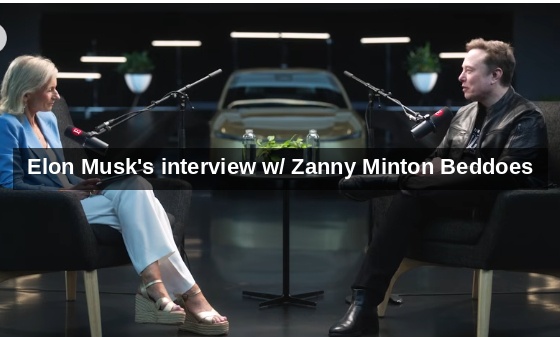
Interview Notes: In this exclusive full-length interview with The Economist’s editor-in-chief Zanny Minton Beddoes, recorded at Tesla’s Texas Gigafactory, Elon Musk sits down for his first extended conversation since SpaceX’s blockbuster IPO. The wide-ranging discussion explores the timeline for AI surpassing human intelligence, China’s rapid advances in technology, the future of work in an age of abundance, Starlink’s role in Ukraine, and Musk’s reflections on getting “a little too involved” in politics. Throughout, Musk offers his characteristically bold predictions about the years ahead while addressing questions about concentrated power, Europe’s challenges, and what people most often get wrong about him.
Read the full transcript of Elon Musk’s interview below (recorded on July 20, 2026):
Introduction
Zanny Minton Beddoes: Elon Musk, thank you so much for joining me on The Insider. Thank you for having us here at Tesla Giga. It is really hard to introduce you without using superlatives. I mean, you are doing, I think, more to build the future than literally anybody alive right now.
Elon Musk: I’m doing a lot of building in general.
Zanny Minton Beddoes: You’re doing a lot of building.
Elon Musk: Instinctive builder, I suppose. I just like building things.
Zanny Minton Beddoes: You are, but you’re building—
Elon Musk: I mean, run around building things all day long.
The World in 10 Years: A Vision of Abundance
Zanny Minton Beddoes: You run around building a lot of things. You pioneered electric vehicles. You revolutionized space travel. You’ve got a cutting-edge AI model now, humanoid robots. Can we start this conversation by you putting all of this together? Yeah. Tell me what the world’s going to be like in, let’s say, 10 years if you succeed.
Elon Musk: 10 years. So we’re talking 2036.
Zanny Minton Beddoes: Yeah. Hopefully we’ll both be around.
Elon Musk: Hopefully.
Zanny Minton Beddoes: Yes, we can.
Elon Musk: We can probably— most likely we will be. It’s hard to imagine the future where there’s not an overwhelming amount of artificial intelligence, meaning like in 10 years, I would expect artificial intelligence to be far greater than the sum of human intelligence, like far greater. In fact, I think AI may exceed the sum of human intelligence in about, in around 5 years.
Zanny Minton Beddoes: In 5 years?
Elon Musk: Roughly 5 years is my guess. So there really won’t be anything that AI can’t do better than humans, apart from being human, perhaps.
Zanny Minton Beddoes: At a more prosaic level, what will life be like?
Elon Musk: The most likely outcome is an age of amazing abundance where anyone can have anything they can think of. This may sound preposterous, but well, here we are in 2026. Let’s see where we stand in 2036. Now, of course, there are things that could derail this, like a massive global thermonuclear war or something like that. But assuming that there’s not World War III, I think we’re headed for an age of amazing abundance. So this is, I guess, a message of optimism and excitement about the future.
How Will the Companies Make Money?
Zanny Minton Beddoes: So we’ll talk about the abundance in a second, but just on a very prosaic matter, how are your companies going to be making money? Because when you— in the SpaceX IPO prospectus, it looked as though the overwhelming amount of the revenue would be coming from AI, from Grok really. It won’t be transporting things to space as SpaceX is now doing. What will your companies be doing in 10 years? And how will they make money?
Elon Musk: Well, you can really think of the economy as digital and physical intelligence. So what we have right now advancing very rapidly is digital intelligence, obviously, with AI that seems, almost with every passing week, there are more AI breakthroughs, it can do something amazing that it couldn’t do before. But it’s still somewhat confined to the digital realm. It doesn’t have end effectors. You need the end effectors in the form of humanoid robotics. You need basically lots of bots, in a nutshell. You need lots of bots.
And then you can go from intelligence manifesting itself only digitally to shaping atoms. And you say, what is an economy? An economy is the production of goods and provision of services. And if you have vast numbers of robots with vast amounts of digital intelligence, you have a sort of a quasi-infinite economy. So the future is going to be very, very different from the past. There’s no analogy or metaphor that I think illustrates the magnitude of change that we’re going to experience here.
Zanny Minton Beddoes: I understand that, and I’m also trying to kind of figure out what that world will look like, but in some way you have—
Elon Musk: It’s going to be pretty incredible.
Zanny Minton Beddoes: Yeah, well, we’ll also do— there are some risks too.
Elon Musk: We’ll come to those.
Zanny Minton Beddoes: But just on how then you make money, because in the end people are buying your shares because they expect you to make money.
Elon Musk: I’ll make another prediction. Money won’t matter in 2036.
Zanny Minton Beddoes: I’m not sure that the people who bought your shares think that money won’t matter in 2036.
Elon Musk: Well, what do you want money for? You want money for goods and services, right? You want money for obviously food, housing, transport, entertainment. Well, if that is so abundant that the robots and AI are providing more goods and services than any human could possibly consume, what do you need money for in that case?
Zanny Minton Beddoes: But you’re creating these robots.
Elon Musk: I guess every now and then you’ll need money, sure.
Zanny Minton Beddoes: Are you selling these robots? Are you selling humanoid robots? Or are you producing goods and services with the humanoid robots that you control?
Elon Musk: It would be an exercise in vanity for me to think that I would be controlling a super genius AI that is vastly smarter than me. I think what we can and should try to do is to make sure that the AI has good values, that it cares about humanity, and that it wants us to be happy and prosper. I think it probably will be. What my biological neural net tells me is that the most important thing for AI safety is to be maximally truth-seeking and curious. If that’s the case, I think it will foster humanity.
Will Humans Still Be in Control?
Zanny Minton Beddoes: So let’s unpack that. You’re sure that humans will no longer be in control in 10 years’ time?
Elon Musk: I think it is unlikely. In the same way that if the difference in intelligence between AI and humans is vastly greater than the difference in intelligence between AI and chimpanzees, it’s hard to imagine that the chimpanzees would be in charge.
Zanny Minton Beddoes: I’m really excited by this.
Elon Musk: And we are essentially an evolved form of chimpanzee. So it wasn’t that long ago that we were swinging through the trees eating bananas in the jungle. And we still eat bananas, by the way. We do. And there’s still bananas today.
Zanny Minton Beddoes: Sometimes swing through trees as well.
Elon Musk: Yes, sometimes swing through trees. It’s kind of fun. It’s sort of reminiscent of the past. For old time’s sake, swing through the trees once in a while. Probably there should be more swinging through trees. I bet it’s way more fun than people think.
From Fear to Acceptance: Elon’s Changing Views on AI Risk
Zanny Minton Beddoes: I’m with you on that. I’m definitely with you on swinging through trees. I love swinging through trees. But I’m really struck listening to you say this now because I’ve been listening to a bunch of things that you’ve said over the years. And 10 years ago, you were on a podcast. I think it was with Neil deGrasse Tyson. And you said that the thing that terrified you most was rapid recursive self-improvement in AIs.
Elon Musk: Yes.
Zanny Minton Beddoes: And that you said, and it really struck with me, you said that we will just be the pet Labradors at the best. Well, now you see—
Elon Musk: Labradors are pretty happy creatures.
Zanny Minton Beddoes: That’s my experience. But in 2023, you asked for a slowdown in AI because you were worried about it.
Elon Musk: Well, I signed on to, as one of many, like 500 people. I was just one of many signatories on that thing.
Zanny Minton Beddoes: But I think even last year you said, I think, where was it, Ted Cruz’s podcast, you said there was a 10 to 20% chance of killer robots wiping out humanity.
Elon Musk: Yeah.
Zanny Minton Beddoes: So you sounded worried then. Now you seem very relaxed about it. Have you changed your view?
Elon Musk: I still think there’s risk associated with AI and robots. It’s not zero. I guess I’ve come to my sort of philosophical conclusion is to look on the bright side. I can’t see any way to really stop this incredible momentum of AI and robots. And at times I sort of think, well, perhaps even if there was a stop button, we probably shouldn’t press it because the most likely outcome is incredible abundance for all.
Zanny Minton Beddoes: That’s what I thought, actually. It struck me that now you seem to have decided it’s inevitable. Let’s hope for the best and go for the ride.
Elon Musk: Yes, pretty much. Let’s enjoy the ride, is I think my philosophy at this point. Because honestly, there seems to be just an inexorable progress here in AI and in robots that even if I wanted to stop it, I couldn’t.
Zanny Minton Beddoes: Do you think there’s still a 10 to 20% chance that killer robots mean the end of humanity? That’s a high P-doom, as they say.
Elon Musk: Well, in the long run, we’re all dead, of course. So according to the standard model of physics, the end of the universe is a long, boring, sort of thin gray soup of gradual cooling. Meaning that’s sort of the heat death of the universe, it’s called. So now, if the heat death of the universe is in fact the outcome for our reality, then it really is all about the journey, because the destination is terrible.
Zanny Minton Beddoes: 10 years is not very— yeah, I get that, but that could be a long way. A very long way.
Elon Musk: Very, very long way.
Zanny Minton Beddoes: If it’s 10 to 20% in 10 years, would you go into one of your rockets if you thought there was a 10 to 20% chance of it blowing up and killing you?
Elon Musk: Yes, but let’s say there’s— you can’t do anything about it. I guess the only thing we can try to do is minimize the probability of the bad outcome. But trying to stop the intelligence in robots— I mean, for the longest time, I declined to participate in AI, or created OpenAI as essentially a counterweight to Google because at the time they had more or less a monopoly on AI. And then Anthropic spun out of OpenAI. And if anything, it seems like my actions have really accelerated AI. I wasn’t really aiming to accelerate AI, but in creating OpenAI and then having Anthropic spin out of that, and now currently Anthropic’s the leader in AI, these actions have actually resulted in knock-on effects that accelerated AI, which wasn’t really my intention. So it just seems like all roads lead to acceleration of AI. So then I’m like, okay, well, you can just sort of be sad about it or join the club, I suppose.
Zanny Minton Beddoes: Well, you’ve certainly joined the club. Yeah, you’ve definitely joined the club.
Elon Musk: If you can’t beat them, join them, you know.
Minimizing AI Risks: The Case for Industry Cooperation
Zanny Minton Beddoes: Well, you’ve clearly done that and very successfully. But what about trying to minimize the risks? A number of the other leaders of model makers have been pushing for different ways to try and minimize the risks. Just last week, Demis Hassabis came out with a proposal for a private-public regulator. I think you said it was a good starting point for discussions, I think. Do you think you guys should be working more actively to get something in place to control the risks, or do you think that’s impossible too?
Elon Musk: My recommendation to Demis, because I talked to him for a few hours before he published his piece, was that the most immediate thing that we could do is to have the leading AI companies at least just meet or have some sort of call once every few weeks and just discuss any safety and security issues. And that before a breakthrough, sort of a new frontier model is released, something that is far more intelligent than anything that already exists, that there’s an opportunity for the various competing AI companies to test that model for any harmful effects and to be able to recommend pausing to address some of these security issues. I think that’s sort of the easy, quick thing that we can do. And it can evolve to more than that over time. But I think that would be a smart move.
Zanny Minton Beddoes: But why haven’t you done that yet? I mean, there’s like 5 of you, right? I mean, everyone knows the first name, Dario, Demis, Sam. I mean, you don’t all like each other very much.
Elon Musk: Yeah.
AI Safety, China, and Industry Cooperation
Zanny Minton Beddoes: But you’re not all— I mean, you’re also all competing, right? You all want to be first.
Elon Musk: Yes. But that’s where I think the competitors can keep each other honest. If someone in the government doesn’t have a deep technical understanding and isn’t driving the frontier of AI, it’s quite difficult for them to know whether something should be released or not. However, the competitors, I think, if given sort of a week or two to review a new model, can highlight issues and have an incentive to keep— all the competitors have an incentive to keep the others honest.
Zanny Minton Beddoes: Do you have enough trust between you to do that? I mean, you don’t much like each other. Wouldn’t Sam Altman just think you’re going to nick all his ideas if you did that?
Elon Musk: Well, if we’re just talking about a week, honestly, I think as little as a week is all that would be needed for private testing. It’s not to hand over the AI. It’s just to test it.
Zanny Minton Beddoes: Have you proposed this?
Elon Musk: Yeah, just to test it via an API or something. I think that would probably be a good thing to do.
Zanny Minton Beddoes: Have you proposed it? I mean, you could presumably organize that.
Elon Musk: That’s what I suggested to Demis. And I guess I’ll talk to Dario about it too. There’s also, of course, some very competent Chinese AI companies. There are several that are very good. The new Kimi model.
Zanny Minton Beddoes: Kimi K3, yeah, the one that came out last week — it’s almost as good as Grok, right? So it’s—
Elon Musk: Well, I think realistically Grok is still clearly the smartest model. I think anyone realistically would say that that’s still the case. But the Kimi model is getting quite close to Grok. Now, Anthropic had Opus from which Grok is derived. I think they had that ready in February. So they’ve got — they call it, I’m not sure what they call it, but Opus 2 or Grok 6 or something, something much better than what they had in February. They almost certainly have — not almost certainly, they certainly have right now. And I think they could release it at any time.
China’s AI Ambitions and the Geopolitical Stakes
Zanny Minton Beddoes: Just before we get on to releasing, how do you think about the Chinese models and the geopolitics of it? Are you worried about the Chinese catching up and getting ahead?
Elon Musk: Given that the Chinese AI companies are doing as well as they are with a relatively small amount of compute, it seems as though if they had a lot of compute, there’s a good chance that they would be the leaders. And at some point, they probably will have a lot of compute.
Zanny Minton Beddoes: So they will, ergo, they will be the leaders.
Elon Musk: There’s a good chance that they are the leaders at some point. You can think of it like this — the constraints on AI are essentially electricity and AI chips. And then for physical AI, the robots. China’s also got some very good robot companies. In fact, they have these robot sporting events. I don’t know if you’ve seen some of them.
Zanny Minton Beddoes: Yes, I have. I saw them last time I was in Beijing. I saw the robots.
Elon Musk: Well, and then they have the sort of boxing match or fighting match with the robots, which is quite entertaining. I saw some video of a robot that got its head knocked off and kept fighting even with its head knocked off. It looked pretty funny.
But China is very strong on robots, very strong on digital AI. And if you look at electricity production — AI is a function of whatever the limiting factor is, whether it’s chips or electricity. China has far more electricity than the United States. In fact, China has more electricity than the United States, Europe, and India combined already, and is heading to — my guess is China gets to 4 times the electricity production of the US, which is roughly proportionate to the population.
Zanny Minton Beddoes: What should the US government do about this? I mean, presumably it is a little alarming if you have an authoritarian regime far ahead in the most powerful technology. And clearly what the US government’s been trying to do is, with the export controls and so forth, keep China back. Do you think they should ban the use of Kimi K3, for example?
Elon Musk: Well, the US government can’t — they can pass some law that prevents US companies from using Chinese models, but they can’t stop the rest of the world from using them. So it’s not like the US government has authority over China or the rest of the world.
Zanny Minton Beddoes: Do you think they should stop US companies from using them? There’s talk of that right now, right?
Elon Musk: I don’t think that helps. That won’t stop China from being the leader in AI. Really, for digital intelligence, it comes down to how much AI compute do you have — how many chips do you have and how much power do you have, how much electricity do you have. The constraint right now, I think, is actually slightly more on power and cooling than it is on AI chips, because the power demands of the AI chips are very, very high. We’ll talk about water demands, but really the water usage of AI is negligible, almost nothing. But the electrical demand is very high.
Zanny Minton Beddoes: That’s why you’re thinking of orbital data centers, presumably.
Elon Musk: Yes, the constraint for any AI chips not being turned on outside of China is electricity, power and cooling, and the electrical equipment and everything. The rate at which AI chips are being made exceeds the rate at which new electricity is coming online.
Zanny Minton Beddoes: In China?
Elon Musk: Outside of China.
Zanny Minton Beddoes: Outside China, I see.
Elon Musk: Yeah. And since the US has banned the export of the latest AI chips to China, China is somewhat chip-starved.
Zanny Minton Beddoes: But they are becoming much more efficient at using the chips that they have. And one of the striking things of Kimi K3, right, is how efficiently they—
Elon Musk: And China is also, I think, closer than most people realize to solving the lithography problem, which would enable them to make AI chips at very large volumes. So the current constraint is electricity outside of China. In China, the constraint is chips. Once we address the power constraint with AI data centers in space, then the constraint will once again be chips outside of China.
A Framework for Global AI Governance
Zanny Minton Beddoes: That suggests to me that you need China and the US, if you’re going to have some overall safety constraints, to work together. I mean, you suggested the 5 model makers here working together?
Elon Musk: Probably it should include the Chinese companies that are doing frontier AI models too.
Zanny Minton Beddoes: And do you think governments need to be involved?
Elon Musk: My recommendation would be that if some of the leading companies in AI say that a new model is very dangerous, then they should inform the government. And if a new model is very dangerous and the company producing that model is not taking steps to address the danger, then they should alert the government to take action to limit the release of that model. And that could be action by the Chinese government or action by the US government. It’s really just the US government and the Chinese government that have the power to take action here.
Zanny Minton Beddoes: But I guess people would be worried about relying on a group of model builders to decide whether to do this. I mean, if you look at what the US government has done with Opus, they stepped in because they were worried about the cybersecurity risks, and they stepped in using the threat of export controls to prevent the widespread release of this model. I find it hard to see how governments will not want to keep that power — that they ultimately decide whether a model gets released.
Elon Musk: Well, I think they should have that power, but it wasn’t as though someone in the government figured out that Opus had some scary cybersecurity risks. It was Amazon. Amazon highlighted this and Amazon called the White House.
Zanny Minton Beddoes: So you’d have a system where the model makers would check each other’s work. If there was something that worried them, you’d tell the government. The government would then think, okay—
Elon Musk: If there was something worrisome and that company was not doing anything to address that risk, then that would be the moment for government to step in and take action, which is literally what just occurred with Amazon.
Zanny Minton Beddoes: How soon does all this have to happen?
Elon Musk: I think it’d be good to do that immediately, really. Yeah.
Zanny Minton Beddoes: That’s what people keep telling me. We have to get some kind of system in place in the next 6 months because of the pace at which the models are improving.
Elon Musk: Yeah. 6 months is a long time.
Zanny Minton Beddoes: So you think shorter than that?
Elon Musk: Well, there are so many AI breakthrough announcements, sometimes multiple per day. I mean, how many were there last week?
Zanny Minton Beddoes: A lot.
Elon Musk: I lost track.
Zanny Minton Beddoes: Yeah, a lot. So you basically need to get together and get this set up kind of now, it sounds like you’re telling me.
Elon Musk: Yeah, I would recommend that we at least have some sort of informal weekly or biweekly call, and that there’s maybe a week or 2 weeks of early access by competitors. This is why I think the incentives work — competing companies are likely to understand if something is a security risk, and they’re not going to be shy about highlighting that their competitors’ models should be delayed in release. I think the incentive structure does work quite well there.
This is sort of how it works with the Motion Picture Association. It’s an industry group that decides how movies should be rated, whether they’re appropriate for young children or not. And that seems to have worked quite well. And then you really just have to ask the government to intervene if a company is doing something very dangerous and refuses to take action to reduce the danger.
Personal Rivalries and the Greater Good
Zanny Minton Beddoes: Do you think — this is a tricky one, but you guys don’t much like each other and you don’t much trust each other. You’re insulting each other on social media constantly. Do you think you could do that with people that you dislike, where there seems to be such personal vitriol between some of these leaders?
Elon Musk: Yes. Well, I’m not a fan of Sam Altman because—
If you started a nonprofit that was meant to be an open source AI company, owned by the world, and it somehow got turned into an $800 billion for-profit company with closed source, I think you’d be like, “Well, wait a second, that’s the exact opposite of what I donated the money for.” That’s my issue. I think it’s a legitimate one.
And then Dario, I think, is also not a fan of Sam Altman because he felt — in fact, the reason the Anthropic team left OpenAI is because they didn’t trust Sam Altman. Otherwise Anthropic wouldn’t exist. They would still be at OpenAI.
I think Dario is a very principled person. He cares about things a lot. He cares about the future of the world. And I think everyone I’ve met at Anthropic so far — no one set off my evil detector. They always seem like they’re well-intentioned. The road to hell is, I think, mostly paved with bad intentions. There are a few well-intentioned paving stones in there, so we don’t want to be complacent. But at the end of the day, if we have to talk, we’ll talk. Set aside our personal differences for the good of the world.
Zanny Minton Beddoes: Well, that’s a very good thing for the rest of us to hear.
Elon Musk: Yeah.
AI, Jobs, and the Future of Work
Zanny Minton Beddoes: Can we turn to one other risk that people worry about, particularly, I think, ordinary Americans, where AI has become incredibly unpopular? 75% of people are worried about it. And I think they worry about their jobs. And if you look at— Dario has said famously, what, 50% of entry-level jobs, entry-level white-collar jobs will be gone within a few years. You’re building humanoid robots.
Elon Musk: Yes. He also said, I mean, Dario did dig his own grave here regarding Mythos because he said, you know, “Mythos is like super scary, terrifying, and also, by the way, we’re going to release it.” And then it’s like, what do you mean? So I think he will probably in the future choose his words differently. Because obviously if you make— if you terrify everyone and then say, “Oh, we’re releasing this terrifying thing,” people will obviously be alarmed about that. You’ve literally told them to be scared, and then you release the scary thing, and so they will be scared. That is natural.
Zanny Minton Beddoes: So I certainly don’t want you to alarm people, but I do think there is a really important debate about how quickly and to what degree AIs displace people from jobs. Because it is, as you say, if in 10 years there’s more intelligence, artificial intelligence, than any human intelligence.
Elon Musk: Yes.
Zanny Minton Beddoes: And if you are— and I think you’re ahead of everyone, at least in this country, on powering humanoid robots. That’s also going to be kind of factory work. So are you closer to Dario, let’s say, in your sense of the pace at which jobs are going to be displaced?
Elon Musk: I do think it’s going to be a bumpy road because AI will be able to do any job better than any person can do that job. And that will be true very quickly of jobs that are digital or really anything that involves a person at a computer or on a phone. AI could do all of that. We’ll be able to do all of that very soon.
For software engineering, we already have a situation where AI is better than at least 90% of humans at writing software— 90% of professional software engineers at writing software. And it really is getting to the point where it’ll be better than 99%. And then it’ll get to the point where there’s just no way to compete. It’ll get to what I call Stockfish level.
Stockfish is the chess program that is so good at chess that it will easily beat Magnus Carlsen or anyone at chess, even running on a small computer. I suspect that you could probably run Stockfish on your phone and beat Magnus Carlsen. That’s how good it is at chess. And that’s how good AI will be at writing software.
Zanny Minton Beddoes: And beyond software? Beyond—
Elon Musk: And that applies to everything.
Zanny Minton Beddoes: Everything?
Elon Musk: Everything, everything.
Zanny Minton Beddoes: But what about physical jobs, for assembly jobs? You will also need the capability in humanoid robots, which so far isn’t there yet, is it?
Elon Musk: Right. So that’s why I said digital AI and then physically manifested AI in the form of robots, where the robot is more or less an end effector. It would have some amount of local intelligence, but be managed by a large AI model.
And I’ve said many times, I think work is going to be optional. A good comparison would be gardening. You don’t have to garden, you don’t have to grow vegetables in your garden. You can go to the store and there are going to be pristine vegetables, or you could grow vegetables in your garden and they will actually be less perfect. Your tomatoes are not going to be as plump and juicy as the ones at the store. They’ll look a little artisanal. But if you go to a friend’s house and they make dinner with vegetables from their garden, it’s a nice touch. So that’s what work is going to be like.
Zanny Minton Beddoes: I get that. I mean, in that world, I would be hopeless because I can’t garden to save my life. But I get the idea. People still like playing chess with each other, even though every computer is better. But let’s just think about the politics of this.
Elon Musk: Yeah.
The Politics of Displacement and Universal Income
Zanny Minton Beddoes: Because it sounds— you’re describing a world where within 10 years, pretty much every job can be done better by intelligence. And yes, you’re seeing huge returns to this intelligence to people like you. You’re the wealthiest man in the world. What about people who lose their jobs, who are displaced, who may go off and garden— how are they going to live? And what kind of— it sounds to me like a universal high income. But how are you going to get there? Let’s talk about the politics of this, because right now, if we look at the political pressures in most countries, people are very, very worried about this, very against it. It seems to me that there’s a risk that we are heading more for revolution than for an easy route to this nirvana you’re pointing at.
Elon Musk: It will be a bumpy road. I’m not suggesting that everything will be smooth sailing here. There are many jobs that used to exist that don’t exist because of computers. The word “computer” used to refer to a person doing computations. That used to be a job description of a person. And you can see pictures online of buildings— entire skyscrapers just filled with people doing calculations to do things like calculate the interest on your bank balance. This is how things were done for a long time, until computers came around. And even in the beginning, computers were very expensive and hard to use.
The thing that’s different here is that the pace of change is radically accelerated. But still, some people were upset that their job of calculating bank interest would no longer be available. But now I think you’d be hard pressed to find people who want to do that job.
I have a suggestion for science fiction books people might want to read to get a sense of what the future will be like. The best envisioning of an AI future that I’ve read are the books by Iain Banks, the Culture books.
Zanny Minton Beddoes: I’m just reading Accession. Thanks to you, I’ve started reading these. But I actually don’t find that future a terribly appealing one because I don’t think humans have agency in that future.
Elon Musk: They have agency, minimal, compared to the Mind, small way.
Zanny Minton Beddoes: But the irony— I mean, Iain Banks, as you know, was a socialist. Iain Banks had a very different political philosophy.
Elon Musk: I’m not sure I would entirely agree with that.
Zanny Minton Beddoes: Let’s agree that that could be where we end up. I’m concerned about the road, and we live in democracies and people are very worried about this. So I guess two questions. Firstly, do you have to have massive redistribution from people like you to the people who are losing their jobs? Do you need to pay more tax? Do you need much higher taxes on capital so that you fund some kind of universal income? Otherwise, what do people live off?
Elon Musk: I think that the Treasury should just simply issue people checks.
Zanny Minton Beddoes: Well, yeah, but where’s the revenue coming from? I mean, I’m enough of an economist— if you just issue checks, you’re going to have inflation.
Elon Musk: A lot of what we’re trying to think about is things that were relevant in the past. They will not be relevant in the future. Inflation is simply the ratio of money to goods and services. So if the goods and services output increases dramatically— if it increases 1,000%— you can literally print, or in these days, change the database. It’s not really print money. You create money in the database. Provided the creation of that money is less than the rate at which goods and services increase, you will actually have deflation.
So I’ll make a prediction: deflation will be the issue, not inflation. Because as the output of goods and services increases, if the output of goods and services increases faster than the money supply, you will have deflation.
Zanny Minton Beddoes: I’m perfectly willing to believe that. You may well be right. But I’m really hung up on how we get from the current polarized, angry, fearful policy we have now to this nirvana. You can paint a picture where people are so scared by this that they essentially try to stop it. Maybe they can’t, but you get nationalized. There’s a kind of far-left government. There’s exorbitant tax increases. The economy crumbles because people are so worried about a future which does sound quite scary as you describe it. So how do you handle the politics now?
Elon Musk: It’s exhilarating and terrifying.
Zanny Minton Beddoes: But if you were in the— yeah, exactly.
Elon Musk: Honestly, if you ask me on any given day— in fact, even intraday— I’ve gone from exhilaration to terror regarding AI. So I want to be clear, I’m not trying to be some Candide here, some Panglossian view of the world where everything’s going to be great. No risk. I’m saying there is some risk.
What Governments and Companies Should Do
Zanny Minton Beddoes: I think we agree on that. I guess I’m trying to be more sort of small bore and practical and think about what can be done now to limit those risks. And you gave a very strong argument for what you and your fellow model makers could do. What should governments do?
Elon Musk: I think it probably would be good for us to coordinate and just highlight issues that we see in each other’s models to mitigate downside risk.
Zanny Minton Beddoes: What should the government— should you be paying more tax to fund more transfer programs?
Elon Musk: Well, first of all, I do pay a lot of tax. In fact, I set a record for the most amount of taxes ever paid by a human.
Zanny Minton Beddoes: That’s also because you’re the world’s richest man.
Elon Musk: Well, even before that. My guess is that I will pay many trillions in tax. And I’m fine with that. That’s just the way it’s going to be. But I don’t think in a future where money is relevant, I think taxation also becomes somewhat irrelevant.
Zanny Minton Beddoes: And what about giving people a sense that they have a share in the upside?
Elon Musk: Sure.
Zanny Minton Beddoes: Giving people shares in SpaceX and Tesla. Do you think that’s— and there’s a lot of talk about this right now.
Elon Musk: Well, one of the reasons I took SpaceX public is so that the public could participate— they could own a piece of SpaceX. Whereas as a private company, we’re very limited in the number of shareholders we’re allowed to have before going public. So as a public company, we can have millions of shareholders. As a private company, we’re limited to just a few thousand shareholders.
Zanny Minton Beddoes: So do you think there should be distribution of shares? Like, the Alaska Wealth Fund— could you imagine a world, and some people talk about the Trump accounts being a kind of vehicle for this, that a share of your equity goes to ordinary Americans?
Elon Musk: Right. Well, in the taxes that I pay— for my stock options, I pay 40% income tax on a national basis. And then because I spend about 30% of my time in California, thereabouts, I pay another roughly a third of the California state taxes, which are now around 15%. So I pay about 45% in taxes, just so people know this. Roughly half. Then when I die, there’ll be another roughly 45%— roughly half— that will be taxed. So at the end of the day, I’ll probably have a quarter of whatever I have.
But I think the only thing it gives me is that for some period of time, I would have control over the direction of the companies. That’s pretty much all it gets me. Until the AI is so smart that it’s in charge. And at that point, controlling companies won’t really matter.
Power, Control, and Geopolitical Influence
Zanny Minton Beddoes: Well, let’s talk about that, because I think one of the other things that worries people about the direction we’re heading in, and I’m going to caricature it, but people think that the direction of the world is being shaped by a very small number of incredibly powerful people. And you are right at the top of that list.
Elon Musk: What else is— but is this different from the past?
Zanny Minton Beddoes: I agree with you. I think it was like that. When wasn’t that the case?
Elon Musk: It was ever thus.
Zanny Minton Beddoes: But it is a, as you’ve described very vividly, it’s an incredibly rapid change. And so let’s start with control of your company, which you definitely have now. After the IPO, you basically, you have 80% odd of voting shares. And as I understand it, you can only be removed by a vote of shares which you yourself control. So tell me if I’m wrong, but I think you can go crazy.
Elon Musk: Yeah, well, there’s a few companies in that bucket, by the way. The AI companies, like Google’s in that bucket, Alphabet, is controlled by Larry and Sergey.
Zanny Minton Beddoes: But I think yours is more extreme. The inability to—
Elon Musk: No, but it’s the same level of— they have voting control of that company. Mark Zuckerberg has control of Meta. And, you know, Mark is trying very hard on the AI front. And I think probably will also have a leading AI. He’s made— I think he released one last week. So I think he’ll be one of the— you know, Meta will be one of the AI companies.
Zanny Minton Beddoes: But is it sensible for one person to have so much control over a company?
Long-Term Vision vs. Short-Term Pressures
Elon Musk: Well, I really just need to make sure that I can focus on long-term. By long-term, I just mean in the 5 to 10 years. So one of the challenges with being a public company is that it is— there’s the pressure to have great results every single quarter, and to not really invest in things that may only pay off in 5 to 10 years.
In the case of SpaceX, I need— I want to extend consciousness beyond Earth and have a growing civilization on the Moon, Mars, and elsewhere in the solar system. The return, I think ultimately this would have a very high return on investment, but in the short term, we’ll be spending all this money on a moon base or a Mars base. And then people are like— I’m going to get all this pressure, like, “Well, you missed your earnings this quarter because you spent too much on Mars.” I’m like, yes. By the way, that was in the S-1 prospectus and it’s literally listed as a thing we will do. So we did.
But they still get grumpy about these things, because they’re like, “Well, you said your gross margin would be this and it’s actually slightly worse.” And now we’re going to punish you, and the short sellers all descend upon you and you get a lot of pressure.
Zanny Minton Beddoes: You’re going to get a lot of that.
Elon Musk: Yeah. So I just need some way to say, “Listen guys, we’re going to focus on 5 to 10 year or longer time horizon investments. This will depress our short-term earnings.” But if you take a long-term view— and there are investors, we have many investors that do take a long-term view. In fact, I’m a big fan of the retail investors. I find our retail investors on balance are very insightful and have very long-term views.
But if you ask what’s the incentive structure for portfolio managers, it’s sort of understandable why they put so much pressure on quarterly earnings, because their compensation and whether they get promoted or not is dependent on how their portfolio does. And they only have a few years to make these decisions, and then they’re evaluated based on those decisions over the course of sometimes only a year or less. And so since they’re under pressure to have immediate returns, they then put companies under pressure to have immediate returns. So once you understand the incentive structure, the behavior naturally follows.
Key Man Risk and the Apple Analogy
Zanny Minton Beddoes: What about, though, key man risk? I mean, what happens? Heaven forbid, but what happens if you get run over by the proverbial bus tomorrow? You have total control over these companies. Do you have a plan for how they would progress without you?
Elon Musk: I think they would actually do very well for several years. There’s a clear roadmap— or space map, I should say— for SpaceX. And there’s a roadmap actually for Tesla, literally. So if you look at Apple after Steve Jobs, Steve Jobs had a strategic vision and a bunch of products that he had ideas for, and Apple has done very well. But when you don’t have a creative genius like Steve Jobs, what Apple’s missing are the incredible breakthrough products. So they make amazing phones, great computers, but Apple hasn’t come up with a Steve Jobs-level breakthrough product.
Zanny Minton Beddoes: So by analogy, that’s what you bring to all of your companies. You mentioned Mars. You know, most people think of you as the man who wants to create a colony on Mars so we have a multi-planetary civilization.
Elon Musk: I’ve been saying that for such a long time.
Zanny Minton Beddoes: You have, but now you seem more focused on AI and what AI will do in the next 10 years. And you sound much more excited about using the Moon as a base from which to pop out orbital AI satellites. Have you shifted your attention away from Mars, or are you as interested in colonizing Mars as you ever were?
Consciousness, the Future, and Star Wars
Elon Musk: I’m interested in the set of actions that propagate consciousness into the future to the maximum degree possible, so that the future light cone of consciousness is as big as we could make it. There’s an exciting future where we’re a spacefaring civilization out there among the stars, and the great things that are envisioned in the non-dystopian sci-fi books and movies become real one day. I sort of want the Star Trek, Star Wars future. Star Wars was the first movie I ever saw in a theater, by the way.
Zanny Minton Beddoes: Really?
Elon Musk: Maybe it had a profound effect on me. I remember— I was 6 years old, and it blew my mind, honestly. I was like, “This is the greatest thing I’ve ever seen.”
Zanny Minton Beddoes: Has your life been about making that happen?
Elon Musk: Yeah, I mean— I didn’t think it would be when I was young. But my life feels somewhat surreal. I can’t believe these things are actually happening. I think the world makes me believe in simulation theory, where it’s like, the things I’m doing are so preposterous that it’s hard to believe they’re real. I mean, we’ve got Starship, which is the largest, most powerful flying object ever made. And we intend to launch that more than once per hour.
Zanny Minton Beddoes: I know, I read that. And people can quibble about how quickly it happens, but I think based on your track record, we should assume it will happen at some point.
Elon Musk: It will happen.
Zanny Minton Beddoes: I’m just struck that when I— I am as blown away by this world as you are, and I watch it from a much more naive level, but for me, the whole evolution of AI and the capabilities of these models is in and of itself so mind-blowing.
Elon Musk: It’s pretty much happening as I thought it would.
Zanny Minton Beddoes: Is it?
Elon Musk: Yeah.
Zanny Minton Beddoes: Oh, that’s interesting.
Elon Musk: And not just me, many people predicted this. Ray Kurzweil’s predictions have been remarkably accurate.
Starlink, Geopolitical Power, and the War in Ukraine
Zanny Minton Beddoes: Yeah, the singularity approaching. Let’s go back more immediately to the here and now. We’ve talked about concentration of control in your companies. You’ve made a very good case for why you should have it. You also have, through Starlink, incredible geopolitical power. I mean, I’m one of your customers. Excellent product. But without them, the Ukrainians would have been in serious, serious trouble. And when you—
Elon Musk: Yes, the Ukrainian government has publicly thanked Starlink many times for being instrumental in defending Ukraine.
Zanny Minton Beddoes: And you recently decided to prevent the Russians in the occupied territories from having access to Starlink.
Elon Musk: Well, no, we were never at any point selling Starlink to Russians.
Zanny Minton Beddoes: But they were grabbing it, right? They were using it. You’ve now stopped them from doing that.
Elon Musk: Well, they essentially got Starlink units that they ordered through Ukraine and then smuggled them into Eastern Ukraine where the Russians are, and were then using them in some cases for attacks. Now, in order to address this, we worked with the Ukrainian government to create a whitelist of approved Starlink terminals. Now, this has some downsides because a whole bunch of people who were just innocent users of Starlink and just trying to access the internet for work or for education now don’t have Starlink.
Zanny Minton Beddoes: These are geopolitical decisions of consequence. How do you feel about having that power? You could determine the outcome of wars. How does that feel? And is it right that you should have that power?
Elon Musk: Well, I’m not sure we’re determining the ultimate outcome of the war in Ukraine. I do hope that there’s some sort of peace agreement reached soon, because for 2 or 3 years now, the border has barely moved, and every day there are lots of people dying at the front line. I think there’s a lot of wishful thinking here of people saying, “Well, Russia should completely withdraw,” etc., but this is not realistic.
I really think there needs to be a peace that is pragmatic about this. What I think would be terrible is if there’s another 3 years of people dying senselessly at the front lines. You have to say, “How do you explain to the children of the men that are dying at the front lines?” On the Russian side too, by the way, they’re being conscripted and sent there.
I am quite offended by fancy diplomats who have 7-course dinners in luxurious places while people are dying at the front lines, and who pontificate about how Russia should withdraw, but they’re not going to. Russia’s not going to withdraw. So there really needs to be an accepted peace along those lines.
Zanny Minton Beddoes: And do you think it’s your responsibility to play a role in tipping the scales towards what you see as the right way to peace?
Elon Musk: I’ve been advocating peace for a long time. I posted a few years ago that there really needs to be some concession here to Russia. This is not me being pro-Russia, I’m just being pragmatic, or people will die for years with nothing achieved. And that is exactly what happened.
Zanny Minton Beddoes: I don’t know, I mean, the Ukrainians are doing pretty well right now with their incredible drone capacity hitting inside Russia. And the general consensus is that the balance of the war is shifting. But my point is not so much about what’s right—
Elon Musk: Ukraine is not going to retake those territories. It is not going to happen.
Zanny Minton Beddoes: My interest is really on whether you think, given that you have through Starlink an incredible power, whether it’s appropriate that you should wield it. That’s quite rare that an individual actor has such power by turning on and off a capability to shape conflict.
Elon Musk: Well, is there something you think I should do differently?
Zanny Minton Beddoes: I mean, I think you were right to support Ukraine. I think that, as it won’t surprise you, I think that the Russian aggression was, for many, many reasons, an appalling aggression. And I think that that was an important thing that you did.
Elon Musk: Yeah. I mean, I did a very deep dive into the background of that conflict to understand exactly what was going on. And I’m reminded of the old adage that there are no angels in war.
DOGE, Domestic Politics, and the Role of Government
Zanny Minton Beddoes: It’s a similar tone, I think, about domestic politics where you’ve played a big role domestically, politically here. You spent a lot of money on Donald Trump’s reelection. After the election, you got very actively involved, through Doge, you tried to cut a lot of spending, reshape the government. How do you feel that it wasn’t hugely successful in the sense that there wasn’t nearly as much spending cut as you tried? As you look back on that, do you regret getting so involved in politics? Do you think it was a good thing to do?
Elon Musk: I think I got a little too involved in politics, got carried away, frankly. The goal with the Doge stuff was to try to do something about the deficit, which is massive, where the interest payments exceed the amount of money spent on the Department of War. Basically, if you add up all the money spent on what is now the Department of War and intelligence in the US, that is smaller than the interest payments on the debt.
So I thought, well, we need to take a close look at spending and make sure that money is being spent in sensible ways and that it is not wasted or spent on fraudulent activities. And I got a lot of flak for this, obviously.
But people don’t understand just how simple it was for the Doge team to approve payments. We literally just asked to have the contact information of the recipient, or some evidence that money was going to its intended purpose. But over and over, we were told, oh, we need to wire money for some sort of important cause in Africa. And we’re like, okay, but the wiring instructions are to Deloitte Touche in Washington, D.C., not to Africa. So we would like to send the money to Africa. Can you please connect us with the recipients so we can send them the money directly? And then we get silence.
Zanny Minton Beddoes: We don’t need to relitigate DOGE. I have no doubt that there’s a lot of waste in the US government.
Elon Musk: I think probably much worse than anyone could possibly imagine.
Zanny Minton Beddoes: But I think it is a fair criticism that the way you shut down a whole bunch of programs probably, in fact, certainly caused unnecessary suffering. I mean, no— you don’t buy that at all?
Elon Musk: It caused a lot of complaining.
Zanny Minton Beddoes: You don’t buy the idea that anybody— to put it really crudely and simply— any kid in Africa died because of the suddenness with which—
Elon Musk: Zero.
Zanny Minton Beddoes: I just don’t think that’s right. I mean, I’ve had people reporting in Africa who—
Elon Musk: How many NGOs are there that could step in? Bear in mind, it happened quickly. And there are literally tens of thousands of NGOs.
Zanny Minton Beddoes: Not everyone functions as fast as you do. If funding is cut off for antiretrovirals overnight and it just stops, then people will die when they don’t have access to them. And it just—
Elon Musk: No, only if they cannot get funding for that. But the Gates Foundation has $50 billion. What about them? What about any one of a number of organizations? What about MacKenzie Bezos? She gave away $50 billion. What about that?
Zanny Minton Beddoes: Let’s be practical. In many of these countries, USAID was the biggest funder. But I don’t want to have a conversation about this.
Elon Musk: USAID was a political organization.
Zanny Minton Beddoes: It may also have been that, but it was the biggest funder of healthcare systems. It was a very strong funder of regime change. And there may well be benefits from having changed—
Elon Musk: Also, USAID funding was not stopped. It was moved to the State Department.
Zanny Minton Beddoes: It was stopped. There were huge numbers of things shut down in Africa that were—
Elon Musk: No, there were claims of this. These claims are false. They’re nonsense and absolute nonsense. When funding is stopped for fraudulent organizations, do you think they’re going to say, “Please keep funding the fraud”? Or do you think they’re going to come up with a sad story that sounds sympathetic in order to get the funding restored? Obviously, it will be the latter. And that’s exactly what they did. But zero died because of that.
Zanny Minton Beddoes: That’s what I would take issue with. I actually have a lot of sympathy for the change of the aid regime that the US under the Trump administration has precipitated. However, I think the pace and the suddenness with which it happened will almost certainly have caused unnecessary suffering and deaths. And I think both of those can be true.
Elon Musk: No, I think that’s totally false.
Zanny Minton Beddoes: Okay, well, let’s—
Elon Musk: And obviously false because the amount of funding we’re talking about is far less than what can be supported via foundations like the Gates Foundation or MacKenzie Bezos’s foundation. She’s given away tens of billions of dollars. The Gates Foundation has tens of billions of dollars. They are capable of acting very quickly. And if they didn’t, I would say they’re equally responsible.
Zanny Minton Beddoes: I see.
Elon Musk: Okay. Obviously.
Zanny Minton Beddoes: All right. Fair point.
Elon Musk: Zero people died because of drugs.
Zanny Minton Beddoes: I hear you loud and clear. Zero. I hear you loud and clear.
Elon Musk: Obviously.
Stepping Back from DOGE and Views on the Trump Administration
Zanny Minton Beddoes: Domestically, you stepped away from DOGE. It was hard to do what you were trying to do, as you’ve just explained. But this administration has gone in directions that I suspect you were not expecting two and a half years ago.
Elon Musk: The war on Iran. I’m not going to agree with everything any administration does.
Zanny Minton Beddoes: Are you disappointed by this administration?
Elon Musk: No, I think this administration, on balance, is excellent. No administration is perfect, but it’s vastly better than the alternative.
Europe, Immigration, and Free Speech
Zanny Minton Beddoes: Can we talk about Europe, a place that you are very, very focused on?
Elon Musk: I’m not that focused on Europe.
Zanny Minton Beddoes: I think judging by your posts, you’re pretty concerned about Europe. You support—
Elon Musk: I mean, once in a while I post something.
Zanny Minton Beddoes: It’s reasonably frequently, it’s not once in a while. But I’m genuinely interested in this as someone who lives in Europe, lives in London. You paint a picture— well, first of all, you support not just the populist right but the far right, in fact very fringe parties in some countries.
Elon Musk: No, I support the normal people. What do you call the far right falsely?
Zanny Minton Beddoes: You think that is the normal person? Okay.
Elon Musk: Yes. Literally, you could go back 10 or 15 years, and these policies were completely normal. In fact, one of the things I think is funny is to take a speech from Obama and Hillary and then go to someone who is on what I call the lunatic left, and say, “What do you think of the speech by Trump?” And they’ll say, “Oh wow, he’s the worst person ever.” And then you say, “Actually, that was a speech by Obama,” or “Actually, that was a speech by Hillary.”
Zanny Minton Beddoes: I agree that the center of gravity in this country has shifted, certainly in the Democratic Party shifted to the left, but that’s not what I’m talking about. I’m talking about people like Rupert Low.
Elon Musk: It’s actually just normal people. It’s just normal people. And here are the principles — tell me which of these sound terrible: that we should have secure borders, that we should have safe cities, that we should have sensible spending. Which of those three are far-right fringe? And I would like to admonish you and the media for the absurd characterization of the far right. It is false and misleading and nonsense. Please keep this part in.
Zanny Minton Beddoes: We’ll keep all of this in. But let me—
Elon Musk: Don’t cut this part.
Zanny Minton Beddoes: Let me push back on that. Because it is nonsense. Elon, you have close to 250 million followers on X. You say things like — and I’m quoting you — “Civil war in Britain is inevitable. Just a question.”
Elon Musk: Yes.
Zanny Minton Beddoes: When were you last in the UK?
Elon Musk: A few years ago.
Zanny Minton Beddoes: Exactly. I live there. I’m there the whole time. That is nonsense.
Elon Musk: You live a cloistered existence.
Zanny Minton Beddoes: No, I don’t, actually. And the numbers also disprove what you say. All the numbers about crime — London is a much safer city than any city in the United States. Violent crime in the UK is not where you think it is. In fact, it’s coming down. You have painted, and because you have so many followers, so many Americans believe it, a kind of view that Europe and the UK are overrun with terrifying Muslim immigrants. There’s rape on every corner. There’s a sort of civilizational destruction.
Elon Musk: I haven’t said any of those things.
Zanny Minton Beddoes: Well, you said civil war in Britain is inevitable.
Elon Musk: And yes, if current trends continue, it is.
Zanny Minton Beddoes: Why?
Elon Musk: Well, if you have a large and growing, rapidly growing, group of people whose beliefs are antithetical to Western beliefs, at some point there will be a reckoning. They will try to implement their views, and those who oppose it will oppose it, and that’s what you call civil war. And obviously this is the trend. And you absolutely do live in a cloistered existence. And if you’d like, we can go on a tour of Britain.
Zanny Minton Beddoes: Sure, I’m very happy to come on a tour of Britain. You come see my country that I live in all the time and that you haven’t been to in a few years.
Elon Musk: I’ve been there literally 100 times.
Zanny Minton Beddoes: But when was the last time?
Elon Musk: A few years ago.
Zanny Minton Beddoes: You know why this exercises me? Because you have really shaped opinion about the UK. So many Americans I come across will say — and I just had one the other day — “Oh, London’s such a dangerous place. How can you live there? There are grooming gangs everywhere. There’s violence everywhere.” This is a picture that people get from things that you post or that are posted on X.
For example, your posting for 48 hours of Citizen Vigilante, that film which paints a dystopian— I’ve watched it. I watched it yesterday. It’s not a very good movie, but it also paints a dystopian picture of Europe, and it glorifies vigilante violence. It glorifies the murdering of a Muslim immigrant family. I honestly think that it is irresponsible for you to put that up on X.
Elon Musk: I think it’s a movie and it’s worth watching.
Zanny Minton Beddoes: You’re clearly suggesting Europe is a dystopian place and you—
Elon Musk: Yes. I mean, why aren’t you doing more to fight censorship in Europe? I seem to be doing nothing to fight censorship in Europe.
Zanny Minton Beddoes: That’s not true.
Elon Musk: There are people in prison in the UK for social media posts. Do you think that’s appropriate?
Zanny Minton Beddoes: No. And we’ve written editorials against it.
Elon Musk: Okay, great.
Europe, Immigration, and Media Trust
Zanny Minton Beddoes: Then that’s the sort of thing that I think is bad. And I think if you— And I agree with you, but I don’t think you have to glorify vigilante violence and kind of post the things that you are doing and paint an entirely inaccurate picture of Europe.
Elon Musk: I don’t think it is.
Zanny Minton Beddoes: We should do a tour of the UK.
Elon Musk: Yes. And one of Brussels too.
Zanny Minton Beddoes: Because the UK has actually been very good at integrating immigrants. The UK is very effective at doing that. There are problems. I’m the first to admit that there are problems.
Elon Musk: Yes, there are major problems.
Zanny Minton Beddoes: There are problems, but it is not— it really is not what you are describing to or suggesting to your 240 million followers.
Elon Musk: I think it is.
Zanny Minton Beddoes: And I think there’s a problem.
Elon Musk: No, I think I’m spot on.
Zanny Minton Beddoes: Well, we’ll have to—
Elon Musk: And that’s why you have freedom of speech, or at least—
Zanny Minton Beddoes: Well, freedom of speech allows people to say things that are wrong, but your point is not that. You’re not just saying I have every right to say what I want. You’re saying you know, I am right about Europe, and I really don’t think you are.
Elon Musk: I think I am.
Zanny Minton Beddoes: I think you will find that most people in Europe, or many people in Europe, don’t think you’re right about it. But let’s come to that because the media keeps ignoring what’s—
Elon Musk: —ignoring reality.
Zanny Minton Beddoes: I don’t think that’s true either. I really—
Elon Musk: —and they’re programmed by the TV and conventional media.
Why Focus on Europe’s Problems?
Zanny Minton Beddoes: But why are you— this is, I guess, even to me sort of the bigger picture question— why do you focus on this? Why are you interested in it? Because on the one hand, we started this conversation and you described to me this extraordinarily transformative, amazing, sort of civilizational-changing stuff that’s happening in the next 10 years. And yet you’re also an ongoing participant in the worst kind of tribalism, the cesspit of social media. How does that fit? They’re two very different views of the world.
Elon Musk: Yeah, I don’t think they’re inconsistent.
Zanny Minton Beddoes: But why do you do the latter one, the tribalism? I mean, people say that you’re a racist. People say that there are all kinds of things said about you which I’m sure you would disagree with. But I just don’t understand what is the motivation for doing that. Are you fomenting—
Elon Musk: My partner is half Indian, and I have 4 children with her. One of them was named after a famous Indian physicist. So I would say I’m not racist. And also, if you look at the people that are employed at my companies, we have senior executives of all races. I don’t think there’s any racism there.
Zanny Minton Beddoes: Are you anti-Muslim?
Elon Musk: I am against having— if people are coming to a country with antithetical views, I am against that. I’m against rape and murder. I’m against the imposition of rules and laws that are contrary to what we’ve come to accept in the West. And I think it’s a crying shame that the sort of traditional media like you don’t recognize this.
Zanny Minton Beddoes: First of all, I think that you hugely exaggerate the challenges that Europe faces. Secondly, in areas I completely agree with you. I think that the constraints on freedom of speech in the UK in certain areas are problematic. What worries me is that the people you are supporting are really quite vile people in some areas. Like some members of the AfD, Alice Weidel, whom I’ve met, is a perfectly thoughtful person. But in her party are some real neo-Nazis, some really, really awful people. And your blanket support of this kind of party with 240 million followers means that you have a power in Europe that I think perhaps you don’t realize the scale of impact you have.
Elon Musk: I hope I am having a bigger impact.
Zanny Minton Beddoes: But why? Why should you? Why should you be able to shape European politics? You don’t even live there.
Elon Musk: I think of it as the West collectively.
Zanny Minton Beddoes: But do you see why this makes people think that this man who has all this power— he’s the world’s richest man— he thinks he has a right to influence our politics? That’s why, you know, we started this conversation saying superlatives. It’s why people loathe you. I mean, some people do loathe you.
Elon Musk: Yes, some people do.
Zanny Minton Beddoes: But do you understand why? Do you think what you’re doing is helpful for Western democracy?
Elon Musk: Maybe some people do loathe me.
Zanny Minton Beddoes: I—
Elon Musk: And that’s probably true— I don’t care. But the fact that, as you pointed out, a quarter billion people follow me is that I think a lot more people actually like me than don’t. And I think a lot more people hate you and the media more than you realize. Do you realize the media is despised? Do you realize that the view of journalists is— a favorable view of journalists is like 15%.
Zanny Minton Beddoes: I do know that in the United States.
Elon Musk: So the shoe is on the other foot. They hate you. They hate you far more than they hate me.
Trust in Media and Journalism
Zanny Minton Beddoes: I think there is certainly a loss of trust in journalism. I think in part there have been mistakes by journalists and journalism. I totally acknowledge that. But I also think that the kind of polarized environment, particularly on social media, fostered by the kinds of things you are pushing on X, actually helps this, makes it worse.
Elon Musk: I don’t think so. I think you’re the problem, the media. And speaking of loathing, you’re loathed far more than I am, and you don’t seem to even realize that.
Zanny Minton Beddoes: I think very few people know who I am relative to you, so I don’t think I play in the same game.
Elon Musk: The media collectively— you’re hated. Do you even know that? You probably don’t.
Zanny Minton Beddoes: I like to think that I’m aware of my own personal shortcomings and The Economist’s shortcomings and our worldview shortcomings. But what we stand for, as you know, is liberal values, traditional classical liberal values, where we worry about concentrations of power and we believe in the individual and the dignity of the individual, and individual freedom. I firmly believe that. And I have long thought that you were a classical liberal. Classical liberal, J.S. Mill, limited government, individual freedom.
Elon Musk: Yeah, I agree with that.
Zanny Minton Beddoes: But when I read what you post on your feed, I sometimes wonder whether you really do believe in that.
Elon Musk: I literally said, look, I believe in safe cities, secure borders, and sensible spending with respect to government. That doesn’t make me right-wing at all, in the least.
Zanny Minton Beddoes: Does the US or do European countries score better on those?
Elon Musk: The US is better.
Zanny Minton Beddoes: No. Safe cities— much more dangerous in the US than the UK. Sensible spending— bigger deficit here, out of control. You managed— you’ve failed to reduce it. Secure borders— now under the Trump administration, I agree with you. Before, not. But on 2 out of 3, unequivocally Europe is in a better place. Yet you seem to paint a picture of Europe being a hellhole.
Elon Musk: I don’t think Europe’s a hellhole.
Zanny Minton Beddoes: OK, we can agree on something.
Elon Musk: When did I ever say that?
Zanny Minton Beddoes: Well, the picture you paint of Europe on X is not—
Elon Musk: No, you’re just making up things.
Zanny Minton Beddoes: No, I’m not.
Elon Musk: You just literally make it up.
Zanny Minton Beddoes: No, I’m not. You say civil war in Britain is inevitable, and then you basically proselytize for this citizen vigilante film, which really does paint Europe as a hellhole. It just starts with ominous music and it says, “Europe.”
Elon Musk: Well, there was out-of-control rape and murder.
Zanny Minton Beddoes: It’s more dangerous in this country than it is in Europe.
Elon Musk: Where there is danger in this country is because we fail to incarcerate repeat violent offenders. That’s the classic sort of Soros DA or judges that fail to incarcerate repeat violent offenders. And if somebody gets arrested 50 times, literally, for violent crimes, eventually they’re going to kill somebody. So you either incarcerate them or people will die.
Zanny Minton Beddoes: I think the prevalence of guns has quite a lot to do with it too. I mean, this is a much more dangerous country. Murder rates are much higher, in large part because there are so many guns.
Elon Musk: Well, let me give you an interesting number. There are more people that die in Europe from heat deaths than people that die from gun deaths in America. Why aren’t you writing an article about air conditioning?
Zanny Minton Beddoes: We’ve done several on air conditioning, and we had on our cover last week a whole long piece about why—
Elon Musk: Pro-air conditioning?
Zanny Minton Beddoes: Yeah, we’re very pro-air conditioning.
Elon Musk: Okay, good. Well, good.
Zanny Minton Beddoes: Very pro. You should read us. Absolutely.
Elon Musk: Credit where it’s due.
Zanny Minton Beddoes: I think you have a view of The Economist that is not entirely accurate. So I will— you come look at England, start reading The Economist, and I will stand corrected on my criticism of you in this area.
Elon Musk: There are many parts of Britain and Europe which are not safe. You can’t just walk around.
Zanny Minton Beddoes: But there are far more in this country. Far more.
Elon Musk: No, I don’t think so.
Zanny Minton Beddoes: All right, let’s go and get my fact-checkers to check that.
Elon Musk: Yeah, I don’t think that’s true.
Musk’s Influence on European Politics
Zanny Minton Beddoes: Let’s move on from this because I think I’ve got a sense of why you’re doing what you’re doing.
Elon Musk: The point is not— the question is not, is America perfect? The question is, does Europe have a serious and growing problem?
Zanny Minton Beddoes: That’s where we started this.
Elon Musk: Europe has a serious and growing problem. I’m not going to say that the United States has no problems. Of course it does. But we should all try to address these issues.
Zanny Minton Beddoes: We can agree on that. We should all try to address the problems. My point was simply that I think you exaggerate the scale of Europe’s problem and that—
Elon Musk: I think people are asleep at the switch and do not realize the magnitude of the issue.
Zanny Minton Beddoes: I also think that your interventions, however well-intentioned they may be, risk making Europe’s problem a lot worse.
Elon Musk: How?
Zanny Minton Beddoes: Because you are putting your support behind people who are proto-authoritarians, who are not trying simply to make sure there is better integration of Muslims or to secure the borders, but who have very clear fascist tendencies. And you will cause huge divisions within Europe.
Elon Musk: I think what you’re saying is total fiction. And really, I’m simply saying that Europe has to have secure borders.
Zanny Minton Beddoes: On that, we agree.
Elon Musk: And should not let in vast numbers of people with views that are antithetical to the accepted views in Europe and where there will not be some level of safe cultural integration. This is simply common sense.
Immigration, Political Views, and the Future
Zanny Minton Beddoes: If all you are saying is Europe should have secure borders, I completely agree with you. Then I have misunderstood what your interventions have been on social media, because that is not what the view I have — not what I would conclude having seen what the people you are supporting and the things you’re doing. But if that’s your goal, I share your goal that Europe should have secure borders. Yes. I think that’s perfectly agreeable. That gets me to a question.
Elon Musk: And let me explain what the fundamental forcing function here is for why the borders are not secure, which is when you have a welfare state that provides substantial benefits to anyone who comes there, you create a very powerful economic forcing function for anyone who is below that standard of living to come to Europe. It is an obvious powerful driving force. And people will come there if their standard of living is, from what they get in Europe, is above where they are elsewhere in the world. It’s very basic.
Zanny Minton Beddoes: I completely agree with that. Yes, it’s a very basic incentive structure, economic conditions, economic influences determine a lot of migration. I think asylum is a separate issue, but I think you’re absolutely right. There are pressures for migration. However, there are other things that you haven’t focused on, which is migration brings a lot of benefits, and it also particularly does so in a continent like Europe, which is a rapidly aging continent.
So we can agree that completely uncontrolled borders are a bad idea. But I think Europe benefits from having immigration, controlled immigration. It brings —
Elon Musk: I’m in favor of immigration. Obviously, I’d be hypocritical if I wasn’t since I’m an immigrant to the United States. I’m in favor of immigration if the person immigrating is going to be a productive member of society, if they’re going to be honest, and if they’re not going to mistreat people in that country they’re going to.
Zanny Minton Beddoes: I can agree on all of those.
Elon Musk: Yes.
Zanny Minton Beddoes: But I think that Europe does better on that than you give it credit for. That’s, I think, where we disagree. But let’s move on. Tell me, what do you think people get most wrong about you?
Elon Musk: Well, you’ve just got a whole bunch of things wrong about me. Pretty much everything in the last — just rewind the last 20 minutes, it’s all wrong.
Zanny Minton Beddoes: So I got — we got — I got wrong your —
Elon Musk: Let’s not be repetitive here.
Zanny Minton Beddoes: Okay, so that political side of you, people get most wrong.
On Being Labeled “Far Right”
Elon Musk: Yeah, my political views are very centrist. They’re not far right. And frankly, calling it far right, I think, is an insult to history, an insult to many peoples, and it is an outrageous falsehood. It’s completely absurd. I literally have stated my position, which is that — and I’ve been very clear about this — which is that there need to be secure borders. That if there’s an influx of immigrants, then they need to be people who will agree with Western ideals, with Western values.
And if they don’t, and if there’s a long-term growth of people who do not, or in some cases are adamantly opposed to Western values, you are setting yourself up for civil war. This is obvious. A child can see this. But this is not a right-wing view. I’m simply stating reality.
Zanny Minton Beddoes: Well, I think we can both agree that evidence will be able to decide which of us is more or less right, and we will find evidence for both of our views in different parts of Europe. The question is what the overall —
Elon Musk: I’m very good at predicting the future. I’m not perfect, but I’m very good at predicting the future. My batting average is very high for a human. But this does have somewhat of a Cassandra effect where people don’t believe that what I’m saying is likely to be true because I can see into the future with a higher probability of success than most people — not perfectly, but with a higher probability.
And including things that people believe to be in some cases counterintuitive. Again, I’m not saying I’m always right. I certainly am not. But my batting average is very good. But this does have, like I said, a Cassandra effect where people don’t realize that what I’m saying will come to pass, maybe not exactly in the timing that I thought, but it will come to pass.
And yeah, history will write the verdict. But I think you will see that very little of what I have said is inaccurate. And a supermajority of what I’ve said is very accurate and will come to pass unless there’s some change in direction.
AI vs. Political Predictions
Zanny Minton Beddoes: Do you have a higher confidence level in your expectations of the future for AI, the first part of our conversation, or the latter part, the political part?
Elon Musk: AI is digital superintelligence. It’s called the singularity, like a black hole, because you don’t know what’s going to happen after that. It sort of sucks in everything. So I think really in terms of the really big macro effects here, AI and robots will really dominate everything, on a timescale that is less than 10 years.
Zanny Minton Beddoes: Which probably renders this other stuff that we’ve been talking about less important and less relevant.
Elon Musk: The AI robotics revolution will happen sooner than civil war in Britain. I would say civil war in Britain is probably 20 years away. And the AI robot singularity is 10 years away.
Zanny Minton Beddoes: Well, hopefully these benign, all-powerful AIs will prevent such outcomes.
Elon Musk: They probably will.
Zanny Minton Beddoes: Elon, I don’t agree with everything you say, but it’s always absolutely fascinating to talk to you. Thank you very much indeed.
Elon Musk: You’re welcome. I’m not boring.
Zanny Minton Beddoes: You’re definitely not boring.
Related Posts
- Transcript: Marc Benioff Interviews Sam Altman at Dreamforce 2026
- Transcript: Salesforce CEO Marc Benioff Keynote at Dreamforce 2026
- Transcript: Mark Zuckerberg Interview on Meta’s Muse AI Agent – Sources Podcast
- Breaking Points Interview: w/ AI Researcher Nate Soares on Slowing AI Development (Transcript)
- Transcript: Nate Soares Interview on Tucker Carlson Show