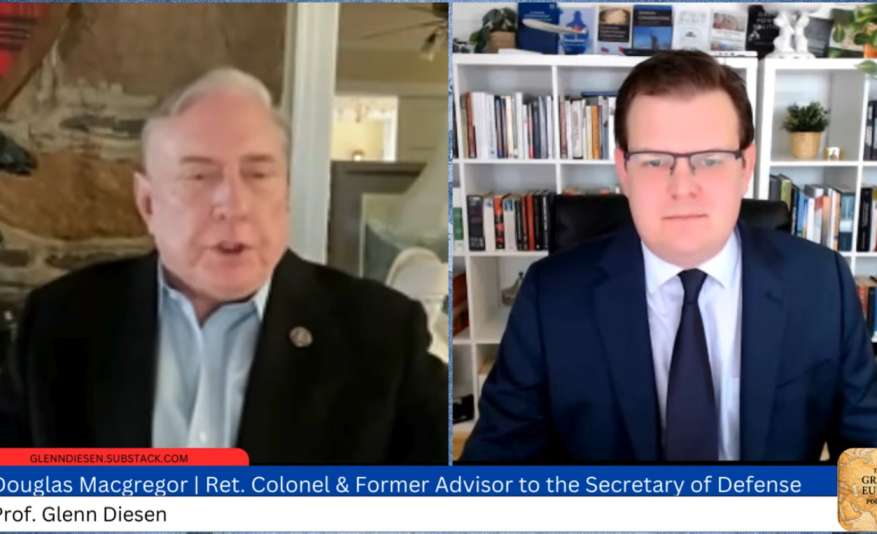
I mean, there are a lot of things depending upon whom you talk to in the administration in Washington, you get a different story.
That’s why I say it’s hard to know with President Trump, because President Trump, whatever his faults, is really privately not somebody who wants to bomb the world. Unfortunately, that’s exactly what he ends up doing because of the people that surround him. But that’s another matter entirely.
So I think we have to conclude that, yeah, war is coming. Exactly when we don’t know, but we see all the conditions that are being developed with the hope of dooming the Iranian regime to defeat. I don’t think the Russians or the Chinese are going to go along with it.
Russian and Chinese Support for Iran
GLENN DIESEN: When you say the Russians and Chinese won’t go along with it, to what extent, though, would they back Iran? I mean, they don’t want a direct shooting war with the United States as that would be—well, it wouldn’t be able to control the escalation if this happens. But is this in terms of economic supporters supplying weapons, or how can they prevent the United States from knocking out Iran?
DOUGLAS MACGREGOR: Well, I think the Chinese and the Russians have provided military technology and technical assistance. There’s no question about that. And this time I think the Iranians have welcomed more assistance technologically, particularly with missiles and radars from the Russians than they previously received.
Secondly, I think the Chinese have been instrumental in defeating the use of StarLink by the MI6, Mossad, CIA opposition inside the country. We now think that 40,000 Starlink terminals were smuggled into Iran. Remember, this is a huge country. It’s the size of Western Europe. It’s got 90 million people in it. So no one should be surprised that you can penetrate the borders. I mean, they penetrate our borders, they’re penetrating Iran’s borders.
And they were able to bring these Starlink terminals in. But the Chinese apparently came to the rescue to shut them down, and they’ve enabled a blackout largely of all the urban areas, and it may be national at this point, to regain control.
Iran Under Siege
But the point that needs to be kept in mind is that there are millions of Iranians, tens of millions that have demonstrated in favor of and in support of the government. And the vast majority of people do not welcome the kind of disruption that the destruction of their government would bring at this particular point in time, given the dangers that confront Iran.
Iran’s living in a state of siege. I mean, somebody earlier today was critical of me because when I said that, yes, I’m sure that several hundred people are being rounded up and probably facing summary execution for treason. But I said, you’re talking about a nation in a state of siege. What do you expect to happen?
Stalin, we know from the time the Germans invaded until the end of the war, executed 1 million Soviet soldiers who refused to fight for communism. That’s what he had to do. He used the NKVD that kept the other several million soldiers in line. The Germans, in contrast, by the way, only had to execute 23,000 out of some 6 or 7 million German soldiers. That’s a very modest number given the numbers that we’re talking about and the pressures of that battlefield.
But I think we have to understand that if you don’t impose that kind of draconian measure, it will continue. And I think that’s what the Iranians are aware of. So I think the Iranian regime is recovering. It’s putting things back together again. I don’t think it disrupted in any way their air and missile defense. I don’t think it had any impact whatsoever on their missile stocks and their ability to attack Israel or, for that matter, our bases in the region.
So we’re back to the initial question. Everybody wants to know, when’s this going to happen? Nobody knows, but there are plenty of indicators that suggest it can’t be that far off.
Trump’s Contradictory Narratives
GLENN DIESEN: Yeah, I thought it was strange, the narrative for legitimizing the new war. That is, of course, it’s not in the Western Hemisphere. So instead we see Trump referencing his love for freedom and protest and democracy in order for, you know, as why he stands in their solidarity. I thought this was strange. I thought it was kind of breaking a little bit away from this liberal imperialism, but apparently not.
However, though, how would this war be different? Because the first round didn’t go well. The Iranians proved that they were able to overwhelm the air defenses of Israel, which were quickly being depleted. And also, Trump seems to have an aversion for long wars. He likes to finish them off quickly. It seems a little bit like Venezuela, and do not get dragged into a long war. So do you think they will just try to go for overwhelming decapitation, strike, or going after key government figures because they tried this last time?
The Venezuela Factor and Congressional Constraints
DOUGLAS MACGREGOR: Well, I think, first of all, we have to keep in mind that President Trump is aware that in the Senate and the House he does not have support for the use of American ground forces in Venezuela. The Senate has already voted on a measure that would prohibit the use of U.S. ground troops, and they voted 52 to 47 against it. That means the Democrats had Republican support.
So I think President Trump is now, I don’t want to say he’s being humiliated, but he is certainly being chastened in the sense that he’s not pushing to get US troops on the ground. Now, I think in Venezuela, he’s a bit naive to think that the population of Venezuela is going to go along with whatever we want with regard to their minerals and mines, gold mines, emerald mines, silver mines, rare earths, plus all of the oil. That’s not going to happen for a whole range of reasons.
It may be that he just decides that he’s done all that he can do, he’ll turn his attention elsewhere. I don’t know. There has never been a viable, executable plan, in my judgment, for Venezuela, or for that matter, for operations in general in Latin America. So that’s the first thing.
The Iran Scenario: Russian and Chinese Red Lines
Now, when you move to Iran, that’s an entirely different matter because that really does attract Russian and Chinese intervention. Even India is not supportive of anything we might do against Iran. So I think if you’re looking at BRICS—Russia, India, China—that’s a substantial chunk of the world, then we could probably go through the rest and find even more opposition. I don’t know how he’s going to handle that.
There’s nothing clean about an air power only operation in this. This notion that air power can achieve miraculous outcomes is a big lie. It always has been. We bombed and bombed routinely in all numbers of places, but until we ultimately went in on the ground, nothing fundamentally changed. Now, after that, we weren’t very successful either. But that speaks more to the wisdom of having gone to begin with than anything else.
The Threat of Iranian Preemption
So I think at this point, he’s trapped. He’s going to have to take action in support of Israel. He may go in with Israel simultaneously when they finally attack. Now, we don’t know what the Iranians will do because for the first time the Iranians have actually talked about potentially a preemptive attack.
I don’t expect them to sit around and wait for negotiations to have an impact. I don’t think anybody really trusts us anymore. I don’t think anything that Trump says is going to be believed. It’s that simple. So if you’re an Iranian right now, you’ve got your finger on the trigger and I think if it looks like something’s imminent, they’re going to pull the trigger.
And this time I think they’ll throw everything they’ve got, including the kitchen sink, at Israel and our bases in the region. My great concern is always the same: what does Israel do if it’s facing potential destruction, annihilation from Iranian missiles and rockets and so forth? Does it turn to the use of a nuclear weapon? If it does, do we have any influence over that? Can we constrain them in any way? I don’t know.
The Turkish Wild Card
Now, the thing we haven’t discussed again, that has to be taken into consideration is Turkey. You know, Turkey has enormous problems with inflation. They want to get it down to 5%. It’s been up to 20%. So that has operated as a brake on things that they might do. Erdogan is very clever. He wants to be on all sides of every issue.
But is he going to be compelled finally to intervene? And the reason for that would be the Kurds. The Kurdish threat to the Turks is substantial and serious. The Turks could be mobilized in a few days to fight the Kurds. Will that spill over and involve Israel? I mean, I don’t know the answers to these questions, but this region is not stable. It’s not predictable. It’s at a slow boil. The question is, when does it boil over? But everyone is beginning to coalesce against Israel. I think that’s clear.
The Risk of Russian Preemptive Action
GLENN DIESEN: You mentioned the possibility of a preemptive strike, and I think this is a variable which should be taken seriously, because this whole idea that the US can just place all its air force around Iran in a perfect position and then go for a strike, which Iran knows is intended to knock out the country at decapitation strike, the idea that they would sit by and just wait for this to come, I would take that warning from Iran rather serious. They have a lot at stake here.
But with you, you mentioned that the Russians, again, the Chinese wouldn’t sit by. But how do you see the Russians calculation having changed, though? Because if this was a few months ago, they would have been perhaps more optimistic about the possibility of a diplomatic solution with Trump, that is, to improve relations between the US and Russia and ending the Ukraine war at the negotiation table.
But over the past weeks with this, we learned that there’s been more US involvement on attacks, on refineries, on Russian civilian ships, even in Russia’s nuclear deterrent, and, of course, the continued effort to sanction Russia in order to break its economy. So I get the impression now from Moscow that they lost hope in the Trump presidency that he would be the one who would be able to end a century of tensions between Russia and the US and essentially become, if not allies, at least much, much closer. Do you think this would impact how Russia would respond to an American attack on Iran?
Russia’s Reassessment of Trump
DOUGLAS MACGREGOR: The Russians have withdrawn their citizens, in other words, evacuated them from Israel. They’ve evacuated their embassy and staff from Israel. I think Mr. Netanyahu has poisoned relations with the Russians. Then you add to that particular matter what you just discussed regarding President Trump.
We used to have something I’m sure you’re familiar with this, we called Kremlinology, where we had all sorts of people sitting around trying to evaluate, estimate, analyze who was going to be in the Politburo, who was next up to be Secretary General of the Communist Party and so forth. I think a lot of that is going on inside Moscow’s inner circle. They’ve looked at Trump, and I think they’ve concluded a few things.
First of all, I think the Russians like President Trump as a person. I don’t think they dislike him at all, and they would like to get along with him, but I think they’ve concluded that he’s unreliable. He may say one thing at one point in time, and then a day or two later, he changes his mind and launches in a new direction.
You remember that in January, February of last year, there were discussions, well, we need to find a way forward. And we’re going to meet with the Russian leadership in Saudi Arabia. Remember, they went to Riyadh, they held these meetings. You had lots of top people, people representing business interests. The usual suspects that supported Trump are showing up to cash in on a particular deal.
Unfortunately, these billionaires align themselves, or Trump aligns himself with them. I don’t know which chicken or egg. You have to figure that out. But bottom line is, we thought there would be a normalization of relations with Moscow, and I think the Russians thought that that was coming. All of a sudden, that stops. Everyone goes home and forgets about it.
Then Donald Trump, who doesn’t change the sanctions regime, refuses to completely divorce himself from Zelensky, despite Zelensky’s bad behavior and routine tendency to ignore what Trump says. He turns around, has a meeting in Alaska, shows up with no new proposals, and then tells the Russians we want a ceasefire, reading nothing, studying nothing, paying no attention whatsoever to Russia’s security interests.
That meeting went off well. It had great atmospherics, wonderful optics, but it went nowhere. It produced nothing. And I think now the Russians have concluded that’s the best you’re going to get out of Donald Trump. It’s not that he is a menace or he’s deliberately misleading. He just can’t deliver.
The Warmongers in Washington
And they’re looking at other people, whether it’s somebody like Lindsey Graham in the Senate, who is the chief warmonger on the Senate side. But he’s not alone. He pulls in lots of Democrats like Blumenthal and others who are willing to join the Russia hate club. Then you have the usual suspects in the White House. You have Rubio, you have Hegseth. They’re in the camp of bombs away. Let’s go for it. Let’s get these bastards and so forth.
Why I wrote in that piece that came out a couple of weeks ago, it’s Team America, and I think they truly believe that there’s not much anybody in the world can do to stop us. And I think that was President Trump’s comments within the last 24 hours. What counterforce is there to what you want to do? In other words, what are the constraints or limitations on you, Mr. President? He says, well, none except my own morality, whatever that means. And I’m sure everybody’s asking that question. Just what does that mean, Mr. President?
That’s why Greenland is up for grabs. That’s why Venezuela is up for grabs. That’s why Iran’s on the agenda. As far as he’s concerned, it’s whatever his whim is, is his will, his wish becomes reality. Now, I don’t think it works very well, but I have a feeling that’s where we are. And I think the Russians have figured that out.
Russia Prepares for the Worst
So what do you do? You prepare for the worst. Everybody in Russia on the ground, in the military, is saying, we have to prepare for a war with Europe. They’re absolutely convinced that’s going to be unavoidable. Now they’re hoping they won’t have to fight us because they don’t want to. They would like to have good relations with us there. There is, for some strange reason, a lingering sense of genuine mutual respect and affection for America. It really amazes me. I don’t know how it persists, but it does.
So I think the Russians are torn right now. They figure, well, we’re going to have to fight the Europeans. Even though you try to tell the Europeans have nothing to throw at you, they sort of say, well, you know, we see what they say and do, we’re going to have to fight them. And of course, the French and the British have given them plenty of reason for that. Same thing with the Germans.
You saw that enormous arsenal of Taurus missiles down in Odessa that was targeted and destroyed. Enormous impact down there. Huge explosion. And Merz went public and said, oh, well, this is a terrible thing. And instead of feeling embarrassed, which he should have, he did the opposite. So I can understand why the Russians are taking that position.
But I look at us and I just ask the question, what is the strategy? In other words, what’s the end state? What are we trying to achieve? And I don’t think we’ve moved beyond Biden’s previous positions. Harm Russia, bully Russia, push Russia into an agreement that it would otherwise never sign. You and I know that’s not going to happen.
GLENN DIESEN: Do you share that sentiment, though, or the expectation that war between Europe and Russia is unavoidable?
Europe’s Military Weakness
DOUGLAS MACGREGOR: No, I don’t think it’s unavoidable at all. That’s the Russian view. Because of all the rhetoric and statements and behaviors, I don’t think the Europeans have anything to put into the battle. And if they push hard enough, I guess potentially they could come under attack. What are they going to do about it?
I mean, when this war started, there was a study done in NATO of just how much of the territory within NATO could be defended against air and missile attacks. And the answer was less than 5% of the territory. That hasn’t changed. So you’re talking about going into a war completely unprepared.
You know, in 1941, when Pearl Harbor was destroyed, or at least partially destroyed, the expectation by the army was that the Navy would carry through on its prewar plan. Its prewar plan was we attack immediately, straight across the Pacific, all the way to the Philippines and relieve the Philippine garrison. In other words, reinforce it, strengthen it, so forth. Two divisions from the United States Army, fully manned National Guard formations, were in San Francisco ready to board ships and go to the Philippines.
Well, the Navy suddenly said, we can’t do that. They’d had this plan for a decade. They tweaked it every year. They couldn’t do it. Why? Well, one of the reasons was they had six operational oilers, in other words, vessels that carried fuel for the surface fleet, six in the entire Pacific. Now you know what the size of the Pacific is like. How far are you going to get? The answer is not very far.
There was another problem called Japanese submarines. They were afraid they couldn’t protect the troop transports. So you know where our troops went? They went to Australia. And so the whole war took a different course.
My point is, right now, that’s the position the Europeans are in. It’s even worse. They just don’t have anything to throw at anybody. I mean, they have effectively disarmed themselves over the last 35, 40 years. So I tell the Russians, forget it. I mean, if I was asked, I would say, you’re waiting for something to happen. It’s not going to happen.
But remember, it’s their country. The Ukrainians are using our intelligence and our technology to attack deep targets. So the Russians look at that and say, this is going to go on until we ultimately crush you, everybody in Ukraine. I mean, that’s the position they’re in right now. We have done nothing to change that. We could have intervened a long time ago, had a real impact. We could have forced the Europeans into an agreement with us and Russia. We have done nothing. So the war continues and it’s dangerous because it could involve us, especially if we do stupid things in the Middle East.
Strategic Stupidity vs. Strategic Realism
Venezuela, remember, the difference between us and the Russians and Chinese is as follows. We’re dumb enough to think that we could fight a war in Ukraine against Russia and win. Impossible for strategic reasons should be patently obvious. We have stupid people that think you can fight a war over Taiwan against China and win some 6,000 or 7,000 miles from the United States. Stupid. Can’t be done.
The Chinese and the Russians are not dumb. They are not going to intervene in the Western Hemisphere against us militarily over Venezuela. It’s not going to happen because they know they can’t win that fight, not in the Caribbean basin.
So now we go to the Middle East, we can project power, but for how long and how much? And the last time around, we were getting close to the end in terms of our ability to project that much power successfully. Fortunately, the Iranians were also low in their capabilities and so were the Israelis. What happens this time around, we don’t know.
But this time around, both the Russians and the Chinese have more at stake. The Chinese, particularly, because of the Strait of Hormuz and because of the One Belt, One Road, and the Russians, because of their southern flank, and we’ve talked about that, they’re not going to allow that to fall into enemy hands. They’re already quite upset over what’s happened in Azerbaijan.
So bottom line is this is a terrible strategic position for us to be in. It’s a terrible strategic position for the Russians and the Chinese. Something’s got to give.
The Perfect Storm: Tariffs, Provocations, and Opportunism
GLENN DIESEN: Just looks like we might be heading into this perfect storm because this 25% tariffs on anyone trading with Iran. It seems that China would be the primary target of this and that would restart the economic war with the Chinese. As you said, the Russians and Chinese would likely back Iran at least indirectly with intelligence weapons.
But also, if there is a war, wouldn’t there be some opportunism? I feel like if the US gets well held up in the Middle East, that the Russians would then feel a bit more confident in terms of retaliating against any European provocations.
I just saw two days ago that the British Foreign Ministry was, or Defense Ministry was making a point that, oh well, we’re developing missiles now which can go 500 kilometers with 200 kilogram warheads so we can start bombing Moscow. I mean, at some point the Russians will see it as irresponsible not to retaliate because it only emboldens the Europeans. Because in Europe now it’s kind of accepted as the normal. We can strike Russia all we want and we just call it helping Ukraine. But it looks as if now that the Russians are coming in a stronger position, they’re not going to accept this anymore.
The European Culprits and British Vulnerability
DOUGLAS MACGREGOR: I think that’s entirely valid. And I think of the three, when you look at Germany, France and Great Britain that are the principal culprits responsible for what goes on from Ukraine into Russia, they’re not alone because let’s face it, we still provide targeting data and information. Our overhead surveillance is still critical to all of that.
But of the three, they really, really have had it with the British because they know how weak the British really are. The British have nothing to fight with. They’re in terrible shape. They don’t hate the British people, but they hate that damn government that is talking and behaving the way it is now.
The interesting part is they seem to want to challenge us over Greenland. That’s about as ridiculous as the Russians or Chinese trying to challenge us in the Caribbean. So hopefully the British and the French will show that dumb idea. And they’re all talking about, “Well, America is bringing an end to NATO.” They don’t seem to understand that that’s fine as far as this administration is concerned. We have been tired of the Europeans and their demands on us for a very long time.
The problem is we can’t seem to shed the Russia hate problem, which I think is entirely an artificial construct that sits in Washington as a result of powerful lobbies. The American population doesn’t share that view. They don’t know much about it. Their knee jerk reaction is to think, “Oh, it must be the Soviets again. Oh, that’s right, it’s not the Soviet Union anymore.” I mean, Americans don’t know much about what’s beyond their borders. Let’s face it, you know that from having been here.
But nevertheless, it’s not a systemic problem in the United States. But I think the Russians, if they’re pushed, they could respond. And I think the British ought to seriously examine their fragility, their vulnerability. The Russians aren’t going to attack London and blow anything up. But there are lots of military targets that could easily be brought under attack and absolutely annihilated, and there’s not a damn thing the British can do about it.
A No First Use Nuclear Policy
Now there’s something else, and you know, this is something I’ve been working on with some friends, and I’m going to try and make this presentation in the near future, but I’m trying to get people to think a little differently about our relationship with Russia. And that’s about no first use.
This idea has been kicked around many times. JFK, before he was killed, after his experience during the Cuban Missile Crisis, wanted to pursue a course that I think would have ultimately led to something like that. The Chinese have a declared no first use policy, but we dismiss that because, after all, their arsenal isn’t that large. Well, it’s actually growing and it’s very potentially lethal.
But we have many nuclear powers today: Pakistan, India, Israel, North Korea, Russia, China, Great Britain, France. I think, given the dangers that we’re talking about in Eastern Europe and in the Middle East, if we cannot come to any sort of agreement that would bring those conflicts to a head, perhaps we can come to some sort of arrangement that prevents the use of nuclear weapons.
Because once a nuclear weapon is used, the escalation is inevitable. Every study that we’ve done, every model that we’ve looked at, inevitably leads to escalation, because every side decides, “Well, if I don’t use it, I’ll lose it, so I’m going to use it.” And this has been discussed for many years behind the scenes.
I think President Trump, who’s talked a great deal about his qualifications for the Nobel Peace Prize, most of the time that evokes laughter. But if he were to step forward and say, “You know, we can’t solve the Ukraine problem today, but we can at least prevent Armageddon now,” and look at it from that standpoint and stand up for no first use, and then sit with Moscow and Beijing and then ultimately India, Pakistan and the rest, and put together an agreement under which everybody says none of us will be the first to use a nuclear weapon under any circumstances, I think that could be very good.
It would also promote a new way forward on the Korean peninsula, because I know that the Republic of South Korea wants to put this away, wants that to go away, the nuclear problem, but they’d also like us to leave because we’re now increasingly seen as a catalyst for war on the Korean peninsula. We’re no longer seen as this security blanket that we once were.
So I would hope that the president will think about that. We’re going to make a push in the very near future about that. I hope to talk about that in Vancouver at the Vancouver Resource Investment Conference that’s coming up at the end of January, 25th through the 27th of January. But that’s the only thing I can think of right now that would circumvent this sort of jammed up diplomatic mess and get to something that is really critical to the survival of the planet, something that we could agree on, I hope.
Nuclear Treaties and Military Budget Expansion
GLENN DIESEN: Well, the START treaty is due to expire next month, if not mistaken. And it seemed at some point that Trump was prepared to make the nuclear weapons a key issue. He talked about denuclearizing the relationship between the U.S., Russia and China. And indeed, if you want to go with the largest nuclear powers, then, well, this would be a good approach. But I haven’t heard much talk about it lately. Instead, I’ve heard talks about increasing the US military budget to $1.5 trillion, which, well, they could impose. I’m sure they find the money, but this will have some consequences.
DOUGLAS MACGREGOR: Well, you know, there’s somebody named William Hartung that you should consider interviewing. I don’t know if you’ve interviewed him or not, but William Hartung, who writes frequently at the Quincy Institute, talks about the budget and he makes the point that this leads to more foreign interventions. And it’s inherently escalatory in terms of moving us down the road to greater violence. I think that’s part of it.
But something that most people don’t understand inside or outside of the United States is that a large part of our defense budget is fixed. It involves the cost of medical care. You know, that may seem, you say, “Well, why is that a big deal?” Well, we have a lot of veterans, we have a lot of wounded. We have a lot of people who were killed and their families have suffered. There’s a lot of money for that purpose dealing with those issues. Then on top of that, you have pensions, huge numbers of people retired because we’ve gone to this “all volunteer force” that’s very expensive. So at the end of the day, that’s a big chunk of the budget.
Now moving beyond that, an awful lot of money that he’s talking about will not produce the dream military establishment he talks about. You’re just going to get more of what you got because ultimately that’s what the generals and the admirals want. And the people on the Hill don’t pay any attention. They just want to spend money.
If I take you to Washington and walk you through the Senate and the House and you ask these people, “What do you do here?” They say, “Well, we spend money. If we’re not spending money, we have nothing to do.” Now when you say that, then they also look at the budget as an opportunity to do what? Aggrandize themselves, their donors, you know, the various corporate structures that are rooted in their districts and states. And so they start piling on in this massive feeding frenzy at the public trough.
So just because you add more money doesn’t necessarily mean that you’re buying more real capability. Now, you just saw us go into and out of Venezuela in what everybody is describing as this brilliant operation. Well, it was. And we have remarkable capabilities in the special operations world, but special operations don’t win wars. They’re a niche capability. And you have to have an environment conducive to the use of special operations.
That worked very well in Venezuela. I wouldn’t try it in North Korea. I wouldn’t necessarily try it in China or Russia right now, Iran maybe, but even there you’re going to have problems. And then we haven’t really told everybody just how much money we spent to buy off key members of the Venezuelan government and security forces.
So what I’m saying is that you’re liable to see a lot more money go into those things, but you may not necessarily see anything that fundamentally dramatically improves your position in a strategic sense. And then finally you have the problem of the debasement of our currency, because all of this is push button money. It comes out of thin air.
GLENN DIESEN: Yeah. The economic crisis coming, I think, is going to come as, unfortunately, as a surprise which will complicate all of these conflicts which are now seemingly playing out at the same time. So, yes, interesting times ahead. Well, Colonel, as always, thank you very much for your time.
DOUGLAS MACGREGOR: Thank you, Glenn. Bye bye.
Related Posts