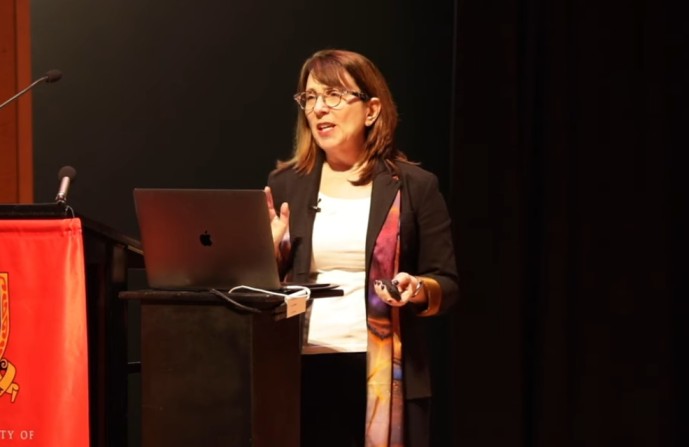
Editor’s Notes: In this provocative lecture, renowned neuroscientist Dr. Lisa Feldman Barrett challenges the traditional view that emotions are universal “fingerprints” pre-wired in our brains. She presents compelling evidence that common beliefs—such as the idea that everyone scowls in anger or that the amygdala is the “fear center”—are actually scientific fictions. Instead, Dr. Barrett explains how our brains construct emotions in the moment by combining past experiences with current bodily sensations and environmental context. This talk offers a revolutionary perspective on the secret life of the brain, revealing that we are the architects of our own emotional experiences. (Oct 14, 2020)
TRANSCRIPT:
Opening Remarks and Introduction
DR. LISA FELDMAN BARRETT: I want to start by thanking Sir Anand and Professor Neil Quigley, and Professor Alison Kirkman, and Amanda Till who organized all of us, the School of Psychology, and particularly Mary Anne Gary for inviting me here to talk to you today. It’s really a wonderful honor and I’m a little bit overwhelmed by the doctorate. I’m very grateful. It’s a very wonderful honor to have.
I should also do a little bit of self-handicapping before I start. It’s basically twelve thirty in the morning for me right now. And so I will thank you for your patience. If I seem to go blank in a moment, it’s just really because I’m probably searching for a word, which is probably buried deep inside my brain somewhere.
But I do want to thank everybody for showing up today and for your enthusiasm about the work that my lab has done. And to reward you, I’m going to give you a fairly provocative talk or what I hope is a fairly provocative talk. And perhaps challenge some of your deeply held beliefs about emotion.
Challenging Scientific Fictions About Emotion
I think we all know that there are lots of examples of fictions in science. We used to believe that the sun revolved around the earth. We used to believe that the earth was flat. And it turns out that many of our most cherished beliefs about emotion are fictions.
And so for the next thirty minutes or so, we’re going to have a go at squashing three of these fictions, and maybe put some real science in their place.
Fiction #1: Universal Facial Expressions of Emotion
And the first fiction that we’re going to take on this evening is the idea that emotions are expressed on the face in a characteristic way. So the idea is that we’re supposed to all smile when we’re happy. We’re supposed to frown when we’re sad. We’re supposed to scowl when we’re angry.
Everyone around the world is supposed to make these expressions and we’re all supposed to be able to recognize smiles and frowns and scowls as expressions of emotion. That was the dominant view in science for the last fifty years and it’s still a very, very popular view around in many parts of the world popular culture.
# Examining the Evidence
So let’s consider the evidence. And I should say, I’m going to present a little bit of data to you this evening because I am a scientist and if I, even in a public talk, if I don’t present a little bit of data, they’re going to take my PhD away. So we’re just going to consider a little bit of evidence.
And along the horizontal axis here, I’m just going to show you the expressive forms on the face that have been proposed as universal. And on the vertical axis, we will look at the proportion of times that people actually make these expressions in the proposed instances of emotion. So how often do people actually scowl when they’re angry? How often do they smile when they’re happy? And it turns out, not so much.
These data come from meta-analysis, which is a statistical summary of published research, and what they show is a very consistent pattern. So let’s take scowling and anger, for example. Approximately twenty-eight percent of the time when we measure how people move their faces when they’re angry, they scowl. That’s above chance. It’s more than what you would expect by chance, so that gets you a publication in a peer-reviewed journal.
But what it means is that approximately seventy percent of the time, people are doing something other than scowling when they feel angry. They might be crying, they might be smiling, they might be sitting with a very still face plotting the demise of their enemy. This is what scientists would call low reliability. Meaning, you don’t move your face in a random way when you’re angry, but you rarely scowl. Actually, you might smile, I don’t know.
If you think about it, when you think about actors, for example, how often do they win acting awards for scowling and anger? It’s not a really common thing in even in western cultures where expressions were supposed to have evolved.
# The Question of Specificity
We can also ask the question, well how often do people scowl when they’re not angry? This is the question of specificity.
So it turns out people scowl for lots of reasons. They scowl when they’re concentrating. They scowl when they’re confused. They scowl when someone tells them a bad joke. They scowl when they have gas.
People scowl for a lot of reasons when they’re not angry, which means that scowling is not a very specific expression of anger. So people sometimes scowl when they’re angry, but not often. And they scowl at times when they’re not angry, which means low reliability, low specificity, and this is true for every proposed expression that has been suggested where there’s been a suggestion that they’re universal, that these expressions are universal.
# Perception vs. Reality
But compare these findings to these findings. These are the proportion of times that when test subjects are given these posed faces with a set of emotion words, and they’re asked to pick the word that matches the face. This is the percentage of time that people label these as expressions. When I say people, I’m first going to be talking about people who live in large urban settings as opposed to people who live in very remote cultures.
So people typically label these faces, perceive these faces as characteristic expressions of emotion even though people don’t actually make them very frequently.
Cross-Cultural Research Findings
So between the nineteen sixties and 2007, actually, there’s a map up there. Can you… I think it’s not… It’s on my screen but I don’t think it’s showing on the screen up here. That’s very strange. Well, imagine a map of the world. That’s what you’re looking at.
And what I’m showing you here are the locations of four samples that were collected where Paul Ekman and other scientists traipsed out to very rural parts of Papua New Guinea in the nineteen sixties, and showed people these posed expressions and asked them to match these expressions to little stories about emotion. Like “Bobby’s dog died, Bobby is sad, pick the expression that Bobby would make.”
And in those studies, they found that people in Papua New Guinea, very remote cultures, cultural context where people didn’t have that much access to western cultural practices and norms, they found that people matched the face to emotion stories at the same, about the same proportion as occurred in the United States in urban samples. And based on these four, based actually on three samples out of these four that were published in two peer-reviewed papers that constituted the strongest evidence for universal expressions until 2008, when these studies were published.
# More Recent Research
Also you have to continue to imagine the… I’m happy to actually show if any of you are real scientists, you want to really see that there really is a map actually on the screen. I’m happy to show you. But really in this period, many many more samples were taken across many many more cultural contexts including hunter gatherers in sub-Saharan Africa by my lab. And what we find is very consistently no evidence at all of any universal expressions.
So in these cultures, people don’t typically scowl in anger or label scowling faces as angry, even necessarily above chance.
# The Case of the “Fear Face”
And I’ll just give you one example because I think it’s pretty interesting. This is the stereotype, the predicted expression of fear that is supposed to be universal. I should point out that many cultures actually have ideas about universal expressions. If you compare them though, in China, in India, in the US, also historically in France, in Germany, all of these different cultural contexts have their own set expressions that are supposed to be universal and they actually don’t look very much like each other.
This face is supposed to be the universal expression of fear. And here what I’m doing is I’m just coding for you what are called the action units, the facial action units, the muscle movements of widening, of raising the eyebrow, inner and outer eyebrow, and widening the eye.
And what’s really interesting is in the Trobriand Islands in Papua New Guinea, this is actually considered to be a threat face or an anger face. So in studies by Carlos Crivelli and his colleagues, thirty-nine percent of test subjects in the Trobriand Islands labeled this as a fear face, which is more than chance. But fifty-six percent labeled it as an anger face. And in another study, I think nine percent labeled it as a threat face.
And the reason why I pointed this out to you is that the Maori warrior face actually has the same action units in the eye region as this stereotypic fear face from western culture. So I think it’s a really good example actually of variability in facial expressions of emotion.
Context Matters
So the punch line here, if we were to summarize hundreds and hundreds and hundreds of studies would be this. If we look at this girl’s face out of context, she looks sad or grieving or maybe in pain. But this actually is my daughter Sofia from a couple of years ago when we were in Cologne, Germany at the chocolate museum. She’s on her second chocolate drink, and I would describe her emotional state as profound pleasure.
This little sweetie is also feeling profound pleasure. And so the lesson here is that different instances of the same emotion category can be expressed with very, very different facial expressions.
And if we just look at this little guy’s eyebrow region, we can see that it looks very similar to this guy who is usually seen as absolutely enraged. But actually, in context, you can see he’s absolutely elated.
And in the US, when I use this image, I like to use this image because this is a picture of Jim Webb, who in 2006, won the senatorial race in Virginia and returned the US senate to democratic control. So when I’m in the US, I usually invite people to just simulate what that would be like for a minute. And without context, his face looks angry because this is the symbol of anger, western symbol of anger.
The Brain is Guessing
So not only do people move their faces in very different ways during instances of the same emotion category, they also move their faces in exactly the same way in instances of different emotion categories. We all do this.
And so what this means is that when it comes to emotion, a face does not speak for itself. When you see emotion in another person’s face, it feels to you like you’re reading emotion in their face. But actually, your brain is guessing what the facial movements mean. And this guessing occurs very automatically with very little effort on your part.
And even if you’re someone like me who believes, is very confident that you can read emotion in someone else, really your brain is just guessing. It’s important to be humble about these things. Because this is how a single physical feature like the curl of a lip, or the raise of an eyebrow, or the tilt of a head can take on very, very different emotional meanings in different contexts.
The punch line for tonight is going to be that variation is the norm. This is true when it comes to facial expressions of emotion. And as we see, it’s actually true when it comes to any kind of measurement that we take related to emotion.
The Origin of Stereotypical Expressions
And so, where do these… Like what’s up with these expressions? Like where did they come from? Well, I can tell you that they did not come from observing how people move their faces in everyday life. These expressions were stipulated. So some scientists got together and said, “We think this is what the expression of anger is universally” and then built an entire science around these faces.
The majority of studies that are published on emotional expressions actually use these faces. And with the data, the pattern of the data, what it shows us is that these are stereotypes. They represent people’s beliefs about how we express emotion on the face but not actually how people express emotion which is much more highly variable. They’re stereotypes.
Why This Matters
So why does this matter? Why does it matter that science has employed these stereotypes? Well, one reason is that if you walk into any preschool in North America and even in… I’m not actually sure if it’s true here, it’s certainly true in Europe. You will find games and puzzles and books and posters that teach children these stereotypes. So basically, we’ve been teaching little kids stereotypes as if they are the real phenomenon for the last fifty years.
And not just to little kids. This represents what’s in every introductory psychology textbook that’s currently in print. It’s also what we teach to our patients. So autistic children, children on the spectrum, people who are struggling with schizophrenia are taught these as the expressions of emotion.
And also the media has been very puzzled to learn that these are actually not universal as claimed.
The Danger of Emotion-Reading Technology
And also there’s a growing economy right now of emotion reading gadgets, apps and algorithms. Tech companies who are claiming that they can read emotion in people’s faces just by electronic means. This is a really serious issue because some of this technology is being rolled out in classrooms to determine who gets access to educational opportunities. It’s being used in hiring practices in companies around the world. It’s now also being used in legal contexts.
And it’s really serious because those companies who are claiming that they can detect emotion in people’s faces are conflating the ability to detect a movement with what that movement means psychologically.
The Limitations of Emotion Detection Technology
So the best technology right now under ideal conditions, which means a full frontal exposure under perfect lighting conditions, can do a really good job of detecting a scowl, but not what that scowl means. And so companies are making claims about detecting emotion when really what they can detect are facial movements. Not necessarily what the movements mean.
And I should point out, I actually think that from a scientific standpoint, one of the most serious issues here in addition to the fact that it’s maybe prematurely being used in these contexts which can actually determine people’s outcomes, is that we’re missing a really important opportunity. Because companies are spending millions of dollars and person hours of the cleverest people on this planet asking really simplistic questions with really powerful technology that actually could be used to learn finally something about the variability with which we all express emotion in our faces in different contexts.
Myth Two: Physical Signatures of Emotion
DR. LISA FELDMAN BARRETT: The second myth is the idea that each emotion category comes with its own signature of physical changes in the body. So this is the idea that there’s a signature of changes in the heart, changes in breathing, changes in sweating and so on that are distinguishable for each emotion category.
So again, I’m going to show you a little bit of data. This time, again from a meta analysis which is a statistical summary of published research. So here I’m showing you an analysis that my lab did on over two hundred studies using I think over twenty thousand test subjects.
Asking the question whether there are patterns of changes in physical changes in the body that correspond or map to distinct emotion categories. And so on the horizontal axis, I’m showing you the average amount of change in the physical signal compared to baseline, a resting baseline. So how much did a person’s heart rate change? How much did the amount of blood pumped by the heart change? How much resistance or how much were blood vessels constricted versus dilated and so on.
So along this y axis, the vertical axis here, just list the measures of the autonomic nervous system that are typically used. And so here, the shape here represents the average change, for example, in a neutral induction where we’re showing people images or playing the movies or having them remember instances that are intended to keep them neutral, feeling very neutral.
And so the size of the shape indicates the number of studies that were available to be summarized. So for example, for heart rate, what we see is that on average, it’s less than a ten percent change. But the wings here represent the degree to which the findings vary across studies.
So for the scientists in the audience, this is a ninety five percent confidence interval. And so what you can see is that on average, heart rate goes up a little bit but actually in some studies it goes down and in general we would say this is not different from zero because it crosses, the wings cross the zero line here.
In fact, in all of the neutral in all of the studies which use a neutral induction, on average, there’s no real physical change. Although sometimes in a given study, a person’s physical changes might be higher than baseline and sometimes might be lower. And so if there’s actually a pattern here that’s distinct for each emotion category, what we would expect to see is that the shapes don’t overlap and neither do the wings.
The Overlap of Physical Responses Across Emotions
So we want to see real distinctiveness, but that is actually not what we see. So here are the findings for anger. So what this means for example is on average, blood pressure goes up about thirty four, thirty five percent. Actually, sorry, that’s a percent change over baseline.
So on average blood pressure goes up, but sometimes it goes up a lot and sometimes it goes up a little. And here are the findings for fear and disgust and sadness and happiness. There’s complete overlap. This doesn’t mean that your body does random things in emotion. What it means is that sometimes, when you’re angry, your blood pressure goes up a little and sometimes it goes up a lot.
Sometimes when you’re sad, your heart rate goes up a little and sometimes it goes up a lot. Sometimes when you’re fearful, your heart rate goes up a little and sometimes it goes up a lot. Basically, there’s nothing predictable here about an individual physical signal or a pattern. So even if you use machine learning techniques, there’s really nothing distinctive here. And if you think about it, again, variation is the norm.
Think about when you’re happy, for example, what are some things that you might do? You might take a walk in the woods. You might lie on a beach and relax. You might bake cookies for your friends. You might do yoga. You might gossip. I mean, you might chat with a friend having coffee. You might garden.
In each of these cases, the physical changes in your body are going to track your actions or your prediction actions. This is something that has been known in physiology since the nineteen seventies.
And so, if you engage in different actions during instances of the same emotion, happiness, then your body will be doing different things as well in those instances. And similarly, it’s not just the case that your body will do different things in instances of the same emotion category. It’s also the case that your body can do the same thing in instances of different emotion categories and sometimes even in instances which are not considered to be emotions.
When Physical Signals Are Misinterpreted
For example, it’s very common for people, particularly women to have a racing heart and make sense of those sensations as anxiety, go to an emergency room. The physician in the emergency room will interview the woman, determine that she is anxious, send her home, and then she dies of a heart attack later.
This is actually more common. Women actually over the age of sixty five die more frequently than men from heart attacks because when a man appears in the emergency room, there’s more interrogation about whether or not he is having a, whether or not his anxiety symptoms are actually authentically a predictor of an impending cardiac event.
And this actually happened to my publicist in the UK for my book. Her mother died this way. And there’s a really interesting story that my friend Jim Cohen, who is a psychophysiologist, I might add, what happened to him was something very similar to this.
And he tells the story, I should say, he tells the story much better than I do on his podcast Circle of Willis in I think last year’s Halloween version or story. He tells the story, but basically, he was having a racing heart and sweating a lot and having what his brain was making sense of as anxiety symptoms. And he went to his doctor and his doctor said, “Oh, you’re just feeling really anxious.”
And so he went home and laid down with his racing heart and his sweaty palms. And as he was drifting off to sleep, he remembered a conversation that he and I had about this idea, the findings that a physical signal like a racing heart doesn’t have inherent emotional meaning.
Can be made, your brain can make sense of it as part of many different emotion instances and sometimes even be mistaken for, it’s exactly the same physical signal but it’s indicating an impending cardiac event. And so on his podcast I was telling him the story about my publicist mother. He was stripping off his sleep and realized, maybe I should go to the hospital and just have this checked out.
And so you know, if they send me home, because I’m having anxiety, I’ll be a little embarrassed but at least I’ll have some peace of mind. And so he went to the hospital and they checked him out and they couldn’t find anything wrong.
And this is the point at which they would have sent him home if he had been a woman. But the pain was getting worse, his chest was the anxiety was intensity less and becoming more intense. And so the emergency room doctor said, “Okay, just wait a second, I’ll go get the cardiologist.”
And as the cardiologist was walking into the room, he had what doctors call the widow maker. He had a massive coronary, and if he had been anywhere else, he would be dead.
The Brain Constructs Emotion
The moral of the story here is that emotions are not written in your body. They are constructed by your brain. So the body does not keep score. Your brain keeps score, and it directs your body, and it makes sense of the sensations that come from your body.
And this is the way that an ache in your stomach can be anxiety, if you’re waiting for a test result. It can be hunger, if it’s dinner time. It can be longing, if you miss someone who’s close to you, and it can be a gut feeling that somebody is guilty if you are a judge or a juror in a trial. Your brain is basically making physiological changes meaningful as emotion.
And if we think about how the brain works, we can see that these findings make a lot of sense. Basically, your brain’s job really why I mean, brains evolved for many reasons, but the main reason that brains evolved is to control the body.
So your brain’s main job is to budget the internal resources of your body like water and salt and glucose and hormones and so on to keep you alive and well. So, you know, you can do nature’s most important job, which is to pass your genes on to the next generation.
And this continually budgeting is largely invisible to you. It continues day and night from the moment that you’re born until the moment that you die, but you are not wired to perceive it. So right now, each of you is sitting there just enraptured by my words.
Body Budgeting and Mood
And you are largely unaware, unless you’re very hungry because it’s dinner time, you’re largely unaware that there is a whole drama going on inside your body. You’re just not wired to perceive it because, which is good actually, because if you were, you would never pay attention to anything outside your own skin ever again.
And so what evolution has fashioned you with is not exquisite sensitivity to the internal, the sensations that come from budgeting, this budgeting process, but something like more general. So basically, if vision seeing is like high definition television, then your ability to detect your sensations inside your own body is more like black and white nineteen fifties television reception during like a bad rainstorm.
It’s just you have this fuzzy sense of feeling pleasant or unpleasant, feeling worked up or feeling calm. It’s basically like this general barometer that everything is copacetic and good with your body budget or maybe you are running a deficit and you’re feeling kind of crappy. And we have a very fancy name for that, we call it mood.
So mood is again, your brain is always running a budget for your body. It’s always calculating what to spend and what deposits will come. And so mood is always with you as well because it is the way that your brain makes available to you the state of your body budget.
And so sometimes you feel really calm and good, and sometimes you feel really crappy. Sometimes you feel really worked up. This is basically like a very quick kind of back of the envelope signal without much detail. Actually scientists call this affect. So affect and mood are really the same thing because you know something is really important in science when it has more than one name.
And your brain basically, so when you feel crappy, what do you do? Well, probably lots of things, right? It depends on the context. And so the point is, there’s really not enough information. It’s not like affect or mood, it’s not like a smartwatch that tells you whether you should eat or whether you should have coffee or whether you should have a nap.
It doesn’t really tell you anything other than something is wrong and I should probably do something about it. So what your brain really has to do is link those sensations it’s experiencing as affect to the context to try to figure out what caused them. And that really is what results in an emotion, but not always. Sometimes your brain makes sense of those sensations and that mood in a different way.
And so understanding that is important, particularly the next time you visit the doctor.
Myth Three: Dedicated Brain Circuits for Emotion
The third myth that we’ll tackle today or fiction is the idea that there are dedicated circuits in the brain for emotion. So emotions feel like they happen to us, like they’re taking over our behavior and causing us to do or say things that we probably wish we hadn’t a lot of the time.
And so this experience of being taken over really makes it seem to us like we have some kind of inner beast that is like these circuits for emotion that are just baked into our brains at birth. And that something in the world will just trigger one of these circuits and then an emotion will erupt and take over our thoughts and our actions.
But if there’s one thing that we know about the brain after all this time, it’s that our subjective experience doesn’t really reveal to us how a brain works, how your brain works or really how any brain works.
The Amygdala Example
So let’s take one example. We’re going to just talk about the amygdala. So here what you’re looking at is what’s called a coronal slice of the brain. So this is the top of the brain, this is the bottom. And so this is the image if you took a slice of the, if you sort of sliced into the skull like this, and you just popped open the front, and you looked in a mirror, and you wiped away all the blood.
That’s, come on, that was funny. I mean, you go ahead. Thank you. That’s what you would see. And you actually have two amygdala which are clusters of neurons on each side of the brain. The amygdala, how many of you here have heard of an amygdala?
The Amygdala: Not Just the Fear Center
Yeah. It’s like the rock star of the brain. Everybody, you know, if you read in the newspaper an article about the brain, the likelihood is over seventy percent of the time it’s usually a story about the amygdala. And the amygdala is supposed to contain, or many people, many scientists thought for a very long time that the amygdala contained the circuitry for fear. So again, a meta analysis.
This time, we’re looking at the proportion of studies which show an increase in amygdala activity during instances of fear. And what we see is about thirty percent of the time in experiments where people are experiencing fear while having their brain scanned, we see an increase in activity in the amygdala over baseline. So again, that’s better than chance. Right? That will get you a PNAS article in the Proceedings of the National Academy of Sciences in the US.
But that means seventy percent of the time, there’s no change in your amygdala when you’re feeling fear, if these studies generalize to public. And that means that’s really much more than we would expect by chance. And actually, so lower liability. And actually, every emotion that’s ever been studied in a scanner shows an increase in amygdala activity some proportion of the time, which is more than chance. And actually, we see amygdala activity increase all the time in the scanner in studies that have nothing to do with emotion at all.
So for example, if I just stick you in a scanner and I show you images of faces or just scenes that you’ve never seen before, your amygdala will go nuts. In fact, shortly I’m going to show you an image which I would love to have portable brain scanners to scan all of you while I show you this image. Because this is anytime your brain doesn’t know what it’s looking at, doesn’t know what it’s hearing, can’t identify, either because it’s ambiguous or it’s uncertain, your amygdala basically is like a sentinel which signals to the rest of the brain, “please learn this. Please take in this information so that I can better predict and better understand what this signal is the next time.”
And every study that’s ever proposed a specific brain region as the home of an emotion circuit, we see evidence like this, which is lack of specificity and low reliability. Again, that doesn’t mean that emotions don’t live in the brain and it doesn’t mean that all of this is random. What it means is again, that variability is the norm. And this is true whether you’re looking at brain imaging studies or even looking at structural studies of people with amygdala lesions.
The Case of Two Sisters
So here what you’re looking at are two structural images of the brain. These are two sisters who are identical twins. So they have a hundred percent of their genetic material is the same. And both of these sisters at the age of twelve, their amygdala is calcified. So what you’re looking at here is what’s called a horizontal slice, which is if we slice the brain that way and we pop off the top and look down, this is what we see without the pretty colors. This is the front of the brain here and this is the back. So, and the colors are really where the amygdalas used to be before they were destroyed.
Sister BG has difficulties experiencing fear except in the most extreme circumstances. She can experience fear but in average everyday experiences, she doesn’t experience fear. And she also has a hard time seeing fear in the faces of other people. But her sister, who has exactly the same damage and exactly the same genes and very, very similar experiences has no problems experiencing or perceiving fear at all. Her brain has learned to make fear in a completely different way, which brain imaging studies of her have confirmed.
So what this means is that you, when you feel fear, your brain does different things at different times. Just like you will express fear differently on your face at different in different contexts. And your body will have different changes during fear depending on the actions that you take and the situations that you’re in.
Brain Patterns and Machine Learning
And if we look at brain imaging studies, which use pattern classification, so that is we’re using machine learning to try to find the pattern for fear. Here is a lateral view of the brain which is blown up so like a balloon so you can see all the parts of the cortex. So the cortex usually is very foldy. And so this is just blown up so you can see all the gyri and sulci. And so this is the lateral view. So you would be looking on the outside like this with the front of the brain here and the back here.
And this is a medial view of the brain. So if you take the two hemispheres and you crack them open like an egg, you’re looking at the inner surface of one inside surface of one hemisphere. So this is the front and this is the back. In my lab, we took that meta analysis and we used machine learning to try to find the pattern for fear in all of the studies. Actually, for fear and anger and sadness.
So here, I’m just showing you the pattern for fear. And here’s another pattern from another study. Here’s another pattern from another study. Now, it’s tempting to think that this is just a lack of replication. But really what it is, is evidence that variability is the norm.
And not only that, but each of these patterns is not a brain state. It’s actually just a statistical abstraction. Meaning, nobody necessarily has to show this pattern of activity during fear in order for this pattern to classify that person’s experience as fear a hundred percent of the time. Basically, these are like averages that don’t apply to any specific individual. They’re just a summary.
So an analogy would be, if there are 3.13 people in the average family in a country, that doesn’t mean that every family has 3.13 people in it. In fact, no family has 3.13 people in it because it’s a statistical abstraction. And that’s what these are too. These are not brain states. They’re statistical abstractions.
And this is actually a finding that’s very consistent with what we understand about how variability works actually which comes from Darwin. So emotions are complex constructions in the brain that vary by context. They are not simple circuits. You do not have mythical emotion circuits buried deep inside some animalistic part of your brain, even if it feels that way sometimes. Your feelings are not a guide to how your brain works.
Debunking the Reason vs. Emotion Myth
And furthermore, the brain is not a battleground between reason and emotion. So there’s been this recurring sort of like one of the most cherished narratives in western civilization is that the brain is a battleground between thinking and feeling. And that the two kind of belted out in control of your behavior. And so there are parts of the brain for emotion and parts of the brain for reason or rationality, and the two are constantly in battle with each other. That’s just actually a complete fiction. Complete fiction.
So how many of you have heard that you have a reptilian brain? Like an inner reptile. Yeah. And maybe also a limbic system which wraps around that reptilian brain. So the idea is that you’ve got these urges that are in your reptilian brain and that’s enrobed by emotion in your limbic system. And so the limbic system was supposedly evolved in mammals. And then there’s this prodigious neocortex which is all new and the home of rationality and very, very big in humans.
That is a story that actually we can trace all the way back to Plato. And what’s really interesting about this story is that it was popularized by Carl Sagan in the 1970s in the Pulitzer Prize winning book, “Dragons of Eden,” at exactly the same time that neuroscientists who were using molecular genetics, that is typing of neurons by their genetic profiles, were demonstrating that this is false.
But if you look in books about emotion, like popular science books, if you read the newspaper, if you ever take a leadership training course in industry, if you read anything about emotional intelligence other than what I’ve written, you will learn that your neocortex is controlling your inner beast.
And what about system one and system two? These are Tweedledee and Tweedledum, talked about in the award winning book “Thinking Fast and Slow” by Nobel Prize winner Danny Kahneman. The idea here is that system one is this really quick, automatic, emotional system. And system two is this more deliberate, rational system.
Well, if you actually look in “Thinking Fast and Slow,” Danny Kahneman is really, really clear that this is a metaphor. It’s a metaphor for the fact that sometimes we do things on autopilot, and sometimes we do things that have a sense of effort. But he never really meant to say, and in fact, he’s very clear about this expressly in the book. And in my book, I actually list the page number where he basically says, “this is just a metaphor.”
Nonetheless, many neuroscientists and many, many journalists talk about these as actual systems in the brain. When in fact what they are, are modes of processing in the brain. This is important because still in the law and economics, there’s this idea of this battle between the more reasoned rational and the more flighty emotional systems. And that really has to be modified to be accurate with the neuroscience that we know.
How Emotions Are Actually Made
So what do we know about emotion? Well, we know that emotions are not built in to the brain from birth. They’re built by the brain as we need them. And rather than show you a ton of evidence, which is described in the book and also in web notes that go along with the book, I’m just going to give you an experience that hopefully will give you an intuition for this.
So take a look at this. Right now, actually your amygdala should be going crazy even though you can’t sense that. Because your brain is trying to guess what this might be. Like what is it? So what do you see here? Anybody? Anything? Okay.
AUDIENCE QUESTION: A Simpson character.
DR. LISA FELDMAN BARRETT: Yeah?
AUDIENCE QUESTION: Snowman.
DR. LISA FELDMAN BARRETT: Sorry?
AUDIENCE QUESTION: Snowman in eyes.
DR. LISA FELDMAN BARRETT: So basically, your brain is searching through your lifetime of past experience, issuing thousands of guesses, weighing probabilities, trying to answer the question, “what is this most like?” Not what is this, but what is this most similar to in my past experience?
Now, in psychology, a group of things which are similar to each other is what we call a category. And a mental representation of a category, how your brain represents a category, is called a concept. So what your brain is doing right now is it’s looking at these blobs and it’s trying to form a concept so that you can see an image instead of black and white blobs. It’s asking, “what is this similar to in my past and what was it the last time I saw it or something like it?”
But of course, you’ve never seen anything like it, most of you, unless you’ve watched one of my talks on YouTube. And so what you’re experiencing if you can’t see anything other than blobs is called experiential blindness. And so now I’m going to cure you of your blindness. Are you ready to be cured of your blindness? Are you ready to be cured of your blindness?
AUDIENCE: Yes.
DR. LISA FELDMAN BARRETT: Come on, I want to hear it.
AUDIENCE: Yes.
DR. LISA FELDMAN BARRETT: Okay, here we go. I’m going to do it again. Alright. Now, how many of you see a bee or part of a bee? Yeah. Because now, when your brain searches through your past experience, there’s new knowledge there from the color photograph. And that knowledge that is in your head changes how you experience these blobs.
The blobs, the visual input from this image is exactly the same as it was before. But what you see, what you literally see is a combination of the information from the screen and the information that is now in your head. Because your brain is making sense of this information so that you see lines that aren’t there to see an image that actually is not present.
The Brain as Predictor
So when you experience an increase in heart rate as anxiety or as determination, like “I’m going to get my butterflies flying in formation and knock this test out of the park,” your brain is categorizing, making a concept that will make sense of the sensory inputs. Just like it’s making the sense of the visual inputs from this image to see something that actually isn’t physically present.
And this kind of a hallucination is actually how it’s like business as usual for your brain. And we need a very special set of examples to demonstrate this to you. Basically, this is what your brain is doing all the time. It’s making sense of sensory inputs from the world and from the body to basically construct your experience and guide your actions. And this is your, this is business as usual for your brain.
The Brain’s Construction of Emotion
This is really how your brain makes all your experiences and basically guides all your actions. When your brain, so for example, now that you can see this as a bee, if I had you hooked up to monitors, if your brain was drawing on past instances of fear because maybe you were stung by a bee, then your heart rate would go up, it would speed, you’d start to sweat, even if I just showed you this image like this.
However, if your brain was drawing on past instances of say interest because you were a beekeeper or maybe pleasure because you’re a gardener, then you would have a completely different physical reaction because your brain is making sense, is constructing a concept to make sense of those sensations that come from that image and make it meaningful so that your brain knows what to do, how to control your body and what you should do next.
So physical changes in your body have no inherent emotional meaning. Your brain basically makes physical changes in your body meaningful as emotions by constructing a concept for emotion which is tailored to the specific situation that you’re in, in a given context.
So your emotions are not your reactions to the world. They are your constructions of the world, or more precisely, they’re constructions of what your bodily sensations mean in a specific context or situation that you are in. So your brain is creating emotion when it links or explains the internal sensations of your body to what is going on around you in the world, so that your brain knows how to keep you alive and well.
And so the bottom line here is that the emotions that seem to happen to you are actually made by you. They’re made by your brain pretty automatically without any sense of effort or agency on your part.
Reading Emotions in Others
And the emotions that you seem to read in other people are actually coming in part from inside your own head. When you see a smile as anger or happiness, it’s because your brain is guessing what that physical signal means in context. And that context includes not just the surrounding situation, but also your own body. Because your body is basically a context for your brain that you carry around with you everywhere you go.
You are in more than just a metaphorical way, you are an architect of your own experience. And that means, you don’t have a hundred percent control over what you experience and you don’t necessarily have a modicum of control in the moment. You can’t just snap your fingers and change how you feel. That’s really hard. But you do actually have more control over constructing your experience and being the architect of your experience once you understand a little bit about how your brain works.
And so if you want to learn more about this, you can see my book or you can see my new book which is coming out in November, which is a little set of essays about the brain. Or you can go to my website. I have an academic website where all my publications are but this is a popular website where I have articles that I’ve written in the New York Times and for lots of magazines and videos and things like that.
And before I end, I just have to actually thank the real heroes here who are not the funding agency. Well, they partly are the funding agencies that support this work. But really, it’s lab that I co-direct with Doctor Karen Quigley, who is a psychophysiologist. So she sort of handles everything below the neck, and I handle everything above the neck. So together, we’re like one person.
And our fantastic team of graduate students and post-doctor fellows who actually are the real heroes here. They’re the ones who do all the hard work. I just get to have the fun to stand up here and tell you about it. And thank you very much for your attention.
Q&A Session
MARY ANNE GARY: Hello, everyone. I’m Mary Anne Gary from the School of Psychology. And just before we get started, thank you very much for that terrific lecture. Also, psychology is the coolest subject, so send your children to the School of Psychology. It is. Am I right? It’s totally right. Thank you very much. She’s happy to take some questions. I really have a lot of trouble seeing right now. So if you would like to ask a question, please do. Just yell. Yes. Oh, yes. Hello. Go ahead.
DR. LISA FELDMAN BARRETT: I just need to, yeah. Really, it doesn’t work from an angle. You have to actually see it head on really in order for it to work. But let me tell you a different, let me give us, I mean, that actually is the real answer, but let me give you a different kind of answer.
So I have a lot of these images. They’re called Mooney images and they’re basically blobs and then it’s very hard. They have them online. There’s like one of a dalmatian in a snowstorm and a cow. That should be, you guys should like that because cows are big news around here. Aren’t they? I mean, stereotypically, have to tell you I was expecting sheep, but now I’ve learned better that this is the dairy capital.
But my point is that so I have one that we made. We do experiments with them and it was actually a snake. It’s a snake. And so, I did the thing like I showed the blobby image and no one knew what it was. And then I showed the snake and then people could see the snake.
And then this woman came up afterwards and she said, “Can you tell me what’s wrong with my brain?” And I was like, I don’t know. I don’t know if I can tell you what’s wrong with your brain. And I said, “Well, what’s the problem?” And she said, “Well, I saw first in the blobby image I saw a Louisiana swamp. And then, when you showed the snake image and then you took it away, I saw in the blobby images I saw a snake for like one second and then it went back to being a Louisiana swamp. What’s wrong with my brain?”
And of course, at that point, what I wanted to say there is, how is it that you’re from Louisiana and you have no accent? But, I did not ask that question. Instead, what I said is, “Well, how long have you lived in Louisiana?” And she said, “My whole life.” And I said, “Well, here’s what’s happening. What we would call your priors, your prior experience for seeing a swamp is very strong. And I just showed you an image for like what? Like ten seconds if that? And so, that prior is very weak.”
And so, the point here is that your brain doesn’t just, isn’t just constructing representations from past experience, it’s also weighing the probabilities or the likelihood that that concept will actually explain those sensations. And that’s true pretty much no matter what you’re looking at or hearing or smelling, or what you’re feeling.
But the real answer here is that you probably from the side, that image is meant to be viewed really head on, and probably from the side, it’s actually very difficult for that illusion to work. But what I would suggest is we should try it. Like when we’re done, you should go to the back there and I’ll do it again, and you’ll see if you see it.
I mean, I’ll believe you if you tell me that you, sometimes people can’t see the whole image, but they can see maybe the thorax. Or they might be able to see the wings or they might just be able to see the antenna. Sometimes you have to leave it up there for much longer than you have when you’re under a time limit and you only have, and you’re already running late. So, it could just be that actually as well. Yeah.
Memory and Emotion Recognition
AUDIENCE QUESTION: Does having a memory contribute to recognizing emotion in others or making it easier for you to?
DR. LISA FELDMAN BARRETT: Well, so, what I want to say is what that means, what having a good memory means colloquially is not what I’m talking about here, when I talk about memory. So, usually what we say having a good memory means that you consciously either have some sense of familiarity with what you’ve seen or you consciously acknowledge that you make a judgment that you’ve seen it before. And that’s not really the same as what I talk about when I’m talking about memory.
Basically, your brain is always using the past, using past experience in order to make sense of the present. That’s actually how your brain works. So, and you’re, so your brain is always remembering in a sense. But, you don’t have an awareness of that happening.
So, I guess the better way to say it is that memories aren’t stored in your brain and we don’t pull them up when we remember. Really, what your brain is doing is it’s reconstituting past experience in the connections between neurons. And as far as I know, no one’s ever tested memory in that way to answer your question. It’s a great question.
What I can say is that conscious recollection has no relationship to the facility with which or flexibility with which you experience emotion or a range of emotions which we call emotional granularity or perceive emotion in others. But what you’re talking about or the way we would understand memory in the way that I just described it, I think that’s an open question actually. It’s a great question. Yes.
The Myth of the Three-Layered Brain
AUDIENCE QUESTION: Three layers of the brain. Yeah. So what are we left with?
DR. LISA FELDMAN BARRETT: Oh, well. You have to read my new book actually. So but you know, here’s the thing. I do talk about this in “How Emotions Are Made” actually, a little bit. And then part of the reason why I wrote “Seven and a Half Lessons About the Brain” is that there’s a lot of really good stuff in “How Emotions Are Made,” I think. Really good science. Not my science like other, I’m writing about other people’s work. Like really cool stuff which largely doesn’t get a lot of attention because, you know, because there’s a lot of stuff in that book.
And one thing that got really overlooked which was driving me kind of nuts was this idea that we have, you know, sedimentary, a brain that like is like sedimentary layers. You know with the cortex which is like icing on an already baked cake. So, the actual story is way more interesting and cool than that narrative which is false. I mean that narrative is basically Plato tattooed on the brain. Right? That you have urges and instincts, you have emotions like two wild stallions, and then you have a charioteer who’s like trying to control them. That’s Plato. That’s really what the triune brain is.
But, what really is true seems to be something more like the following. Every, well certainly every mammal that’s ever been studied, every mammal brain, and probably every vertebrate brain on this planet has exactly the same kinds of neurons, exactly the same. But as brains get bigger, they reorganize.
So a bird brain, for example, doesn’t have a cortex, cerebral cortex, but it has neurons, the same neurons that we have. But our neurons are arrayed in the cerebral cortex. Theirs is not. But still there are birds who can do really, who have language, rudimentary language, who can do pretty complex problem solving. And they are, their neurons are wired and function to some extent like parts of our cerebral cortex.
So, the really cool thing is that if you, this is work by Barbara Finlay, who’s a neuroscientist, a developmental and evolutionary neuroscientist. And what she has shown pretty remarkably is that over two hundred instances in brain development from an embryo all the way to past birth occur in exactly the same order. But in some species, certain stages run for longer which means more neurons are born at the end so the brains reorganize.
And so, it looks to us if we use a naked eye, like a reptile, like a lizard doesn’t have a cortex. But actually, a lizard has every kind of neuron that you have in your brain. It’s just organized differently. And I’m not saying that that means that, you know, lizards have exactly the same functions that we have, that we can do. But what I am saying is this idea that you have some kind of inner beast which is preserved, and that rationality, your ability to rationally control that inner beast, that is a myth.
Rethinking Rationality
Rationality has nothing to do with controlling an inner beast. It has to do more with how your brain is running your body budget. Just to put it really simply, you know, depression, which you can think of as kind of a bankrupt body budget, is incredibly rational. What do you do when you’re running a deficit in your budget? You stop spending. What are the two most expensive things a brain can do? Move your body and learn something new, which is what you stop doing when you’re depressed. It’s actually very rational.
So, I just think what this means is we have to kind of reconsider what it means to be rational actually. But that myth just needs to go away, I think. One more question. Yep.
Darwin and Variation
AUDIENCE QUESTION: Wow. What a great question. You need to come to my talk tomorrow in the department.
DR. LISA FELDMAN BARRETT: So, here’s what I’m going to say, which is going to sound a little preposterous maybe, because there isn’t really enough time to fully develop it. But here’s what I’m going to say. The idea that variability is the norm actually comes from Darwin. Not Darwin’s book on emotion, which is basically a very anti-Darwinian book, frankly, which also I explain in my book. But from “On the Origin of Species.”
So, Darwin did this really remarkable thing. Everyone thinks the remarkable thing that he did was discover natural selection, and that is remarkable. But what he really discovered is that variation is real and that’s what natural selection acts on.
The Challenge of Studying Emotional Variation
So, what Darwin did is he observed. He was incredibly observant. And he observed birds, and he observed mollusks, and he observed variability in all these animals. And before Darwin, a species was considered to be like a perfect platonic type, and any variation in the individual is considered to be irrelevant error. Right?
So, you take like a cocker spaniel and it can vary in its size and in its coat thickness and its color and so on. And before Darwin, all of that variability was considered to be error. And after Darwin, that variability became important to explain. And in part, biologists realized this because he did the super careful observation and mapping of the variation. But in psychology, we never did that.
And we never did it for a lot of reasons partly because we didn’t really have the methods to do it. And now, we do. What we now what we don’t have is money. And that sounds funny, and I kind of mean it to be a little cheeky, but only a little. Because the point that I want to make is that the kind of science that we have to do is actually do very big like use big data observation and data analysis on individual people across time in different contexts.
And that is orders of magnitude more complicated and more expensive than what we currently do. Now, if physicists—So, basically, what I’m going to tell you is that your brain works like a complex system and your body. And what we know about complex systems, the best information that we have comes from physics and chemistry. If physicists were funded at the level of psychology and neuroscience that is related to psychology, no one ever would have discovered the Higgs boson. Ever.
The Need for Adequate Research Funding
So the question is really what could psychologists do with that kind of funding? Could we actually study emotion and learn something about the variability in—So, could I learn in you, for example, that you have a vocabulary of ten facial expressions that you make in various contexts when you’re angry, and maybe you have three for fear, and maybe you have eight for gratitude, and maybe I have twelve for anger. And maybe some of them overlap and maybe they don’t. Maybe they overlap because we’re both women and we’re both speak English and but you know—So, my point is that we have to do this kind of like really deep observation that respects and maps variation. And we have the technology to do it and we have the math to do it.
Now what we don’t have is the money. And like I said, that sounds cheeky but it really isn’t. If this is a question that that the public wants an answer to, then you know scientists have to have the ideas and they have to have the will to execute those ideas and they have to have the money to do the studies properly. And currently, we have two of those things, but we don’t have the third.
Closing Remarks
UNIDENTIFIED SPEAKER: Lisa Feldman Barrett, you are a rock star, warrior, scientist, changing the face of behavioral science. It has been a real thrill to have you here. I’m so happy. My students are walking around saying, she’s amazing. She’s much more amazing than you are. No.
I want to thank you for everything. And thank you all for coming. You can pick up a copy of Lisa’s book outside. She won’t be here to sign it for you, but you could bring it to Wellington on Friday where you can see her as part of the New Zealand Readers and Writers Week. Or you can bring it to my office tomorrow and I’ll sign it for you.
In a purple pen. Yeah. Yeah. Anyway, thank you very much. Stay selfish.
Related Posts
- Neil deGrasse Tyson on UFO Files, Trump & Alien Existence (Transcript)
- Professor John Lennox: AI Is Humanity’s Attempt to Make God (Transcript)
- What’s Changing, What Kids Must Learn w/ Sinead Bovell @ SXSW (Transcript)
- The AI-Generated Intimacy Crisis – Bryony Cole (Transcript)
- The Problem With Uploading Your Consciousness @Cosmic Queries #105 (Transcript)