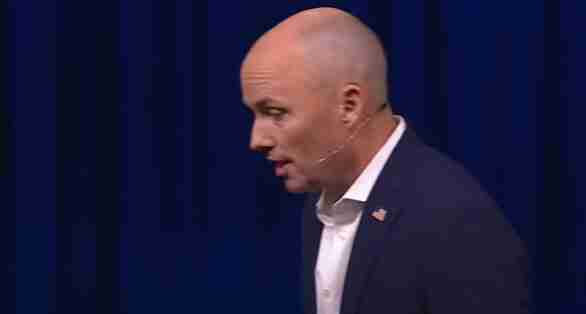
Here is the full transcript of Spencer J. Cox’s talk titled “How To Disagree With Respect — Not Hate” at TED Talks 2024 conference.
Listen to the audio version here:
TRANSCRIPT:
The Legacy of Ronald Reagan
In 1967, Ronald Reagan became the governor of the State of California. In his inaugural address, he talked about the peaceful transfer of power, something he described as “the simple magic of the commonplace routine, which makes it a near miracle to many of the world’s inhabitants.” He then went on to utter an iconic phrase that would be repeated by politicians for decades to come. “Freedom is a fragile thing,” he said, “and it’s never more than one generation away from extinction.”
Now like countless others, I have used that quote many times, but I have a confession to make. I never really believed it. Surely, after 250 years of this stuff, we no longer have to worry about losing it. I’m not pleased to report that I actually believe it now.
The First Cracks in Confidence
The first cracks in my confidence came during one of those commonplace routines of transferring power as Lieutenant Governor of the State of Utah. It was my duty to certify the votes of the electors for the presidential election. While the meeting to do so was open to the public, it was so commonplace and routine that no one ever showed up. As I walked into the room, I was stunned to see dozens of angry protesters screaming that the election had been stolen and demanding that we violate state law and change the votes of the electors.
Now I know what you’re all thinking, and you’re probably wrong. This was not 2020. This was 2016, and the protesters were Hillary Clinton supporters.
A Call to Action
Now it got far worse somehow, four years later. With the election less than two months away, a friend and I were talking and lamenting about the state of our country following a summer of destructive protests by the extreme left and an extreme right that was already undermining the validity of an election that hadn’t even happened yet. “Isn’t there something you can do?” she asked.
Well, that question haunted me all weekend, so I picked up the phone and called my opponent. By the way, I was running for governor at the same time that Trump and Biden were battling for the presidency. I called my opponent, a Democrat named Chris Peterson, whom I respected, and I said, “Hey, Chris, this is Spencer Cox. I have a crazy idea. What if we filmed a campaign ad together?”
A Collaborative Campaign Ad
I could almost hear the confused look forming on his face. To his credit, he agreed, and one week later, we were in a studio together. Let’s watch.
(Video Clip)
Chris Peterson: “I’m Chris Peterson.”
Spencer Cox: “And I’m Spencer Cox.”
Chris Peterson: “We are currently in the final days of campaigning against each other to be your next governor.”
Spencer Cox: “And while I think you should vote for me –“
Chris Peterson: “Yeah, but really, you should vote for me.”
Spencer Cox: “There are some things we both agree on.”
Chris Peterson: “We can debate issues without degrading each other’s character.”
Spencer Cox: “We can disagree without hating each other.”
Chris Peterson: “And win or lose, in Utah, we work together.”
Spencer Cox: “So let’s show the country that there’s a better way.”
Chris Peterson: “My name is Chris Peterson.”
Spencer Cox: “And I’m Spencer Cox.”
(Together) “And we approve this message.”
The Overwhelming Response
Well, the response was instantaneous and overwhelming. The ad went viral. Neither of us saw it coming. There were media requests from all over the world, millions of views and shares.
Perhaps there really is an exhausted majority, I remember thinking to myself, and maybe this is the message they want to hear. I could actually feel my faith in the American idea start to rekindle. The popularity of the ad validated my hope that most people really do want their political leaders to uphold the values that we teach our kids.
The Power of Respect
That we can disagree without hate and contempt, even that we can find ways to treat each other with respect even when we disagree. It seemed like there was a hunger for architects instead of arsonists. My hunch was confirmed one year later, when a professor submitted a version of our ad to the Stanford Polarization and Social Change Lab as part of a huge depolarization experiment.
Scientific Validation
It was chosen as one of 25 interventions to be tested on over 30,000 people. The result? Our ad actually had a measurable depolarization effect, including a reduction in urges towards violence. It turns out there really are things that we can do to alter the trajectory of the United States.
Now look, I get it. It’s easy to feel a little hopeless as Americans once again barrel towards an election with unsatisfying candidates and campaigns. But there is good news.
A Growing Movement
Over the past six months, 20 governors from all across the country have filmed similar ads, most of them with a public servant from the opposing party. And the data continues to show that people really are hungry for something different. According to polling from More in Common, 70 percent of Americans hate the divisiveness in politics.
And it also turns out that Americans aren’t as far apart as we think we are. The problem isn’t how far apart the average Republican and the average Democrat is on the actual issues. In fact, we’re not much different than other Western democracies.
The Perception Gap
The problem is how far apart we think we are. Due in large part to conflict entrepreneurs in both the media and politics, both sides overestimate the extremism on the other side by about 30 percent. Now interestingly, this perception gap is actually strongest amongst progressive activists on the left and amongst extreme conservatives on the right.
So the people most engaged in the political process also have the most inaccurate views of the other side.