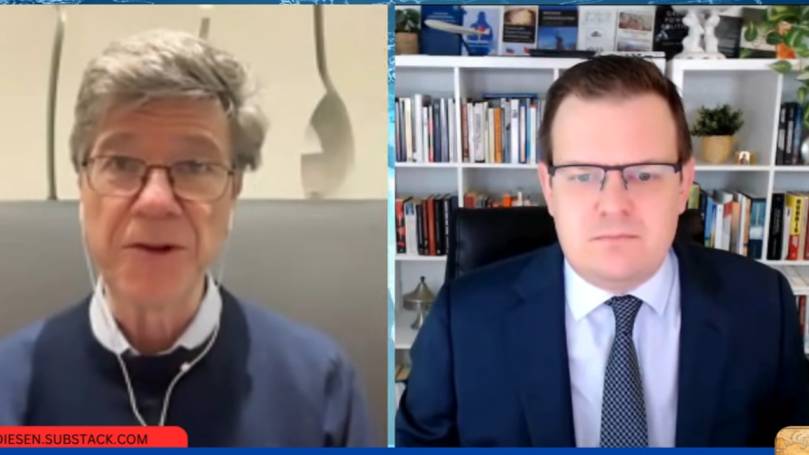
Here is the full transcript of Prof. Jeffrey Sachs’ interview on Greater Eurasia Podcast with host Glenn Diesen on ‘Open Letter to Chancellor Friedrich Merz: “Security Is Indivisible — and History Matters”’, December 19, 2025.
Brief Notes: In this urgent discussion, Professor Jeffrey Sachs joins Glenn Diesen to explain the critical arguments in his open letter to German Chancellor Friedrich Merz. Sachs calls for an immediate end to the “drums of war” and demands that German leadership acknowledge its historical role in the destabilization of European security, from the broken 1990 promises regarding NATO enlargement to the failure of the Minsk II agreements.
He warns that the current path—led by Merz and Ursula von der Leyen—is a dangerous rejection of “indivisible security,” the principle that no state should strengthen its security at the expense of another. This interview provides a stark look at the need for honest diplomacy and a return to the truth before the continent faces an irreversible disaster.
Introduction
GLENN DIESEN: Welcome back to the program. Joining us from the lounge in Belgrade is Professor Jeffrey Sachs. Welcome and thank you for taking the time in your very busy schedule.
PROF. JEFFREY SACHS: Pleasure to be with you. Thank you for reaching out to me.
GLENN DIESEN: Well, the reason I reached out to you is you have advised governments around the world and you continue to have very good contact with many different world leaders. And this is interesting because you just wrote an open letter to the German Chancellor Friedrich Merz about Germany’s responsibility for European security. I was wondering if you could flesh out some of the arguments that you make in this letter.
Germany’s Role in Beating the Drums of War
PROF. JEFFREY SACHS: Absolutely, Glenn. The letter arises because Chancellor Merz is beating the drums of war almost every day. He is saying that Russia is an enemy, that we have to prepare for war. He does not even attempt to engage in any kind of diplomacy with President Putin. He is the Chancellor of Germany. He has a responsibility.
And I am rather alarmed at the state of affairs in European politics right now because Europe is on the wrong track. It’s on a very dangerous course. It is on a course of no self-understanding whatsoever. And the German Chancellor really should be understanding this situation.
The point of my letter is that the German Chancellor should understand that Germany has played quite a role in the lead-up and the continuation of this Ukraine war. Germany has not behaved responsibly. Germany at many points took an absolutely wrong path and a contradictory path to what German leaders were saying. And I want Chancellor Merz to reflect on this before disaster occurs. I want honest reflection in Germany.
The Broken Promises of 1990
And Glenn, I start out with a very, very basic point. Of course it’s been much discussed, but it’s of special responsibility for Germany, and that is that in 1990 the German government unequivocally and repeatedly promised to the Soviet leadership and to the Russian leadership, still within the context of the Soviet Union, that NATO would not expand eastward in the context of German reunification.
So Germany has an absolutely central role and responsibility in the disaster that has unfolded. Because of course Germany cheated and the United States cheated. Both Germany and the U.S. in February 1990, on repeated occasions to President Gorbachev and other senior Soviet officials, unequivocally in the context of the negotiations over German reunification, said “not one inch eastward.”
There was no ambiguity about it. The meaning of it was clear. NATO would not even expand into the eastern part of a reunified Germany, much less into Eastern Europe, much less to the Baltics, much less to Ukraine and Georgia.
And that was not an accidental commitment. Unification in 1990 of Germany was the end of World War II. And in order for Germany to be reunified, Germany committed to the Soviet Union and then to President Yeltsin in 1991 and 1992, that the reunification of Germany, of the country that caused the disaster of World War II, would not take advantage of the Soviet Union and specifically that NATO would not move eastward.
Of course, in the Western propaganda world, this is denied or brushed off or “that’s insignificant, that’s a long time ago.” It is not insignificant. It is the casus belli of this war. Everybody knows it, that has been close to this war.
Actually, just a couple of days ago, a senior National Security Council figure in the U.S. Biden administration, pranked on a call, said unequivocally, “Yes, if we had said no NATO enlargement, there would not have been a war in Ukraine.”
So my point in the letter to Chancellor Merz is: take some responsibility, Chancellor. This is your country. Your country is at the center of this crisis. Understand this history and tell the truth and stop beating the drums of war.
A Pattern of German Complicity
I go on to many, many other examples of German lack of candor or reflection or honesty or understanding about Germany’s own role in leading to this disaster. And there are many, many cases that one could discuss.
Another is in 1999 when Germany, as part of NATO, participated in the bombing of where I am today, Belgrade, for 78 days in the heart of Europe, under no instruction or accountability to the United Nations. This was a big power play in which Germany played its role in an absolutely illegal action.
Or Germany’s acquiescence and quiet when the United States unilaterally walked out of the Anti-Ballistic Missile Treaty in 2002, which was the single most important destabilization of the nuclear arms control framework of modern times. And everything about NATO enlargement needs to be understood in the context of a fractured, destabilized nuclear arms framework that the United States and NATO allies broke, because the ABM Treaty was part of the nuclear stability.
And then the United States said, “No, we don’t participate in that,” and “we expand NATO contrary to the promises that we had made.”
Or the recognition of Kosovo by Germany in 2008 after the NATO bombing. So Europe is all full of the inviolability of borders, except when Europe wants to break the borders. So Europe broke Serbia, and not only did it break Serbia apart, naturally, not surprisingly, it put the largest NATO military base of Southeast Europe into Kosovo, the part of Serbia that it broke apart. And then it used Camp Bondsteel, the largest NATO base in the Balkans region.
The Bucharest Summit and the Path to War
And then in the same year, Germany participated in the disaster of the Bucharest NATO summit. Very interesting meeting, by the way, the one that was the proximate cause of this war. Because in 2008 the United States demanded that the NATO allies announce that NATO will expand to Ukraine and to Georgia.
Very interesting. Not only completely contrary to promise, actually completely contrary to what the Ukrainians themselves wanted that year. Because there was overwhelming public opposition to NATO membership. Because the Ukrainians knew this will get us into trouble.
Bush pushed hard. Chancellor Angela Merkel has written in her recent memoirs that she knew that this was a terrible and dangerous decision that could lead to war. But she folded her hand and on the second day of the Bucharest summit went along with the United States with the commitment that NATO would enlarge to Ukraine and to Georgia, putting us on the path to outright war.
The Maidan Coup and Broken Agreements
Then I remind Chancellor Merz that on February 21, 2014, in the context of the Maidan uprising or demonstrations that were stirred and spurred and funded by the United States in many different ways, Germany together with Poland, together, I believe it was with France also, the three foreign ministers of the European Union negotiated with President Yanukovych of Ukraine that in the context of this instability there would be calm restored, the constitutional government of President Yanukovych would continue, and there would be elections late in 2014.
All of that was agreed by the German foreign minister and his colleagues on February 21, 2014. Within hours, the so-called protesters backed by the United States, really hard-right paramilitaries, seized the government buildings in Kiev and installed an extra-constitutional government and lied by claiming that Yanukovych had resigned, where Yanukovych said, absolutely, clearly, “I am President of Ukraine. I absolutely did not resign.”
So where was Germany? A few hours after it had brokered an agreement, it went silent. “Yeah, we support the new government, we support the coup.” No responsibility by Germany at all.
When the Donbass region said “we don’t go along with the coup,” and when the coup regime immediately proposed to crack down on the ethnic Russian population in many ways, including the use of the Russian language, of course, the war began.
The Failure of Minsk II
And in early 2015, so not even a year into this war, basically almost on the anniversary of the Maidan, just before, Russia helped to broker a peace agreement which was called the Minsk II agreement, and that called for an end to hostilities based on the political autonomy of the Donbas region of Donetsk and Lugansk.
And Germany stood up again, Chancellor Merkel and France said, “We will guarantee this new treaty.” The treaty was passed by the UN Security Council unanimously and Germany and France were to be the guarantors in the so-called Normandy process.
They cheated once again because inside, inside this game of the U.S. and Ukraine, they said, “Nah, we’re not going to give autonomy to the Donbas, we’re going to retake it by force.” And the U.S. of course, built at billions of dollars of expense a million-man army in Ukraine for that purpose.
What did France and Germany as guarantors of the Minsk II agreement do? When Ukraine refused to implement the agreement that was endorsed by the UN Security Council, Germany did nothing, not a word.
And then when Chancellor Merkel was asked about it after she had left her position, she said, “Oh yes, you know, really it was just buying time for Ukraine to gain strength.” For a lot of reasons, I don’t think that was the original intention. I think it was the weakness of Germany, not that it was a game from the start.
I have reason to believe that Chancellor Merkel actually thought that autonomy was the right model because in part the Minsk agreement was modeled on an autonomy arrangement for ethnic German-speaking citizens of Northern Italy in a region called South Tyrol, something that Chancellor Merkel knows a lot about. And so I don’t think she meant it from the start that it was a game, but she did not stand up for peace at all.
A Call for Accountability
So Glenn, all of this is to say that you wouldn’t hear a word of this from Chancellor Merz. He has not said one word about German accountability, about German responsibility, about NATO enlargement, which again everybody understands is the core reason for this war.
He hasn’t said a word about the Maidan coup that was contrary to what Germany promised. He hasn’t said a word about the failure of the Minsk II agreement which Germany had promised to guarantee in its implementation.
So I find the situation both extraordinarily dangerous and without any seeming reflection whatsoever by these so-called leaders who are leading us to disaster and leading Europe to disaster. And it’s this pair of German leaders, it’s Merz and it’s Ursula von der Leyen, and they know each other. They’re working hand in hand, these two German leaders who don’t acknowledge for one moment Germany’s responsibility for peace and its responsibility for having helped to get us into this disastrous situation.
The Irony of German Reunification
GLENN DIESEN: The irony though is that when Moscow supported the unification of Germany, you actually had some very strong political forces both in France and Britain who were not that comfortable about the German reunification, who even referred to it as a Fourth Reich. That is, well, the argument was that Germany would achieve in peace what it couldn’t achieve in war.
But yet, as Moscow supported the unification of Germany, Germany was seen to, well, to some extent stab the Russians in the back. Because when it’s time to unify Europe, everyone was eventually going to be included to have a seat at the table, except for the Russians, which effectively revived the bloc politics.
PROF. JEFFREY SACHS: But this is interesting and Glenn, we know that Germany was right there at the start of this deceit, not only violating the explicit promises that it made, but arguing right away, “Oh, NATO should expand,” contrary to every word that had been said.
So Germany wasn’t just a bystander that allowed its word to go bad. It was an active participant in 1993 and 1994 from the start in helping to persuade Clinton, Bill Clinton, who was a very inconsequential and at the time, extraordinarily unexperienced president, to do this absolutely disastrous thing that was done, which was to break a very important diplomatic agreement.
And, you know, this has been rehearsed again and again and debated. But there are countless now testimonials that this NATO question was the key, including the one I mentioned just a couple of days ago of an insider in the Biden administration making this acknowledgment. So, Merz, tell the truth about this.
GLENN DIESEN: This was Amanda Sloat, is that correct?
PROF. JEFFREY SACHS: Yeah, yeah. No, she was the head advisor for Europe. This was not a small advisor at all. But that is absolutely correct. They know what they’re doing.
And by the way, as I’ve said on many occasions, I had exactly the conversation with Jake Sullivan at the end of 2021 where I said to him on a long phone call, “Jake, say that NATO is not going to enlarge to Ukraine.” And he said to me, “Jeff, believe me, NATO’s not going to enlarge to Ukraine.”
And I said, “Jake, if you say that, say it publicly.” “Oh, no, Jeff, I can’t say it publicly. We have an open door policy.” I said, “Jake, you’re going to go to war over something that isn’t even going to happen.” And he said to me, “Jeff, there’s not going to be a war.”
This is the flimsiness with which we live right now and the falsehoods with which we live of these government officials. And Merz needs to behave honestly before we are dragged into disaster.
The Principle of Indivisible Security
GLENN DIESEN: Given that Germany has become one of the main authors of this war, what I found very powerful in your letter is this argument that European security has to be indivisible, that this is not a Russian talking point. This was at the center of all our agreements, which we actually signed for a pan-European security architecture.
Yet when you listen to the Germans today, they refute the basic notion that Russia should have any security guarantees at all. I mean, how did we end up from recognizing indivisible security as the core of stability in Europe to even rejecting that the Russians have any legitimate security concerns or should have guarantees at all? I mean, this is quite extraordinary, but it’s become normalized, I feel.
The Pattern of Deceit: Germany’s Historical Role
PROF. JEFFREY SACHS: You know, I’ve been looking back at the key moments of the last two centuries. It’s a repeated affliction. And Germany has played a role in this repeatedly.
You go back, of course, to World War II. At the end of World War II, the main conference in Potsdam said that Germany would be neutral and demilitarized. And again the US and Britain and France cheated on that. They said, “No, our part will be remilitarized, it will become an independent country and it will become part of NATO.”
And in 1952, Stalin reached out in what’s called the Stalin Note and said to the west, “But Potsdam, you promised neutral and demilitarized.” And that’s how the Cold War that was evolving could end. And you know, historians then argued—Western historians said, “No, Stalin didn’t really mean it,” and so on.
But when the archives were opened, it turned out Stalin absolutely meant it. Neutralize Germany, disarm Germany, the Cold War can end. And the one that blocked it was Adenauer, the Chancellor of Germany. He said, “Better that we’re divided than we are neutral.” And so Germany played a false card.
And he actually had his ambassador to London say to tell the British senior officials in a very secret note, “I don’t trust the German people, I don’t want to be neutral. Maybe in the future they would side with Russia. So I don’t trust my own people.” And in this communication, it was explained by the German ambassador, “Please, this should never become public because that would obviously weaken the political position of the Chancellor were this to be known.”
But the point is that Adenauer behaved with deceit. And the claim was, “Oh, Stalin didn’t mean it.” But the historians have shown Stalin meant it. The one that was deceitful was Germany. And I’m sorry, we are seeing this again and again.
But the point for my letter today, I didn’t even want to go back to all of this history. I just wanted to say in the immediate period of unification, Germany was right there and it did not keep its word. And it has to take responsibility right now to make peace on the basis of diplomacy, not on this propagandistic narrative about what is happening right now.
And Merz absolutely needs to know this history and tell it truthfully before we are all going to suffer a complete disaster. And I just cannot believe that Merz and von der Leyen are trying to put Europe in their hands again. In a twisted way, sorry, that is going to create a disaster for Europe, too. That’s the point.
Germany’s Lost Legacy of Ostpolitik
GLENN DIESEN: Yeah, well, something to be said for Germany that during they did have the Ostpolitik, which contributed with something good. So it’s very sad to see that yet again, Russia—no, sorry, Germany aspires to take a leading role of a war against Russia.
PROF. JEFFREY SACHS: But also just to say, you know, Willy Brandt, of course, with Ostpolitik, was a remarkable politician. Helmut Schmidt I knew personally. Chancellor Kohl I knew personally. I met and had meetings with Hans-Dietrich Genscher. You know, I thought they were honorable people that wanted German unity and they had some stature.
And they explained how this can be done with indivisible security for Russia as well as for Europe. And if they would just live up to this now, this war would end.
The Power of Truth
GLENN DIESEN: Thank you very much. And well, just last point. I also found that very fascinating in your letter, the focus on truth, that truth can put an end to all these hostilities. Because it’s not just that we have disagreements, as you now suggest with Sullivan. In our previous talks, you mentioned Merz, now Nassar, Macron, and now Merz.
It’s the fact that they do know exactly what Russia fears. What caused the war. What caused the war is the fact that they lie. It’s not two competing arguments. It’s they don’t tell the truth. They know and they say something private, say something different in public. It’s this deceit and propaganda, which is the horrible part of this whole war.
PROF. JEFFREY SACHS: I mean, until the prankster gets someone to tell the truth, they tell lies to each other. That’s absolutely correct.
GLENN DIESEN: This is who has to bring us the reality. Pranksters and comedians. It’s a great tragedy. But, well, I know you’re there at the airport. I have to catch your next flight. So, as always, thank you so much for taking the time.
PROF. JEFFREY SACHS: Thanks. Great to be with you, Glenn. Thanks so much.
Related Posts