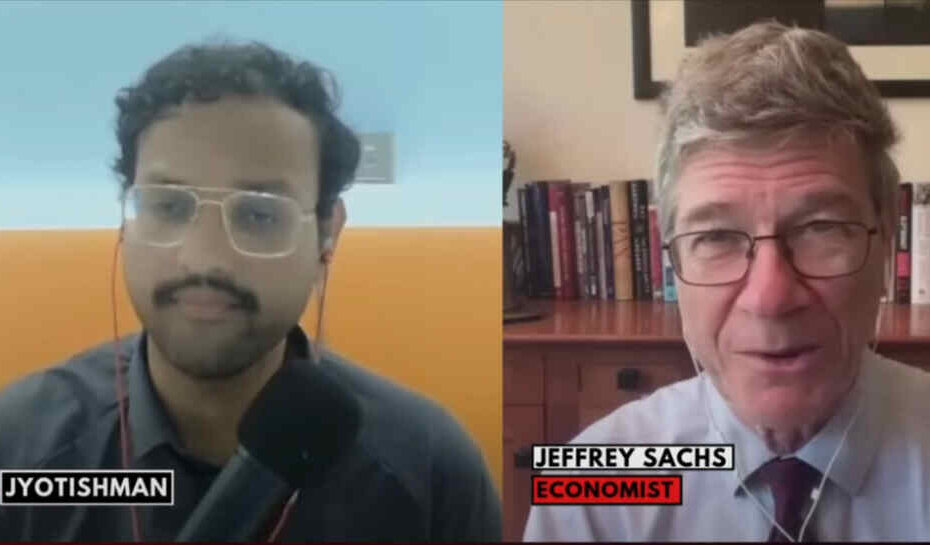
Read the full transcript of economist and public policy analyst Jeffrey Sachs’ interview on India & Global Left Podcast on “US–Russia Talks, China-Taiwan future, BRICS Rise & Palestine’s future”, premiered on August 8, 2025.
Introduction
JYOTISHMAN MUDIAR: Hello and welcome to another episode of India and Global Left. If you are new to the show, please smash that subscribe button. Also consider becoming a YouTube member, a Patreon or donate small amount given in the link in the descriptions box. But the least you could do is to watch this show like share and comment.
Without further ado, let me welcome our guest tonight, Professor Jeffrey Sachs. Professor Sachs is an economist, public policy analyst, and one of the most important voices in geopolitics. He’s a professor at Columbia University. Professor Sachs, welcome back to Indian Global Left.
JEFFREY SACHS: Great to be back with you. Thank you so much.
US-Russia Relations: Negotiations or Blackmail?
JYOTISHMAN MUDIAR: I wanted to start with US Russia relationship, given that’s been the center of a lot of other things in the global affairs. And I think for those of us who have been following the issue, the big question, if not the biggest question, is whether Washington, whether those who are negotiating on the behalf of Washington, whether they take these negotiations as an opportunity to blackmail or force Russia into a ceasefire, potentially to present that as a victory for its domestic constituency, or whether they consider this as a renegotiation of the security framework in Eurasia. Taking into account the concerns of Russia. What do you think is in the minds of those in Washington?
JEFFREY SACHS: Of course, Washington is a bit divided. There are hawks that for the last 35 years have been intent on undermining Russia, dividing Russia, even regime change in Russia. NATO enlargement was part of that program and it’s gotten us into a lot of trouble because Russia does not want to be subordinated to the United States.
And it resents, more than resents, it regards this hawkish US approach as a direct and immediate threat to Russian security. I frankly don’t blame them in that view. I’m a critic very much of this deep state US approach, which has been pretty consistent.
Supposedly, Donald Trump wanted to do something different. And I say supposedly because to this moment it’s not sure whether he understands, really wants to do something different, has the capacity to do something different, and will stand up to what clearly remains the hawkish deep state part of the American political scene.
But Trump came in on the ostensible idea of ending the Ukraine war. There were statements made informally that, yes, NATO enlargement was a provocation. “We can see Russia’s point of view,” but those statements were never made into U.S. policy. To this moment, Trump has never given a speech to the American people explaining, “we’re going to do something different.”
Trump has sent his envoy, Stephen Witkoff, to Moscow. They’ve talked with the Russians. It looked to me promising a few months ago. And then Trump changed his line. He’s also sent this old man, General Kellogg, who definitely reflects the mainstream of the military industrial scene in the United States.
And this comes to your specific question. What is the US asking? What is Russia responding and where is the real American policy at this moment?
The Russians, to start there, are very clear, they say this war came about because of actions that threaten Russian security. And the way to end the war is to resolve those underlying causes of this war. And number one is NATO enlargement. Number two, by the way, is the US participation in the choosing the regimes of Ukraine.
The US is deeply involved in Ukrainian politics to a disgusting extent. And the US played a direct role in the coup in February 2014 that overthrew Viktor Yanukovych, the president of Ukraine, who wanted neutrality rather than NATO.
So the Russians are saying, “look, these are the root causes of this war. We have to have a security architecture that this doesn’t continue.”
The US side has varied over time. For a while, the US hawkish side said, “keep fighting. Russia will collapse. It will collapse because of the economic sanctions. It will collapse because of US weaponry, It will collapse because Putin is politically weak in Moscow.” These were all wrong assessments. I think one can even be stronger and say they were delusional assessments, but they were wrong.
When Russia started to win on the battlefield, the hawkish side said, “cease fire is the answer. Freeze the conflict.” The Russians said, “well, freeze the conflict just means we have the momentum right now. You want us to stop the advance and when your side strengthens, you’ll start the war again because you won’t get to the core issues.”
The United States never answers that challenge publicly. The Europeans are beyond pathetic in their public rhetoric. So this is part of the idiocy of global events, that serious issues are raised, but they’re not responded to in a serious way.
But the Russians are saying, “what do you mean, cease fire? We want to get to the root causes.” Up until this moment. After an initial seeming progress on getting to root causes, Trump reversed, went to the ceasefire. Then he went to the unconditional ceasefire within 10 day approach. This is how India got into this tariff business.
And then suddenly two days ago, there’s an announcement of the meeting between Trump and Putin. What does it mean? Well, nobody knows, I think really what it means. But one idea is the hopeful ideas that Witkoff made real statements of awareness of root causes and readiness to agree on resolving the root causes of the war. That’s the optimistic side that maybe Trump is coming back to what seemed to be the initial course.
The pessimistic side is, well, it’s just another meeting and Trump’s going to do whatever he does afterwards and Russia is going to maintain its position and nothing will come of it.
That’s certainly possible also.
So I don’t feel that we understand on the inside why suddenly this summit meeting is taking place. If I had to guess, I guess that the Americans signaled some reality this time around, this would be the best news.
What’s interesting is that on the surface, Trump is still. Well, on the surface, I should say, vis a vis Russia, Trump has said, “well, I don’t know whether we’ll continue to make this demand for a unilateral cease fire, unconditional cease fire. We’ll see what Putin says.”
But at the same time, incredibly, he’s punishing India in the process. In the process of saying, “you have to stop purchasing oil from Russia” and the tariffs are going into effect. And this is already having major ramifications for global politics just within hours.
All in all, I think the United States is incoherent in its foreign policy. I’m not very optimistic about Trump in general because I don’t think he has an attention span longer than 15 minutes. And I don’t know whether they can make peace because of Trump’s limitations, but I could say they should make peace.
And Russia is actually on the right side of this, which is stop the NATO enlargement. It never should have happened. Address the issues of the territories. Crimea is, of course, never going back to Ukraine under all of the history and the circumstances. But there is the scope for ending this war, and it should be ended. And it should be ended by addressing the fundamental reasons for the war.
The Power of the Military Industrial Complex
JYOTISHMAN MUDIAR: How powerful do you think is the military industrial complex and the whole NATO infrastructure? Given some people are arguing now that Europe has decided to subsidize NATO fully. I mean, all the aids that dried up after President Trump came to power has been fully replenished by more than replenished by Europeans, mostly the Nordic countries and Germany. How much of an incentive or how much of a pressure is coming out of NATO and the military industrial complex to not normalize relationships between the United States and Russia?
JEFFREY SACHS: In terms of core fundamental power, Donald Trump could end the war, tell NATO that enlargement is not going forward, and accomplish that. Europe could not sustain the war effort even if it decided it was in its interest to do so.
At the same time, Trump would have to manage this politically in a pretty sophisticated and consistent way. Because he’d face opposition all over the place, starting inside the United States, inside the Congress with senators like, most notoriously, Lindsey Graham and Richard Blumenthal. But a lot of senators who are basically part of the military industrial complex. They’re on the Armed Services Committee. The mindset in Washington is war all the time. And so a president has to change that mindset.
Now, could Trump do so first, Constitutionally, yes. If he says we’re stopping, the US will stop. He has the responsibility of foreign policy. Congress can’t wage a war over the United States president’s head. And for this reason, if the president does his job, yes, he has the authority to do this, could he win the politics on this?
Yes, because the American people, as a public opinion, as an electorate, has no interest in this war at all. They’re sick of it. They don’t want any more. His Trump’s MAGA base was told the war is going to end quickly. The early rhetoric from J.D. Vance and from others was this war is going to end quickly. So it’s not that Trump would face pushback from the broad electorate. The pushback would be from inside the military industrial complex.
Then comes Europe. Yes, The Europeans are basically wanting the war to continue. I think this is profoundly wrong headed from their point of view, from their, from Europe’s interests. Europe’s interest is actually open, normal relations with Russia because Europe and Russia are complementary economies. They do well when they trade with each other. They both hurt when the trade is sundered, although Europe hurts even more.
It’s the Western appendage of Eurasia. Russia can turn to India, can turn to China, can turn to other places, whereas Europe actually is in fact more dependent on Russia than Russia is on Europe. So I think the Europeans get it wrong, but they are a pressure group.
They think it’s good that Ukraine is fighting Russia because they think, “well, that’s less chance that Russia will be on our border.” This is primitive, by the way. Russia is not going to invade. Europe doesn’t have the means. The reason the motivation would not face the dangers would and all the rest. But the Europeans have been on this harder line.
Now, as I said, they do not have the capacity to overrule the President of the United States. They have a capacity to raise the political pain for Trump. Charges of appeasement, charges of being soft on Russia, those count to some extent in American politics. And they’ll make those charges, and they have in the past months.
But could they really continue the war without the United States? The whole idea is laughable even with the United States, the war is not going to be won. Russia is going to win the war on the battlefield. So given all of this, it’s up to Trump. If he acts presidential, it’s a big if, but if he acts presidential, the war will end.
Economic Warfare and Global Governance
JYOTISHMAN MUDIAR: I want to ask my next question on, let’s say international economic governance and I want to enter that through these so called tariffs, economic warfare. I think tariffs is a bit misleading here because if you carefully follow it, I mean, the deal with Indonesia Professor Jayati Ghosh has written about is the US is bringing in all kinds of things to the table. Investment rights, patent rights, digital customs, even quality control, etc.
In South Africa, they would use, you know, their grievance about the Palestinian case or this absolutely ridiculous idea about white genocide. In Brazil, they are using this prosecution thing or, you know, anything that you don’t like can literally be brought to the table. And then in the garb of tariffs and trade deficit, you can arm twist nations.
I think the big question that comes to that most nation states are contemplating on is what is this global economic governance given the United States, the chief mafia is acting on his behalf and there seems to be no collective platform to resist. I mean, yes, there are BRICS, there is the WTO mechanism that President Lula has now said will draw. But we know how these things play out. So what are your thoughts about what is what, what is this doing to north south relationship in particular?
US Economic Isolation and BRICS Integration
JEFFREY SACHS: I think basically at the fundamental level, the United States is becoming more economically isolated and less economically relevant and competitive. So I regard this as America shooting itself in the foot, not dominating the world or extending its hegemony.
Yes, it’s true. Europe bowed down to the US and made this asymmetric agreement. Several other countries did as well. They want to keep access to the US Markets, they want to please Donald Trump. But you know, it doesn’t strengthen the US Economy, doesn’t make the US Economy more competitive, it doesn’t raise the international role of the US – it diminishes it.
And the real attack, well, it’s across the board. So the US has lost friends everywhere, lost respect everywhere, broken the international trading system under WTO everywhere. But this is really aimed at the big countries. This is aimed at the BRICS. It’s not an accident that the high and punitive tariffs are against the big countries because ultimately this is about power and it’s about Trump’s idea that he wants to limit the power of the big countries, especially China.
But as I always said to Indian friends, “Don’t worry, you’re next. Don’t side with the United States. You’re just next in line.” And I think I’ve been proved right on that, sadly. But the truth is if you go after Brazil, Russia, India, China and South Africa, you are going to be the one to pay the cost, not those countries because the BRICS are going to become even more integrated economically.
The shift to local currency payments will accelerate. The internationalization of the renminbi will definitely accelerate. India’s announcement today, though I don’t know all the details, but the announcement that it’s canceling military purchases from the United States – that will get notice in Washington. And if that’s really the case, that’s strategic from America’s point of view and what India is doing is absolutely correct.
What I see is that within 48 hours of these punitive tariffs and the threats and the 25% extra tariffs on India and the punitive tariffs on Brazil, that it’s actually bringing the BRICS diplomacy to a higher level. Everyone’s been in touch with everyone else. Prime Minister Modi is going to see President Xi soon. I know that President Lula has spoken with the Prime Minister Modi and with the Chinese leadership. There is a lot of diplomacy underway right now. That’s good. It accelerates the move to a multipolar world.
My bottom line is that the US is accomplishing nothing serious and constructive over the longer term. Certainly not for the world economy, but not even for the US Economy or for US Geopolitical power. I think it is absolutely going to hurt the United States in future years.
US-China Relations and Taiwan Tensions
JYOTISHMAN MUDIAR: China is at the center of a lot of what the United States is doing, of course, although the axe has fallen on many other nations. But China is definitely the key target. I wonder if you could just share a few thoughts about what do you think is the future of US China relationship and particular question would be what do you think would happen in the Taiwan Strait?
How volatile is the situation? We have of course seen recently the DPP’s attempt to recall 24 legislators from, you know, dismiss the KMT legislators, which some people are reading as a fatigue within Taiwan about this identarian concept of anti China rhetoric. But others also say that this doesn’t have a lot to do with that. It’s most basically on local issues. But Taiwan is sitting at a very dangerous position. We are seeing Philippines being included in this missile range and so on. Please share your thoughts on that.
JEFFREY SACHS: Yes, fundamental point – U.S. grand strategy is U.S. hegemony. And this is the starting point for everything we’re talking about. The US aims to be number one, supposes that it is number one, plans to stay that way. It’s a lot of delusion, it’s a lot of anachronism, but it is the American idea. China is the number one threat to American hegemony. China says “No, we don’t want a hegemon and no, we don’t submit to US threats or demands.”
And this view of China as the threat or the enemy is about 15 years old now. For almost 40 years China was basically viewed as supportive of US hegemony, as a counterweight to the Soviet Union or as a counterweight to Russia. But never, by the way, as a country in for its own interest. But always how does it serve US hegemonic aspirations?
Starting around 2010, the American elite came to view China as an unexpected threat. “How did China develop so fast? How did it gain this technological edge?” This was all a surprise. It wasn’t necessarily a surprise to an economist looking at this, but it was a surprise to the American elite.
By 2015, the containment doctrine had pretty much set in on Washington, meaning we need to take active steps to stop China’s further rise. And there’s an article that I often cite, published by Robert Blackwell and Ashley Tellis at the Council on Foreign Relations in March 2015 called “A New Grand Strategy Towards China,” which outlined the need for containing China’s rise. And it listed all the things that are taking place right now as part of the US strategy. New trade system, trade barriers, technology, export bans, building up the military along China’s rimlands and so forth. And it spelled it out 10 years ago. And those policies are being followed right now.
Of course it has not stopped China’s rise. The US can’t stop China’s rise. But this remains the basic idea. And within that context Taiwan plays a special role. Partly a substantive role because of the importance of Taiwan in the US semiconductor supply chain with TSMC, and partly a historic and symbolic role that Taiwan was America’s ally. The US has invested politically in so called “defending Taiwan.”
And so the Taiwan issue has been central to US China relations, going all the way back to normalization of relations starting in 1971-72. The US said of course, as part of its normalization with the PRC, “There’s one China and Taiwan is part of it.” But the US also maintained some right – self proclaimed – to defend Taiwan and to call for a peaceful resolution of the tensions across the Taiwan Straits.
What has happened in the last 10 years is that the US has become more strident in saying that it would defend Taiwan. And at the same time, of course, Taiwanese politics moved much more towards an open declaration of secession or independence under the DPP. And this has raised tremendous tensions because if there were to be a unilateral declaration of independence – and the rhetoric of the Taiwanese DPP is close to that. It’s not exactly that, but it’s close to that – this would possibly trigger a war between China and the United States.
The details remain to be seen, but it’s very threatening. China, that is the PRC, will not let Taiwan declare independence, much less to have independence. That’s out of the question. But even to declare independence would be a cause of war. And by the way, Americans should remember Fort Sumter and December 1860 and the Declaration of independence by the American confederacy. It did not go well. It led to a civil war that was devastating for the United States.
So this is the situation across the Taiwan Straits. It’s very fraught. American politicians are stupid. Many, just a large number, they’re provocateurs, they’re bombastic. They want to be in the news, they want to fly to Taipei to show their support. All of it, in my view, adds up to the potential of Taiwan becoming the Ukraine of East Asia.
And by that, Ukraine declared that it intended to join NATO. By the way, it only declared that after the US installed a government that would say that thing. But when Ukraine declared that, it made itself the battleground of a war between the US and Russia. And if the Taiwanese leaders take that step, or if the United States does something very provocative in the extent of the militarization of its support for Taiwan, there could be an open conflict which would be devastating, absolutely devastating, horrendously threatening to the world.
Gaza Occupation and Global Response
JYOTISHMAN MUDIAR: We have the Gaza reoccupation plan. This has come at a time when there is enormous, not just settler violence, settler and military violence in the occupied west bank, but also expansion of the settlement areas in E1, near Malia Dumim and so on. Is it fair to assume that a long occupation of Gaza is to continue and there is no ceasefire given? Washington has given complete green signal to Israel to do whatever it likes.
JEFFREY SACHS: Well, I think we’re at another moment of truth. First of all, Israel is starving 2 million people right now, so we have a genocide underway in front of our eyes. It’s absolutely revolting, shocking, unacceptable, disgusting and sanctioned and supported, I should say, just to be clear by the United States – supported. The US is complicit in this in many, many ways, including directly arming and financing Israel. Till this moment as a genocide is playing out, almost all the world is aghast.
Almost all the world has voted repeatedly in the UN General assembly for the two state solution. There was a meeting at the end of July at the UN, a high level meeting for the implementation of the two state solution, saying that Israel’s occupation of Palestine is illegal. Israel must return to its borders which are of 4th June 1967. There must be constituted a state of Palestine. That was the outcome declaration at the end of July. It has the support of more than 180 countries.
The only ones that oppose it actually are Israel, the United States, Argentina, Paraguay, Micronesia, Nauru, Papua New Guinea and I think maybe Vanuatu on some votes. But basically it’s the US and Israel standing against the rest of the world. 95% of the world’s population says two state solution. “Israel, return to your borders and let’s get on with it.”
So this is the situation and now Israel is saying they will occupy Gaza and Gaza City. It’s horrendous. This is a rogue state, completely in violation of international law in every way and committing massive war crimes and crimes against humanity before our eyes. It needs to be stopped.
The questions are first, can the 180-plus countries of the world that know this somehow implement this even though in a formal sense the US has a veto in the UN Security Council? But the overwhelming sentiment of the world is that this needs to stop. Israel could be suspended from the UN General Assembly. Israel could be sanctioned in many ways. Countries could end their diplomatic relations. They could put on blockades not just of weapons, but of, or embargoes not just of weapons, but of other kinds of trade. But genocide should not go on before our eyes.
Second question is, would the United States ever change its position? And here, as in many other areas, American public opinion is rather decisively now on the side of the Palestinians. Maybe 65-35. Roughly speaking, it’s a massive change of American public opinion over the last three years. So the politicians are running against American public opinion. That’s not so rare on many issues. In the United States we have almost – it’s a very flaky political system. It does not represent public opinion or even American interests. But this is at least notable for politicians.
But the political class is still deeply in the hands of the Israel lobby to an extent that I find rather shocking actually. I have to say I’m often naive about these things, but I still find it hard to believe that until this moment almost all of the Congress and the White House and the military industrial state are standing against the whole world community and on the side of genocide right now.
So this is this moment. We’re about to come to the annual General assembly meetings at which France, Britain and a number of other countries will, according to what they’re saying, despite heated U.S. pressure, recognize the state of Palestine. And I think all of the politics will heat up.
As for this very specific announcement that Israel plans to occupy Gaza, worldwide, there’s been an outcry and I’m hoping that the Arab world, the Organization of Islamic Cooperation, France and Saudi Arabia, which are the co chairs of the UN General assembly meeting on the two state solution, will step up and say “No, you are not occupying Gaza. That is out of the question. It’s against international law, it’s against the UN General assembly” and that they would put in place an alternative.
AI and Global South Preparedness
JYOTISHMAN MUDIAR: I had been thinking about asking a question on AI, but we are out of time. Would you allow me to ask a final question, a quick question?
JEFFREY SACHS: Okay.
JYOTISHMAN MUDIAR: So I’ve always wanted to ask you about AI, given you are an economist and you think about development and AI is so central to our life in so many ways for the labor market, for high end technology, there is a lot of geopolitical race around critical minerals which are so central to AI military technology. So my question to you is what should national governments, particularly in the Global South, that lacks technology and people relatively poorer people who lacks good education, how should they be prepared to live under this age of AI?
AI’s Impact on Global Development
JEFFREY SACHS: Well, AI is going to pervade every economy and every sector. So it’s going to be key for rich and poor economies alike. India in particular has great technical capacity and it has already put a lot of the economy onto the digital space with a lot of benefit in my view, in all sorts of payments inclusion and efficiencies of systems and governance and so forth. And it should plan to incorporate AI.
My own view, which takes us far afield, I’d like to see India and China cooperate on this much more closely. China is doing a fantastic job in AI. And one of the notable points for China in order to compete with the big US tech is that China’s gone open source. And this is a fantastic tactical approach or even strategic approach one could say.
But it fits very well partnership with India as well, because this could create a massive platform which basically outruns a lot of the US proprietary Big tech AI systems. So just one tactical point would be India and China aligning on an open source AI. Both sides would have a huge amount to add, both in technical capacity. India brings a lot of English language data and flow to this for hundreds of millions of people, which would be a huge benefit for China also. So this would go both ways.
The Promise and Challenges of AI
AI raises a host of very interesting, subtle, unsolved issues. And just to mention them first, the tool can accelerate development massively. So I’m sure that AI and digital more generally can dramatically democratize and expand education at all levels. And since education is so fundamental, all universities can be online, all schools can have individual avatar tutors for students. We can do a huge amount to improve education through these tools themselves.
And I’m doing all my teaching online these days, by the way. But then I have a global classroom in effect. And so there’s ways to use the technologies I think that will be great for leapfrogging. AI will solve huge problems in health care, especially where there are no doctors. There will still be diagnostics, monitoring and all sorts of procedures that otherwise would have been out of reach and completely impossible. And one can go through each sector now.
At the same time, the downside is where are the jobs going to be? And this is an interesting question. Will we all become students and people of leisure because the machines are going to do what needs to be done? It’s kind of an extreme scenario, but there’s a smidgen of truth to it. But then who owns the machines and how are poor countries going to be part of that?
I have to tell you, having worked on this and thought about this, the answers are not clear quantitatively. We don’t really understand anyone who says they can give you the scenario of this. I don’t believe it because we don’t really know how this will play out.
Strategic Planning for AI Integration
Countries should absolutely plan on rapid incorporation of AI into public services, into governance, into key sectors of the economy, whether it’s agriculture, mining, manufacturing and so forth. And being as much part of, and having the physical infrastructure to take advantage of this is key.
So India needs to get into robotics also, even though it seems premature in a way in a country of 1.5 billion people, this is the economy that is going to evolve quickly. And those who delay in this, I think, will find themselves falling farther and farther behind.
JYOTISHMAN MUDIAR: Professor Norman Finkelstein once told me that ChatGPT has severed his relationship with his students. Have you faced any such problem with your students?
JEFFREY SACHS: Oh, that’s interesting.
JYOTISHMAN MUDIAR: Because he would say that “this is a ChatGPT written answer” and that has severe implications for their relationship.
JEFFREY SACHS: I still like a zoom when we’re looking each other in the eye, so I’m having more conversations with more students all over the world than ever before. So that’s not exactly AI, but it is digital and I like that because I’m getting a fun chance, as I said, to teach in a global classroom.
JYOTISHMAN MUDIAR: We’ll leave it there. Professor Sachs, thank you so much for your time and this was a lovely conversation.
JEFFREY SACHS: Absolutely wonderful to be with you. I hope we can do it again soon.
JYOTISHMAN MUDIAR: Have a wonderful rest of the day.
Related Posts