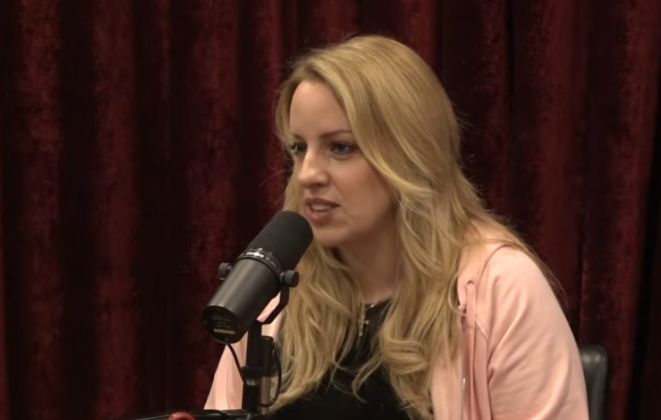
Editor’s Notes: In this episode of the Joe Rogan Experience, Joe sits down with author Rachel Wilson to discuss her provocative book, Occult Feminism: The Secret History of Women’s Liberation, which explores the hidden origins and unintended consequences of the feminist movement. Wilson details how Marxist and occultist influences aimed to dismantle the traditional family unit by pushing women into the workforce under the guise of progress. Together, they examine the paradoxical decline in women’s happiness over the last several decades and the personal experiences that led Wilson to challenge mainstream narratives. It’s an eye-opening deep dive into a side of history rarely discussed in the public sphere. (February 26, 2026)
TRANSCRIPT:
Rachel Wilson on Growing Up Between Two Worlds
JOE ROGAN: Hello, Rachel. What’s happening?
RACHEL WILSON: Hello, Joe.
JOE ROGAN: Very nice to see you again. So when your husband Andrew came in here, he told me about your book. And then I talked to you, and you seemed very interesting, and you gave me a little brief synopsis of it. And so then I listened to it on audio tape, and it’s fing crazy. It is The Occult, Feminism, the Secret History of Women’s Liberation.*
You know, I didn’t really have much of an opinion on feminism. My opinion was, unfortunately, you run into some feminists that just seemed to not like men for whatever reason. And there’s a lot of people in this world that aren’t happy with their position or station in life. But I didn’t really think too much into how this all got started until I listened to your book, and I’m like, this is kind of bonkers.
So before we get into your book, how did you decide to write about this? What was your journey?
Rachel’s Childhood: A House Divided
RACHEL WILSON: Yeah, it’s kind of a big journey. So when I was growing up, I was in all the advanced kid classes. And from the time I was in kindergarten, it was just pounded into my head like, you’re going to college. You’re going to have a career. You know, you’re smart, and you have to do something with that. It was the only option that was put before me.
And so I followed that path all the way through school. And by the time I got done with 12 years of regular school, I realized a couple things. One is school is not where you go to learn things. Public school is not so great for smart people for the most part. And that I really didn’t like — another four years of school just sounded like hell to me. And I really just wanted to get married and have kids. That’s kind of what I always wanted to do, much to the horror of my Marxist feminist mother, who did not —
JOE ROGAN: Indoctrinated at an early age.
RACHEL WILSON: Well, she tried, but I was the “why” kid. I was the kid that’s just like, why? Why? But why? And I had a Rush Limbaugh dad. They got divorced. Shocker. Who could have seen it coming? So they got divorced when I was like nine. And I grew up in two worlds. I had Republican business owner Rush Limbaugh dad, and I had Marxist feminist crazy mom.
JOE ROGAN: Was the mom always a Marxist feminist? And was the dad always like a Rush Limbaugh Republican?
RACHEL WILSON: Yep.
JOE ROGAN: How did they fall in love? How did all that happen?
RACHEL WILSON: They didn’t. I was an accident.
JOE ROGAN: Oh, so they just fell in lust.
RACHEL WILSON: Yes. I was like an oops baby. And my dad said that when he saw me, he was like, “Well, I don’t want anybody else. This is the only thing that matters to me, so I’m going to make this work.” And he tried his best.
JOE ROGAN: How did they even hook up with such radically different ideologies?
RACHEL WILSON: I don’t think they were talking about that sort of thing when they got together. They were probably hanging out at a bar.
JOE ROGAN: So they didn’t really know each other very well.
RACHEL WILSON: Not really. They were kind of like — they worked in the same place and met at work and then had a fling. And then I was born. Yeah. So I had divorced parents. It was really rough because my mother hated my dad. She could never tell you anything he did wrong.
JOE ROGAN: Yeah.
RACHEL WILSON: It was just like, “He’s an evil white patriarchist. Bad, bad Republican man.” One of my earliest memories is them fighting over the Bush-Dukakis election in ’88, threatening to lock each other in the house so that one couldn’t cancel the other one’s vote. Fun. It was fun.
The Kitty Dukakis Tangent
JOE ROGAN: Was this before or after Kitty Dukakis drank mouthwash? What did she drink? She drank something like that — aftershave or mouthwash to try to get drunk.
RACHEL WILSON: Yeah.
JOE ROGAN: The pressure of the election must have been so insane. And this is pre-social media. This lady was already struggling with alcoholism, and I think she was hospitalized for drinking something that was not a drink. Do you remember that?
RACHEL WILSON: I just remember that whole election being pretty nuts. As far as the Democrats versus Republicans — this was when Democrats were more like how Republicans are right now.
JOE ROGAN: They had him riding in a tank to make everybody think he was a pro-war tough guy. Remember that?
RACHEL WILSON: Yeah, yeah. And I remember “Read my lips, no new taxes” and all that stuff. So I had this going on as a kid. I think my brain was already thinking about this sort of stuff from the time I was little.
JOE ROGAN: Rubbing alcohol. That’s crazy.
RACHEL WILSON: Nail polish remover.
JOE ROGAN: Oh my God. She drank nail polish remover. Holy —
RACHEL WILSON: She couldn’t just huff paint like a normal person.
JOE ROGAN: “Very open about her struggles with alcohol and addiction to amphetamines to reduce the stigma surrounding these issues.
Two Worldviews, One Childhood
RACHEL WILSON: So my parents were ready to kill each other over that. And then they divorced right after that. So I’d spend time with dad and I’d spend time with mom, and I had two completely different realities and worldviews.
Growing up like that, you’re trying to sort out what’s true. You’re trying to figure out if there’s any merit to what mom’s saying the world is, or any merit to what dad’s saying the world is. And I think dad was more persuasive and better at pulling me in his direction. Because I never really absorbed Marxism — it was just fake and stupid to me. I just never bought into it at all.
JOE ROGAN: Why at an early age did you think that?
RACHEL WILSON: Because I had already seen that we’re not all born equal with equal things. Some people work much harder, some people have natural gifts and talents. My mother would literally say stuff in the house like, “From each person according to their ability, to each person according to their need.” And I was like, even when I do that in class — if there’s a group project, everybody wants me on their team because I’m the smart kid who’s going to do the homework. I end up doing everything and everybody else gets the A, even though I did everything.
JOE ROGAN: So those are the people that are really into socialism — the people that half-ass stuff?
RACHEL WILSON: Yes.
JOE ROGAN: Yeah.
RACHEL WILSON: And so from being a little kid, I noticed — no, things aren’t equal and things aren’t always fair. It depends on your natural skills and abilities and then what you do with those things. Because there are lots of people — my mother was a super talented, really intelligent person, but she was so emotionally chaotic. She never applied them to anything. She never really got anywhere or did anything.
She had big dreams of what she thought she should have, and never really got there because she was so emotionally unregulated and kind of chaotic. So I just kind of saw that — no, there’s not this thing where you can just even the playing field and make it all equal for everyone. That’s not how it works.
JOE ROGAN: There’s also a thing that if you’re locked up in something like Marxism — if that’s your ideology — you’re in this constant struggle with the rest of the world all the time where you want to bend it to your ideology, you want to change it. And so even if you’re a very intelligent person, your daily mindset is struggle. Your daily mindset is conflict and existential crisis.
RACHEL WILSON: That is exactly the picture that was laid in front of me.
JOE ROGAN: Yeah, it’s such a —
RACHEL WILSON: I’d go to dad’s house and he’s like — he started a business after the divorce and he’s hustling. He’s working 12 to 14 hour days. He’s doing everything he can to make it work. He’s not complaining. He’s just like, “This is what you’ve got to do if you want to make it. If you want to do your own thing and prove that you’re good at what you do, you have to compete, you have to get out there, you have to work hard. Why complain about it?”
And then my mom’s whole world was — she ended up being very bitter and resentful. It was like this view of, “But I deserved this. That should have been me. I got robbed of it.” And often it was like, “If I was more attractive, the men at work would have given me a raise if I looked like the other woman in the office.” So it was this bitter, resentful — she was kind of at war with the world.
Seeing those two things — neither of my parents are perfect, who has perfect parents? — but it was kind of like, I’d rather play over here where there’s a purpose for me, working hard and giving it my best shot and trying in life and figuring out what’s important to me and then tailoring all my efforts toward that.
And I just thought that having a family was so cool, and I wanted to have the family I didn’t have. So I had this dream of getting married, having kids, having an intact family, and making it a place where kids can grow up without all the screaming and yelling and chaos that I had — and that a lot of kids have nowadays.
So I didn’t go to college. I had a full ride scholarship and I didn’t go. Everybody thought it was the end of the world. It was like, “How could you do that? Your life is over. You’ll never be anything.” And I was kind of like, “We’ll see.”
The Myth of Formal Education
JOE ROGAN: It is very weird that we’re convinced that the only way to get educated is by an official institution — with all the information that’s available now. Even back then, that’s the whole premise of Good Will Hunting. You can get very smart from a public library. You really don’t need — the books are available for everyone. The information is available for everyone. If you chase it down, it’s not like the only people that get any information are the ones who go to these colleges.
RACHEL WILSON: It’s one of the biggest lies — that education can just educate everyone. The problem is we’re not educated enough, and if everyone had enough access to education, everyone would be intelligent, everyone would be thriving. As the Internet has kind of —
JOE ROGAN: Proved this. I had a teacher —
RACHEL WILSON: It’s not an information problem.
JOE ROGAN: I had a teacher in high school that said something — I don’t know if this is his quote or he was quoting someone else — but he said, “Education is something that allows you to get along without intelligence, and intelligence is something that allows you to get along without education.”
RACHEL WILSON: I like that. That’s pretty good.
JOE ROGAN: I was like, oh, I get it. There are certain people that are just dumb at certain things. I remember being around intelligent people that had no knowledge of how a car worked. Back in spark plug days, you’d explain to them, “Oh, one of the cables for your spark plug got loose. You’re only firing on five cylinders. That’s why it’s shaking like that.” If it was anything else — if you’re talking about the economy, if you’re talking about the political process — that guy would think the other guy was an idiot. But now this guy thinks he’s a moron.
I remember being in auto shop class going — there are a lot of different kinds of intelligence. We’ve just done this weird thing where we’ve categorized it like, you have to go to specific schools, you have to get a degree. Everybody wanted to go to Ivy League schools. I lived in Boston — it was very important. “Did you get a higher education? You go on to make everybody proud.” And they were all f*ing miserable.
Rachel’s Early Life: Motherhood, Career, and the Two-Income Trap
RACHEL WILSON: Well, my dad said this to me. He was the only person that. When I graduated, I said, I don’t think I want to go to college for this. I don’t think that’s what I want to do. Like, any of the things I’m looking at. When I think about having a career in that thing, I’m not very excited about it. I don’t get hyped up to go do this.
I was like, I really just kind of want to, maybe someday, but I would love to have a bunch of kids and stuff. And my dad was like, you know, a lot of the people in my office have degrees and they have careers, and some of them are very miserable people. So if you don’t want to do that, he’s like, you could always decide to go later. So I was like, I’ll kind of bargained with everyone. I was like, I’m just going to give it a year. And if I feel like I want to go to college after a year of no high school, then I’ll go.
I ended up having a baby at 20, which, again, was the end of the world. “Oh, my God, Rachel, your life is over. You’ll never be anything. You’ll never do anything. It’s over for you. It’s such a tragedy.” It was treated like this horrible thing, and I thought it was great.
And when I had her, the job that I had did not matter to me anymore at all. It seemed so stupid. I was like, anybody can go — I was a hair stylist at the time — anybody can go do haircuts. Someone else can cut Debbie’s hair, but only I can be her mom. I want to do that.
And everybody was telling me, “You have to go back to work. You have to go back to work. That’s what we do now. Two weeks after the baby’s born, you gotta go back to work. You need the money. You need the security. You need the income.”
And I looked around and thought, this is insane. Like, who came up with this system? Because I am going to go drop her off at two weeks old and let some lady who doesn’t know or care about or love my baby the way that I do take care of her all day long. If you factor in the commute, it’s like nine, nine and a half hours that I’m away from her. By the time I get home and feed her and give her a bath, it’ll be bedtime, and that’ll be it. I’ll get maybe two hours with my baby all day.
And I get to pay half of what I make to this other random person to raise my child — who came up with this? This is stupid. And I have to pay taxes, and I have to have a second vehicle and insurance and a work wardrobe. And I just thought, this is the most inefficient, stupid system. And everyone around me is like, “This is good. This is what we all need to do.”
Even Christian Conservative women that were friends and family members were like, “Well, you don’t want to depend on a man because then you’re going to get abused.” They fear mongered me to death about staying home with my kids.
At the time, this was my high school boyfriend who I had my first child with, because I was kind of a libertarian at this stage. And both my parents — at this point, my parents have multiple divorces between the two of them. And I always heard, “Oh, marriage is just a piece of paper. What really matters is that you love each other,” and that sort of thing. And I’d known this guy since we were kids. We’d known each other forever. We’d been together for a long time. So I thought this was great. And my goal was, let’s get us to the point where I can stay home and be a full time mom.
And he had stuff going on. It did not work out. He took off. Devastating, horrible, terrible for me. No big fights, no cheating, nothing like that. He’s a private person so I don’t want to tell his business, but he had his own personal things going on and left. And it was back to, I had to work and be a working mom. And I didn’t like that. And I still thought that there was something wrong here, but I hadn’t really looked into — where do we get this idea that women must be working?
Like, my grandma didn’t work — bless her soul, by the way, she is going to be turning 100 April 1st. My grandma who’s still with us, and she’s probably my ace in the hole. And the reason I kind of turned out normal despite my chaotic family upbringing, because she was super grounded, nice Christian lady. Only an 8th grade education, but she knew how to do everything. She’d go back and pluck a chicken, cook it up for dinner, can everything in the garden, preserve all the food. And she had more done by 8am than most human beings on earth. So I had grandma as a pillar to really help me through this stuff. So shout out grandma.
JOE ROGAN: Which is work.
RACHEL WILSON: Yeah.
JOE ROGAN: It’s housework.
RACHEL WILSON: Yeah.
JOE ROGAN: Which is really important. Like, it has to get done.
RACHEL WILSON: Yeah.
JOE ROGAN: And most people think someone else should do that.
RACHEL WILSON: Yeah.
JOE ROGAN: I need to be in an office.
RACHEL WILSON: Yeah. This is for wages, like low, low paid, wagy people to do. I need to be doing something important. But I always thought she was really important. She was super important to me because when my parents were off doing whatever they were doing, I’d always get dumped at Grandma’s. So I spent a ton of time with her growing up, and she was full of wisdom. And like I said, she knew how to do everything. Her practical skills were crazy. She can cook anything. She can clean anything. She can can and preserve food. She grew up during the Great Depression. She was born in 1928.
JOE ROGAN: Oh, wow.
RACHEL WILSON: Yeah. And she had been through some stuff. Like, she lost her husband to cancer. She lost her daughter to kidney disease. She had been through it. So she had a lot of good advice and wisdom. And she’d always say, “Oh, I wish I was smart like you. I wish I was smart like you, and I could go to school and stuff like that.” But I thought, grandma, you’re the only person that knows what the hell they’re doing. You’re the only person in my world who seems to know what they’re doing.
Women in the Workforce: The Hidden Cost
JOE ROGAN: Grass is always greener. When you’re looking at a woman that’s entering into the workforce who’s really intelligent, you start thinking, “Oh, she’s going to have a career. She’s going to be a CEO someday. Everyone’s going to respect her.” Meanwhile, that person’s on pills and suicidal and can’t sleep.
RACHEL WILSON: Well, we’re going to get into that. We’re going to get into how it’s turned out for women, pushing them into the workforce, telling them they can have it all, and how they’re dealing with that. But I didn’t deal with it well. When I was at work, I felt like I should be at home and I was missing my kids, and I was really failing on the home front. And when I was at home, I felt like I should be giving more to work. And I felt constantly torn. And that’s something I hear from pretty much every woman I talk to who has kids and a job.
JOE ROGAN: Yeah.
RACHEL WILSON: That it’s really tough, that you always feel like you’re not able to give enough to each thing. You just can’t spread yourself that thin all the time. And I think it’s bad advice. I think we give women backwards advice. I think we tell them, spend all your fertile years, all your youth, building a career, going to school and building a career. Then by the time you’re like 30, 35, and you’ve got all that established, then you can think about getting married and having kids. Well, by then, you better find somebody quick and get on it, because you got a handful of years left, and you might need IVF and all these other things, and a lot of women struggle.
And it’s actually — nobody wants to talk about this. This is the conversation no one’s ready for. Women’s access to higher education is the number one correlate around the world, regardless of economics, race, culture, status, anything, to falling birth rates.
JOE ROGAN: Wow.
RACHEL WILSON: So it turns out that when you push young women with “it’s education, career, education, career” — because why? Why do we tell them that? “Otherwise you’re at the mercy of a man and he’ll abuse you. He’ll take advantage. He knows that you depend on him.” So you’ve got to do that.
The Two-Income Trap
JOE ROGAN: Is there also a practical consideration for a lot of people? Because the cost of living is very different now than it was, say, in the 1950s or 1960s. And it’s very difficult for a lot of people to get by on one income.
RACHEL WILSON: Yes, it is, but have you ever asked why that is?
JOE ROGAN: I have, but I’d love to hear you talk about it.
RACHEL WILSON: So prior to the 1970s, we had 5% of mothers with school age kids working outside the home. And for all of human history, even during the industrial revolution — the 1700s, 1800s, 1900s — like you said, in the 40s and 50s, you could be a janitor and support a family and have four kids on one income. And something shifted in the 1970s and it’s never shifted back.
So it can’t be like how the stock market’s doing. It can’t really be like all these other independent economic factors that have shifted and changed and been so different over the course of the last 50 years. The one big thing that we changed is we pushed women into college and into the workforce. And by the 1980s they were on par with men in workforce participation. So in the span of about 20 years, we almost doubled the labor force by pushing all the women in. And men’s wages have never recovered. So now you are stuck in a two income trap where even women who want to stay home, and even dads who would love to have their wife home with their kids, it’s really tough.
JOE ROGAN: So why did women entering the workforce keep men’s wages stable or keep them from going up along with the —
The Female-Based Economy and the Roots of Feminism
RACHEL WILSON: The inflation really fundamentally changed the economy. I have a friend named Aaron Clarey who wrote a book about this. It’s an analysis of what he calls a female-based economy, where it’s more consumer driven. Women are responsible for 80% of consumer spending. And now that they’re all educated and in the job market, we have a lot more of things like HR departments, psychology, sociology.
The economy shifted away from being manufacturing and production and more male-dominated things. We have all these women coming out of university, and what do they get degrees in? I think 80% of psychology degrees are earned by women. And despite all our efforts to push women into STEM, they’re still maybe 20% of STEM degrees.
So we have all these very educated women, and we have a lot of kind of fluffy jobs, like office jobs, HR jobs, social media managers. And mostly women do a lot of the same things they used to do in the home. So they’re nurses, they’re early childhood educators, they’re retail workers, they’re cooks, they’re housekeepers. They’re doing a lot of the stuff they used to do, which the Marxist feminists called unpaid labor.
This is the myth of women’s unpaid labor. So instead of cleaning your own house, educating your own children, cooking meals for your family, maybe for your parents or grandparents who can’t cook for themselves, all the things we used to do for our own family — clerical work, bookkeeping for your husband’s business, things like that — we’re doing those things for corporations.
And this was kind of by design. A lot of the book is about the fact that there were people who pushed feminism, and it wasn’t because women were oppressed and they cared about the position of women necessarily. It’s because the same people who pushed the 19th Amendment and pushed progressivism and feminism were the same people who drafted the Federal Reserve legislation, came up with the income tax, came up with the compulsory education system.
And especially on the Marxist side, they pushed feminism because they said, “If we can push mothers and women into the workforce and we double the workforce, workers of the world, unite.” So it’s like we have this huge workforce, and through the university systems, we can kind of propagandize the young women to be socialists and to be Marxists, because they kind of tend that way anyway.
The way that women’s brains work is very communitarian, for a reason. We’re moms. So it’s very easy to radicalize. And this isn’t my opinion. I go over in the book how you can just read the writings of these people and they tell you. August Bebel, Alexandra Kollontai, Margaret Fuller — all these early 1800s writers were saying, “We need to get women away from the home and away from being mothers and push them into the workplace, because then we can politicize them, we can motivate them into becoming revolutionaries, and that’s how we’ll get the numbers to make this work.”
JOE ROGAN: Wow.
RACHEL WILSON: Yeah. So now instead of staying home with your kids and doing all these things for your family, for your community, you’re doing them for a corporation and you’re paying income tax. You’re paying all the other taxes associated with having to work outside the home — gas tax, because you’re driving back and forth to work, payroll taxes, all that kind of stuff — and you are away from your kids all day.
Where do they go? They go to public schools, where the public school system then can dictate to them what the values should be, what the worldview should be, instead of the parents.
JOE ROGAN: It just makes you wonder — there are all these giant shifts in culture, and it makes you wonder, what would we look like if that had never taken place?
Feminism as the Biggest Social Revolution in Human History
RACHEL WILSON: That’s why I started writing about this. Because I had an aha moment where I realized feminism is, far and away — it’s not even close — the biggest social revolution in all of human history, and it happened in one century.
We took the whole social order that was in every culture around the world for all of the rest of recorded time, and we flipped it upside down and completely changed it in one century. Everything about your life is different now because of feminism, in ways that you don’t even think about. The way that you act in the workplace, the way that legislation works, the way that school systems work — every single thing about life has changed as a downstream result of feminism and pushing this model of women’s equality, which it’s really not about equality.
And all you have to do is read the first wave. Everybody thinks first wave was just, “Oh, they just wanted rights, they just wanted a few rights, and that was good.” And the average person would say, “Yeah, I think that was good.” But that’s because they don’t know the real history.
And the reason they don’t know the real history is because when they invented gender studies and women’s studies — which were created by the Ford Foundation with some help from the Rockefellers and the Carnegies in the late 60s — they literally rewrote the history of how women’s suffrage happened.
There’s a professor named Joseph Miller who did an examination of the main 12 textbooks that are most commonly used in all the western universities to teach women’s history. And he’s not even a right-winger; he’s a liberal college professor. But when he examined those 12 textbooks and compared them to the actual writings — newspaper articles, writings of feminists themselves, public debates held between suffragists and anti-suffragists, all of the writings of anti-suffragist groups, which far outnumbered pro-suffragist groups — he found that they left out huge chunks of what really happened, or intentionally misrepresented what actually happened, on purpose, to kind of sell feminism as something different than what it really was.
JOE ROGAN: So what did they leave out?
Women Did Not Want Women’s Liberation
RACHEL WILSON: The most important thing they left out was that women did not want women’s liberation.
JOE ROGAN: What?
RACHEL WILSON: Yes. Everybody assumes and believes that it was a grassroots thing — that women looked around in the 19th century and went, “We’re oppressed, we don’t have any rights. I wish I could work. I wish I could get away from my bastard husband who drinks and beats me. I need rights, I need a bank account, I need credit cards, I want to go to university.” And they marched and they picketed until they had voting rights and equality in the workplace. That’s the story everyone’s heard, and it’s not correct at all. In fact, it’s the opposite.
So we had this big fight in the late 1800s between pro-suffrage groups and anti-suffrage groups. Most women in the United States and England, if they were a member of either, far outnumbered the pro-suffrage groups by joining the anti-suffrage groups. They were very much against it. It was only a small minority of women who were pro-suffrage.
These groups would debate publicly, they would write pamphlets, they would write tracts. We have a really good written historical record of what actually happened. And women didn’t want it. They thought they had a lot of great things going on already that were going to get ruined by suffrage.
Myth-Busting: Women’s Education and Rights Before the 19th Amendment
RACHEL WILSON: Let’s do a little myth-busting. People have this idea that prior to the 19th Amendment, women were denied an education. Completely untrue. Some of the first universities in the United States were exclusively female universities, and seminaries and secondary schools. More women actually probably had the opportunity to go than men, because men always had to work in the fields, in the mines, go to war, build the infrastructure of the nation, work on railroads. So women were seen as, “Well, you’re going to be teaching the kids, so you should probably do a little extra education.” Whereas Jimmy and Billy, they need to work the farm with dad.
There was never any law that prohibited women from higher education. What feminists do is they rely on framing. So they’ll say, because there weren’t co-ed universities — because it was women’s universities and then men had separate ones, it was mostly segregated — they’ll say women didn’t have equal access to education.
JOE ROGAN: Were the better schools men’s schools?
RACHEL WILSON: No. I’d say there were a handful of Ivy League institutions that didn’t let women into certain programs, but it was mostly medical stuff, things like that. And that had already changed before the passage of the 19th Amendment. Women were already being let into Ivy League education, being allowed to do biology and become doctors.
Many of the women in my book who were first wave suffragists had degrees, had educations. The other myth is that women weren’t allowed to leave the house, weren’t allowed to have sex out of wedlock or children out of wedlock. But most of the women in my book who were traveling the world promoting women’s suffrage had children out of wedlock, had extramarital affairs or multiple sex partners, or were even open lesbians, touring the world, making money, giving speeches, writing pamphlets and tracts, raising money for the suffrage movement.
Nobody put them in jail, nobody whipped them. Was there some stigma? Sure. But I don’t think you can argue that stigma against those sorts of things equates to oppression of women by the patriarchy. It’s always framed that way, but that’s not true.
Why Women Opposed the Right to Vote
JOE ROGAN: So what year did they pass the 19th Amendment? The 19th Amendment is what gave women the right to vote, right?
RACHEL WILSON: 1920.
JOE ROGAN: So there were women that said, “I don’t want the right to vote.” Why wouldn’t you just want the right to vote? Even keeping a traditional household — the right to have a say? If it’s about the world, it’s about the United States, it’s about our laws and how we’re going to govern.
RACHEL WILSON: I’ll tell you what their reasoning was. They said, “We’re going to lose a lot of the protection and provision that we currently enjoy.”
For example, in the state of New York in the 1800s, as a woman entering a marriage, if you had money, if you had an inheritance that came with you when you got married, if your husband cheated on you or left or divorced you, he couldn’t take any of that. Your inheritance was protected from your husband leaving and taking it. And only men could be held responsible for debt.
There was something called breadwinner laws that the courts upheld — it was like a whole legal framework that said, “Women have to raise kids and be pregnant and have babies, so we have to hold men responsible for financially taking care of women and children.” So women couldn’t be thrown into a debtor’s prison. They couldn’t be held legally liable for repaying a loan or anything like that.
They could own property. People don’t believe that either. People believe women couldn’t own anything. And the reason they say that is because once you were married, you were considered one legal entity. But even then, a married man in the state of New York in 1800 couldn’t sell a property that was owned after he was married without his wife’s written consent, and the court had to be assured that she was not being coerced into it.
So the anti-suffragists themselves argued, “We kind of have everything we want. We have most of the benefits of this system” — they didn’t call it a patriarchy, but what we would call a patriarchy. They said, “We’re the primary beneficiaries of this system. We have a lot of protections, and if you make us equal, we’re going to lose those. What if we get drafted? What if we have to go do jury duty and hear the gruesome details of murders and rapes? It’s going to pit the family against each other.”
JOE ROGAN: Just with the right to vote?
RACHEL WILSON: Yeah, just with the right to vote. Because —
JOE ROGAN: So why couldn’t you keep all those things and just be able to participate?
The Anti-Suffragist Predictions and the Women’s Temperance Movement
RACHEL WILSON: Well, unfortunately they were right. So one really good example is the women’s temperance movement. You guys remember prohibition? That was primarily women who pushed for prohibition. It was the Women’s Temperance Union. It was like a Christian movement to ban alcohol and women didn’t have the right to vote. But they got Prohibition passed, which was huge. Like it was one of those things that nobody thought was even going to happen. And it happened largely because of their political motivation.
And the reason that it worked is because they could go to Congress or they could go to the Senate and say, we’re not a political voting bloc. We have a moral high ground from which to ask for these things. Because you can’t buy our vote. You can’t, you know, offer us things and kind of seduce us into voting for you based on promising us things that we want. And they didn’t want to lose that because they felt like they had a lot of influence.
And the things they predicted would happen — the anti-suffragists said, you’re going to see a lot of divorce. You’re going to see broken up families because it’s going to pit husband and wife against each other, just like it did with my parents. Where you’ve got, you know, mom wants to vote for the Democrat, dad wants to vote for the Republican or vice versa. Now they’re fighting about it. They want to split. They have separate worldviews and political interests will be used to drive a wedge between men and women and break up families. And then we’re all going to be a bunch of single moms. We’re all going to have to work. Like, they literally predicted this stuff. It’s in — one whole chapter of the book is dedicated to their arguments.
JOE ROGAN: How did they have such amazing foresight? I mean, I just would — ignorantly I would think, okay, well, I think women should have the right to vote. They’re human beings, they live here. These are laws that are being — why would that…
The Fallacy of Presentism and the History of Voting Rights
RACHEL WILSON: Well, I think one of the problems we have when we look back at history is the fallacy of presentism. We’re looking at it through our eyes now with all of the presuppositions that we have about the world kind of baked in. And at this time — so in 1920 — people don’t realize that men had only universally gotten the right to vote very shortly before women got it.
So in the UK, most men couldn’t vote until about 10 years before women got the vote in the UK. There were all kinds of restrictions on voting in the United States for men. You may have to pay a poll tax. You might have to take a test, like a literacy test or a political literacy test. There might be a religious requirement of some kind. There might be a racial requirement of some kind. There could be all different kinds of restrictions on men voting. You might have to be a property owner. You might have to be a certain age. So there were a lot of men — it wasn’t like all men could always vote and no women could ever vote.
And at the time of trying to pass suffrage, there were already a few states in the west that had granted women’s suffrage, like Utah and Wyoming. And Utah is a fun case because it was mostly settled by Mormons at the time, and they were mostly polygamists. And there was this big fight between the feds and the state of Utah because the feds did not — they were like, this polygamy thing is getting really popular out there and it’s going to cause us some problems. And they want to give women the right to vote.
And the Mormons thought, if we give women the right to vote, we can keep polygamy because they’re going to vote for it, because it’s beneficial to them in whatever ways that the LDS Church thought it was. The feds were betting on the fact that, nah, I think if we give women the right to vote, they’re going to say, no more of this polygamy. So let them have it. Just let them have it.
Well, the feds lost the bet and the Mormon wives kept voting for the polygamy stuff. The feds didn’t like it. So what they did — there was also a little bit of stuff going on with the finances of the LDS Church that was a little — they passed an amendment, or yeah, a law through Congress in 1878 — I think, I could be wrong on the date — to take away women’s suffrage. They took the vote back from them. They said, no more voting for —
JOE ROGAN: You can’t do that because you’re voting for polygamy.
Women’s Suffrage in Utah: Granted and Removed
RACHEL WILSON: Yeah. And so women in Utah had suffrage granted and then had it removed for 50 years. It was from — I think it was about 1870 to 1920 that they didn’t have the right to vote.
And the anti-suffragists — this was a big deal. So pro-suffrage women would go to Utah and anti-suffrage women would go to Utah and they’d talk to the women and try to — because everyone’s trying to get them on their side. And they kind of found that women really didn’t want to be involved in politics. They felt like, we have so much going on at home.
They were the community organizers — we don’t have this anymore, by the way. I’m taking care of my grandparents, I’m taking care of my uncle who has a disease and is infirmed. I’ve got seven kids and so does my cousin and so does my sister. And we all raised them kind of together. We’re very busy. We’re doing all the church stuff, we’re teaching the kids together. Politics is just like — you have to know so much about it and you have to be so informed. And we just don’t have time and we really don’t have interest.
Most of them were really indifferent, but more were either indifferent or against it than were for it by such a margin. So this is the test — they let them vote on whether they wanted the vote in a huge — the biggest referendum was in Massachusetts. So they let women vote on whether they wanted the vote in a referendum. Of the women that showed up — not a lot of them showed up, it was a fairly smallish number — but of the thousands that showed up to vote, only 4% wanted suffrage on the ballot.
JOE ROGAN: That’s crazy.
RACHEL WILSON: Only 4%. So guess what Elizabeth Cady Stanton and Susan B. Anthony did after that? All the pro-suffrage leaders — they banned women from voting on whether they wanted to vote. Isn’t that crazy?
Susan B. Anthony and the Suffrage Narrative
JOE ROGAN: How did — Susie B. — Susan B. Anthony get involved in all this? Because she was one of those people that was like — what was she on the two dollar bill or something? Yeah. And she was one of those people that was always held up as this amazing woman. And then I started listening to your book and I was like, wait, what?
RACHEL WILSON: Yeah, a lot of these women like her and Elizabeth Cady Stanton were kind of the two big figureheads in America. There were a lot of other important people, but those are the two most people have heard of. They’re the ones who wrote the history of women’s suffrage, which is this giant, multi-volume history that they wrote. Now they wrote it from a very biased perspective to make themselves the rock stars of this movement. They wanted to be remembered in the history books as being these awesome, badass, kind of revolutionary, strong, independent women.
They, in fact, came up with the strong independent woman narrative — that women were victims who needed to be unvictimized. They had other suffragists that they were trying to cut out of the history when they were putting together this history of women’s suffrage. Lucy Stone was one that said, wait a minute. You guys are leaving out huge chunks of important information, like the fact that our main support comes from men — progressive men and socialist men and polygamist men. Why are you guys leaving this out? If you do, everyone’s going to know. You just didn’t mention any of that, because at the time it was super well known.
They had a lot of PR problems in the suffrage movement because it was known as something that prostitutes, socialists, Marxists, polygamists, and revolutionaries were into. And she was like, you can’t leave that out. It’s like a main point. Maybe you don’t like how it portrays us, but you’ve got to include it. So they reluctantly did include some of that, but they were going to try to leave it out altogether and frame it as we know it now — as a fight of women against men. This fight of oppressed women against the oppressive patriarchy that was systemically trying to keep a boot on women’s necks. And even their own colleagues were like, that ain’t how it happened.
The Simp Problem: Progressive Men and Feminism
JOE ROGAN: It’s crazy that progressive men were a problem even back then. The simp problem — men have always been a problem. They’re a giant problem. And that’s one thing that feminism does. It gives them a way to be — I always call them, like, vampire familiars.
RACHEL WILSON: Yes.
JOE ROGAN: Like, they never really get to be a vampire, but they do all the deeds for the vampires and the vampire loves them, and they hang around the vampire and they —
RACHEL WILSON: It’s the sneaky mating strategy.
JOE ROGAN: Yes. Yes. What is that? Cuttlefish. Yeah, yeah, cuttlefish do that. Like, sneaky ass cuttlefish. Pretend they’re female so they can hang around the females.
Victoria Woodhull and the Hidden History of Suffrage
RACHEL WILSON: Yep. And that’s exactly what was happening. There were other motivations too. Like, Victoria Woodhull was a famous feminist. She was the first one to have, like, a big newspaper. She was known as Mrs. Satan because she was into free love. She wanted to make prostitution legal. She said that marriage was just a legal form of prostitution. She saw it to be no different than regular old run of the mill prostitution. She was, like, really radical.
She was also a scam artist. Like, the thing I found when I was looking into the histories of all these women — they were into the occult or very anti-Christian because they saw it as patriarchal and oppressive. They were usually con artists or scammers. So spiritualism and snake oil salesmen was, like, really big and popular at the time.
This lady sold fake cancer cures. She was wanted in, like, four different states for selling fake cancer cures to dying people and scamming them out of their money. And by pushing suffrage, she got a lot of people to fund her and give her money. And one of them was Cornelius Vanderbilt.
She would pretend to be able to contact the dead. She would say she could contact, like, ancient Greeks and all these spirits, like the spirit of Abraham Lincoln was coming to her in dreams and stuff. I don’t think Cornelius believed that at all. But what he did know about her was that she did run a prostitution ring, and all her friends were hookers who worked the Wall Street gentlemen. And so she basically had a spy network of prostitutes who would give her insider trading information.
He used that to game the stock market on the first Black Friday. I think it was like 1869, for today’s equivalent of $26 million, according to the New York Times. And when the New York Times interviewed him and said, “How did you come out? $26 million. At the time, it was $1.3 million. But in today’s money, $26 million. How did you pull this off when everybody else has just lost their ass?” And he said, “Do as I do. Consult the spirits.” So he said that this woman had contacted the dead and given him the tip that way, but it was really just that she had a prostitution ring.
The CIA, Feminism, and the Cold War
So these were the people involved, and this is what they were really doing. But when gender studies departments got a hold of this history, they’re not going to tell you any of this. Their job was to become the PR branch in the universities, to sell Marxism and feminism to young women, to revolutionize and radicalize. And they had help doing that from the CIA.
At the same time, because we were in the midst of a Cold War — and I’m not saying communism is good, I’m definitely not — but according to the CIA at the time, they were trying to push Western liberalism as being superior to communism in Russia and the Eastern bloc. So they thought feminism was good for that purpose. So they helped fund the beginning of Ms. Magazine. They granted scholarships, they made up, like, fake scholarships, one of which was given to Gloria Steinem, and then they had her employed for years going around the world pushing feminism.
So it was never that the average woman was like, “I want to vote. I want to listen to political debates. I want to learn about economics and foreign policy. I’m really concerned about these things, and I want to know and I want to vote.” Women were concerned about things like having clean water, drinking water, clean milk, safe parks, less crime, all those sort of things.
And one of the other things they predicted would happen — they said, “If you give women the vote and you politicize us like this, it’s not going to be about the welfare of our children and communities anymore. It’s going to be about things like abortion and birth control.” And what are the only women’s issues that you ever hear about anymore in politics? The right to abortion and things like access to birth control. It’s like the only thing you hear now.
Where are all the women, even on the right, fighting for the things they were fighting for 150 years ago? Nowhere. It’s all about — even Trump. Trump frustrates me on this because he’s like, “We’ve got to have more programs to get all the moms back to work.” And I’m like, why? Why do you want to do that? Why do you want to push all the moms back to work? That’s a terrible idea.
JOE ROGAN: Why do you think he’s saying that?
The False Promise of Feminism
RACHEL WILSON: He’s a liberal and he’s a feminist. He loves hiring women. It’s probably his biggest Achilles heel — if he would stop hiring women, he’d get rid of a lot of his problems. But he loves hiring women and he’s very pro working woman. His first wife — one of the things he loved about her was she was very, like, successful in business and things like that. Ivanka, same thing. And yes, they have kids, but they have nannies and they have all the money in the world to, like, support them while they’re off doing this sort of thing.
But what happens to the average woman? The promise of feminism looks something like you’re going to have the corner office. It looks like Sex and the City. You’re going to have the corner office, and you’re going to be in Paris over brunch, having champagne and signing the ink on the next deal. And you’re going to be doing all this exciting boss babe stuff. And then you can also have a kid, and the nanny will take care of the kid while you’re doing all this important stuff at work. And it’s just going to be amazing.
The average woman like me ends up working a basic — like I’m a retail manager, I’m a waitress, I’m a school teacher, I work a 12-hour nursing shift four nights a week. And I have to come home and take care of my kids and my family, and I feel like I can’t do it all. It’s too much. So a lot of women just aren’t even having kids anymore. I’m sure you’ve looked at birth rates.
JOE ROGAN: Yeah, it’s kind of weird. There was always this narrative about overpopulation.
RACHEL WILSON: Yes.
JOE ROGAN: And it’s only been over the last decade or so that people start talking about population collapse and the catastrophic impacts of that, particularly on some foreign countries, like South Korea, Japan. They do not have a replacement rate.
Margaret Sanger and the Malthusian Population Agenda
RACHEL WILSON: Right. There won’t be a South Korea in the near future if something radical doesn’t happen over there. But there’s a whole other chapter in the book dedicated to this whole thing and where this came from. The Malthusian Population Agenda. Margaret Sanger gave me nightmares writing the chapter about her. I literally had nightmares about her because she was so evil. Everybody’s heard what she said about black people by now. Most people.
JOE ROGAN: What did she say?
RACHEL WILSON: Oh, that they’re the lowest of the low and we just need to get rid of them. That it would be best for humanity if we could just convince all of the lower races to just stop breeding. Planned Parenthood on purpose focused on African American and indigenous communities and poor whites too. But she was part of the Rockefeller Bureau for Social Hygiene. It was a eugenics program, and Planned Parenthood was a eugenics program.
And she was so antinatalist. You can find clips of her on the Internet now where they would interview her on the radio and she’d say, “If it were up to me, nobody would ever have babies anymore. We just would stop having them. Because life is terrible and life is hard and it’s suffering, and bringing children into the world is a terrible thing.”
She said — this is a famous quote of hers — “The most kind thing a large family can do to one of its young members is to kill it.”
And her whole shtick was sold on lies. She told lies about her mother. She said that her mother died from overbreeding, that she had so many children it just destroyed her body and she died. Not true. Her mom had tuberculosis and died from tuberculosis, like half of everyone back then. So she lied about that.
She told a fake story about a woman named Sadie Sachs who didn’t know how she kept getting pregnant. And the doctor refused to tell her because the bad male doctors just wanted the women to just keep having babies. So they refused to tell them how that worked. Which — I went and asked my grandma. I’m like, “Grandma, you were around in this exact time period. Did you and your mom not know how babies were made?” And she was like, “What are you talking about? Of course we knew that.” In fact, she said after her younger sister was born — the fourth kid in the family — the doctor told her parents, “You guys need to be careful, like time things, because she had some health problems. He said another baby might be risky. So if you want to avoid that, here’s how you avoid that.” She’s like, “Of course we knew this.”
JOE ROGAN: People have known that since the beginning of time.
RACHEL WILSON: Of course they have. But she wrote a whole book that purported to have thousands of letters from women around the world writing to Margaret Sanger saying, “I’m only 23 and I’m on my 14th baby.” The numbers were insane. She was alleging that there were 23-year-olds who were on like their 11th pregnancy and dying from over-birth and that they just didn’t know how to stop it. And so she was like, “This is why we need abortion clinics.”
Now I looked into this because there’s something called the Margaret Sanger Papers Project. They have everything she’s ever done. If she wiped her mouth on a napkin, they’ve got that in the archives. They have everything. Do you think out of the thousands of letters she said that she got from women saying, “I just can’t stop having all these babies and it’s killing me and I’m miserable” — how many do you think are preserved in the Margaret Sanger Papers Project?
JOE ROGAN: How many? Zero.
RACHEL WILSON: Three.
JOE ROGAN: Three.
RACHEL WILSON: Three out of thousands. And I emailed them directly and I asked, “It seems weird — you guys have literally letters that she wrote to her friends, you have all this documentation on everything she ever did. Certainly if she was getting thousands of letters, you’ve got more than three.” And they said, “Well, we think it was mostly lost to time. Or she sent them to abortion doctors to encourage them to keep going because people didn’t like abortion doctors. So we think she sent them to a lot of abortion doctors to give them a pep talk. We just don’t really know. It’s just lost to time.”
JOE ROGAN: So you think she made a lot of it up?
RACHEL WILSON: Oh, yes. Especially because if you read the book — nobody reads this crap, except me. I’m crazy. Nobody else wants to read all of their horrible writing. But in the book, if you’re reading these letters, they sound literally like they’re all written by the same person. So extremely dubious at best.
I would love it if the Margaret Sanger Papers Project folks want to come and tell me where all these are, if there’s any proof of this. I would love to see it, because I looked for two and a half years and couldn’t find anything. In fact, the most popular Sanger biographer in the world, who knows everything about her, admits that she lied about tons of stuff. She’s like, “Oh, she lied about the Sadie Sachs story. She lied about why her mother really died. And she probably lied about those other stories and letters too.” But she believed it was for a noble cause. She thought what she was doing was good.
And the other big secret is she was getting a lot of money. She was getting paid by the Rockefeller Foundation and promoted by people like H.G. Wells, who she was also having an affair with. They’re all a bunch of creepers, Joe. I’m telling you.
JOE ROGAN: She sounded like a sane person in the book.
Gloria Steinem’s CIA Connections and the Feminist Movement
RACHEL WILSON: Yeah. She was married and had three kids. She left her kids in, like, hippie bohemian communities. One of them died from neglect in one of these communities. Didn’t care about her kids at all. In fact, one of her sons grew up and said, “My sister would not be dead if my mother gave any shits about us whatsoever. But she didn’t. She was anywhere except where we were. Any excuse to leave.”
She let her ex-husband take the wrap for her distributing illegal stuff about abortion and birth control that the Comstock Laws didn’t allow back then. So she was wanted in court and was going to be put in jail for distributing that stuff. She let her husband take the fall for it while she went to England and had affairs with people like H.G. Wells and Havelock Ellis, and they were all bisexual and they were all occultists and doing all this crazy stuff.
H.G. Wells called her the most incredible woman ever to live and said that she was going to have more impact on the future of humanity than any other person.
H.G. Wells: Science Fiction Writer and Eugenicist
JOE ROGAN: Why do you think he thought that?
RACHEL WILSON: Because he was a eugenicist who loved the idea of millions of abortions a year.
JOE ROGAN: H.G. Wells, the War of the Worlds guy, was a eugenicist?
RACHEL WILSON: Yep. You should have Jay Dyer on to tell you about H.G. Wells. I brought you his book.
JOE ROGAN: I don’t want to know the War of the Worlds.
RACHEL WILSON: He wrote some great fiction, but he was a die-hard Malthusian. These people really believed it. It was actually a very popular thing. We’re talking right after Darwinism. We’re talking about just before the Nazis. We’re talking about the Kaiser Wilhelm Foundation. It was a very popular position to be in favor of social hygiene, as they called it, which was, you know, anybody with birth defects shouldn’t be able to reproduce. Anybody of the lower races or inferior mentally, any of those kind of people shouldn’t reproduce, because we want a cleaner, better human race going forward.
The Birth Control Pill and Its Eugenicist Origins
So feminism was instrumental in that. That’s actually where the birth control pill came from as well. Margaret Sanger, the Rockefeller Foundation, the Kaiser Wilhelm Foundation, and a lot of Nazi scientists are the ones who started synthesizing human hormones to make birth control pills.
And the way they sold that was they said, “Look, we know abortion’s very unpopular. People don’t like it. It’s a very terrible thing that we have to do. We have to do it because we don’t want all these babies. But if you let us have the birth control pill and you make it widely available and socially acceptable, abortion will be a thing of the past. Nobody will need one ever again.”
That’s how it was marketed and sold to the world. And it sounds right, it sounds reasonable. Maybe it’s better just to prevent all the pregnancies and then we don’t have to worry about abortions.
But here we are in 2026. You can get birth control pills for $4 at Walmart. You can go down to your local health department in your county and get them for free if you’re under a certain income status. And we still had about a million abortions a year in this country, even with the shot and the pill and all these types of birth control and more education than we’ve ever had.
That was the other thing when I was in school — more sex ed, more sex ed, and then no more teen pregnancies. That hasn’t panned out whatsoever. It turns out that if you take all the stigma away from sexual activity, tell everybody premarital sex is actually good, you got to get in there and figure out how things work before you get married — we still have a million abortions a year. We still have Plan B pills and things like this. There’s been more babies aborted in the last century than all the men that have been killed in all the wars of the 20th century, like far and away.
JOE ROGAN: So the Gloria Steinem CIA thing is nuts. Yeah, that’s nuts.
RACHEL WILSON: Yeah.
Gloria Steinem and the CIA
JOE ROGAN: Because the real tinfoil hat people want to think that the CIA has been involved in every single social aspect, including the rock and roll movement of the 1960s. And there seems to be some evidence.
RACHEL WILSON: Yeah.
JOE ROGAN: And when you see how far the tentacles actually go, and then you see it in feminism, you go, “Wait, what? She was what?” So explain.
RACHEL WILSON: So Gloria Steinem was recruited out of Smith College in the 50s — an all-women’s college. She already had some pretty left, progressive, feminist leanings. And this is generally how this works. If you want to know how the left has taken over academia, I have a whole paper about this on my Substack — how NGOs and universities have just swung completely left and captured the university systems.
They do it this way. So they recruit her out of Smith College. She’s writing papers about women’s rights and feminism and stuff like that. And they go, “She’s pretty good at this.” So they approach her and they say, “We’re willing to offer you something called the Chester Bulls Fellowship.” And she goes, “What’s that?” And they’re like, “Well, it doesn’t really exist. We made it up for you. Because what we’re going to do is give you this fellowship. We’re going to send you to India, we’re going to send you to Europe, we’re going to have you tour the whole United States, do a media tour, start a magazine to promote women’s rights, the things that you believe in.”
So it’s a little more sneaky than everybody sitting in a dark back room plotting some evil plan to make America into a feminist hell hole. It was more like, “We’re trying to promote liberal democracy around the world because it’s part of the Cold War. You’re really good at this feminism stuff. And if we can get a lot of women voting and if we can get them into universities and mobilize them as a political group” — just similar to what they did with black people. Convince blacks that you’re all oppressed, you’re all victims, and radicalize them and make them permanent Democrat voters. Same thing that they did with feminism.
So they sent her to India where she worked for the Ford Foundation — again, the same people who created gender studies. She learned a lot of interesting things over there in India. In my book, I said it’s like a hotbed of theosophy and crazy stuff — the Dalai Lama and there’s a lot of weird stuff going on in India. I don’t know why they send everybody there and then when they leave India, they go and promote this weird stuff. It’s what they do.
So they sent her to Eastern Europe to a youth festival where she promoted feminism. And this is at the time where the Eastern Bloc is still communist and it’s hard to get in there. But as a woman — this is something they traditionally always do with women — it’s very easy to sneak female spies or propagandists in rather than men, because they’re less suspicious. It’s like, “Oh, she just wants to promote education for women.” And they’re like, “Fine, she can come, I guess, whatever.” So she’s promoting feminism there.
Gloria Steinem Undercover at the Playboy Mansion
Then she comes here. She’s undercover at the Playboy Mansion, weirdly.
JOE ROGAN: Undercover?
RACHEL WILSON: Yeah. People didn’t know she was CIA at this point. She was like a Playboy bunny for a little while.
JOE ROGAN: What? She was at the Hugh Hefner Mansion undercover as a Playboy bunny?
RACHEL WILSON: Yeah.
JOE ROGAN: That’s hilarious.
RACHEL WILSON: Yeah. She was kind of hot, back in the day, in the late 60s. She was kind of hot. Well, compared to the other feminists we had to choose from. Who else did we have? Betty Friedan. I don’t know if you’ve ever seen.
JOE ROGAN: Is there any photos of Gloria Steinem at the mansion?
RACHEL WILSON: Yeah, there’s a picture of her in the bunny costume.
JOE ROGAN: Oh, we got to see that.
RACHEL WILSON: Yeah. Maybe Jamie can pull it up. And that was to promote the sexual liberation stuff, right? Hey, women can —
JOE ROGAN: For the CIA?
RACHEL WILSON: Yeah.
JOE ROGAN: Well, yeah, it doesn’t say for the CIA here, but Undercover Playboy Bunny — it’s an HBO original. Wow. There’s a documentary on it. That’s crazy. I wonder how they frame it. This says it’s for going about exploiting women and low wages. Let me see if there are photos of her down there.
RACHEL WILSON: Where?
JOE ROGAN: Below, where it says images. Click on one of those. Where it’s her. Yeah. She’s pretty.
RACHEL WILSON: Yeah. Good enough.
JOE ROGAN: That’s on her.
RACHEL WILSON: Yeah.
JOE ROGAN: Oh, is that Kirstie Alley playing her?
RACHEL WILSON: Must be.
JOE ROGAN: Oh, yeah. She played Gloria. And that was — what year was that? 85. Wow, that’s crazy.
RACHEL WILSON: She did come out in her memoirs and talk about it.
JOE ROGAN: Interesting.
RACHEL WILSON: And she also talked about —
JOE ROGAN: Did she talk about that she was working for the CIA?
RACHEL WILSON: Yes. So she started Ms. Magazine with CIA funding. She was working with Clay Felker and a couple of other —
JOE ROGAN: Is that her?
Ms. Magazine, Betty Friedan, and the Cold War Agenda
RACHEL WILSON: No, that’s not her either. She was okay. I mean, it was nothing thrilling, but it was good enough to get her in there. And like I said, her and Betty Friedan had this vicious rivalry in the press because Friedan was a Marxist. There’s always been this battle between the liberal capitalist type of feminists and the Marxist type of feminists.
And Betty Friedan was not attractive. She was very frumpy. She was older. And the press loved Steinem because she was stylish and cool. She had highlights in her hair, and she was kind of a hippie. So she got all the press and she started Ms. Magazine — there’s a bunch on that in my book as well.
But yeah, it was part of the Cold War. It was part of pushing the liberal democracy stuff to contrast it against the communist Eastern Bloc at the time. And it was very useful. There’s extensive writing from so many people in this movement about how, “Hey, if you can get young women into universities, they’re very easy to propagandize, they’re very easy to program with whatever worldview you want to give them. And if you want to make them into revolutionaries, they make excellent revolutionaries.”
Women as Political Weapons
This is why right now you see women in Minnesota and Portland and LA going up to ICE agents and getting in their face and calling them names — “Oh, you got a small dick, little man. You think you’re tough.” If you’re wondering why it’s women, why are women trying to fight ICE agents in the streets? It’s because we send them all to college. They get indoctrinated with this Marxist feminist worldview that masculinity is toxic and bad, that men are inherently violent and oppressive, and women are inherently like Mother Nature, Earth types who bring goodness and fairness into the world, make sure everyone has enough to eat. This is the false dialectic that everyone gets taught.
So what these women see when they see ICE arresting someone — even if it’s a sex criminal who has warrants — they don’t care. They see him as a sweet, innocent victim of the evil white patriarchy. These are fascist Nazis coming to arrest the beautiful baby immigrants who are helpless and need protection from mommy. So they weaponize them.
JOE ROGAN: You see, there’s a video of this guy going up to people to try to get people that ICE has deported brought back into the country. Have you seen this video?
RACHEL WILSON: No.
The “Bring Them Back” Campaign Video
JOE ROGAN: Let me send it to you, James, because it’s quite funny because he’s explaining how one of them, the one who wants to get back in the country, has committed five murders. But he thinks he needs a second chance and they’re 100% agreeing with him. It’s like, it’s one of the funniest things. You see how f*ing kooky people are with this stuff. It’s not like, “Oh, wow, he’s a bad person.” It’s like, no, in their little tiny blinder-sided ideological bubble, anybody that gets deported should be brought in. ICE is bad. Immigrants are good.
RACHEL WILSON: Yeah.
JOE ROGAN: And without any regard whatsoever for the consequences of bringing over murderers and rapists and drug dealers and gang members. Put your headphones on real quick because this is kooky.
VIDEO CLIP BEGINS:
UNIDENTIFIED SPEAKER: Bring back illegal immigrants who were deported by ICE.
RACHEL WILSON: We’re with the Bring Them Back campaign.
UNIDENTIFIED SPEAKER: Could we get your signature for our petition? Just need your name and email address. Specifically, we’re trying to bring back Edwin Hernandez from El Salvador.
RACHEL WILSON: Yeah.
UNIDENTIFIED SPEAKER: We do have to disclose to you, though, that he is an admitted member of MS-13 and he did kill five people back in El Salvador. But we think he deserves a second chance, and we want to get him back. That’s him right there. What do you guys think about what’s going on with ICE in this country?
RACHEL WILSON: Oh, it’s appalling. I guess maybe not even a strong enough word. Yeah, we’re from Maine. There’s been a lot of ICE activity in Maine.
UNIDENTIFIED SPEAKER: Up in Portland, right?
RACHEL WILSON: Yep. Up in Portland. Yep. That’s where we live. Yeah. So I’m a teacher, and there were lots of students that were afraid to come to school. Thank you so much.
UNIDENTIFIED SPEAKER: Hopefully we can get Edwin Hernandez back.
RACHEL WILSON: Yeah.
UNIDENTIFIED SPEAKER: So he doesn’t have to be criminally convicted in El Salvador, right?
RACHEL WILSON: Yes. All right.
UNIDENTIFIED SPEAKER: Thank you so much. Thank you. Good work, good work, good work. Bring that murderer back. Who is he? MS-13 gang member who’s killed five people. Yeah, bring him back.
VIDEO CLIP ENDS:
The Feminist Indoctrination of Female Teachers
RACHEL WILSON: She’s the perfect example. She’s a schoolteacher. What schoolteacher do you know who’s not liberal? Very few.
JOE ROGAN: Very few.
RACHEL WILSON: And most of K through 12 is female teachers. By the time you get to high school, there’s a few more, but I think it’s like 80, 90% of schoolteachers are women. So they go to university, they go for education, and they almost inevitably end up getting some kind of women’s studies course thrown in there. And so they’re taught this worldview that white men are evil and oppressive to women, to minorities, to poor people.
So they see Edwin Hernandez, whatever his name, well, sure, he murdered five people, but he wouldn’t have done that if he wasn’t poor and oppressed by the evil white patriarchy. It’s not fair. And so she wants to protect him. And she said, “There’s kids who are afraid to come to school.” The kids are afraid.
It’s just like the Democrats last night with their little reply to Trump’s State of the Union, where they said the same thing. “Oh, if you’ve been trying to protect your neighbors from the Gestapo who’s coming to arrest, we understand how stressful that is.” They just create this completely false narrative. That’s not how the world really works.
Ask the average white man out there who he’s oppressing, because most of them are just working hard as Amazon delivery drivers or plumbers or sewage workers or something like that. The average white man has never had this incredible amount of power. It’s all framing. The minute you take away and destroy the framing that everyone accepts, this all falls apart.
Which is why I wrote the book. Because I’m like, if women knew — especially women like me — this is supposed to be for us. This whole movement was supposed to be for me and my daughters to liberate us. And I was like, “Okay, from what?” From the people who have the best interest in protecting me. My father, my husband, my brother, the men around me.
In order to believe the feminist narrative that men have systemically just always wanted to keep women down and oppress them, you’d have to believe that they didn’t care about their mothers, their daughters, their sisters, their grandmothers, their neighbor lady. Just all the men wanted to systemically oppress the women so that they could have free maids and sex-bought women at home.
The Stepford Wives and Feminist Propaganda
RACHEL WILSON: There was a ton of propaganda in the 70s as well about this. Remember the Stepford Wives movie, where it was revealed in the movie plot that all the evil men in this nice suburban neighborhood full of white people, they all had sex-bot wives. They didn’t want their real wives. They wanted a mindless sex-bot that cleaned the house and baked casseroles. And this was supposed to imply that this is why men are oppressing you. They don’t want you to have a brain. They don’t want you to have input. They don’t want to hear your thoughts on things or have you be a real person. They just want you to serve them.
That’s not how life is. Life’s a lot more complicated than that. But when you fill the university systems with this, and then you fill the workplace with it, we’ve got HR, we’ve got MeToo, we’ve got all these systems in place now that actually promote feminism. It’s far and away the dominant social aspect of the culture.
Look at every female celebrity, every single one of them. Think of the top ones like Kylie Jenner, Taylor Swift, Beyoncé, Katy Perry, any of the really popular female pop culture. They’re all girl boss, sexual liberation, shitting on your ex-boyfriend. “Men ain’t shit. I’m going to dominate him with my sexy physique and my sexual prowess.”
Goddess Kali and the First Issue of Ms. Magazine
RACHEL WILSON: And it turns out that a lot of the ancient goddess worship, which was really popular with feminists in the 70s — there was a huge revival of that. A lot of the goddess archetypes that they brought back had those same themes, like the goddess Kali, who’s a Hindu goddess with eight arms and blue skin and a tongue hanging out of her mouth. In all of her depictions in Hinduism, the feminists chose that and put it on the cover of the first issue of Ms. Magazine in 1973.
That seems like a weird choice, if you’re trying to get suburban moms in 1973 to buy your magazine, to put this blue-skinned, terrifying Hindu goddess on the cover. So why did they do that? Well, because they had her holding an iron and a baby and all these domestic things. And the goddess Kali symbolizes, at least to feminists, vengeance against men, taking back power from men and having revenge on them. Because that goddess only accepts male sacrifice — male human sacrifice, especially on the battlefield. She drinks the blood of deceased male warriors. She’s intentionally terrifying. And she’s supposed to symbolize this.
Let me see what she looks like. Jamie, if you pull up that — Ms. Magazine, Goddess Kali.
JOE ROGAN: There it is.
RACHEL WILSON: “Women tell the truth about their abortions. On raising kids without sexual…”
JOE ROGAN: What year was this?
RACHEL WILSON: 1973. Yep. “On the housewife’s moment of truth.” This was the huge propaganda campaign to convince women that staying home and raising your own kids is actually horrific oppression. And it’s abuse and you’re enslaved. “You want to be at work, working for your boss. You want to be paying those taxes. Don’t submit to your husband. Submit to your boss, though.”
JOE ROGAN: Right.
RACHEL WILSON: That’s fine. But —
JOE ROGAN: Or become the boss.
RACHEL WILSON: Yeah. Or become the boss. Which, again, we’ve had 50 years of trying to push women to be the boss, and guess what? They really don’t want to. And this is what I always say —
JOE ROGAN: Some of them do, though.
RACHEL WILSON: Some of them do. That’s true.
JOE ROGAN: And they’re not a lot of fun.
RACHEL WILSON: They’re not. I would say there’s always been like 5% of women who are genuine outliers, who are really not cut out for motherhood, who can go out there and crush it, who are going to do something else. Historically, usually it was like maybe you would become a monastic, like a nun or something. Maybe you would run a boarding school or a tavern. Women have owned businesses and done other things in almost every culture, but —
JOE ROGAN: You should be free to do that. The issue is, are we indoctrinating people into a very specific ideology in schools and universities?
RACHEL WILSON: Yes.
JOE ROGAN: And is that why they’re going to something that really, maybe they’re not that outlier and they wouldn’t really be interested in it. I was talking the other day about this video that I saw on Instagram a while back where there was this woman. She was talking about how when she was in college, she was dating this guy who was a Christian and he wanted a traditional family. And he’s like, “I’ll take care of you and I’ll raise our kids.” And she goes, “I didn’t want that. I wanted to go out there in the world.” So she got her education and got the job and is doing the thing that she wanted to do, and she doesn’t want it. She was crying. She’s like, “I don’t want it. This is not what I want. I’m not happy.” And she f*ed up.
RACHEL WILSON: Yeah.
JOE ROGAN: And it’s just crazy, how many people silently feel like that.
The Personal Cost of Speaking Out
RACHEL WILSON: Yeah. Well, the truth is that since this book came out a few years ago, I’ve paid a pretty high personal cost for putting this information out there. And in the first chapter, I say, “Look, I’m just going to present to you the actual facts about the history and what really happened.” Because I think it’s for you women to decide. This is supposed to be for you. I want you to look at what really happened and the results of that. And the whole last chapter is a ton of statistics about where are we now after 50 years of this being the super dominant thing. It’s not great.
But I was like, I want women to have the ability to look at it truthfully for themselves and decide what they think. And I have been slandered. The things that have been said about me, the lies and the gossip that have been spread online, calling me everything under the sun, just wild, crazy rumors about my personal life that are not true.
JOE ROGAN: Because that’s going to happen.
RACHEL WILSON: Yes, it is going to happen.
JOE ROGAN: Anyone that says anything controversial is kind of seen —
RACHEL WILSON: As somebody betraying the sisterhood. Right. Because we’re so programmed that it’s like the knee-jerk reaction from women oftentimes. But I get hundreds now — emails, DMs, letters in the mail, even to our PO Box — from women. Like, one was a lady who was like, “I’m 60 years old. I’m sitting here reading your book and it’s covered with tears because I fell for this. Now I’m 60 years old, I have no husband, I have no kid. I have a shitty job that I hate. I’m going to die alone. And I can’t go back and change any of it. What do I do?”
Sex and the City’s Creator Speaks Out
JOE ROGAN: Do you know who’s upset about it, too? The lady who created Sex and the City.
RACHEL WILSON: Oh, yeah.
JOE ROGAN: Did you see that?
RACHEL WILSON: She’s a gem. Yes. There’s a video about that, isn’t there, where she said that she regrets having ever made that.
JOE ROGAN: Yeah. Isn’t that crazy? Because how many women saw that and were like, “I’m going to be that boss girl.” What was the one lady that everybody — the hot blonde lady. Jamie.
RACHEL WILSON: Samantha.
JOE ROGAN: You’re a giant fan of Sex and the City? No, but that’s the character’s name. Samantha’s the character. Yeah, that lady. She was in all the —
RACHEL WILSON: Kim Cattrall.
JOE ROGAN: That’s it.
RACHEL WILSON: Yes.
JOE ROGAN: Super hot.
RACHEL WILSON: Yeah.
JOE ROGAN: And it was like, “I’m going to be like her.”
RACHEL WILSON: “I’m going to be a Samantha.” Yeah, I know.
JOE ROGAN: Yeah.
The GDP Argument and Feminist Ideology
RACHEL WILSON: Well, I mean, it was pushed on me really hard. And I was told, you’re like a loser. I’ll never forget this. It was like maybe 12 years ago, somebody from the RNC that I was arguing with online about this, she told me, “You should be ashamed of yourself. You are not a proper conservative woman, and you are not contributing to the movement by staying home with your kids.”
And I said, “Really? How’s that?”
She goes, “What about the GDP?”
I was like, “The GDP?”
She’s like, “If you were a real Republican, you’d be out there working and contributing to the GDP.”
That was like, you’re right. Raising five children and trying to make them the best human beings I can help them be. Who wants to do that? I should get out there and work for a corporation.
JOE ROGAN: That’s GDP, was her argument.
RACHEL WILSON: Yeah.
JOE ROGAN: And that’s crazy.
RACHEL WILSON: I debate feminists all the time.
JOE ROGAN: Yeah.
RACHEL WILSON: Online, I’m pretty undefeated, if anybody wants a piece.
Candace Bushnell and the Career vs. Family Debate
JOE ROGAN: Well, here’s the thing about liberals online. I was just talking to Andrew about this. Incorrect. A take on her. The opposite is true. “I’ve never regretted not having children. I feel compelled to have a career since I was a child. But who’s judging? Not me. Read all about it. My new book.”
But I thought, so why does it say here Sex and the City writer Candace Bushnell, 60, admits she regrets choosing a career over having children, as she is now truly alone. I don’t know.
RACHEL WILSON: And then there’s a link.
JOE ROGAN: Imagine she was selling a book and they’re taking something out to get some headlines. This is the Daily Mail, though. The Daily Mail’s a little sus. Right.
RACHEL WILSON: It’s pretty.
JOE ROGAN: Click on that, highlight that, and click on that article. That Daily Mail article. Like, do they quote her?
RACHEL WILSON: Even if it’s just the words, there’s definitely plenty of other women who push this. 100% say they regret it.
JOE ROGAN: But I wonder, like, how are they able to say that she regrets this if she doesn’t, if there’s no quote attached to it? So what does it say here, then? “When I got divorced, I was in my 50s, started to see the impact of not having children and being truly alone.”
RACHEL WILSON: Okay.
JOE ROGAN: “I do see that people with children have an anchor in a way that people who have no kids don’t.” Okay. And what does it say below that anymore? Did she elaborate? She explained that she didn’t feel like dating after her 2012 divorce. Ballet dancer. Da, da, da. She married a ballet dancer. Red flag.
RACHEL WILSON: This was a headline going around for a while, but—
JOE ROGAN: Sorry, male ballet dancers. I’m just kidding. It’s not that long to get to my age. I know women who have gone longer. That was it. That was the entire quote.
RACHEL WILSON: Well, I can see why they took it that way then.
JOE ROGAN: But, yeah, that seems like maybe she’s—
RACHEL WILSON: —saying, overall, she still thinks it was better to go after a—
JOE ROGAN: Or maybe she’s just gaslighting everybody to sell a book.
RACHEL WILSON: Could be.
JOE ROGAN: Maybe she’s like, you want to sell that book, you better be like, on the go, go boss girl.
RACHEL WILSON: I suppose so. But like you asked, do women really want to be in the workplace, or are they only kind of really choosing—
JOE ROGAN: That’s a giant generalization anyway.
RACHEL WILSON: Right? Of course it is.
JOE ROGAN: Obviously, some women do and some women don’t. And there’s a lot of women who naturally, maternally, want to have children, want to have a family.
RACHEL WILSON: Well.
JOE ROGAN: And then it’s also finding a guy that you can trust, that you care about and you think is going to stick with you, and he’s really going to be invested in this whole thing and someone who’s like a solid man who’s not going to become an alcoholic and lose his job and fall apart. And, yeah, that’s what happened to me. That can happen to anybody.
Simone de Beauvoir and the Origins of Feminist Ideology
RACHEL WILSON: But that aside, for just a moment, Simone de Beauvoir, arguably the biggest feminist of the Second Wave, the French intellectual who was buddies with Jean-Paul Sartre, and they got in trouble for grooming underage kids and seducing them and all kinds of crazy stuff. But she’s respected as the greatest feminist intellectual of the 20th century, and she was super influential.
And in a 1970s interview with Betty Friedan, she said, “I don’t believe that society should give women the opportunity or the choice to stay home and be mothers, because if we do, they’re all going to pick that. And I don’t think it should be an option.”
So it was the view of the feminists that — yeah, and Susan B. Anthony and Elizabeth Cady Stanton said that. They said, “We would have never passed suffrage had it not been for men. If it was ever left up to women alone, we would have never passed suffrage. They would have never gone for it. They don’t want liberation.”
Now, of course, from their view, they’re like, well, it’s because they’re oppressed and they don’t know that they hate their slavery yet. They just haven’t realized how oppressed they are. And if they could see it for what it is, they wouldn’t like it. But we couldn’t convince them for a hundred years. We had to convince the men that it would — don’t you want your daughters to have their own money and this and that?
So the feminists themselves say women didn’t want it. If we ever left it up to women, they wouldn’t have ever chosen it. At least not as a whole. Sure, there would always have been a minority, but I would argue that the minority of women who fought for that were the ones that — the status quo historically of get yourself a good man, have a family, stay home — it doesn’t work for them.
So a lot of them — there’s a book about this. Edward Dutton wrote a book about witches, feminism, and the fall of the west, where he says, traditionally, the archetype of the witch being ugly and haggard and living on the outside of town, it’s kind of historically accurate. Most of the feminists — have you ever seen a picture of Susan B. Anthony, for example?
JOE ROGAN: I have not.
RACHEL WILSON: She is aesthetically challenged. We’ll say that. So is Betty Friedan. So are a lot of these women. Not all, but a lot of them are.
JOE ROGAN: And I think men were not really interested in them.
RACHEL WILSON: I think they look at the system and they go, well, this isn’t fair to me. I’m smart. I can do other things. I’m just a baby factory. The amount of women who have called me a baby factory is pretty insane because I have five kids.
JOE ROGAN: Well, they’re not fun women.
RACHEL WILSON: No, they’re not fun women, but they’ll be like, “I don’t want to be you. You’re just a baby factory.”
JOE ROGAN: And it’s like the same kind of men that call me toxic male.
RACHEL WILSON: Oh, yeah. How dare you be a successful masculine archetype of a man?
JOE ROGAN: You’re not allowed.
Women, Masculinity, and the Reality of Physical Differences
RACHEL WILSON: Right. It’s very threatening to people. Well, in some ways, I’m the weirdest person to be here talking about this because I grew up a tomboy and I have a lot of — people use this against me. They’re like, “Oh, you’re actually really masculine for a woman. You may not always look super masculine.”
JOE ROGAN: Well, you’re really into firearms.
RACHEL WILSON: I’m a firearms instructor. I love weightlifting. I’m like an OG meathead. I love bodybuilding. I did powerlifting for years. I grew up on farms playing in the mud with the other boys in the neighborhood. That’s what I liked to do.
But I think that when you grow up like that as a woman, you realize, I’m really strong for a woman. I can deadlift 250 pounds for sets of five. But the guy next to me who has never trained in his life can do that too. And you give him six months in the gym and he’s going to blow past me. You just have a more realistic understanding of how that works.
And I think that in the modern era, all the feminist side debate, they live in this world — we’re sitting in the studio right now and all this wonderful stuff that allows me to be here talking to you and talking to all the folks that are watching. The microphone, the technology, everything was built by men. You’ll hear the Hedy Lamarr thing that she came up with Wi-Fi. No, it’s not true.
JOE ROGAN: Really?
RACHEL WILSON: No, it’s not true. She worked with a man on a precursor to it, but it wasn’t her. I think it was one of her boyfriends. I could be wrong on that. But no, if you even just ask Grok, “Is that really true?” it’s like, “Well, a little bit, but not really.”
But far and away, men are the builders and maintainers of infrastructure and technology, and they always will be. Because the truth is, women have had 100 years to get into that stuff, and they just don’t really want to. They’d rather be interior designers or psychologists or things that are about people and social dynamics and aesthetics and stuff like that.
I’m that way too. I have a really strong intellectual, logical side. I love debating and all that kind of stuff. But I also love smelling babies’ heads and dressing them in cute little outfits. And I love glitter and sparkly things. So it is what it is. Women don’t want to go be men.
What Happens When You Make Women Be Men
JOE ROGAN: Right.
RACHEL WILSON: That’s what we’re finding out after 100 years of this, is that when you make women be men, they hate it. Like that lady that tried to be a man — have you heard of that story where the woman tried to pose as a man for like a year and she ended up deleting herself, I think. Because it was so horrible. It was so awful. She was like, “Life as a man is awful. It’s tough. It’s hard. Nobody cares about your feelings. Nobody’s coming to rescue you.”
And I think women growing up in this era, they don’t think about when they turn on the light switch in the morning, how that happens. When they get in their car and drive to work, they don’t think about who built the road they’re driving on, who built the cars or designed them, or who changes their oil. It’s all men.
When they flush the toilet, they don’t think about, hey, if that toilet backs up or the sewage treatment plant has a problem, it’s going to be men that go in and fix it. If there’s a hurricane or an ice storm, who’s going to be back out in the dangerous weather trying to rescue people and get the power back on? It’s going to be men.
I’m waiting for the feminists to come and rescue all the people from the flood waters and to put the power lines back up after the tornadoes come through. So far they have not appeared. They haven’t shown up to do the dirty, dangerous, and difficult jobs that men do. And I’ll believe them that what they want is equality when they start signing up for those jobs.
The Undervalued Work of Raising Children
JOE ROGAN: Well, it’s just such a bizarre perspective to think that it’s not a huge task to raise children.
RACHEL WILSON: Yeah.
JOE ROGAN: And to care for them and communicate with them and see to their emotional needs and help them solve things and figure things out and help them with their schoolwork and just normal stuff that is so crucial to the development of a child. And we’ve somehow, because there’s no monetary — you can’t put a number on that, like what, how valuable it is. It’s not valuable if it’s not bringing in money, if it’s not contributing to the GDP.
The Feminist Debate Course and Debunking Feminist Myths
RACHEL WILSON: Yes. Yeah, that whole myth of women’s unpaid labor. I’m glad you brought that up. I just finished a huge project that I’m working on with Andrew, my excellent, handsome husband, and Steven Crowder, Dr. David Patrick Harry and Rob Knorr, who’s a champion debater. We put together a feminist debate course that’s coming out really soon. I think this week. I think it drops this week.
And we go over all these myths and debunk them, and we show people and demonstrate how to debate this feminism thing, because it’s a leviathan, it’s a beast if you take it on. Like, one of the reasons I’m out here doing it is because when men try to argue against feminism or feminists, they immediately get slapped with, “You’re a misogynist, you hate women. You’re an incel.” All the tropes. “You have a small dick. What are you, gay?” Like, just all the insults, right?
Well, when I sit in front of them and make those arguments, you can’t really just get away with that. You have to contend with them. Because I’m a woman.
JOE ROGAN: Right.
RACHEL WILSON: I mean, you could try to insult me, but it’s not going to land the same as when you do that to a man. So we put together this course to try to help people deconstruct the framing that’s been built, question all the founding axioms that feminism was this good, necessary grassroots thing, that it’s good for women, that if it ever went away, all the women would be chained to the stove in servitude, not allowed to learn how to read or drive a car.
When you hear about women’s oppression in the Middle East, that’s a result of Islam. In Christendom, that was never a thing. Like, even in ancient Christianity, it was one of the first places that women were really seen as full human beings. And a lot of it’s because of the Theotokos, the Mother of God, the Virgin Mary being the Ark of the New Covenant that brought Christ into the world for man’s salvation. She was even asked by an angel and she said, “Let it be so.”
JOE ROGAN: Which is so bizarre that modern feminist women support Islam.
RACHEL WILSON: Yes, they do. And they hate Christianity and they hate the Virgin Mary. They don’t like her being an archetype of virginity and motherhood, and strength and men’s salvation. They don’t like that. But they’ll support Islam all day long. That’s fine.
JOE ROGAN: It’s so strange. It’s so strange that it worked. It’s so strange that something that goes against actual human nature somehow became the prevailing ideology amongst liberal women. The occult aspect of it was very shocking.
RACHEL WILSON: Yes, it was very weird. It was very shocking to me.
JOE ROGAN: You didn’t know.
The Occult Roots of Feminism
RACHEL WILSON: When I started researching to put together the book, I thought it was going to be mostly about the funding of the feminist movement. The Jekyll Island Club being the same guys that went to Jekyll Island in secret and put together the income tax and the Federal Reserve and the compulsory education system. I thought it would be mostly about that and the fact that women never wanted it, that women weren’t the ones that just came together and demanded it.
And then I started researching all the popular figureheads and really reading their stuff, because I was like, “This is a very unpopular. I’m making pretty intense claims here, so I really have to be able to back it up. And I better make sure I’m correct and I better make sure I’m accurate.” Because whenever you’re challenging a narrative this big, everyone’s going to go through with a fine tooth comb and try to see where I’m wrong or see if I’m lying or see if I’m twisting things. So I did two and a half years of just reading feminist literature. It was rough, but I got through it.
And what I found was, holy moly. Most of these women, almost all, but certainly most, were into spiritualism, which was like a big 1800s movement of trying to do seances and contact the dead and things like that. Theosophy, which combines Eastern occult practices with other Western traditions, ancient goddess worship, New Age stuff, and even Satanism and Luciferianism.
In fact, in my book, I cite a book that’s a PhD thesis by a professor from Norway. His name’s Per Faxneld. I don’t know if that’s the way you pronounce it, but that’s how it’s spelled, P-E-R. It’s called Satanic Feminism, his book. And now he himself is a Satanist. He’s a Luciferian himself. So he sees it as a good thing, that the women of the 19th century openly declared Lucifer as their liberator and the mascot of their movement.
Now you would look back and think these were Christian women because they were in, like, New England and stuff in the United States, Puritan communities and things like this. But they weren’t. In fact, Elizabeth Cady Stanton and a bunch of her friends wrote something called The Woman’s Bible in 1895, where they rewrote the Bible from a feminist perspective and took out the things that they thought were oppressive and patriarchal.
And in the intro, Stanton herself says — I think her husband was a preacher maybe, or something really involved with the church at the time — but she said, “I don’t believe that any man has ever heard anything from God. I don’t believe the Bible is divinely inspired. I think all of Christianity was made up specifically by men to oppress women.” That’s my personal belief. She was more of a proto New Ager. She believed in this monism stuff. And she said, if I could — monism, yeah. Monism is like the kind of — a lot of the New Age or even some of the DMT bros will kind of come to this conclusion that there’s like a one that we have to return to. Like, we’re all one and we’re all God, and we forgot that we need to return to.
JOE ROGAN: We’re all God.
RACHEL WILSON: Yeah, we’re all God.
JOE ROGAN: I’ve heard that one before.
RACHEL WILSON: Yeah. And we got to return to the one. And they were writing about this stuff in the early 1800s — like transgenderism, gender abolition. Gender as a spectrum was being written about by Margaret Fuller in the 1840s in America, and she said, “We’re never going to return to the one as long as we have this gender division. So in the future, I’m envisioning a future with no gender. There’s no men and women anymore.” And she said, “Nobody’s really born a man or a woman. You’re on this spectrum, and some people are more on the male side and some people are more on the female, but nobody is fully one or the other.”
The Gender Spectrum Debate
JOE ROGAN: I had that argument once with a guy who was a professor. It was one of the dumbest conversations I’ve ever had on this podcast. And I eventually had to say to him, “If you go buy a puppy and it’s a boy puppy, but you wanted a girl puppy, do you say that there is no gender? What do you do?”
RACHEL WILSON: Right.
JOE ROGAN: Like, what do you do? Like, what are we talking about here? You’re saying that some men don’t exist, that men aren’t real, that women aren’t real, that no one is a man and no one is a woman. Like, that’s crazy. How did you get here? You got here because someone with an XY chromosome had sex with someone with an XX chromosome. And that’s how it works. It’s like a biological definition based on objective reality.
Like, we all know that, but there’s this weird f*ing dance. And that dance, if you keep just asking questions like, “Why is that dance? What are you doing? Like, why are you saying that? Like, what does that mean? Well, what about this and what about that?” It just falls apart. But yet they have this weird resistance to facts.
RACHEL WILSON: Yes.
JOE ROGAN: Very strange.
RACHEL WILSON: Well, this is why the occult was so appealing to these people. And why feminists are drawn to the occult and occultists are drawn to feminism, because in most occult traditions, there is this idea of gender bending and gender fluidity and transcending gender.
JOE ROGAN: Yeah.
RACHEL WILSON: In order to transcend to something higher, to become the stars again or to become part of the one monad. So I’m reading all their backgrounds and they’re all writing about this stuff. Many of them claimed to be automatic writers. So they would write a book about feminism and say, “It’s not coming from me, it’s coming from this entity that’s speaking through me.”
JOE ROGAN: Yes, yes, yeah, yeah, like that kind of stuff.
RACHEL WILSON: So they would do that. Like Victoria Woodhull would claim to be able to contact the dead, or they would just say, “This Christianity stuff is only here to oppress women. Lucifer was the good guy.” Kind of the Promethean myth of, like, actually he was the good one because he enlightened us and gave us free will.
Luciferianism Explained
JOE ROGAN: And Luciferianism is very strange because you look at the definition of Luciferianism, you think, “Oh, they’re going to say someone who believes that the devil is God.” But it’s not quite that. Please pull up Perplexity and ask it, “What is the definition of Luciferianism?” Because when I went down this rabbit hole with your book, I looked this up. So it’s very strange. “A diverse belief system” — by the way, that’s a weird way to say it — “a diverse belief system that reveres Lucifer not as the Christian devil, but as a symbol or deity of enlightenment, knowledge and human potential.”
RACHEL WILSON: Yes.
JOE ROGAN: Lucifer.
RACHEL WILSON: Yes.
JOE ROGAN: Satan.
RACHEL WILSON: Huh?
JOE ROGAN: The guy who rules Hell.
RACHEL WILSON: Yeah.
JOE ROGAN: Where everybody burns for eternity. “Luciferianism. Luciferians emphasize self improvement, free will and intellectual pursuit over traditional religious dogma. They view Lucifer as a lightbringer or liberator, often drawn from pre-Christian figures like Prometheus. Practices may include ceremonial magic, but the focus is typically on personal empowerment rather than the worship of evil.” But that’s a trapdoor, ain’t it?
RACHEL WILSON: Yes, it is.
JOE ROGAN: That’s what it seems like.
RACHEL WILSON: Exactly what it is.
JOE ROGAN: It seems like a trapdoor. Just the way they describe it. You’re like, “Oh, well, that’s me, man. I’m into self improvement.”
RACHEL WILSON: And that’s why — we’re all God, I’m God. And that’s where you get moral relativism. Secular humanism comes from Luciferianism, by the way. And in the 20th century, almost all the feminists signed the humanist manifestos and things like that. The secular humanism stuff where it’s like, “Morality is subjective. What’s right for you at the time is what’s right, and what’s right or wrong for me at the time.” And there is no objective moral facts.
By the way, the reason they get away with rewriting the history on feminism is because they use something called standpoint theory. And this is an epistemological framework that asserts that there is no such thing as objective historical truth or facts. There’s no objective timeline of history. There are no historical facts. And to the extent that these historical facts exist, they were created by white patriarchal oppressors to perpetuate their patriarchal oppression.
We can’t know the real history unless it’s told from the perspective of the most oppressed woman. And so that is how they rewrote everything. And the stuff you’re getting from their textbooks, the things you’re being taught in university, is this stuff. It’s not anything having to do with objective historical timelines.
Lucifer in the Bible
JOE ROGAN: So Lucifer appears explicitly only once in the Bible, in Isaiah 14:12, King James Version. “How art thou fallen from heaven, O Lucifer, son of the morning, how art thou cut down to the ground, which did weaken the nations.” Original context: Lucifer translates from the Hebrew term meaning “shining one,” “bright one,” or “light bearer,” often linked to the morning star.
RACHEL WILSON: Yep.
JOE ROGAN: I think the later link in later history is the Hell and Satan — scroll back down again to what they — stop right there. It says, “Not originally a proper name or reference to Satan.” So, but that is Satan though, right? So it’s who became Satan.
RACHEL WILSON: Yeah.
JOE ROGAN: Right. So it’s like Lucifer before he went bad. The old days, like the Beatles, the early albums.
RACHEL WILSON: Yeah. No, well, it’s —
JOE ROGAN: So Lucifer’s not Satan?
RACHEL WILSON: No.
JOE ROGAN: What?
RACHEL WILSON: Well, the orthodox tradition is that he is, and there’s multiple names for him. So sometimes he’s called the adversary, sometimes he’s called different things. The modern Protestant interpretations of things, because they use sola scriptura, there’s a ton of word concept fallacies where they think this word always refers to this one thing and they’re not correct about that. So our church tradition says, yes, he is Satan, he is the adversary, he’s the evil one. He’s got lots of names. I think Lucifer is like his name as an angel, but —
The Hidden History of Feminism
JOE ROGAN: was a fallen angel come Satan. Yeah, so what? But obviously if someone, it’s not just a fallen angel, becomes like the worst being in the world or in the universe, like, how could you ignore that and only concentrate on the self improvement? Could you name that after somebody else? Aren’t there a lot of other self improvement people in the Bible? It just seems tricky.
RACHEL WILSON: Well, that’s the thing. What this really comes down to, the name of the book is Occult Feminism. It has two meanings. The first thing is a lot of these women were really into the occult, right? That’s the most obvious one. But the second one is occult. The term itself just means hidden. And there’s a whole history here that’s been completely intentionally hidden from both women and men, but specifically from women, that if they knew it, I think they’d have a whole different view of this movement and they would question a lot of its foundational grounding axioms and all the presuppositions we have that it was to protect women.
So if we look at that, if we look at the promises of feminism, the promises we were told, it’s going to protect you from abusive men, from unhappy, abusive marriages, it’s going to give you more freedom and more choice in your life. Those were the selling points and the things we were promised. But if you actually look at the statistics, you look at the outcomes of what’s happened since feminism became dominant and we pushed women into the workforce, we discouraged them from… I mean, antinatalism is so rampant. I mean, you hear people refer to children as like, icky. They call them crotch goblins. They call them sex trophies. All these derogatory terms for children and parents.
And you see the dual income, no kids people, the DINKs, making all their TikToks about like, “a day in our life as DINKs. We went to the Taylor Swift concert last night and then we slept in extra late. And then we had brunch and smoked a joint.” Like Chelsea Handler. “Look, we have no responsibility. We live purely for ourselves. We do whatever we want. It’s so great.”
So it’s like always been this dialectic of, do you want to be self-sacrificial and give of yourself for something greater that goes into the future long after you’re gone, this greater purpose that you might never even see fully the fruits of in your lifetime? Or do you want to party and have fun and go after what you want now and be kind of hedonistic, kind of selfish? And that’s the Luciferian paradigm. Like even the Satanic Temple guys, Anton LaVey and all those guys, they said, “Look, we’re not even like deistic Satanists. We just think, I’m my own God. I decide what’s right for me. I do what I want in my life for my own fulfillment. And nobody is entitled to anything from me. I decide if and when I want to give anything to anyone. This life is for me.” Those are kind of the two sides you kind of end up on.
And so when I say occult, I kind of mean that too. I kind of mean like, yeah, raising five kids was really hard. I didn’t buy fancy new clothes, I didn’t get beauty treatments. I didn’t do much of anything for myself. I went like 20 years with no sleep. It is hard work. But my children, and hopefully their children, who is who I wrote this book for. When I wrote it, I thought it was going to be for like my grandkids and my great grandkids and things like that because I wanted them to know this stuff. That’s hard. It’s hard work. And on the front end of that, the first 20 years that you’re raising kids, it feels kind of thankless sometimes. It feels tough and you go, “What am I doing all this for? My friends are out at the concert, they’re partying.”
JOE ROGAN: Every job feels like that.
The Case for Prioritizing Family Early
RACHEL WILSON: Yes. So when you put in all that hard work and sacrifice on the front end. Now I’m in my mid-40s, my kids are all grown. I have children that are in their mid-20s, adults. My youngest is in high school. I have more time to do other things. That’s why I said we give women backwards advice. We tell them, “Spend all your fertile years building an education and a career. And then later, if there’s time for a family, maybe you can do that.”
What we should tell women, I think, is you can do a lot of things. I’m not saying you only have children and you never do anything else. And that was never the case historically. I had my first child at 20. I had my last one at 32. I got a lot of living. God willing, I’ll be able to do other things. I’m doing this now. Once I have grandkids, you probably never see me again because hopefully I’ll be doing a lot with that. I’ll have time to do things for my church, for my community. I could do anything I want. I can garden, I can write books. There’s a million things you could do. And that was always the case.
This idea that women didn’t have choices before feminism is nuts. They were writing novels, they were supporting themselves, doing all kinds of other things. And what’s happened after feminism is now I think you don’t have many choices because my daughters, my second oldest is like, “I would love to just get married right now and have kids. But how do we pay for it? What do I do until I find a husband? Like between 18, say I don’t find a guy till I’m 23, what do I do for those five years? Just stay at home and twiddle my thumbs? Do I get a job?” She feels like she doesn’t have choices. She would love to stay home and have kids.
Most of the women who write to me are like, I had one lady write to me and say, “Ever since I got together with my boyfriend, started going to church with him, all I can think about day in and day out is getting married and having kids. I daydream during the day about my future children, and I dream about them in my dreams at night. That’s all I want to do. Everything in me wants to do that. But I’m in my last year of dental school and I have all this debt, and my parents fully expect me to graduate and start a dental practice. And if I told them I’m not going to do that, I’m just going to stay home and have kids, they would lose it. They would probably disown me. They would think I’d lost my mind. They would say, ‘Are you kidding? You can’t do that.'”
And I talk to women all the time who feel like they’re trapped that way.
The Statistics Feminism Doesn’t Talk About
RACHEL WILSON: And the truth is, feminism didn’t make anything safer for women. It did the opposite. If you look at the data we have on this, cohabitative relationships where you just live with your boyfriend have a 35% higher domestic violence rate than married couples. If you look at child abuse, there’s something called the National Incidence Study. I have a whole breakdown of this on my Substack too. It’s gone over the last 45 years. Of all the data we have from every reporting agency in the country, it’s the most comprehensive one for the last 45 years. Children who live with married biological parents are 12 times safer on every metric, whether it’s sexual abuse, physical abuse, emotional abuse, neglect, by a factor of 12 times safer than any other living situation.
And kids that come from disrupted family living situations like mine, where you got divorced parents and dad’s got a girlfriend, mom’s got a new husband, those sort of things, those are all far, far, far unsafer for children on every level that we look at. And then if you look at kids from fatherless homes, the risk for everything, addiction, learning disabilities, mental health problems, ending up in a juvenile facility, being homeless, it’s like between 70 to 85% of kids in those situations come from fatherless homes.
So what we’ve done over the last 50 years is take dads and husbands out of the home and replace them with the government. And it has made women and children more vulnerable to abuse, to abandonment, to ending up on welfare, to ending up in any number of bad situations that you can think of. It didn’t protect us. And I think if more women knew that, they would at least give it a second thought and be like, “Maybe the whole getting married and having kids thing isn’t so terrifying.” We don’t fear monger women about what can go wrong if you dedicate your whole life to a career. We don’t tell them, “Well, what if this happens? What if you try to be a brain surgeon and then you get Parkinson’s and you can never work again?”
JOE ROGAN: But what percentage of families in this country require both parents to work in order to get by?
RACHEL WILSON: Most. Most.
JOE ROGAN: So what’s the solution to that?
RACHEL WILSON: Well, I think it’s not going to be quick. It’s going to be a multi-generational project. But I think if you give women the choice, I believe Simone de Beauvoir when she said that if you give women the choice, more and more will choose to be moms instead of—
JOE ROGAN: But what if they can’t?
RACHEL WILSON: If they can’t, in this situation—
JOE ROGAN: —specifically talking about where they require two incomes in order to pay the bills.
RACHEL WILSON: So that was me. So when Andrew and I got together and we had two kids of our own, we’ve now got a house full of kids. He’s starting his career. He’s making okay money, but nothing crazy. And we had to move out to the country where it’s cheaper. We had chickens, we had a garden. I learned how to be a firearms instructor because I could teach a class on a Saturday, only be gone for one day of the week, and make like $2,000, so I could make like a week’s worth of money only working one day a week on the day that he’s home.
So my advice to people, I’m not super huge on giving advice because it depends. There’s a lot going on that I don’t know about your situation. But you have to get creative. Try to find things you can do on the side, things you can do from home. That was one of the benefits of COVID. Now something like 30% of work is remote from home. If you can do that and kind of structure your day more around the kids and work at night, maybe when dad’s home, things like that. That’s kind of what you do in an ideal situation.
Jack Parsons: Rocket Scientist and Satanist
JOE ROGAN: I wanted to talk about Jack Parsons. And all the craziness because we had gone over the fact that this guy was working for NASA. He was involved in rocketry.
RACHEL WILSON: Yes.
JOE ROGAN: And yet he was an avowed Satanist.
RACHEL WILSON: Yes.
JOE ROGAN: And he got involved in the whole feminist movement.
RACHEL WILSON: Yeah. Through his girlfriend, Marjorie Cameron, who was like an archetype of the Scarlet Woman. So Parsons was kind of like, he created a kind of an occult cult that was a break off from Aleister Crowley and had a lot of Crowley’s beliefs. And when he met Marjorie Cameron, she was like this rebellious redhead who smoked and drank and slept around, and a lot of Hollywood dudes in his circle kind of liked her. A lot of his friends slept with her too. And she was very into the occult and she was really into witchcraft and ritual magic. And so was he. And so when they met, it was like instant chemistry. And the rumor, the legend is that they spent many days, even up to a couple of weeks, non-stop doing sex magic together. Like, that’s all they did for a couple of weeks.
JOE ROGAN: What’s sex magic?
RACHEL WILSON: So according to Crowley and a lot of these more openly Satanist, left-hand path type of occultism, the sexual experience and the orgasm is super powerful because it can channel your emotions in a way that nothing else can. You get like this big surge of energy and emotion that will make whatever spell or ritual you’re doing more powerful. So Crowley’s favorite thing to do was sodomize fellow occultists in order to worship demons or invoke demons. Yeah, he had pets. He had dudes that were his bottoms for his… I need to go.
JOE ROGAN: Was Crowley gay or bisexual?
RACHEL WILSON: He was bi. He had a lot of women he would do this stuff with too. But he thought that the homosexual stuff, basically the more degenerate it is, the more intense it’s going to make the spell.
JOE ROGAN: Oh boy. So he cast spells while butt f*ing. Yeah.
The Occult Roots of Feminism
RACHEL WILSON: And then you add a little bit of hallucinogenic drugs in there too. And so that’s where you really get the good stuff.
JOE ROGAN: What impact did all these people have on feminism?
RACHEL WILSON: So, Parsons was also friends with the guy who came up with Scientology. Hubbard. Yep. And they actually fought over Marjorie Cameron for a while. And when Parsons died because he blew himself up, you know, at home working on a rocket, he blew himself up. Cameron didn’t handle it well. She freaked out. She moved out into the desert and started her own community cult of like moon children. So nuts. It’s so nuts.
She specifically recruited like all different races of people. Like she focused on finding dudes to impregnate her supposedly to make moon children who were going to bring the Antichrist, and they’d go out into the desert and live on this ranch together and do a bunch of peyote. And she made like art. I have some of her art in the book. This crazy, weird looking crazy art. One of her paintings is called Peyote Vision. It’s wild.
But she was doing all the sex magic stuff to try to reincarnate him, to try to bring about the Antichrist. She thought she was the scarlet woman that was going to be like the Antichrist version of Mary, where the Antichrist is born through this scarlet woman. And it’s references to Babylon and the end times in the Bible and all this stuff, which Crowley did all that stuff too.
And she was a feminist icon because this stuff goes along with being rebellious. There’s a reason there’s like an archetype of feminists, like a stereotype that they’re all — they have daddy issues. They’re man haters with daddy issues because they kind of are. It’s usually like they’re very against God. They’re very against their dad. Like, “You can’t tell me what to do. You’re not the boss of me. I’m a strong, independent woman. I’m going to get what I want, even if I have to use my sexuality to do it.”
It’s like a very recurring theme of using sexuality because women don’t have the monopoly on force. Men do. So what do women have to get power? Sexuality and the power of determining who gets to reproduce. Did you know that we all have twice as many female ancestors as we do male ancestors?
JOE ROGAN: No.
RACHEL WILSON: So throughout history, genetic studies show that twice as many women have been able to reproduce as men because — that’s where our power is. Our power is, if you’re a fertile female, someone’s going to fertilize you. You don’t have to be special or do much. As a man, you have to compete. You have to have resources. You have to out-compete the other men who are trying to get the female pregnant, that sort of thing.
And a lot of men historically died in battle really young or doing dirty or dangerous jobs. They died younger a lot of times, or in war. And then you’d have war brides, you know, so they’d get impregnated again by like the enemy who took them back to their homeland, that kind of thing.
So yeah, we have this — that’s where women feel that their power lies, is in sexuality. That’s why every pop star and every movie star who’s a famous woman, for the most part — there’s a handful of exceptions — but most of them, they’ll do anything to stay hot. They’re trying to be sexy at 70. Like, who was that? Jane Fonda. Sexy at 70, sexy at 80. She’s going to be sexy forever.
JOE ROGAN: Hearing bones crack.
RACHEL WILSON: Ow. My hip. Yeah. I mean, Jennifer Lopez is kind of doing that too. She’s had how many husbands and engagements and divorces, and she’s still out there in the thongs, shaking it on the Vegas shows and stuff. And yeah, she looks good. She’s got endless money to do endless things to look good. Lord knows what they’re doing. But that’s where women think their power comes from.
So Cameron was big into pushing this into the California counterculture in the 60s. And at the time, this was in the 50s and 60s. So even people like Sammy Davis Jr., who’s another guy that said he was a Satanist.
JOE ROGAN: Sammy Davis Jr. was a Satanist. Hanging out with Sinatra.
RACHEL WILSON: Yeah, that’s what he said. Now, you wonder sometimes if they just say that for shock value. I don’t know.
JOE ROGAN: Or maybe they had fun parties.
The Scarlet Woman Archetype and Its Cultural Legacy
RACHEL WILSON: Oh, they definitely had. They were having Diddy parties before Diddy was around. You know what I’m saying? So Cameron was the it girl in the counterculture in LA and her art was really popular and stuff. And there’s a lot that kind of came out of her popularity that went into the mainstream later, like these scarlet women archetypes of the sexy bad girl who’s rebellious and is undomesticated and unattached. You know what I mean? And that’s become the cool girl now for a lot of people.
And that’s why you’ll see celebrities talking about, “Oh, I’ve had four abortions. Yeah, so what? I do what I want and I’m not going to be held down by no man or no baby. I’m a strong, independent woman out here, and I decide.” That’s why you see women screaming about how abortion is great. They go to these rallies and they’re just screaming the most horrible things.
And I think if you convince enough women that motherhood and having babies is like this horrific, oppressive ball and chain — which is what my mother was convinced of. She was totally convinced. She said to me once, “Having children is the worst thing that ever happened to me. No offense.” She said, “No offense, but it’s the worst thing that ever happened to me.”
And I asked her once, “What is it that you would have gone and done, if it weren’t for having kids?” She had no idea. She had no answer. She just knows that it would have been great. So it’s like they use a lot of fear of missing out.
JOE ROGAN: You get indoctrinated.
RACHEL WILSON: Yeah. Yeah.
JOE ROGAN: And then that becomes your primary narrative, and you believe it no matter what, and you just default to that. No matter what. And all your discomfort is because of this thing that you’ve already identified. This is the problem. Patriarchy. Men. “I got saddled down with kids. That’s why I’m miserable.” Not because I’m completely unproductive. I don’t have a good community. I’m not healthy.
RACHEL WILSON: Right.
JOE ROGAN: All the above.
RACHEL WILSON: Isn’t it weird? Have you ever noticed, like, all the videos women will make about how they get a divorce? “I just went through my divorce. And then I had a post-divorce glow up.” They lose 40 pounds, they get in shape, they get their hair done, maybe get a little plastic surgery, a little Botox, a little filler. And they’re like, “Look at me now.” And it’s like, if you had done that while you were married, you’d probably still be married and having a great time with your husband.
JOE ROGAN: Perhaps the husband’s a loser sometimes. That happens. There’s a lot of losers out there. There’s a lot of guys I wouldn’t want to hitch my wagon to.
RACHEL WILSON: That’s true.
JOE ROGAN: As a woman, like, count on this dipshit to figure things out.
RACHEL WILSON: I think that’s the other result of the sexual liberation stuff though, is like, what motivation do men have to be like good, dependable, upstanding providers, right, when they can just sleep around and be boys and losers.
Dating Apps and the Paradox of Endless Options
JOE ROGAN: And that’s where the dating apps are so crazy. It’s so crazy. Like you’re on a date, someone says one thing you don’t like, like, “Let me just pick up my phone and see who else is around.” Yeah, it’s crazy that so many people are on those things and you’re just constantly inundated by options.
RACHEL WILSON: I’ve never been on a dating app. It’s one of my biggest flexes in life. Never been on a dating app. I’ve been with Andrew for almost two decades now. So it’s like I missed that whole thing. I feel like I caught the last chopper out of ‘Nam.
JOE ROGAN: I have friends that met wonderful people on dating apps. Like, I have a good buddy of mine who met his girl on a dating app and he loves her and they have a great relationship. It can happen.
RACHEL WILSON: Sure.
JOE ROGAN: It’s just like, people that you don’t want to go to a bar — that’s not the type of people you want to meet in the first place. How do you find them? And there are like certain dating apps that are more selective, about like what are you into, trying to pair someone up who’s like-minded. If you’re alone and you’re busy with other stuff and you find it very hard to meet someone, I would imagine it’s really interesting.
But then also, yeah, if you’re a young person and you’re just trying to bang it out there on the streets and you’ve got 14 people hitting your inbox and pictures of your abs and you f*ing flexing or whatever it is — that is chaos. And I don’t think people are supposed to have those kind of options.
RACHEL WILSON: No, you didn’t. You never did. Historically, it’s only been like 15 years. It used to be your area, where you live — those were the people to choose from. And you’d find the best person for you in that.
I interviewed my grandma on my YouTube channel when she was 96 and I asked her, like, when you and Aunt Thelma were looking for husbands in the early 40s, what were the things you guys were looking for? What did you think about when you were looking for a guy? She’s like, “Oh, well, he had to have a good reputation. He had to come from a nice family, because when you marry a guy, you marry his family. So you’ve got to think about that. I wanted him to go to the same type of church as me and believe the same things, and he had to have good job prospects, good future prospects, because you want to raise a family.” Those sort of things.
She did not say six foot, six pack, or six figures. None of that came up. It was all pretty wholesome and very long-term minded. She’s thinking of the future. I don’t even feel like I did that. I feel like when I was young, I was stupid and I was like, “He’s cute and funny. That’s good enough for me.”
JOE ROGAN: Well, there’s normal preferences that people have, like tall guys, fit people.
RACHEL WILSON: Yeah.
JOE ROGAN: Wealthy people. Those are normal things. But the thing about today and all the options is not just that — it’s all the performative stuff that people do consistently and constantly online. So then you’re also looking for positive feedback from strangers constantly.
RACHEL WILSON: Yes.
JOE ROGAN: And then you’re also reflecting on negative feedback from strangers constantly.
RACHEL WILSON: Yeah.
JOE ROGAN: So kids today are just overwhelmed, drowning in anxiety.
RACHEL WILSON: Yeah.
JOE ROGAN: Because they’re addicted to this feedback and this thing where they’re always pretending to be someone they’re not online, and they’re using filters and cars that they leased and, you know. Yeah, it’s very strange.
Raising Girls in the Age of Social Media
RACHEL WILSON: Yeah. I have four girls and I made a point to always show them — like, I’ll show them before and afters of the Kardashians. I’ll show them, “Here’s Kylie Jenner before all the probably hundreds of thousands of dollars worth of work that she’s had done, and professional stylists and trainers and all the facial augmentations and all the different things that they get done. Here’s what she looked like — just any normal girl from your junior high. The only reason she looks like this now is…” And on top of all the work and everything else, there’s filters and there’s apps that they edit everything with. And I’m like, “This isn’t real.”
JOE ROGAN: Right?
RACHEL WILSON: Because I remember growing up in the 90s, I don’t ever remember thinking a whole lot about what my butt looked like or if my nose was too big. Like, all the things that they hype these girls to pick themselves apart about today. Yeah, it’s terrifying. It’s heartbreaking. I think boys do the same thing. They’re like, “I’m short. It’s over for me. I might as well self-delete. I’ll never be anything because I’m short.”
JOE ROGAN: And I’m like, well, what percentage of guys are in sales today? It’s kind of nuts.
RACHEL WILSON: It’s pretty high.
The Reality of Dating Standards and Hypergamy
JOE ROGAN: It’s really high. Like, higher than, like, there was a percentage of men that don’t have any sex at all right now. And it’s nuts. But it’s that thing. It’s like 20% of the men are desirable to 100% of the women, and those 80% of guys are.
RACHEL WILSON: Yes. Yeah, I don’t know what we do about that. I don’t have a great answer for that. I’ve tried kind of like talking, like, I’ll go on the whatever podcast once in a while and kind of like, ask girls probing questions about that. Like, do you think it’s possible that you could be missing it? Like, if you’re 22 and you won’t date a guy because he only makes 50 grand a year, it’s like, yeah, well, my husband only made 40 grand a year when we met, but he makes way more than that now. Like, you used to grow together, and having a family really motivates a man to hustle and grow, whatever it is that he’s doing, and try to be better. But it’s like, if you’re 22 and you’re like, “I won’t even look at you unless you make six figures,” you’re missing out on a ton of great guys. And it’s like, what exactly do you want? What are you looking for? And they don’t even know.
JOE ROGAN: Well, they’re kind of programmed towards hypergamy today.
RACHEL WILSON: Right.
JOE ROGAN: It seems like they’re programmed to go after the super successful, hyper successful people and not think, “Oh, I’m developing a relationship with a man and we’re going to grow together.”
RACHEL WILSON: Yeah. And they have it. This is true. We know there’s problems with men, but we talk all the time about problems with men, and I think what we tell women is, “You’re perfect how you are. You are a goddess, girl, and you don’t have to change for anybody.” That’s what we tell.
Body Positivity and the GLP-1 Contradiction
JOE ROGAN: But then how many of those women are now on Ozempic? That was crazy. All the body positivity. Women are all, like, 120 pounds now, and they look like they’re making weight at the UFC.
RACHEL WILSON: Yeah. All the fattest, beautiful influencers are now just like skeletons. Yes.
JOE ROGAN: And it’s, like, so strange.
RACHEL WILSON: Kind of gave the game away.
JOE ROGAN: Kelly Osbourne on TV, God bless her soul. I don’t know if she’s doing that, but I know a lot of them, they just get so.
RACHEL WILSON: Meghan Trainor got popular on a song about being a little bit chunky and having a big butt and that boys actually like that better. And the minute she can get a GLP-1, she’s like, “Never mind. Yeah, I’m going to be skinny now.”
JOE ROGAN: A lot of people did it. A lot of people did it.
RACHEL WILSON: Lizzo did it.
JOE ROGAN: Yeah. But it’s this thing I always say to men, when they tell me, like, “Oh, I don’t want to work out. I don’t want to do any of those things. Why do you waste all your time doing that?” I go, “If I could give you a pill that could make you really strong, like, instantaneously really strong and able to, like, strangle men. Like, you could kill people with your bare hands. You wouldn’t take it? Do you want to be vulnerable? Do you like it?” Well, there’s no pill, but if you just work, you can become that. You can become a different type of man. Like, that’s possible.
RACHEL WILSON: Yeah.
JOE ROGAN: But you don’t want to do it, so you want to dismiss it as being silly. Well, why would it be silly to have power? To have strength, to have a physical body that can, like, move things around easier, that can hold people down. If there’s something terribly wrong, you can defend yourself. Why would you not want to have that? Well, everybody wants that. It’s just an incredibly long path to get there. So they’re scared of it. So they dismiss it.
The Power of Lifting Weights — For Men and Women
RACHEL WILSON: Yeah. It’s the same thing as raising kids. So I lifted weights for, it’s been like 18 years. And there were periods where I was really lean and I looked fantastic. And then there were periods where, I lifted all through my pregnancies and everything. Thank God. And I highly recommend it because if you don’t want to have a lot of the complications you can have post pregnancy, like pelvic floor issues, birthing issues, get really strong and squat heavy. Be able to do some heavy deadlifts and stuff. All that stays really strong. And it really helps with your health.
I had a doctor that told me I wasn’t going to walk again after my fourth baby because my pelvic bones separated when I birthed her.
JOE ROGAN: You’re not going to be able to walk?
RACHEL WILSON: Yeah. She was like, “You should just get a walker.”
JOE ROGAN: Oh, my God.
RACHEL WILSON: “You’re not going to be able to do it.”
JOE ROGAN: That’s so crazy. There’s no rehab? There’s nothing to do?
RACHEL WILSON: By that time, I knew that most doctors give you advice based on liability. They don’t want to get sued. She doesn’t want to tell me to go squat because what if I hurt myself and then it’s her fault.
JOE ROGAN: It’s so funny.
RACHEL WILSON: So I just went right back to, I’m just going to start with, like, literally lifting my legs in bed. And then I progressed. And now I’ve got nothing wrong with me. I’m super strong. I’m fine.
But that’s the best thing to do. And through all those years of lifting, even when I was a little too chunky, like after my son passed away, I gained a lot of weight. I could not care about myself for a couple of years. I just couldn’t bring myself to do it. But I still went to the gym because it kept me sane. It did more for me mentally than therapy or anything else, other than prayer. I would say prayer would be the number one thing. Gym a close second.
It was a really great way to battle out all of the really strong, crazy emotions that I had. Just one more rep, you know, until you’re so tired that a lot of the bad feelings and stuff you have, you have some clarity and you can kind of figure it out. You know what I mean?
Encouraging Men Toward Difficult Physical Challenges
JOE ROGAN: Yeah. That’s one thing that I think would be a good way to develop more men, is to encourage them into doing difficult things.
RACHEL WILSON: Yes.
JOE ROGAN: And difficult hard work. And specifically physical things. Because I think your body has a certain amount of requirements in order to maintain, like, a stable level of anxiety and mental health.
RACHEL WILSON: I think.
JOE ROGAN: I think it’s a giant factor. I know it’s a giant factor because when I take a few days off, there’s something wrong. If I get hurt or something like that, I start getting batty. I’m like, “Oh, this is like most people most of the time.” Like, that’s a terrible way to live your life.
RACHEL WILSON: Yeah. Andrew knows if I’m out of sorts like that. He’s like, “You haven’t been to the gym.” And we just moved across the country and there’s so much that goes into doing that, especially when he has a business and everything, and there’s kids. So it was like the longest I’ve taken off ever, I want to say. Like, even with kids and surgeries, I didn’t have to take off that long. And we finally got the home gym put in, and he’s like, “Oh, you’re normal again. Great. You’re mentally balanced again.”
It’s great for women, too. If you’re a woman that struggles with depression and anxiety, try pushing yourself really hard in the gym and you’ll find out what you’re made of. It doesn’t mean you have to be stronger than dudes. You’re not going to get huge muscles because you don’t have enough testosterone to do that unless you’re taking gear or something. But get in there and work out, and then you have the added benefit of it’s going to help you through childbirth and pregnancy. As you get older, you’re not going to be fragile and need your kids to take care of you all the time.
My parents both have terrible health, and I want to avoid that. So I’m trying to be, like, really proactive about keeping myself healthy, avoiding heart disease, diabetes, all these things, so that my kids don’t have to have a power of attorney and take care of me. Right. You know?
On the Book and Closing Thoughts
JOE ROGAN: Is there anything else you want to cover in the book? Because it’s really. I didn’t read it. I listened to it. The guy who’s reading it was a very odd voice. It’s very odd. I really wish you read it.
RACHEL WILSON: I want my husband to narrate it. I’ve asked multiple other people to narrate it, and I can’t get anybody to do it. I would love to do a reproduction. He actually did that for free because he thought it was. He was like, “This book is so important. I’m happy to do it.” He just sounds like he has a bit of a sinus infection.
JOE ROGAN: Yeah. He’s got an odd voice, which is fine, but it’s just, like, the information’s very fascinating, but I just always wish people read their own book in audio.
RACHEL WILSON: You know why I didn’t? Because I think I sound like Lois Griffin and Sarah Palin had a baby. And I don’t know that anybody wants to listen to hours of my book.
JOE ROGAN: I’m sure they do. They’re listening to it right now.
RACHEL WILSON: Maybe I’ll do. Maybe I’ll do.
JOE ROGAN: It’s all in your own head.
RACHEL WILSON: Well, I have this upper Midwest, like, all guy, you know, like, you’re from the upper Midwest.
JOE ROGAN: Doesn’t matter. But the point is, it’s like, it’s interesting because this is your work. It’s your perspective, you know, and it’s really good.
RACHEL WILSON: There’s a lot I’d say if I got to say anything else about it. I did not write this book, nor do I talk about these things or debate feminists, because I hate women. I do not hate women. I love women. I’m a woman. I have daughters. I have women in my life that I love.
JOE ROGAN: And that’s a crazy narrative.
RACHEL WILSON: Yeah, well. And people think they’ll say, like, why do women act so crazy nowadays? Why are they all so crazy? And it’s like, what do you think would happen if you took any group of humans and you said, “You are perfect the way you are. You are a goddess. You are strong, independent. You don’t need to change. There’s nothing to be improved upon. And if you do something wrong, it’s only because a man somewhere hurt you or did something bad. And that’s the only reason that you would do” — we’ve removed accountability.
We’ve given women more power than the balance. I think there was a balance already before feminism, because you had women with the power over reproduction and mate selection and sexuality and motherhood and all the influence they have over men through those things. And then you had men with the monopoly on physical force and probably political force and things like that. So there was kind of a balance.
And what we did with feminism was we just completely threw it off. And now we’re like, “No, men, you stay down. You be quiet. You’re toxic. You’re bad.” Schools, public schools are terrible for boys. “Sit down. Be quiet. Be like Susan Doozy. Just use the highlighter and organize things by color and be quiet and still and soft and nice.” We HR manage boys to death now.
So we’ve thrown the balance off and what we’ve done is give women all this power but taken away all the accountability. And it’s like, why would you not expect them to act a little crazy? Why would it not kind of spoil them? And I don’t think women are inherently bad. I think what feminism has done has made them a worse version of who they would be otherwise.
I think we need accountability and responsibility. We need to have some self-sacrifice in life. We need to have the same inherent human struggle that men have and that all people have had, and we did before.
The Historical Myth of Male Privilege
So every time you look in history, this is a key thing. If you are arguing with feminists, if you’re looking at history and they say, “Look at this horrible thing, women couldn’t have this, or women didn’t do this, or there was stigma around this,” ask yourself, was that also true for men? Because it always is. It always is. Men didn’t have this glorious carefree existence free of responsibility, where they had all the power and control but none of the accountability. That’s a lie. That’s a myth. But we’ve convinced women of that. So now we’re trying to flip it the other way.
And yeah, women are acting crazy. We have Bonnie Blue and we have all these crazy OnlyFans girls. And the only women online besides me and a handful of others are boss babes and OnlyFans chicks and Instagram models and blue-haired, screeching feminists. That’s what we’ve ended up with.
So I wrote it because I think feminism is bad for women. And I think it’s bad for everyone and kids. I am no longer willing to sacrifice the welfare of children on the altar of feminism ever again. I won’t do it. And if you want me to throw kids under the bus so that women can do whatever, I don’t care what it is, I’m not going to do it. I want to see kids growing up in loving families with both their parents. I want to see community again. I want to see families again. All the great stuff that we all lost from that — the loneliness epidemic, all the depression and the anxiety.
Women have higher rates of substance abuse than ever in recorded history right now.
JOE ROGAN: Don’t men also have higher rates of substance abuse?
RACHEL WILSON: No. It’s actually stayed pretty static with men. In fact, Gen Z boys hardly ever drink.
JOE ROGAN: Opioid addiction.
RACHEL WILSON: The opioid epidemic is pretty much both, because I think it’s kind of medically based. A lot of people get something, get a surgery or whatever, and then they get hooked.
JOE ROGAN: And then they get hooked on it, and then they got to go looking for it elsewhere.
The Physical and Mental Health Toll on Women
RACHEL WILSON: Yeah, and they get hooked on it, and then they got to go looking for it elsewhere. But women — we’ve never seen as high a rate of fetal alcohol syndrome in babies as we’re seeing now. And alcoholism is much worse for women. Our bodies are smaller. Our livers don’t handle toxic amounts of alcohol even as well as a man’s. It’s bad for men. It’s even worse for women. 26% of American women are on at least one psychiatric prescription drug. Yeah, that’s nuts.
JOE ROGAN: That’s nuts.
The Paradox of Female Happiness
RACHEL WILSON: And in my book, I covered a big study called the Paradox of Female Happiness. And this came out in 2008, I think, and it made huge waves where they did this giant survey of women. They had done one in the 70s, and they were repeating it, 40-something years later, to see, okay, we’ve had a lot of feminism — are women doing better? And on every metric they measured, women reported being less fulfilled, less happy, and less content than they did in the 70s before they were fully liberated. And they give a lot of reasons as to why — the burden of having to juggle work and home, and the expectations versus the reality of what feminism sold them, and things like that.
And then they did a repeat study several years later that was even more comprehensive, where they went to other countries and other societies and different types of places and did another survey about women’s happiness. Because now feminism is pretty global. There’s only a few places in the world where it hasn’t really taken hold yet. So they were like, we should check other places.
And the authors of the study opened with something that I thought was kind of funny. They said, “Regardless of where you look — culture, economic status, religion — it doesn’t seem to matter. Women everywhere and always are less happy than men.” And they said the reasons for that are somewhat biological. We have hormonal fluctuations that men don’t deal with — things like periods and menopause and all that sort of stuff. And we’re just less emotionally stable. Women experience three times the mental illness that men do.
And it could be for many reasons. But feminism hasn’t made women happier, it hasn’t made them safer. I don’t think it’s really given them more choices. It’s just given them kind of different choices. And children are suffering the most.
Marxist Feminism and the Destruction of the Family
And when you tear apart the family unit, which is what the Marxist feminists said was their explicit purpose — because property rights are passed down through men, men build businesses and own properties the most and pass it down to their kids — so they’re like, “We’ve got to get rid of this fatherhood stuff, the patriarchy. We’ve got to get rid of the family unit.” Especially the Leninist ones were like, “Lenin should be the daddy. The government should be the daddy.”
JOE ROGAN: Yeah, and you see that with a lot of socialist-leaning cities where they want the state to be in charge of things, like decisions whether or not a child can medically transition. Yes, that kind of thing.
RACHEL WILSON: Yes, all that stuff. It’s all there for reasons which are all detailed in the book, but it’s basically a scam. And I feel like women have been grossly misled and horribly propagandized to believe a whole bunch of stuff that’s not even true. And if they read my book and if they look into it themselves, they double-check all my sources, they go back and read everything themselves, and they still believe it’s better for them — that’s fine. But I at least want them to know the truth and be able to make an informed decision about why they’re living their life the way they are, and if they believe this sort of stuff, and if they really accept this feminist framework or not.
JOE ROGAN: Well, it’s a really, really well-written book.
RACHEL WILSON: Thank you.
JOE ROGAN: And it’s very fascinating. And I really enjoyed this conversation.
RACHEL WILSON: Well, thanks. I’m so glad that you loved the book. I was really shocked that you liked it so much.
JOE ROGAN: No, I really did. It was very eye-opening. Like, how many of these people were full-on kooks that just abandoned their kids. And these are the people that everybody’s looking to, like, “Oh, she was a boss lady.” She was a monster. She’s a horrible person that didn’t think anyone should have children. There’s so much of that in the book. It’s really, really crazy.
RACHEL WILSON: It’s crazy.
JOE ROGAN: So here it is. Occult Feminism: The Secret History of Women’s Liberation by Rachel Wilson. Go get it.
RACHEL WILSON: Thank you.
JOE ROGAN: Thanks so much. It was fun. Bye everybody.
Related Posts
- Seyed M. Marandi: Israel & U.S. Launch Surprise Attack on Iran (Transcript)
- Joe Rogan Podcast: #2461 w/ Robert F. Kennedy, Jr. (Transcript)
- Tucker Carlson Show: w/ Catherine Fitts on Control Grid, Banks’ Role in War (Transcript)
- Megyn Kelly Show: w/ Tucker Carlson on Epstein, Iran, America’s Gender Divide (Transcript)
- This Past Weekend: #642 with James Li (Transcript)