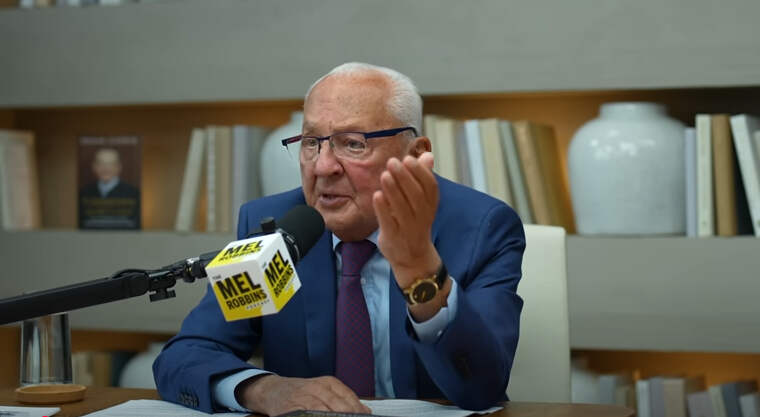
It says no riders. You wasn’t supposed to be on the truck unless you work for the company. Except my brother and I. My father would wake us up. We were riders and carriers.
MEL ROBBINS: Of the milk probably, too. Right, right.
A Father’s Prophetic Words
MEL ROBBINS: You write in your remarkable book, Compassion in the Court, about one of the most impactful moments in your life. You were in sixth grade, you were about to graduate, and something happened. Could you tell us that story?
JUDGE FRANK CAPRIO: I’m not sure if they still do this, but when you left the sixth grade, you went to middle school, and it was a big deal. And we all had an autograph book, and our friends would sign it. You know, if you’re thirsty near the spring, all that.
MEL ROBBINS: All the funny stuff the kids write. Right.
JUDGE FRANK CAPRIO: So my father came home from work one day and he was tired and he had his milkman uniform on and he was reading the newspaper. And I had my autograph book. I had my mother sign the autograph book. First I said, mama, you want to sign the book? She signed three pages. Love, Mom, I love you.
So I asked my father, I said, dad, will you sign my book? And he said, he just reached for it and he put it down and he just was staring at it for what seemed like a long time, probably a couple of minutes, trying to think of what he was going to say to his 12 year old son who’s going to go to middle school.
The street is wide, the road is long and very bumpy and very tough going. But I know that you will proceed along it honorably with your head held high to the end of the highest learning. And then the line that really got me here was, from your dad, Antonio Caprio Jr. My father was born in Italy. He came here with his parents, but he wanted to make sure that this document was accurate. So it wasn’t just your dad, Antonio Caprio Jr. This is an official document with my legal name. And I really mean it from the bottom of my heart is what he was saying to me.
MEL ROBBINS: What does it mean to you?
JUDGE FRANK CAPRIO: I still have that book. It’s in the right hand drawer of my desk. I keep it.
MEL ROBBINS: What do you think your dad was trying to say to you in that phrase?
JUDGE FRANK CAPRIO: My dad was trying to say to me, listen, we don’t have the resources to give you material things in life. The road is tough going. It’s very tough going. So you’re going to have to be a little bit tougher than the next person and you’re going to have to study hard. And he constantly was saying, you have to go to college. You have to go to college.
A Moral Compass from Family
MEL ROBBINS: I’m reading to you from page 43 and you write and you’re reflecting on what your father said. My father was not educated, but he had the soul of a poet. I have read that message a thousand times. His words touched me to this day. And I still find myself trying to make him proud and live up to his high expectations. For me to successfully navigate the wide street, long and bumpy road, we all need a moral compass. I wasn’t told how to be moral. I learned by watching others, most importantly, the fine examples set by my mother and father. And they did set a really big example for you. And your father kept saying, go to college. And so you did tell me about going to college and what happened next in your life.
JUDGE FRANK CAPRIO: My father was one of 10 and he was considered the smartest one of the family. He was right in the middle and unfortunately he couldn’t go to college because of the financial position. Family of 10 emigrated from Italy. They were fruit peddlers with a push cart.
So my father’s dream always was to go to college. And it was not afforded to him, but he wanted to make sure then my brother and I both had an education. And he would wake us up at 4 o’clock in the morning and we’d go to work on the truck. And he would constantly say, if you don’t want to do this, you’re going to go to college. He just drove that into us.
And it worked because a lot of my friends after high school we had no money and they went out and got a job and then they were able to buy a car and they had some material things that I didn’t have. And it was a temptation to go, not to go to college, to go out and get a job. But it was my father’s dream that we do that. And he impressed it upon us so much that was a no brainer for me that I had to go.
MEL ROBBINS: Where did you go to college?
JUDGE FRANK CAPRIO: Providence College.
MEL ROBBINS: You went to Providence College? Did you know you wanted to be a lawyer?
The Calling to Law
JUDGE FRANK CAPRIO: My father, when I was, I must have been 12 years old, we lived in what they called a cold water flat, which meant we didn’t have heat, central heat. We had an old potbelly stove. And I recall it like it happened like five minutes ago that my brother and myself, and it was freezing that day and we were sitting, they kept the oven door open so we could get some heat. My father would talk about things in life and so forth.
And he was saying to my brother, this is what you’re going to do in life and so forth. And he said to me, he says, you’re a good talker. These are his words. And yeah, I was 12 years old and I still remember them. He says, you’re a good talker. You’re going to be a lawyer someday. It was like an idiot coming down from heaven. I never wanted to be or do anything else except be a lawyer.
As a matter of fact, when I was in middle school, we had to write a career book in the eighth grade. My career book was on being a lawyer. And when I went to school, my courses were all geared toward going into the legal profession. And it was just that one sentence that my father said to me. And if I remember it correctly, he put his hand on my shoulder. Put his hand on my shoulder. You could have said, you’re going to be President of the United States. No, no, no, no. I’m going to be a lawyer. My father said, I’m going to be a good lawyer.
And then my father said, and this still remains with me, he said, remember, you can’t charge poor people like us. You can’t charge poor people like us. And then he said, but don’t worry, because you make it up with the rich people. Those were his exact words. I was 12 years old. And can I tell you something? My law office has never charged a poor family. Never. And we won’t.
MEL ROBBINS: It is amazing, because you’re right. It is like it came straight down from heaven, because he basically told you what was going to happen, that you would be successful like the rich people, but you would never, ever, ever judge the poor.
JUDGE FRANK CAPRIO: I think more parents should do that. Sometimes parents think the way they can get their kids to succeed is by berating them. But you have to encourage them, let them know you believe in them.
MEL ROBBINS: And you did that every day in court. It was absolutely amazing to watch because you didn’t just talk it, you showed it. When you graduated from college, did you go straight to law school?
The Path to Law School
JUDGE FRANK CAPRIO: I determined when I was a junior in college that I would not have enough money to go to law school. So I have to get a job teaching. But I had majored in political science, which I thought would prepare me for law school, which does it, incidentally. It prepares you for political science. It does not prepare you for law school.
There was this misconception that, oh, you take political science, that’s a pretty good entrance into the law. It’s not. Actually, business is a better entrance into law. For all you kids out there who want to go to college and then to law school, major in business. I was a wrestling coach as well. I taught at Hope High School in Providence, Rhode Island.
MEL ROBBINS: And how did teaching high school and coaching a wrestling team, what did that teach you about life?
JUDGE FRANK CAPRIO: Well, life’s a lesson for me because all the things that they taught you when you were younger, you know, if you don’t give up, if you stay the course, you know, you find a way to do it. It’s hard work, but you will survive. So I always did what I had to do. But my final goal was law school. Because my father said to me, you’re going to be lawyer. Right? And I wanted to be a lawyer after that. Because I never wanted to be anything else.
MEL ROBBINS: How long did you teach before you… Because you went to law school at night.
JUDGE FRANK CAPRIO: I went to law school at night. Four years.
MEL ROBBINS: Okay.
JUDGE FRANK CAPRIO: I taught for six years.
MEL ROBBINS: So you taught for six years and then while you were teaching, you went to law school at night?
JUDGE FRANK CAPRIO: Yes.
MEL ROBBINS: Wow. And what did that period of your life teach you? Just keep going. There’s a will, there’s a way. You can figure it out.
JUDGE FRANK CAPRIO: There never was “Oh, poor me.” And I used to drive. Me and a friend of mine would drive up to law school and then he dropped out. So I drive up alone sometimes I took the train. One time I got stuck right outside the Lafayette house and had to hitchhike the rest of the way to school.
MEL ROBBINS: Well, there’s one thing about you. Once you lock your mind on something, you’re going to find a way.
JUDGE FRANK CAPRIO: Yeah, I’m going to find a way.
From Lawyer to Judge
MEL ROBBINS: So what kind of law did you practice before you?
JUDGE FRANK CAPRIO: General law.
MEL ROBBINS: And how did you come to be elected to become a judge?
JUDGE FRANK CAPRIO: First of all, I ran for the Providence City council when I was a lawyer. And I ran against the president of the city council, who was a very powerful individual. He had been in the council for 35 years. He was considered the most powerful figure in Providence, more powerful than the mayor. And it was a remarkable victory back then.
MEL ROBBINS: What happened when you won?
JUDGE FRANK CAPRIO: I won. I was the boss.
MEL ROBBINS: That’s fantastic. So when did you decide to run and become a judge or how were you appointed to become a judge?
JUDGE FRANK CAPRIO: Actually, I was appointed by the city council because it’s a municipal judgeship. So I had my friends on the council and I had the councilman from my district and the mayor supporting me. I had a pretty good record in public life, so I wasn’t exactly an unknown.
MEL ROBBINS: Now, were you excited to be a judge? Is it something that you thought you wanted to do or did somebody recommend it to you?
JUDGE FRANK CAPRIO: This judgeship was ideal for me because it’s a part time judgeship, because I could never have supported five kids on a judge’s salary, particularly a municipal judge’s salary. So I was able to be… I was actually a part time judge. I was the chief judge and there were two other judges, but it wasn’t… I could still practice law while I was practicing on the court as well. If not, I would never have been able to take the job.
The First Day Lesson
MEL ROBBINS: So in your incredible book, chapter 19, you write about the first day as a judge and what it taught you about compassion. Would you be able to tell us that story about what happened the first day you…
JUDGE FRANK CAPRIO: I’m on. I get elected now. I’m a judge. I got the robe, right? I’m going to go. I’m the boss. I’m going to sit on the bench. And this is it now, right? I have arrived. So I said to my father, I said, dad, you know, my first day on the bench, he said, I’ll come down and walk. I said, good, come down. I’ll offer you to come down.
So I’m there, and I am really full of myself. I’m a judge now. Look at me. All rise, please. Everybody rises and so forth. It’s so crazy. So this woman comes before me. She owed… She had a boot on her car. I don’t know what she owed. A couple hundred dollars in tickets, and she couldn’t pay them. So I said, if you don’t pay it, I’m not going to take the boot off the car. And she says, I just don’t have the money. I don’t have the money, and I have four kids.
It’s my first day on the bench. No one’s going to bully me around, right? So I says, well, you owe the money, and if you don’t, we’re going to leave the boot on the car. She said, I don’t have the money. I have to get my kids to school. So I said, I’m sorry. Continue the case. We’ll give you a couple of days to come in, right?
My father’s in the courtroom. After the court’s over, my father comes into the chambers. I said to the sheriff, how’d my father come in? Chambers? I’m so happy. I said, dad, how did it go? He said, how did it go? How could you do that? How could I do what? He said, that woman. I said, she was disrespectful, you know. I said she wasn’t respecting the court. I said I wasn’t going to take care of her.
He said, Frank, she had four kids. Now, suppose she can’t feed the kids tonight if she paid those tickets. No, she doesn’t have a car. She can’t drive him to school. What are you doing? You weren’t brought up that way.
My first day on the court set the tone of my judgeship of over 30 years. After that, I took everybody’s personal situation into consideration in the imposition of a sentence. And that case still bothers me. It still bothers me to this day when I think about it. I say to myself, how could you do that, you know, with my upbringing and so forth. And I don’t know why my first aid, my case, this woman, she was… She was insulting to begin with, but you have to overcome that because she was scared and she was scared to death, right?
MEL ROBBINS: Yes.
JUDGE FRANK CAPRIO: As my father said.
MEL ROBBINS: Well, I think she was a gift to you because you write in this book on page 110, the lesson was that being a judge is much more about the person in front of you than it is about the law. Since then, I’ve always tried to find out what was really going on with the person. And I always considered how my ruling would impact not only them, but their whole family.
JUDGE FRANK CAPRIO: Right.
MEL ROBBINS: Like, if you really think about…
JUDGE FRANK CAPRIO: Those aren’t only words. I did that.
MEL ROBBINS: Yes. Yes, you did. You did that for over 30 years. And I think you needed that case with your father sitting there to be reminded of who you are. We all need those moments. You were just smart enough and wonderful enough to recognize what it was and to actually change, which is incredible.
You know, if somebody is listening to you, judge, and they want to follow your advice of putting more kindness into the world, of being more compassionate towards other people, how can you practice that? Particularly in a moment of time where things seem overwhelming, the headlines are stressful, the economy’s all over the place, or maybe you feel like, well, it’s not going to make a difference if I’m kind. What would you say to somebody?
The Power of Compassion
JUDGE FRANK CAPRIO: Place yourself in their shoes. Imagine that you were sitting there. Because it can happen to all of us, you know, tomorrow. We don’t know what tomorrow brings. We’ve had many very wealthy people who ended up penniless, you know, and so I always have subscribed to that. I always placed myself in the shoes of the person that was before me and then try to exercise a modicum of compassionate understanding. Sometimes I went overboard, but you know what? I’d rather go overboard with compassion than go overboard with punishment.
MEL ROBBINS: When you step into somebody else’s shoes as a judge, you have seen people at their most vulnerable. You have seen them scared, you’ve seen them ashamed. What’s something that you’ve learned from all of these interactions with people that really gives you hope about human beings and the world? Because you have been in this amazing role as a judge. You step into people’s shoes, you consider their circumstances. You always take into account how this is going to impact the family. What do you believe is true about the true nature of every human being that stands before you?
JUDGE FRANK CAPRIO: We’re not in this world alone. We have to rely on other people for many necessities in life, for some of our needs. We have an obligation to use whatever resources we have our own resources to help others, to make society better because of our contributions. Those are the words we hear all the time. You know, dedicate yourself to a cause, give to charity, help people. They sound good, but put them in practice.
I mean, I’ve seen people, I mean, for lack of a better term, who are frauds, who are preaching this, but don’t do it. People in public life, you know, they preach one thing and do another. My theory always was, you know, if you deserved an 8 or you deserve the 6 in sympathy, I gave you a 10, hoping that it would help you and that it would change your life.
Dealing with Regret
MEL ROBBINS: You know, you mentioned that you really regret how you handled that first case. How do you deal with regret? The things that you wish you had done differently?
JUDGE FRANK CAPRIO: It’s a lesson. Just… I never repeated it after that. And I was on the bench for 30 years after that. I never repeated it. I can’t tell you how many times I was there and I knee jerk reaction. I wanted to really beg somebody and I said, you know, I can’t do that. They have kids at home. They probably won’t be able to put food on the table tonight, you know, so all of those things, you know.
Global Impact and Recognition
MEL ROBBINS: Judge, your show Caught in Providence went on public access TV in Rhode island about 25 years ago, and it later went into syndication all over the world. And now you are online. You have millions of followers. These clips inspire people around the world. I’m talking billions, billions of views. Why do you think your work and your approach to life and relationships is resonating with people?
JUDGE FRANK CAPRIO: Because it addresses decency, it addresses honor. It addresses all of those things that families are hoping for for themselves. And that’s what it’s all about. It addresses compassion and understanding. I don’t just use those words when I was on the bench, you know, I exercised them. You know, it’s very simple. Just put yourself in the shoes of the person before you. How do you want them to treat you?
MEL ROBBINS: You have been just known and people follow you. Millions of people follow you because of the incredible advice that you give. What do you think the best advice is that you’ve given?
JUDGE FRANK CAPRIO: Just be honorable.
MEL ROBBINS: What does that mean? Because I think in the world today, a lot of people don’t even think about honor.
JUDGE FRANK CAPRIO: When people came before me, I would implore them, just tell me the truth. Just tell me the truth. Be honorable about all of this. You know, and at the end of the day, it pays off. It does pay off. You know, I showed compassion to people. Some people came in and had nightmarish stories. I mean, I had a woman come in and she owed $500 in tickets, and she didn’t pay them. And she said she didn’t have the money and that she was shot in the leg. She had a bullet in her leg. What do you do in a case like that?
MEL ROBBINS: I would probably dismiss it so she can pay her medical bills.
JUDGE FRANK CAPRIO: That’s what I did.
The Power of Believing in Others
MEL ROBBINS: You know, one of the things that I want to read to you from your bestselling book, Compassion in the Court. This is on page 116. And I’d love to hear you reflect on this, because in being a big fan of yours, the way that you spoke to children in particular always struck me.
“I often tell children that I’m expecting them to leave my courtroom and go on to do great things. The power in knowing someone expects greatness from you is immeasurable. I am certain that people feel inspired to do their best because along the way, someone told them they believed in them. I’m certain that I became an attorney and in time, a judge because my father and mother told me I could be one. Imagine if all of us did more acts of generosity and we told more people that we believed in them, how much better we could make the world.”
Talk to me a little bit about that.
JUDGE FRANK CAPRIO: I think that you can change the course of someone’s life right in the way a minute by placing your hand on their shoulder and telling them that you love them, that you believe in them, and that they will succeed if you encourage people in the gentlest way instead of yelling and screaming and berating them.
And I’ve always made it a very special point when people came to court with children to concentrate on the children in a positive manner, because as soon as they walk into the courtroom, they’re terrified. A courtroom can be a very intimidating experience. You walk into a courtroom if you’re 12 years old. I mean, you see a judge in a robe, you see a cop with a gun. You see an oak panel courtroom. You see everybody sitting like this, and particularly if the judge is, for lack of a better term, a jerk, and is insisting that everybody behave in a certain way.
I never did that. I always try to treat people civilly, let them feel comfortable. But particularly when there were children in the courtroom. Some of the best episodes are when there were children in the courtroom. And I brought them up on the bench and had them help me determine their parents’ case. And some of the answers just are amazing. They’re humorous, but they’re very revealing.
We had one in particular. There was a family that relocated from Africa and came to the United States. They had been here for six months and they came to court and I think there were two or three children, but one of the children was about 10 years old. And I had him come up, they came from Africa and they were only here for six months, and he’s up at the bench and they’re nervous and so forth. So I said, I’m going to ask you one question. Is your father guilty or not guilty? And without hesitation, he said, guilty.
MEL ROBBINS: Oh my God. So what was it? Was it like a speeding ticket or a parking ticket?
JUDGE FRANK CAPRIO: Speeding ticket.
MEL ROBBINS: Speeding ticket, yeah.
JUDGE FRANK CAPRIO: He said guilty. And I mean, it just broke the house up. And I always think of that. And kids are so honest.
MEL ROBBINS: What did you do in that case?
JUDGE FRANK CAPRIO: I dismissed the case.
MEL ROBBINS: And why did you dismiss the case?
JUDGE FRANK CAPRIO: Because he had four children. He came from Africa, he was just getting started to earn a living here. And so in consideration of his family commitments and the fact that he was very respectful, I took that into consideration.
Marriage and Partnership
MEL ROBBINS: So you and your wife Joyce have been married for over 60 years. What advice do you have to somebody who may be listening, who is just at the beginning of their relationship?
JUDGE FRANK CAPRIO: Well, it’s a give and take situation. There’s no such thing as a boss in the marriage.
MEL ROBBINS: So you can’t be the judge when you come home, is that what you’re saying?
JUDGE FRANK CAPRIO: I behave myself.
MEL ROBBINS: Joyce is watching, so be careful.
JUDGE FRANK CAPRIO: No, we have five children and she’s the best mother in the world. And we have a great relationship. We’ve had our issues on minor things, and we don’t talk for a day, maybe a day and a half, and that’s it. But she knows me pretty well by now, and I know her pretty well. And we don’t have those skirmishes anymore.
MEL ROBBINS: Well, I would imagine you’re both pretty kind to each other.
JUDGE FRANK CAPRIO: Whatever she wants, she gets.
MEL ROBBINS: Well, there you go. You just said the secret to a marriage, Judge. Whatever my wife wants, we’re good. That’s how you keep peace in the house.
Facing Cancer with Courage
MEL ROBBINS: So, judge, you recently had a life altering diagnosis of pancreatic cancer. Can you share what this journey of facing this cancer diagnosis has taught you?
JUDGE FRANK CAPRIO: Well, it teaches you a lot, teaches to stay close to the people you love. It drives you to prayer. You test your religion, you examine your life and see where you went wrong. Try to make amends and try to set an example of strength for those that are around you.
For someone that was pretty healthy entire life, so all of a sudden it’s a death sentence. Pancreatic cancer is not curable. So it’s a question of how long you can live with it. And I haven’t given up the battle. I’m fortunate to be treated by two very well known and proficient medical teams at the Dana Farber Institute and the Miami Institute because I spend winter down in Miami. So I’m very fortunate to have excellent medical treatment.
But it’s a natural tendency when you’re younger, think of how long am I going to live and how am I going to die? Am I going to die in a car accident? What’s going to happen? So I know how I’m going to die. I’m going to die of cancer and going to try to stay around as long as possible. I’m very fortunate that I feel well.
MEL ROBBINS: And you look great.
JUDGE FRANK CAPRIO: Well, I feel well. I’m not giving up. There’s one thing I never did in life was give up. And I’m certainly not going to give up now.
MEL ROBBINS: If the person who’s listening is going through something very difficult like you are, or somebody that they love is, they have a scary diagnosis, they’re really struggling, what would you say to them, Judge?
JUDGE FRANK CAPRIO: You really have no choice. Listen to your medical providers. Everyone wants to be their own doctor. I do what the doctors tell me to do and I tell them to be honest with me. How much longer do I have to live? What is my prescribed course of treatment? But rely on expert medical advice is the only advice that I can give them.
What Makes a Good Life
MEL ROBBINS: Now, as you approach your 90s, you’re approaching your 90s.
JUDGE FRANK CAPRIO: Well, I mean I’m approaching my mid-80s.
MEL ROBBINS: What are you looking forward to?
JUDGE FRANK CAPRIO: I’m looking to keep my family intact. I’m very lucky. We have a very close knit family.
MEL ROBBINS: I can tell two of your sons are here. They’re making sure that you don’t screw up. That’s why they’re here. I can tell they’re here.
JUDGE FRANK CAPRIO: I need them because I am very incorrigible, so they have to keep me in line.
MEL ROBBINS: What do you think makes for a good life?
JUDGE FRANK CAPRIO: A good life is being a good family man, good family person and having good friends, that’s all there is to life. Everyone who thinks that they’re better than someone else or because of their wealth, that they have special privileges. No, we’re all in the same boat here together.
MEL ROBBINS: So what are your plans for the future? What do you still want to do? What do you want to see? What do you want to experience, Judge?
JUDGE FRANK CAPRIO: Well, I enjoy traveling. I’ve been very lucky to travel to Europe, to my father’s village, where he was born. I went to where my dad was born. It was a dirt floor still. It’s still a dirt floor. And I was able to go to the Middle East, so I enjoy traveling. And as trite as it sounds, I know it sounds, I derive great pleasure out of helping people.
MEL ROBBINS: I don’t think that sounds trite at all. In fact, I think that’s the secret to a good life, is being kind, being encouraging and helping people.
JUDGE FRANK CAPRIO: Being in the service to others is what gives you a happy life.
Words of Wisdom
MEL ROBBINS: For the person who’s listening right now, who is like you and maybe tired or retired or a little older, what words of encouragement would you give them about what’s possible for the rest of their lives?
JUDGE FRANK CAPRIO: I think they should become active in some civic duties, volunteer at the home for the elderly, help people, drive people, but be of service to others as much as you can.
MEL ROBBINS: And what do you think your father would say about who you’ve become?
JUDGE FRANK CAPRIO: Well, he’d put his hand on me and he’d be so proud. It would be a vindication of everything that he taught me. But he taught me by way of example. Like when I saw my father paying a milk bill for one of his customers, he didn’t have to give me a speech. He demonstrated by his actions. He just came here with nothing, from Italy. He had to leave school. He was so smart, but he had to work many jobs. So I owe a great deal to him, which every father should set that example.
MEL ROBBINS: And I think your sons would say the same, since they’re crying right over there in this studio, that you’ve set an incredible example for them.
JUDGE FRANK CAPRIO: Well, they’ve both done pretty well.
MEL ROBBINS: You’re a hard act to beat. So that’s saying a lot. What would you tell yourself if you could go back in time? You’re on those milk runs. You’re 10 years old, you’re on Federal Hill. What would you say to yourself?
JUDGE FRANK CAPRIO: I’d say don’t quit, because the end of the road is successful. I mean, I have a great family. I’m not extraordinarily wealthy, but I’m not broke. I have an opportunity to come and speak to you and other programs as well. I’ve had an opportunity to give back. There’s a great sense of joy giving back and not just receiving. I never was a receiver, and I keep using the same phrase all the time. I got that from my father.
MEL ROBBINS: And we’re getting it from you. That’s the example that you have given to the world. To not take, but to give.
JUDGE FRANK CAPRIO: I am amazed at the impact that my actions have had worldwide. Now, this is going to sound very egotistical. It is not. I get messages from all over the world every day. And the conclusion that I come to is that the world is not full of compassion or understanding. We’re in a very contentious world and being exposed to people worldwide. I get the messages every day. Congratulations. Thank you. We need more people who take into consideration the plight of others, and it’s very rewarding.
Keeping Hope Alive
MEL ROBBINS: Since you have a global audience and you are inspiring and encouraging people around the world. For somebody that is feeling very discouraged, they may live in a part of the world where they don’t have a lot of support. The headlines are scary. How do you keep hope alive, Judge?
JUDGE FRANK CAPRIO: Well, I mean, the first priority I have whenever I have issues like that is my religion. So I’m not a holy roller, but I am a practicing Catholic, and I’m a very strong believer in the power of prayer. And that usually is what gets me through all of these scrapes that I’m thinking about.
MEL ROBBINS: So if the person listening, Judge, takes just one thing from everything that you’ve shared, what do you think the most important thing to do would be to make your life better?
JUDGE FRANK CAPRIO: My parting words are that we are not in this world alone, that we have to rely on each other, and that we should show understanding and compassion toward others and help them in their time of need.
MEL ROBBINS: Judge Caprio, it is an honor to be with you. I am so glad that you are here, that we are getting to be inspired by your life, by the way that you move through life. It has been an honor to sit with you, to be inspired by you, and I wanted to be sure to tell you I love you.
JUDGE FRANK CAPRIO: I’m very appreciative of the opportunity. Thank you so much.
Closing Thoughts
MEL ROBBINS: You’re welcome. And I appreciate you. I appreciate you for taking the time to listen and to learn and to spend time with somebody as remarkable as Judge Caprio.
And in case nobody else tells you, I wanted to be sure to tell you that I love you and I believe in you, and I believe in your ability to create a better life.
One of the things that I’m taking away from this one is the power of kindness and the fact that purpose is not what you do, it’s how you do it. And I think in this moment, how we do it and how we treat other people is absolutely everything.
I cannot wait to hear what you get out of this. I can’t wait to hear what the people you share this episode with get out of this. And I also will be waiting for you to welcome you into the very next episode, the moment you hit play. I’ll see you there.
And for you sitting here watching with me on YouTube, I just want to say, please share this with somebody. Don’t just sit and watch. Please do something and take a minute and subscribe to this channel because it’s really a way that you can support me in bringing you new videos every single day. And I’m sure you’re looking for something really inspiring to watch, to really move you. So I want you to check out this video next.
Related Posts