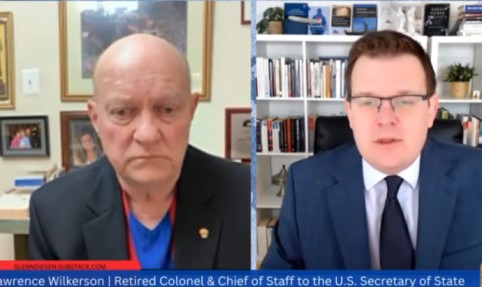
Editor’s Notes: In this sobering discussion, Colonel Lawrence Wilkerson joins Glenn Diesen to analyze the rapidly escalating conflict between the United States, Israel, and Iran. Wilkerson warns that the Trump administration’s current military posturing may be a desperate attempt to buy time, even as the global economy faces a potential depression due to the closure of the Strait of Hormuz. Perhaps most alarmingly, he explores the dire possibility that the conflict could culminate in a nuclear exchange, suggesting that Israel’s survival as a state may be at risk. This deep dive into imperial hubris and geopolitical miscalculation serves as a stark warning about the path toward global instability. (March 28, 2026)
TRANSCRIPT:
Introduction
GLENN DIESEN: Welcome back. We are joined today by Colonel Lawrence Wilkerson, former chief of staff to the US Secretary of State and also spent a long time in his military career and at the White House. So thank you very much for coming back on the program.
LAWRENCE WILKERSON: Good to be with you, Glenn. I hope it’s getting a little bit better in Europe, but I’m told by other people, one Norwegian friend this morning said, nope, it’s getting worse.
The Situation in Europe and Trump’s Iran Countdown
GLENN DIESEN: Well, the weather is looking good otherwise, politically, everything else? No, it seems to be going quite poorly as most places in the world. But, yeah, a lot of these problems appears to have gotten worse. Of course, things were already bad, but it’s getting a lot worse due to the war, war against Iran.
And, well, the most recent statements we got from Trump, first he gave this 48 hour countdown for the destruction of Iran’s energy facilities. Then he extended it to five days. Then he extended it to 10 days again. I wanted to know what you think will happen at the end of this countdown. I mean, can Trump really afford to go up the escalation ladder now?
And also it’s unclear what this countdown is for. Does he actually believe he can get this from Iran? Is it public diplomacy to manage narratives, or do you see something to hold the government together? I’m just wondering how you interpret these recent events coming out of the White House.
Trump Buying Time — and Netanyahu’s Role
LAWRENCE WILKERSON: If I were to be absolutely honest with you, and I will be, I think it’s Trump trying to buy back time that he knows is running out and he doesn’t know any other way to do it. And he’s got a sycophantic enough cabinet where they go along with it.
I don’t think he has any idea how he’s going to get out of this. He’s in it. He’s in it deeply. He’s finally, I think, come to the realization that he’s in it and in it deeply and he has not the tools to extricate himself. The main person who got him in it to this depth is Bibi Netanyahu, and that Bibi has absolutely no sympathy for him whatsoever and in fact, would take him with him in a heartbeat if it were to hell and back.
So he’s really probably finally realizing, even through his megalomania, which is intensifying every day. I think Jeff Pace is right about that. He can’t finish not only sentences, sometimes he can’t finish individual words coherently. And he’s stuck. And he’s trying to buy time right now with all these different, you know, five days, 10 days, 13 days, whatever it might be.
But he’s also very frighteningly marshaling lots of force across the globe. Not significant military force in terms of an invasion of Iran, because we simply could not do that. And if you were to attempt it, I think we would probably be looking at impeachment, joined in by his own party.
Special Operations Forces and the Venezuela Comparison
LAWRENCE WILKERSON: What he’s doing is assembling all manner of special operating forces and auxiliaries there too, like the 160th SOAR Special Operations Aviation Regiment, like the Rangers from Washington, like the Rangers from other places in this country. All manner of special operators whom he is going to try to use in some esoteric way.
Think Karg Island or some of the other islands in the Gulf I heard mentioned this morning, or other places like he did in Venezuela, with this kind of instant precision afforded by the delivery vehicles and the extraction vehicles and such. And it’s impossible. You’re not going to do that in this scenario like you did in Venezuela. And you’re certainly not going to do it with all these disparate forces being brought in from different points on the globe. Aircraft from Ramstein, aircraft from Italy, aircraft from Japan.
I just don’t know what he’s thinking other than, “I’m going to pull off a really quick one like I did in Venezuela and it’s going to be so hahaha. And I have done so much damage, for example, to Karg Island, Iran’s principal port, that I will get some movement in the talks” — which aren’t being conducted.
Witkoff’s Lies and the Iranian Position at the UN
LAWRENCE WILKERSON: Those were total lies by Witkoff yesterday. I’m told by very reputable authority that he has not seen a single Iranian. He’s been dealing with Pakistanis or Omanis or other people offering their good offices, thank God. But he hasn’t talked to a single Iranian.
And in that vein, let me tell you what the most important Iranian in my mind just said. This is Araghchi. At the UN meeting, specially convened emergency meeting — the UN is pretending that it wants to look at the bombing of the school in Iran where many school children were killed — and Araghchi had this to say. And these are just quintessential Araghchi type statements, but they sum up the situation really well.
“Two bullying nuclear weapons regimes have attacked my country.
“Normalization of crimes against humanity is not sufficient to describe this. The attack on the school was just the latest chapter. This all began with Palestine. It all began with Gaza. Now we have 27 days of illegal war against my country. We have established — you, America, you, Israel, you, the United Nations — have established there is no regard for humanitarian law. 600 schools in my country have been bombed. Hospitals have been bombed. Nursery homes have been bombed. Nursing homes have been bombed. Ambulances, both stationary and mobile, have been bombed. Water sources have been bombed. Food sources have been bombed. These are all war crimes, all a product of the world ignoring Palestine” — brought it right back to that, the original crime, if you will. Then he ended: “But we have resolve.”
And I have no doubt they do. That’s whom he should be negotiating with. Witkoff is scared to death of Araghchi, who wouldn’t dare go into the same room with him because he is a superb diplomat and Witkoff hasn’t a clue. Him and Kushner are just making money on their diplomatic envoy tours.
So that’s where we are. We’re at a point of utter confusion in the empire, and that Cabinet meeting was a personification, if that’s the right term, of it. I don’t know where it goes from here, but I know it isn’t good.
Buying Time for What?
GLENN DIESEN: Well, you mentioned buying time. What is there to buy time for, though?
LAWRENCE WILKERSON: Buying time to be buying time. Yeah, that’s it. He’s buying time to be buying time. And he’s moving all these forces around as if he’s some kind of magician with military force, when in fact, people like General Keane ought to be telling him this is costing billions and to no end. Other than what, Mr. President? What is it that you attempt to achieve?
I listen to Keane this morning. You know General Keane, that asshole, all he does is proselytize for the people he’s making money off of. He’s talking about how everything is going to come down to, “We’re going to attack them, and we’re going to attack them with these forces that are currently being marshaled.” The MUSEs, the two MUSEs, the one from Okinawa, and I think the other one’s coming from somewhere in CONUS, and the 82nd Airborne element, and these people who are special operators. “We’re going to attack them.” Where are we going to attack them? Where?
“We’re going to attack them on various islands. We’ve had islands offered by the UAE.” Oh, well, you mean that island out there you’ve been contesting with Iran now for about, what, 50 years? Little Sparta. What are you going to do from that island? It’s not even near the strait. What are you going to do from that island? Just sit there and preach?
A Failure of Military Leadership
LAWRENCE WILKERSON: I’m sorry, General Keane, you have made the absolute error that if I were on a game floor with a major or lieutenant colonel participating in that game, who turned around and told me what you just told me — that we are accomplishing all of our objectives — I would have thrown him off the game floor.
“Listen, son, you’re not here to accomplish your objectives. You’re here to accomplish your mission. Your objectives being accomplished are supposed to lead to accomplishment of the mission. What’s your mission?” And you would have been unable to tell me. You would have been categorically unable to tell me what your mission was.
That’s where we are. In military terms, this is the worst performance I’ve ever seen by a leadership cell from the United States. It’s terrible. It’s utterly terrible. And I blame them all, from Keane to Hegseth to the President.
The Strange Character of This Administration
GLENN DIESEN: How do you make sense, though, of this new leadership? Because a lot of people were worried about this, because what’s happening now was very much predictable. For once, the Iranians were quite open about what they were going to do, despite Trump’s claim that no one could have predicted they would attack all these bases and that they would shut down the Strait of Hormuz.
Yes, well, reasonably, I guess the how quickly they shut down the Strait of Hormuz came as a surprise to many. But the overall direction, I think, should have been predictable. But what is it with the administration? Why it seems to be different, not just in his demeanor and the vulgar language, but we also see these other components, like all these strange prayer meetings. And, you know, I’m a Christian, I don’t mind prayer, and I think it should have a greater role in the culture, perhaps, but in politics and in the war rhetoric, it seems it doesn’t belong there. If anything, it’s quite absurd.
The Bastardization of Christianity and the Old Testament Cudgel
LAWRENCE WILKERSON: It’s a complete bastardization of Jesus Christ. No question about it. It’s an adoption of the Old Testament that Jesus Christ repudiated. His whole time on this Earth, his whole 33 years or so of life was spent repudiating the Old Testament. He even said it again and again and again.
And now we have these people from Franklin Graham to Pete Hegseth that want to resurrect the Old Testament, Ted Cruz included, and a host of other people, Mike Johnson of the House. They want to resurrect this Old Testament God and use it as a cudgel to beat their enemies with. And their enemies are everyone from Democrats to the Iranians. And they like what Trump is doing.
The Global Economic Catastrophe Unfolding
LAWRENCE WILKERSON: I can’t believe that the leadership of both parties, though, is going to continue this progress towards destruction, because the cost of it — not just in dollars for a country that’s already $40 trillion in aggregate debt — but the cost for the world.
This morning we were looking at shipping, we were looking at commerce in general. We were looking at key products in that commerce. One of them was helium, for example. You can’t make computer chips in many regards, the more sophisticated ones anyway, without helium. Well, a large portion of the helium — we didn’t even know this when we were looking at commodities and so forth — it comes through the Strait of Hormuz. It’s like the urea. I didn’t know that that much urea came through the Strait of Hormuz.
We are disturbing the world economy in such significant and profound ways right now that it might not recover for years. We are already in recession. If you just look at two quarters in a row, we are already in recession. There is a really good chance we’ll go into depression. And all because — not all because — because a lot of this was, you know, foretold by our profligate fiscal policy, but this has sped it up and deepened it and made it instantaneous, almost.
And I don’t think Scott Bessent or Donald Trump have a clue that they’re doing this, nor did anyone we were talking with this morning know that they know what they’re doing to the global economy. If they do, they should all be taken out and shot tomorrow morning at dawn. Because this isn’t just the empire. This is a lot of people. This is 7, 8 billion people that are going to be impacted seriously and significantly by what we’re doing if we don’t stop very shortly. And I don’t even know if it’ll stop if we stop, because we’ve started it.
The Damage Is Already Done
GLENN DIESEN: Yeah. I was going to say, even if we stop, I think even if the war would end tomorrow or today, a lot of the problems are already now in place, like ships —
LAWRENCE WILKERSON: — now off the strait that have no place to go, all loaded with crews. Granted, the crews are only 10 to 12 people, but I mean, that’s all it takes to run with these big ships today. But they’re standing off the strait with nowhere to go. Yeah. Or this is out in Mariners, almost 4,000 ships.
GLENN DIESEN: Well, this is the vulnerability though, after, you know, decades of this globalization, interdependence, everyone making themselves reliant on the whole machinery working smoothly and then suddenly one attacks Iran. I mean, this is, yeah, truly disastrous.
The Strait of Hormuz and Global Choke Points
LAWRENCE WILKERSON: But actually when I was at the Naval War College, I wrote a paper on it and actually studied, among other things, all the straits in the world that were critical. And I use as my guide for criticality the buildup at that time that was going on to produce the Law of the Sea treaty. And I looked at what those straits might be given the Law of the Sea treaty’s regime. You know, the straits are either international or they’re parsed. So they’re partially here in this territorial sea, here in this territorial sea, and then the center, where the ships pass, actually pass, is internationalized. I’m not making an accurate trail of it, but they did a good job of showing where all the critical choke points were, critical seas, inland seas, for example, like the Sea of Okhotsk, which was a big interest to us with the Pacific War with the Soviet Union at the time.
And I came away from that realizing that there were about six or seven in the world that if you got control of them — and control meant you had to have all the paraphernalia of that control, air, sea and subsea, maybe space — you could bring the world to its knees. And it’s coming through, it’s coming true in the most desultory and disgusting way. It’s coming true. And the Strait of Hormuz was not actually the most serious in the top five identified, but it was one of the top five where you could really do it. The Bab-el-Mandeb was much more serious than the Red Sea. We’re doing it, we’re doing it to ourselves.
And as you pointed out, it’s partially because we let ourselves become so globalized. But it was pretty good, it worked pretty well, as long as everything functioned. Continue to throw something like this into it, and that’s what I did in my scenarios. I threw things in there and I saw a very, very badly disruptive world when I did. And you know, we weren’t as globalized then. This is 25 years ago. We weren’t as globalized then as we are now.
Trump’s Approach and Iran’s Red Lines
GLENN DIESEN: Well, it seems that Trump is a bit of a one trick pony. His approach to most adversaries is this massive threats, show overwhelming strength, and then comes in the deal maker to get an all or nothing deal. And the problem though seems to be that if Iran holds all the cards in terms of going up the escalation ladder, and also the kinds of deals that Trump wants, they’re not really possible for Iran because they see this as an existential threat. They’re not going to give up anything. They don’t even want to go back to the status quo because it was getting intolerable. And also, even if there was a deal which seems reasonable, there’s no trust anymore. It’s very likely they would be hit by missiles while they’re there at the signing of the deal.
LAWRENCE WILKERSON: Israel’s never going to let it go anyway, to the last Israeli. They’re going to keep it up, they’re going to keep it going. And by the way, I think we are getting close to the point where we might be thinking about the last Israeli. It’s getting really dire for Israel.
Israel’s Military Struggles and Internal Turmoil
GLENN DIESEN: What do we know though about the situation in Israel? Because we don’t get much footage out of Israel at the moment. Not at the moment at all.
LAWRENCE WILKERSON: I think the very fact that in Hebrew, Netanyahu announced last night, in a moment of peak, or a moment of just imbecility or just hysteria, that he was going to call up another 400,000. The battle in Lebanon is not going well for them. Hezbollah has shown a remarkable ability to stop tank columns and actually kill the lead tank, kill the rear tank, and then begin to pick off the tanks in between. You’ve got Israeli tankers unlimbering their tanks and running up the hills beside the columns, trying to get away from the fire. They have taken out seven or eight Merkavas already in a single column. They’re not having a good time of it.
In other words, I do now understand why he said he was going to call up another 400,000. But then the question in my mind arose immediately: you just called up 300,000, 30% of whom didn’t show up. Where are you going to find these other 400,000? And even more to the point, where are you going to find those that will show up? Are these over-65-year-olds? Are these under-18-year-olds? What are these people that you’re calling up? You do not have that big a nation.
And you’ve probably seen the scenes — one IDF general pulling his hair out and actually crying on camera, a couple of mayors doing the same sort of thing. It’s becoming extremely dangerous to be in Israel in any capacity other than in a bombshell. Nothing is going up virtually and everything is coming down. There is no air defense left in Israel, and Iran has not run out of missiles, and in fact now can use cheap drones to do major damage in Israel because they have nothing even to shoot the cheap drones down with.
Lebanon — and the real tasks they’re confronting now in Lebanon — put into that mix what is still going on with regard to Gaza, and you have Naftali Bennett making these egregious statements. And the reason Bennett is making these statements is because he doesn’t think Netanyahu has finished Hamas in Gaza. And he’s right, he hasn’t. This vaunted, massively successful, hugely prideful military, the IDF in its ground component, has still not defeated Hamas in Gaza. And Bennett’s angry at Netanyahu for taking his eye off the ball, for letting the UN and Trump create this, you know, Trump City or whatever.
So Israel is in turmoil right now. I hate to say this, and I’ve been predicting it for a long time, but I don’t feel any joy in having it come true. Israel is going to disappear as a Jewish state in the Levant. Israel is going to disappear, and Netanyahu is going to be the presider over that disappearance.
The IDF Chief of Staff’s Warning
GLENN DIESEN: Well, I saw in the Times of Israel it was reported that the IDF Chief of Staff, Lt. Gen. Samir, warned that the IDF — again, this is the Chief of Staff of the IDF arguing — that the IDF will collapse on itself due to the manpower shortage. This is quite a warning. He argued, you know, “If you put up a red flag, I would put up all 10 red flags.” This is, it would seem, the time not to double down, but to find an off ramp.
LAWRENCE WILKERSON: You bet.
GLENN DIESEN: You say there is no off ramp and Israel could cease to exist.
LAWRENCE WILKERSON: The off ramp requires Netanyahu to face the music, though, I think. And I think that’s a big impediment for him finding an off ramp, because if he faces the music, he’s probably going to jail.
Could Israel Reach for Its Nuclear Weapons?
GLENN DIESEN: But I just have a hard time. Also, if you look at Iran’s demands for the United States — that is, to leave the region, and if it doesn’t do so voluntarily, it will essentially pressure the Gulf states to do so through conditioning access to the Strait of Hormuz and also to bomb out all the US bases — it doesn’t look like both the United States and Israel, two countries which have linked their security to global primacy and regional primacy, and militarized that, and also with leaders as they have now, that they’re willing to essentially argue, “Well, we made a miscalculation. We’ll give the Iranians what they want and walk back from this war,” which many people have been pushing for for decades. So do you think there’s a possibility, instead of Israel ceasing to exist, that they will instead reach for their nuclear weapons?
Iran’s Nuclear Capability and the Risk of a Nuclear Exchange
LAWRENCE WILKERSON: In that regard, I have some very disquieting news from Ted Postol, the emeritus professor at MIT who’s been advising a lot of us on nuclear issues. He called me at William and Mary while I was down there Tuesday night, and we talked at length. And I think he convinced me — I should say, I think what he’s saying is at least 75, maybe 80% a possibility — I don’t know what percentage he would put on it — that the Iranians have sufficient enriched uranium now and a facility deeply underground, that they could build a bomb, put the warhead on a Khorramshahr or similar type Mach 3, Mach 4 missile, and deliver it, and maybe even more than one.
And as Ted was talking to me, I went back to Kang Sok Ju and Yi Goon and Jim Kelly, our assistant secretary for the Pacific, going to Pyongyang and taking an economic package that was fairly robust. It had taken a lot to get it through George Bush, even more to get through Dick Cheney, as a compensation for their giving up their pursuit of a nuclear weapon. And Yi Goon, or Kang Sok Ju — I can’t remember which one — looked at Jim and in Korean, translated, immediately said, “We already have the bomb.” And that ended the diplomatic mission. It was over. Jim came home.
I think we’re looking at that sort of talent, capability, intent, if you will, deep underground in Iran. And if they have made a decision to do what Ted Postol said he thinks they have made a decision to do — and certainly they have the capacity and material to do it, and the expertise — then we’re in a new ball game. Very shortly, we’re in a very new ball game, because Iran will have not one or two, but three or four or five. As the Koreans said, they had six to 12 nuclear weapons. Where do we go from there, if that is the case? And how does Iran demonstrate that? That’s a huge question in my mind now after talking with Ted.
It also brings us back to Netanyahu, because I think still that Netanyahu is the most apt person to use not one but multiple nuclear weapons when he gets in a real bind and is aware fully of that bind, which might be produced by these sort of harebrained elections that are coming up. Will he do it? Will he let the genie out of the bottle and use nuclear weapons?
I take you back to our chief statement, first bullet, and it was: “I’m being attacked. We’re being attacked. Iran’s being attacked. We’re a non-nuclear state and we’re being attacked by two nuclear weapon states, one admitted and one not admitted.” Maybe it’s going to be three here very shortly. And then you have to go over to Riyadh and ask yourself a question about what’s the deal that Mohammed bin Salman has with Pakistan, and will Pakistan live up to it?
So we’re entering an entirely new dimension — which is why Ted called me to talk with me — of this conflict. A dimension that, in addition to what’s happening to the global economy, which won’t go away and may indeed produce within the next six months a depression, a global depression, we’re looking at the possibility of a nuclear exchange, and a serious one.
We also have Putin having talked with Xi, and both of them agreed — at least this is good intelligence, I think — that they are going to do what they can to help the straits stay open. And I assume that that means per Iran’s conditions, that is to say, any state supporting Israel or supporting us in this war is not going to be allowed to transit, and everyone else can transit. How they’re going to affect that on the water, as it were, I don’t know.
But we’re bringing this to a head in a way that does not look good when you survey it and say, “What are the potentialities in this set of circumstances?” There are so many bad ones. And then you look at who’s leading the empire — the baboon, the idiot that’s leading the US Empire, and the orangutans assembled around him — I can’t be any more graphic and be accurate. You really have deep, profound concern.
Wider Ripple Effects of the War
GLENN DIESEN: It just seems like this is going wrong on so many levels. On the battlefield, obviously going terribly wrong, which of course could escalate into a nuclear exchange. As you said, Iran could already have a nuclear deterrent in case Israel goes down this path. We have the economy, the global economy melting down. You see the Trump administration, which seemed to have its day in the sun after the attack on Venezuela, now sees its administration could fall apart. It just seems this has a lot of dimensions to it and all of them are pretty much terrible.
Did you see any other wider ripple effects of this war? I mean, for example, simply having lack of access to gas — this impacts key economic centers, be it Taiwan with its semiconductor industries. How do you see this possibly spreading, or getting wider ramifications?
The Risk of Global Conflict and Economic Collapse
LAWRENCE WILKERSON: Well, we did a little stubby pencil work down on campus and we tried to look at how many countries, particularly on somebody’s hit list like Taiwan, how many countries had how many days of supply before they began to fall apart, especially industrially, technologically, whatever. Taiwan again came to mind. But we were looking at other countries too, those that are involved in conflict or are looking at conflict like Pakistan and Afghanistan.
And we came to the conclusion that there are so many hot points on the globe right now that are lit brighter, if you will, by this crisis in Southwest Asia, that you could make a real good case for having what would very much look like a global war very shortly, accompanied by, as we said, global depression and countries actually engaging in it, trying to solve their depression-related problems.
Not to put too fine a point on it, but you just look at what’s going to happen in this country. I think when you get prices like now are occurring in Southern California, for a gallon of gasoline back here in the east and in other states where it’s still not low, but it’s not eight or nine dollars a gallon. Someone told me yesterday in Florida it went up to $3.59 or something like that. So that’s unusual. Let that ripple across the country and let the other impacts that we’re going to feel, unquestionably going to feel, if this really turns into not just a recession, which it already is.
As was pointed out this morning, it already is a recession by the definition of recession. We’ve had two quarters in a row, it’s a recession. Now it has to head down a little bit further in order to be a depression. And then once it becomes a depression, we’re in a position that historically is very difficult to get out of.
And if we’re complicating it even further in time in terms of extrication therefrom by this business of putting almost 4,000 ships off the Strait of Hormuz with nowhere to go and other things like that, because what we’re doing is backing up things all across the globe, then we’re just augmenting it and deepening it.
It’s almost as if, Glenn, there are some people who want a global conflict. I mean, I hate to say something like that, but it almost looks like some of the financiers, the Rothschilds, the JP Morgans, the Medicis, those types in the world today, are fomenting for a global conflict and won’t be satisfied until they get it.
I think they’re going to have very, very, very heavy and deep recriminations if they do, because this is not going to be fun for anyone. You’re not going to be able to go into the market and ride in and ride out and make fortunes off of this, because you’re looking at, at its most profound and deepest concern level, you’re looking at a nuclear exchange, and then you’re looking at a large nuclear exchange.
And as Ronald Reagan even came to realize in the latter part of his second term, we don’t want to do this because it’s the end of the human race. Bingo. We’re walking down a very dangerous road right now.
A Government of Fools
And the thing that troubles me so much is we’re walking down, in my country, in the Empire, we’re walking down it with fools, with absolute fools. And I don’t just mean one or two. I mean a whole horde of them. From Hegseth in his Christianity and Trump and his grifting, to Gabbard and her lack of courage, to Blinken in his absolute disdain for children dying, you name it.
The Secretary of Energy, who yesterday made an absolute ass of himself. I asked the question of my students: why do you think we made the Secretary of Energy the latest statutory member of the National Security Council? Why did it take so long and why do we make it? Well, the answer was because he looks over nuclear weapons. Bingo. That’s national security to the ultimate.
And yet what a fool we have as the Secretary of Energy. And I was thinking back to the one — I can’t remember his name now, but he was a nuclear physicist and he helped Obama mightily with the JCPOA. And one of the reasons he was able to offer such extraordinary expertise to those negotiations was because he was a nuclear physicist. Yes, he was Secretary of Energy, but he was a nuclear physicist. Probably the only one we’ve ever had who’s qualified to be that. And now look who we have. A baboon in one of the most dangerous departments of all. A baboon. So we’re in trouble, Glenn. We’re in deep trouble.
Iran’s Nuclear Threshold and the Risk of Escalation
GLENN DIESEN: Well, if Ted Postol is correct, the Iranians have, if not crossed the line yet, they can cross it. And indeed, if they face an existential threat and they think the US and Israel, in desperation, could reach for nuclear weapons, they have the material and the know-how. It seems not improbable that they would develop a nuclear deterrent.
I was just wondering how you see the US and Israel reacting to this, though, because it’s not as if, if you see Russia or China having a nuclear deterrent, the first reaction is, okay, we have to be a bit more restrained. But it looks as if the rhetoric around Iran is that they’ve bought into this — that they’re all irrational, crazy mullahs, they want to just destroy Israel and the West. And as Pete Hegseth might think, that this is therefore a war for God, the good versus the evil, all of this nonsense. How would the US and Israel then react to an Iranian nuclear deterrent? Because they probably wouldn’t see it as a deterrent. They would see it as a doomsday device or something.
Iran’s Regional Target List
LAWRENCE WILKERSON: Well, let’s look at another aspect before I get to that. And I wasn’t completely aware of this. I knew there was a target list, as it were, but I didn’t know how extensive and how specific it was. I saw some of it this morning. Iran has a target list for the region. Read Saudi Arabia, UAE, Qatar, Bahrain. They’ve already pretty much destroyed. They have a target list that is all the main, truly decisive points in the region for all these countries.
As an interim step for them, let’s just postulate for a moment that we do put troops on the ground somewhere — limited troops, because we don’t have enough troops, but a lot of them there. The rumors right now are the MUSE, which is about 4,500 total, the 82nd group that’s coming in. All of these other troops are basically special operating forces like we used against Venezuela. So you’ve got the Rangers, you’ve got the Special Operations Aviation Regiment, SOAR, out of Fort Campbell. You’ve got all these people assembling around in places now, Ramstein and so forth, where they can descend on Iran.
Let’s say they do that and they land on one or two of those islands in the Gulf, including possibly Kharg, and they do a little damage here, a little damage there and so forth. And Iran says to itself, well, now it’s time for the interim step, and they attack all these targets. That’s going to bring every single Gulf state to its knees, because these targets are the critical ones. They are things like the output facility for Saudi Arabia, which is around 12 million barrels of oil per day. Some of it goes on the pipeline and goes over near Jeddah and out through the Red Sea. By that time, the Houthis will probably be interdicting that too. Some of it goes through the Strait of Hormuz, the preponderance that way.
So we’re talking about bringing all of the states in the region to their knees before they do anything else. What will we do then? Good question, Larry. What will we do then? Because we will have — we’ve already lost our allies, I think, for all practical purposes — but we will have totally lost them, and not just lost them as in they don’t want our protection anymore, but lost them because they will be basket cases. One has to ask the question: what will their own people do at that time when the ruling parties are pretty much wiping themselves out?
The Nuclear Threshold: Would Trump or Netanyahu Use the Bomb?
So that’s the interim step. Then you get to the answer to your question about nukes. Do I think Donald Trump would even consider that Iran was a target that he shouldn’t use a nuclear weapon on? Not for a minute. Do I consider that Bibi Netanyahu would feel that way? Not for a minute.
So what do we have then? We have the Empire and its vassal state in the Mediterranean, Israel, using nuclear weapons on an ostensibly non-nuclear weapon state to destroy it. Well, the only way you’re going to do that is if you use a lot of nuclear weapons. I do mean a lot. I mean a US ballistic missile submarine in the North Arabian Sea unloading its Tridents.
What do you think is going to happen when that happens? I hesitate to even consider it, because there are other people on the other side who have the same arsenal. In fact, there are two countries on the other side that have the same arsenal. Russia, even bigger than ours. China, slightly smaller than ours, but getting larger and certainly capable of wreaking havoc. So we’re talking about the three predominant nuclear powers in the world then facing one another with a proposition of the US just having used massive nuclear weapons on Iran. I don’t want to go there. I don’t want to go there. I prefer maybe the grave before I go there.
Is There a Diplomatic Way Out?
GLENN DIESEN: Yeah, well, one would think that the US wouldn’t go down that path given the risk of pulling in the other nuclear powers.
LAWRENCE WILKERSON: And Trump, to his credit, he said he won’t. He has said he won’t. But how many things has he said he won’t that he then subsequently did?
GLENN DIESEN: I was going to say that this would make sense given how predictably disastrous it would have been. But attacking Iran to begin with was predictably a disaster. So it doesn’t fill me with optimism.
Let me just ask you a last question, though. What are the possible ways out of this? Because as you said, the Iranians can go up the escalation ladder, they can go tit for tat, they can cancel out all those Gulf states if they want to. The US can’t really do much in terms of penetrating the Iranian fortress besides using nuclear weapons. So unless we’re going up that escalation ladder with all those consequences, we definitely don’t want to risk — what is the possible out here? Because Trump, if it was Yemen, he could declare victory and go home, but he can’t go home because it’s not a possibility. So what are we looking at? What is the possible diplomatic pathway out of this, keeping in mind that the last two negotiations were used to launch surprise attacks?
LAWRENCE WILKERSON: I think you just said it. I don’t think it’s very likely, but I think you just said it, and because it’s not very likely, you see the predicament we’re in. But what you said was: declare victory and leave. And that means leaving Israel too, to its own end. And it will be an end.
That’s the best thing to do — declare victory and leave, and let Iran on its own, by itself, without a single US sanction upon it. Because we would lift those sanctions, we would goad the Europeans into lifting theirs too, and say to Iran, rebuild your state. I would even offer some reparations. Were I there, I would never have created this situation in the first place. But were I suddenly lifted into it, I would offer some reparations, and I would tell that little quisling state of Israel: do as you can, but stop the killing. And I’d back myself up on the Gaza situation too.
It’s not going to happen. So I’m pipe-dreaming. It’s not going to happen. But declaring victory and leaving might — that kind of thing probably would appeal to Trump, because he thinks he can spin anything with his people, and he only cares about his people. He can spin anything into their believing it. And he’s probably right, with a significant core of his MAGA group still, that he could spin this into a victory if he tried hard enough.
Trump, the Midterms, and Impeachment
Then come the midterms, he’s going to lose and he’s going to be impeached. So are we going to have the midterms? That’s the next huge question for us, even if we get through this by some miracle like I just described. He’s still got to win the midterms, and all the polls show he’s going to lose. His party’s going to lose disastrously. And he knows impeachment is around the corner from that, because I think even his own party will jump on it at that point.
I remember Dick Nixon and I remember how the Republicans agonized over joining in the impeachment proceedings. And then in the end, they went over to the White House and they showed him the impeachment documents. And Dick said to himself, I think I’ll resign, instead of being the first president successfully removed from office by impeachment, because they were so powerful — the articles were so powerful. That’s what needs to happen to Trump.
GLENN DIESEN: Well, I have a feeling he’s not going to go down without —
LAWRENCE WILKERSON: Yeah, probably in a straitjacket. That’s the way he’ll leave the White House, in a straitjacket. I mean, I’m laughing, but I’m crying. That’s probably the way he should leave the White House. Yeah.
The Seeds of Imperial Hubris
GLENN DIESEN: It’s sort of tragic how we ended up here. As I spoke recently with John Mearsheimer, I was making the point that it was reason for so much optimism initially, because in the first term, he didn’t start any new war — he was pretty much the first president not to do it. It was all premised on the idea that the US had to adjust to this new international distribution of power, that it has to end the forever wars in the Middle East, that it has to pull out and put an end to the Ukraine war. Not that the objectives were altruistic, but just that we have to focus on China and the Western Hemisphere. And then here we are, one year into it, still in Ukraine, and now launching the worst war in the Middle East.
LAWRENCE WILKERSON: If I read John right — I watch him pretty frequently and I know him a little bit, we started the Quincy Institute together — he thinks it’s all Israel’s fault, ultimately. I mean, our fault for letting Israel do it, but nonetheless, Israel’s fault.
I think it’s bigger than that. I think it’s more profound than that. I’ll give you that Israel owns the Congress and they own lots of other aspects of our life — so many aspects now that I think Americans are actually revolted as they’re finding out how much they own. And that’s healthy. But I don’t think it’s all that. I think it’s imperial hubris, too.
I saw that hubris up close and personal when the Cold War ended and H.W. Bush got beaten and driven out of the White House by a huge coalition backed and funded by Israel. But nonetheless, we’ve just been off our rockers since that. It’s almost as if the victory in the Cold War made us demented. And that’s so strange because it wasn’t a victory. Gorbachev gave us the Soviet Union. We didn’t take it.
Rewriting the End of the Cold War
GLENN DIESEN: Yeah, that’s the argument of Jack Matlock as well. As you know, he was there negotiating the end of the Cold War. And he also warns that when the end of the Cold War was rewritten — that is, instead of ending by negotiations in ’89, it became a victory in 1991 — it changed, or at least impacted, the DNA of the political leadership. The idea that peace is not created through mutual understanding and diplomacy, but by staring down the opponent and defeating them. And in victory, of course, one can plant the seeds of one’s own destruction.
LAWRENCE WILKERSON: That was certainly Richard Cheney’s philosophy. He said, more than once — I heard him — “Fear is far better than love.”
GLENN DIESEN: Yeah, well, thank you for taking the time on this very depressing topic. As always, I really hope you’re mistaken about this possibility.
LAWRENCE WILKERSON: I’ll be more than willing to go into the streets in sackcloth and ashes and wail and gnash my teeth if I’m wrong. I’m wrong.
Related Posts
- Transcript of Elizabeth Lane Interview on Propaganda Network: Tucker Carlson Show
- Transcript of Justice Ketanji Brown Jackson Interview: IMO Podcast
- Transcript: Mary Talley Bowden Interview on Tony Fauci’s Diary @ Tucker Carlson Show
- Transcript of CIA Whistleblower Jim Erdman Interview: Tucker Carlson Show
- Transcript of Shawn Ryan Interview: Trump’s Betrayal – Tucker Carlson Show