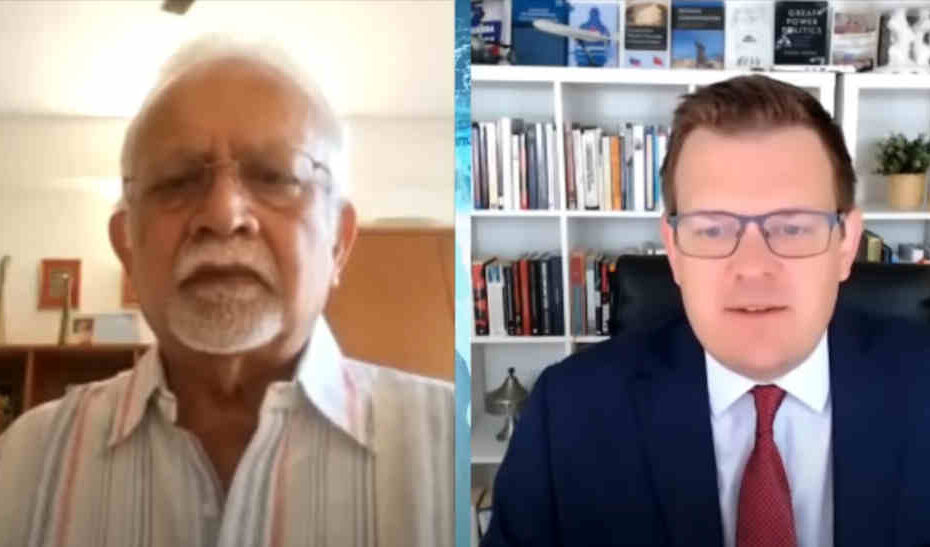
Read the full transcript of Indian ambassador and diplomat M. K. Bhadrakumar in conversation with political scientist Glenn Diesen on “India Ignores Trump’s Threats of Secondary Sanctions”, August 3, 2025.
India’s Response to US Pressure
GLENN DIESEN: Hi, everyone, and welcome back. We are joined today by Ambassador M. K. Bhadrakumar, retired diplomat and ambassador from India, and also the writer of the very popular blog Indian Punchline. So, I’m very happy to have you back on the program because I really wanted to discuss with you this more aggressive approach by the United States towards India. That is the pressure put on India and also the reasons why.
So I thought a good place to start, perhaps, is where you see how you’re reading this whole wider situation. That is, it seems India is being presented with a dilemma, like other countries, that is fall in line or be punished. And it’s unclear if India will push back as China or subordinate itself like Europe. But how are you interpreting this situation? Because you’ve been writing about this lately.
M. K. BHADRAKUMAR: Thank you, professor, once again inviting me for this prestigious show of yours, which we all are keen listeners and watchers of it all the time, for getting a peep into the future. You’re doing a wonderful job. Thank you very much.
Now, coming to this topic that we’ll have a conversation on. Let me say at the outset that there is no sense of panic in India at all about this. It’s a curious situation of one or two sticking points in India’s market conditions which are drawing Trump’s attention for this kind of a tariff level.
Agricultural Sensitivities and Trade Negotiations
The main thing from the Indian point of view would be agriculture and dairy products. Now, if you go by the FTA, which has been negotiated with Britain just the other day, Britain has conceded the point. And Britain has a very good familiarity with its agricultural products and dairy products to Indian market, because you see something like 40% of the population of India critically depend on agriculture.
The situation is not even comparable to France in Europe, you know, agriculture and politics. It’s a very, very sensitive. It’s almost an explosive subject. So there is really no leeway for making concessions there because the blowback could be so severe, catastrophic politically, not only for this government, but for any government in power in India, if it is seen as compromising on the interests of the peasants, the farmers. That is the point number one.
Second point is about this not being really the final stage. The last word has not been said about India on Trump’s part, because, unlike a lot of others, perhaps Canada is also in a similar situation, as I can see, because the Canadian team is camping in D.C. there is another track running, which is active negotiations.
And from what one can gather in Delhi, the negotiations are world class negotiations, high caliber negotiations from both sides. And our guys have said that they never seen this kind of negotiations before. So very intense negotiations are going on and pending the outcome of the negotiations. Trump has touched this. Therefore, the point I would like to make, second point is that I would like to see this as a kind of a temporary situation which is not likely, which is certain to undergo changes as and when the package is negotiated fully.
Defense Industry and Make in India Initiative
The third point I would like to mention is this. That is that there is a curious dimension to it today in terms of the penalty that Trump has threatened India with. That is penalty in terms of India’s trade with Russia. And there are two dimensions there.
One is weaponry, the defense relationship there. It is unrealistic again for the United States to impose such demands on India because I’m not trying to speak about the geopolitics of it or anything like that, but realistically speaking, India is also ambitious to be coming to somewhere near, for example, Iran has reached, South Korea has reached, or you know, some other countries are overtaking India and going ahead in terms of the defense industry.
You see, India has been buying weaponry, using them, but never really developed a defense industry. So this government and this prime minister has come up with the idea of bringing in this doctrine of “Make in India,” that concept into the defense industry, which means that major defense transactions between now and the foreseeable future are going to be decided on the basis of the willingness of the vendor to enter into designing, co-production, et cetera, of the weapons in India and to set up an infrastructure for that instead of buying off the shelf.
And having run into a lot of problems because there is such a plethora of military technology available in India in terms of these purchases, starting from Britain, France, Israel, US etc. So we need to rationalize things this way. And therefore any weapon system, it is not really problematic for India to have access to high level military technology.
Russia as a Reliable Defense Partner
Russia is a good case there, because Russia is even this SU-57 stealth fighter, the fifth generation fighter. The Russian offer is to pass on to India, the technology and to produce the aircraft in India. Now the point is, in all fairness, a country’s autonomy, a country’s sovereignty is to be measured in terms of these templates, whether it really would like to insist on these as prerequisites of a major defense transaction.
Interim arrangements are okay, but there has to be, it has to be telescoped to the future in terms of an Indian content in it, “Make in India” content in it. So if the United States is willing to do that, for example, for their F-35 aircraft, well, we will consider, I’m sure about it. But if they cannot, and if somebody else matches it like Russia matches it, or if France matches it with its Rafale aircraft technology, then we have a choice to make there.
So this is the situation.
It’s not very simple. It’s not only in terms of the spokesman, Indian spokesman kind of narrowed it down to a matter of the time tested friendship with Russia. It is a fact there is a time tested friendship. Russia is reliable. And that matters when you come to weapon systems and so on.
When you go and you have a conflict situation and you want to deploy your weapons, the vendor puts in conditions keeping the technology with him or her and do not share it with India, there is a problem. We are dictating then the foreign policy and the military policy of the country. So you see, this is one aspect of it.
Therefore, it’s more than the time tested relationship. Time tested relationship is the fundamental that Russia has never let India down. And that is the plain truth. And even if they have reservations about something that India is doing, they sequester that and they allow a free play for India, free hand for the Indian decision makers. Now, this is a great virtue as far as India is concerned and Trump should appreciate that.
Energy Security and Russian Oil
The second thing is about this oil business. Oil really. India has not allowed politics to come into the oil. It is too serious a matter to be mixed up with politics or geopolitics. It’s about energy security. 86% of the Indian population requirements for oil is met through imports. 86%. Look at the vulnerability of the economy.
Our High Commissioner in London said the other day that the demand that is being made to cut down Russian oil actually is a demand to shut down the Indian economy. Is it possible for us to do that?
Diplomatic Developments and Peace Prospects
But there is a silver lining there. I find from President Putin’s remarks with Lukashenko on the 1st of August during their meeting and their press interaction, the certain remarks made by Marco Rubio the previous evening in a Fox interview and certain remarks made by Foreign Minister Lavrov six hours after Putin’s remarks, taken together in my background as having someone worked in the old Soviet space for nine years as a diplomat, I see that the dark clouds are dispersing in the sense that the cutting edges of this ultimatum, the American ultimatum that the war must end by the eighth, is getting fudged.
And the surest indication of that is Witkoff’s reappearance on the diplomatic stage. And this other General, Kellogg, has moved back into the shade. Now this is a very interesting signal from there. This signal implies that a political, diplomatic track is resuming with a vengeance.
They have, both sides have made moves which are extremely alarming and which are probably no precedence, starting with the dispatch of the nuclear bombs to Britain, the deployment of the submarines and open statements about the state, about the future of Kaliningrad, threatening statements about Kaliningrad. All this taken and culminating finally in Putin’s disclosure, deliberate disclosure, out of context disclosure on 1st of August that the Oreshnik missile has been inducted into the military and serial production is beginning.
So it’s a very alarming situation that was there and all we are left with now, finally, if you just look at the calendar, it is just another five days for this war to end. I mean, anyone who’s talking and insisting on that is talking through his hat. It’s not possible because the war is raging. It’s a raging war and it is accelerating, if anything.
Sanctions and Peace Talks Logic
So the point is the remarks that have been made by the Russian leadership and the sensible, rational, calm remarks made by Marco Rubio that have been probably responded to by the Russian side, they give an opening for the resumption of talks. And if the resumption of talks, why I’m saying this is because if the talks resume in whatever format, it’ll mean that the cutoff date of November 8, August or 9 August becomes irrelevant.
And that means the sanctions are not going to be imposed on Russia. How can you have sanctions and then discuss peace talks? It’s not possible. It’s logical. And if sanctions are not going to be imposed on Russia, how can there be secondary sanctions in the nature of tariffs on oil?
I’m not going to get into the further aspects of it. Whether, for example, United States is in a position to impose such tariffs on China, which is also bracketed with India as a major buyer of Russian oil. I don’t think it is possible because then all these discussions that have taken place wherever, Copenhagen, Geneva, wherever, between the Chinese and The American delegations, they become useless, whatever understanding they’re trying to forge.
So if you take the entirety of it together, I don’t think that what these doomsday men have been predicting about a World War 3 and so on is even remotely in the minds of either Trump or Putin. And then the rest is, there’s a lot of grandstanding going on and the talk is about tariff.
Let me stop at this point. So I repeat what I said, that there is really no crisis in the situation as far as India is concerned. We will wait and watch. And our negotiators are now finessing their best arguments in terms of why India cannot afford to compromise on certain vital aspects of the economy.
India’s Strategic Approach vs European Subordination
GLENN DIESEN: The efforts by India to win over Trump as a friend by buying weaponry from the United States, the Europeans pursued something similar that is committing themselves fully to the United States. So accepting this 5% spending on military, this recent trade agreement, which was seen as a complete capitulation, calling Trump “daddy,” this kind of things, really trying to win over America. But instead, we see the Europeans becoming more and more subordinated.
Do you see India’s. How India will try to stay out of the crosshairs of the United States? Will it. Do you think it will continue to make investments, for example, in American weaponry? Not necessarily because they’re the best one, but because to avoid Trump’s punishment.
India’s Defense Independence vs. Colonial Alliance Models
M. K. BHADRAKUMAR: You see, we wouldn’t ideally like to find ourselves in the sad state of affairs that Europeans are finding themselves in buying weaponry from America. But the European split is that they got so used to it, so addicted to it, that they never really sought technology transfer, they never really wanted in the downstream, the development of a full fledged European defense industry. And now they are regretting it. And now it is almost practically impossible to catch up with lost time. That is point number one.
Point number two. You know, if you look at it, the pattern, actually, the basic, the matrix of the defense transactions, military transactions between the United States and the European allies has got a very big dose of colonialism. I’ll tell you why. Because the Western alliance system is used to create, manipulated, to create market conditions for export. As it is in 2024, 34 or 35% of all American exports, arms exports in the world went to Europe. Europeans were buying 30, 34, 35% of that country.
Now, Trump’s logic is well taken on this plane that Europe must stand on its own feet. Therefore, he brought in this idea of the 5%, 3% first and 5%. But what does it amount to when these countries are not in a position to raise this kind of money? They are being forced to do that. What is the budget deficit of the powerhouse in Europe, the giant German economy? $300 billion budget deficit today.
So it’s number one, it’s unrealistic to force those countries to do that. And the second one is what is it that is actually being done? Forcing them to take loans and then buying weaponry from America. Even bigger quantity than what they have been doing previously.
Now why should India do that? India is not part of any kind of alliance system. India is not a captive market. India is not a colony like the United States treats the Europeans. You know, whether it is energy, whether it is weaponry, why should India do that? Even from Europeans, even from Western countries, there could be offers of weaponry if the United States doesn’t give weaponry.
That is why I said in the beginning it is all a question of qualitative judgment. And it has to be measured, of course, it has to be competitive, the pricing. But it has to be qualitatively also worthwhile for India to do that because India is wanting these weapons to be integrated into the Indian defense industry for production, local production in India.
So I can’t see how India can jettison this policy. And this is a very prestigious policy where it carries the imprimatur of the Prime Minister himself, Narendra Modi. He has gone all over the world to speak about “Make in India” as a concept. Now, now Trump is demanding virtually, “you just keep buying from us.” Is it tenable?
Wherever Americans have shown willingness or readiness to share technology and to produce in India, India has accepted it. Whether it is helicopters or whether it is anything. India has accepted it drone technology, whatever. But otherwise, I don’t know whether it is possible for India to do this.
And then Americans have this bad habit even with the Europeans. They don’t share the code. So you see, these fellows are kept a tight leash that in a kind of, I’m not saying that they will rebel and they will want to fight a war which America opposes. It’s not that. But the point is this. It’s a very restricted sovereignty Europeans are enjoying. They are made to believe that they are getting the cutting edge weaponry, but they’re surrendering their sovereignty.
And you can imagine that there is a logic in it in terms of Article 5 and so on, Western alliance system. But why should India worry about all that.
The Colonial Model of Asymmetrical Interdependence
GLENN DIESEN: Yeah, no, it feels like we have this Brezhnev doctrine now in Europe of limited sovereignty, as you said. And I thought it was interesting, your comment on a colonial model, because this is largely what’s created by this very asymmetrical interdependence.
Because the United States seems to actively push for Europe to limit itself to only trade with the United States, prevent diversification. And again, this is what you want to do if you want to lock in a weaker part into a relationship of excessive dependence.
And we saw this after World War II, but continuously, the US draws a lot of power from making sure that other countries only use US Technologies, only use its industrial products, only use energy, its supplies, only use its transportation corridors, banks, currency, the swift power payment system.
Again, if everyone is dependent on the US and the US avoid any real dependence on anyone else, then you can have this asymmetrical interdependence where the US draws its hegemonic power from. But I think the Europeans, they committed themselves to this model thinking that they would be rewarded. Instead, as you said, it’s more of a vassal status now.
But how do you think the United States… Well, Trump is very open about his intentions to break up BRICS. But is this also a pressure on India to reduce its ties to BRICS? In other words, if BRICS is an instrument for diversification to have a more multipolar economic system, how far is India willing to go to defend its position in BRICS? Because often one gets the impression that India’s commitment is not among the strongest.
India’s Position on BRICS: Setting the Record Straight
M. K. BHADRAKUMAR: Look, professor, this is a brainwave of the Russians BRICS idea. And then the Chinese and our Prime Minister happened to be visiting Russia at that time, and on the sidelines of a multilateral event, he was sounded out whether he would sit in for a meeting like this. He agreed, if anything, out of sheer politeness. And then it was languishing.
You look at the history of this movement languishing. And then the Russians breathed new life into it in 2014, in 2020, 2022, when they needed it, they brushed it up and brought it up as a platform to defy the US and to orchestrate processes which have a strong anti American content. Plainly, I’m saying that this is what has happened on BRICS. Otherwise, BRICS is a toothless organization and it has absolutely no cutting edge in it.
This is completely a doing of the Russians and the Chinese. India had nothing to do with it. That is the plain reality now, therefore, if Trump is raising dust over it, the person to answer that should be Vladimir Putin or Xi Jinping. This is do not pit India against Trump when it comes to BRICS. That is maybe a very smart game. And they go and lie under the carpet not being seen at all. But they are the ones, the culprits here to give a cutting edge to this and at an earlier time even Shanghai Cooperation Organization, you were hair cutting edge like this and it used to be called Asian NATO.
India never really was part of the big part of giving an anti American slant to the BRICS. So Trump knows that and Trump is comfortable with that. If BRICS has not gone in the direction of developing a new BRICS currency, Trump should give credit to India because it was India’s opposition, India’s reservation.
Look at it like this. India has no problem with swift. India has no problem in trading with dollars. India is not fearing that. India is not fearing that its reserves are going to be confiscated by the Americans. Whose problem is this? And India is interested in one aspect of it, which is to transfer the payment system to local currencies because that is an entirely different matter.
It is in giving a habitation and a name for India’s currency in the world currency basket commensurate with India’s growing stature as an economic power. You see, it also has no anti American thrust to it. If there are countries which do not have dollars to spare, India can still trade with them. If they trade in local currencies, there is no anti American content there. And both these countries, India and that country which does it, they both have access to shift. Nonetheless, we use it like this.
So therefore, it’s an ingenious thing that is happening here when you speak about, on the one hand, time tested friendship and so on between India and Russia and then the Russians going and hiding when there is pressure from the Americans on BRICS and saying that it is India’s can of worms. It’s not. It was conceived in the womb of the Russian decision makers. So the Russians must answer this.
India-Iran Relations and the North-South Corridor
GLENN DIESEN: Well, another area of pressure though for India is seemingly on reducing its economic connectivity with Iran, as this is not a new thing, obviously. But Trump also wants Iran to India to reduce its trade with Iran. Is this some additional pressure coming or how do you see this impacting the international north south transportation corridor? Because it seems as if a lot of the usage of this transportation corridor is inhibited by the sanctions imposed on Iran.
M. K. BHADRAKUMAR: You know, Iran is a completely different story. Completely different story. You must remember that even at the peak of the American sanctions on Iran, they allowed Chabahar Port collaboration between India and Iran. What does it signify? So you see, they have given space for India to develop relations with Iran.
That relationship is nowhere near optimal. I’m not saying that, and I know this very well because I’ve dealt with this relationship since 1979, first time I began dealing with Iran. I can tell you this, that the relationship is not optimal. It is for a variety of other reasons, reasons which are known even to China and Russia is difficult. It’s a difficult market to work with. And Iranians are very tough negotiators. And there is no constancy in their negotiating position. They keep shifting and who will put money in the basket on the table when you know, the conditions are not available for that.
But I don’t think the relationship is atrophied because of American pressure. I don’t see any evidence of it. In fact, high level exchanges take place constantly. There are consultations going on between the foreign offices. And Americans are indifferent to that. And we also have a very strong relationship with Israel. Americans know that also.
And there is, in fact, I personally think that the balance is important and India is not always keeping it in recent times and that we should be more vocal in support of the Palestinians and Gaza situation and so on. That’s my personal point of view. But that is really, it’s not because of any American pressure as far as I can see.
Prospects for US-Russia Negotiations and Tariff Relief
GLENN DIESEN: And are you optimistic that if now the Americans and the Russians return to negotiations, which is one of the areas why Trump has put pressure on India, is it likely that tariffs might come down as well? Or is it a bit like the Europeans and the British that the tariffs are linked to the industrialization of the US in a way.
M. K. BHADRAKUMAR: Let me tell you this way, that unless the Americans sanction Russia Russian oil, there are no secondary level sanction possible on India. There’s no reason for secondary level sanction for India. And if there is no secondary level sanction for India, there is no requirement for penalty, tariff penalty. The whole concept is completely baseless.
So you see, that is why I began saying that we are at an inflection point. I am being a diplomat, perhaps I have a right to be optimistic, but it may not be borne out by developments or events subsequently. I don’t know and I don’t even have a control over it.
But the point, I think, is that with my familiarity with Russian, American relationship, we have had many moments like this. And it’s not always what it seems on the surface. And these are days when we have all these podcasters prophesying that war is imminent and so on.
And certainly the signs are very telling when Putin has to announce that Oreshnik is entering, has entered serial production. It’s a huge statement because it’s a weaponry that the Western world simply lacks, and it is a weaponry whose use would be primarily against the Western target. So it’s a hugely symbolic announcement. So it is worrisome.
But at the same time, when I saw that Trump’s disclosure that after Tel Aviv, Kellogg has been told to proceed to Moscow, that is there. And then we are not discussing another aspect of it, completely unrelated, which is in terms of the high turbulence in American domestic politics, we are not discussing it.
What are the… Like, when I began in my work in the Foreign Ministry, my boss told me that when you deal with Pakistan, your first thought should be, “what are the compulsions in this Pakistani move against India?” Unless you know that you cannot handle this situation. So it is the same kind of thing. What are Trump’s compulsions here? Trump has managed in these last recent days, a massive digression from Epstein, isn’t it?
GLENN DIESEN: Yeah, from Epstein.
Trump’s Nuclear Rhetoric and Domestic Challenges
M. K. BHADRAKUMAR: It has massive implications. This thing, because this is so much more provocative. Oreshnikov and, you know, sending nuclear bombs back to Ukraine for use against Russia and sending submarines to the dark waters near Russian coast and, you know, lying there to hit at Russia for a first strike capability.
Medvedev answering that, you know, the second strike capability will still be retained and “remember the dead hand” and so on and so forth. His last one was a chilling reminder that “you have no place to hide.” Even if you go for a first strike against Russia or decapitating the Russian leadership, you have no place to hide. That is the stark message.
See where things have come to. And the Soviets and the Americans never talked this way against each other, and they had a polite, civilized way of waging proxy wars. So this is where it has come to.
So Trump has also got a lot of challenges. And sometimes I wonder whether the Russians are not accounting for that, that there’s a huge problem he faces internally in American politics and the midterms are next year.
So basically, I think the thing is the Trump doctrine holds. He doesn’t want a war, which is what Rubio also repeated in his Fox interview, and which prompted Putin to agree with that and subsequently Lavrov to underscore it, that neither side wants that and both sides want to talk. So I think I would like to take it as a positive turn to events and all this, and then all these discussions get an entirely different coloring depending on what it carries from Moscow back to the White House.
Domestic Politics and the Ukraine War’s Future
GLENN DIESEN: I agree. I think the domestic politics is often left out of the analysis of international affairs. That’s a good point. And the Epstein thing is really, it stood out. It seems to be what could bring Trump down. It brought together a lot of dissatisfaction around foreign policy and everything. But it was interesting that it’s really this domestic issue which could create these problems for him.
My last question, though, was, given that the future of US-India relations to a great extent depends on the war in Ukraine, how do you see this war developing now, though? Because there are huge changes on the battlefield. There’s problems in the west as well in terms of weapons supply, irrespective of the promise of sending more weapons. There is a manpower issue in Ukraine, but also, at the same time, we see that the willingness in the west to accept that we lost this proxy war against Russia is quite strong.
So I often fear that there will be a lot of desperation if there’s a crack now in the front lines. And politicians tend to do stupid things when they’re desperate. So do you have any views on how the war is developing? Because if Trump would go for these harsh sanctions against Russia, going after secondary sanctions with countries such as India, it would likely be because there’s concern that the front line is collapsing. So I was wondering how you see the war.
Putin’s Territorial Delimitations and Negotiation Signals
M. K. BHADRAKUMAR: See, there are two things, professor, that I see here. Number one is if you closely run a fine comb through Putin’s remarks, he spoke about the regions of Russia, regions of Ukraine, that are part of Russia irrevocably, and that is Donbass and Novorossia, apart from Crimea.
So that, to my understanding, the mood in Russia, the popular mood in Russia is that now that we have waded more than half into the stream of blood, it must be carried forward and finished off so that it doesn’t revisit us again. This could be the popular mood in Russia, but Putin’s remark did not reflect it. You know, it did not reflect in any way that the Russian objectives would include, on the contrary, include Odessa, Kyiv, Dnipropetrovsk, Kharkiv, and so on. So that I thought was very significant. Because he delimited it.
And second point he said is that, you know, that they are not conditions. He has used that specifically. He has mentioned that these things which are spelled out in the meeting at the Russian Foreign Ministry in June last year, they are not conditions. That is a second one.
And the third one is again, on the positive side, this is nothing about Kremlinology, but on the positive side, we have now a situation where Russia has offered, Russia has proposed Istanbul talks, the constitution of two committees, working groups, Russian-Ukrainian side, two working groups, one on military and one on political side. And from what I understand from Lavrov’s remarks, Ukraine accepted it and Ukraine accepted it, but has not yet acted upon it. And Lavrov has said that if they act on it, it will be a major step, quote, unquote, “major step forward.”
European Security Architecture Negotiations
And on the other hand, the Ukrainian side proposed that any Ukraine settlement has to be situated within a pan-European security architecture, which is the Russian demand also. So in other words, you are now going across the whole spectrum of the proposals that Russia had made prior to the launch of the special military operation in Europe. So Russia is getting a very good deal there.
And of course, Europeans will militate against it, but Baltics will hit the ceiling. You know, Baltic states, all that is to be expected. But I get a strong feeling that it was not just for playing golf that Trump went for four days to Scotland. He got Starmer away from the hurly burly of European British politics in a seclusion in a secluded way for long hours of conversation because it’s very imperative for Trump to carry the Brits along. You know, they can punch above their weight even now and they can be a terrible spoiler if they are not traveling along.
So, you know, we are, in a way, we are underestimating Trump. You know, his body language and everything, you know, and he spoke tough with Starmer on his side vis-à-vis Russia. But then he’s carrying him, he’s finishing it and he’s taking it along. And after that, his first major announcement is setting Witkoff back.
Behind-the-Scenes Diplomatic Maneuvering
And then there are many other things to be put also on the chessboard, you know, which we have not touched on. For example, this chief negotiator in Istanbul, this former defense minister who’s an ethnic Tatar, as you know, who was nominated by Zelensky as a new ambassador to the US. And Trump turned it down, refused to give agreement and said he must go back to his job. Why he was being sent out? Because he was a reasonable negotiator for the Russians. So they wanted him out of the way and to send somebody else there.
There’s a lot of politics therefore going on within Ukraine and Trump said nothing doing, he will continue to do his job. So now, you know, the telltale signs will be that in the next 48 hours, I would say if there is some forward movement on the announcement, forward movement on the working groups which I mentioned earlier, or Lavrov hinted at it, if that takes place, it will be a very big telltale sign that Trump has gone back and put pressure on those guys to come out to this because the Russians have said it will be recognized as a “major step forward” in the political process.
Russian Demands and Territorial Concessions
So what have they got? The Russians have got general acceptance of this, that, you know, that those territories which are in the Russian position is unrealistic to try to take back and that is no basis for a settlement. Then the next one is, you know, that Russians have also now insisted on the repeal of all anti-Russian laws from the statute book. And it’s a very reasonable request because Lavrov has said, if you read that statement again, Lavrov has said that there is no country on the planet which is legislated on these lines.
And then the final thing is the most important thing is not just a NATO expansion proposition. It is the entire question of the European security architecture and an acceptance that Ukraine settlement has to be situated within the pan-European security architecture. So I tend to look at the Russian demands before they launched the operations. We are somewhere near meeting those demands at the negotiating table.
Indivisible Security and Historical Context
GLENN DIESEN: That could be quite remarkable. This is what the Russians have been talking about for the past 30-plus years. That is security architecture based on indivisible securities. So not having one side enhance its security at the expense of the other side. And again, this is why NATO expansion became, you know, the replacement in canceling the inclusive European security architecture. This became always the real cancer in relations between the east and West. Something that redivided the continent, restarted the Cold War logic.
If they’re able to get this through, this would be everything else from territorial issues to everything would pale in comparison. This would be a massive achievement. The main concern though, I think is that there would be high skepticism in Moscow that these agreements would actually be upheld.
Because for example, in 2005 the Europeans and Russia signed this common space agreement where they said the same thing, that the integration initiatives towards the common neighborhood would have to be harmonized, essentially recognizing the principle of indivisible security. It didn’t take many months before the EU already began pursuing this Eastern Partnership in which it sought to integrate all the countries on its eastern periphery towards the EU with the exception of Russia.
So it is, it’s been the past 30 years there’s been a lot of promises, agreements signed, but many of them have failed. But of course something like this, some overarching structure, it could be a real game changer though to fix some of the problems which were planted in the early 90s or mid-90s which are now of course resulting in war. But I think it’s good to always, there’s a lot of doom and gloom. So I’m very happy to hear some optimistic analysis because it seems often to go from bad to worse.
Professional Optimism and India-US Relations
M. K. BHADRAKUMAR: Well, mine is an old habit. I was paid to be optimistic for something like 30 years. That was my profession. So maybe I’m wrong. Time will tell. But I have a reasonable certainty and I even suspect that that explains the lack of panic in India in Delhi that we see that all this is a work in progress and there is no finality about it.
To come back to our topic of discussion on tariffs against India. So I don’t think India-US relationship is anywhere near facing a crisis. Of course there will be lessons to be learned from what has happened, you know, because there were assumptions made about the ABC of dealing with the United States. Now, some of them new ground rules, new guardrails may appear. But it will not be anywhere near an antagonistic relationship.
I can tell you that even fence mending is not necessary really because alongside you find a number of good happenings also in the recent weeks. For example, this Pakistani group which staged the attack in Pahalgam, you know, killing dozens of Indians in Kashmir, that has been designated as a terrorist group by the USA department and it has been linked also to the Lashkar-e-Taiba which is based in Pakistan. It’s a very scathing indictment for Pakistan.
Continued Cooperation Despite Tensions
And then you know, there are a number of other things, you know, like launching a fantastic satellite, you know, with American help, with NASA’s help, a collaborative effort between NASA and India. So you know, this kind of thing is taking place and you know, this military drill which is taking place in the Western Pacific in Australia for the first time, India is participating in it, you know, and it has even led to some Russian experts alleging that Quad is taking the shape of a military alliance. So it’s a major step, you know.
So, you know, the thing is, what I’m trying to say is that, you know, that there are a number of other things going on. The relationship is on track, you know, and its momentum has not been affected by this. So in a way this may turn out to be a sideshow, but a sideshow which is important for India because I’m happy in this way that you know, that certain kind of illusions, you know, have been dispelled and we have greater clarity.
Dispelling Illusions About US-China Conflict
And clarity which goes along with this also that our idea was that Trump will go for a war with China over Taiwan. Far from it. And the illusion is this, that you know, that India has an ability to create space vis-à-vis China by forging close links with the US but that’s not the way it is taking place. And this will give impetus even arguably this will give even impetus for the normalization process that the government has introduced, has initiated with China. You know, this will give impetus to it. And I don’t think that there is any scope for any kind of lasting damage to India-Russia relationship either as a result of this.
India’s Role as a Non-Aligned Power
GLENN DIESEN: Also it’s fascinating to watch India because again this is the main non-aligned power throughout the Cold War and again post-Cold War also seeking to avoid being pulled into alliance systems or any zero-sum arrangements which would then not just bring it to a bloc but which would also adversely affect its ability to act as an independent pole of power.
And I know in the past we’ve spoken – you’ve been a bit critical about the ability of India to act as an independent polar power in a multipolar world. But again as a non-aligned power, I think many people aspire this for India to continue this path and not get pulled into any destructive block-based system.
So anyways, thank you so much for your time. I think much of the world is looking at India now and what is happening. So thanks again.
M. K. BHADRAKUMAR: Thank you very much. Thank you very much. And we are very happy to have this conversation with you. Thank you for inviting me. Thanks.
Related Posts