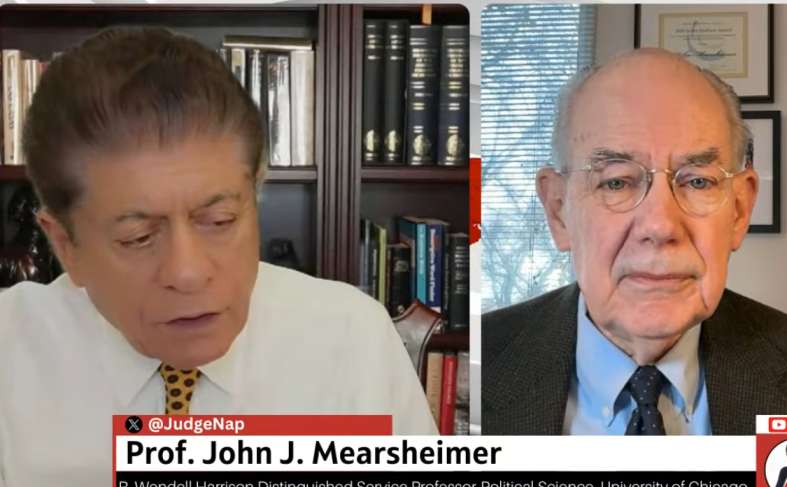
Editor’s Notes: In this episode of Judging Freedom, Judge Andrew Napolitano and Professor John Mearsheimer explore the complex geopolitical landscape surrounding the conflict in Ukraine and the escalating tensions between the U.S. and Iran. Mearsheimer provides a stark assessment of the war in Ukraine, describing it as a war of attrition where Russia currently holds a strategic advantage due to its battlefield momentum and crumbling Western support for Kyiv. The conversation also delves into how President Donald Trump has “boxed himself in” diplomatically regarding Iran, facing irreconcilable demands from Israel while attempting to avoid another “forever war”. Ultimately, Mearsheimer highlights the immense pressure from regional players and the potential for devastating global consequences if these diplomatic stalemates lead to direct military confrontation. (Feb 17, 2026)
TRANSCRIPT:
“Undeclared wars are commonplace. Tragically, our government engages in preemptive war, otherwise known as aggression, with no complaints from the American people. Sadly, we have become accustomed to living with the illegitimate use of force by government. To develop a truly free society, the issue of initiating force must be understood and rejected.”
JUDGE ANDREW NAPOLITANO: What if sometimes to love your country, you had to alter or abolish the government? What if Jefferson was right? What if that government is best which governs least? What if it is dangerous to be right when the government is wrong? What if it is better to perish fighting for freedom than to live as a slave? What if freedom’s greatest hour of danger is now?
Hi everyone. Judge Andrew Napolitano here for Judging Freedom. Today is Tuesday, February 17, 2026. Professor John Mearsheimer will be with us in just a moment on just how did Donald Trump box himself into a corner diplomatically on Iran?
The Russia-Ukraine Peace Talks: Kabuki Theater?
JUDGE ANDREW NAPOLITANO: Professor Mearsheimer, good day to you, my dear friend. Thank you for coming onto the show as always and accommodating my schedule. Before we get to President Trump and Iran, do you assign any significance to the arrival of the deputy Russian foreign minister to the trilateral talks between Russia, Ukraine and the United States, and the movement of those talks from Abu Dhabi to Geneva?
JOHN MEARSHEIMER: Not really. There’s been a lot of talk in the media that the appointment of Vladimir Medinsky to head the Russian delegation means that the Russians are toughening their position. There’s a feeling that the Russians think they’re on the threshold of victory and now is not the time to compromise. And if anything, what they want to do is broaden the agenda and play hardball with the Ukrainians and with the United States.
But to me, this has been Kabuki theater from the beginning, and nothing has changed. The key issue is what do Russian demands look like? What are the Ukrainians and the Europeans willing to concede on vis-à-vis those demands? And you just see that there’s a huge gulf between the two sides. So whoever’s in the driver’s seat on either side doesn’t matter. The fact is that the terms each side is willing to accept are irreconcilable.
JUDGE ANDREW NAPOLITANO: The chief Ukrainian negotiator, who is the head of their intelligence services — the Russians have accused him of masterminding the murder of a Russian general and the attempted murder of another Russian general. One wonders if the negotiations were moved from Abu Dhabi and its relative neutrality to Geneva and its absolute neutrality for that reason.
JOHN MEARSHEIMER: It’s possible, but I think where it takes place just doesn’t matter very much. Because, again, the key question is whether or not you have any reasonable chance of fashioning a deal where both sides make compromises and the outcome is acceptable to both sides. You can have it in Abu Dhabi, you can have it in Geneva, you could have it on the moon. It just doesn’t matter.
Russia’s Position on the Battlefield
JUDGE ANDREW NAPOLITANO: Does Russia have any incentive to give in on anything?
JOHN MEARSHEIMER: No, I don’t think so. It’s very clear that the Russians are doing well on the battlefield. The spring is coming, and they are well prepared for a major offensive. They’ve been blasting the electrical grid in Ukraine to the point where it’s almost completely wrecked.
And most importantly, it’s quite clear that the Americans are no longer interested in supporting Ukraine in any meaningful way. The Europeans can’t make up for the loss of American support. So overall Western support for Ukraine is going down at a critical juncture in the war. It’s just hard to tell a story about how Ukraine improves its situation on the battlefield. If anything, it looks like Ukraine — which is already reeling from attacks — is only going to be in a worse position over the next year. So from a Russian point of view, the smart thing to do is just to continue to push on as they have in the past.
JUDGE ANDREW NAPOLITANO: So it’s just a matter of time before the Ukrainian military either doesn’t exist or gives up the ghost.
JOHN MEARSHEIMER: That’s my view. In a war of attrition like this, the two sides stand toe to toe for a long period of time, and each side tries to bleed the other white. Then at some point, one side collapses.
This is what you saw happen in World War I. You had the Germans on one side and the French and the British on the other side, and eventually the Americans came in as well. The two sides were just standing toe to toe, pounding each other. There was very little movement on the ground. But eventually the Germans reached the point where they were bled white and they quit. It wasn’t that the Western Allies marched into Germany — in fact, they never set foot in Germany until the war ended, because it was a war of attrition. And this is basically what you have here. The question you have to ask yourself is: how long can the Ukrainians last?
JUDGE ANDREW NAPOLITANO: It was also a war where they had the Christmas Eve and Christmas Day truces, and they actually dined with each other, and then the next day went back to trying to kill each other.
An entirely different world, obviously.
Do you place any significance in the recent use by Foreign Minister Lavrov and other senior Russian officials, including President Putin, of the phrase “Novo Russia” — the new Russia — to describe all of those oblasts, starting with Crimea in the south and going up to Kharkiv?
How Much Territory Will Russia Take?
JOHN MEARSHEIMER: Yes, Kharkiv in the north, and Kherson is just above the Crimean peninsula. I think the really interesting question here is how many oblasts to the west of the four oblasts they have already annexed the Russians will try to take.
I’ve long argued that it was in Ukraine’s interest to settle this war now, because they’ve only lost four oblasts plus Crimea. Of course, the Ukrainians would recoil at my use of the word “only.” But the problem is that if the Russians do win on the battlefield, as I was describing, they are likely to take more territory — oblasts like Odessa and Kharkiv — and this would be even more disastrous for Ukraine.
But if you’re the Russians and you think about where this war is headed — that you’re going to get some sort of frozen conflict, some sort of armistice, not a meaningful peace agreement — that means you’re going to have poisonous relations between Russia on one side and the West plus Ukraine on the other side, for as far as the eye can see. You then have, as the Russians, a powerful incentive to, number one, grab as much territory as you can to position yourself for this long war, even though it’ll be a cold war once the armistice is set in place. And also to go to great lengths to make Ukraine a dysfunctional rump state so that it can’t join NATO and isn’t any kind of a threat to you. If you take Odessa, for example, you basically take away the Black Sea coastline from the Ukrainians, which will hobble their economy in very important ways.
JUDGE ANDREW NAPOLITANO: Well, they’ll be totally landlocked, won’t they?
JOHN MEARSHEIMER: Yes, they will, and that will be disastrous for them. Again, this is why I think if the Ukrainians were smart, they would have cut a deal already. Now, one would say that’s a terrible deal. To which I would say: you’re correct, it’s a terrible deal, but it’s the least bad deal you can get.
The Istanbul Agreement: A Missed Opportunity
JUDGE ANDREW NAPOLITANO: The deal that had been negotiated and more or less agreed to — that 126-page document in Istanbul in 2022 — the deal that Joe Biden, Boris Johnson, and Secretary of Defense Lloyd Austin talked President Zelensky out of, would have been a much better deal than what they’ll end up with now, would it not? In terms of the retention of land?
JOHN MEARSHEIMER: Oh, there’s no question about that. The Russians at that point in time had not annexed any of the four oblasts. This is in the March-April 2022 period, right after the war had started, when these negotiations began. The Russians had annexed Crimea, and Crimea was lost. But the four oblasts they’ve now annexed were not annexed at the time.
I think if the Ukrainians had been really flexible, they could have worked out an agreement with the Russians where they kept all four of those oblasts, including the two oblasts in the Donbass. They would certainly not have lost as much territory as they now have. And then again, as we were saying, the really interesting question at this point is whether or not they lose any further oblasts, including places like Odessa and Kharkiv.
Iran, Israel, and the Question of Palestinian Statehood
JUDGE ANDREW NAPOLITANO: Before we go to Iran and whatever Donald Trump plans to do — how different would the US-Iran relationship be, the US-Israeli relationship be, and the Israeli relationship to the Middle East be, if Palestine were a free state?
JOHN MEARSHEIMER: When you say if Palestine were a free state, that can have two meanings. Do you mean there was a two-state solution and you had a Palestinian state and an Israeli state?
JUDGE ANDREW NAPOLITANO: Yes.
JOHN MEARSHEIMER: Well, assuming that was done in a way that produced a peaceful outcome — that this Palestinian state and this Israeli state could live side by side — the Middle East would be much more peaceful. There’s no question about that.
US-Iranian relations and Israeli-Iranian relations are another matter. One could argue that if you had a two-state solution and Iran still had a nuclear enrichment capability and ballistic missiles, then Israel would have its gun sights on Iran, and therefore the United States would have its gun sights on Iran. So one could argue that Iran is a somewhat separate issue from the Palestinian issue.
Linking that to the war in Ukraine — what happens in the Middle East would have no effect on the war in Ukraine. The war in Ukraine has a life of its own. You remember the war in Ukraine was going on before October 7th and all the big trouble started in the Middle East.
However, one could argue that if you look at what’s happening in Iran, the Russians and especially the Chinese are tightening their relationship with Iran. I think when you and I are talking about the Iranian crisis a year from now — and we probably will be talking about it a year from now — China and Russia will be much bigger factors in the equation than they are now. We don’t spend that much time talking about the China-Russia dimension of the conflict involving Iran, but that’s beginning to change. You can see all sorts of evidence of that.
So one could argue that in terms of Russia and China, even if you settle the Palestinian conflict, if you don’t settle the Iran conflict, you’re going to have big trouble down the road involving the three great powers in the Middle East.
Trump and Iran: What Can He Hope to Achieve?
JUDGE ANDREW NAPOLITANO: The situation in Iran — what can Trump possibly hope to achieve diplomatically?
The U.S.-Iran Nuclear Standoff: Can a Deal Be Reached?
JOHN MEARSHEIMER: Well, I’ve been thinking about this in anticipation of the show. I think if it was just the United States — just Trump and the Iranians — you could work out a deal. I think that you could get some new variant of the JCPOA that could be dressed up as a great improvement on that. And I think the United States could live with some nuclear enrichment capability on the part of the Iranians.
The Iranians are floating all sorts of proposals that have an economic dimension — how the United States and Iran can get rich together and so forth. That would, I think, be attractive to President Trump. And Trump, I don’t think, is enthusiastic about starting another forever war in Iran. So I think if it’s just the United States and Iran, you could work out a deal.
And by the way, as you like to say — and I agree 100% — Iran does not present a threat to the United States. That’s the starting point. It’s not a threat to the United States. So you ought to be able to work out a deal.
But the problem here is it’s not just the United States, or just the Trump administration and the Iranians — it’s the Israelis as well. And the Israelis have a set of demands that go well beyond putting limits on the nuclear enrichment capability. And there’s no way the Iranians are ever going to agree to those Israeli demands.
JUDGE ANDREW NAPOLITANO: Is the Iranian set of negotiations also a kabuki dance?
JOHN MEARSHEIMER: Yeah, there’s just no question about it. I see no way that’s going to work out.
Trump Boxed In: The Israeli Factor
JUDGE ANDREW NAPOLITANO: Well, do you think that Trump has decided already whether or not he’s going to attack? Whether it’s to please Netanyahu, to please the lobby in the United States, or because he honestly thinks this will bring about a resolution?
JOHN MEARSHEIMER: I don’t know what he’s thinking. I think that he’s really boxed himself in here. The problem is it’s virtually impossible for any president, including Donald Trump, to ignore what Israel wants.
And Israel wants zero enrichment capability. They want the whole nuclear enrichment infrastructure taken down. They want Iran to eliminate all the ballistic missiles it has that can hit Israel. They want Iran to give up supporting the Houthis, Hezbollah, and Hamas. And these are demands that there’s no way the Iranians are going to accept.
So even if Trump can work out a deal that’s satisfactory to him along the lines I described before, it’s not going to satisfy the Israelis. And the Israelis have made it very clear that they will attack Iran alone if that is necessary.
And of course, if they attack Iran, there’s no way we don’t get involved — because we’re going to have to help defend Israel when the Iranians start launching ballistic missiles at Israel. And also, we’re going to get involved because the Iranians are in all likelihood going to try to shut down the Strait of Hormuz and stop the flow of oil out of the Persian Gulf.
So I don’t see what Trump can do. And just to take it a step further, as you and I have talked about — Trump can have U.S. forces attack Iran, but that doesn’t solve the problem. It’s not going to get rid of the ballistic missiles. It’s not going to cause regime change. It’s not going to end Iranian support for Hezbollah, the Houthis, and Hamas. So we don’t have a military option here.
The Nuclear Double Standard
JUDGE ANDREW NAPOLITANO: So I’ve asked this before — why is it that Iran, which has signed the Non-Nuclear Proliferation Treaty, is not permitted to have a nuclear weapon, and Israel, which has not signed that treaty, is permitted to have a nuclear weapon? Can anybody explain that?
JOHN MEARSHEIMER: I can explain it to you. It’s very simple. Israel has a special relationship with the United States that has no parallel in history. Israel can do pretty much anything it wants, and we will give it unconditional support.
With regard to all the countries that live in Israel’s neighborhood, Israel basically dictates to us that we have to go to enormous lengths to make sure they have no nuclear weapons of their own — or even a nuclear enrichment capability, as we have been talking about — and that those countries kowtow to Israel. And we go to great lengths to help Israel achieve those goals.
That’s what’s going on here. You just have to understand that there’s a special relationship between the United States and Israel that has no parallel in recorded history.
The Strait of Hormuz: A Global Flashpoint
JUDGE ANDREW NAPOLITANO: This is just in from the Hindustan Times, about 30 minutes ago. Iran has sent shockwaves through global markets by declaring a round-the-clock surveillance lockdown over the Strait of Hormuz — a vital chokepoint carrying nearly one fifth of the world’s daily oil flow. The IRGC Navy, that’s the Iranian navy, announced full-spectrum monitoring across surface vessels, drones, even submarines, during intense naval drills in and around the Strait of Hormuz.
So the Chinese import 1.4 million barrels of oil from Iran a day. Are they just going to sit back and allow the Iranian leadership to be toppled if Netanyahu and Trump attack?
JOHN MEARSHEIMER: No, they’re going to go to great lengths to help Iran. And as I said to you before, with the passage of time, the Chinese especially — but also the Russians — are going to help the Iranians more and more. That’s why I said to you, a year from now when we’re talking about this issue, it will be clear that the China-Russia dimension will be more important then than it is now. But it’s already important now.
I want to make one other quick point to put this whole crisis in perspective. I believe that virtually every country in the Middle East — except maybe the UAE, which is pretty closely allied with Israel — but virtually every other country in the Middle East, plus the Chinese, plus the Russians, want this war to not happen.
The only country that really wants it to happen is Israel. The Americans really don’t want this war. Trump doesn’t want to fight a war against Iran. He’s being pushed down this road by the Israelis.
So you see the remarkable power of Israel, simply because it has such a hold over American policymakers. Just think about it — every country in the Middle East, except maybe the UAE, is desperate to avoid this war. The Chinese and the Russians don’t want this war. Trump really doesn’t want this war. Who wants this war? Benjamin Netanyahu. Wow.
Will Netanyahu Get the War He Wants?
JUDGE ANDREW NAPOLITANO: Will he get the war that he wants?
JOHN MEARSHEIMER: It’s very hard to say. I go back and forth on this one.
On one hand, I say this war can’t happen because we can’t achieve our goals by striking Iran. And furthermore, you have to take into account what Iran can do in retaliation. You were just talking about the Strait of Hormuz and what the consequences would be if that situation heated up. And of course, the Iranians are going to launch ballistic missiles at Israel as well. So it’s hard to see why it makes sense to start this war from a purely strategic point of view.
But then it looks like Trump has boxed himself in. And furthermore, the Israelis appear to be putting enormous pressure on him to go to war against Iran. Can he disobey his masters? I don’t think so. So that pushes me in the other direction.
I feel one day that war is inevitable because of pressure from the Israelis, and the next day I think it’s not going to happen because I can’t tell a story as to how a war leads to some sort of happy ending for all the parties.
Israel’s Calculus: A Window of Opportunity?
JUDGE ANDREW NAPOLITANO: Don’t the Israelis, with their intel and military superiority — or at least accomplished excellence from their perspective — understand how devastating to Israel this war would be? Don’t they understand the power of the Iranian offensive weaponry?
JOHN MEARSHEIMER: Well, you remember that on January 14th, in the form of Prime Minister Netanyahu, they asked President Trump not to attack Iran because they were fearful of the ballistic missile attack. And they’re now deeply interested in making sure that Iran’s ballistic missile inventory is reduced to the point where it can no longer effectively hit Israel, because they’re fully aware of just how dangerous this ballistic missile threat is.
But having said all that, it looks like they see this point in time as an opportunity for the United States to blast Iran and eliminate its ballistic missile capability once and for all. And at the same time, although the Iranians will retaliate against Israel with their own ballistic missiles, we have enough defensive systems in the Middle East — along with Israel’s various defensive systems — that we can together handle the ballistic missiles that come in from Iran. I think that’s their thinking. This is a window of opportunity, in their view. The problem is only going to get worse with the passage of time.
But I actually think that what will happen is you will not destroy their ballistic missile capability once and for all. I can’t even imagine a plausible story for how that’s possible. You may inflict significant damage on the Iranian ballistic missile force with an attack in the next month or so, but you’re not going to eliminate it forever. It’s going to come back.
And furthermore, I believe that in this conflict, should it happen, the Iranians will launch a significant number of ballistic missiles at Israel, and a good number of them will get through — just as happened last year.
JUDGE ANDREW NAPOLITANO: You said “at Iran.” You meant at Israel.
JOHN MEARSHEIMER: Excuse me, at Israel. Yes. Just as happened in the 12-Day War.
Lessons from the 12-Day War
JUDGE ANDREW NAPOLITANO: In the 12-Day War, reportedly, Netanyahu begged Trump to stop so that the Iranians would stop.
JOHN MEARSHEIMER: Yes, that’s true. And you also want to remember that we were running out of defensive missiles. We used up about a quarter of our THAAD missiles in the 12-Day War. And furthermore, we were spooked by the fact that it looked like the Iranians were moving to close the Strait of Hormuz. This was in June of last year. And Trump did not want that to happen.
One would think Trump does not want that to happen today. And one would think that’s why the Iranians are conducting live-fire exercises now in the Strait of Hormuz — because they’re sending a signal to Trump that if the United States or Israel, or both of them, attack Iran, the Iranians will close the Strait. And Trump does not want that to happen.
JUDGE ANDREW NAPOLITANO: Agreed. Professor Mearsheimer, thank you very much, my dear friend. Thank you for coming on at what is not your usual time. I appreciate your accommodating my schedule. Safe travels to you. We’ll look forward to seeing you next week.
JOHN MEARSHEIMER: Likewise, Judge. And of course, I look forward to seeing you as well.
Related Posts