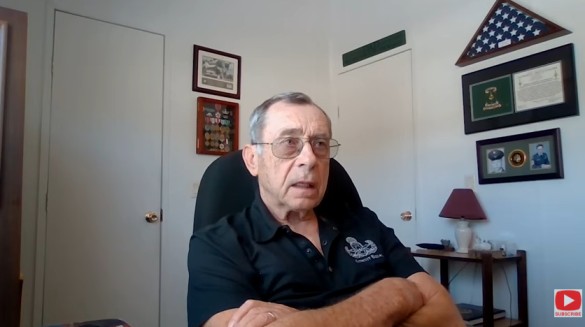
Editor’s Notes: Most people know Delta Force from movies and mystery—but this is the first‑hand story from one of the original men who built it. In this episode of Mike Drop podcast, Vietnam veteran and retired Sergeant Major Mike Vining walks through a 26‑year career that spans bomb disposal in Vietnam, the creation of Delta, and some of the most consequential missions of the late 20th century. From crawling explosive‑filled tunnels in Cambodia to defusing live 500‑pound bombs inside active firebases, his calm, detailed recollections show the mindset it takes to run toward things everyone else runs away from. If you’re fascinated by special operations history, EOD, or the real human cost behind “elite units,” this conversation is going to keep you hooked for hours. (Feb 3, 2026)
TRANSCRIPT:
Introduction: The Man Behind the Legendary Photo
MIKE RITLAND: Ladies and gentlemen, it is an enormous honor and frankly humbling to have my next guest on the Mike Drop podcast. He’s a Vietnam veteran, he’s in the army for 26 years. A retired sergeant major, one of the founding members of Delta Force, and also one of the first EOD specialists. He’s participated in many of the American military operations that frankly have defined the latter part of the 20th century.
Not to mention as an explosive ordnance disposal technician and an elite special forces operator, he’s got more awards and accommodations than can really even fit on his uniform. He’s the author of the upcoming book Blasting Through, which comes in August of this year, 2026. Ladies and gentlemen, the man behind perhaps one of the greatest pictures on the Internet today, Sergeant Major Mike Vining.
MIKE VINING: Thanks for the introduction, Mike. Good to be here with you on the podcast.
MIKE RITLAND: Yeah, thanks for coming on and making the time. You know, it’s funny, I’ve seen that picture I don’t know how many times, and it never ceases to crack me up. And before we kind of get into the meat and potatoes of the interview, you know, that service uniform photo has become an Internet meme because of how kind of unassuming that you look in that photo and just the disparity or contrast between what most people would expect a guy with your career would look like versus how you come across in that photo. I’m curious, what was your first reaction when you first kind of saw it circulate?
MIKE VINING: Yeah, it started circulating on memes. I think what happened is I went on the website, Army Together We Serve, if you’re familiar with that. There’s the Air Force, Navy, Marine Corps, Coast Guard, Army Together We Serve. And I went on that and I posted that picture. That was my retirement picture I took, like, in November of 1998, and I put that on the website.
And I think some people saw it and were surprised or whatever. And so, yeah, it started circulating around on the Internet and with memes and everything, and they were just wondering who this person was because they never heard of it. Because for 20 years I was in the black side of Special Operations. So I was kind of out of sight for about 20 years, and then I just pop up. And so I think it was just a lot of speculation and curiosity.
MIKE RITLAND: Did it surprise you that it’s been as popular and prolific as it has been?
MIKE VINING: Yeah, yeah. I don’t know what people expect, what a soldier supposed to look like. You know, especially in special operations, I think they draw a lot of conclusions from all the movies that they see, these action movies, you know, and you just—we’re just average, everyday Americans.
MIKE RITLAND: Yeah. Well, I would say in terms of the way, you know, maybe the aesthetics that’s the case, but the mental component is, as I imagine you well know, there’s a pretty big distinction, and I’m looking forward to getting into your career, generally speaking, and especially, you know, being a founding member of one of the most famous units in existence.
Just before we get into that, I’m curious, what’s the last full book that you’ve read?
Reading and World War II Bomb Disposal
MIKE VINING: The last book I read, The Kaboom Boys. Elaine Peake wrote a book about her father who served in army bomb disposal. He was a captain in World War II. And so she wrote this book and so I’m reading it now called The Kaboom Boys. They’re trying to make it into a miniseries on TV.
So the book is not a biography of her father. It’s like, what would you call it? It’s a novel format, but everything happened in the book is true. Some of the, you know, her father’s name is true, but the men that served with her father have pseudo names. But you know, the other people, high ranking people, are real names. And so that’s what my last book I’m reading now.
MIKE RITLAND: Was there a specific or significant takeaway from it for you?
MIKE VINING: Well, yeah. Well, one of the things we’re trying to do with that book, Tim Gray from The World War II Foundation, who has, I don’t know, 40, 50 World War II documentaries under his belt, he now wants to do one on military bomb disposal during World War II. So hopefully we can get some funding to do the documentary. And I was asked to be one of the technical advisors on the documentary.
MIKE RITLAND: Oh, wow. That’ll be awesome. I hope that comes to fruition. It sounds awesome. If time travel were possible, where and when would you go? And why?
MIKE VINING: Time travel? I never thought of that. Where would I go? What period of time stands out? Well, you know, World War II is fascinating. And you know that was the beginning of US bomb disposal in World War II. Both the Navy and the army set up schools prior to us entering the war.
So that was the formation of today’s Explosive Ordnance Disposal. So that was a unique period of time. When I graduated from EOD School in 1969, the Explosive Ordnance Disposal field was only at that time, 27 years old. So it was relatively young. And so got to, you know, see and meet some of the World War II veterans that served bomb disposal.
MIKE RITLAND: Yeah, that’s a great answer. I love it. Do you have a favorite quote?
MIKE VINING: Favorite quote? Well, my kids will tell you that it’s, I would say, “Well, what did you learn?” when they would get into a little mischief and everything. But recently I heard the quote, you know, that we have the human, you know, we have two deaths, we have a mortal death, and then we have the final death is when the last person speaks your name.
And that was said—Admiral Olson gave that quote at Major General Bargewell’s dedication up in Hokum, Washington. His schoolmates dedicated a park in Hokum, Washington for Major General Eldon Bargewell. And Admiral Olson spoke at the thing and that was one of the quotes that he used.
MIKE RITLAND: Yeah, I love that. It for sure highlights the importance of legacy and, you know, frankly, the impact you have. That’s profound.
EDC wise, I mean, having spent so many times in such a kind of famous unit and one known for its shooting prowess, do you carry day to day when you’re at home?
Daily Life and Personal Philosophy
MIKE VINING: I do not. I don’t carry. When we go out, you know, in an area where there are bears, we carry bear spray. But nope, I do not hand carry a weapon. I don’t have a concealed weapon. Nothing. I do have a shotgun I keep.
MIKE RITLAND: Yeah, I think that would surprise a lot of people. Is that a very intentional decision or is it just kind of you’re just not that into it or—
MIKE VINING: I’m not that into it.
MIKE RITLAND: Yeah.
MIKE VINING: I don’t worry about it.
MIKE RITLAND: Yeah. That’s awesome. I’m curious, what was your favorite thing to do growing up?
MIKE VINING: Favorite thing to do? To explore. You know, we lived out in the country and we had a swamp that was nearby. And I spend time out into the swamp, just exploring, seeing, you know, looking at nature, wildlife. Yeah, that kind of stuff.
MIKE RITLAND: Where was that at? Where did you grow up?
MIKE VINING: I grew up in Michigan in the lower peninsula in the central western part, just north of Grand Rapids, about 35 miles north of Grand Rapids. Place called Howard City, Michigan.
MIKE RITLAND: Okay. And did you have siblings? And what was your childhood like, if you were to kind of characterize it?
Growing Up in Rural Michigan
MIKE VINING: Well, I had two younger brothers. Frank was two years younger, Randy three years younger. I was the oldest, grew up, you know, attended Howard City schools and most of my classmates from kindergarten to our senior year was the same kids. I lived in the country. I was a member of the Boy Scout—well, Cub Scouts, Boy Scouts, 4H, that kind of stuff. I raised a grand champion steer that was in the fair one year. And you know, so I lived out in the country.
MIKE RITLAND: Yeah.
MIKE VINING: Did a lot of work for farmers, you know, bringing in straw.
MIKE RITLAND: I mean, it’s easy to characterize it as a pretty rural, hard working childhood, would you say?
MIKE VINING: Yes, yes.
MIKE RITLAND: Yeah.
MIKE VINING: With a lot of freedom. My parents gave me a lot of freedom.
MIKE RITLAND: Yeah. Any getting into trouble or were you pretty straight laced?
MIKE VINING: No, I never got into any serious trouble. You know, one of the things, you know, that I say, you know, I was interested in science as a kid. You know, I would get like chemistry sets for Christmas each year, I’d get a bigger chemistry set, and I would make—well, in Popular Science, they have ads in the back, and there was this one ad for “101 Pyrotechnic and Explosive Formulas” that you could get if you send in a dollar.
So I sent in my dollar, and I got all these formulas to make explosives and pyrotechnics, which I did. So my parents, they allowed me to make it. And then, of course, I had a place out in the yard where I would set the stuff off. So, yeah, I was making explosives as a child.
MIKE RITLAND: Yeah. So hardwired into your DNA, it sounds like. Yeah, man, that’s awesome. Did you play any sports growing up? Was that a big part of your life?
MIKE VINING: In my seventh grade, I played football, played really good football. Then my eighth grade, I had a new coach, and I just sat on the bench, so didn’t do that. I wrestled a little bit in wrestling in high school and track. Made me a pole vaulter. Yeah, I wasn’t very good at it.
MIKE RITLAND: That’s awesome. From a kind of, I guess an overall childhood standpoint, was the inclination and catalyst for joining the military—kind of did it stem at all from any of the things that your parents did with you, camping, hunting and that kind of stuff?
Family Military Heritage
MIKE VINING: Yeah. My dad served in the Navy during World War II. He was a gunner’s mate on an LST. You know, I had relatives that served in the military. I had an uncle that was in the army and served on Guadalcanal, another uncle that served a medic in Korea. And like my grandfather, my mother’s dad, he was a Marine prior to World War I, he served in the Pacific on the armored cruiser USS Maryland in the Pacific prior to World War I.
MIKE RITLAND: Was that a big part of growing up, hearing them talk about that kind of stuff? And did that influence your decision to want to join?
MIKE VINING: I think it did, yeah. And of course, in the 1960s was the hundredth anniversary of the American Civil War, so there was a lot of stuff about the American Civil War going on. Again for Christmas one time I got a Civil War set, you know, with toy soldiers and everything. And then another year, I got an Alamo set.
So I was always interested in the military, and I knew that I wanted to go into the military when I was old enough, so that was always a thing. I didn’t know what I wanted to do in high school, what I wanted to do for my life. I planned on going to college but I didn’t know what I wanted to major in, so I figured I’d go into the army and maybe that would give me time to figure out what I wanted to do.
MIKE RITLAND: And what year was that that you joined?
MIKE VINING: 1968, basically two weeks after I graduated from high school, and it was Tri County High School there. I went into the—I was still 17. Both my parents signed for me to go in. So I entered basic training on the 1st of July, 1968.
Entering the Army During Vietnam
MIKE RITLAND: Wow. So going through, I guess, during high school and just as you were growing up and the Vietnam War is taking place at that time, I’m curious what your thoughts were thinking back to then, you know, whether it was political or, you know, from a global or foreign policy standpoint. Like, were those things entering your mind at all? Was that anything that you even really thought about as to whether or not we should be there or not, or, you know, just with all the kind of chaos that it seems like there was at the time, societally, was that something that you considered or thought about as you were entering?
The 1968 Tet Offensive and the Decision to Serve
MIKE VINING: Yeah, I was really, you know, Vietnam War was on the news every night. And of course, early in ’68 was the big 1968 Tet Offensive, you know, where the North Vietnamese made a big push, hoping that the South Vietnamese would rally to support the North Vietnamese.
And, you know, so all that was going on, you know, of course, the White House and the Pentagon were saying that we’re winning the war. And then the news people saying that we’re not winning the war, we’re losing the war. You know, that was a desperation. The 1968, it decimated the Viet Cong in the South. The Viet Cong, after the 1968 Tet Offensive, the Viet Cong organization ceased to really exist.
It did exist after ’68, but it was made up with members of the North Vietnamese, not members of the South Vietnamese. So, yeah, it didn’t work the way. But, you know, North Vietnam did an excellent job of psyops of, you know, making the American people, you know, here we are, you know, distrust and what we’re being told by the White House and the Pentagon.
And I wanted to go over to see for myself what’s—what is it all. Why are we there? You know, why did we put combat troops in 19? Well, we had advisors going in in ’58, but why did we put combat troops in in 1965? So I, you know, I wanted to see for myself what was going on.
MIKE RITLAND: I mean, it’s fascinating that, you know, curiosity played the largest role in you wanting to actually go over there and see if you could kind of walk us through from the time you joined until you ended up stepping foot over there and what that process looked like.
The Path to EOD School
MIKE VINING: Well, so I talked to my recruiter about different options, careers, you know, MOS’s in the military. One of them was Explosive Ordnance Disposal. But you could not enlist for it. You had to have an MOS. And then after you had an MOS, you could volunteer for EOD.
The reason being that EOD had such a high washout rate that if you washed out of the school, you’d have the MOS to be immediately reassigned. You wouldn’t have to be sent to an AIT. So in basic training, I attended a briefing by the EOD team there, the detachment at Fort Knox, Kentucky, you know, I signed an intent that I would like to volunteer for EOD.
And then I went to my MOS, which was Ammunition Renovation. Ammunition, it’s basically maintenance of ammunition. Now, today that MOS doesn’t exist because all maintenance of ammunition is done at the depot level. But back then, both civilians and military worked at the depot to renovate ammunition.
But it was a good stepping stone for EOD because one of the things Ammunition Renovation did, people did, was to destroy ammunition that was uneconomical to repair. So we went out to the EOD range there at Redstone Arsenal, and they taught us how to destroy ammunition, large amounts of ammunition that was uneconomical to repair.
And that’s where I actually, you know, signed a volunteer statement, went through. You know, I put on the chemical suit. You had to wear the chemical suit for a half an hour, make sure you’re not claustrophobic. And from there I went right to EOD school.
The phase one of EOD school was chemical and biological, and that was held at Fort McClellan, Alabama. So I went through that two week course, and then I went to the surface course of EOD, which was at Indian Head, Maryland, the Naval Ordnance Station. So I went through that part of the school, and then I was in E4 and I wasn’t eligible.
Well, I was a PFC when I graduated from EOD school, so I wasn’t eligible to go to the nuclear weapons part of the school. So I was assigned to technical escort at Edgewood Arsenal. Technical escort. We work with chemical munitions escort, chemical munitions. And so I did that.
Then while I was there, I made E4, finished nuclear weapons disposal. And after that I volunteered for Vietnam. I actually put in three, three requests for Vietnam. And each time I would put in a request for Vietnam, my commanding officer, Colonel Dickey, would disapprove it. He didn’t want me to leave Tech escort.
But when they put in it for the third time, he says, “Okay, go ahead.” They even offered me Rocky Mountain Arsenal. We had a detachment there, Tech escort detachment, Rocky Mountain Arsenal, which I like Rocky. I want their TDY twice. But I wanted to go to Vietnam. That was my sole purpose going into the military, was to go to Vietnam.
MIKE RITLAND: Wow, that’s fascinating. And so that was approved. And then you found yourself there shortly thereafter.
Arrival in Vietnam
MIKE VINING: I did, yeah. I was, yeah, I sent a—somehow I sent a message to the EOD unit, the control detachment in Vietnam at Long Binh, and gave him a copy of my orders that I was coming so they would expect me, I was told, to do that.
So then I went to, flew in, went to the 90th replacement station there at Long Binh. And then they picked me up in the jeep and took me over to 533rd Control Detachment. And then I was assigned to the 99th Ordnance Detachment, EOD at Phuoc Vinh.
Phuoc Vinh is about 35, 40 miles northwest of Saigon. It’s in the northwest corner of Three Corps, up against the Cambodian border. And at Phuoc Vinh, which was also at that time called Camp Gorvad, was the 1st Cav Division rear.
So we were—so we supported the 99th Ordnance Detachment, EOD. We supported all of 1st Cav’s operations. And we supported the part of 1st Infantry Division. They left Vietnam during my tour. But in the beginning, the 1st Infantry Division was there. The 199th Light Infantry Brigade and the 11th Armored Cavalry Regiment.
So our geographical area, we supported any military unit that was operating in our geographic area. In the corner of Cambodia, near Cambodia.
MIKE RITLAND: And what units did you find yourself supporting? Were there a bunch of them or were there one or two that you were—
MIKE VINING: All the first Cav, part of the first division, 190, all in 199th and 11th ACR. We supported them all.
Daily EOD Operations
MIKE RITLAND: And in terms of that support, what does that look like day to day? Like, what were some of the things you were doing?
MIKE VINING: Well, we would receive a call that they needed EOD assistance someplace, wherever the problem was, and then we would respond. If it was a place where we could drive to, we would actually drive there. If it was a place that we needed to fly, they would actually have to provide us with a helicopter and fly us there.
And then usually that was no problem. Flying us back to home base was usually a problem because once we got there, a lot of times they wanted to keep us there in case they found something else going on.
It can be anything from encountering a dud bomb, you know, that they come across a dud bomb or something like that, that we did not want to fall into enemies hands because they would repurpose that bomb and turn it into, you know, an improvised IED or they would actually saw a bomb in two and use sledgehammers and beat out the explosives to repurpose the explosives.
So they would come across, that we would call if they came across a bunker complex a lot of times before they would actually move in for the bunker complex, they would call us to come in and when we would check for booby traps and stuff like that. So during Vietnam—
MIKE RITLAND: Okay. Oh, go ahead.
MIKE VINING: I just said during Vietnam we called everything what we call today improvised explosive devices. Back then we just called it booby traps. So you had booby traps and you had man traps. You know, man traps would be the punji stick type stuff.
MIKE RITLAND: Did you come across much of that, the man trap type stuff that, because that was, it’s something that, you know, Hollywood or whatever is portrayed as quite a common tactic. Did you see a lot of that?
MIKE VINING: No, I, we were never, you know, if the infantry units encountered that, they destroyed it themselves. You know, we only worked anything that was explosives. Like if they had a DH10, a mine set up, you know, with like a trip wire, using a vine as a trip wire stuff, we would come and take care of all that kind of stuff.
Repurposing Explosives
MIKE RITLAND: Is sawing in half and sledgehammering explosives out an effective means of repurposing? It seems pretty counterintuitive.
MIKE VINING: Yeah, I seen videos, I didn’t see examples of them doing it, but during that time I see black and white videos of the Vietnamese actually two people on a saw cutting a large bomb in two and then beating it up with a hammer. I can tell you I wouldn’t recommend, I couldn’t recommend that.
But yeah, they, you know, you have these BLU-3B bomblets, you know, with bomblets and submunitions, they have a high dud rate, you know, so the BLU-3B is a fragmentation bomblet that has little wings that come out. And a lot of times those things would get hung up on the brush and stuff like that.
And so they would repurpose that into a hand grenade or they would repurpose that into anti-personnel mine that you could step on.
MIKE RITLAND: So that’s a, that’s some junior man type of workload, I imagine. Go, go grab the unexploded ordnance and beat it into submission. Yeah, it’s wild.
MIKE VINING: Yeah.
MIKE RITLAND: Is there a most ingenious means that you saw booby traps being implemented over there?
MIKE VINING: A lot of times they would take a dud artillery shell and you have a bunker complex and they, with trees. And they would take the artillery shell, work it and put in electric, you know, blasting cap into that. And so that when you would approach the bunker, they would set this artillery shell off as you approach the bunker.
It was, you know, we had a rubber plantation. There was a booby trap there. They booby trapped somebody. Booby trapped the owner of this rubber plantation, booby trapped his desk. And he pulled it out, saw something and left it. And then we had to go in and disarm it. So it was nothing really sophisticated.
Close Calls at Fire Support Base Barry
MIKE RITLAND: Yeah. Any super close calls for you guys on any of your approaches or, you know, any time that you were disarming anything? Did you guys have any—anything bad happen?
MIKE VINING: Yeah, it was Fire Support Base Barry. This was after Cambodia was, you know, in May of June in 1970, we had the Cambodian incursion. President Nixon authorized us to go into Cambodia for two months and go into the sanctuary zones and destroy all the weapons, ammunition, and all the infrastructure that the North Vietnamese had in Cambodia because we were turning the war over to the Vietnamese. It was called the Vietnamization program.
So when the Cambodian incursion was over, it was a rapid withdrawal of American troops out of Cambodia. And so all the ammunition was just slung load by under helicopters and dropped off at the fire support bases on the Vietnam side of the border.
And in Fire Support Base Barry, what happened one night is a flare. They launched a flare, landed just outside of the wire where the ammunition was that had been dropped off and detonated all that ammunition and kicked it all over the fire support base. They had to withdraw to a small section of the fire support base with all the explosives going off.
And so I was—we were called in, Master Sergeant Land and I. And so we got five infantry guys to help us clear up all this unexploded ordnance from that. And—
MIKE RITLAND: And—
Defusing Live Bombs at Fire Support Base Camelot
MIKE VINING: And of course, we told the infantry guys what stuff they could pick up and put into a pile. So we had a stack of ammunition inside the fire support base and we had another stack that was outside. And the plan was that we would then load it up in trucks, take it outside the perimeter and then blow it up.
Well, one of the ammunitions, the piece of ammunition that was there was something relatively new. It was the XM202 flash launcher that fired the XM74 66 millimeter rockets. The XM74 has basically the motor section is like a M72 law, 66 millimeter law. But it was a liquid, had a liquid incendiary called TPA. And this TPA, it was XM, it was experimental. And so we knew very little about that because in Vietnam they would make these ordinance, these ordinance would be rapidly put together and sent to Vietnam. And a lot of times we knew nothing about these new pieces of ordinance being introduced into Vietnam.
So this launcher fires four of them and they’re used against bunkers. It’s a liquid incendiary. And all of a sudden one of those rockets, a flame started to come out of one of those rockets and Master Sergeant Land with his hands was putting mud on it, just like what we would do with white phosphorus. You cover it with mud or put it in water and that puts out the white phosphorus because it’ll burn in the exposure of air and there’s a bursting tube inside there.
And then I grabbed a shovel, we covered it with mud that we treated just like white phosphorous. And then we marked it. And then I was—we had some other ones in that stack inside of the fire support base. And I was walking up to the stack of ammunition, and all of us about 20 feet away, all of a sudden I see a flame come out of the stack of ammunition as one of those rockets. And before I could yell a warning to anybody, it blew up.
And this liquid incendiary rocket—and initially everything was orange, hot and orange. And I actually thought that I was dead at that moment. I thought I was dead until I felt pain. Then when I felt pain, I knew I was alive. I grabbed my elbow and I ran, but I didn’t know if I was actually running or not. I didn’t even know if I had legs. And so I looked down and I had my uniform on. I had a bush hat on, I had my uniform, and I was splattered with that liquid explosive that burning.
And I looked like Wiley Coyote that just walked into a dynamite locker that was all black and lit a match to see what was going on. And so then I turn around and there’s the infantry guys. And I helped them take shelter because only thing that detonated was that incendiary rocket. But there was a—it was still burning. The pile of ammunition was burning. So we took cover.
And then there was another explosion, and things were going through the air. You know, there was 40 millimeter HE rounds going through the air. There was all kinds of stuff going through. Hand grenades and detonating. And anyway, we had to call in the medevac helicopter and to medevac the infantry guys out.
So I was just slightly burned. Master Sergeant Land was just burned on his hands. We stayed. And then the next day, then we cleaned it up and we dug up that one that we buried in the mud, put it in a 105 box. We put mud in the 105 box, covered it up, put an engineer stake through it, carried it out into the jungle and blew it up.
But then when I went to refresher school later on, you know, several years later, I went to EOD refresher. And it reacts also violently with water. It should have blew up when we put mud on it. It should have blew up, but it didn’t. So the army, the military adopted it. But by the 1980s, it was out of the military system. This stuff is really dangerous. Those rounds come in a sealed plastic bag that has nitrogen gas in it. And if you unload one of those and you see any liquid in, then you don’t open that bag.
MIKE RITLAND: Do you know, I mean, from a strategic or tactical standpoint, what the benefit is of that weapon? Like why it was integrated into the system?
MIKE VINING: Well, it was designed to be fired in—you shoot it into the enemy bunkers. That’s the whole thing. You know, it’s kind of like a flamethrower, but, you know, you can launch it.
MIKE RITLAND: Wow.
MIKE VINING: And but in Delta, I got to actually fire some. In Delta, go to the range and shoot some off.
MIKE RITLAND: Yeah. When you actually got to shoot it, was it, is it—or was it an impressive weapon when you actually fired it?
MIKE VINING: Yeah, I think it is pretty devastating. It serves its purpose. But it was, you know, I think it was too hazardous, you know, because, you know, I don’t know what the shelf life would be on that with that, but it was just too dangerous of a weapon.
MIKE RITLAND: Yeah, yeah. And it sounds like unstable.
MIKE VINING: Yeah, yeah.
380 EOD Incidents in 11 Months
MIKE RITLAND: I’m curious from a—I mean, I’m glad that you were not hurt anywhere nearly as bad as it sounds like you could have been from that happening. Could you put a percentage on all of the kind of calls that you went on in that—in those first few, you know, months or better part of a year in Vietnam?
MIKE VINING: Yeah, I spent 11 months in Vietnam because—and I went on 380 EOD incidents in that 11 months.
MIKE RITLAND: Wow. So over one a day on average. Were they all typically ones where you would blow them in place or were there ever kind of the Mission Impossible style, having to disarm something where it has to stay in place and you have to deal with it?
MIKE VINING: Yeah, that was at Fire—that was in Cambodia at Fire Support Base Camelot, for example. First Cav wanted to put a fire support base into this one area in Cambodia. It was a clearing. So they called in an airstrike to just pre‑strike the area. And then they came in and they set up the fire support base. They put up the 105 guns and stuff. And then they thought—then they saw that there was three dud bombs within the fire support base. One of them was—one of the dud bombs was about 20 feet from a 105 gun emplacement.
So we flew in. Sergeant Fearnow and myself flew in and we were actually met when a helicopter landed. The assistant First Cav’s Assistant Division Commander, General Schoomaker actually came up to our helicopter, shook our hands and told us that we were the most important people there. And then had a colonel lead us to where the bombs were.
The one bomb had gone in really deep and detonated really deep and didn’t cause a crater. It caused what we call a camouflage. So the bomb detonated deep in the ground and it did do a crater but it didn’t burst the surface. So it’s like a cavity in there. And the danger of that is if anybody was walking over it and it caved in and they would fall into that cavity, there’s probably a lot of poisonous noxious gases in there that would—they would succumb, you know, probably kill them. But so it was—so that was one of the bombs that they were worried about.
The other one had come, was laying horizontal on the ground and the other one went down really deep and curved back around and came up and the nose was sticking out of the ground. So we had to take care of those two bombs that were in the fire support base where all the guns and stuff were set up so we could not blow them in place.
They were Mark 82 500‑pound bombs. The bombs were fused nose fuse, 904 fuses, impact fuses. The fuses were sheared off on impact so they were no problem. But the both bombs had tail fuses, M905 tail fuses, which is an impact inertia type fuse. It has a free floating detonator. So once bomb hits the ground, the free floating detonator hits the primer and the bomb detonates. And so the bombs were armed. There’s a little window you can look in and see that it’s red.
And so Sergeant First Class Fearnow took one bomb and I took the other bomb and we defused the bombs by hand. We screwed the fuses out of the bomb. So that was my first big bomb to defuse. And each turn of the fuse, you know, I was wondering, you know, if it would just detonate. And then I got it out and he got his out and we took our fuses out into the jungle and blew the fuses up. And then they brought in a helicopter and slung load the bombs out of there. Wow, that was pretty interesting.
The Mental Process of Defusing Live Ordnance
MIKE RITLAND: That sounds like it. I mean, I’m curious from a mentality standpoint, obviously the thoughts going through your head with every turn or rotation that this thing might go off in your life evaporates, you know, in an instant. Is there a mental process that you walk through to kind of work or walk through that or how do you get yourself to a place where you can do that calmly?
MIKE VINING: Well, yeah, the training, you know, I always rely on the training, you know. So the training is really good in the EOD school. And of course then once you get to the field, you’re constantly learning from the senior NCOs that have maybe done multiple tours already in Vietnam. And so you learn from them.
I just felt confident, you know, I knew what the bomb was, I knew what the fuse was, I knew how it worked, the insides of it, what it would look like, the middle picture, you know. Now if that was a—that was a 905 fuse, if it was a 906, it could have been a different story. The 906, its firing pin is spring loaded. So what we call that a ck striker. And usually when a ck striker fails to detonate, it’s because maybe there’s a metal piece of metal shaving that’s in there and it’s binding up, it’s wanting to go, but that metal shaving is keeping it from going all the way and hitting the primer.
Now that metal shaving, could you—the slightest movement could be just all it needs for it to go, or it’s just bound up so hard that you could beat it with a sledgehammer and it won’t go. But when you get fuses that have ck strikers in them, that’s a little more dangerous.
MIKE RITLAND: Yeah. So it sounds like your knowledge of what you were disarming coupled with the training made it a lot easier for you to stay calm and work your way through it.
MIKE VINING: Yeah, it did. The training was really good.
Rock Island East: The Largest Weapons Cache in the Vietnam War
MIKE RITLAND: I do have a note about a seven‑man EOD team that supported First Cav. And you guys were tasked with securing and destroying, you know, the largest weapons and ammo cache in the Vietnam War. Can you tell us about that?
MIKE VINING: Yeah, well, First Cav found it. It was a helicopter, part of a pink team, and he was flying over the jungle. And one of the purposes of a pink team is to actually draw fire from the ground, purposely to draw fire. And as soon as they draw fire, they will—they have WP, like rockets or hand grenades and stuff with WP smoke. They would mark the area and then the gunships, the Cobras would then come in and attack the thing.
But he was flying low over the jungle trying to draw fire, and then he actually saw these stacks of ammunition through the trees. So he reported that. And then I think it was Charlie Company, 2nd of the 12th, 1st Cav that combat assaulted in it and recovered Rock Island East, which turned out to be the largest enemy weapons cache in the Vietnam War.
There was over 328 tons estimated of weapons and ammunition at this cache site. Everything from 122 millimeter rocket launchers to all sorts of weapons, anti‑aircraft weapons. The strange thing was there was stacks of 85 millimeter fixed ammunition there. And we had not really seen the use of 85 millimeter ammunition in Vietnam. It’s artillery ammunition. It’s used by the Soviet D44 85 millimeter field gun. It’s also used by the Soviet T‑34 tank uses that.
Now we had not seen any use of this in South Vietnam at that time. And so it was speculated that they were putting in the ammunition for a future offense in South Vietnam. And so we blew up all that 85 millimeter ammunition. So after they backhauled all the weapons out and they also for some reason backhauled all the 12.7 millimeter ammunition to repurpose it. And so we blew up about 74 roughly tons of weapons and ammunition. We used 288 cases of C4 to blow it up.
MIKE RITLAND: Is that all daisy chained together or how do you use that amount?
Demolishing Enemy Cache Sites
MIKE VINING: Yeah, yeah. We had to lace, you lace this composition C4, the M112, one and a quarter pound C4 blocks. They have adhesive tape to them. We laced the cache sites, we had to restack the cache sites because they took stuff off the cache site. So we had to reorganize the stacks of ammunition. It was down a jungle trail and laced explosives over it.
And then we would connect everything with dual detonating cord lines and we would bury the detonating cord lines because we didn’t want anybody when we started to withdraw security off the site, we didn’t want the enemy to come in, find a detonating cord lead and cut it. So we set this thing all up, got it ready to go.
So on the day that we were going to set the blast off, there was just two of us on the ground. Two EOD guys, Master Sergeant Lan and myself were on the ground. And then we had a squad of echo recon, second of the 12th. That was our security element.
MIKE RITLAND: So.
MIKE VINING: Everything was all set up to blow. So we had 10 priming systems. Either one of the priming systems could set the whole thing off with 10 minutes of time on there. So we had M60 fuse igniters. So Master Sergeant Land and I, when we got ready to go, we had two. We had a clearing here that two helicopters in position.
So when it came ready to pull, so we pulled our shots, we run to the helicopter to get on the first lead helicopter and this captain on the radio was talking on the radio. He yells to us, “Cut the fuse. Cut the fuse. Cut the fuse.” Three times he yelled it. So we run back out where fuses are. We don’t know what’s going on, why there’s a need to cut the fuses.
So we cut. We take our crimpers out, we cut the fuses, we go back to the helicopter and he tells us to light it, you know, to relight it. So we go back up. We have no fuse igniters, so all we got is our C ration matches. So we get our knives out, we split the time fuse, put the head of one match in the time fuse, and then light a match and then light inside of there.
And then, of course, it spits back. And then we can light. Usually if you’re quick enough, you can actually light another. When it spits back, you can light another fuse off that. So we are relighting these fuses and, you know, we got less time than our 10 minutes now because we just went in and cut fuses.
And so while we’re lighting these things, we had eight charges around the perimeter that we had set up with C4 blocks to. That would go off at different times from 2 minutes to 10 minutes that these blocks would go off to keep the enemy from coming in and trying to, you know, cut our fuses.
So as we’re lighting this, our scare charges are going off. I know the people on the helicopter, the helicopter crews don’t know anything about these charges. And so I think they think we’re getting mortared. And you look at the helicopters, we lighten it. You can see that they want to get out of. They want to leave.
So anyway, we light the thing, get into the lead helicopter, and then we can’t take off. We’re too overloaded. So the door gunner taps me on the shoulder, says, “You’re going to have to get off.” And he tapped another guy, one of our security guys, and both of us get off the helicopter. We were told to go back, get on the rear helicopter.
So we get off and we go to the rear helicopter. They can’t lift off, so they drop off two people. Now the helicopters are taking off without us. There’s four of us on the ground. So I don’t want to be there when this thing goes, so I’m going to cut the fuses again. But there was another helicopter that was in orbit, and he came down, picked us up, and we got out of there before it detonated.
MIKE RITLAND: How much time did you have from the time you were picked up until it actually detonated?
MIKE VINING: I have no idea. We were probably, I would say I, I took pictures of it blowing up. I had my camera with me. So I did take pictures of it, and that’s on the Internet now. I would say we were probably five miles away when it blew up. We got five miles away.
MIKE RITLAND: I mean, did you calculate what the safe blast distance is for that? Like how far you had to be away at a minimum?
MIKE VINING: No, no, I don’t know what the safe was, but I actually either a week or two later, I flew over that area in a helicopter and I could see the, you know, the devastation that it did cause in the jungle.
MIKE RITLAND: Wow.
Rock Island East and Warehouse Hill
MIKE VINING: Yeah, that was Rock Island East. That was the largest enemy weapons ammunition cache destroyed in the Vietnam War. The second largest was a place called the City. The city was a built. I didn’t go on the City. No, I didn’t go on the City. The city was a build up area that the North Vietnamese had. They had schools, medical hospital. They had motor pool and ammunition storage area there. So I didn’t go on the City.
Third largest was Warehouse Hill and I was on Warehouse Hill and Warehouse Hill was. It was all underground. They had dug trenches and they had dug into the ridge and had ammunition buried underground. So there was four of us EOD on Warehouse Hill.
MIKE RITLAND: And that’s where you were crawling through underground tunnels and disarming booby traps, placing C4 explosives. Can you tell us about that?
MIKE VINING: Yeah, that was one of several underground ventures in Vietnam. But yeah, we go underground. It was always, it was interesting, you know, because the wildlife that’s in these tunnels and stuff like that, you know, you, you know, especially these ones that aren’t actually occupied that they’re used as underground storage areas. It was full of cave crickets. It was centipedes, venomous centipedes. Scorpions were all. And spiders. They were all underground.
MIKE RITLAND: It sounds like a real treat crawling around through there.
MIKE VINING: Yeah. And bats. Too bad. Forgot about bats. I was in one. And all of a sudden I hear this noise in this tunnel and you know, my heart just bumped. Yeah. Thumps. And this whole flight of bats just flew over the top of my head because I didn’t know what was coming. That, that, that was something.
MIKE RITLAND: What, what are you doing to kind of mitigate or, or prepare yourself to, to cover up and keep from getting stung or bit or whatever. Were you stung and bit? And how big are the tunnels diameter wise?
MIKE VINING: They’re really, well, normal. The tunnels are.
MIKE VINING: You know, the Vietnamese people are small. The ground in Vietnam is interesting. It’s a tropical soil. It’s called laterite. And laterite is kind of like a clay that is almost in the form of a rock. And this is what they dug their tunnels in, this laterite.
And the amazing thing about laterite is that it can compress. So if a bomb lands near a tunnel, the shock wave, the ground shock wave and stuff, because of the compression of the material laterite, it doesn’t necessarily cave in the tunnel, the tunnel, because it’s kind of. There’s an elasticity to it. So you can’t just be destroying these tunnels by bombing them and that.
And. But it is great carving. You don’t have to use. You can carve these, the tunnels by hand. And that’s what the Vietnamese would do. And of course, they’ve been doing that. You know, they probably started tunnels during World War II when the Japanese occupied the French Indochina. So they had been building these tunnels for a long time.
And so tunnels are, you know, have a curve shape and they have a drainage system, you know, for water. But then these big. The storage areas are, you know, they’re bigger, they’re carved out and stuff. I had one tunnel that we went into that had. Was full of medical supplies. It was. Had bicycles in it and it had cans of petroleum gasoline stored in the tunnel that we blew up.
MIKE RITLAND: Wow. Was there anything that. That surprised you finding in some of those tunnels?
MIKE VINING: Just the bats.
MIKE RITLAND: Just the bats with. With the bats, the crickets, the spiders, scorpions. Did you get bit or stung by any of that stuff?
MIKE VINING: No, the strangest thing, the crickets, I just. You just crush the crickets. You just. Because they’re all over the place, jumping on you and stuff like that and you crush. But the centipedes would hang upside down on the ceiling and by shining your flashlight on them, they would move away from you so you could. I could actually clear my way in using a flashlight.
And so I never got bit, stung snakes. I only saw one snake in Vietnam and that was a bamboo viper. But yeah, not too much wildlife. Some deer.
MIKE RITLAND: That’s surprising. It sounds like a Vietnam haunted house almost. Man, it’s. That’s dicey with the crawling through all these underground tunnels. There were booby traps that you had to disarm and you’re placing C4 explosives, is that correct?
MIKE VINING: Yep, that’s true.
MIKE RITLAND: And how long was that operation?
Disarming Booby Traps Underground
MIKE VINING: Yeah, the one that had the bicycles and fuel and medical supplies. A infantry lieutenant attempted to go into that tunnel prior to us getting there. And they opened it up. He. And then he went in and what he was trying to. He was after an SKS rifle, assault rifle.
Anyway, it was booby trapped and he. It was a stick grenade that was there. And when he went in, the stick grenade went off, but they had knocked a bunch of dirt in. So he was physically blown out of that tunnel and they had to medevac. I knew they had to medevac him out. And that’s. Once they. Once he got blown out of the tunnel, that was it. So they called us to come in there and do it.
MIKE RITLAND: And how long did that whole process take?
MIKE VINING: Two days.
MIKE RITLAND: Warehouse Hill. Two days?
MIKE VINING: Yeah, we spent the night there.
MIKE RITLAND: Did you encounter anybody in any of those tunnels or were they all empty in terms of people?
MIKE VINING: They were all empty. We never got to call crawling the tunnel that was occupied most of the time. The tunnels we were called in on were the ones that had ammunition and stuff being stored, and we called in to destroy it.
MIKE RITLAND: And you said you spent the night.
MIKE VINING: Yeah, we spent the night there. Now my lieutenant, I was with my lieutenant, he did get bit by a spider that night in his hand during the night. But I never got. I ever knew. We never even got leeches on there.
MIKE RITLAND: Oh, wow. In terms of spending the night, like, you guys slept inside that tunnel?
MIKE VINING: No, we slept on the ground. What we would do is that we would set up, you know, we would. When we’re with the infantry, and we would stay on an area and spend the night there. A lot of times we would set up a poncho. It would wait till it gets dark, and then we would set up a poncho low to the ground, and then we would sleep. We had a poncho liner, and we would sleep there on the ground.
MIKE RITLAND: Not in a hammock, actually. On the ground.
MIKE VINING: On the ground. We slept on the ground. That did. You know, when I did jungle training in Panama, we slept in hammocks.
MIKE RITLAND: Yeah. I mean, we did a survival course in the Philippines, and I can’t imagine not using a hammock. There’s no way I would want to sleep on the ground in that environment.
Life in the Field
MIKE VINING: Oh, yeah. One time I was sleeping on the ground, had the poncho underneath me, and I heard all this crunching noise and stuff like that. It was termites. Yeah, we slept on in Vietnam. We slept on the ground. And we slept low, too.
MIKE RITLAND: Yeah.
MIKE VINING: You know, we wouldn’t want to be up high.
MIKE RITLAND: Yeah. Any other operations that you went on as an EOD guy in that deployment to Vietnam that are worth sharing? I mean, they’re all worth sharing, but ones that you want to share.
Mortar Mishaps and Field Calls
MIKE VINING: Yeah. Well, let’s see. Some good ones. Some of them are funny. Some of them are some of the incidents that we would get called on. We got called on, like, for different all kinds of stuff. We had this call was a mortar stuck in a tube, 81 millimeter mortar stuck in the tube. So we fly out there and we go out outside of the fire support base, and there is this 81 millimeter mortar tube laying on the ground with a big plug of dirt in the muzzle of the mortar tube. And we’re like, what happened here?
And what happened is that the mortar tube, the mortar got stuck in a tube. So in Vietnam, they have this tropical coating on the mortar tubes that’s kind of a waxy coating as a preserving it for the rain and stuff. And of course, mortar men’s would get this wax stuff on their hands, and then they’d be handling these mortars, and eventually the mortar tube would get fouled and the mortar would get stuck in the tube.
So what they did trying to get the mortar out is, of course, the pin is pulled. Now this is 81 millimeter with a M524 fuse in it. And M524 fuses back in Vietnam were pretty dangerous. If you pulled the safety pin out of the mortar fuse, sometimes the mortar will arm and you won’t be able to put the safety pill. So these were a bad, these 524 fuses were really bad. Cost a lot of accidents too.
And so what they did was they took that mortar tube, took a rope, threw it over a tree and they pulled it up. And what they—and then they let the rope go so the mortar to drop into the ground. And they were hoping to shake the mortar out of the tube, but instead it hit into the dirt and it was all plugged up. So we had to get clean the dirt out. We had to get in there. We finally got extracted the mortar out of the tube, but we told them that the next time you do that, we’re just going to blow the tube up, you know.
MIKE RITLAND: Yeah.
MIKE VINING: Another time, another time on a fire support base that on the green line, this soldier there in a bunker on the perimeter decided that he would take M79 40 millimeter grenade launcher. He decided it’d be interesting if he took one of those slap flares and put it in the tube of the M79 and then put an HE 40 millimeter round in it. That if he fired it, when he fired it, the 40 millimeter would also function the flare and they both would go out.
But that’s not what happened when he fired. When he fired it, the flare did go out, but the kick from the flare caused the 81, you know, the 40 millimeter HE round to stick in the barrel. So again, we go out there and we used a broomstick to push that out. But you know, it’s—you get some of these calls or somebody might be a 40 millimeter that they accidentally discharged inside of a bunker. Then we’d have to take care of the 40 millimeter. It’s—yeah, there was a lot of stuff, you know, trying to, you start.
MIKE RITLAND: To see where warning labels come from.
MIKE VINING: Yeah, yeah. People, they get bored and stuff like that. We had to investigate a lot of accidents that involved explosives. Guy was reading up some claymores and I guess he dropped a roll of detonating cord. It landed on an exposed blasting cap for the claymore and it detonated.
Handling the Dead
And I remember having to, you know, one incident when I first got to Vietnam was there outside of Phuc Vinh. There was a patrol got ambushed by the North Vietnamese. And so there was a lot of dead bodies there and we had to go in there and remove all the explosives, you know, hand grenades and everything off the enemy soldiers that were killed in the ambush.
And that, that experience is, you know, I remember that my first time I had do anything like that. I remember this one soldier, Vietnamese soldier, that was killed, enemy soldier, he didn’t have any shirt on and he had M16 bullet hole in his side and a little drop of blood, and that was it. He was dead. But just with the bullet hole, small bullet hole, there wasn’t no exit wound or anything. And I really didn’t believe that he was dead, I thought. But anyway, he was dead. But yeah, doing that kind of stuff.
MIKE RITLAND: Did that impact you mentally having to sift through such a chaotic and just kind of mind—
MIKE VINING: I can tell you, EOD school didn’t prepare you for that. You know, there’s a lot of things, you know, that they give you the basics, but in real war, real combat, nothing can prepare you other than the real experience of doing that.
Changing Perspectives on the War
MIKE RITLAND: Yeah. So with that, I’m curious, you know, from the time that you showed up until the time that you left, you know, you had this curiosity that drove you to want to go there. What was your, your kind of impression upon getting there? And by the time you left, did it change at all in terms of why we were there? We should be there, we shouldn’t, it’s worth it, et cetera?
MIKE VINING: Well, what I saw in Vietnam was, you know, enrolled in the countryside. These people just are trying to exist, you know, subsistence. They’re farming their rice, you know, they got their water buffalo out there. They’re just trying to make a living and survive. They’re not interested in the politics, what’s going on, you know. You know, most of that stuff affected the people that lived in the larger cities of what was going on. But people in the countryside just, they were just trying to get by.
And you know, my perspective today, I’m writing this in the book My Reflections of Vietnam. I just wrote a couple days ago. I finished My Reflections. Vietnam, you know, Vietnam should never have happened. It shouldn’t have went that way.
You know, during World War II, French Indochina, French colony, Vietnam, Cambodia, Laos were French part of French Indochina. And the French were exploiting rubber, had rubber plantations, mineral wells, all that kind of stuff. So it was a colonial state. And during World War II, the Japanese occupied French Indochina for the mineral wealth and for the rubbers plantations, you know, and so, you know, we sent in advisors. We sent in advisors from the OSS and the British SOE went into Vietnam.
In Vietnam, the people already formed an insurgency called the Viet Minh to fight the Japanese. And so we sent advisors in and Ho Chi Minh actually worked for the US OSS. I think he had a code, nickname, code name Lucas or something like that. And so he worked for us.
So after World War II ended and the British were in charge of the defeat of the surrender in French Indochina, but it was agreed upon by President Truman and the Prime Minister after Churchill had already left office that the French would recolonize French Indochina. The Viet Minh wanted their independence. You know, yes, they were leaning towards the communist ideology, but I firmly believe if we supported their independence, both Britain and United States, and helped them rebuild Vietnam back up and for their independence, things would have been different and allow the French to recolonize.
So once the French reinstituted to govern French Indochina, the Viet Minh then fought the French and they were defeated the French at Dien Bien Phu. And then we came in because of the Dom, you know, against the, you know, communists, the domino effect, you know, and we’re all, you know, the McCarthy era and stuff like that.
But anyway, then of course, when we pulled out of Vietnam, we pulled out lots, stock and barrel. When we finally withdrew combat troops in 1973, we had troops that fell in 75. But we stopped funding the South Vietnamese government. We pulled out and, you know, their defeat was going to happen. They were going to, you know, the North Vietnamese had a, you know, a lot better army than the South Vietnamese led by a lot better generals. So.
MIKE RITLAND: So that’s what happened. Your perspective on your reflect—
MIKE VINING: Sorry, it was a waste.
Lessons from Vietnam
MIKE RITLAND: Yeah, I feel, I mean, I—yeah, no, I can certainly appreciate your perspective. You know, I’ve had a handful of Vietnam vets on the show in the last several years. And, you know, it’s interesting here and hearing that perspective, you know, years, years later, I am curious two things. Number one, do you think that the way that we got involved and the why behind it is purely as it was kind of advertised in terms of the McCarthyism, anti‑communism thing? Or do you think that there was more to it than that, that most of the public isn’t aware of? Like, why do you think we did it the way we did it?
MIKE VINING: I do think it was fear and it was, you know, that if Vietnam fell to communist ideology, that they would then spread that throughout Southeast Asia. I think there was a fear of, you know, the Cold War and the ideology. So I think that was a driving factor, you know.
And I don’t know, I came in my book, I said that this is what I wrote too in my reflections. Before we go into a country to put boots on the ground and to occupy that country for a period of time, we need to establish several things. One of the things is that we need to do right from the beginning. What are our goals and objectives? What is the, what is going to be our end state? What are we trying to achieve? And so once you identify your goals and objective, then identify a timeline to achieve those goals and objectives.
Vietnam kept dragging on the American, you know, the losses became high. 58,000 plus Americans died. So you develop a timeline to those goals. The other thing is you got to, what you got to watch out for is mission creep. Vietnam was full of mission creep, where, you know, things just are getting stagnant and new, maybe new goals are established and focus is changing. So you got to avoid mission creep.
And then you’ve got to look at, you know, an exit plan. How do you plan on exiting from this? And then the last thing you got to do is do have a nation building plan. You need all of these things before you send troops on the ground, whether it be in Afghanistan, Iraq, you need to have all these plans. We don’t go, our plans are not that in depth to, you know, what’s the end state. Do we have a nation building plan?
You know, we did during World War II. You know, we had World War II, we had the Marshall Plan in Europe to prevent what happened in, from World War I. You know, and so we rebuilt the European nations, we rebuilt Germany. In Japan, we had MacArthur, MacArthur’s plan for Japan. You know, I say it was a masterpiece. You know, he didn’t get rid of the Emperor. You know, he kept the, what structure that they had in Japan in place. And so today we buy cars from Germany and we buy cars from Japan. And these are things that I strongly feel, and I wrote that in my reflections just a couple days ago.
MIKE RITLAND: I really appreciate you saying that. And I’m curious, or I guess I would add, I also think being able to check the box that says should we not put boots on the ground, that there’s a definitive and existential threat to the American way of life by not doing so. I think that box has to be checked in addition to everything you mentioned.
Counterterrorism Strategy and the War in the Shadows
MIKE VINING: Yeah, and of course, counterterrorism. You know, my belief in counterterrorism is counterterrorism is actually a war that is fought in, should be fought in the shadows. And American people don’t hear about the war unless maybe there’s a major kill or capture.
But you know, the biggest thing in counterterrorism is to also, you know, go after the funding. First of all, terrorist organizations have to have money to operate. They have to have funding. And you go, you know, you go after the money, how they’re funded. Then you go after their recruiting strategy, you know, with psychological warfare, you know, to counter their strategy in recruiting, you know, by doing different things.
We actually, you know, help the recruiting—the terrorist organizations to recruit—by putting boots on the ground, say in a Muslim country that they feel that that’s a violation because it’s a Muslim country, accidentally killing in war, killing innocent people. You know, you send a drone in and you destroy this car that you think is full of insurgents. Turns out it’s a family.
All these atrocities that happen just to the chaos of war, that helps the other side recruiting. And economics helps the other side recruiting too. You know, when you have a large population that is unemployed and then this terrorist organization is offering employment money to the terrorists, those things like, you know, you got to rebuild their economy.
You know, you got a country that’s, you know, their main, one of their main is poppies, you know, growing poppies and stuff like that. You just got it in which, you know, both terrorists use the poppies and the heroin and criminals use all that stuff. It’s complicated. But you know, I think that’s the—go after the money and the ideology and then, you know, if there’s, you know, go after the terrorist camps and stuff like that, you know, you just do hit and run operations. You don’t have to put boots.
MIKE RITLAND: Yeah, no, those are all great points and I couldn’t agree more. Do you see a lot of parallels between Iraq and Afghanistan and Vietnam?
MIKE VINING: Absolutely.
Parallels Between Vietnam and Afghanistan
MIKE VINING: Absolutely. The parallel—it’s uncanny the parallels and how like our withdrawal from Afghanistan so reminded me of our withdrawal from Vietnam. Now with the South Vietnamese, they were not prepared without our help to defend against the North Vietnamese.
You know, and in Afghanistan you have, the Afghan army was so dependent on, you know, we provide them with all this technology, weapons and stuff like that, but we’re the ones that were maintaining it, you know. And without our technical support, they just couldn’t function with all that stuff.
And I don’t think we did a good enough job of turning the war over to the Afghan army. And of course there’s corruption, you know, the so‑called ghost armies, you know, where these generals had so many people and they inflated the number of people that they had in their army. And of course they got money based on how many people that they had under their control. Yeah, it’s—
MIKE RITLAND: Yeah, it’s frustrating to see that. Yeah, it’s frustrating to see, you know, the same mistakes being made half a century later. You know, it is just painful.
The Need for Historical Perspective in National Security
MIKE VINING: Yeah, I know. I even said, I wrote my senators one time, this a few years ago, that I believe that they ought to have a historian as part of the National Security Council. Because you know, you might have a Russia expert, a China expert and stuff like that, but they don’t seem to know history. And to not know history causes you to repeat it. And we repeat it so much.
So I thought—I think there’s a value in having historians part of the National Security Council.
MIKE RITLAND: That’s a brilliant idea. I love it. Did you hear back from them?
MIKE VINING: No. No.
MIKE RITLAND: Imagine that. Yeah. Big surprise there. I’m curious, at what point in your life, through your reflections, did you come to the conclusion that you just put down? Was that something that was very gradual or was there a specific moment where you recall kind of feeling that way?
MIKE VINING: I think it was gradual over time. You know, I read military books, I read history. I do a lot of history writing. It’s all mostly military history. And, you know, I just see it and the uncanny parallels to what happened in GWOT, you know, the invasion of Afghanistan. And then shortly thereafter we go into Iraq, you know.
And to me, you take care of one thing and then you go. And it just was too—I divided our resources by that shortly thereafter, going into Iraq. I think it diluted the effort.
MIKE RITLAND: Do you think that there’s any—go ahead.
MIKE VINING: No, you go ahead, Mike.
The Decision to Invade Iraq
MIKE RITLAND: Well, I was going to ask, do you think that there’s any correlation or parallel between the mental or I guess the sentiment of fear which led to us going into Vietnam the way that we did, in a similar fashion to Iraq in that, you know, in a very close proximity post‑9/11, where there’s this fear of it happening again, of that, you know, we don’t want to be attacked on our own soil and there’s this preemptive nature with which our government now wants to operate to avoid even the slightest chance of that happening?
Do you think that that was both a predominant reason and a justifiable one to go into Iraq, or do you think that there’s more to it in a nefarious way?
MIKE VINING: Well, the reason we went to Iraq is supposedly weapons of mass destruction that they didn’t have. You know, after Desert Storm, we sent people, their people went in there and we made sure that the Iraqi got rid of all of the Scud missiles, that we accounted for every single Scud missile, and they were all destroyed and looking for any weapons of mass destruction that they had. And we destroyed it all.
To me, post‑Desert Storm, they did not have any weapons of mass destruction. Now, what happened was Germany had an agent, one of their agents in Iraq, and this is what I’ve been told, and this agent is totally unreliable, but he was feeding information to the German government that Saddam Hussein was redoing, you know, rebuilding his weapons of mass destruction and stuff like that. And told the German government.
So the German government is under obligation to inform the United States about this information. But the German government caveated it as this person that the source is unreliable. But they went with the source and not the unreliable part. And of course, former General Colin, Secretary of State at this time, then went to the UN and declared that they restarted the weapons of mass destruction program and that—and they didn’t. It was under false.
MIKE RITLAND: Do you feel that we were just being preemptive or proactive and trying to not have another major attack? Or do you think that there was something more sinister in terms of that pitch to go into Iraq?
MIKE VINING: Yeah, yeah, I think it was—Saddam Hussein was still there and we didn’t want him there.
MIKE RITLAND: Unfinished business.
MIKE VINING: Unfinished business. This is my opinion. And I talked to a Marine colonel. He was part of the team that went into the intelligence team that went into Iraq following Desert Storm. And he’s the one that was accounting for all the Scud missiles and stuff like that. And so I talked to him about the whole thing. And so that’s where I get base my knowledge on.
MIKE RITLAND: Yeah.
9/11 and the Saudi Connection
MIKE VINING: And you know, 9/11. Let’s talk about 9/11.
MIKE RITLAND: Well, I’m curious not to go too far down rabbit holes. Do you feel it happened the way that we’ve been told it did?
MIKE VINING: Well, most of the terrorists—was it 14 of them of the 19 were Saudi nationals.
MIKE RITLAND: I think it was 17 actually.
The Khobar Towers Investigation
MIKE VINING: Yeah, really high. We’re Saudi nationals. And bin Laden, Saudi national. What’s going on? My opinion, I don’t want to get too political, but my opinion is there’s a group of people in Saudi Arabia that are not happy with the royal family and want to see that royal family thing go. And so they are doing everything that they can do to separate our alliance with Saudi Arabia by doing these attacks. I believe that’s the reason 9/11 occurred.
And then in 1996, this is before 9/11, I was the explosive investigator for Khobar Towers, Dhahran, Saudi Arabia. If you remember, recall, 19 airmen were killed and over 300 were injured from a truck bombing in Dhahran at Khobar Towers.
What happened earlier than Khobar Towers was there was a pickup loaded with explosives and acetylene gas tanks that rammed into the Sang building in Riyadh. And the Sang building is the Saudi Arabia National Guard building where there are American advisors that were there. It killed several Americans and, I don’t know, Saudis and wounded several. I have a friend that was wounded in that attack and that was prior to Khobar Towers.
And then Khobar Towers, what happened there? So Khobar Tower, we were, the Air Force was there and this was the cantonment area at Khobar Towers where the Air Force were staying. And we had the, it was the, what’s it called, Southern Watch or whatever. We supported the no‑fly zone over Iraq. And that’s the mission, that was the Air Force mission to support the no‑fly zone.
So these apartment buildings, eight‑story apartment buildings were built for the, you know, the Arab people, Saudi people to live in. But we took them over. Two buildings, Building 131 and 133, were only like 54 feet from the perimeter fence. 54 feet, two eight‑story buildings, that’s all the perimeter was. And these eight‑story buildings are glass fronted, lots of glass.
So what the Saudis did, the Saudi people that are against the royal family did, they took a sewage truck and placed probably about 5,000 pounds worth of composition C4 in the sewage truck. And it’s American C4. And you can tell American C4 from other C4s when you do a chemical analysis of the C4. Explosives have taggings in it, right? Well, they also have a fingerprint on manufacturer print, how they’re manufactured and the amount of impurities in it.
You know, C4 has 91% RDX explosives. Then it’s got the plasticizers and stuff like that. So what you can look at the residue and analyze, you know, how much there’s certain parts of the explosive that doesn’t detonate. Not all explosives completely have a hundred percent detonation. Anyway, you can, they have fingerprints that you can even identify where they were manufactured because they manufacture C4 in Europe too. And anyway, it was our things and then they filled it with sewage.
They drove the truck in front of that Building 131, got out of the truck, the drivers got out of the truck, got into a second vehicle and took off. Now what happened? There was an Air Force police, security police on top of the eight‑story building. And they saw what was taking place, that this truck was parked in front of the building. These guys run hastily, get in a vehicle and they take off.
So the police then are going down. They went to the eighth floor, knocking on doors, telling people to get out. They were at the seventh floor when it detonated. Eighteen airmen were killed in that building. Another airman was killed, the 19th was killed in a building that was further back. But everybody that died in that building were mortally injured by glass shards. And then of course the building, the front of the building collapsed. And so there was then blunt trauma and everything. But the people that died there would have just died from the glass injuries that were there. And over 300 were wounded. A lot of glass security.
Security Failures at Khobar Towers
So the Air Force mission, the air mission was number one priority to no‑fly zone. The other one was the Air Force mission there. To me as one of the investigating teams was quality of life, you know, and then security fell below quality of life. You know what, you know what’s quality of life if you’re in the ground six foot.
So there was a lot of security lapses there. Now the Air Force said they went to the Saudis and they asked the Saudis to extend the perimeter. It was a big parking area there to extend the perimeter out. The Air Force told us, the Downing Assessment Task Force that I was a part of, that the Saudis refused them to extend the perimeter.
When we went to the Saudis, they said that no, they never, the Air Force never asked them to extend. If they would have asked us to extend the perimeter, we would extend the perimeter. That’s what the Saudis said. So it’s here, you know, one person says this, one person says that, no documentation.
The buildings were substandard. They would not make it here in the United States. The glass in those buildings was regular glass. It wasn’t any tempered, tempered type glass, just normal glass. There was a plan to put Mylar sheeting on those glass, but it was budgeted someplace down the road, you know, to put Mylar on those windows so that there wouldn’t be those glass shards.
Those buildings did not even have fire detectors in those buildings. Smoke alarms. They did not have battery operated emergency lighting in those buildings. There was no way to communicate to anybody in those buildings if there was an emergency that you needed to evacuate. There was no plan to go, where to go. If there wasn’t an alert, where to go. Where to go would have been the stairwell. In the stairwells of those buildings is no windows.
So I am big on base defense and force protection. I really stress base defense and force protection, which I identify those as two separate things. Base defense would have been the defense of the containment area itself. Force protection goes outside of the wire, you know, with intelligence and all that kind of stuff to stop anything that could occur, you know, as attack outside of the perimeter.
I’m big in that and I’m big in risk assessments to do, conducting risk assessments. I give talks a lot of times during military safety days. I would do Zoom talks with military units and I would stress force protection, base defense, risk assessments.
MIKE RITLAND: Do you feel? Yeah, no, I love, love all of that. Do you feel as though that ties into 9/11 somehow?
MIKE VINING: Yeah, because the Saudis that did it, the whole purpose is to why they attacked the Americans inside Saudi Arabia is to put a wall, try to put some distance between us and the Saudi government. And they’re looking at trying to overthrow the royal family.
Now they did catch the people that did that at Khobar Towers, the Saudis, you know, they’re good, they got good intelligence. They caught the people that did this operation. But, and of course now the FBI, I worked with the FBI there. The FBI was doing, because Americans died, the FBI was doing the criminal investigation. So I was working alongside the FBI investigating what took place at Khobar Towers.
But before the FBI could interview the people that did the attack, they were executed.
MIKE RITLAND: Oh, wow. Probably not a coincidence on that one.
MIKE VINING: No.
Vietnam and Special Forces
MIKE RITLAND: Now, yeah, if we could take one or a couple steps back, I guess, going back to the transition from coming home from Vietnam and then now later on, all of the kind of precursor, career wise to leading up to the Khobar investigation and then afterwards. I am curious with the time that you spent in Vietnam before you came home and got out, before you went back in, were you aware of Special Forces, SEALs, SOG, etc. when you were in Vietnam as an EOD guy? Like, were you, did you work with those guys? Did you see them? How aware were you of them and what did you think?
MIKE VINING: I did not. Yeah, I was aware of the Special Forces in Vietnam. Didn’t work with any of the other units. But I was never called to go and support, do anything to support the Special Forces in Vietnam. We never got the call from them, so we never supported them.
Like at this one fire support base, which was a Special Forces camp, the Special Forces unit abandoned the camp and they destroyed the camp that they abandoned. They put up, had explosive charges that blew up the bunkers on the camp and stuff like that. And so they left. I think it was at a place called Bodup.
And so the First Cav then wanted to occupy that Special Forces camp as a fire support base. And they renamed it Fire Support Base Snuffy. So we did a combat assault, a combat assault in with First Cav Master Sergeant Land. And I went in with the, I think of the First of the Ninth Blues. My favorite First Cav unit is the First of the Ninth Blues. I really always, if I went out with the First of the Ninth Blues, I knew I was in good hands. They were great troops.
So we combat assault into Bodup. It used to be before it was a Special Forces camp, it was a French outpost. They had a dirt strip and the Special Forces took it over. The First Cav took it over. So we went in there and looked at anything, you know, any dud ammunition that was left behind or ammunition that wasn’t destroyed. The bunker, some of the bunkers, some of the charges didn’t go off.
So while we were at, Master Sergeant Land and I were in the fire support base, the infantry First Cav guys were doing patrols inside the jungle. So when we destroyed all this stuff, got it all cleared up and then as it started getting dark towards evening, getting twilight, all of a sudden we hear all these helicopters come in down at the end of the runway strip that was there.
And then we see helicopters come in. The infantry guys load the helicopters and then they’re gone. And it’s just the two of us, Master Sergeant Land and I. We have no radio. I have my M16, he has a .45. We were there. It was quiet and we had no way we could contact anybody. And so we were going to figure out, well, we’re going to have to spend a night here at this camp, just the two of us, until somebody figures out that we’re missing.
But I guess they got all the way back to Phuoc Vinh and somebody said, where’s the EOD team? And so—
MIKE RITLAND: Oh.
MIKE VINING: So then they came back and picked us up and got us out of there.
MIKE RITLAND: Left behind.
MIKE VINING: Yeah. Left behind, yeah.
MIKE RITLAND: So, so many stories. I mean, I can imagine 380 EOD missions in 11 months.
MIKE VINING: Yeah.
MIKE RITLAND: It’s just there’s so much work that you did.
MIKE VINING: Yeah, yeah. So that’s my only contact, you know, I mean. Yeah, I didn’t.
Rejoining the Army
MIKE RITLAND: So I guess, yeah. So you come home, you get out, there’s a window of time where you work for a Ford motor company and then you decide to rejoin the army in ’73. Can you walk us through that? Kind of.
MIKE VINING: I got married, had a child, my oldest daughter.
MIKE RITLAND: I worked at this factory. It.
# The Path to Delta Force
MIKE VINING: We made body parts. The factory had a contract with Ford. It wasn’t Ford, but we made body parts, car body parts for Ford. So I became—within six months I became the lead man on third shift of the largest press in the shop. A 500‑ton pressing out body parts.
But I just could not see that this was going to be my life. You know, it was good pay, but I wanted to go back into the military. My wife agreed at the time. This is my first wife. And so I did.
So I went—when I first talked to the recruiter, they were not taking any priority. The military was downsizing after Vietnam and they were not taking any prior service. But then the recruiter told me that I could go back into the Army, but I had to go back as EOD. I says, “That’s great.” He says, “Where do you want to go?” I said, “I don’t care.” He says, “How about Fort Leonard Wood, Missouri?” I says, “Never been there.”
So I went to the 63rd Ordinance Detachment, Fort Leonard Wood, Missouri, and went back into the Army. I was E5 when I got out of Vietnam. But they made me a PFC when I went back into the Army. So I was PFC. Didn’t take long to make rank back. But I don’t know what the purpose was to make me down my rank, two ranks. Had I been out—I was out for two and a half years. Had I been out for three years, I would have had to do basic training all over again. They would have made me do that.
Supporting Secret Service and Presidential Candidates
And so I went back at the 63rd. Now in the 63rd, this is the experience that shaped me at Fort Leonard Wood during 1975 and ’76. ’76 was the election year. Ford was president and he was running for reelection.
What a lot of people probably don’t know is that EOD supports Secret Service for all the bomb searches. It’s military EOD that does this, works with the Secret Service. We wear a suit and we have a special lapel pin, but we do all the searches.
So in 1975, there were several people running for president. You know, Ford was running for president. Ronald Reagan was running at that time period, McGovern, Sergeant Shriver, Frank Church. So we supported Secret Service and we supported all the candidates that were running.
So in—it was October of 1976, we were in Quincy, Illinois, four of us in Quincy, Illinois. Senator Bob Dole was now running as Ford’s vice president. So Senator Dole and his wife Elizabeth were at Quincy, Illinois to speak at the high school gymnasium.
So we went, we got there, we did all the checks and stuff like that. You know, the hotel room, the event, everything, the airport and all that kind of stuff. Working with the Secret Service. And that evening, Senator Dole spoke at the thing. And we searched everybody going in. So we have the magnetometers, we search everybody’s bags and stuff like that. It’s the EOD people that do that. And of course, Secret Service is right there. If we find anything, like somebody—some woman got a big knife in their purse, then that’s confiscated.
So that went fine. But then Sergeant Major Ken Foster and I, we were working as a team. He just made sergeant major. This was his last mission. He was going to go to Germany, and Germany would be his final retirement site.
The Quincy Bombing Incident
So him and I went out to eat. We left two guys at the hotel where Senator Dole was. And while we were at the restaurant, we heard four explosions in town. There was one at a bridge and three were at a Colt compressor factory.
So Secret Service, the county sheriff’s team, you know, went out that night to check everything out. Our two guys went out there to check everything out and that was it. There was just two large explosions with some damage and stuff.
And the next morning we were at the airport getting Senator Dole and his wife out. They had a contract aircraft. We checked the aircraft out, we checked the airport out, we checked the luggage that was going to be loaded. And a bomb threat came in. And Secret Service turns to us and says, “What do you think?” We did our searches, everything’s good to go. Senator Dole and his wife Elizabeth get in, they leave.
So the county sheriff asked if we would go out in the daytime at the site of the explosions and give an assessment of what we think took place, you know, those explosions. So we went out there and when we got to the Colt compressor factory, they were doing a search of the area and they found an IED that did not go off.
The Death of Sergeant Major Ken Foster
So we got there and Sergeant Major Foster, Ken Foster—the plan was it was in a truck, 18‑wheel truck. And the whole trailer of this truck was a compressor and it had sliding doors. The fire department was doing a search of the area. Opened up the sliding door on the back of this tractor trailer, saw a clock, a mechanical clock, several sticks of dynamite. They took a Polaroid picture and then they closed the door. The fire department, instead of leaving it open, they closed it.
So Ken Foster—and these trucks were parked right side by side. So he had to walk down between the things. So the arson inspector for Illinois was there and he was going to stay back a little bit. Ken Foster was going to go down for a recon. He was the senior person in our four‑man team. I was back getting the tools ready. Jim Smith and George Sledge were on a kind of a rise so that they could look down and actually observe Ken Foster.
When Ken went down there, then there was an explosion. The trailer was ripped apart. And so I run down there. So George and Jim helped the arson inspector. He couldn’t see, he had his eardrums ruptured. They helped him back to safety.
I ran down there to Ken Foster and Ken was—he was dead. He was killed immediately. There was nothing I could do to save his life. Nothing nobody could have done. He was right there immediately within very close distance when it went off.
And I believe he was just supposed to go down and look at the IED. But I believe he went down there—it was a mechanical clock with a screw in the face. And I think the hands were probably touching the screw but weren’t making good electrical contact, you know. And I believe that he thought he had to do something immediately. So I believe from that he tried to pull the blasting cap out of the dynamite. That little bit of movement was enough to cause the final electrical contact and detonated the device.
So it was a time delay device that inadvertently turned into an anti‑disturbance device.
And so anyway, then we had to search the area because once they found that IED, they stopped the search. So we had to search the area, three of us, to make sure it was clear to bring the coroner in and that. So we did that. Then the bomb threat was called in at the high school. So we went over to the high school, evacuated the high school. We had some of the teachers and custodian workers search the high school for anything out of place or unusual. Anyway, so that was done.
So as a result of that incident with Ken Foster, now the four of us drove from Fort Leonard Wood to Quincy, Illinois. Only three of us drove back. We went to the coroner’s office, got Ken’s personal effects, and three of us drove back.
Becoming an EMT and the Path to Special Forces
But I decided I needed more medical training, you know. So I enrolled in an EMT course and I was registered EMT in Missouri and I was nationally registered as an EMT.
So at that point I decided—this was 1976, after having the EMT training—I decided that I was going to leave EOD and go into Special Forces. And I was going to be a Special Forces medic, you know, primary Special Forces medicine, back out, you know, with the back of being a demo guy.
So I had it all set up. I had a school date and everything to be a Special Forces medic. And before that happened, my school date, I got a phone call. My sergeant major, the one at our control, called me up. He knew I was leaving EOD. He knew I was going to try out first to be a Special Forces medic.
He called me up, he says, “Hey Mike, they’re forming a new unit down at Fort Bragg, North Carolina, and they’re looking for six EOD people, NCOs. And if they have—it’s a plus if they got combat experience.”
So he gave me a phone number. I called that number, talked to somebody there and they said, “Can you come to Fort Bragg in two days?” And I said, “Sure.”
Joining Delta Force
So got a set of orders, went to Fort Bragg. I interviewed with the CSM of Delta, and that was Country Grimes. And then I met with Colonel Beckwith, went through all the interview process there, and then I went back to Fort Leonard Wood. And within 10 days, I think, I PCSed to Fort Bragg.
They wanted six EOD techs in the unit as operators, so we would be operator first, EOD second. And they had already done selection and assessment for the first operator training course. But with the five of us that—there was only five of us at the time, EOD guys—they put us right into OTC without going into selection and assessment. But we were told that it was required that we have to pass selection assessment to stay within the unit.
So we went through—five of us went through the operator training course. Only two of us made it through. Sergeant Major Dennis Wolf, he wasn’t—he was E7 at the time. And myself. We were the only two in OTC 1.
And then in OTC 2, there were five EOD techs and only two made it through OTC 2. The four of us then went through selection and assessment in the fall of ’78, and only three of us made it through selection and assessment.
Now, they still wanted six EOD techs, but weren’t getting any more. And so we took three guys that were Special Forces demo guys, and they volunteered to go to EOD school. So we sent them to EOD school. So the three of us that were, you know, seasoned EOD, trained the three Special Forces guys. Then they would be our assistants.
And that’s how I got into Delta. So I went through the operator training course. I went through selection assessment, then I went to jump school. I did my jump school at Fort Bragg. 7th Special Forces group was running an airborne course, so I went through the seventh Special Forces jump school for basic jump. And later on, I went through military free fall school at Fort Bragg.
MIKE RITLAND: That’s such a fascinating path. To your knowledge, are you the—are the four of you the only Delta guys to do it in reverse that way to go through OTC and then selection?
Colonel Beckwith’s Vision for Delta
MIKE VINING: Yeah, it was a rush, you know, counter terrorism. Colonel Beckwith knew that there would be hostages that may have IEDs on them. You know, there would be people, you know, terrorists, maybe with suicide devices. There would be booby traps. And so Beckwith wanted the EOD part.
And of course, Delta was not—you know, the OTC 1 and OTC 2 were primarily made up of Special Forces guys and Rangers that had served in Vietnam. But after that, you know, Beckwith opened up Delta MOS immaterial. It didn’t matter what MOS you had, you could try out for Delta because we had our own training course, operator training course.
So Beckwith believed that a counter terrorist unit should have people that have different skills. You know, if there’s a bulldozer blocking an airfield, well, we should have somebody that knows how to jump on a bulldozer and take it off the airfield. Or we need somebody to drive a tractor trailer truck, or we need somebody to pretend that they’re a cook, you know, pretend a chef. So it’s MOS immaterial.
MIKE RITLAND: I think it’s a brilliant way to do it. And I mean, at this point, it’s, I think, impossible to argue that it’s not a phenomenal foundation to what Delta has become. To your knowledge, do you know if the selection—I know OTC, I’m sure, has changed a fair bit over the years with tactics and, you know, lessons learned and equipment, technology, etc. I’m sure the core principles are similar—but to your understanding, is the actual selection when you went through basically the exact same as it is today?
# The Real Story Behind Delta Force Selection
Selection and Assessment: The British SAS Foundation
MIKE VINING: From my understanding, selection assessment is exactly the same. So Beckwith spent time with the British 22 SAS. He was a liaison officer with British 22 SAS. They were doing counter‑surgery. When he was a liaison officer, they were doing counter‑surgery, surgical stuff in Malaysia. And so Beckwith’s core principles came from the British 22 SAS and their special forces and their selection and assessment.
So their selection is done in Wales in a place called the Beacons. It’s really rugged territory and it’s done by carrying a heavy weight, a heavy rucksack, carrying your weapon in your hand, carrying a map and compass in your other hand, and going over the roughest terrain that you can go. You have each day you got all these points that you have to go to and it’s all timed. There are cutoff times, and if you don’t make the cutoff time, then you can get pulled. So you have to go as fast as you can.
So Beckwith did that. So initially, selection assessment was at Uwharrie National Forest. And I was in the last selection assessment at Uwharrie National Forest. And then that was in the fall of ’78, spring of ’79, we moved it to West Virginia. And I was part of a group that went to West Virginia to run the lanes in West Virginia for times. So I did the West Virginia one also just getting times for the next selection assessment thing.
No Harassment—Only Self‑Motivation
So it’s all done—basically when you start there is no harassment. It’s different than like the Navy BUD/S school and no harassment whatsoever. In selection assessment you are working all by yourself. There is not a team you’re doing. The only motivational factor you have is yourself. You motivate yourself. Nobody’s screaming at you to motivate you.
You know, we believe that this harassment type stuff is counterintuitive. It motivates people and we want the person to be—and we want to—we’re looking for a person that does not know the meaning of the word quit. That’s what we’re looking for—to operate by yourself and you don’t know quit.
So you start out with a rucksack that weighs 45 pounds minimum weight. Food, water, all that stuff is extra. And you start out doing these lanes each day with a 45‑pound ruck. Then it’s increased to 50 pounds and then it’s increased to 55 pounds. So on the final thing, my rucksack weighed 58 pounds. That was the minimum because they would—when you go into an RV point there’d be somebody there and they would—there’d be water there, there would be a scale that they would weigh your rucksack and everything you did at that RV point is recorded. You know, you are monitored throughout this thing. Your attitude.
The 40‑Miler
And the final day was you do what’s called the 40‑miler. Now you don’t know it’s the 40‑miler, but you eventually start to figure it out because this is a long day—40 miles. And I did the 40‑miler in 15 hours and 15 minutes.
And so you have to carry your weapon. At this time, my weapon that I had to carry was an M3 grease gun. That was our assault weapon at the time, the M3 grease gun. And so you carry the M3 grease gun. The only time that you are allowed to sling your weapon is when you do river crossings because they don’t want you to lose the weapon.
And you’re not allowed to use any roads or trails. And there are actually people over‑watching these roads and trails that you might use to make sure you don’t use them. And they’re taking pictures if you use them. And so you’ll see those pictures at the end at the board if you used a road and trail.
The Operator Training Course
Yeah, so that’s kind of like selection assessment. OTC, the Operator Training Course—you’re put into a team that you’re on. And so what they’re looking for is for people that can work all by themselves, don’t have to be part of a group, and they’re also looking at the same person that can also work well within a group. Because there are people that work better by themselves. There’s people that really only function well in the group, but we’re looking at people that can do everything.
And you’re constantly—selection assessment is never over. We say in Delta that selection assessment is every day.
MIKE RITLAND: Yeah. I’m curious, do you remember how many—first of all, it’s fascinating to hear you talk about it. You know, I’ve had a few Delta guys on the show over the years and to have the privilege of sitting down with one of the original guys is just humbling to say the least. So I just want to mention that. But also, do you recall how many guys were in your selection versus how many made it total? I know the EOD guys, it was four and two, but do you remember the whole group?
MIKE VINING: I believe it could have been between 140 to 160 that started my selection assessment and only 10 of us finished.
MIKE RITLAND: Wow.
MIKE VINING: We had one selection assessment—only two people finished.
MIKE RITLAND: Geez. At the time did—I mean, did it feel and seem as challenging as it sounds when you were going through it being such a new thing? Obviously, you know, at this point everybody who goes there has some idea, has a pretty good idea of the history and what they’re getting themselves into, what the job is. With this being so groundbreaking, like was it—did that register with you as you’re going through it? Kind of how groundbreaking it was?
MIKE VINING: Yeah, well, it was new to me. I’d never done anything like that before. And yeah, so it was—that was new. And of course now, you know, basically Special Forces Q course is kind of like a modification of our course. They kind of took what we did, not to the extent of what we did, but that’s basically—my understanding—the SF Q course.
MIKE RITLAND: But I guess at the time, going through it, you know, even though it was something that you’d never experienced, did you find it to be, you know, unquestionably the most challenging thing you’d ever gone through?
The Hardest Challenge
MIKE VINING: Yeah, it was. So, yeah, you don’t know that day—you don’t know the length, how many, what kilometers you were going to do that day. You don’t know how many RV points. And you could quit any time. When you got to an RV point, you could say, “I quit.” And the guy will then say, “Okay, take your ruck, you know, take your rucksack, go over there and sit. You’re done.” And then you go back to Fort Bragg and process out. No harassment, even quitting.
I mentioned one time I talked to a guy who ran an RV point. And at the end of the day, everybody ended up at his RV point and that’s where there were two trucks at his RV point. And so that’s where the people that were doing the course ended up. And he said to the people that were there that finished that day, he says, “This truck here is going back to Fort Bragg. This truck here is going back to camp.” And pointed it out to this group of people.
And every single one of them got into the truck to go back to Fort Bragg. And he’s like, “Boy, did I say this wrong?” You know, he says, “Guys, guys, I might have got this wrong, but this truck’s going back to Bragg. This one’s supposed to go back to camp.” They all shook their head. “Yep, we know.” The whole group at his station quit.
MIKE RITLAND: Wow. Was quitting ever something that you considered?
MIKE VINING: No, no, no. I, you know, I went through the Operator Training Course. I was motivated to do that. Now, you know, I had—you could bring a lot of stuff with you. I had bags of caramels and I had my pockets filled with caramels. And I would be—throughout the day, I’d be eating these caramels because they won’t melt.
And then, you know, you go over this stuff. The terrain—like some of the terrain was second‑growth forests that were in Uwharrie and it was full of vines and briar bushes. Just terrible terrain. Sometimes you could not see 10 feet in front of you, so you had to have that compass right there, staying on track to be able to hit that RV point. So we use land nav as a tool.
The Swim Test
The other thing is that we had a five‑event PT test that you have to pass. And one of the events is a 100‑meter swim. You have to be able to—with your uniform on and with boots on—you have to swim 100 meters before you go to selection assessment. And the reason for that is that we’re going to—you have to do a lot of river crossings.
And we did have one death in selection, a drowning death in selection and assessment. So it was very important that doing all these river crossings, that we know that people can swim. So you have that swim test. It’s not timed, but you just got to be able to swim 100 meters with fatigues and boots on.
They actually—there was—at one time, they wanted us to drop or reduce that swim test. And mainly because they felt that that eliminated a lot of people that, you know, certain groups of people that aren’t good swimmers. It’s discriminatory, but we had it in there for safety, you know, and so we never changed our standards. Selection assessment, as far as I know, has been the same throughout the whole thing.
Building Something Special
MIKE RITLAND: Yeah, I’m curious. I mean, it’s maybe a silly question, but, you know, at that time being so groundbreaking, at least for the U.S. military, was there any concept in your mind, as you’re going through it in the early days, that Delta would turn into, you know, such a special and elite unit that it has become today?
MIKE VINING: Well, I knew it was going to be special. You know, it was just—it was unique. You know, Colonel Beckwith, that was his vision, and he was the right person at the right time to do that.
You know, we had—you’re talking about the 1970s, you’re talking about aircraft hijacking. All this stuff was going on in the world. And our—well, first of all, we had an unclassified mission, and our unclassified mission was POW rescue. That was one of the things that we trained for.
The Son Tay Raid
It was based on Son Tay, you know, the camp in North Vietnam where Americans were being held, called Son Tay. That was in the fall of 1970 when they tried to attempt to rescue the Americans held in North Vietnam outside of Hanoi, southeast of Hanoi, where Son Tay was. And so they had to train up a group of Americans to do the raid on the camp. They also added all the aircraft and everything like that. It took a period of time to train everybody up to implement the raid.
And of course, if you’re familiar with the Son Tay raid, you know that the camp was empty. There was no Americans at the camp. Is that something you know about, Mike?
MIKE RITLAND: I don’t know. No, I’m not familiar with it.
The Real Story Behind Son Tay and Delta’s Mission
MIKE VINING: Okay, well, no Americans were at the camp when they went in there. Beckwith’s vision was that we would have a force that could do POW rescue or any kind of prison rescue, that we would have this force. And a lot of our early missions in Delta were aimed at prisons like Grenada, Richmond Hill Prison.
I was on the Grenada operation to rescue the political prisoners at Richmond Hill during Operation Just Cause Panama. The mission there was to rescue Muse, Kurt Muse, who was being held there in the prison. So, you know. And then of course, after the Iran hostage rescue mission, the American hostages were moved to different prisons. So that was kind of our forte.
Now, Son Tay, interesting fact about Son Tay is nobody’s. There’s several documentaries, there are several books on Son Tay, but they’re all from the American perspective and none of them have from the Vietnamese perspective. And there’s speculations why the Americans were moved out of the prison camp in Son Tay. Speculations was the monsoons flooded the camp. Well, monsoons happen every year. Camp floods every year. It wasn’t the monsoon.
The other thing is that maybe the North Vietnamese got wind of some kind of rescue attempt was going to be made. But I have a friend who is Vietnamese. He was a Vietnamese refugee and he worked for Coca. Then after he came to the United States, he worked for Coca Cola. And he was the Coca Cola representative in Vietnam post, you know, post Vietnam. And he knew. He got acquainted with all the old generals, North Vietnamese generals and all the political people. North Vietnam.
And he told me the real reason why, and this hasn’t been written or recorded or anything, the real reason why that there was no Americans at the Son Tay camp. The Soviets were monitoring all air traffic over North Vietnam. The Soviets were. The Soviets noticed an uptake of U2 and SR-71 flights over Son Tay. About 12 kilometers from Son Tay. The Soviets were building for the North Vietnamese underground command post around Hanoi.
There are all these underground bunkers around Hanoi today. You can go to Vietnam and tour through them. This one was going to be the big command post and it was just not very far from Son Tay. Soviet engineers were building this for the North Vietnamese. What the North Vietnamese were afraid of is all these flights that the prison was attracting attention from these that we would discover this underground bunker complex that’s being built.
And that’s why they moved the prisoners so that it would take attention off that we wouldn’t accidentally discover this thing. When Ho Chi Minh died, he laid in state in this underground bunker. It’s called K9. So this friend of mine, contact I have, has told me all this kind of stuff. So about it is fascinating.
MIKE RITLAND: Yeah, that’s incredible. I appreciate sharing it.
MIKE VINING: Yeah. So anyway, that’s what we were mainly designed for. You know, that was our unclassified mission, POW rescue.
MIKE RITLAND: And then the classified mission is that, is it, is it the obvious counterterrorism mission that now is less classified? If that’s a thing?
MIKE VINING: Yeah, yeah, it’s. Yeah, it’s probably less classified, yeah, yeah.
First Impressions of Colonel Beckwith
MIKE RITLAND: I’m curious, what was your impression of Colonel Beckwith when you first met him?
MIKE VINING: He is amazing person, actually. You know, he was wounded in Vietnam, he’s part of Mike Force in Vietnam. He actually took a 50 cal 12.7 millimeter round in his stomach.
MIKE RITLAND: And so how you survive that.
MIKE VINING: No, I don’t know how you survive that either. And it’s just amazing for person. Very gruff, you know, speaks his mind. I said he was the right person for the right job. You know, there was a lot of people. He had, he had support in the Pentagon and stuff, but he also had his enemies out there and. Yeah, I liked him a lot.
I’m still in contact with one of his daughters and Connie and at Fort Bragg. Have you ever been to Fort Bragg?
MIKE RITLAND: I have, yep.
MIKE VINING: Yeah. You know where McKellar’s Lodge.
MIKE RITLAND: Yeah, it’s. Yeah, well, they re, you know, they renamed it.
MIKE VINING: I didn’t know that.
MIKE RITLAND: It’s the Shoemaker Screw Maker and Beckwith Lodge. And McKellar’s Road is the Schoomaker and Beckwith Road now. So when they renamed McKellar’s Lodge they had a dedication for it. You know, it’s named after General Schoomaker and he was my B Squadron Commander when I was in the unit. Then he became General and he was Army Chief of Staff.
So they named it after Beckwith and stuff. So when they had the dedication, they. Connie was going to be there, his daughter. But they wanted to write up Colonel Beckwith’s bio. So Connie ran by Colonel Beckwith’s bio by me because I have his remembrance site on Army Together We Serve and get corrected. All his medals and stuff like that in the write up on that. So I worked with her on making sure it’s correct.
If you look up Colonel Beckwith on Wikipedia or several different things, it says he has the Distinguished Service Cross and he doesn’t have, he never was awarded the Distinguished Service Cross. But Wikipedia has it. When he went inducted, Ranger Hall of Fame, they had it. A lot of things on the Internet says he had it. You know, he has the Distinguished Flying Cross. So I think what happened is people got that mixed up.
So Wikipedia, Wikipedia is a good source of information, but you, it’s. I can tell you there’s a lot of inaccuracies on, in Wikipedia and one of them is his medals. And we got that straight because I have, you know, a copy of his DD240.
So, yeah, I liked him. You know, what happened in Iran, the Operation Eagle Claw and stuff like that, and we had to abandon the rescue attempt. You know, that haunted him. I believe after that they set up, you know, they had the Holloway Commission investigated what went wrong. And I believe Iran. And that’s when Joint Special Operations Command was created out of. Out of the ashes of Son Tay.
Basically. Delta was created out of the ashes of the Iran Hostage Rescue Mission. JSOC Joint Special Operations was created out of the ashes of Operation Urgent Fury in Grenada. U.S. SOCOM was created. So, you know, each of these things we’ve learned in Special Operations, we, you know, learn from our mistakes and doing better.
MIKE RITLAND: Yeah, it would be nice to see the US Government apply that same logic, unfortunately.
Visiting Beckwith in Retirement
MIKE VINING: Yeah. I visited Colonel Beckwith once when he was retired, and he was in Austin, Texas. And so at this time in the unit, I was the RN Research and Development became the Research and Development Sergeant Major for the unit. And so he had a guy down there that was doing muscle compensators, you know, for .45s, and he wanted us to go and check it out.
So I went down there, took an armorer with me. We checked out these muzzle compensators and stuff like that. So spent some time with Colonel Beckwith in retirement in his house. I went to this one room he had in his house. This whole room was like a gun vault. I mean, I go in there, there are all these guns and weapons and everything. It things. A lot of them were given to him. You know, like the Texas. He had this fancy revolver from Texas Cattlemen’s Association. Yeah, it was just. It was amazing.
MIKE RITLAND: Wow. So that’s, that’s. It’s just. It’s incredible to be able to talk to somebody who knew him that well and. And have those experiences. So I’d love to get into, you know, in those early years, some of these instrumental operations that took place, your involvement and just kind of the overall scope of what it was like to be at the unit at that time.
Obviously, you’ve got the Operation Eagle Claw that, that, you know, went south. The way you mentioned that JSOC was born out of that. Can you kind of walk us through those early years of your involvement there and what role you played in any of those kind of instrumental foundational operations at the unit?
The Iran Hostage Rescue Mission: Desert One
MIKE VINING: Yeah, well, that was, you know, the unit just got validated. I’m trying to think. So Iran, the takeover of the embassy in Iran took place on November 4, 1979. That October, prior to that, we just got validated. We did our final exercise, and we were given the green light that we are now operational.
And so for B Squadron, I was in B Squadron. We went out to Breckenridge, Colorado. So A Squadron stood up, you know, as the alert squadron. And we got to go on break. Basically, we do winter training out at Colorado, at Breckenridge. So we’re out there in Breckenridge. We’re learning to ski. It was important that everybody, you know, do winter skiing, downhill skiing, but also do winter training, you know, winter survival training. And that was first thing.
And that’s when we got the notice that to come on back, you know, to. So we went back down to Colorado Springs, loaded up, flew back to Camp McCall, went into isolation at Camp Perry, Virginia, and we started our train up for that. So right away we became validated, and that was our first mission.
And, you know, basically we, you know, when we did launch, you know, the night of April 24th and 25th, 1980, to do the Iran Hostage Rescue mission, the unit had—we’ve been functioning for two years as a unit, but we had to put together this task force. You know, the air, all the air assets and all the other things just had to come together really quick, you know. And so that was—it was put in. Went right into the frying pan.
We did at Camp Perry, we laid out the embassy grounds. The embassy grounds were like 13 acres. And initially there was 66 hostages. And some of the Americans that were there were in town in Tehran, and they went to the Canadian embassy and they went out. They were taken out as Canadians. But there were 66 Americans that were captured at the American embassy.
Then they started releasing them, the Iranians. And so it was down to 53. So when we went into Iran was to rescue 53 hostages. Now, if you look on Wikipedia again, said we’re only going to rescue 52 hostages. If I was down at U.S. SOCOM at SOFT Week this past May last, maybe they had a big banner out there in SOFT Week about the Iran Hostage Rescue mission. 52. 52 hostages. They said that we were going to rescue.
Well, we were going to rescue 53. And so even the documentary on Eagle Claw said we were rescuing 52. You know, that’s a mistake. When we were going in, there were 53 hostages. And that was in April. In July, one of the Americans, a guy named Queen, got really sick and he developed multiple sclerosis, I believe. And the Iranians were afraid that he would die in their care and they did not want that at all. So he was released.
And that was two months after, you know, April got May, June, July, three months after our attempt. So at the end of 444 days, on January 20, 1981, only 52 hostages were set free. But somehow in history we were saying that we were only going to rescue—I even wrote to public affairs people at USSOCOM saying that we’re going to rescue 53. So yeah, and that was an issue.
Helicopter Problems and Desert One
The helicopters were always an issue with us. When we did any of our training with the helicopters, the RH-53D helicopters, we had problems. Initially we had Navy crew that crewed them because they’re Navy. RH-53D helicopters are Navy helicopters used for counter mining. They operate those helicopters in the daytime over water and they do counter mining, they do a grid pattern, they run to search for mines.
So these guys weren’t good, you know, the pilots that we got weren’t used to flying at night, flying in the desert, flying in with night vision goggles and stuff. So then we got Marine crew to crew these helicopters. But you know, even though a CH-53 is a 53, an RH-53 is a 53, there are differences in those aircraft. And the Marines were not, you know, 100% familiar with those aircraft. And that was one of the problems.
The other thing was the desert, the haboobs, the dust storm. Somehow, you know, that’s typical and you live in Texas and you know about haboobs, you know, you know about thunderstorms and they kick up all that dust and stuff like that. And that happens in Iran and you know, at that time of year. Why that wasn’t incorporated in our plan of what happens if you get encounter a dust storm, I do not know.
So when we went into Iran, we were on the fixed wings and we launched from Oman, Masirah, the island there. There was a British air base there. So we had three MC-130E models and we had three EC-130E models, the MC-130E, you know, the Talons. And I was on the first aircraft. The EC-130s we converted to bladder birds, put a 5,000 gallon bladder fuel, aviation fuel bladders in those three aircraft and we were all going to rendezvous at Desert One.
And where we would then refill the helicopters that launched off the carrier Nimitz. And when they land there, we refill them, the fixed wings would fly back. Then we would go in the helicopters to Desert Two. Desert Two was a hide site that we would spend the daytime hours at Desert Two. But we never got to Desert Two. It ended at Desert One.
When the fixed wing encountered the haboobs, then the fixed wing flew above the dust storms. We moved up above them. Everybody was going to fly, you know, to avoid radar. You were going to fly low nap of the earth. The Marines kept flying in the dust storm. They encountered the dust storm number one. Instead of flying above the dust storm, they were flying through the dust storm.
Radar cannot detect—yeah, well, the radar can’t detect you in a dust storm. The dust storm blocks out radar. But nobody told the Marines were not briefed on that. And back then, we did not have secure comms with them. We had the secure satcom radios, and we had them fixed up in our—in the fixed wing. We had the satcom antennas there on the hatch in the cockpit.
But the Marines had satcom radios. But they would have had to land the helicopter and set up the radio, set up the antenna to talk to us. That’s how, you know. So otherwise we were blackout, you know. Then they went into the second dust storm, which was longer and bigger.
The Bus and the Burning Tanker
So I was on the first aircraft that landed. When we landed the door open. Next thing I know, there’s headlights coming down the road. And Colonel Beckwith yells, “Stop that vehicle.” And so the Rangers had the gun jeep there. The Rangers come out, and one of the Rangers fires a 40 millimeter in front of the bus, stops the bus.
Then we get on the bus and we remove everybody from the bus. And then the Ranger roadblock team’s going down the road. Here comes another set of headlights coming down the road, and it’s a fuel truck. The Rangers fire a M72 LAW at that truck. Missed the truck, but it detonated below the truck where the tank is. But it did catch the tanker on fire.
And those people jumped out of the truck, went back. There was another vehicle in trail, and they hopped in that vehicle and they took off. So now we got—so we got a tanker that’s burning. We got a bus that’s full of 44 Iranians now that there are detainees. And I found out later, many years later, that all those people on that bus were related to each other. They were going to a family reunion in the next town over.
So anyway, I go on the bus, I search the bus, and then I stay. I’m guarding the Iranians. We got put them in a ditch and stuff and got the tanker burning. Now the helicopters are late, waiting on the helicopters. Finally they start landing.
Well, what happened then? Eventually the tanker blew up. Big, huge fireball in the sky. And then the helicopter spot the tanker burning, the exploding tanker and the helicopters land. And so we only have six helicopters out of the eight that were launched.
One turned back to the aircraft carrier, developed some kind of overheating problem. One landed in the desert and it because of a BIM light, a blade indicator malfunction light came on. So what happens is the rotor blades in the helicopters are filled with nitrogen gas. And if there’s a crack in the blade, the nitrogen gas leaks out. There’s a gauge that says loss of pressure. You got a crack in your rotor blades, you have to land immediately.
That’s the Marines helicopter CH-53s. They develop a BIM light comes up, but those lights malfunction all the time. And but the RH-53 are different. And I don’t know, I was just told that when a BIM light comes on, an RH-53D, you can still keep flying, but at some point you need to have maintenance take a look at the aircraft. But anyway, they abandoned it.
So we had six. Six was the minimum to do the mission to bring the rescue force in, to bring 53 rescue force and 53 hostages out. Anything less than six, we could not do the mission. So we had planned two extra helicopters. Then what happened is the—another helicopter went down, developed serious hydraulic problems. So that was, it was grounded. So we only had five flyable helicopters. And so the mission was aborted.
MIKE RITLAND: So how many of you, how many of you were there on that mission?
The Desert One Mission: A Firsthand Account
MIKE VINING: We had a force of about 120 rescue people. We had three elements. We had a red element, which is A squadron, blue white element, which was B squadron, the squadron I was in. And we had a blue element, which was our security force. So we had those three elements, about 120 rescue force.
The plan was, could we cut down the amount of rescue people to go in and do the mission? We were already—the embassy I said was like 13 acres. And the people were dispersed in different buildings in there. We would have to go and search and find everybody. And we could not reduce our force and go with five helicopters.
And what if we had five helicopters and went to hide site two, then when we got there, one of the helicopters broke down at hide site two? Then what were we going to do? So that’s why it was aborted.
So B squadron, we loaded in one of the EC‑130s sitting on the ground. All this time, fixed wing has been going. The three MC‑130s went back, the three EC‑130s are on the ground and they’ve been running the props. They didn’t shut off. And now because everything was being delayed, they were critically low on fuel.
So we had the helicopters—the helicopters had been refueled and they were going to fly back to the Nimitz, the aircraft carrier. So this one helicopter which was to our left rear when it landed, it landed so hard it flattened all of its tires so it could not taxi away from us to get out of our way.
So it had to lift up and when it lifted up it blew up a bunch of sand and the pilot got vertigo, came around and crashed into us. Rotor blades cutting through the top of the EC‑130. Then there’s an explosion. The external fuel tank that’s in the helicopter blows up and we’re covered completely in a fireball.
And the cockpit, left front cockpit door is blown in and nothing but fire comes in and we don’t know what’s going on. So we opened up the left rear paratrooper door and there was nothing but flames coming in. So we shut that, opened up the right rear paratrooper door and it was intermittent. Flames would sometimes be there and sometimes not.
So we just started jumping out and it was a very quick and orderly—there was no panic, it was a quick and orderly evacuation. But we’re on a giant fuel bladder, like a giant waterbed moving up and down. Flames are coming into the aircraft, small arms are starting to cook off.
And so I was up near the front, so I was near the last to get out and I jumped through and got out, rolled on the ground, got to my knees and got away. And I could hear hand grenades going off, detonating and we had six Red Eye missiles on board for anti‑aircraft protection. And they started cooking off and going out, flying out into the desert.
So the five Air Force crewmen perished in the cockpit. The three Marines that were in the cargo compartment of the helicopter perished. The pilot, co‑pilot of the helicopter was able to escape out of their cockpit windows. They were badly burned, they had second and third degree burns.
When I finally got into another EC‑130, I go in there, the pilot and co‑pilot are already on the aircraft. They were helped on the aircraft. So the co‑pilot was near the front, the pilot was near the ramp and I get on and he’s burnt badly and so I immediately focused my attention onto him.
He was having difficulty breathing. He had sucked in some hot fumes and stuff like that. He had a nylon cord around his neck, parachute cord. I cut that off. And so I started giving him medical aid, making sure his airway was clear and stuff. Another Glenn Nichol was doing the same thing with his person that was up front, the co‑pilot.
So then we finally left. When we left we hit a berm on the side of the road. We went up into the air, then we came down and then we finally got airborne. And then once we got airborne they said that we don’t know what shape our landing gear is going to be in when we land.
And then later on in the flight they came over and said we’re low on fuel, we may have to ditch at sea. Luckily we made it back to Masirah and I don’t know how much fuel we had on board, but all the time, we got some of the dead A guys, we had some detachment A guys from Berlin on there. They actually had some morphine and so we were able to give the pilot and co‑pilot the morphine.
And basically we needed a medical package on board. We needed—they needed—they were in shock, we needed IVs and stuff. So in my post write‑up of what happened, we all had to write up our perspective of what we did, what we saw and what we recommend.
And I wrote up that each aircraft needs to have a medical package on board with everything, with IVs and all the kind of stuff that you need to keep an airway open. And we didn’t—all the aircraft had was these little tiny first aid kits that they hang up there that are really worthless.
So that was my recommendation, was each aircraft needs to have a medical package because we are all trained. I was a EOD guy, but I had EMT background. Later on I went through a combat medical course. So just to have that skill.
The Aftermath and Moving Forward
MIKE RITLAND: That’s a brutal first crack at real world operation for a newly stood up unit.
MIKE VINING: Yeah.
MIKE RITLAND: As Murphy‑ridden of a mission as exists.
MIKE VINING: We had 100% confidence if we could get to the embassy, we could do the mission at the embassy. That was never in my doubt that we couldn’t do the embassy. We were worried about the extraction. That was what we thought would be the biggest problem.
So after we would get the hostages, they would breach a wall, a hole in the embassy wall, so we could go across Roosevelt Road to a soccer stadium and the helicopters would come into the soccer stadium. And we believe that’s where the mission would fall apart, whether or not all the helicopters would make it to the soccer stadium or what.
So we were prepared that if we got left behind in Tehran, that each team had an E and E plan, escape and evasion plan. We had E and E kits sewn into our fatigue jackets, which were dyed black. And I had $5,000 in US money, and I had $5,000 in Iranian money.
I also had a kit that I could hot wire vehicles. Before we went in there, we had training on hot wiring vehicles, how to steal vehicles and hot wire them, and which vehicles are the best ones to steal. And if we had to work E and E out, if it took me six months to get out of Iran, I was prepared for that.
MIKE RITLAND: Wow, that’s incredible. It, again, just really such a special occasion to be able to hear the firsthand account of a mission that I’ve heard so much about my entire career and life. How was the kind of the aftermath once you guys got back and regrouped? Was that a hit to morale or was it more of a motivator?
MIKE VINING: I’d say it’s a hit to morale. Initially, we flew back and we went back into isolation. Not back with our families. We went back into isolation to decompress and to do brief backs and do all that kind of stuff at Camp Perry.
And then President Carter and his National Security advisor, Brzezinski, they flew into Camp Perry and met with each of us and shook our hands, thanked us for attempting to rescue the hostages. And that was a pretty big deal.
MIKE RITLAND: Yeah.
MIKE VINING: And but, yeah, so then it became a motivator. And of course, once JSOC formed up so that we would have—it’d be a joint effort. We would have all these special ops aircraft and people, and we do quarterly exercises, joint readiness exercises. We do emergency deployment.
One of my jobs when I left the unit and went to JSOC, so my seven years in JSOC, I was still assigned to the unit, but I was on duty at JSOC. So my first JSOC duty was I was the exercise sergeant major. So in charge of helping plan Joint Readiness Exercises, I’d go out and scout areas, potential areas to do exercises in.
And then when we would do a JRX Joint Readiness Exercise, I would end up on the Ranger site. So I was the safety person during the exercises at the ranger site to make sure everybody stays safe.
Grenada: Urgent Fury
MIKE RITLAND: That’s amazing. Between the 1970s, well, the Iranian hostage rescue mission and your time as the exercise planner, there was also Urgent Fury in Grenada that went south too. But you were on that mission, ready to go. Can you walk us through that experience?
The Sudan Mission
Yeah. Well, before Urgent Fury, I was on another mission. Between the two, I was—went into Sudan. So, yeah, this mission’s not—I haven’t really told this mission much about going into Sudan.
What happened is the vice president of Sudan came to the United States. One of the things he asked for was a team to go to Sudan to evaluate the security of the President of Sudan. President of Sudan was a guy named Numari at that time. So myself and Bud Morgan, two people from Delta, went with another team and we went over into Sudan and evaluated the president’s security of Sudan.
My job was to look at the EOD folks in Sudan. The army EOD folks that they have. The army EOD folks in Sudan were trained by the Brits. So I went into Sudan and I started to create a VIP EOD support to the President of Sudan. So I went with the Sudanese EOD and spent time with them to learn how they operated.
And at this time in Khartoum, there was terrorist bombings going on. There was a group of terrorists from Chad that were sending off sophisticated digital time electronic IEDs in Sudan. And so I worked with them.
One time we went to the airport there in Khartoum. And the Sudanese had great intelligence. So we went to the airport and they captured—they got these two suitcases. We took them to a small room and they were really heavy, large, like Samsonite type suitcases. They opened them up in this room. Just open up the suitcases. Click. I’m standing there, click, click, open up the suitcases.
Both suitcases are full of Semtex H explosive and packed full. I told them, I says, “You know, if you intercept many more of these, the next time you go click, click and open a suitcase up, it’s going to explode.”
So anyway, then once they found out my background, that my knowledge and different stuff, they had me—there’s two ammunition depots outside of Khartoum. So I went and looked at their safety procedures that they have at the depot and looked at all the stuff, a lot of junk that they got.
They would get stuff, come in by the port, airport, Port Sudan, and go by train and they would get the stuff. They got a lot of Russian junk, a lot of India junk, China junk. These countries just get rid of their old ammunition and give them to these other countries as some defense military thing.
And then also in Sudan, they had a factory there that made 12 gauge shotgun and 9 millimeter ammo. So I looked at the factory and I went out to where they stored the magazine powder for the smokeless powder for the ammo.
So I go out to this bunker out there, open and open up the door of the bunker and I’m hit with these fumes. The bunker is poorly ventilated. And then I go and look inside of the bunker and there is smokeless powder laying loose on the floor. And he’s got these—you know, couple two or three tons worth of smokeless powder in there.
And there is no static electricity protection because normally you go—you know, a situation like this, you got to be grounded. You actually there’s copper, usually a copper lining the sides of the thing. And then you wear a harness that you connect to the copper. So you ground yourself from static electricity.
These things were powder on concrete floor, standing on metal pallets. I go in there and I look at this stuff and it’s all hot, the fumes. And I just see this thing going up in a flash. And so I told him about all this. It’s just, that’s not a way to store the stuff. It’s an accident waiting to happen.
And then I went back into Sudan the second time and brought in equipment and I trained the Sudanese EOD and set up a VIP thing. And then later Namaari, the President went to Egypt and while he was in Egypt there was a coup and he was overthrown at Sudan.
Operation Urgent Fury: Grenada
Yeah, then I did Urgent Fury, Grenada. I was out in Washington State climbing because I’m on a mountain team and that’s my background, mountain climbing, rock climbing and stuff. So I’m out in Washington State doing rock climbing out at Leavenworth. Then we get the call to come back. So we come back to the unit and in like in three days we had to prepare to go into Grenada.
And so I was B Squadron and our team’s mission was the Richmond Hill prison and Richmond Hill prisons where all the political prisoners were being held because they had the coup. Now they have a Marxist government. They overthrew the Maurice Bishop who was elected.
And so this Marxist government now has ties with Cuba and Cuba and there’s Cuban engineers in Grenada and they are at the Salina airfield. They’re enlarging the airfield for MiG aircraft, but they’re saying they’re enlarging for tourist trap—you know, make it bigger for tourism. And they’re setting up MiG hangars. So there was their intention to store MiG aircraft there in Grenada.
And they took Maurice Bishop out and executed him. To this day, they don’t know where his body is.
So that was our unit’s mission, was Richmond Hill, the political prisoners. SEAL Team 6 had two missions. One was the British Governor General Scoon. He was under house arrest at his residence. The other SEAL Team 6 mission was the radio station. So that by capturing the radio station, we sent them to communicate, broadcast to their forces. So those were the three missions.
The medical students were not a priority. I can honestly, even though we were told by President Reagan that we were concerned for the safety of the medical students, I can tell you they were not in any harm’s way. The medical program on Grenada is—their medical school is a cash cow. It’s a major economic source for them, and they weren’t going to disrupt that.
So that mission was given to the Rangers to round up the medical students. And frankly, we had no idea where they were located. When the Rangers did find one group of medical students, then the medical students told them where another group of medical students were.
But our mission was to free the political prisoners and to help re‑establish the government of Grenada.
The Assault on Richmond Hill Prison
So we were supposed to go in before first light. We had eight helicopters. Delta had six helicopters. These are the MH‑60s, you know, 160 Special Operation Aviation Regiment. So we had—we had these six, eight helicopters. We had six of them. The SEALs had the last two, number seven and eight. We were going in together and we were delayed.
The reason we were delayed is that the Marines were doing an amphibious assault on the north side of the island to capture Pearl’s airfield. The Marines do not do any nighttime assault. So the reason we were delayed is because they didn’t want to alert the Grenadians that we were invading the island. That’s why we were delayed.
It doesn’t make sense to me because if we went in before first light, we would have been the perfect diversion for the Marines. You know, they would say, “Oh,” you know, and then they would concentrate towards us. But anyway, we were delayed.
How did that factor into us is that—well, first of all, we were over the water. We were listening to Radio Grenada when we were over the water and we weren’t even there yet. And they said, “The Invasion of Grenada has begun. Grab your rifles and go to the beaches and meet the Americans.” This is what—they knew we were coming. They were ready for us.
And then when we get over the prison, you know, stuff. They, of course—well, first when we fly over the beaches, we fly over the beaches and the people are lined up on the beaches waving at us. And you could hear a pop here and there, but people were on the beaches waving as we came in.
So when we came in, we had no air support, no AC‑130 gunships. Now, the AC‑130 gunship was on station when we were supposed to be there at a certain time before first light. But so the AC‑130 was in orbit and then had to pull off orbit to get refueled. And then when we came in, we had no air support. Nobody told the gunship. It was delayed.
There was so much miscommunications, and each force couldn’t communicate with each other. That was the biggest problem. General Schwarzkopf was the ground force commander on the flagship. You know, this was an admiral, was in charge of the whole operation. And of course, General Schwarzkopf was a conventional guy.
General Schwarzkopf, I can flat tell you, did not like special operations. Special operation. Oh, yeah, he was a—oh, even in Desert Storm. Yeah. He was reluctant to even use special operations in Desert Storm.
MIKE RITLAND: Do you know why?
MIKE VINING: Yeah, why?
MIKE RITLAND: He didn’t like—
MIKE VINING: He’s just a conventional army guy. And, yeah. So I don’t know. He developed a distaste for special operations and special forces.
So we got shot up. They had—so when we went in there, six aircraft. Now, we had fast ropes, the first use of fast ropes, and 90 foot fast ropes. And above Fort Frederick is—above Richmond Hills Prison is Fort Frederick. So it overlooks the prison. They mounted some ZSU‑23s. The Cubans did some twin ZSU‑23s up there. They had also some 12.7s up there.
And so when we came in, they unloaded on us. We were being hit with 23 millimeter, 12.7 and 7.62 ammunition. They were just shooting at us. And had we, in my mind, if we had six Huey helicopters, all of us would have crashed.
But helicopter, I was in helicopter four. Helicopter, I mean five, excuse me, I was in helicopter five. Helicopter four was hit. The pilot, a guy named Lucas, his last name Lucas, was mortally injured. Helicopter four crashed, and then we pulled off the target.
So my team, we were going to fast rope outside of the prison. And there was a guard shack. Well, guard building. And our job was to prevent the guards from reinforcing the prison. That was my team’s mission. And the other teams would land inside the prison. Anyway, we pulled off the target. The fire was so intense.
MIKE RITLAND: We—
MIKE VINING: We did a big, huge circle. And then we came in the second time and again the fire that was intense. Now they’re shooting at us from below, from the prison. Bullets are going through the bottom of the helicopter. I see that there’s a toolbox there. So I don’t want to get shot in the butt. So I sit on top of a toolbox.
And so we’re just wait—we just want to get low enough, put the fast ropes up. We want to get on the ground so we can fight. We cannot fight. Our door gunner, the first was shot immediately. When we—the first time he was shot, he was wounded on the left side. M60 door gunner.
And then we pulled off again, off target again. And we landed. Only one helicopter was deemed flyable. So my team and another team, we get in that helicopter and we fly to the crash site of helicopter four. And then we pull security on the crash site until a medevac helicopter from one of the ships comes out and picks up our wounded.
And then we go back to the—we’re at a hill overlooking the Salina airfield and Rangers are jumping in. I have my camera with me. I always carry a camera with me. I took pictures of the Rangers jumping in. I think I got the only pictures of the Rangers jumping in. I do have that picture jumping into Salina airfield. And we were above the field, looking down on the field.
And then we were going to do a ground assault on the prison. We were going to reorganize and just by foot, go to the prison. But then we were informed that all the prisoners, after we left, they just opened the gates and let everybody out.
The SEALs had, you know, went to the Governor General’s thing, then they were being attacked by some armored vehicles there. So they had—they had an interesting time at the British Governor General’s time. And then also the SEALs that took the radio station and basically then we left. Once the political prisoners were secured and the airfield was secure, the C‑141 came in and we flew out on the C‑141.
The Birth of SOCOM and Inter‑Service Cooperation
MIKE RITLAND: That’s another dicey operation, which, because of the inter operations or inter service operations being so difficult, SOCOM is born. I’m curious, in those early days, you know, SEAL Team 6 being even newer than Delta, did you cross train with those guys much or at all?
MIKE VINING: Yeah, yes. Our—we had two groups that spent a lot of time breaches. I became a breacher. Okay. And so I became B squadron’s master breacher. And then later on I was the unit’s R and D breacher from like ’86 to ’92. I was in charge of research and develop breaching research and development.
And so our snipers and SEAL Team 6 snipers worked really close together. Our breachers worked really close together. There was three of us that were worked close together on all those. That was the FBI Hostage Rescue Team.
So whenever I did a breaching R and D program, you know, going out and doing some type of testing and development of breaching, representatives from SEAL Team 6 and representatives of the FBI Hostage Rescue Team would also go out to those events. They were—and likewise if FBI was doing some breaching research or SEAL Team 6. So we shared everything breaching wise. And also the snipers worked closely together. Those were the two, I would say.
Comparing Delta and SEAL Team Six
MIKE RITLAND: That’s super cool to hear. I, of course, I’m curious what you thought of your Team Six counterparts in terms of capability, competency. There’s always the rivalry of who’s better—Team 6, Delta. And each side tends to have their bias.
MIKE VINING: I can personally say for breaching, there was no rivalry. It was total cooperation. Even their head breacher—we stay, even today, we stay, him and I stay in contact. I stay in contact with several of the SEAL Team Six guys that I knew. Some have since passed away, like things from cancer. But yeah, I’m still in contact with two of them today.
MIKE RITLAND: That’s really cool to hear. I love it.
Alaska Assignment and Family Challenges
So you did a quick stint to Alaska before you took the head breacher or R&D breacher position during that six year. Was the Alaska move—it says with the 176, is that correct?
MIKE VINING: Yeah, 176 Ordinance Detachment EOD at Fort Richardson, Alaska. So I made E7 by this time and so in Delta the whole time I’m in Delta, my whole time from ’78 to ’99, I was in 11B duty position my whole time. But my primary MOS at that time was 55Delta, which is EOD. EOD today is 89Delta. They changed all the MOS. So my primary MOS was 55D.
I was getting promoted in 55D but I really wasn’t doing the traditional EOD stuff. So I was at E7. I figured I needed my time in a regular EOD unit as a supervisor to make E8. So I needed to go. I felt I needed to go back to the field.
I also felt that my family needed a break from all this. I was still married at the time. I can tell you that life was hard on the family. You know, in the middle of the night, my pager would go off. I would have to go into work, and sometimes I was gone. So my wife would be notified that I’m gone. I’m TDY. And so she did not know where I was. She did not know how long I’d be gone. She knew nothing.
So she would communicate with somebody, a representative at the unit. I would communicate with a representative at the unit, and that’s how we would communicate. And you know, like, when I was in isolation for Iran, as far as my wife knew, I was out skiing in Colorado. And when I went to Grenada, as far as she knew, I was out in Washington State climbing. So she never knew where I was and when I’d be back. When I was in Sudan, she had no idea I was in Sudan. Yeah. And so that’s hard on the family.
So I figured I’d go and take a break and take a tour in Alaska. It was supposed to be three years. Well, then I was only there—well, I got there, like, in the summer of ’85. In January of ’86, Lt. Col. Bucky Burris calls me up. He says, “Mike, have you had enough fun time when you’re in Alaska? Could you come back to the unit TDY?” And I said, “Sure,” because nothing’s happening in January in Alaska. You don’t really do any EOD work because everything’s covered with snow.
So I got permission. So I went back to the unit, even though—and then I helped set up the special EOD section. They still needed EOD people, but this time we had the—we got six billets for EOD people, and we set up a direct support EOD section in the unit. I helped set that up and get that running off. So I just decided that, well, I might as well come back to the unit, you know. So I did. But I also got divorced.
Divorce and Single Fatherhood
MIKE RITLAND: Was it because you went back? Was that—
MIKE VINING: Well, it was partially probably because of that and everything the years before. And the other thing is that my wife found somebody else.
MIKE RITLAND: Oh, wow.
MIKE VINING: So that’s brutal.
MIKE RITLAND: How did that impact professionally? I mean, did that spill over and affect you professionally or compartmentalize it?
MIKE VINING: Yeah, the divorce, any divorce is hard. So we got an Alaska divorce, which is quick and easy. Alaska is not like California. Alaska, the justice systems, the laws in Alaska are like the frontier laws. So we did what’s called the dissolution of marriage. We sit down on a piece of paper, write out how it was going to go, and then normally you file the paperwork. And normally you get a date in front of a judge. Usually takes 30 days. In our case, it was less than 30 days.
And we had a dispute, so we had the dissolution of marriage. Now, we had two children, two daughters. One was a teenager, one was a little younger. And so anyway, the youngest daughter wanted to stay with her mom. The oldest daughter wanted to go with me. So when I left Alaska, drove back to Fort Bragg, I had to leave one daughter behind in Alaska. And to me, that was tough. That was the toughest part. Even one—my youngest daughter behind. And then the oldest daughter came to live with me at Fort Bragg. So that’s tough. Yeah.
MIKE RITLAND: It’s rare that they’ll—sorry, go ahead.
MIKE VINING: No, you go ahead, Mike.
MIKE RITLAND: Well, I was just—it’s rare or it seems rare or I guess not traditional that a judge would even separate children that way, especially, you know, an active duty military guy.
MIKE VINING: Well, it was a dissolution of marriage where we agreed to the terms. And so, yes, that was pretty—
MIKE RITLAND: How were you able—yeah, how were you able to juggle having a teenage daughter? Is that a big contributing factor as to why—
MIKE VINING: I had to have a plan. Yeah. I had to have a care plan. You know, I had to have somebody that she would be able to stay with if I get deployed or went TDY. Yeah. I had to have a family care plan.
MIKE RITLAND: Yeah. And was that a big adjustment being a single dad all of a sudden at the unit, I imagine, a single—
MIKE VINING: Dad with a teenage daughter? Yes, it was. But my philosophy is that she was good. She was members of the different clubs, like the French club stuff. She took modeling classes and stuff like that. Modeling, acting classes. And the thing is, I believe you just—you keep them busy and they don’t get into trouble.
MIKE RITLAND: Idle hands of the devil’s workshop, right? Yeah. Yeah.
Return to Delta: R&D and Operations
All right, so you’re back at the unit, primarily R&D for breaching and EOD tech and etc. What was that six years like, operationally? Were you deployed further? Were there any other missions in that window of time?
Desert Storm and the Taji Number Two Mission
Yeah, well, 1989 was Panama, Just Cause. So I was in—I was breach—I was breaching R&D during Panama. And so what I did there, I did next of kin notification. I went through training. I stayed behind. I didn’t go to Panama.
So I was tasked to be a part of a group that if we had to do any next of kin notification, I would go with the chaplain to do next of kin notification, which I would have rather been in Panama than to do something like that. But luckily we had some of our guys get injured in Panama, but we had no one killed in Panama. Yeah, so that was a good thing.
Then next thing came was Desert Storm. And so now, Mike, you’ll see—you see and you still see this on the Internet—they have me as part of Schwarzkopf’s security team. You know, have you seen this guy with black hair, black dark glasses and white shirt? Well, it came out in the very beginning that that was me on Schwarzkopf’s security team. And it still pops up from here.
That was not me. That was a friend of mine, Bill Cronin. So we did have four guys in our unit that were part of Schwarzkopf’s security team that wore plain clothes. But that wasn’t me. That’s not my job. I’m a demo guy. I’m not somebody’s security thing. I can evaluate security, physical security and do all that kind of stuff. But being somebody’s bodyguard is not a good use for my, say, talents.
The Taji Number Two Underground Command Post
So during Desert Storm, I wasn’t Schwarzkopf’s security guard. I was involved with the destruction of underground command post called Taji Number Two. Taji Number Two is outside of Baghdad. It was a two‑story cut and cover facility.
So what the Iraqis did—dug a big hole in the ground, big hole. Built a two‑story concrete structure in there and covered it up with sand. There was two entranceways with bomb blast doors. And then when they covered the bunker up with fill, they put a concrete burster slab on top of that. So it’s a thick piece of concrete, reinforced concrete. And then they added more sand to that.
So what happened was during the Gulf War, the Air Force dropped 60 BLU‑109s onto Taji Number Two. The BLU‑109 is a 2,000‑pound bomb that has hardened steel. It’s at that time was the Air Force’s quote, “bunker buster.” But you know, with a 2,000‑pound bomb, 2,000 pounds only has so much kinetic energy. And so they dropped 62,000‑pound bombs on—BLU‑109s—and did no damage to it.
So I was tasked to destroy Taji Number Two. That was my mission, not to guard Schwarzkopf, was to destroy Taji Number Two. So we had satellite photographs of how it was constructed. And so what it was going to be is going to be a Ranger battalion assault on Taji Number Two. And there’d be two of us from Delta, myself and my partner Keith Lamb, and we would be the breachers for the Rangers.
So I would go and take one of those bomb blast doors and I’d have two or three Ranger guys for my support assistant breachers. And he would take two or three and then we would try—we would breach the bomb blast doors, the breachers, the Rangers would assault the bunker and then we would bring in explosives and blow it up. So that was my mission during Desert Storm.
Briefing General Steiner
Now, at the time General Carl Steiner was commanding general of USSOCOM. So General Steiner came to Fort Bragg and I briefed General Steiner on the mission and how we would attack it. And I started out my briefing to General Steiner. I says, “If we roll back time, today is now 1945. We had the capability to destroy that bunker in 1945 and here it is 1991 and we can’t destroy that bunker. I says, what happened?”
Well, the Air Force went nuclear. So we do have a bomb called the B61, which is our nuclear bomb penetrator. I’m not saying this is—open source. You can Google it on Wikipedia. Everything I’m saying you can—it’s open source. So we weren’t going to hit it with a B61. So the Air Force did not develop any conventional bomb to breach it at that time.
I said back in 1945, the list of bombs that we had, well, we had the M110 which was a 10,000‑pound demo bomb that wouldn’t have been a good bomb for it. But we also had the 12,000‑pound Tallboy bomb and the 22,000‑pound Grand Slam bombs.
Now the Tallboy and the Grand Slam are British bombs that was used on British Lancasters and they would bomb the submarine pens in France and they bomb the railroad yards, railroad tunnels, the dams. They also had a special dam buster bomb and I got to see one of those. But so we had those two bombs—they were British bombs, but they were actually forged in the United States. We would—we had the capability to make the bomb casings, they would be sent to Britain, filled with explosives and then on a British Lancaster.
So we had those two bombs. And then towards the end of the war we developed a bomb called the T12. The T12 is a 43,000‑pound bomb. It’s called the Super Blockbuster or the Cloud Maker bomb, the T12. And we had those—we’re going to use those in Japan. The T12s.
And I says, “General Steiner, I says there’s two of them I know in existence. One of them is at Eglin Air Force Base at the Air Force Armament Museum. It’s laying on the ground horizontally outside the museum. I says the other one is located at Aberdeen Proving Grounds in a middle of a traffic circle standing on it’s—that bomb.”
Since when it closed Aberdeen down, that bomb has now moved to Fort Lee. It’s in a traffic circle at Fort Lee. And later I found out there’s a third bomb that’s located here in Colorado at the Pueblo Chemical Depot. Outside of the chemical depot they have a list of—they have Honest John rocket. They have a bunch of different stuff. They have a T12 there.
I says, “We could take those two T12s and fill them up with explosives and use them.” They were test dropped. The T12 was test dropped out there at Fort Irwin—oh, China Lake. I think it was China Lake that they were test dropped out of a B‑29. But they were meant to be dropped out of a B‑36 and we were going to use them in Japan. Some of the targets in Japan. Of course we developed the two nuclear bombs for Japan.
Anyway, I briefed General Steiner so I explained to him the mission.
Development of the GBU‑28
What happened was toward—at Verve Ammunition Depot up in New York they have a stack pile of 8‑inch gun barrels up there, artillery gun barrels, 8‑inch. There was an ordinance officer up there at the depot and he was looking at those 8‑inch gun barrels and he said, “You know an 8‑inch gun barrel, you can convert that into a pretty good bomb.”
So he proposed converting 8‑inch gun barrels into a bomb. And that idea went, you know, good idea. So they—that became the GBU‑28, which is also nicknamed the Sodomizer. So they built one, test dropped it at Eglin Air Force Base. And so they shipped two of them—two of them were taken over to England. They were loaded on two F‑111s.
So you have a 4,700‑pound bomb on the F‑111 wing and they put two conventional 2,000‑pound bombs on the other wing to balance it out. They flew from England on the last day of the war, they flew from England to Iraq and the first plane dropped its—and these are guided—GBU‑28 means it’s a guided bomb unit. So he missed the target. The first GBU‑28.
Second one came around, launched it. Went top dead center and took out Taji Number Two. It looked like a full destruction, but that same Marine I was talking about earlier actually inspected that bunker and it was only partially destroyed. So my target was taken out on the last day of the war by the GBU‑28.
MIKE RITLAND: Wow. But that whole process of figuring out and developing a way to neutralize that via the air campaign is fascinating. And even for me, it’s not something I was aware of or would have even considered as realistic, you know, given kind of how fly by the seat of your pants that mechanism for developing a weapon system kind of on the fly for us.
MIKE VINING: Why it’s called the GBU‑28 is because it took 28 days to develop it.
MIKE RITLAND: That’s crazy.
MIKE VINING: That is remarkable.
MIKE RITLAND: Yeah, yeah, it’s amazing. That’s—it’s a fascinating piece of military history. No doubt about it. So you end up not getting to go on that mission to take care of that target. How did your career at that point kind of wind down?
# The USS America and Operation Uphold Democracy
MIKE VINING: Well, then when I went to JSOC, I was the exercise sergeant major. And then we have the next one is Operation Uphold Democracy. So Uphold Democracy was to restore the democratic elected government of Haiti.
So we were on the aircraft carrier, the USS America CV66. On the aircraft, because I was an exercise branch, we were kind of—our branch was in charge of organizing the aircraft carrier. So on board. So we launched from Virginia, Norfolk, Virginia. We flew off the coast of—when we ship, we sailed off the coast of Georgia.
And then what happened is all of 160th aircraft flew on to our aircraft carrier. So we—so that, you know, people wouldn’t see all these helicopters because it was supposed to be a surprise. Now Jimmy President, former president Jimmy Carter and a bunch of his people are in Haiti trying to negotiate a return to the government. They had a coup and they were trying to fix so that we would not have to, you know, forcibly assault Haiti.
So on board the aircraft carrier, by chance, I was the senior ranking enlisted for the Joint Task Force. So I was the senior enlisted advisor on the aircraft carrier. On the aircraft carrier, we had all of 160th aircraft, you know, from the CH47 MH‑47s to the MH‑60s to all the different helicopters. And this is the first time Special operations has worked on a floating forward staging base. And so it was a learning experience. And I was the senior enlisted on board there for the Joint Task Force.
And so I would have to work out all the details. I also, during any air operations, I wore a white jersey as signifying that I was safety, to make sure our guys were staying safe and having all the—right. When you do flight operations, you got to have your helmet on, you got to have your flotation device, your goggles, making sure that everybody who stands up safe. And I would have meetings twice a day with the ship and our—all the senior NCOs from the task force.
Now, we had—we had a full Ranger battalion on board the aircraft carrier, and we had another company from another battalion, Ranger battalion on board the aircraft. Also, we had two teams from SEAL Team 6 on board the aircraft. And so other than a few people from Delta, there was no other person on board. You know, we weren’t involved in that one.
And so I would have to iron out all the daily tasks, you know, like laundry. You know, I had to learn how to operate the ship’s laundry, then bring people down to operate ship’s laundry. You know, I had—the ship also was a no tobacco. Had a no tobacco policy on board the aircraft carrier. A captain of the ship can—he’s, you know, he’s the guy in charge, and he can make any rules that he wants. And so the ship was a no tobacco policy ship.
Well, Rangers dip and chew, and that’s what they do. They started it when they go through Ranger school. Now today, nicotine, tobacco and caffeine is not allowed in Ranger school today. But it was back then, you know, because—and that, to me, that was a bad habit.
The FOD Walk Incident
So when we had—we did this—so they were—so when we did the first flight operations off the aircraft carrier, you have to do what’s called a FOD walk, foreign object damage walk. So you have to go and look for any debris on the flight deck. You know, whether it be a nut, bolt, screw, anything, because, you know, whether it be a jet engine or the helicopters, can take that piece of whatever it is on the flight deck, throw it, damage equipment, injured people.
So on the flight deck of an aircraft is all these recess areas that are called pad eyes. This is how they tie down the aircraft and all the handling equipment into these pad eyes. Well, when it rains, they pad eyes fill up with water. But—so you have to search all the pad eyes to make sure there’s no nuts, bolts and screws.
Well, a lot of them were filled with tobacco spit. And that didn’t—that did not go well for the crew, you know, Navy crew and stuff like that. And, you know, when first and if you’re on the flight deck and they call for a FOD walk, everybody on the flight deck is part of the FOD walk. Well, our guys were wanting to escape down and like, tell them that you’re on the flight deck FOD walk. You—you’re a part of the FOD walk.
I had—I had to provide 28 KPs for the kitchen, the galleys, on board the ship 24 hours a day. The Rangers said that they would do all the KPs if I didn’t assign them any other job. Nice. Everybody agreed to that.
We had to do some underway replenishments. And the SEALs—SEALs volunteered to help with the underway replacement replenishments, making sure everything is taken down, put in storage and stuff like that. So it’s pretty good.
Our gym equipment had an organized gym hours. I say the only difference between a prison gym and an aircraft carrier gym is the prison gyms are a lot better than the aircraft carrier gym. You know, the equipment is poorly maintained. Our guys were breaking the equipment. So I had to—tell me, you tell me. You give me a list of what is broken and I’ll get it fixed.
Got library. The people in charge of the ship’s library wanted our guys to leave their ID cards when they checked out a book. I says, anytime we could be called up to do a flight operation and go into Haiti, I’m not having my guys come down here and getting their ID cards. I said, I will guarantee any book that’s checked out, you’ll get back. And then I said to the other senior NCOs, I says, I’m guaranteeing it. And you all are guaranteeing that the books will be returned? Yeah.
It was whenever—whenever my phone rang, it was always something. It was always an issue, a problem to be solved. I never got good news.
MIKE RITLAND: Yeah, I mean, it’s wild to me, the being in that position at that point in your career, with the amount of experience and expertise and kind of tactical savviness that you possess, that you’re now in this position where to say you’re overqualified for it is a woeful misstatement. But, you know, it’s I guess, textbook military, you know, putting you in charge of something like that.
One thing I did want to ask is, I meant to ask it earlier timeline wise, but—Operation Pocket Planner, the Georgia prison riot.
Operation Pocket Planner: The Atlanta Prison Riot
MIKE VINING: Did you play a role in that was 1987. Yeah. What happened is during the Carter administration, President Carter was getting coming down hard on Castro for human rights, you know, and Castro says, okay, so he opened up his prisons, his—some of his pretty bad prisons prisoners, and some of his people that were judged criminally insane gave him boats and said, go to America.
So that was the Mariel boat people. And so they came. They came to the United States, all these people that Castro didn’t want, and says, okay. And they were arrested and put into different federal penitentiaries, several different ones throughout the United States. And one of them was the Atlanta federal Penitentiary.
Well, President Reagan now is the president, and he’s going to send them all back to Cuba. And these people and these Cubans don’t want to go back to Cuba. An American prison is a lot better than a Cuban prison. So several of the prisons like Oakdale and Atlanta, the Cubans were kind of on the minimum part of, you know, security part of the prisons, you know, but they did not want to go back to Cuba.
So they rioted and took over the prisons at Atlanta. Not only when they took over the prisons, they opened the gates to all the other prisoners that were there and let them out, including those that were in what’s called E cell block. E cell block is where the—the worst of the worst are housed in Atlanta. And so they let all them out.
They also—the Cubans took hostages, the medical staff, the medical clinic guards and everything. So the Cubans had hostages, and now all the prisoners are free. And also there’s a factory there, kind of to say a machine shop. And so the Cubans were then making weapons at the machine shop, got grinders going, torches going. They also take the torches and they would weld doors, put pieces of metal, and weld door shuts. So the Cubans are reinforcing the prison, and they had hostages.
Now, we were worried about this, especially this one prisoner called Silverstein. He was an Aryan nation guy. And this guy is in prison because he killed people. And even in prison, he’s killed people. He’s killed a guard. He’s the worst of the worst. And one of the things we were worried about is that he might take revenge on one of the hostages, like some guards that he may have a grudge against.
So we told the Cubans that if, you know, we’re trying to negotiate, but if any hostage is harmed, negotiations are off.
So what happened is, you know, there’s a law called posse comitatus. Are you familiar, Mike, with that law? Posse comitatus? Yeah. Well, that was made shortly after the civil war, during the reconstruction of the south. And what happened is that sheriffs and stuff would go to a military base and deputize soldiers to do whatever the sheriff wanted to be done. Some of the stuff maybe not so legal down south.
And so that was established posse comitatus, that, you know, military can be used for humanitarian purposes, you know, like preventing medical, you know, like national disasters and different other things. But we cannot with posse comitatus, we can’t, you know, basically police U.S. citizens.
Well, President Reagan signed an executive order waiving posse comitatus so that we could now support the FBI in the FBI hostage rescue team at Atlanta Prison. Now, the reason is because of the hostages that they held there. And we were concerned with the safety. So in essence, it was a humanitarian that we deployed.
Now, we deployed our medical staff, we deployed our camel. We deployed our sniper observers to be—not snipers, but to be observed observers. And we deployed our breachers. And that’s why I went to Atlanta prison as a breacher, to support the FBI breaching.
So—and our snipers would report on, keep—they’re really good at observing and recording and have a system of recording what activities are going on into the prison. So—and we help better provided communications within the prison with our commo guys. And we had our own medical staff there, and we had the breachers, and we signed breachers to each of the team.
So I was assigned to—first, I was assigned to the Knoxville FBI SWAT team as their breacher. And then when the FBI hostage rescue team, I was then assigned to the FBI hostage rescue team I was on. And the team leader of the hostage team I was on was Tommy Norris. Tom Norris. You know Tom. Or heard of Tom Norris, the former—
MIKE RITLAND: Team guy, Medal of Honor recipient.
Working with Tommy Norris
MIKE VINING: Tom Norris, Medal of Honor recipient for Vietnam. And I was on his team. I mean, it was an honor to be on his team. You know, he received the Medal of Honor for rescuing a downed pilot disguised as a Vietnamese going into occupied territory in the DMZ by surrounded by North Vietnamese. He had a Vietnamese SEAL team with him disguised. And they just pretended like they were just local Vietnamese going up the river. But they rescued and got that pilot out, and he was awarded the Medal of Honor for that.
And then on a later mission, he went into—he hadn’t got the Medal of Honor yet, but on a later mission, he went on a recon mission into North Vietnam with Mike Thornton in SEAL—SEAL NCO. So as Mike Thornton, Tommy Norris, he’s a lieutenant, they went into North Vietnam with a Vietnamese SEAL team. They were put off. They were—they sent ashore into the wrong area, and they got compromised. And there was a firefight.
Tommy was shot. He shot in the eye. And the SEALs, Mike Thornton was on the beach, and the SEALs that were the Vietnamese SEALs that were with Tommy left him, abandoned him and left him and went to the beach. And Mike Thornton asked them, where is Tommy? He said, well, Dyweed is dead.
Well, Mike is not going to leave him there. So Mike goes in and finds Tommy and grabs him out. They go to shore, he swims him out into the ocean until several miles until they’re picked up out in the ocean. And so you have—Mike Thornton received the Medal of Honor himself for saving the life of a Medal of Honor recipient.
MIKE RITLAND: Yeah, it’s such a wild story. Both—both guys absolute legends in the—in the SEAL teams that, you know, I remember coming—coming up hearing about him quite a bit.
MIKE VINING: Yeah, so—so I was on Tommy’s team, and Tommy, of course, was medically discharged and he became a lawyer and then he did joined the FBI, and then he worked undercover, mostly with white supremacist groups, doing undercover with white supremacist groups. And then when they formed a hostage rescue team, he qualified and became a team leader.
MIKE RITLAND: So you end up on his team for—for this operation.
MIKE VINING: For the operation. So it was good. But again, finally, with Silverstein, the guy that—the troublemaker, Silverstein, the—they had access to drugs. The Cubans had access to drugs. They had the medical thing and they had alcohol. They were making alcohol.
MIKE RITLAND: Alcohol.
MIKE VINING: Anyway, they invited Silverstein to a party that they were having, and once they got him drunk and drugged, they jumped him, tied him up, brought him to the front gate of the prison, turned him over to us. So then he went to a supermax, and then it was negotiated. We worked a negotiated deal. We did not have to do an emergency assault into the prison. So it was concluded without—
MIKE RITLAND: Without having to go in.
MIKE VINING: Yes.
Reflecting on a Remarkable Career
MIKE RITLAND: That’s incredible. So many things have transpired in your career that are, you know, any one of the stories by themselves would be remarkable to be a part of. And you’ve got one after the next, after the next. It’s such a treat to be able to hear you walk through them.
I am curious, as your career wound down, what was the turning point or kind of the catalyst for you to finally say, I’m ready to retire and actually exit the military?
The Final Years: Target Defeat and Special Plans
MIKE VINING: Well, in 1996, I became the JSOC J3 special plan sergeant major. So from ’96 to ’99, I was the special plans sergeant major, still assigned to Delta, but duty at JSOC. My job was target defeat of hardened targets. And one of them during that time was Tarhuna in Libya.
So that was one thing I did. Tarhuna—Gaddafi was still in power. Gaddafi bought two tunnel boring machines that these, the channel between France and England were made, cut by tunnel boring machines. Gaddafi bought two of them. And there was a mountain range outside of Tripoli called Tarhuna. And it’s sandstone, the mountains are made out of sandstone. And the sandstone is an impermeable sandstone. So you got permeable sandstone, you got impermeable. Depends on how solid the sandstone is.
So he dug two parallel tunnels in Tarhuna and cross tunnels and stuff. Now, he told everybody in the world that it was part of his great man‑made water projects and that he was going to store water in the tunnels to supply Tripoli. But we knew that he had visions of making an underground chemical weapons production facility. He already had one, a small plant that made nerve agent and mustard agent called Rafta. And it was all above ground, a small plant. So we knew that he was going to create this underground.
So I was given the mission to destroy Tarhuna before it became operational. And so what you got is two big tunnels in the ground and you got cross tunnels that connect the two. But as this tunnel boring machine goes into the ground, it also sets the steel, it sets the concrete as it goes. And then when the tunnel boring machines end their job, they stay in the tunnel. They don’t come out like the ones that were used to make the Chunnel in Britain and France. They’re still underground. They went and dug themselves into a side channel and there they sit today, the tunnel boring machines for the channel.
So how do you destroy big open cavities with nothing in them, no infrastructure yet in them? And so other than using the B61, the nuke, I came up with the idea about imploding them. We would actually implode. Instead of exploding the tunnels, we would implode them.
So we went out and searched the United States for sandstone that was similar to Tarhuna. We found them in New Mexico at Socorro, out there at New Mexico Tech, which has all the support facilities that we needed. So we actually duplicated how the tunnels would be structured out there. And then we came up with a method to implode them using drilling rigs. I learned how to operate a drilling rig to drill 5‑inch diameter boring holes and then we would pump explosives in it, a slurry, mix explosives. And we would drill several of these holes along the tunnel between, outside of the concrete structure and implode the tunnel.
And so that was one of my projects. Tarhuna. And again, Wikipedia open source. But once it was announced to the world what Gaddafi was doing—making a chemical weapons production facility underground—Gaddafi actually ceased operations. So that mission never was a go.
Survivability Assessments and Strategic Targets
I’d be given a lot of those kind of tasks. I worked with the Defense Nuclear Defense Special Weapons Agency, which is today the Defense Threat Reduction Agency. And I would conduct what they call balanced survivability assessments. And I’d go around the country. I went to Cheyenne Mountain, did a balanced survivability assessment at Cheyenne Mountain. I did the ones at the White House, the bunkers at the White House that I hear there’s plans to renovate those bunkers. They’re 1950s era bunkers at the White House.
And one of the concerns they had at the White House with the bunkers was if there was a large explosion near the White House and the ground shock caused the earth to kind of shift, those bomb blast doors would bind up, jam up and they were worried about getting how to get people out if the doors were jammed. So I came up with two plans to how we would go in and extract people out of those shelters at the White House.
I did Mount Weather in Virginia, which would be the underground command post if some national event occurred and Congress and everybody had to go underground. Again that’s open source. I did COMSAC. I did the survivability assessment at Kirtland, underground magazine storage area where a lot of the nuclear weapons are stored. And I even went to Norway, did some stuff and evaluated some of the stuff in Norway that they have in Norway.
So I did all that kind of stuff before I retired. But I’m now closing in on 30 years and so I’m hitting the peak of how I can stay in.
Meeting My Wife on a Mountaintop
And then I met my second wife just before I retired. I met her on a mountaintop, the highest mountain in Guadalupe, Texas. So in Delta I was also not only an operator, I was a breacher, I was EOD. I did the climbing, I instructed climbing, I guided climbing trips and stuff. And I was a professional member of the American Mountain Guides Association, American member of the American Alpine Club. I was a member of the Missouri Speleological Survey, the National Speleological. So I did caving, rock climbing, mountaineering.
So in 1990 I climbed Denali with nine members of the British SAS, 22 SAS. So I was the only American on Denali with them. And there was 10 of us and we all made the top of the mountain together. Denali, super cool. At that time it was called McKinley, but currently it’s called Denali.
And then I reclimbed it again in 1994. I guided a leg amputee up to the summit of Denali. He was trying to do the fastest climb up all 50 high points of the 50 states. And he did, he set the record, 67 days. So he climbed the state high points by the lower 48. You do it by driving. You can fly to Alaska, you fly to Hawaii. So his first one was Alaska. And he contacted me and I guided him up that one quite fast too. Twelve days to get up, three days to get down.
And then he contacted me again to guide him up Gannett Peak in Wyoming, the highest peak in Wyoming, and then Granite Peak in Montana, the highest point in Montana. So I guided him up the three peaks. And I had done some of the state high points.
So I was doing—while I was out in Socorro, New Mexico doing that testing, I decided to go down to Texas and climb the highest peak in Texas, Guadalupe Peak, about 9,000 feet. And that’s where I met my future wife. And so we talked, we shared business cards and stuff like that. She was a freelance photojournalist doing a story on Guadalupe Peak National Park, Guadalupe Mountains National Park. So she was doing a story on that.
And then she was in Death Valley doing a story on Death Valley National Park. And then I was doing testing out at Nevada test site, doing more testing. And then on the weekends, we had three‑day weekends there at the test site. I would go to Death Valley and hike with her. And we started seeing each other.
And then on Mount Rainier, I proposed to her on Mount Rainier. And then we got married in Hawaii on the highest point in Hawaii, Mauna Kea. We exchanged our vows on top of Mauna Kea. And then we went down to the Kilauea Military Recreation Camp there at Hawaii Volcanoes National Park. We have a chapel, there’s a chapel there. And I had a chaplain marry us after we got off the top of the highest point in Hawaii.
So my wife was a military—my wife Donna, we’re still married, she’s next door—she was a military wife for 25 days. So I was single from ’86 to when we got married in ’99, which, and then my daughter graduated, she moved away. So I was just free to do work stuff and I was gone all the time in those latter years.
MIKE RITLAND: That’s such a neat story on how you met and proposed and got married in such a unique and kind of less than conventional environment. That’s an amazing story. I personally appreciate you sharing it.
So as you retired and wrapped up your military career, that was in ’99. So from ’99 to now, freshly married, freshly out of the military, what has the last two and a half decades looked like for you?
Life After the Military: Travel and Wildlife Photography
MIKE VINING: Well, my wife, as I say, she was a freelance photojournalist and she was a professional wildlife protection photographer. So I liked what she was doing, traveling and stuff like that. So I joined her. And since we got married, we’ve been to Antarctica three times. We’ve been to Svalbard, a group of islands north of Norway, halfway between Norway and the North Pole, been to Greenland two times, been to the Canadian Arctic, been to Galapagos, been to the Amazon, been to—they say Antarctica, but we’ve been to South Georgia Island, Falklands, Australia and stuff.
We spent, we went, did two trips in Australia, spent time in there. We rented a camper van and went from the north on the east coast to Cape Tribulation on the north side, all the way down to Melbourne. Two‑month trip in Australia photographing wildlife and stuff like that. So that’s what we’ve been doing. We travel about half the year and she’s now semi‑retired.
MIKE RITLAND: Yeah. So in essence, you guys are total homebodies and don’t get out much. That about summarizes—
MIKE VINING: Yeah, yeah, yeah, yeah.
MIKE RITLAND: What a cool way. Yeah, man, that’s amazing. I love it.
Writing the Book
I am curious, I mean in terms of getting into the book, what prompted you to write it all these years later?
Well, I’m a member—I’m also a member of, I’m a director with the National EOD Association, I’m an honorary board member for the EOD Warrior Foundation. And so I just write a lot of articles, EOD history type stuff to share with the current EOD folks so that they know their history.
And in giving these podcast interviews, people have come back and said, “Well, you ought to write a book.” And I said, “Well, not going to write a book. I’m not going to do it.”
My wife has published 13 books, but they’re guidebooks like hiking guidebooks. She has the hiking guidebook to the Weminuche in South San Juan Wilderness in Colorado. Weminuche is the largest wilderness in Colorado. And we hiked a lot of these things. She’s got the camping book, all the public campgrounds to Utah. These are all Falcon Guides.
My wife rode her bicycle from Florida to Maine. She wrote a book on biking the east coast and then she rode her bike from Virginia to Oregon on the Trans American Trail. So she got a book from biking coast to coast. So she’s written all these books, but it’s not the type of book—biography type, autobiography type book—that she would write.
I did—this lady, I recently, not a while back, I did a podcast interview with her and she was interested in, after the podcast was over, of writing the book, to be my ghostwriter. And she has a bachelor’s degree in history. She has a master’s in English. She’s taught college English. She also did a lot of writing, professional writing for corporations when they—before AI, where you can use AI to write your whatever you need to write—she would write these things. And then she’s also a publisher, a book publisher.
So we are doing it together and she’s my ghostwriter, she’s my publicist and basically my agent. All three in one. And so we’re writing a book called Blasting Through. She thought it would be good—I’m not on social media at all. Never was except for Army Together We Serve. And so she thought that she put us on X, former Twitter, to promote, give pre‑publicity for the book and promote the book.
Now we have a deadline, August of 2026. That’s our goal. You got to have goals. And we’re working on that. But once the book manuscript is done, I have to run it through Department of Defense for approval and probably—and I’ve already notified USOCOM, the public affairs of USOCOM, gave them the concept and what I’m trying to do with the book and I got the go ahead to write the manuscript from USOCOM. So it just got to go through those steps to make sure that I don’t put anything in there that they don’t want to be in there. So I don’t know how long that process will take, the review process.
MIKE RITLAND: Yeah, it could take a short time, or it could take over a year. I mean, you just never know with that stuff. It seems real hit and miss with that type of scrubbing.
Writing About Leadership, Ethics, and Moral Injury
MIKE VINING: In my book, I like to say I’m not just going to chronologically go over my career. There’ll be some stuff like that in the book, but I do want to emphasize certain things in the book. I want to talk about leadership. I want to talk about the ethics. I want to talk about moral injury.
I’m big with the moral injury. I got involved with this about four years ago. I had no clue what moral injury was. A psychologist from Utah contacted me, saw me on the Internet, contacted me, and then we started this moral injury thing. And during SOFT Week 2020 down at Tampa, Florida, I was part of a panel with an audience, and we talked about moral injury.
And now USOCOM has a book, a pamphlet, glad to share on moral injury. We believe moral injury is one of the significant causes of suicide. And not that there’s not other causes like tendinitis, TBIs, health issues, but we do feel that a significant amount of suicides are from moral injury.
And moral injury is also known as soldier’s heart or soul wound. We believe something happened during your career which violated your morals, which you grew up with. As you grow up in life, you develop your moral codes from your parents, from your family, your nuclear family, from your teachers, your schoolmates, your church, different organizations, and you develop this moral standard. And whenever there’s a violation of that moral standard, it kind of eats at you.
And it can be anything. It’s a guilt. It can be survivor’s guilt that why did I survive and nobody else. Or survivor’s guilt is that you were supposed to go on a mission, but you got out of it. Somebody else took your place. They were either killed or seriously maimed. You were supposed to go on that mission.
You were doing your job. Like as an EOD tech, you were clearing a building for IEDs. And once you said the building was clear, say an intel collection team went into the building, tripped an IED that you missed, and so now you’re feeling guilty that you missed that IED. People were killed because you didn’t do your job properly, that you should have found that IED.
But you got to tell the people, you talk to them, you tell them that the enemy has been doing this for a number of years. The enemy is very good at what they do. And in concealing IEDs, they do very well. It’s not your fault that you missed it. They just did a good job at what they did.
Also the other thing is like you witnessed something—atrocity was committed and you witness it, but you never reported it, or in the heat of combat, you accidentally shoot a non‑combatant, or anything like that. All that guilt will eat at you. And that’s what we call moral injury.
So I want to talk about moral injury. I also want to talk about risk assessments, whether it’s in training or in operations. And then also about the base defense and force protection. I want to highlight—there’s a lot of things I want to get across in the book that I believe in.
MIKE RITLAND: Yeah, I mean, I love that it’s a combination that way of not just focusing on your career, but also so many important highlights and lessons learned, leadership, all the different things that you mentioned. I am excited for it to come out. Can’t wait to check it out once it does. And I appreciate you writing it and sharing it with us.
I have to ask what your thoughts were here recently with the Maduro raid being your former unit executing what seems like as flawless and competent of a special operations mission as has ever existed. I mean, just really blown away by the way that they executed that. I’d love to get your take on it.
Reflections on the Maduro Raid
MIKE VINING: Well, it appears to me that it was textbook. Now it might not appear to the people that were on the ground at the time, but it has the appearance that it went off flawlessly. It was textbook. They had their air cover. I was so impressed with what kind of air support that they had. I wished I would have had that air support, but it’s a growth thing and we finally, we’re getting there and each generation is learning from the other generation, which is so good that we’re learning all these things.
One of the things that the unit would do, after you got done with the mission, you would have a hot wash, which is really good. I mean, when you’re in the hot wash, everything that happens in the hot wash stays in the hot wash. You can’t be thin skin in a hot wash. You just let it go. Whether it’s after an operation or it’s even after a training event, we will have a hot wash. And you just got to say what you got to say.
And also during operations and missions, we were required to write down what happened, your perspective, what happened, and any list of recommendations and stuff like that. So it’s a constant growth and learning experience.
And I hope that anything that we did collectively that aided them in what they can do, gave them the tools, the equipment, the knowledge, the skills, and training supported all that. Yeah, I was proud of them. I heard through news media—not, I don’t hear anything directly—that some of our guys were injured and that’s probably, that’s to be expected, but at least didn’t hear of any deaths.
MIKE RITLAND: Yeah, yeah. Again, to say it was executed flawlessly or as good as it could have been under the circumstances seems like an understatement. I mean, again, just such a textbook execution of such a high level mission. Super impressive to your point. No two ways about it.
I mean, it’s your guys and the foundational kind of forefathers or the OGs of the original Delta Force are the reason that the existing Delta Force is in existence. So pat on the back and tip of the cap to you and all the guys that started it and set the standard, because they wouldn’t have been able to done that had you guys not done what you did. So I love to see it.
Somalia: Operation Gothic Serpent
MIKE VINING: Yeah. One thing we didn’t talk about too is Somalia, Operation Gothic Serpent. We didn’t mention Somalia during my time. And I tell you what I was doing during that. I was at that position during Somalia, Operation Gothic Serpent. I was the Delta liaison to JSOC during that time.
So I spent time in the Joint Command operations center at JSOC when October 3, 1993 unfolded. To sit there and to listen to all the radio traffic and all what was going on during that time. That was something.
I had my close friend, very close friend was killed in that operation. That was Tim Martin, known as Grizz. He was one of my breachers and he was one of my best breachers. And he was a good friend. I know his family and stuff. Not too long ago, I was contacted by a reporter from his hometown. He wanted to do an article on Tim, so I helped him with writing an article about Tim.
Yeah. That was a day. Gordon was killed and Shugart was killed, both recipients of the Medal of Honor. Yeah. So that’s—I sat back and had to watch and listen to all that that was going on.
MIKE RITLAND: I can’t even imagine how that feeling of helplessness must have just been overwhelming. Yeah. In terms of the aftermath within the unit right after Somalia, what was that like?
MIKE VINING: Well, the morale was really at a low point. Yeah. Morale was low for a while. It was a terrible time. We lost so many operators and stuff since Somalia. Three of our guys have committed suicide that were there.
MIKE RITLAND: Wow. It’s just heartbreaking.
MIKE VINING: Yeah, it is.
MIKE RITLAND: I imagine that is a driving force behind components of the book that you want to really talk about.
MIKE VINING: Yeah, it is.
MIKE RITLAND: Yeah. Yeah, yeah. Well, I appreciate you writing it. I can’t thank you enough for coming on the show and spending your day with us and telling your story. It’s such a fascinating one. And again, I just want to reiterate how big of an honor it is to be able to sit here and ask you these questions and hear your story because you’re an absolute living legend and just have the absolute utmost respect for you and appreciate everything you’ve done for this country.
MIKE VINING: No, thank you, Mike. And thank you for your service.
MIKE RITLAND: No, it’s a pleasure, for sure. Wouldn’t change a thing. And again, just can’t thank you enough for joining us. Thank you to the listener, viewer. I hope you enjoyed it. Please go get the book when it comes out in August. Blasting Through. Check them out on X. Lots of good content on there. If you didn’t enjoy it, you can choke yourself. And until next time, this is Mike Drop.
Related Posts
- Bondi, Baal, and the Dow @ The Tim Dillon Show #483 (Transcript)
- You’ve Been Lied To About Masculinity – Scott Galloway @ TRIGGERnometry (Transcript)
- Joe Rogan Podcast #2454: w/ Robert Malone (Transcript)
- Nicolai Petro: Europe at a Crossroads at Munich Security Conference (Transcript)
- Tucker Carlson: Epstein Files, NATO, Iran & China’s Rise (Transcript)