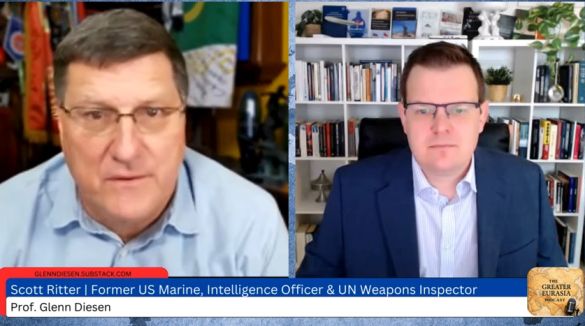
Editor’s Notes: In this timely interview, former UN weapons inspector Scott Ritter joins Glenn Diesen to analyze the escalating tensions between the United States and Iran as military forces reach a peak buildup in the region. Ritter examines the strategic goals behind potential precision strikes, including the possibility of regime change and the fracturing of the Iranian state. The discussion also highlights the critical roles of Russia and China, as well as the severe global economic fallout that could follow an outbreak of hostilities. Ritter ultimately assesses whether a diplomatic “off-ramp” remains possible or if the current momentum is leading toward an inevitable and devastating conflict. (Jan 28, 2026)
TRANSCRIPT:
Assessing the Military Buildup
GLENN DIESEN: Welcome back. We are joined today by Scott Ritter, a former UN weapons inspector, US Marine Corps intelligence officer and prolific author. So thank you for coming on.
We’re seeing now a lot of indicators that another attack on Iran could be imminent. That is, some US Naval forces are arriving in the region. Trump claims that this is a greater armada than what was sent to Venezuela. There’s also a lot of US air power coming in. We see some disruption to the airspace. That is, some civilian flights are being redirected and there’s media reports about the plan of doing precision strikes against Iranian officials.
How are you assessing the information? Are we heading towards war?
SCOTT RITTER: It certainly looks that way. You know, Donald Trump has a history of pulling back from the brink on Iran, because the consequences of conflict remain the same. There’s the old saying, “Don’t strike the king unless you plan on killing the king.” Because if you strike the king and the king’s still alive, the king’s going to kill you.
Iran’s the king of the region. Let’s just be straight up about that. Iran has the ability to terminate all energy production capabilities in the region at will. In addition, Iran has the ability to inflict horrific harm on American military bases to include the potential of killing hundreds, if not thousands of American service members. I think we have to keep in the back of our head the possibility of the United States losing some ships up to and including an aircraft carrier.
And Iran, of course, has the ability to deliver near lethal damage to Israel. Israel has told the United States that it’s apparently, according to news reports, that it’s prepared to absorb up to 700 Iranian ballistic missiles if the United States can guarantee that whatever military action is taken removes the Iranian regime from power.
Yeah, I’ve got bad news for US military planners. Let’s just be straight up and honest about this. You don’t have what it takes to remove Iran’s military and civilian leadership from power, especially now that you’ve literally broadcast your punch.
Iran’s Underground Infrastructure and Resilience
This isn’t going to be a repeat of June where you lulled the Iranians into a false sense of complacency by leading them to believe that there would be ongoing negotiations about their nuclear program. They went to bed at night only to be attacked by Israel with the backing of the United States in a decapitation attempt that failed.
The Iranians have been preparing for more than 20 years now to wage an existential conflict against Israel, the United States and the West. They have divided their nation up into self-sustaining military and governing districts under the assumption that there could be a decapitation strike against Tehran. Not that it would eliminate the leadership, but it could eliminate the ability of the leadership to communicate with the various regions of Iran.
So the Iranians have built underground cities, underground command posts that are capable of independently overseeing the designated terrain. And they’re also capable of independently continuing to resist against enemies, both those who may be threatening Iran from within and also striking those without.
The Iranian government has a buried city in Mashad. I would imagine that they have their own continuity of government plan in place and that the appropriate leaders have been sent to the appropriate places. As we learned with the case of Fordow, the underground nuclear enrichment plant, Fordow was basically a modified pre-existing underground cavern that was created by the Iranians for resilience.
They have dozens if not more of these around the country, many of which we don’t know about, where they can hide production equipment, they can hide sensitive military equipment, they can hide documents, they can hide government office spaces, they can hide enrichment capabilities. The Iranians would be fools not to have implemented whatever plans they need to implement for national existential resilience.
And so we blew it. I mean, if you’re going to carry out a decapitation strike, it has to be done by surprise. You don’t telegraph your punch. And even if the United States were to come in with nuclear weapons, and I don’t see them doing that, they’re not going to eliminate the Iranian regime. It just isn’t going to happen.
The Potential Consequences for Israel and the Global Economy
And what’s going to happen is that the Iranians are going to deliver a knockout punch against Israel that very well may end Israel’s ability to survive as a modern state by taking out critical infrastructure that will not be repaired anytime soon, making Israel basically uninhabitable for millions of people who have to flee Israel. And demographically, that’s the end of Israel.
The Iranians are prepared not only to shut down the Strait of Hormuz, but to permanently disrupt the ability of regional energy producing nations to produce energy. This will have a near fatal impact on the global economy. I mean, I fear for me and for my family and for the United States, the consequences.
You know, the dollar has already lost 10% of its value in the past year. We’re looking at the potential of a complete collapse of the dollar and energy prices out of control and this will resonate globally.
I fear for you because I know, I mean, I know Norway produces its own energy but you will be impacted by this as well. This is the consequence of this.
And hopefully there’s people that are smart enough to say, “Hey, Mr. President, this decision, this isn’t going to work. It’s not going to work at this time. Let’s not do this. This is foolhardy. You will lose the midterms, you will be impeached,” all the things. So we’ll see what Trump does. But right now it looks as if the pieces are being put in place to carry out a major military attack against Iran.
The Real Objective: Regime Change and Fragmentation
GLENN DIESEN: Well, what would the objective be here though? Because there’s no longer any talk about the nuclear program. That is, well, Trump claims that this was already destroyed. Doubtful. But anyways, the talk now is about precision strikes against the government. It’s about holding to account the government for the killing of protesters. Essentially, they’re talking about regime change.
And given that there’s no unifying opposition, it begs the question whether or not the main objective, therefore is to destroy Iran, that is to break it into many smaller manageable pieces. Indeed, there was this Wall Street Journal article recently which had a title that “A fractured Iran might not be so bad.” And it recognized that a distinct possibility of a civil war following a regime change operation, which seems like it could…
Well, either you would need an extremely authoritarian opposition to take over, capable of controlling it, something like the jihadists who were put in place in Syria, or it would be the fragmentation of Iran. Do you see this being the main game plan just to destroy the country?
SCOTT RITTER: Absolutely. The plan would be to destroy Iran’s ability to carry out effective national level command and control, to suppress regional security infrastructure, institutions, units, organizations, et cetera. And then to facilitate uprisings.
In Baluchistan, we know that the CIA actively backs a Baluch Liberation Army. We know in Ahvaz, we back Arab liberation. We know we back Kurds, we know we back Azeris. And so you’ll be seeing uprisings in all of these areas, CIA-backed uprisings. And then you’ll have the MEK and the monarchists working to destabilize Iran from within, the core of Iran.
I think Trump believes that he can put the Shah in power, the Shah’s son in power, and resurrect the monarchy. You know, Trump is not the smartest man in the world. He literally isn’t. I think people need to understand that, especially about the world we live in. He’s extraordinarily susceptible to nonsense being whispered in his ear.
And right now he is being presented with what appears to be a solid front of anti-regime Iranians, expatriates in Los Angeles, a very strong group there, but also throughout the United States, people who are saying that it’s time for the regime to fall, that the monarchy is ready to go. And remember, the CIA has been backing the monarchy, Israel’s been backing the monarchy for again, close to 30 years. So I think Trump has bought into the nonsense and he believes that this plan can succeed.
The Status of Ground Assets and Covert Networks
GLENN DIESEN: But if there is a regime change operation, as you suggested, you need some groups on the ground. I had the impression that the efforts to instigate all these riots and anti-government violence which died off recently, that this was essentially the opportunity to go after the Iranian government and once it failed, that the US or Israel would come in bombing during the chaos in a way of supporting an uprising. But given that this fell apart…
SCOTT RITTER: It didn’t just die down.
GLENN DIESEN: It appears that Iran was able to essentially roll up a lot of these covert networks which have been built up over years, if not decades. So has the US and Israel lost a lot of its, I guess, ground assets in Iran which could have been used during a war or at least as a necessity for a regime change operation?
The Strategy of “Shaking the Tree”
SCOTT RITTER: Again, not being read into the covert plan, I can only speculate here. What I think happened is that a network of an internal cellular network of agents working for hostile foreign intelligence, primarily Israel, United States, Great Britain, were sacrificed to create the conditions of unrest.
If I know the Israelis the way I think I know the Israelis, the CIA the way I think I know the CIA, they operate… when they do something like this, it’s called “shaking the tree.” I’ve done it before. You go in and you tickle the system, then you see how the system responds. And they tickled the system. They sacrificed an entire network and we’re talking hundreds of assets to achieve this.
But what they didn’t do is mobilize the actual paramilitary organizations that would lead the insurrection. I think the goal was to create the unrest. And then there was supposed to be a bombing campaign to suppress those security nodes identified that were activated to suppress.
So now, to be honest, the United States knows exactly how Iran responds. They got it all, they collected it all. They’re not stupid. They sacrifice these people. But the Iranians had to communicate, had to activate, had to mobilize. They identified units, personality structures that responded. This was their first team. And the team’s been identified. And this is a team that’s going to be bombed when the strike begins.
And they’re going to suppress this. And this is when the paramilitary forces come in, the people that are training that are in northern Iraq, the Kurdish forces there, the Kurdish forces that operate along the border of Iran. This is where Azeri forces that are operated inside Azerbaijan under CIA and Israeli control, the Baluch Liberation Army, all of these paramilitary military forces, actual terrorist armies, are going to mobilize and make the move at the same time.
The Mujahedin-e-Khalq, which is one of the most resilient, survivable organizations, they will mobilize from within. These people have networks that weren’t sacrificed, that are still in play. These are the networks that the Israelis use to assassinate scientists, et cetera. They’re going to be killing everybody they can get a hold of. They’re going to be running around putting plastic explosives on cars, in rooms. This is going to be the full scale, go after everybody and kill everybody.
Not necessarily the senior leadership, which should have been evacuated, but all of these security nodes that were identified when they shook the tree. They’re going to die, or at least they’re going to try and die. And the idea is to create massive confusion, airstrikes on the ground activity, paramilitary moving in, resumption of the uprising. Because now there won’t be security forces to lower it down. And this will cause Iran to fracture and break apart.
Whether Iran is actually split up… and you’d have to have the Pakistani government willing to absorb Fars, and I don’t see the Pakistani government doing that because of issues. But I think you’re going to see Iran be fractured into autonomous regions of chaos and anarchy that will be uncontrolled by the center. And from the Israeli perspective, this is a success.
Israelis don’t care about the Iranian people. The Americans don’t care about the Iranian people. All we care about is getting rid of the Ayatollah regime. And that’s what we’re going to be trying to do.
Iran’s Preparedness and Netanyahu’s Political Survival
Again, I say this, understand that what I just laid out, which I believe is actually what’s going to happen, the Iranians know this. They’ve been preparing for it. So it’s not as though the Iranians are going, “Oh, you mean the MEK is going to come out of the woodworks? Oh, you mean the Baluch Liberation Army?” The Iranians are ready for this now.
How ready you are… it’s like saying, “I’m ready for Mike Tyson to punch me in the face.” Can you really be prepared for Mike Tyson to punch you in the face? You know, if he knocks you out, you’re knocked out, but at least you know the punch is coming and you can prepare for it. We’ll see what happens.
I think this is a horrible… there’s no reason for the United States and Israel to be pushing for the elimination of the Iranian government at this time, except that Benjamin Netanyahu desperately needs this for his political survival. So once again, the United States is willing to sacrifice everything, our national security, our national legitimacy, everything, on behalf of Israel.
The Iranian Response: Deterrence vs. Existential Threat
GLENN DIESEN: Well, if you were advising the Iranian government or if you’re just in Tehran, how would you assess their likely response? Because in the first attack on Iran, I would have thought that the main objective of Iran would have been to essentially show the strength it has, the resilience, the ability to strike back, essentially to build up its deterrent, to make sure that the aggressive forces were pushed back and that they would be deterred from doing this again.
But what you’re describing, though, this is an existential threat. That is, the goal is not some limited strike. It’s to destroy, essentially, Iran. And if they fail, they would perhaps go back, regroup, and try again.
So given that this is how Iran likely sees the threat against it, it would have an incentive to react differently this time. I would think that is to not hold back in terms of striking various Western military assets, Israel in the region, or even, you know, some have suggested Iran might even do a preemptive strike. If all the American warships and fighter planes, bombers, all are in position and it looks like they’re going for the go, then it would be better for Iran to hit them first.
Again, this is speculations. One scene is in the media. No one in Tehran is whispering my ear either. So I’m just wondering, how do you assess the likely way the Iranians would behave differently this time as opposed to the first time they were attacked?
SCOTT RITTER: Well, the first time they were attacked, they weren’t expecting that attack. It took them by surprise. So right off the bat, if Iran is taken by surprise, then shame on them. I mean, that’s their own issues.
I don’t… I mean, if I were the decision maker in Iran, the Abraham Lincoln would already be sunk, American bases would already be destroyed, Israel would be eliminated, and I’d be carrying out massive operations against the Kurds. And in Iraq, the Baluch. I’d be wiping out Avaz. I’d be killing anybody suspected of the of MEK ties. I’d be sending assassination teams around the world to kill the Shah’s son. I would kill everybody, but that’s just me. I’m not Iranian. I’m just a bloodthirsty son of a bitch who doesn’t believe in standing by and getting hit in the face first.
The Iranians, unfortunately for them, are very civilized, they’re very proper. And I believe that their government still holds out hope that war can be avoided. And so they’re not going to take, I believe, the actions that would be necessary to preempt this.
Iran has every right to. I mean, the statements made by the United States and Israel already justify this. There’s no doubt that there’s an imminent threat that’s building up. Iran should go to the United Nations and declare an emergency and demand international intervention and declare that there’s an imminent threat. And if that imminent threat can’t be eliminated in a period of time, Iran has no choice but to carry out preemptive self-defense under Article 51 of the United Nations Charter. They’d have every legitimate right to do this.
But I also think they’re being advised by the Russians and the Chinese to be patient too, that again, we know of at least two occasions when Donald Trump pulled back from the brink. And so maybe there’s people advising the Iranians that this can be the third time, that there’s no reason or justification to go forward because, you know, a preemptive strike, again, if you’re going to strike the king, kill the king.
So the preemptive strike has to be a knockout blow to the United States and to Israel. And one of the things that happens if you carry out a very effective preemptive strike is that you open yourself up to nuclear retaliation. And that would be, again, the end of Iran.
Which is why, hopefully, if I were advising the Iranians, you’d have some rational people say, “That’s okay, Scott, go sit in the back corner and eat your raw meat. We’ll get back to you later.” You know, but no, I think, you know, Iran, I have hope and I have confidence that the Iranians understand what’s happening and that they are preparing to ride out what’s going to be one hell of a storm.
I also need to say this. You know, I’m an American. I don’t wish harm on any Americans. You know, I don’t want any American hurt in this. And you know, yeah, I just, I, you know, this is going to just be a bad, bad thing, a very bad thing, because it’s a war of choice. And I just hope and pray that the leaders of the American men and women who are in harm’s way do their jobs right and bring as many of their boys and girls home as possible.
Trump’s “Deal” and the Language of Gangsters
GLENN DIESEN: Well, meanwhile, Trump, though, he made some comments that as this massive armada is heading towards Iran, he said that the Iranians now want to make a deal. Again, his words. We shouldn’t necessarily take it literally. I don’t think the Iranians necessarily said, “We’re ready to make a deal.” It’s just words.
But it does beg the question, what kind of a deal would we even talk about? Because this is no longer about the nuclear deal. So is this just more trying to give them a sense of security, that this is just to put pressure to negotiate, or is he actually looking for a deal?
Because surely Trump must see the disaster that awaits if he goes forth with this. And it kind of fits his approach to not get dragged into something too big. He seems to always want to, you know, even if it’s Yemen or Venezuela, just go quickly in, quickly out and have something to show for it as opposed to being, you know, taking massive casualties on the American side.
So do you think he’s actually looking for a deal? Or if so, what exactly would that deal be? Because it would have to be something else. Are the Iranians going to disarm? Are they going to accept voluntary regime change? I mean, what would such a deal actually entail?
SCOTT RITTER: Well, I think a deal would, first of all, you know Karen Kneissl, she’s a former Austrian foreign minister that’s currently residing in St. Petersburg. She heads up what’s called the Gorky Center, a very smart lady. She abhors the term “deal.” She calls it “the language of gangsters.” Well, which is why Donald Trump uses it.
A deal isn’t… I mean, Donald Trump wants a deal because the deal is a one-way street. Donald Trump wants everything for him, nothing for you. And he could break it anytime he wants because he’ll just call it a bad deal and “I’m looking for a better deal.” It’s the language of gangsters and the Iranians should understand that and not be looking for any deal.
You don’t deal with the mafia. They always win because that means that you’ve gone down to their level and you’re playing their game. Iran needs to be looking for a comprehensive treaty-based agreement founded in international law, which is problematic because Donald Trump has stated that he doesn’t believe in international law. So right off the bat, I’d say that we just have incompatible visions on what conflict resolution looks like in Iran and in the United States.
But to answer your question, a deal would be nuclear. You know, to bring, to close the nuclear file and ballistic missile that Iran would have to voluntarily disarm of the one thing that gives it viability. And once they did that, then Israel would come in and finish them off. I mean, that’s the deal.
What the United States is saying is voluntarily get rid of anything that gives you, you know, deterrence capability, and then Israel will finish you off because we want regime change. Israel will not be happy until the ayatollahs are gone. And frankly speaking, the core of American policymakers share the same sentiment.
You know, they shouldn’t have gone over the Embassy walls in 1979, because when they did that, they taught an entire nation to hate them. And that hatred’s still there. It’s irrational hatred. It doesn’t make any sense, but it doesn’t matter. You don’t take Americans hostage for 444 days. You don’t poke the dead bodies, the charred bodies of eight American service members who were sent to Iran not to invade it, but to rescue hostages that the Iranians took hostage.
I mean, Iranians aren’t the good guys here in terms of what happened in 1979. I know the Shah, SAVAK complex, culpability and all that. American people don’t care about that. Iranian people need to understand that when you insult the American people, that insult says, we don’t forgive and forget. We hold grudges.
And right now, there’s a big grudge against Iran. There’s not too many Americans out there. I’m one of the few that articulate for good relations, normalized relations with Iran. Most Americans would be very happy to see ayatollahs go away. Not because they know anything about the ayatollahs or they know anything about how Iran functions, but because they have been programmed into linking the ayatollahs with holding Americans hostage, taking American embassy, you know, a failed rescue mission, eight dead Americans, bomb burned on the desert floor, Desert One. You know, this is the reality.
So, you know, it’s… there should be no compromise on the part of the Iranians, because the moment they compromise, the moment make a deal, it’s over. You don’t make a deal with the devil, you don’t make a deal with the Mafia, and you don’t make a deal with Donald Trump.
The Russian and Chinese Factor
GLENN DIESEN: Well, given that this is an existential threat to the Iranians, that is, even if they make a deal or not, as you say they will, the regime change is nonetheless the key objective. How does this impact how the Russians and the Chinese would respond to an American and Israeli attack on Iran?
Because, well, I heard that there was good possibility that the Russians had something to do with shutting down the Starlink during the riots. But overall, Iran is a key regional power, and the wider Eurasian continent is a key pillar of this Greater Eurasian Partnership.
SCOTT RITTER: So…
GLENN DIESEN: And for countries like China, it’s also an important source for energy. And if it was able to be knocked out, it would certainly be taken advantage of to go after Russia or China in the future. So it’s hard to… it’s hard to expect it to be reasonable that they would allow Iran to go down in a similar way as Venezuela, for example.
Russia and China’s Strategic Response
SCOTT RITTER: I think you hit the nail on the head here. Iran’s not Venezuela. Iran is much closer and much more important. It’s a BRICS member. Russia has a strategic relationship with Iran. There’s a secret military annex that now has been ratified by both the Russians and the Iranians. That’s in play. And the Chinese have likewise been working with the Iranians.
I wrote an article a couple weeks ago that many say is the reason why I got debanked. Basically, I said, “give the camel a bloody nose.” That you can’t let the camel stick its nose under the tent or else the camel’s coming in and the United States is the camel. It’s trying to stick its nose under the tent here and that somebody needs to give it a bloody nose.
Now, again, I’m not advocating for any harm to come to any Americans. I don’t want that at all. And I was more or less talking about economic actions that can be done to hold the United States back or punish the United States for bad policy.
But if I were the Russians again, the United States isn’t as smart and clever as it thinks it is. The B2 strike that was conducted gave away every American capability you can imagine. When they talk about precision strikes, they’re talking about penetrating Iranian airspace with B2 bombers, with F35s, with F22s. That profile has been flown, has been captured, has been recorded. Every aspect of it has been assessed by Iranians and Russians and Chinese.
And if I were the Russians, I would say that my goal is to shoot down one or more B2 bombers and prove once and for all that the concept of American supremacy, that America can’t be touched, America is able to do anything it wants, is a fundamentally flawed concept. Now, if they do shoot him down, I hope the American air crews get out, are rescued by American search and rescue, and there’s no prisoners of war and all that good stuff.
But the point is, again, if I were advising Donald Trump, don’t do this, you could be entering a trap, because the Russians aren’t going to sit back idly and let you bomb Iran. Russia’s not going to respond directly. They’re not going to go to war for Iran. But Russia is going to do everything they can to ensure that your military adventure is a failure, a fundamental failure.
The Threat to American Naval Assets
You know, and this is up to and including, the Iranians have the ability to hit American shipping in a way that no other nation that has recently fought the Americans could, including the Houthi. We’re talking about a Oreshnik-like missiles that cannot be intercepted, that will rain death and destruction down on the platform, penetrating the deck, potentially penetrating the nuclear reactor, potentially sinking the ship with catastrophic loss of life, sinking other ships that are part of the carrier battle group.
The United States has become very cocky, and we’ve become accustomed to inflicting harm on people without having harm inflicted on us. I believe that the Russians and the Chinese are going to do everything possible to help the Iranians give the United States a bloody nose, a broken nose in this fight.
And that’s, again, another reason why you have to ask yourself, then, why are we doing this? Why go through this motion? Because of Trump’s ego. I mean, it really comes down to that. It becomes also the control that Israel has over American foreign policy and national security policy.
But, you know, I’m not saying the Iranians are perfect, and I’m not saying the Iranians can’t mess it up, and I’m not saying the Iranians are going to succeed. But if I were the Russians, I’d be doing everything I could to ensure that the Iranians shoot down at least one, maybe two B2 bombers and the strike forces. That strike package is going to be coming in. That will be a humiliation to Donald Trump that he won’t be able to survive.
GLENN DIESEN: Well, as we speak now, I see on one of the screens here that there’s American surveillance aircraft over the Strait of Hormuz, and there’s also Iranian drones near while doing reconnaissance on the American naval assets in the region. So it does look as if both sides are preparing for war now.
But this is a last question. If we’re not going to war, what will be an off ramp by now? Because it’s very hard to step back from this massive show of force unless there’s something to show for it, to show that your pressure tactics were successful and you can come home with something. Otherwise, it looks as if war seems very certain by now.
Potential Off-Ramps and Trump’s Options
SCOTT RITTER: Donald Trump is somebody who has little problem telling lies, and he’ll be able to, if he wants to, he can craft something about, “I received a phone call, assurances that Iran will behave properly.” You know, once again, American military strength has compelled the ayatollahs to back down and things of that nature. That’s the off ramp.
You know, we’re going to, because this war has no legitimate foundation, because normally an off ramp is an off ramp that takes us away from the issues of concern. Now, here they say the issues of concern are the nuclear program, of ballistic missiles. But, you know, Iran’s not going to give those up. Not in a vacuum, not anytime.
You know, so it’s, I think, Donald Trump, if he wanted to end this, could do what he did last time. You know, “I made a decision to save Iranian lives.” You know, “When I was briefed on the totality of the damage that would be done by this strike, I realized that the Iranian people have suffered enough at the hands of this regime, and I am not going to facilitate continued suffering. Thousands of Iranians would be killed if we struck.”
And instead, “we’re going to pull back and double down on sanctions and work to further isolate the regime, and we always will have our military here in the background ready to pounce,” you know, something like that. So because Donald Trump has no problem telling lies, manufacturing his own reality, he can say anything he wants. And unfortunately, we have an American population that’s just dumb enough to believe it.
GLENN DIESEN: That could be a strength now, though, wouldn’t it? Because usually countries, they lock themselves, they get stuck in a rhetorical trap because Trump’s skills, in terms of lying, getting away with it, just spewing pure BS or just this ability to shift focus. I mean, one day you’re talking about Venezuela, day two you’re talking about Greenland. It is a talent, I guess, this managing the media. It could be an off ramp if one just wants to be optimistic. So, final thoughts?
SCOTT RITTER: I mean, you’ve got to take the silver lining when it’s offered. Okay. You know, there’s a dark cloud over us, but look, you know, it’s sort of reflective of the state of affairs that we’re confronted with today, where having a lying leader with no moral compass is a good thing. Because his lies, his lack of moral compass could actually prevent a war. So I’ll take it.
GLENN DIESEN: Well, on that optimistic note, thank you very much for taking this time and sharing your insights.
SCOTT RITTER: Thanks for having me.
Related Posts