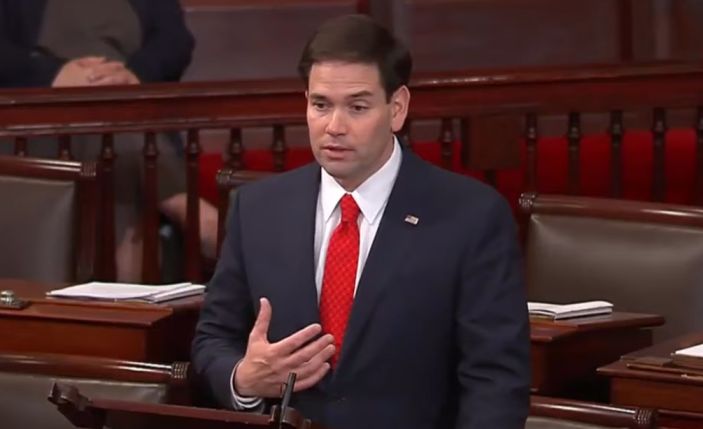
Editor’s Notes: In this floor speech from May 2015, Senator Marco Rubio outlines his significant concerns regarding the Iran nuclear negotiations and argues for the importance of the Iran Nuclear Agreement Review Act. He details the multi-faceted threat Iran poses through state-sponsored terrorism, its desire for regional hegemony, and the pursuit of nuclear capabilities that he believes could lead to a catastrophic arms race or war in the Middle East. While expressing disappointment that certain strengthening amendments were not voted on, Rubio emphasizes that the bill is essential to ensure a formal congressional review and provide a voice for the American people on this critical issue. This speech provides a comprehensive look at the legislative and security stakes surrounding one of the most contentious foreign policy debates of the last decade. (May 8, 2015)
TRANSCRIPT:
Introduction
MARCO RUBIO: Thank you, Mr. President. I wanted to come to the floor today to speak about the risk that Iran poses to the world and, as a result, the legislation that’s before the Senate at this moment.
A lot’s been talked about in the media over the last months, years, quite frankly, about the notion that we’re going to work out a deal with Iran that will prevent war. Sadly, I believe that the direction this deal is headed almost guarantees war at some point, certainly in our lifetime, but maybe before the end of the decade.
Let me back up and first describe what the issue is at hand.
Iran’s Government and Its Goals
The issue at hand is that Iran, run by a radical Shia cleric — its government, I should say; its people perhaps don’t partake in that process — but its government, whose head and supreme decision maker is a radical Shia cleric, has made two decisions.
The first is they feel it is their obligation to export their Islamic revolution everywhere in the world, and of course, it begins with the Middle East. And two, they’ve decided they want to become the hegemonic power in the region. They want to become the dominant nation, the dominant movement in the Middle East and in that entire region.
So how do you achieve that?
Iran’s Strategy: Asymmetrical Warfare and Terrorism
Well, first it requires you to drive the Americans out of the area, which is why we’ve seen them invest in all sorts of asymmetrical capabilities like these little small swarm boats that they use to sometimes harass U.S. Naval vessels. That’s why you see them, just a week ago, basically hijack a commercial vessel on the international waters.
The second thing they do is they sponsor terrorism. They have all these proxy groups in all these countries in the region that are doing their bidding. That’s also asymmetrical warfare — asymmetrical meaning it’s not frontal. It’s using some nontraditional method to expand their power or to show their power. So they use these proxy groups like Hezbollah, or now the Houthis that they’re involved with in Yemen and in other parts of the world.
The threat is that if you attack Iran, these terrorist groups will attack you. And in fact, we have seen the hand of the Iranian government in terrorist attacks. For example, we saw an attempt to assassinate the ambassador of Saudi Arabia here in Washington D.C. We know that in 1994, there was a bombing in Buenos Aires that was linked to Iran. So they sponsored terrorism.
Iran’s Nuclear Ambitions
But the third aspect of their desire to become the hegemonic regional power is a nuclear weapon. What do you need to acquire a nuclear weapon? You need three things.
The first thing you need is a bomb design, and the truth is you can buy a bomb design. The second thing you need is a delivery system, an ability to deliver the weapon, whether it’s on an airplane or on a missile. And that is why Iran is developing long range rockets. They’re expending a lot of money, despite all the sanctions that are on them. They’re expending a lot of money to build these long range rockets. That isn’t for some sort of fancy fireworks show. It isn’t to put a man on the moon. They’re building these long range rockets because they understand that is the second critical component of a nuclear weapons program.
And the third thing is you have to be able to get your hands on enriched uranium or reprocessed plutonium. And no one in the world is going to import to them weapons grade uranium or plutonium. So they’ve decided to build the infrastructure to do it themselves. And they do it the way North Korea did it. They do it the way other nations have done it when they try to hide their program. They do it by claiming that they have a peaceful nuclear program that they’re trying to build. In essence, their argument is we don’t want to build a weapon. We’re just trying to build nuclear reactors so we can provide electricity.
It makes no sense for two reasons. The first is this is an oil rich country. They don’t really need nuclear energy in order to provide cost effective energy for their country. But the other is it costs so much money to build the equipment to enrich and reprocess. They could just buy it, already reprocessed or enriched, and ship it, bring it into the country the way South Korea does, the way other nations do.
So if it would be cheaper to bring these things in by simply importing it, as opposed to having to spend all this money enriching and reprocessing themselves, why are they spending all this money on the infrastructure?
The Regime’s True Motivations
And the answer is because at some point in the future, they know they’re going to want a nuclear weapon. Now, perhaps they haven’t made the decision they need it today or next week or next year, but they certainly, at a minimum, want to have the option to be a threshold nuclear power.
And I believe, knowing everything we know about them, both open source and classified, that whether they’ve decided or not to build a nuclear weapon, they will decide to build a nuclear weapon because it provides for them the sort of regime stability they crave.
The radical Shia cleric that heads that country, he looks at North Korea and he looks at Libya. And he says Libya is what happens when you don’t have a nuclear capability. North Korea is what happens when you do. Muammar Gaddafi is dead and out of power, but North Korea is still run by that madman. Why? Because he has a nuclear weapon. You can’t invade him or touch him because of what he’ll do in response.
And I think they’re guided by that principle. They’re guided by the principle that they want to be the regional hegemonic power and nuclear weapons gives them that role.
And they’re guided by a third, equally sinister motivation, and that is the open and repeatedly stated desire to destroy the state of Israel, to wipe it off the face of the earth. They haven’t said this once in passing. The supreme leader of Iran has said this on hundreds of occasions. In fact, every Friday in Iran, in government sanctioned religious events, they chant “death to America” and “death to Israel.”
And if there’s one lesson of history, it is that when a leader or a nation repeatedly says, “We are going to kill you,” you should take that seriously. And when the nation that says, “We are going to kill you,” is using its governmental money to sponsor terrorism, you should take that even more seriously. And when the nation that’s going out and saying “we’re going to kill you and wipe you off the face of the earth” is reprocessing plutonium or enriching uranium, you have a right to be extremely scared.
The Failure of Sanctions and the Path to Negotiations
The world understood this ten years ago, eight years ago, and so it imposed UN Security Council sanctions on Iran, international sanctions. They were not easy to put together. A lot of those countries in Europe have companies that were dying to do business in Iran. They didn’t want these sanctions, but they were in place.
And then about a year and a half or two years ago, the president decided it’s time to try to open up to Iran and see if we can work a deal out with them. And look, in normal circumstances, there’s nothing wrong with that. Two countries who have a disagreement on some issue, you can work things out. There’s a place for diplomacy in the world.
The problem is that the issue we have with Iran is not based on agreements. They’re not mad that we did something and so that’s why they’re acquiring a nuclear weapon, and if only we stopped doing what it is that aggrieved them, they would go away. This is not a grievance-based problem. This is an ideological problem.
Because if you read the founding documents of the Islamic Republic, it doesn’t describe the supreme leader as the leader of Iran. Iran happens to be the country they operate from. It describes them as the supreme leader of all Muslims in the world. And that is why they believe that it is their goal, it is their mandate, it is their calling to export their revolution to every corner of the planet, but beginning in the Middle East. And a nuclear weapon capability would give them leverage in carrying out that goal that they have. And in their mind, nothing would be more glorious than the destruction of the Jewish state.
A Process of Constant Appeasement
So the president enters these negotiations, and it has been a process of constant appeasement. Moment after moment, we went from saying no enriching and reprocessing, to you can enrich and reprocess at five percent, to you can enrich up to twenty percent for research purposes. We went from saying no enrichment ever to saying in ten or fifteen years, all bets are off.
And there are still items in the negotiation that are not clear. The White House put out a fact sheet. They put out a piece of paper and they said, “This is what we agreed to.” And Iran put out a piece of paper just like it, except it sounded like a totally different deal.
For example, the U.S. fact sheet said that sanctions on Iran would not come off until Iran complied. But Iran’s fact sheet said, “No. Sanctions come off immediately.” And now when you press the White House on it, they refuse to say that in fact it will be phased, not immediate.
Amendments Filed and Blocked
That’s why I filed an amendment. And even though I think that the president’s deal as outlined in the fact sheet was not good enough, I filed an amendment to at least hold him to that. And the amendment to this bill read very simply. It just said that whatever deal the president crafts has to reflect the fact sheet that he provided to the Senate, but we couldn’t get a vote on it.
And the other amendment I filed is that any deal with Iran should be conditioned on Iran recognizing Israel’s right to exist. And here’s why that was so important. That was so important because this is not just about the nuclear program. The deal the president is trying to sign is about removing sanctions, meaning money is now going to flow back into the Iranian government’s coffers.
What are they going to do with this money? Are they going to build roads, hospitals? Are they going to donate to charity? No. Are they going to buy food and medicine for people that are hurting around the world? The hundreds of thousands that have been displaced by Assad, their puppet? No. They’re going to use that money to sponsor terrorism. And the prime target of the terrorism they sponsor was the state of Israel.
We couldn’t get a vote on that amendment either. Apparently, there are senators terrified of voting against that amendment, so they’d rather not have a vote at all.
The Current State of the Debate
And so I am deeply disappointed by the direction this debate has taken because I felt — and I understand that this deal was carefully crafted, I’m on the committee that passed it — but I also understand that every member of the Senate has a right to be heard on this debate. And unfortunately, only a couple of amendments were allowed to be voted on and no one else had an opportunity to get their amendments voted on, amendments that I thought would have made this bill much more meaningful.
But now we’ve reached this point where the majority leader has filed cloture on the bill because it’s time to move on to these other issues, and I respect that. And we have to make a decision.
The Choice Before the Senate
And the decision is not whether we’re going to pass the bill we want or nothing at all. The decision is, are we better off as a country with this bill or with no bill?
If we don’t pass a bill, the Senate can still weigh in on the Iranian deal, but the Iranian deal kicks in immediately. And unless and until the Senate acts, the sanctions will be off — at least the U.S. sanctions will be off. There’s also no guarantee that the White House will even show us the agreement if we don’t pass a bill.
If we pass a bill, it delays the sanctions being lifted for a period of time. It requires the White House to submit the deal to us so we can review it. And ultimately, it calls for a vote up or down on approving the deal or not. It actually requires that that vote will have to happen. There can’t be any procedural process to impede it, for the most part.
So at the end of the day, while this bill does not contain the amendments — we didn’t even get a vote on the amendments that we wanted — it doesn’t contain the different aspects that I thought would make it stronger. If left with the choice that we have now, I don’t think there’s any doubt that we’re in a better position if this bill passes. Because at a minimum, at least it creates a process whereby the American people, through their elected representatives, can debate an issue of extraordinary importance.
The Risk of War
If I’m troubled by anything, it is that while this issue gets a lot of coverage, I’m not sure the coverage accurately reflects what a critical moment this is. I said at the outset that I think a bad deal almost guarantees war, and here’s why.
Because the state of Israel, such an important ally to the United States, they’re not thousands of miles away from Iran. Put yourself in their position for a moment. A small country with a small population, nine miles wide at its narrowest point, with a neighbor to the north that openly and repeatedly says it wants to destroy you and is on the verge of acquiring a nuclear capability. And Israel feels like their very existence is being threatened. And faced with that, Israel may very well take military action on their own to protect themselves. I think a bad deal exponentially increases the likelihood of that happening.
I also think you look at the other nations of the region — because Iran is a Shia country, a Shia Persian country, but its Sunni Arab neighbors aren’t big fans of the Shia branch of Islam. So for example, Saudi Arabia, an incredibly wealthy country, they have already said whatever Iran gets, we’re going to get. If Iran gets the right to enrich and reprocess, we will enrich and reprocess. If Iran builds a weapon, we will build a weapon. And so it creates the very real specter that we’re going to have an arms race, a nuclear arms race in the Middle East.
Conclusion
UNIDENTIFIED SPEAKER: Senator’s time has expired.
MARCO RUBIO: I ask unanimous consent for thirty seconds that I may conclude.
UNIDENTIFIED SPEAKER: Is there objection? Without objection.
MARCO RUBIO: You talk about a region of the world that could have a nuclear arms race, one of the most unstable regions on the planet. And so I hope we’re going to get a good deal. I’m not hopeful that we will, but I think we’re better off if we have this process in place. And so I hope this bill passes here today so that at least we’ll have a chance to weigh in on an issue of critical importance.
I yield the floor.
Related Posts