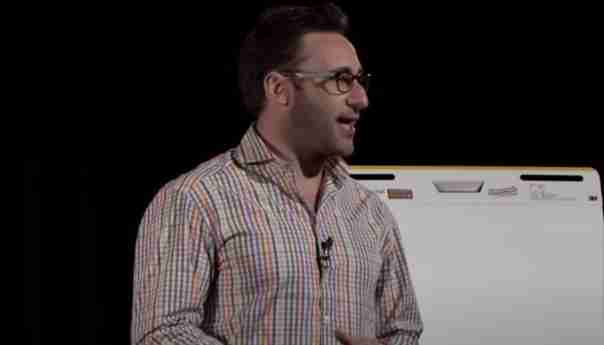
Here is the transcript of Simon Sinek’s talk titled “Why Leaders Eat Last”. In this presentation, Sinek discusses how leaders eat last in order to motivate their employees and how this behavior reinforces the status quo. He argues that this system is flawed, as it can lead to instability and conflict among group members. He provides advice on how to lead effectively, emphasizing the importance of sacrifice and being willing to be open about one’s problems.
Listen to the audio version here:
TRANSCRIPT:
So, the date is August 16, 2002, and flying over a valley, in Afghanistan are two A-10 Warthogs. An A-10 is a heavily armored, low-flying, slow aircraft designed to provide ground cover for troops on the ground. And on this night, it’s a very, very cloudy night, there are storms in the area, and these two planes hanging up above, just waiting in case anybody down below needs help.
Up there, it’s gorgeous. The moon is bright, there’s thousands of stars in the sky, the clouds look like the snow had just fallen. Down below in the valley, however, there were 22 special forces, special operations forces, troops, trying to make their way through the country, and they could feel that something was wrong. They could feel, they felt uneasy.
One of the pilots up above callsign Johnny Bravo, and yes, he stands like this. He could feel their unease listening to him over the radio, so he decides he was going to go down below the cloud and just have a look. He tells his wingman, ‘Hang out up here, I’ll go see what there is.’ And he points his plane down into the clouds.
And as he’s going through the clouds, the call comes over the radio. Troops in contact. Troops in contact is what they say when they come under effective fire. It means they’re in trouble. So Johnny Bravo points his plane straight down. The plane is getting thrashed about in the turbulence.
And when he comes out below the clouds, he’s less than 1,000 feet off the ground, and he’s flying in a valley. Cliffs on both sides. Now, this is only 2002, and the planes were not yet equipped with ground-hugging radar, and worse, they were using old Russian maps. That’s all they had at the time.
And the sight that greets him is something like he’s never seen before, not in training, and not in the movies. He sees tracer fire, fire coming from all sides of the valley, pointed right in the middle where the American forces are. And so he picks the point and starts to lay down suppressing fire.
And he’s flying, and he’s in danger of hitting the cliff, of course. He knows his speed, he knows his distance on the map, and he literally counts out loud while he lays down the suppressing fire. 1-1,000, 2-1,000, 3-1,000, 4-1,000, 5-1,000. Pulls hard on the stick, pulls back up into the cloud, comes down around again. 1-1,000, 2-1,000, 3-1,000, 4-1,000. Good hits, good hits, it says over his radio. And again, he comes around. 1-1,000, 2-1,000, 3-1,000, 4-1,000, 5-1,000.
He runs out of ammunition. Fuel is fine. Flies back up to the top of the cloud, tells his wingman, you need to get down there. His wingman isn’t sure about the conditions, so the two of them fly back down together. His wingman lays down the suppressing fire, and Johnny Bravo counts as they fly three feet apart from each other wing to wing… 1-1,000, 2-1,000, 3-1,000, 4-1,000, 5-1,000. Up and around again, 1-1,000, 2-1,000, 3-1,000, 4-1,000, 5-1,000. That night, 22 Americans went home alive with zero casualties.
My question is, where do people like Johnny Bravo come from? Who are they? Who would risk their lives for others so that they may survive? I asked Johnny Bravo. I asked him, why would you do it? Why would you risk your life so that others may survive? And he gave me the same answer that everybody in his position gives, because they would have done it for me.
Now, if you think about it, in the military, they give medals to people who are willing to sacrifice themselves so that others may gain. In business, we give bonuses to people who are willing to sacrifice others so that we may gain. We have it backwards.
Wouldn’t you like to work in an organization in which you have the absolute confidence, the absolute knowledge, that other people that you may or may not know who work in the same organization as you would be willing to sacrifice themselves so that you may survive? And I’m not talking about giving your life. I mean, we don’t even like to give up credit. You know?
So where do people like Johnny Bravo come from? Well, it’s an age-old question. They’re not born. They’re actually made. If you look at the human animal, the human animal is like a machine. There are systems inside our bodies that are trying to get us to do things that are in the interest of the survival of the human animal, right?
Just like in a business, in a company, if you want people to do something, you offer them some sort of positive or negative incentive to direct the behavior, right? So if you want people to achieve a certain goal, you offer them a bonus if they achieve that goal, and they’ll work towards that goal because they want the bonus. It’s a very simple system.
HAPPINESS BREAKDOWN (4 CHEMICALS)
The human body works exactly the same way. It works exactly the same way. Inside our bodies are chemicals that are trying to get us to do things that are in the best interest of us. If you’ve ever had a feeling of happiness, pride, joy, love, fulfillment, all of these feelings that we have are chemically produced feelings, and they’re produced by four chemicals, predominantly.
These two chemicals, endorphins and dopamine, I like to call these the selfish chemicals because you don’t really need anybody’s help to get them, right? Let me tell you a little bit about what they are.
Endorphins
Endorphins are designed to do one thing and one thing only. Mask physical pain. That’s it. That’s what they do. If you’re a runner, if you’ve ever done heavy exercise, you’ve heard of an endorphin rush or a runner’s high. Basically what’s happening is when that runner’s out there pushing their bodies harder than they’ve ever pushed before, they feel good. And when they’re done with their run, they feel fantastic.
And then an hour later, they’re in pain for damage they caused their muscles an hour before. This is what endorphins are designed to do. They’re designed to mask physical pain. The caveman reason for this stuff, because this stuff was all from 50,000 years ago, understand homo sapien existed at the same time as other hominid species, and yet we survived and they didn’t.
What is it about this species that’s so good at survival and thriving? Look at the world we’ve built. It’s not just that we’re smart. We’re certainly not the strongest and we’re certainly not the smartest. It’s that we’re social animals. We have to do things together. We have to look after each other and we have to work together to ensure that we survive, that we do well. This is how we’re designed. Right?
These chemicals are trying to make that happen. So in these caveman times, 50,000 years ago, Paleolithic era, we had to eat. We’re not the strongest, we’re not the fastest. But there’s one thing that a human animal is made for. Endurance. We could track an animal for hours and hours and hours and miles and miles and miles. And if we were tired, we’d keep going. And if we got injured or we had to bring the food back to the cave, we’d continue to do it. And it was so good, it felt so good, that maybe we’d even volunteer to go hunting the next day. Just like we get addicted to exercise, right? Oh my God, it was so much fun yesterday. I will totally go hunting tomorrow. Right?
Good system for the survival of the group. Good system. By the way, the reason laughing feels good is because of endorphins. You’re actually convulsing your internal organs and endorphins are masking the physical pain. I’m sure everybody here has laughed so much that the endorphins eventually run out and you go, stop, stop. It hurts. Endorphins. They feel good.
Dopamine
Dopamine is the feeling that you’ve found something you’re looking for, but you’ve accomplished something you set out to accomplish. So you know that feeling you get when you cross something off your to-do list? That’s dopamine. It feels awesome. You know when you have a goal to hit and you achieve that goal? You’re like, yes! You feel like you’ve won something, right? That’s dopamine.
The whole purpose of dopamine is to make sure that we get stuff done. The historical reason for dopamine? We would never eat if we only waited until we got hungry because there’s no guarantee that we would find food. So dopamine exists to help us go looking for food. We get dopamine when we eat, which is one of the reasons we like eating.
And so when you see something that reminds you of something that feels good, we want to do the behavior that helps us get that feeling, right? So let’s say you’re out there going for a walk and you see an apple tree in the distance. You get a small hit of dopamine. And then what it does is it focuses us on our goals. And now we start walking towards the apple tree.
And as the apple tree starts to get a little bigger, we feel like we’re making progress. You get another little shot of dopamine and another little shot of dopamine until you get to the tree and you’re like, yes! Okay? This is why we’re told you must write down your goals. Your goals must be tangible.
There’s a biological reason for that. We’re very, very visually oriented animals. You have to be able to see the goal for it to biologically stay focused, right? If you don’t write down your goals, if you can’t see your goals, it’s very hard to get motivated, to get inspired.
For example, think about corporate visions, right? A corporate vision has to be something we can see. That’s why it’s called a vision. You can see it, right? To be the biggest, most respected, to be the fastest growing are not visions. They’re nothing, right? What does that even look like? Respected by whom? Your mother? Yourself? Your friends? Your shareholders? Who knows? What’s the metric? Dunno. It’s amorphous. Doesn’t motivate us.
Just like I can’t tell you, you will get a bonus if you achieve more. You’re going to ask me, how much more? I’m going to say, more. Doesn’t work. You need a tangible goal. You need a tangible goal, right?
Here’s a great vision. Martin Luther King. I have a dream that one day, little black children and little white children will play on the playground together and hold hands together. We can imagine that. We can set our sights on that.
And every time we achieve a goal and achieve a metric and achieve a milestone that makes us feel like we’re making progress to the vision we can see, we keep going and going and going until we achieve something remarkable. You have to be able to see it. Dopamine.
Like I said, dopamine is the feeling you get when you set out to find something you’re looking for as well. I talked about the to-do list.
I came home from a trip just a couple days ago and I had a bunch of errands to run and I wrote down a little list of things I had to do and off I went. Right? And as I was walking past, I think it was the dry cleaners, I don’t remember, I was walking past something. I remembered, oh, I have to do that and I hadn’t written it down on my, I hadn’t written it down on my to-do list.
So I went in and finished what I needed to do and then when I came out, I then wrote it on my to-do list and then crossed it out. Because I wanted the dopamine. Feels good!
DOPAMINE IS DANGEROUS WHEN UNBALANCED
Dopamine comes with a warning. Dopamine is highly, highly, highly addictive. Here’s some other things that release dopamine: Alcohol, nicotine, gambling, your cell phone. Oh, you think I’m joking.
Okay, we’ve all been told that, if you wake up in the morning and you crave a drink, you might be an alcoholic. Well, if you wake up in the morning, the first thing you do is check your phone before you even get out of bed, you might be an addict. If you walk from room to room in your own apartment holding your telephone, you might be an addict.
When you’re driving in your car and you get a text and your phone goes beep, we hate email, true, we love the beep, the buzz, the ding, oh. Right? You’ll be there in ten minutes and yet you have to look at it right now. You might be an addict. And even if you read it and it says, are you free for dinner next Thursday and you have to reply immediately, you can’t wait the ten minutes, you might be an addict.
And for all you Gen Ys out there who like to think that you’re better at multitasking because you grew up with the technology, then why do you keep crashing your cars when you’re texting? You’re not better at multitasking, you’re better at getting distracted.
In fact, if you look at the statistics, ADD and ADHD have — diagnoses of ADD and ADHD have risen 66% in the past ten years. Okay, ADD and ADHD is a frontal lobe disorder, right? Are you telling me, out of nowhere, 66% of our youth have a frontal lobe problem? Where did that come from? No, it’s a misdiagnosis, right?
What are the symptoms of a dopamine addiction to technology? Distractibility, inability to get things done, easily distracted, you know, shortness of attention, it’s all the same thing, so we misdiagnose things. It’s this, it’s the addictive quality of dopamine.
We can also get addicted to performance in our companies when all they do is give us numbers to hit, numbers to hit, numbers to hit, and a bonus you get, and a bonus you get, and a bonus you get, all they’re doing is feeding us with dopamine and we can’t help ourselves, all we do is want more, more, more.
It’s no surprise that the banks destroy the economy because one of the things we know about dopamine addicts is they will do anything to get another hit, sometimes at the sacrifice of their own resources and their relationships. Ask any alcoholic gambling addict or drug addict. Ask them how their relationships are doing and if they’ve squandered any of their resources. It’s an addiction.
Dopamine is dangerous if it is unbalanced. It is hugely helpful when in a comfortable and balanced system, but when unbalanced, it’s dangerous and it’s destructive. You don’t need anybody’s help to get these. Go for a run, achieve your goals, you’ll get dopamine. You’ll get endorphins. But you won’t have any feeling of fulfillment or love or trust. That’s where these come in.
These are attempting to manage these. This is what makes our society great. This is where people like Johnny Bravo come from. It’s because of these two chemicals that leaders really fulfill their great responsibility. Outside in the world is danger at all times for various reasons.
In caveman times, that danger may have been a saber-toothed tiger. It may have been the weather. It may have been a lack of resources. It may have been who knows, any number of things. Things that with no conscience are trying to kill you. They want to end your life.
And so how do we survive? We work together. And together, we come together in our groups, in our companies, in our tribes to feel like we belong, to be around people who believe what we believe so that we may feel safe.
When we’re surrounded by people who have our best interests in mind and we feel safe, we will organize ourselves and cooperate to face the dangers externally. Don’t forget, the outside dangers are a constant. In a modern world, the outside dangers may be your competition that’s trying to put you out of business, or at least steal your business. It might be the ebbs and flows of the economy. It might be terrorism. All of these unknowns, all trying to put you out of business, take away your job, take away your livelihood, end it for you. Nothing personal. It’s a constant.
Inside our organizations, the dangers we face are not a constant. They are a variable. And they are the decisions of leadership as to how safe they make us feel when we go to work. This is the job of leaders.
Aesop said it better than I can. There’s an Aesop fable about four oxen that stand tail to tail, and whenever the lion tries to eat them, no matter what angle from which he attacks, he will always be met with horns. However, due to infighting and disagreement, they separate and they go and graze in different parts of the field. And one by one, the lion picks them off and kills them all.
When we stand together, we can more easily face the dangers outside. When we break up inside our companies, if our leaders don’t allow us a space to feel safe inside our own companies, to feel like we belong, then we have to, we’re forced to exert our own energy to protect ourselves from each other and, by the way, expose ourselves to greater danger from the outside.
If you have to worry about politics, if you have to worry about someone stealing your credit, if you have to worry about your boss not having your back, think about the energy you invest not in your business, not in the products you’re trying to develop, not in your work, not in how great you’re producing, not in your creativity, but in just keeping yourself feeling safe. This is destructive.
The responsibility of leadership is two things. One, to determine who gets in and who doesn’t get in. This is what it means to start with why. What are our values? What are our beliefs? Who can we allow in?
Second thing is to decide how big this is. How big do we make the circle of safety? How big do we make the circle of belonging? Do we keep it around just our C-level executives and call it an inner circle and allow others to try and fend for themselves and maybe try and get into our inner circle? Or do we extend it to the outermost edges of the organization?
Great leaders extend the circle of safety, the circle of belonging, out to the outermost edges so the most junior person feels like they belong, feels safe, feels like they have top cover from somebody like Johnny Bravo. That’s what these other two chemicals are trying to do.
Serotonin – Leadership Chemical
Serotonin is the leadership chemical. It is responsible for feelings of pride and status. This is why public recognition is very important. We are social animals and we need the recognition of others. This is why we have the Oscars and this is why we have public awards events. This is why we have commencement for graduation.
Think about it. What does it really take to graduate college? You need to pay your bills, fulfill the minimum requirements, and collect enough credits. That’s it. It’s a formula. You could get an email that says, Congratulations, you fulfilled all the requirements for graduation. In close, please print out the PDF of your diploma. P.S. Magna Cum Laude. Wouldn’t feel so good, right?
So instead we have a big ceremony to recognize the accomplishment and in the audience we put our family and our friends and our teachers, all of those in our tribe who have supported us and watched our backs as we’ve made it through. And then we show up on that day and we go up on that stage and we take our diploma. It feels great. We feel our status rise. We feel our pride go up. And by the way, when you have serotonin in your veins, your confidence goes up also.
And here’s the best part about serotonin. At the exact moment that you took your diploma and you felt that surge of serotonin go through your body, at the exact moment, your parents sitting in the audience also got a surge of serotonin and also felt an intense pride watching you graduate. And this is what serotonin is trying to do. It is trying to reinforce the relationship between parent and child, boss and employee, coach and player, the caregiver and the one who is grateful for the support they are given.
And think about it. Think of the speeches that we give. If you give an award to somebody, what do they say? I couldn’t have done it. I thank God. I thank my parents. I thank my coach. We thank the person who we believe was looking out for us. We could not have done this without them, we say. And they look at us and they say, I’m so proud of you. And we work to make them proud.
Great teams don’t want to win the trophy. Great teams want to win one for the coach. They want to make the coach proud. We want to make our parents proud. And it raises our status and it raises our confidence and it feels good. And we in turn will look after others so that they may accomplish the same. This is what serotonin is trying desperately to do.
The problem is you can trick serotonin. We live in a materialist society, so we judge status very often in our country based on how much money you make, right? So any conspicuous display of wealth raises your status. This is why they put the logos on the outside. No good on the inside. Nobody can see them. We want the red line of our Prada glasses. How good? You own a pair of designer shoes. How good does it feel to put on your Gucci shoes?
Oh my God, it feels so good. And you walk out and you feel a million bucks. You can actually feel your confidence rise when you put on the stuff, right? Because it’s showing this display of status. It feels great. The problem is there was no relationship that was reinforced because of it. You tricked the system. That’s why we keep trying to accomplish things and accumulate more and more material goods, and yet we never feel successful because there was no relationship. We tricked it. We gamed it.
VALUE OF GROUP-LIVING
Serotonin is the leadership chemical. The reason I call it the leadership chemical is a historical reason, a very simple historical reason. We had a very practical problem as our animal was developing, as the homo sapien was developing. We lived in communities of about 100 and 150 people, and there’s a very practical issue, which is if we’re hungry and somebody brings back food and drop a carcass on the floor, we’re all going to rush in to eat.
And if you’re lucky enough to be built like a linebacker, you will elbow your way to the front. And if you’re the artistic one of the family, you get the elbow in the face. Not a good system to keep the whole tribe alive and definitely not a good system for cooperation. Because remember, the value of group living means that if I trust you and you trust me, I can fall asleep at night and trust that you will alert me to danger. If I don’t trust you, I can’t go to sleep at night.
It’s the same in our companies. If we trust each other, we will turn our backs, we will take risks, we will innovate, we will do things that will change the course of our world. If I don’t trust you, I can’t do that. I can’t do that. There’s value in group living and group working.
And so if you got an elbow in the face that afternoon, odds are very high that you’re not going to wake the guy who punched you if danger’s there. You’re just not going to do it. Bad system.
BEING ALPHA COMES AT A COST
And so we evolved into hierarchical animals. We’re constantly assessing and judging each other, constantly arranging ourselves. Who’s the alpha? Who’s the dominant? Who’s the one who is the more dominant personality or dominant talent in the room?
In caveman times, it might have been physical muscle. In a creative industry, it might be talent. In the military, it might be courage. There’s no standard by which we judge alphas. It’s relative to the industries we’re in. And it’s relative to us as well.
If you’ve ever met someone and you were nervous while you were meeting them, you’re not the alpha. We’ve all had the experience where we’re meeting somebody and we can sense that they’re nervous meeting us. You’re the alpha.
I’ll tell you a little aside that’s kind of funny. You know when women all live together, their menstrual cycles align, right? Assuming they’re not on the pill, then it doesn’t work. But if they’re not on the pill, then all the menstrual cycles go together on the same schedule. It’s not arbitrary. They always align with the alpha female’s schedule.
And the reason is, is because when a woman is in her menstrual cycle, she can’t bear children. And so in evolutionary terms, you want the alpha male and the alpha female to do it so you can have alpha children, right? Nice, strong, strapping kids are going to survive. But if she’s off the market, that produces competition. So Mother Nature has created a very clever way that when she’s off the market, everyone’s off the market.
Back to the talk. So we’re constantly judging and assessing each other who’s alpha, right? And what we do is when we assess that someone else is the alpha, we voluntarily take a step back and allow them to eat first. Alphas get first choice of meat and first choice of mate. Good system. Good system. The alpha gets to eat first. The rest of us may not get the best cut of meat, but we will get to eat eventually and we won’t get an elbow in the face. Good system. We’ll happily alert them to danger later. Good system.
This is why we’re constantly trying to raise our status is because there are benefits to being the alpha. People will do things for us and step back and offer us favors, right? And to this day, we’re perfectly comfortable giving special treatment to our alphas. No one has a problem that your boss makes more money than you. You might think he’s an ass, but you don’t have a problem that he makes more money.
Nobody has a problem that somebody who outranks us at work has a bigger office than us. Doesn’t offend us. It is deeply ingrained in us. We happily step aside and allow our alphas first choice of meat and first choice of mate. It’s good to be the king. There are advantages that come with being the alpha. You get special treatment. You get to eat first.
People show you love and respect. It boosts the serotonin. You walk around like this. It boosts your confidence. It’s awesome, but comes at a cost. You see, the group is not stupid. We’re not giving all of that stuff away for free. Leadership, alpha, comes at a cost.
You see, we expect that when danger threatens us from the outside, that the person who’s actually stronger, the person who’s better fed, and the person who is actually teeming with serotonin and actually has higher confidence than the rest of us, we expect them to run towards the danger to protect us. This is what it means to be a leader.
The cost of leadership is self-interest. If you’re not willing to give up your perks when it matters, then you probably shouldn’t get promoted. You might be an authority, but you will not be a leader. Leadership comes at a cost. You don’t get to do less work when you get more senior. You have to do more work. And the more work you have to do is put yourself at risk to look after others. That is the anthropological definition of what a leader is.
This is why we’re so offended by these banker boys who pay themselves astronomical salaries. It has nothing to do with the number. It has to do with the fact that they have violated a deep-seated social contract. We know that they made all of that money and allowed their people to be sacrificed. In fact, they may have sacrificed their people for the money.
If I told you we’re going to give $150 million to Nelson Mandela, would anyone have a problem with that? Nope. $250 million to Mother Teresa. Got an issue with it? Nope. It’s not the number. It’s not the amount of money they make. It’s that we are deeply and viscerally offended that we know that we allowed them to have this alpha position and they did not fulfill their responsibility of the alpha. They’re supposed to sacrifice themselves for us. Never sacrifice us for themselves. This is why we’re angry and offended and don’t trust them. They fail. Oh, there’s more.
OXYTOCIN
Oxytocin. This is the best chemical of all. Oxytocin is the feeling of love and trust and friendship. It’s all the warm and fuzzies. It’s all the unicorns and rainbows. It’s the reason we like to spend time with our friends even if we don’t do anything with them. We just sit and watch TV. We love their company.
I promise you nearly every single person sitting in this room today chose the person they’re sitting next to. You’re not sitting next to a stranger. You’re sitting next to somebody you met, came with, or kind of know a little bit. Why? It makes you feel safer, doesn’t it?
If you got up and went and sat next to strangers, it wouldn’t feel so good. That’s the feeling of oxytocin. Oxytocin is that intense feeling of safety that someone’s got your back. There are multiple ways you can get oxytocin. One way to get it is physical contact. Hugging feels wonderful. Right?
When women give birth to children, huge surge of oxytocin in their body. This is what’s responsible for the mother-parent, the mother-child bond. It’s all that oxytocin in the system. This is why shaking hands matters.
Imagine you’re doing a deal with someone and you’re ready to sign the contract and you say, I’m so excited to do business with you. And they go, I don’t need to shake. Let’s sign the contract. I’m also excited to do business with you. And you go, Great. Well, let’s shake on it then. They go, No, no, no, no. I agree to all the terms. Let’s get this deal done. I can’t wait to work with you.
Human bonds matter
You might get everything you want in the contract, but business relationships are not rational. They’re about feeling safe. They’re about feeling we belong. It’s human. And one of the ways we want to know that that relationship is solidified is with physical touch. Their simple refusal to touch you, to exchange that oxytocin, means one of two things will happen. You will either completely scuttle the deal or you will go into it nervous.
Another way you can get oxytocin is through acts of human generosity. An act of human generosity is defined as giving of your time and energy and expecting nothing in return. Money doesn’t work. Sorry. If I told you that this morning I gave a thousand dollars to charity, what would you think of me? You’d be like, Good for you.
What do you want a medal? But if I told you that last Saturday I gave up my day and I went and painted schools in the inner city, then what would you think? You’d be like, Nice. Cool. I should do more.
The value of my labor, much less than a thousand dollars, could have hired many more people for a thousand dollars to go paint schools in the inner city. But you see, as human beings, we put a premium on time because it is an equal commodity and it is a non-redeemable commodity. You spend money, you make money. You spend time, you’ll never get it back.
Some of you are sitting in this room right now saying, I will never get this time back. I got nothing for you. So we put a premium on people who give us their time and energy. A leader who says to you, I’ll pay for something for you, is not a leader. A leader who comes and sits down next to you and says, How can I help you? is a leader.
I was talking to some oil executives and they were trying to convince me that they really care about how fulfilled and how happy their employees are at work. To which I said, No, you don’t. And they said, No, we do. And I said, No, you don’t. And they said, Yeah, we do. You see how this went.
And I said, I bet you hired some high-priced consultancy to come and do a web survey about whether people like their jobs or not. And they said, Well, we didn’t hire a consultancy. I said, Okay, so it’s kind of like sending your son an email, right? Dear son, your mother and I care that you feel like a valuable part of this family. Please tell us candidly what we can do better so that you feel like you belong here because we really love you. Love, Dad.
Or, you go into his room, you sit on his bed, and you say, Hey, son, your mom and I really care that you feel like a valuable member of this family. Please tell us candidly what we can do better because we want you to feel like you belong and we really love you.
Same words, same intention, same desire. The difference is one, you gave time and energy, and the other one, you didn’t. This is the problem with email. It’s too easy. It’s too easy. There’s no time and energy expended. It’s too easy. Don’t feel anything.
If I come to your house for dinner and you make me a lovely dinner, the next day I send you a very nice thank you email. What a wonderful host you are. Or, three days later, you receive a handwritten note from me with the exact same words that were written in the email. Which one makes you feel better?
Handwritten note. The sentiment was the same. The words were the same. The difference is one took a little more time and a little more energy. Leaders are the ones who give us their time and give us their energy, not the ones who give us their money. It doesn’t count. It doesn’t work. It just biologically doesn’t work.
This is how you get oxytocin. Doing nice things for people that require that you sacrifice a little bit of time, a little bit of energy, something you will never get back. And if you expect something in return that you weren’t really giving in the first place, you take someone out for dinner because you want them to hire you, you’re not really taking them out for dinner. You want something in return. It’s just a protracted transaction. It’s not relationship building. It’s nonsense.
I was walking down the streets of New York. True story. And the guy in front of me, his backpack opened and a bunch of paper spilled out on the street. Didn’t think much of it. I bent down, garred the papers up, handed them back to him and pointed out that his bag had opened.
I did a small act of generosity for somebody. I got a small burst of oxytocin. I felt good. Also, the person on the receiving end of the act of generosity feels good. They get a shot of oxytocin. He felt good. He says, thanks. I get to the end of the block and I’m standing waiting to cross the street.
And a guy who also happens to be standing waiting to cross the street turns around, true story, turns around and says to me, I saw what you did back there. That was really cool. As it turns out, witnessing acts of human generosity release oxytocin. Remember, our bodies are trying to get us to repeat behaviors that are in our best interest and it’s making us feel good when we see or do acts of human generosity so that we will do them.
In fact, the more oxytocin you have in your body, the more generous you actually become. In other words, the more you do, the more you want to do. It gets better than that. Lots of oxytocin in your body inhibits addiction. It makes it very difficult to get addicted to something when you have lots of oxytocin in your body. It actually inhibits addiction. It boosts your immune system. It makes you healthier.
That’s why happy people live longer. It’s why couples live longer. Oxytocin, it actually is good for us. It increases our ability to solve problems. It increases our creativity. It’s really good for us and it’s not addictive. It just feels great. It takes time to build up, though.
You know, I went on a date with a girl the other day. It was our first date. We totally got along great. We’re going to get married. Why are you laughing? That’s my social life. The reason you laugh is because you inherently know that I cannot form a bond of trust strong enough to get married in seven days. You know that.
Why don’t you go in a couple more days? Inherently, you know that. But if I told you that I’ve been dating somebody for seven years and we’re not married yet, what do you say? What’s wrong?
In other words, we know that that bond of trust takes more than seven days and less than seven years. Don’t know how long it takes, though. So when you start a new job and you’re really excited to work there and they’re really excited to have you, you don’t quite feel like you belong. You don’t quite feel like you’re trusted yet. Right? Even though you’re really excited and they’re really excited. It takes time. And you have to do little acts of generosity and make little sacrifices. Do little things for people. Not big risks. Small risks. It’s like dating.
You know? You don’t start by buying them a diamond. You start by taking them for lunch. Buying them a drink. You know? Little bits. Then they take you out or you take them out again. You do something a little bigger. Then you do that in a movie. Then they come over. And then you buy them flowers. And then you say, I love you.
And one day you wake up in the morning it’s like you pressed this belief button. And you just, I’m in love. I don’t know when it happened. It just clicks. And you feel like you belong. Same thing at work. Same thing at work. It just clicks. And you feel like you belong. Because you’ve got enough oxytocin built up in your system.
We don’t allow this to happen. We’re too busy sending emails. We’re too busy sending emails. The next time you want to tell somebody something, email is fantastic for the exchange of information. Right? It’s fantastic.
Here’s the report you wanted. The meeting’s at four o’clock. Fantastic. What did you think of my idea? Do not reply on an email. That’s an emotional question. Email is a rational tool. You get up from your desk. You walk the 30 feet. And you say, I wanted to tell you what I thought of your idea. And I promise you, not only will that information be better received, but you will start to create relationship. Because oxytocin starts to get released. If you can’t get up and walk 30 feet, pick up the telephone. I’ve done it. It’s an amazing thing. You pick up the phone and you go, Hey. They’re like, What’s the matter?
You’re like, No. I’m just replying to your email. Wanted to tell you what I thought. What? And people who tell me, But I need a paper trail. Have the conversation. Hang up and say, Just to confirm what we talked about. Boom. There’s your paper trail.
The reason we get so many emails is because we reply to them all. And 12 emails are sent. And then somebody misunderstands something. And somebody gets angry. And then you have to pick up the phone and deal with it anyway. Do it at the beginning. Quicker. Easier. Better. Biology. Give your time and give your energy. And this is why leadership is really difficult. Because you can’t give it to everyone because you don’t have enough to give to everyone. You just can’t.
You have to make sure that you can trust others to trust others, to trust others, to trust others. And this is what happens in the circle of belonging, in the circle of safety. This is what effective bureaucracy is. Which is, as the CEO, as the leader, or whatever your job is, you have one responsibility and one responsibility only. Which is to make sure the people you know that you have physical contact with, you know their names, are confident and feel looked after and encourage them to do the same for the ones who work beneath them, who work beneath them, who work beneath them.
And when this group of people really feel safe, then they will invite in the customer to also feel safe. They will talk to these people as if they are human. I actually flew on an airline recently and I was appalled at how I was treated. It was disgusting. It was like cattle. Right?
And I said something. I said, why do you treat people like cattle? And she literally said to me, I’m sorry sir, I have to do it or I’ll lose my job. What did she tell me? My organization that I work for doesn’t make me feel safe. I don’t feel like I belong. So I’m going to treat you like dirt to protect myself.
As opposed to somebody who feels safe that says, sir, I will do everything in my power to make sure that you feel happy and good because I’m not worried. That’s called a highly effective organization.
CORTISOL – THE FEELING OF STRESS AND ANXIETY
There’s one more chemical I haven’t told you about. It’s a big C. Cortisol. Cortisol is the feeling of stress and the feeling of anxiety. We share these chemicals with all the social mammals. And so when you see a herd of gazelle, you’ve all seen the documentary on Discovery or whatever, right? You see a herd of gazelle grazing and one of them thinks they hear a rustle in the grass. And they go, that’s a head, right? That’s what cortisol does.
Cortisol is designed to keep us alive. It is the first stage of fight or flight. It makes us paranoid. It makes all of our senses hyper-retuned to look for danger. It injects glucose into our muscles to make us stiff and ready to go in case we need to fight or flight. It increases our heart rate like crazy, right? And it makes us start looking. It makes us paranoid to find the danger.
And the cool thing about cortisol when you work in a social environment is if other people sense that you’re nervous, they get nervous. So all the other gazelle go, they didn’t hear anything. They just saw Steve over there get really freaked out. And so they got all freaked out.
And now they all start looking for the danger. Good system. And one of them who didn’t even hear the initial rustle in the grass sees the lion, runs. They all run. They all live another day. Good system.
So that when we go to work and somebody says, I think there’s going to be layoffs, all of us are like, what do you mean? Wait. We’re all paranoid now. We’re all freaked. I shouldn’t have talked in that meeting. We start to get crazy. We start to get paranoid. Our hearts start to race. It’s what cortisol does. It’s trying to keep us alive.
You wake up in the middle of the night. You hear a bump in the middle of the night. What’s the first thing you do? You wake the person next to you. And then what do they do? They go. And if there’s nothing there, you go and trust your eyes. You go looking for it. We’re visual animals, right?
If there’s nothing there, you go like this. Cortisol leaves our body and we relax and our heart rate goes back down. Cortisol, to get all of that extra energy, to make us paranoid, to make us self-interested, it needs to shut down non-essential systems because we have to get it from somewhere, right? So it shuts off things like growth.
CORTISOL INHABITS OXYTOCIN
You don’t need your fingernails to grow at that moment. It shuts it off. The other thing it shuts off is our immune system. Don’t need it in that moment. The problem is you’re not supposed to have cortisol in your system all the time. You’re supposed to have it in and then gone.
And when we go to work in a place that doesn’t make us feel like we belong, that doesn’t make us feel safe when we’re at work, guess what? We got little bits of cortisol dripping in our body. Drip, drip, drip, drip. It makes us paranoid. Drip. I know my boss hates me. I know he hates me. He hates all my ideas. I know it. Drip, drip.
It makes us self-interested. One of the things cortisol does, it inhibits the release of oxytocin. Biologically, if you work in a high-stress environment where you don’t feel safe, you are biologically less empathetic and less generous. We don’t care about each other because we’re too busy trying to protect ourselves. Drip, drip, drip.
Our immune systems are now compromised. Drip, drip, drip. Drip. We live in a country with some of the best medical education in the world, some of the best medical systems in the world, some of the best doctors in the world, some of the best hospitals in the world, some of the best medicines in the world. Please explain to me why diabetes is on the rise, heart disease is on the rise, some cancers are on the rise. It ain’t partially hydrogenated oils. Our jobs are killing us.
Our Jobs Are Killing Us
And the people who are responsible are the leaders. And we also know that parents who come home stressed out, their kids learn that this is what work is, that work is something that makes you short-tempered and unhappy. And so they expect it as they grow older.
Worse, we know that parents who come home upset and angry, it has such a negative impact on their children that there’s some studies that show that they might actually become bullies because of their unhappy parents who hate their jobs and have excessive amounts of stress.
Our companies are literally killing us. So what are you going to do about it? What are you going to do about it? Leadership is not a rank. Leadership is not a position. Leadership is a decision. Leadership is a choice. It has nothing to do with your position in the organization.
If you decide to look after the person to the left of you and look after the person to the right of you, you have become a leader. You’ve seen the movie 300, right? The Spartans, the greatest fighting force of all time.
You want to know one of the things that made the Spartans great? It wasn’t their muscles. It wasn’t their spears. It was their shields. They stood shield to shield and the phalanx was strong because they all, those shields were big. And they were told when they were young children, you either bring your shield home or you come home on your shield.
The punishment for losing your shield was tremendous in battle. Because if you lost your shield, that means you cannot protect the person to the left of you and the person to the right of you and you have destroyed the phalanx. It’s the shield that matters, not the spear.
Not the spear. It’s your willingness to sacrifice yourself, not your life, maybe your credit, maybe your little time, maybe a little energy, maybe your time, you know, maybe getting up from your desk and talking to somebody for 30 minutes instead of sending a 3-minute email. It’s your willingness to sacrifice for someone, to hold that shield up so that they feel safe that makes you a leader.
How To Beat A Dopamine Addiction
And you want to know how you beat a dopamine addiction? If you’re worried that you’re addicted to performance and all those dopamine things? Alcoholics Anonymous has been highly effective for decades, 80-something years. We all know the first step of the 12 steps. We joke about it, right? You have a problem.
Do you know the 12th step? Don’t say it, it’s supposed to be anonymous. I’ll tell you what the 12th step is. Alcoholics Anonymous knows that if you master all 11 steps but not the 12th, you will drink again. If you master the 12th step, you will beat the disease.
What’s the 12th step? The 12th step is the commitment to help another alcoholic. Service. Service to another. Oxytocin wins. Serotonin wins. The more we look after each other, the safer we feel, the more we feel like we belong, and the more we will work together to confront the dangers outside. Do this for others, and others will become Johnny Bravo. Thanks very much.
RELATED PRODUCT Recommends:
(Book) Leaders Eat Last: Why Some Teams Pull Together and Others Don’t
Related Posts
- Neil deGrasse Tyson on UFO Files, Trump & Alien Existence (Transcript)
- Professor John Lennox: AI Is Humanity’s Attempt to Make God (Transcript)
- What’s Changing, What Kids Must Learn w/ Sinead Bovell @ SXSW (Transcript)
- How Emotions Are Made: The Secret Life of the Brain – Dr Lisa Feldman Barrett (Transcript)
- The AI-Generated Intimacy Crisis – Bryony Cole (Transcript)