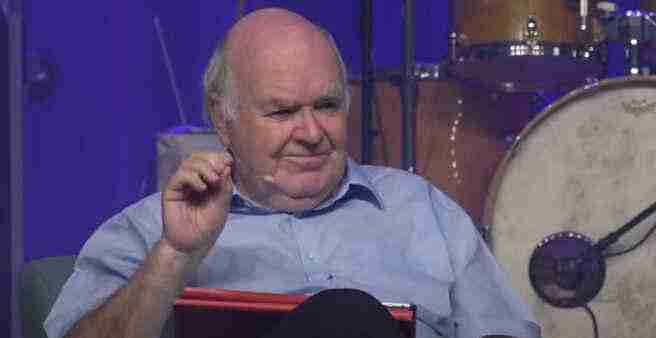
Read the full transcript of Mathematician John Lennox’s talk titled “Against the Flow: The Inspiration of Daniel in a Time of Relativism.”
Listen to the audio version here:
TRANSCRIPT:
JOHN LENNOX: Well, thank you so very much. It’s an absolute pleasure to be with you all in Norway, and it’s lovely to see so many young people. I’m going to talk to you about a person who lived in 600 or so BC, so around 25 centuries ago. Why should we be interested?
Well, there are several reasons. First of all, the main part of what I’m going to say is about Daniel as a young person, and what he experienced essentially as a teenager, let’s say between he was 15 and he was 20. He lived in a very narrow culture for the first part of his life. It was a monotheistic culture, it was a Jewish culture.
And then suddenly, virtually overnight, he was taken by force many kilometres away to a completely different culture. The language was totally different, the legal system was totally different, the economic system was completely different. And so it goes on. It was a very powerful culture.
The Relevance of Daniel’s Story
We can think of that and ask ourselves why should it be important for us as young people in the 21st century to think about it at all? I want to come to the central point right away, and it’s this: Daniel was brought up in a God-fearing environment, that’s clear. To the end of his life, he maintained devotion to God.
It’s clear that he prayed and he read his Bible, and that’s very good. But there’s something else he kept doing. You see, I’ve lived long enough to notice many people who still read their Bible, they go to church, they say their prayers. But long ago, they have lost the cutting edge of their public witness.
They’ve been silenced by secular culture. Many of them have got scared so that their Christianity is done in private, either in the box that is their house or the box that is their church. And for years, they’ve never let other people know that they’ve been a Christian, that they are one. And what amazes me about this man, Daniel and his three friends, is they did not simply maintain their devotion to God, but they maintained their witness.
Many years ago, when I was thinking about this, I thought, here am I, in a university away from my own home. I moved from Ireland to England. I can maintain my devotion, I think, by the grace of God and my Bible reading. But how do I keep on witnessing?
And that’s what I want to encourage you to do. Because there’s nothing that transforms your life as much as the experience of having the courage to witness to your friends and peers and to see their lives transformed. And the first person you see become a Christian and change their worldview, that will change you completely. And so we’re going to have a look and ask the question, Daniel, tell us, what was it kept you standing straight in public for all of your life, standing as a believer in God?
The Culture of Babylon
Now, I say that he moved to the culture of Babylon. And I want you to get some idea of this, because Babylon was a spectacular city. It was the most swinging city in the world at the time, with this beautiful processional way that went down through the center and the river Euphrates, and all these buildings, wonderfully adorned, as you can see, the Pergamon Museum with the lions and the ceramics and all this kind of thing. Babylon was advanced in music. It was advanced in art. It was advanced in engineering. It was light years ahead of Jerusalem.
So you’ve got to think about these four young people coming to Babylon forcibly, but suddenly finding themselves enrolled in the top course in King’s College Babylon, the university. And we’re going to follow them there, because once they got over the shock, there was then coming to terms with a new culture. Now, they’re very like you and me. Why? Well, we haven’t been taken from our home to another culture. No. We’ve stayed at home, and the culture has changed around us. The effect is identical. Have we got that?
Daniel was taken out of one culture into another. We have stayed still, and the culture has changed dramatically. The culture you grow up in today is vastly different from the culture that I grew up in. So there is a very big parallel.
The Language and Structure of the Book of Daniel
Now, the Babylonians were brilliant people, and they developed language to a high degree. And one of the very interesting things about the book of Daniel is that it is written in two languages. There’s Hebrew and Aramaic. It starts off in Hebrew, moves to Aramaic, and goes back to Hebrew.
And people wonder, why do we have this? It’s a very odd phenomenon. Now, the scholars argue about it, but not being a scholar, I can think about it much more simply. And what I think about it is this: Aramaic was the cultural language in Babylon of the day. Now, put together with that, the fact that the book of Daniel is not all written by Daniel. Chapter 4 starts with the words, “I, Nebuchadnezzar.” He was the emperor.
So perhaps with Daniel’s help, he wrote the fourth chapter. And it is a remarkable testimony of how God came to Nebuchadnezzar’s attention, and he came to believe, at least to a certain extent, in Daniel’s God. That was the effect of Daniel’s witness. And we look at it more carefully, but I just want you to get the broad facts before we go into the details.
So, the emperor comes to believe in God and writes about it in a language everybody could understand.
So, there is a sense in which the book of Daniel is the first evangelistic tract in a whole of history. Just imagine if you had a document today written by one of the top world leaders explaining how they came to faith in God. You’d want to distribute it.
And so the Aramaic bit is the bit that everybody could understand, and its centerpiece is the testimony of the king. Now, when we look at ancient documents, people ask lots of questions. I spend my life asking questions. How do we know it’s genuine?
The Authenticity and Prophecy in Daniel
And isn’t it a very strange book because it talks about history, it talks about personal history and incidents in Daniel’s life. It also talks about the future. And books that talk about the future, people are very suspicious of them today. And Daniel talks about the future to his day. That is the future in the second century BC, in the time of the Greeks. And he gets it so accurately right that many people say, well of course Daniel didn’t live what he claims he lived. He lived 400 years later. And there’s no such thing as predicting the future in the biblical sense.
So this faces us with a hugely important question today. As you know, I’m a mathematician. I work in the sciences. And one of the biggest objections to the whole of the faith and the biblical revelation that I meet from people is, look, you cannot possibly believe this stuff. Because the central claim of Christianity to start with, that God became human, that is supernatural. And the supernatural doesn’t happen. And this book of Daniel, he claims to predict the future. Don’t be ridiculous. This is not possible. No one can know history in advance. Well, we shall see.
Historical Evidence
It’s good to anchor things in history. And this is the way they wrote newspapers and records in the ancient world. They wrote these cylinders. And these are the Babylonian Chronicles in the British Museum. And this one mentions the capture of Jerusalem in 507 BC.
So we’ve actually historically inscribed cuneiform texts. Cuneus means a wedge. Cuneiform texts recording the events that are in Daniel. These are independent verifications of what is going on.
So we’ve got a little bit of idea of the history, a little bit idea of the culture. And I ought to say, of course, that most of us are wearing watches of some kind or other. Do you ever notice that there’s 60 seconds in a minute and 60 minutes in an hour? Do you know where that came from? Babylon. They were brilliant mathematicians. How they worked in their cuneiform script, I don’t know. But their mathematical texts are absolutely fascinating. And they’ve worked out that the number 60 was highly divisible by whole numbers. So they used it as a base. So traces of Babylon are culturally imprinted here in Norway.
The Babylonian Worldview
Now, what about their worldview? What did they think about ultimate reality? This is one of the most important questions. Because, you see, contrary to many atheists’ ideas, every one of us has a worldview. We have a set of answers to the big questions.
You have a worldview, for many of you it’s Christian. Dawkins has a worldview which is naturalism. And the Babylonians had a worldview. And they had ideas of creation. It proceeded through sexual union of the gods. But now here’s the interesting thing. They had a theogony as well as a cosmogony. Now, what does that mean?
A cosmogony is the genesis of the universe. We believing Christians have a cosmogony. It’s called Genesis 1. But they had a theogony, and that means, how did the gods originate? Because they believed that the gods originated from somewhere. They were not always there. And what they thought was this: In the beginning there was primeval matter. And all else, the world and so on, and the gods, arose from this original matter.
And you say, but this is very remote as an idea from the ancient world. But just a minute. What they did effectively was to make gods out of the forces of nature. And here I see a huge similarity to today. I know physicists, and effectively they believe that the four fundamental forces of nature, strong and weak, gravitational force, strong and weak nuclear force, and electromagnetism. Those forces determine everything. They don’t call them gods, but they might as well. Because they’ll get you in the end. Gravity will get a lot of us in the end, unfortunately.
And many thinkers like Paul Davies, the physicist, he looks at the universe. He sees great evidence of intelligence and design. And you think he’s going to become a believer in God. Oh no, he says. This is superhuman intelligence. It’s not supernatural. It has evolved in exactly the same way as our intelligence.
Now, apart from the different language, there’s hardly any difference at all between many atheists today and the ancient Babylonians. In other words, Daniel and his friends were pushed into an essentially materialistic worldview. Do you notice where the gods came from? They came from the matter of the universe. They are material gods. And so we can learn a great deal in how they dealt with them.
And of course, these days what happens is no one can avoid the question of creation. They get rid of a transcendent creator, God, and then they say matter is capable of creation. You’ve got to have something do the creation. But even more so, they claim that nothing is the creator. That the whole universe created itself out of nothing.
And at this point, I’m tempted to give you a lecture on nothing. But I’m not going to. Because I’ve written a book about nothing. It’s really called “God and Stephen Hawking.” But it investigates this idea. You know, in our culture today, the basic choice that you have to make is between God as creator and nothing as creator. It’s one of the reasons the biblical worldview makes so much sense to me. So there are parallels.
The Structure of the Book of Daniel
But now, let’s look quickly at the whole book. The trouble with talks like this is that we don’t get very far. And I know you’re intelligent young people. And one of the things that has fascinated me since boyhood is the way in which some literature is organized at the structure level. And Daniel is a brilliant example of it. So I want us to look at what the book is like as a book.
Well, first of all, some of it is chronological. But unfortunately, the revelations of chapter 7 and 8 occur before what is said in chapter 6. So the whole book is not chronological. Secondly, it’s not neatly divided into prophecy and narrative. There’s narrative in chapter 1. There’s prophecy in chapter 2. There’s narrative in chapters 3, 4 and 5. And then there’s some prophecy, etc, etc. So that’s not neat either. So the important thing is to look at its literary structure.
Now this might be a slightly new idea to you. So I’m going to give you the fastest run-through Daniel you’ve ever seen in your lives. So fasten your seatbelts and let’s go. Here is a table of contents of the book of Daniel.
First of all, the story in the university where he refused the king’s food. Do you remember that?
Secondly, in chapter 2, there’s the story of Nebuchadnezzar’s terrifying dream of a great image that came crashing down when a stone hit it.
Thirdly, Nebuchadnezzar himself built a golden image. The dream had gone to his head. So he built a golden image and he asked people, including Shadrach, Meshach and Abednego to bow to it and they refused.
And then in chapter 4, Nebuchadnezzar, and it’s about him again, got very proud and he was walking on the roof of Babylon and he said, “Isn’t this great Babylon that I built for my glory and my majesty?” And then that moment he was cut down exactly in fulfillment of a dream of a tree he’d had that was cut down. And he behaved like an animal and he ate the grass and his hair grew long and his nails grew long for years. And then God restored him.
But in the next chapter 5, there’s another king, Belshazzar, and he made a mockery of God. And he was mocking God at his banquet, Belshazzar’s feast, where he brought the vessels from the temple of God and put them on his table. And a hand came out and wrote on the wall, and that night he was killed and the empire of Babylon fell. Why that happened we shall see.
So there are five stories, one after the other, and they come to a huge climax at Belshazzar’s feast and the end of the reign of the Babylonians. Now be careful here.
The Transition of Empires
Babylon remained the capital city as we move into chapter 6, because now the governing empire is Medo-Persia, but it’s the same capital city. So we have a change of empire. It’s like, in a way, Hong Kong was ruled by the British for a while, and now it’s gone back to the Chinese. It’s the same place, but different rulers.
That’s what happened here, incidentally. Daniel is the only person in history of any kind who’s ever run two empires. How do you rise to the top of two empires and not only maintain your faith in God, but maintain your witness to God? Well, we shall see.
Overview of Daniel’s Later Chapters
So let’s now look at what happens next. This is the story of Daniel refusing to pray to the king, and he’s put in the lion’s den, and he’s released. Then in chapter 7 and 8, we have two visions. A vision of four animals, and then a vision of two animals.
In chapter 9, Daniel is studying scripture, and he realizes it’s about to be fulfilled, and he prays to God, “What’s going to happen to my home city of Jerusalem?” And God tells him there’s going to be a long history before Jerusalem is restored. And then the final three chapters are obviously one section, and they lead down into the Greek Empire and ultimately become a prediction, I believe, of the time of the end. Well, that’s a fast run through Daniel, isn’t it?
The Structure of the Book of Daniel
Now think of it. There are ten segments to the book. Do they make any sense? Yes, they do, because you start with an administrative story in Babylon. You then follow with two images, one a dream image, one a real image. Then you have two kings disciplined. One is disciplined and restored, one is disciplined and not restored. Then you start up again.
You have administration in Medo-Persia, and then you have two visions of animals, and then you have two writings explained. The first one is the Bible, and the second one is what Daniel calls the writing of truth. So you can look at them side by side. This is the kind of structure that appears in secular classical literature sometimes, but it appears in very highly and uniquely developed form in our Bible, and not only in Daniel.
And what got me going on this was my friend and mentor, Professor David Gooding, some of you in Norway know, who discovered this in Daniel many years ago and wrote a monograph about it for Tyndale Press. Now you notice that there are similarities in the structure, and the first half of the book is the end of Babylonian supremacy. The second half of the book is the time of the end. So it’s talking about the far distant future.
So it’s fascinating. We have a mixture of personal story, of history, of prophecy, and we have a projection of things into the future. Is it really credible or not? So now we’re going to have a look at some detail, in case you’re fed up with generalities.
Daniel Chapter 1: The Beginning
So we’re going to have a look at a little detail. So let me read from the beginning of Daniel 1:
“In the third year of the reign of Jehoiakim king of Judah, Nebuchadnezzar king of Babylon came to Jerusalem and besieged it. And the Lord gave Jehoiakim king of Judah into his hand with some of the vessels of the house of God. And he brought them to the land of Shinar, to the house of his God. And he placed the vessels in the treasury of his God. Then the king commanded Ashpenaz, his chief eunuch, who seems to have been the dean of students, to bring some of the people of Israel, both of the royal family and nobility, youths without blemish, of good appearance, skillful in all wisdom, endowed with knowledge, understanding, learning, competent to stand in the king’s palace, and to teach them the literature and language of the Chaldeans. The king assigned them a daily portion of the food that the king ate, and of the wine that he drank. They were to be educated for three years, just like at Oxford and Cambridge, which is probably where they got it from. They were to be educated for three years. At the end of that time, they were to stand before the king. Among these were Daniel, Hananiah, Mishael, and Azariah of the tribe of Judah. And the chief of eunuchs gave them names. Daniel he called Belteshazzar, Hananiah he called Shadrach, Mishael he called Meshach, and Azariah he called Abednego. But Daniel resolved that he would not defile himself.”
I very much hope you have.
God’s Control Over History
So let’s have a look at the first major thing in Daniel’s life. It starts seemingly innocently. Nebuchadnezzar came in a certain year, but then it says this, “and the Lord gave Jehoiakim king of Judah into his hand.” What?
Come on. If it had been the other way around, and it said the Lord gave Nebuchadnezzar, who was a very powerful monarch with all the latest weapons and a vast army, into the hand of Jehoiakim, who was a very weak king, that would have been very impressive, wouldn’t it? But listen, any contemporary historian, and I’ve talked to them, would say what happened is a typical example of Darwinism in history. You’ve got a vast great nation, you’ve got a tiny little nation standing in the way, and they just roll over them and wipe them out.
So what’s this then? The Lord gave. Why risk looking a fool by saying the Lord’s behind it? It’s very striking to me, and it’s telling us a great deal about Daniel.
Here is the first source of this, at that time, young man, his confidence. He passionately believed that there’s a God in control of history. Do you? Now listen, there are two histories here.
Think about it carefully. Daniel’s history at this point had been very painful. He lost his parents. We don’t know that he ever saw them again. He’d been pushed into, way outside his comfort zone, into a new country, new language, and all the rest of it. And he said the Lord was behind it. You know, I find in life, I don’t know about you, it’s very easy to say the Lord is behind things when they go well, isn’t it? But to start a book, the Lord was behind this devastating experience that tore me apart emotionally and moved me to another country.
The Lord was behind it, and I held on to that. That is very big stuff, folks. Now, we have two levels of history. There’s my personal history, and as you sit here tonight, we each of us have a history, and we’re in the middle of that history, so to speak.
And perhaps you’ve got huge questions about your history right now, tonight. Is God really behind what’s happening to me now? Can I trust him for tomorrow and next week? There’s your history, but then there’s global history.
Things are happening in my country. You may have heard of Brexit. I don’t understand them, and many people are fearful of what will happen, and around the world things are happening. Global moves in technology, global moves in culture, and all the rest of it, and they’re way beyond little me, and they seem out of control.
Are they? Is there really? I mean, let’s face it, let’s be open. Is it really possible to believe there’s a God ultimately in control?
This is a hugely important practical question, and Daniel puts it right at the beginning to shake us into thinking about something vitally important. Now, he’s a brilliant teacher. You would expect that the question will be answered, and it is answered. It’s answered in chapter 9, where Daniel is reading scripture, Jeremiah, and he discovers that he’s living at a period nearing the predicted end of the exile, and being a very wise person, when he reads prophecy and scripture, he prays about it.
Daniel’s Faith and God’s Fulfillment
“What does this mean, God? Are we going to go back home, or what’s going to happen?” God’s answer is very complex, but as Daniel prays, he opens his heart, and he shows us why he held on to God. Why did he?
When he was a boy in Jerusalem, clearly he had a Jewish background. Presumably, he went to synagogue with his father, and he’d heard the prophets, and again and again, the prophets came first to Israel, and then to Judah, and Daniel saying, “Look, in your culture, you are compromising with the idolatrous interpretation of the universe that the Assyrians and Babylonians hold. You’re playing with fire, and what’s going to happen, God says, is that if you don’t stop, that culture is going to engulf you.” They didn’t stop, and the culture engulfed them.
So, Daniel’s own captivity, get this, because this is just amazing, his own captivity became evidence to him that God’s Word was being fulfilled. And our culture, folks, our culture is in huge danger. Each one of you, all of us, do you know you’re only two clicks away from disaster on the internet? And some of you have been looking at stuff last night that you shouldn’t have been, and you know it in your heart.
Perhaps it’s got a hold of you. That culture, the need to be connected to things that are very questionable. I wonder sometimes, do young people read the lyrics of the songs they buy? I do, and some of them are fearfully anti-God, and yet we think they’re lovely tunes.
Let’s get it straight here. What happened at this time in history was a result of professing believers sinking into compromise with culture, at least secretly. And this generation, this world, this age, we’re the most vulnerable because it’s so easy to do everything in your own house without being seen. But you’re being tracked. You’re being tracked.
So let’s get this lesson, because it’s a huge lesson, that when the disaster happened, it actually was evidence that God was behind history. And so Daniel accepted it. I think that’s amazing for a teenager.
Now, you might say he didn’t understand it then. I’m fairly sure he didn’t understand it then, but he came to understand it. And I find that so encouraging, because sometimes things happen to us that we’d never have expected to happen. We’d never have asked for them, and yet years later we look back and say, you know, I can see that God allowed that.
And that doesn’t mean we’re fatalistic, but it means we’ve got confidence that in some sense, very complex sense that I don’t begin to understand, global history is in God’s hand, and my little history is in God’s hand. That was one of the things that really encouraged Daniel.
The Significance of the Temple Vessels
But now there’s something else. I didn’t finish the sentence, you see. And this is the very odd thing, because you see, what happened was that sentence goes on. And how it goes on is that the Lord gave Jehoiakim into his hand along with some of the vessels from the temple of God. Well, now if you’d been writing Daniel, would you have put that in? “By the way, Nebuchadnezzar took some of the pots and pans out of the temple.”
What? Now, being a mathematician and a scientist, things that look strange interest me. What on earth is Daniel wasting time talking about Nebuchadnezzar conquering the nation? Well, that was a big thing. And he doesn’t say next, “and he took me and my friends.” No, the next thing he says, he took the vessels. And not only that, he details it. He said he took them into the house of his God, and he put them into the treasury of his God.
We need to think about them. Because, you see, Babylon was a brilliant artistic city. If you go to the Pergamon Museum in Berlin, you’ll see it, and the British Museum in London. And in Daniel’s day, they reckon there were about 1137 temples. There were many museums connected with the temples. And as you know, museums in the world are usually full of stolen, I mean, they’re usually full of all kinds of interesting artifacts that have been got from different parts of the world and not always paid for properly. That’s another thing. Well, let that be.
But, you see, he put these things into a museum. Now, why do you put things in a museum? Not because you don’t respect them. The opposite. He valued them to a certain extent. So, he put them into the treasure house of his God. And he was naive, like many of these monarchs. And you can just imagine the exhibition marked “Jerusalem” and a big glass window and a little note saying, “I, Nebuchadnezzar, overcame this little country on this such and such and so and so. And here are some of the artifacts. Aren’t they beautiful? Aren’t I a clever king to overcome a nation like this?” And there were dozens of them from all kinds of nations that he conquered.
The Significance of the Temple Vessels
Now, let’s ask what he was doing. What does this represent? And here’s what it represents. Those vessels made of gold and silver from the temple of God represented absolute value. They were symbols of the glory of God. And to Daniel, they represented absolute value. Nebuchadnezzar made them of relative value. Do you recognize that in your culture?
You see, Daniel’s explaining to us the big issues. And he’s saying, what I noticed in my life was that powerful people—and not so powerful people—take things of absolute value and they make them of relative value. You like Jesus? Well, that’s very nice. I like crystals myself. I find them more helpful. You see, that’s making Jesus of relative value. And our culture is full of it.
The Challenge of Relativism
Because the influence of relativism from the ancient world has been to do exactly this, so people come to the foolish conclusion that there is no absolute truth, that there is no absolute value, that there is no absolute morality. That’s very logically silly. Do you like logic? You think of the statement, “There is no absolute truth.” The person that says it expects you to take it as an absolute truth. So, if there’s no absolute truth, there’s one absolute truth, absolute truth, and that is a contradiction in terms. Everybody believes that there’s absolute truth, folks, only usually not in areas that they think are unimportant. They believe in absolute truth about how much they have in the bank, but not about their morality.
Now, what is this raising? It’s raising the hugely important contemporary question of the relationship between the absolute and the relative. Is that vital to you? Of course it is. Because you have to decide where your values come from. I can imagine Daniel and his friends going down sometimes to the museum in Babylon quietly, and going to the window where these lovely vessels were, and Daniel saying, “Guys, that’s what we stand for.”
There’s a Christian version of it. Maybe you’ve prayed it. “Father, hallowed be your name. Your name be separate. Be my supreme value.” The basic Christian confession is what? Jesus Christ is Lord. He’s my Lord. He’s my supreme value. Your values are going to be tested tomorrow.
How do you value truth? Has everything you said about other people, or I’ve said about other people today, been accurate? 10% accurate? 60% accurate? Or do I not value truth? And so it goes on. This is a huge challenge, but it’s showing the secret of standing. If you’ve got no sense of God covering your history, you’ll wobble and fall. If you’ve got no sense of God being your supreme value, the same thing is going to happen. You’re going to be wiped away in a society that is desperate to take what’s most precious from you and destroy your value system.
The Nature of Values
Now, this is the start of an analysis of the nature of values. Because, you see, in that first chapter, we’ve read what happens. In the second, Nebuchadnezzar dreams of an image full of metals, gold, silver, bronze, iron. It’s all about the values, but this time, the value of a political system. That’s an interesting question. And then, in chapter 3, he makes a golden image, and the three friends are ordered to bow down to the image.
Now, watch what’s happening. In chapter 1, Nebuchadnezzar relativizes the absolute. In chapter 3, he absolutizes the relative. That’s what happens. You see, you can’t live without absolutes. And if you take the true absolute of God and relativize it, in the end, you’ll take something else and make an absolute out of it. Either it’ll be money, sex, or power. And here, it’s a stake.
And so, Nebuchadnezzar builds this huge, golden, very valuable statue and says to men, “You bow down to that.” How would you have faced that? How would I have faced that? We read this as a lovely little story for kids. The fiery furnace, and God delivered them in a fiery furnace, and they never suffered. Listen, that’s a fairy story. They suffered terribly. Not in the furnace, but before they got to it.
The Challenge of Standing Firm
I’ve often thought of one of these men, now older, owning a palace with a job for life, with huge reserves of money in the bank. Suddenly, Nebuchadnezzar announces to them that the following week, he will expect them all to be down in the square at the time. And they will bow. When the state symphony orchestra starts to play, they will bow to his image.
Imagine going home to your wife and saying, “I’ve got something to say to you.”
“What is it, dear? You look a bit sad.”
“Well, I am. Nebuchadnezzar has ordered us next week to come. And bow down to a statue that he has erected, and it’s just a statue of his God.”
“Well, what’s the big deal?”
“I’m not going to do it.”
“You what? But what’s going to happen?”
“He’s erected the furnace. Anybody that doesn’t do it will be burned.”
“But my husband, what about me? What about the children? I mean, haven’t you taught us that there’s nothing in these gods? And it’s a huge sea of people. Huge sea of people. Nobody will notice if you just make a little…”
“I’m not going to do it there.”
Wow. Do you know there are people in our world facing that choice right now? Can you imagine that? Before I finish this talk, there’ll be an eternity with the Lord. Because they refuse to bow.
This is values, folk. Daniel set his heart at the beginning. God was holy to him. And these three men, I’m amazed at them. They didn’t know a thousandth thousandth part of what you know from the Bible. Shadrach, Meshach, and Abednego. And they faced Nebuchadnezzar. And he said, “King, listen, our God is able to deliver us, but he might not. And we want you to know that even if he doesn’t, we won’t bow.” That’s magnificent, folks. Do you feel you’ve got that far? Wow.
A Message for Our World
We need to think about these things. This is a message for our world. This is a message for our world. Where are your values? When you feel yourself under pressure from the internet or peer pressure to conform and do things that you don’t really know what to do, we’ve got to look upwards and see our value system. I find it a huge challenge. I’m not speaking to you as some expert. What I’m doing is trying to share these big things in the hope that in your teens and in your 20s, you make up — make some really big decisions.
And I’m praying that this weekend, some of you are going to go out of here radically different in the terms of your commitment to God. Finally, why are the vessels important? Well, Belshazzar, they reappeared on his table. And those vessels destroyed his empire. That’s why they’re important. He valued God at zero. And God wrote, “You have been weighed in the balances and found wanting.” I value you at zero.
It’s very dramatic, isn’t it? And taken all together, there are five lessons on values. We look at some of them again. Now I have a confession to make. The clock on this machine has stopped. And I think I’ve spoken for the right length of time. So if you want to hear any more, you’d better come tomorrow. Thank you very much.