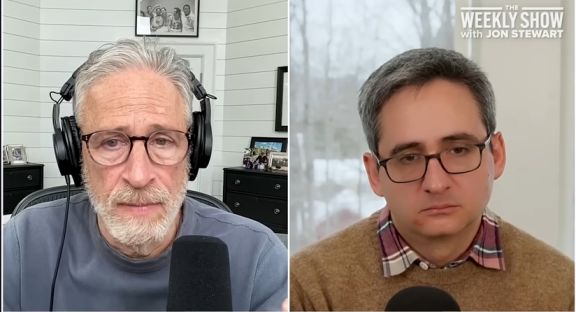
Editor’s Notes: In this episode of The Weekly Show, Jon Stewart sits down with economist Oren Cass to discuss the growing concerns surrounding the “financialization” of the American economy. They explore how the shift toward prioritizing Wall Street profits over industrial production has impacted the middle class and national stability. Cass, the founder of American Compass, provides a rare right-of-center critique of modern capitalism, arguing for a return to a system that rewards real-world value and domestic investment. It is an insightful conversation that bridges political divides to tackle the fundamental question of whether our current economic path is sustainable. (February 12, 2026)
TRANSCRIPT:
Introduction
JON STEWART: Hey everybody. Welcome to the weekly show podcast. My name is Jon Stewart. I am the host of this and today, oh special thing tonight, the halftime of the podcast. We’re going to have someone do a halftime show entirely in Latvian. They’re just going to sing.
I’m still recovering from just the anger and outrage that the right expressed over a fun musical performance that they’ve gotten. So weak, so thin, so feeble. They can’t go 15 minutes without hearing the country song. It just, it hurts them, it hurts the country, it hurts the foundation that we were built upon to have something like that.
My favorite was somebody mentioned, you know, Trump is complaining, the whole thing is in Spanish. And you’re like, you know that the name of the place you live, you know the language that’s derived from, right? Mar a Lago. Yeah, that ain’t that, that ain’t from London, brother.
But moving on to more important things, you know, I read an article just recently that I’ve been waiting for so long to read as coming from someone from the right, which was about how our economy has over, has been over financialized, you know, that the financial services has become too large a part and it’s hurting ultimately the bottom line. And I, you know, and I’m sure that there are 50 years of left wing economists out there who saw the article and just rolled their eyes and thought, yeah, finally.
But I was excited to see it and to see that it was written by our old pal friend of the show. It’s a title not bestowed often, friend of the show. And he is joining us today to discuss this article and to discuss these larger issues in general that an over financialization of the economy may portend for the future stability of our economy.
So I’m delighted to welcome back Oren Cass, Ladies and gentlemen. Please allow me to reintroduce himself. His name is Oren Cass. Oren Cass. Oren, it’s so nice to see you again. You are the chief economist at American Compass. And that is a self imposed title.
OREN CASS: Or that imposed is good. Yes, self imposed.
JON STEWART: The founder and chief Economist at American Compass Think tank, contributing opinion writer for the Financial Times and the New York Times, which is why I wanted to talk to you. You recently wrote an op ed in the New York Times and it is an op ed I have been waiting for, young man, for, for many, many years to come from someone who is more or is classified as more on the right.
So to get into it, I want you to briefly explain. It was about the idea that the financialization of our economy is a net negative. But I want you to give just sort of a brief description of, of this op ed and sort of what, what motivated you to write it.
Defining Financialization
OREN CASS: Sure. Well, thank you for having me on to talk about it. These are always a lot of fun, always. Financialization, I guess we probably have to define it as a starting point. It is essentially, and there are all sorts of technical definitions, but essentially it refers to the increasing role of financial markets in the economy where they become ends unto themselves and people start transacting and rejiggering and configuring businesses and taking cash out, not with any effort to create anything valuable in the real world, simply to generate more cash out of the activity.
JON STEWART: Give some examples of what financialization specifically what that might be.
OREN CASS: Sure. So you see it in a lot of the kind of Wall Street firms, if you think about hedge funds, private equity funds, a lot of the time what they’re doing is they’re collecting a whole lot of money and interesting question where that money comes from. And then they’re going out and looking for things that they think they can buy at one price and sell at a higher price.
So if you’re a hedge fund, right, in the case of what’s called a high frequency trading hedge fund, you don’t even care what you’re buying and selling. You’re literally building bigger fiber optic cables to try to race your trades to the floor faster so that you can get out in front of whoever else is bidding on them. You make a teeny, teeny little bit on millions of transactions and ta da, you’ve generated a profit. You haven’t actually done anything useful. You’ve, you’ve just extracted value from somewhere else.
If you know you’re a private equity firm, in a lot of cases, what, what you’re trying to do is say, let’s go out and find a series of smaller businesses. Maybe they’re privately run, maybe the people running them aren’t even just maximizing profit. Maybe they’re veterinarian clinics, let’s say, or nursing homes.
JON STEWART: Right.
OREN CASS: And can you buy up a bunch of them, combine them together, maybe squeeze out, you know, squeeze the customers a little harder, squeeze the workers a little harder, get more cash out of it. Now you have a profit, maybe. And now can you sell it to someone else?
Now you’ve also added more risk, which means if something goes wrong, turns out firms bought by private equity funds are five to ten times more likely to go bankrupt.
JON STEWART: Right?
OREN CASS: Well, if you’re a private equity fund, okay, well, if I buy a hundred, I’m okay with a bunch of them going bankrupt. I can generate more profit, on balance, from taking more risk, even though, of course, all the workers at the firms that went bankrupt only had the one job.
And so you see in financial markets a lot of this kind of activity. I think it’s important to say financial markets are important. Right. Like, I think capitalism is great generally.
JON STEWART: To economists, I would say that’s.
OREN CASS: There you go. Right, right. Like the idea that you want to have bankers and others who are collecting people’s savings, collecting capital, finding productive ways to deploy it, that’s incredibly important. They deserve a return on doing that. I have no problem with someone making a good living, becoming rich, doing that.
JON STEWART: Right.
The Problem with Modern Finance
OREN CASS: The problem is that the share of the activity on Wall Street and financial markets that actually represents productive investment, actually causing anybody to build anything new and useful in the world keeps going down. And so even as financial markets, the financial sector, as a share of our economy keeps getting bigger, bigger share of GDP, the biggest source of corporate profits, the number one place that people from top business schools go to, that keeps getting bigger.
And yet in parallel, the actual amount of real investment happening in our economy keeps going down.
JON STEWART: Right.
OREN CASS: And so that’s the disconnect that first of all, I think is just. That is a problem in and of itself. But it also then obviously has, you know, incredible consequences for the real economy, for the, for the country as we experience it.
JON STEWART: This is, I think, generally a critique that has been leveled more on the, on the left. Would you say that that is. And you, I think, are more associated with the Right. And I guess my question is, do you still have an office where you are or have they, once they read this op ed, did they put you in the mop room? Are you, do you have a window? I guess.
OREN CASS: Well, as you can see, I have, I have lovely windows behind me.
JON STEWART: I figured they weren’t that’s not your real office?
OREN CASS: No, no, this is my office.
JON STEWART: I’m.
OREN CASS: I’m out in the woods. We have a lot of snow on the ground. But no, the nice thing about being chief economist is I guess you can say whatever you want.
Why Did This Happen?
JON STEWART: But dictates its own terms. Is financialization, is it a perversion of what sort of the markets is the critique that first of all, why do you think it happened? Why do you think that these financializations grew faster than what you would consider to be the economy of real things, Jobs and industrial policy and those kinds of things? How did this happen?
OREN CASS: Yeah, it’s a great question. And the way I understand it is not quite that it’s a perversion. And I think it’s also important to say at the end of the day, the folks doing a lot of this stuff on Wall Street, it’s also in a lot of companies that are even operating companies, increasingly, they try to suck money out for shareholders rather than build up companies. It’s not like they’re doing anything illegal. They’re not even lying about it. It’s not a scam. They are operating in the system as we have constructed it.
And so the core of the problem in my mind is that you know the entire premise of capitalism, you go all the way back to Adam Smith and all the way back to the invisible hand.
JON STEWART: The core of your critique is the entire system of capitalism.
OREN CASS: No, exactly the opposite. That I think that the entire system of capital then. Well, this is. So this is a good point, right? A lot of people say, well, this is the problem. Capitalism is just broken and can’t work. I feel exactly the opposite.
I think that the basic premise of capitalism, the idea that you want to have a system where, you know, people are always going to pursue their self interest, right? So the question is, can you have a system in which people pursuing their self interest also serves the public interest so that the things that generate the most profit for you also turn out to be good for other people?
And if you go all the way back to Adam Smith and the invisible hand, this is actually exactly what he was describing. The invisible hand has become this. It’s a bad metaphor because it sounds like this magical force, it doesn’t matter what you do, somehow magically, it will work out great for everybody as long.
JON STEWART: As you don’t intervene. I mean, it wasn’t the idea of that, that governments should not intervene in what these markets will create on their own through supply and demand.
The Invisible Hand Revisited
OREN CASS: Well, that was certainly not. That was certainly not Smith’s view that is what it has become for a lot of modern economists. But if you go back, the paragraph where Smith uses the term invisible hand, he only uses it once, is it actually starts by noting that he’s expecting that people will prefer investing domestically to investing in foreign countries and that people will prefer to invest in the ways that produce the most things of greatest value.
And what he’s saying is that if that’s true, if somebody pursuing profit, the way they’re going to do it is by investing a lot domestically in creating things of value, then it’s like there’s an invisible hand that somehow ensures that what they are doing in their own self interest also serves the public interest.
So he’s explaining how this can work, right? This is like at the very outset of markets, people are like, whoa, what’s going on here? And he’s saying, no, no, no, see, look, if, if the things that people are doing to earn a lot of money also benefits outcomes, then this could be a great system, it’ll be quite stable.
JON STEWART: And. But the way it turned out is the invisible hand sometimes slaps you across the face and then that’s. Well, that’s the difficulty.
OREN CASS: That’s right. I think. And so this goes to my point about like, what are people doing? What’s gone wrong is it seems to me that people in their self interest are then always going to look at the system and say like, okay, well is there an even easier way to make more money? Maybe that doesn’t create so much good stuff for other people.
And you see over and over again throughout history that happening, right? So if you go back to the Industrial Revolution, you had a period where the Industrial revolution was working out horribly for most workers. I mean, people were literally getting shorter, dying earlier. And people would say like, gosh, we probably need like some labor laws.
JON STEWART: If you’re eight years old, you shouldn’t be in a factor, right?
The Evolution of Economic Policy
OREN CASS: Maybe that also, maybe this will work better if one of the constraints we impose is if you want to make a lot of money building big factories, you also have to use adult workers and treat them reasonably. That will work. And then in fact, people started doing that and you had what I would call the much more beneficial Industrial Revolution that led to huge productivity gains, ultimately the creation of the middle class.
You had the same thing at the end of the 19th century with the giant trusts, Rockefeller and so forth. And as you had railroads and utilities, people were saying, I could make a lot of money if I just monopolize this thing. Well, that’s fair point. And that’s when Teddy Roosevelt shows up and says, well, okay, Teddy Roosevelt, Republican. But this system does not work. We actually are going to have to do trust busting.
And so I think you sort of go through these cycles where then what happened in the second half of the 20th century? You have the financialization and I think globalization are sort of parallel. A lot of people said, wow, and obviously we pursued free trade, we deregulated financial markets. And people said, well, this is great. The easiest way to make a lot of money is to do this set of things that does not create good jobs, does not necessarily produce growth. So that’s what people started doing.
JON STEWART: Look, the algorithm, the algorithm is killing us. But the antidote, the antidote is information. And that’s where Ground News comes in. Ground News, it’s this website and app designed to give readers a better way, an easier way to navigate the news. It pulls together every article about the same news story from all outlets all over the world and puts them in one place and not incentivized for the worst, most hostile, most partisan take. It tells you where it’s coming from.
The bias comparison feature highlights specific differences in reporting from across the political spectrum. It’s an amazing learning tool. You can see starkly in black and white how these different organizations and algorithms are manipulating the information that we get. Ground News helps you understand the full picture rather than just the slice of it these bad actors want you to see. You can use it to stay informed. You can use it to stay engaged. You can use it to stay educated without becoming an angry 3am s*poster.
If you want to see the full picture, go to Ground News. They can help you through the noise. Get to the heart of the news. Go to groundnews.com/stewart, subscribe for 40% off the unlimited access Vantage subscription discount. Available only for a limited time. This brings the price down to like $5 a month. That’s groundnews.com/stewart or scan the QR code on the screen.
Challenging Market Fundamentalism
JON STEWART: What you are describing feels very akin to my view. As you speak, it feels like a salve to my soul. I hear what you’re saying. You say, you know, financial markets, profit is a wonderful driver of these things. But to utilize the energy of that profit motive, governments must also find ways to create a more sustainable value for the people through their labor and other things.
That’s my understanding of sort of what you would think is leftist economics isn’t kind of Milton Friedman, you know, the patron saint of this sort of. No, that’s not what economics and capitalism is about. It’s about pure profit. And that pure profit and the pursuit of it is actually what will create the most value. Is this a rebuttal to that, to Friedman, who, I mean, if you could say in the 70s when he comes out, that’s sort of leads us into the deregulation of the financial markets and leads us into globalization and all these political policies that might lead to incredibly high capital, then wins and labor kind of loses.
OREN CASS: Yeah, it’s definitely a rebuttal of them. I think the important thing to say in the political context though is that until they came along, this wasn’t a left-right fight in the way that we think about it now. So you know, Friedman and the other guy gets associated with this a lot, Friedrich Hayek.
JON STEWART: Yes. And you’re going to get some nasty letters from the Hayeks, man. Those guys. Oh yes, they are. They are active online for sure.
OREN CASS: Well, they. What you find is that Friedman and Hayek were not conservatives and they would not describe themselves as conservatives. In fact, Hayek, maybe his most famous essay is called “Why I Am Not a Conservative.” Literally, that’s the title of the essay. And it goes to exactly what you were just describing, which is that Hayek basically says the wonder of the self-regulating market is what produces prosperity. And you just basically have to have faith that it will work and get out of the way. And all these conservatives out there don’t have enough faith in that. And that’s a real problem.
JON STEWART: Right.
The Reagan Coalition
OREN CASS: And so up until that period, as you said, kind of the 70s and the 80s, obviously conservatives and progressives were fighting about all sorts of things. But it wasn’t the conservative view that, well, if we just get out of the way, markets will magically fix everything. I mean, just thinking about, that doesn’t actually sound very conservative if you stop and think about it for a moment.
And what happened in our politics is Ronald Reagan came along and Reagan built this coalition. Reagan combined what you would call the free market libertarians, the Hayeks and Friedmans, literally guys walking around with Adam Smith neckties.
JON STEWART: Do they still sell those?
OREN CASS: I don’t know if they do. I wanted to reference it saying. So I tried to do a little research. I think we’ve moved on maybe from that. But combine that with the more traditional mainstream conservatism and then also the Cold War hawks. Right. You had a whole bunch of people all of a sudden who were, let’s go start lots of wars.
JON STEWART: It’s also, they viewed it as, I think, a battle between communism, which they viewed as sort of a very blanket suffocating state that was dictating terms.
OREN CASS: That’s exactly right. That’s what these groups had in common was they all believed that the top priority was defeating communism. Whether that was in market economic terms, whether that was in social and religious.
JON STEWART: Terms, putting “In God We Trust” on a coin and then moving on.
OREN CASS: And grand strategy from all perspectives. And I give them a lot of credit, it worked, right? They did win the Cold War and that was very important. But that coalition then sort of lived on even after its animating purpose was gone. And so it’s really in a lot of ways after the Cold War is won that things get out of control, that you start just saying we’re just going to keep cutting taxes no matter what.
I mean, Reagan raised taxes five times when his initial reform didn’t generate the revenue he wanted. Reagan was a protectionist. Reagan slapped all sorts of tariffs and stuff on the Japanese. After the Cold War is won, this coalition sort of just keeps going. So you get the economic view that no, no, no, it really is just the market is the end unto itself.
I use the term market fundamentalism, which people think, yeah, sure, it’s a little derogatory, it doesn’t sound great, but it’s also a descriptive term. I mean, what is a fundamentalism? It is a sort of overly simplistic attempt to impose a very rigid set of beliefs to often in a way that completely misinterprets the original texts.
JON STEWART: Are you sure you’re not a lefty? You’re preaching, baby. I keep trying to keep myself from going, Amen, Oren. Come on, brother, keep it coming.
OREN CASS: Well, you’re going to get me in trouble with this, Jon, so you got to. Maybe we’ll do a quick five minute interview where I give you some of my more conservative views.
JON STEWART: We’ll go back the other way.
The Economics Priesthood
OREN CASS: But fundamentalists in the sense of sort of not only just reinterpreting texts, very rigid view, but that is specifically designed to give all of the authority to this narrow set of people who claim a special wisdom over what must be done. And so this is what certainly right of center economics, and to some extent, I would say broadly economics became. It was this sort of almost priesthood where if you didn’t understand that financial deregulation and free trade were going to be great for the typical worker, that was just because you were not sophisticated enough.
JON STEWART: Or did they even care?
OREN CASS: Oh, I think they did for the most part.
JON STEWART: Okay.
OREN CASS: My experience, having been in the political world for a while is, yeah, there are, you know, outright bad actors, but by and large, if you’re an economist, if you’re, you know, even someone running for office, in most cases, if you want to work in government, you may have convinced yourself of this in some way in various ways, but at the end of the day, you are trying to do good things.
And so a lot of folks really deeply believed, and let’s remember on the, I mean, globalization, financialization, this was as much Clinton as it was Bush. It was an entirely sort of bipartisan consensus. And so these folks really did. They really did believe it.
The Pendulum Swing
JON STEWART: Let me ask you when. Because my understanding of sort of the shift of this was we shifted from kind of, if I’m thinking about it in kind of epochs, you know, you have the New Deal epoch where it’s kind of the government decides. We also have to create a kind of framework of a safety net around to help maybe in some ways ameliorate the collateral damage that the system may create for people at the lower levels.
And then that begins to shift in the 70s with Friedman and those guys into this, you know, the famous Laffer Curve, 1980s supply side trickle down economics. Is that what made that switch into trickle down? And what were they using to kind of justify that? And are the things that you’re saying, is that consistent with sort of that understanding of those eras?
OREN CASS: Yeah, I think that’s a good description of the eras. I would think about it more as a pendulum swinging though. I think it’s helpful to in general think about what happens in our politics. Right. The New Deal emerges in response to the Great Depression and what had been a very minimalist government that clearly was not serving people’s needs at that point.
And so I think with FDR, you get this real swing of the pendulum all the way from we’re much too far to one side. You come to, okay, we got to fix this and then swing through to an overcorrection where by the kind of Great Society, you know, LBJ, Great Society programs of the 60s.
JON STEWART: Is that where conservatives would look at. Okay, I mean, they were against maybe the New Deal as well, but is it the Great Society that is the cleaving point for them?
OREN CASS: You know, I think certainly if you talk about sort of what parts of the welfare state as it’s been constructed, that we would say, yeah, that was really good versus that’s not so good. There’s definitely a very different view of New Deal type, you know, social insurance. Right. Basic Social Security, fair labor standards. You don’t see a lot of Republicans out there saying, let’s get back to child labor or whatever.
JON STEWART: There’s a couple of them.
OREN CASS: There’s a couple. You can find them. But, you know, by and large, I think people on the right would say those were good. Great Society in the 60s. I think you’d see more of a mix, I think, on things like Medicare. Obviously, that’s widely supported.
JON STEWART: Right. But wasn’t. I mean, Reagan famously came out. I don’t know if you’ve ever heard that great recording of Reagan talking about Medicare as the socialist creep coming. You know, he cut advertisements against Medicare.
OREN CASS: No, that’s right. So there’s. That is certainly where. Well, of course, if you go back to the 30s, you would have Republicans, you know, saying the same thing about Social Security. And so you get. There’s both sort of more of an acceptance of good parts over time, more of, I think, an increasingly sharp critique of pieces that didn’t work.
JON STEWART: Right.
OREN CASS: But so you get in the Great Society, I would say you swing through the, oh, these were good things that we really should have in this country into, whoa, we’re starting to build up some stuff that is creating problems. I think you see the same thing, for instance, with organized labor, where I think the idea of worker power, workers having unions, et cetera, that’s a fantastic thing. By the way, Adam Smith did too.
But you swing from they don’t have any power or representation at all to, okay, good, they have a seat at the table. They have equal standing to. By the 1970s, in a lot of cases, they are actively leveraging that power into a lot of quite counterproductive things, I would argue, in the economy.
JON STEWART: And becoming somewhat corrupt in and of their own self and that using the money.
The Supply Side Pendulum
OREN CASS: Yeah, those. Absolutely right. And so I think if you think about what was called the sort of stagflation of the 1970s, we were in a very bad position economically. And what the supply siders came in and said, which was fundamentally correct, like I would describe myself as a supply sider, is you can’t just fix the economy. You can’t get the growth you want just through what had become the main government model, which is just give people more money to spend.
At some point the question is, what are the incentives for businesses to invest and build stuff or not. Right. It goes back to that piece of capitalism. I think we entirely agree on which is you do want the profit motive driving positive behavior.
JON STEWART: Right.
OREN CASS: And so the basic idea of supply side economics is to say, look, one of the best ways to spur growth would actually be to improve the incentives of people to invest and build and grow businesses that can be good for workers too. I think that’s correct. But I think that then you pull this pendulum back in the other direction. You do some things that are more business friendly, you create a better environment for investment, that’s great. And then that swings straight all the way through to anything that’s good for corporations and leads to more profits or reduces taxes, is always going to be better.
JON STEWART: Right.
OREN CASS: And same with, okay, we did have overregulation, a lot of cases. Well, therefore any. Right. And we did need various types of deregulation. Let’s swing that all the way through to just the less regulation, the better the market will automatically work. And so I think we sort of got all the way back up to that side of the pendulum and now we are, we need to swing back down again.
Tools for Rebalancing
JON STEWART: So then it becomes what are the tools in the arsenal that can help us swing the pendulums back? And does the policy discussion become, all right, are the tools, you know, tax incentives, disclosure rules or as you were saying, like limits on buybacks or so, so what are the tools now that we look at, you know, or the metrics that we look at that tell us we’ve gone too far?
Is it, you know, I can point to wage growth, you don’t get a tremendous amount of wage growth or income inequality tells me the system is out of balance. What are the tools that we can use then that bring it more back into that balance?
OREN CASS: Yeah, so that’s exactly where the rubber meets the road on all this. And I think it’s interestingly where you start to see some of the traditional political divisions reemerge. Because, you know, my view is it’s a real problem if you have left and right disagreeing on the diagnosis.
JON STEWART: Do they disagree still or is it, it feels like there’s still disagreement.
OREN CASS: Less much, much less. So there is some. So I think if you look back to, you know, the 2000s, let’s say the Republican party had really dug into a position of saying essentially we have achieved equal opportunity, everyone can succeed and build a great business. And actually if we adjust the numbers in this way, everybody’s wages are going up.
And therefore that’s, you would be surprised how many people’s full time job is to adjust the numbers to show that wages are going up. Yes, I’m sure, but, and sort of therefore, tada. We don’t need to take action on any of these fronts because in fact everything is going great.
And you would also see that on things like, I think like climate change is another quintessential example where well, we’re not sure if we acknowledge that climate change is an issue. Well then are we going to just have to embrace the Green New Deal? Let’s just say that it’s not a problem and I think we have plenty of issues of that type on both sides. I would say we could talk about ways where the left doesn’t want to say that saying is a problem because if they do, well then what right of center answer do we have to accept?
JON STEWART: Sure. Well you’re seeing that now with the argument about housing supply where you’d say, you know, that they want to say that this is a problem, but we don’t want to also say that overregulation might be a problem, especially you know, environmental regulations that may have to fix it. So you have, I see those tensions in any of the places.
OREN CASS: And so, you know, my view is just that that is a very unhealthy partisanship. Right. Like there’s nothing partisan about trying to figure out what is actually happening in the world. We should be able to reach a common description of that. Now we might apply different values to it, say which parts are good versus bad. So conservatives might say we’re comfortable with a relatively higher level of inequality than progressives might, but we shouldn’t be disagreeing.
JON STEWART: On what that level is or that it exists.
OREN CASS: Exactly. That’s right. Or what direction the trend is in and so forth. And so, you know, something like financialization I think is a great example of this where there are a lot of very difficult discussions to have about okay, what would you do to address this. But we should be able to agree that the scale that Wall Street has grown to and a lot of what it’s doing just is not creating value in the world.
The Problem of Financialization
JON STEWART: That’s right. And the percentage, you know, you talk about it in the article, you know, the idea of financialization is sort of what percentage it takes up of economic activity.
OREN CASS: Yeah.
JON STEWART: And you were saying years ago it might have been at 10%, but it has doubled. Meaning that these sort of financial instruments and is containing it so difficult because you know, in truth, I would imagine financialization is more agile than industrial policy. Certainly investing in manufacturing or warehouses or creating value for workers takes a much more stable uncertainty is going to throw it.
Financialization is, hey, man, I just came up with this idea, what if we bundle mortgages? You know, it seems much more agile and harder to catch up to.
OREN CASS: I think that’s exactly right. And so that’s a great sort of way into this question of what do we do? Because I think one place where I at least perceive still very large differences between how someone like I would think about addressing this versus folks on the left is I think the more left of center view tends to be okay, we essentially need to find the things that we don’t like and prescribe them and sort of construct a regulatory apparatus that is going to sort of keep these things inbounds, figure out which ones we do like versus which ones we don’t like.
JON STEWART: And like in the case of, you know, 2008, saying, well, you know, maybe banks shouldn’t leverage at 35 to 1 40, you know, creating, you know, stress tests.
OREN CASS: Yeah.
JON STEWART: That don’t allow it to become a hydrogen bomb for the economy.
OREN CASS: But then if you look at what Dodd Frank actually is, right, it’s thousands of pages generating thousands of pages of regulations that in a lot of cases end up doing things like saying, well, if banks can’t lend, make certain risky loans, banks will instead lend to this new set of institutions that we will call private credit and they will make the risky loans. And to your point, that will typically be more agile than the regulators will be.
JON STEWART: And a lot of that stuff though is added in by, to be fair, by lobbyists for these financial institutions. You know, the difficulty again is you also have a Congress that is, has much more access to the lobbyists for these very rich financial firms than to the people that they’re sort of, you know, trying to help avoid these catastrophes.
OREN CASS: Yes, but it is important to take that as a baseline reality when you’re deciding what we should do. Right. In other words, I do get very frustrated with my friends on the left when they’re like, no, but this would have worked better if not for the lobbyists. I’m like, well, did you have a plan for there not being the lobbyists?
JON STEWART: Because if not that, well, poor people need better lobbyists. I’ve always said that.
OREN CASS: I think the question of how you represent workers more effectively is a super important one.
JON STEWART: Well, I think the idea is for the left that your representatives are your lobbyist. In other words, you look to them as a bulwark against that financial group rather than this kind of entity to be corrupted or swayed by it. That you kind of view it as, that’s the battle.
OREN CASS: And that sounds fantastic. And then I would again say, and how’s that working out for you? Right.
JON STEWART: Not fair. That is not fair.
OREN CASS: We conservatives are pragmatists if nothing else.
Pragmatic Solutions
JON STEWART: So how do you design it? How do you catch up to. Because they’re kicking our ass. I mean that’s the thing that makes it so difficult is they’re so much more agile even in the way of, let’s use your sort of example of part of financialization is in some ways like setting up microwave towers right next to where the trading is going so that you’re making all your money on volatility or payment for order flow or all these other kinds of invented or gamifying it so that it resembles more, you know, FanDuel than it might anything resembling the real economy.
And the SEC is completely overmatched. What are the things you can design to get ahead of it in pragmatic terms?
OREN CASS: Right. So what this leads me to is just to think is that what we really need is quite sort of blunt, broad based constraints like Volcker rule, kinds.
JON STEWART: Of that one page. If you’re a bank, you can’t use savings to finance your whatever adventurism and financialization.
OREN CASS: Right. So very clear lines. What kinds of institutions can and can’t do very clear transparency and disclosure requirements. So if you are planning to collect 7% of people’s investments in fees to yourself, you actually have to publish that very clearly so that a pension fund knows that’s what you’re doing.
Things like just stock buybacks are not allowed, which was the case until 1983. It’s very funny. You say we should get rid of stock buybacks. People like, oh, like that’s Marxist. I’m like, well, it was also US law for more than 200 years. So, you know, we’re right.
JON STEWART: But they say anything you do is, you know, you really are. You’re wading into a battle that I think the left has been fighting for a really long time, which is there’s this strange kind of dichotomy that if the government intervenes with the market in quotes on behalf of labor, that’s Marxist. But if they intervene on behalf of financialization, easing their road, that’s capitalism.
I think that’s the frustration you talk about. I understand the frustration that you may have with the left, but that’s the frustration, I think, that the left has, that there’s this, as you said earlier, kind of this dogma. The government doesn’t pick winners and lose. And I think if you’re on the left, you go, no, it does all the time, but it just picks the winners that have the most access to it and the most money. And that’s our frustration.
The Sustainability Crisis
OREN CASS: I think that’s right. I think it is a frustration on a large segment and a growing segment of the right as well. I mean, you’ve seen obviously a very sharp fallout between business roundtable and Chamber of Commerce and so forth and the right of center in the Republican Party, because I think there’s an increasing recognition and it goes back to that point about just like, what are the basic facts that this really isn’t working.
And we really do need to understand why it’s not working and do something about it. And the thing that I always emphasize to folks on the right is, you know, what we have right now is not sustainable, right? Like the COVID your ears and tell people things are great.
JON STEWART: What parts of it in your mind are least sustainable? Like, is it inequality? What are the things specifically that you’re looking at that you go, man, we’re creating something that’s not going to hold?
OREN CASS: So I think there’s what I would call a micro element at the personal level and a sort of macro element at the national level. And I’ll just hit the macro one first because it’s a little quicker. The reality is that the U.S. economy, it performs great on the measures like stock market valuation and top line GDP figures and so forth.
Our actual capacity to make things, to create jobs, to innovate, to compete with China is in sharp decline. And a system that does not reward that above all else is not going to produce the kinds of outcomes that we want. And so whether it is on these questions of financialization, if it’s on these questions of trade and industry, I think there’s an interesting sort of immigration dimension to it and the extent to which we say, well, we’re just going to have to bring in, we can’t find the workers we want here, so our solution is to just bring in somebody else.
The formula we have settled on is not one that is actually conducive to the liberty and prosperity of the United States. And I think we are on what many people rightly feel is a downward slide that we need to reverse.
The Old Economy vs. The New Economy
JON STEWART: Now, wouldn’t people on the right side know reversing it is an artificial contrivance that what we’ve learned is financialization, financial services, legal services, tech services, that’s we’re actually, manufacturing is the old economy, we’re actually creating the new economy. And why would you want to go back to that? I disagree with that view. But isn’t that what they would say? They’re getting out of the way and allowing these future markets to dictate our economy.
OREN CASS: There is a small and shrinking and declining in influence group that will go down with the ship saying that I would say it is at this point pretty far out of the mainstream, certainly within the Republican Party and Republican politics and in a lot of the sort of, you know, newer publications, what, you know, the kinds of programs younger people are participating in, there are very few people at this point who would say no that things, things have been going well, this is the right track.
JON STEWART: Even as they point to, you know, look at our GDP. It’s, you know, you realize it’s seven companies and like, you know, AI data centers that we don’t even know will ever be used.
OREN CASS: Yeah, no, so that’s a perfect example, I think you’ll find. And again, politics is politics. People whose job is to promote how well the Trump administration is doing will point to the things that show the Trump administration is doing well. But in the actual sort of intellectual debates, today’s equivalent of what Friedman and Hayek were arguing in a prior generation, you won’t find anyone anymore saying, but look at The S&P 500 things are fine. That’s a punchline, not an actual argument.
JON STEWART: Right, okay.
OREN CASS: And I think you see that even in, if you look at the sort of next generation of leaders on the right of center and listeners are free to support them or not, but they’re—
JON STEWART: Free to do that now. We don’t, six months from now they may not be free to support them or not. We don’t know what’s going to happen.
OREN CASS: I suspect, expect that freedom will persist just fine.
JON STEWART: All right.
OREN CASS: But on these issues that we’re talking about, if you look at what a JD Vance or Marco Rubio was doing in the Senate, if you look at a Josh Hawley, Bernie Moreno, who’s a new senator from Ohio, Jim Banks from Indiana, this is stuff that they talk about all the time and in these terms. And so I think it takes time obviously for these things to turn over in a political party. But at the staff and writer level and at the political level, I think you see a pretty significant shift certainly on these macro questions, on the need to re-industrialize, on the need to take on China and so forth.
Tantronomics and Policy Incoherence
JON STEWART: Why hasn’t that then coalesced into something more coherent at the policy level? And this gets into maybe a larger discussion, and it’s one that I stepped in shit in last week with, you know, economists being very angry that I’m confusing economics with policy. But when you talk about that, why hasn’t that shift in mindset created a more coherent governing philosophy of economics?
When I look at the Trump administration filled with these, you know, I’m assuming more right of center economists and people of that thing, it feels incoherent. I’m going to take 10% of Intel. You know what, I’ll let you sell chips to China, but you’ve got to give me a cut of that. Oh, also I’m going to put 50% tariffs on Brazil because I don’t really like the way they’ve treated Bolsonaro. And then, and you sort of can’t wrap your mind around what we are and how they’re designing these policies not as correctives for pendulum swings or societal ills, but as kind of impulse, like giant baby impulse.
OREN CASS: Well, I think what you have with the Trump administration is President Trump and, right. I mean, I think, you know, fair enough.
JON STEWART: Fair point.
OREN CASS: Fair point to my point, you know, in parallel to my point to the left about taking as a baseline reality that you have the lobbyists. There is also a baseline reality that the head of the executive branch is Donald Trump. And Trump is someone who, as you just described, tends to go in a lot of different directions.
JON STEWART: I call it tantronomics.
OREN CASS: Tantronomics.
JON STEWART: Tantronomics.
OREN CASS: And it’s important to say, I think what’s so fascinating about him as such a non-ideological person is that I think that actually had some real benefits in his willingness to reject everything that had been standard Republican dogma.
JON STEWART: But you can’t replace it with a sort of nihilistic and vindictive—
OREN CASS: Well, so that’s right. So the metaphor that I always use is the building metaphor, right, which is that like demolition is an important part of a rebuilding process. If all you do is demolition and then go find the next thing to demolish, you are less likely to be remembered as a great builder.
JON STEWART: I see. So you’re saying right now we’re in the east wing part of our economy, but we haven’t yet gotten to the ballroom. We’re waiting to get to the ballroom of the economy.
OREN CASS: I think it is certainly fair to say that there has been a lot of demolition. And I think the interesting thing when you mentioned take 10% of this company and so forth, what you see at this sort of fundamental level is in fact a shift toward, you know, we are going to do industrial policy or—
Kleptocracy and Baseline Stability
JON STEWART: A state run capitalism. But you know, we get into this, this loop now, which is how do you then prevent the kind of kleptocracy and feeding at the trough of the patrons of the President? You know, it’s very hard to look at any rebalancing of the economy when people can say, but the President has benefited by the tune of $4 billion through the course of this.
Isn’t at the base of this, we have to preserve what kind of got America to this point, which is a baseline of there are stable rules of the road that we will honor that allow for. You know, they always say in the economy the worst thing is uncertainty. Have we lost that that was our gold standard. And how do you rebuild before we can even tackle the kinds of remedies that you’re talking about, don’t we need to rebuild kind of that baseline stability?
OREN CASS: Yes, I think that’s an incredibly important point that there are certain, you know, when you, when we think about the sort of interaction between politics and the economy, this is one of the things that was so lost. It’s funny, there didn’t used to be a field called economics. It was called political economy. People called Adam Smith, a political economist. And it was only really in the 20th century that you defined this separate field of economics, which was just with math and abstract models and so forth. We can kind of say what should be done when in reality, the political dimension is almost always inseparable, certainly at the level of what should we be doing.
Economics vs. Policy: The Motte and Bailey
JON STEWART: But don’t economists try and have it both ways? I have to say, you know, one of the things that felt disingenuous about, we talked to Richard Thaler last week, which, by the way, I love talking to that. I thought it was a great conversation. But there were a lot of economists that were really pissed. Not at him, at me, for ignorance and all kinds of other things.
But one of the things they were pissed about is you don’t understand the difference between economics and policy. But don’t they want it both ways? Because they don’t just study it in an ivory tower and put it in a terrarium. They’re in the room when these policies are made. You know, they are incredibly influential in designing the parameters of our economy. And yet if you criticize that, you know, it stirs up. They’re, if I may say, very mean. They’re very mean people.
OREN CASS: Yes, the, so I completely agree with that. I think the, in debating circles, we refer to that as a Motte and Bailey, which is, are you familiar with the Motte and Bailey?
JON STEWART: I’m not familiar with the Motte and Bailey.
OREN CASS: Oh, let me tell you about, let me tell you about the Motte and Bailey.
JON STEWART: I would like the Motte and Bailey.
OREN CASS: The Motte and Bailey is the configuration of a medieval village that had, I might get them backwards, but I believe the Motte was the small fortress on top of the hill. And then the Bailey was the sort of open village area that everybody preferred to live in.
JON STEWART: Okay.
OREN CASS: And so you lived out in the Bailey. And then if, you know the barbarians were attacking, you could retreat into the Motte.
JON STEWART: Solid move. Well designed.
OREN CASS: There you go. And so the Motte and Bailey form of argument is you sort of spread out and make these very expansive claims and sort of have a great time. And then when you actually get attacked, you retreat to this much narrower thing that you can defend.
JON STEWART: And then when you’re in your Motte, you yell insults at anybody who dares, like—
OREN CASS: Like the Monty Python.
JON STEWART: Yes.
OREN CASS: And then, but as importantly, as soon as the attackers have gone, all right, fine, and moved on, spread right back out again into your Bailey.
The Economics Debate and Policy Making
OREN CASS: This is a constant feature of the economics debates that I think is very important is that yes, there is an important valuable discipline of economics that has useful insights that uses both analysis and data and so forth to make useful points that we should consider when we are making public policy. And then there is the actual policymaking process.
And economists have gotten very comfortable asserting that their narrowly useful technical insights dictate what policy should be. So our model shows that free trade is efficient.
JON STEWART: That’s right. If you only followed them right.
OREN CASS: Therefore anybody who questions our prescription of free trade is an idiot. And it’s like, whoa. Actually, I understand your model of free trade. Here are 10 reasons why in the real world, first of all, maybe I just have values for optimizing around other things. Second of all, here’s ways other people are going to behave that you’re not taking into account. Third of all, here’s what’s going to happen to our politics if we do that and if we undermine our politics in that way.
JON STEWART: Thank you.
OREN CASS: What do you think is going to end up happening to the economy and so on and so forth.
JON STEWART: And it creates a credibility issue.
OREN CASS: Yes.
The 2008 Financial Crisis and Economic Credibility
JON STEWART: That I think undermines, rightfully so. And I probably consider in the way that I think a lot of people view the Iraq war as a kind of cleaving point for American credibility overseas. And again, you probably can go back to the 60s and 70s and say the Vietnam War did a very similar thing.
I think the 2008 financial crisis, and maybe it’s been an overcorrection against that credibility, but it really, for something that was so devastating to the broader economy and to the jobs and labor and all that, and the direct result of the financialization and instrumentation of the economy, I’ve been surprised at how resilient the architects of all that remain in the economy. How is that?
OREN CASS: Well, I think at least until recently, this goes back to the sort of priesthood phenomenon. They were the arbiters of it. I mean, you can even find all sorts of great papers, unsurprisingly about how the great financial crisis was not their fault, which are technically the authoritative academic journal. If it’s in the journal, it’s in the Journal of Financial Regulatory Economists. It turns out that they had nothing to do with it.
But I really do think it’s the double whammy of the financial fallout from the Great Recession and the sort of industrial fallout from free trade with China that are these, because that also was such an iconic. I love quoting Larry Summers on this point. I think I can still do that maybe a little bit longer.
JON STEWART: Wait, the room just got cold. I don’t know what happened.
OREN CASS: He testified before Congress as Secretary of the Treasury that economists disagree on everything on this. There is only one answer. And the kind of Clinton White House walked these Nobel laureates up to the briefing room to sort of lecture people that if you did not see how great this was, you just were not smart enough to understand it.
JON STEWART: Right. You don’t understand the science and you’re an idiot.
The China Trade Debacle
OREN CASS: And then even worse, it carried on after it was obviously wrong. So I worked for Mitt Romney’s presidential campaign in 2011, 2012, and Romney actually was, because he came from more of a business background, was very focused on the China issue and the ways that free trade with China was clearly not working out.
And this was 10, 12 years into this debacle and economists just absolutely denied it. That’s just not true. Free trade works well for everybody.
JON STEWART: And was it a misunderstanding of that sort of capital can travel but labor can’t. Is it just the advantages that capital had in this new electronic world economy that labor just was naturally going to get its ass kicked?
OREN CASS: I think that’s a piece of it. I think the two other problems though, one is they always just assumed that trade would be balanced. So if a whole bunch of capital flees to China to make something cheaper in China, that’s okay, there’s going to be something else that we make here now to trade for the stuff from China.
And it was a sort of rock solid principle. There’s actually Paul Krugman wrote a famous essay talking about what should we teach undergraduates about economics? And one of the core things was trade deficits are self correcting, so you can’t have a long term. I was on a podcast with him last year and mentioned this to him. He didn’t remember, of course.
JON STEWART: He must have been very excited to be reminded of that article.
OREN CASS: And then I said, no, no, I’m always ready to read the quote as needed. And he said, well that was naive. It was like, well, oh, okay, well.
JON STEWART: That’s credit to him.
OREN CASS: I wish you hadn’t written the accompanying essay suggesting that people who could not understand your economics should be ridiculed because ridicule is more powerful than actually trying to argue with them.
JON STEWART: Yeah, I’m aware of that as well. That’s my Mott and Bailey.
Consumption vs. Production
OREN CASS: Now you’re just misusing terms left and right. But this was sort of the MO of all of this. And so, right, if you figure, oh, a whole bunch of stuff will go to China, that’s fine, we’ll get something else instead, maybe that could have worked out, but it turns out that was simply wrong.
And then the other core assumption under all of this economics that the economists hate talking about is that all they care about is consumption. Quite literally, the way that economics defines the good is having more stuff to consume. And in fact it defines work as the bad. The ideal economic outcome.
JON STEWART: Explain this. What does that mean? Because I’m familiar with sort of the consumer index and consumer spending being 70% of the economy and all that, but isn’t work productivity what they would define as productivity, or is that still only defined as it is to consuming.
OREN CASS: So in the formal economic models, it is for the sake of the consuming. And so Jason Furman, who was chair of Obama’s Council of Economic Advisors, now teaches the intro level econ course at Harvard, gave a speech a year or two ago in Geneva at the WTO World Trade Organization convening, where he specifically noted that economists know that imports are the good thing that we get and exports are just the bad thing that we have to do to get more imports.
JON STEWART: So it’s basically we’re all working for the weekend. Well, that’s what we’re.
OREN CASS: Yeah, exactly.
JON STEWART: Fair enough.
OREN CASS: So the ideal, if you’re kind of, they do what they called scoring policies, right. We’re going to run our model and say, what’s the best policy? The ideal policy would be one where we get just everything we want to consume and don’t have to do any work.
JON STEWART: I think that’s Elon’s future. I think that’s what he says is going to happen to us through AI.
OREN CASS: Well, this is an interesting question, right. Would that be good or not?
The Value of Work and Relevance
JON STEWART: Wouldn’t that make. See, this gets us in. This is such an interesting. Because from the sort of the powers that be within the tech world, the new billionaires that are going to design the, whatever dystopian world we’re going to live in, they look at the gig economy that automation and AI, not only is it going to replace us to certain places, it’s better that it does.
That they look at it in the way that you’re saying, which I think misses out also on that people want to feel relevant.
OREN CASS: Yes.
JON STEWART: That’s an important part of life. Is the feeling that what you do through your labor matters in the smallest of ways. Whether that, it’s that idea of we all would like to be essential workers, we don’t want to be replaced, we just want a wage commensurate with being able to live, not paycheck to paycheck for that relevance.
OREN CASS: Yes, that’s exactly right. And this is the core of the point that I try to make and my organization, American Compass, focuses on is the idea that there are a lot of things we actually need markets to do. So again, we love capitalism. We want markets. We think markets are the right way to organize an economy. We want them to work well.
And what that means is there’s actually a lot of things we need them to do besides just give us access to cheap stuff. And one of the most important is be generating jobs in the places where people live aligned to the kinds of things they can do that allow them to support families.
JON STEWART: Right.
OREN CASS: And so we’re all the way back to the Adam Smith invisible hand thing again. Are the things that are happening in our economy the kinds of things that generate that outcome? And economics formally is just completely blind to that.
JON STEWART: Well, certainly financialization is for sure.
OREN CASS: Well, that’s right. The financialization, it reflects a market where the incentives are not to do that. Economics as a field of analysis just doesn’t really have a way to measure that. So when you see GDP go up, that doesn’t tell you anything about whether it is going up in a way that supports those things or not.
The ESG Movement and Its Limitations
JON STEWART: Or let me ask you this because I remember, and maybe this is because it was kind of a self regulating proposition, but if you remember, there was a movement, it wasn’t even that long ago, 10, 15 years ago, that ESG movement where corporations were now also going to judge themselves or be judged on whether or not their economic production was also positive or a net positive.
And they created sort of these different parameters about environment and social justice and these different things. And it was a disaster politically and otherwise.
OREN CASS: Yes.
JON STEWART: Why would that be given sort of what we’re talking about?
OREN CASS: If I may make a respectful point regarding the left at this moment?
JON STEWART: Yes.
OREN CASS: ESG, the idea that we do need to care about things besides profit is very important.
JON STEWART: Important.
OREN CASS: One of the most unfortunate elements of ESG was that it said the things that we therefore really need to concentrate on more are essentially the progressive agenda. So there was a very heavy focus on climate change. And what are you doing to reduce climate change?
JON STEWART: Although a lot of it was, to be fair, a lot of it was lip service. I mean, a lot of it’s kind of nuts.
OREN CASS: Oh, absolutely. But to the extent that you want to take it seriously, it was not actually focused on the set of things we’ve been talking about here. Are you investing domestically? Are you creating the kinds of jobs that are going to allow people to support families?
JON STEWART: I see what you’re saying.
The Cultural Question of Profit
OREN CASS: It was focused on the set of essentially the left of center side of this elite that is generally happy with how things are going on, but wanted to impose a particular set of policy priorities around things like climate change, you know, a certain conception of social justice.
JON STEWART: And maybe ill defining it. Yeah. Although the social justice part, you know, I’ve always been so surprised that the pushback on, especially for those who, you know, talk about meritocracy, I would think, you know, if you think about social justice in terms of markets, aren’t these communities that have been traditionally excluded oftentimes explicitly by the law, couldn’t you just reclassify them as emerging markets and suggest that you wanted to create better investment in emerging markets to create a larger, more meritocratic system ultimately with more competition?
Isn’t, I always viewed that as, it was surprising to me that it was viewed so negatively because it’s basically taking a legacy system and kind of breaking it down.
OREN CASS: Right. I mean, I think the, you know, again, if you’re just putting your hat on as a business leader trying to maximize profit, what you like about an emerging market typically is it’s a place to generate a lot of profit. And in the US as you’ve defined it for the most part, those, you know, groups that have typically been excluded, places that have been left behind, those don’t tend to be the places where a lot of the profit opportunity is.
And again, short term, short term, which is what they’re looking at and which connects us to another of the big problems with financialization, which is when you’re making all of your money in financial services, you know, to some extent in tech, in media, you are, you can generate a lot of growth, but you are there, you are making the most profitable things, the boosting and lifting up of those narrow enclaves that are already doing best.
And one of the most powerful things I think we need, and again, I think this is where you’ll then get different answers across the political spectrum is, okay, what does it mean to drive more investment back out into the rest of the country? In my view, you aren’t going to get that done by basically making a bunch of rules saying you have to go do that. What you want to do is create these very broad rules.
Even taking a tariff as an example, you want to create a broad rule that says it’s going to be cheaper to sell something that you’ve made in the United States than it is to sell something that you made somewhere else.
The Tariff Debate
JON STEWART: Oh, which is awfully difficult when you think about the imbalances of regulation overseas and what they get away with paying people and what their standard of living is. That’s a really hard thing then to engineer, isn’t it?
OREN CASS: Well, that, in my mind is exactly the argument for something like tariffs is to say, if all we want is the cheapest thing, then this is great. If Chinese slave labor makes it, it will be cheaper.
JON STEWART: The problem with the tariffs though is ultimately, and again, not to push back on the dearest of our leaders, but ultimately that ends up being a regressive tax on consumers and the people that can least afford, you know, to pay that premium and that money may not come back to them in investment. So it’s, isn’t it, aren’t we punishing the very people we purport to help?
OREN CASS: There is potential for it to be regressive. There’s actually a wonderful, I guess he’s an economic historian officially named Michael Lind, who makes this point that I think is so important and wrote a great essay for us about it that it’s really important to remember that the progressivity or regressivity of our income, of our tax system isn’t the primary question. It is a secondary thing that we do to make up for all of the other inequality.
JON STEWART: How else do you make it up?
OREN CASS: Taking tariffs as an example, if we do things to restructure our economy in ways that are actually going to benefit typical workers left behind, parts of the country are going to ideally generate better economic outcomes. If that comes alongside less progressivity in the tax system, but the end result is better jobs and opportunities for the typical worker, that’s a great outcome.
The CHIPS Act and Industrial Policy
JON STEWART: But isn’t that, what wouldn’t you say, like the CHIPS Act? Isn’t that what that would be? And then, so why on the right was that such a controversial and negative response to it? That sounds like, in terms of what you’re saying, almost the perfectly designed political program to do such a thing.
OREN CASS: Yeah. So I love the CHIPS Act. We pushed very hard for the CHIPS Act.
JON STEWART: I saw that bumper sticker on your car.
OREN CASS: That’s right. I’m a huge hit at cocktail parties. Ultimately, I think something like 16 or 17 Republican senators voted for it. And so you’re right, it’s something that was, it divided the Republican Party at this point because you had the more old guard folks who were like, oh, that’s not what we do. And you have an increasing segment that say, like, oh yes, actually this is what we should do.
JON STEWART: And maybe more positive than tariffs, which they support across the board.
OREN CASS: Well, so, but this is the key is, I think you can’t do it all through those kinds of policies. Right. You can’t go and find every industry and everything you wish we did and design a government program to boost it. I think that kind of industrial policy can be really valuable where you have like a particular must have thing. So semiconductors is a great example. You’re seeing it now with critical minerals is a great example.
But if you want to think more broadly about, we want people investing in the US, bringing back the kinds of things that can be done here productively. You do need to address that problem you just described, which is labor and environmental regulatory issues, just baseline wages and so forth. There are an awful lot of reasons not to build things in the US. Other countries give so much more support to their producers in a lot of cases. And so we do need something to offset that.
State Competition and Federalism
JON STEWART: Meanwhile, we’ve got, even within our own country, a kind of miniature globalization dynamic in that there are certain states that work to undercut the protections and wages of other states. You know, the kind of, so we’re almost facing that same battle at home that we’re also facing overseas. And in this model, is there anything you can do to address that aspect of it?
OREN CASS: Yeah, it’s a tricky balancing act because the flip side is that we like the idea of states competing against each other in constructive ways. Right. There are all sorts of things we would say it’s good that states can go their own way. If states are actually competing on who can have the most efficient process for permitting something new, that’s good, we should want that.
And so the sweet spot, it seems to me, is you need to have good national baselines, right? You need to have the national labor law, the national employment standards, the national environmental standards paired with then allowing and encouraging states to compete with each other. And so I don’t think we have it exactly right. But I would say that it is actually one of the real benefits of the American system that we have some sort of flexibility and give and take.
JON STEWART: In that the federalism that I think.
OREN CASS: On balance probably benefits us.
Growth Metrics and Shareholder Value
JON STEWART: Right. So ultimately, as we sort of bring it all around to a circle, you know, you describe this kind of pendulum swing from labor to capital and all these things that financialization is kind of a metastasized version of what that is, and different policies that can kind of gain it under, to get it under control.
Can I ask, is ultimately, is it a product of, obviously I think it’s more agile than our political system, but is it a function of the fetishization of growth over, you know, and we see that in a lot of areas, you know, the stock ticker is down at the bottom of your screen as though that’s an actual important way of determining the health of the economy when it’s just this tiny part of it.
Does the fetishization of growth skew all these incentives in favor of these quick hit big profit, doesn’t build the types of stability and industrial base that you’re talking about. And is that a problem that goes all the way back then to Friedman, which is it’s about maximizing shareholder value and these guys coming in and working purely for that.
OREN CASS: I’m glad you brought it around to that because, you know, that’s where I end my essay as well is on the point that there’s a, there are all sorts of policy discussions to be had. But in the final analysis, this is also a cultural question. You know, there have always been ways to make money that are just not good things to do.
JON STEWART: Sure.
OREN CASS: That are embarrassing, frankly.
JON STEWART: Greed is good. I mean that was, that’s the catchphrase from the 80s.
OREN CASS: That’s right. That was one of the sort of transition points. You know, there are plenty of ways to go make money that are legal in the United States today that most people would still say like, oh, like that’s not going to be the top thing the college kids are going to the recruiting presentation on.
JON STEWART: Right.
OREN CASS: And so I don’t think it’s exactly the fetishization of growth because I do think growth is good. I think, you know, in the periods where the United States where the economy was working best, people were absolutely obsessed.
JON STEWART: With growth or the right metrics of growth. Maybe, maybe it’s.
OREN CASS: Yeah, exactly. So I think that’s more the problem is that, and this connects back to sort of some of what especially the more sort of market fundamentalists got wrong is there’s been a very concerted effort to make the case that any pursuit of profit is productive. And anybody who makes a lot of profit that must prove that they’ve done something valuable. And I think it’s just, and that is a cultural issue. As long as people believe that it’s going to be very hard to sell them on, you know, we need the regulation or anything else, we need to do anything differently.
The Gamification of Finance
JON STEWART: And sadly I worry we’re moving in the wrong direction because everything you’re saying, if I look at sort of where the weather vane is pointing, it’s to the gamification, it’s to creating a more gamified financial system and is maybe sort of crypto the poster child for the direction we’re moving in. That is the antithesis of what you’re talking about it.
OREN CASS: I think that’s right. I guess that is what gives me optimism, that I think we’ve finally sort of hit the reductio ad absurdum of it is just, it is impossible to look at what’s going on at this point and defend it. And I think people are starting to see and you know, it’s funny that of course my editor was like you had to, you know, make this more in like everyday terms things people see. And it’s finally at the point where you can do that. Right. Like whether it’s your experience trying to figure out how to watch the football game or youth sports or you know, now you do see young people obsessed.
JON STEWART: With prediction markets and crypto like Kalshi and Polymarket. I mean that’s if you’re looking at the growth segments, that’s where it all seems to be going. And that seems to be the opposite of what we’re talking about.
OREN CASS: Yeah, I mean someone point out, you know, if you watch the Super Bowl ads this year, you’d think our economy was driven entirely by, you know, chatbots, prediction markets and weight loss drugs.
JON STEWART: Right.
OREN CASS: And I think there’s a way in which it is so obvious at this point that these things are not correlated with the actual well being and human flourishing. That that is the point of all of this. That I think there is, there is increasing potential for a political response.
JON STEWART: And you have an optimism of that because it’s almost like looking at it as financialization is sort of, it’s standing in for political failure.
OREN CASS: Yes. Right.
JON STEWART: Well, this conversation, and I say this with great respect, has convinced me to sell my Melania meme coin or hold. That’s what I meant, hold. That’s what I meant. Hold.
OREN CASS: Because you got to remember if you’re selling it, someone else is buying it. It may be better just go down with the ship.
JON STEWART: Oren, it’s always such a pleasure to talk to you. Fascinating stuff. Really enjoyed reading that article. Oren Cass, Chief Economist, American Compass and just thanks again for joining us and having the conversation.
OREN CASS: Well, thank you for wanting to talk about it. It was great to see you.
The Economist Backlash
Beautiful. Nice to see you as well. This episode’s brought to you by Ninjalux Cafe. You know, I got a question for you guys. You know how to drink coffee? Sometimes you have to leave your house. What’s that supposed to be? You got to what, talk to people? Share their space? It’s not why I’m on this earth. No. If you’d rather not have to brave the outside world with the cold and the schlepping and the people. For your $20 latte with stuff in it that is pretty sure is not edible or drinkable. Or would you rather just press a button? Have one made in your own home? Home. That’s what we’re talking about.
This episode sponsored by Ninja Lux Cafe Barista Assist Technology handles the details. Grinding, weighing, brewing. You don’t have to Ninja Lux Cafe makes cafe quality without the guesswork and without the drive to your coffee shop. Listeners of this show get $60 off the ninja Lux Cafe premiere series with Code Stewart exclusively on SharkNinja.com while supplies last. That’s $60 off the ninja Luxe Cafe premiere series with Coach Stewart exclusively on SharkNinja.com Wild supplies.
I have to say I appreciate his ability to discuss these matters in a way that feels accessible.
OREN CASS: Yes. And not condescending and not condescending and not tickish.
JON STEWART: And I have to say I don’t know what shit I’ve stepped in this week because after talking to Richard Thaler, who was the economist from last week, I was very pleased with the conversation. I thought well that was really interesting and spirited and said some things back and forth but I had no idea how mad the economists. And they were f*ing mad.
OREN CASS: They were mad. I will say though, I was looking at a lot of the response and they weren’t really from economists. They’re just people that ride for economists for whatever reason.
JON STEWART: Wait a minute, there’s a beyhive for economists?
OREN CASS: Yeah, apparently there’s people really eager to just jump in for their defense. This summary just seem to be not all economists as well.
JON STEWART: But also the summary seemed to be like, well you’re just f*ing stupid.
OREN CASS: Well that too.
JON STEWART: And I was like, well that. I don’t know if that’s a really a cogent critique of he this guy.
OREN CASS: Is that constructive criticism? Not really.
JON STEWART: A lot of it was just shock. Like how can this guy have been on television for 30 years and not understand anything? And I’m like, I mean I did Richard Thaler, he’s a Nobel prize winning economist. He could have very easily said like I think you’re completely misunderstanding or like big boy, he could have handled the.
OREN CASS: He said you passed his class.
JON STEWART: People were literally writing articles like John Stewart is what’s wrong with the American electorate. And I’m like I think that’s hyperbolic.
OREN CASS: I love that headlines like I don’t really know what I’m getting into with this article. Could be a few things.
JON STEWART: It was bad man. I was just like, whoa. Was there anything that he said that struck you as. It’s so interesting to me because it’s so reflective, I think, of what I would consider as kind of a more leftist view of what the economy is.
Left and Right on Financialization
OREN CASS: Something that kind of stood out to me is that in this conversation, he was talking about how the left and right agree on the diagnosis. And in his article, he refers to Marco Rubio and J.D. Vance as people who have talked out against financialization. But I thought it was interesting because he cites Marco Rubio in 2019 and J.D. Vance in 2023. And I haven’t seen these people talking out against financialization recently where the President of the United States is benefiting so much from this grift.
JON STEWART: I’m against financialization. Except for the Trump eagle coin. The Trump eagle coin. Get it today?
OREN CASS: Yeah. I mean, Oren, he calls himself a pragmatist, but I think it’s very optimistic that he always thinks the Republican Party is, like, right on the precipice of doing this.
JON STEWART: I do think. I do think he’s optimistic in that turn. And I imagine it’s frustrating. You know, this has been, you know, since the Keynesians kind of moved out of a position of authority and kind of the Reagan revolution and deregulation moved in. I think it’s probably difficult for those on the left to hear it and not say, like, that’s what we’ve been f*ing saying for 50 years. Like, what?
OREN CASS: But you’re both right that the deregulation was a bipartisan project that got us into this mess.
JON STEWART: So, yes, that’s always the thing. I’m always like, deregulation. It’s like, well, Clinton, shut up. Don’t you dare talk about those guys.
OREN CASS: But besides that, besides that guy and.
JON STEWART: Carter, maybe we should just only do economic conversations. Maybe next week we should have like a roundtable like, come at me, bro. And we should just get all the.
OREN CASS: All your favorites economists around. Do we get to invite Furman back?
JON STEWART: Furman, Yes.
OREN CASS: I think Larry Summers might be busy, though.
JON STEWART: Yeah, it’s not like, how did that happen? Like, the meanest conversation, like, economists, they’re literally like, this is group of bullies that just sit in the thing and just like every time you ask them a question, it’s like, well, if you.
OREN CASS: Understood anything, it’s revenge of the nerds.
JON STEWART: I wish it was because they have so much power and control within the whole f*ing thing. But maybe next week we’ll. We’ll. Or no, next week we’re not Are.
OREN CASS: We doing anything on vacation? Yeah. What?
JON STEWART: President’s Day. President’s Day. We’ll jump in with something, you know, more accessible, more culturally. On the. We’ll go. We’ll go engagement farming. We’ll go engagement farming on the next.
OREN CASS: That’s a no on the Economics Roundtable.
JON STEWART: It’s going to be a no on the Economics Roundtable. Brittany. What? What do the kids want to know this week?
Audience Questions
OREN CASS: Alrighty. First up, John, can you please explain what Jeff Bezos is doing with the Washington Post?
JON STEWART: He’s looks maxing it, he’s mogging it. He’s hitting it in the face with a hammer to get its chin a little bit more. I mean, I think it’s pretty clear what he’s doing. I mean, talking about financialization. He’s hollowing it out. You know, here’s what I wonder. Let me ask you guys about this. Do we have a nostalgic view of the Washington Post? Because in my mind, it was kind of New York Times, Washington Post were like the flagships. Especially post Watergate.
OREN CASS: All the President’s Men. Right. I mean, it’s a great film. I’ve heard it’s a book.
JON STEWART: You’re a newspaper that had a movie made out of you. There’s very few that can say that. Maybe Boston Globe with Robert Redford. Redford. Can I tell you, that was. He was my guy in the 1970s. Robert Redford was in every great movie that Three Days of the Condor, Electric Horseman, the Sting, Butch Cassidy and the Sundance Kid.
OREN CASS: Like Jeremiah Johnson.
JON STEWART: Absolutely. Whoa. You’re going.
OREN CASS: I’m also a big fan.
JON STEWART: You’re going, Burley Redford with the beard.
OREN CASS: The Way we were.
JON STEWART: But he. He was the best. I completely forgot what I was talking about.
OREN CASS: Washington Post, Jeff Bezos.
JON STEWART: Oh, the Washington Post. The heyday.
OREN CASS: Robert Redford has the ability to do that. Yeah, there is a nostalgia. I mean, Bezos can do a lot of things where. And the brand will continue. People have that recognition of the brand, so. And there’s going to be good, great journalists there, despite any number of layoffs. But it’s been on this trajectory for a long time. And I mean, media has been.
JON STEWART: I think the hope was, you know, in the grand tradition of billionaires wasting money on newspapers, that he would have viewed it as a responsibility to the public more than something to arbitrage and, like, sell off for parts, that he would. That he would say, like, well, shit, if I can spend billions and billions on sending Katy Perry somewhat close to the troposphere, like, maybe I can Keep this thing going in a robust way.
I think that’s my disappointment is what the f* else are you doing with the money that you have, other than like, what better use could there be?
OREN CASS: There’s a Melania documentary in cinema, I’ve heard.
JON STEWART: I meant other. Yes, that’s also a good use of it. But I think it also shows again, like, just because you came up with a good way to get books to people faster doesn’t mean you care or know the first thing of running, you know, a quality newspaper. Just. It just. It’s disappointing that he would.
Maybe it’s this. Maybe he has like a weird relationship with the newspaper that, like, if it gets stronger, his body gets frailer. But as he gets pumped up, the Washington Post must get frailer. Maybe they have. Maybe it’s a weird symbiote.
OREN CASS: Like, I think it’s steroids, but that’s just me. I think we’ll never know.
JON STEWART: We’ll never know. What else do they want? What else do they know?
DOGE and the Epstein Files
OREN CASS: John, do you think Doge would have done a better job at releasing the Epstein files?
JON STEWART: Come on, they’re such self serving. Like, I love how like his whole personality right now is. I want to get to the bottom of this Epstein thing. I want to find out what am I doing in those files. Getting a massage. What? Wait, how did that happen?
Yeah, that’s. Doge has always been the misguided tantrum of entitled billionaires who come in and suggest that the only way to discern value is to just walk in and cut 50% of something off without any real clear understanding of what it provides. So I, There’s. I can’t f*ing like, I’m so mad.
OREN CASS: Well, Elon, he could have just released his emails and then we would have gotten halfway there at least.
JON STEWART: I love it now that he’s like, I’ll protect anybody who testifies. And you’re like, yet now it’s like.
OREN CASS: A tweet a second about the Epstein.
JON STEWART: Files and it’s all. And it’s all the same bullshit that they always like the anticipation. I’m a free speech absolutist. Somebody says something I don’t like, they should be in jail. Like the contradictions. I don’t understand how you just carry around in those heads and expect that people don’t see through it, but they don’t.
OREN CASS: Do you think, you think people don’t see through it?
JON STEWART: I really. I think that there is. There are very few people that have acolytes and are worshiped in the way that Like, I can’t tell you how often I, like, thank you for saving free speech. And you’re like, you support a president who threatens to put people in jail for saying the wrong thing. Like, how the f* are you suggesting that that’s supporting free speech. It’s insanity, you know, but that’s. That’s the end of it.
But Doge, Apparently, Doge ended up costing America billions more than.
OREN CASS: You’re kidding.
JON STEWART: No, for real. Yeah. No, I wrote it down.
OREN CASS: All right, final one, last one, John. Can my vegan wife and I please buy you a vegan lunch in New York City between March 6th and 11th? Do you want me to connect them with your social secretary?
The Competitive Sport of Veganism
JON STEWART: Like, first of all, what an enticing offer. It’s. You know, when we got. We got ourselves a little rescue farm, and we had no idea the world we were stepping into. And it’s so interesting to me that the vegan world they describe. I’m vegan. And you’re like, no, you’re a human that has a certain diet. But it is. I had no idea what a competitive sport veganism was.
Do you guys. Have you guys. First of all, have you guys ever done it? Have you ever gone and tried to do it?
OREN CASS: Yeah. Yes.
JON STEWART: F*ing hard.
OREN CASS: It is really hard. Especially if you don’t cook. You have to cook if you’re vegan.
JON STEWART: No question. No question. And it’s also really hard to do it. Like, they always say, like, oh, you just have more salads and stuff. The truth is, you have more potato chips.
OREN CASS: I was just about to say, the thing that I became aware of is that there’s junk food for vegans.
JON STEWART: Like, there’s a place called Slutty Vegan.
OREN CASS: They. They yell at you when you walk in and say, hey, slut. Like, there’s definitely junk for everybody.
JON STEWART: Wait, that’s how they greet you when you walk in.
OREN CASS: I was stunned, but I remembered where I was. They’re still in business. That’s interesting, right?
JON STEWART: I would think they’d at least go, hey, vegan.
OREN CASS: No, they go with, it’s 50. 50? Yeah.
JON STEWART: You know, it’s this world where it’s the most unwelcoming world I think I’ve ever been a part of. It’s incredibly competitive, and they’re constantly stress testing whether you’re living up to the right. It’s like, the first thing, if you say, I’m vegan, the first thing vegans will always say to you is, how long have you been vegan?
And you’d be like, I guess it’s been like two years. And I’m like, yeah, 15 years. I’ve been doing it 15 years. And then somebody else would be like, well, I knew when I was 8 that it was wrong to. And then so you’d be talking again and they’ll be like, do you eat honey?
And I’m like, not completely. I mean, I have other shit. And they’re like, the damage that does to… And at a certain point, somebody once told me they go, you really want to f* them up? Just tell them mushrooms are more sentient than shellfish. Because that’s true. And just watch them implode.
OREN CASS: Okay, well, you’re actually really harming my relationship to mushrooms right now. But just to be clear, is that a no to lunch?
JON STEWART: I’ll see them there. I’ll see them. You know what? Tell them I’ll meet him at the slutty vegan.
OREN CASS: Okay, add around.
Wrapping Up
JON STEWART: All right. How else can they get a hold of us there?
OREN CASS: Twitter, we are weekly show pod. Instagram threads, TikTok Blue Sky, we are weekly show podcast. And you can like, subscribe and comment on our YouTube channel, the weekly show with Jon Stewart.
JON STEWART: Boom. We got next week off. Thank you guys so much. Enjoy your week off. Thanks again for your wonderful help in putting these episodes together, but also in helping me fend off the wrath of whatever community I’ve stepped in shit in. The Economist came after me last week. Be on the lookout for vegan emails because they’re f*ing…
OREN CASS: Oh, no.
JON STEWART: They’re coming, brother. Lead producer Loren Walker. Producer Brittany Mehmedic, producer Gillian Spear. Video editor and engineer Robertola audio editor and engineering, Nicole Boyce. And our executive producers, Chris McShane and Katie Gray. Thank you guys so much. Have a great week.
Boy. The weekly show with Jon Stewart is a Comedy Central podcast. It’s produced by Paramount Audio and Busboy Productions.
Related Posts
- Transcript of PBD Podcast #860: w/ Tony Robbins & Christopher Zook
- Transcript: Mark Carney’s Keynote Speech at Canada Investment Summit 2026
- Escaping Interface Debt: Migrating to a Unified Icon System Before Series A
- How to Decide Which Home Improvements Are Worth the Cost
- Transcript: Howard Lutnick Interviews Nvidia CEO Jensen Huang at G20 Innovation Summit