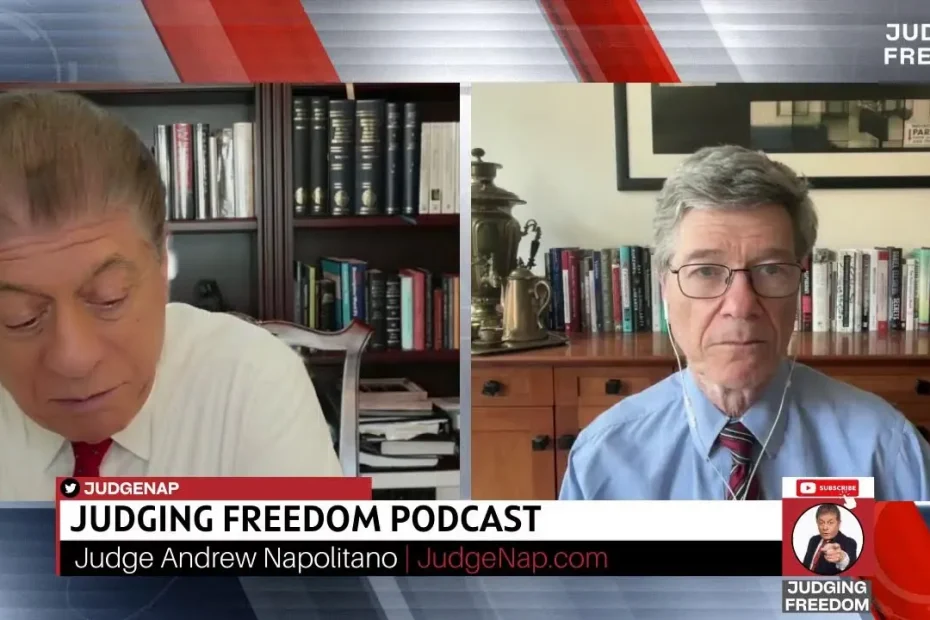
Read the full transcript of a conversation between Judge Andrew Napolitano and Professor Jeffrey Sachs on Judging Freedom Podcast titled “Ceasefire or Surrender? What’s Really Happening in Gaza”, premiered March 12, 2025.
Listen to the audio version here:
TRANSCRIPT:
ANDREW NAPOLITANO: Hi everyone, Judge Andrew Napolitano here for Judging Freedom. Today is Wednesday, March 12, 2025. Professor Jeffrey Sachs joins us on, what is Marco Rubio talking about? Ceasefire. But first this.
[Advertisement removed]
Introduction with Foreign Minister Lavrov Mentions
[JUDGE NAPOLITANO:] Professor Sachs, a pleasure, my dear friend, welcome here. I spent two hours, as you know, earlier this week with Russian Foreign Minister Sergey Lavrov and I had planned to tell him of my relationship with you, but before I could even say anything about you, he came up to me and said, please tell Jeffrey how much I enjoy watching his appearances on your show.
[JEFFREY SACHS:] Well, this is just to say everyone’s watching you because wherever I’m going in the world, people are coming up and saying, I just saw you on Judging Freedom, so this is very nice.
[JUDGE NAPOLITANO:] For the Foreign Minister of the Russian Federation to be so familiar with the privilege that I have to work with you was deeply moving. He made a couple of other funny comments as well. You know his personality. He said to me, I’m a little disappointed in you. I said, why? He said, well, you arrived in Russia on Thursday. We saw you go right on television with Dimitri Simes and I had to wait five days for you to visit me. The next time you come to Moscow, you come to me first.
[JEFFREY SACHS:] That’s the way, that’s Sergey Lavrov, wonderful, remarkable person, by the way, absolutely remarkable.
The Ceasefire Claims and Russia’s Position
[JUDGE NAPOLITANO:] You know him far better than I do. I came home from Moscow, you know how long the flight is, and learned that Secretary of State Rubio and National Security Advisor Waltz claimed that they’ve negotiated a ceasefire with President Zelensky and, quote, “the ball is now in Russia’s court.” One of the questions that we put to Foreign Minister Lavrov was whether or not there could be such a ceasefire. He looked right at me and said, why would we do that? Doesn’t the American team know that there are four or five conditions that President Putin has laid out regularly, consistently, systematically from the beginning that would have to be met in order to end this war, and that those conditions were included in the agreement between Kyiv and Moscow before the agreement was disrupted by Boris Johnson and Joe Biden?
[JEFFREY SACHS:] Well, I think the U.S. must understand that this is not about a ceasefire as good as that would be in a broader context. This is about ending a war. And what we don’t know about the discussions that took place in Riyadh is what was said about ending the war. Maybe it’s possible that the Ukrainian side said, yes, we accept conditions that could lead to the end of the war, and that those are being communicated privately with the Russian government. It may be that they said no such thing. We don’t really know at this moment what occurred in Riyadh.
It would be naive, more naive than I think is the case, actually, that this was simply an announcement for a 30-day pause. You know, what’s happening on the battlefield is that Russia is winning on the battlefield. In fact, there’s a major operation underway in the last few days in the Kursk region of Russia, which the Ukrainian forces had entered a few months ago, which they wanted to hold as a bargaining chip, so-called, for a final settlement. And the Russian forces are clearing out the Ukrainians by the hour right now.
And so Ukraine is on the defensive. It’s retreating. Russia would not stop this effort for no reason. The only way that it would stop would be if the Americans communicate with the Russians that, yes, behind closed doors, Ukrainians have recognized what is the way to end the conflict.
The 2022 Agreement That Never Happened
Now, I think on that, there’s no mystery. There has been no mystery since April 2022. I would say there’s been no mystery since 2015. Indeed, one could go back even before that. What do I mean by all of this? As you mentioned, on April 15, 2022, there was a draft agreement for ending the conflict, close to being signed by Russia and Ukraine. We have that draft agreement. That’s not hidden from view. The New York Times published it in 2024. It’s a very plausible end to the war. It could have been achieved almost three years ago and a million casualties ago on the Ukrainian side.
Probably a million Ukrainians have died or been grievously wounded since that accord was pushed aside by Biden’s team and by Boris Johnson. They told the Ukrainians, keep fighting. This is what was such a disastrous foreign policy by Biden. The UK is so consistently disastrous in advice. I don’t even expect better. I wince at how ridiculous the UK approach is. The US should have done better, could have enabled a peace already about three years ago.
We know what the contours of the agreement would be. In that interview, it’s a terrific interview, extremely informative, extremely interesting by Foreign Minister Lavrov. He notes that one of the points of the agreement in April 2022 was some territorial concession by Ukraine up to that point of the fighting. In fact, he said now it is worse for Ukraine. Ukraine fought on for three years and they’ve lost relative to where they were before. They’ve lost legally, juridically and on the battlefield.
The Three Key Elements for Peace
But the contours of reaching an agreement quickly are known. What are they? They are that Ukraine will be permanently neutral. In other words, it will not join NATO.
NATO will not be dangled as something to happen in five years or 10 years or 15 years. Ukraine will be neutral. This was the sensible position for the last 30 years. The US could not take common sense.
The second is there will be territorial adjustments. There wouldn’t have been before the coup in 2014 that the United States participated in. There wouldn’t have been any at all. There wouldn’t have been territorial loss in eastern Ukraine in the Donbas region or what is called Lugansk and Donetsk because the Minsk agreement that the US and Ukraine dissed, they signed and then they dissed it, didn’t call for territory to go to Russia, but it called for constitutional autonomy of the ethnic Russian regions of eastern Ukraine. Well, they lost that opportunity. In 2022, there were some concessions based on where the contact lines were at that point. But now things have gotten worse. So there will be these territorial adjustments.
And the third part of the agreement that was already reached on April 15, 2022, by the way, based on a communique that was jointly issued on March 29, 2022, which also people can find online, is that there will be security guarantees for Ukraine. And I say rather straightforwardly, because it’s the way that things should work in this world, put them through the UN Security Council. That’s what it’s there for.
And so this is the third point. Permanent neutrality, some territorial border adjustments that reflect the events of the last 11 years, actually, and security guarantees for Ukraine, in my view, under the UN auspices. That’s how to reach peace. Really, we were there on April 15, 2022. We could be there immediately. That’s nothing to do with the ceasefire, except if in the closed room in Riyadh, Ukraine said, yeah, yeah, okay, that makes sense. We were about to sign in April 2022. We’ll sign now. Maybe they said that. Maybe that’s what’s being communicated. But if it’s just a ceasefire, it’s not going to happen.
[JUDGE NAPOLITANO:] Are you of the view, Professor Sachs, that President Zelensky would risk his tenure in his job? I don’t want to say in office. It’s not a legal job that he has anymore. And maybe even his life, if he were to show some rational behavior and cease the military conflagration, this crew that regulates him from his right would kill him?
[JEFFREY SACHS:] Look, I don’t know about his personal safety, but I could say something…
[JEFFREY SACHS:] …about his political term. It would likely end. He, like a head of state, represented a platform and a position. And terms come to an end. We don’t run countries for the sake of our rulers. We don’t run countries for the sake of our heads of government. Our heads of government are to be for the sake of the people, not the other way around.
That’s a principle that was established rightly in the United States in 1776, July 4th, in a very well-written document by Thomas Jefferson, which we call the Declaration of Independence. It was enshrined in the U.S. Constitution in the convention in 1787.
With all respect to President Zelensky, terms come to an end. He’s ruling under martial law. I don’t know, maybe he runs for election and he wins. Okay, that’s one thing. But the question of his political term is, frankly, of no particular interest to me, and I don’t think should be of any particular interest to anybody. We don’t run countries for the sake of individuals.
And what we know from both the logic of the situation, the tragedy of the situation, and the opinion surveys in Ukraine is that the Ukrainians want peace. They say so. Peace, even with territorial concessions. How do they express that right now? By trying to flee from people that are grabbing them off the streets and sending them to their deaths into front lines because they can’t vote on it. This is a martial law regime.
I hope nothing personally happens to him. If that’s a risk, he should figure out some way to leave or do something, but I’m not giving him personal advice.
[ANDREW NAPOLITANO:] Understood.
[JEFFREY SACHS:] At a political level, we cannot run international affairs for the sake of an incumbent. We need to address the needs of people. We need to address security. We need to address global peace. That’s what this is all about.
Recent Diplomatic Developments
[ANDREW NAPOLITANO:] Let me take you back to where we started this conversation about statements by Secretary Rubio. Here is the clip from them, that is Secretary Rubio and National Security Advisor Waltz yesterday.
[SECRETARY RUBIO:] Today we made an offer that the Ukrainians have accepted, which is to enter into a ceasefire and into immediate negotiations to end this conflict in a way that’s enduring and sustainable. We’ll take this offer now to the Russians, and we hope that they’ll say yes, that they’ll say yes to peace. The ball is now in their court.
[NATIONAL SECURITY ADVISOR WALTZ:] We also got into substantive details on how this war is going to permanently end. We have a named delegation in terms of next steps from the Russian side. We have a named delegation in terms of next steps from the Ukrainian side. I will talk to my Russian counterpart in the coming days. Secretary Rubio will be with G7 foreign ministers in the next couple of days. We have the NATO Secretary General in the White House on Thursday, and we’ll take the process forward from there.
[ANDREW NAPOLITANO:] Now compare that to this, cut number 10.
[FOREIGN MINISTER LAVROV:] Prime Minister of Denmark, she said that these days Ukraine is weak, Ukraine cannot be fairly treated now, therefore for Ukraine today peace is worse than war. She said this. She said, let’s pump Ukraine with weapons again, and when we have shaken Russian position, then let’s see whether we can talk. And the chief of German intelligence a couple of days ago said that it would be bad for Ukraine and for Europe if the war ends before 2029, and 2030 even better.
[ANDREW NAPOLITANO:] Your comments and observations on the statements by Secretary of State Marco Rubio and Foreign Minister Sergey Lavrov.
The Path to Peace
[JEFFREY SACHS:] I think what is implicit, maybe I’m reading too much into it, but I don’t think so. I think what’s implicit in what Secretary Rubio and the National Security Advisor Waltz said is that they got into the conditions for ending the war. In other words, behind the closed doors, they talked about neutrality, guarantees, and territory. Those are the three conditions. Those are what was on the table in near agreement on April 2022 in the Istanbul process so-called.
So it sounds like they did discuss those and that they will communicate those with the Russian side. If that’s the case, this is moving forward. If it’s not the case, the ceasefire is not moving forward. I think it’s plain and straightforward as that.
When it comes to the European position, in one sense, actually, it doesn’t matter in the following. If President Trump maintains the basic position that the United States is not going to continue to support Ukraine in a useless, destructive war when there is a clear way to end the war on the lines of the Istanbul process, if he maintains that consequently, whatever the Europeans say does not matter in the sense that the war will end.
The war will end because Ukraine cannot fight on without the U.S. armaments and the U.S. financial backing. Europe can say what it wants, but it cannot sustain Ukraine in the war, however wrong-headed that would be, by the way. It’s just not logistically, financially feasible for Europe. Of course, it’s the wrong thing to do anyway, but it’s not even feasible.
What is the only mistake that would come, and it was said, actually, so you can’t rule out the mistake, but when this ceasefire was announced, it was also said that the U.S. would resume military support. I believe the word military was used, but support for Ukraine and intelligence support for Ukraine.
President Trump said clearly in the White House that as long as Zelensky believed that the U.S. would always support them, he would continue to hold out, maybe for this very personal reason that has nothing to do with the well-being of his country, but only for his personal political well-being, if I could put it that way.
So the U.S. has to be clear. The U.S. support for this useless, destructive, violent, unnecessary war is over. As long as President Trump says that, that’s an America-first foreign policy. As long as he’s clear about that and unequivocal about that, the war will end. If he’s not unequivocal about that, if he says, oh, until the Russians agree to a ceasefire we continue to arm Ukraine and there are no real terms for ending the war, well, then we’re kind of locked in the Biden status quo.
So actually, the United States does not have to negotiate with anybody. The United States doesn’t have to negotiate with Ukraine. The United States doesn’t have to negotiate with Europe. The United States doesn’t have to negotiate with Russia. The United States merely needs to say we are not continuing our financing and arming of Ukraine for a useless, destructive, violent war when the terms of ending the war are clear and have been clear since April 15, 2022.
[ANDREW NAPOLITANO:] Were you as disappointed as I, and I was deeply and profoundly disappointed when President Trump announced the reopening of the spigot, the pipeline of arms to Kiev and the reinstitution of United States intelligence on the ground and signals intelligence dealing with the Ukrainian intelligence? It’s almost like we’re back to where we were under Joe Biden.
[JEFFREY SACHS:] You know, with this administration, we don’t know what the words mean. Is it really a full flow of armaments? Is it really the status quo ante that it is a continuation of policy? If it is, it’s a profound mistake because as President Trump himself said, as long as Ukraine believes that Ukraine can call the shots on whether or not the U.S. continues the funding, they will not end the war for the very personalistic reasons of the small leadership group that rules by martial law in Ukraine.
If these are words that are kind of a signal, but they don’t mean very much because there’s nothing real in the pipeline, the money has been spent down, there’s nothing really there, it’s a rhetorical show of support, but in private to the Russians, everybody knows there’s not much there. It’s something different.
So we’re not in the kind of administration where the words are meant with precision. And therefore, I’m very cautious hour to hour and day to day in interpreting. But on substance, what you’ve said is, of course, 100% right. If in fact, it’s a real flow of arms that continues, well, then President Trump would have really made the mistake that he explicitly warned against in the Oval Office when he said Ukraine won’t come to peace if it believes that the United States will automatically backstop whatever Ukraine is doing.
I don’t believe that’s the case. I would be really shocked, profoundly disappointed and…
[JEFFREY SACHS:] upset and worried if the administration went back to Congress, for example, and said, let’s have another package of military aid. Oh, my God, then we would be in Biden land, stuck forever in this horrendous situation. So I wouldn’t overread any words, because with this administration, the words aren’t meant to convey precision. They’re kind of mood music that change by the hour. But I think the intention of this administration is to have an America first foreign policy in which the U.S. stops funding and arming a Ukraine that’s getting Ukraine killed on the battlefield and leading to no good results for the world.
[ANDREW NAPOLITANO:] Do you agree with Foreign Minister Lavrov that European leadership wants an extended drawn out war?
[JEFFREY SACHS:] Well, what the European leaders are saying is, yes, more war, but truly, again, we have words and we have reality. I want to emphasize the United States doesn’t have to negotiate with anybody. It just has to end the arming and financing of Ukraine. The rest will follow. There will be a peace agreement. This will end.
Whether Europe rhetorically says so, whether Ukraine rhetorically says so or not, the war will end because it can’t go on. Wars are expensive. Wars require armaments. Wars require U.S. technical support. The European rhetoric is tragic and absurd, completely misguided. They couldn’t see an exit ramp if it was staring them in the face. So what they’re saying makes no sense.
But in some sense, it doesn’t matter because they can’t continue the war no matter what the Germans or Starmer or Macron or anyone else says. They don’t have the means to do so. So this war will end if President Trump is clear and resolute that America will no longer arm and finance Ukraine for this devastating, mistaken war that Biden and others bought into so deeply. This is a loser and I don’t think President Trump wants to hold a loser.
Conclusion
[ANDREW NAPOLITANO:] Professor Sachs, thank you very much. Thank you for your time. Thank you for your intimacy and thank you for your relationship with this show and with me, which obviously, my credibility and relationship with Minister Lavrov, it was deeply moving for him to come up to me and speak of you as a mutual close friend of both of us.
[JEFFREY SACHS:] Look, I think we need to be a friend of peace globally. This is the point. And we’re close to it. If we’re clear sighted, we’ll reach peace.
[ANDREW NAPOLITANO:] Thank you, Professor Sachs. We’ll see you again next week.
[JEFFREY SACHS:] Absolutely. Great to be with you.
[ANDREW NAPOLITANO:] Coming up later today at three o’clock Eastern, Aaron Maté. At two o’clock Eastern, Scott Ritter. At noon Eastern, the interview with Sergey Lavrov. Judge Napolitano for Judging Freedom.