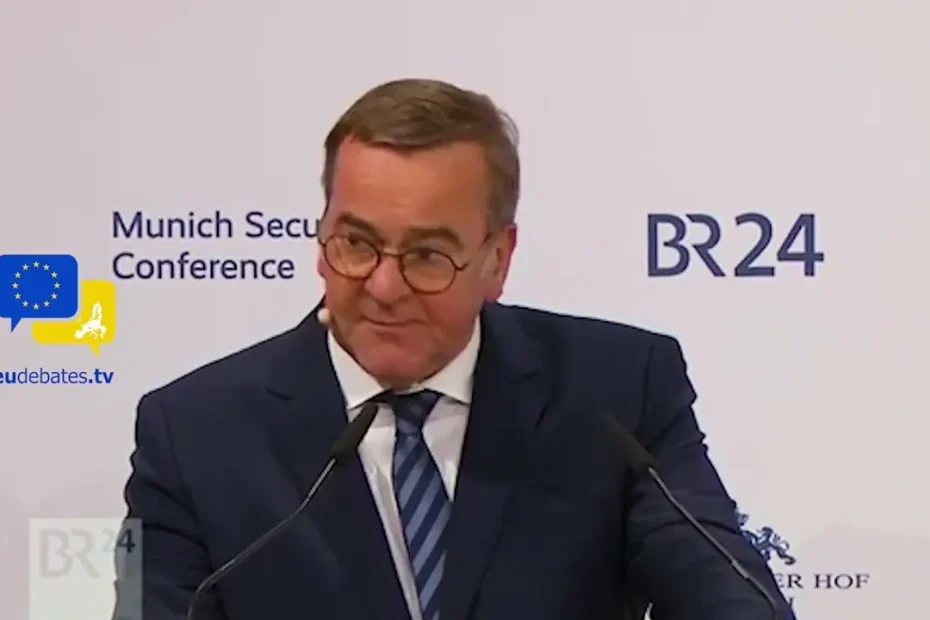
Read the full transcript of German Defense Minister Boris Pistorius’ speech at the Munich Security Conference on Feb. 14, 2025.
Listen to the audio version here:
TRANSCRIPT:
Introduction and Response to US Vice President’s Speech
GERMAN DEFENSE MINISTER BORIS PISTORIUS: Ladies and gentlemen, let me start in German. I did have a speech that I prepared for today. It was a speech which was supposed to be about security in Europe, but, to be honest, I cannot start my speech in the way that I originally intended to. I am a staunch believer in the transatlantic alliance, and I am a staunch ally and friend of America. The American dream is something that has always fascinated me and influenced me, and this is why I cannot just ignore what we heard before.
I cannot not comment on the speech we heard by the US Vice President. “We fight for your right to be against us.” That is the motto, one of the mottos of the Bundeswehr, and it stands for our democracy. This democracy that was just called into question by the US Vice President, and not just the German democracy but Europe as a whole, he spoke of the annulment of democracy, and if I understood him correctly, he compares the condition of Europe with the condition that prevails in some authoritarian regimes.
Ladies and gentlemen, this is not acceptable. This is not acceptable. This is not the Europe, not the democracy where I live and where I conduct my election campaign right now, and this is not the democracy that I witness every day in our parliament. In our democracy, every opinion has a voice, and it makes it possible for parties that are partly extremist, such as the AFD, and they can campaign just as any other party.
This is democracy. And if the Vice President had the opportunity to switch on his TV set when he arrived yesterday, he would have seen one of those candidates in primetime TV. By the way, we even admit media that spread Russian propaganda, and the representatives of the federal government answer their questions. Nobody is excluded.
But democracy does not mean that a vociferous minority will automatically be right, and they cannot decide what truth is. It does not mean that anyone can say anything, and democracy must be able to defend itself against extremists that try to destroy it. I am happy to live in Europe where this democracy is defended every day against its internal and external enemies.
And therefore, I would like to explicitly contradict and oppose the impression that our democracies oppress and silence minorities. We not only know against whom we defend our countries, but also what we defend it for. It’s for democracy, for freedom of opinion, for the rule of law, and the dignity of each and every one, ladies and gentlemen.
Focus on European and Transatlantic Security
Ladies and gentlemen, but unlike the Vice President, I would also like to focus my speech on the most pressing questions of European and transatlantic security.
The last days have confirmed what many had speculated for months. The United States are pushing for a quick peace settlement between Russia and Ukraine, and they expect Europe to take the lead in securing any agreement that follows. These negotiations can be a turning point for our continent and for transatlantic relations, a historic turning point that can go into very different directions. The choices we make now will determine whether we live in peace or in crisis.
They will determine our future and the future of the next generation in Europe, but also beyond. We must ensure that Ukraine is not left alone, ladies and gentlemen, because one thing remains unchanged. There will be no lasting peace in Europe without a strong and free Ukraine. There will be no sustainable rules-based order if aggression prevails.
We must equally make sure that Russia does not emerge from this war as an even bigger threat than before. A fragile peace that only postpones the next war is not an option. Yesterday there was strong consensus among NATO Allies that imperialist powers will only respond to deterrence and strength, be it in Europe or in the Indo-Pacific. Therefore we must and we will negotiate from a position of strength.
Three Crucial Points for Negotiations
Three things are crucial for that.
First, European and Ukrainians must play an active part in the negotiations. Only united we will be able to stand strong. Only united will we negotiate a stable and long-lasting peace.
Second, Ukraine needs to negotiate from a position of strength. Germany will therefore remain the largest supporter of Ukraine on this continent. And we will continue our engagement in the near future and beyond.
Third, the transatlantic alliance must not take anything off the table before the peace talks have even started. Discussions about Ukraine’s NATO membership or territorial issues must take place at the negotiating table with careful consideration and in close coordination among Allies. At the same time, Secretary Hekset made it very clear that the US will remain engaged in NATO and in Europe.
European Responsibility and Defence Measures
But the recent statements are also a strong reminder of what has been clear for many years, if we are honest. We Europeans have to contribute the lion’s share to conventional deterrence and defence in Europe. We need to shape the reality we live in before it shapes us. Yesterday, in NATO, we agreed to develop a roadmap to organise the burden-shifting from the US to Europe in the years to come, and to avoid at the same time by orchestrating it that we run in capability gaps which are critical.
It is time for fewer promises now and more action. That is why my French colleague Sébastien Le Corneuil and I established the Group of Five together with the United Kingdom, Poland and Italy at the end of last year, to chart a course for a strong Europe. We will use this format to develop the roadmap in the upcoming month and discuss it with our Allies, especially with the United States.