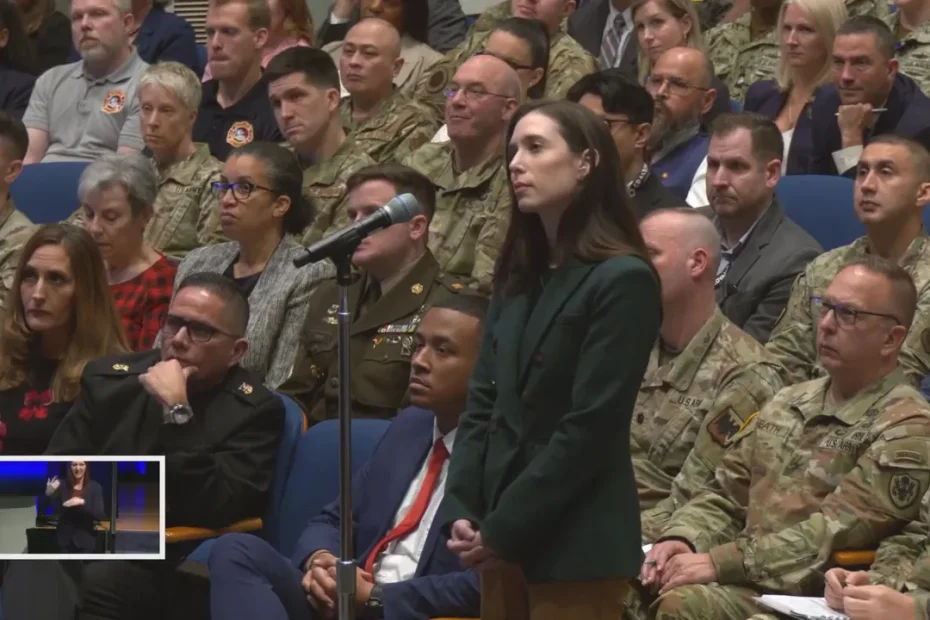
Read the full transcript of Defense Secretary Pete Hegseth hosting a Q&A at the town hall meeting at the Pentagon, Feb. 7, 2025.
Listen to the audio version here:
TRANSCRIPT:
PETE HEGSETH: And you can ask questions. It’s okay. I think there’s a microphone here and here. If you want to come up, sir, to the microphone so everybody can hear you. There’s one right here.
Yes, sir. I’m going to grab a water. Thank you, sir.
Deterrence and Gray Zone Activities
[RICH LAUER, AIR FORCE A-10]: You talked about deterrence. Do you see the department becoming more aggressive, more assertive in the gray zone to further deter China and Russia?
PETE HEGSETH: It’s a good question. I hope that it’s been noticed and it’s intentional that a lot of our outreach, my outreach early on to defense ministers has been in the Indo-Pacific, strengthening those alliances even more. There’s gray zone activities that exist, some of which you can acknowledge, some of which you cannot, but certainly we want to send the signals to China that that area will be and continues to be contested. Our allies and partners, we will stand with them robustly in real time with defense capabilities, and we’re not just going to allow them to perpetually sort of de facto gobble up more of that contested space by the routines that they conduct, to sort of demonstrate that all is normal in an increasingly escalating way, maybe even to mask efforts they might be undertaking.
So we’re definitely keeping an eye on that, we’re clear-eyed about the communist Chinese, the PRC, but we’re also not attempting to initiate conflict or create conflict where it otherwise doesn’t need to exist. We’re going to stand strong with our partners and then President Trump at his strategic level is the one who’s having the conversations to sort of ensure that we don’t ever have a conflict, we don’t want that, they don’t want that, we just have to remain strong in order to be in the best possible position. Thank you, sir.
Standards and Military Leadership
[KEVIN DANIELS, ARMY IG]: So I’m really happy to hear you say standards, going back to standards. That’s incredibly important. I’m involved in senior official investigations for headquarters DA, and by and large, our military leadership is doing the right thing. I’m proud to say that as an Army IG. What can we do with the service across the board to better the standards across the whole formation? Right? So we have some examples of improprieties and things that have metastasized over the last decade. How do we get at those kinds of things? What is the department doing to look at those kinds of cancers that are within our ranks?
PETE HEGSETH: It’s a good question. First of all, I think in some cases, there’s simplification that needs to be had, at least from my perspective. And that goes back to kind of our initial charge, which is culture, the intentional crafting of culture, that there are a lot of reasons why we could look at each other and create differences or caveats or special categories, that I think create unnecessary differences and ripples that lead to conflation points, that lead to accusations or disagreements or inability to enforce standards.
I just wrote a book called “The War on Warriors,” which was used for me and against me in my hearing. But in writing that book for six months, I was on the phone off the record with active duty service members, with at all ranks. Right? Junior enlisted, senior officers, NCOs, warrant officers, all services, all ranks. Because I wanted to get a sense of what their feeling was. And I wrote this down, and it’s true. A lot of commanders were expressing they felt like they’re walking on eggshells inside their own formations.
And this is company commanders, battalion commanders, brigade commanders. Sorry. Sometimes I only use army speak for formations. I’m learning the rest, in real time. But you know what I mean as far as formations.
Because the standards have become opaque and loose, or there’s such an emphasis on differences that treating someone one way is offensive to somebody else as opposed to treating somebody this way and is offensive to somebody else. By simplifying that and saying you are an individual who’s put on the uniform of our nation, who’s sworn an oath to defend the constitution, and you will be treated by your capabilities, your commitment to the mission, how your work ethic, and what you deliver. You, that’s it. It has nothing to do with your race or your ethnicity or your gender or your sexual orientation. That’s not how we’re reviewing the environment for your consideration.
When you’re looking at all these other categories as sort of a tapestry, it creates a serious amount of complications. I think by simplifying and focusing on standards, I think a lot of that, I don’t want to say washes away because you still have plenty of complications and you still have problems, everyone needs to be treated equally, those things to be recognized, sexual harassment, not tolerated, all of those things remain true, which have been true and need to be enforced at the highest levels, but hopefully by some level of uniform and simplification that can be addressed.
AUDIENCE QUESTION: Great. Thanks for taking the time to come and speak with us. Recognizing the president’s intent to streamline the federal workforce, I was hoping you could provide a little bit of your process and your thinking of what that means for the department, where there’ll be identified areas to be cut or streamlined, and if you have a sense of also the timeline.
PETE HEGSETH: Sure. Thank you for the question. It is the way I look at it or I’ve thought about it is from the flagpole to the front lines. There are thousands of addition and I’m not saying that just because we’re here in the Pentagon, but there are thousands of additional Pentagon positions, headquarters positions, others positions that have been created over the last twenty years that don’t necessarily translate to battlefield success.
Additional staff, additional layers of bureaucracy, additional flag officer positions, that we are, we would be remiss if we did not review.
We also live in a budget-constrained environment, and that’s politics that I thankfully don’t have to worry about anymore. I have my opinions, but that’s not my job. My job is a ready force. We will have to live inside the constraints of the past.
I mean, I just, we were down at Fort Bliss recently, and the unit there, the armored, cab unit there relayed that they’ve had to cut an FTX, a series of training exercises coming up because of budget constraints. Well, when you’re living off of continuing resolutions, and caps, and then you have contingency operations and things that change, suddenly you have shortfalls, and now unit training falls by the wayside. From my perspective, that’s, I mean, that’s completely unacceptable. What are we spending elsewhere that can be targeted efficiently, and it’s not just the fraud, waste, and abuse stuff, it’s systems, it’s hierarchies, it’s layers, that we can review, reduce, recommend those reductions, that then allows us to ensure that training and readiness in the frontline units and the COCOMs is even increased. I want more of that.
So it is it’s interesting. Former secretary Rumsfeld gave a speech on September 10, 2001, that was about acquisitions and reform and Pentagon bureaucracy, that overtaken by events the next day, September 11, 2001, was quickly forgotten and really never addressed. I feel like I could give about 85 percent of the same speech today that Secretary Rumsfeld gave on September 10, because a lot of those processes have become even more systemic in taking root here that cause delays, redundancies, and bureaucratic red tape. That’s we’re looking at the headquarters level. We’re looking at the highest levels.
I said this in my hearing as well. You know, we won World War II with seven four-star generals. Today, we have forty-four. Do all of those directly contribute to warfighting success? Maybe they do. I don’t know. It’s worth but it’s worth reviewing to make sure they do. So we’re looking at all options. What we’re not going to be is hasty about it because we’re in the business of national security, and something that may not look like it’s contributing may be incredibly important to the effort, and so whatever we do is going to be done carefully. Thank you.
Long-Term Strategy for US Dominance
AUDIENCE QUESTION: Morning, sir. Based on what you said about maintaining American dominance in the world, our adversaries, especially Chinese and Russians, they have a 20-year strategy, a 30-year strategy, and they look that far ahead. How do we change our approach to maintain US dominance abroad? That strategy is more than five years, more than ten years, and also ensuring that our resources are prioritized and allocated to maintaining our US dominance in decades, if not in years. How do we?
PETE HEGSETH: Tell me. Sounds like you need to come work for me. Or maybe you already do, and thank you. I’m figuring it out. I found out where the bathroom was.
That, sir, indeed, is the key question. We, you know, autocracies have an advantage, not just because of the top-down nature in which they organize. I mean, they have disadvantages for obvious reasons, but because they have the convenience of planning without political, you know, the pesky people problem of voting and ballots, they can plan fifteen, twenty years and then drive that plan without consequence to their own population, which does have strategic advantages, no doubt. I actually think that system loses in the long haul because of its inherent weaknesses, but that militarily has advantages.
I think you’re going to see a defense strategy coming out of our office that tries to look that far down the line, tries to make disruptive changes to how we acquire, and rapidly field, and look at systems that are not about congressional districts or budget line items for FY 26 or FY 27, but try to look toward what strategically we’re going to need five, ten years down the line, looking ahead at what the emerging threats are and what a shifting in the balance of power would mean.
I mean, when we’re in a different world than we were at the end of the Cold War, we’re now at a near peer or peer environment, which changes a lot of the dynamics of how we need to plan, specifically to maintain American strength around the world, because it is not hyperbole to say without America, the rest of the world acknowledges there’s nowhere else to look as far as actual leadership and capabilities in the defense space. It’s us or us. And then our robust allies and partners who we incentivize to come alongside us, and that’s how you create a Western force capable of ensuring not just our country and our hemisphere, but the world remains free, to trade, travel, all the things that we share.
So our I think we have to be willing to look further than any time this president would be in office or I would be in office and set the department up to do that, knowing that at any time, two years from now or four years from now, the American people can make a different choice, and that can lead to different views of that. But we’re trying to take an America first strategic perspective at how we maintain our dominance, and I think you see some things already changing in that.
America First Strategy and Long-Term Planning
PETE HEGSETH: Our southern border, the focus on making sure we have control over the Panama Canal, making sure that there’s not a scenario in an emergency where our ships couldn’t transit because you have foreign ownership on either side, those are sort of America first views that we’re willing to look into, that look further into the future than just that, should there be a contingency while looking to the Indo Pacific and realizing the aspirations of the CCP, which are real and could drive a decision point vis-a-vis something like Taiwan.
So, you’re right. We are trying to think that way with how we because dollars drive a lot of those decisions. And so the budget—as much as I thought this was a job about strategy and people, it’s a job about budgets and what you fund is what you is a reflection of what your priority is. And so we’re spending a lot of time looking at that.
But thank you. That’s the key question, sir. Sir? One more. Alright.
Supporting Military Families
AUDIENCE QUESTION: Yes, sir. Hi, sir. Thank you for your time today. My question is more about the families of the military and the civilians that support the family of the Department of Defense. So often in frequency of moves, the unsettled nature of what we do impacts the families, and looking for your comments on how we plan to continue to take care of those.
PETE HEGSETH: Oh my goodness. You’re a hundred percent right. Either way, we’re in a reconciliation process right now, which is a unique funding situation in not just looking at budget cycles. And as a former, you know, O-4 who spent most of his time as an O-2 and an O-3, I spent most of my time with E-4s and E-5s and E-6s, and have heard robustly the frustrations they and their families have, which is a massive readiness and retention issue, and a morale issue.
So as we’ve driven budgets, I have said to the team, that needs to be—I don’t, you know, funding one more multi-billion dollar system is not as important as funding the families and the capabilities or human systems that make it all happen.
So I want that to be and I applaud the previous administration’s increase in E-1 to E-4 pay. Like, that stuff is really important. We need to do more of that. That trickles to the family and how they’re cared for. And then, yeah, we have to look at all aspects of how we interact with families, from childcare to DOD schools, and, the president signed an EO talking about choice in schools.
Military families should have choice, if it’s great, on post or on base, great, if not, do they have a robust opportunity to seek education or childcare for their kids elsewhere? That matters a lot. Making sure BAH matches, all of these things are important.
And my wife’s going to be traveling with me to, we’re going to the NATO ministerial to, we’re not going to the Munich Security Conference, we’re instead going to Poland to see the troops out there, and we’re going to Germany to see EUCOM and AFRICOM. I would much rather talk to troops than go to cocktail parties. That’s my job. And we’re going to meet with military families. She’s going to meet with husbands, wives, and spouses on that trip. Go see schools, go see faith groups, childcare centers, to get a real pulse of what that is and then make sure we’re funding it. So I want you to know that’s something that matters a lot to us.
I appreciate the question. So we have one more? Oh, go ahead. Let’s do one more. Ricky told me I couldn’t, but why not?
Acquisition Process and Reforms
[ELLEN HARNISH, OSD CAPE]: Good morning, sir. Appreciate you taking the time. My name is Ellen Harnish. I’m from OSD Cape. And my question follows up on your point about the acquisition process. You know, we’re in a day right now that we have a lot of dangerous powers that are rising, and we’re trying to figure out what to focus on in the acquisition process. And us as civilians, we want to be there to support the warfighter and get them the capabilities that they need fielded in the fastest time possible, but with the appropriate amount of testing and making sure everything works when it gets to the battlefield. So I guess my real question for you is kind of what’s your focus when it comes to the acquisition process and reforms and the trade off between faster capabilities you know, fielded quicker versus these larger scale capabilities that we really need for that deterrent effect?
PETE HEGSETH: In a perfect world, I would say both. Right? You recognize—I mean, first of all, listening to the COCOMs, listening to the people on the pointy end of the spear, watching what’s happening in real time on the battlefield. Take Ukraine as an example. A lot of people—we’re learning a lot about what low-cost systems UAVs can do to high-cost systems that we have invested a great deal in, and the question is, do you keep investing in those or not, going forward?
Listening to the services, also making balances and it’s not necessarily choosing between services, but recognizing capabilities of services vis-a-vis perspective, upcoming fights.
And then I think I think we have a unique opportunity to tap into industry, Silicon Valley, other—I mean, obviously, we’ve got massive organizations that have helped create big platforms that are incredibly important for deterrence. We also have some really fast moving, newer contractors that are willing to work that have already put a lot of money into R&D, that want to help us rapidly field these new systems that we’re going to need for fights in the future.
So funding even more robustly, and I don’t want to name check anything and say that’s the only route, but things like DIU and others where you can experimentally rapidly field new technologies and then find a way to make sure they’re funded so that they can be scaled, and tested even in real time out with COCOMs as opposed to an 18-month testing process, to kind of move things, merge things together so they’re happening more quickly. And we’re hearing a lot of that from commanders in the field who are saying, hey, skip this, this, and that process. Let us figure out how it works, and then we can scale it once we know it does or does not.
But I also want I want to underscore that a lot of these major platforms, and that was a wonderful part of doing the advising consent process in the US Senate. Yes, there are senators that are invested in certain platforms or systems from their home state or their district. But when you actually dig underneath it, they understand the strategic deterrence effect of these big systems we spend a lot of money on, oftentimes too much money, over budget, and too long, and that’s something we are definitely going to address for reasons of urgency and for reasons of taxpayer, respect for taxpayers.
But we need and want those systems, because without them, we don’t have the umbrella that allows us to do so many other things. So we’re looking at both, but we’re trying to get outside the box and be disruptive on both, recognizing we won’t be able to do everything in every way.
But thank you for the question. Appreciate it.
Closing Remarks
PETE HEGSETH: I just want to thank everybody for your time. I appreciate what you do. We’ll let you get back to work.
I know—I mean, again, I can’t even fathom the size and scope of this building and what everybody does. I know that. I know what I don’t know. But, we’re trying to hire the best and brightest to come alongside all of you in the work that you’re already doing, and I’m just honored to be a small part of it. So thank you very much.
ANNOUNCER: Ladies and gentlemen, this concludes today’s town hall. Thank you for joining us. Please remain in place for the departure of the official party. Fans, so I got to go with that. Philly fans, come on.