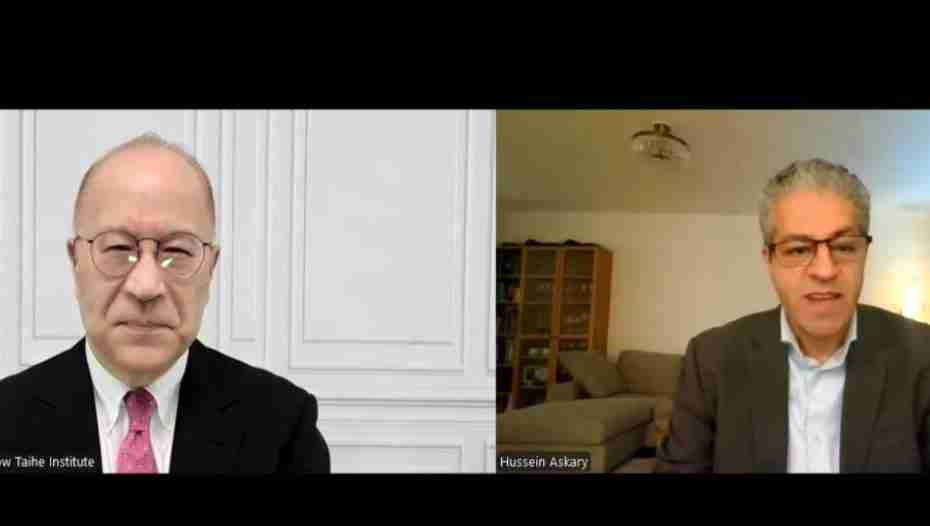
Read the full transcript of a conversation between author Hussein Askary and Einar Tangen, Senior Fellow at Taihe Institute in Beijing on “Where Will China’s Foreign Policy Head Now?”. This discussion explores changes and continuities in Chinese foreign policy in light of the resolutions of the Two Sessions, and also the policies of the new Trump Administration. [Mar 12, 2025].
TRANSCRIPT:
Understanding China’s Two Sessions
[HUSSEIN ASKARY:] Hello and welcome to a new webcast from the Belt and Road Institute in Sweden. My name is Hussein Askary. Today is Tuesday, the 11th of March. Yesterday a very important event concluded in China.
It’s called the Two Sessions, which is considered the most important political congregation or meeting. The Two Sessions refer to the National People’s Congress on the one hand, and is joined by the National Committee of China People’s Political Consultative Conference. And consultative is what is interesting here.
I will not go too much into the details because I’m not the expert on this. Therefore, today I have invited Mr. Einar Tangen. He’s a senior fellow at the Taihe Institute in Beijing.
[EINAR TANGEN:] It’s a pleasure, Hussein. Really, thank you for having me.
[HUSSEIN ASKARY:] Thank you very much. You took the time to be with us today. We will have two episodes of this special podcast or webcast on the Two Sessions in China.
Today we will discuss the question of foreign policy – what kind of discussions took place concerning China’s policy in the world, which is changing very rapidly. And in the next few days, we’ll have the second episode, which is about what kind of economic decisions and discussions took place.
We will have an economic expert also from China to discuss that. But today we would like to discuss much more the question of foreign policy. And therefore, I am very happy to have Mr. Einar Tangen with us today.
But please, first of all, can you introduce yourself to our viewers?
Einar Tangen’s Background
[EINAR TANGEN:] Yes. My name is Einar Tangen. I am an American citizen. I was born in Washington, D.C. I grew up between England and America for the first third of my life and then spent the next third in Wisconsin, where I went to school, law school, practiced as an attorney, was in politics, investment banking, had some businesses, did some real estate development. And then in 2005, I moved and made Beijing my home. So I’ve been here for slightly over 20 years.
I’ve written a number of books about Chinese government that have been published. I’m on three think tanks, including Taihe. I’m an editor for TIO, which is a scholarly magazine put out by the Taihe Institute.
China’s “Whole Process Democracy”
What are they? Well, first, China is a one-party state. So the question is, how do you get feedback? I mean, the bureaucracy can be in a bubble, just listening to themselves. So what they do is they have this consultative, and this was since the very beginning.
There was this real, because it was communist socialism, they said there has to be a feedback mechanism from the people. So what China calls its democracy is whole process democracy. And what they mean by that is it’s representative. That means, for instance, that the 2,000 people who showed up for the CPPCC, that’s the consultative group, came from every walk of life. You had housewives, you had people who collected the trash, you had taxi drivers, you had everybody across the whole stratus of society, including very well-known businessmen, sports stars, et cetera. And what they do is they represent constituents.
They actually go, they’re not full-time, they get some time off from work to do their duties, but their job is to inspect, to make sure that what the government says it’s doing is happening, and if it is happening, that it’s happening in the right way, does it need improvement, and then to make suggestions on a yearly basis based on what they have seen, and specifically along the lines of the areas that they have expertise in.
Through it, they’ll have thousands of suggestions. They will be responded to. They have to be. There’s a whole timeline in which they have to be responded to, and they always get to about 99.9 percent. There’s always that small quotient where it can’t be settled at the moment, so they go on.
The Two Sessions Process
And once the consultative meets the day generally before the National Party Congress, which is the bureaucracy, that’s government, and what they do is they’re responsible for the actual workings of government, coming up and looking at plans, and then executing them, making sure that they go through.
So in both sides, what they do is they have these work reports, and the work report covers everything that they said that they would do. They would look at the five-year plan that they have, and they say, okay, did we meet this? Did we actually achieve this? And what did we do?
So the consultative would talk about the suggestions they made, the inspections they made, and the number of things that were carried through in terms of the suggestions, how they were implemented, and then they would be also looking at the draft laws to make any kind of final adjustments.
Now, people often like to say, oh, it’s just a rubber stamp. They just meet for a week. What point is that? Well, they don’t understand that every single one of these work reports is the product of millions of man-hours. It has to be harmonized. They have to collect the information. The information has to be reviewed from the very bottom at the village level all the way up to the national government level, and they have to make sure that the information is accurate before it can be given out in a report.
So there’s a tremendous amount of work that goes into it. What you have here at this meeting is putting the final touches, making sure that there’s nothing that goes wrong, basically dotting the I’s and crossing the T’s.
Now, one of the things that always strikes me about this process is, as was said during this last session, you know, government is 10 percent ideas, and then 90 percent is just implementing them and implementing them well.
And that’s really what China does.
There’s so much planning that goes on. It’s one of the only countries where if you don’t know what’s going to happen, it’s because you don’t want to read the five-year plans that they put out. It is not opaque. Quite the contrary, you know, other countries are opaque because they don’t have an idea what they’re going to do from one year to the next. So it’s very, very predictable.
And this is what they were very interested in doing, is having a very predictable result. You’ll note that the NPC’s work report went through everything very sober, plain language.
[HUSSEIN ASKARY:] That report was presented by the premier, Li Qiang, in the beginning of the two sessions, right?
[EINAR TANGEN:] Yes. Well, the work report for the consultative was presented first, and then the NPC was presented. Now, they’re two separate bodies, okay? They meet at approximately the same time. Consultative meets a day earlier. The NPC ends a day later. This year they were both seven days. There’s no particular time. It’s just what is necessary to get through the work that they need to do.
So the NPC work report covered a lot of areas, but it was a very sober assessment, as we are talking about the international side of this, of the kind of headwinds that China is facing with an unpredictable Trump throwing tariffs around like they’re confetti, and what that means to China.
And quite frankly, they, as you’ll discuss with my friend Ding Yifan tomorrow, this was about creating confidence, and not only internally, that’s one side, but externally. The Wang Yi’s press conference went into great detail about how China wants to go at things. So when you think about the consultative, you should think about it as the apex of a process of a pyramid that so many millions of hours of work go into it, and it has to be repeated every single year.
The Consultative Process
[HUSSEIN ASKARY:] Yeah, yeah. This body, they are not permanent. They have this work for one year, and they’re not even paid for that work, the consultative part. I saw one program, for example, there was one high-tech engineer, and he was part of that kind of discussion. He wanted to introduce some ideas to the government about using AI in certain specific programs for children with special needs in education and so on. So he said, this is one of the things he wants to present to the government.
And it’s quite interesting that you have so many people with so many different parts of life in China who participate in these things.
China’s Transparency
As you said earlier, if you want to understand what the Chinese government is up to, you don’t need spies. You just need to read these annual reports. You need to read the five-year plan, the plenary sessions of the CPC. They put everything out. This is what we are planning to do.
[EINAR TANGEN:] It’s not only what they’re planning to do. They actually have a report card every single year. Can you imagine if Congress had a report card on all the stuff they said they were going to do with the U.S. Congress, which they didn’t do? Or even the president? There’s enormous transparency.
HUSSEIN ASKARY: I think Mark Twain said, “First you have to get your facts in place, and then you can twist them whichever way you need.” But you first have to get the facts.
Wang Yi’s Role and Foreign Policy
You mentioned the fact that the minister of foreign affairs, Wang Yi, he’s not only a minister of foreign affairs, he’s also a member of the political bureau of the CPC, which is the highest political position, but also the state council. He’s a state councillor. And the state council, if I understand, this is the cabinet. This is like the government, right?
[EINAR TANGEN:] Yeah, that’s a very important distinction. Anybody watching can get easily confused because you have party members who are in the government and also in the party, but not necessarily exclusive. There are a lot of people who work for the government who are not in the party. But when you get to the upper echelons, generally it is party members.
They have nine to ten different parties, depending on how you want to say it. But actually, it’s the CPC. I mean, it’s the Communist Party of China, which is dominant. And it’s generally somebody coming from a party background that is going to be at these, quote, higher levels. Now, the purpose of the party is, in a one party system like this, is to represent the people. And as I said, you need this feedback mechanism to go with it.
[HUSSEIN ASKARY:] Right. One of the ministers, actually, I met him here in Stockholm before the COVID-19, was the minister of science and technology. He was not a member of the Communist Party. He was a member of another party, Mr. Wang. If I remember correctly, I even have a picture with him. He was not the Communist Party leader. He was responsible for the whole science and technology policy of the People’s Republic of China.
Wang Yi’s Press Conference
So anyway, we talk about Mr. Wang Yi, minister of foreign affairs. He held a press conference, which he does every year, on the sidelines of the two sessions. Because the two sessions are very much focused on the economic stability in China, economic short-term and long-term plans. So therefore, the foreign policy part is delegated to Mr. Wang Yi to explain to people, I understand, and he usually brings all the international press together. And they can ask him questions and he would answer. And that way explains China’s next steps.
Of course, now we have a world which has changed dramatically. It’s on everybody’s mind that President Trump is, somehow, intentionally or not, is demolishing the unipolar world, the so-called rules-based order, whatever that could mean.
EINAR TANGEN: And also, a law-based order. I think law, you’re demolishing it. It’s a rules-based order, but it’s his rules.
HUSSEIN ASKARY: But what has happened is that it’s a very tumultuous situation, because he’s not following the script, which has been in place for several years, especially with respect to the war in Ukraine, relations with other nations. So it just turned everything upside down. We don’t know what the outcome of that is.
Of course, we hope that things will be positive. He called the President Putin of Russia. He also called President Xi Jinping. Today, there are rumors that Trump might visit Beijing sometime soon. So we don’t know. It’s not predictable, which makes it a bit difficult. But China is a more stable major power. It is very predictable. It has its own principles, both in words, but also in practice. And I think this is what Mr. Wang Yi wanted to explain.
But if you can give us a bit of the main takeaways from his press conference, what were the most important aspects. I have, of course, some questions on certain issues. But if you can tell us a bit from your standpoint, what you think was most important about this press conference.
[EINAR TANGEN:] Well, it was 90 minutes. And basically, he was appealing to people to say, look, if we’re going to have a world multipolar or however, some sort of order, it has to be law-based. We need to use the UN. We need to have bodies. But obviously, the UN has been hobbled by the US and Israel on issues like Gaza. They have not been effective in terms of Ukraine. So you’re seeing increasingly regional areas crop up. But he wasn’t really stressing that.
He was really talking about what is necessary for it. Might does not make right. And we know this historically.
Trump’s Foreign Policy and International Legal Order
[EINAR TANGEN:] And him having to repeat that is just how far down the rabbit hole of Donald Trump that we have gone. Donald Trump is deliberately dismantling the international legal order and the institutions that were created, in essence, by the United States, or a large part of which was supported by the US. The US didn’t always join. It’s not a member of the ICC, the International Criminal Court. It didn’t pass a lot of things like the protection of women and children. Why would that be controversial? But everyone says, oh, this is a massive change.
Actually, not. The US has always said that there should be an international legal system. There should be international bodies. But if you look at the actions of the United States, they have always strayed from that. The US didn’t join UNCLOS, the UN Convention of Laws of the Seas, because they said, well, we don’t recognize that anybody can tell us what to do. UNCLOS can tell you what to do, but not us.
And by the way, we’re going to enforce UNCLOS, even though we’re not a member. The ICC is the same. The ICC, when it came to prosecuting people that the United States didn’t want, the ICC was the gold standard. As soon as it came to prosecuting US for war crimes, no, no, no. That’s not possible. We cannot be judged by anybody who’s not an American.
So in essence, those people escaped scot-free. And you have the same situation with Gaza right now. You have international warrants out for them, and the US is supporting that.
US Approach to International Institutions
So it is a bit of a myth to say that the US has always been in that corner. But at least in the past, they paid lip service to it. Even though they dismantled the World Trade Organization, in essence, by not allowing appellate judges, which are necessary to render a final opinion if somebody appeals, they don’t make any bones about it.
Once again, the argument is, look, unless they’re all US judges, we’re not going to obey it because we don’t like other countries judging us. They have no power over us. We’re the unipolar power.
And then you get back to this issue about what is the US. The US is an empire. We have grown by taking things from others. When we have problems, we go out and grab stuff. We did that. First got independence from Great Britain. We fought wars with Great Britain again, against France, against Spain, against Mexico. And then we started exporting our wars around the world. And even before and after World War II, we just went willy-nilly into countries, and we would change their governments because they didn’t suit our economic interests.
I mean, people don’t realize that Panama was not a country until we created it by taking it from Colombia. It was part of Colombia. And we just said, well, we couldn’t make a deal with Colombia for the Panama Canal. So we just sent troops down there. We said, oh, there’s a country, Panama. We’re going to do a deal with them.
So that’s how America has acted. I mean, we change regimes everywhere. We try to assassinate Fidel Castro, what, 400 times or something like that. It’s ridiculous. And then we’ve had our hand in regime change operations, most notably through the National Endowment for Democracy after Regenstein. Before then, it was all covert.
And then USAID did a lot of good work. But they were often used as a front for spying activities. For instance, the Osama bin Laden chase. They pretended that they were inoculating people when they were, in fact, trying to gather any kind of information about the genetics of people so they could somehow trace it back to Osama bin Laden. That has resulted in all these people who are trying to administer polio to keep children from this horrible disease being killed because they’re on suspicion that they are, in fact, spies. So the U.S. has continued on this basis.
Wang Yi’s Response to Trump’s Approach
Now, Wang Yi is simply reacting to Donald Trump simply dropping the pretense that the U.S. abides by international laws. We didn’t abide by them in Afghanistan, Iraq, et cetera, Sudan, you name it. We go in and we do what we want, and we continue to do that.
Now we’re saying that we’re going to take Greenland, Canada, Gaza, and the Panama Canal. These are not the actions of somebody who believes in an international world order and the sanctity of laws. That is just going back to the jungle. I’m king of the jungle. I take what I want. So Wang Yi is reminding people.
[HUSSEIN ASKARY:] Yeah, Mr. Wang Yi, and even before that, President Xi Jinping, they actually referenced this question of the law of the jungle. The thing is that everybody realizes that, you know, in addition to U.S. State Secretary Marco Rubio, that today’s world is not a unipolar world. The balance of power has changed.
We have a multilateral, multipolar world, and that’s a reality. If you want to survive, you cannot dodge that question, that there are other powers you cannot simply defeat or, you know, subjugate or force them to follow your desires. So there should be a certain level of balance.
But that’s where I think the difference is that Mr. Wang Yi says there are principles. We have the United Nations Charter. We have our own principles, like the five principles of peaceful coexistence. And this is what makes China so reliable, because they will always stick to these principles. By the way, I was, yes, last year, I think you were there too, at the celebration of the 70th anniversary of the declaration of the five principles of peaceful coexistence. And I had the pleasure of meeting Mr. Wang Yi and giving him my book, which he thought was interesting, looking at the cover.
But, you know, that this is the issue. There are principles. There is a UN Charter. There are other principles of diplomacy. And, of course, Mr. Wang Yi is warning against this kind of law of the jungle. But at the same time, he’s keeping the door open for possibilities for cooperation.
Russia-China Relations
One interesting thing in the press conference that this, the first question was, of course, to the Chinese television. But the second question was to the reporter from ITAR-TASS, the Russian news agency. Because it’s on everybody’s mind, there’s this old geopolitical thing, which everybody knows, you know, Kissinger played that, Brzezinski, that the US policy is to keep Russia and China separate.
So the fact that the Russian correspondent got the second question about, you know, how will this new situation with the Trump administration, and if there is agreement on Ukraine between Russia and the United States, how would that affect China? And Mr. Wang Yi had, of course, a very interesting answer. Interestingly, he cited this British geopolitical mindset. I think it was Lord Palmerston, he cited, without naming him, you know, saying that there are no permanent friends, there are only permanent interests.
And Mr. Wang Yi said, this is not how we think. We think that friendship is forever, and interest should be shared by everyone. But from your standpoint, being in Beijing, how do people look at this rapprochement between the United States and Russia? And how would that affect the Russia-China relationship?
[EINAR TANGEN:] Okay. So Russia and China are, you know, there’s no point of sugarcoating it. It’s an alliance of convenience. Russia, 2007, Putin goes before the Munich Security Conference after being there, after being very, very gracious in 2001 when he spoke to the German Bundestag in German, which is a breach of protocol. You’re generally talking about their European home. Well, lo and behold, in 2007, he says, you have betrayed us. You have lied to us. You have humiliated us. And we are dedicated to changing the world order against a U.S.-led order. And since that time, he’s been very, very consistent.
Why did he say that? Because the U.S. had promised, and, you know, there’s the paper to back it up from the U.S. side. Baker, Howard Baker, said, we will not move one inch, not one inch, into the former Soviet areas. And that was taken as a promise.
You know, the State Department, once again, just like they do with the one-China principle, said, oh, gee, well, you know, we interpret that a different way. I don’t know exactly how you do that. But as a lawyer, I think, you know, you have a lot of leeway, but not when it’s plain English like that and you have it in writing.
But it wasn’t a legal document. It was a promise. But here’s the thing. Between countries, there is no court, right? Only the court that you submit yourself to. So the entire basis of international relations is based on people, I mean, countries coming together and saying, for the good of ourselves and the world, we will submit to rules. And, you know, unfortunately, the U.S. is, as I’ve said before, the chief violator of that.
US Foreign Policy Inconsistencies
They’re the ones who walk away, keep walking away from these climate accords that they’ve agreed to. They walked away from the Iran nuclear deal. Now they’re saying they want to negotiate. I mean, gee whiz, wouldn’t it have made more sense to just go along with the original deal rather than to wait eight years to come back and say, gee, I should probably have done that. Let’s figure something else out. But this idea that, you know, you can have an international order only based on interest, not on friendship, that it has to be individual to you.
That’s something very, very unique to Donald Trump. He has no limits when it comes to American interests. You know, as he’s shown, I’m going to take all these lands from other people. China doesn’t believe that’s the way to go. They do not enforce their ideology. And to give you a perfect example, Belt and Road Initiative, right? The U.S. pressured Panama to leave the Belt and Road Initiative.
And I laughed because after they, quote, leave, what has changed? Nothing. The Belt and Road Initiative is an idea. It’s about connecting countries together for their betterment of trade so that they can develop. There’s no ideology, all right? I mean, all it was was simply the U.S. saying, oh, we can pressure them. We can be a bully. We can make small countries do what we want because we’re strong.
That’s the law of the jungle. So, you know, Wang Yi is just stressing the fact that if you want to have a world where there is peace, you have to have some sort of comity. There has to be shared interest.
Trump’s Approach to International Relations
I mean, the shared values part is, you know, that’s the rhetoric of Beijing. But I want you to think of something they’re saying, you know, Donald Trump, when he was sitting with Zelensky in the Oval Office, kept saying, you don’t have the cards, as if this was some sort of game or something like that. You know, all these people who had died, they’re just part of some macabre game played by leaders, right? And he’s in essence bluffing.
He believes that he’s uniquely positioned to be the master of the game player in this because of his real estate experience and branding and, you know, having his show, this type of thing. I mean, it’s quite incredible that he thinks that he is in charge of everything when, in fact, his policies, all his threats are empty. I mean, what China has did during the two sessions was they laid all the cards on the table.
They said, OK, here are the headwinds. Here are the problems. Here’s what we need to do. And this is what we’re going to do. You could not be more transparent than that. So they’ve shown the U.S. their hand. Trump is trying to play his cards as if he has four aces when, in fact, he doesn’t. He’s, you know, these tariffs. I mean, let’s just take steel and aluminum.
Economic Impact of Trump’s Tariffs
You know, when the last aluminum factory was made in America 40 years ago, steel, steel and aluminum, you know, of the existing factories that are still there, the utilization is above 90 percent. The U.S. is the largest importer of steel and aluminum in the world. So given that they can’t satisfy their demand internally, that means that all of these companies, for no particular reason, are going to have to pay tariffs.
Those tariffs aren’t being paid by governments. You know, the steel and aluminum comes to the U.S. Whoever imported it has to pay the tariff to the government. It’s a tax. Very simply.
HUSSEIN ASKARY: So the consumers will pay at the end. The consumers, American consumers, will pay at the end of that. One economist a long time ago said that since the 70s, the United States had replaced the steel economy with the stealing economy.
EINAR TANGEN: But here right now, they’re stealing from their own people. This is the part I don’t understand. I mean, Donald Trump was elected. I used to run elections in the U.S. I mean, I can tell you voters vote with their pocketbook. They held their nose and voted for Donald Trump because they had no faith in Kamala Harris.
All right. They just said she’s following Biden’s line. Biden keeps telling us everything’s great. And, you know, I lost my job. I can’t make payments on my car. I have to put milk back that I would have given to my children because I can’t afford it. So they said no. Seventy percent of Americans before the election believed that they were living paycheck to paycheck. That’s not happy people.
Did they love Trump? No. They voted for Trump because they thought he would do something about the economy. He said, remember his promise, day one, I’m going to lower prices. That’s what I’m going to do. Well, he hasn’t. Now he’s changed his tune. He says, well, you know, it could be a little rocky. It could be a little tough. You know, you’ve got to do. I’m doing big things. So, you know, little people might get ground down. Yeah.
I mean, everything he’s doing is raising the price. I mean, when he says he’s going to tax Chinese ships coming into port, well, that tax is going to be paid on pass on the consumer for steel, for everything that he’s doing. Twenty five percent to Europe, to Canada, to Mexico.
The Economic Impact of Trump’s Policies
[EINAR TANGEN:] I mean, this is all going right on top of the consumers. And you’ve already had the tax bureau, the independent group that monitors tax, that this is going to result in between eleven and twelve hundred dollars on top of the existing households. They don’t have it.
There’s going to be a real blowback to Donald Trump. And the question is, can he reverse this in time? Or is this going to do irreparable damage, causing a recession or even a depression?
[HUSSEIN ASKARY:] Yeah, this is what the discussion in the United States has been also, because, you know, if you remember, President Trump was so proud that the stock markets were going up after his election and he said this is the benchmark for success. Now the stock markets are collapsing, went down almost 10 percent last week after his State of the Union.
Tomorrow, the Central Bureau of Statistics, I think they will release the consumer price index report. And everybody’s expecting that this would be a disaster, that the prices have been going up, that the inflation is increasing and there will be a very tumultuous situation in the economy. And President Trump already is talking about, “Well, there will be some pain in the beginning.”
[EINAR TANGEN:] And not for him.
[HUSSEIN ASKARY:] But you see, this is what the situation is. The thing is that President Trump, this is his negotiation style. I think he plays the cards very high up as if he has four aces. But then he tries to test what the other parties have, you know, by choice.
So this is a negotiation. But reality is reality. You cannot dodge that one. I just wrote an article published yesterday about who will lose from these tariffs. And U.S. farmers, for example, there will be a total disaster for them. Last time there was the trade war, they lost 27 billion dollars in lost exports to China. And who gained from that? It was Brazil and Argentina. Because China has such a big economy now, they can pick and choose. You are not dependent on the United States, even for exports.
China’s Global Positioning
China is not dependent on the U.S. and the EU. Of course, they are very important partners for China. But there is another world which has grown where China is now. And also this is one of the things which Mr. Wang Yi emphasized very, very much is the Global South, the Belt and Road Initiative, the Shanghai Cooperation Organization, the BRICS, all these things. And I think these are the real cards, if you want to talk about cards, is that China will no longer be dependent on the United States and the EU as economic partners or trade partners and markets. There is a whole new world which is emerging where China actually has a very dominant position, but as a partner, not as a hegemon in these areas.
[HUSSEIN ASKARY:] And I think this was very clearly pronounced by Mr. Wang Yi in the press conference, that this idea of China being part of the Global South, that this is where the home turf for China, this is where China’s principles can be implemented. But they’re still keeping the door open. So I don’t know if the question of the Belt and Road is still on the table.
As you said, the Belt and Road is not like an ideology or something. It’s these nations sign a memorandum of understanding, and then it facilitates cooperation of all nations, and those nations win by that.
[EINAR TANGEN:] How terrible.
[HUSSEIN ASKARY:] Yeah, it’s like, what? The funny thing is that how much the Belt and Road was vilified in the Western media, the debt trap stories. But still, developing nations are still joining the Belt and Road initiative because they believe it has enormous benefits for them. So that combined with the BRICS, which is now growing, Indonesia just became a member, Egypt, Ethiopia, the United Arab Emirates, Saudi Arabia was welcomed, it’s still not decided.
So this is a whole new world opening up. And I’m sure that the Trump administration, they’re aware that they are not in control of everything. They’re just trying to play high to gain some ground in this whole game.
Russia-China Relations and Global Diplomacy
[HUSSEIN ASKARY:] And that’s why I brought up this question of the Russia-China relations. Also, Mr. Wang Yi mentioned the fact that there will be this 80th celebration of the victory over fascism. And of course, President Putin wants to, I think, invite Trump to the celebration of the victory day.
But I guess Mr. Xi Jinping could be also there. What do you think of the prospects of the three of them meeting? And who knows, Prime Minister Modi from India could be there too. And that this would be a perfect marriage in heaven, so to speak, to push aside the geopolitical games.
[EINAR TANGEN:] Yeah, I’m going to disagree a little bit. Trump would love to be presiding over another Yalta, you know, the post-World War II decision to divide up the world and things like that. It’s just not going to happen.
And there’s just one simple reason why. No one trusts Donald Trump. He’s not a man of his word. He breaks treaties. He doesn’t care. So as I said earlier, the international relations are not based on a court of law. They’re based on submitting to this, agreeing, keeping your word. If I sign a treaty, I’m going to follow through with it. Donald Trump has no intention of doing that.
So what would a treaty with Donald Trump be worth? Absolutely nothing. So at this point, there’s no way anybody is going to cooperate with Donald Trump, least of all China or Russia, but they will certainly play him. And I don’t think he realizes that he’s up against much more capable people who think in long terms.
He’s thinking about day to day. As he said in his biography, “I get up every day and I try to make the most I can during that day, seize every opportunity.” Do you think about the future? “No, because I don’t know what’s going to happen.” So that’s his attitude in life. And unfortunately, that’s not how you run a country. You can’t run it on whims and these kind of threats and, you know, bluffs and all these types of things.
Global Economic Concerns
[EINAR TANGEN:] He’s hurting the American people. He’s hurting the world. I mean, if the United States goes into a recession or depression, right, that is going to have a knock-on effect for the majority of the world.
The U.S. is such a high percentage of the world’s consumption. If they get a real downturn, goes down by 10 percent in terms of demand, this is really going to hurt other people. But he doesn’t care. He doesn’t care about Gaza. He really doesn’t even care about all the people dying in Ukraine. He’s concerned what? Well, I got a real estate deal in Gaza. Can you imagine? I mean, here you have tens of thousands of women and children who have been slaughtered. And he’s talking about, “Oh, I can make this into a paradise. I can see my condos on the beach.”
And then Ukraine and talk about all the people who died. What he said is, “Hey, you got stuff I want. Give it to me or I will not support you in a war that I got you into.” I mean, there’s absolutely zero empathy. And that’s something he shares with Elon Musk. So, you know, this idea that some sort of deal can be made that Donald Trump, this people will flatter him. They’re waiting for two years and then four years. In two years, he might be facing a very hostile Congress where the majority of the Senate and the House of Representatives are overwhelmingly against him. He’s not going to get anything done.
He’ll probably try to institute some sort of martial law. But that won’t last long. And after four years, he will be gone. So making bets right now on anything that Donald Trump is doing would be silly. As a businessman, do you want to bet millions of dollars in investment on Donald Trump policies, which you can pretty much be absolutely certain are going to be changed with the next guy and likewise in the international arena? No one’s going to rely on him.
The Gaza Situation
[HUSSEIN ASKARY:] Well, you brought up the question of Gaza, which is quite important. I mean, it’s a benchmark. It has been the way the whole “rules-based order” and this virtue signaling collapse that these Western powers who were the leaders of human rights and protection of human rights just supported the party which was destroying the lives of the people of Gaza. But Mr. Wang Yi, he mentioned the fact that China’s main principle is that Gaza belongs to the people of Gaza. He countered immediately President Trump’s idea, which everybody knows is not realistic. It’s not going to happen no matter what he believes.
And also, Mr. Wang Yi praised the Egyptian plan for the reconstruction of Gaza without deporting its people. So, I mean, there’s a difference between reality and what President Trump and others think. And as you mentioned, there is a long-term process which is, you know, peoples and nations and cultures and civilizations are older than political leaders.
But if we can conclude, what is your view of the Chinese foreign policy, given the situation in the world, but also the long term without this going into what Trump thinks. But what do the Chinese side think about world politics right now and China’s role in it?
China’s Foreign Policy Principles
[EINAR TANGEN:] Well, they’re going to be very consistent as they have been. I mean, they have three pillars that they believe that almost all nations can accept because they’re not ideological. You know, every country wants to be secure. So that’s no problem there.
Every country wants a path for development of its economy and for the betterment of their people. So that’s not controversial. And the last one is every country wants to be respected. They’re sovereign countries. All right. They need to be respected and understood.
So these are the three principles that China has been pushing. They’re kind of, you know, further development of the principles of non-alignment. But they express very clearly that if there’s going to be a multipolar world, there has to be some basis for that, something that all countries can agree on.
And I think most countries can agree on that, except those countries who believe that they have an entitlement to rule over other countries and that they can disregard those rules if it doesn’t suit them, their security, their development, or they don’t care about respecting other countries.
Economic Development as a Path to Peace
[HUSSEIN ASKARY:] Yeah, one of the important aspects of this policy, which is Chinese diplomacy, is this idea of peace and security through economic development, which has been, you know, it’s also the best way of getting peoples and nations thinking long term and their interdependence as nations. Economic cooperation is the best tool in foreign policy.
I think this is the Chinese position, and I think it will continue. But also there is the Chinese president, he has presented not only the Belt and Road Initiative, but also the Global Development Initiative, Global Security Initiative, and Global Civilization Initiative. And the last one on civilization is quite remarkable, because many people in the world think in terms of politics as power, you know.
This is what we have learned, both as the major powers, but also victims of the major powers. They think everything is defined by power, there is no empathy, there is no morality, there is no beauty to, you know, and creativity for human society. Everything is all politics.
And I think the Global Civilization Initiative is trying to bring into world politics something completely new and different, is that there is, you know, we all are human, but also we have certain wonderful aspirations that we long for, but we also have our culture and our civilization, which tries, in our context as nations, to develop that. So I think this is quite interesting that people have to think that, you know, power politics could be something of the past, probably soon, because there we do have a balance of power, there is no one hegemon in the world. And I think people will have to start thinking about the question of economic cooperation, the question of people-to-people communication, but also cultural cooperation as true basis for, you know, what President Xi calls a community of a shared future for humanity.
That these things are not just slogans that the Chinese leadership is throwing around, but they come from a very deep civilization. So I don’t know if you have some final comments on this.
The Power of Small and Medium Businesses
[EINAR TANGEN:] Yeah, I mean, people think of the Civilization Initiative as somehow soft, that it’s not going to pay for itself. It’s, you know, it’s just a begging bowl. It’s nonsense. The greatest untapped economic force in the world today are small and medium-sized business entities.
In China, for example, they are 70% of new innovation. There’s 60% of government revenues, 50% of GDP, 80% of existing jobs, 90% of new jobs. Now, that’s extreme.
But, I mean, in most countries and around the world, if you take the numbers, they’re equally high at or above 50%. And these are an untapped force. Now we have technology, AI, that can help these small businesses use platforms that allow them to sell directly overseas to get payment for what they have, to use the logistics systems that are in place, right? But what’s missing? They need to understand the markets they want to go into.
And that means understanding the countries. And countries are not one thing. They’re complex mosaics of different groups, cultures, often languages, legal systems, poetry, you know, literature, all of these things. And they affect people’s willingness to buy and their tastes. So if you don’t understand that, you’re not going to be successful long-term. So this is a huge growth area that could be supported.
You’re talking about something that dwarfs all these major companies in the world, which are now dominating. And this would be truly something that establishes people-to-people relations. It’s completely in line with this Belt and Road Initiative because it’s the Belt and Road Initiative that is providing the hardware by which they can, in fact, trade.
And if this is successful, you could see a long period of peaceful development as countries, small individuals, are able to make good livings selling specialized products to people who appreciate them.
[HUSSEIN ASKARY:] Well, very well said, Einar. This was a very good, poetic conclusion to our discussion.
I mean, this is such a wide-ranging area. I think we will have new dialogues to discuss bits and pieces of everything we’ve discussed today because every one of them is a huge area of research and discussion. But I’m really happy you could join us and give us your insights and present your side of the picture.
So thank you very much for joining us today.
[EINAR TANGEN:] Thank you, Hussein. Always a pleasure to talk to you and be on your show.
[HUSSEIN ASKARY:] Thank you.
Related Posts