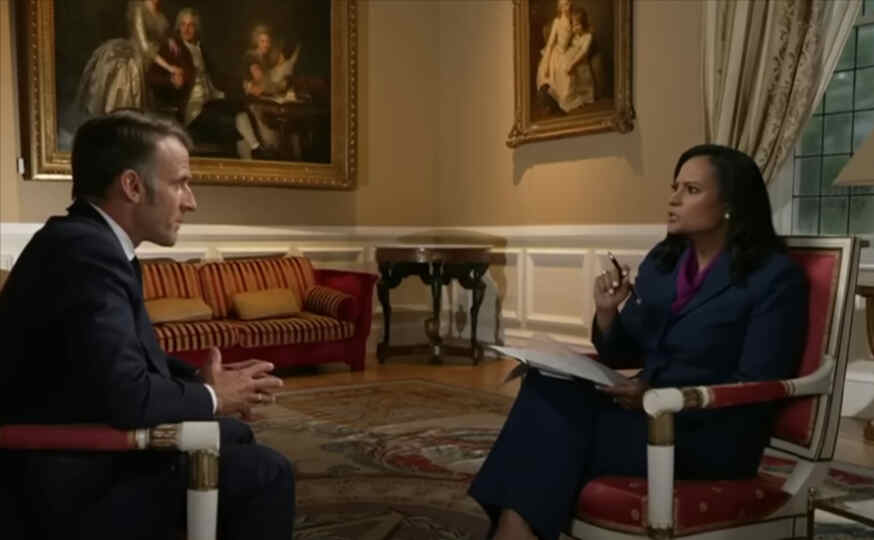
Read the full transcript of Meet the Press moderator Kristen Welker’s interview with French President Emmanuel Macron after his meeting with President Trump and other European leaders at the White House to discuss the war in Ukraine, August 19, 2025.
Opening Remarks
KRISTEN WELKER: President Macron, thank you for your time. We really appreciate it.
EMMANUEL MACRON: Thank you. I’m very happy to have the opportunity to speak with you.
KRISTEN WELKER: We are honored to have you here to speak with us, Mr. President. Take me inside your meeting at the White House today, those high stakes talks. Are you now closer to reaching a peace deal between Russia and Ukraine?
Progress Toward Peace Agreement
EMMANUEL MACRON: Look, I do hope, and I really believe it was an important meeting at the White House this 18th of August with President Zelenskyy, President Trump and a series of European leaders here. All of us, we want peace, all of us, from day one, and this is very important.
Second, all of us are very clear that we want to stop the killings as soon as possible. You can call it a ceasefire, you can call it a truce, an armistice, but we want to stop these killings.
Number three, all of us, we are clear about the fact that we want a robust and long standing peace, which means no peace without what we call security guarantees. Why? Because we want to preserve Ukraine from risk of new aggression after this peace. And we want to contain Russia as an aggressive power vis-à-vis the rest of Europe.
Here are our objectives and I think we did progress because we converged, all of us first, to work very actively on security guarantees. So from tomorrow we will work very actively. And you know, we launched in February this year this coalition of the willing. We have now 30 countries and we co-chair with the UK this coalition.
And this coalition will work very actively now with the United States of America, which is great news, in order to provide the day we have a peace agreement, these security guarantees together.
And second, we decided as well that a bilateral meeting between President Zelenskyy and President Putin will be organized. And this is the clear outcome of the discussion at the end of our meeting between President Trump and President Putin.
And this bilateral meeting will be followed by a trilateral meeting between President Zelenskyy, President Trump, President Putin and I propose as well as a follow up that we enlarge and have a multilateral meeting because the Europeans, probably the Turks as well, and some others have to be around the table because we don’t just speak about the security of Ukraine, but the security of the whole Europe.
So on all these points we had a clear convergence. And for me it was very important today, after the meeting between President Trump and President Putin in Alaska, to have this clear convergence of Europe and Ukraine and the US on these key outcomes.
Trump’s Confidence in Deal-Making
KRISTEN WELKER: I want to delve into all of those issues. I do have to ask you, President Trump was overheard on a microphone talking to you and he said, quote, “I think he wants to make a deal,” meaning Putin. “I think he wants to make a deal for me. You understand that as crazy as it sounds.” What went through your head when he said that to you?
EMMANUEL MACRON: I think if at the end of the day, if we have a deal which is compliant with this long standing and robust peace, this is great news. And your president indeed is very confident about the capacity he has to get this deal done, which is good news for all of us and can break these daily killings which are the responsibility of the Russian aggressors. So I think it’s great news.
My point, and this is why we’ve worked so hard during the past few months and we need this convergence, is to be sure that this deal is not detrimental to Ukraine and Europe and all of us. We want a deal and we want a peace deal, but we want to make sure that this peace and so this deal will be something which will allow the Ukrainians to recover the country and live in peace, to be sure, the day after this peace deal that they will have sufficient deterrence power not to be attacked again, and to be sure for the Europeans that they will live in peace and security.
So this is the nature of the peace which will be now the core of our work. But I think this is great news. And indeed, your president is very confident about his capacity to get this deal done with President Putin. And it’s great.
The Need for a Ceasefire
KRISTEN WELKER: Let’s talk about the issues. You were very firm. You still think a ceasefire is necessary? President Trump, on his way to Alaska, said that he wanted there to be a ceasefire agreement. Otherwise, he said there would be very severe consequences. Do you think a ceasefire is still possible?
EMMANUEL MACRON: I do hope. Let’s call it once again truce or ceasefire. But we need to stop the killings. First, for humanitarian reasons. Second, because if we want sincere, reasonable, comprehensive talks in order to build a peace, you cannot organize this discussion in the middle of the bombs.
Look, today we were with President Zelensky. President Trump called President Putin at the end of our meeting and we meet again right after this call. In the meantime, the Russian army organized a series of strikes on civilians in Ukraine. So it’s impossible for a Ukrainian president and Ukrainian officials to have talks about peace as their country is being destroyed and other civilians are being killed.
KRISTEN WELKER: Did all of the European leaders press President Trump on that point today and insist that he continued to apply pressure to Putin for a ceasefire?
EMMANUEL MACRON: I will be very clear on that.
President Trump was the first one to propose a ceasefire in February. In March, President Zelensky accepted the unconditional ceasefire in Doha. The one who always refused a ceasefire has been President Putin.
Pressure and Sanctions
KRISTEN WELKER: So should President Trump impose sanctions on President Putin?
EMMANUEL MACRON: Now, President Trump was very clear on the fact that after Alaska, his perspective is not just to have a ceasefire, but a peace deal, which is much more comprehensive. So it could be good news. But it’s clear that a peace deal will not be written overnight. It will take time, probably a few days, few weeks. And during this period of time, we need a truce. This is why I call it a truce and not a ceasefire, if we want to use different words. But we have to stop the killing.
So we all agree with your president that we have to increase the pressure to stop the killings and to launch a process to have a full fledged peace agreement. So these are our objectives.
KRISTEN WELKER: Can he apply pressure to Putin without—
EMMANUEL MACRON: I’m very much in favor of the fact that if, at the end of the day, there is no serious progress during the bilateral, or if there is a refusal of the trilateral meeting and or if the Russians don’t comply with this approach, yes, we have to increase the sanctions, secondary and primary sanctions, in order to increase the pressure on the Russians to do so.
And sometimes I’m very shocked by the fact that a lot of people can present something as just a war between two sides. There is an aggressor, which is Russia. There is a country which decided to kill people to steal children and will refuse to ceasefire and peace. So we cannot just create an equivalent situation between Ukraine and Russia.
Security Guarantees Framework
KRISTEN WELKER: Let me ask you about the discussion over security guarantees. What exactly did you agree to as it relates to security guarantees? Does that mean European troops and does that mean U.S. troops?
EMMANUEL MACRON: Look, I think for me, it’s a very important progress of the past few days that your president expressed the clear commitment of the US to be part of the security guarantees. It’s brand new.
And last February, when I took the responsibility to gather a series of European leaders with President Zelensky in Paris, and we followed up in London and we created this coalition of the willing. And it was a reaction to the feeling we had that we could see a temptation to go to a rapid peace, but without any guarantee for Ukraine. And we know what it means. It was Georgia 2008, but it was as well Crimea 2014.
And there is full certainty that if you make any peace deal without security guarantee, Russia will never respect its words, will never comply with its own commitments. So it’s for us totally critical. And this is an essential part of any deal for Ukraine and for the Europeans. This is for our own security.
So this is a very important progress of the past few days that the US now is willing to be part of these security guarantees. We worked with the coalition of the willing, which is co-chaired by UK and France and we have a very clear view of the content of such a security guarantee.
# First Pillar: Ukrainian Army
The first pillar is the Ukrainian army. The first security guarantee for Ukraine and Europe is to have an important Ukrainian army which will resist to any new aggression and which will create a deterrence effect vis-à-vis the attempt to attack Ukraine again. So we worked on the format of this army and in fact what we want is no limitation in terms of number of soldiers, ammunition, equipment and so on. And who is ready to help the Ukrainians on training equipment, Patriot system, and new generation system aircraft and so on to have this solid Ukrainian army.
# Second Pillar: Allied Support
The second pillar is to be sure that in the air and sea, on land, we have support from all the different key partners of the coalition of the willing to come and to support the Ukrainian forces. Not to be a substitute and the obsession and the first priority is not to have our boots on the ground, but to be sure that we have regular operations which are a sort of guarantee or strategic signal that it’s not just a piece of paper that the day they are attacked we will be here.
Because this piece of paper, we had it in the past, it was called the Budapest agreement and it didn’t work. So we want to create a clear strategic signal of our support to the Ukrainian army and some of the key countries part of the coalition of the willing already committed to do it. UK, France, Turkey for instance, which has a very important role in sea and series of other countries.
So now from tomorrow we will start to work with the US, all the members of the coalition of the willing, these 30 countries from Canada to Japan, Australia and a lot of Europeans, in order to clearly go to the detail and say who is ready to do what. And this first phase is very important and should be finalized before the trilateral meeting because these security guarantees are the ones to put Ukraine in a situation to negotiate.
Territory and Sovereignty
KRISTEN WELKER: And I’m getting a wrap. Let me just ask you two very lightning round questions. As you have said, Russia is the aggressor here and yet President Trump has talked about the possibility of land swaps, there are reports that President Putin wants to keep all of the territory that he’s illegally occupied and even more the entire Donbass region. Is that a non-starter? And is the only solution for Ukraine to give some of the territory to Russia?
EMMANUEL MACRON: Look, I don’t see any swap in the proposal of the Russians except a swap in comparison with what they wanted at the beginning. But let me be clear. On territory, they got a lot of territories after the first phase of the war between February and summer 2022. But because the Ukrainian army and the Ukrainian people did organize themselves very impressively, because we organized unprecedented support, they managed to push them back at the end of the second semester of 2022.
And if you take the situation between November 2022 and now, more than 1,000 days of war, the Russian army took less than 1% of the Ukrainian territory. So I want everybody listening to us and watching your program to be aware of the fact that the Russians, they are not performing well there.
Three and a half years ago they launched a special operations which was supposed to last three weeks. And during the past 1,000 days they took less than 1% of the Ukrainian territory. So all those who are saying the Ukrainians are lost, they will lose, it’s total fake news.
Now when we speak about territory, this is for the Ukrainian President and the Ukrainian people to discuss about it. It’s not my job and it’s absolutely unacceptable to have all the leaders discussing about that. And your president was very clear before Alaska as well. Why? Because it’s about sovereignty.
And third, the day we start accepting the recognition of territories being taken by force, this is just the end of international order. How do you want us collectively to be credible in other places in Europe, in Africa? How do you want us to keep having debate on Taiwan?
Do you believe once again, if we recognize part of Donbass or Crimea and you say okay, because this is a nuclear power, it’s okay, there is no more international order. This is not compliant with the UN Charter. And the day after our collective credibility, the US Europeans, all these permanent members of the Security Council will be totally zero vis-à-vis all the others. We think we are the guarantee in last resort of this international order.
Final Thoughts on Ukraine Peace Process
KRISTEN WELKER: I’m getting a wrap. But very last question. In a few seconds we are going to see this meeting between President Putin and President Zelensky. What is your level of optimism as we sit here today that they can break through this logjam?
EMMANUEL MACRON: First, I think the optimism of your president is to be taken seriously. So if he considers he can get a deal done, this is great news, and we have to do whatever we can to have a great deal being fixed, concluded. But a great deal is a deal with security guarantees and a robust peace.
As far as I’m concerned, when I look at the situation and the facts, I don’t see President Putin very willing to get peace now. But perhaps I’m too pessimistic. So I think it’s very important to launch this process. I think it’s very important we build the security guarantees. This is a game changer for Ukraine and for the European security.
And I think we have to launch a process of this bilateral meeting, this trilateral meeting, and this multilateral meeting. But I think at a point of time, probably we will have to increase the pressure on Russia to be sure they want peace, because as long as President Putin and his people will consider they can win this war and get a better result by force, they will not negotiate. This is my feeling and my conviction.
So it’s important to remain united. This is a key message of the meeting today, to be lucid about the situation, to be committed, and we are, and I will do my best, and France will do its best to have a positive bilateral and trilateral meeting and to deliver the results following these lines. But we are ready as well to step up sanctions and tariffs in order to increase the pressure. And I think it will be very important in case of failure of such a process, that your president will take the baton and increase the pressure.
KRISTEN WELKER: President Macron, thank you so very much for your time tonight.
EMMANUEL MACRON: Thank you.
KRISTEN WELKER: We really appreciate it.
Closing Remarks on Global Security
EMMANUEL MACRON: This is my pleasure. And thank you very much. It’s an important issue, and if I may just find a word, I think what’s happening in Ukraine is extremely important for Ukrainian people, obviously, but for the whole security of Europe, because we speak about containing a nuclear power which decided just not to respect international borders anymore.
And I think it’s very important for your country because it’s a matter of credibility. The way we will behave in Ukraine will be a test for our collective credibility in the rest of the world. So this is why I’m here today.
KRISTEN WELKER: Thank you, President Macron. I have many more questions, but I will leave it there because I want to respect your time.
EMMANUEL MACRON: Thank you.
Related Posts